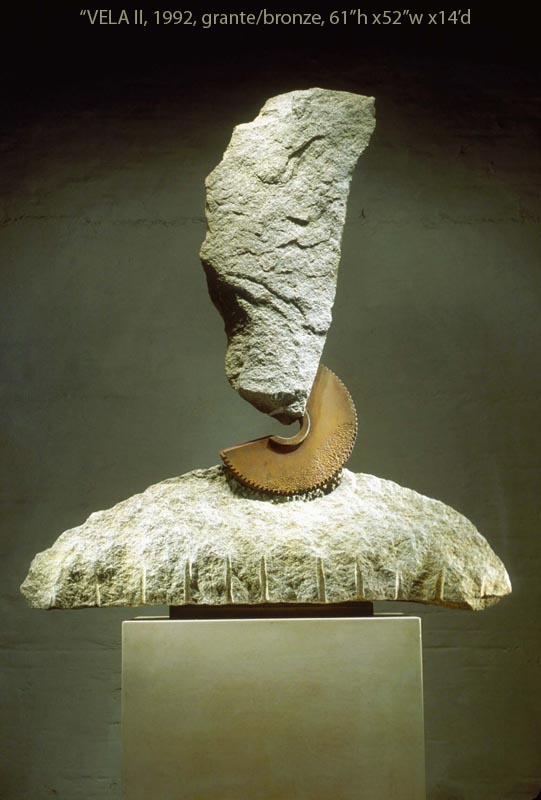
VELA II, 1992, Vermont granite and bronze, 61"h x52"w x14'd
private collection
Vela: Latin for sail
|
“ Vela II ” (1992), a Vermont granite and steel sculpture by John Van Alstine, draws on the image of a sail—an object whose very form is shaped by the invisible force of wind. Van Alstine contrasts this idea of responsiveness and flux with the upper granite element, a material we instinctively understand as ancient, heavy, and enduring. By positioning this mass in a way that suggests lift and tension, he creates a striking visual paradox: stone appears to behave as if it were as supple and wind-driven as cloth.
This interplay between the ephemeral and the immutable aligns closely with Van Alstine's broader sculptural aims. Throughout his career, he has sought to animate dense, earthbound materials—granite, slate, and steel—into configurations that suggest motion, suspension, and balance. In “Vela II,” steel functions as both armature and vector, subtly directing the composition upward and outward, while the granite becomes unexpectedly responsive, as if caught mid-billow. The sculpture reads as a moment of arrested movement, where opposing forces—weight and lift, permanence and change—are held in dynamic equilibrium.
Like many of his works, “Vela II” also reflects an underlying engagement with navigation and orientation. The sail, as both tool and symbol, implies direction, choice, and the harnessing of natural forces—ideas that resonate with Van Alstine's recurring interest in charting one's course through life. Here, that metaphor is distilled into material terms: the artist gives form to the invisible, allowing wind, motion, and energy to be felt through the careful orchestration of stone and steel. The result is a sculpture that embodies his enduring pursuit—transforming solidity into something that seems, if only momentarily, to move. |