 Image 1 of 2
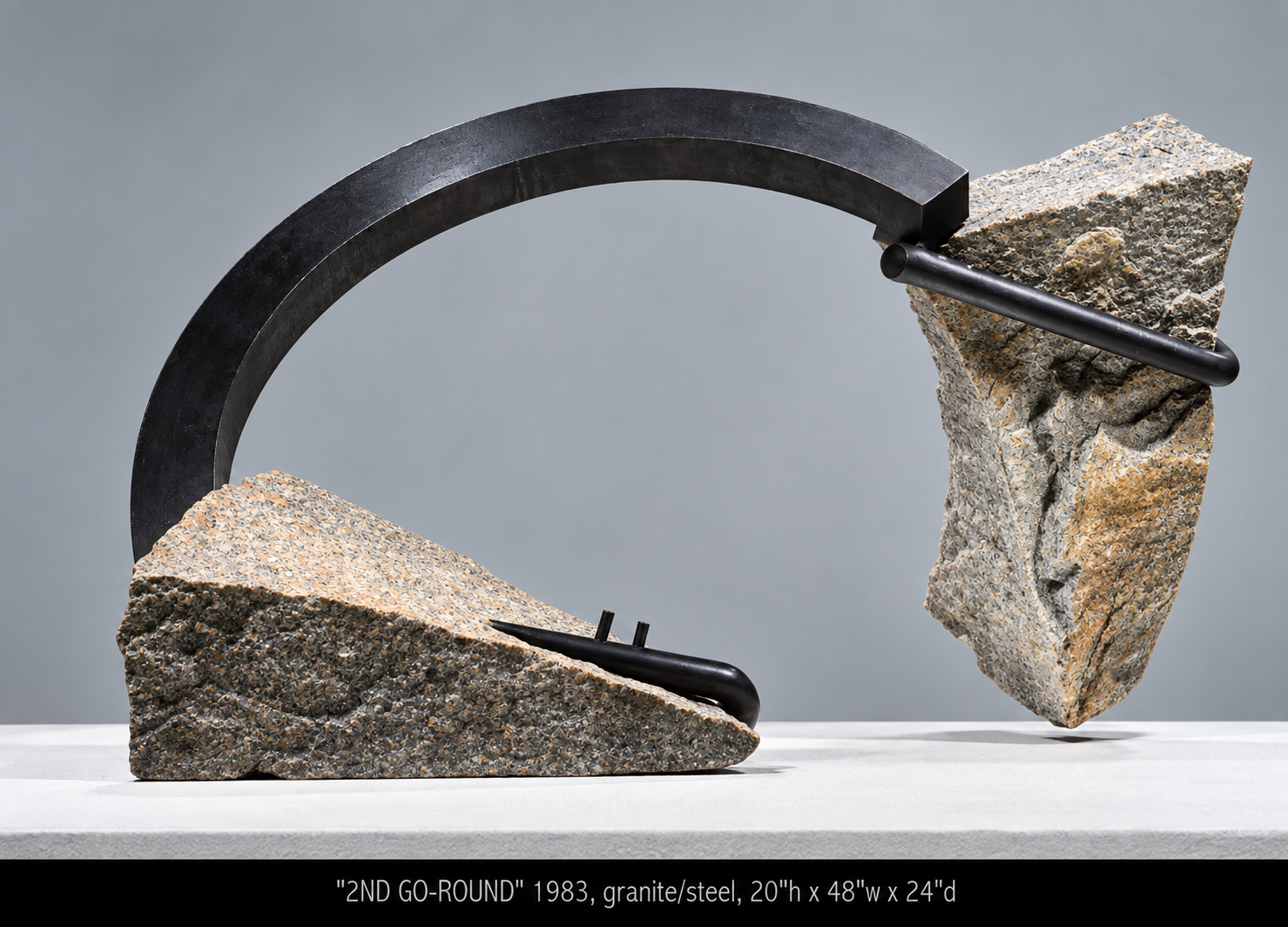 Image 2 of 2
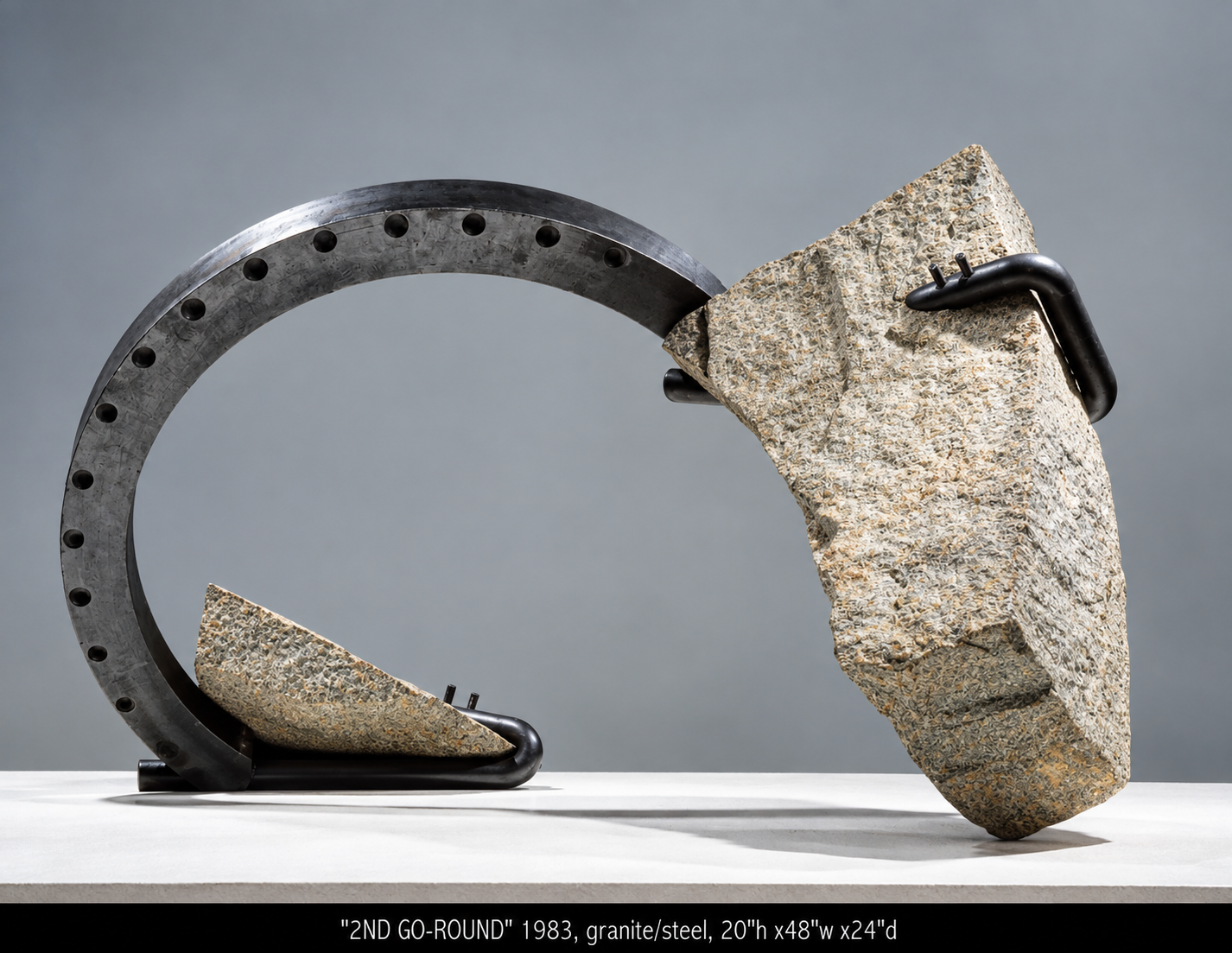
1983. Granite, steel. Dimensions: 20 × 48 × 24 in (51 × 122 × 61 cm).
Private collection - Washington, DC
2nd Go-Round continues the ideas introduced in 1st Go-Round, using a broad arc of steel to connect two found granite forms. Here the sweeping curve becomes more dominant, lifting one stone almost entirely off the ground and creating a strong sense of circular movement and arrested motion. The visible forged-steel pins and attachments remain important—not only structurally, but as an acknowledgment and celebration of how the sculpture is assembled. The series marks my movement away from the stricter structural principles of the earlier tensegrity, or Brute Series, toward a more fluid and associative sculptural language.
The title Go-Round grew partly from my years in Wyoming and the language of rodeo, where a contestant may have more than one “go-round” at an event. I liked the term because it also describes the circular movement of the sculpture and, more importantly, the idea that a sculptural problem is rarely exhausted in a single work. Each piece becomes another attempt—or “go-round”—at an evolving idea. This exploration soon expanded into the monumental Big Go-Round of 1983 and, conceptually, anticipated my later recurring use of the circle and stone in the Sisyphean Circle Series.
1983. Granite, steel. Dimensions: 20 × 48 × 24 in (51 × 122 × 61 cm).
Private collection - Washington, DC
2nd Go-Round continues the ideas introduced in 1st Go-Round, using a broad arc of steel to connect two found granite forms. Here the sweeping curve becomes more dominant, lifting one stone almost entirely off the ground and creating a strong sense of circular movement and arrested motion. The visible forged-steel pins and attachments remain important—not only structurally, but as an acknowledgment and celebration of how the sculpture is assembled. The series marks my movement away from the stricter structural principles of the earlier tensegrity, or Brute Series, toward a more fluid and associative sculptural language.
The title Go-Round grew partly from my years in Wyoming and the language of rodeo, where a contestant may have more than one “go-round” at an event. I liked the term because it also describes the circular movement of the sculpture and, more importantly, the idea that a sculptural problem is rarely exhausted in a single work. Each piece becomes another attempt—or “go-round”—at an evolving idea. This exploration soon expanded into the monumental Big Go-Round of 1983 and, conceptually, anticipated my later recurring use of the circle and stone in the Sisyphean Circle Series.