The works shown here are available for acquisition. If a piece speaks to you, please don’t hesitate to get in touch — I’d be glad to tell you more about it.
2020’s
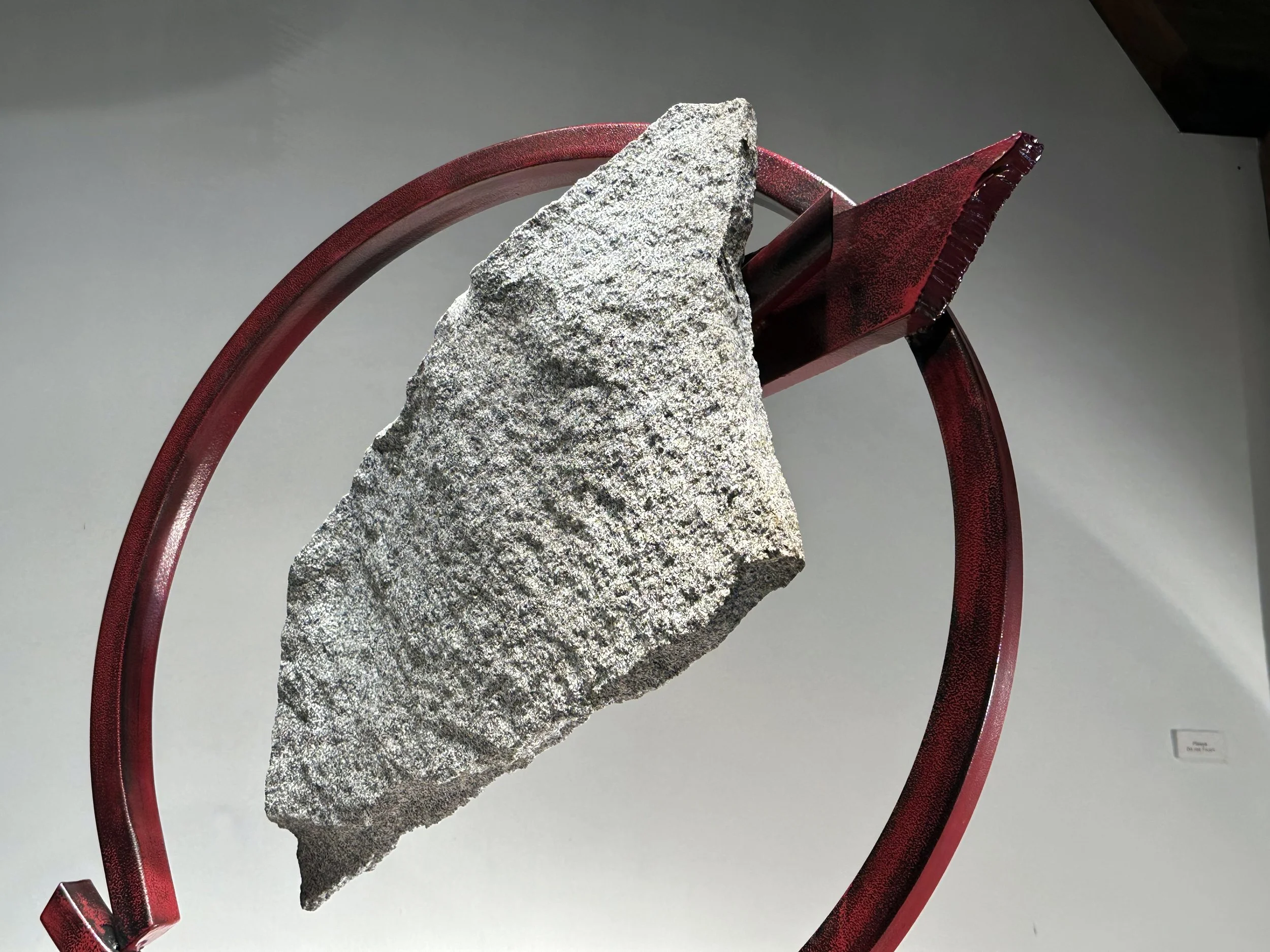
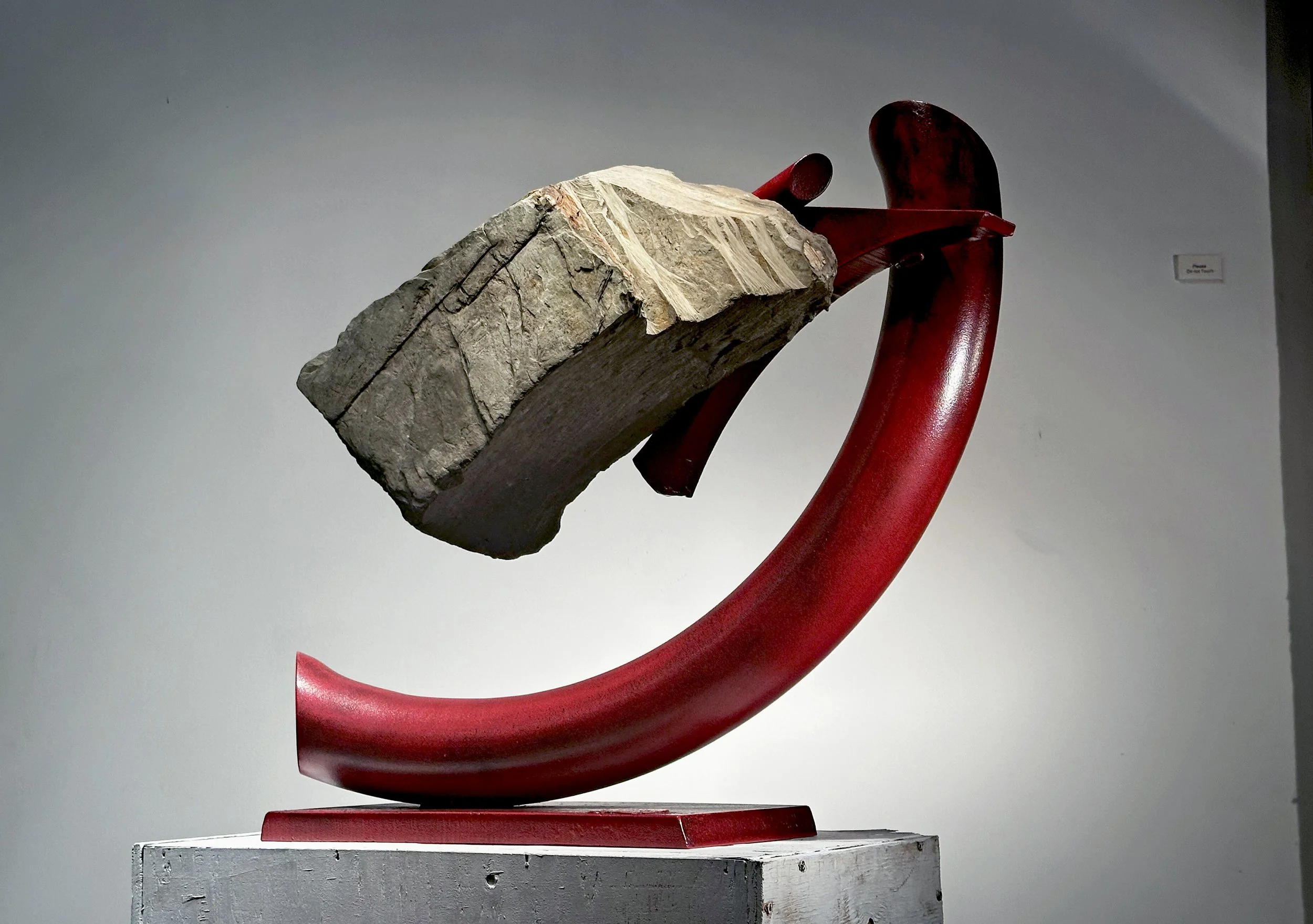
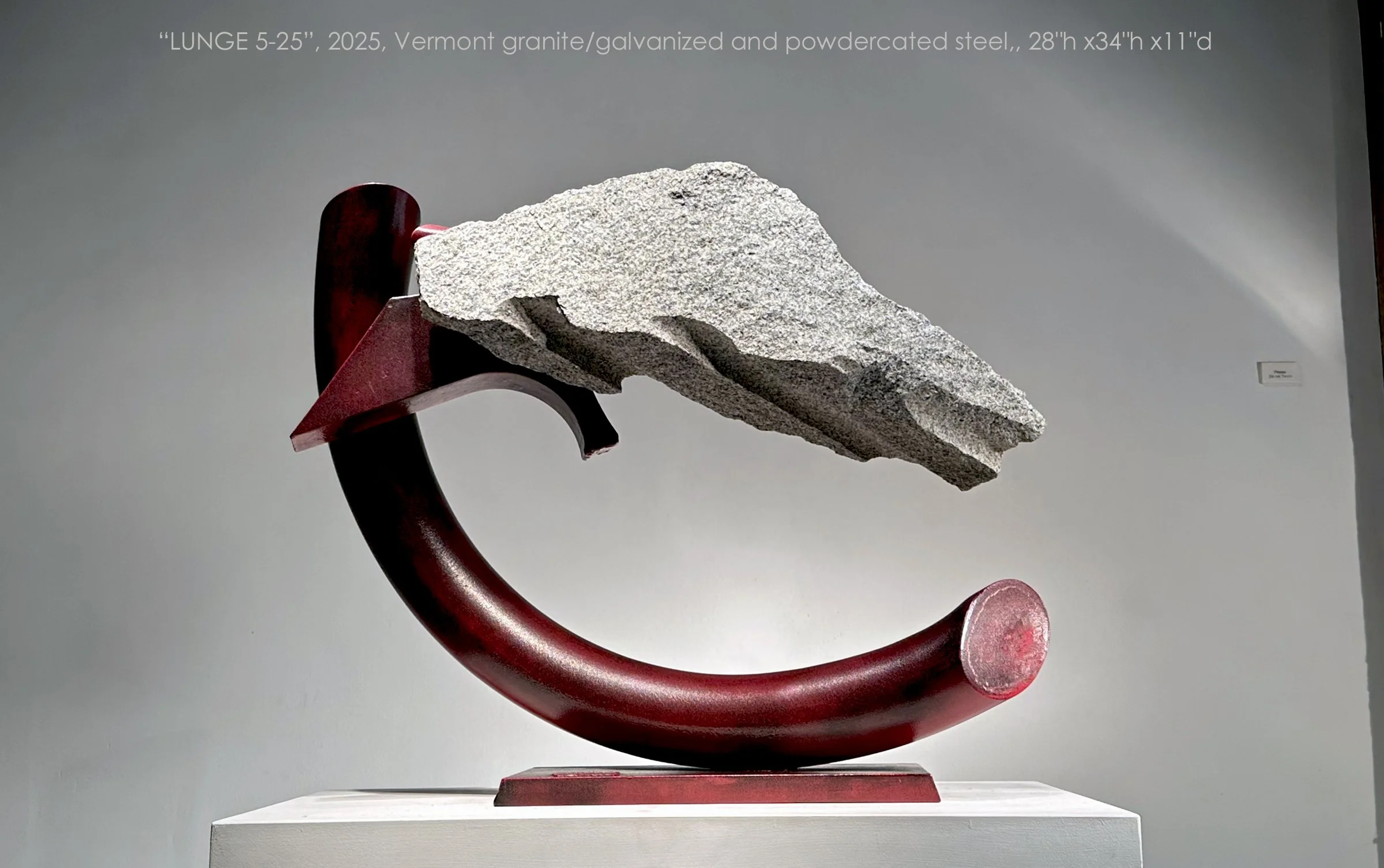
May 2025. Vermont slate, galvanized and powder-coated steel. Dimensions: 27.5 × 35 × 11 in (70 × 89 × 28 cm).
Lunge/Slate 5-25 explores implied movement and gesture through an abstract sculptural language. The title Lunge suggests a sudden extension of the body—a reaching, thrusting, or shifting of weight that gives the sculpture a sense of physical momentum and directed energy.
While not figurative in a literal sense, the work draws on my interest in the expressiveness of the human figure. Its balance, tension, and spatial gesture suggest a body caught in motion, allowing the sculpture to convey a human presence through posture and movement rather than recognizable form.
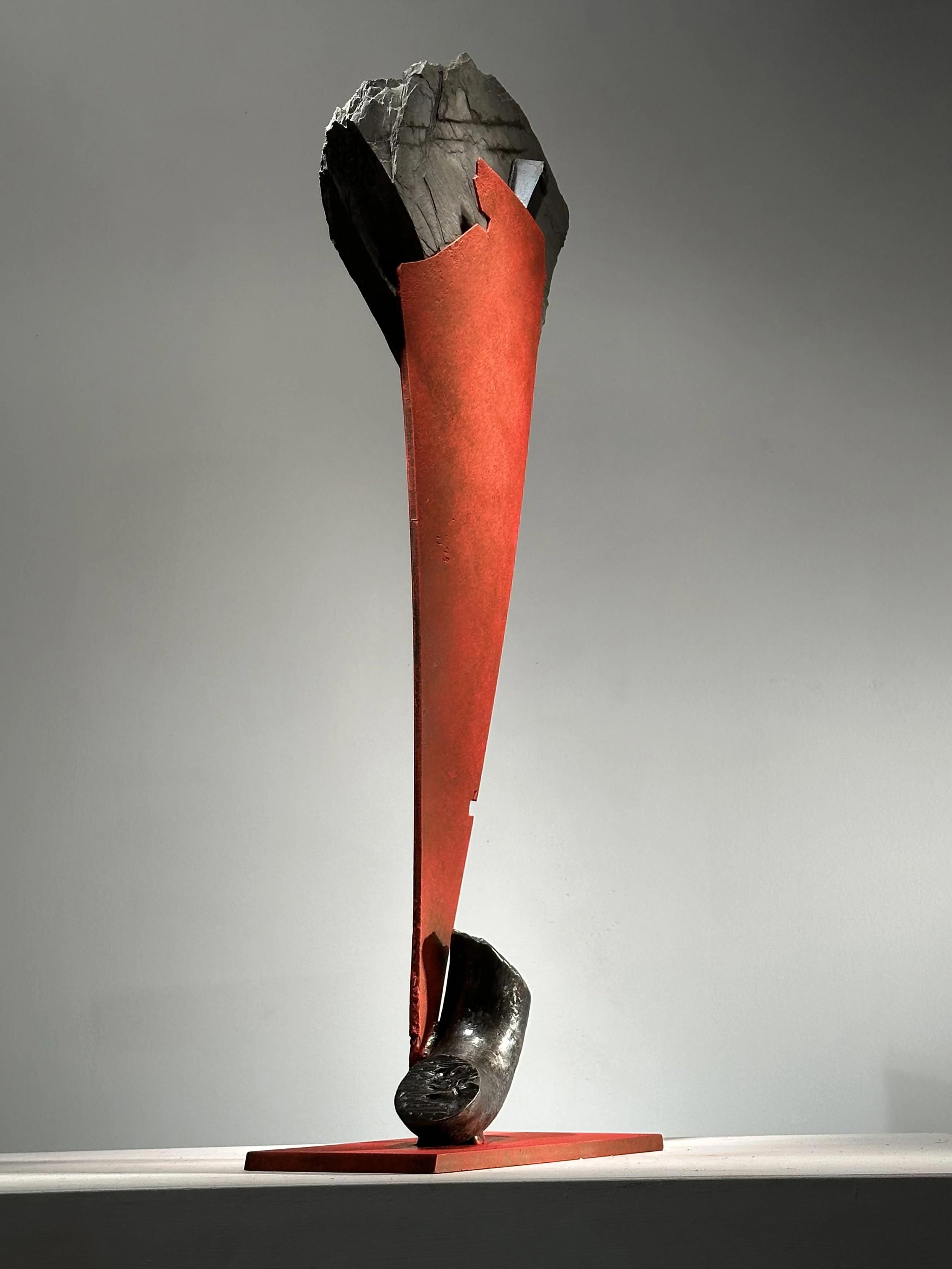
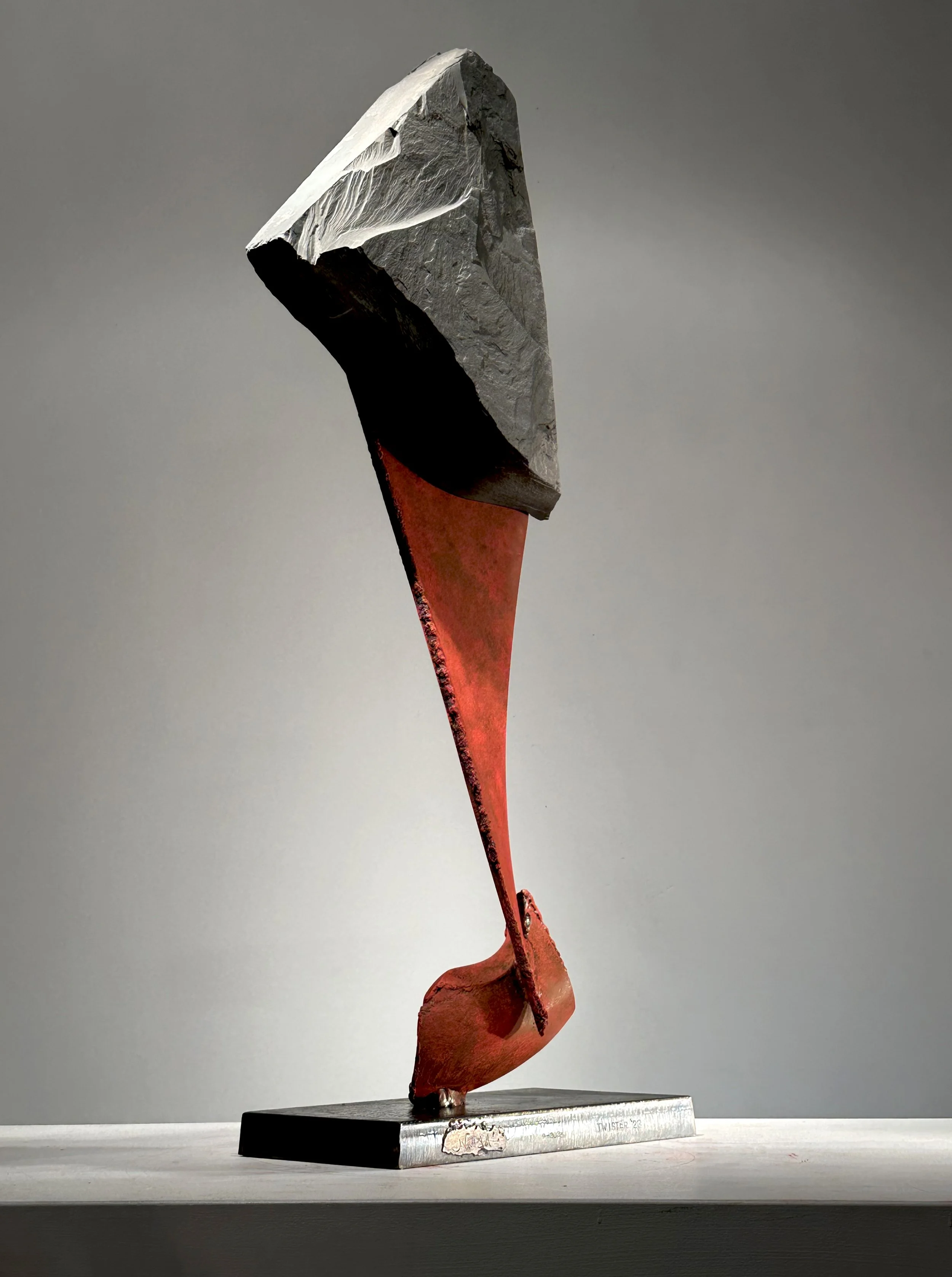
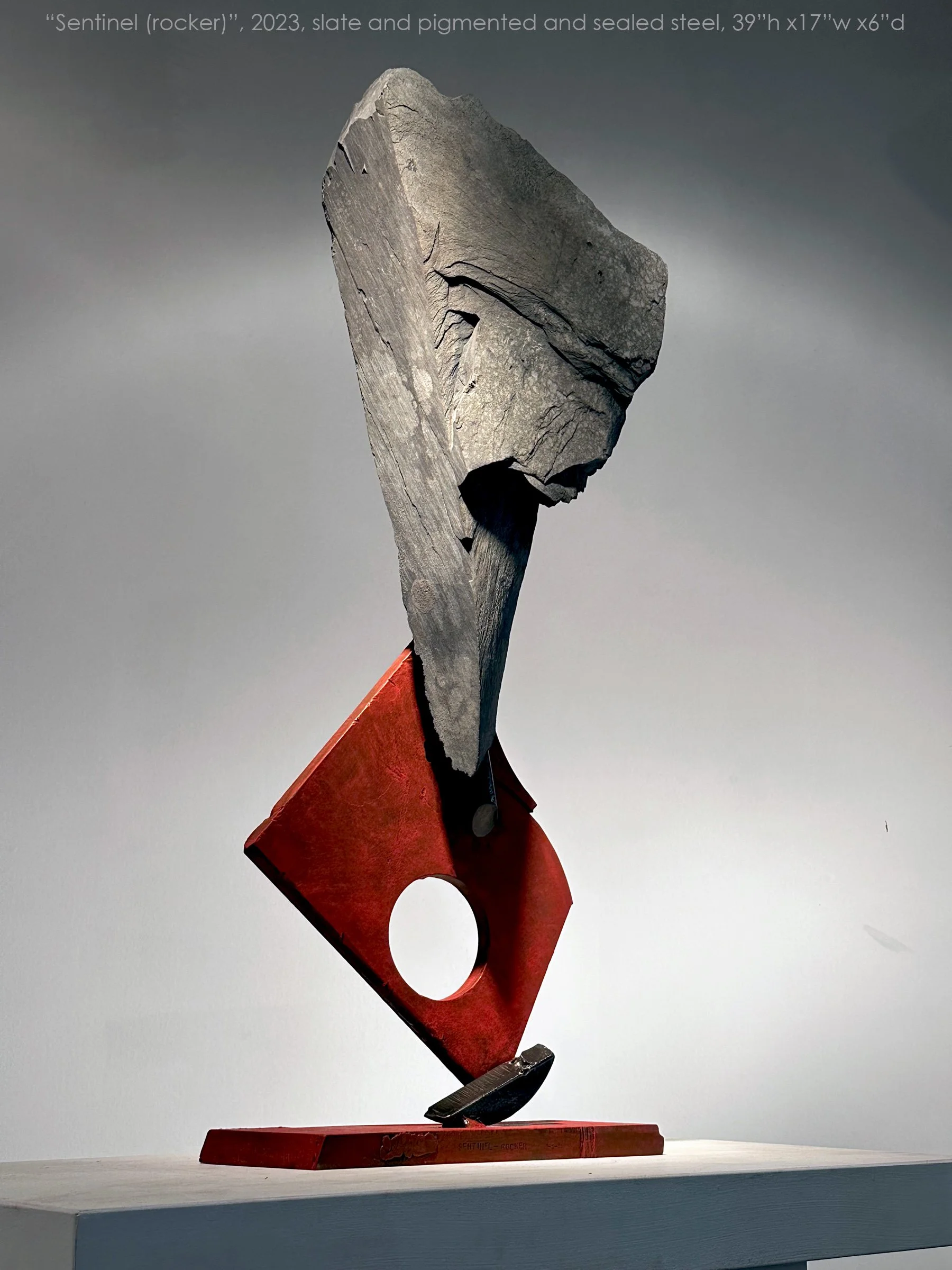
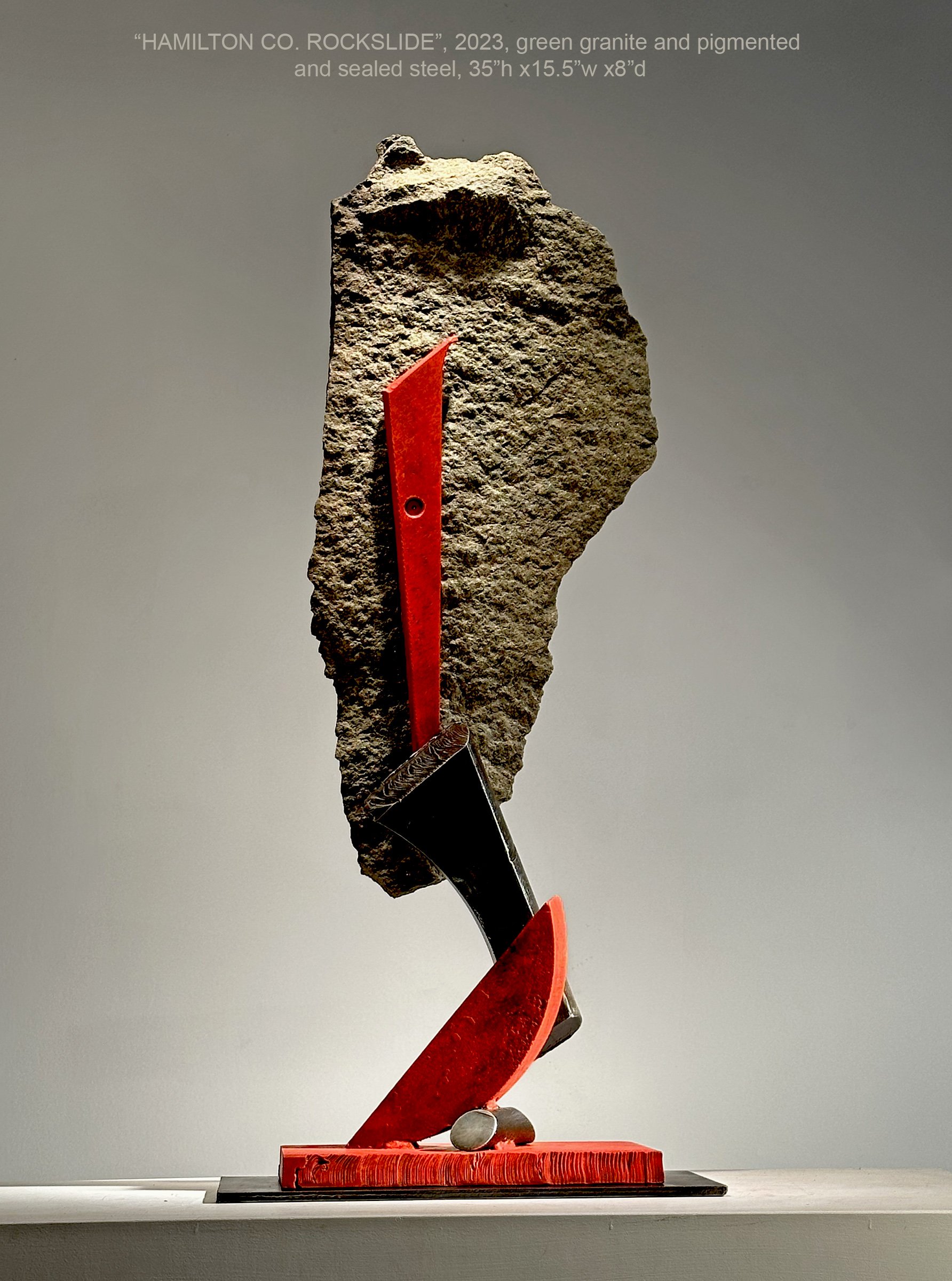
May 2023. Green Hamilton county granite, pigmented and sealed steel. Dimensions: 35 × 15.5 × 8 in (89 × 39 × 20 cm).
Stone has been a constant in John Van Alstine’s work for more than forty years. He often focuses on the material’s inherent qualities—especially its weight—choreographing stone and steel to create moments of visual and physical tension.
Landscape, particularly the mountain terrain where the artist has spent much of his life, has also been a powerful influence. In the Rockslide series, the shape and placement of stone, and its dynamic interaction with steel, evoke the drama of a familiar alpine event: a rock caught in mid-fall.
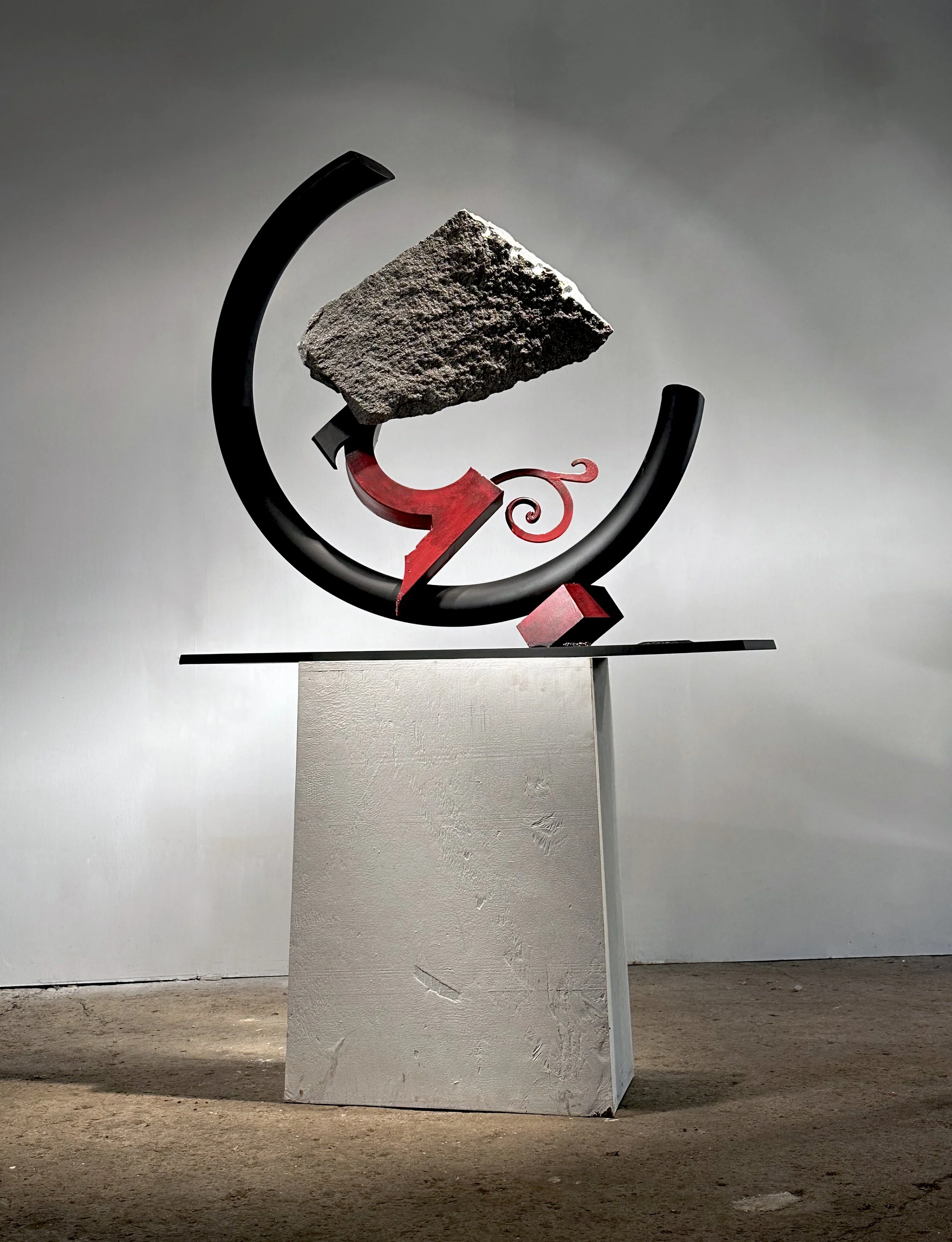
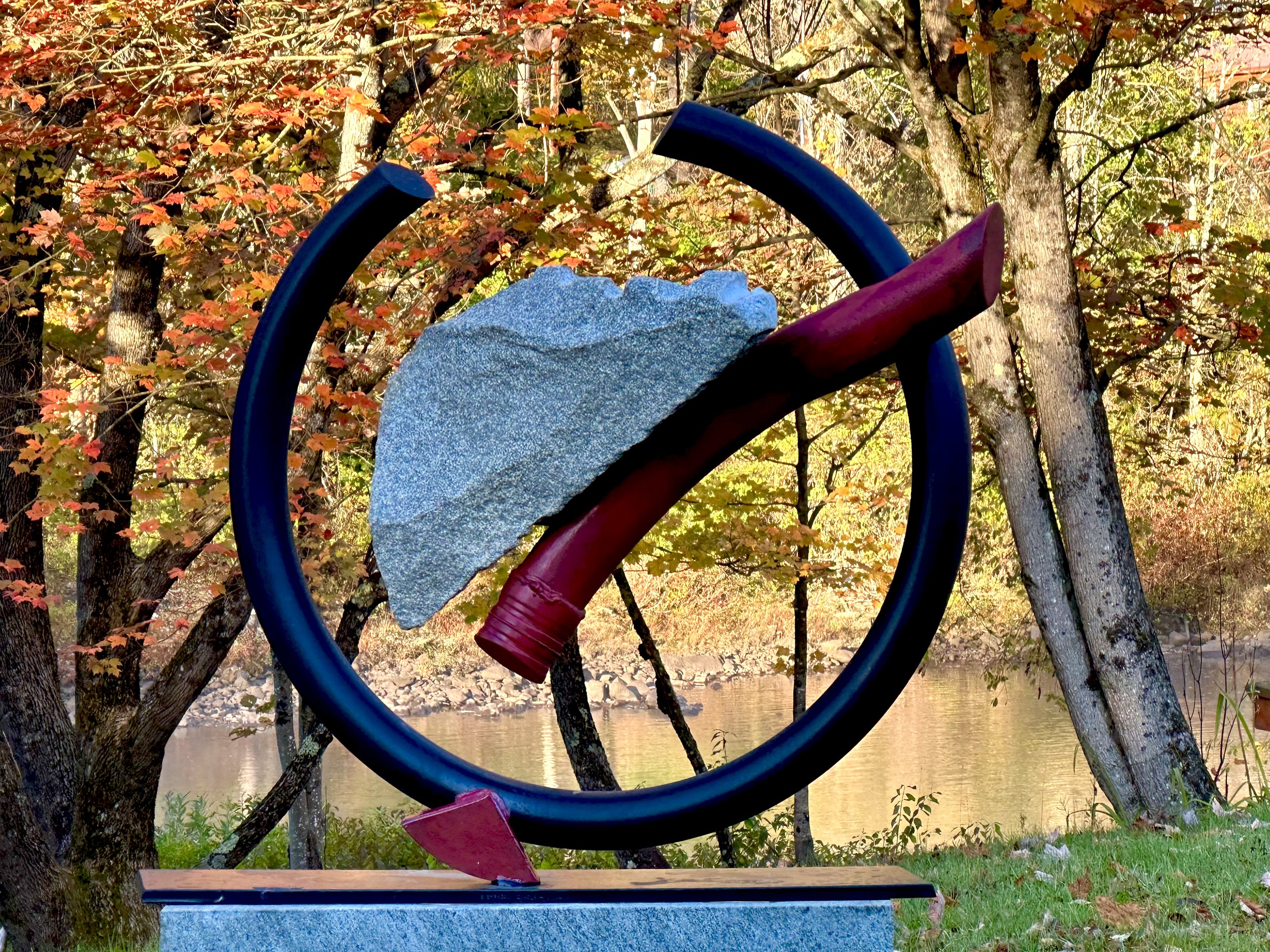
May 2023. Granite, galvanized and powder coated steel. Dimensions: 42 × 46 × 11 in (107 × 117 × 28 cm).
Available.
The Sisyphean Series
The Greek myth of Sisyphus, condemned to endlessly push a boulder uphill, has inspired more than 250 of my sculptures. Rather than seeing the myth as a symbol of futility, I share philosopher Albert Camus’s more positive interpretation—that meaning and fulfillment can be found in the struggle itself. In many ways, I see Sisyphus as autobiographical, reflecting my lifelong pursuit as an artist, confronting challenges, taking risks, and finding purpose in the act of creation.
My Sisyphean works bring stone and steel together in precarious yet stable arrangements, often incorporating circular forms suggesting perpetual motion. For me, they are metaphors for the creative process—an ongoing cycle of experimentation, discovery, setbacks, and renewal. Each completed sculpture is both an achievement and a starting point, celebrating the journey rather than simply the destination
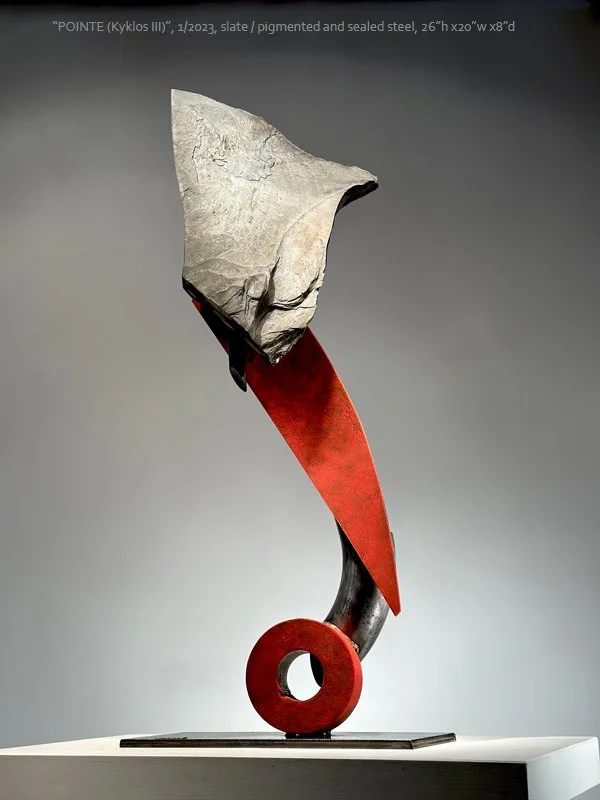
January 2023. Slate, pigmented and sealed steel. Dimensions: 46 x 20 x 8 in.
Available.
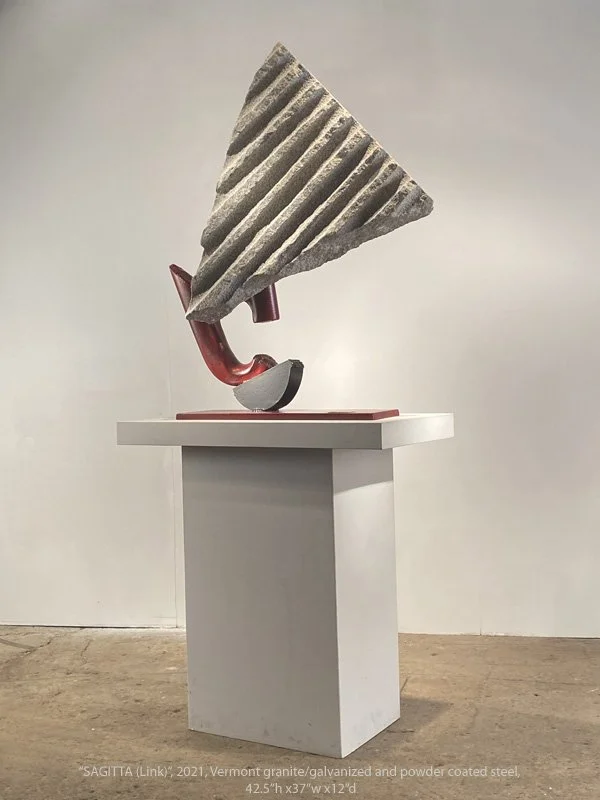
November 2021. Granite, galvanized and powder coated steel. Dimensions: 42.5 × 37 × 12 in (108 × 94 × 30 cm).
SAGITTA: Latin for arrow
Constellation: A dim but distinctive constellation in the northern sky, representing an arrow
and included in the original 48 constellations listed by Ptolemy. It is not to be confused with the larger constellation Sagittarius.
Mythology: The constellation is associated with the arrow of Hercules, the arrow of Apollo, or the arrow of Eros (Cupid).

March 2021. Bronze, Vermont slate. Dimensions: 17 × 33 × 8 in (43 × 84 × 20 cm).
Available.
Implement (Cornu) explores the relationship between human invention and the natural world. Throughout John Van Alstine's work, tools have symbolized human ingenuity and labor, while animal horns represent nature's elegant solutions for defense, survival, and strength. Here, these two forms merge, revealing their shared purpose and surprising visual kinship.
Rather than opposing nature and technology, Implement (Cornu) suggests they are part of the same continuum. The sweeping cast bronze form echoes the organic growth of a horn, while the granite anchors the sculpture in the enduring landscape from which both culture and nature arise. The work reflects Van Alstine's enduring fascination with the dialogue between the invented and the evolved.
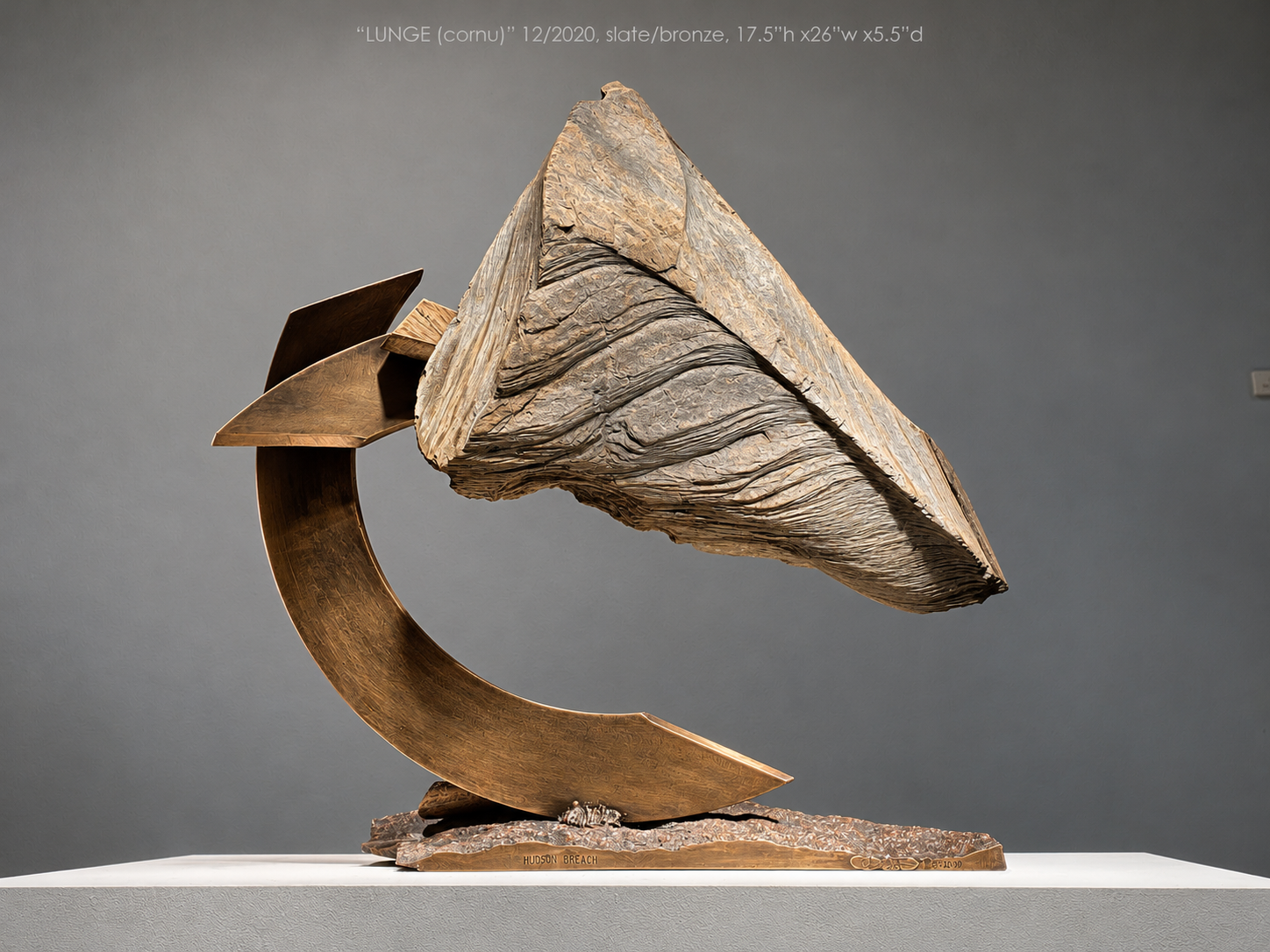
December 2020. Bronze, slate. Dimensions: 25.5 × 26 × 9 in (65 × 66 × 23 cm). Private Collection.
A humpback whale surfaces near the Statue of Liberty in this photo taken from a boat on New York Harbor. (Source: Bjoern Kils via Reuters) In a rare occurrence, a massive humpback whale has been spotted several times this week in the Hudson River near midtown Manhattan.
The whale was caught on camera in front of the Statue of Liberty and other New York landmarks as it paid a visit to the city’s harbour.
SOLD
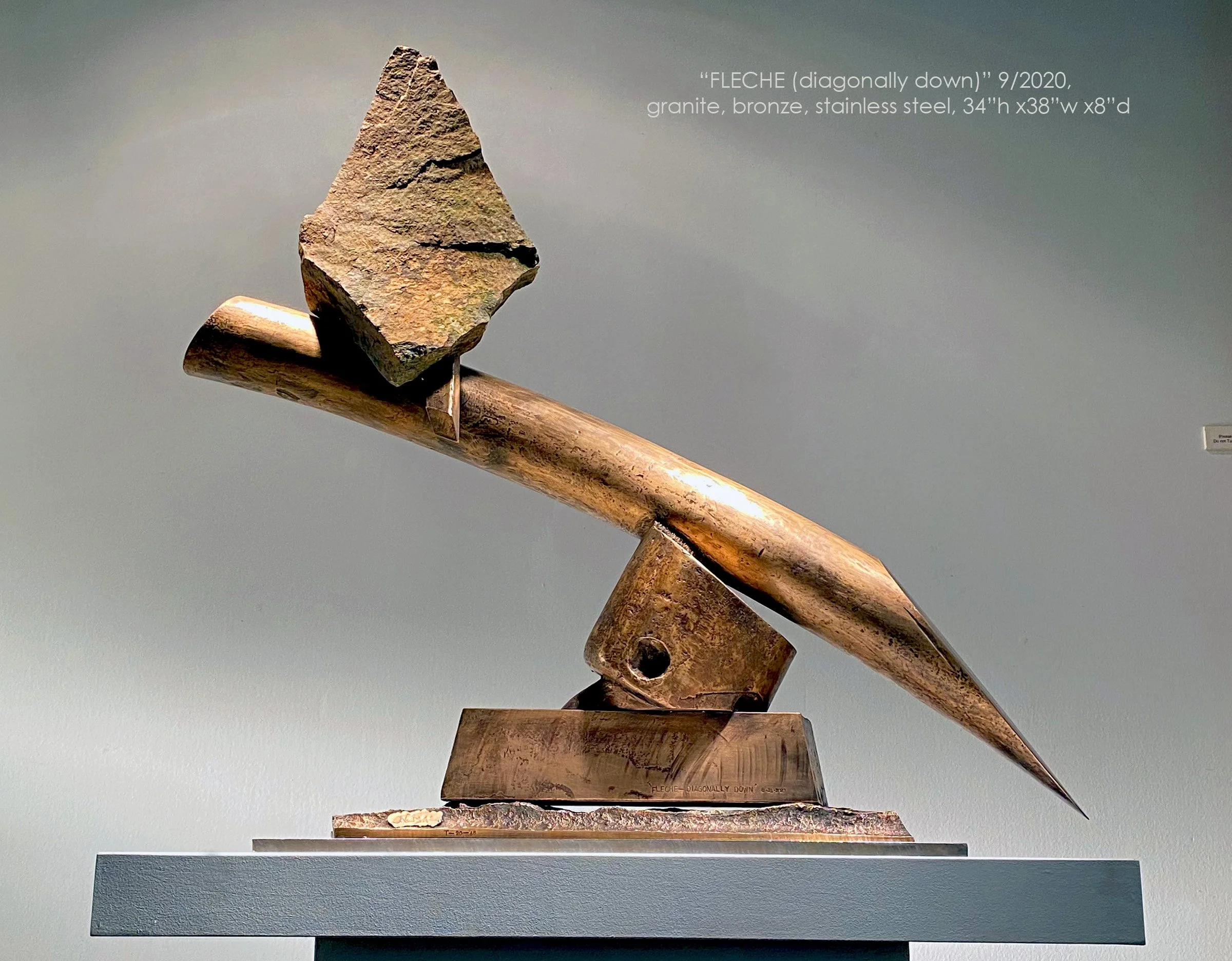
August 2020. Bronze, stainless steel, granite. Dimensions: 34 × 38 × 8 in (86 × 97 × 20 cm). Private Collection.
flèche
Pronunciation: 'flesh, flèche
Function: noun
Etymology: French, literally, arrow, from Old French fleche, of Germanic origin; akin to Middle Dutch vlieke arrow, Old English flEogan to fly
: SPIRE ; especially : a slender spire above the intersection of the nave and transepts of a church
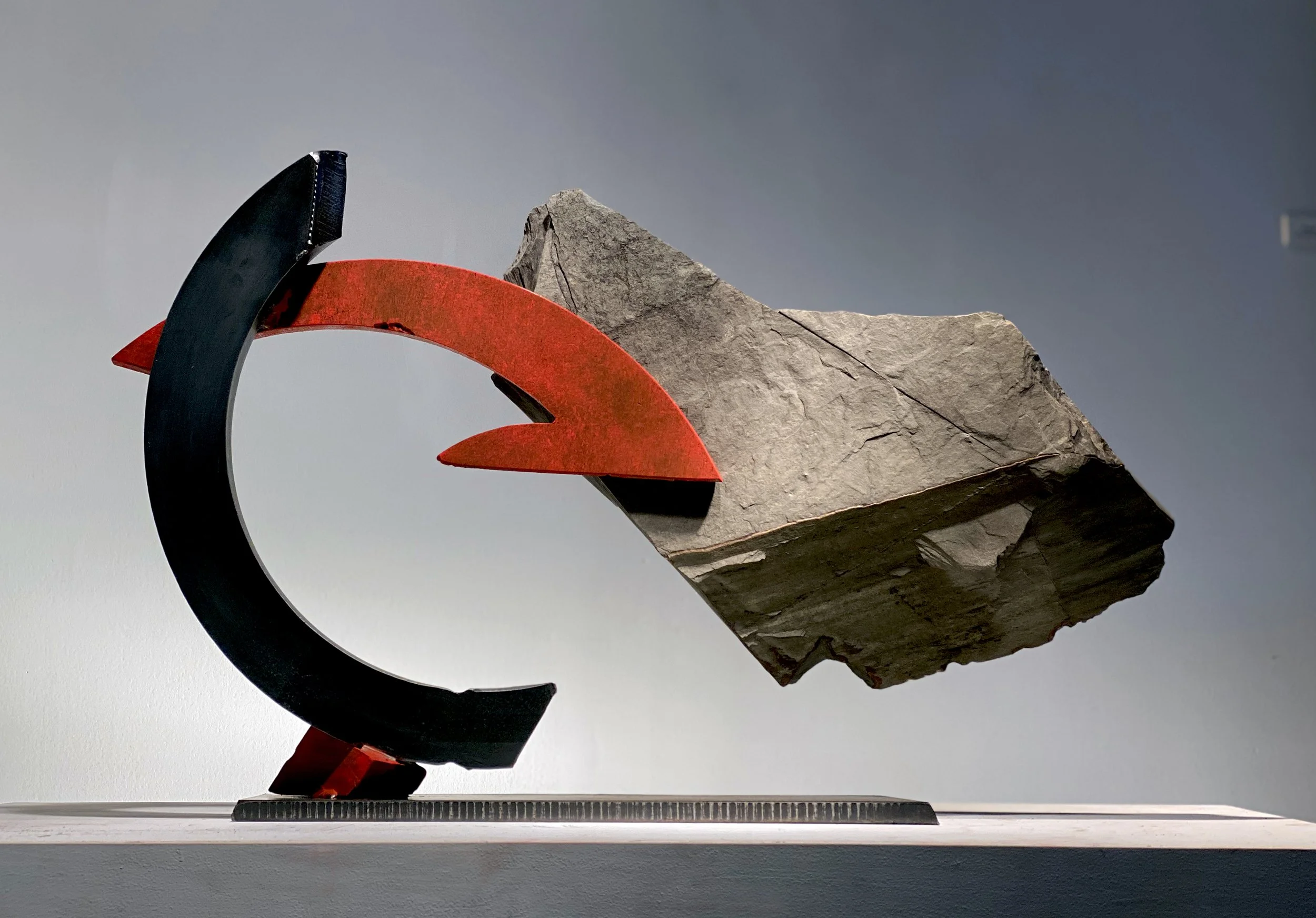
March 2020. Slate, pigmented and sealed steel. Dimensions: 17 × 27 × 5 in (43 × 69 × 13 cm).
Available.
The Lunge series explores implied movement and gesture through an abstract sculptural language. The title Lunge suggests a sudden extension of the body—a reaching, thrusting, or shifting of weight that gives the sculpture a sense of physical momentum and directed energy.
While not figurative in a literal sense, the work draws on my interest in the expressiveness of the human figure. Its balance, tension, and spatial gesture suggest a body caught in motion, allowing the sculpture to convey a human presence through posture and movement rather than recognizable form.
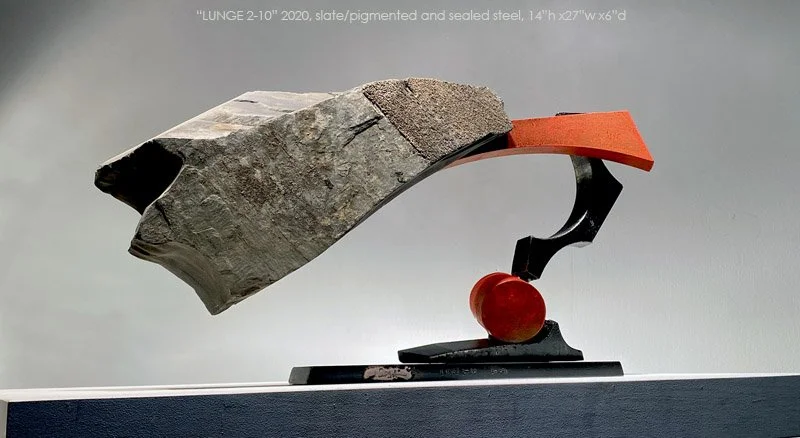
February 2020. Slate, pigmented and sealed steel. Dimensions: 14 × 27 × 6 in (36 × 69 × 15 cm).
Available.
2010’s
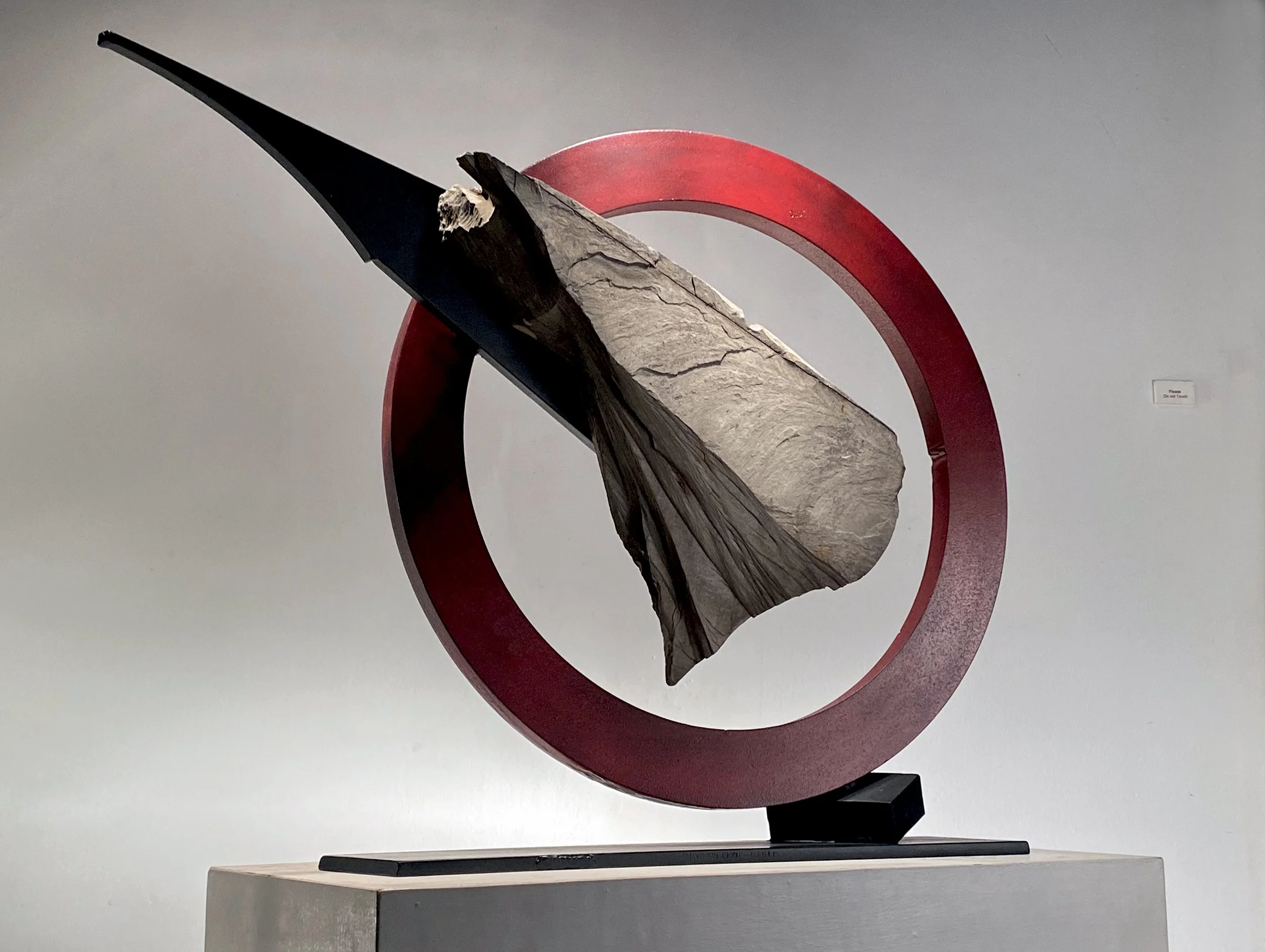
October 2019
Slate, galvanized and powder-coated steel
30.5 × 42 × 7 in. (77 × 107 × 18 cm)
Sisyphean Circle (Tefillin) draws its title from the small black steel element that anchors the circular form to the base, recalling the Hebrew tefillin (phylacteries)—small leather boxes containing passages from the Torah that are traditionally bound to the arm and forehead during prayer as symbols of faith, remembrance, and devotion. Here, the stone becomes both burden and sacred object, suggesting that the weight we carry can also be a source of purpose and spiritual meaning.
Like other works in the Sisyphean Circle series, the sculpture suggests a figure engaged in the timeless act of lifting or guiding a stone. Inspired by Albert Camus' reinterpretation of the Sisyphus myth, the work embraces the creative process as an act of perseverance and affirmation. Rather than dwelling on endless labor, it celebrates the journey itself, reminding us that meaning is found not in reaching the summit, but in the continual act of striving.
— John Van Alstine
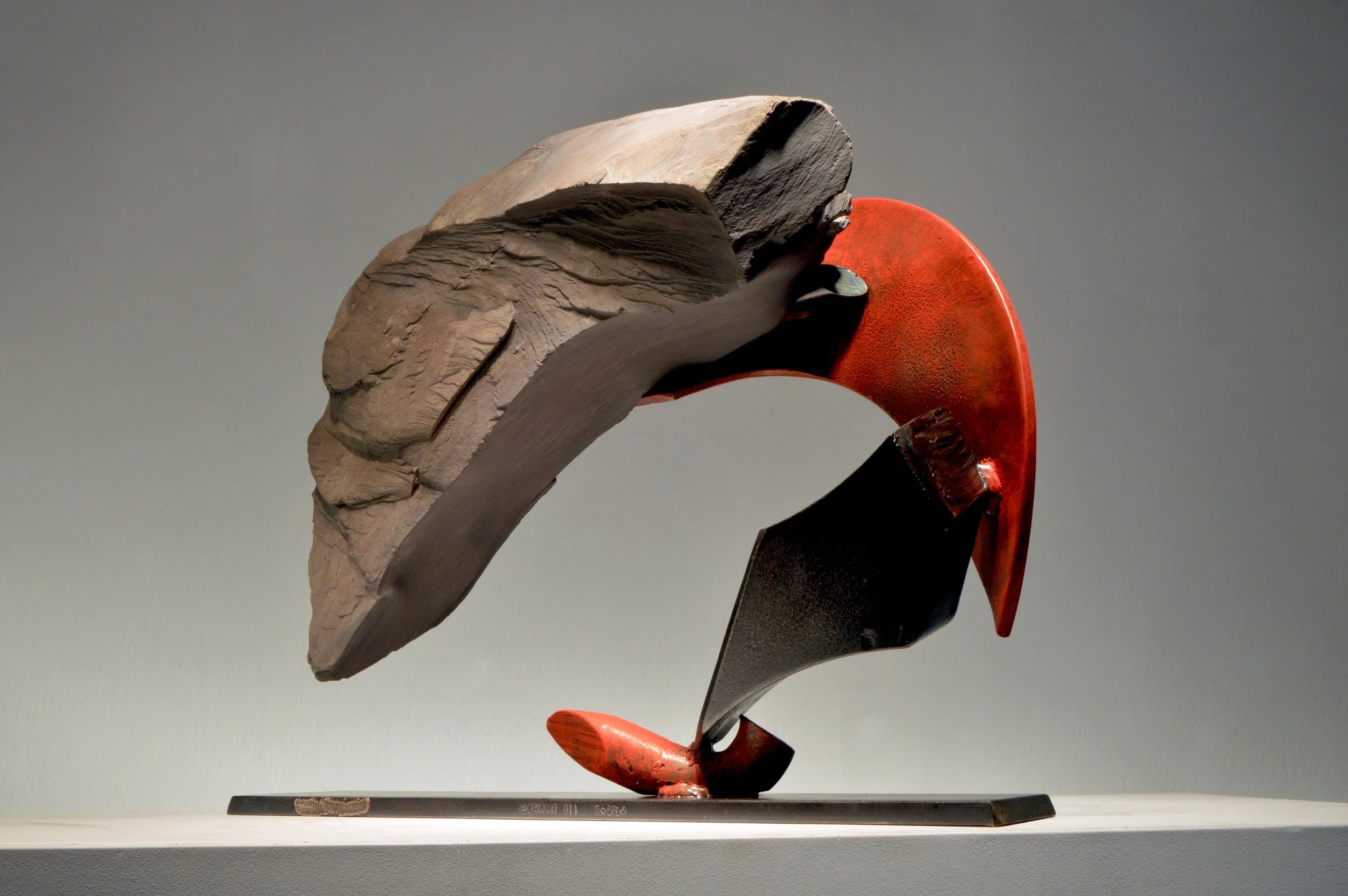
May 2019
Slate, pigmented and sealed steel
17 × 22 × 8 in. (43 × 56 × 20 cm)
The title Barani comes from the gymnastic term for a half-twisting front somersault. Here, the arrangement of stone and steel suggests a body caught in mid-rotation, suspended between ascent and descent. The sculpture captures a fleeting moment when gravity, momentum, and balance exist in perfect equilibrium.
Like many of John Van Alstine's sculptures, Barani III explores the tension between stability and motion. The weight of the slate is countered by the lightness and sweep of the fabricated steel, creating a composition that appears both grounded and airborne. Rather than depicting a literal figure, the work evokes the grace, risk, and exhilaration of movement itself.
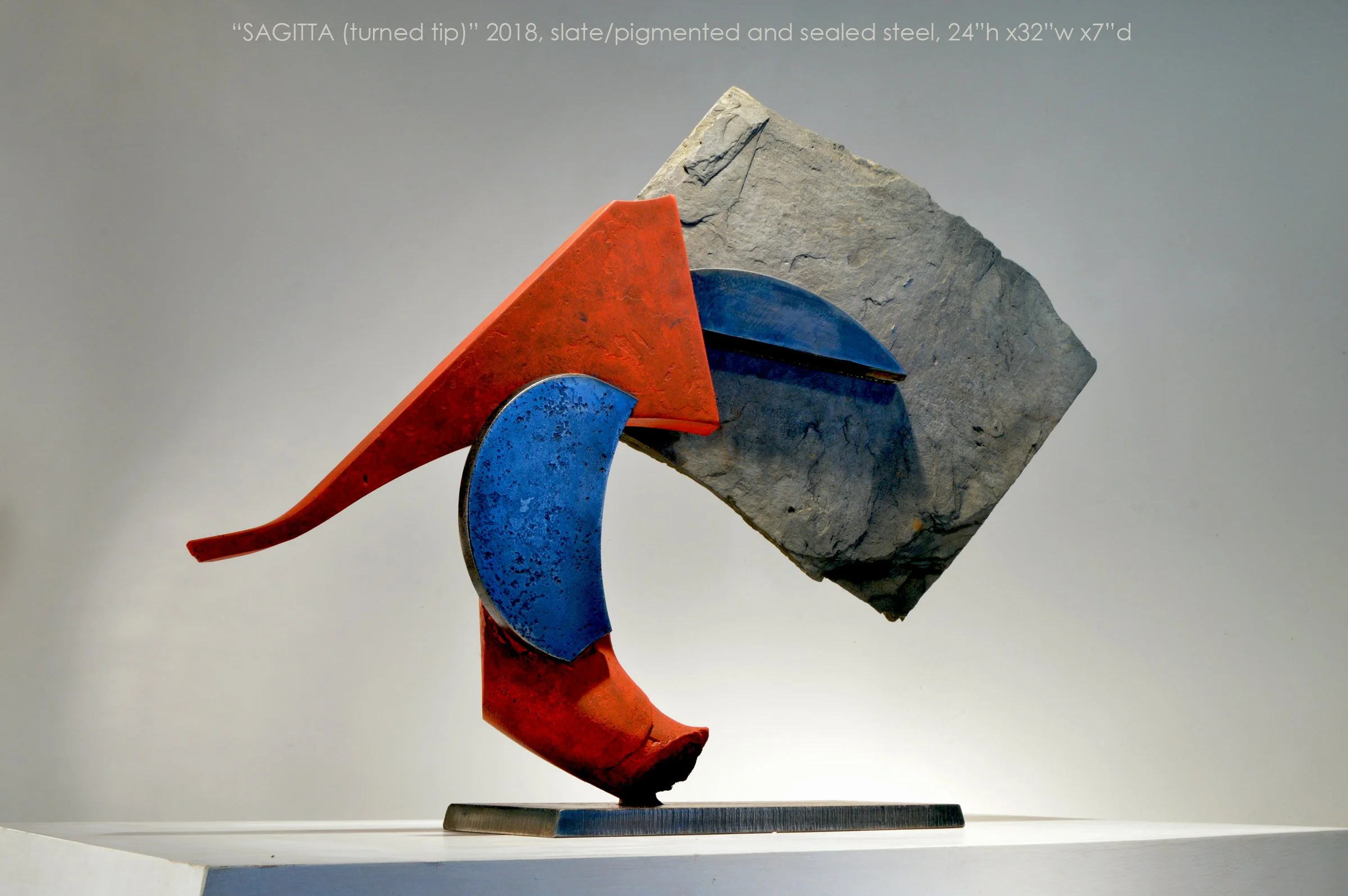
March 2018
Slate, pigmented and sealed steel
24 × 32 × 7 in. (61 × 81 × 18 cm)
The title Sagitta, Latin for arrow, refers both to the ancient constellation and to one of humanity's oldest and most enduring tools. First recorded by the astronomer Ptolemy, the constellation has long been associated with the arrows of Hercules, Apollo, and Eros—symbols of strength, purpose, and transformation. In Sagitta (Turned Tip), the arrow is reimagined as an abstract dialogue between stone and steel.
The turned tip introduces a subtle tension, suggesting that even the most direct path may be altered by circumstance or intention. Rather than depicting a weapon, the sculpture evokes the arrow as a symbol of direction, aspiration, and the continual search for meaning. As in much of John Van Alstine's work, the interplay of weight and movement transforms a familiar form into a meditation on balance, journey, and possibility.
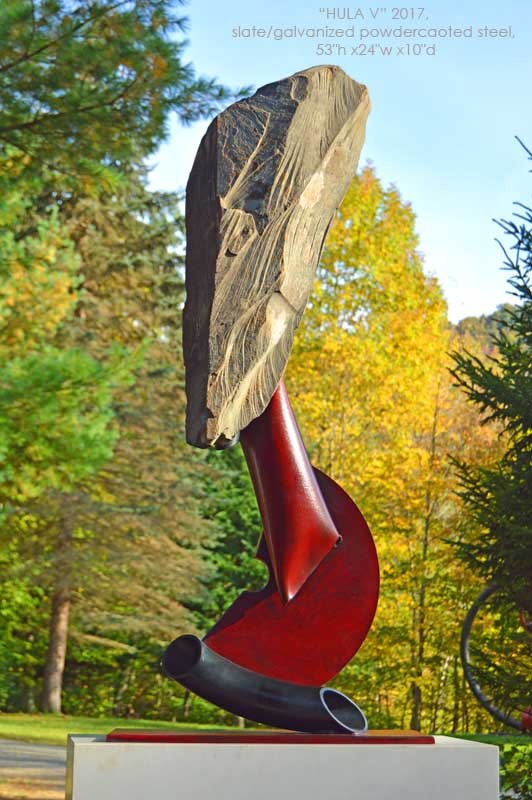
June 2017. Slate, galvanized and powder coated steel. Dimensions: 53x 24x 10 in. (135 x 61 x 25 cm).
Available
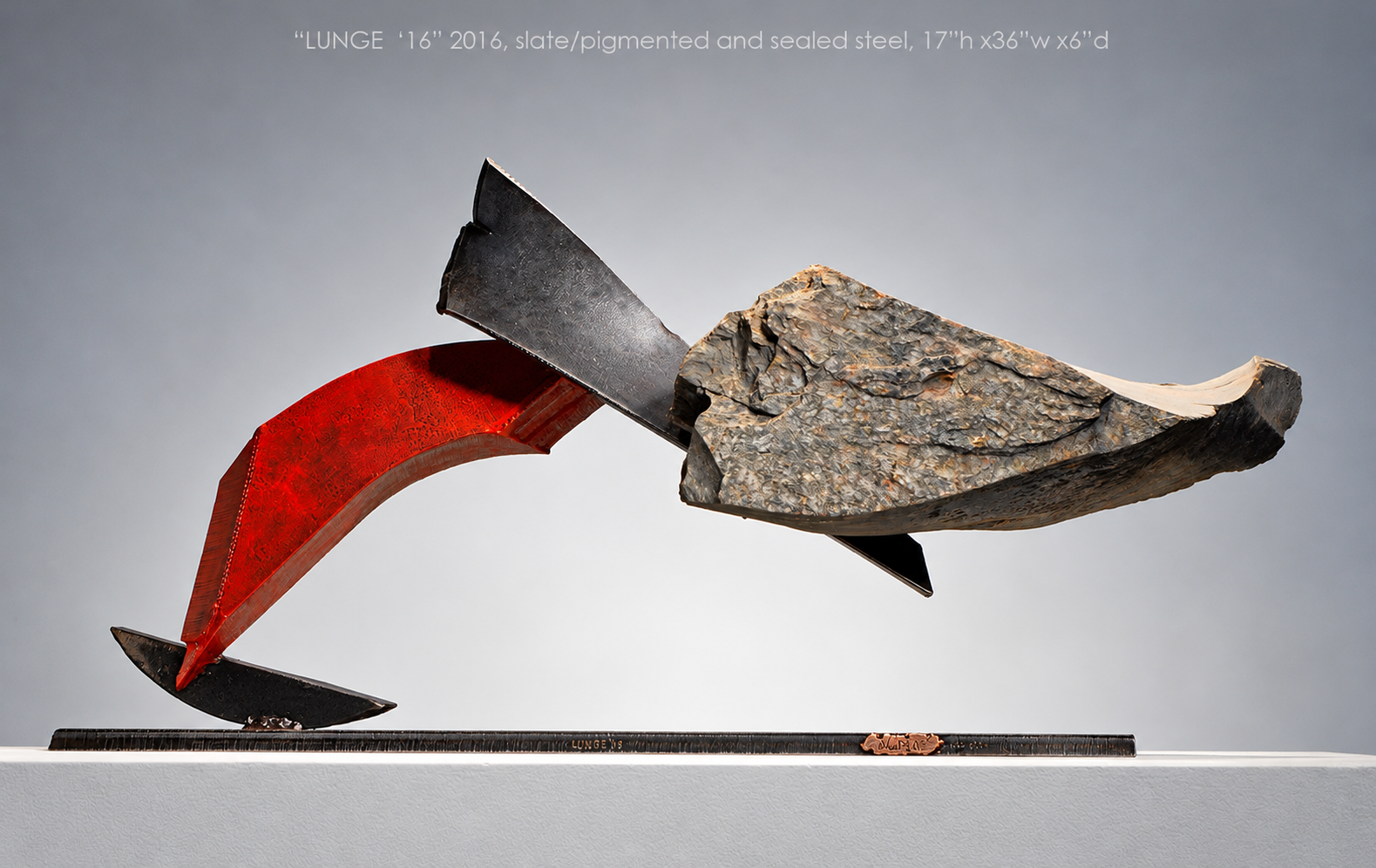
December 2016. Vermont slate, pigmented and sealed steel. Dimensions: 17 × 36 × 6 in (43 × 91 × 15 cm).
Available
The Lunge series explores implied movement and gesture through an abstract sculptural language. The title Lunge suggests a sudden extension of the body—a reaching, thrusting, or shifting of weight that gives the sculpture a sense of physical momentum and directed energy.
While not figurative in a literal sense, the work draws on my interest in the expressiveness of the human figure. Its balance, tension, and spatial gesture suggest a body caught in motion, allowing the sculpture to convey a human presence through posture and movement rather than recognizable form.
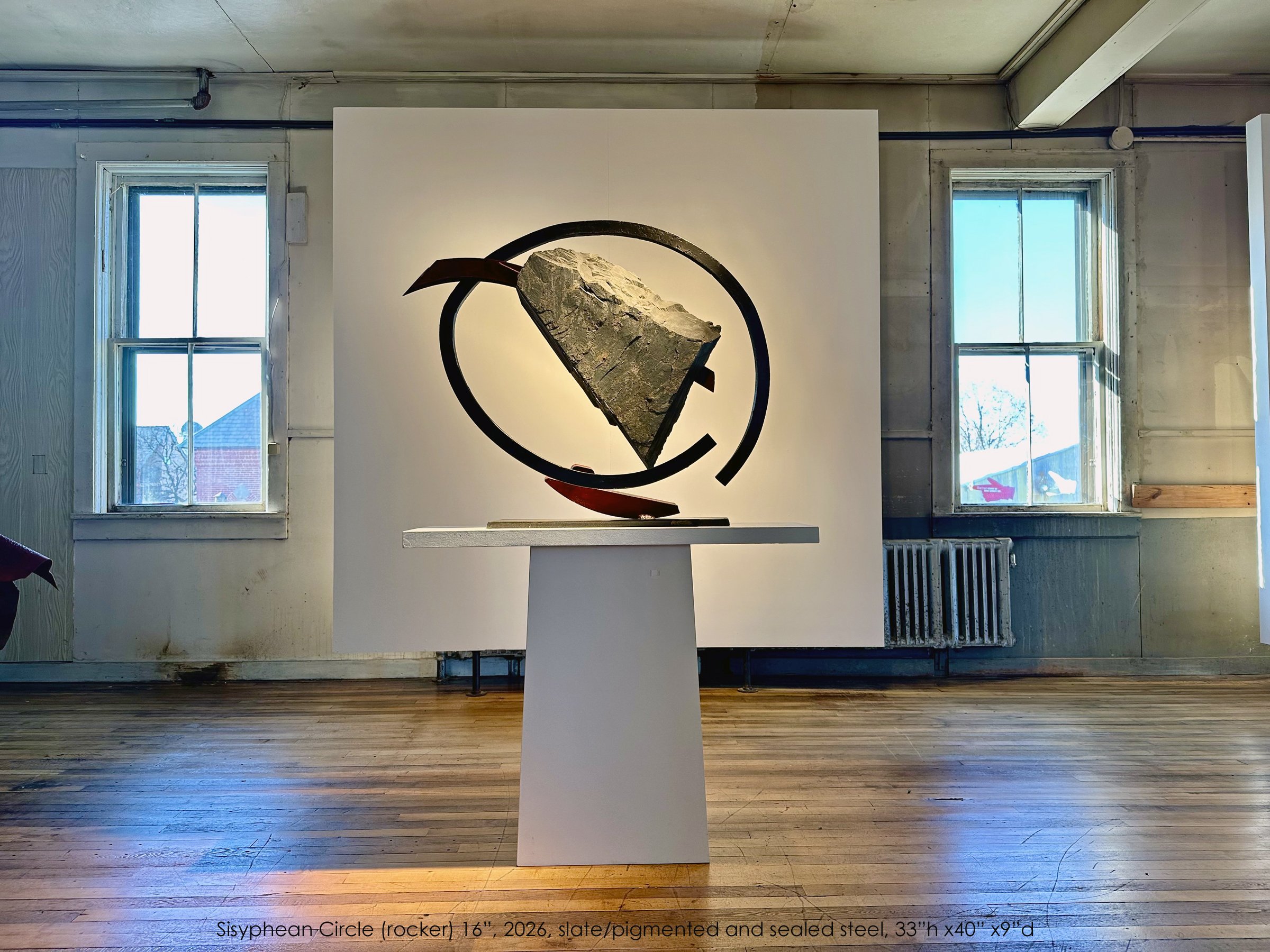
Granite and galvanized and powder-coated steel, 33”h x 40”w x9”d
Available
Sisyphean Circle Series
The formal arrangements of stone and steel in the Sisyphean Circle series often suggest a figure frozen in the act of prying or pushing a stone. Yet to view the creative process simply as endless toil is undeniably negative. I prefer to approach the myth and metaphor through the lens of Albert Camus.
As in life, this perspective lies at the core of the creative process, where the act of making ultimately triumphs over the object or final product. The focus shifts from the burden of creation to the meaning found in the effort itself—celebrating the process as the true reward rather than the finished sculpture.
—John Van Alstine
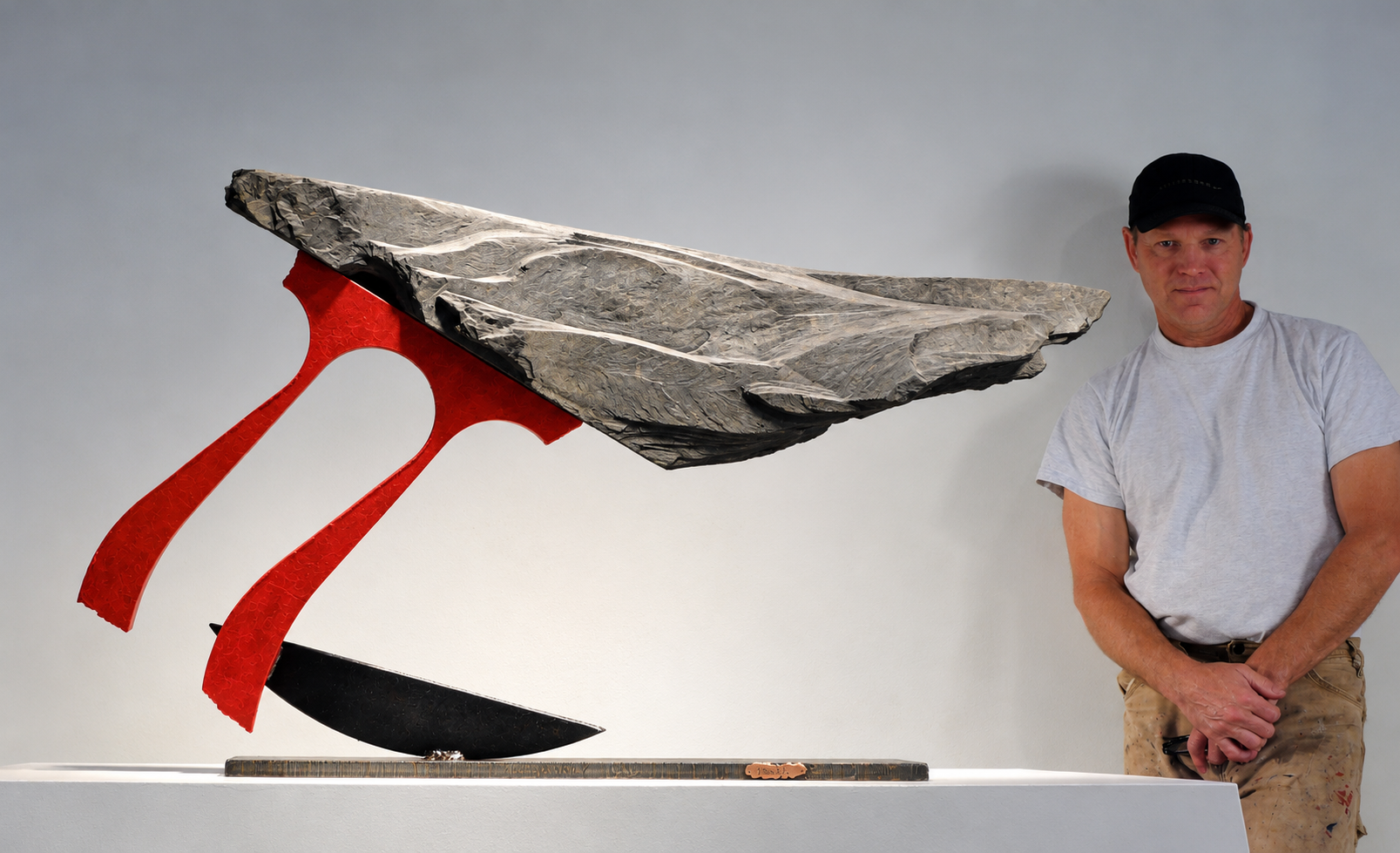
July 2015
Vermont slate, pigmented and sealed steel
23 × 41 × 6 in. (58 × 104 × 15 cm)
Available
Storm Warning V (Red Rain 3.14) grew from John Van Alstine's experiences in the vast landscapes of Wyoming, where towering storm clouds and sweeping curtains of rain could be seen moving across the open sky, sometimes evaporating before reaching the ground. Here, a heavy slate form becomes an ominous storm cloud while strands of red steel suggest rain suspended between earth and sky.
The sculpture embraces the visual irony found throughout Van Alstine's work: the earthbound stone appears to float while the "falling" rain simultaneously supports it. The red rain alludes to the environmental threat of acid rain in the Adirondacks, while the subtitle 3.14 refers to the steel element's resemblance to the mathematical symbol π, expressing the artist's belief that science, understanding, and human ingenuity can help solve the environmental challenges we create.
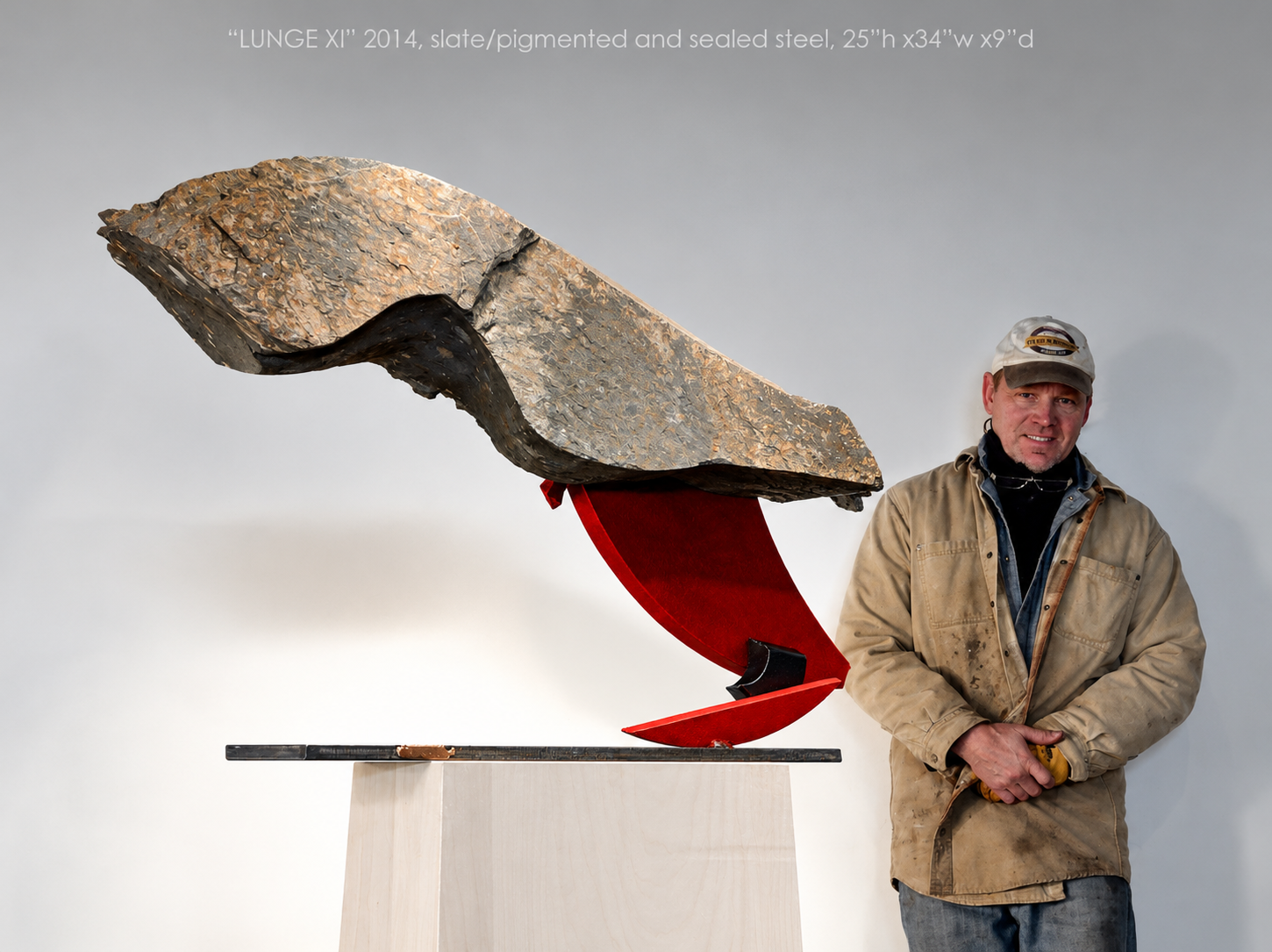
November 2014. Slate, pigmented and sealed steel. Dimensions: 25 × 34 × 9 in (64 × 86 × 23 cm).
The Lunge series explores implied movement and gesture through an abstract sculptural language. The title Lunge suggests a sudden extension of the body—a reaching, thrusting, or shifting of weight that gives the sculpture a sense of physical momentum and directed energy.
While not figurative in a literal sense, the work draws on my interest in the expressiveness of the human figure. Its balance, tension, and spatial gesture suggest a body caught in motion, allowing the sculpture to convey a human presence through posture and movement rather than recognizable form.
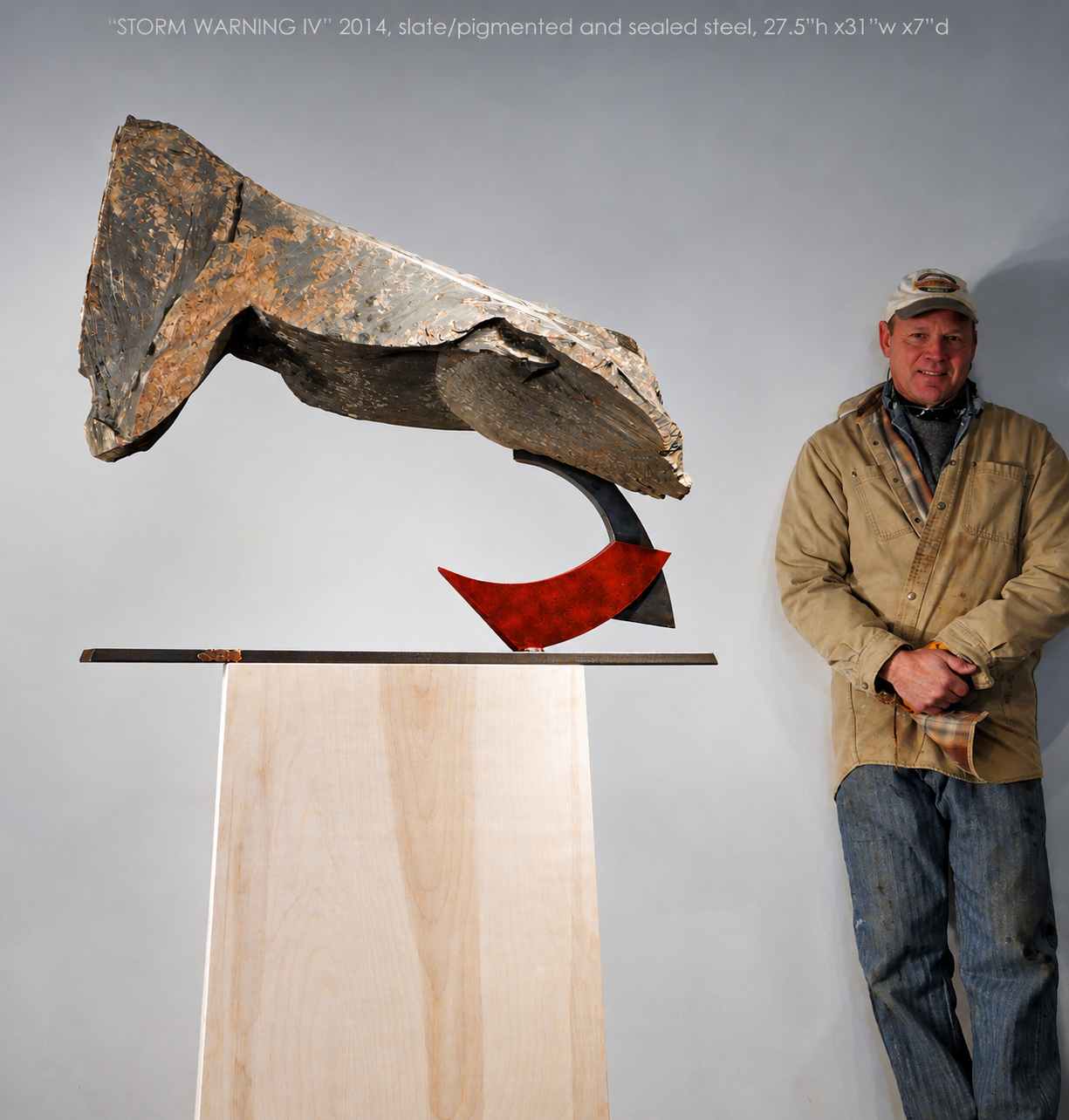
November 2014. Slate, pigmented steel. Dimensions: 27.5 × 31 × 7 in (70 × 79 × 18 cm).
Available
The title for Storm Warning IV grew out of my experiences with the vast “big sky” landscapes of Wyoming and the major rainstorms that would roll through. I was impressed how often you could see the entire event, the large dark clouds and the waves of trailing raindrops, sometimes evaporating before they hit ground.
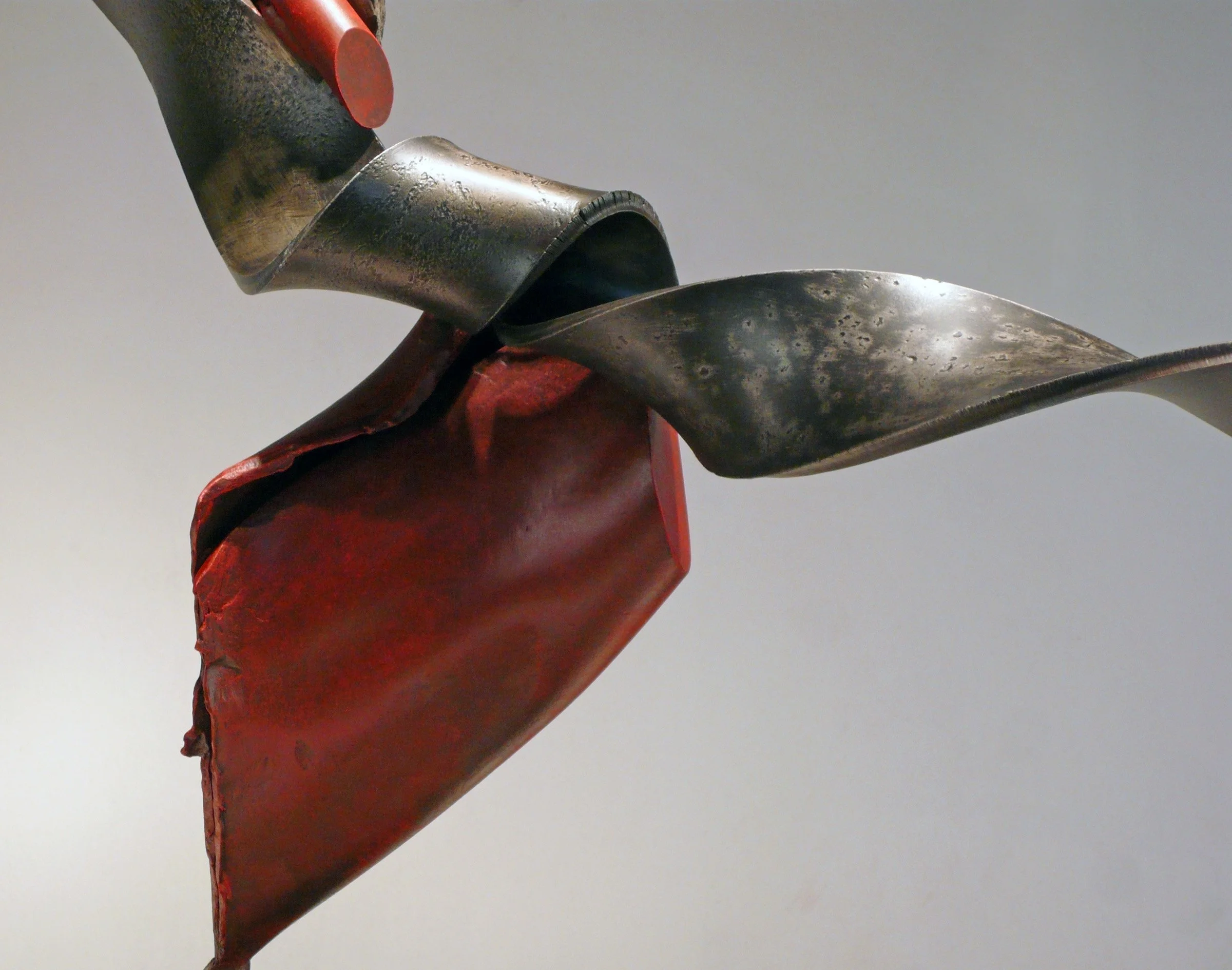
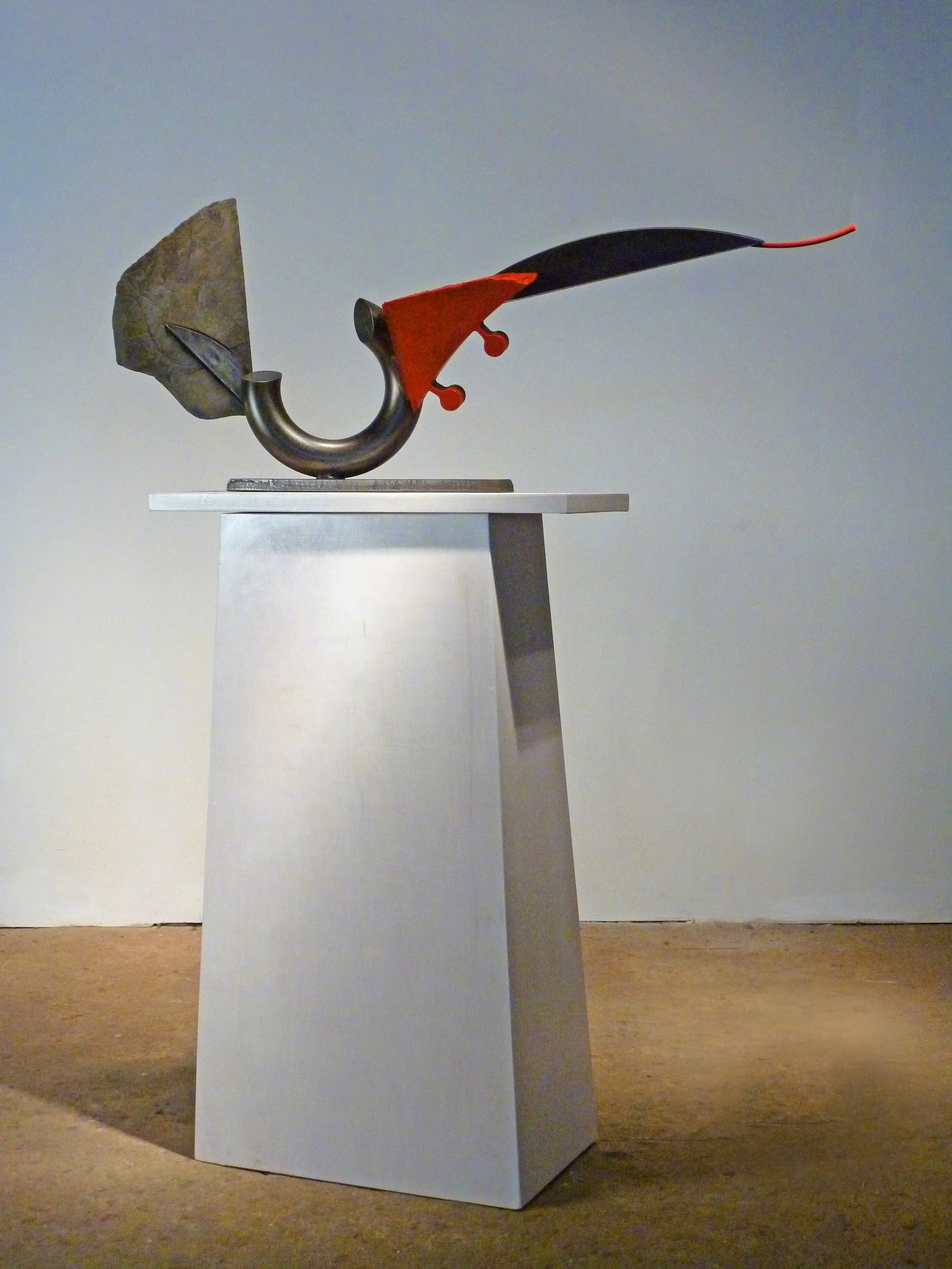
March 2013. Slate, pigmented and sealed steel. Dimensions: 17.5 × 44 × 7 in (44 × 112 × 18 cm).
A meteoroid fell to Earth on February 15, 2013 streaking some 20 to 30 kilometers above the city of Chelyabinsk , Russia at 9:20am local time. Initially traveling at about 20 kilometers per second , its explosive deceleration after impact with the lower atmosphere created a flash brighter than the Sun. An estimated 500 kilotons of energy was released by the explosion of the 17 meter wide space rock with a mass of 7,000 to 10,000 tons. Actually expected to occur on average once every 100 years, the magnitude of the Chelyabinsk event is the largest known since the Tunguska impact in 1908 .
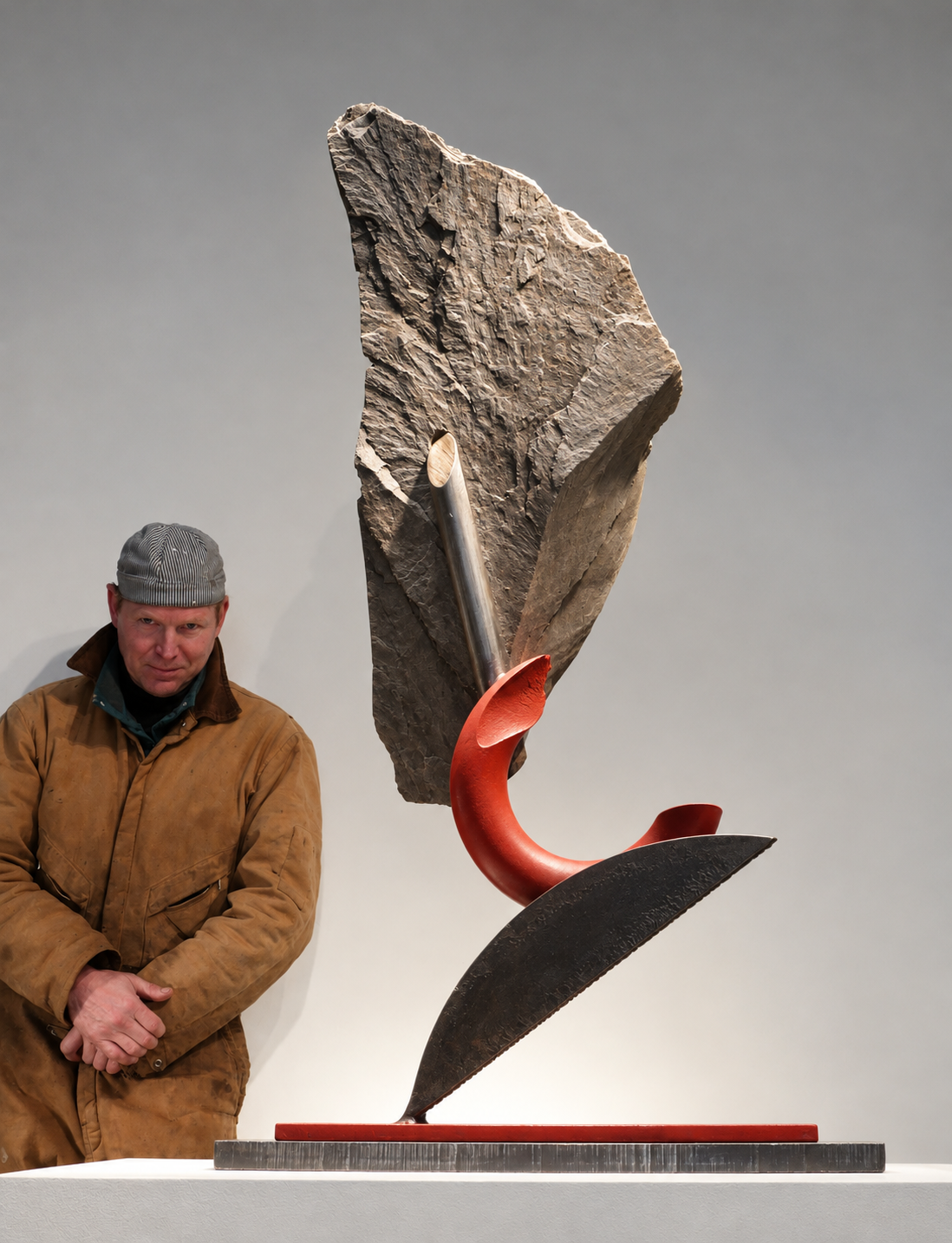
April 2012. NY state slate, pigmented and sealed steel. Dimensions: 43 × 24 × 8 in (109 × 61 × 20 cm).
Available.
PIQUE
In dance, "piqué" (pronounced pee-KAY) means "to prick," and describes a step where a dancer steps directly onto the pointe or ball of the foot. The term is most famously used for the piqué turn, a traveling turning step that involves stepping onto one leg en pointe while the other leg is in the air, usually in a passé position (drawn up to the knee).
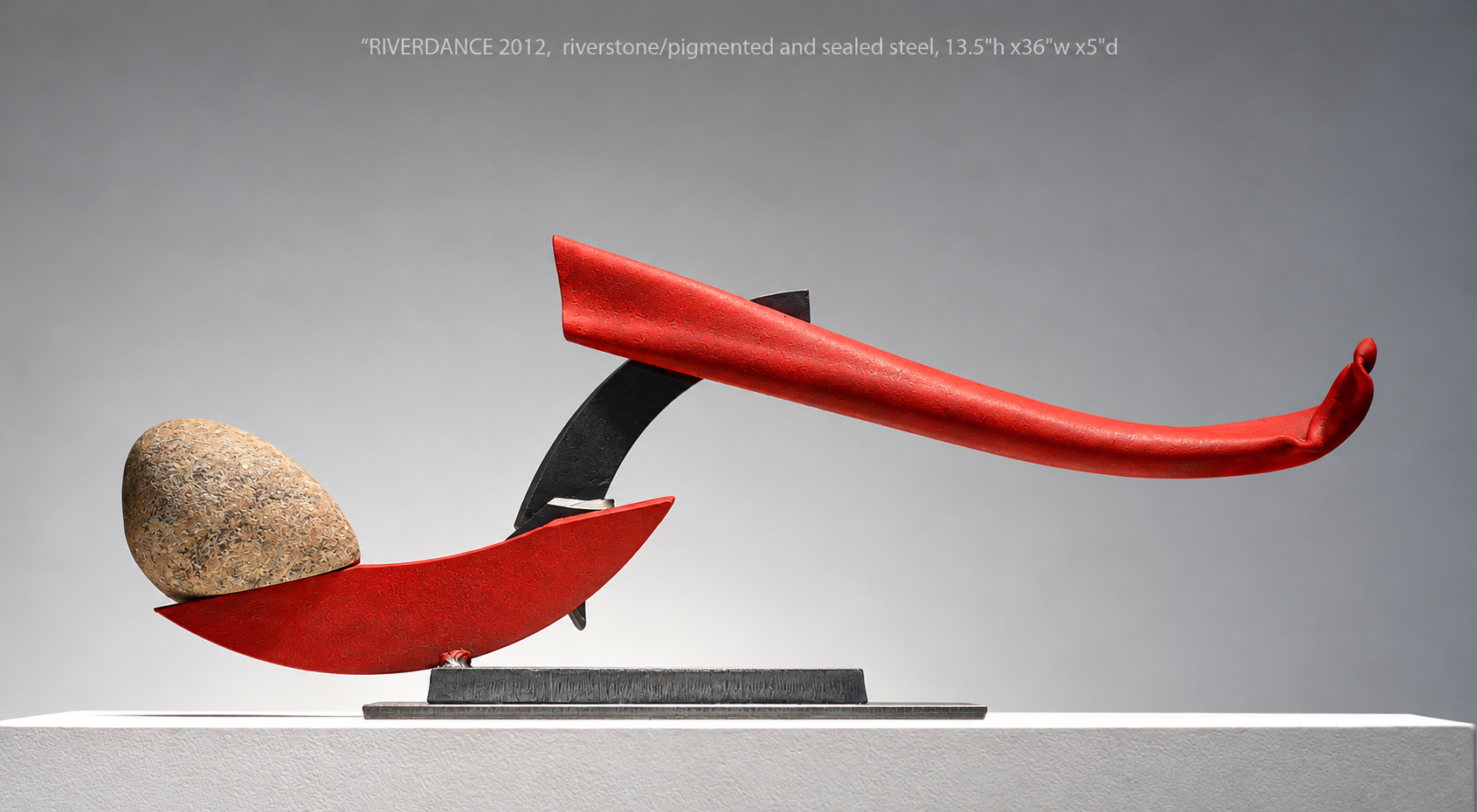
April 2012. River stone, pigmented and sealed steel. Dimensions: 13.5 × 36 × 5 in. (34 × 91 × 13 cm).
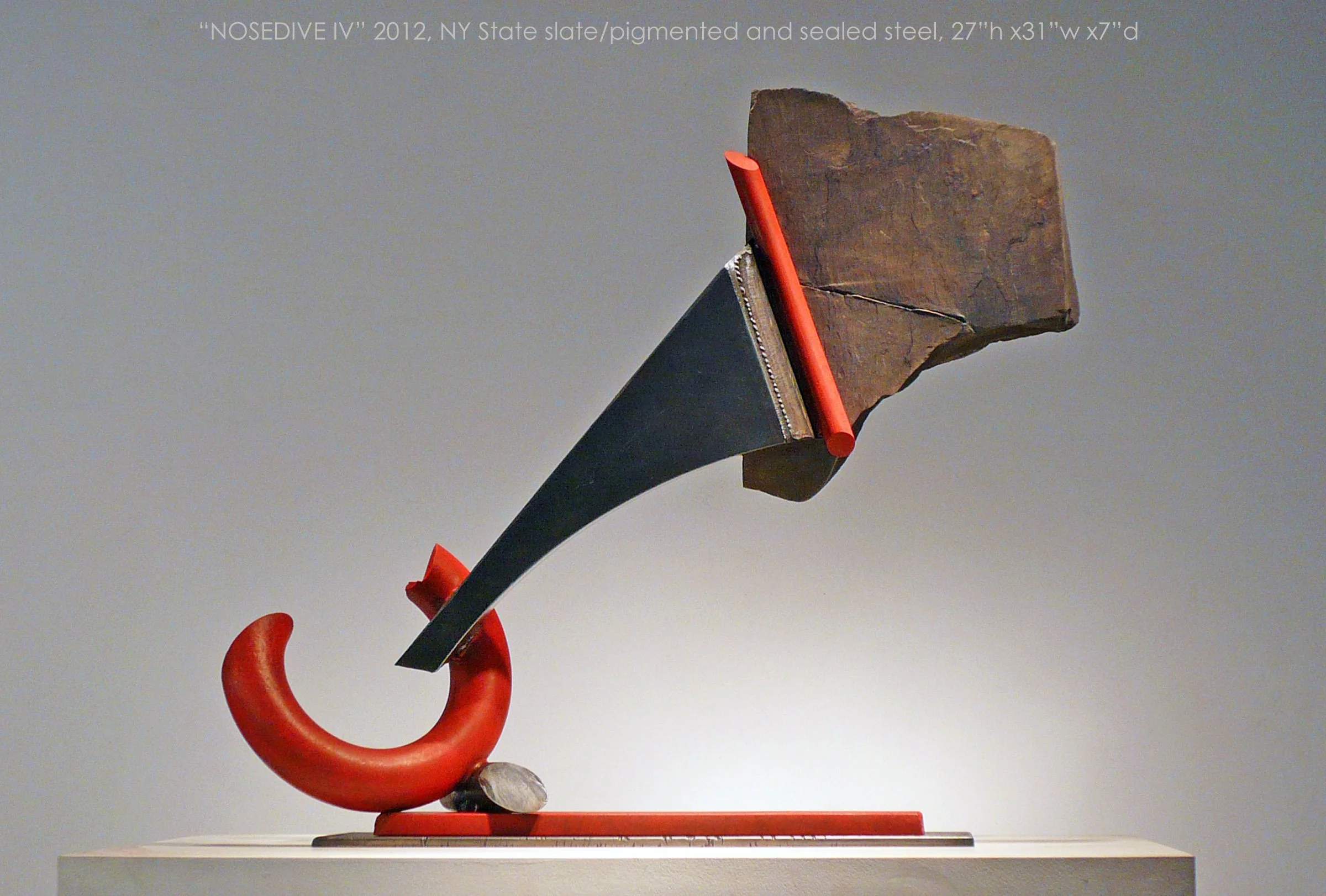
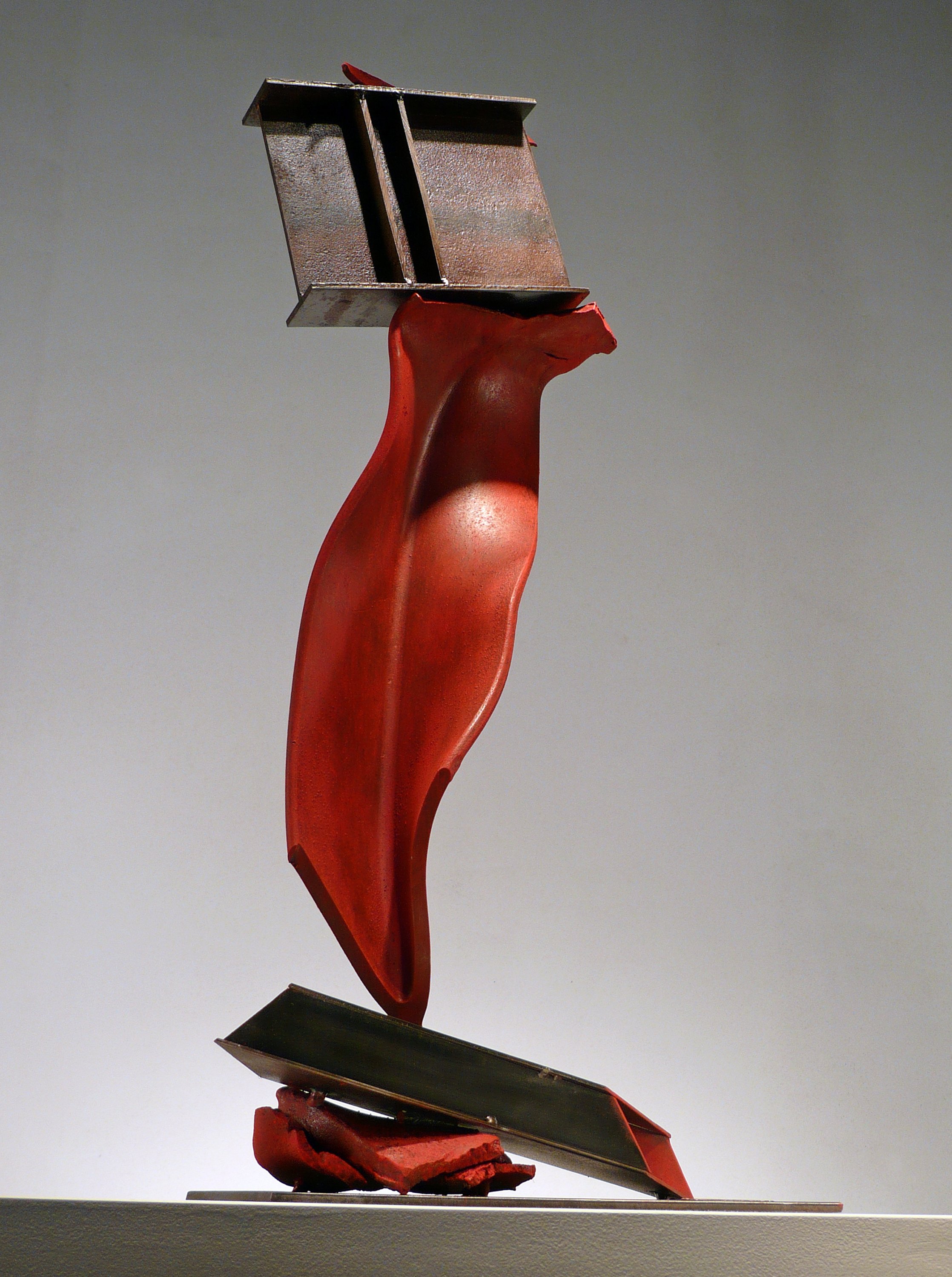
May 2011. Pigmented steel. Dimensions: 31 × 15 × 8 in (79 × 38 × 20 cm).
One of several models (ideas) for Saratoga Springs, NY September 11 memorial project.
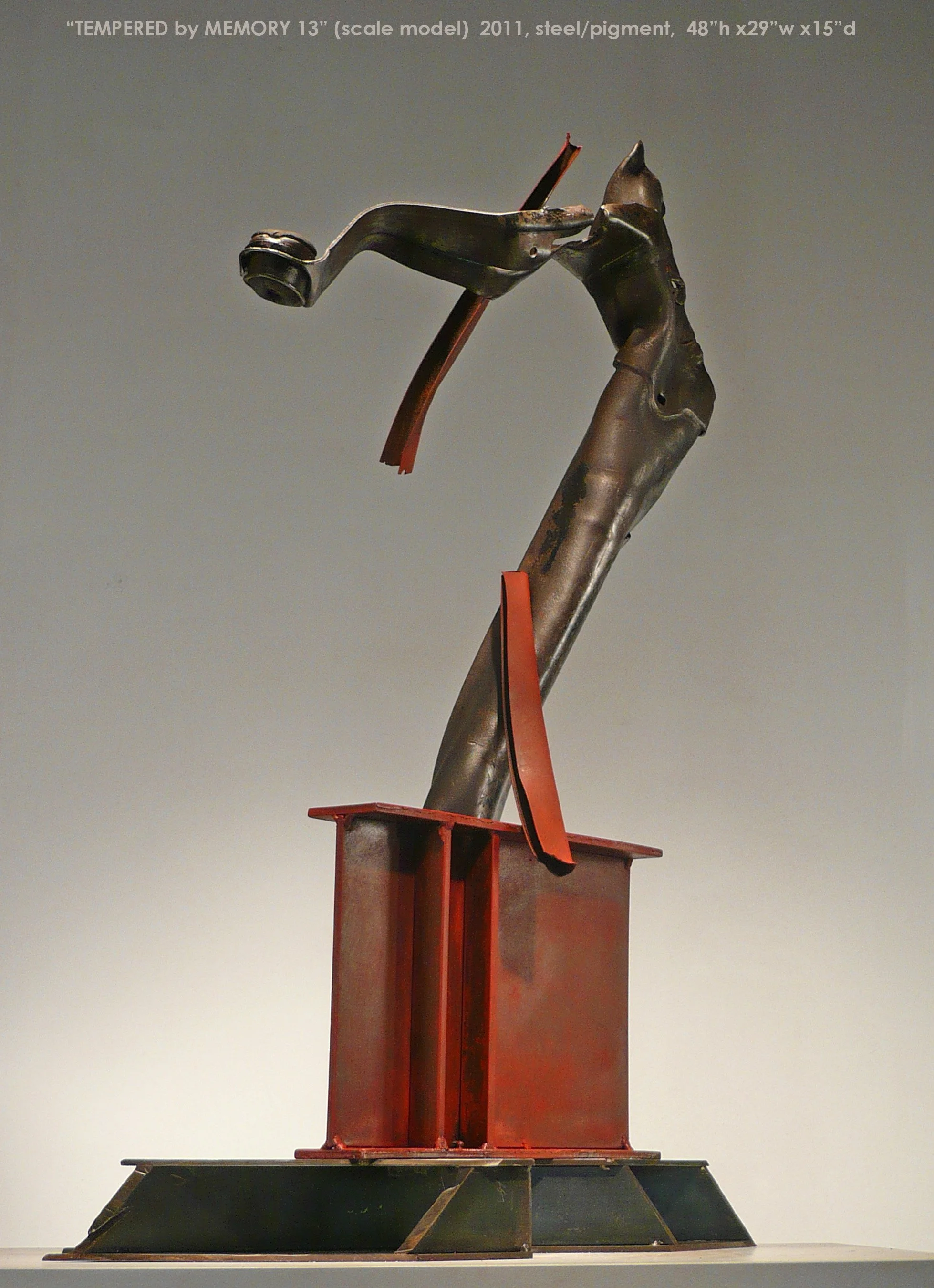
May 2011. Steel, pigment. Dimensions: 48 × 29 × 15 in (122 × 74 × 38 cm).
One of several model (ideas) for Saratoga Springs, NY 911 Memorial project.
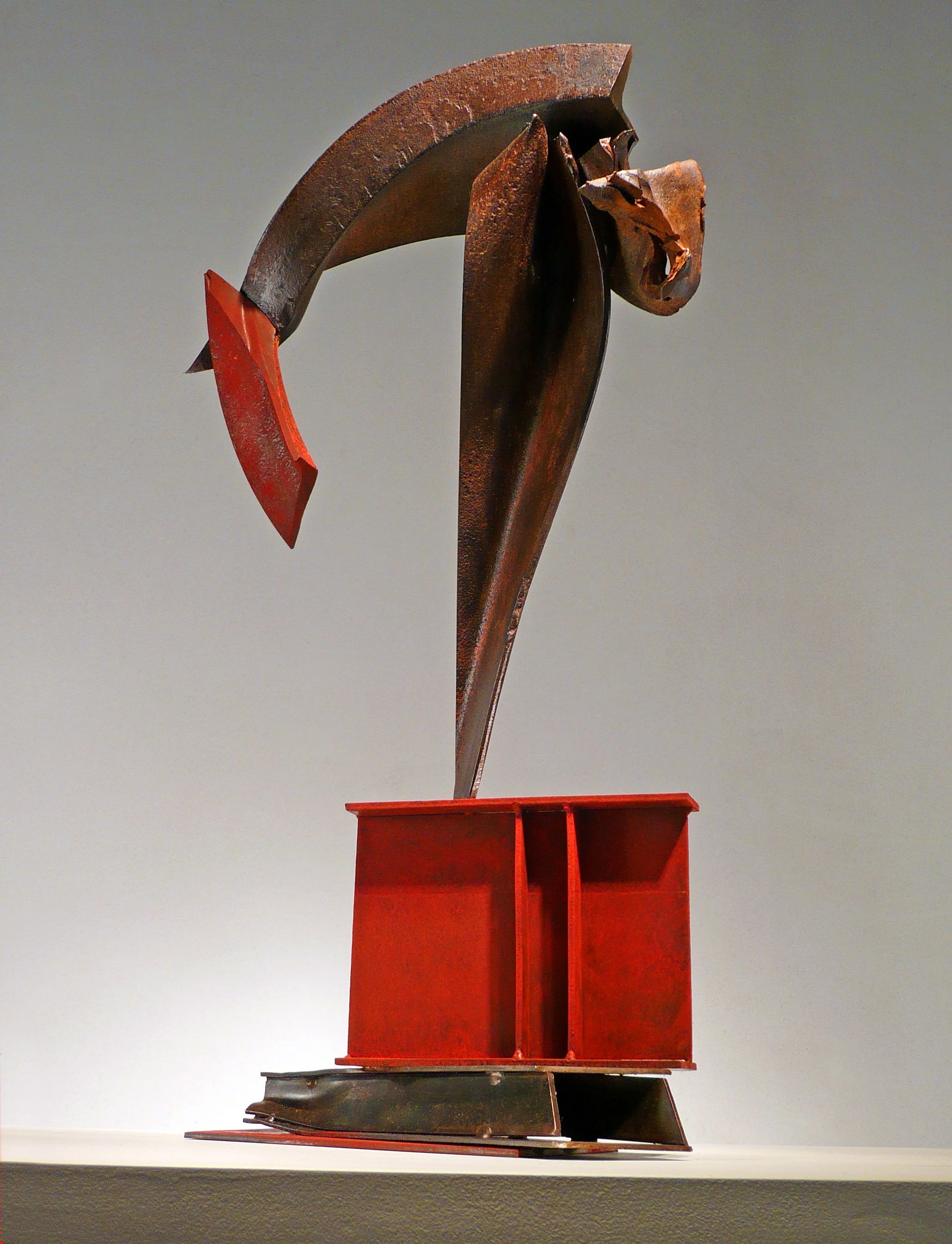
May 2011. Steel, pigment. Dimensions: 28 × 15 × 9 in (71 × 38 × 23 cm).
One of several models (ideas) for Saratoga Springs, NY September 11 memorial project.
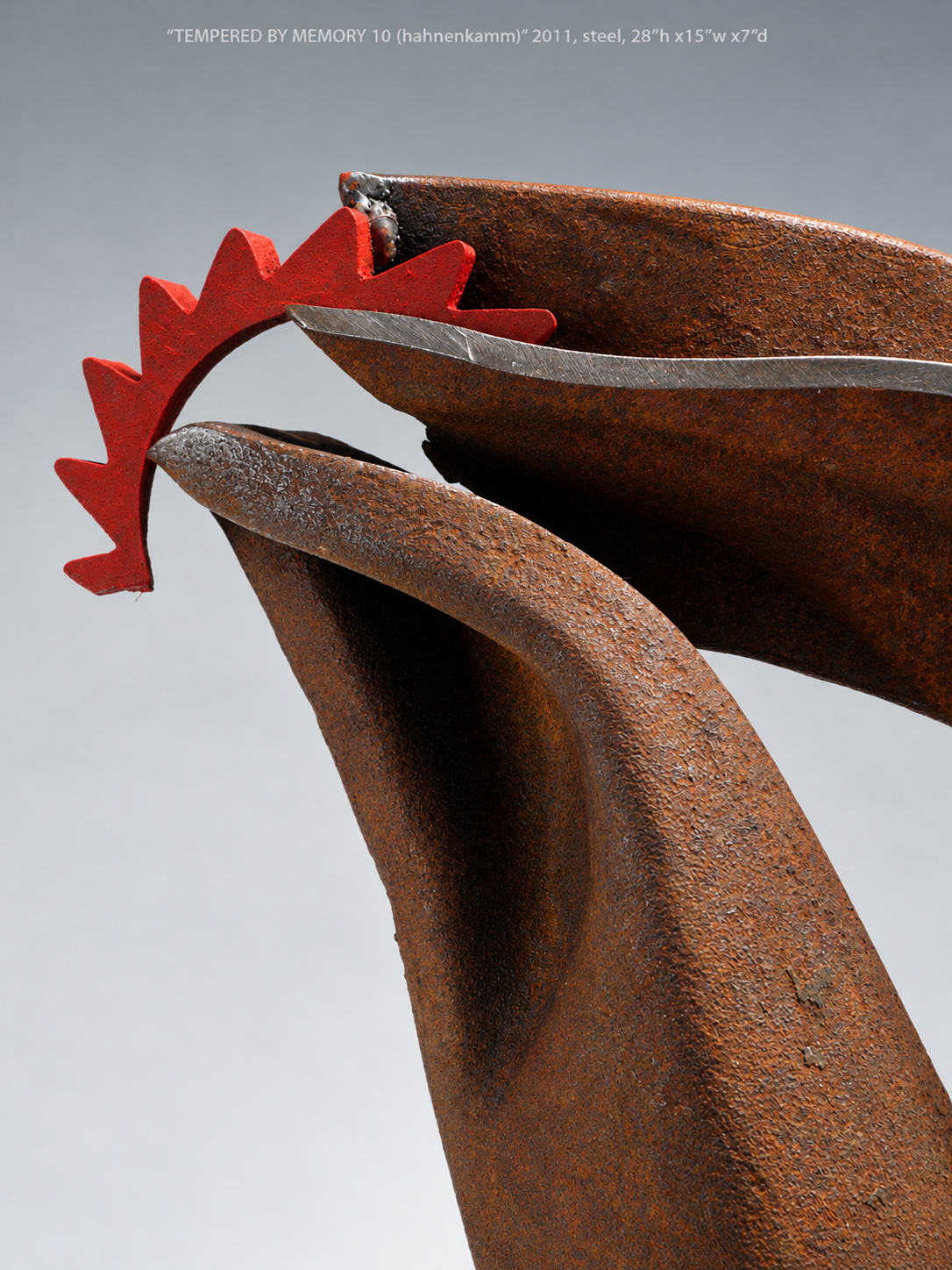
April 2011. Steel, pigment. Dimensions: 28 × 15 × 7 in (71 × 38 × 18 cm).
One of several models (ideas) for Saratoga Springs, NY September 11 memorial project.
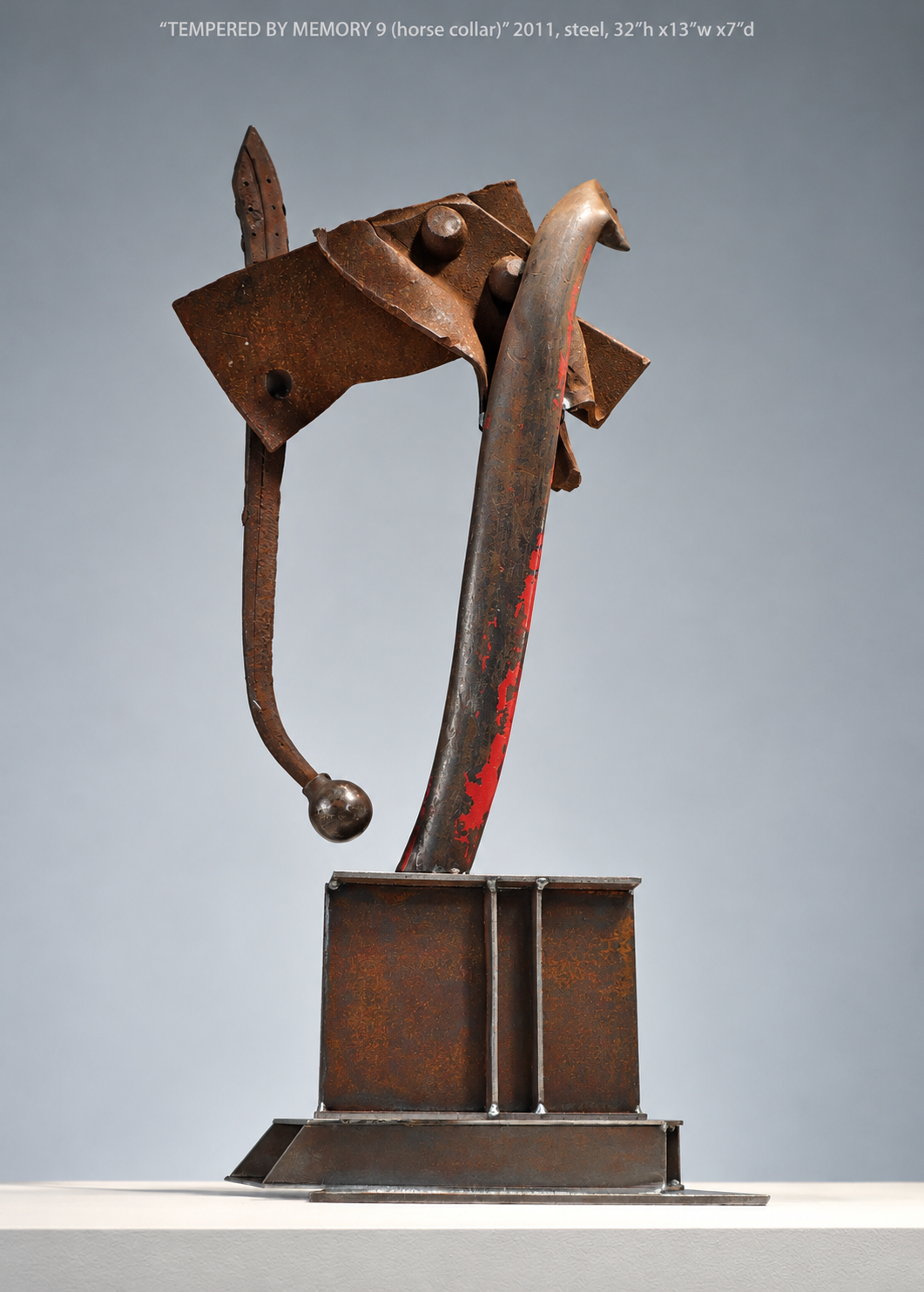
April 2011. Steel, pigment. Dimensions: 32 × 15 × 7 in (81 × 38 × 18 cm).
One of several models (ideas) for Saratoga Springs, NY September 11 memorial project.
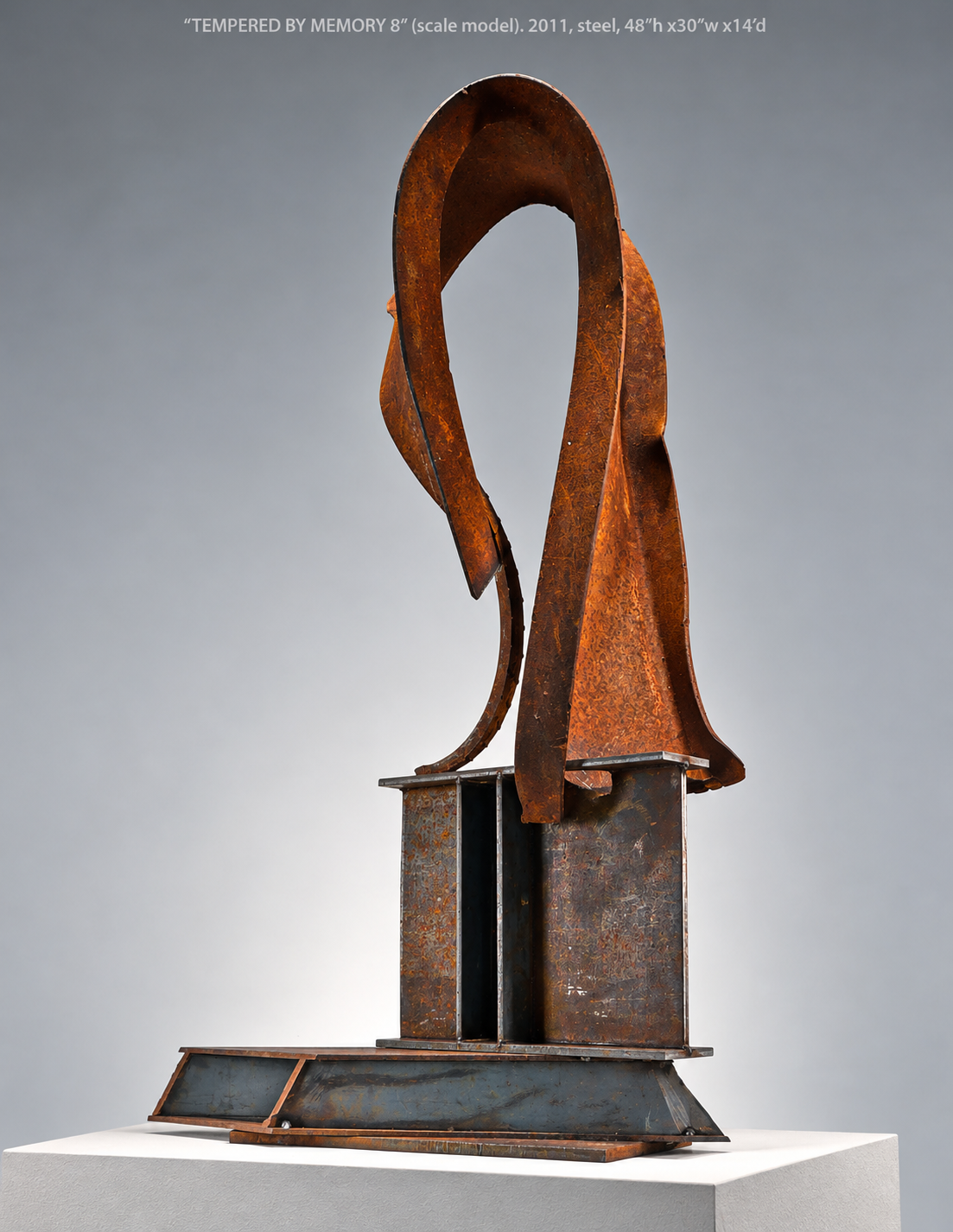
April 2011. Steel, pigment. Dimensions: 48 × 30 × 14 in (122 × 76 × 36 cm).
One of several models (ideas) for Saratoga Springs, NY September 11 memorial project.
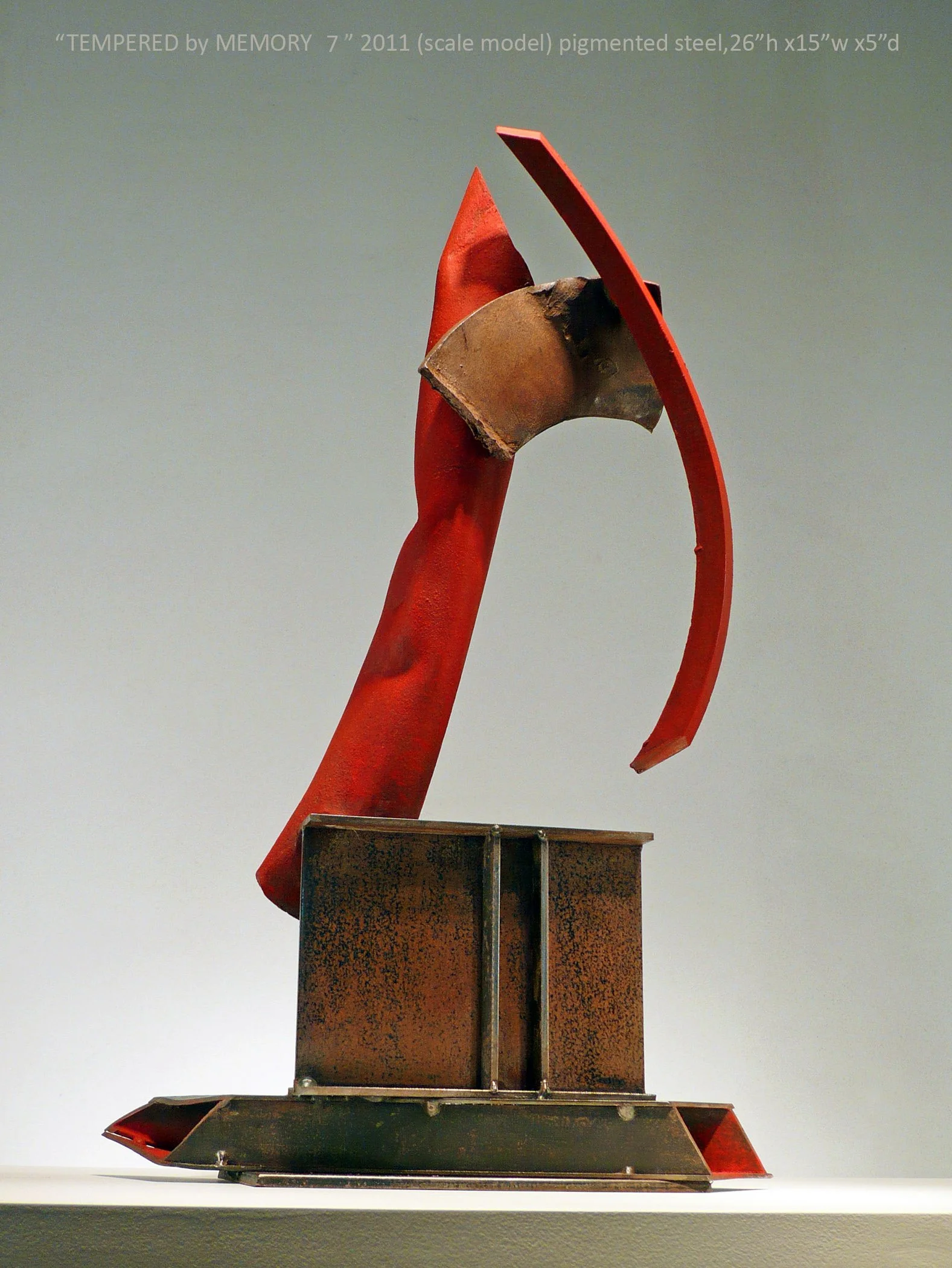
April 2011. Steel. Dimensions: 26 × 17 × 5 in (66 × 43 × 13 cm).
One of several models (ideas) for Saratoga Springs, NY September 11 memorial project.
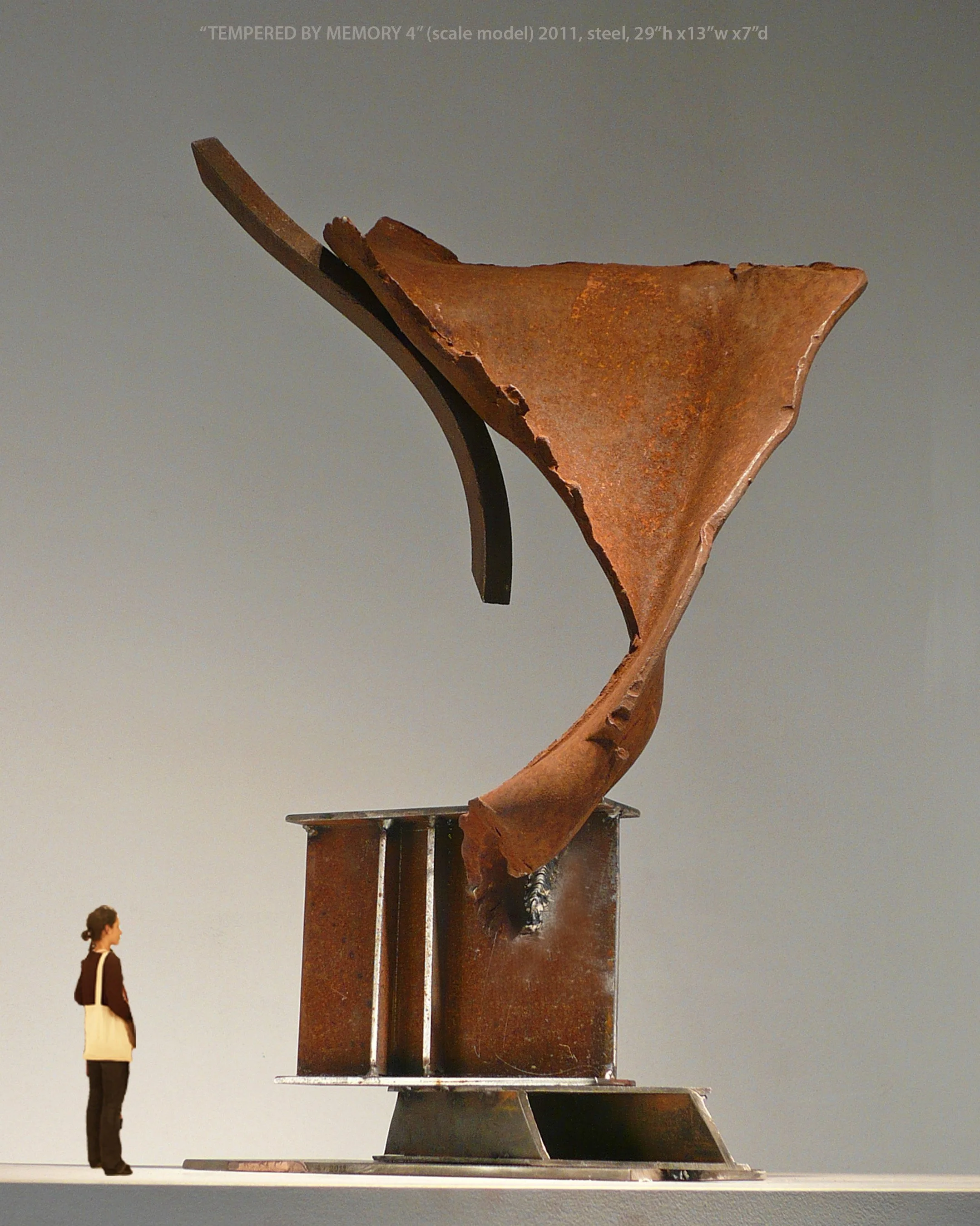
April 2011. Steel. Dimensions: 25 × 15 × 9 in (64 × 38 × 23 cm).
One of several models (ideas) for Saratoga Springs, NY September 11 memorial project.
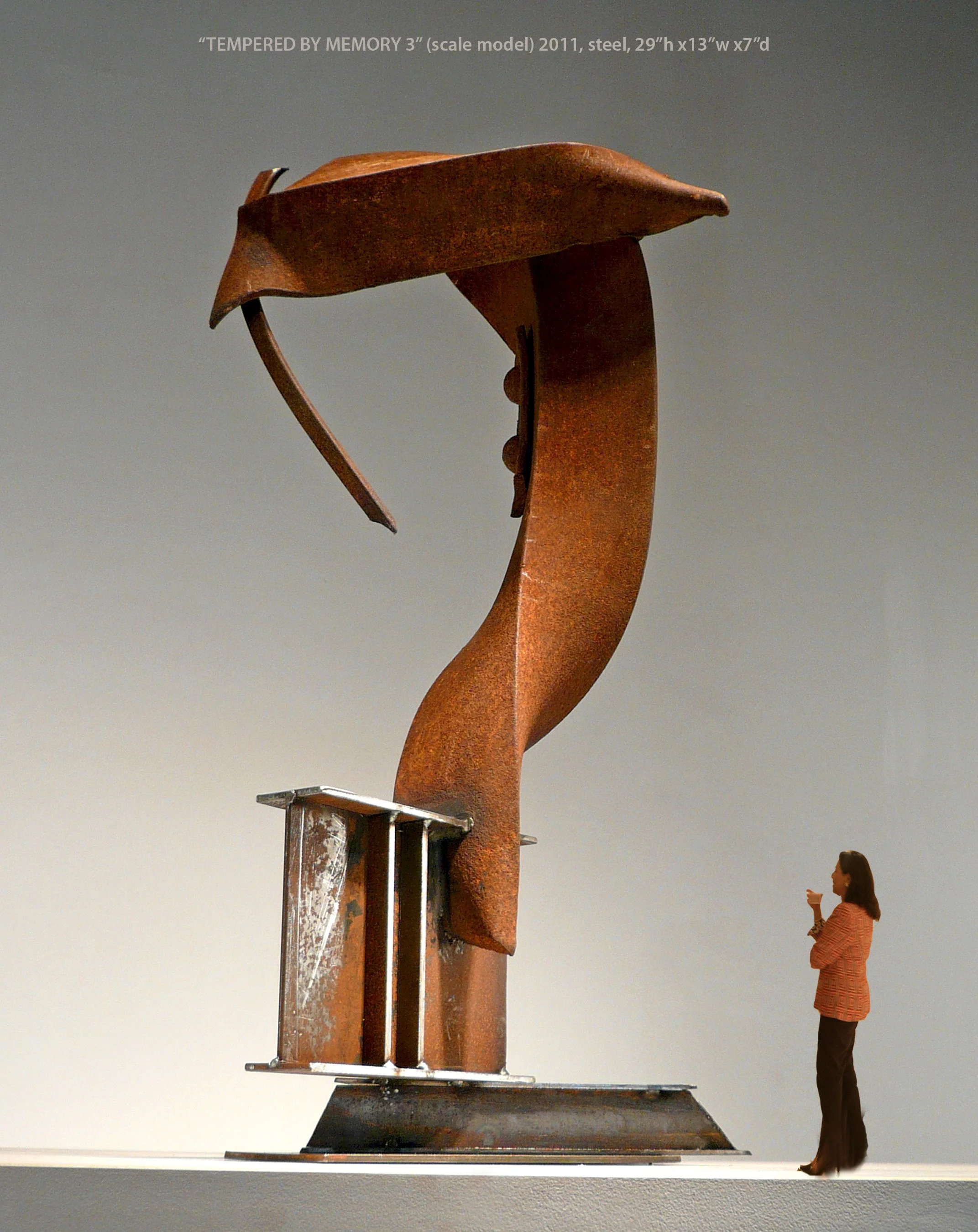
April 2011. Steel. Dimensions: 29 × 13 × 7 in (74 × 33 × 18 cm).
One of several models (ideas) for Saratoga Springs, NY September 11 memorial project.
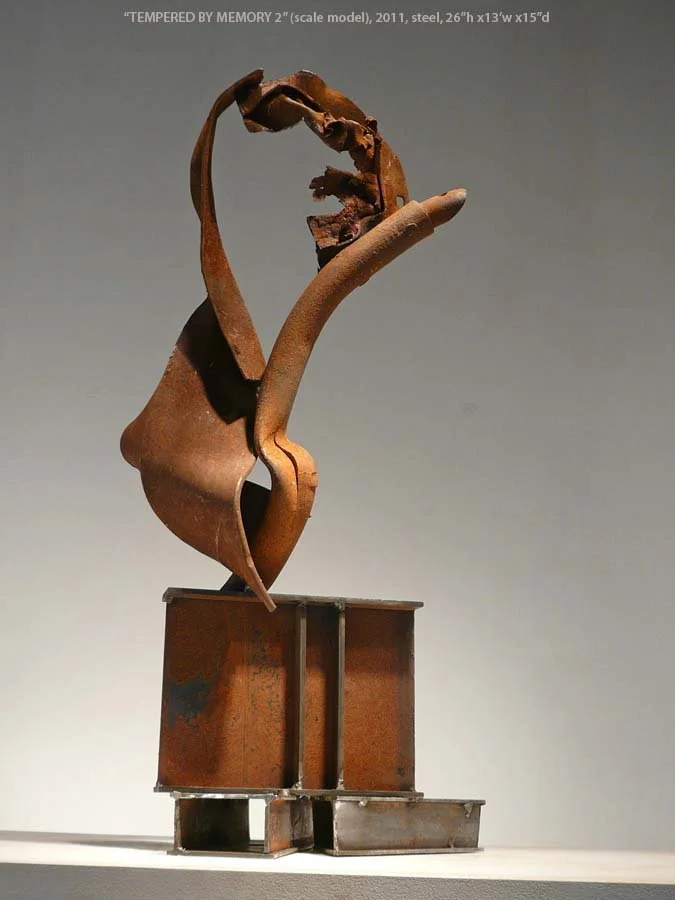
April 2011. Steel. Dimensions: 26 × 15 × 13 in (66 × 38 × 33 cm).
One of several models (ideas) for Saratoga Springs, NY September 11 memorial project.
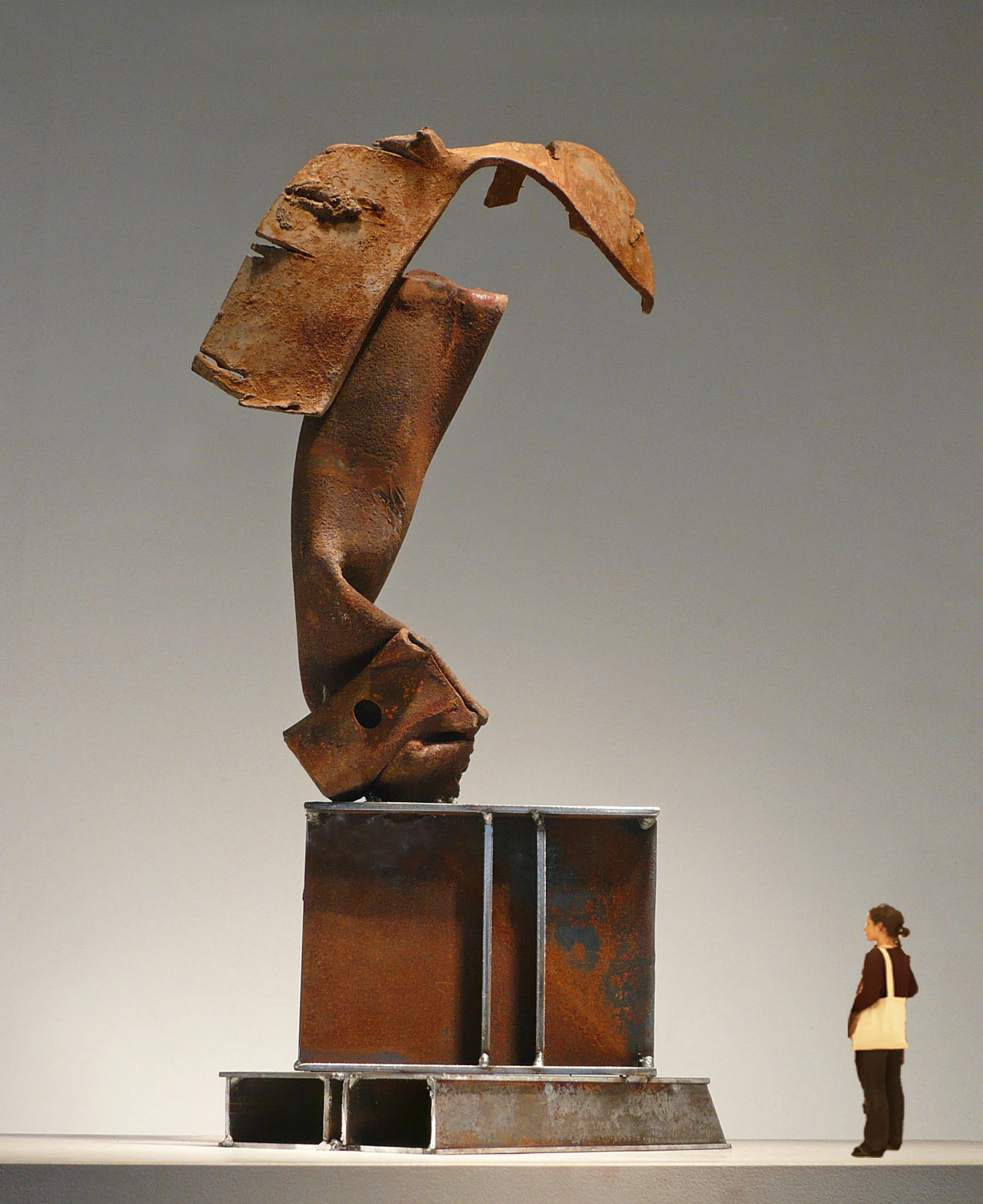
April 2011. Steel. Dimensions: 28 × 12 × 12 in (71 × 30 × 30 cm).
One of several models (ideas) for Saratoga Springs, NY September 11 memorial project.
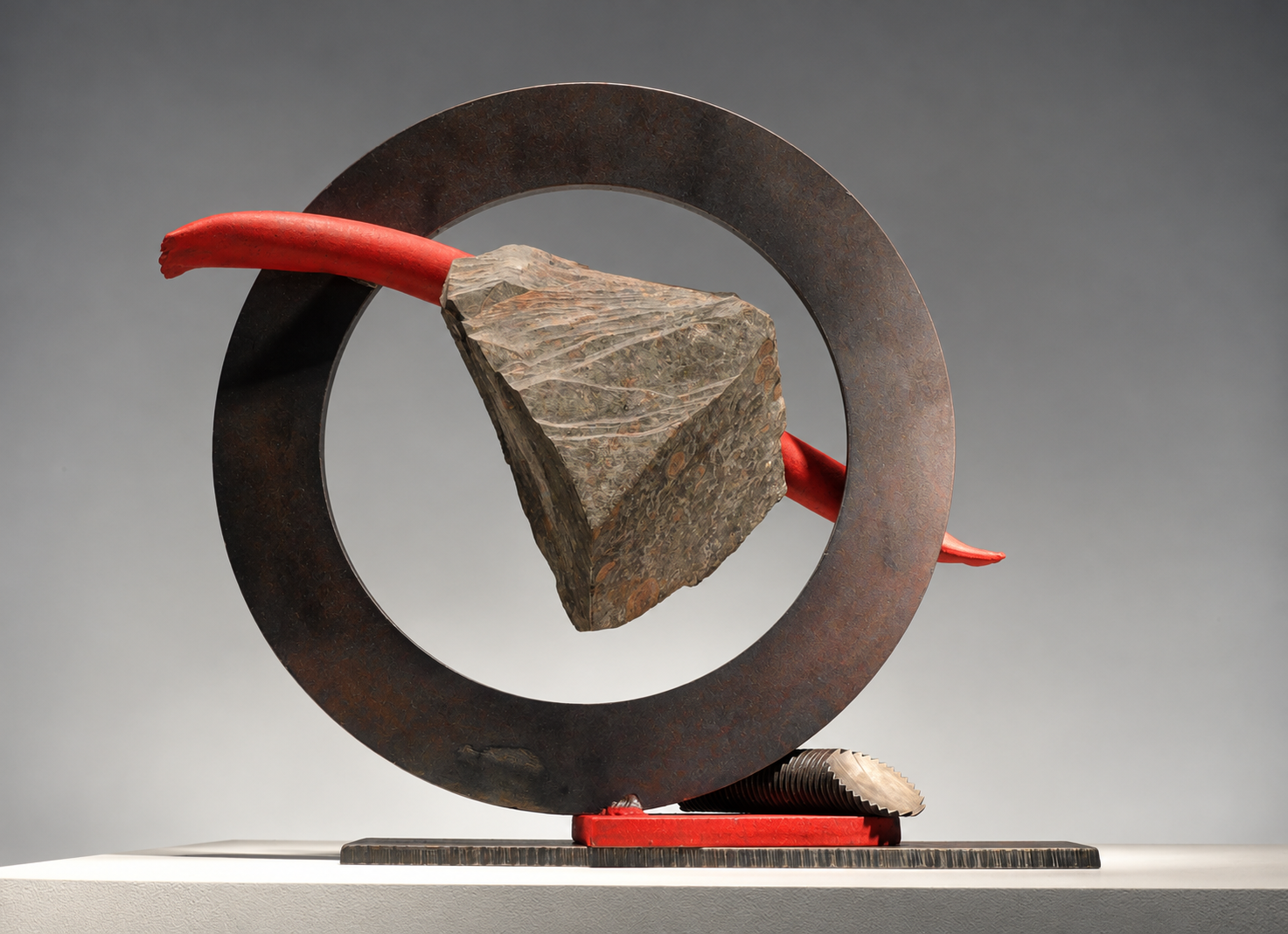
November 2010. Slate, pigmented and sealed steel. Dimensions: 21.5 × 23 × 8 in (55 × 58 × 20 cm).
The Sisyphean Series
The Greek myth of Sisyphus, condemned to endlessly push a boulder uphill, has inspired more than 250 of my sculptures. Rather than seeing the myth as a symbol of futility, I share philosopher Albert Camus’s more positive interpretation—that meaning and fulfillment can be found in the struggle itself. In many ways, I see Sisyphus as autobiographical, reflecting my lifelong pursuit as an artist, confronting challenges, taking risks, and finding purpose in the act of creation.
My Sisyphean works bring stone and steel together in precarious yet stable arrangements, often incorporating circular forms suggesting perpetual motion. For me, they are metaphors for the creative process—an ongoing cycle of experimentation, discovery, setbacks, and renewal. Each completed sculpture is both an achievement and a starting point, celebrating the journey rather than simply the destination.
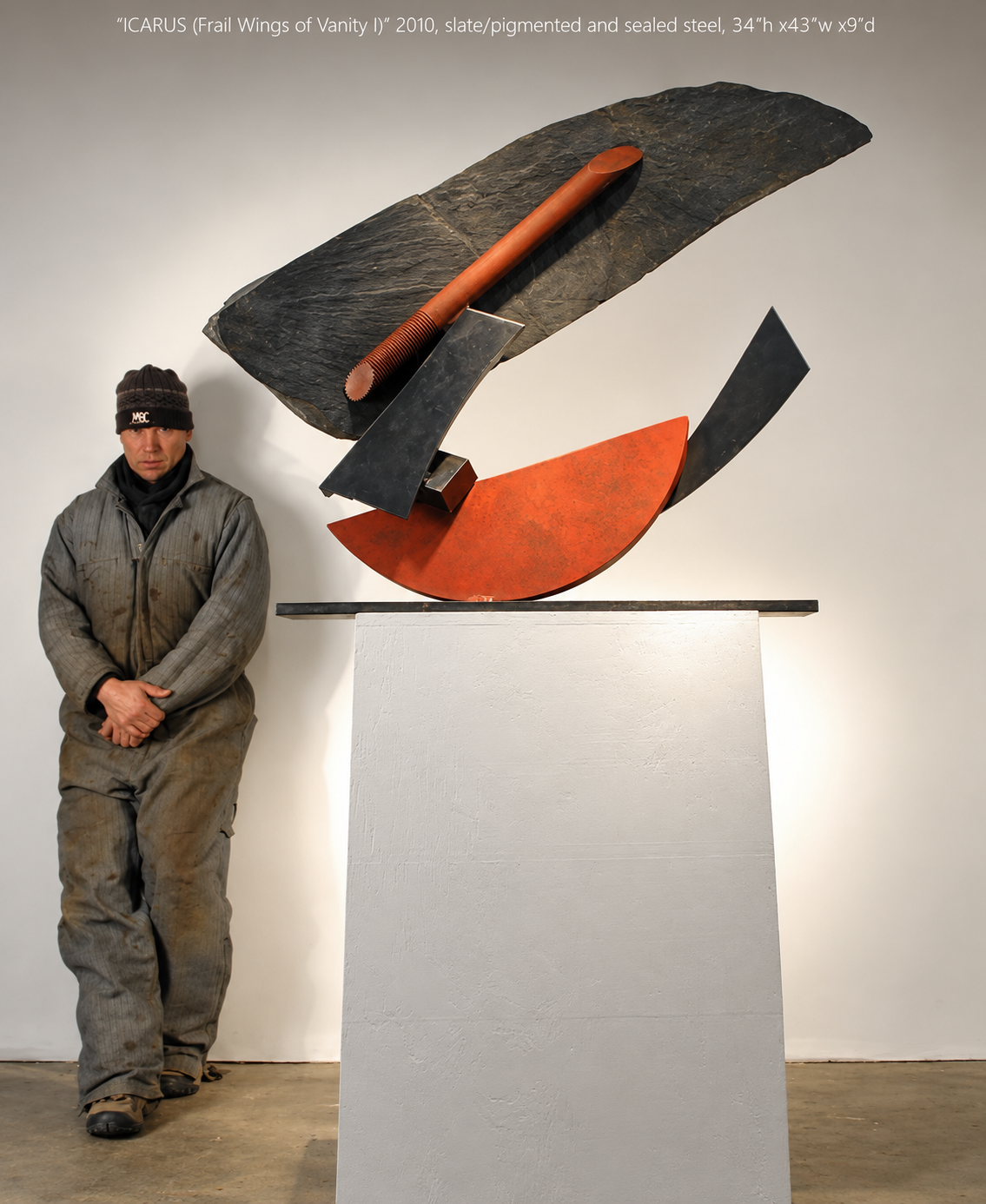
March 2010. Slate, pigmented and sealed steel. Dimensions: 34 × 43 × 9 in (86 × 109 × 23 cm).
Icarus – Frail Wings of Vanity (2010)
Icarus – Frail Wings of Vanity draws on the Greek myth of Icarus, whose ambition and disregard for his father's warnings led him to fly too close to the sun, melting his wings and sending him crashing into the sea. The myth serves as a metaphor for human ambition, hubris, and the often precarious relationship between aspiration and consequence.
The sculpture combines a massive, wing-like slab of slate with industrial steel elements, suspended above a curved, vessel-like form. The dramatic imbalance suggests both the exhilaration of flight and the inevitability of a fall. Through the interplay of weight, balance, and arrested motion, the work explores the fragile boundary between human achievement and overreaching ambition.
2000’s
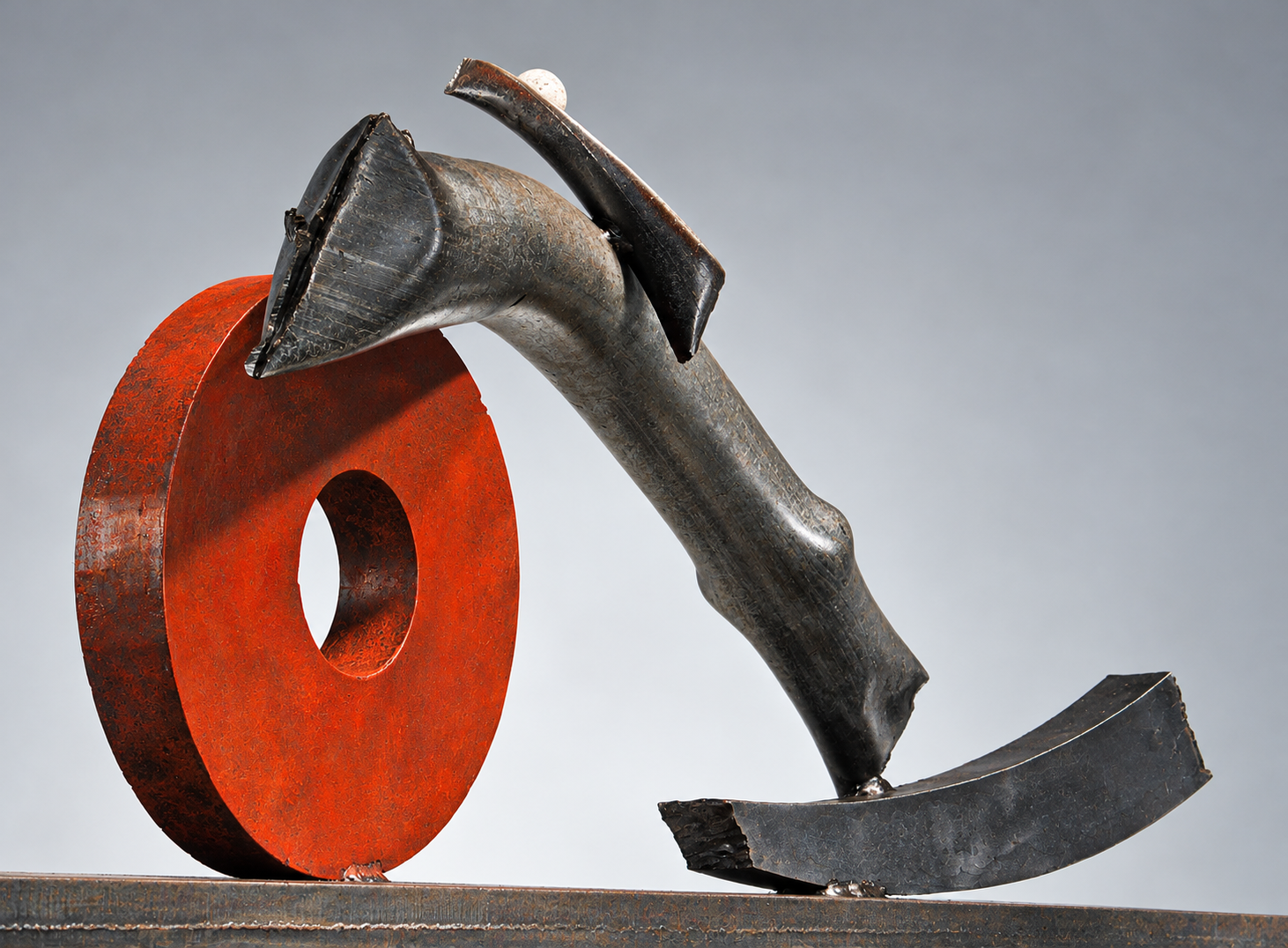
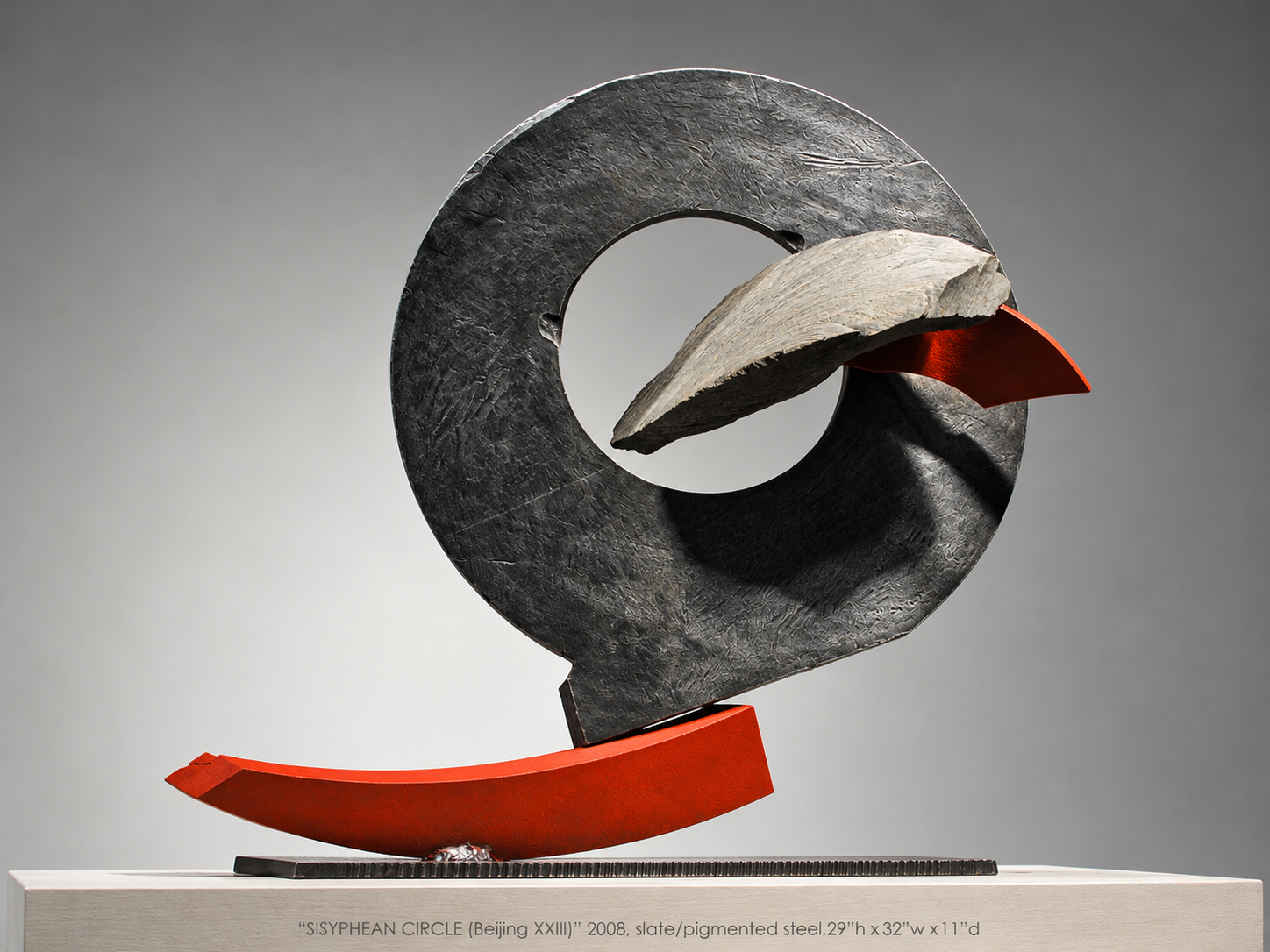
December 2008. Slate, pigmented steel. Dimensions: 29 × 32 × 11 in (74 × 81 × 28 cm).
The Sisyphean Series
The Greek myth of Sisyphus, condemned to endlessly push a boulder uphill, has inspired more than 250 of my sculptures. Rather than seeing the myth as a symbol of futility, I share philosopher Albert Camus’s more positive interpretation—that meaning and fulfillment can be found in the struggle itself. In many ways, I see Sisyphus as autobiographical, reflecting my lifelong pursuit as an artist, confronting challenges, taking risks, and finding purpose in the act of creation.
My Sisyphean works bring stone and steel together in precarious yet stable arrangements, often incorporating circular forms suggesting perpetual motion. For me, they are metaphors for the creative process—an ongoing cycle of experimentation, discovery, setbacks, and renewal. Each completed sculpture is both an achievement and a starting point, celebrating the journey rather than simply the destination.
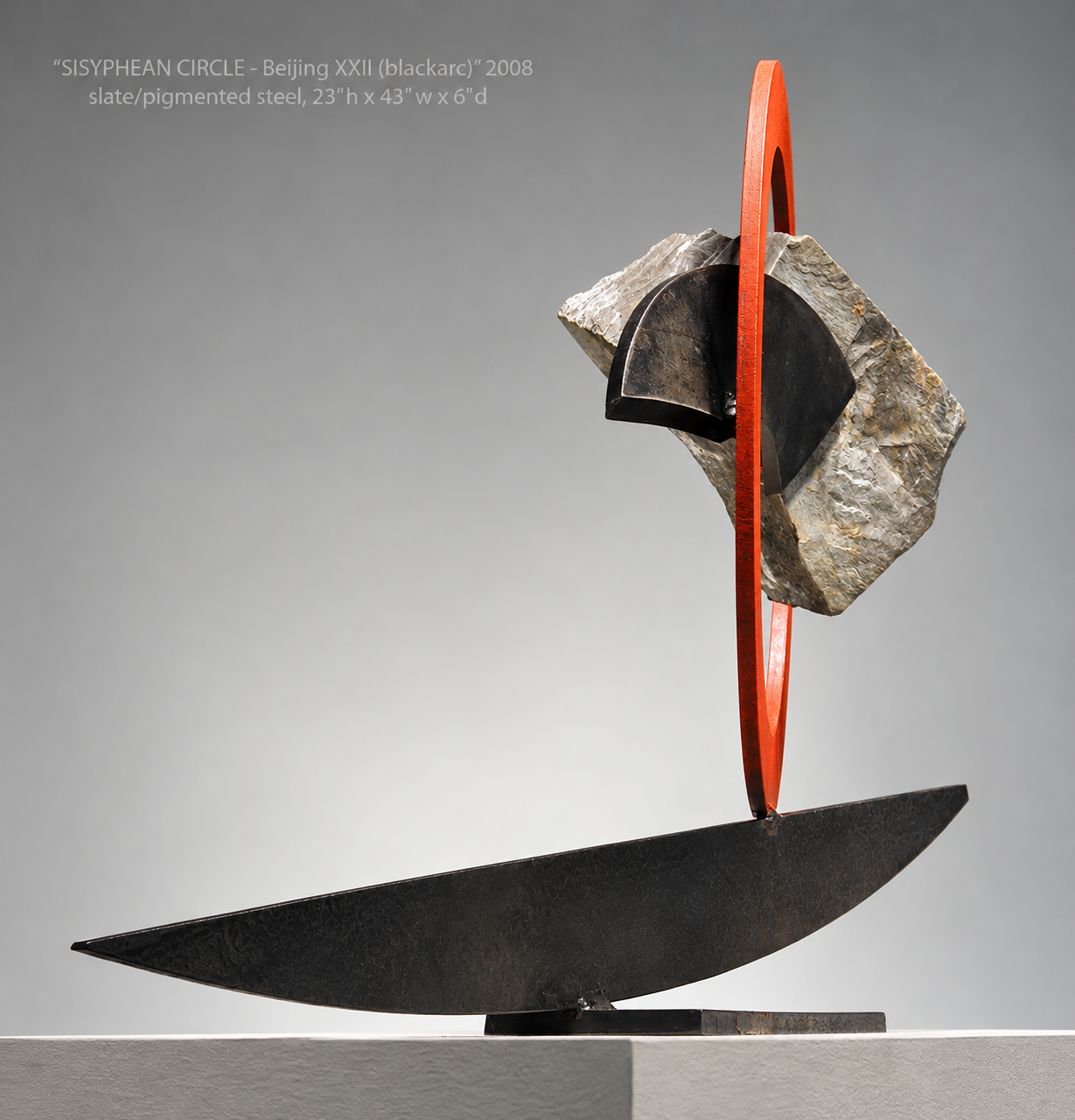
November 2008. Slate, pigmented steel. Dimensions: 23 × 43 × 6 in (58 × 109 × 15 cm).
The Sisyphean Series
The Greek myth of Sisyphus, condemned to endlessly push a boulder uphill, has inspired more than 250 of my sculptures. Rather than seeing the myth as a symbol of futility, I share philosopher Albert Camus’s more positive interpretation—that meaning and fulfillment can be found in the struggle itself. In many ways, I see Sisyphus as autobiographical, reflecting my lifelong pursuit as an artist, confronting challenges, taking risks, and finding purpose in the act of creation.
My Sisyphean works bring stone and steel together in precarious yet stable arrangements, often incorporating circular forms suggesting perpetual motion. For me, they are metaphors for the creative process—an ongoing cycle of experimentation, discovery, setbacks, and renewal. Each completed sculpture is both an achievement and a starting point, celebrating the journey rather than simply the destination.
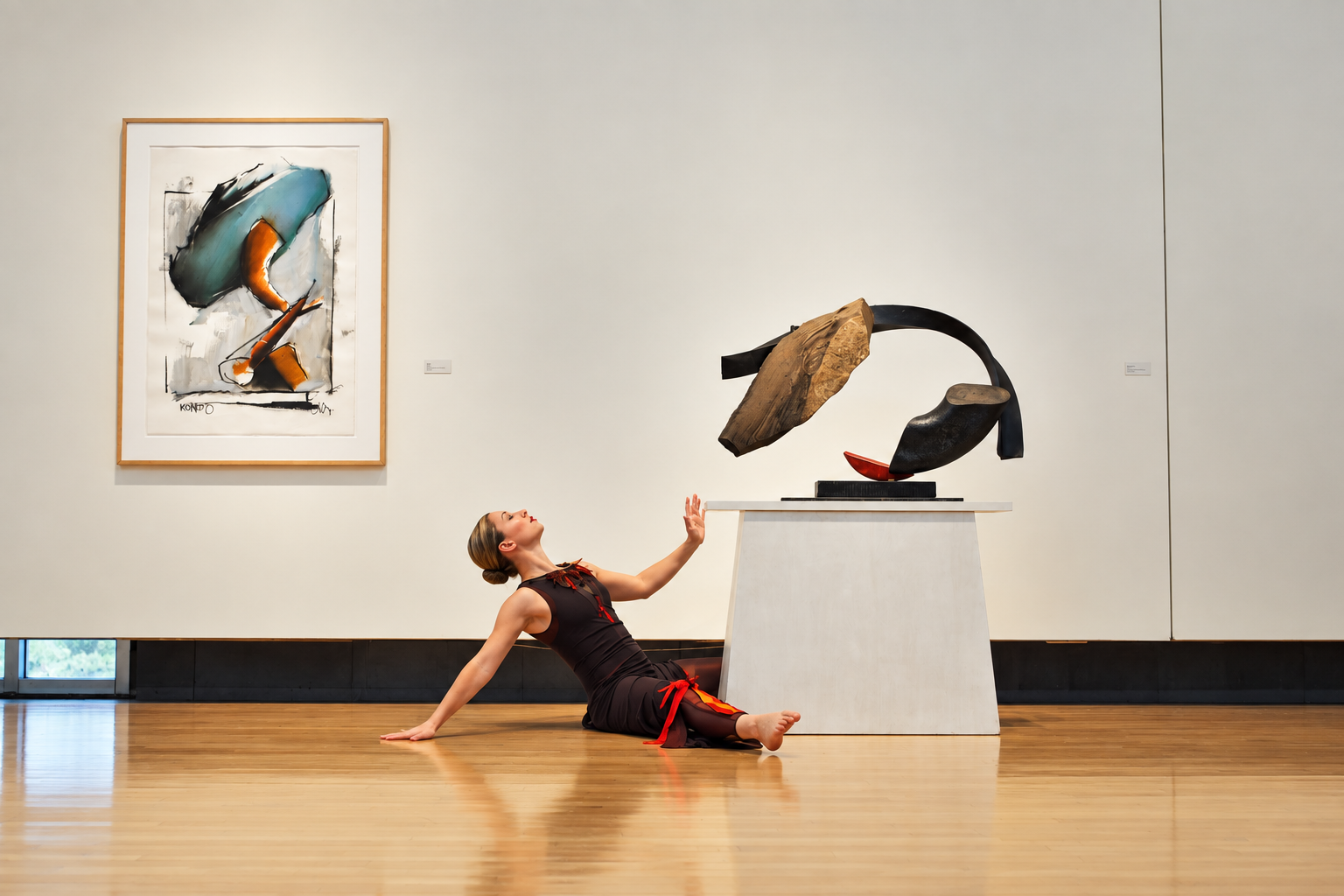
November 2007. Slate, pigmented and sealed steel. Dimensions: 27 × 40 × 12 in (69 × 102 × 30 cm).
Sidewinder ’07, 2007
Sidewinder ’07 returns to a sculptural idea I first explored more than two decades earlier, bringing the circular movement of the Sidewinder Series into a more fluid and expressive configuration. A broad arc of steel sweeps between contrasting forms of slate and steel, creating a strong sense of weight, balance, and suspended motion. The rough, layered character of the slate is set against the dark curved steel, while the small rust-colored element at the base introduces a sharp visual accent.
Created in 2007, the sculpture demonstrates my continuing interest in revisiting earlier ideas rather than considering them exhausted by a particular period or series. Sidewinder ’07 was exhibited in my 2008 solo exhibition at Gerald Peters Gallery in Santa Fe. As of 2026, the work remains available.
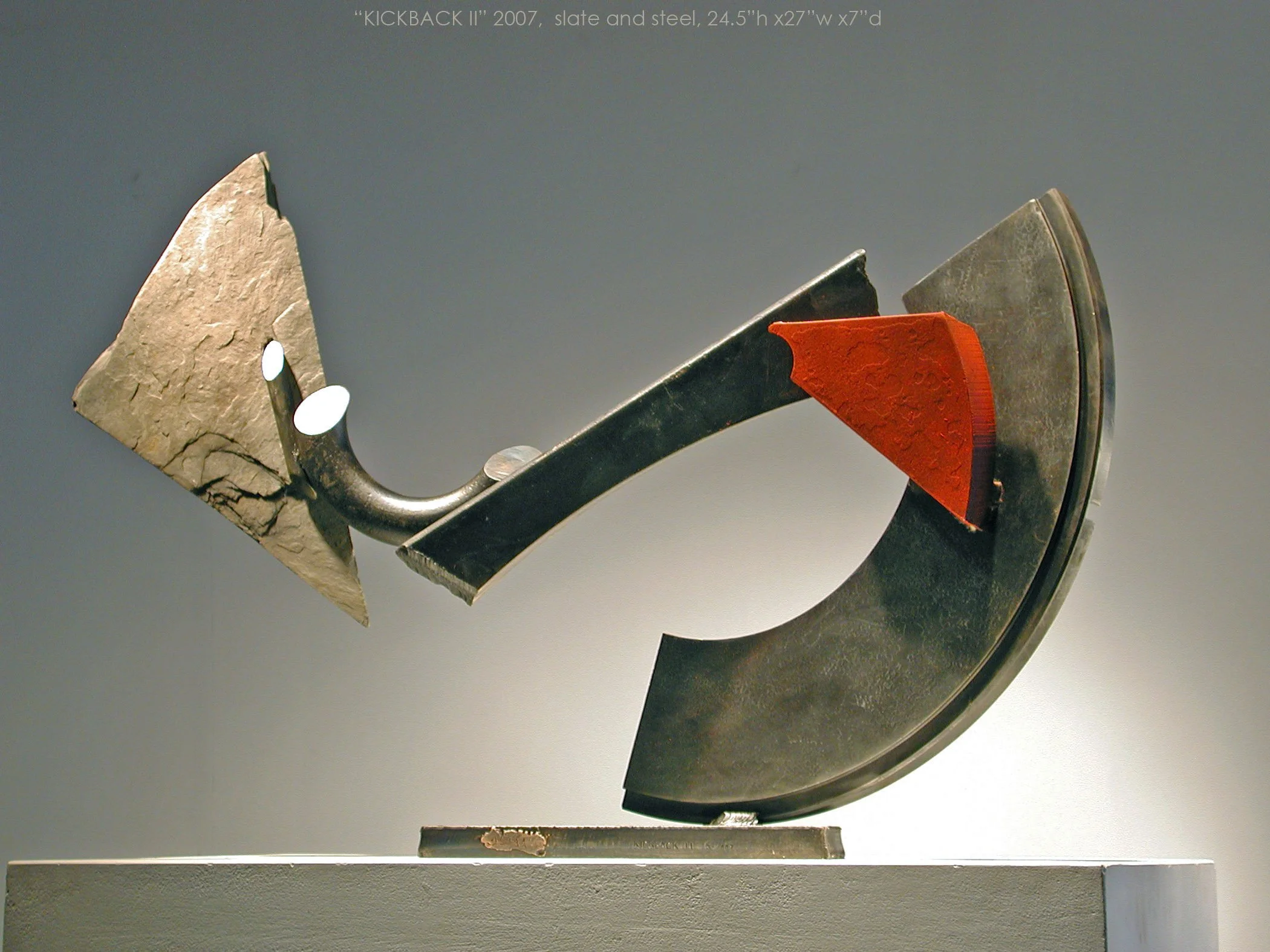
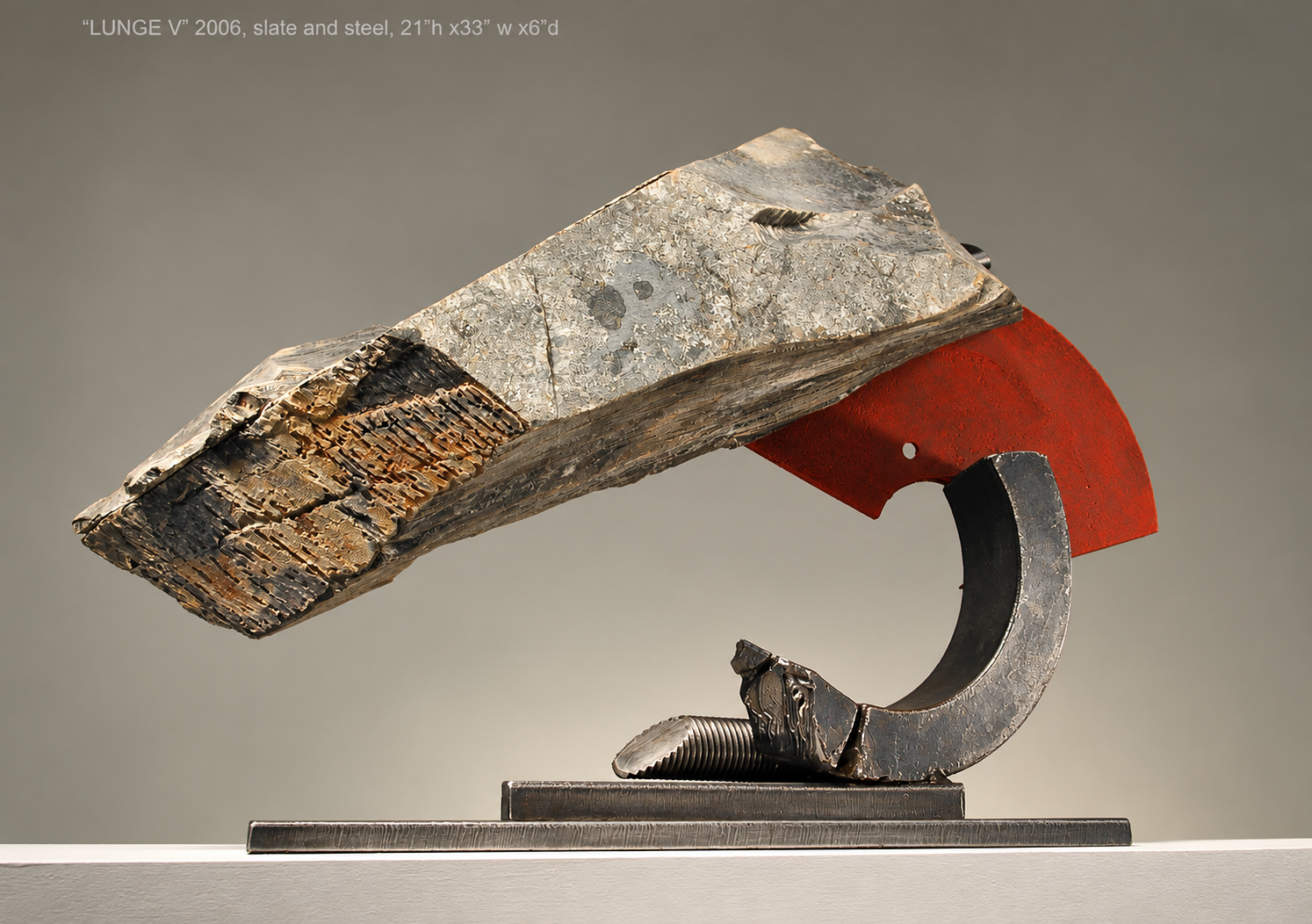
November 2006. Slate, steel. Dimensions: 21 × 33 × 6 in (53 × 84 × 15 cm).
The Lunge series explores implied movement and gesture through an abstract sculptural language. The title Lunge suggests a sudden extension of the body—a reaching, thrusting, or shifting of weight that gives the sculpture a sense of physical momentum and directed energy.
While not figurative in a literal sense, the work draws on my interest in the expressiveness of the human figure. Its balance, tension, and spatial gesture suggest a body caught in motion, allowing the sculpture to convey a human presence through posture and movement rather than recognizable form.
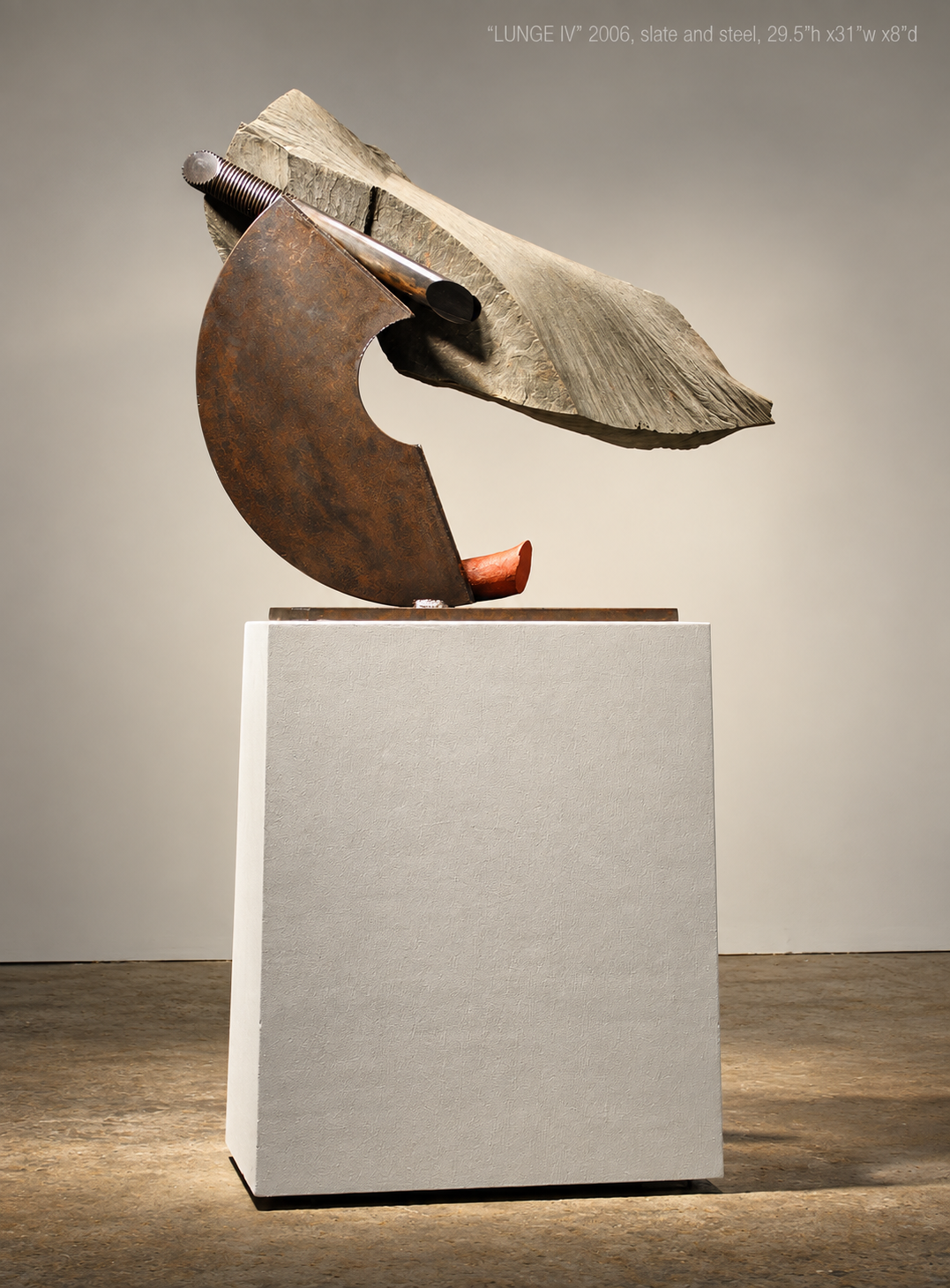
November 2006. Slate, pigmented steel. Dimensions: 29.5 × 31 × 8 in (75 × 79 × 20 cm).
The Lunge series explores implied movement and gesture through an abstract sculptural language. The title Lunge suggests a sudden extension of the body—a reaching, thrusting, or shifting of weight that gives the sculpture a sense of physical momentum and directed energy.
While not figurative in a literal sense, the work draws on my interest in the expressiveness of the human figure. Its balance, tension, and spatial gesture suggest a body caught in motion, allowing the sculpture to convey a human presence through posture and movement rather than recognizable form.
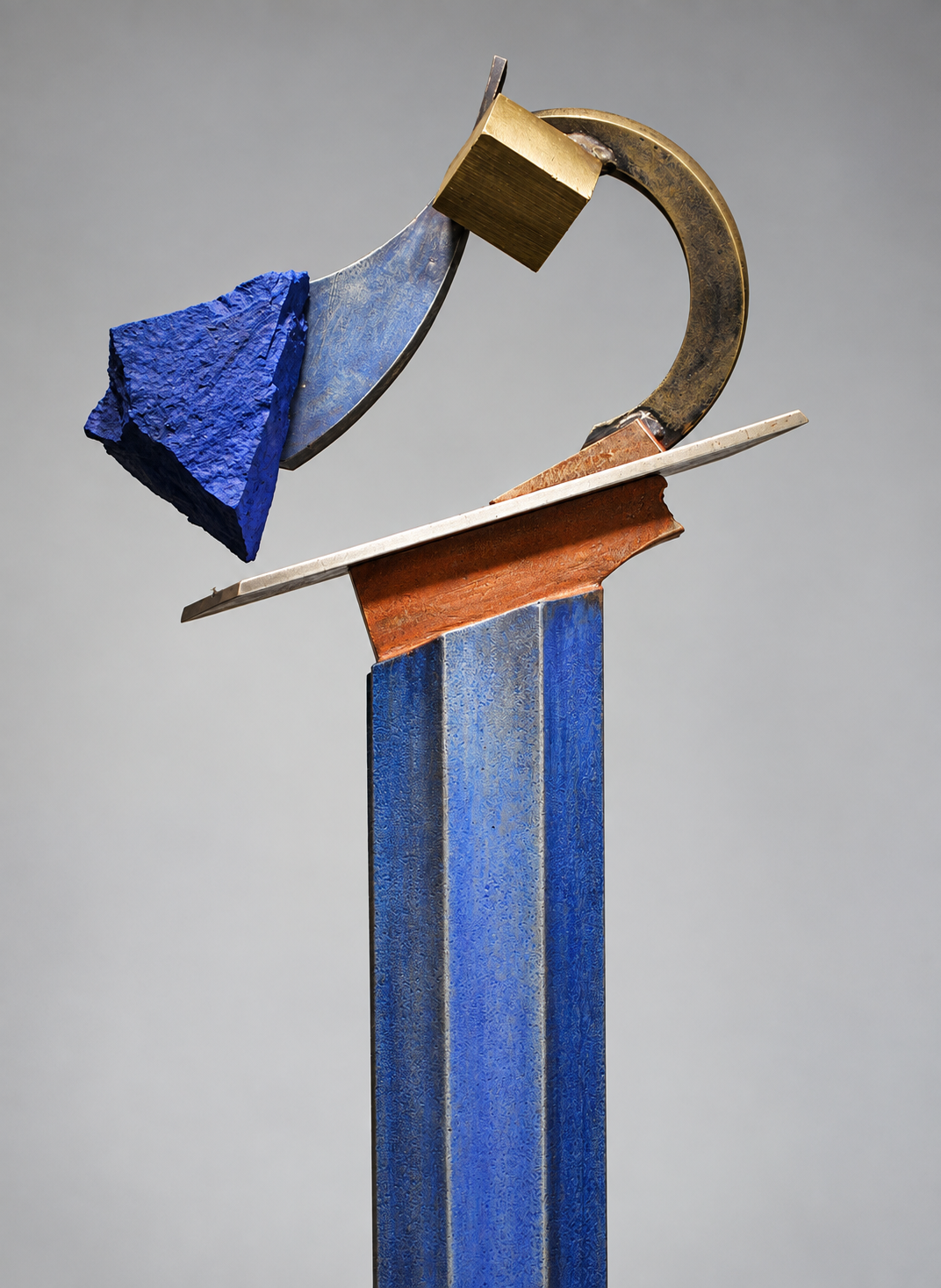
December 2003. Oil enamel on stone and steel. Dimensions: 84 × 31 × 18 in (213 × 79 × 46 cm).
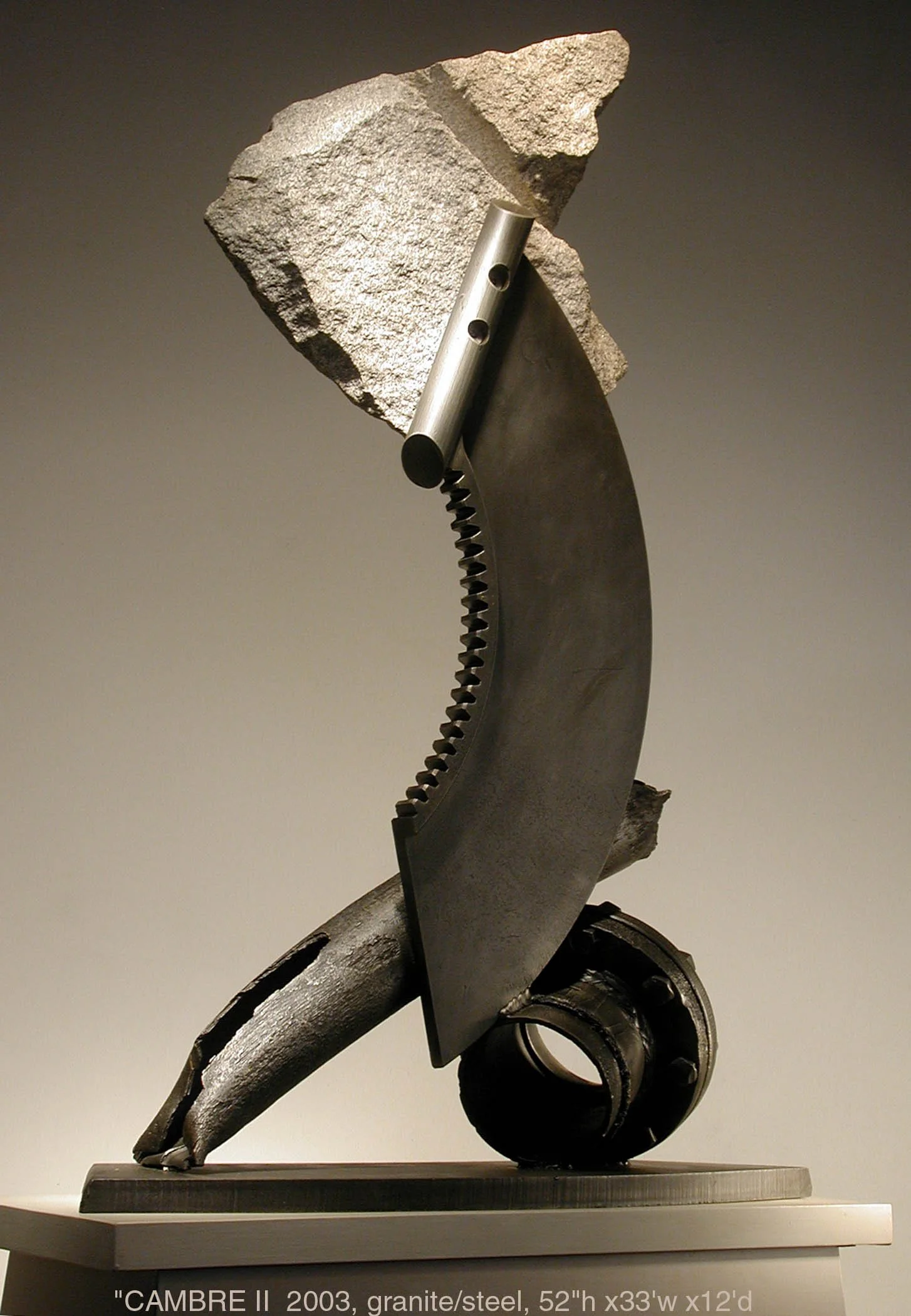
December 2003. Granite, steel. Dimensions: 52 × 33 × 14 in (132 × 84 × 36 cm).
Cambre II takes its title from the classical ballet term cambré, meaning “arched”—a movement in which the body bends from the waist, with the head following. The sculpture translates this gesture into granite and steel, its sweeping form bending upward while supporting the massive stone in a seemingly precarious position.
The work reflects my interest in the connections between artistic disciplines, particularly sculpture and dance. By “choreographing” the typically earthbound materials of stone and steel through balance, tension, and arrested motion, I seek to transform their physical weight into a sense of gesture and movement.
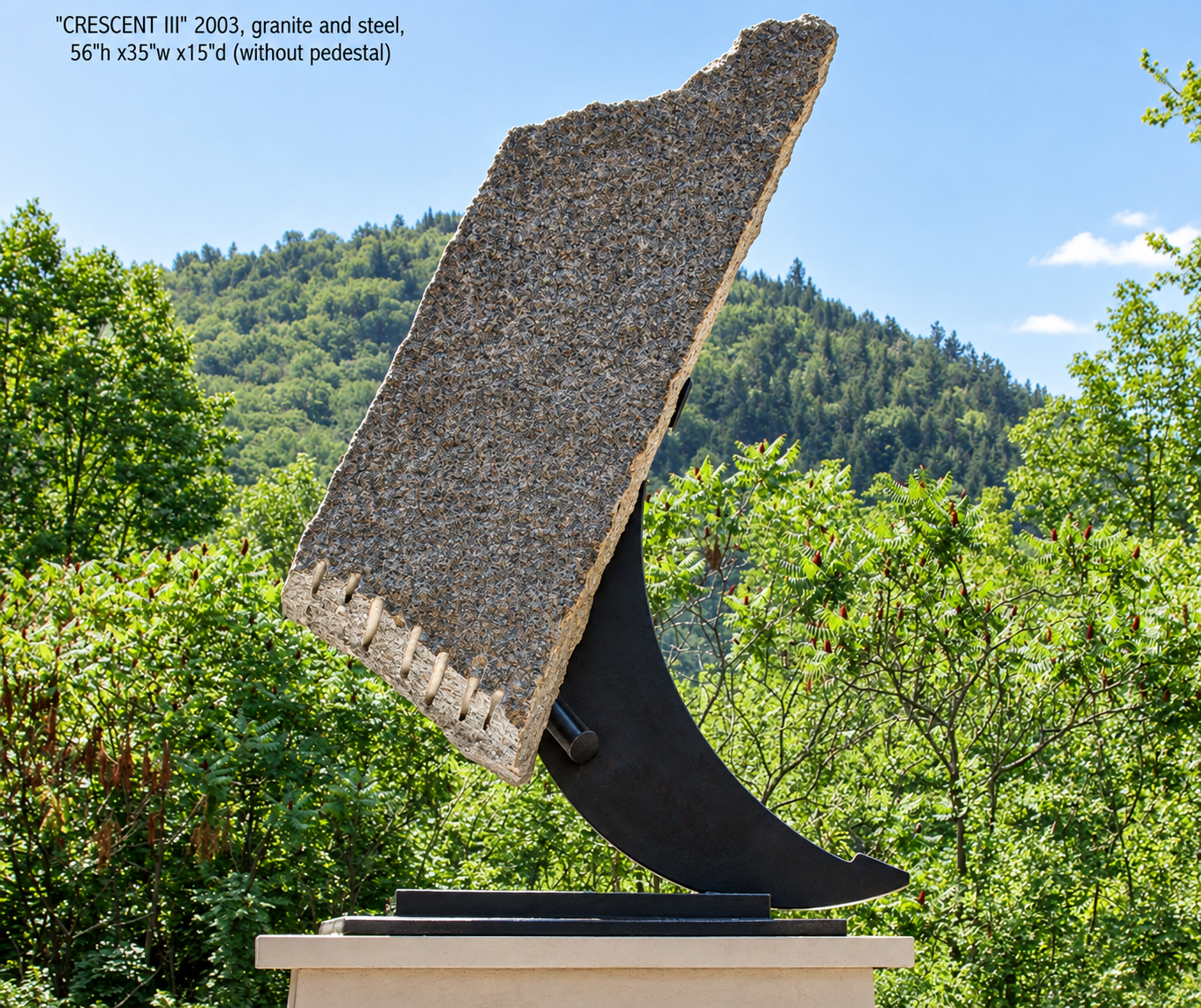
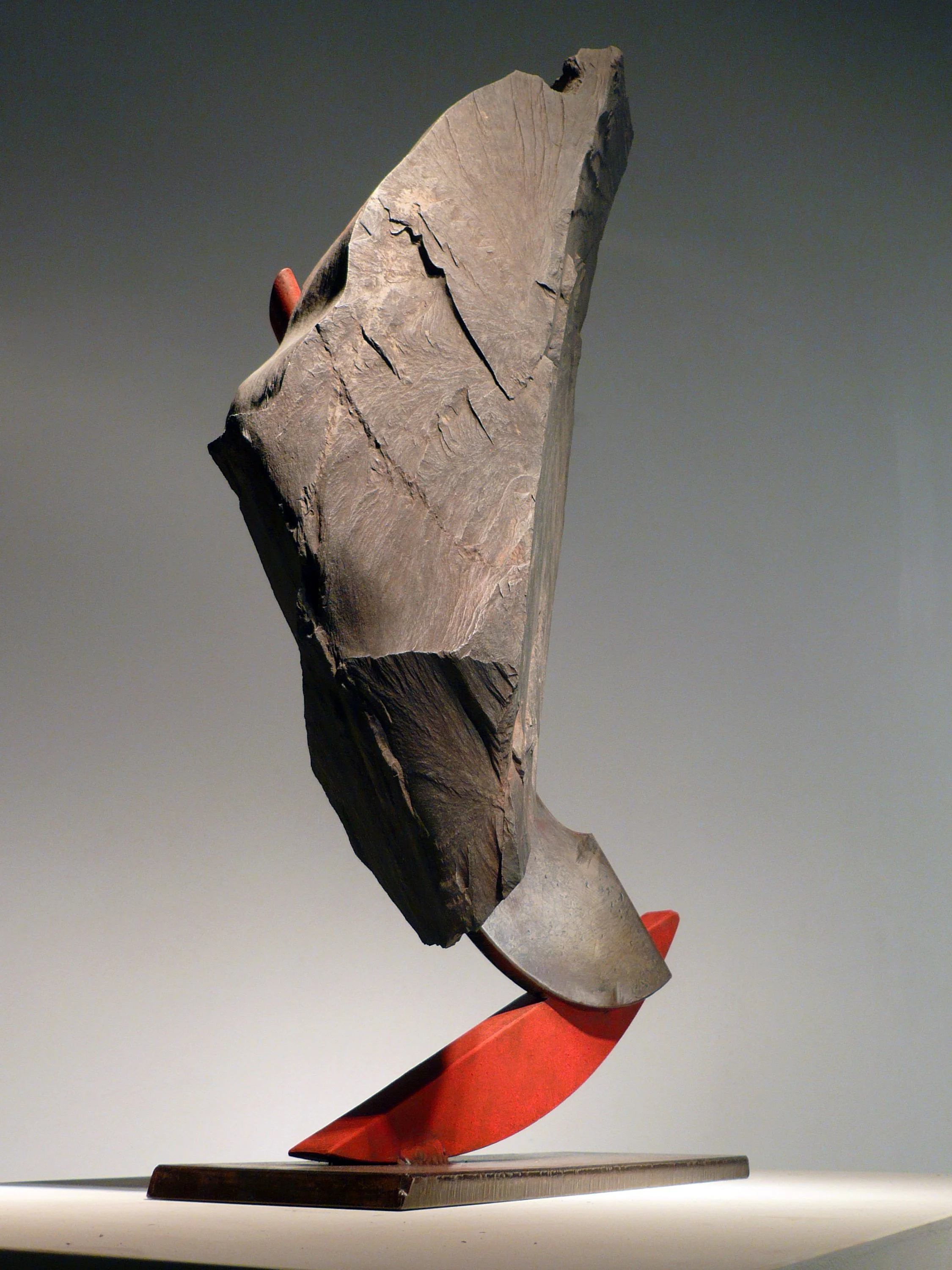
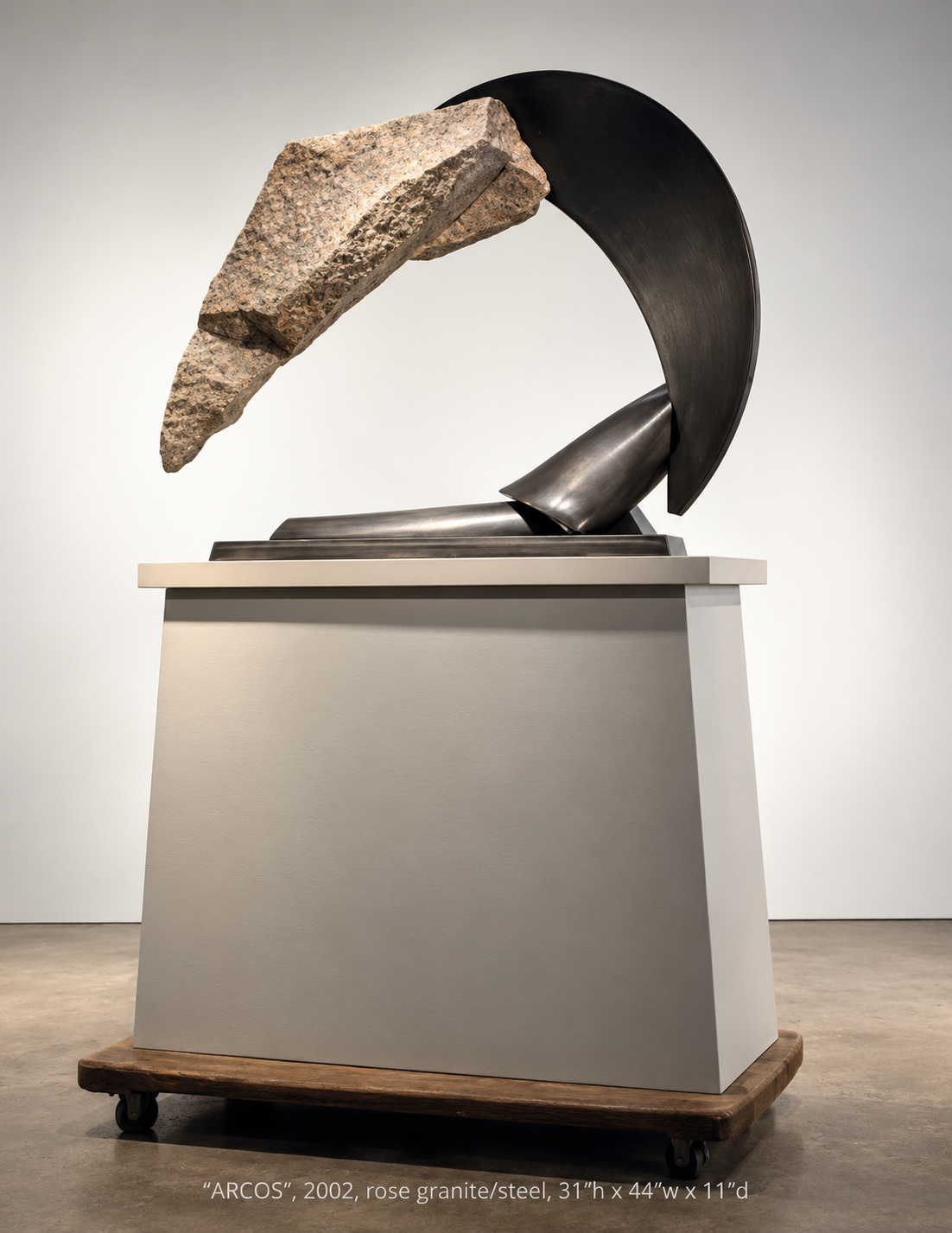
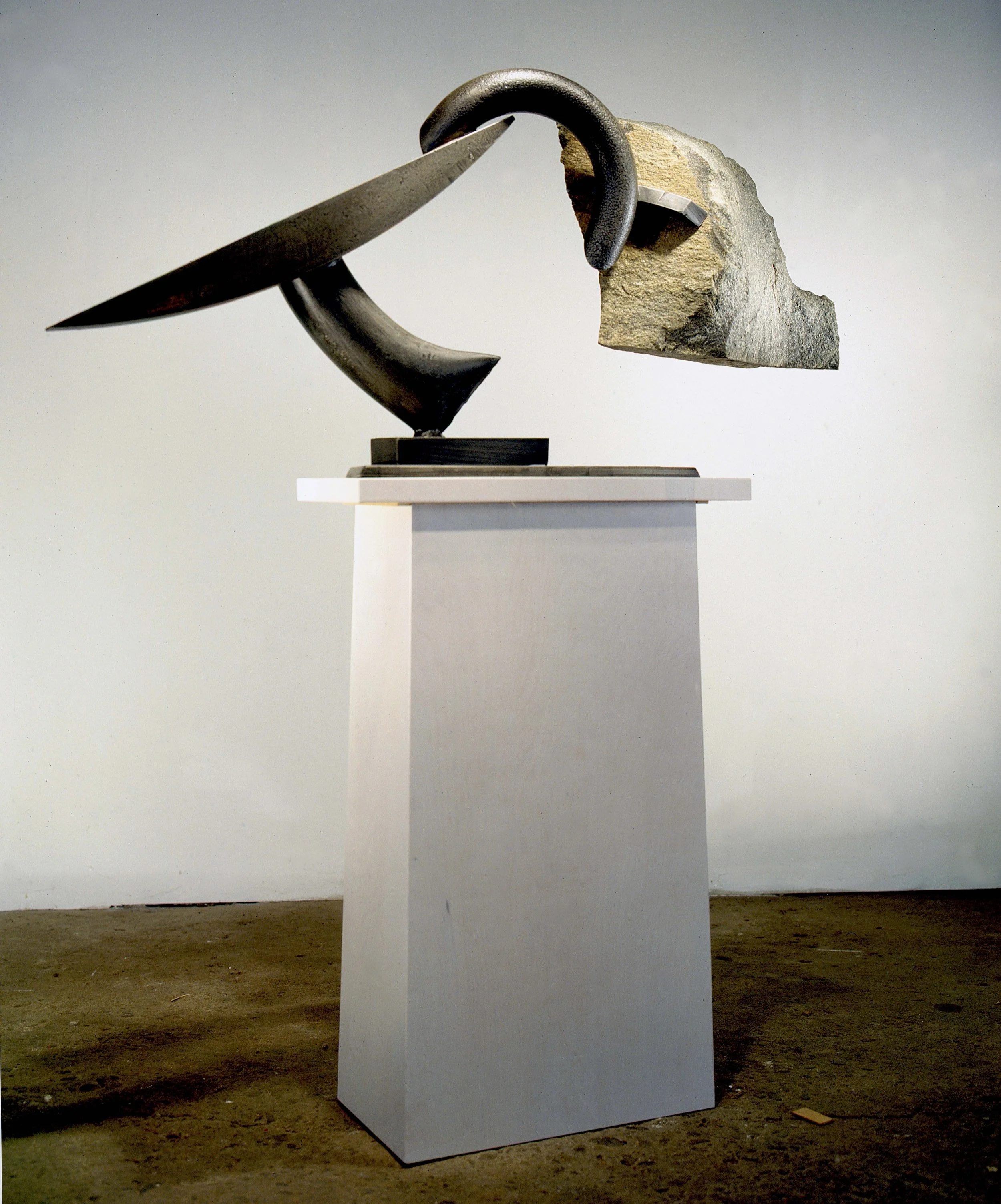
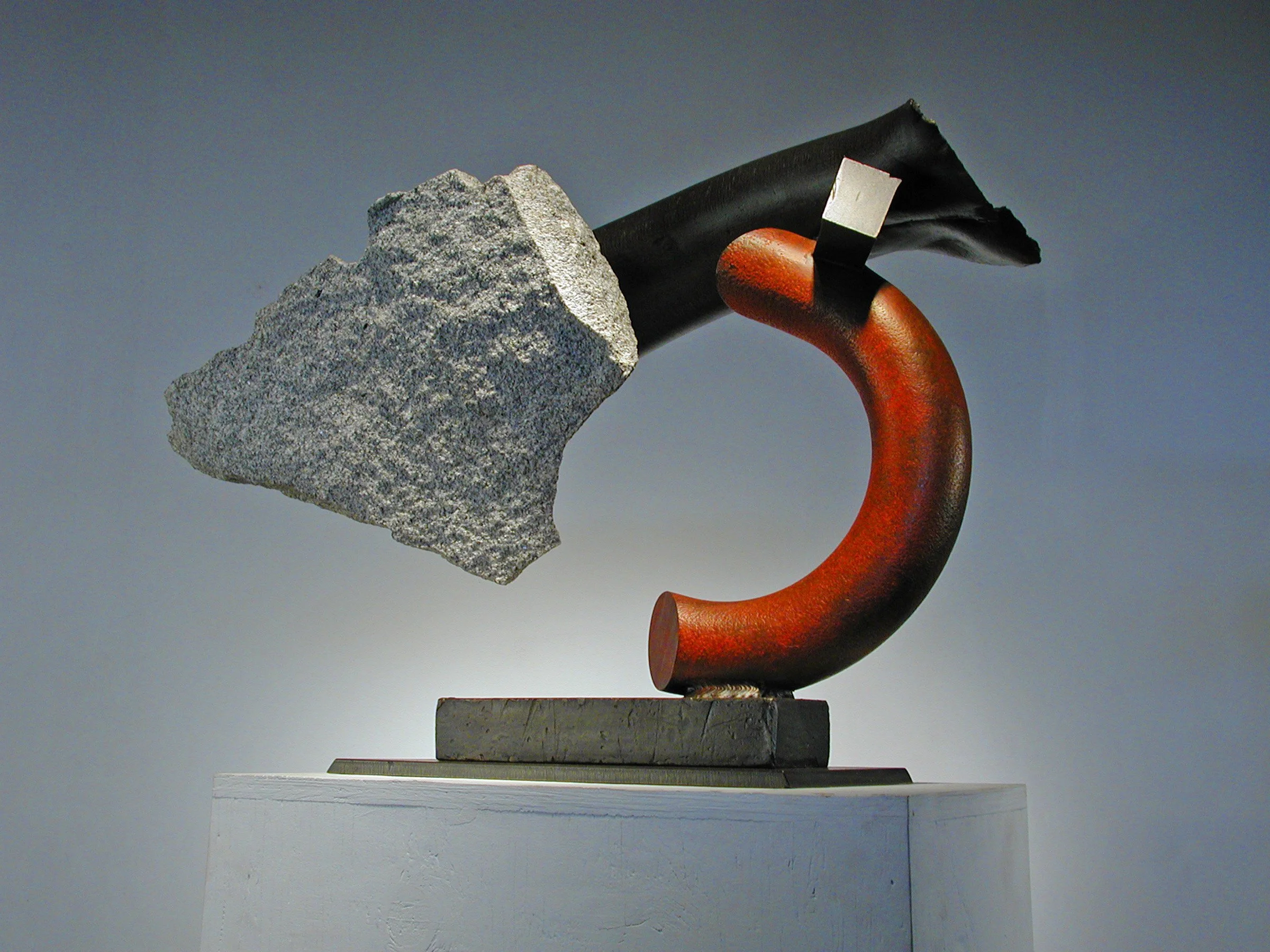
March 2002. Granite, steel. Dimensions: 21 × 31 × 9 in (53 × 79 × 23 cm).
Sa*git"ta, n. [L., an arrow.] 1. (Astron.) A small constellation north of Aquila; the Arrow.
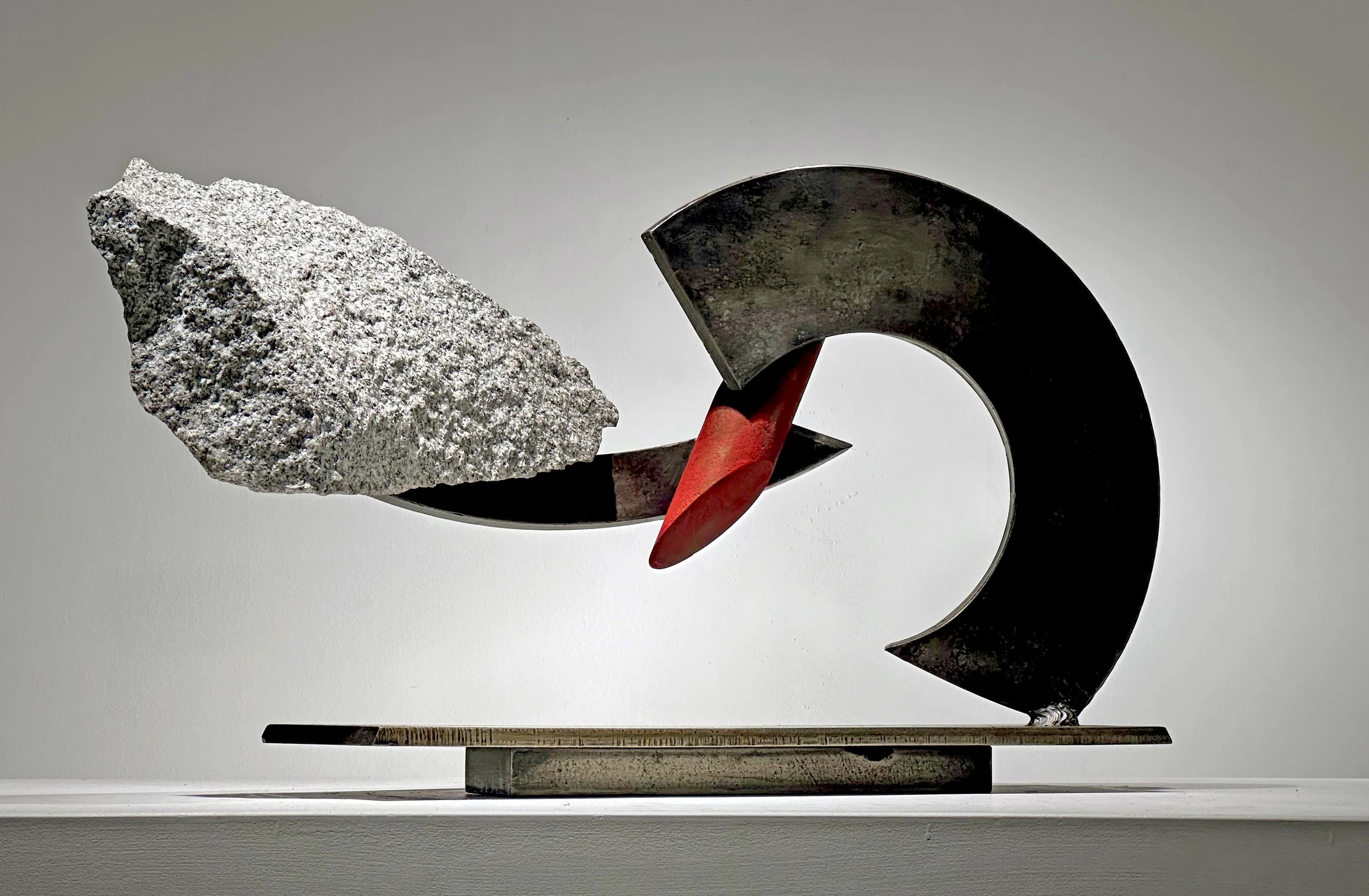
January 2002. Granite, steel. Dimensions: 13.5 × 24 × 6 in (34 × 61 × 15 cm).
Private collection
Planche, 2002
Taking its title from the gymnastic planche—a horizontal handstand in which the body appears suspended against gravity—Planche exemplifies John Van Alstine’s exploration of the implied human figure. Rather than depicting the body literally, Van Alstine translates its physical dynamics into stone and steel. Weight, extension, tension, balance, and counterbalance transform the sculpture into a kind of arrested gesture. Like the gymnast, whose apparent stillness depends upon extraordinary exertion, the work suggests movement held momentarily in equilibrium. Throughout Van Alstine’s sculpture, references to dance, gymnastics, and fencing provide a vocabulary for this choreography of materials: granite assumes the weight and gravitational presence of the body, while steel extends, braces, pivots, and reaches. Planche thus occupies a space between abstraction and figuration, inviting the viewer to experience sculpture not simply as an arrangement of materials, but as a body negotiating gravity.
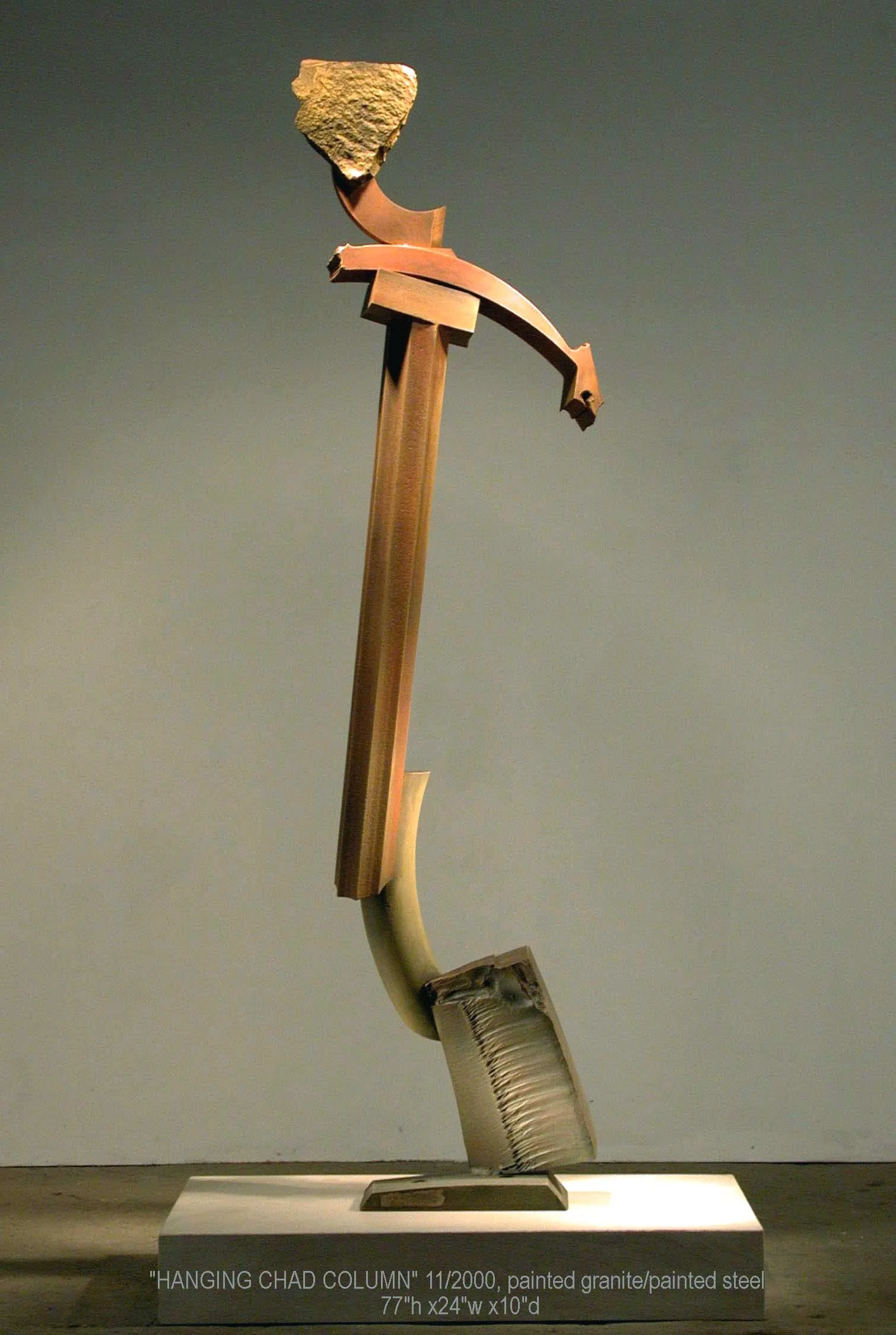
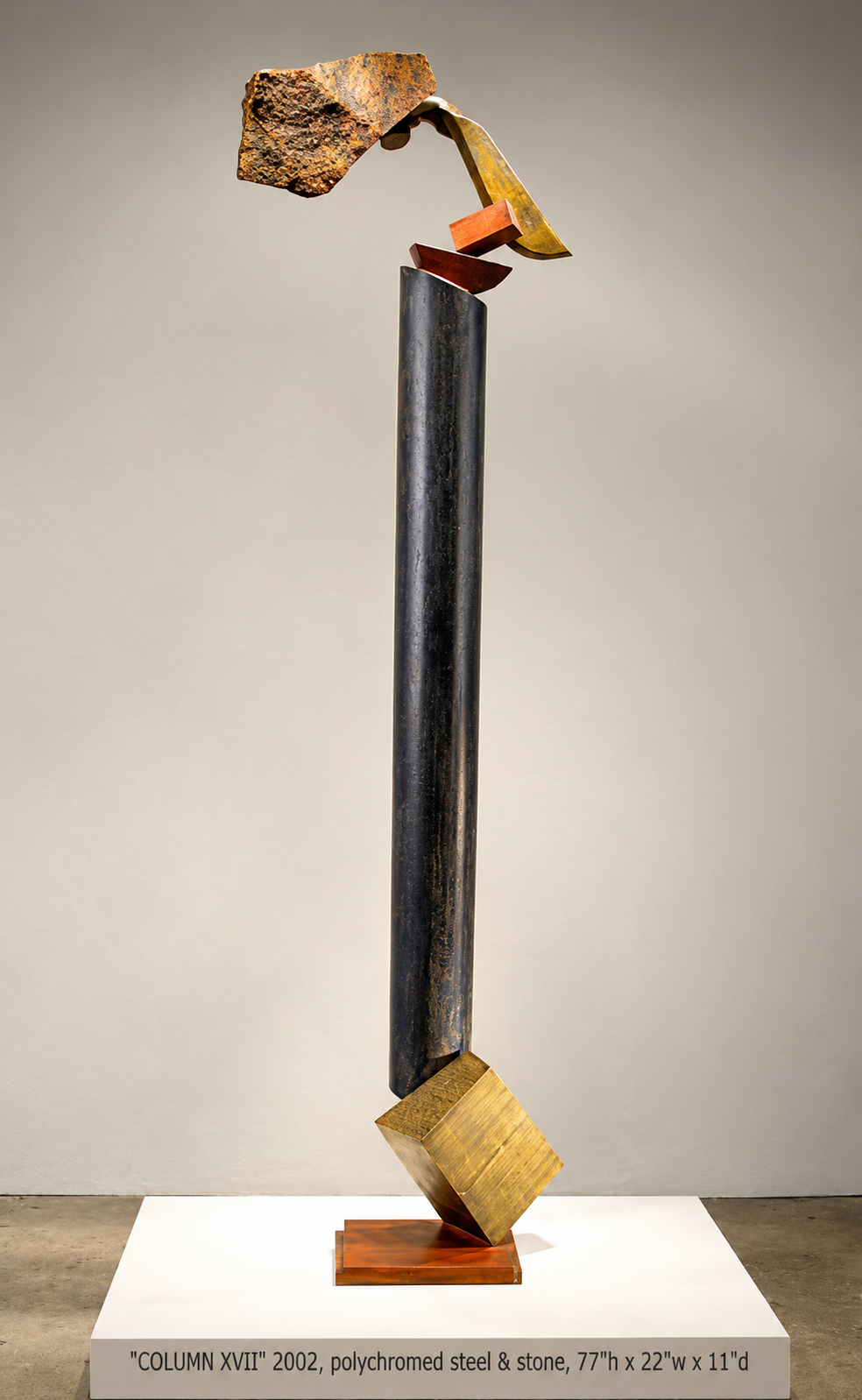
November 2000. Enamel on granite and steel. Dimensions: 77 × 24 × 10 in (196 × 61 × 25 cm).
Hanging Chad Column, 2000
Hanging Chad Column is part of a series of human-scale columns from this period combining painted stone and painted steel. The vertical structure becomes almost figure-like, with the stone and projecting steel elements creating a precarious sense of balance and gesture. The work dates to November 2000 and measures 77 × 24 × 10 inches.
The title adds a humorous political reference to the disputed 2000 presidential election between George W. Bush and Al Gore. “Hanging chads”—partially detached pieces of punched voting cards—became emblematic of the contested Florida recount. To the disappointment of many, myself included, the dispute ultimately reached the U.S. Supreme Court in Bush v. Gore, whose December 12 decision effectively ended the recount; Bush subsequently received a majority of the Electoral College votes.
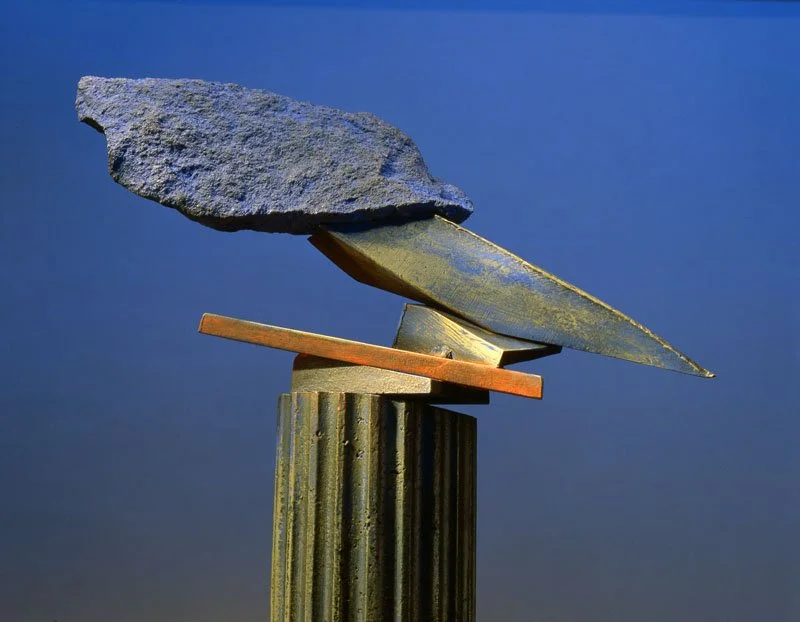
April 2000. painted granite and steel/cast iron. Dimensions: 78 × 23 × 21 in (198 × 58 × 53 cm).
1970’s - 1980’s - 1990’s
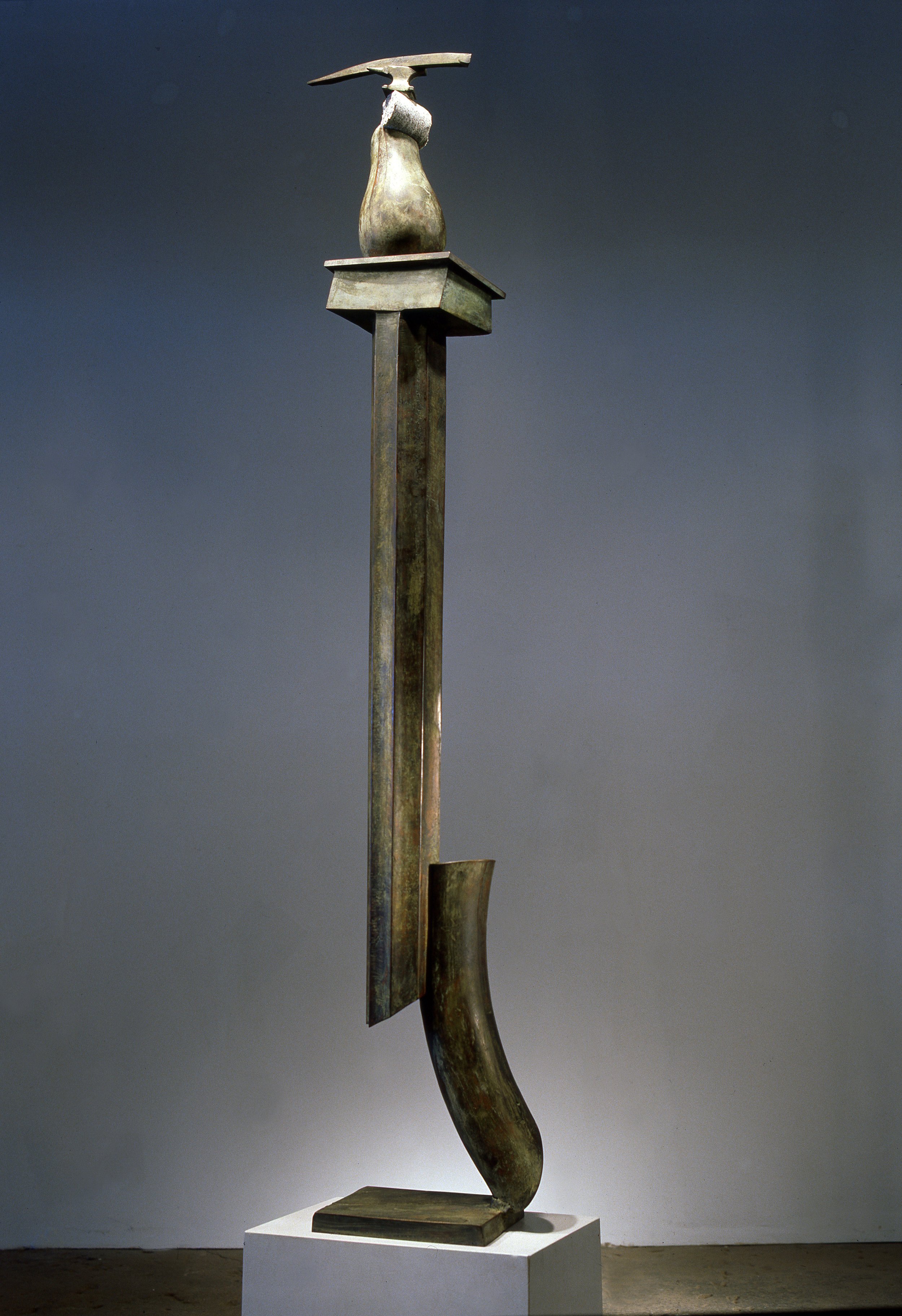
December 1999. Bronze, granite. Dimensions: 65 × 12 × 8 in (165 × 30 × 20 cm).
Private Collection - Philadelphia, PA
Strange Fruit (Ara), 1999
Strange Fruit (Ara) explores the column as a vertical, almost figure-like structure. At its summit, a fruit-like bronze form contrasts with the architectural shaft, while a small anvil seemingly balanced on a stone cylinder brings together recurring interests in tools, weight, and precarious balance.
The anvil—a place where material is literally forged—also serves as a metaphor for creative transformation. Ara, Latin for “altar,” reinforces the work’s ritualistic quality, while elevating this quintessentially heavy object creates an unexpected sense of lightness and suspension.
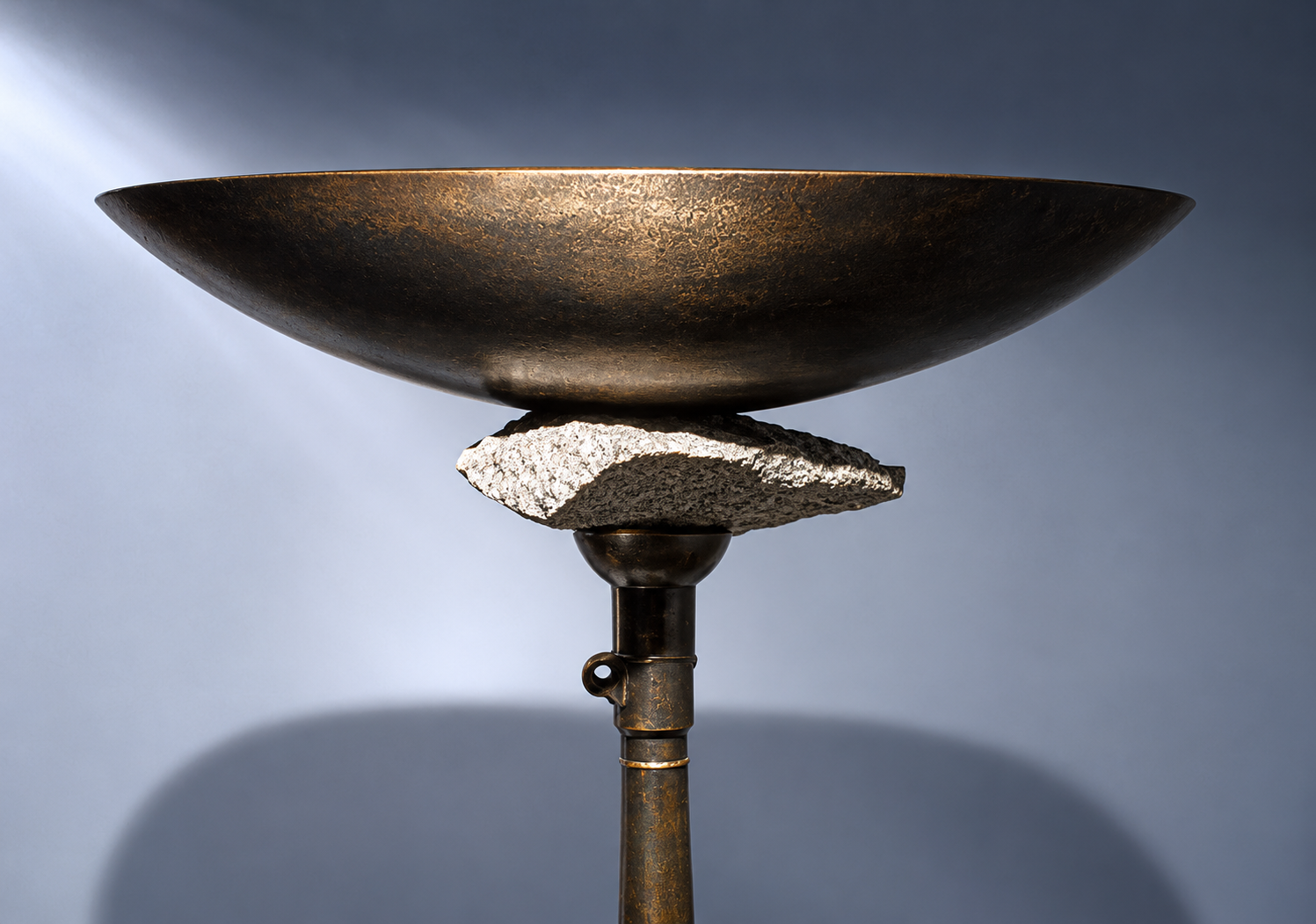
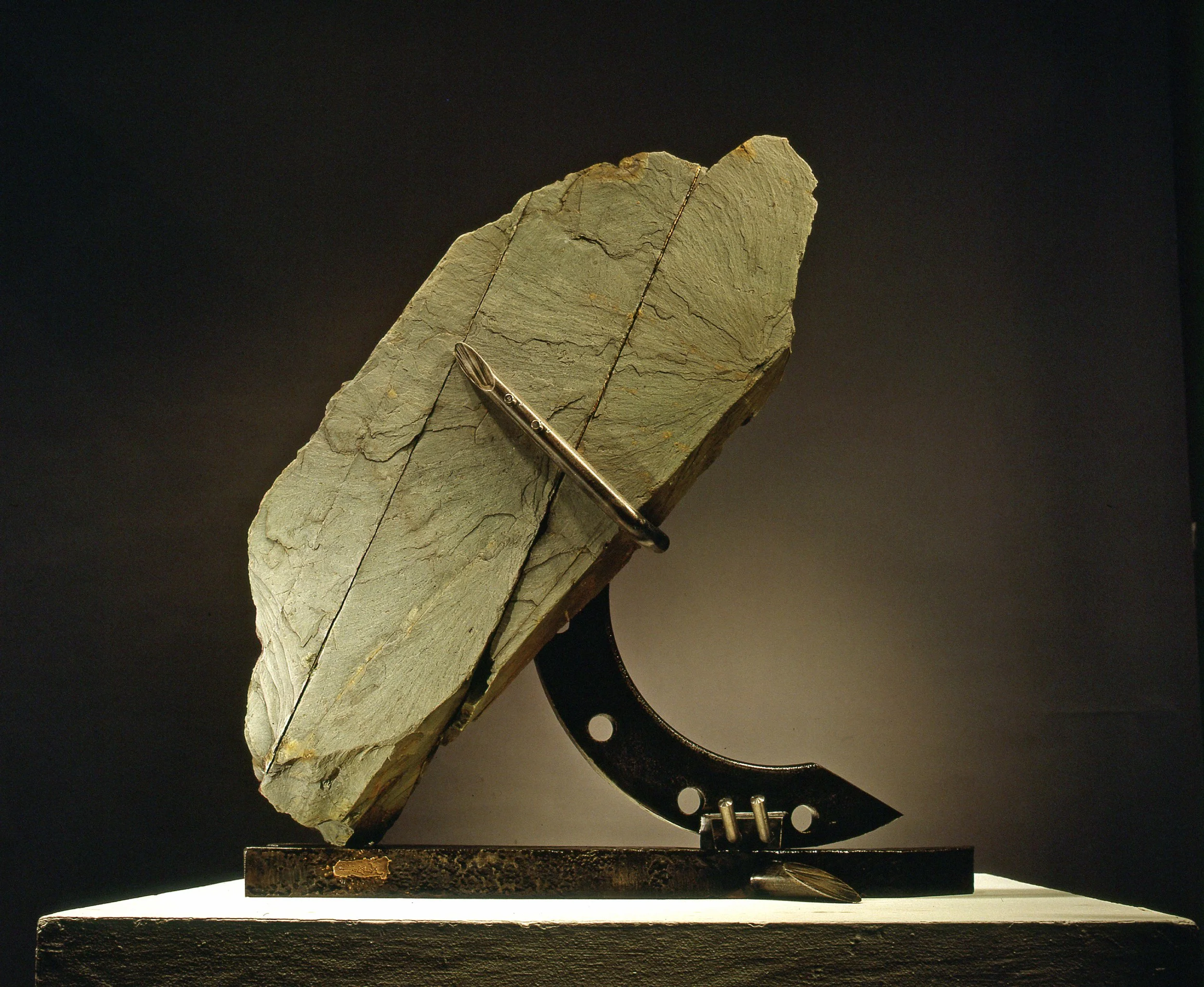
November 1991. Slate, steel. Dimensions: 32 × 31 × 10 in (81 × 79 × 25 cm).
Cudgel II is part of my ongoing exploration of tools and tool-like forms as expressive vehicles. I have always thought of tools as extensions of our hands and, for artists, essential allies in the quest for creating. A cudgel is among the most elemental of these forms—an extension of the arm associated with physical action, strength, and force. In Cudgel II, the combination of slate and steel suggests something that might be grasped, lifted, or swung, giving the sculpture a distinctly human presence.
Tools also connect to my broader interest in movement, balance, gravity, and gesture. Like my references to dance, gymnastics, and fencing, they provide a way to evoke the figure without depicting it literally.
John Van Alstine
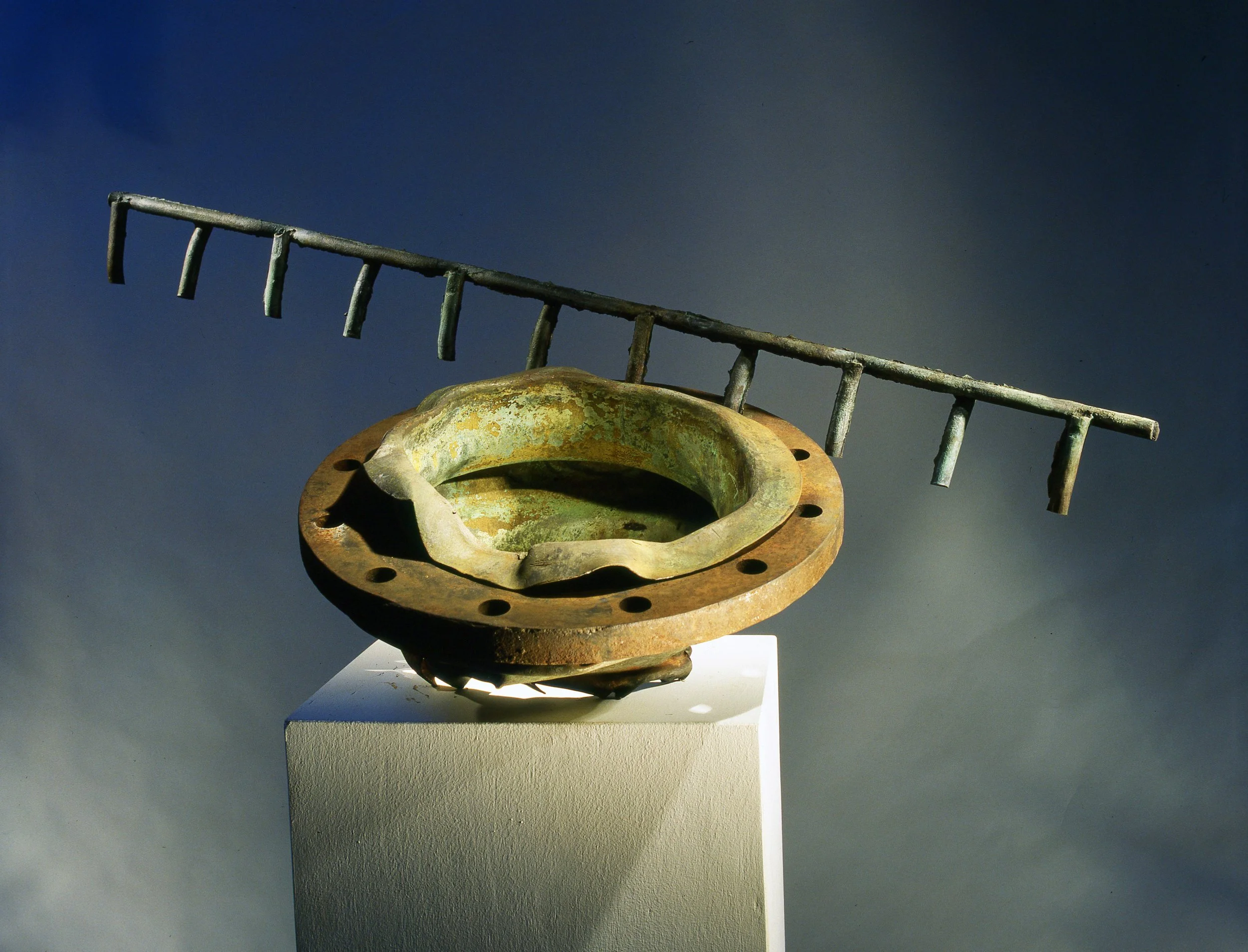
April 1990. Bronze, steel. Dimensions: 29 × 51 × 30 in (74 × 130 × 76 cm).
Nidus is Latin for “nest.” It can also carry related meanings such as a dwelling place, home, birthplace, or place of origin—a place where something is sheltered, formed, or begins.
In this case the sculpture suggests more than a literal nest: containment, protection, nurturing, origin, and the place from which something emerges or develops.
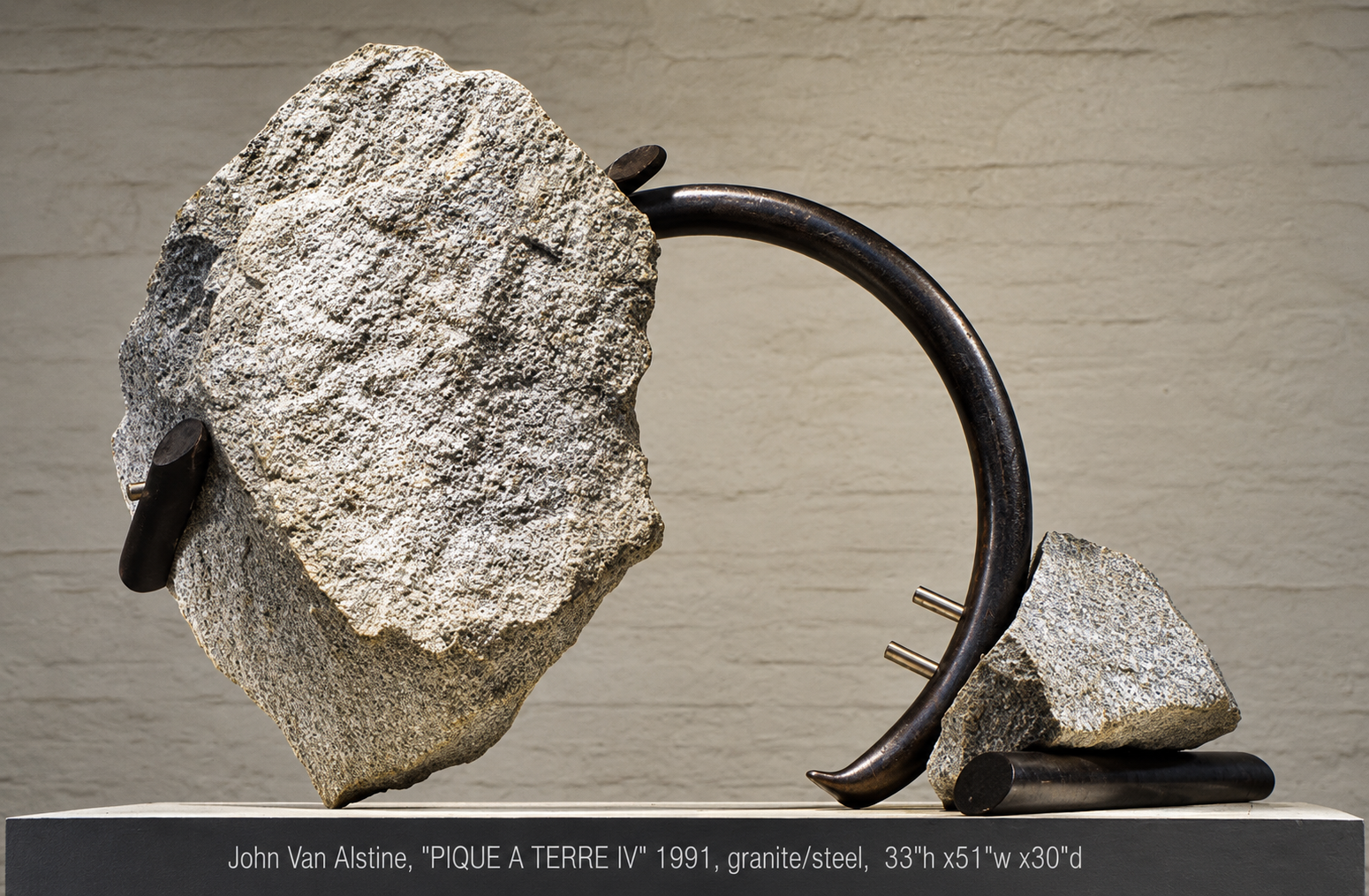
March 1991. Granite, steel. Dimensions: 33 x 57 x 32 in (84 x145 x 81 cm).
Pique à Terre IV, 1991
Pique à Terre IV, the fourth work in the series, developed as a spin-off from my earlier Rounder and Go-Round Series, continuing their circular vocabulary and my ongoing interest in combining stone and metal. Here, two granite elements are linked by a sweeping steel arc, with the larger stone lifted and poised delicately on a single point. The arrangement turns weight, gravity, and balance into gesture, giving these dense, earthbound materials an unexpected sense of movement and levity.
The title comes from classical French ballet and refers to a pose in which one toe lightly touches the ground, the other foot remains firmly planted, and an arm makes a sweeping gesture. I began to think of myself as a kind of choreographer—arranging heavy stone and steel so that they seem almost to dance. In Pique à Terre IV, the circular steel form acts much like that sweeping arm, connecting and animating the stones while transforming their inherent heaviness into a moment of precarious balance and arrested motion.
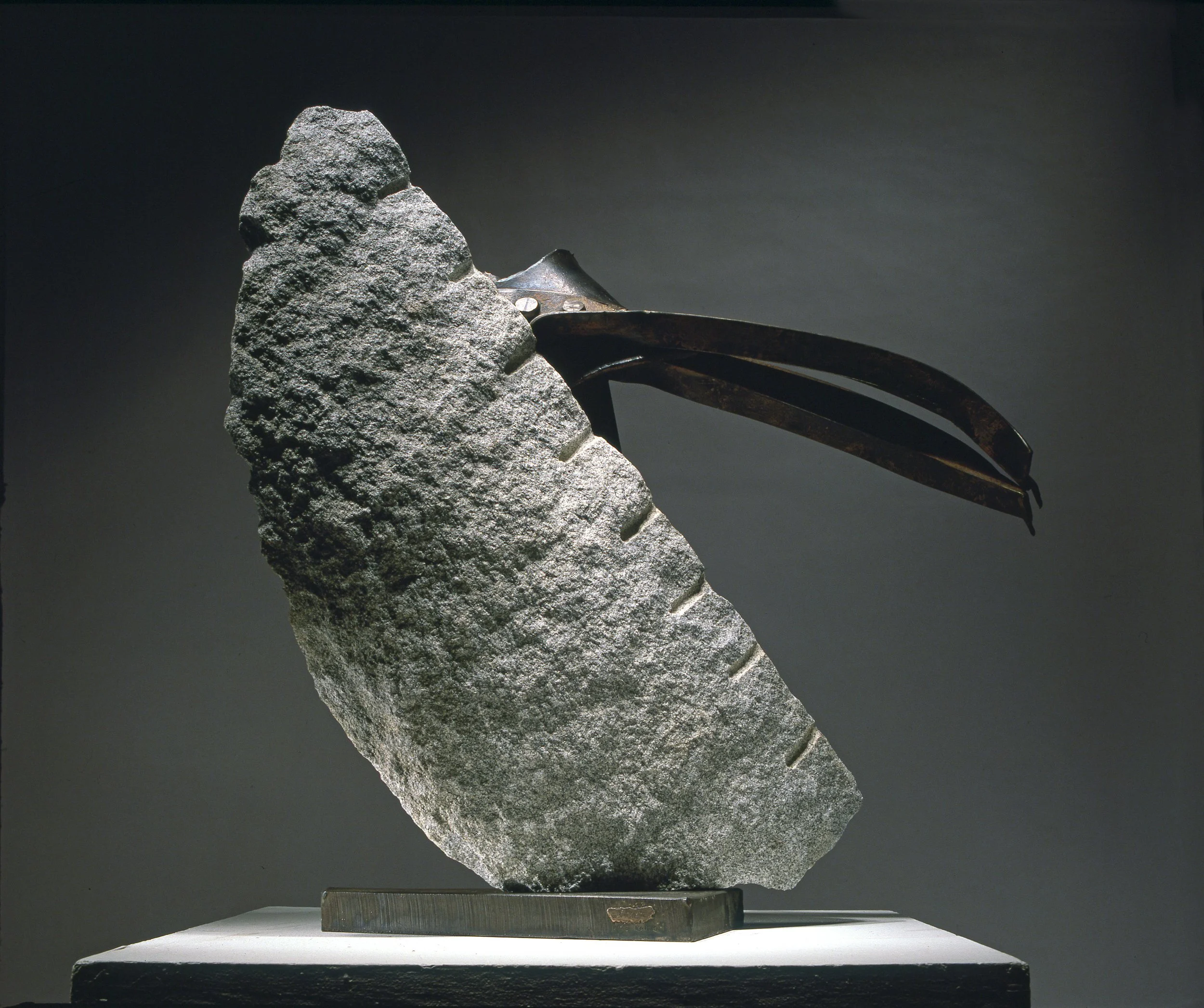
October 1990. Granite, steel. Dimensions: 42 × 41 × 18 in (107 × 104 × 46 cm).
An adze (/ædz/) or adz is an ancient and versatile cutting tool similar to an axe but with the cutting edge perpendicular to the handle rather than parallel.
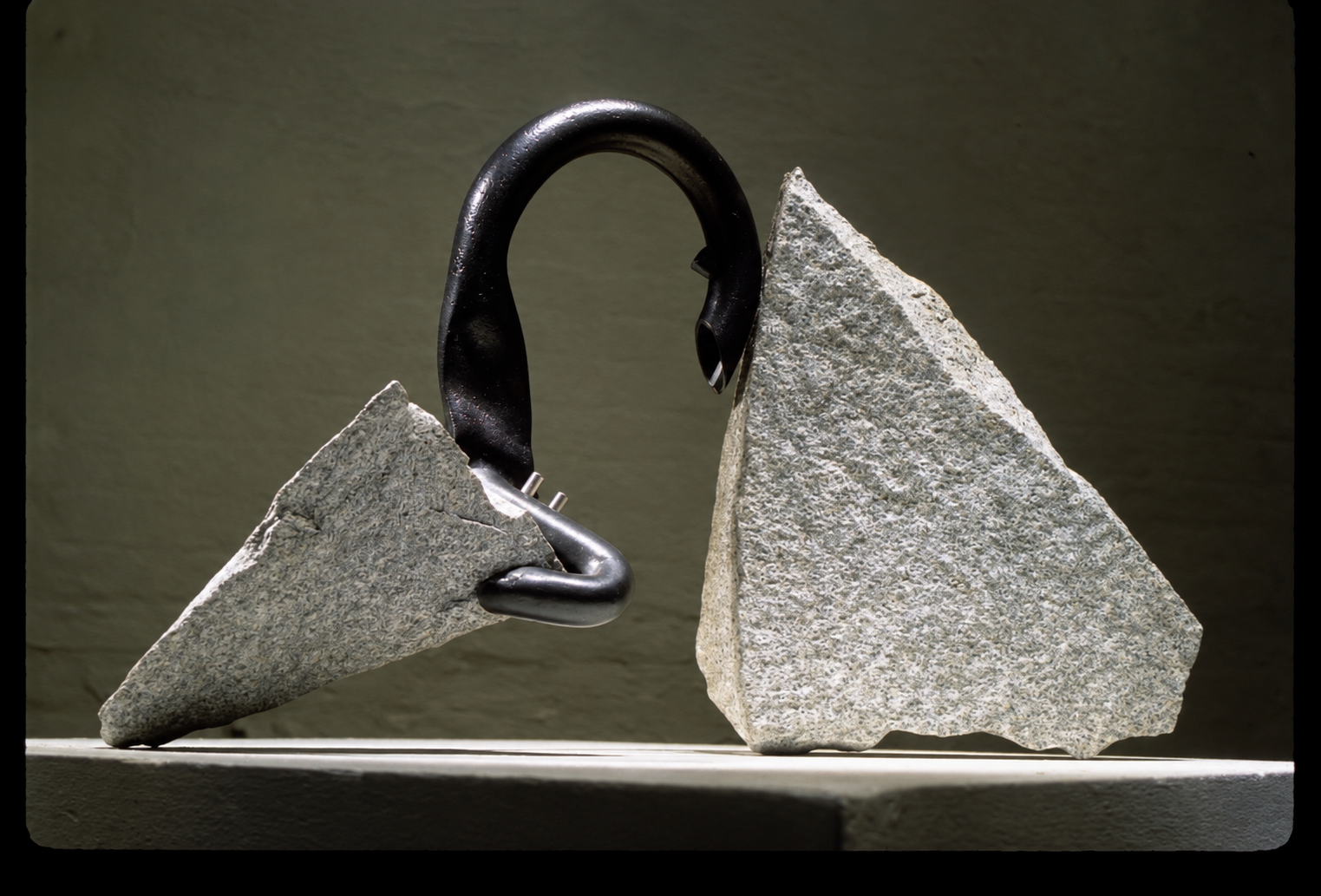
March 1990. Granite, steel. Dimensions: 21 × 35 × 13 in (53 × 89 × 33 cm).
Over the years I have created many sculptures that feature openings or portals suggesting entrance or passages into spaces and places, both real and figurative. In Portal (ad augusta per ad augusta)” 1990, a small, narrow “portal” or archway is created by an arc of steel bookended by two pieces of found granite.
Occasionally I use Latin (the one foreign language I briefly studied) in my titles as a way to “bridge” the romance languages and expand the work’s communicative power. The sub title literally translates “to honors through difficulties” (augusta refers to holy places, angusta to narrow places) all suggesting that to achieve great results, we must pay the price, a maxim that was very much a part of my upbringing and perhaps a fit motto for dieters.
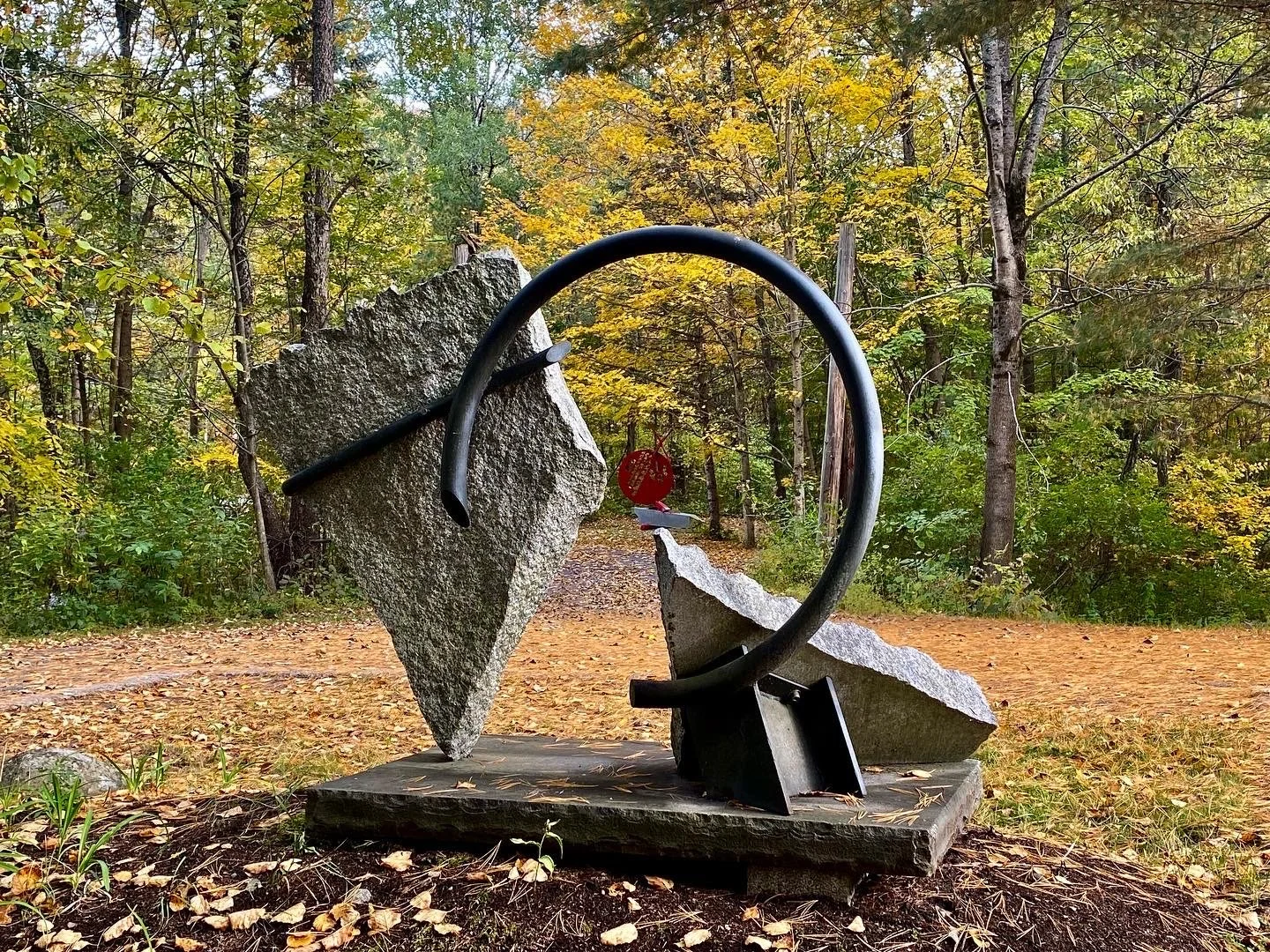
December 1989. Granite, steel. Dimensions: 48 × 75 × 32 in (122 × 191 × 81 cm).
Sidewinder ’89, 1989
Sidewinder ’89 revisits and expands the circular language of my earlier Sidewinder Series. Here, a large sweeping bronze arc links two contrasting granite forms, creating an open circle charged by weight, balance, and implied movement. The larger stone is poised dramatically on a single point, while the bronze curve and visible steel pin emphasize the physical connections that had remained an important part of my sculptural vocabulary.
Sidewinder ’89 was exhibited in my May 1990 solo exhibition at Norha Haime Gallery in New York City, where it was purchased by collector Ruth Baum. She later exchanged the sculpture for a larger outdoor work, Pique à Terre VII (S-99-07).
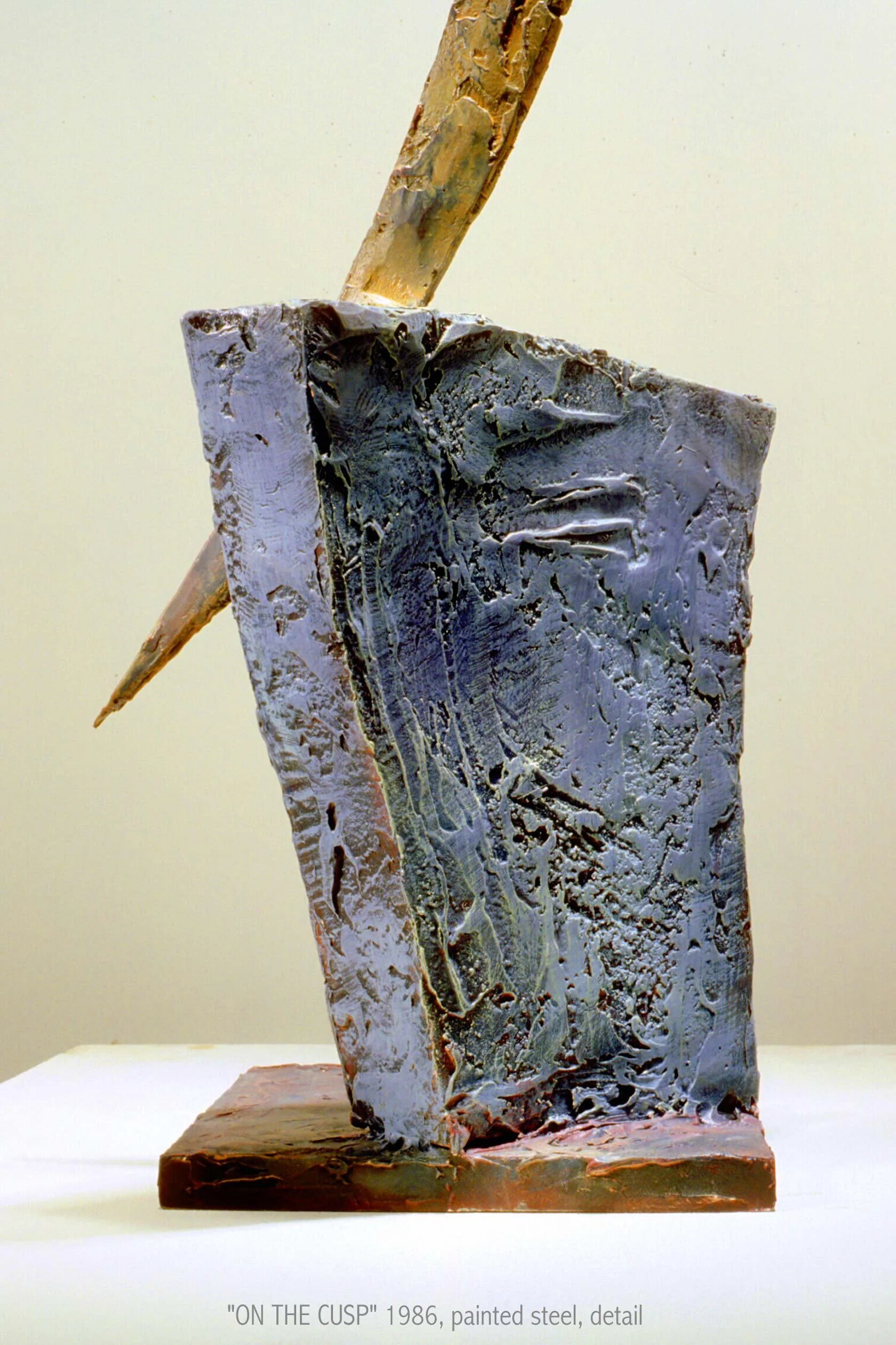
August 1986. Painted steel. Dimensions: 54 × 14 × 11 in (137 × 36 × 28 cm).
On the Cusp
On the Cusp reflects my growing tendency during this period to look to the skies for inspiration. The long, sweeping crescent-like form suggests a celestial trajectory—an orbit, lunar arc, or body in motion—and relates to ideas I was exploring simultaneously in the Luna Series and in the solar and celestial concepts incorporated into several of my large-scale public works. The title reinforces this sense of transition: to be “on the cusp” is to occupy a threshold, poised between one state and another.
The work also marks a transition in my approach to color and expressive surface, stimulated in part by my increasing involvement with drawing, particularly color pastels. Its richly worked, almost impasto-like surfaces and layered color introduce a gestural, painterly quality that departs from the spare “truth to materials” aesthetic of my earlier tensegrity, or Brute Series. Rather than relying primarily on the inherent character of steel, I was beginning to use color, texture, and surface as active expressive elements, expanding the visual and emotional vocabulary of my sculpture.

April 1975. Vermont marble, stainless steel. Dimensions: 24 × 24 × 18 in (61 × 61 × 46 cm).
In 1975, a nearly completed carved marble sculpture, similar to Wedge I, fell off my Cornell studio carving table and broke into pieces. After a period of consternation and disbelief, I finally regained enough composure to pick the shards off the floor. The crystals of the freshly broken surfaces, gleaming in the sunlight, caught my eye. Intrigued by the relationships I saw among the shapes, volumes, and contrasting surfaces—and trying to make the best of a bad situation—I began experimenting with the shards.
Falling Stones, initially conceived as an attempt to recapture the act of falling, consists of two “broken” elements lifted from the floor and pinned precariously to a steel plate. It was my first sculpture with dynamically positioned stone elements and the first to feature rough, natural “found” surfaces.
I didn’t fully realize it at the time, but this sculpture—and, more significantly, the “new” approach to making it—marked one of the most important hinge moments in my career. It set me on a new and dynamic course, freeing and choreographing this traditionally “earthbound” material.
The transformation came as a result of a disruptive event and an honest re-evaluation of the material and how I could best communicate with it.
JVA, 1999
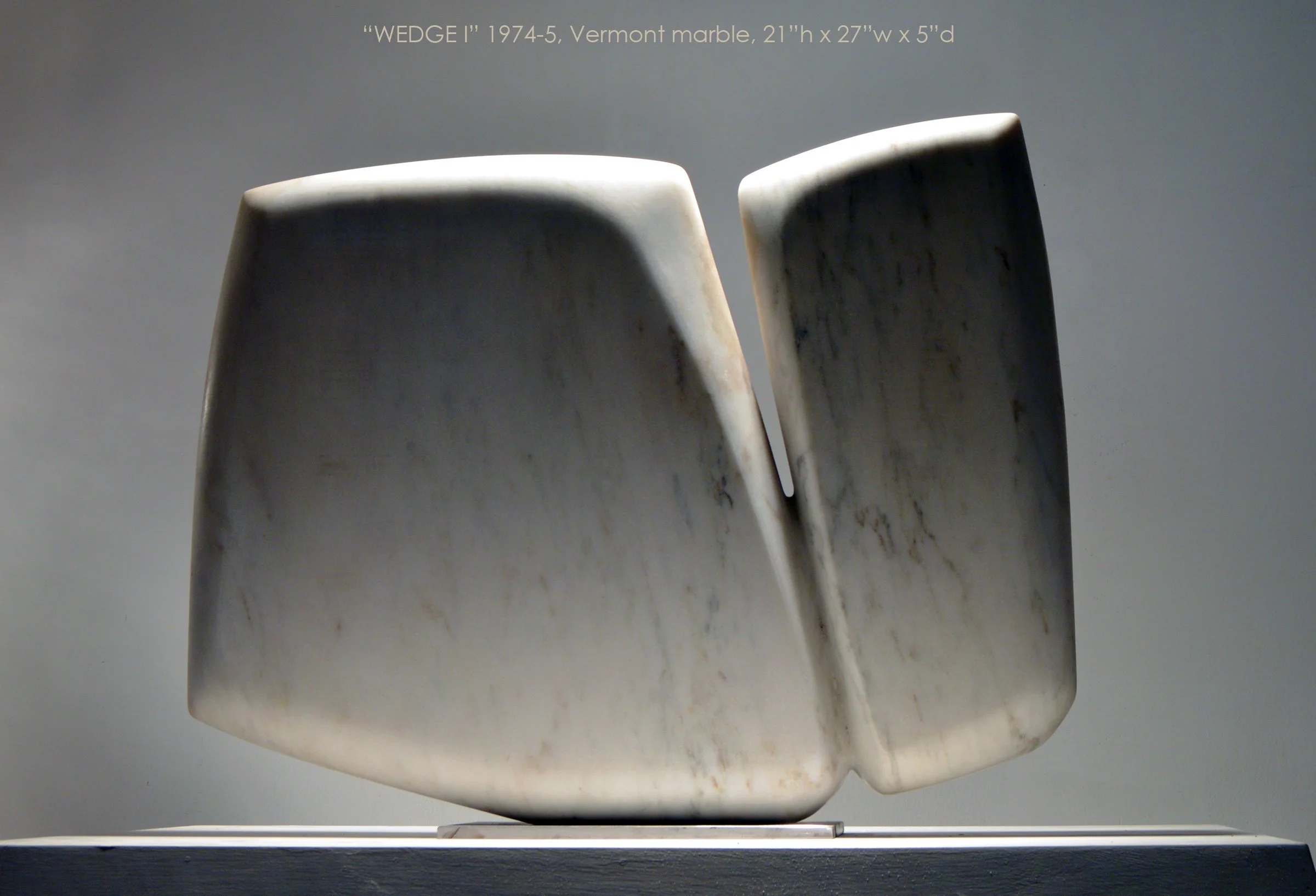
Wedge I (More Than the Sum of Its Parts), 1975, Vermont marble and stainless steel, 21"h x27"w x5"d. Private Collection.
Wedge I (More Than the Sum of Its Parts)
Wedge I was the first sculpture I created after beginning my MFA studies at Cornell and continued the minimally carved aesthetic I had begun at Kent State. The title grew from my original plan to place a carved walnut wedge between the two marble forms, creating the illusion that it was forcing them apart. The idea referenced an early stone-splitting technique in which wooden wedges were soaked with water, causing them to expand and exert pressure on the stone.
After several attempts, I abandoned the walnut wedge, encouraged by my dear friend and older, more seasoned sculptor Clara Seley, who compared the space between the marble forms to the cleavage between a woman’s breasts—beautiful and sensuous in itself—and felt that filling it with wood diminished its power.
Although I would soon go on to successfully combine different materials, I sought to do so in ways that allowed each material and its physical properties to speak more truthfully. This became an important step toward the material honesty and real physical forces that would soon become central to my tensegrity, or Brute Sculpture. The subtitle, More Than the Sum of Its Parts, came later and playfully acknowledges the expressive power created by bringing separate elements into relationship.
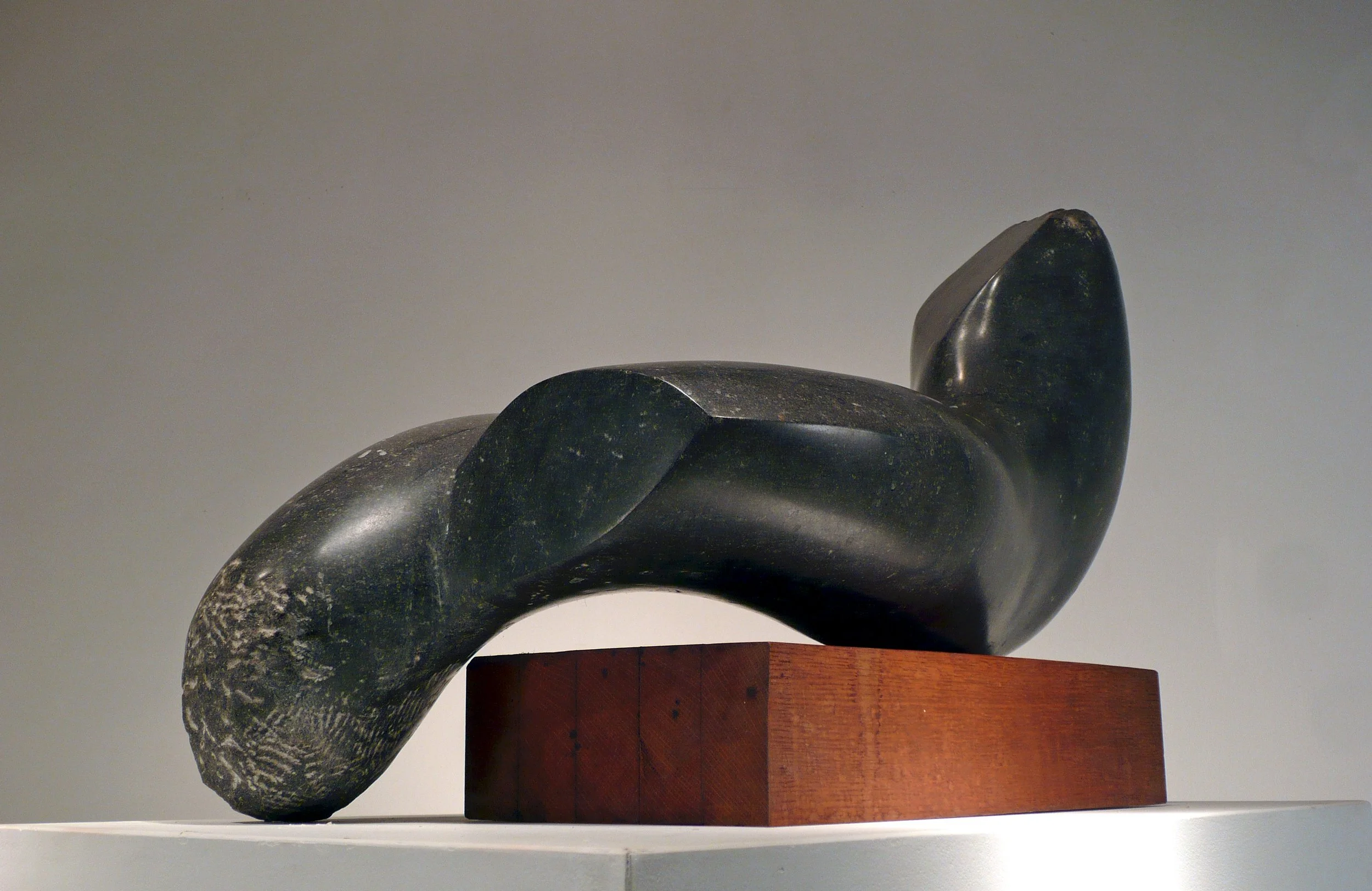
1973, gray marble, 18.5"h x30"w x14"d. Collection of the artist.
Reclining Form, 1973
Reclining Form was created during the summer of 1973 while I was attending the Blossom Festival School in Cleveland on a full scholarship in sculpture. The work reflects my early interest in the organic abstraction of Jean Arp, Constantin Brancusi, and Henry Moore—particularly Moore’s use of the reclining human figure as a point of departure for abstract form. At the same time, the sculpture shows the emerging influence of Isamu Noguchi in my decision to leave portions of the marble uncarved, specifically the quarry drilling channels and chisel marks, allowing the stone’s found and unfinished surface and character to become an expressive part of the work.
Although I did not fully recognize its significance at the time, this simple decision marked an important shift in my relationship with stone—from seeing it primarily as a material to be shaped toward allowing its inherent form, texture, and history to participate in the sculpture. This developing awareness of the nature of the material would become increasingly central to my work and, several years later, find fuller expression in my tensegrity or Brute Sculpture and the Nature of Stone Series.
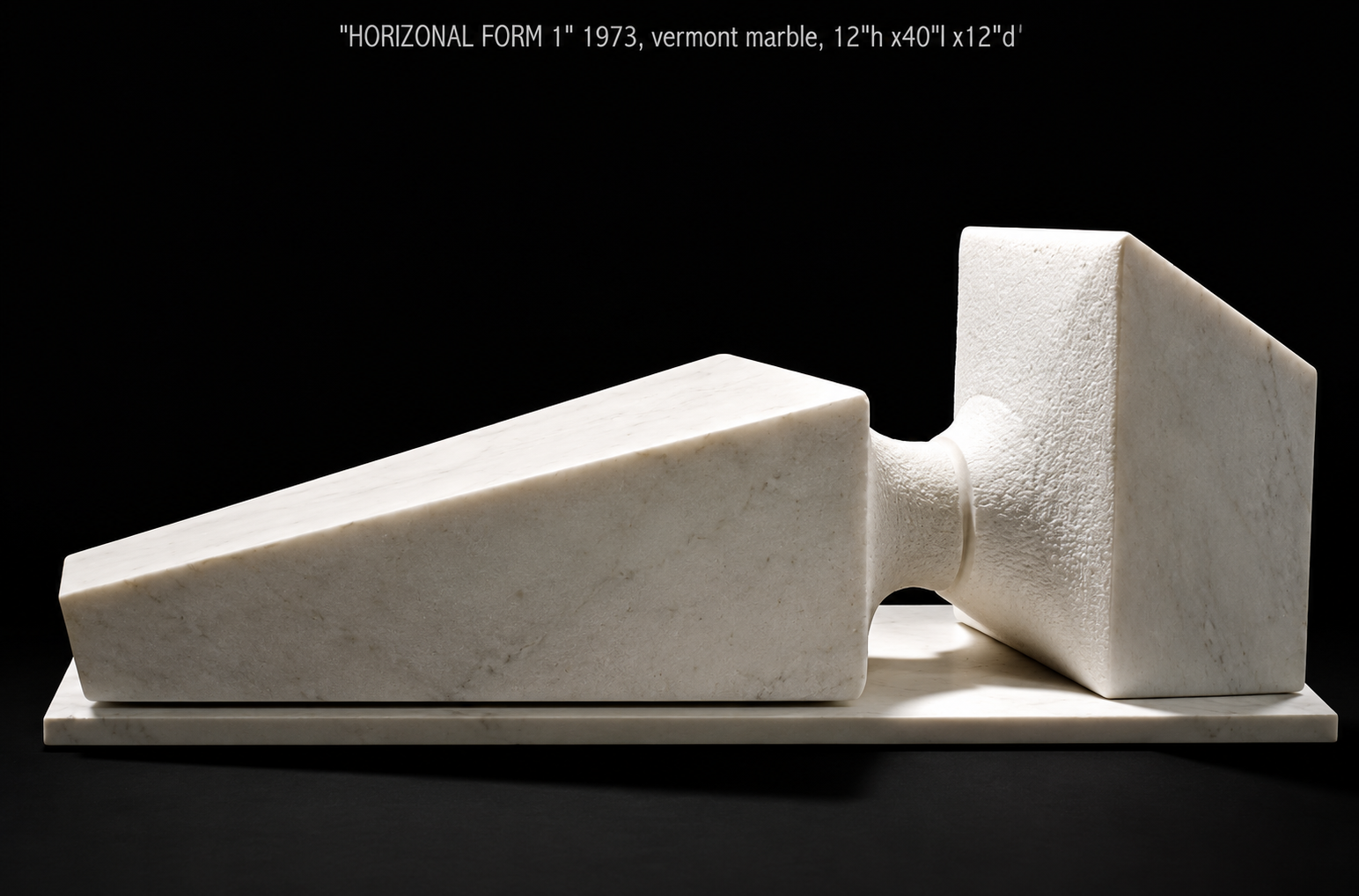
January 1973. Vermont marble. Dimensions: 12 × 42 × 12 in (30 × 107 × 30 cm).
Horizontal Form #1, 1973
Horizontal Form #1, created while I was an undergraduate at Kent State, shares many of the concerns found in my other marble sculptures from this period. Two geometric forms are placed in close relationship, creating a concentrated area of negative space between them. The contrasting carved surfaces and solid block-like masses reflect my early interest in the organic abstraction of Jean Arp and Henry Moore, as well as the reductive geometry and directness of Constantin Brancusi.
The work also reflects my growing awareness of the Minimalist aesthetic of the 1960s and ’70s prevalent around me at Kent State—an approach I later affectionately called “Midwest minimalism.” Rather than treating negative space simply as an absence, I was beginning to see the space between separate elements as an active sculptural form, creating visual tension and linking the individual masses into a unified whole.