 Image 1 of 1
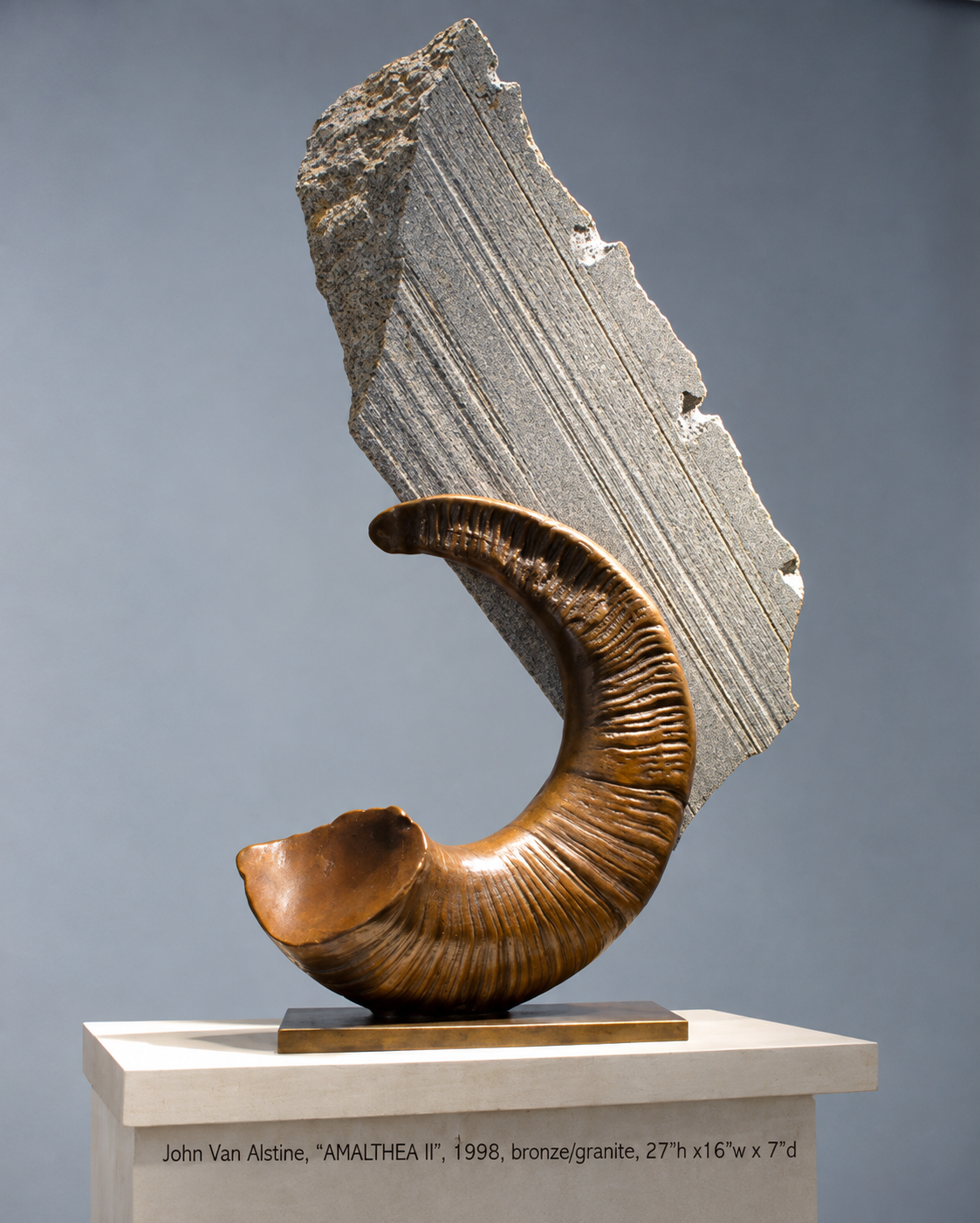
December 1998. Bronze, granite. Dimensions: 27 × 16 × 7 in (69 × 41 × 18 cm). Private Collection.
Amalthea II is the second work in my Amalthea Series and reflects my growing interest in combining the natural forms of animal horns with stone. Cast in bronze, the horn becomes both a structural and expressive element, supporting and visually lifting the rough granite while bringing organic form into dialogue with stone.
The title refers to Amalthea, the nurturing figure in Greek mythology who fed the infant Zeus. One of her horns became the cornucopia, or horn of plenty, a symbol of nourishment and abundance. I use the myth as a metaphor for the sustaining power of art—my belief that art and culture nourish and sustain the human spirit.
December 1998. Bronze, granite. Dimensions: 27 × 16 × 7 in (69 × 41 × 18 cm). Private Collection.
Amalthea II is the second work in my Amalthea Series and reflects my growing interest in combining the natural forms of animal horns with stone. Cast in bronze, the horn becomes both a structural and expressive element, supporting and visually lifting the rough granite while bringing organic form into dialogue with stone.
The title refers to Amalthea, the nurturing figure in Greek mythology who fed the infant Zeus. One of her horns became the cornucopia, or horn of plenty, a symbol of nourishment and abundance. I use the myth as a metaphor for the sustaining power of art—my belief that art and culture nourish and sustain the human spirit.