 Image 1 of 1
April 1978. Granite, forged steel. Dimensions: 16 × 84 × 56 in (41 × 213 × 142 cm).
private collection
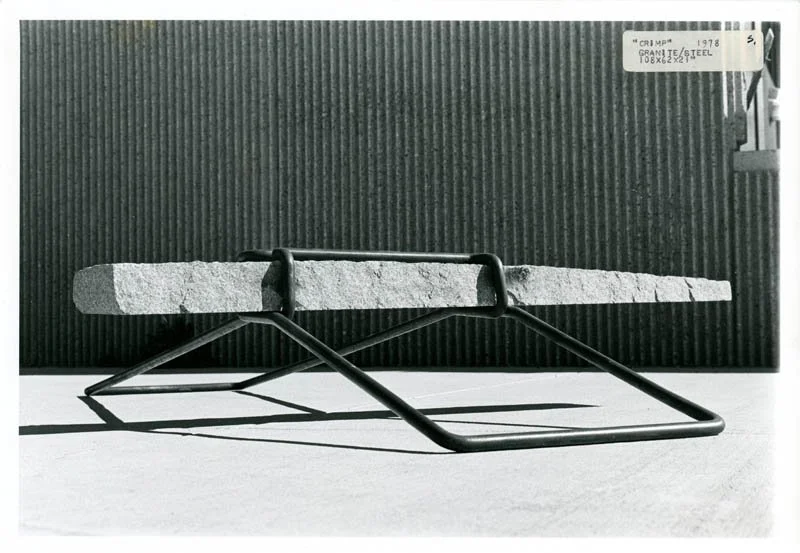
Crimp II is part of my tensegrity, or Brute Series. The title describes the physical action of the sculpture: the weight of the found granite literally crimps the forged-steel bars together. Rather than carving the stone or using it to represent something else, I allow its inherent form, mass, and weight—and the structural behavior of the steel—to become the subject of the work. In this sense, Crimp II is deliberately self-referential: sculpture about sculpture, assemblage about assemblage.
Gravity and the downward pressure of the stone provide the energy—or “glue”—that holds the sculpture together without welding. As the stone settles, its weight activates the interlocking steel bars, producing tension, compression, and equilibrium. The result is a static energy event—a sculpture held in arrested motion, in which the gravitational force that threatens collapse is redirected to hold the structure together.
April 1978. Granite, forged steel. Dimensions: 16 × 84 × 56 in (41 × 213 × 142 cm).
private collection
Crimp II is part of my tensegrity, or Brute Series. The title describes the physical action of the sculpture: the weight of the found granite literally crimps the forged-steel bars together. Rather than carving the stone or using it to represent something else, I allow its inherent form, mass, and weight—and the structural behavior of the steel—to become the subject of the work. In this sense, Crimp II is deliberately self-referential: sculpture about sculpture, assemblage about assemblage.
Gravity and the downward pressure of the stone provide the energy—or “glue”—that holds the sculpture together without welding. As the stone settles, its weight activates the interlocking steel bars, producing tension, compression, and equilibrium. The result is a static energy event—a sculpture held in arrested motion, in which the gravitational force that threatens collapse is redirected to hold the structure together.