 Image 1 of 2
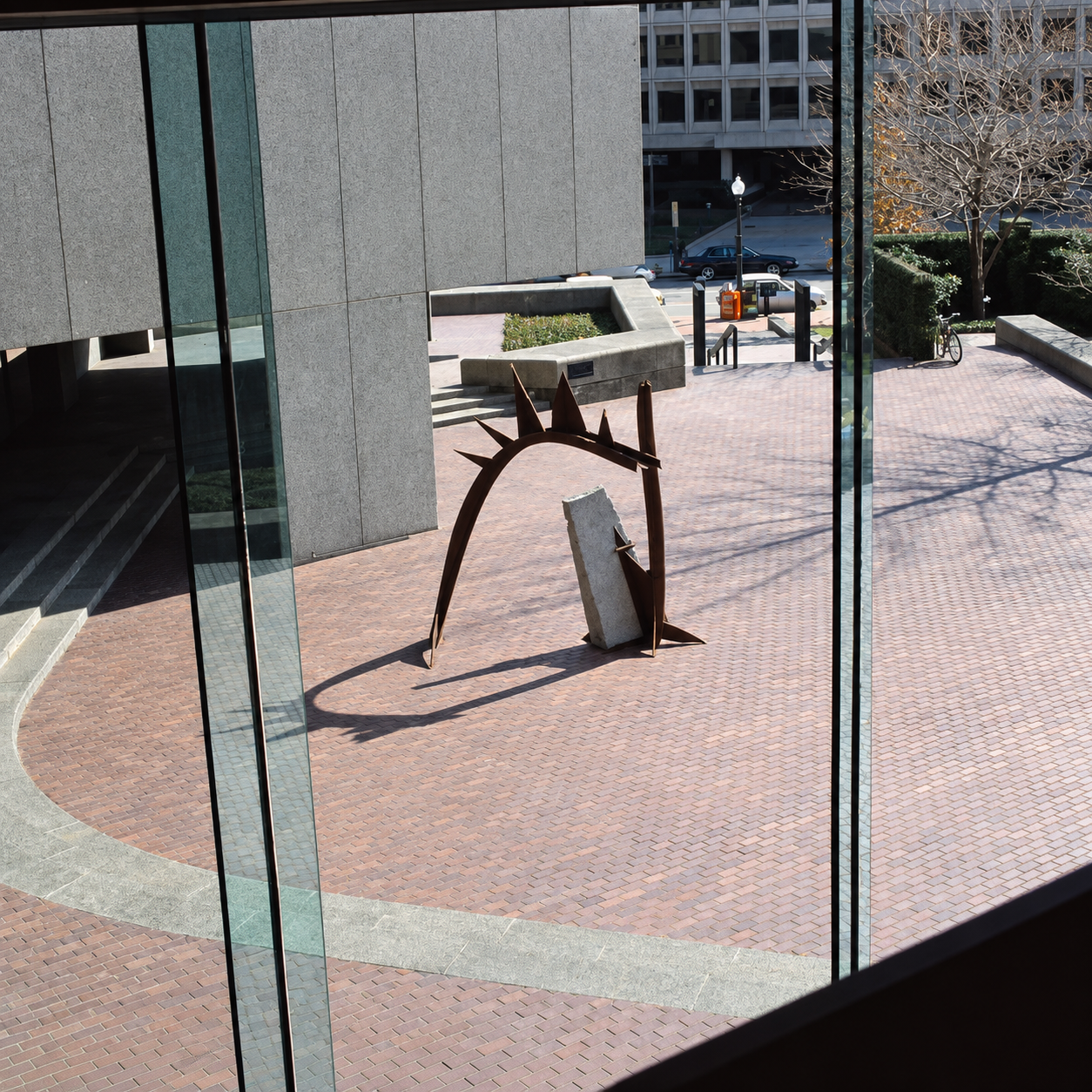 Image 2 of 2
April 1982. Granite, steel. Dimensions: 12 × 12 × 4 ft.
Private collection - Washington, DC
Cronus marks an important transition from the structural concerns of my earlier tensegrity, or Brute Series, toward a more expressive and metaphorical language. The massive granite slab remains dependent upon steel, weight, and balance, but the sweeping arch, animated by sharp, tooth-like projections, introduces a more aggressive, almost figurative presence.
The title refers to Cronus, the powerful Titan who swallowed his children, fearing one would eventually overthrow him. When Zeus was born, his mother Rhea saved him by wrapping a stone in swaddling clothes and giving it to Cronus, who swallowed it believing it was his son. The granite anchoring the sculpture suggests this stone, while the spiked steel evokes the threatening power of Cronus himself. Rather than illustrating the myth literally, I use it as a framework for ideas of power, conflict, and inevitable change.
The work is shown here in the courtyard of the American Institute of Architects’ national headquarters in Washington, DC. It was later acquired by a Washington-area collector and developer and displayed at one of his buildings in Rosslyn, Virginia, just across the Key Bridge from Georgetown.
April 1982. Granite, steel. Dimensions: 12 × 12 × 4 ft.
Private collection - Washington, DC
Cronus marks an important transition from the structural concerns of my earlier tensegrity, or Brute Series, toward a more expressive and metaphorical language. The massive granite slab remains dependent upon steel, weight, and balance, but the sweeping arch, animated by sharp, tooth-like projections, introduces a more aggressive, almost figurative presence.
The title refers to Cronus, the powerful Titan who swallowed his children, fearing one would eventually overthrow him. When Zeus was born, his mother Rhea saved him by wrapping a stone in swaddling clothes and giving it to Cronus, who swallowed it believing it was his son. The granite anchoring the sculpture suggests this stone, while the spiked steel evokes the threatening power of Cronus himself. Rather than illustrating the myth literally, I use it as a framework for ideas of power, conflict, and inevitable change.
The work is shown here in the courtyard of the American Institute of Architects’ national headquarters in Washington, DC. It was later acquired by a Washington-area collector and developer and displayed at one of his buildings in Rosslyn, Virginia, just across the Key Bridge from Georgetown.