 Image 1 of 1
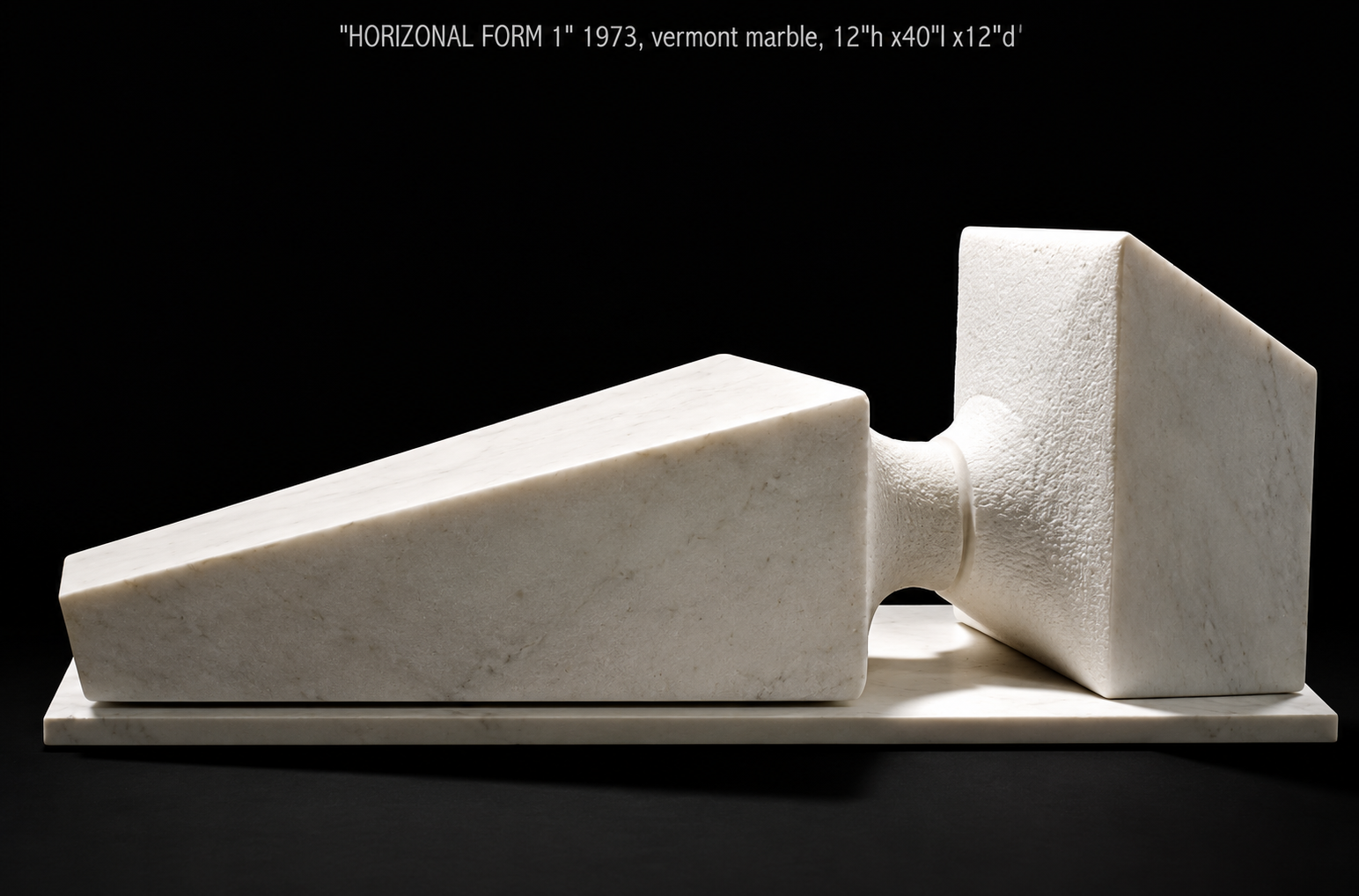
January 1973. Vermont marble. Dimensions: 12 × 42 × 12 in (30 × 107 × 30 cm).
Horizontal Form #1, created while I was an undergraduate at Kent State, shares many of the concerns found in my other marble sculptures from this period. Two geometric forms are placed in close relationship, creating a concentrated area of negative space between them. The contrasting carved surfaces and solid block-like masses reflect my early interest in the organic abstraction of Jean Arp and Henry Moore, as well as the reductive geometry and directness of Constantin Brancusi.
The work also reflects my growing awareness of the Minimalist aesthetic of the 1960s and ’70s prevalent around me at Kent State—an approach I later affectionately called “Midwest minimalism.” Rather than treating negative space simply as an absence, I was beginning to see the space between separate elements as an active sculptural form, creating visual tension and linking the individual masses into a unified whole.
January 1973. Vermont marble. Dimensions: 12 × 42 × 12 in (30 × 107 × 30 cm).
Horizontal Form #1, created while I was an undergraduate at Kent State, shares many of the concerns found in my other marble sculptures from this period. Two geometric forms are placed in close relationship, creating a concentrated area of negative space between them. The contrasting carved surfaces and solid block-like masses reflect my early interest in the organic abstraction of Jean Arp and Henry Moore, as well as the reductive geometry and directness of Constantin Brancusi.
The work also reflects my growing awareness of the Minimalist aesthetic of the 1960s and ’70s prevalent around me at Kent State—an approach I later affectionately called “Midwest minimalism.” Rather than treating negative space simply as an absence, I was beginning to see the space between separate elements as an active sculptural form, creating visual tension and linking the individual masses into a unified whole.