 Image 1 of 2
 Image 2 of 2
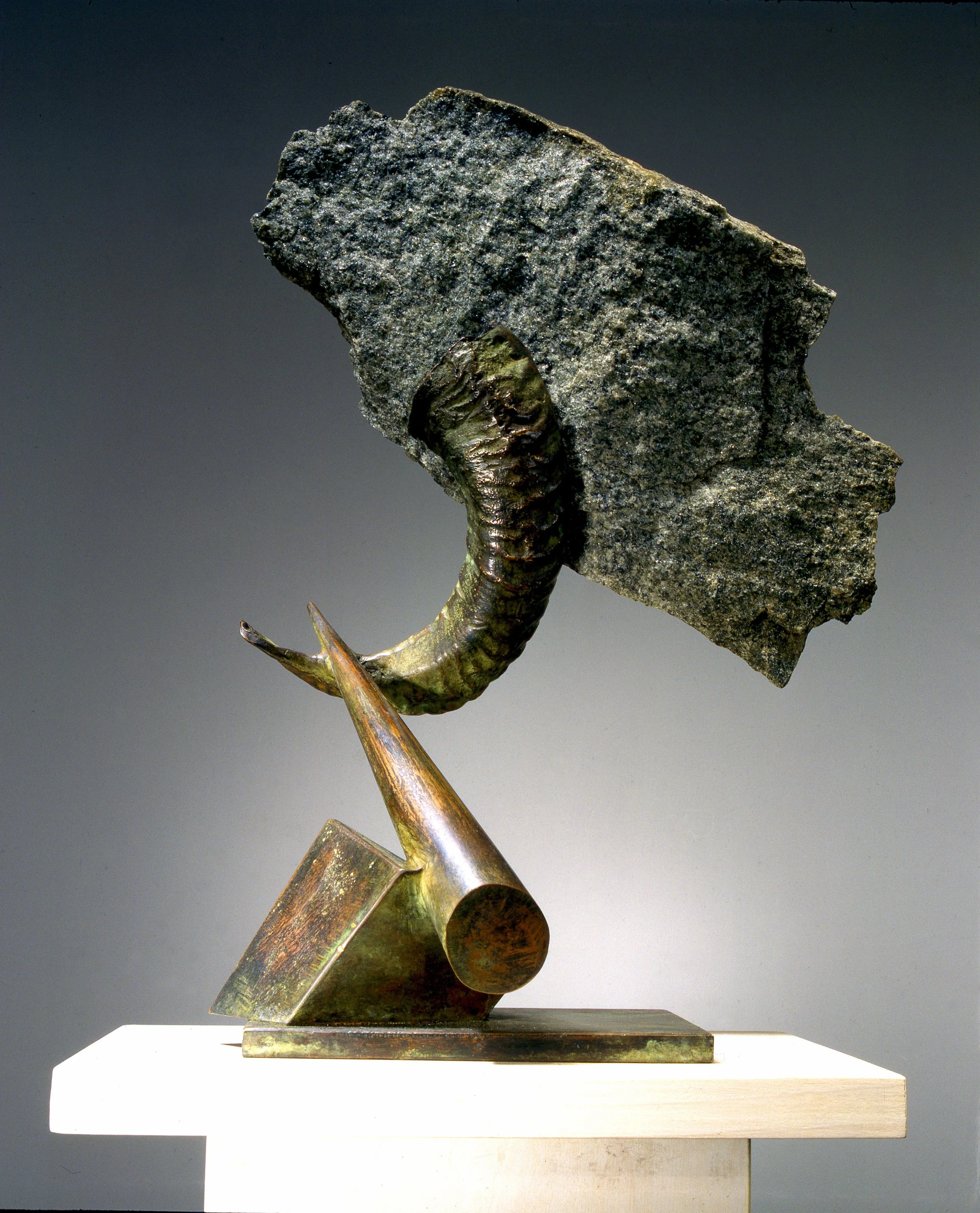
December 1996. Bronze, green granite. Dimensions: 16 × 12 × 6 in (41 × 30 × 15 cm).
Private collection.
As a sculptor, I have always been fascinated by tools, implements, and instruments. I see them as extensions of the hand—essential allies in the act of making—and am drawn to their raw, efficient beauty, shaped over time by function and necessity. They also embody human ingenuity, labor, and our impulse to shape and engage the world around us.
Throughout my work, agricultural implements—rakes, plow blades, sledges, and tillers—as well as anvils, scales, compasses, and other instruments become both sculptural forms and vehicles for metaphor, suggesting ideas of balance, navigation, transformation, and our relationship to the natural world.
- John Van Alstine
Horns, antlers, and nautilus-like forms fascinate Van Alstine for the natural geometry embodied in their arcs, spirals, and tapering curves. Cast in bronze, these organic forms become sculptural building blocks that can suggest both nature’s functional ingenuity and human-made tools—hooks, hammers, blades, and other implements.
December 1996. Bronze, green granite. Dimensions: 16 × 12 × 6 in (41 × 30 × 15 cm).
Private collection.
As a sculptor, I have always been fascinated by tools, implements, and instruments. I see them as extensions of the hand—essential allies in the act of making—and am drawn to their raw, efficient beauty, shaped over time by function and necessity. They also embody human ingenuity, labor, and our impulse to shape and engage the world around us.
Throughout my work, agricultural implements—rakes, plow blades, sledges, and tillers—as well as anvils, scales, compasses, and other instruments become both sculptural forms and vehicles for metaphor, suggesting ideas of balance, navigation, transformation, and our relationship to the natural world.
- John Van Alstine
Horns, antlers, and nautilus-like forms fascinate Van Alstine for the natural geometry embodied in their arcs, spirals, and tapering curves. Cast in bronze, these organic forms become sculptural building blocks that can suggest both nature’s functional ingenuity and human-made tools—hooks, hammers, blades, and other implements.