 Image 1 of 1
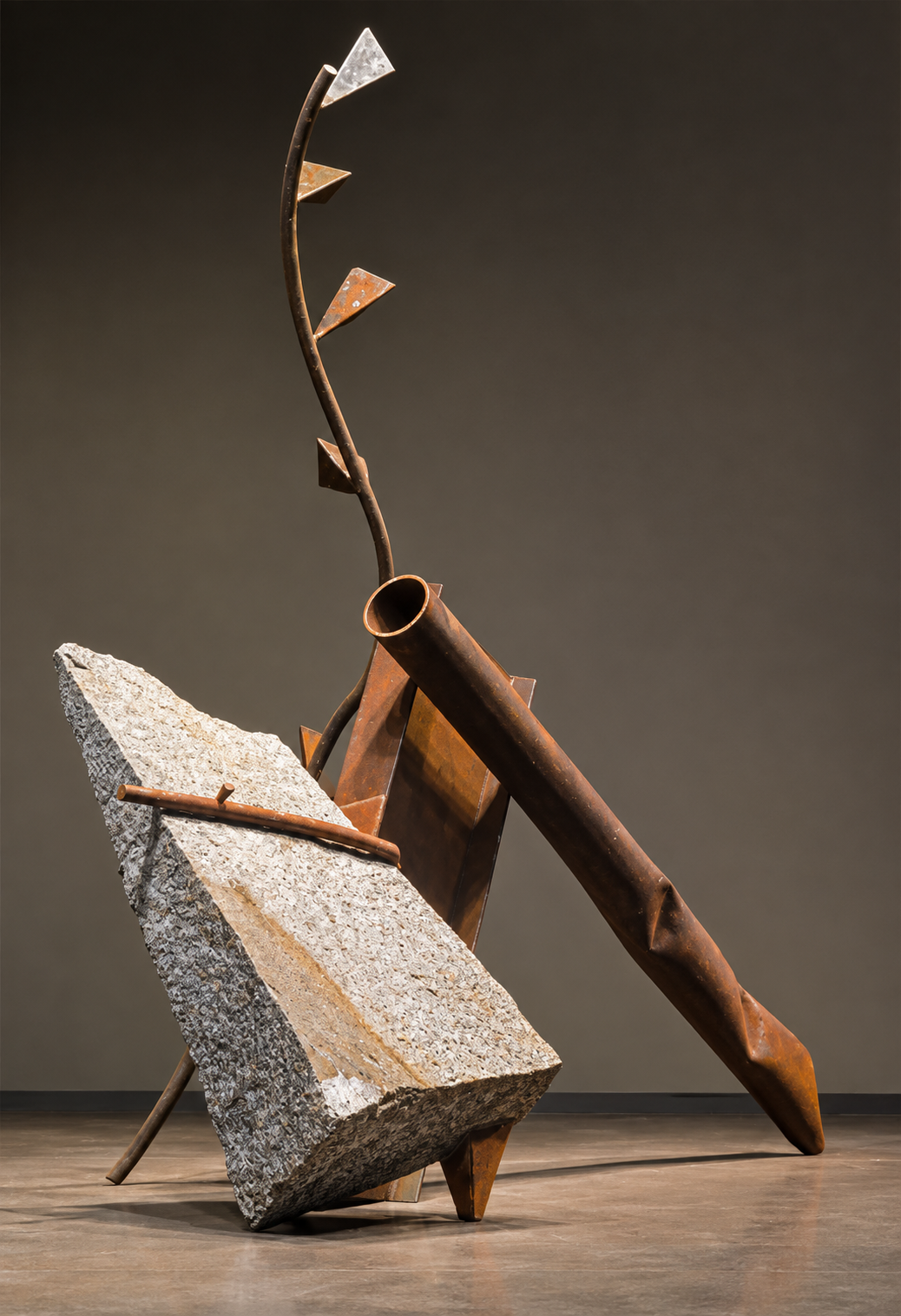
1982/83. Granite, steel. Dimensions: 8 × 10 × 6 ft.
Collection: GULBENKIAN MUSEUM, Lisbon, Portugal
In the Clear marks an important transition in my work as I began moving beyond the tightly structured, gravity-driven concerns of my earlier tensegrity, or Brute Series. After moving to Washington, DC, I became increasingly responsive to the urban environment and to found industrial materials. A timely discovery of crushed I-beams, pipes, and other steel remnants in a subway construction yard provided a new vocabulary of forms. Here, stone and steel remain physically interdependent, but the steel begins to move more freely—projecting outward and upward in a loose, gestural manner rather than functioning solely as structure.
The title operates on several levels. In the Clear suggests a landscape—a form emerging into a clearing—and the tall, curving steel element with its small projecting shapes carries a suggestion of vegetation or new growth. More importantly, the title describes my own desire at the time to “break clear” of the self-imposed restrictions of making sculpture governed primarily by structural necessity. The work became a bridge between the concentrated physical forces of my earlier stone-and-steel sculpture and the more associative, gestural, and metaphorical language that would increasingly characterize my work during the 1980s.
1982/83. Granite, steel. Dimensions: 8 × 10 × 6 ft.
Collection: GULBENKIAN MUSEUM, Lisbon, Portugal
In the Clear marks an important transition in my work as I began moving beyond the tightly structured, gravity-driven concerns of my earlier tensegrity, or Brute Series. After moving to Washington, DC, I became increasingly responsive to the urban environment and to found industrial materials. A timely discovery of crushed I-beams, pipes, and other steel remnants in a subway construction yard provided a new vocabulary of forms. Here, stone and steel remain physically interdependent, but the steel begins to move more freely—projecting outward and upward in a loose, gestural manner rather than functioning solely as structure.
The title operates on several levels. In the Clear suggests a landscape—a form emerging into a clearing—and the tall, curving steel element with its small projecting shapes carries a suggestion of vegetation or new growth. More importantly, the title describes my own desire at the time to “break clear” of the self-imposed restrictions of making sculpture governed primarily by structural necessity. The work became a bridge between the concentrated physical forces of my earlier stone-and-steel sculpture and the more associative, gestural, and metaphorical language that would increasingly characterize my work during the 1980s.