 Image 1 of 3
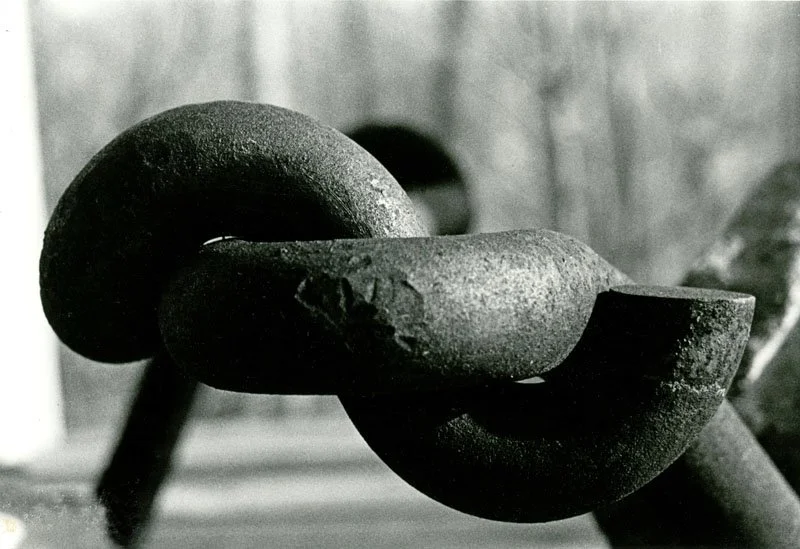 Image 2 of 3
 Image 3 of 3
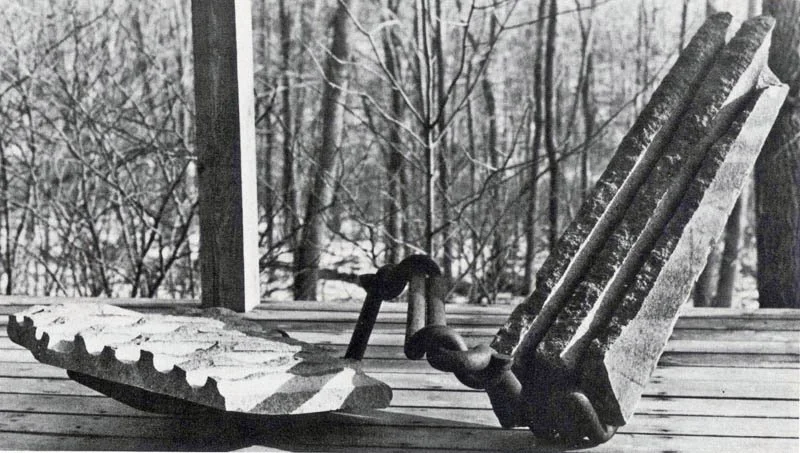
Nature of Stone I, 1976, Granite and steel, 33 3/4" h x69 1/4 x43 3/4"d ., 500 lb. (85.7 x175.9 x111.1 cm, 226.8 kg)
Collection Hirshhorn Museum and Sculpture garden, Washington, DC
Nature of Stone Series marks the beginning of my exploration of tensegrity, an approach that would become central to the early Brute Sculpture. In these works, gravity and the physical pressure of massive stones provide the energy—or “glue”—that holds the sculpture together without welding.
Weight is not simply a burden to be supported, but an active structural force. These forces are traced both visually and physically through the linear forged-steel bars. Stone and steel press against and respond to one another through tension and compression, creating a precarious yet stable state of expressive equilibrium that reveals the intrinsic nature of the materials.
This period also marks my increasing use of “found stone,” obtained from both industrial and natural sources, and my treatment of it as an additive sculptural element rather than as material to be carved through the traditional subtractive process. The stone is allowed to retain and celebrate its inherent form, weight, texture, and character—an approach that has an affinity with the appreciation of naturally occurring stone in the Japanese rock garden.
Nature of Stone I, 1976, Granite and steel, 33 3/4" h x69 1/4 x43 3/4"d ., 500 lb. (85.7 x175.9 x111.1 cm, 226.8 kg)
Collection Hirshhorn Museum and Sculpture garden, Washington, DC
Nature of Stone Series marks the beginning of my exploration of tensegrity, an approach that would become central to the early Brute Sculpture. In these works, gravity and the physical pressure of massive stones provide the energy—or “glue”—that holds the sculpture together without welding.
Weight is not simply a burden to be supported, but an active structural force. These forces are traced both visually and physically through the linear forged-steel bars. Stone and steel press against and respond to one another through tension and compression, creating a precarious yet stable state of expressive equilibrium that reveals the intrinsic nature of the materials.
This period also marks my increasing use of “found stone,” obtained from both industrial and natural sources, and my treatment of it as an additive sculptural element rather than as material to be carved through the traditional subtractive process. The stone is allowed to retain and celebrate its inherent form, weight, texture, and character—an approach that has an affinity with the appreciation of naturally occurring stone in the Japanese rock garden.