 Image 1 of 3
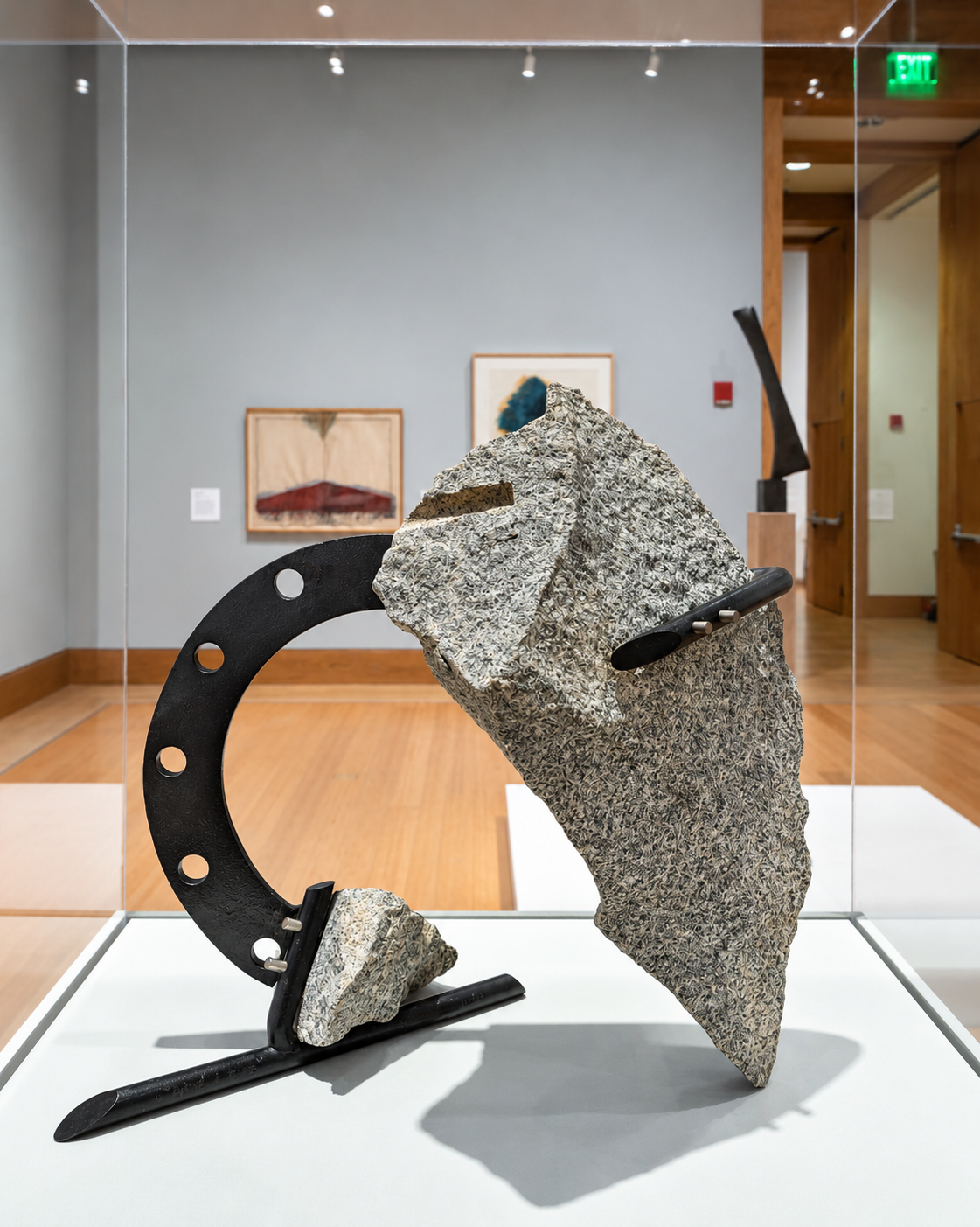 Image 2 of 3
 Image 3 of 3
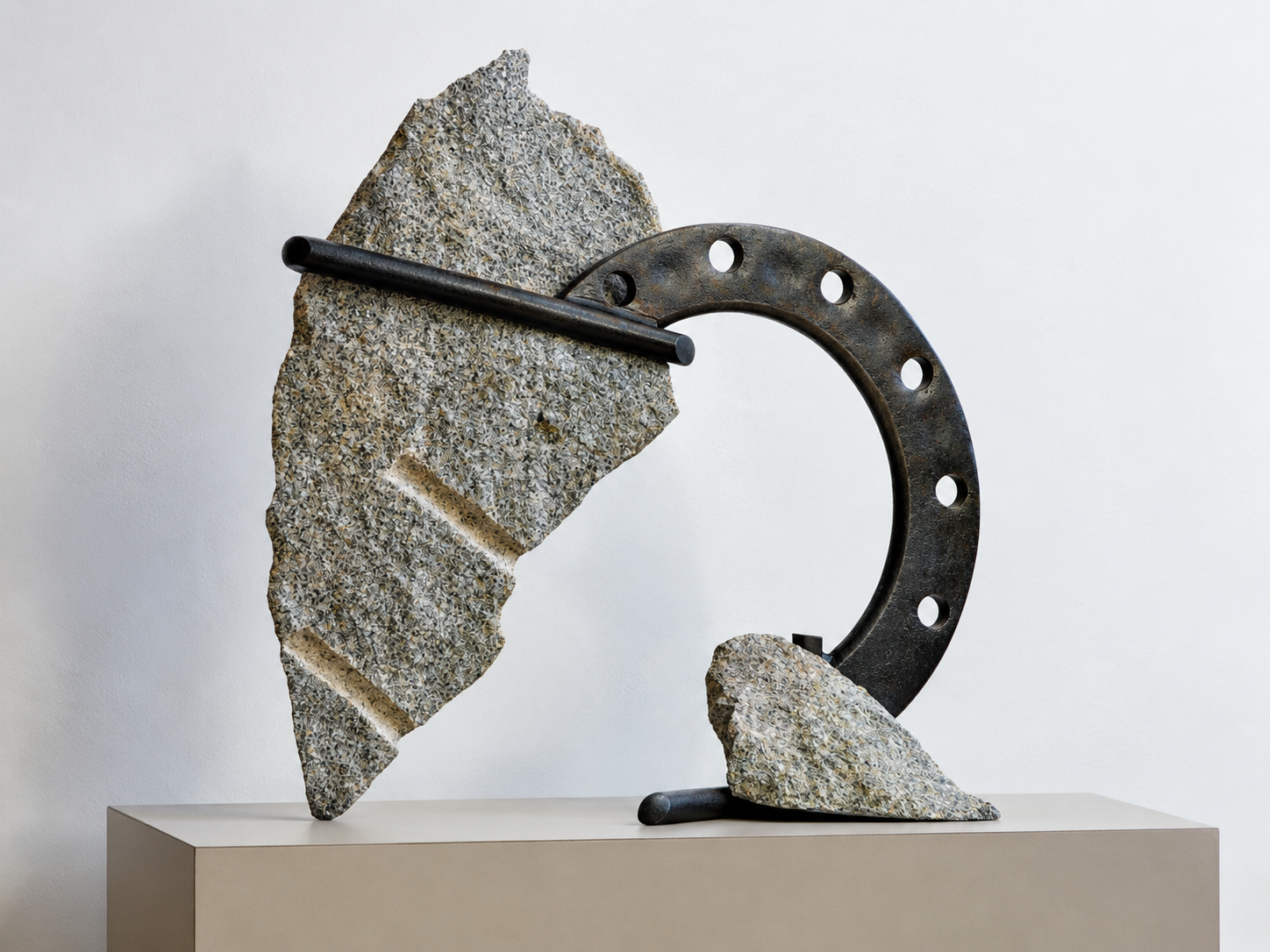
January 1990. Granite, steel. Dimensions: 22 × 30 × 15 in (56 × 76 × 38 cm). Collection: Ringling Museum of Art, Sarasota, FL. Gift of Murray Bring and Kate Delaney Bring.
Pique à Terre I, the first work in the series, grew as a spin-off from my earlier Rounder and Go-Round Series, carrying forward the circular steel arc and my ongoing interest in combining the raw weight of stone with industrial metal. Here, however, the relationship becomes more explicitly connected to movement and the human figure. The granite appears poised and lifted, while the sweeping perforated steel arc gives the heavy elements a sense of motion and levity.
The title comes from classical ballet, referring to a pose in which one toe lightly touches the ground while the other foot is firmly planted and an arm makes a sweeping gesture. That idea became central to the series: I began thinking of myself as a choreographer, arranging dense, earthbound materials so that they seem almost to dance. The challenge was to transform the inherent heaviness of stone into something suggesting balance, gesture, and grace.
January 1990. Granite, steel. Dimensions: 22 × 30 × 15 in (56 × 76 × 38 cm). Collection: Ringling Museum of Art, Sarasota, FL. Gift of Murray Bring and Kate Delaney Bring.
Pique à Terre I, the first work in the series, grew as a spin-off from my earlier Rounder and Go-Round Series, carrying forward the circular steel arc and my ongoing interest in combining the raw weight of stone with industrial metal. Here, however, the relationship becomes more explicitly connected to movement and the human figure. The granite appears poised and lifted, while the sweeping perforated steel arc gives the heavy elements a sense of motion and levity.
The title comes from classical ballet, referring to a pose in which one toe lightly touches the ground while the other foot is firmly planted and an arm makes a sweeping gesture. That idea became central to the series: I began thinking of myself as a choreographer, arranging dense, earthbound materials so that they seem almost to dance. The challenge was to transform the inherent heaviness of stone into something suggesting balance, gesture, and grace.