 Image 1 of 1
1990. Granite, bronze. Dimensions: 28 × 35 × 16 in (71 × 89 × 41 cm).
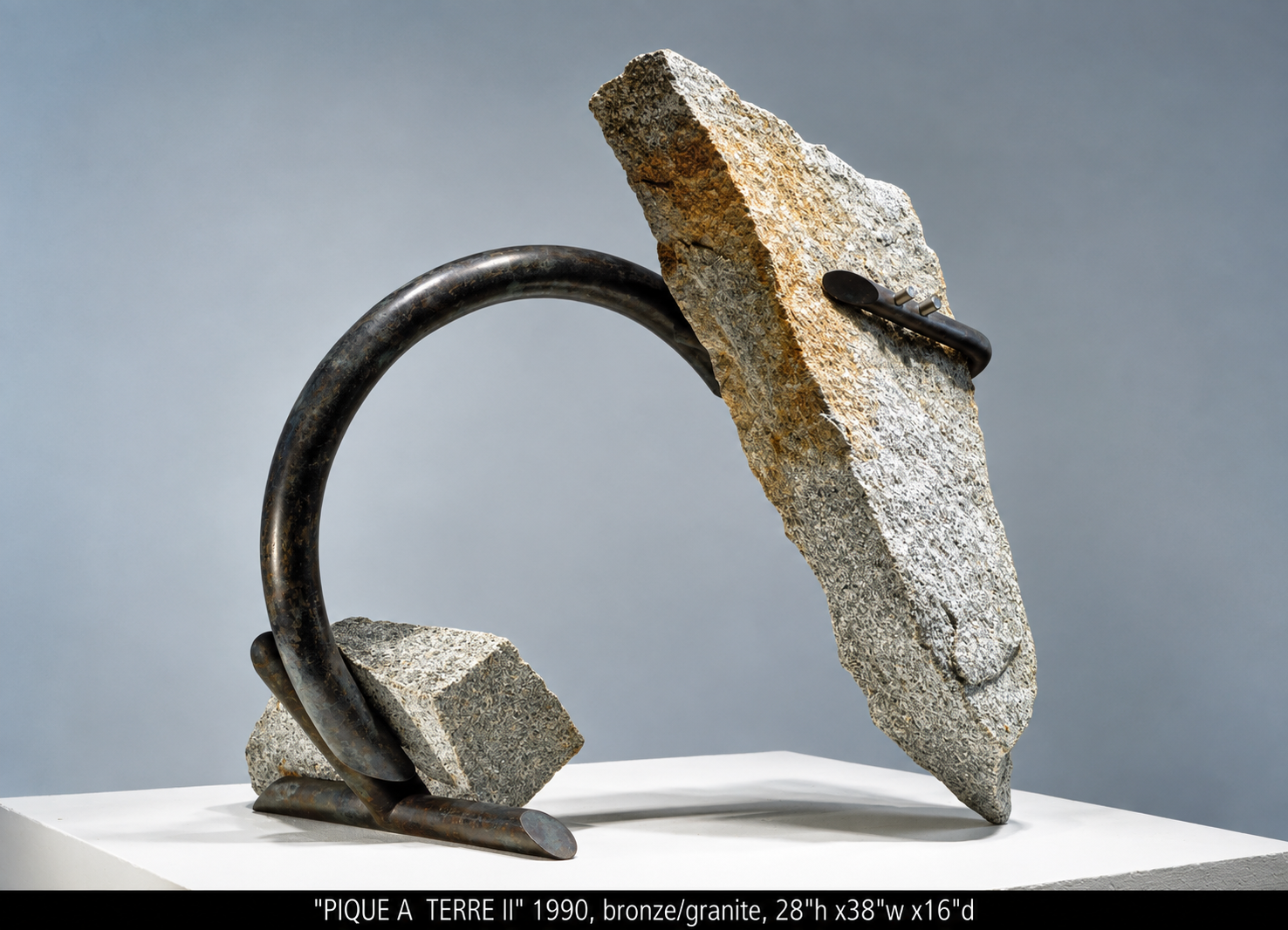
Pique à Terre II, the second work in the series, developed as a spin-off from my earlier Rounder and Go-Round Series, continuing their circular vocabulary and my ongoing interest in combining stone and metal. Here, the sweeping bronze arc supports and connects two granite elements, allowing the larger stone to rise dramatically onto a single point. The dense, earthbound materials appear suspended in a moment of precarious but graceful movement—an idea central to my work during this period.
The title comes from classical ballet, referring to a pose in which one toe lightly touches the ground, the other foot remains firmly planted, and an arm makes a sweeping gesture. This became a metaphor for what I was attempting sculpturally: to act as a choreographer, arranging heavy stone and metal so that they seem almost to dance. Rather than denying the inherent weight of the materials, I use balance, suspension, and gesture to transform that weight into a sense of movement and levity.
1990. Granite, bronze. Dimensions: 28 × 35 × 16 in (71 × 89 × 41 cm).
Pique à Terre II, the second work in the series, developed as a spin-off from my earlier Rounder and Go-Round Series, continuing their circular vocabulary and my ongoing interest in combining stone and metal. Here, the sweeping bronze arc supports and connects two granite elements, allowing the larger stone to rise dramatically onto a single point. The dense, earthbound materials appear suspended in a moment of precarious but graceful movement—an idea central to my work during this period.
The title comes from classical ballet, referring to a pose in which one toe lightly touches the ground, the other foot remains firmly planted, and an arm makes a sweeping gesture. This became a metaphor for what I was attempting sculpturally: to act as a choreographer, arranging heavy stone and metal so that they seem almost to dance. Rather than denying the inherent weight of the materials, I use balance, suspension, and gesture to transform that weight into a sense of movement and levity.