 Image 1 of 1
February 1985. Granite, steel. Dimensions: 8 × 12 × 11 in (20 × 30 × 28 cm). Destroyed by artist.
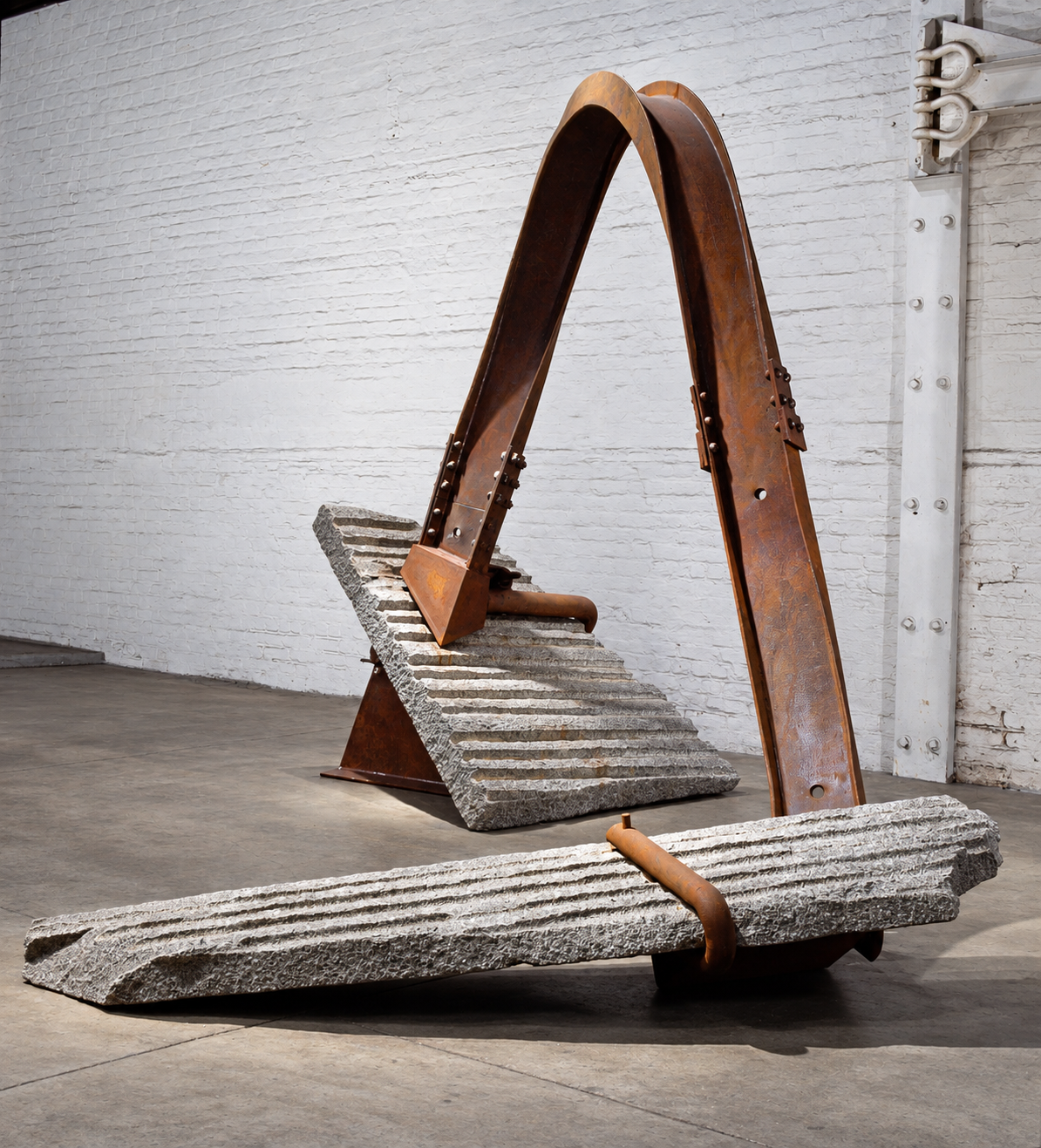
Rockslide III, the third work in my Rockslide Series, expands the series into a broader, more architectural composition. Two granite slabs are connected by a sweeping arch of curved steel I-beam, creating a strong sense of movement between the grounded stones. As in the earlier Rockslides, visible pins, brackets, and fastening devices deliberately emphasize how the sculpture is held together, making the connection itself both a visual and conceptual focus.
The work continues my earlier concerns with gravity, balance, and visible assembly while allowing the steel to become increasingly gestural and expressive. Rockslide III was cannibalized later in 1985, and its large arching I-beam was reused to create Los Arcos (S-85-20) and rectangular granite slab in Ciscle Rounder (S-87-20)—an example of how found materials and even earlier sculptures could become the starting point for new work.
February 1985. Granite, steel. Dimensions: 8 × 12 × 11 in (20 × 30 × 28 cm). Destroyed by artist.
Rockslide III, the third work in my Rockslide Series, expands the series into a broader, more architectural composition. Two granite slabs are connected by a sweeping arch of curved steel I-beam, creating a strong sense of movement between the grounded stones. As in the earlier Rockslides, visible pins, brackets, and fastening devices deliberately emphasize how the sculpture is held together, making the connection itself both a visual and conceptual focus.
The work continues my earlier concerns with gravity, balance, and visible assembly while allowing the steel to become increasingly gestural and expressive. Rockslide III was cannibalized later in 1985, and its large arching I-beam was reused to create Los Arcos (S-85-20) and rectangular granite slab in Ciscle Rounder (S-87-20)—an example of how found materials and even earlier sculptures could become the starting point for new work.