 Image 1 of 2
 Image 2 of 2
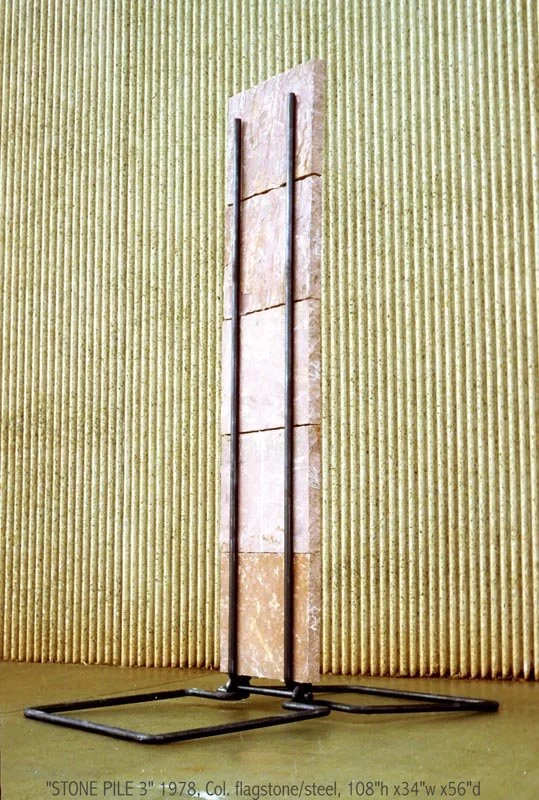
January 1978. Colorado flagstone, steel. Dimensions: 108 × 34 × 56 in (274 × 86 × 142 cm).
Stone Pile 3 is part of the tensegrity, or Brute Series, in which gravity and the pressure of the stones provide the energy—or “glue”—that holds the sculpture together without welding. Weight becomes an active structural force as stone and steel interact through tension, compression, and balance.
Gravitational energy is channeled and made visible through the interlocking forged steel bars, creating a static energy event—a sculpture held in arrested motion. The title Stone Pile functions deliberately as both noun and verb, suggesting not only an object but an action—the act of piling or stacking. The work reflects a recurring concern in my sculpture: how opposing forces—weight and lift, mass and movement, tension and stability—can be brought into balance.
The work also subtly pays homage to Romanian sculptor Constantin Brâncuși’s Endless Column. The open-ended vertical steel bars suggest that the stack of stone might continue upward indefinitely, extending the sculpture conceptually beyond its physical limits.
January 1978. Colorado flagstone, steel. Dimensions: 108 × 34 × 56 in (274 × 86 × 142 cm).
Stone Pile 3 is part of the tensegrity, or Brute Series, in which gravity and the pressure of the stones provide the energy—or “glue”—that holds the sculpture together without welding. Weight becomes an active structural force as stone and steel interact through tension, compression, and balance.
Gravitational energy is channeled and made visible through the interlocking forged steel bars, creating a static energy event—a sculpture held in arrested motion. The title Stone Pile functions deliberately as both noun and verb, suggesting not only an object but an action—the act of piling or stacking. The work reflects a recurring concern in my sculpture: how opposing forces—weight and lift, mass and movement, tension and stability—can be brought into balance.
The work also subtly pays homage to Romanian sculptor Constantin Brâncuși’s Endless Column. The open-ended vertical steel bars suggest that the stack of stone might continue upward indefinitely, extending the sculpture conceptually beyond its physical limits.