 Image 1 of 1
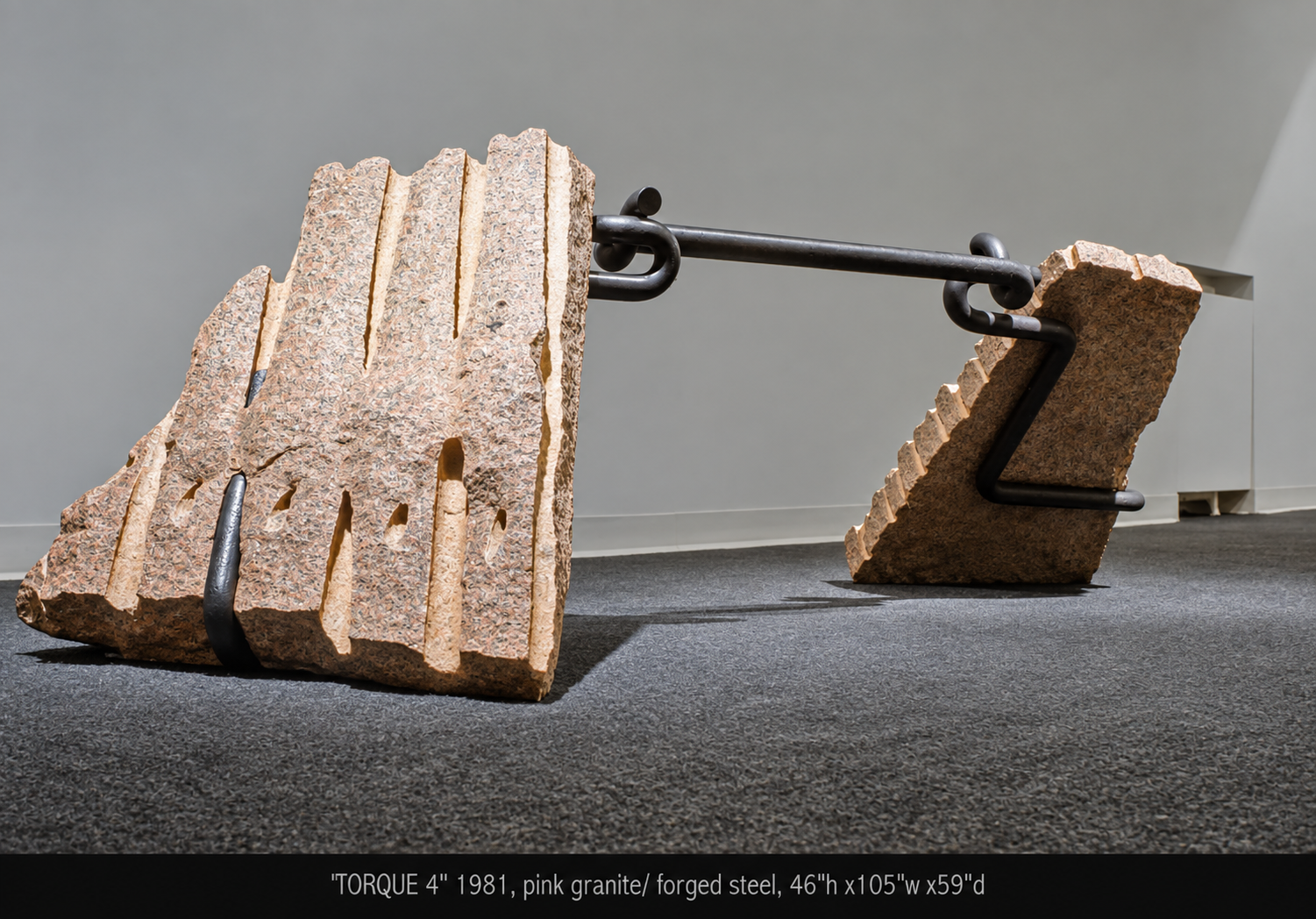
January 1981. Pink granite, steel. Dimensions: 44 × 105 × 59 in (112 × 267 × 150 cm).
Private collection - Washington, DC
Torque 4 is part of my tensegrity, or Brute Series, in which gravity, weight, tension, and compression become active sculptural forces. Two rough granite forms are held in equilibrium by interlocking forged-steel bars, with the weight of the stones literally torquing the steel together. Gravity becomes the energy—or “glue”—that holds the sculpture without welding, creating what I think of as a “static energy event”—a sculpture held in arrested motion.
The title Torque describes both the twisting force within the sculpture and the action responsible for its assembly. The natural mass and quarry marks of the granite are left intact, while the forged steel traces and makes visible the forces acting between the stones. In this sense, the work is deliberately self-referential—sculpture about sculpture, assemblage about assemblage—with the act of holding its materials together becoming both its structure and its subject.
January 1981. Pink granite, steel. Dimensions: 44 × 105 × 59 in (112 × 267 × 150 cm).
Private collection - Washington, DC
Torque 4 is part of my tensegrity, or Brute Series, in which gravity, weight, tension, and compression become active sculptural forces. Two rough granite forms are held in equilibrium by interlocking forged-steel bars, with the weight of the stones literally torquing the steel together. Gravity becomes the energy—or “glue”—that holds the sculpture without welding, creating what I think of as a “static energy event”—a sculpture held in arrested motion.
The title Torque describes both the twisting force within the sculpture and the action responsible for its assembly. The natural mass and quarry marks of the granite are left intact, while the forged steel traces and makes visible the forces acting between the stones. In this sense, the work is deliberately self-referential—sculpture about sculpture, assemblage about assemblage—with the act of holding its materials together becoming both its structure and its subject.