 Image 1 of 1
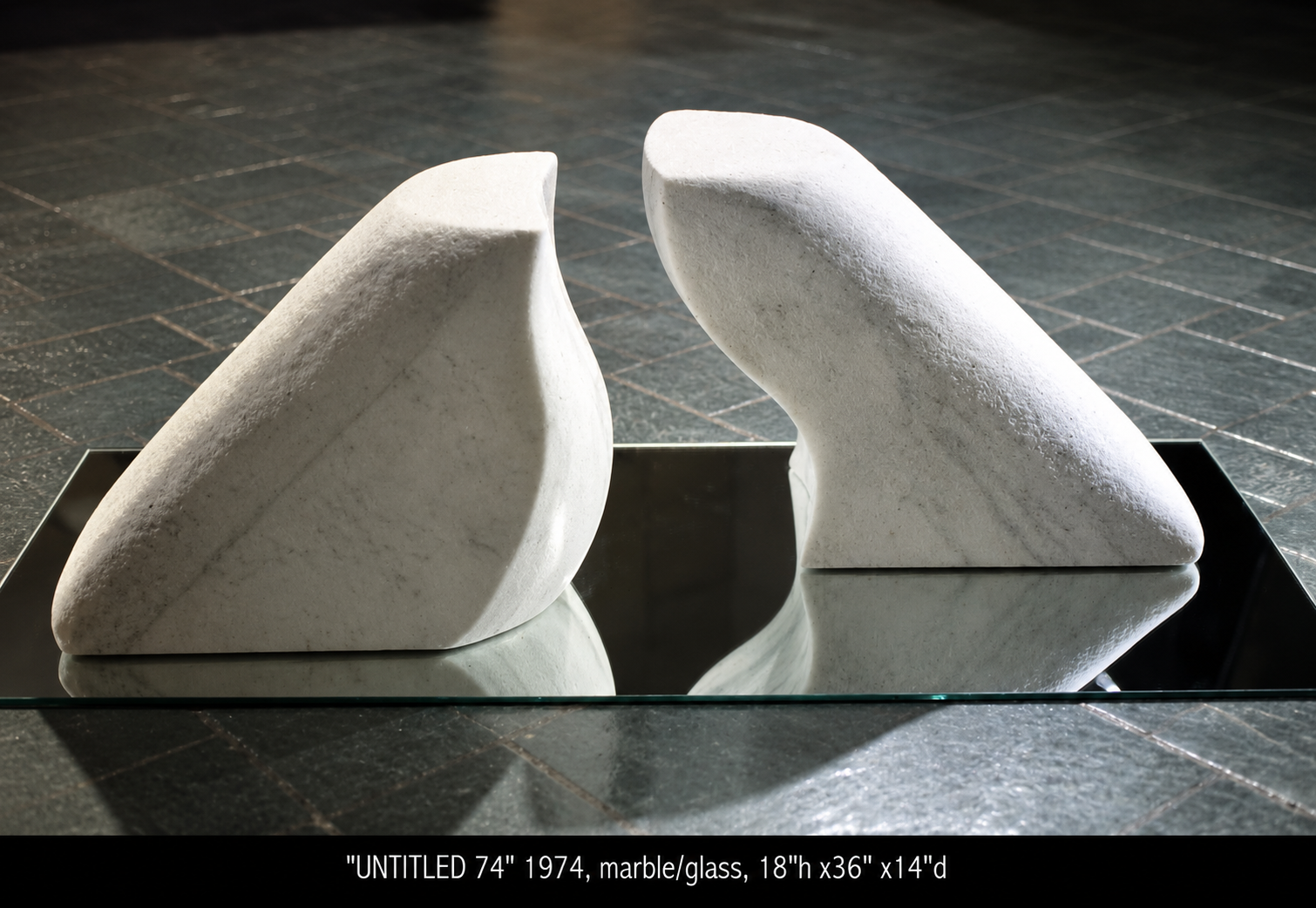
January 1974. Marble, mirror. Dimensions: 18 × 14 × 26 in (46 × 36 × 66 cm).
Untitled #4 continues my early exploration of positive and negative space while I was an undergraduate at Kent State. The work reflects the influence of Jean Arp, Henry Moore, and particularly Constantin Brancusi, whose simplified forms and respect for the integrity of stone were important to me. Two carved marble elements are positioned in opposition, creating an active space between them. Placing the forms on a mirror extends and multiplies that relationship, making reflection—and the space surrounding the sculpture—part of the work itself.
Although lower and more horizontal than other works in the Vertical Series, its flowing contours and the channel of space between the forms also recall my longtime involvement with skiing and racing—the clean tracks of a well-carved turn through snow and the sensations of balance and controlled movement. By retaining much of the geometry and natural character of the original quarry blocks, the piece also reflects my growing awareness of the Minimalist aesthetic prevalent at Kent State—an approach I later affectionately called “Midwest minimalism.” The work represents another early step toward making the space between separate elements an active part of the sculpture.
January 1974. Marble, mirror. Dimensions: 18 × 14 × 26 in (46 × 36 × 66 cm).
Untitled #4 continues my early exploration of positive and negative space while I was an undergraduate at Kent State. The work reflects the influence of Jean Arp, Henry Moore, and particularly Constantin Brancusi, whose simplified forms and respect for the integrity of stone were important to me. Two carved marble elements are positioned in opposition, creating an active space between them. Placing the forms on a mirror extends and multiplies that relationship, making reflection—and the space surrounding the sculpture—part of the work itself.
Although lower and more horizontal than other works in the Vertical Series, its flowing contours and the channel of space between the forms also recall my longtime involvement with skiing and racing—the clean tracks of a well-carved turn through snow and the sensations of balance and controlled movement. By retaining much of the geometry and natural character of the original quarry blocks, the piece also reflects my growing awareness of the Minimalist aesthetic prevalent at Kent State—an approach I later affectionately called “Midwest minimalism.” The work represents another early step toward making the space between separate elements an active part of the sculpture.