 Image 1 of 2
 Image 2 of 2
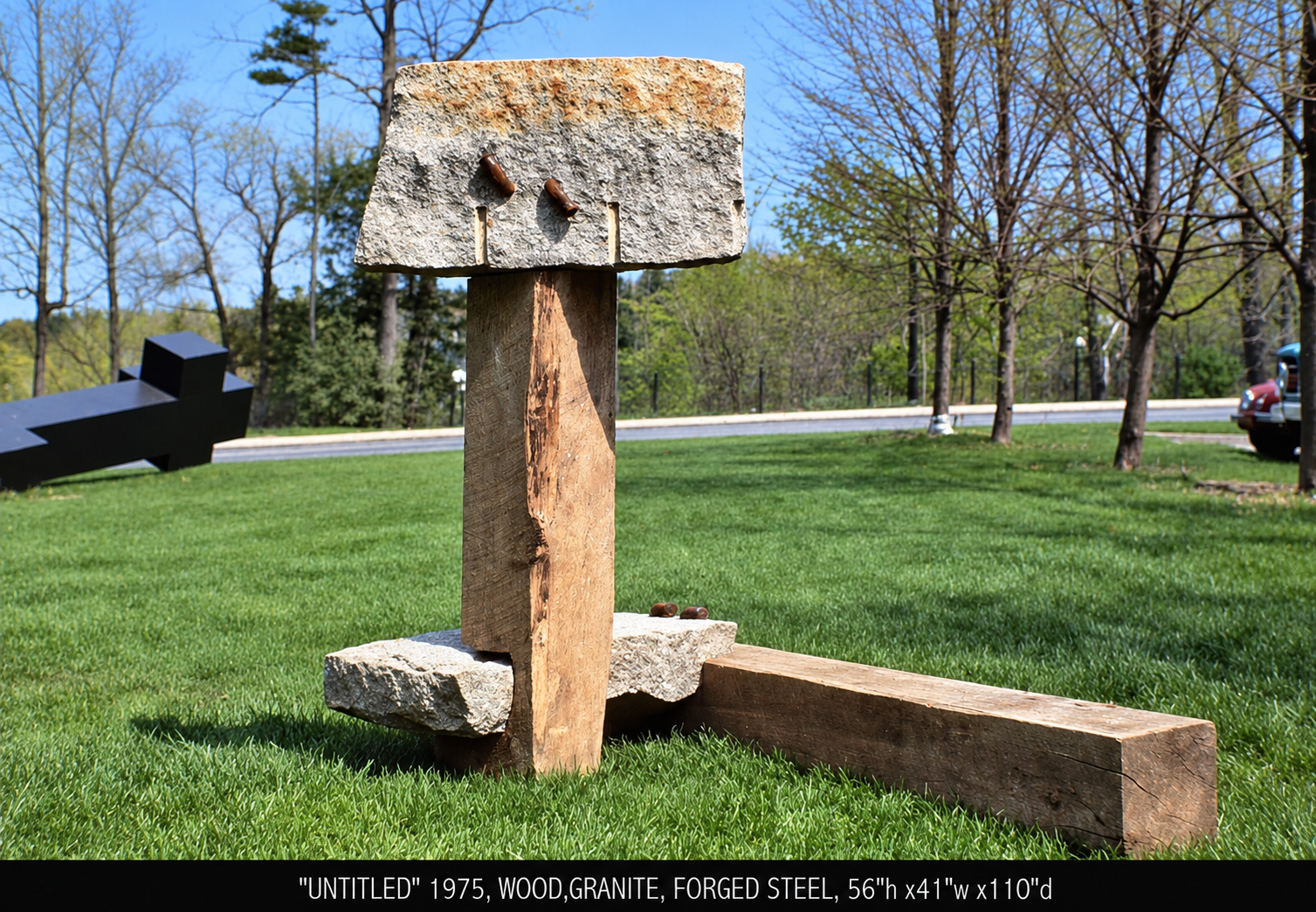
January 1975. Wood, granite, steel. Dimensions: 51 × 84 × 48 in (130 × 213 × 122 cm). (Destroyed)
Untitled (Bent Pins), 1975
Untitled (Bent Pins) followed Stone Assemblage I and II and represents another step in my move away from carving toward assemblage and a more architectural approach to sculpture. I was particularly interested in Japanese building traditions in which joinery and fastening are acknowledged rather than concealed, as well as the work of early 20th-century California architects Greene and Greene, whose Arts and Crafts architecture incorporated Asian-inspired joinery and exposed structural details.
In this sculpture, stone and timber are joined by oversized forged-steel pins that pierce the granite and are bent flat against its surface. Rather than hiding the connection, the fastening becomes an expressive part of the sculpture—the bent pins create a strong directional graphic while clearly revealing how the work is put together.
The bent-pin idea grew from something I had observed along the Maine coast near Kennebunkport, where I spent seven summers: old iron and steel pins embedded in granite, bent and worn through years of use and exposure. Incorporating that memory reinforced my evolving interest in material, structure, gravity, and the physical act of assembly. In retrospect, Untitled (Bent Pins) is an important transitional work—the hidden pins of the preceding Stone Assemblages have become emphatically visible, anticipating the more direct and structurally explicit connections of the tensegrity or Brute Series that soon followed.
January 1975. Wood, granite, steel. Dimensions: 51 × 84 × 48 in (130 × 213 × 122 cm). (Destroyed)
Untitled (Bent Pins), 1975
Untitled (Bent Pins) followed Stone Assemblage I and II and represents another step in my move away from carving toward assemblage and a more architectural approach to sculpture. I was particularly interested in Japanese building traditions in which joinery and fastening are acknowledged rather than concealed, as well as the work of early 20th-century California architects Greene and Greene, whose Arts and Crafts architecture incorporated Asian-inspired joinery and exposed structural details.
In this sculpture, stone and timber are joined by oversized forged-steel pins that pierce the granite and are bent flat against its surface. Rather than hiding the connection, the fastening becomes an expressive part of the sculpture—the bent pins create a strong directional graphic while clearly revealing how the work is put together.
The bent-pin idea grew from something I had observed along the Maine coast near Kennebunkport, where I spent seven summers: old iron and steel pins embedded in granite, bent and worn through years of use and exposure. Incorporating that memory reinforced my evolving interest in material, structure, gravity, and the physical act of assembly. In retrospect, Untitled (Bent Pins) is an important transitional work—the hidden pins of the preceding Stone Assemblages have become emphatically visible, anticipating the more direct and structurally explicit connections of the tensegrity or Brute Series that soon followed.