 Image 1 of 2
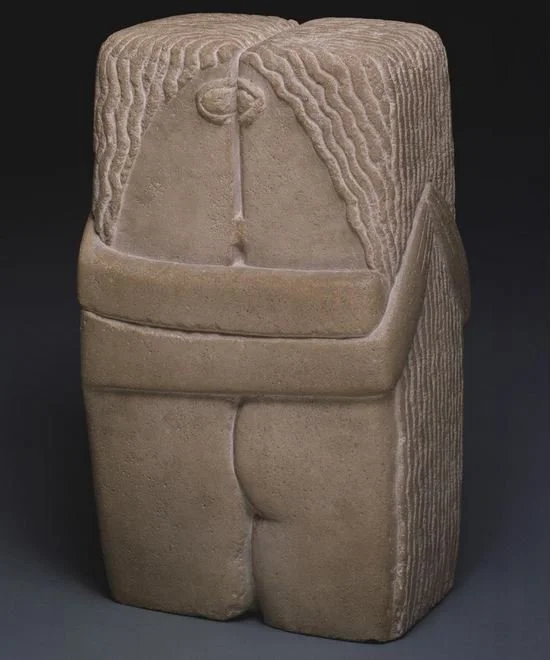 Image 2 of 2
January 1974. Marble. Dimensions: 36 × 30 × 20 in (91 × 76 × 51 cm). Private Collection.
Untitled (Kiss II) was created while I was an undergraduate at Kent State and reflects my early interest in Jean Arp, Henry Moore, and particularly Constantin Brancusi. It is the second in the series and pays homage to Brancusi’s The Kiss and his reduction of the embracing figures to two simplified, block-like forms. Here, two marble elements are brought closely together, activating and electrifying the negative space between them simulating and expressing the sexual attraction of the couple.
Like Brancusi, I retained much of the geometry of the original quarry block, allowing the rectangular mass of the stone to remain clearly present. At the same time, the work reflects my growing awareness of the Minimalist aesthetic of the 1960s and ’70s, particularly the reduced geometric sculpture being made around me at Kent State—an approach I later affectionately called “Midwest minimalism.” The piece represents an early merging of these influences: the sensual, carved forms of European modernism with the more austere geometry of contemporary American sculpture.
January 1974. Marble. Dimensions: 36 × 30 × 20 in (91 × 76 × 51 cm). Private Collection.
Untitled (Kiss II) was created while I was an undergraduate at Kent State and reflects my early interest in Jean Arp, Henry Moore, and particularly Constantin Brancusi. It is the second in the series and pays homage to Brancusi’s The Kiss and his reduction of the embracing figures to two simplified, block-like forms. Here, two marble elements are brought closely together, activating and electrifying the negative space between them simulating and expressing the sexual attraction of the couple.
Like Brancusi, I retained much of the geometry of the original quarry block, allowing the rectangular mass of the stone to remain clearly present. At the same time, the work reflects my growing awareness of the Minimalist aesthetic of the 1960s and ’70s, particularly the reduced geometric sculpture being made around me at Kent State—an approach I later affectionately called “Midwest minimalism.” The piece represents an early merging of these influences: the sensual, carved forms of European modernism with the more austere geometry of contemporary American sculpture.