 Image 1 of 3
 Image 2 of 3
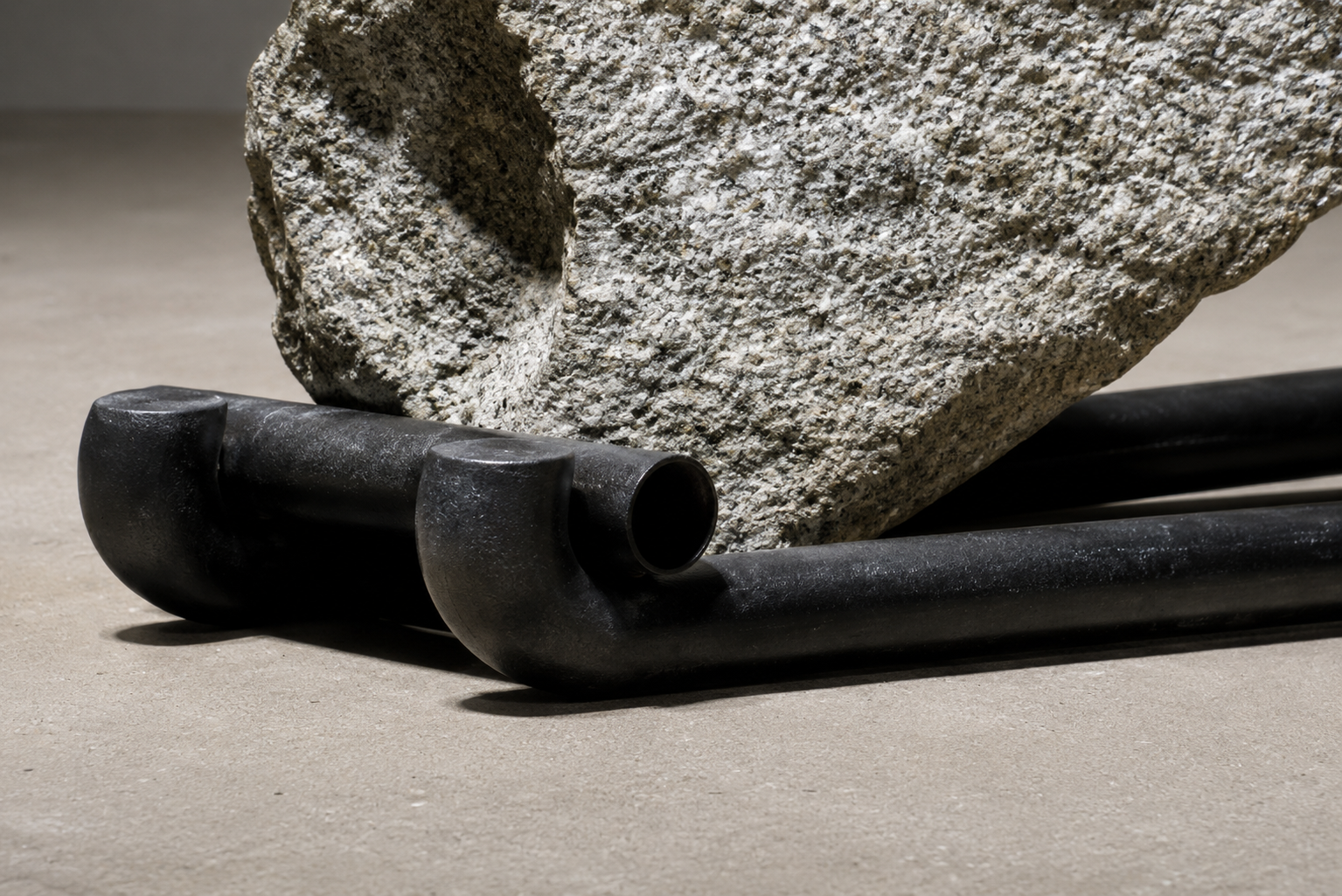 Image 3 of 3
November 1980. Vinalhaven granite, steel. Dimensions: 18 × 21 × 42 in (46 × 53 × 107 cm).
The Arch Series of the late 1970s and early 1980s evolved from my earlier tensegrity, or Brute Series, in which gravity and the physical pressure of massive stones provide the energy—or “glue”—that holds the sculpture together without welding. In these works, weight is not simply a burden to be supported but an active structural force. Stone and steel press against and respond to one another, creating a state of tension, compression, and equilibrium.
In the Arch Series, this principle developed into low, arching configurations in which heavy stone elements appear to rise from the ground while remaining firmly subject to gravity. The arch became both a structural device and a metaphor—suggesting support, passage, shelter, and the transformation of downward gravitational force into lateral tension. The works explore a recurring concern in my sculpture: how seemingly opposing forces—weight and lift, mass and movement, tension and stability—can be brought into a precarious but resolved balance.
November 1980. Vinalhaven granite, steel. Dimensions: 18 × 21 × 42 in (46 × 53 × 107 cm).
The Arch Series of the late 1970s and early 1980s evolved from my earlier tensegrity, or Brute Series, in which gravity and the physical pressure of massive stones provide the energy—or “glue”—that holds the sculpture together without welding. In these works, weight is not simply a burden to be supported but an active structural force. Stone and steel press against and respond to one another, creating a state of tension, compression, and equilibrium.
In the Arch Series, this principle developed into low, arching configurations in which heavy stone elements appear to rise from the ground while remaining firmly subject to gravity. The arch became both a structural device and a metaphor—suggesting support, passage, shelter, and the transformation of downward gravitational force into lateral tension. The works explore a recurring concern in my sculpture: how seemingly opposing forces—weight and lift, mass and movement, tension and stability—can be brought into a precarious but resolved balance.