 Image 1 of 2
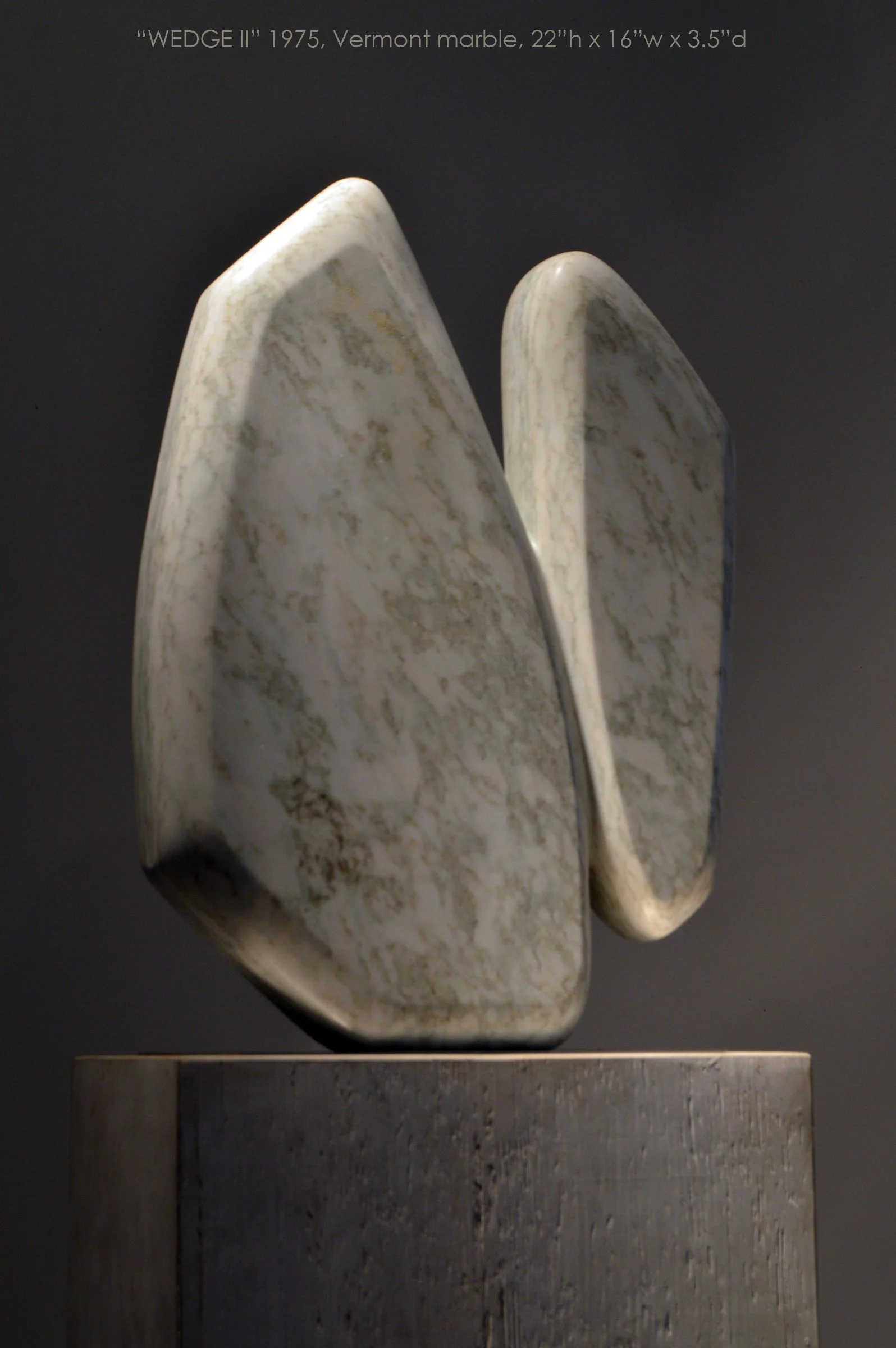 Image 2 of 2
January 1975. Vermont marble. Dimensions: 22 × 16 × 4 in (56 × 41 × 10 cm). Private Collection.
Wedge II, my second carved sculpture at Cornell, is both an aesthetic and conceptual extension of Wedge I. Two minimally carved marble forms are brought into close relationship, creating a narrow, activated negative space between them. The softened geometry and restrained carving continue ideas developed at Kent State, while the separation of the two elements gives the sculpture a sense of tension, balance, and implied movement.
In retrospect, Wedge II stands very near the end of one phase of my work. It preceded Falling Stone (1975), which grew from the accidental breaking of a nearly completed carved marble sculpture in my Cornell studio. That event redirected my attention from carving predetermined forms toward working with broken and eventually found stone—allowing the material’s natural surfaces, weight, and physical forces to become active parts of the sculpture. Wedge II therefore occupies an important transitional position between my early carved marble works and the tensegrity, or Brute Sculpture, that would soon follow.
January 1975. Vermont marble. Dimensions: 22 × 16 × 4 in (56 × 41 × 10 cm). Private Collection.
Wedge II, my second carved sculpture at Cornell, is both an aesthetic and conceptual extension of Wedge I. Two minimally carved marble forms are brought into close relationship, creating a narrow, activated negative space between them. The softened geometry and restrained carving continue ideas developed at Kent State, while the separation of the two elements gives the sculpture a sense of tension, balance, and implied movement.
In retrospect, Wedge II stands very near the end of one phase of my work. It preceded Falling Stone (1975), which grew from the accidental breaking of a nearly completed carved marble sculpture in my Cornell studio. That event redirected my attention from carving predetermined forms toward working with broken and eventually found stone—allowing the material’s natural surfaces, weight, and physical forces to become active parts of the sculpture. Wedge II therefore occupies an important transitional position between my early carved marble works and the tensegrity, or Brute Sculpture, that would soon follow.