 Image 1 of 1
January 1984. Granite, steel. Dimensions: 22 × 42 × 10 in (56 × 107 × 25 cm).
Private collection - Baltimore
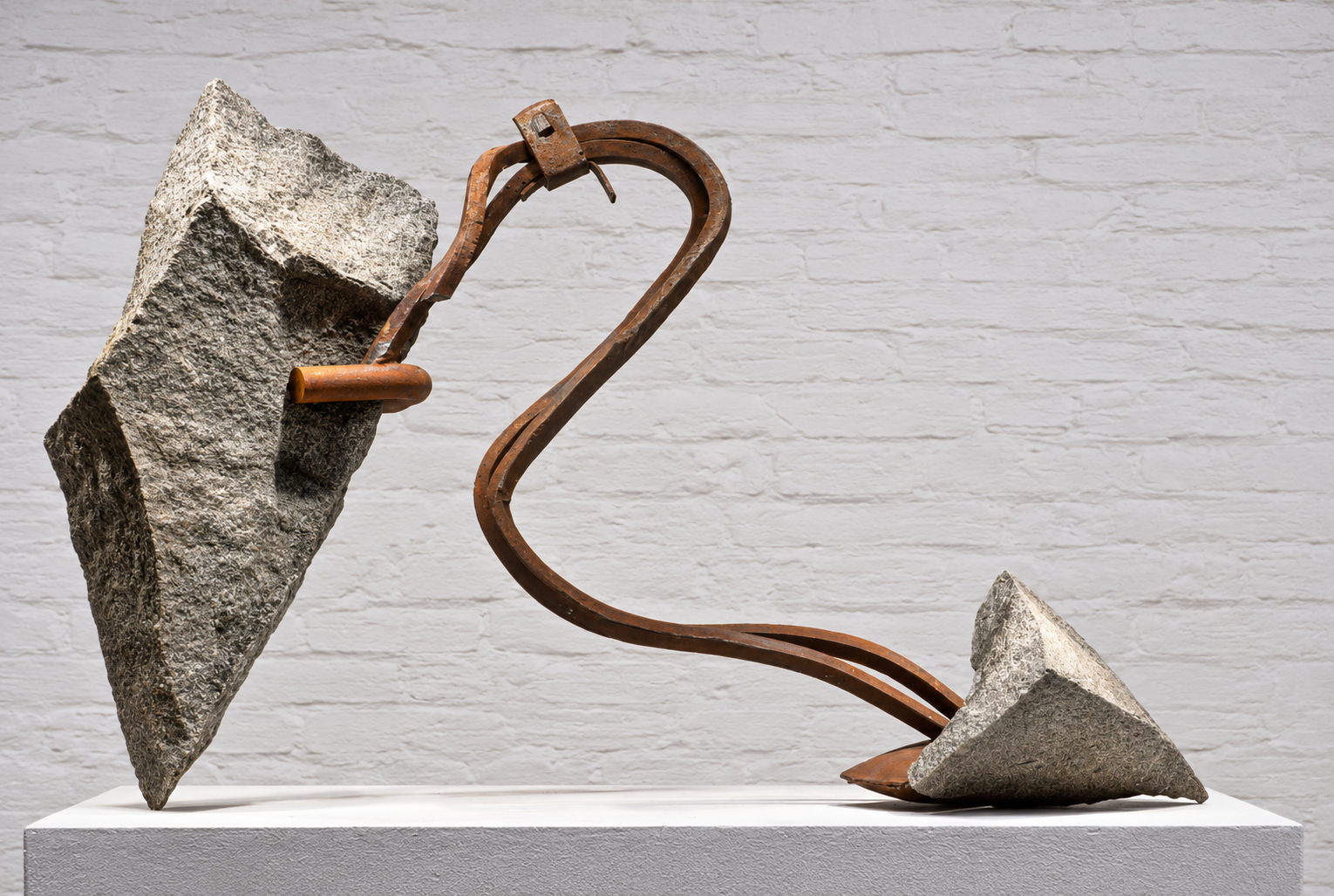
Wrangler marks an unusual figurative reference in my work at the time. Two pieces of granite are joined by long, looping found-steel elements whose sweeping gesture suggests a figure—or perhaps the action of handling and controlling something larger and more powerful. The work retains my interest in gravity, balance, and visible assembly, but moves beyond the tightly structured, self-referential concerns of my earlier tensegrity, or Brute Series. This gradual opening toward figurative association would become increasingly important in my work.
The title Wrangler reaches back to my years in Wyoming and to the world of cowboys, rodeo ropers, and wranglers. The looping steel suggests a rope or lariat, allowing the materials to carry associations beyond their purely structural function. In this sense, Wrangler represents a loosening of my earlier, almost dogmatic adherence to “truth to materials”—a move toward a more playful and expressive vocabulary in which gesture, metaphor, and association could become part of the sculpture.
January 1984. Granite, steel. Dimensions: 22 × 42 × 10 in (56 × 107 × 25 cm).
Private collection - Baltimore
Wrangler marks an unusual figurative reference in my work at the time. Two pieces of granite are joined by long, looping found-steel elements whose sweeping gesture suggests a figure—or perhaps the action of handling and controlling something larger and more powerful. The work retains my interest in gravity, balance, and visible assembly, but moves beyond the tightly structured, self-referential concerns of my earlier tensegrity, or Brute Series. This gradual opening toward figurative association would become increasingly important in my work.
The title Wrangler reaches back to my years in Wyoming and to the world of cowboys, rodeo ropers, and wranglers. The looping steel suggests a rope or lariat, allowing the materials to carry associations beyond their purely structural function. In this sense, Wrangler represents a loosening of my earlier, almost dogmatic adherence to “truth to materials”—a move toward a more playful and expressive vocabulary in which gesture, metaphor, and association could become part of the sculpture.