2010
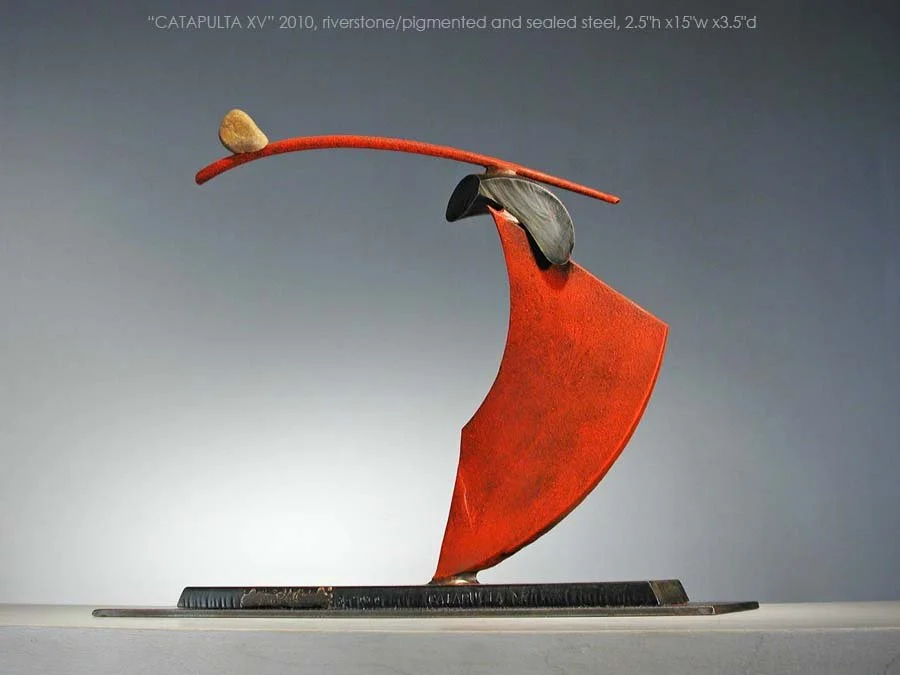
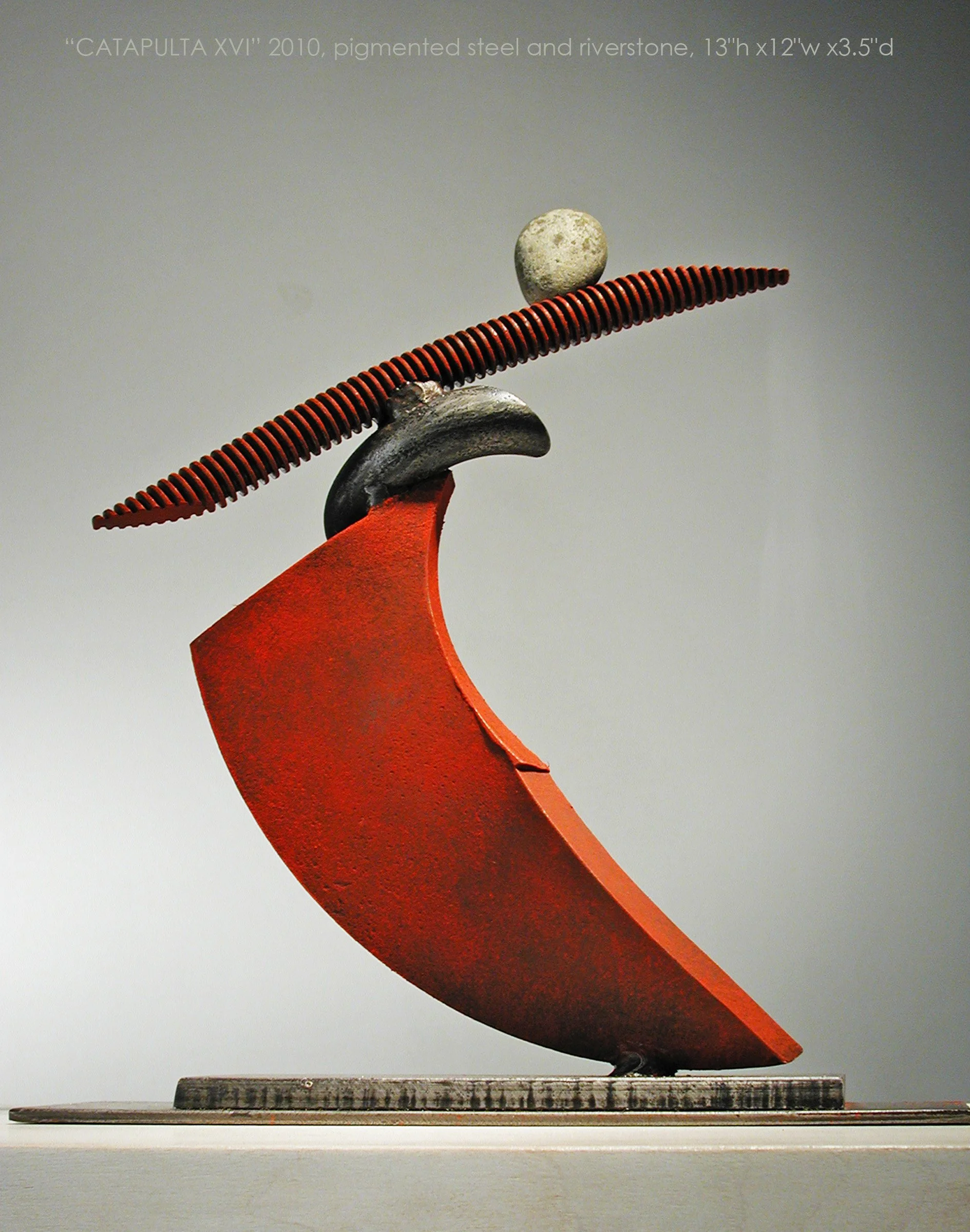
January 2010. River stone, pigmented and sealed steel. Dimensions: 13 × 12 × 3.5 in (33 × 30 × 9 cm). Private Collection.
The title derives from the English word catapult, meaning “to launch forward.” The sculpture’s arrangement of stone and steel conveys a sense of arrested motion—energy captured and poised for release—a dynamic tension that has been a central focus of Van Alstine’s work throughout his career.
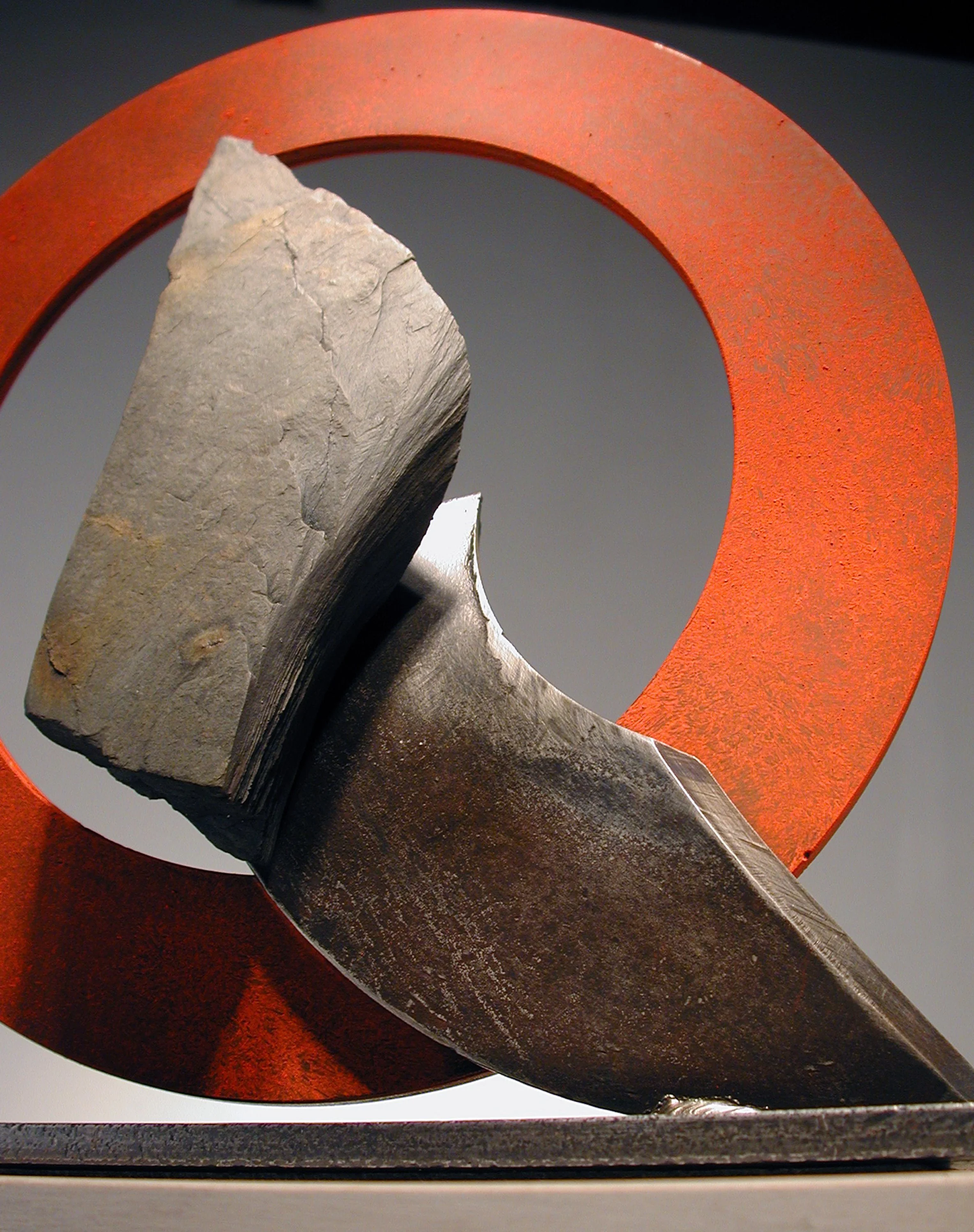
January 2010. Slate, pigmented steel. Dimensions: 15 x 19 x 4.5 in. (38 x 48 x 11 cm). Private Collection.
The Sisyphean Series
The Greek myth of Sisyphus, condemned to endlessly push a boulder uphill, has inspired more than 250 of my sculptures. Rather than seeing the myth as a symbol of futility, I share philosopher Albert Camus’s more positive interpretation—that meaning and fulfillment can be found in the struggle itself. In many ways, I see Sisyphus as autobiographical, reflecting my lifelong pursuit as an artist, confronting challenges, taking risks, and finding purpose in the act of creation.
My Sisyphean works bring stone and steel together in precarious yet stable arrangements, often incorporating circular forms suggesting perpetual motion. For me, they are metaphors for the creative process—an ongoing cycle of experimentation, discovery, setbacks, and renewal. Each completed sculpture is both an achievement and a starting point, celebrating the journey rather than simply the destination.
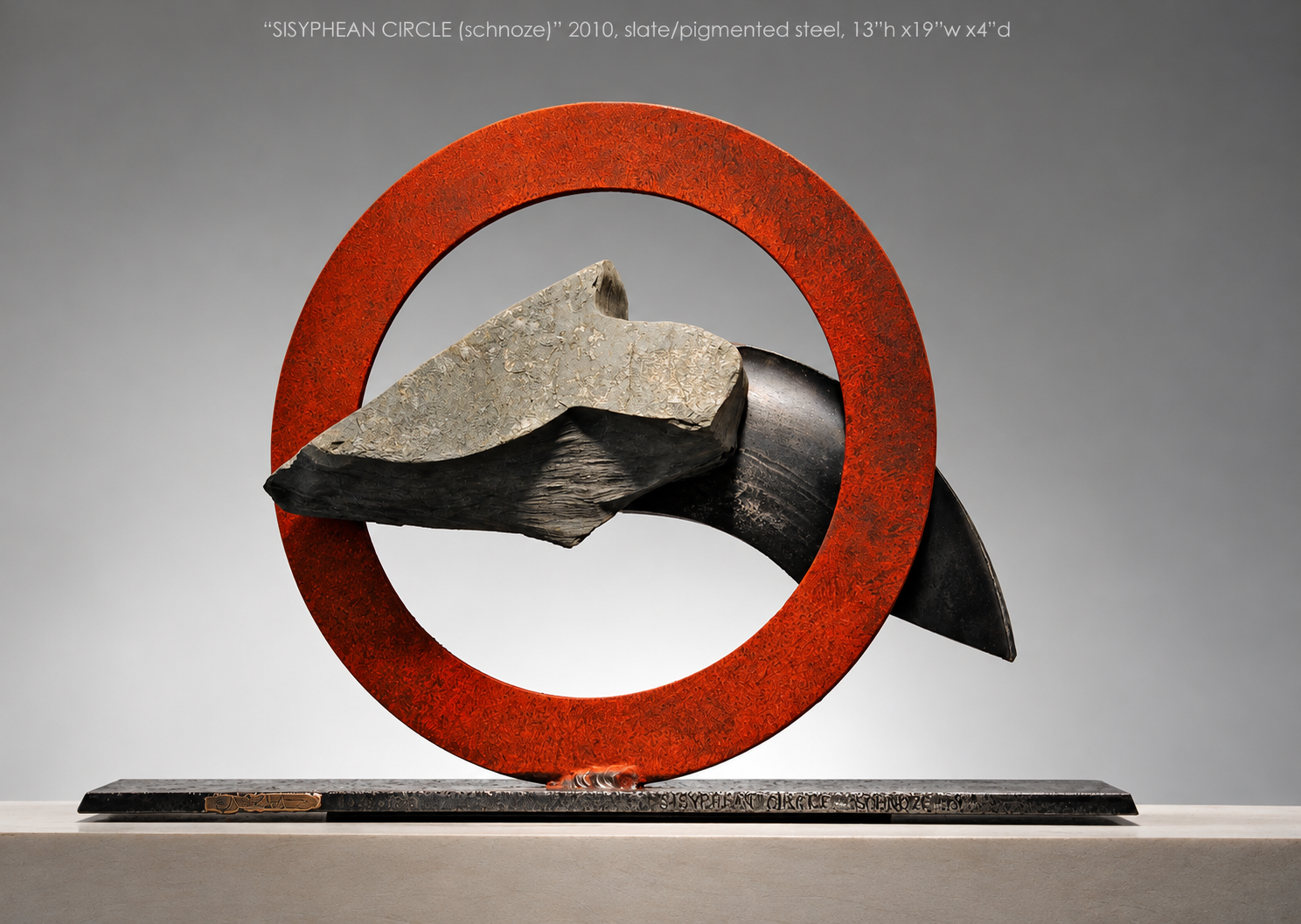
January 2010. Slate, pigmented. Dimensions: 13 x 19 x 4 in. (33 x 48 x 10 cm). Private Collection.
The Sisyphean Series
The Greek myth of Sisyphus, condemned to endlessly push a boulder uphill, has inspired more than 250 of my sculptures. Rather than seeing the myth as a symbol of futility, I share philosopher Albert Camus’s more positive interpretation—that meaning and fulfillment can be found in the struggle itself. In many ways, I see Sisyphus as autobiographical, reflecting my lifelong pursuit as an artist, confronting challenges, taking risks, and finding purpose in the act of creation.
My Sisyphean works bring stone and steel together in precarious yet stable arrangements, often incorporating circular forms suggesting perpetual motion. For me, they are metaphors for the creative process—an ongoing cycle of experimentation, discovery, setbacks, and renewal. Each completed sculpture is both an achievement and a starting point, celebrating the journey rather than simply the destination.
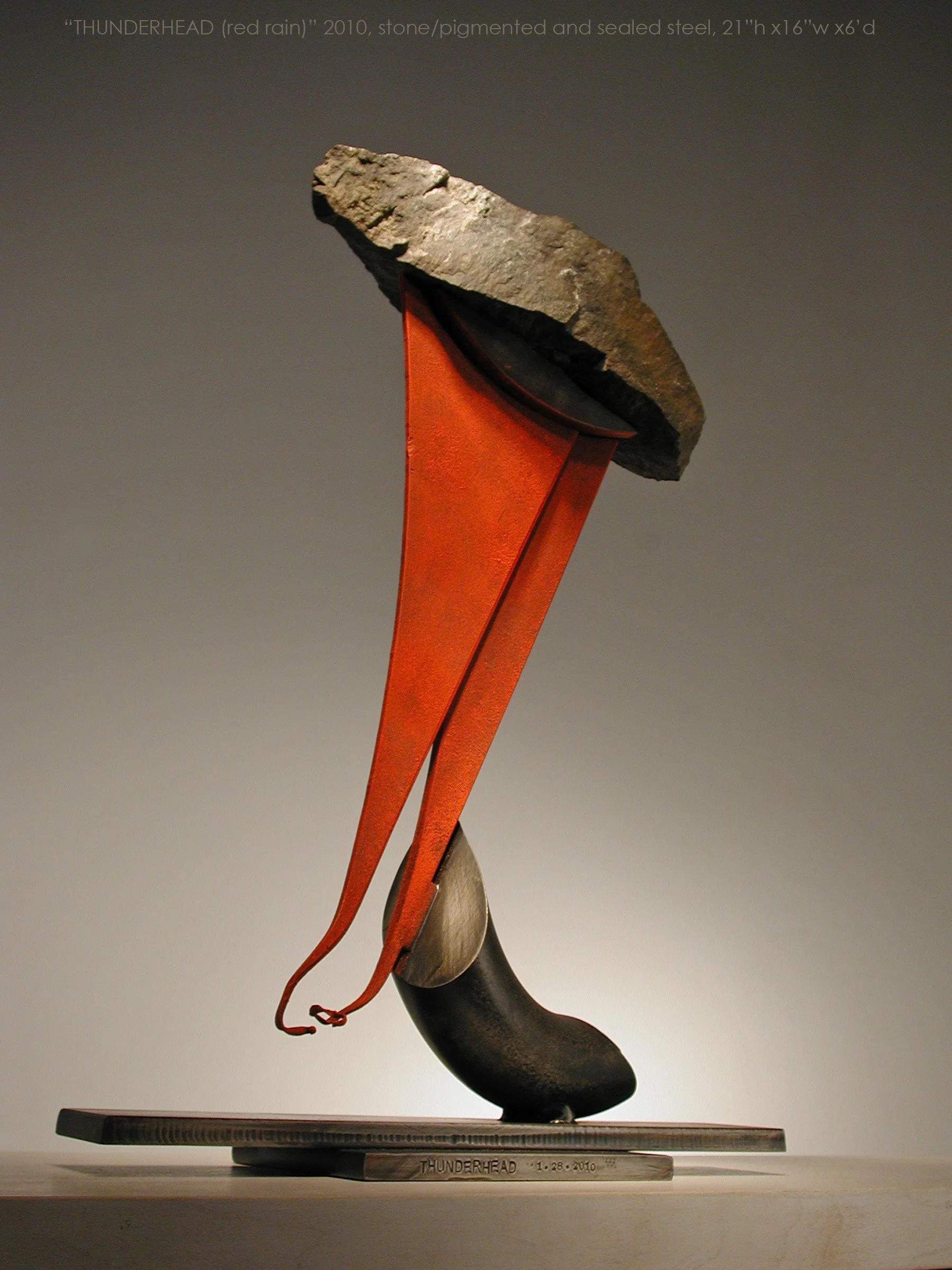
January 2010. Slate, pigmented steel. Dimensions: 21 x 16 x 6 in (53 x 41 x 15 cm). Private Collection. South Carolina.
Thunderhead (Red Rain) is a landscape-inspired sculpture rooted in my experiences on the high plains of Wyoming, where massive storm clouds would march across the expansive landscape, releasing dramatic curtains of rain that often evaporated before reaching the ground—a phenomenon known as virga. Here, a rugged stone suggests a thunderhead, while descending red steel forms evoke falling rain, capturing the drama and atmospheric energy of western storms.
The subtitle Red Rain introduces an environmental dimension, referencing the acid rain that plagued the Adirondacks, largely caused by emissions from Midwestern power plants. This pollution left many lakes and streams unable to support fish and other aquatic life. By transforming rain into an unsettling red, the sculpture connects the grandeur of nature with the destructive consequences of human activity.
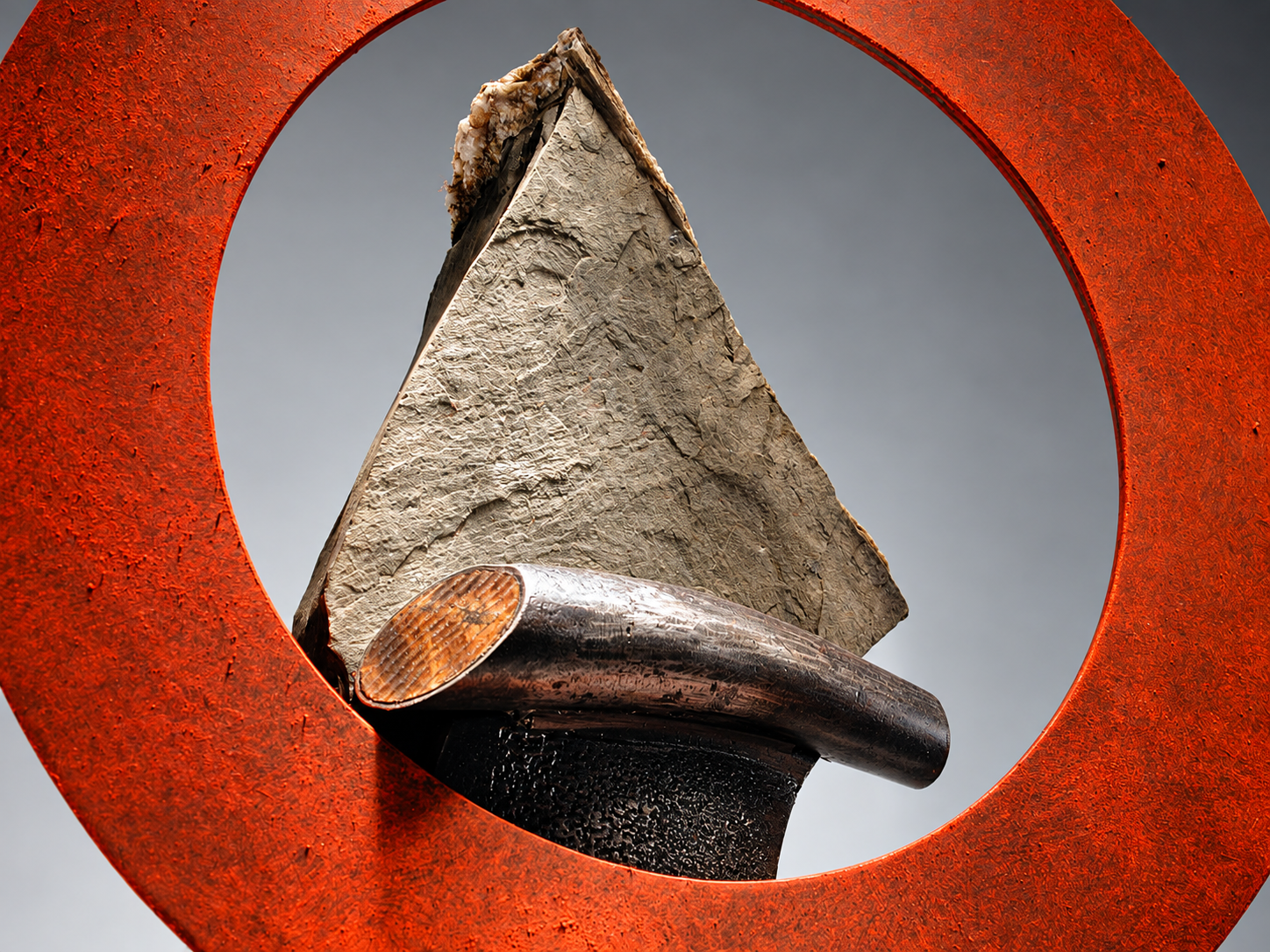
February 2010. Slate, pigmented and seal steel. Dimensions: 20.5 x 25 x 5 in (52 x 64 x 13 cm). Private Collection.
The Sisyphean Series
The Greek myth of Sisyphus, condemned to endlessly push a boulder uphill, has inspired more than 250 of my sculptures. Rather than seeing the myth as a symbol of futility, I share philosopher Albert Camus’s more positive interpretation—that meaning and fulfillment can be found in the struggle itself. In many ways, I see Sisyphus as autobiographical, reflecting my lifelong pursuit as an artist, confronting challenges, taking risks, and finding purpose in the act of creation.
My Sisyphean works bring stone and steel together in precarious yet stable arrangements, often incorporating circular forms suggesting perpetual motion. For me, they are metaphors for the creative process—an ongoing cycle of experimentation, discovery, setbacks, and renewal. Each completed sculpture is both an achievement and a starting point, celebrating the journey rather than simply the destination.
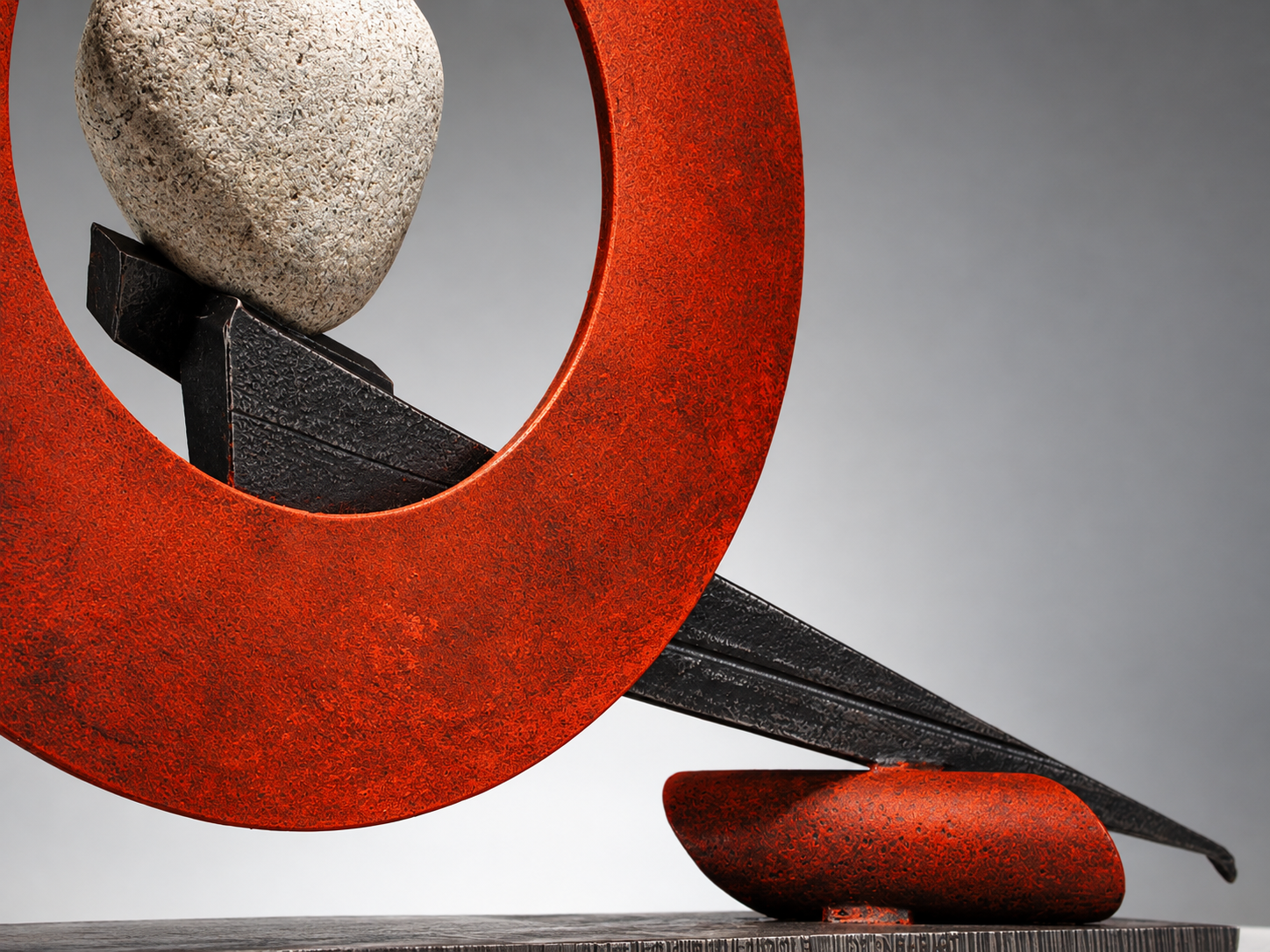
February 2010. River stone, pigmented and sealed steel. Dimensions: 15 x 24 x 4.5 in. (38 x 61 x11 cm). Private Collection Kettering, OH.
The Sisyphean Series
The Greek myth of Sisyphus, condemned to endlessly push a boulder uphill, has inspired more than 250 of my sculptures. Rather than seeing the myth as a symbol of futility, I share philosopher Albert Camus’s more positive interpretation—that meaning and fulfillment can be found in the struggle itself. In many ways, I see Sisyphus as autobiographical, reflecting my lifelong pursuit as an artist, confronting challenges, taking risks, and finding purpose in the act of creation.
My Sisyphean works bring stone and steel together in precarious yet stable arrangements, often incorporating circular forms suggesting perpetual motion. For me, they are metaphors for the creative process—an ongoing cycle of experimentation, discovery, setbacks, and renewal. Each completed sculpture is both an achievement and a starting point, celebrating the journey rather than simply the destination.
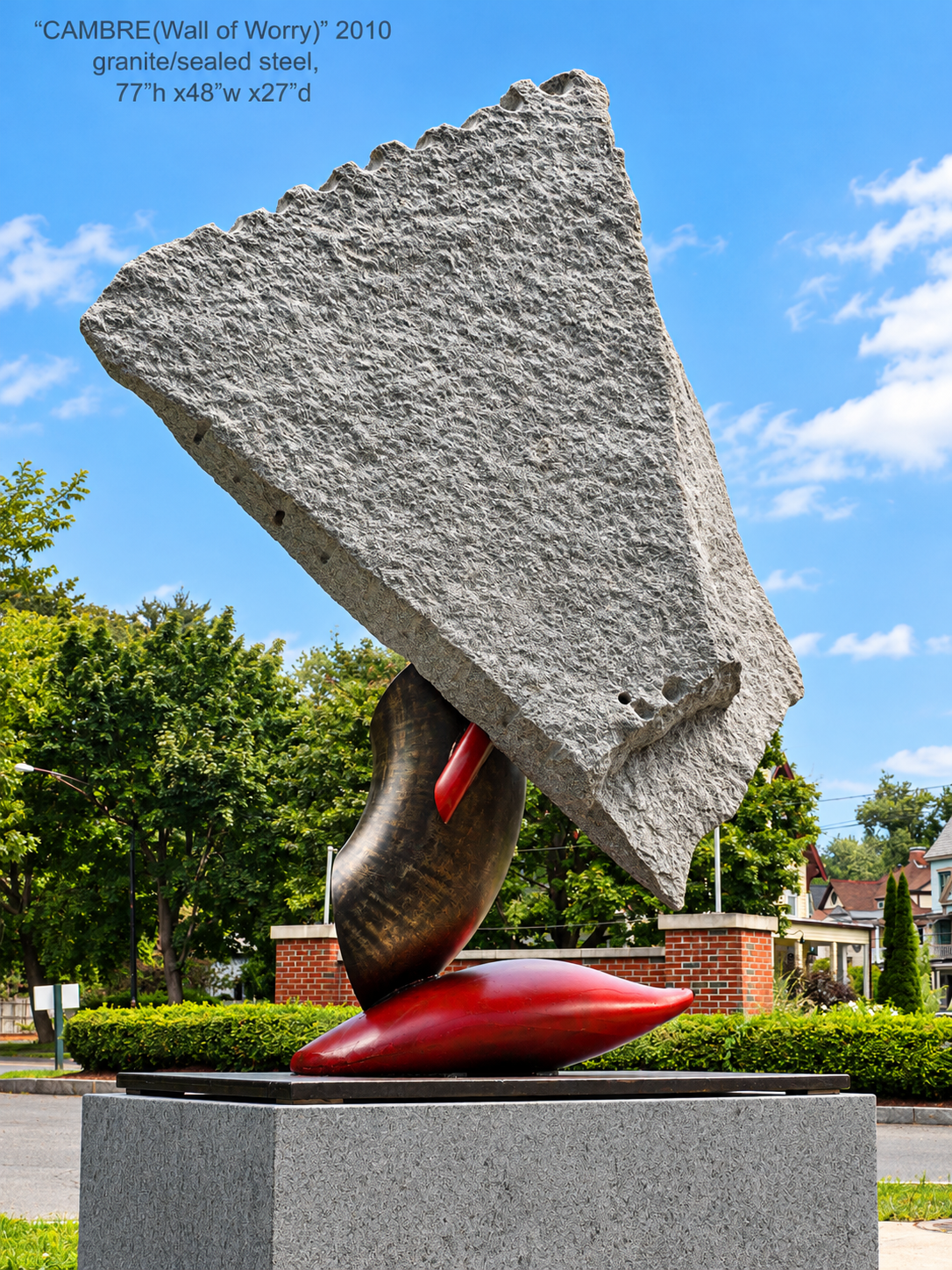
March 2008. Granite, pigmented and sealed steel. Dimensions: 77 × 48 × 27 in (196 × 122 × 69 cm).
A Cambré describes an arched movement of a dancer’s upper body, bending from the waist upwards; the movement can be done forwards, backwards or sideways. I use dance references in many of my works to create a conceptual framework to view and understand the heavy assemblage of earth-bound elements bringing life and meaning to its choreography.
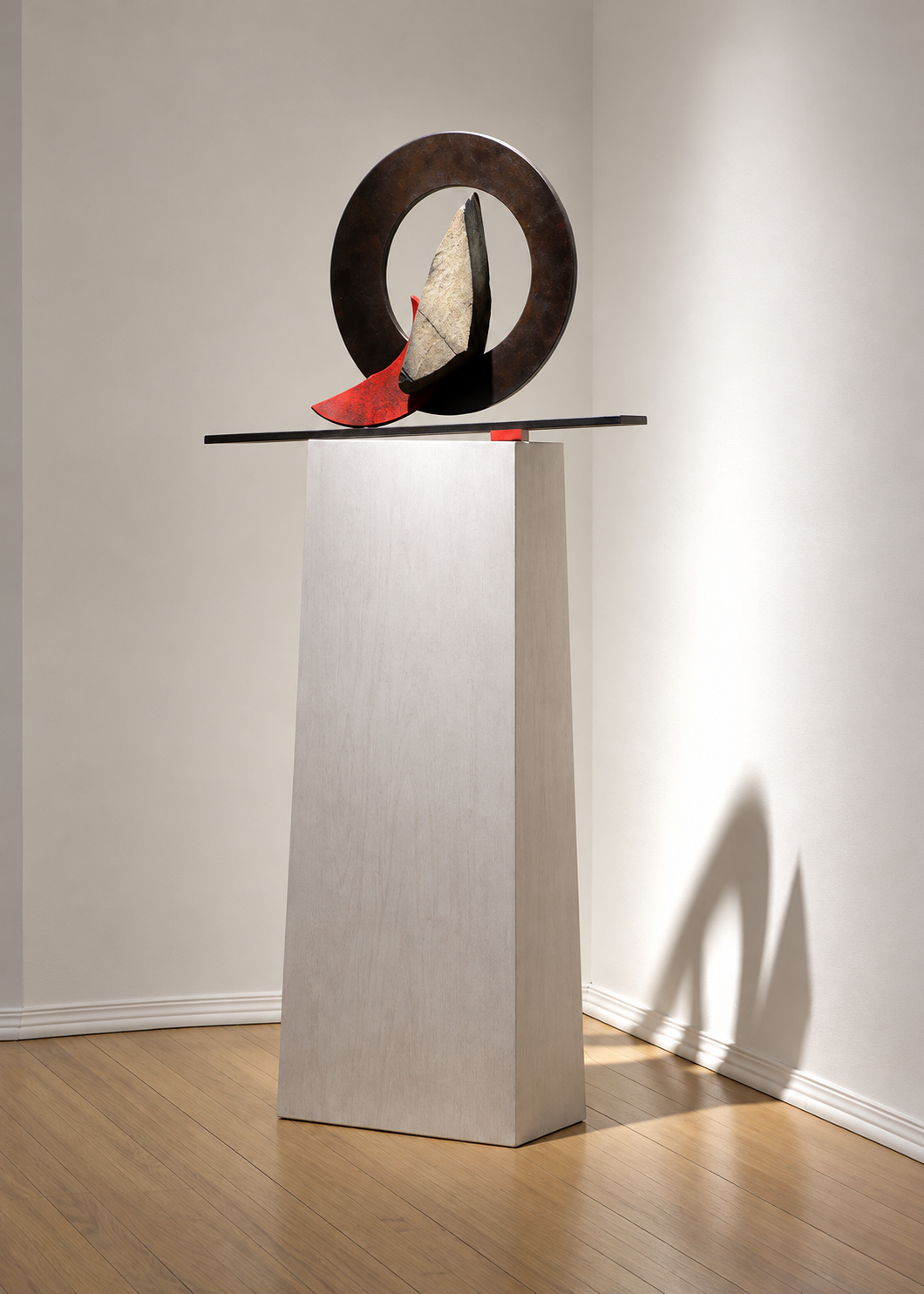
March 2010. Slate, pigmented and sealed steel. Dimensions: 18 x 27 x 4 in. (46 x 69 x 10 cm). Private Collection.
The Sisyphean Series
The Greek myth of Sisyphus, condemned to endlessly push a boulder uphill, has inspired more than 250 of my sculptures. Rather than seeing the myth as a symbol of futility, I share philosopher Albert Camus’s more positive interpretation—that meaning and fulfillment can be found in the struggle itself. In many ways, I see Sisyphus as autobiographical, reflecting my lifelong pursuit as an artist, confronting challenges, taking risks, and finding purpose in the act of creation.
My Sisyphean works bring stone and steel together in precarious yet stable arrangements, often incorporating circular forms suggesting perpetual motion. For me, they are metaphors for the creative process—an ongoing cycle of experimentation, discovery, setbacks, and renewal. Each completed sculpture is both an achievement and a starting point, celebrating the journey rather than simply the destination.
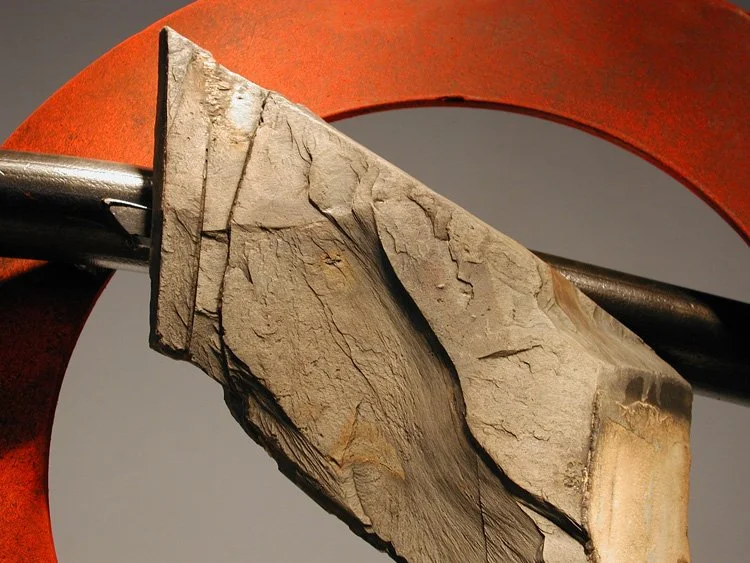
March 2010. Slate, pigmented and sealed steel. Dimensions: 18 x 29 x 8 in (46 x 74 x 20 cm). Private Collection.
The Sisyphean Series
The Greek myth of Sisyphus, condemned to endlessly push a boulder uphill, has inspired more than 250 of my sculptures. Rather than seeing the myth as a symbol of futility, I share philosopher Albert Camus’s more positive interpretation—that meaning and fulfillment can be found in the struggle itself. In many ways, I see Sisyphus as autobiographical, reflecting my lifelong pursuit as an artist, confronting challenges, taking risks, and finding purpose in the act of creation.
My Sisyphean works bring stone and steel together in precarious yet stable arrangements, often incorporating circular forms suggesting perpetual motion. For me, they are metaphors for the creative process—an ongoing cycle of experimentation, discovery, setbacks, and renewal. Each completed sculpture is both an achievement and a starting point, celebrating the journey rather than simply the destination.
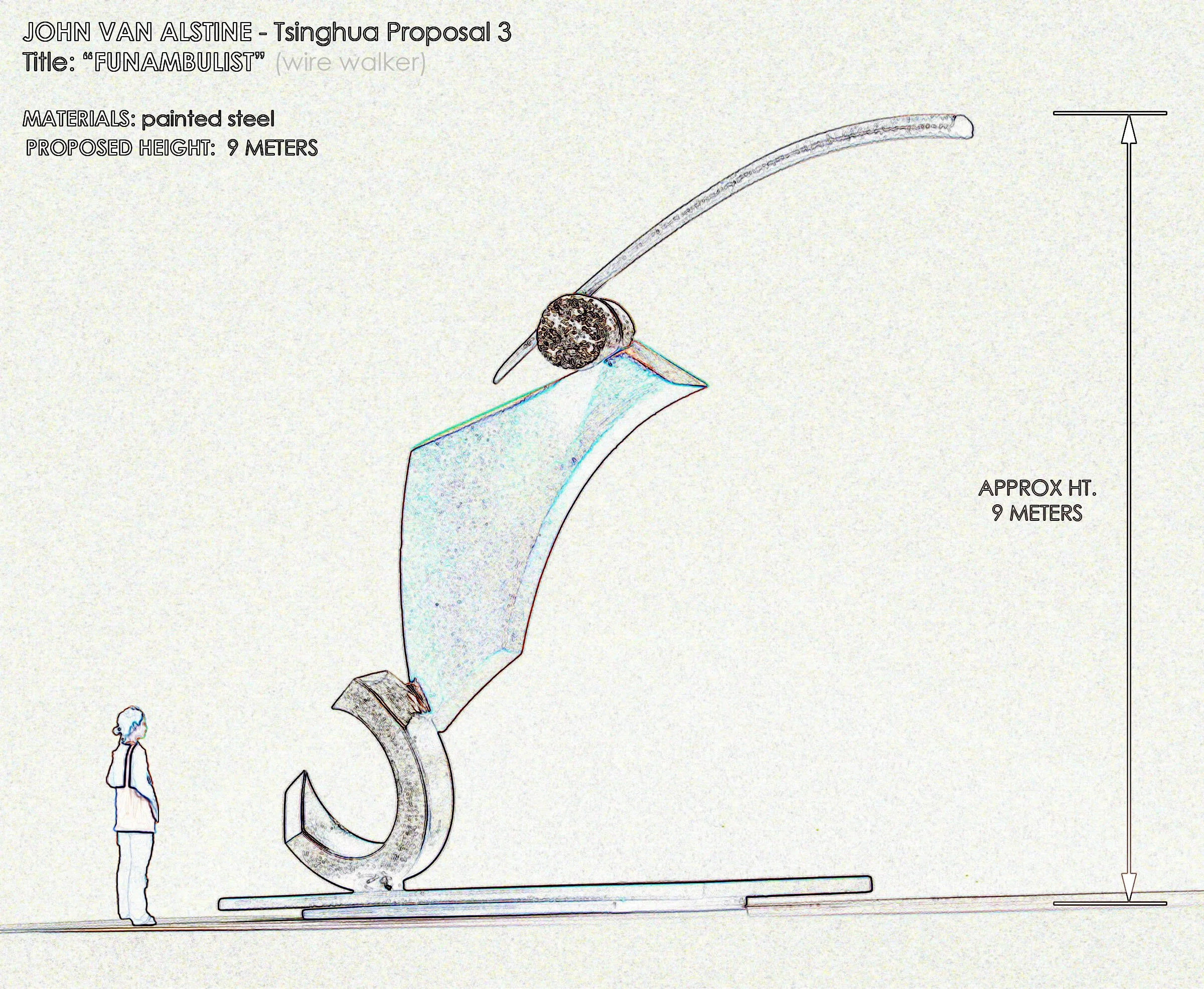
March 2010. Granite, pigmented and sealed steel. Dimensions: 12 × 17 × 4 in (30 × 43 × 10 cm). Private Collection.
The title derives from two Latin words—fūnis, meaning “rope,” and ambulāre, “to walk”—and refers to a tightrope walker. The meaning is reinforced by the sculpture’s dynamic horizontal “balancing baton” and its overall sense of precarious poise. It evokes the physical balance, agility, and daring of a circus performer, while perhaps more poignantly suggesting mental agility—the ability to maintain equilibrium amid uncertainty and change.
A celebrated modern funambulist is Philippe Petit, who became famous for his unauthorized high-wire walk between the Twin Towers of New York’s World Trade Center on August 7, 1974. His feat became an enduring image of extraordinary balance, concentration, risk, and resolve.
This piece was proposed for the West Ridgeway Avenue Corridor Commission, Cedar Falls Public Art Committee, Cedar Falls, IA in 2013.
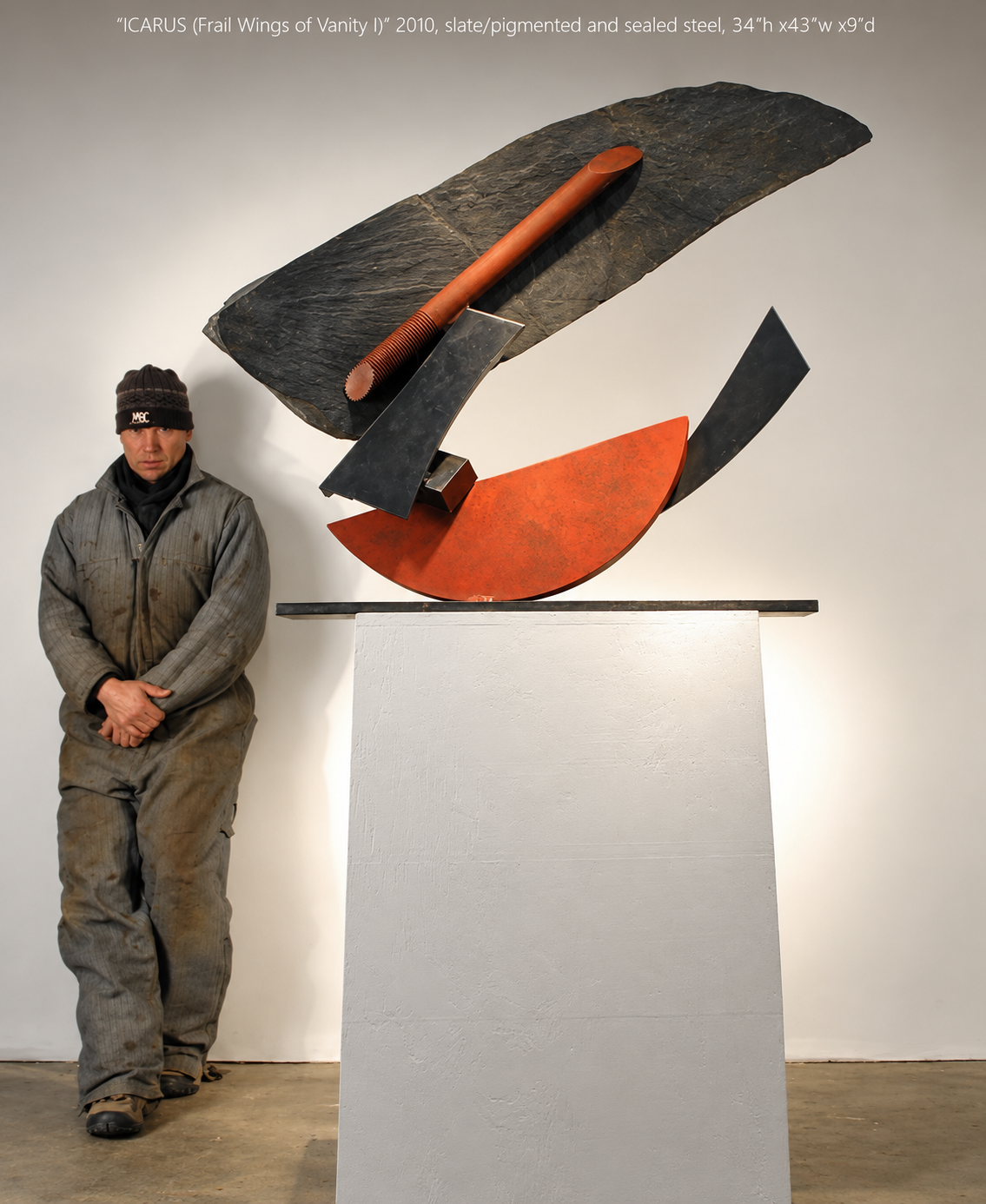
March 2010. Slate, pigmented and sealed steel. Dimensions: 34 × 43 × 9 in (86 × 109 × 23 cm).
Icarus – Frail Wings of Vanity (2010)
Icarus – Frail Wings of Vanity draws on the Greek myth of Icarus, whose ambition and disregard for his father's warnings led him to fly too close to the sun, melting his wings and sending him crashing into the sea. The myth serves as a metaphor for human ambition, hubris, and the often precarious relationship between aspiration and consequence.
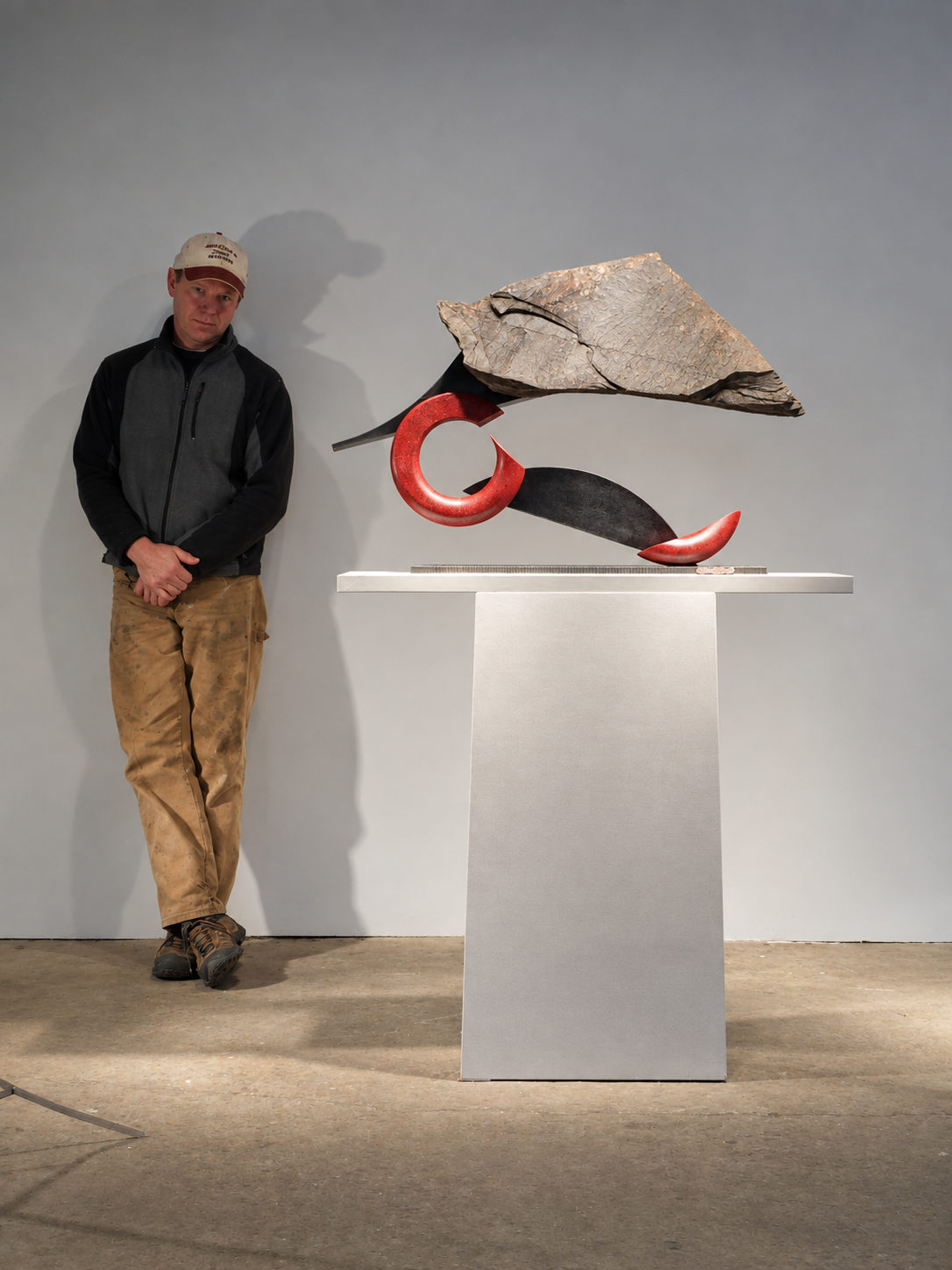
The sculpture combines a massive, wing-like slab of slate with industrial steel elements, suspended above a curved, vessel-like form. The dramatic imbalance suggests both the exhilaration of flight and the inevitability of a fall. Through the interplay of weight, balance, and arrested motion, the work explores the fragile boundary between human achievement and overreaching ambition.
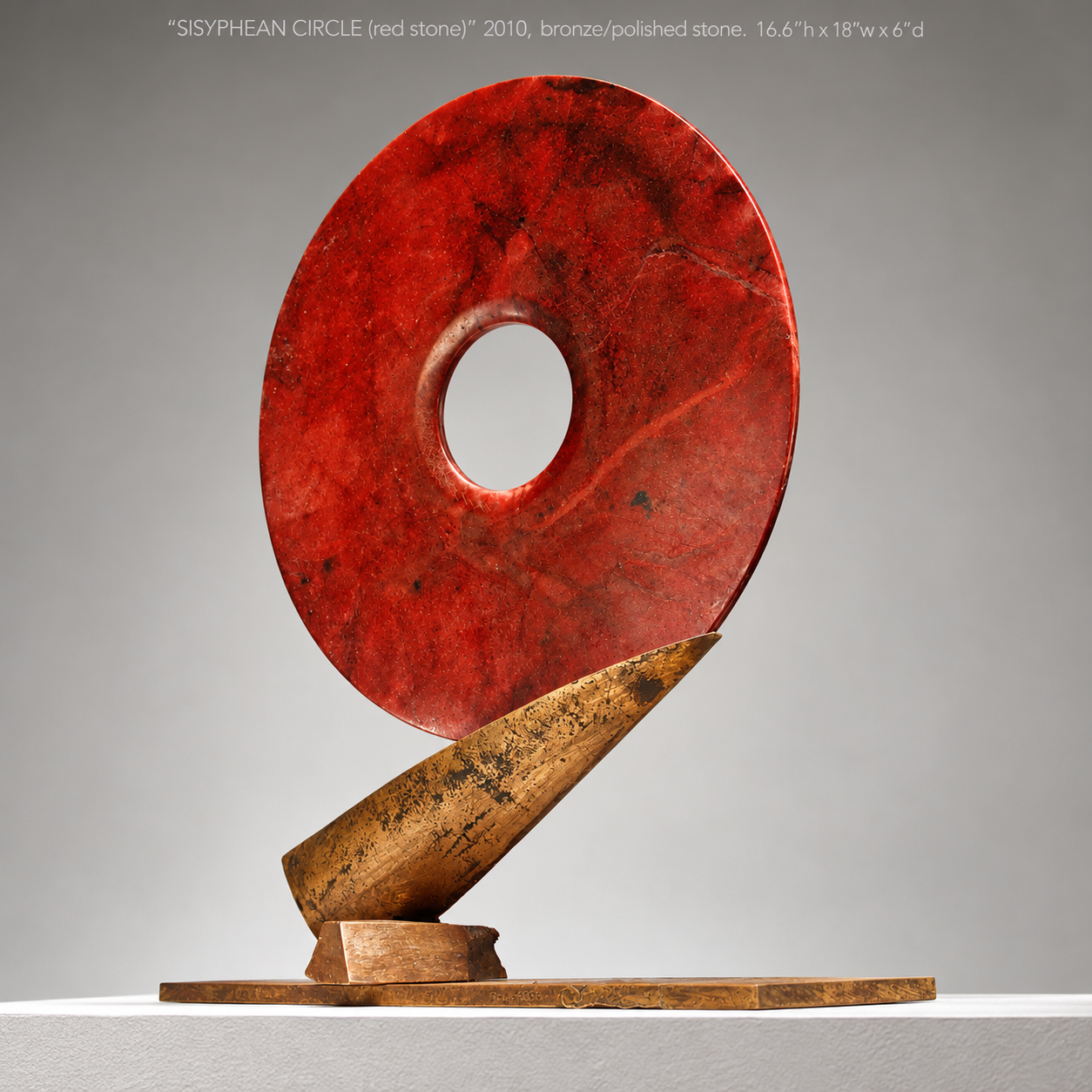
May 2010. Bronze, red stone. Dimensions: 16.6 x 18 x 5 in. (42 x 46 x 13 cm). Private Collection.
The Sisyphean Series
The Greek myth of Sisyphus, condemned to endlessly push a boulder uphill, has inspired more than 250 of my sculptures. Rather than seeing the myth as a symbol of futility, I share philosopher Albert Camus’s more positive interpretation—that meaning and fulfillment can be found in the struggle itself. In many ways, I see Sisyphus as autobiographical, reflecting my lifelong pursuit as an artist, confronting challenges, taking risks, and finding purpose in the act of creation.
My Sisyphean works bring stone and steel together in precarious yet stable arrangements, often incorporating circular forms suggesting perpetual motion. For me, they are metaphors for the creative process—an ongoing cycle of experimentation, discovery, setbacks, and renewal. Each completed sculpture is both an achievement and a starting point, celebrating the journey rather than simply the destination.
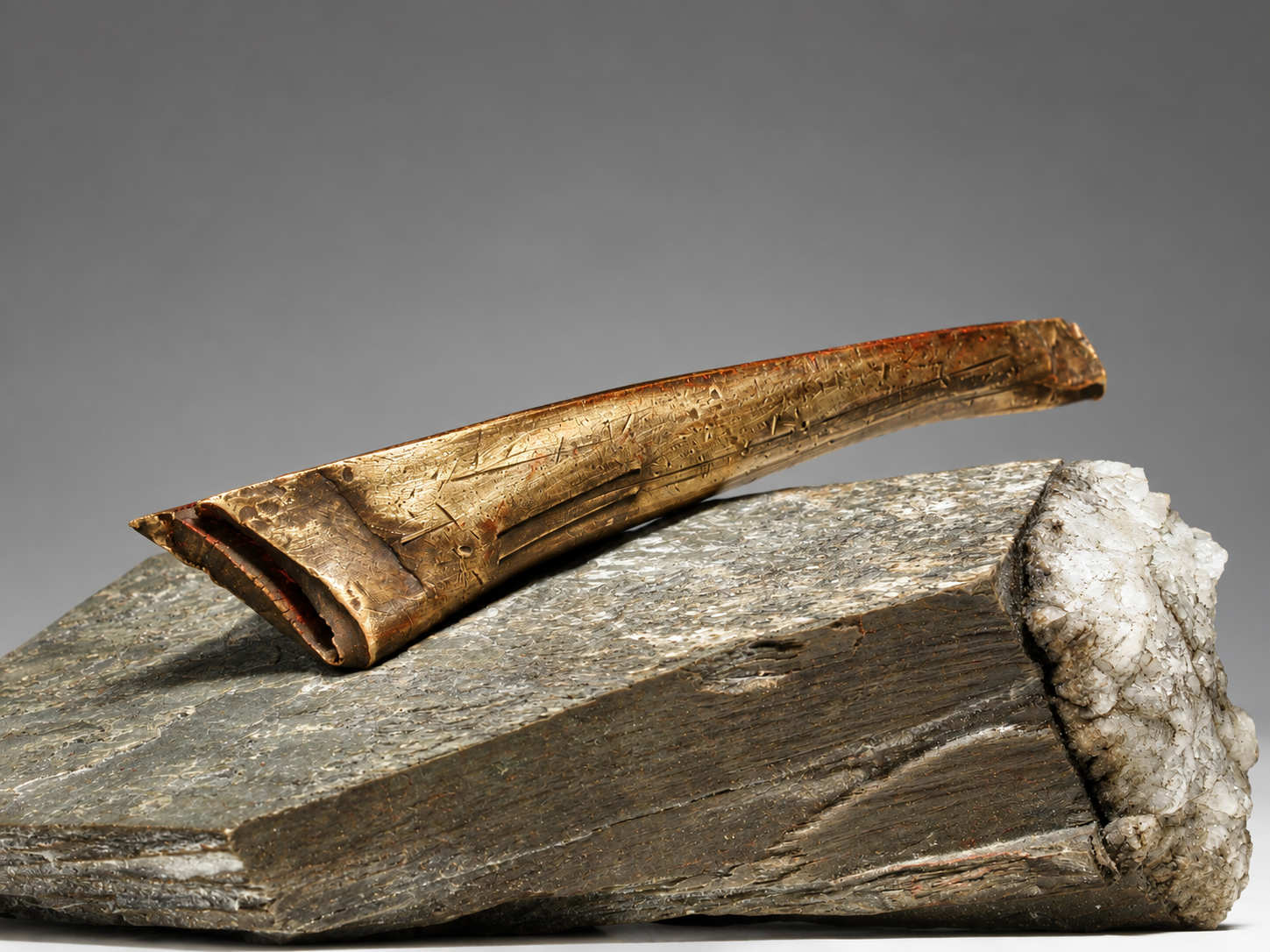
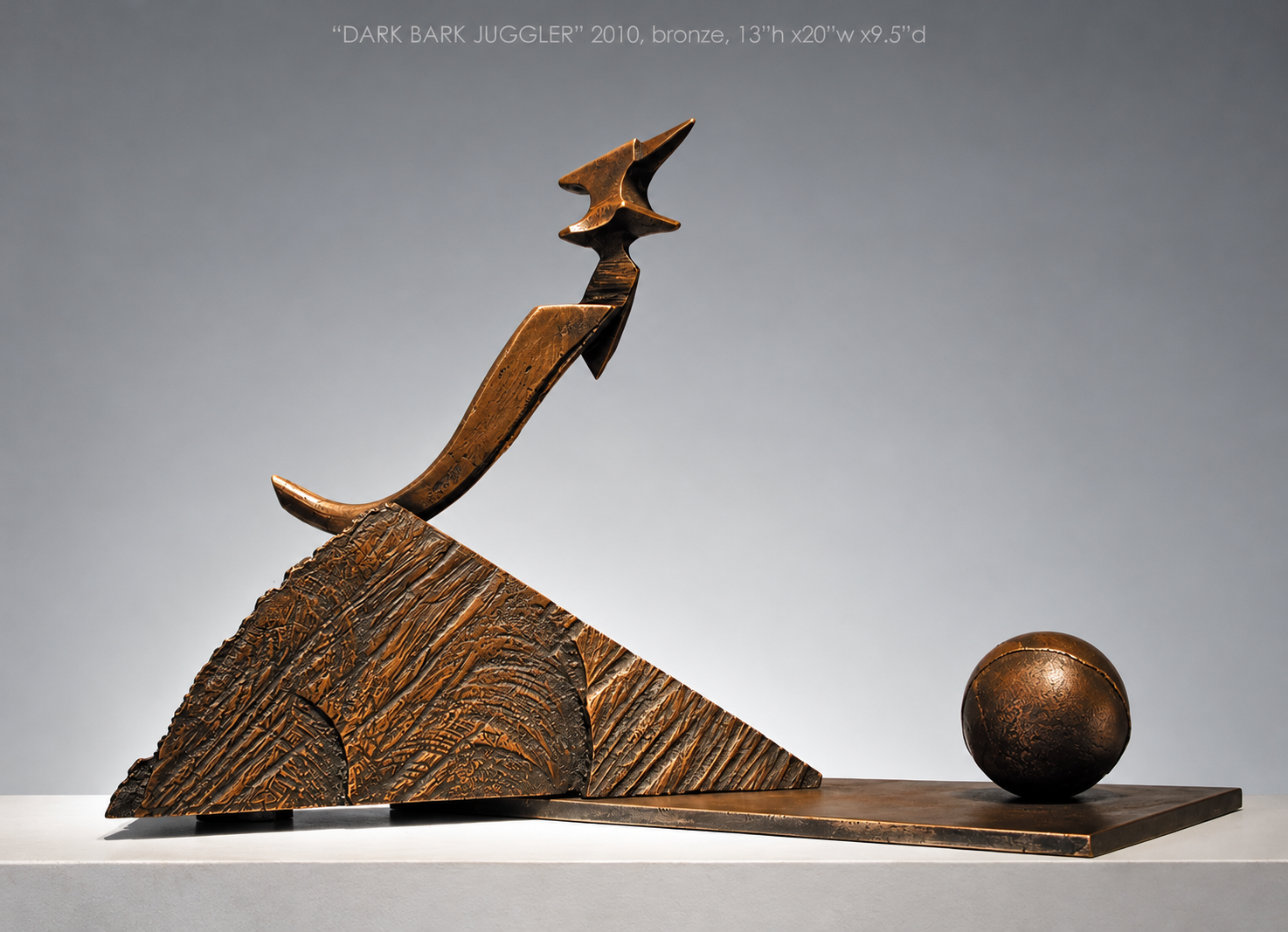
May 2010. Bronze. Dimensions: 13 × 20 × 9.5 in (33 × 51 × 24 cm). Private collection.
Many of Van Alstine’s works take inspiration from the movement of the human body. This work can be seen as a kind of self-portrait, suggesting his studio process—literally juggling and repositioning the individual elements of a sculpture until they achieve a moment of perfect balance, then freezing that moment in space through welding. More universally, juggling becomes a metaphor for the way we all balance the competing demands of family, work, play, and responsibility.
The anvil, which appears in a number of the artist’s works, represents both the ultimate heavy object to “juggle” and the act of assembly itself—the forging together of object, material, and ideas that is central to Van Alstine’s work.
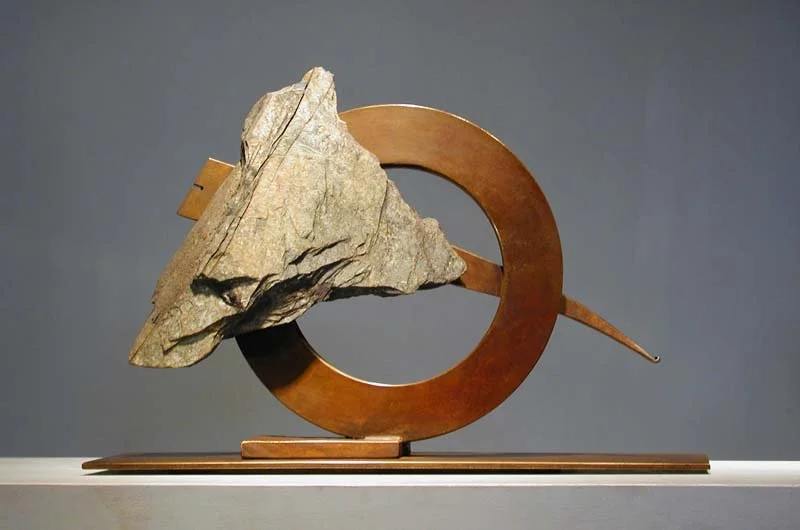
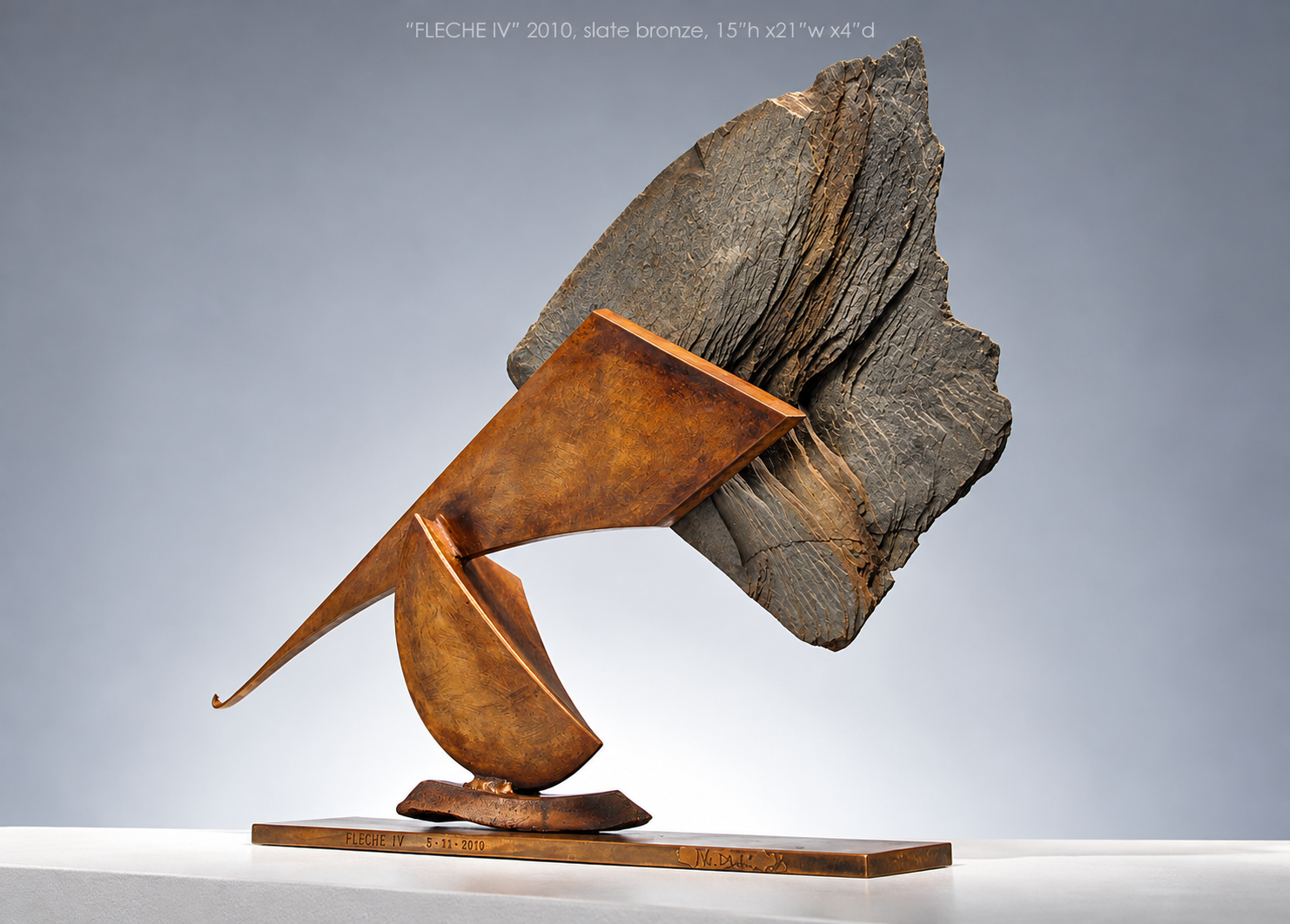
May 2010. Slate, bronze. Dimensions: 15 x 21 x 4 in (38 x 53 x 10 cm). Private Collection.
Flèche is French for “arrow” and, in fencing, describes a running attack with the weapon arm extended. The sculpture translates that gesture into material form: sweeping steel thrusts through space while the heavy slate appears lifted and suspended, creating a tension between weight and movement.
Flèche
Pronunciation: 'flesh, flèche
Function: noun
Etymology: French, literally, arrow, from Old French fleche, of Germanic origin; akin to Middle Dutch vlieke arrow, Old English flEogan to fly
: SPIRE ; especially : a slender spire above the intersection of the nave and transepts of a church
also: in the sport of Fencing : defined as a running attack with arm extended
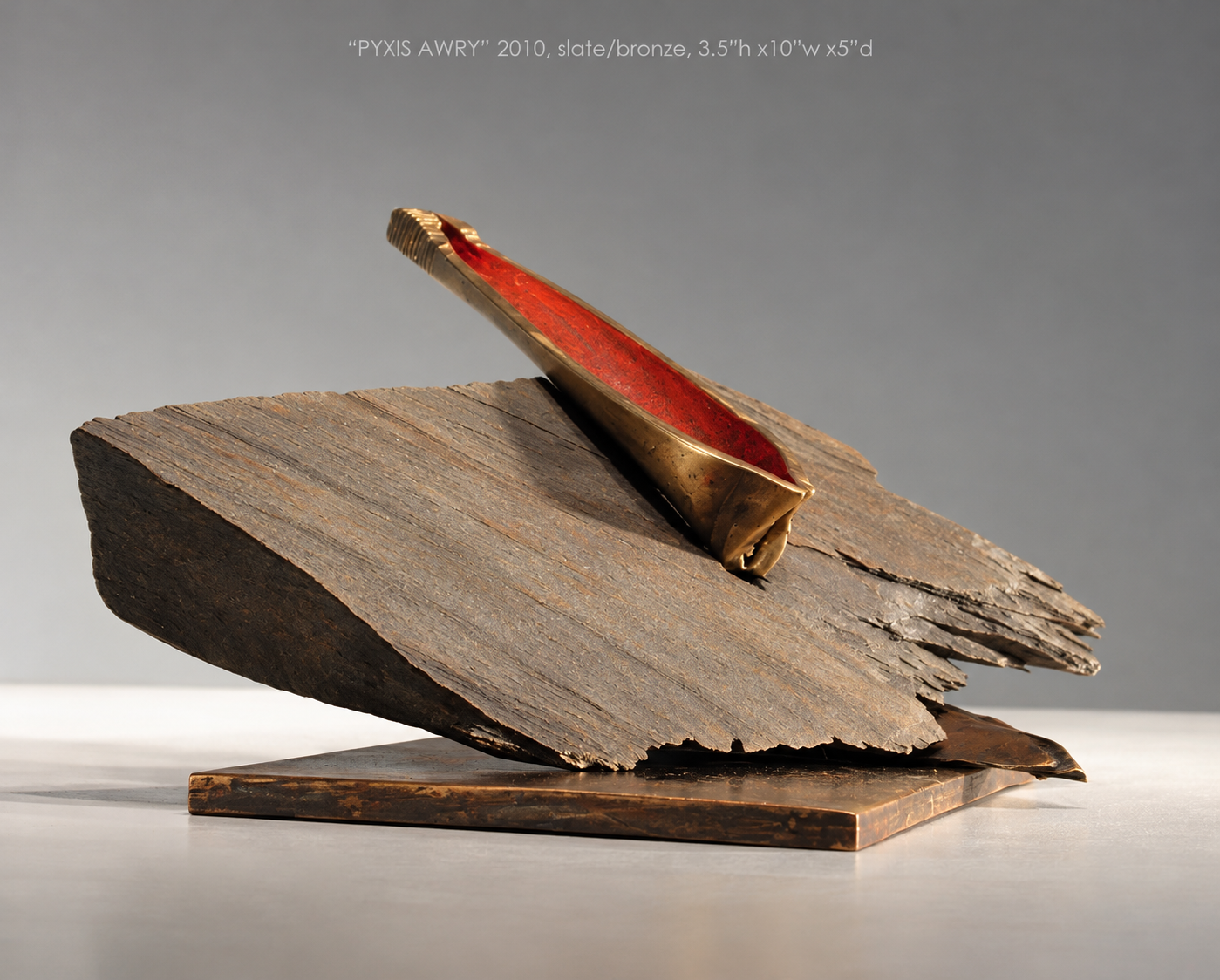
May 2010. Bronze, slate. Dimensions: 3.5 × 10 × 5 in (9 × 25 × 13 cm). Private Collection.
Pyxis - small and faint constellation in the southern sky. Latin for a mariner's compass. Pyxis is completely visible in latitudes south of 53 degrees north from January through March.
Awry (1): in a turned or twisted position or direction: askew; (2): off the correct or expected course: amiss
The works in this series feature a “vessel” form - historically understood in art and literature as a symbol or metaphor for the self, a group of people, human kind. If the vessel’s compass is awry it will likely end up adrift, untethered, off course.
My intent is raise questions as to personal (or a group) decisions/courses of action and shed light on the resulting consequences, whether they are personal, political, environmental.
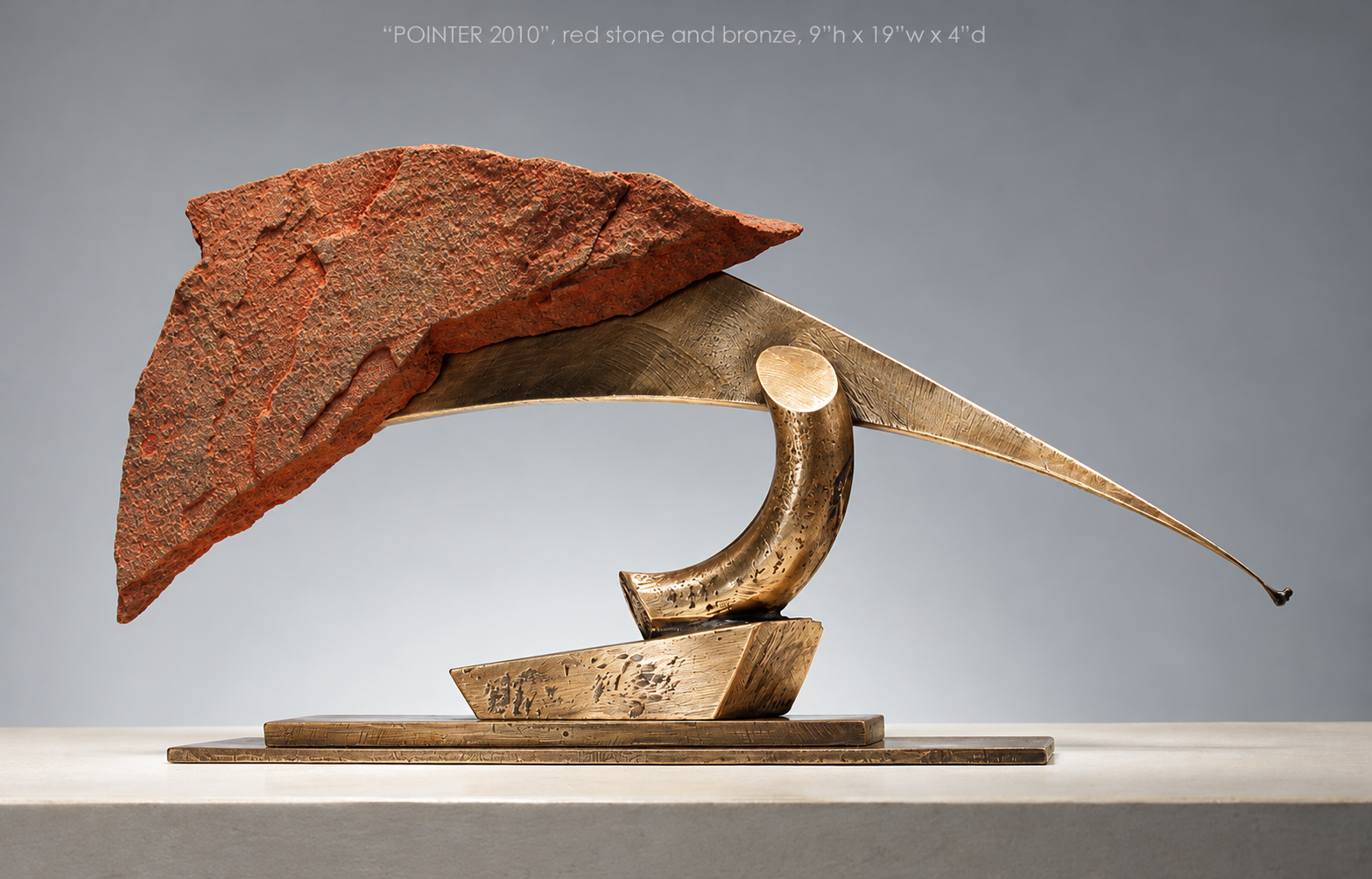
May 2010. Bronze, red stone. Dimensions: 9 x 18 x 4 in (23 x 46 x 10 cm).
Private Collection.
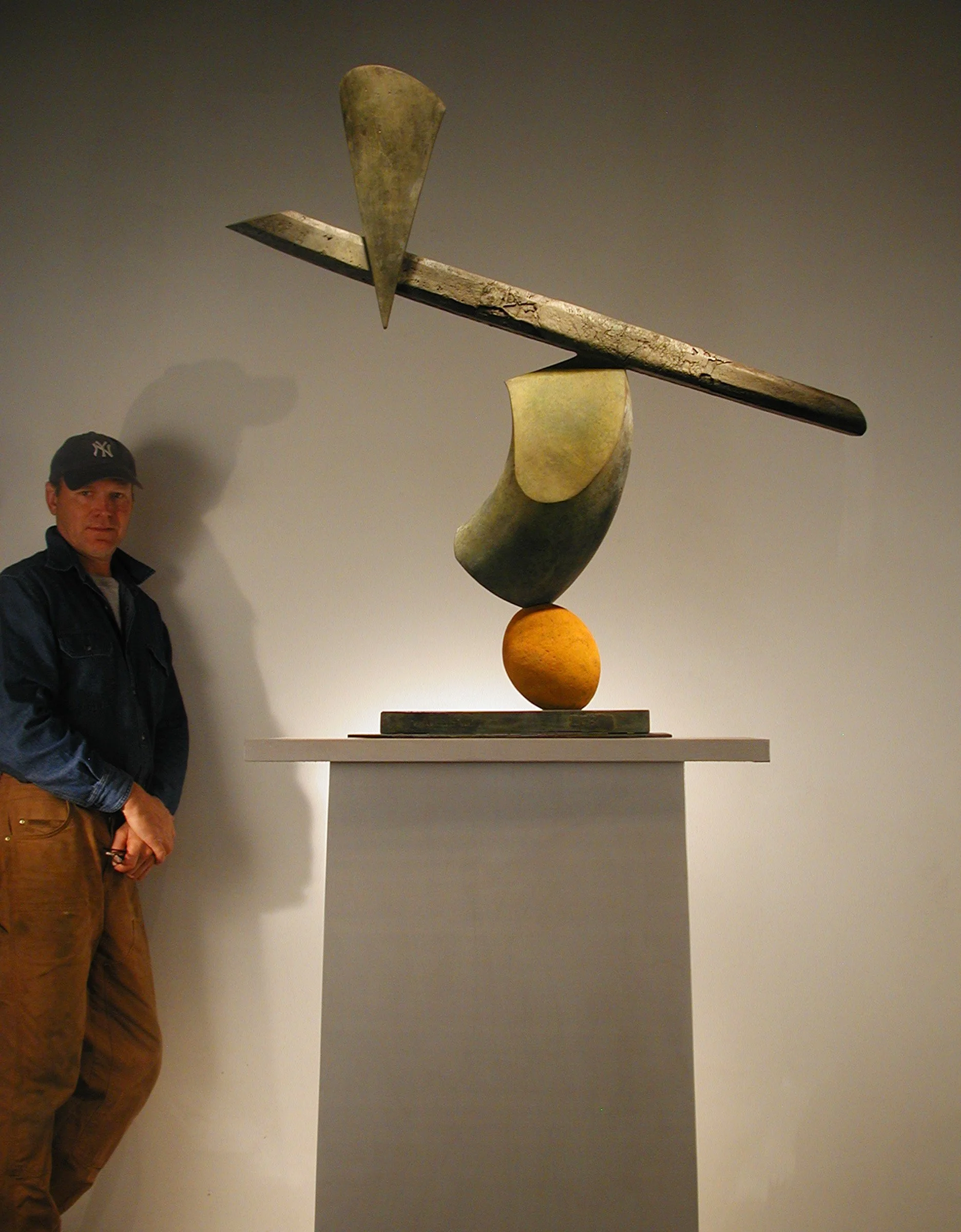
May 2010. Bronze, pigmented river stone. Dimensions: 37 × 37 × 13 in (94 × 94 × 33 cm). Private Collection.
The title derives from two Latin words—fūnis, meaning “rope,” and ambulāre, “to walk”—and refers to a tightrope walker. The meaning is reinforced by the sculpture’s dynamic horizontal “balancing baton” and its overall sense of precarious poise. It evokes the physical balance, agility, and daring of a circus performer, while perhaps more poignantly suggesting mental agility—the ability to maintain equilibrium amid uncertainty and change.
A celebrated modern funambulist is Philippe Petit, who became famous for his unauthorized high-wire walk between the Twin Towers of New York’s World Trade Center on August 7, 1974. His feat became an enduring image of extraordinary balance, concentration, risk, and resolve.
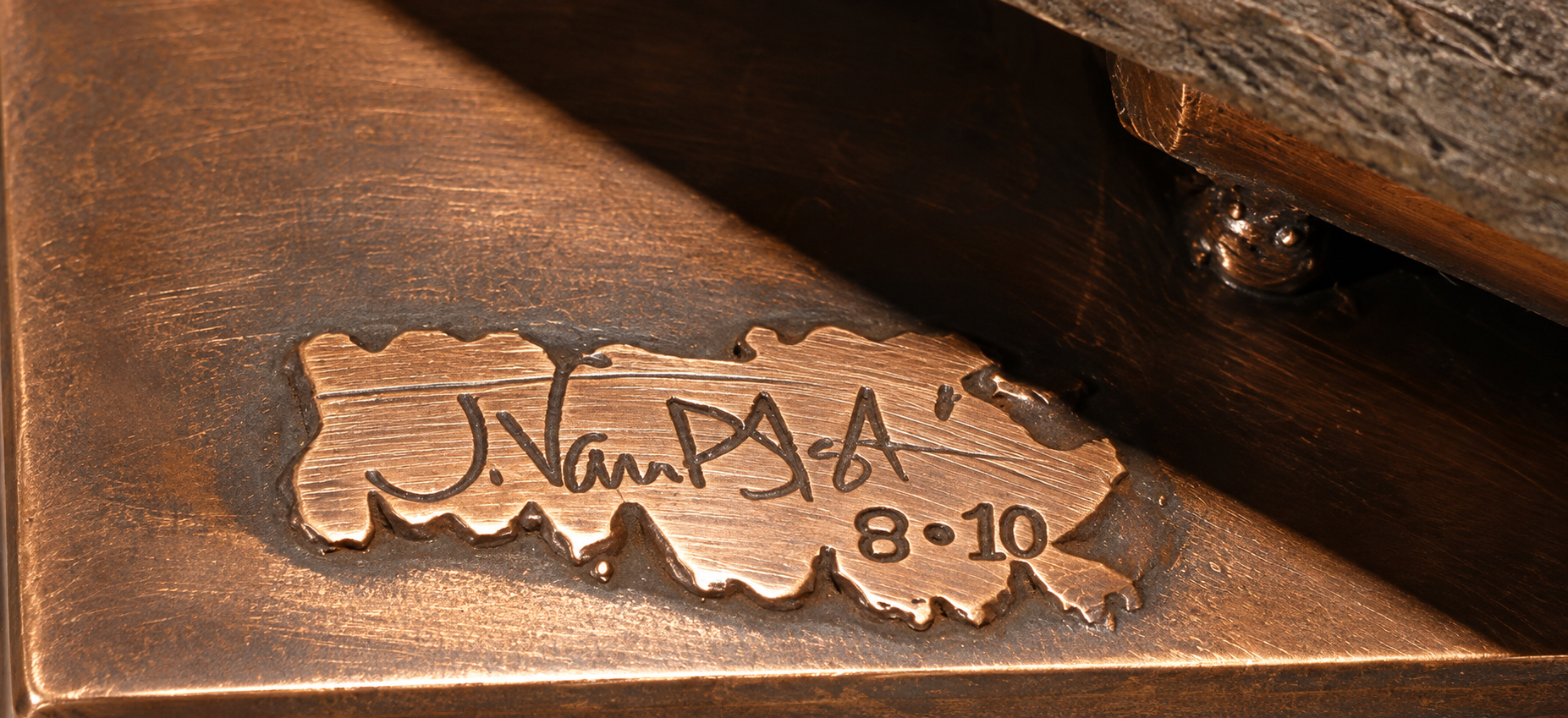
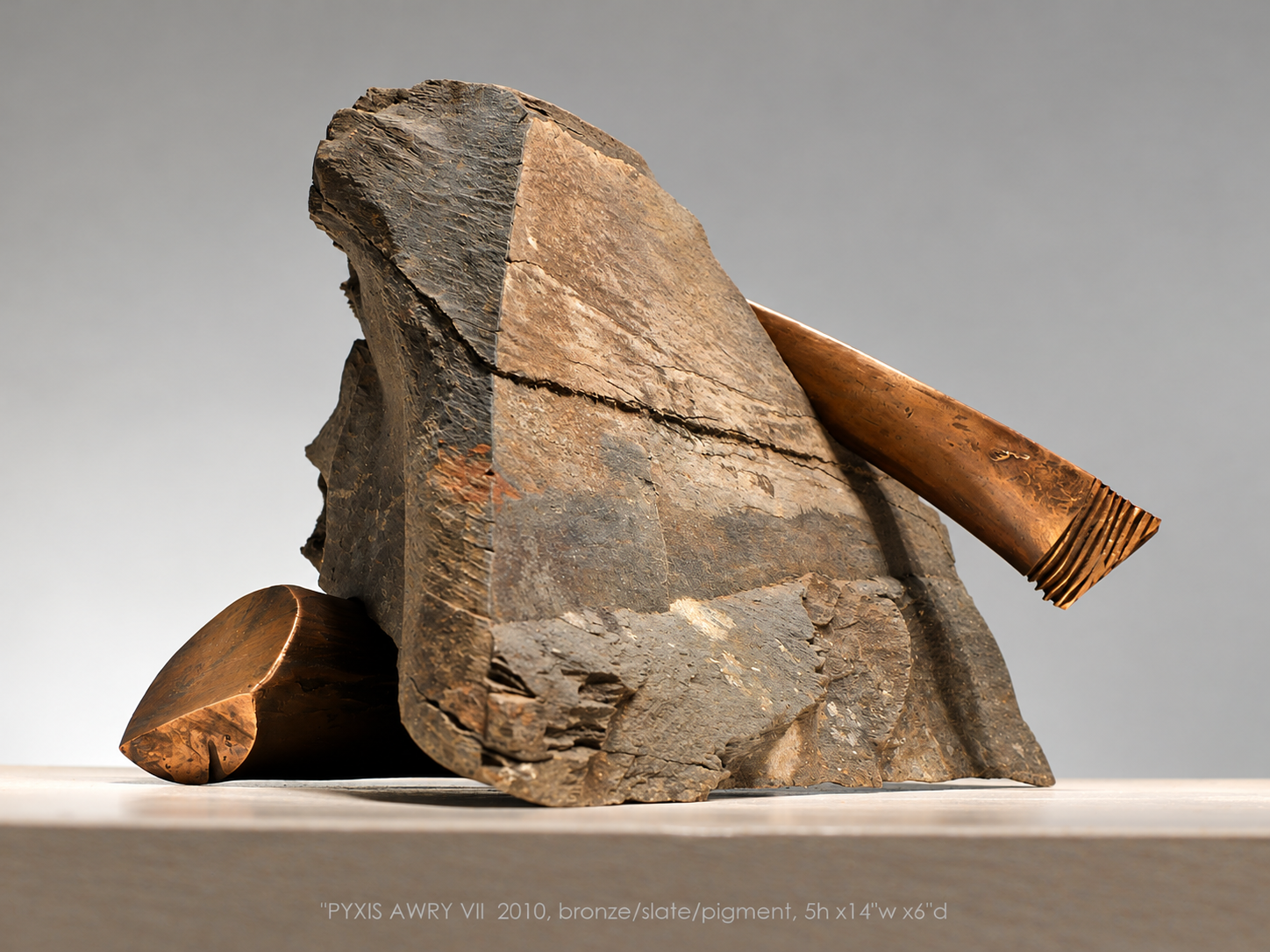
August 2010. Bronze, slate, red pigment. Dimensions: 4 x 13 x 7 in (10 x 33 x 18 cm). Private Collection.
Pyxis - small and faint constellation in the southern sky. Latin for a mariner's compass. Pyxis is completely visible in latitudes south of 53 degrees north from January through March.
Awry (1): in a turned or twisted position or direction: askew; (2): off the correct or expected course: amiss
The works in this series feature a “vessel” form - historically understood in art and literature as a symbol or metaphor for the self, a group of people, human kind. If the vessel’s compass is awry it will likely end up adrift, untethered, off course.
My intent is raise questions as to personal (or a group) decisions/courses of action and shed light on the resulting consequences, whether they are personal, political, environmental.
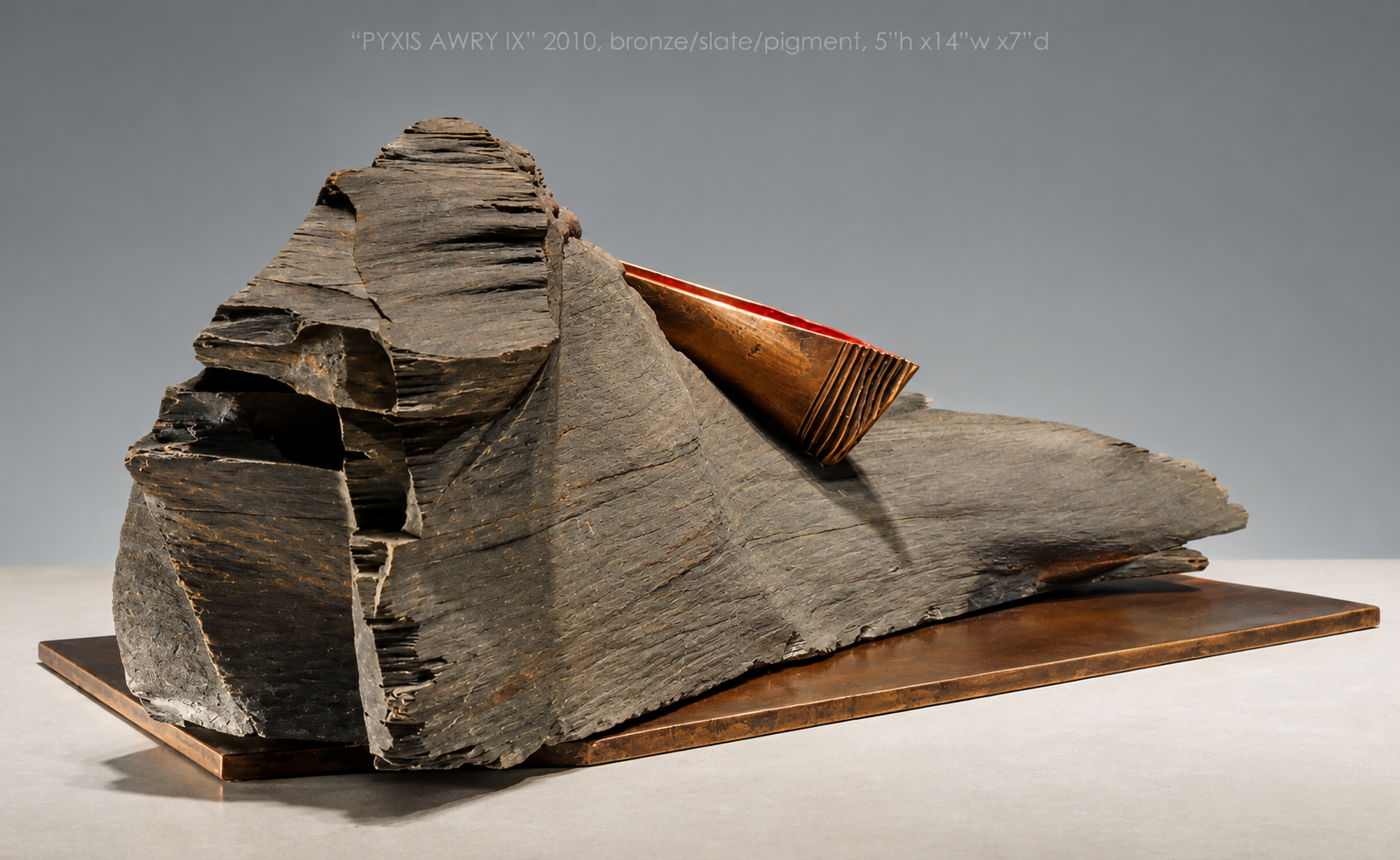
August 2010. Bronze, slate, red pigment. Dimensions: 5 × 14 × 6 in (13 × 36 × 15 cm). Private collection.
Pyxis - small and faint constellation in the southern sky. Latin for a mariner's compass. Pyxis is completely visible in latitudes south of 53 degrees north from January through March.
Awry (1): in a turned or twisted position or direction: askew; (2): off the correct or expected course: amiss
The works in this series feature a “vessel” form - historically understood in art and literature as a symbol or metaphor for the self, a group of people, human kind. If the vessel’s compass is awry it will likely end up adrift, untethered, off course.
My intent is raise questions as to personal (or a group) decisions/courses of action and shed light on the resulting consequences, whether they are personal, political, environmental.
August 2010. Bronze, slate, red pigment. Dimensions: 5 × 14 × 7 in (13 × 36 × 18 cm). Private Collection.
Pyxis - small and faint constellation in the southern sky. Latin for a mariner's compass. Pyxis is completely visible in latitudes south of 53 degrees north from January through March.
Awry (1): in a turned or twisted position or direction: askew; (2): off the correct or expected course: amiss
The works in this series feature a “vessel” form - historically understood in art and literature as a symbol or metaphor for the self, a group of people, human kind. If the vessel’s compass is awry it will likely end up adrift, untethered, off course.
My intent is raise questions as to personal (or a group) decisions/courses of action and shed light on the resulting consequences, whether they are personal, political, environmental.
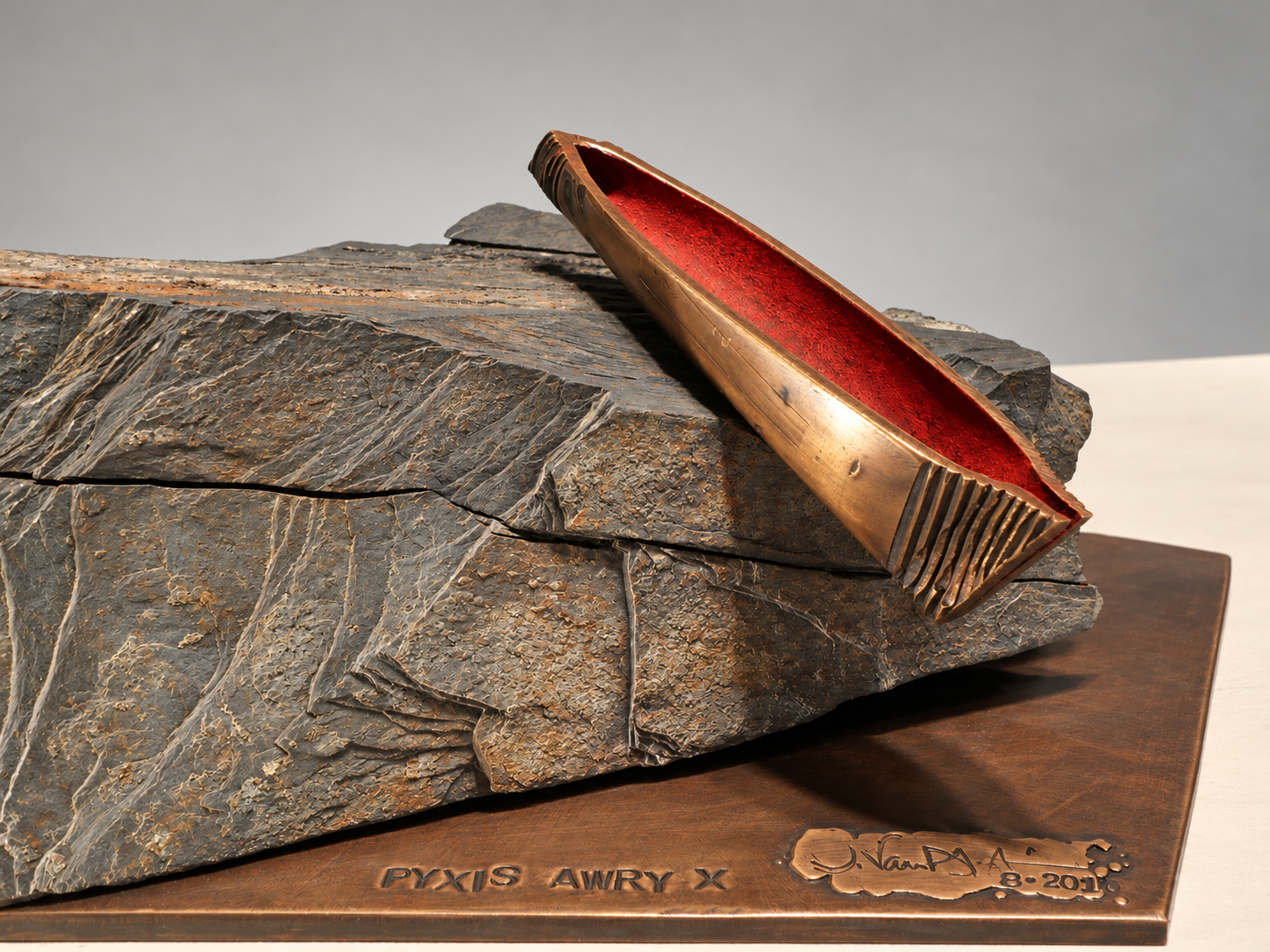
August 2010. Bronze, slate, red pigment. Dimensions: 5 × 17 × 7 in (13 × 43 × 18 cm). Private Collection.
Pyxis - small and faint constellation in the southern sky. Latin for a mariner's compass. Pyxis is completely visible in latitudes south of 53 degrees north from January through March.
Awry (1): in a turned or twisted position or direction: askew; (2): off the correct or expected course: amiss
The works in this series feature a “vessel” form - historically understood in art and literature as a symbol or metaphor for the self, a group of people, human kind. If the vessel’s compass is awry it will likely end up adrift, untethered, off course.
My intent is raise questions as to personal (or a group) decisions/courses of action and shed light on the resulting consequences, whether they are personal, political, environmental.
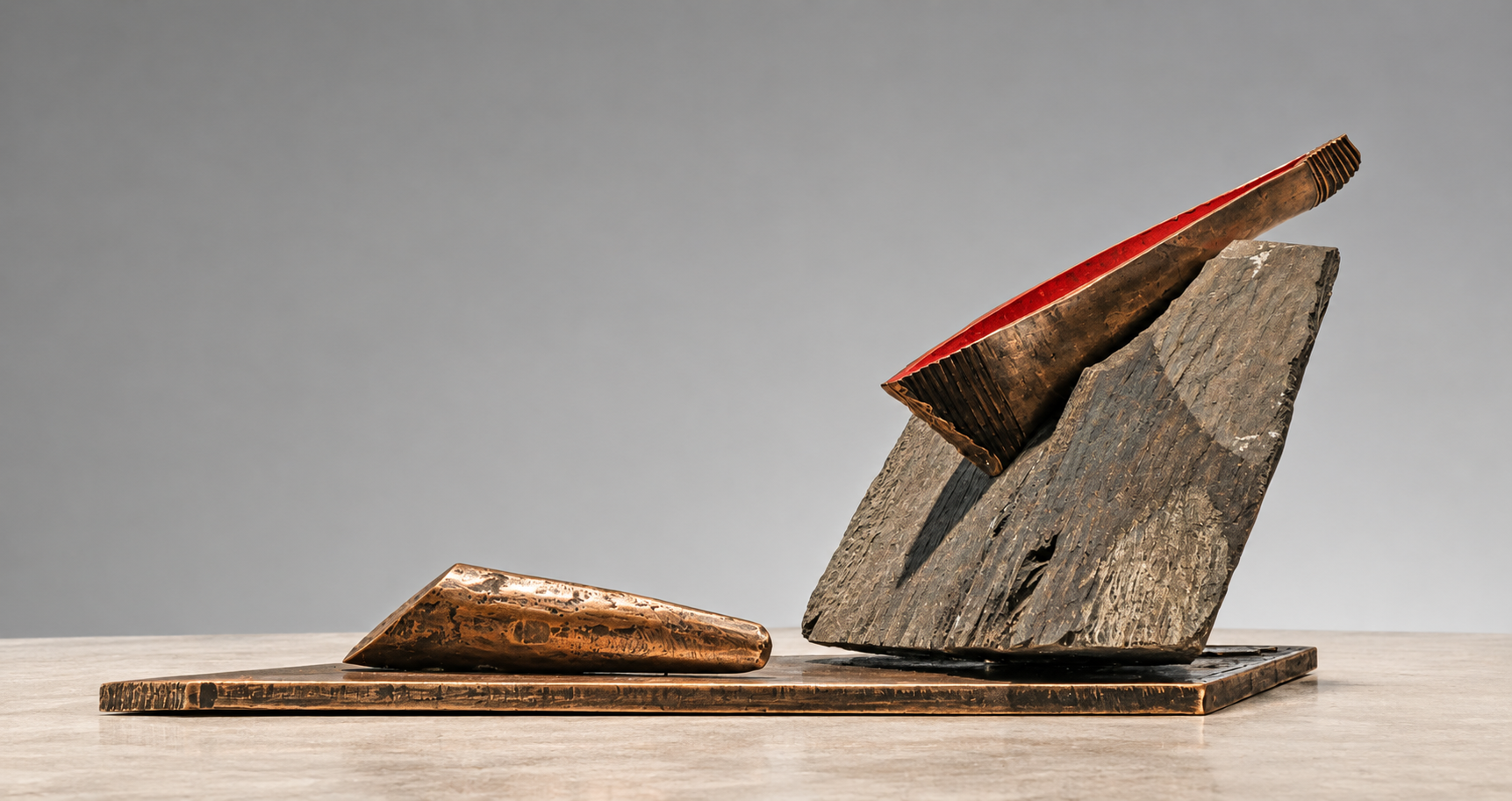
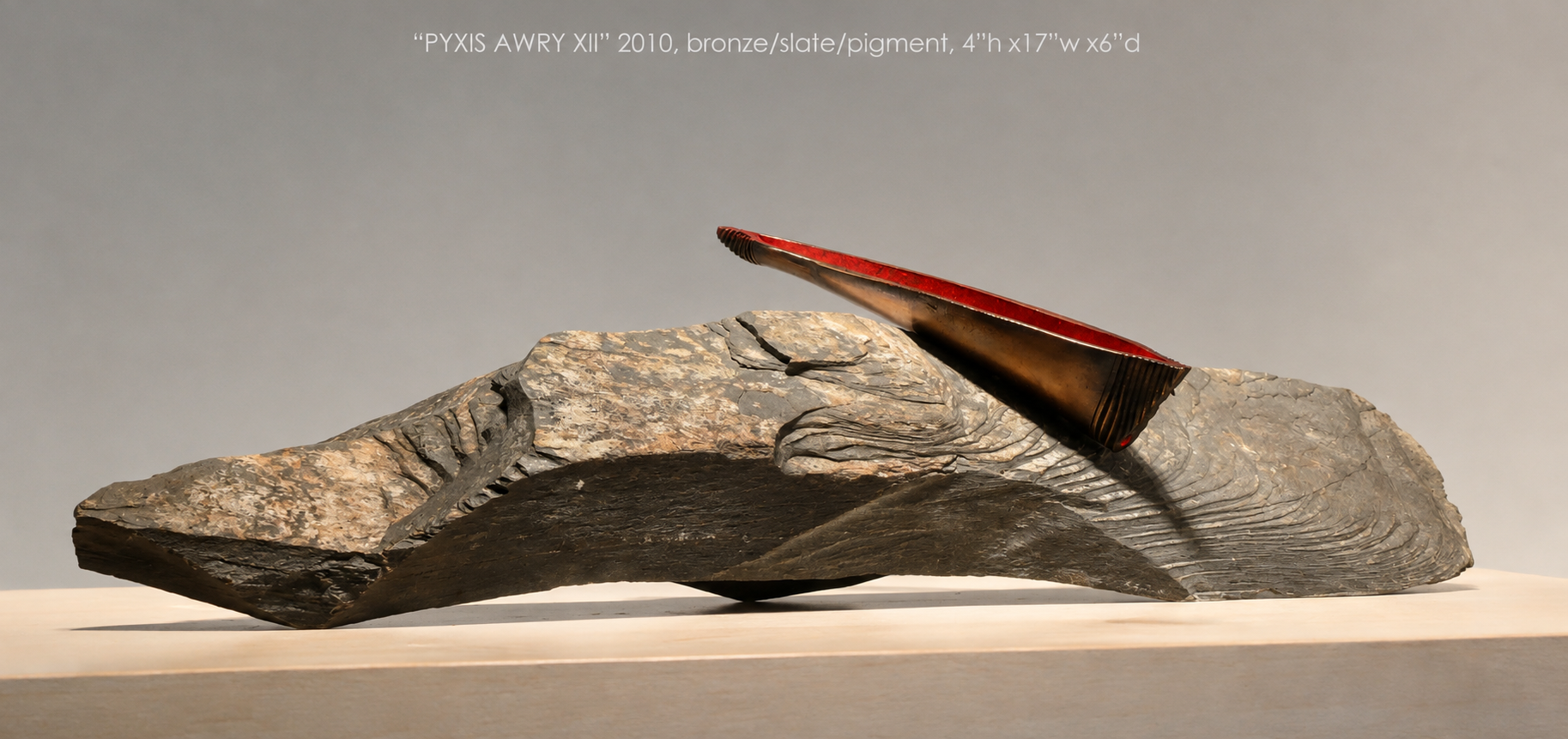
September 2010. Bronze, slate, red pigment. Dimensions: 4 × 17 × 6 in (10 × 43 × 15 cm). Private Collection.
Pyxis - small and faint constellation in the southern sky. Latin for a mariner's compass. Pyxis is completely visible in latitudes south of 53 degrees north from January through March.
Awry (1): in a turned or twisted position or direction: askew; (2): off the correct or expected course: amiss
The works in this series feature a “vessel” form - historically understood in art and literature as a symbol or metaphor for the self, a group of people, human kind. If the vessel’s compass is awry it will likely end up adrift, untethered, off course.
My intent is raise questions as to personal (or a group) decisions/courses of action and shed light on the resulting consequences, whether they are personal, political, environmental.
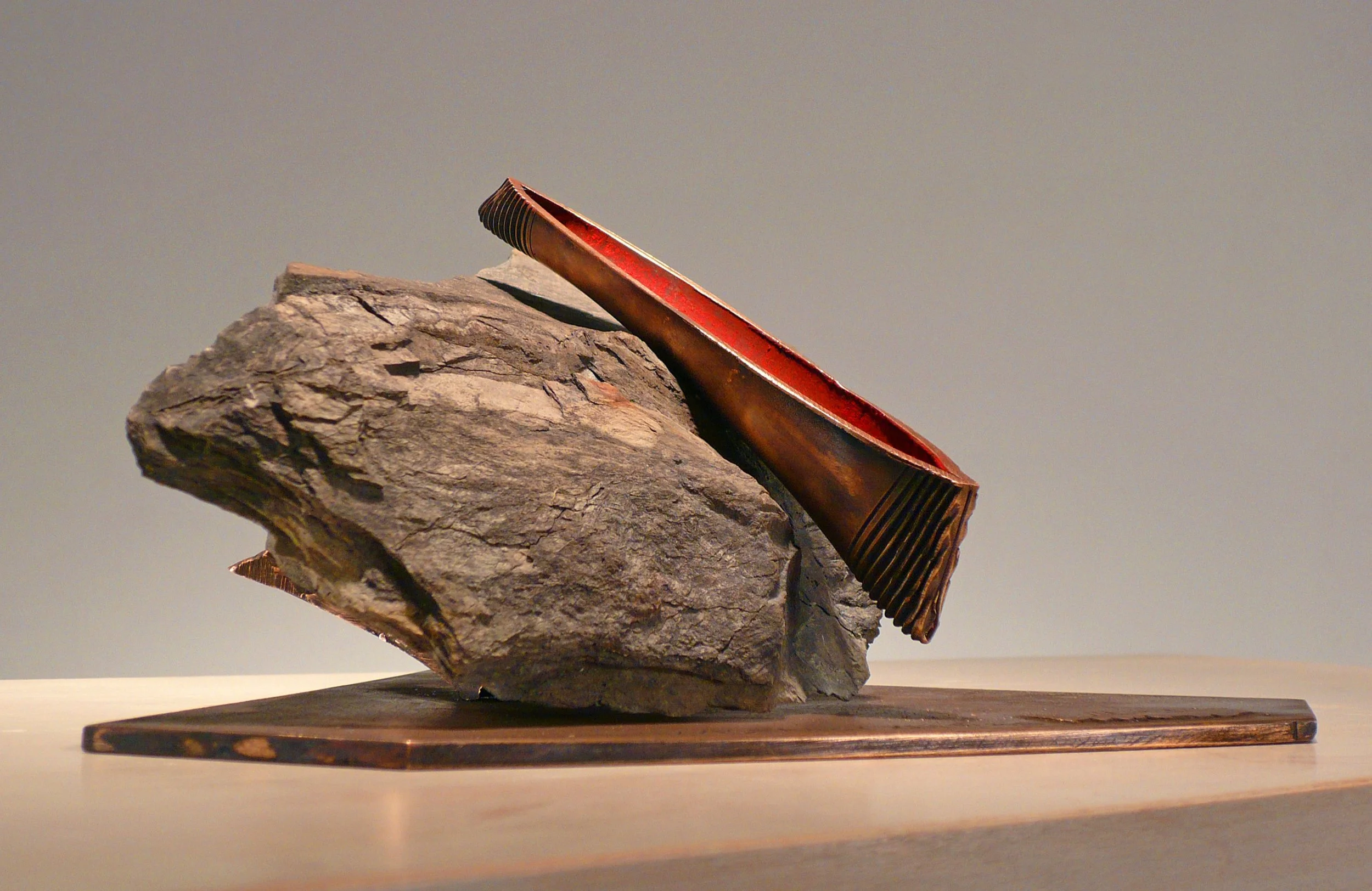
September 2010. Bronze, slate, red pigment. Dimensions: 4.5 × 11 × 9 in (11 × 28 × 23 cm).
Pyxis is a small and faint constellation in the southern sky. Its name is Latin for a mariner's compass Pyxis is completely visible in latitudes south of 53 degrees north from January through March.
awry 1: in a turned or twisted position or direction: askew 2: off the correct or expected course: amiss
The works in this series feature a “vessel” form - historically understood in art and literature as a symbol or metaphor for the self, a group of people, human kind. If the vessel's compass is awry it will likely end up adrift, untethered, off course.
My intent with this series is raise questions/search for answers relative to personal (or a group) decisions or courses of action and shed light on the resulting consequences, whether they are personal, political, environmental.
SOLD
October 2010. Slate, pigmented and sealed steel. Dimensions: 24.5 × 37 × 6 in (62 × 94 × 15 cm). Private Collection.
The Lunge series explores implied movement and gesture through an abstract sculptural language. The title Lunge suggests a sudden extension of the body—a reaching, thrusting, or shifting of weight that gives the sculpture a sense of physical momentum and directed energy.
While not figurative in a literal sense, the work draws on my interest in the expressiveness of the human figure. Its balance, tension, and spatial gesture suggest a body caught in motion, allowing the sculpture to convey a human presence through posture and movement rather than recognizable form.
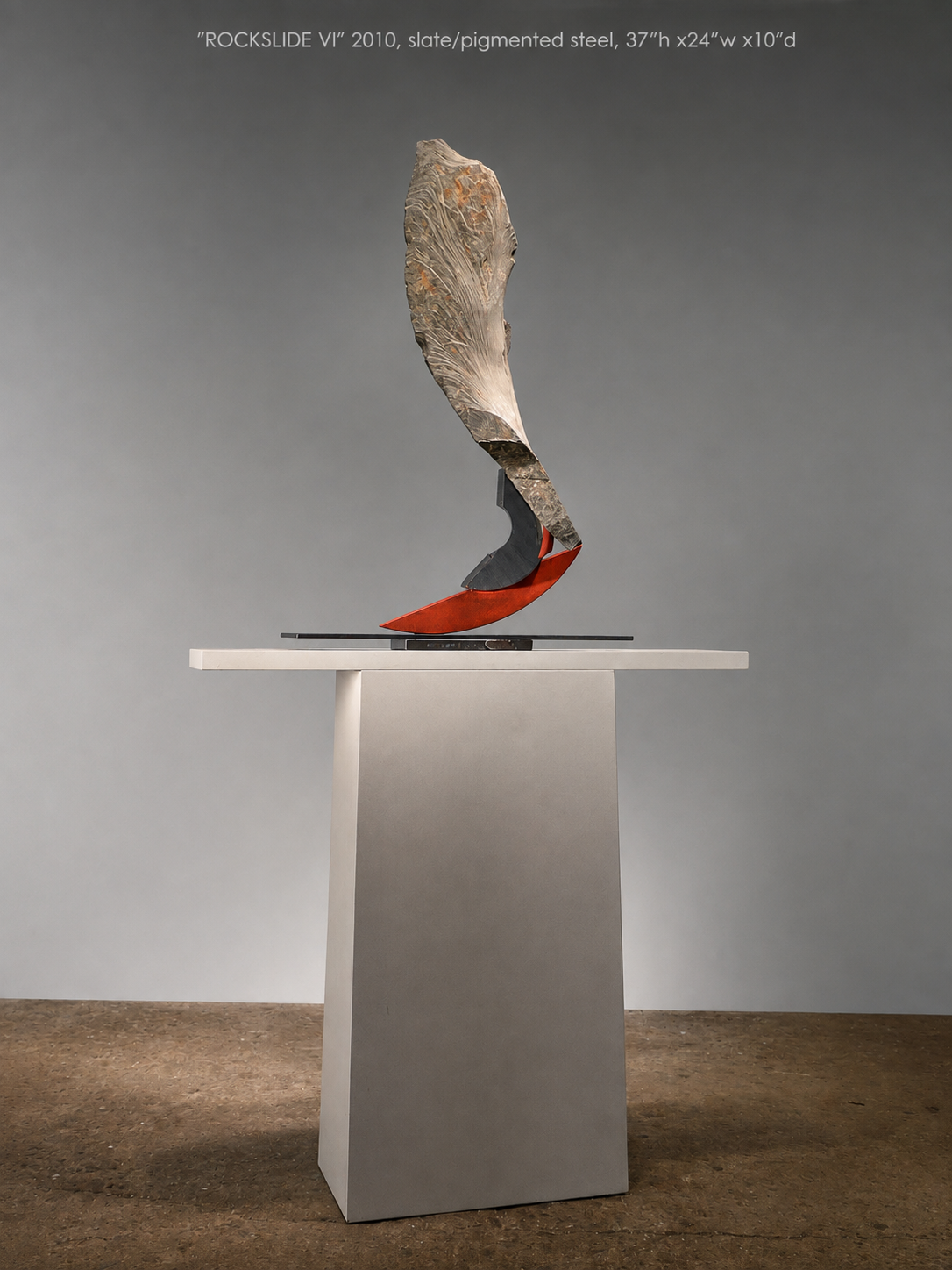
October 2010. Slate, pigmented and sealed steel. Dimensions: 37 × 24 × 9 in (94 × 61 × 23 cm).
Private collection - Germany
Stone has been a constant in John Van Alstine’s work for more than forty years. He often focuses on the material’s inherent qualities—especially its weight—choreographing stone and steel to create moments of visual and physical tension.
Landscape, particularly the mountain terrain where the artist has spent much of his life, has also been a powerful influence. In the Rockslide series, the shape and placement of stone, and its dynamic interaction with steel, evoke the drama of a familiar alpine event: a rock caught in mid-fall.
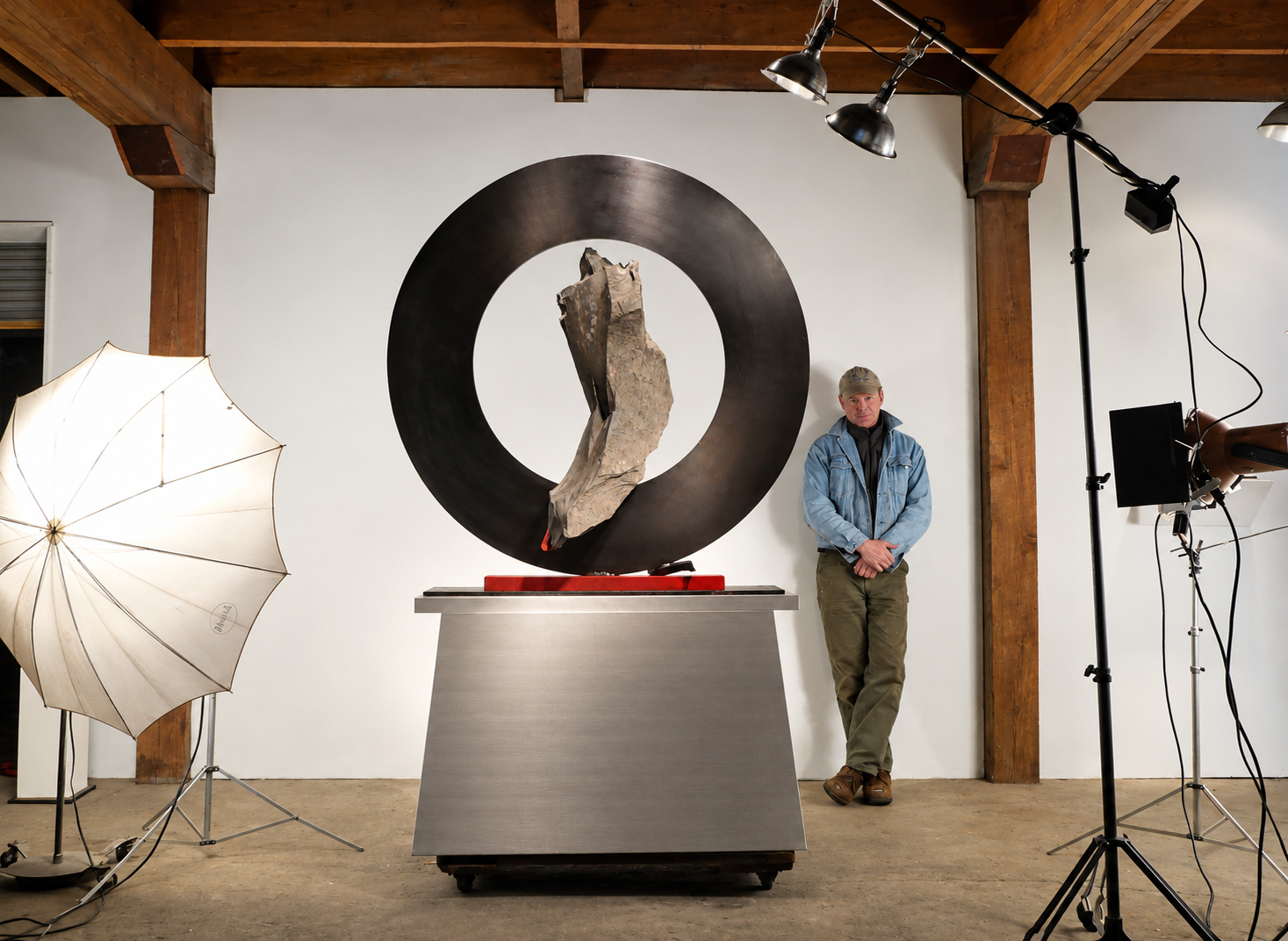
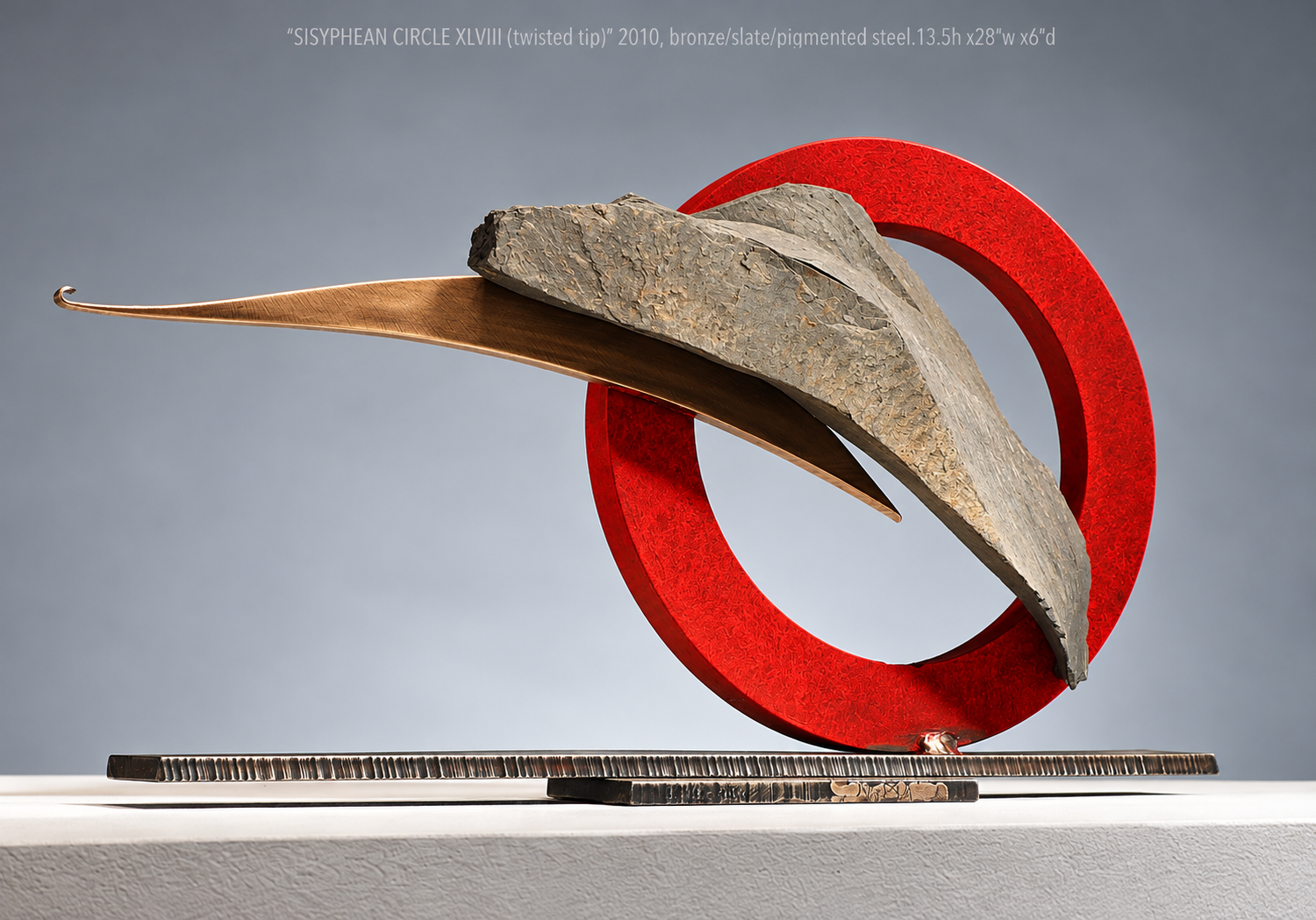
November 2010. Bronze, slate, pigmented steel. Dimensions: 12 x 21.5 x 4 in (30 x 55 x 10 cm). private collection.
The Sisyphean Series
The Greek myth of Sisyphus, condemned to endlessly push a boulder uphill, has inspired more than 250 of my sculptures. Rather than seeing the myth as a symbol of futility, I share philosopher Albert Camus’s more positive interpretation—that meaning and fulfillment can be found in the struggle itself. In many ways, I see Sisyphus as autobiographical, reflecting my lifelong pursuit as an artist, confronting challenges, taking risks, and finding purpose in the act of creation.
My Sisyphean works bring stone and steel together in precarious yet stable arrangements, often incorporating circular forms suggesting perpetual motion. For me, they are metaphors for the creative process—an ongoing cycle of experimentation, discovery, setbacks, and renewal. Each completed sculpture is both an achievement and a starting point, celebrating the journey rather than simply the destination.
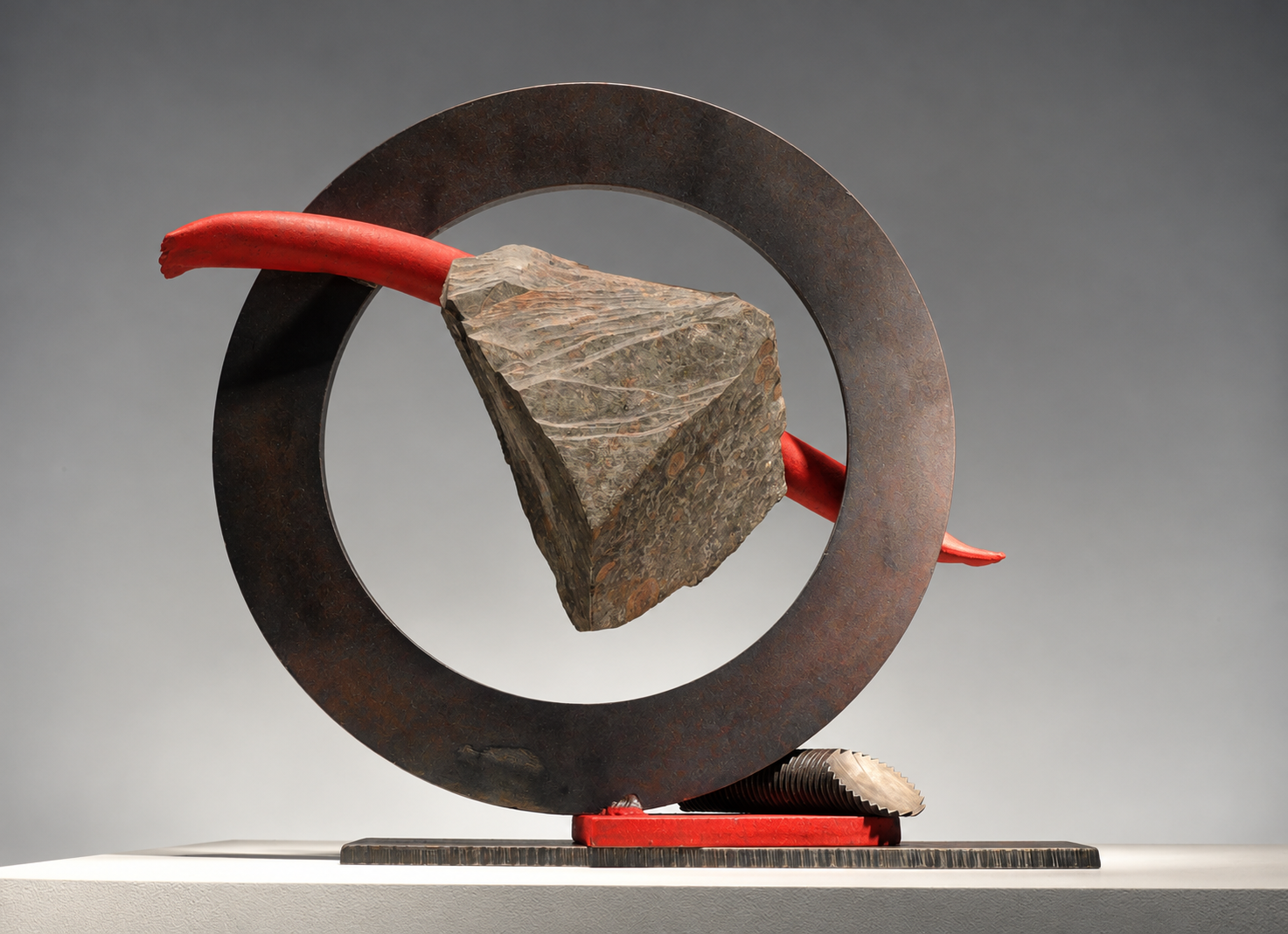
November 2010. Slate, pigmented and sealed steel. Dimensions: 21.5 × 23 × 8 in (55 × 58 × 20 cm).
The Sisyphean Series
The Greek myth of Sisyphus, condemned to endlessly push a boulder uphill, has inspired more than 250 of my sculptures. Rather than seeing the myth as a symbol of futility, I share philosopher Albert Camus’s more positive interpretation—that meaning and fulfillment can be found in the struggle itself. In many ways, I see Sisyphus as autobiographical, reflecting my lifelong pursuit as an artist, confronting challenges, taking risks, and finding purpose in the act of creation.
My Sisyphean works bring stone and steel together in precarious yet stable arrangements, often incorporating circular forms suggesting perpetual motion. For me, they are metaphors for the creative process—an ongoing cycle of experimentation, discovery, setbacks, and renewal. Each completed sculpture is both an achievement and a starting point, celebrating the journey rather than simply the destination.
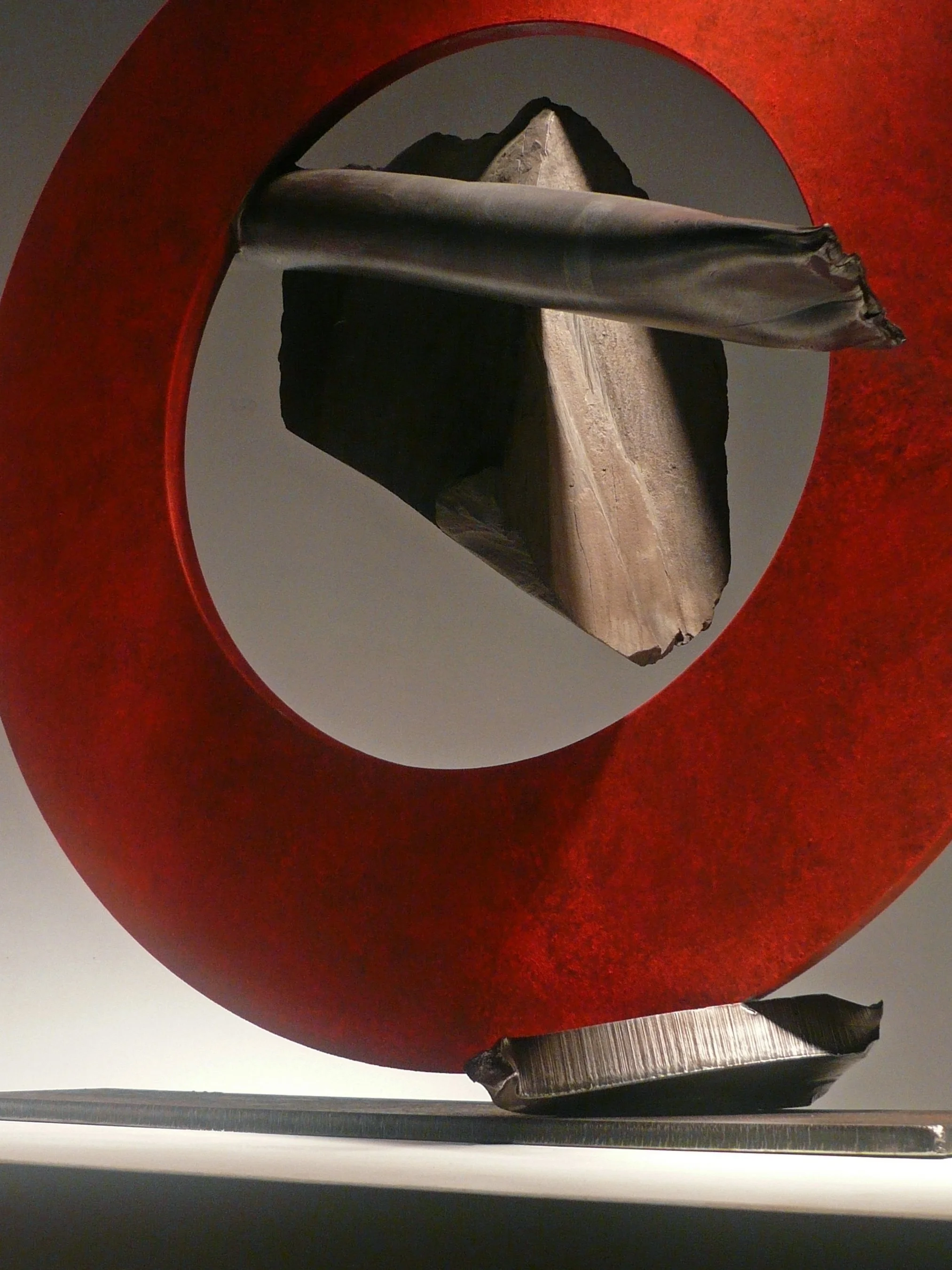
November 2010. Slate, pigmented and sealed steel. Dimensions: 29 x 28 x 9 in. (74 x 71 x 23 cm). Private Collection.
The Sisyphean Series
The Greek myth of Sisyphus, condemned to endlessly push a boulder uphill, has inspired more than 250 of my sculptures. Rather than seeing the myth as a symbol of futility, I share philosopher Albert Camus’s more positive interpretation—that meaning and fulfillment can be found in the struggle itself. In many ways, I see Sisyphus as autobiographical, reflecting my lifelong pursuit as an artist, confronting challenges, taking risks, and finding purpose in the act of creation.
My Sisyphean works bring stone and steel together in precarious yet stable arrangements, often incorporating circular forms suggesting perpetual motion. For me, they are metaphors for the creative process—an ongoing cycle of experimentation, discovery, setbacks, and renewal. Each completed sculpture is both an achievement and a starting point, celebrating the journey rather than simply the destination.
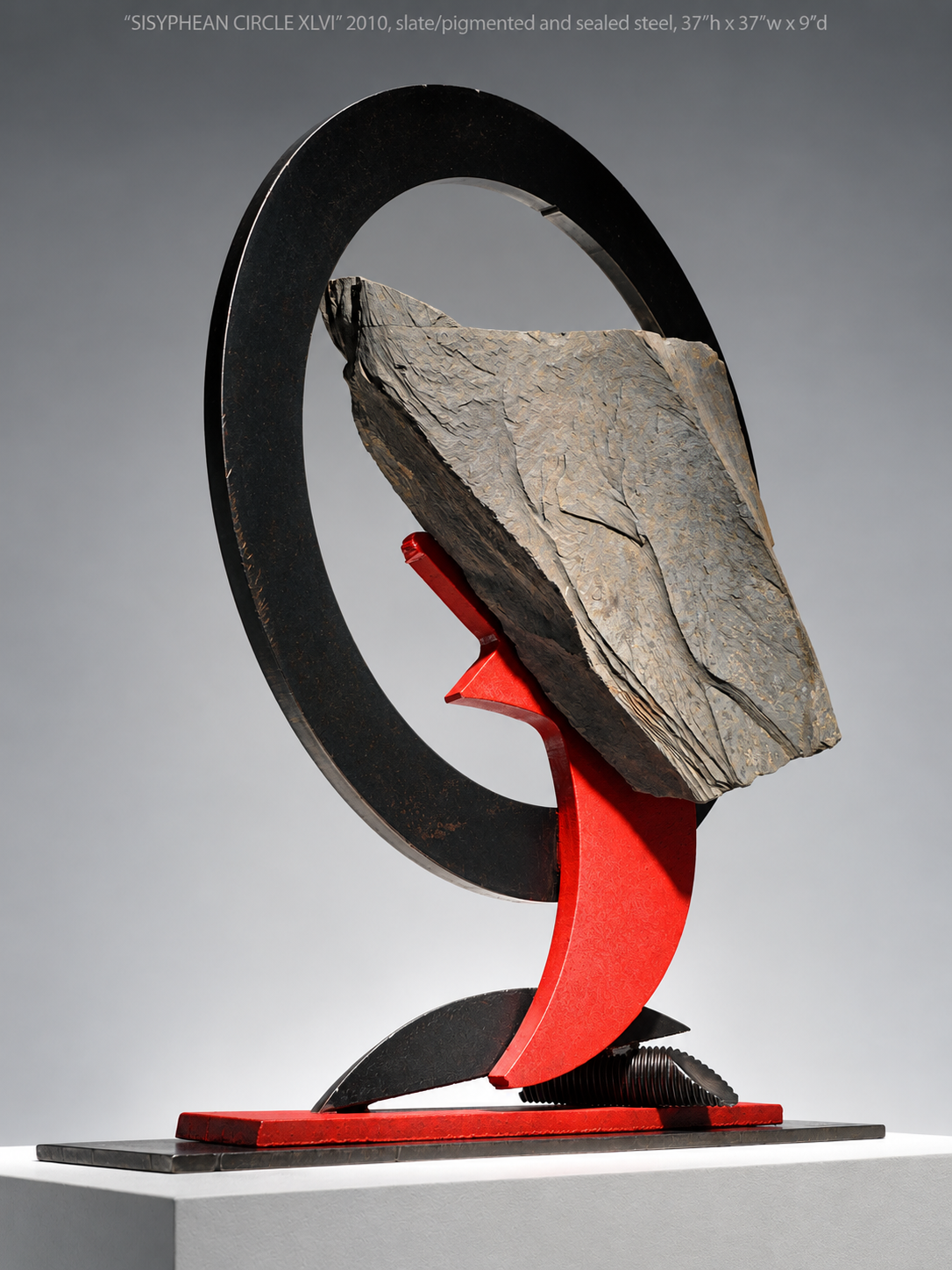
November 2010. Slate, pigmented and sealed steel. Dimensions: 37 × 37 × 9 in (94 × 94 × 23 cm). Private collection.
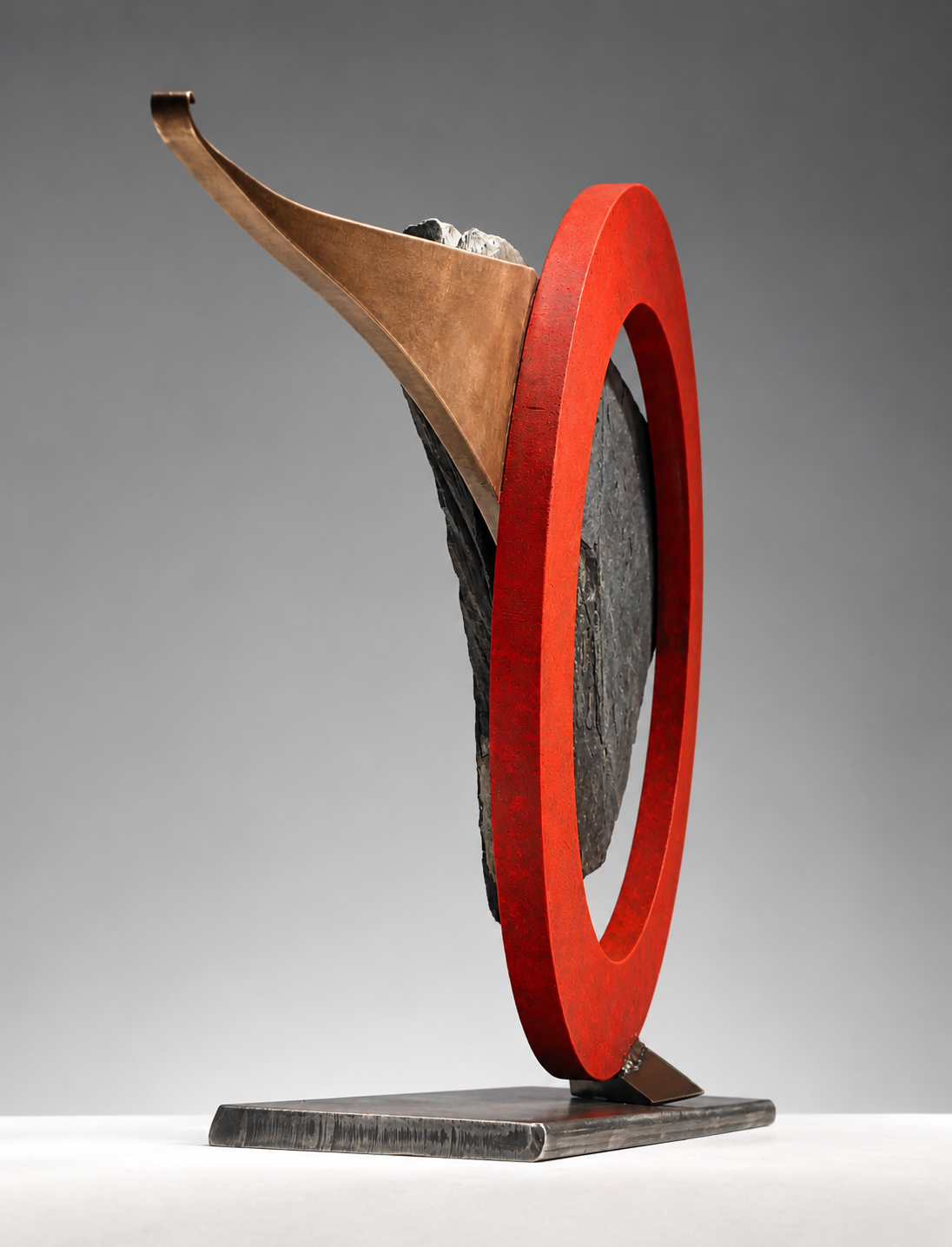
November 2010. Bronze, slate, pigmented and sealed steel. Dimensions: 17.5 x 28 x 5 in (44 x 71 x 13 cm). Private Collection.
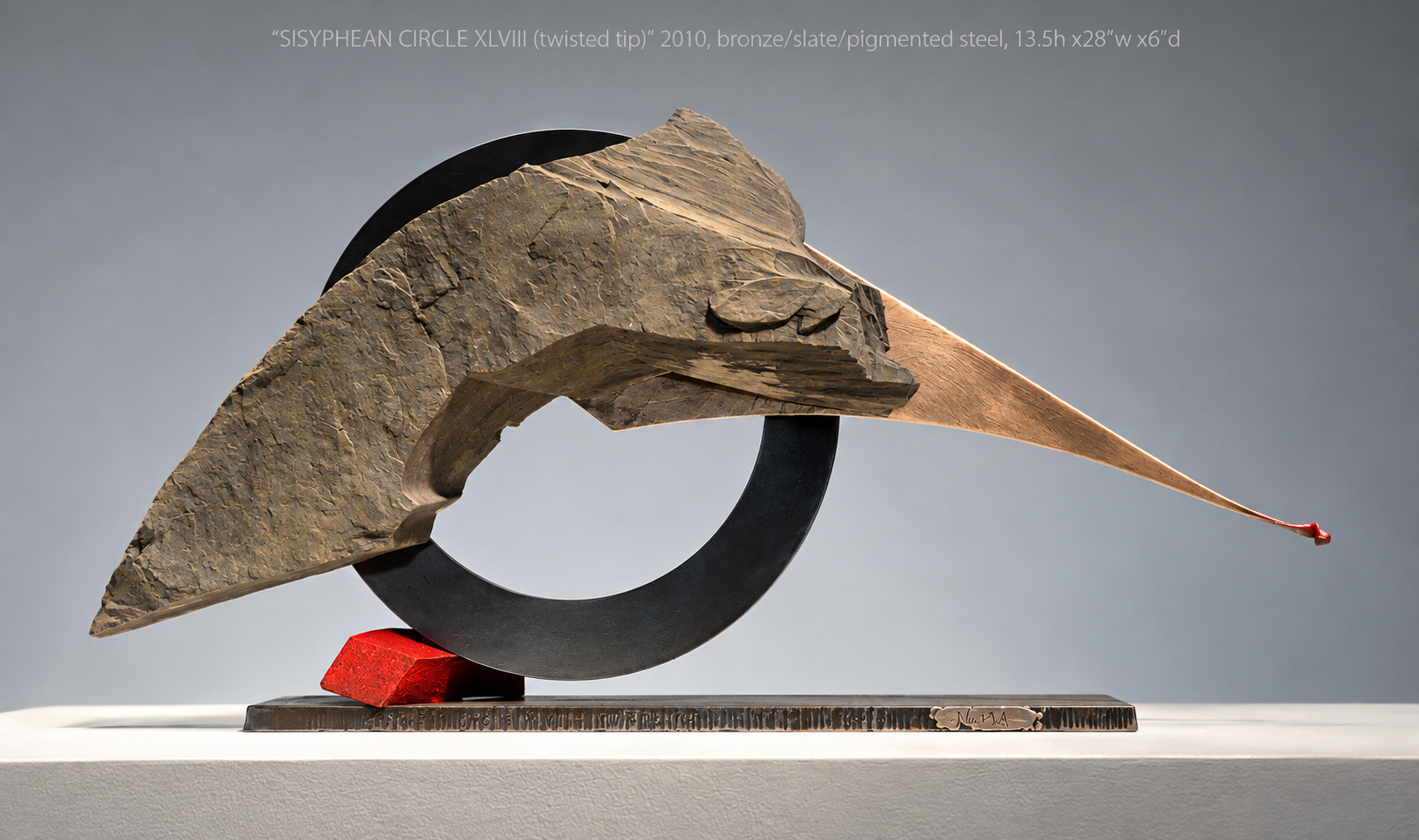
November 2010. Bronze, slate, pigmented and sealed steel. Dimensions: 13.5 x 28 x 6 in (34 x 71 x 15 cm). Private Collection.
The Sisyphean Series
The Greek myth of Sisyphus, condemned to endlessly push a boulder uphill, has inspired more than 250 of my sculptures. Rather than seeing the myth as a symbol of futility, I share philosopher Albert Camus’s more positive interpretation—that meaning and fulfillment can be found in the struggle itself. In many ways, I see Sisyphus as autobiographical, reflecting my lifelong pursuit as an artist, confronting challenges, taking risks, and finding purpose in the act of creation.
My Sisyphean works bring stone and steel together in precarious yet stable arrangements, often incorporating circular forms suggesting perpetual motion. For me, they are metaphors for the creative process—an ongoing cycle of experimentation, discovery, setbacks, and renewal. Each completed sculpture is both an achievement and a starting point, celebrating the journey rather than simply the destination.
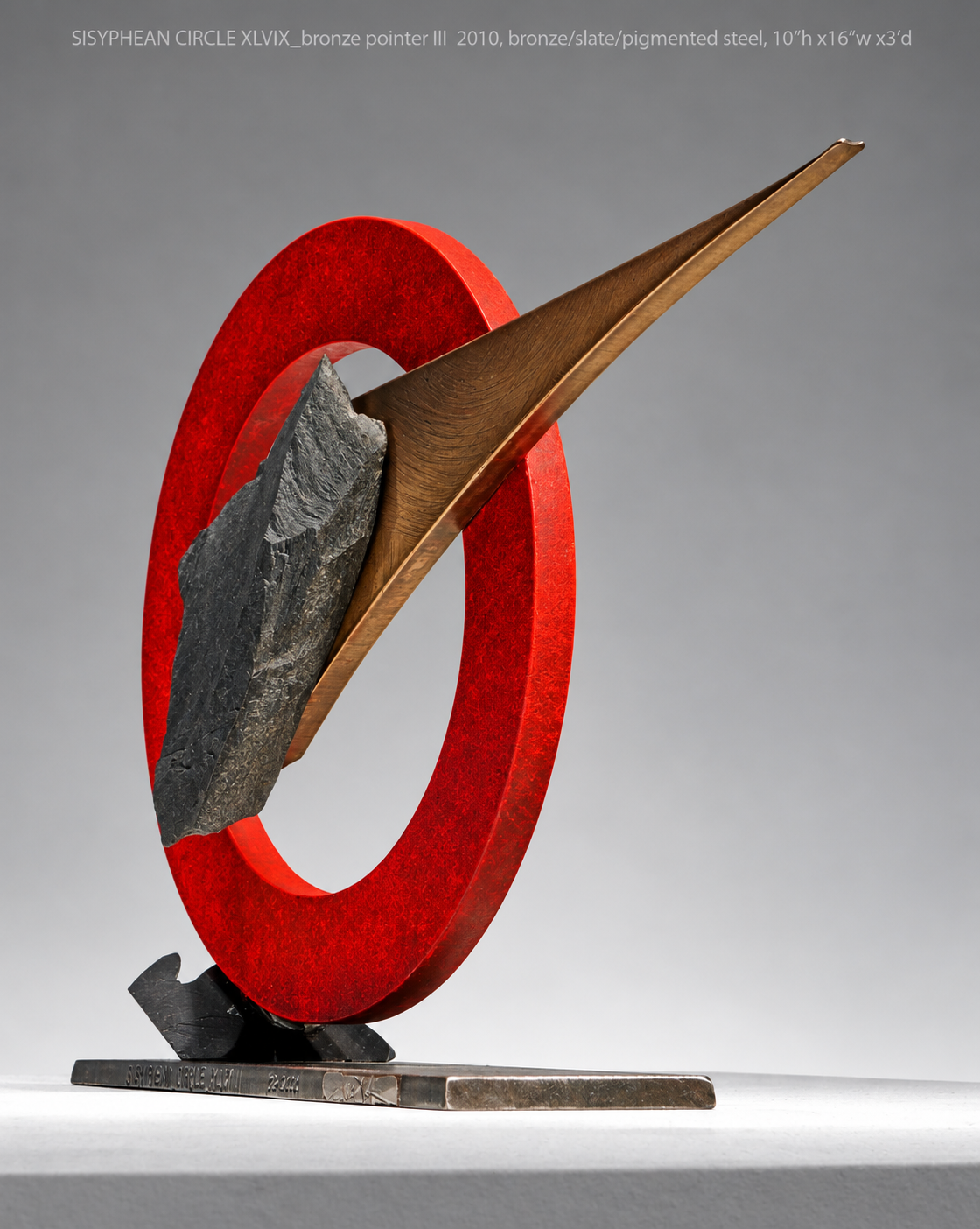
December 2010. Bronze, slate, pigmented and sealed steel. Dimensions: 10 x 16 x 3 in (25 x 41 x 8 cm). Private Collection.
2009
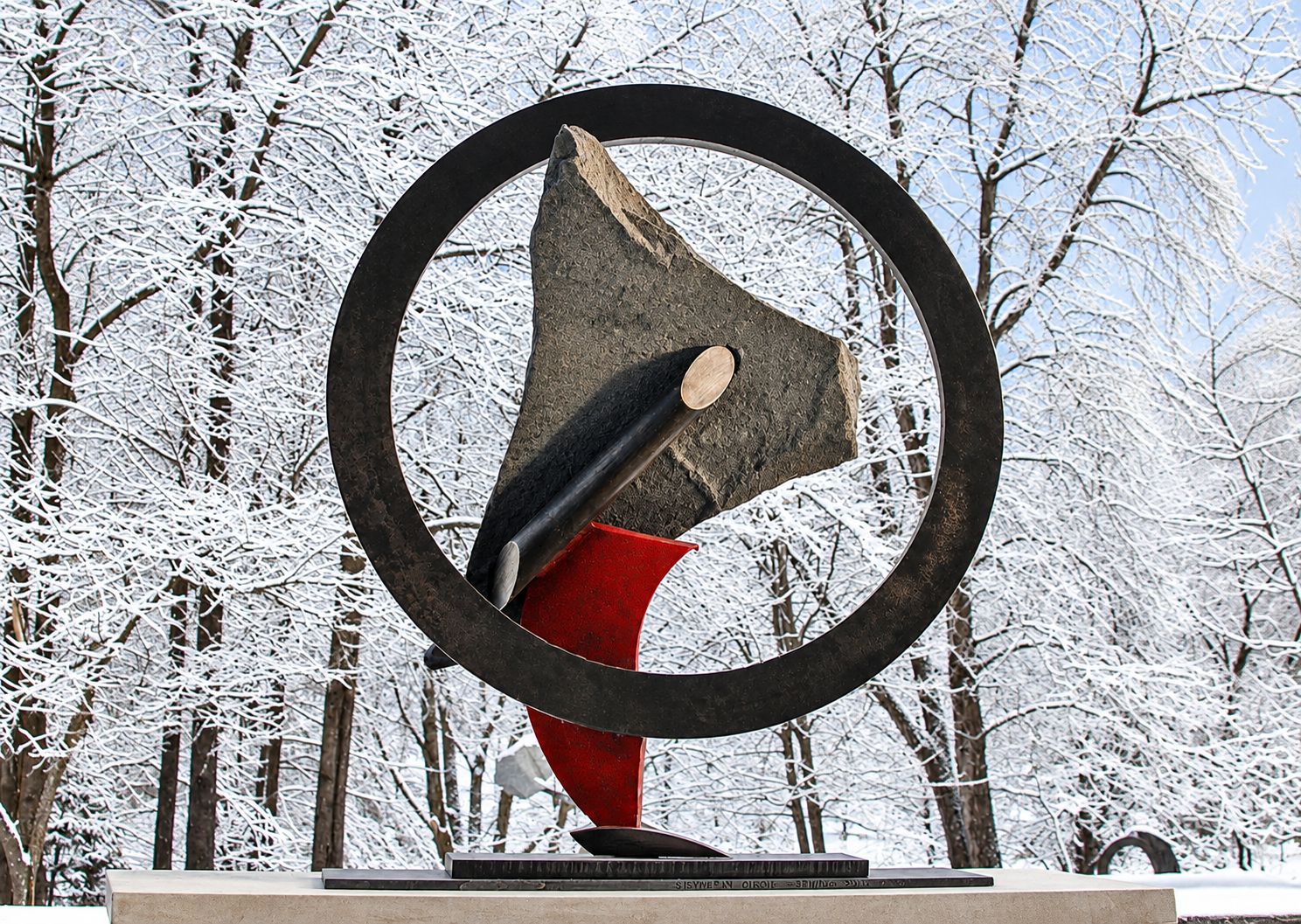
January 2009. NY bluestone, pigmented steel. Dimensions: 24 × 20 × 6 in (61 × 51 × 15 cm).
Private Collection.
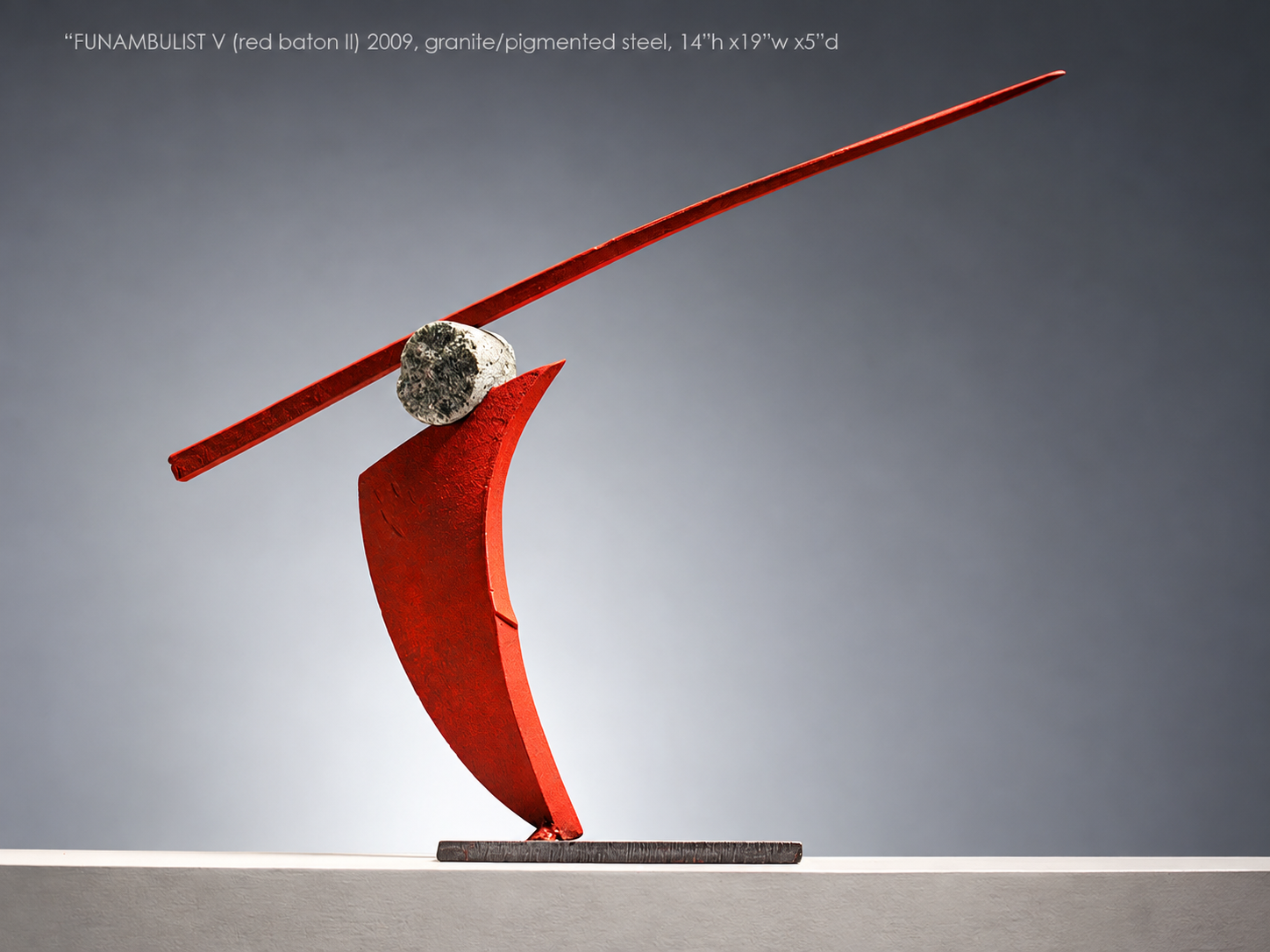
January 2009. Granite, pigmented steel. Dimensions: 14.5 × 19 × 5 in (37 × 48 × 13 cm). Private Collection.
The title derives from two Latin words—fūnis, meaning “rope,” and ambulāre, “to walk”—and refers to a tightrope walker. The meaning is reinforced by the sculpture’s dynamic horizontal “balancing baton” and its overall sense of precarious poise. It evokes the physical balance, agility, and daring of a circus performer, while perhaps more poignantly suggesting mental agility—the ability to maintain equilibrium amid uncertainty and change.
A celebrated modern funambulist is Philippe Petit, who became famous for his unauthorized high-wire walk between the Twin Towers of New York’s World Trade Center on August 7, 1974. His feat became an enduring image of extraordinary balance, concentration, risk, and resolve.
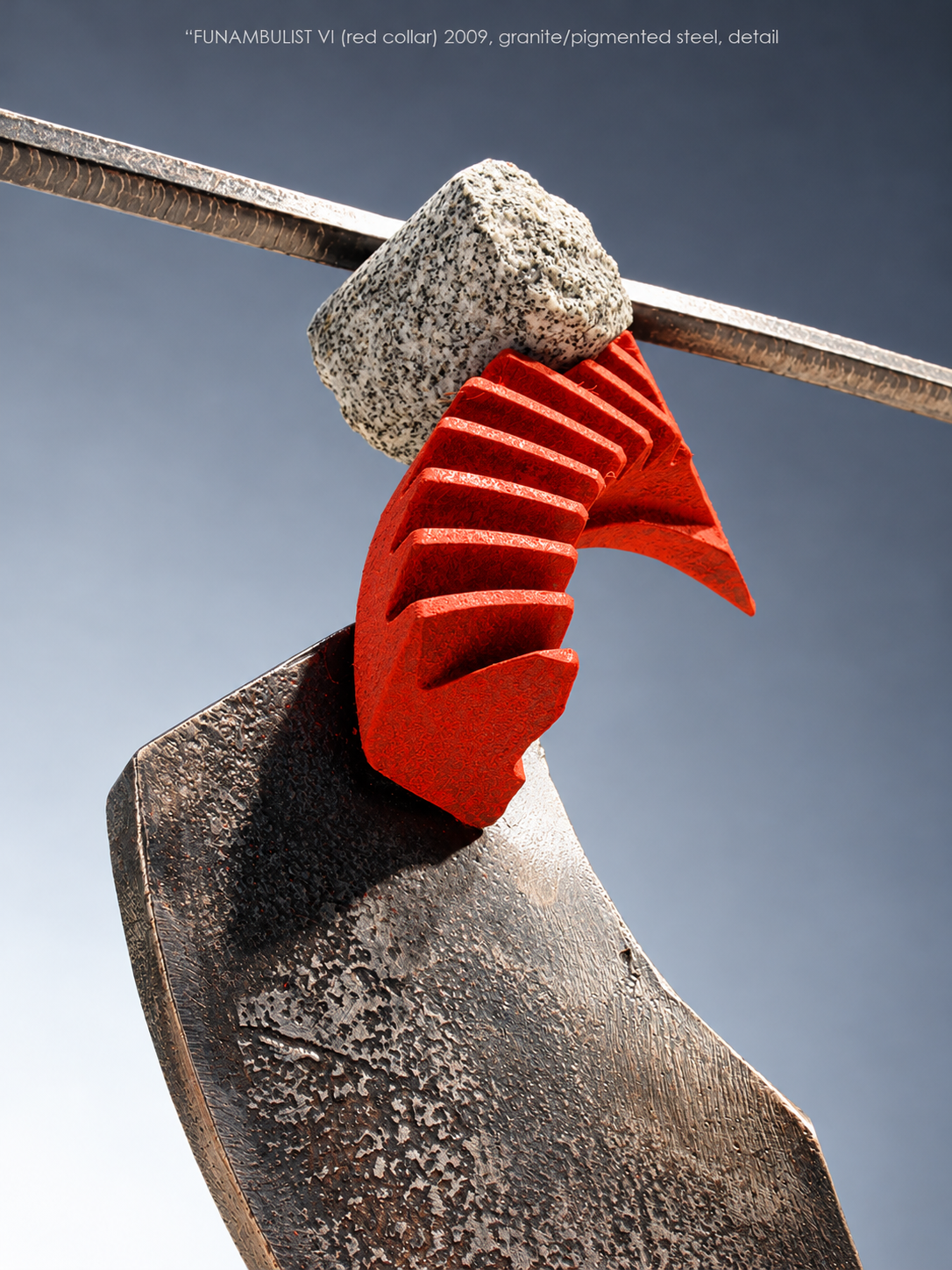
January 2009. Granite, pigmented steel. Dimensions: 13 × 18.5 × 7 in (33 × 47 × 18 cm). Private Collection.
The title derives from two Latin words—fūnis, meaning “rope,” and ambulāre, “to walk”—and refers to a tightrope walker. The meaning is reinforced by the sculpture’s dynamic horizontal “balancing baton” and its overall sense of precarious poise. It evokes the physical balance, agility, and daring of a circus performer, while perhaps more poignantly suggesting mental agility—the ability to maintain equilibrium amid uncertainty and change.
A celebrated modern funambulist is Philippe Petit, who became famous for his unauthorized high-wire walk between the Twin Towers of New York’s World Trade Center on August 7, 1974. His feat became an enduring image of extraordinary balance, concentration, risk, and resolve.
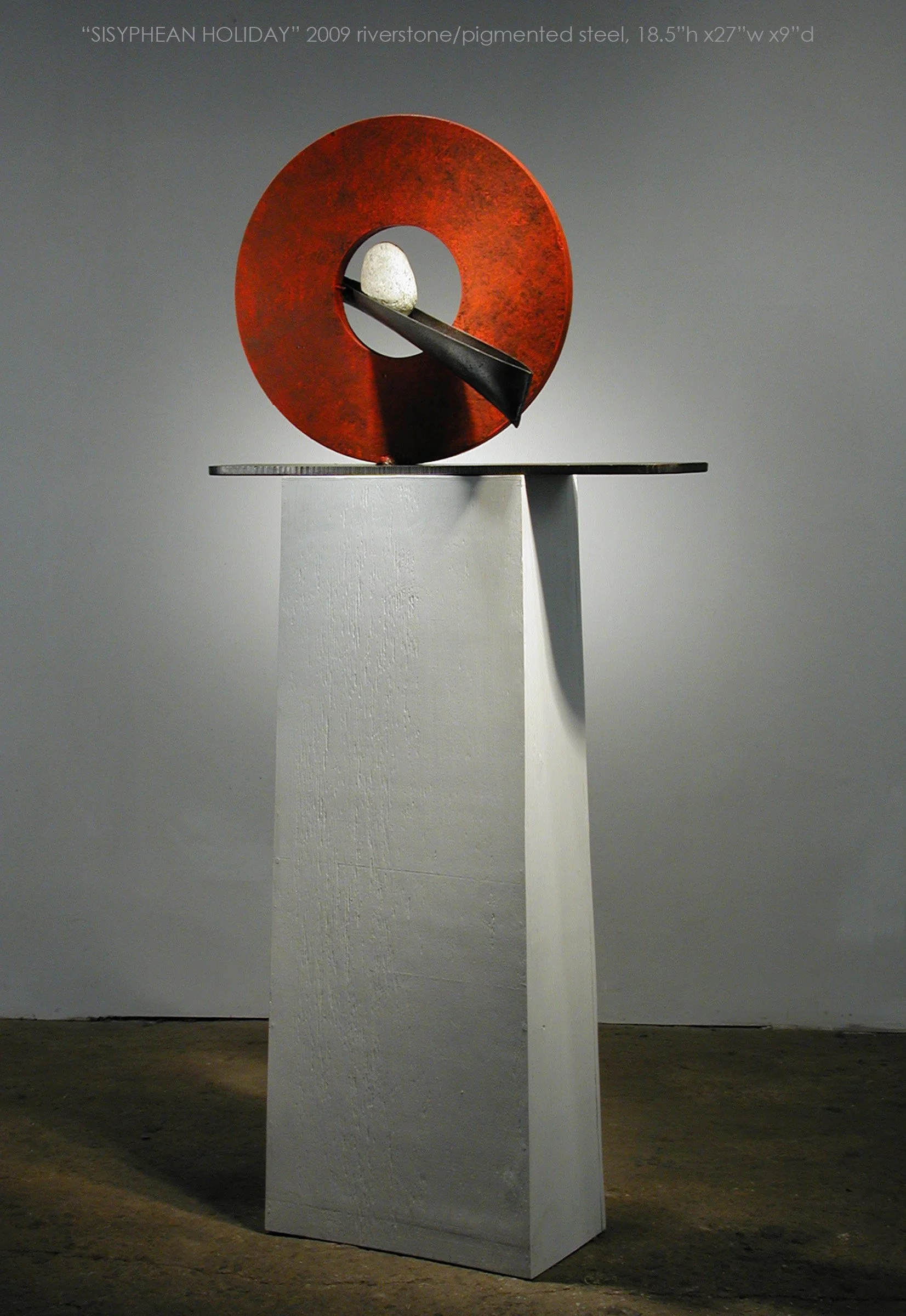
February 2009. River stone, pigmented steel. Dimensions: 18.5 × 27 × 9 in (47 × 69 × 23 cm).
Corporate collection: Pittsburgh. PA
After completing more than 150 sculptures in the original Sisyphean Circle series, a new direction emerged—the Sisyphean Holiday series. These works take a lighthearted, tongue-in-cheek approach, suggesting that Sisyphus (and perhaps the artist) might finally deserve a break—a holiday from the endless task.
Here, the familiar “Sisyphean stone” is placed within a vessel form reminiscent of an Adirondack guideboat or canoe. The shift offers a playful twist, transforming the symbol of perpetual struggle into one of pause, reflection, and perhaps even leisure.
—John Van Alstine
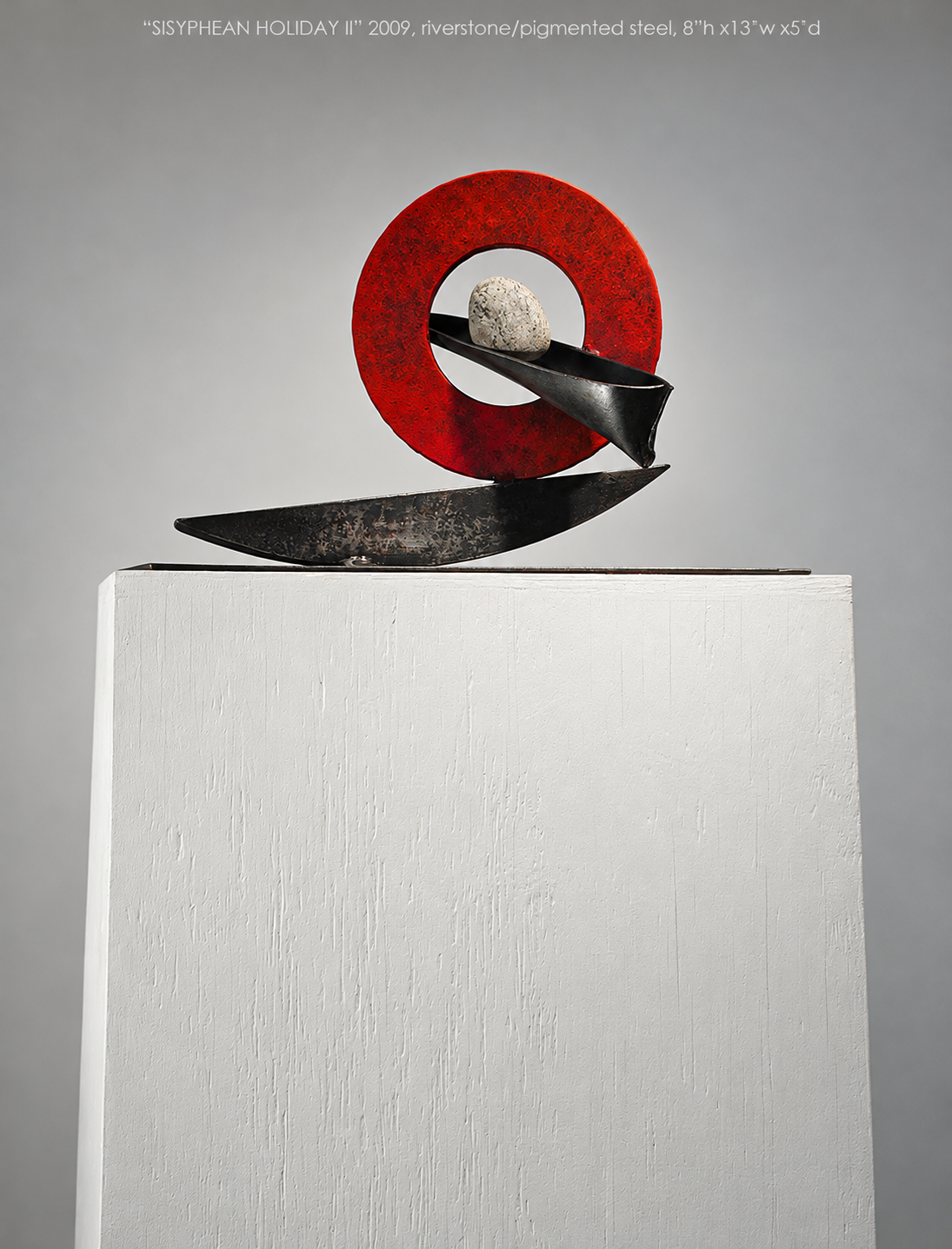
February 2009. River stone, pigmented steel. Dimensions: 8 × 13 × 5 in (20 × 33 × 13 cm). Private Collection
After completing more than 150 sculptures in the original Sisyphean Circle series, a new direction emerged—the Sisyphean Holiday series. These works take a lighthearted, tongue-in-cheek approach, suggesting that Sisyphus (and perhaps the artist) might finally deserve a break—a holiday from the endless task.
Here, the familiar “Sisyphean stone” is placed within a vessel form reminiscent of an Adirondack guideboat or canoe. The shift offers a playful twist, transforming the symbol of perpetual struggle into one of pause, reflection, and perhaps even leisure.
—John Van Alstine
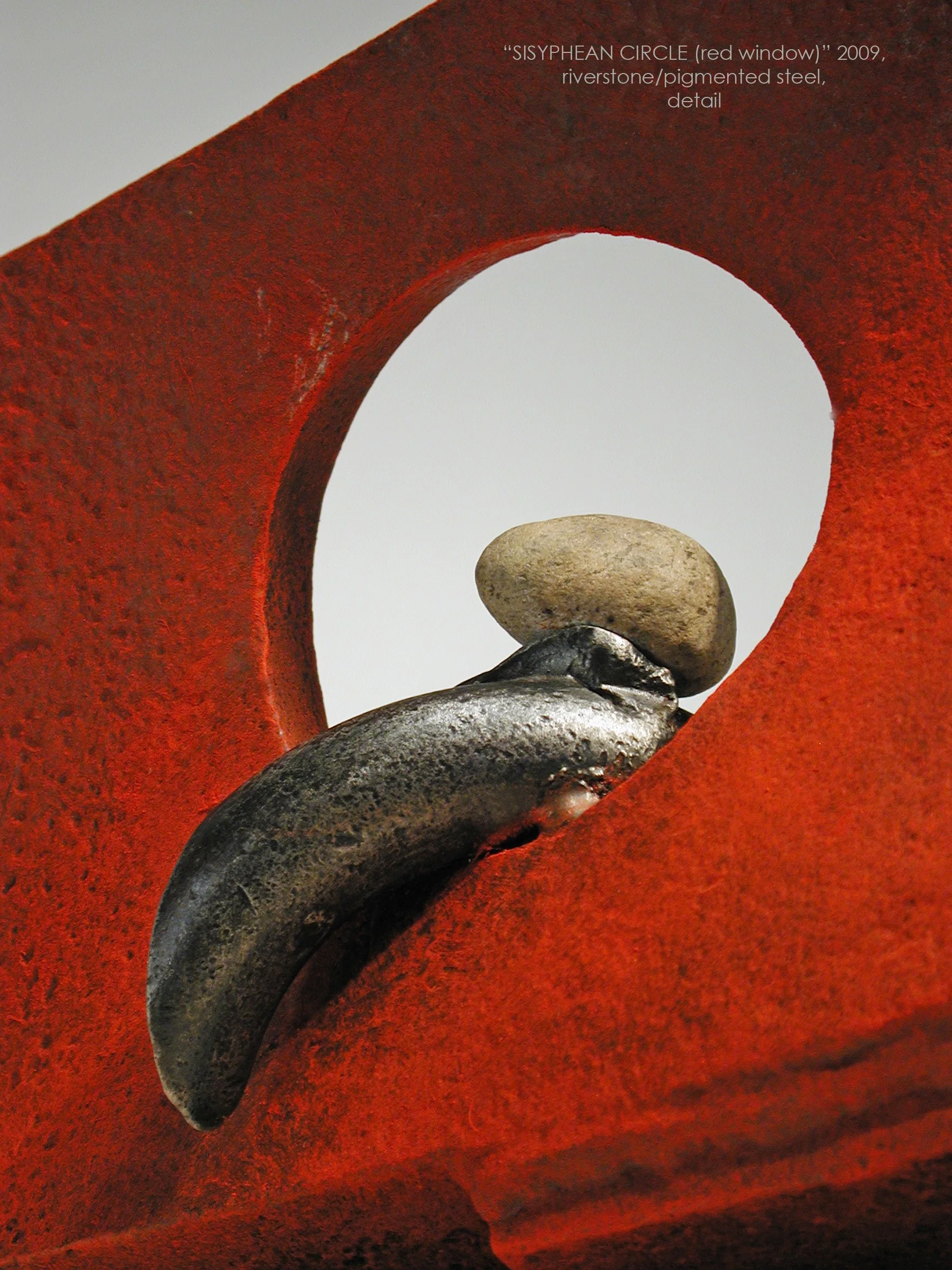
February 2009. River stone, pigmented steel. Dimensions: 11.5 × 16 × 6 in (29 × 41 × 15 cm). Private Collection - Boston, MA.
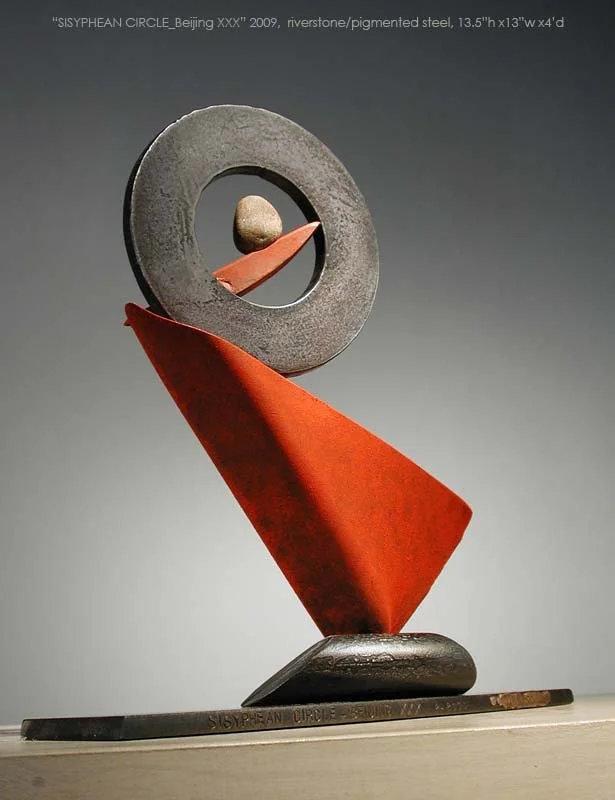
February 2009. River stone, pigmented steel. Dimensions: 13.5 × 13 × 4 in (34 × 33 × 10 cm).
Private Collection - Cadiz, Spain
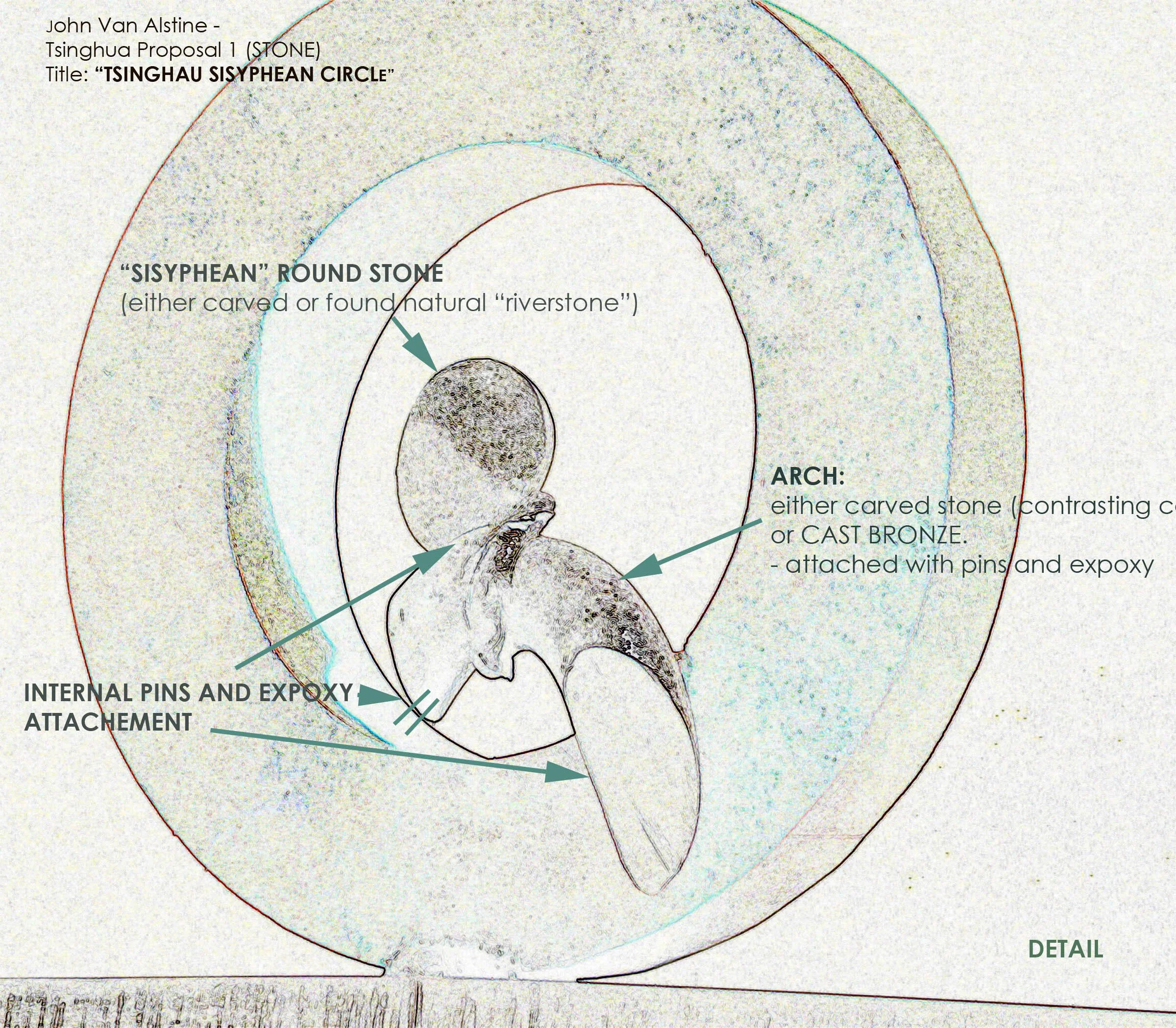
February 2009. River stone, pigmented steel. Dimensions: 10.5 × 25 × 3.5 in (27 × 64 × 9 cm). Private Collection Baltimore.
Piece was proposed as a scale model in 2011 for enlargement and installation at Tsinghua University, Beijing China.
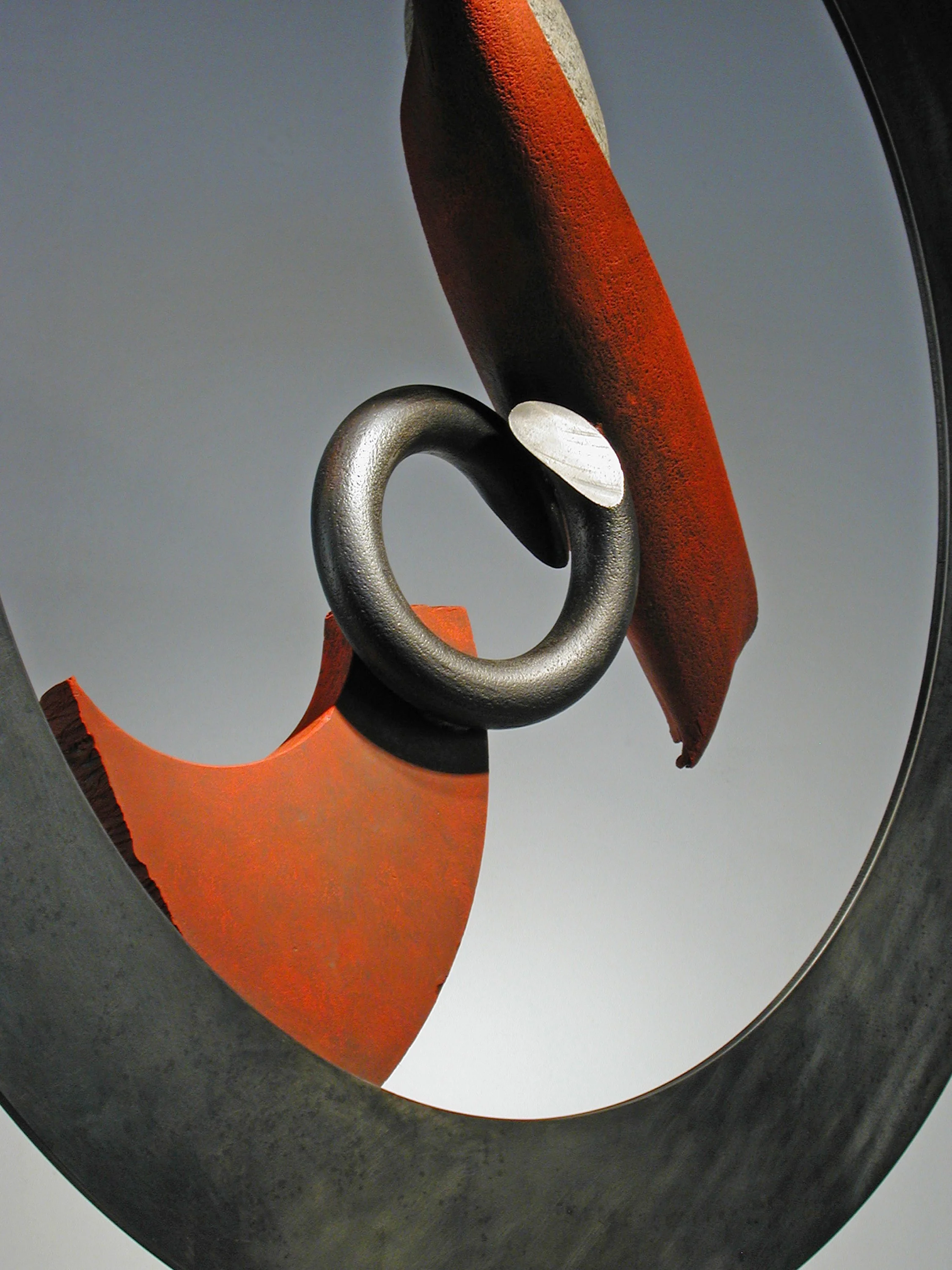
March 2009. Slate, pigmented steel. Dimensions: 42 × 37 × 7 in (107 × 94 × 18 cm).
Corporate Collection: Washington, DC
After completing more than 150 sculptures in the original Sisyphean Circle series, a new direction emerged—the Sisyphean Holiday series. These works take a lighthearted, tongue-in-cheek approach, suggesting that Sisyphus (and perhaps the artist) might finally deserve a break—a holiday from the endless task.
Here, the familiar “Sisyphean stone” is placed within a vessel form reminiscent of an Adirondack guideboat or canoe. The shift offers a playful twist, transforming the symbol of perpetual struggle into one of pause, reflection, and perhaps even leisure.
—John Van Alstine
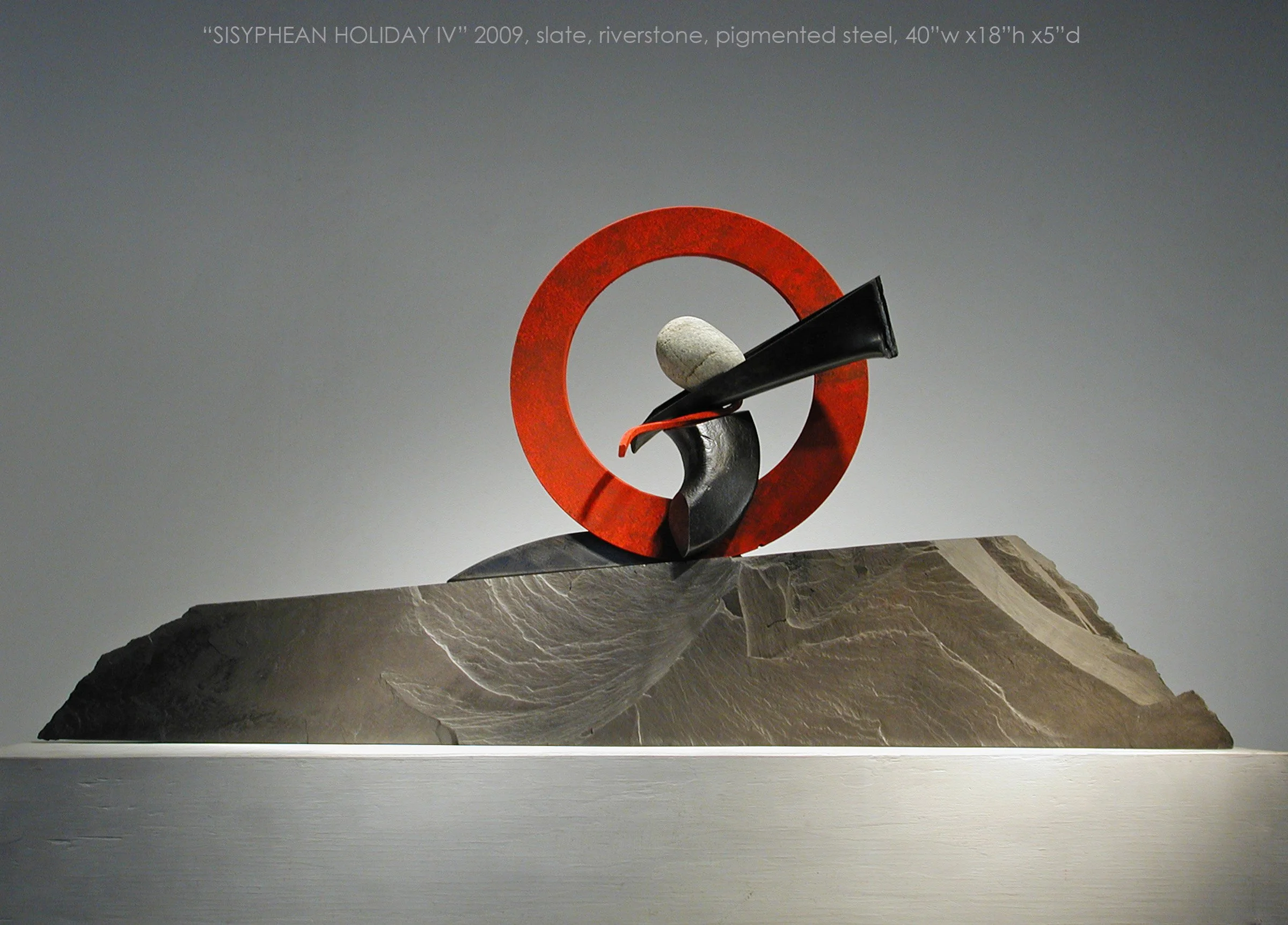
March 2009. River stone, slate, pigmented steel. Dimensions: 18 × 40 × 5 in (46 × 102 × 13 cm).
Private Collection - Pittsburgh, PA.
After completing more than 150 sculptures in the original Sisyphean Circle series, a new direction emerged—the Sisyphean Holiday series. These works take a lighthearted, tongue-in-cheek approach, suggesting that Sisyphus (and perhaps the artist) might finally deserve a break—a holiday from the endless task.
Here, the familiar “Sisyphean stone” is placed within a vessel form reminiscent of an Adirondack guideboat or canoe. The shift offers a playful twist, transforming the symbol of perpetual struggle into one of pause, reflection, and perhaps even leisure.
—John Van Alstine
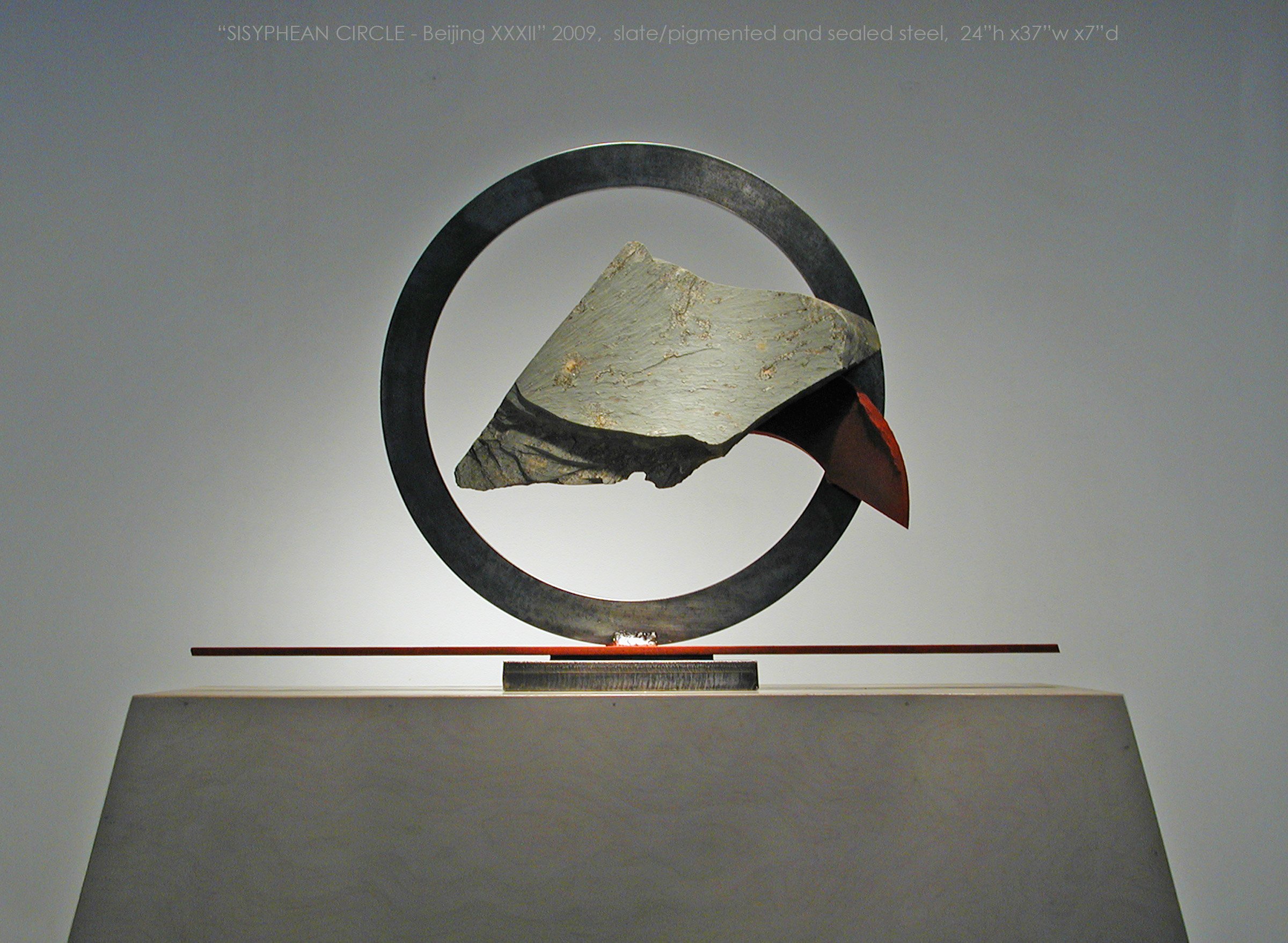
March 2009. Slate, pigmented steel. Dimensions: 24 × 37 × 7 in (61 × 94 × 18 cm).
The Sisyphean Series
The Greek myth of Sisyphus, condemned to endlessly push a boulder uphill, has inspired more than 250 of my sculptures. Rather than seeing the myth as a symbol of futility, I share philosopher Albert Camus’s more positive interpretation—that meaning and fulfillment can be found in the struggle itself. In many ways, I see Sisyphus as autobiographical, reflecting my lifelong pursuit as an artist, confronting challenges, taking risks, and finding purpose in the act of creation.
My Sisyphean works bring stone and steel together in precarious yet stable arrangements, often incorporating circular forms suggesting perpetual motion. For me, they are metaphors for the creative process—an ongoing cycle of experimentation, discovery, setbacks, and renewal. Each completed sculpture is both an achievement and a starting point, celebrating the journey rather than simply the destination.
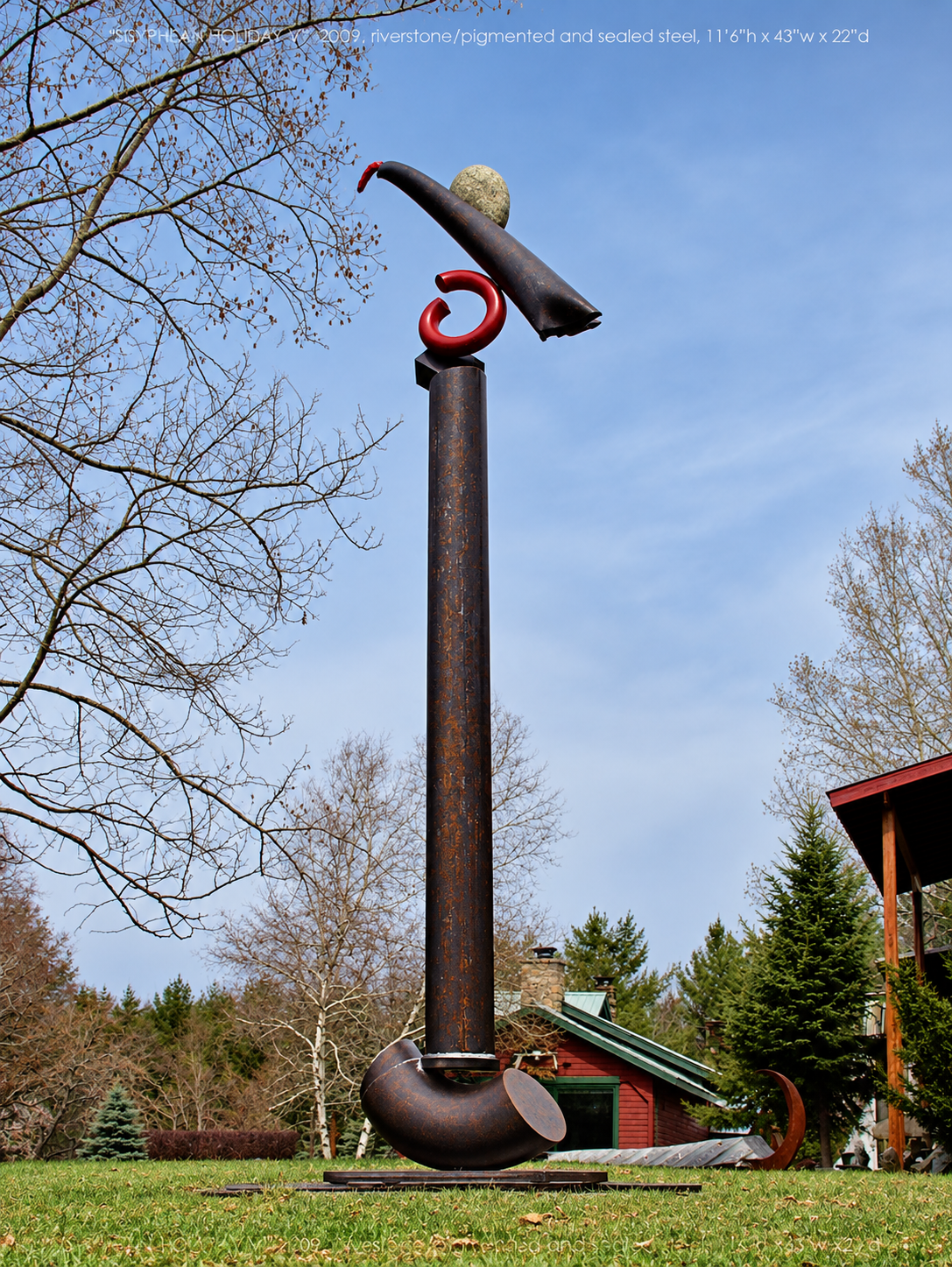
April 2009. River stone, steel. Dimensions: 116 × 43 × 22 in (295 × 109 × 56 cm).
Collection: SUNY Potsdam, gift of Don and Kathy Lougheed.
After completing more than 150 sculptures in the original Sisyphean Circle series, a new direction emerged—the Sisyphean Holiday series. These works take a lighthearted, tongue-in-cheek approach, suggesting that Sisyphus (and perhaps the artist) might finally deserve a break—a holiday from the endless task.
Here, the familiar “Sisyphean stone” is placed within a vessel form reminiscent of an Adirondack guideboat or canoe. The shift offers a playful twist, transforming the symbol of perpetual struggle into one of pause, reflection, and perhaps even leisure.
—John Van Alstine
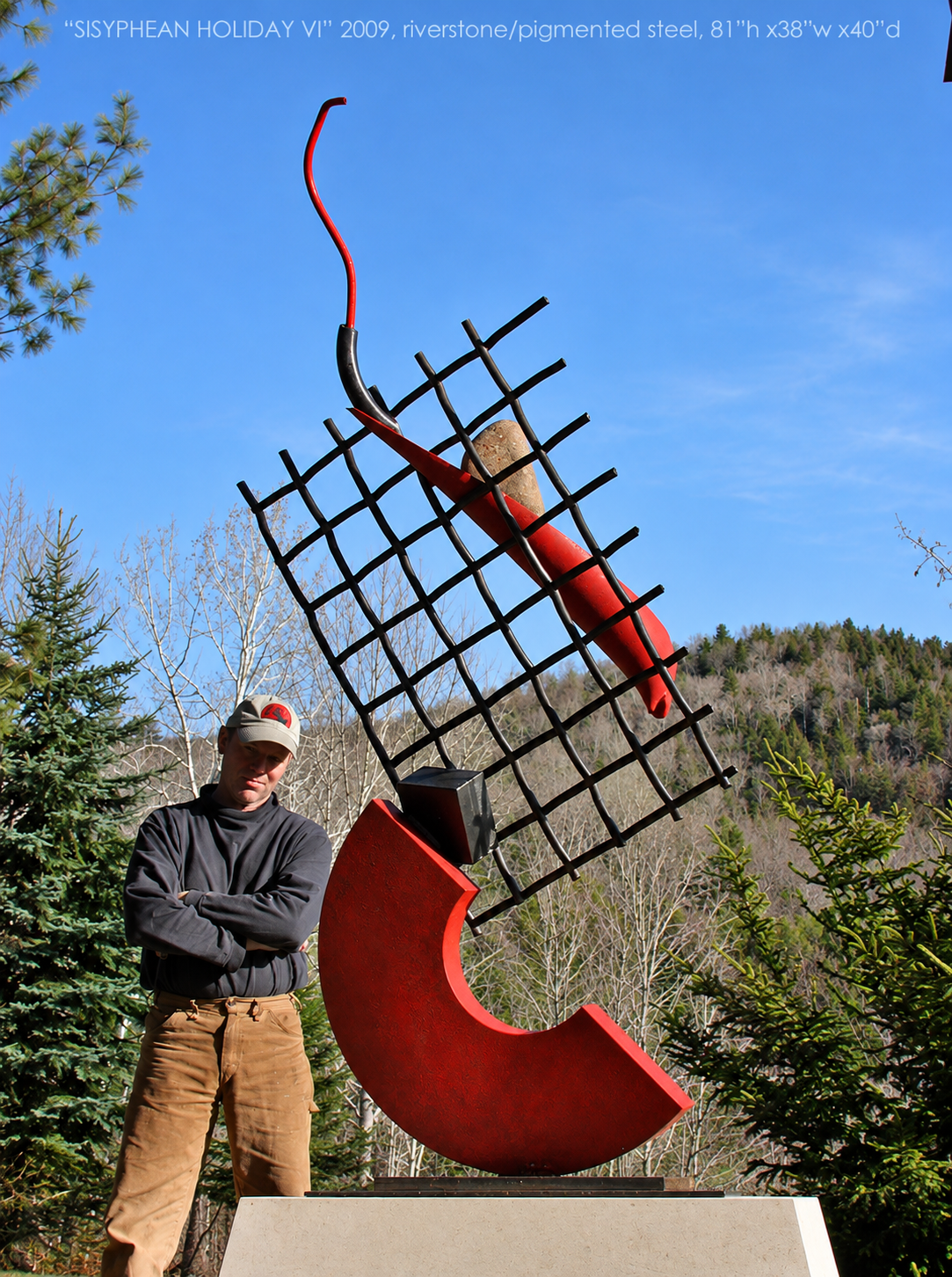
April 2009. River stone, pigmented and sealed steel. Dimensions: 81 × 38 × 40 in. (206 × 97 × 102 cm).
Corporate Collection: Hudson Headwaters Medical Group, New York
After completing more than 150 sculptures in the original Sisyphean Circle series, a new direction emerged—the Sisyphean Holiday series. These works take a lighthearted, tongue-in-cheek approach, suggesting that Sisyphus (and perhaps the artist) might finally deserve a break—a holiday from the endless task.
Here, the familiar “Sisyphean stone” is placed within a vessel form reminiscent of an Adirondack guideboat or canoe. The shift offers a playful twist, transforming the symbol of perpetual struggle into one of pause, reflection, and perhaps even leisure.
—John Van Alstine
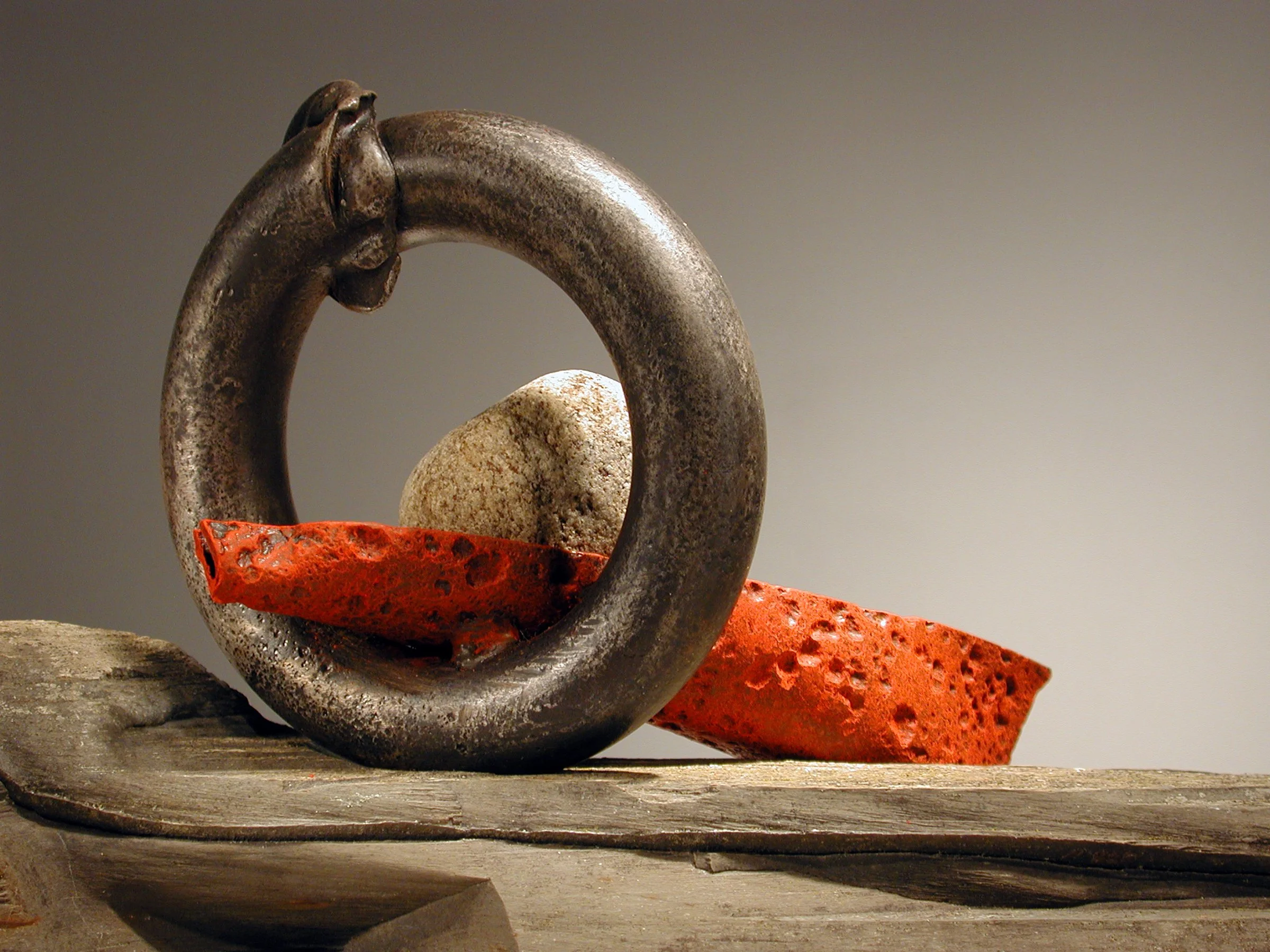
April 2009. River stone, slate, pigmented and sealed steel. Dimensions: 7.5 × 27 × 7 in (19 × 69 × 18 cm). Private Collection.
After completing more than 150 sculptures in the original Sisyphean Circle series, a new direction emerged—the Sisyphean Holiday series. These works take a lighthearted, tongue-in-cheek approach, suggesting that Sisyphus (and perhaps the artist) might finally deserve a break—a holiday from the endless task.
Here, the familiar “Sisyphean stone” is placed within a vessel form reminiscent of an Adirondack guideboat or canoe. The shift offers a playful twist, transforming the symbol of perpetual struggle into one of pause, reflection, and perhaps even leisure.
—John Van Alstine
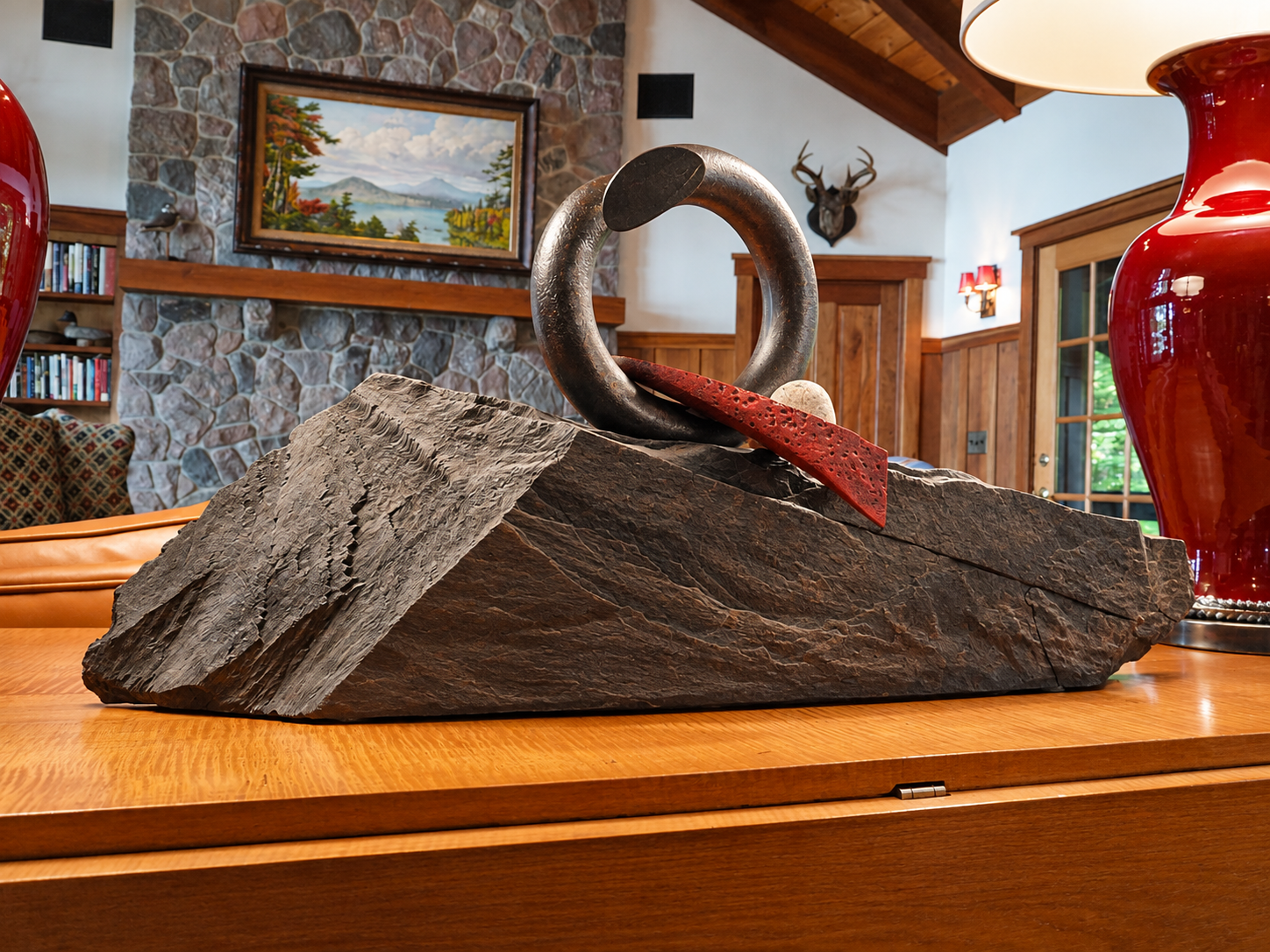
April 2009. River stone, slate, pigmented and sealed steel. Dimensions: 16 × 36 × 12 in (41 × 91 × 30 cm). Private collection.
After completing more than 150 sculptures in the original Sisyphean Circle series, a new direction emerged—the Sisyphean Holiday series. These works take a lighthearted, tongue-in-cheek approach, suggesting that Sisyphus (and perhaps the artist) might finally deserve a break—a holiday from the endless task.
Here, the familiar “Sisyphean stone” is placed within a vessel form reminiscent of an Adirondack guideboat or canoe. The shift offers a playful twist, transforming the symbol of perpetual struggle into one of pause, reflection, and perhaps even leisure.
—John Van Alstine
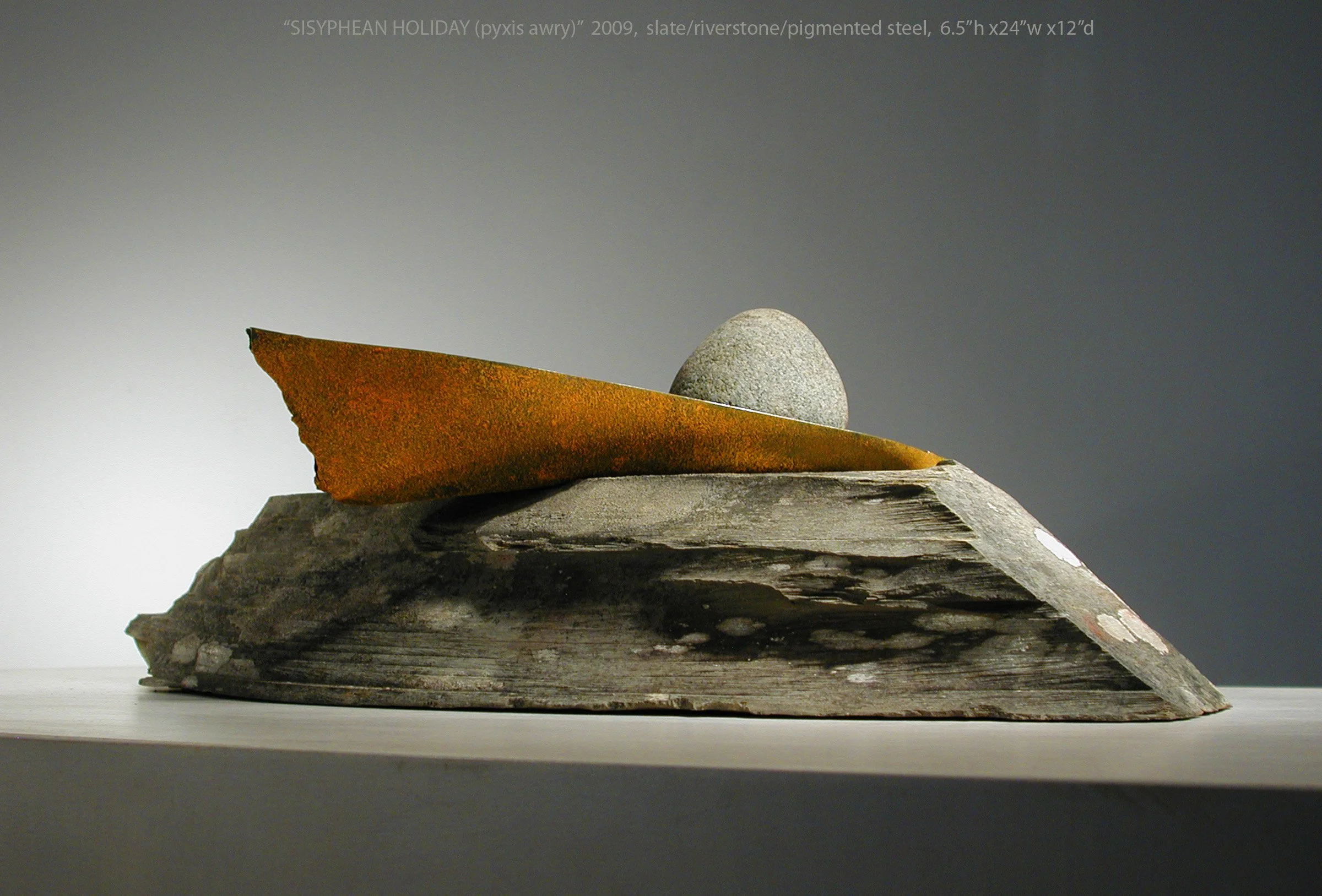
April 2009. River stone, slate, pigmented and sealed steel. Dimensions: 6.5 × 24 × 12 in (17 × 61 × 30 cm).
After completing more than 150 sculptures in the original Sisyphean Circle series, a new direction emerged—the Sisyphean Holiday series. These works take a lighthearted, tongue-in-cheek approach, suggesting that Sisyphus (and perhaps the artist) might finally deserve a break—a holiday from the endless task.
Here, the familiar “Sisyphean stone” is placed within a vessel form reminiscent of an Adirondack guideboat or canoe. The shift offers a playful twist, transforming the symbol of perpetual struggle into one of pause, reflection, and perhaps even leisure.
—John Van Alstine
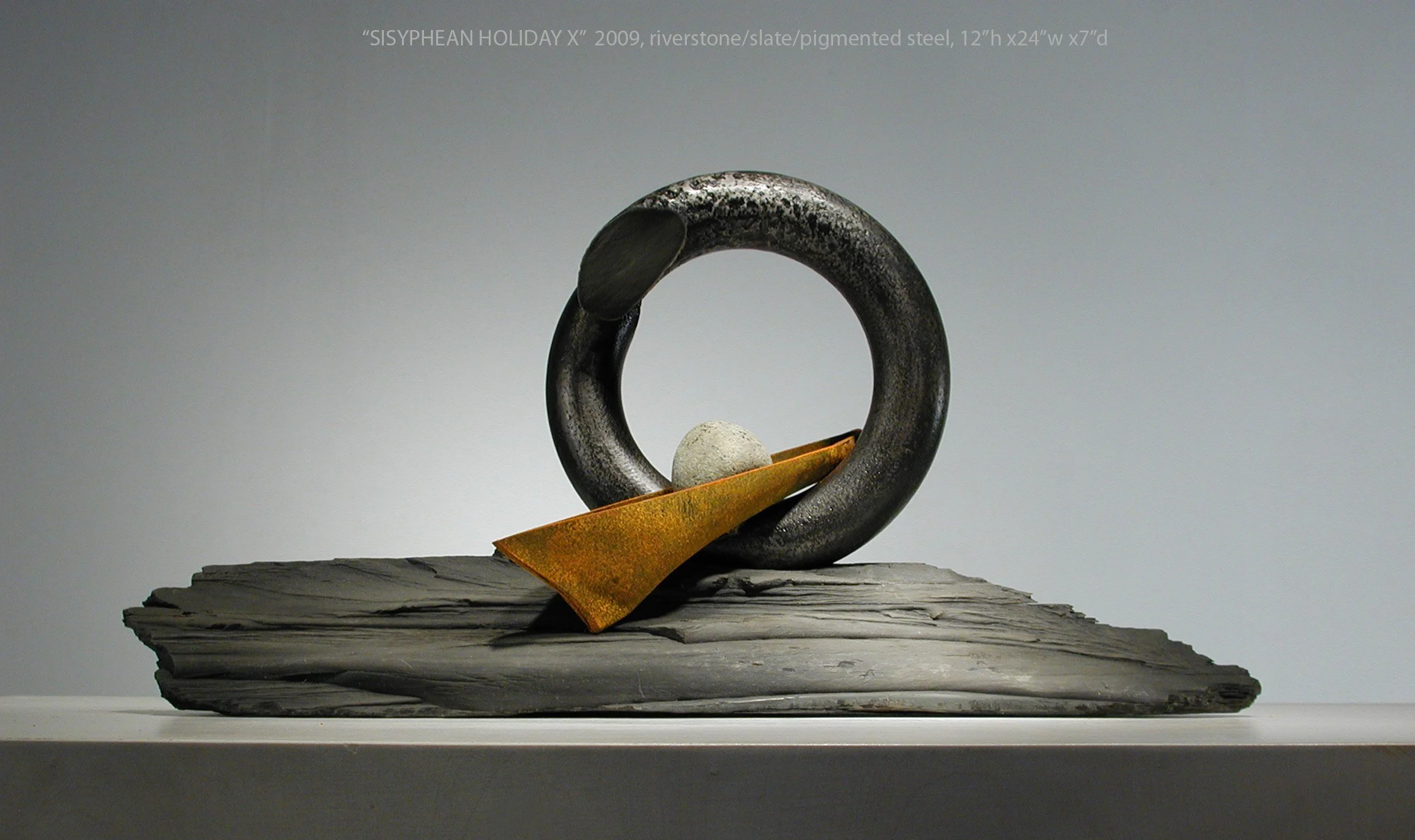
April 2009. River stone, slate, pigmented and sealed steel. Dimensions: 12 × 24 × 7 in (30 × 61 × 18 cm). Private Collection.
After completing more than 150 sculptures in the original Sisyphean Circle series, a new direction emerged—the Sisyphean Holiday series. These works take a lighthearted, tongue-in-cheek approach, suggesting that Sisyphus (and perhaps the artist) might finally deserve a break—a holiday from the endless task.
Here, the familiar “Sisyphean stone” is placed within a vessel form reminiscent of an Adirondack guideboat or canoe. The shift offers a playful twist, transforming the symbol of perpetual struggle into one of pause, reflection, and perhaps even leisure.
—John Van Alstine
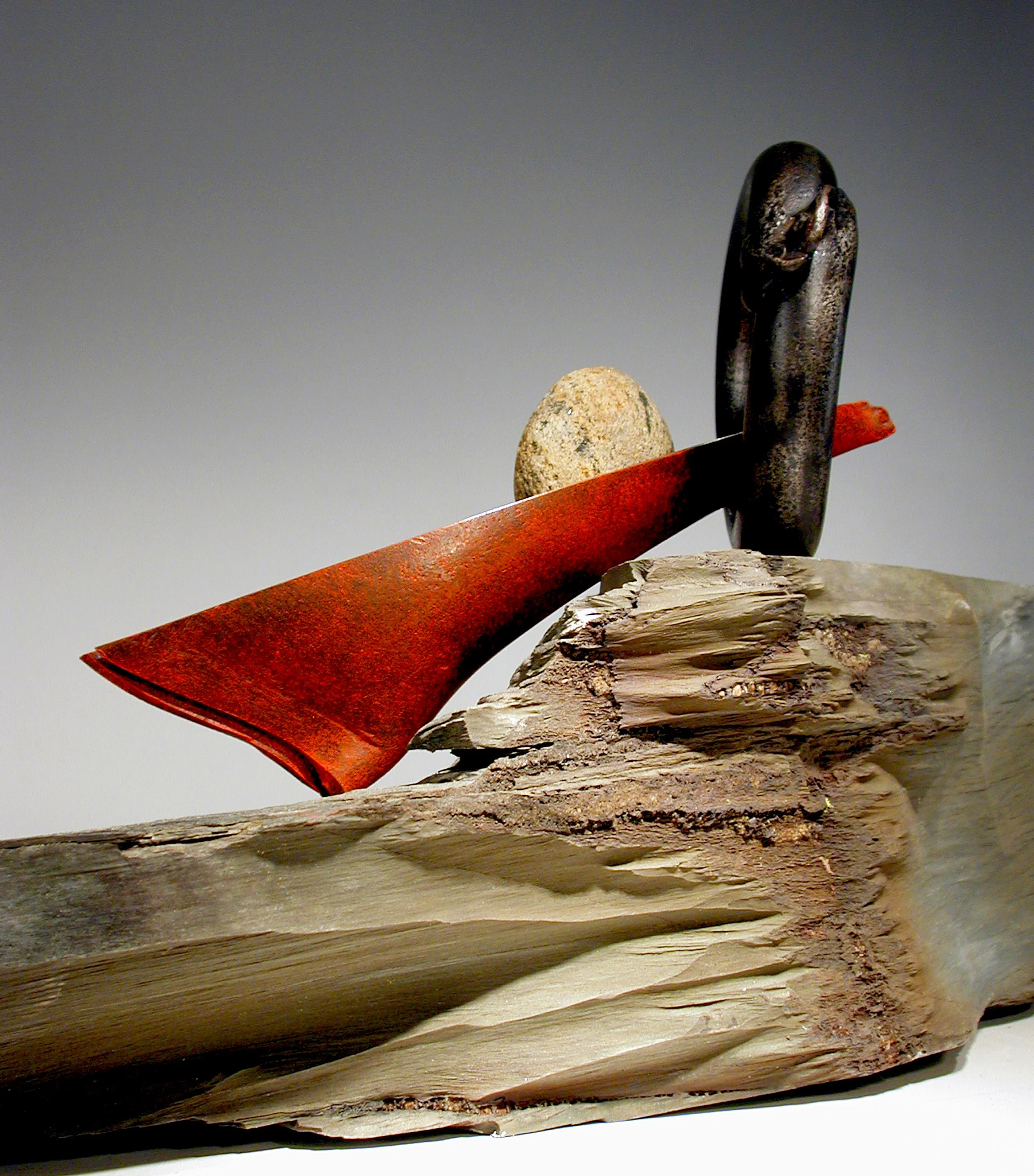
April 2009. River stone, slate, pigmented and sealed steel. Dimensions: 10.5 × 31 × 6 in (27 × 79 × 15 cm). Private collection.
After completing more than 150 sculptures in the original Sisyphean Circle series, a new direction emerged—the Sisyphean Holiday series. These works take a lighthearted, tongue-in-cheek approach, suggesting that Sisyphus (and perhaps the artist) might finally deserve a break—a holiday from the endless task.
Here, the familiar “Sisyphean stone” is placed within a vessel form reminiscent of an Adirondack guideboat or canoe. The shift offers a playful twist, transforming the symbol of perpetual struggle into one of pause, reflection, and perhaps even leisure.
—John Van Alstine
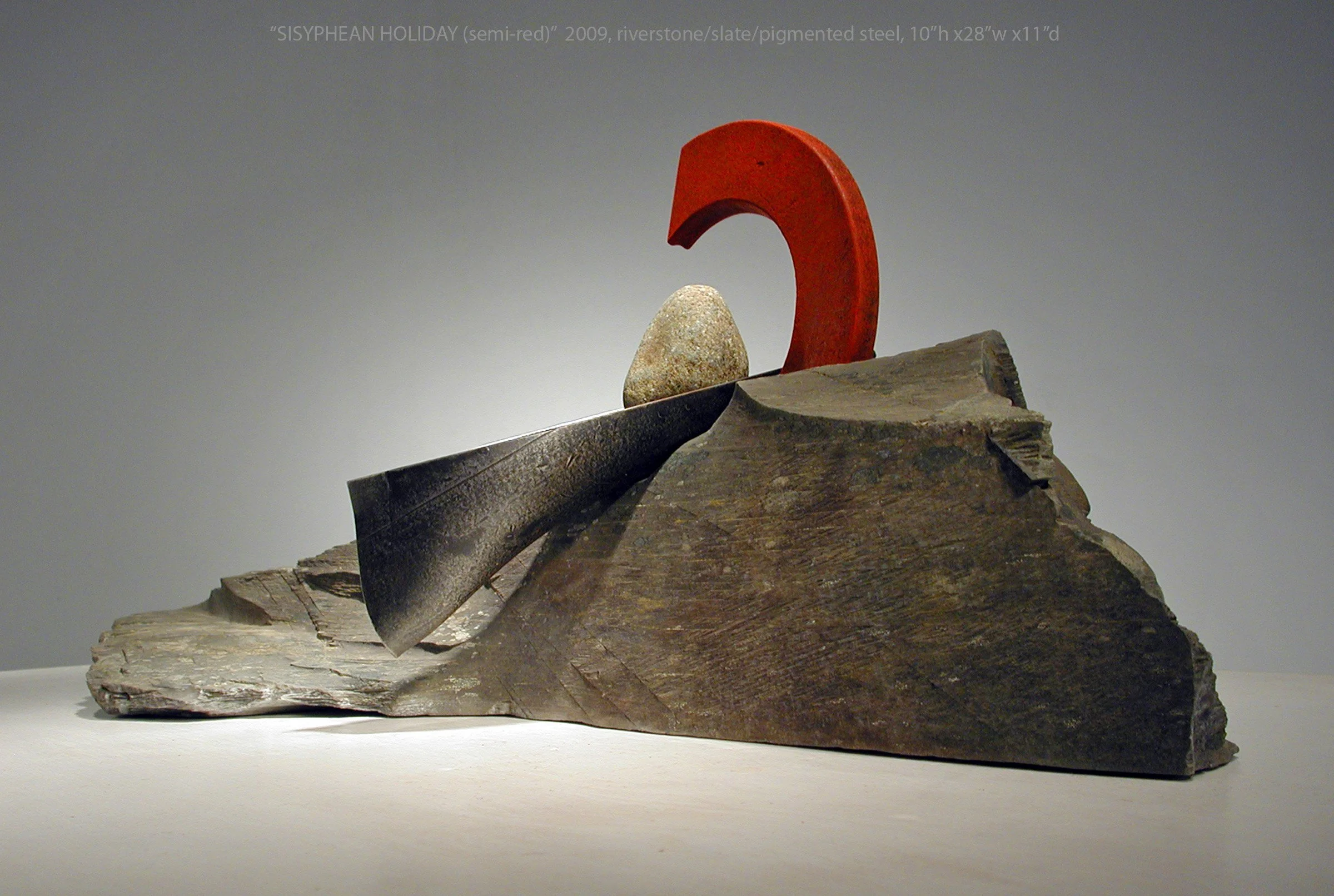
May 2009. River stone, slate, pigmented and sealed steel. Dimensions: 10 × 28 × 11 in (25 × 71 × 28 cm). Private Collection.
After completing more than 150 sculptures in the original Sisyphean Circle series, a new direction emerged—the Sisyphean Holiday series. These works take a lighthearted, tongue-in-cheek approach, suggesting that Sisyphus (and perhaps the artist) might finally deserve a break—a holiday from the endless task.
Here, the familiar “Sisyphean stone” is placed within a vessel form reminiscent of an Adirondack guideboat or canoe. The shift offers a playful twist, transforming the symbol of perpetual struggle into one of pause, reflection, and perhaps even leisure.
—John Van Alstine
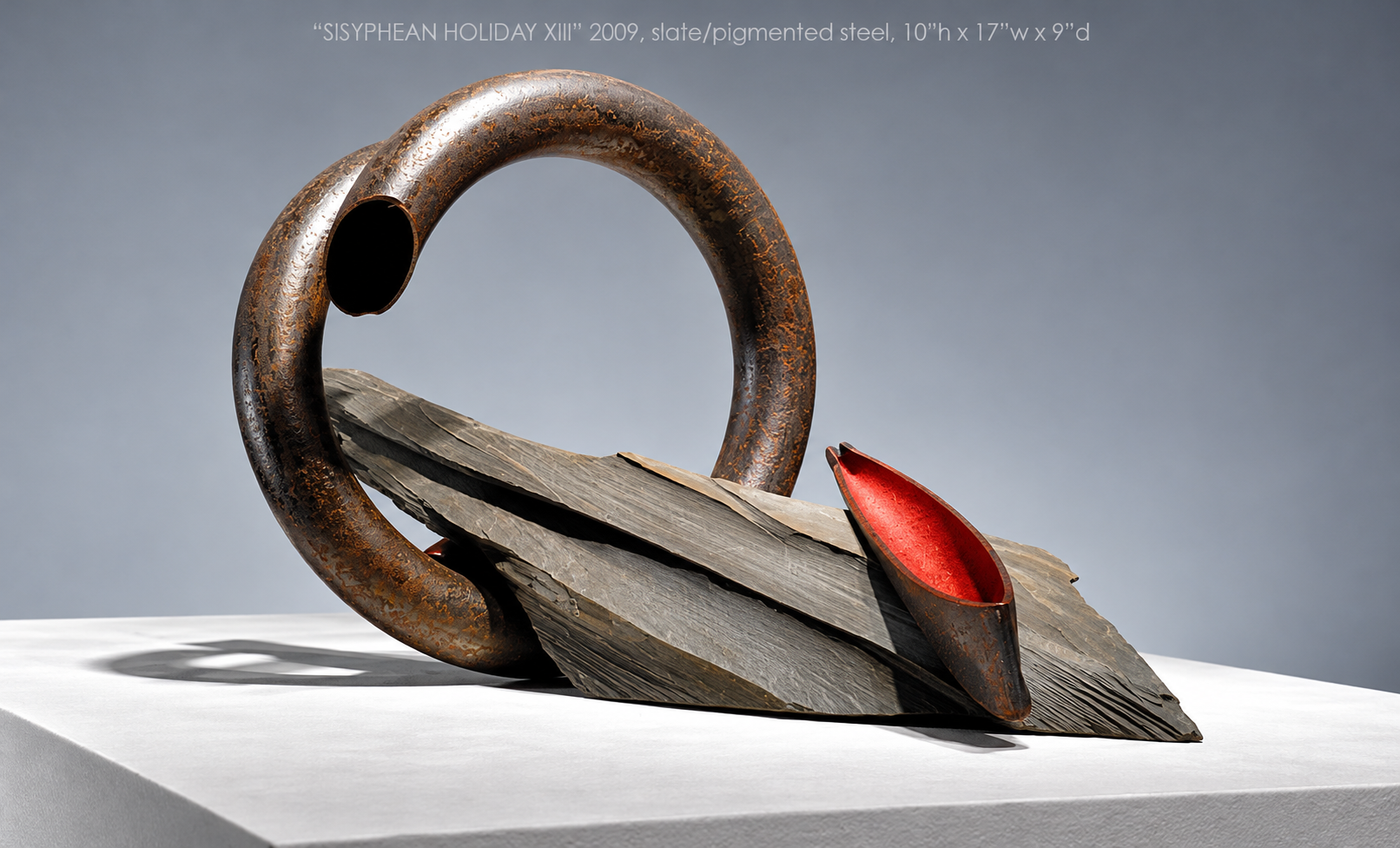
May 2009. Slate, pigmented and sealed steel. Dimensions: 10.25 × 17 × 9 in (26 × 43 × 23 cm). Private Collection.
After completing more than 150 sculptures in the original Sisyphean Circle series, a new direction emerged—the Sisyphean Holiday series. These works take a lighthearted, tongue-in-cheek approach, suggesting that Sisyphus (and perhaps the artist) might finally deserve a break—a holiday from the endless task.
Here, the familiar “Sisyphean stone” is placed within a vessel form reminiscent of an Adirondack guideboat or canoe. The shift offers a playful twist, transforming the symbol of perpetual struggle into one of pause, reflection, and perhaps even leisure.
—John Van Alstine
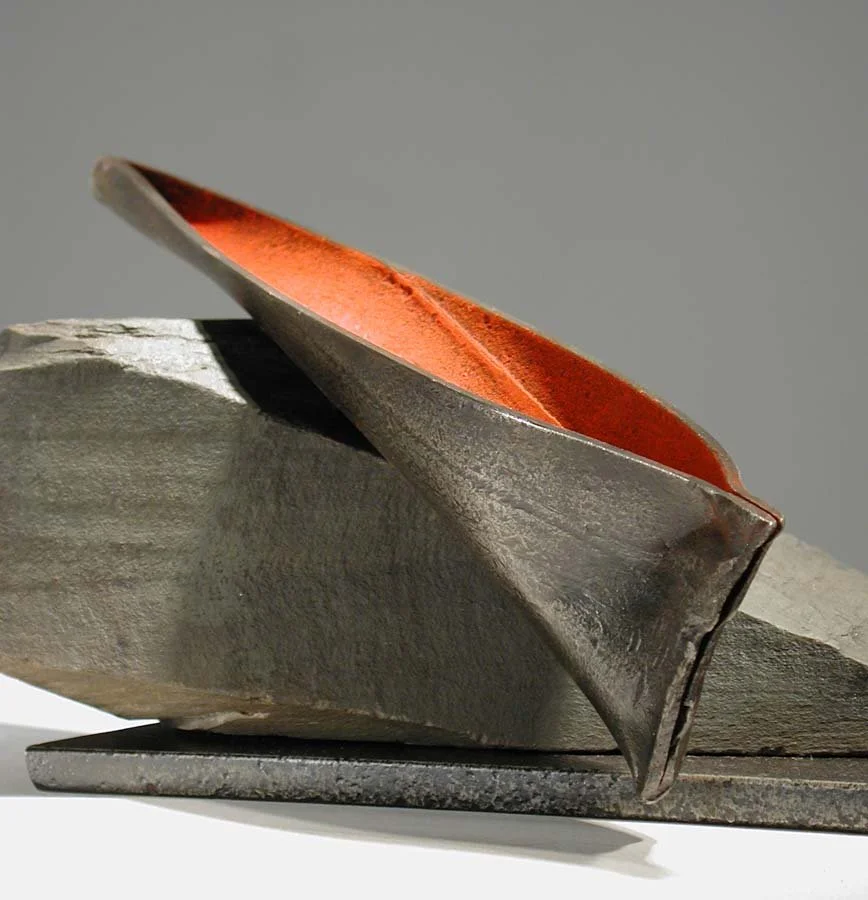
June 2009. Slate, pigmented steel. Dimensions: 5.5 x 14 x 7 in. (14 x 36 x18 cm). Used as scale model for “Passage” large scale commission for Tsinqhua University, Beijing, China.
Pyxis is a small and faint constellation in the southern sky. Its name is Latin for a mariner's compass
Awry 1: in a turned or twisted position or direction: askew 2: off the correct or expected course: amiss
The works in this series feature a “vessel” form - historically understood in art and literature as a symbol or metaphor for the self, a group of people, human kind. If the vessel's compass is awry it will likely end up adrift, untethered, off course.
My intent with this series is raise questions/search for answers relative to personal (or a group) decisions or courses of action and shed light on the resulting consequences, whether they are personal, political, environmental.
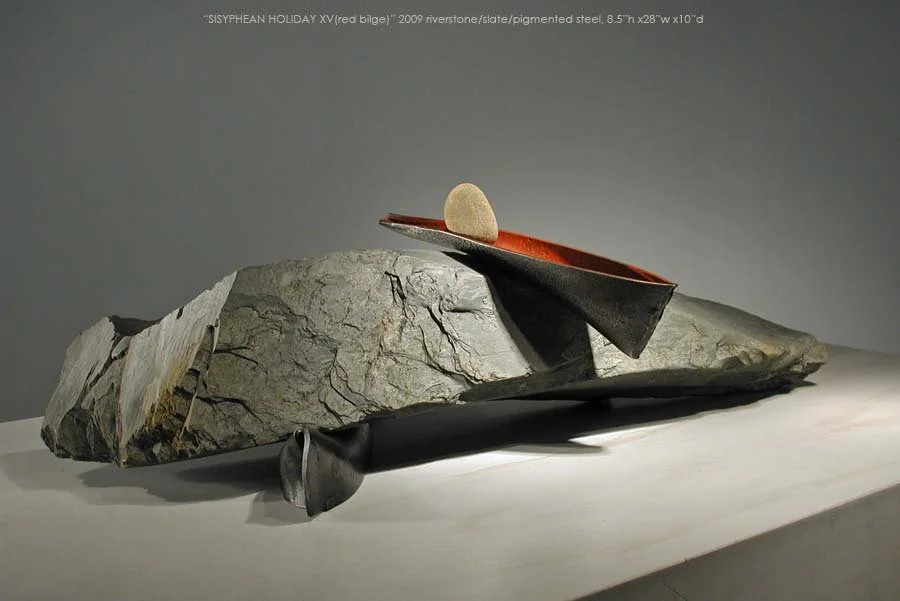
May 2009. River stone, slate, pigmented and sealed steel. Dimensions: 8.5 x 28 x 10 in. (22 x 71 x 25 cm). Private Collection.
After completing more than 150 sculptures in the original Sisyphean Circle series, a new direction emerged—the Sisyphean Holiday series. These works take a lighthearted, tongue-in-cheek approach, suggesting that Sisyphus (and perhaps the artist) might finally deserve a break—a holiday from the endless task.
Here, the familiar “Sisyphean stone” is placed within a vessel form reminiscent of an Adirondack guideboat or canoe. The shift offers a playful twist, transforming the symbol of perpetual struggle into one of pause, reflection, and perhaps even leisure.
—John Van Alstine
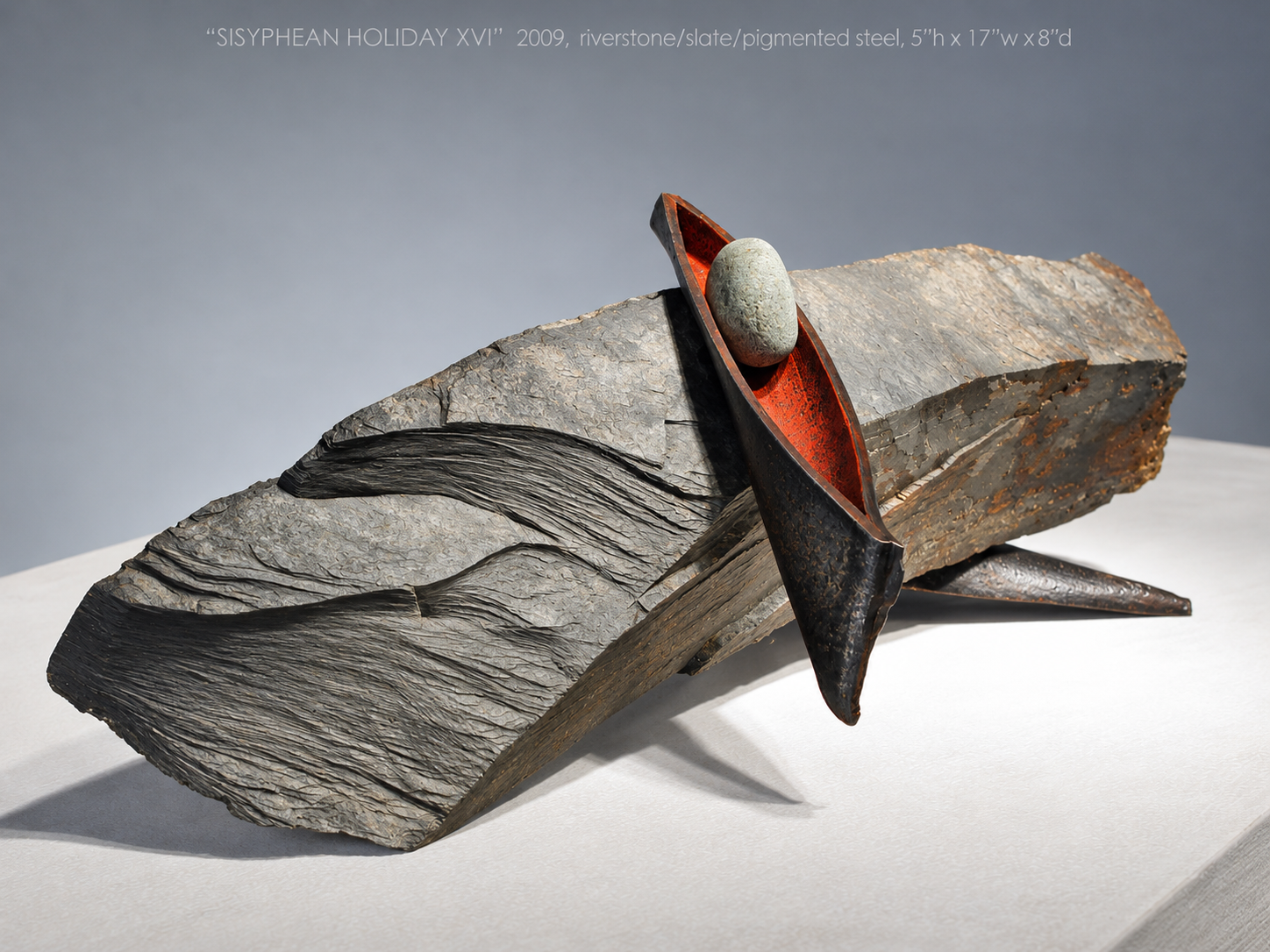
June 2009. Riverstone, slate, pigmented and sealed steel. Dimensions: 5 x 17 x 8 in. (13 x 43 x 20 cm).
After completing more than 150 sculptures in the original Sisyphean Circle series, a new direction emerged—the Sisyphean Holiday series. These works take a lighthearted, tongue-in-cheek approach, suggesting that Sisyphus (and perhaps the artist) might finally deserve a break—a holiday from the endless task.
Here, the familiar “Sisyphean stone” is placed within a vessel form reminiscent of an Adirondack guideboat or canoe. The shift offers a playful twist, transforming the symbol of perpetual struggle into one of pause, reflection, and perhaps even leisure.
—John Van Alstine
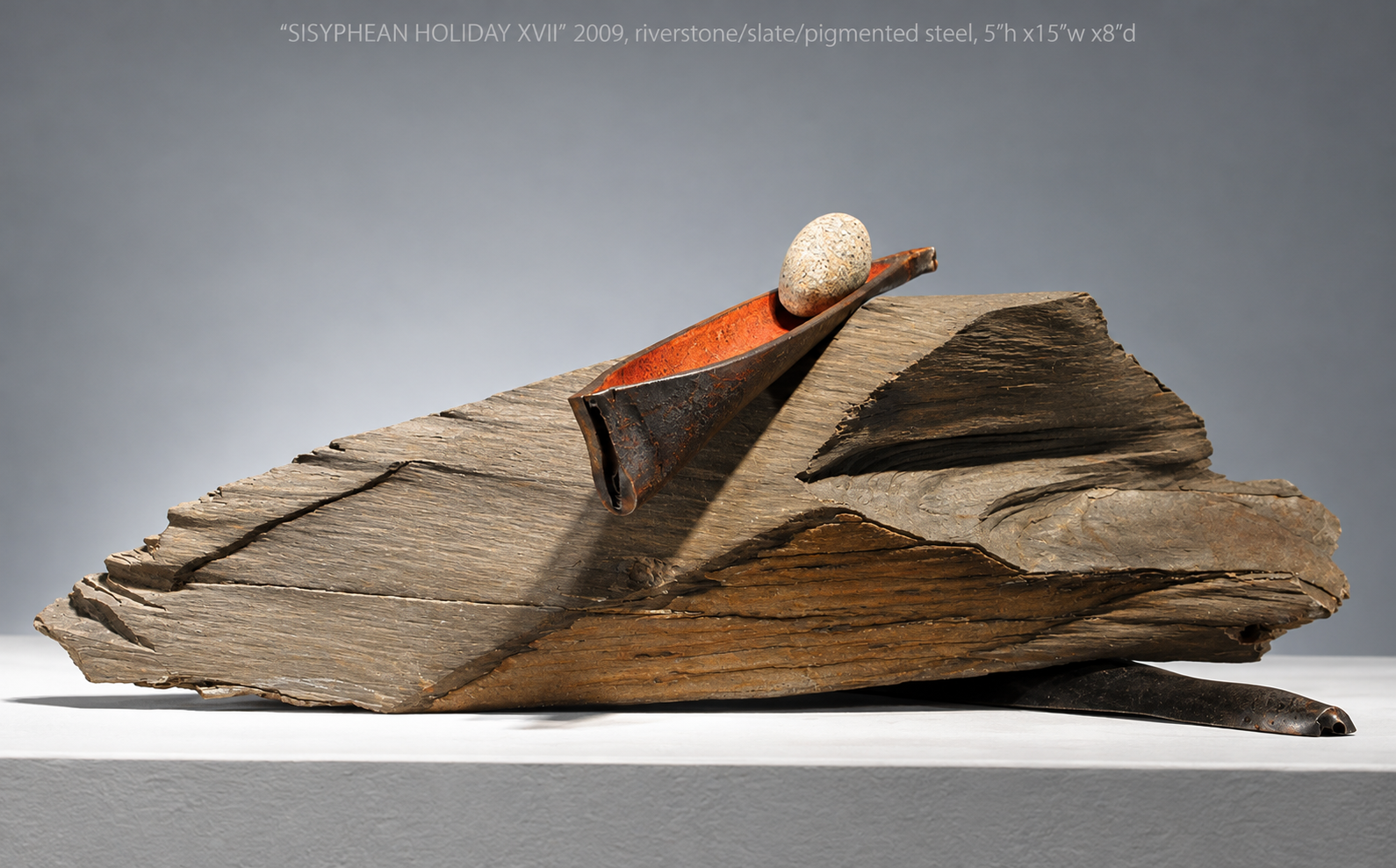
June 2009. River stone, slate, pigmented and sealed steel. Dimensions: 5 x 15 x 8 in (13 x 38 x 20 cm). Private Collection.
After completing more than 150 sculptures in the original Sisyphean Circle series, a new direction emerged—the Sisyphean Holiday series. These works take a lighthearted, tongue-in-cheek approach, suggesting that Sisyphus (and perhaps the artist) might finally deserve a break—a holiday from the endless task.
Here, the familiar “Sisyphean stone” is placed within a vessel form reminiscent of an Adirondack guideboat or canoe. The shift offers a playful twist, transforming the symbol of perpetual struggle into one of pause, reflection, and perhaps even leisure.
—John Van Alstine
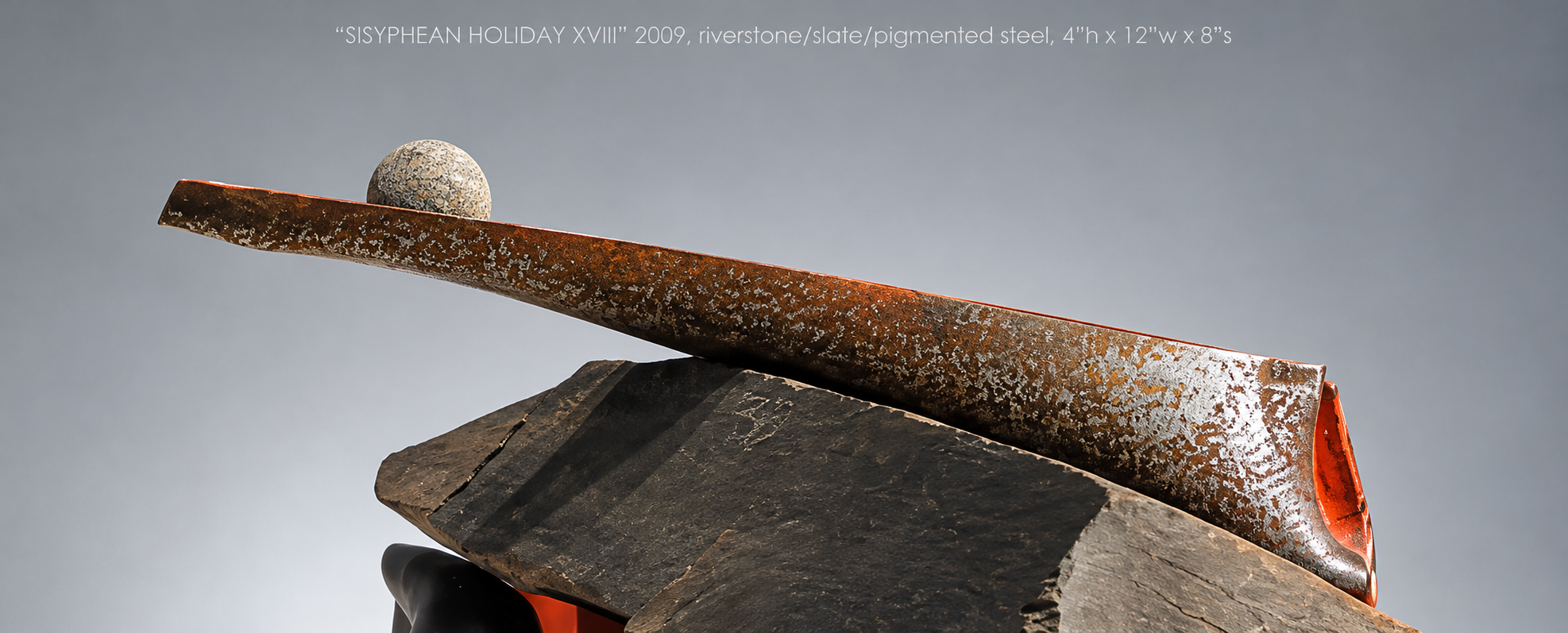
June 2009. River stone, slate, pigmented and sealed steel. Dimensions: 4 x 12 x 8 in. (10 x 30 x 20 cm). Private Collection Kentucky.
After completing more than 150 sculptures in the original Sisyphean Circle series, a new direction emerged—the Sisyphean Holiday series. These works take a lighthearted, tongue-in-cheek approach, suggesting that Sisyphus (and perhaps the artist) might finally deserve a break—a holiday from the endless task.
Here, the familiar “Sisyphean stone” is placed within a vessel form reminiscent of an Adirondack guideboat or canoe. The shift offers a playful twist, transforming the symbol of perpetual struggle into one of pause, reflection, and perhaps even leisure.
—John Van Alstine
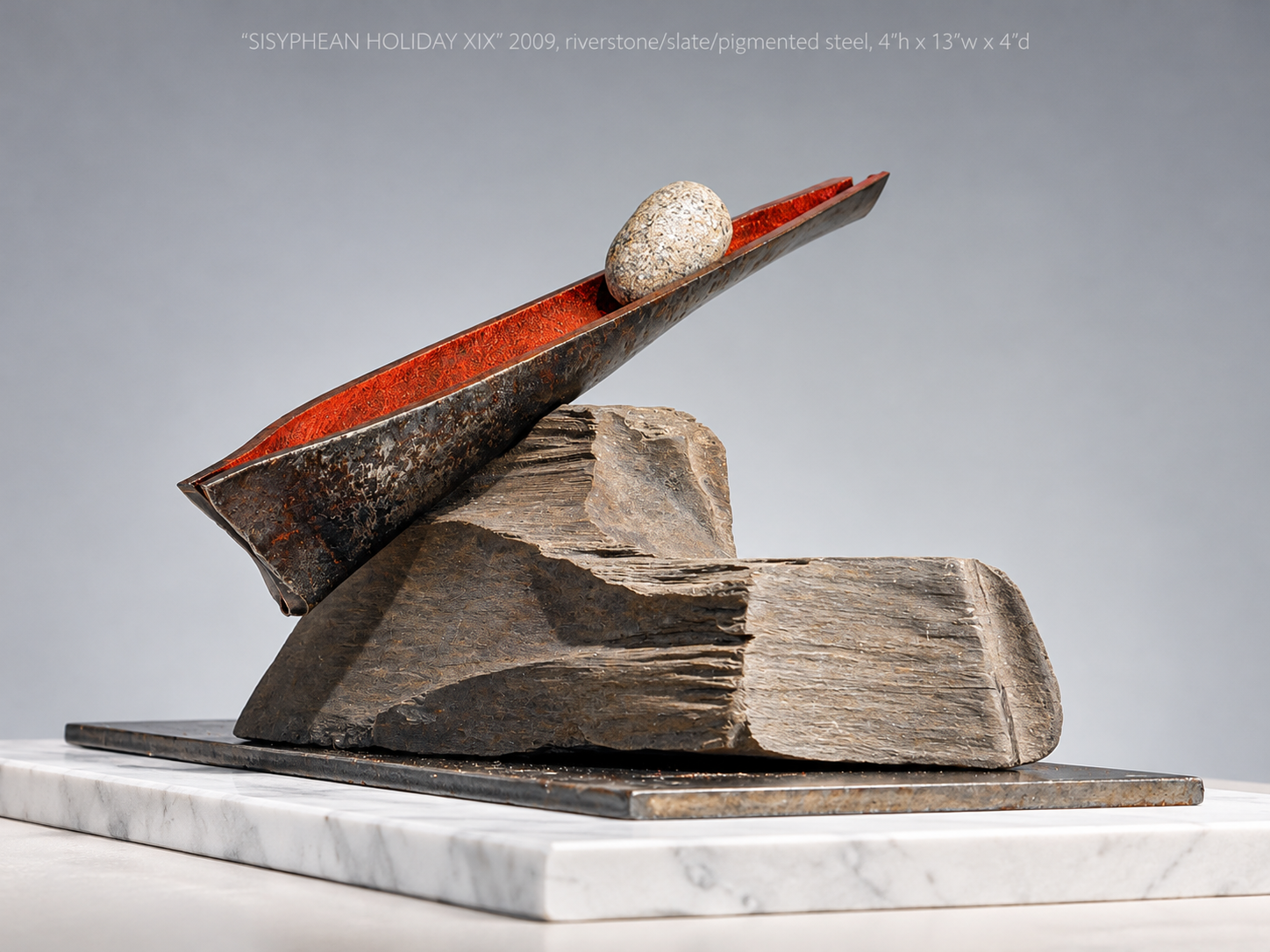
July 2009. River stone, slate, pigmented and sealed steel. Dimensions: 4 x 13 x 4 in (10 x 33 x 10 cm). Private Collection.
The Sisyphean Holiday Series draws on the Greek myth of Sisyphus, condemned to endlessly push a boulder uphill, transforming his struggle into a metaphor for the challenges and absurdities of human existence. Combining natural stone with industrial steel, the sculptures often incorporate vessel-like forms inspired by Adirondack guideboats and canoes, offering Sisyphus’s stone a symbolic ride rather than another uphill climb. The title Holiday introduces playful irony—a momentary reprieve from endless labor—while the precarious balance and implied movement suggest perseverance, uncertainty, and the importance of the journey rather than simply reaching a destination.
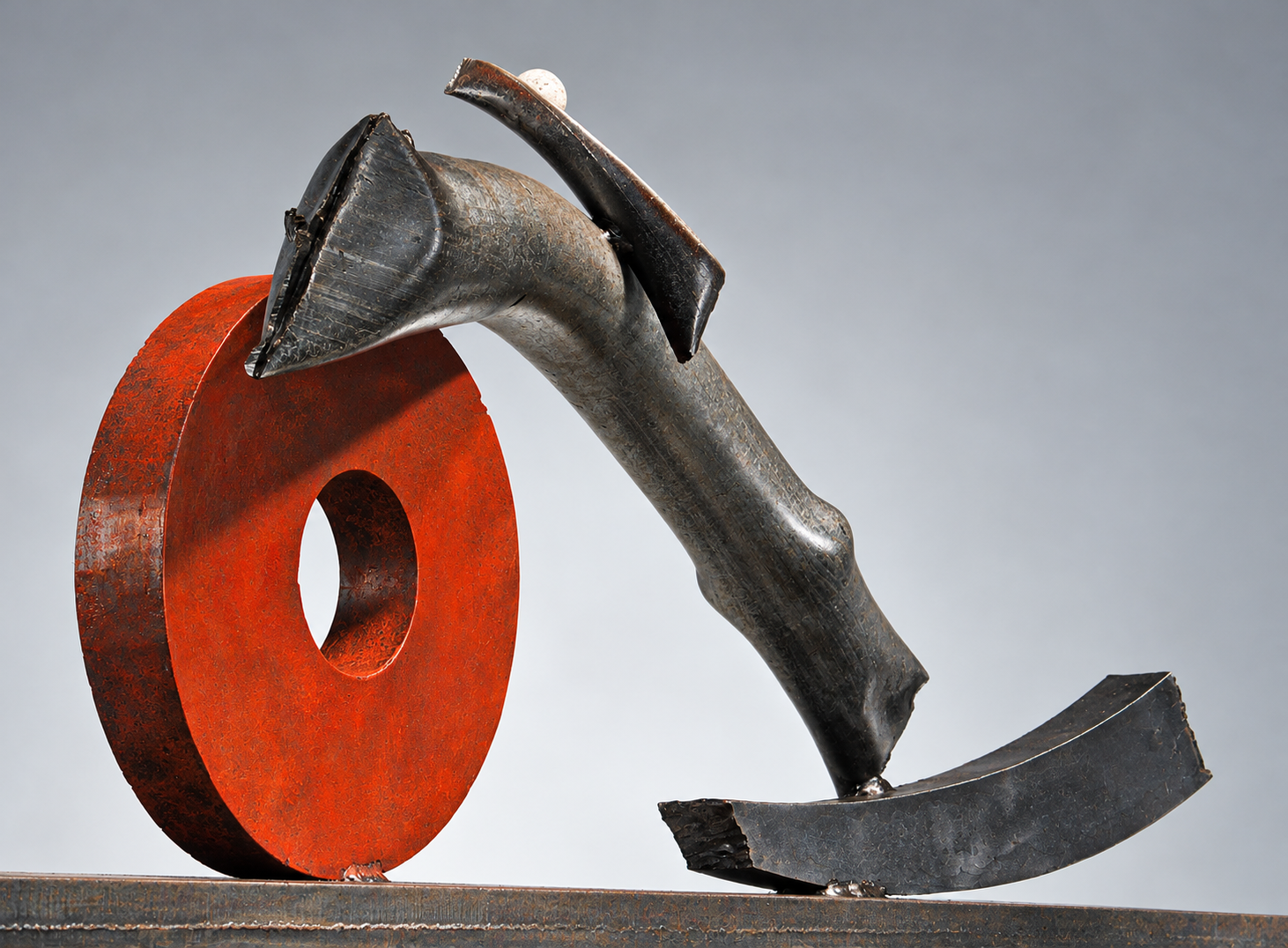
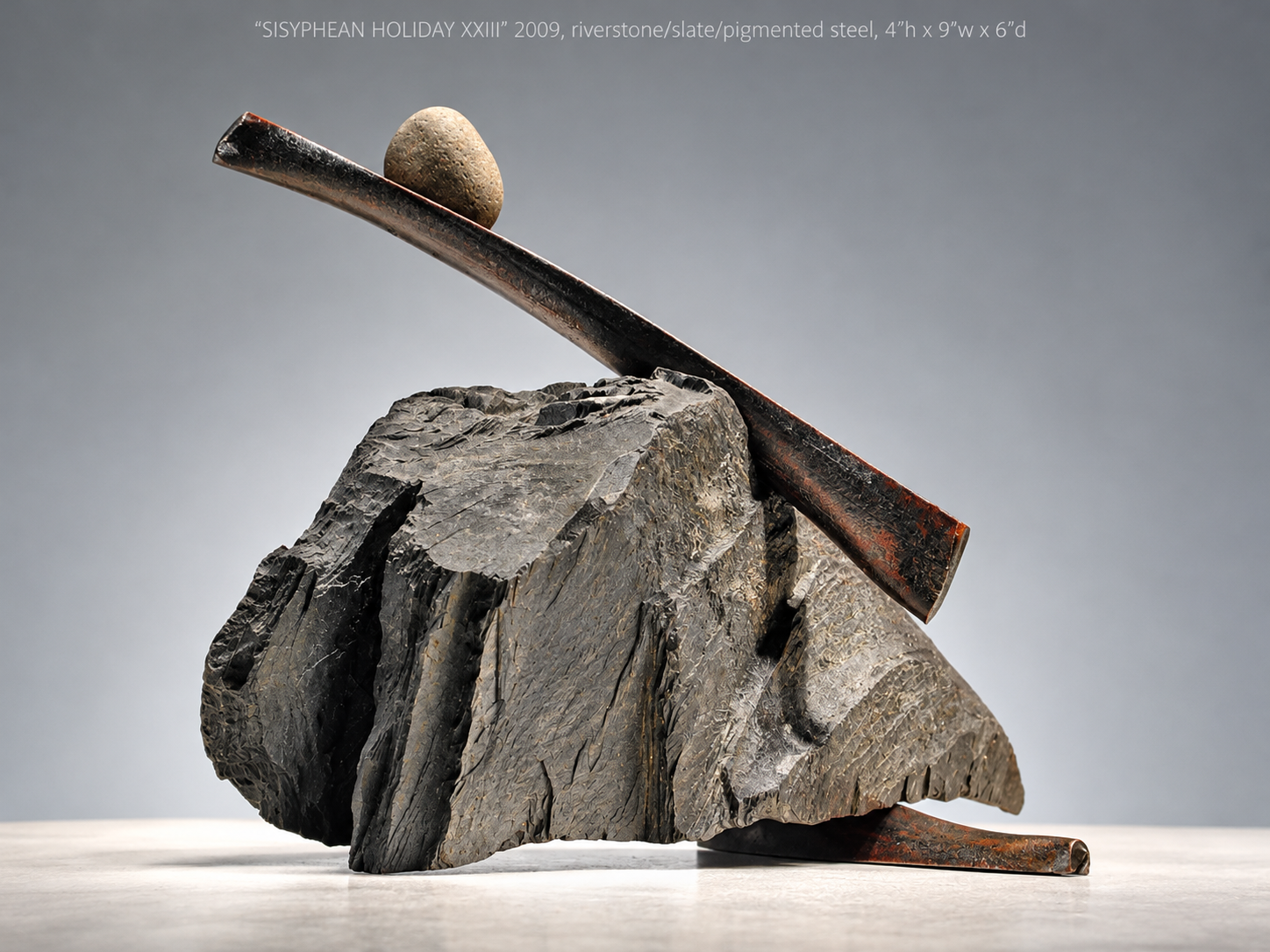
July 2009. River stone, slate, pigmented and sealed steel. Dimensions: 7 x 18 x 6 in (18 x 46 x 15 cm). Private Collection.
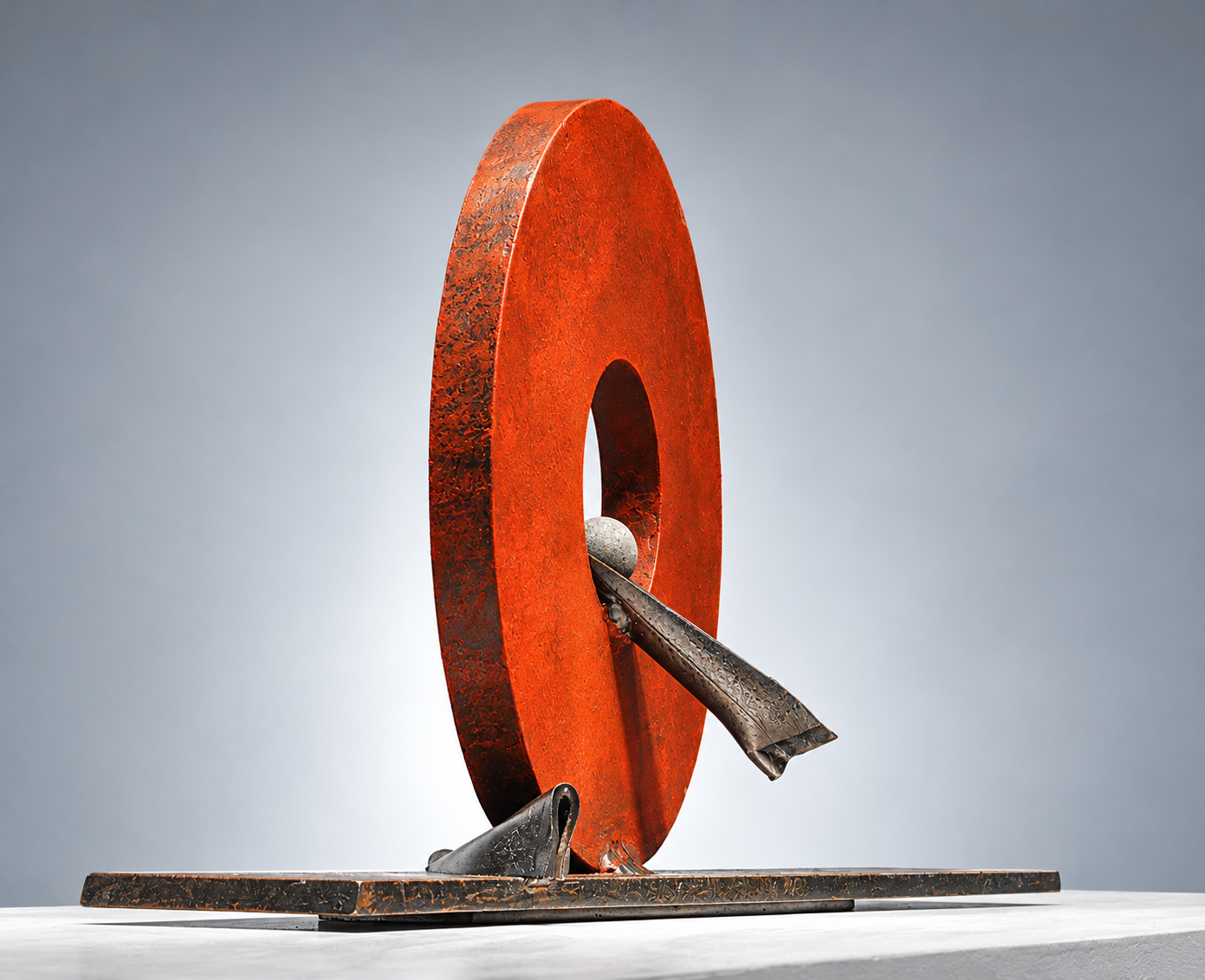
August 2009. River stone, pigmented and sealed steel. Dimensions: 11 × 19.5 × 5.5 in (28 × 50 × 14 cm). Private Collection.
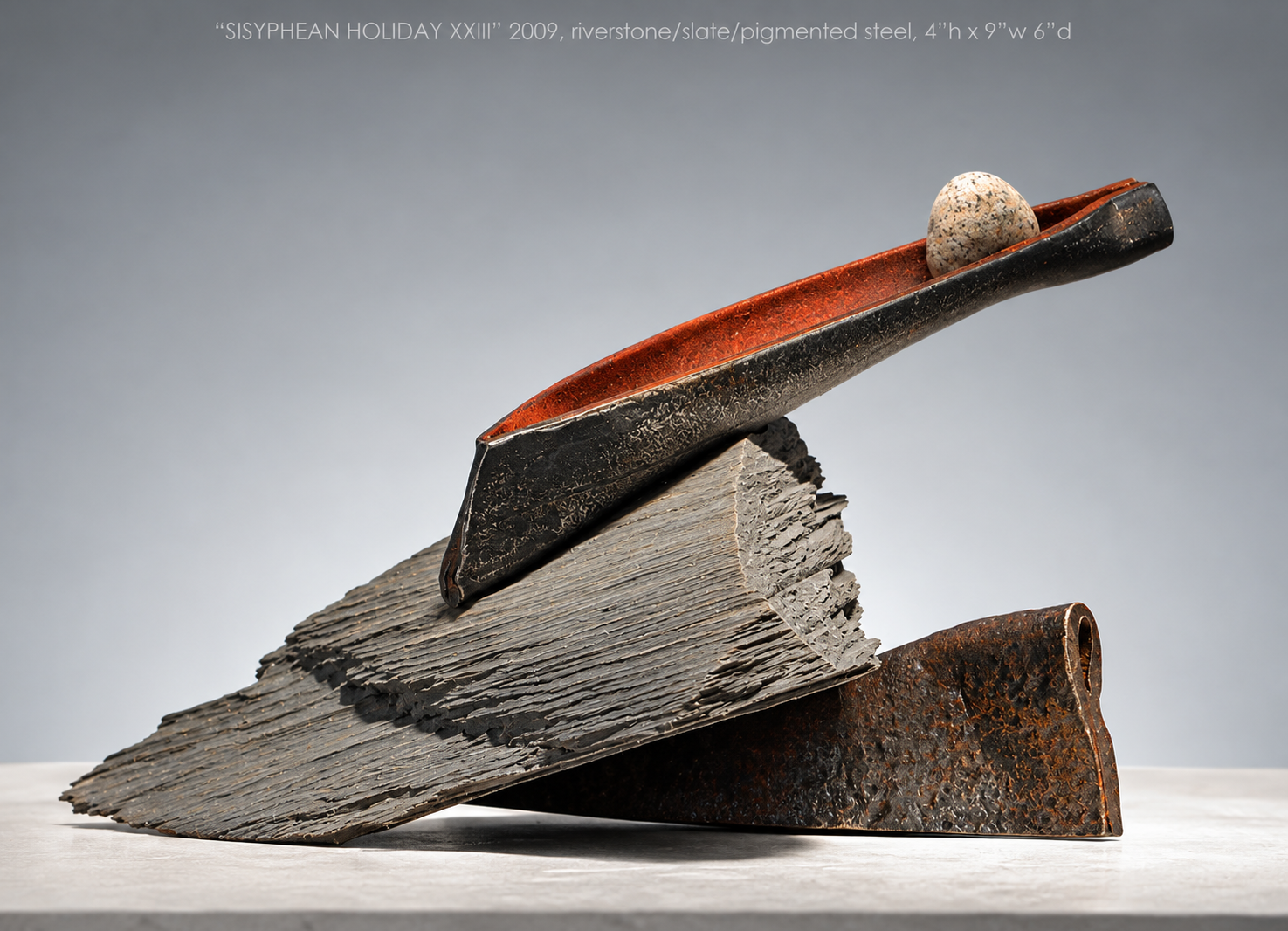
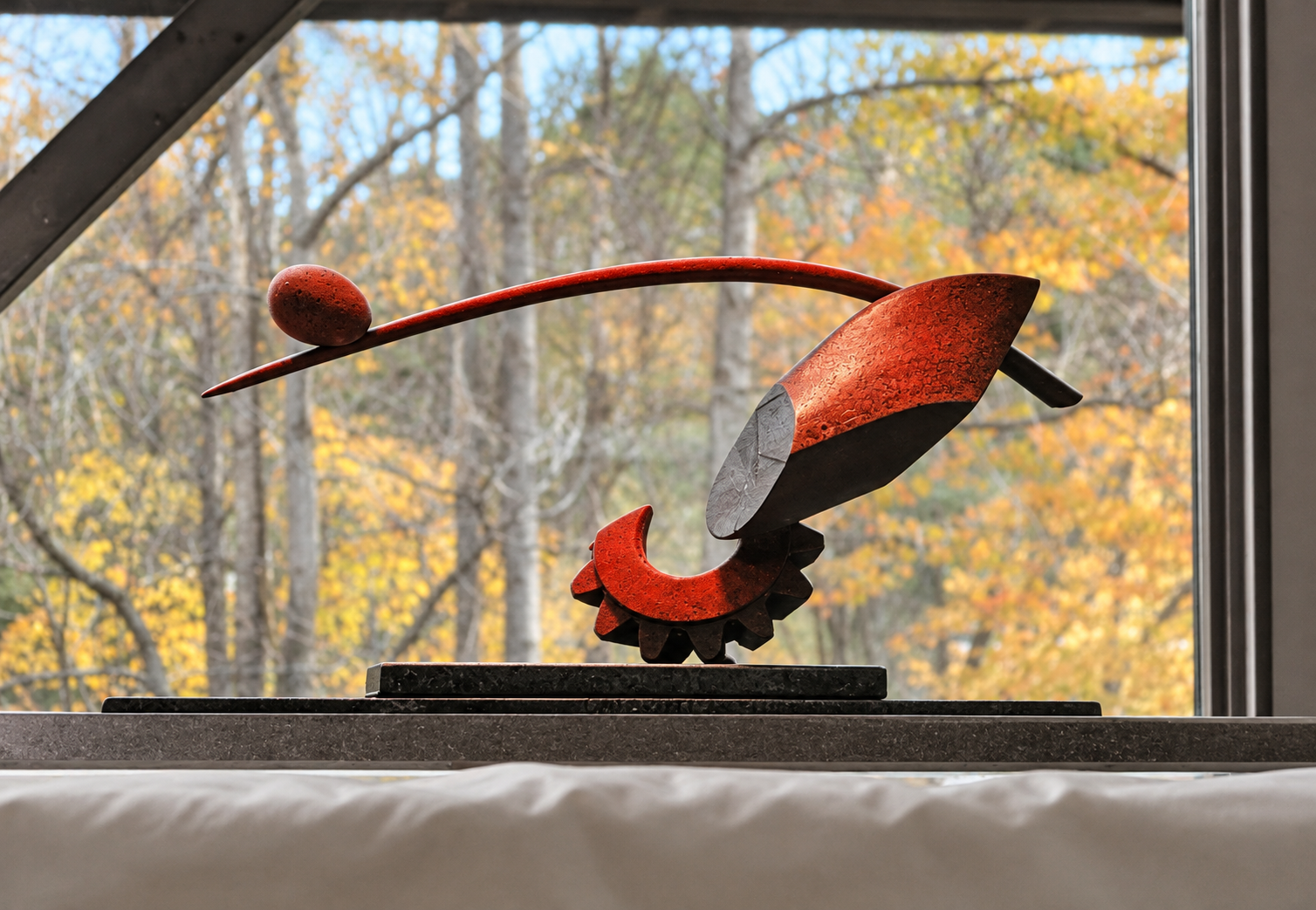
August 2009. River stone, pigmented steel. Dimensions: 6.5 × 13.5 × 4 in (17 × 34 × 10 cm). Private Collection.
Catalulta XII reflects my ongoing interest in tools and tool-like forms as expressive metaphors. Removed from their practical function, these familiar forms suggest human ingenuity, effort, and our impulse to act upon and transform the physical world.
The sculpture also projects a sense of kinetic energy. Through the tension of weight, balance, and leverage, the forms appear poised for movement—as if something might pivot, swing, or release. Though physically static, Catalulta XII holds a sense of potential action and suspended energy.
John Van Alstine
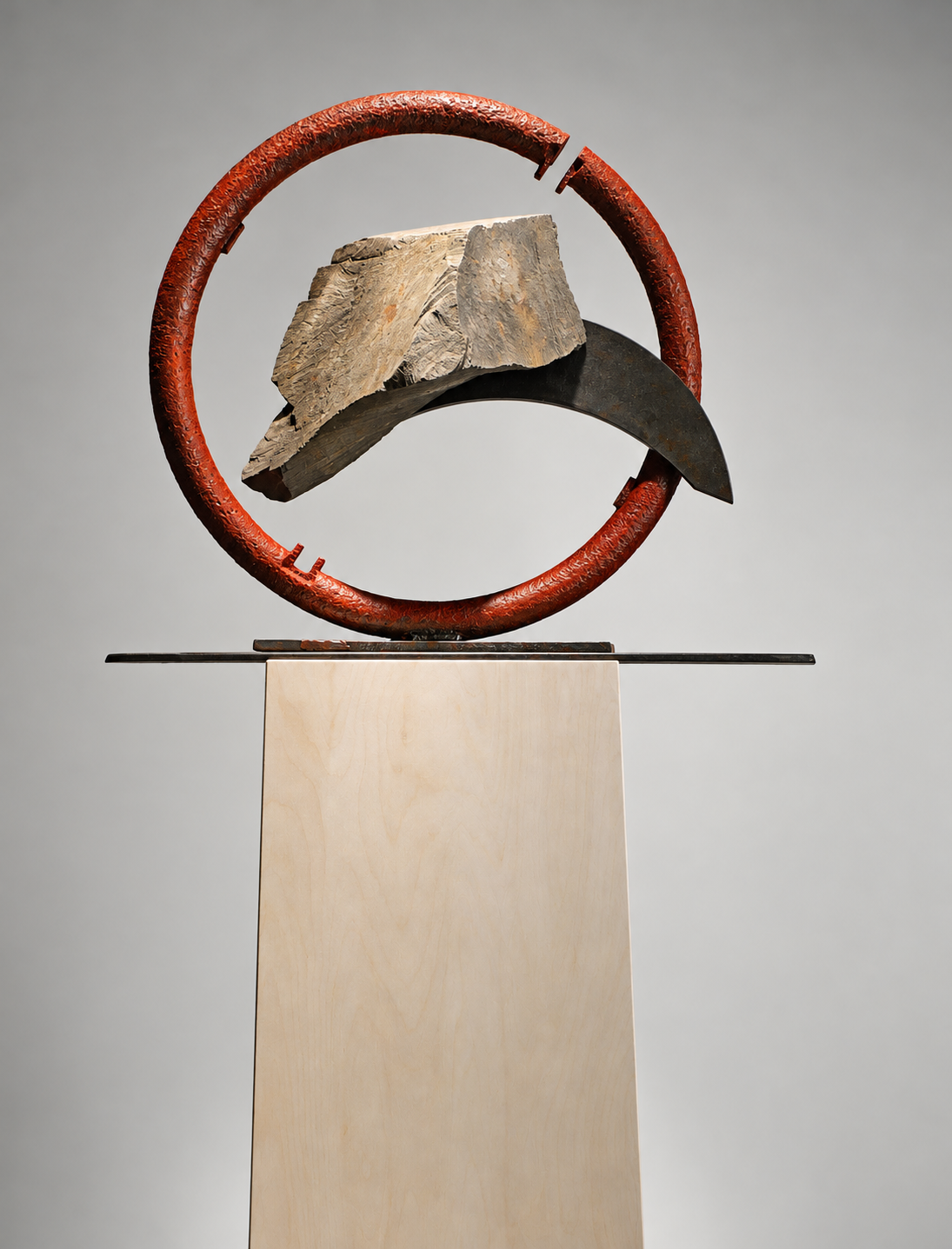
September 2009. Slate, pigmented and sealed steel. Dimensions: 26 x 32 x 7 in (66 x 81 x 18 cm). Private Collection.
The Sisyphean Series
The Greek myth of Sisyphus, condemned to endlessly push a boulder uphill, has inspired more than 250 of my sculptures. Rather than seeing the myth as a symbol of futility, I share philosopher Albert Camus’s more positive interpretation—that meaning and fulfillment can be found in the struggle itself. In many ways, I see Sisyphus as autobiographical, reflecting my lifelong pursuit as an artist, confronting challenges, taking risks, and finding purpose in the act of creation.
My Sisyphean works bring stone and steel together in precarious yet stable arrangements, often incorporating circular forms suggesting perpetual motion. For me, they are metaphors for the creative process—an ongoing cycle of experimentation, discovery, setbacks, and renewal. Each completed sculpture is both an achievement and a starting point, celebrating the journey rather than simply the destination.
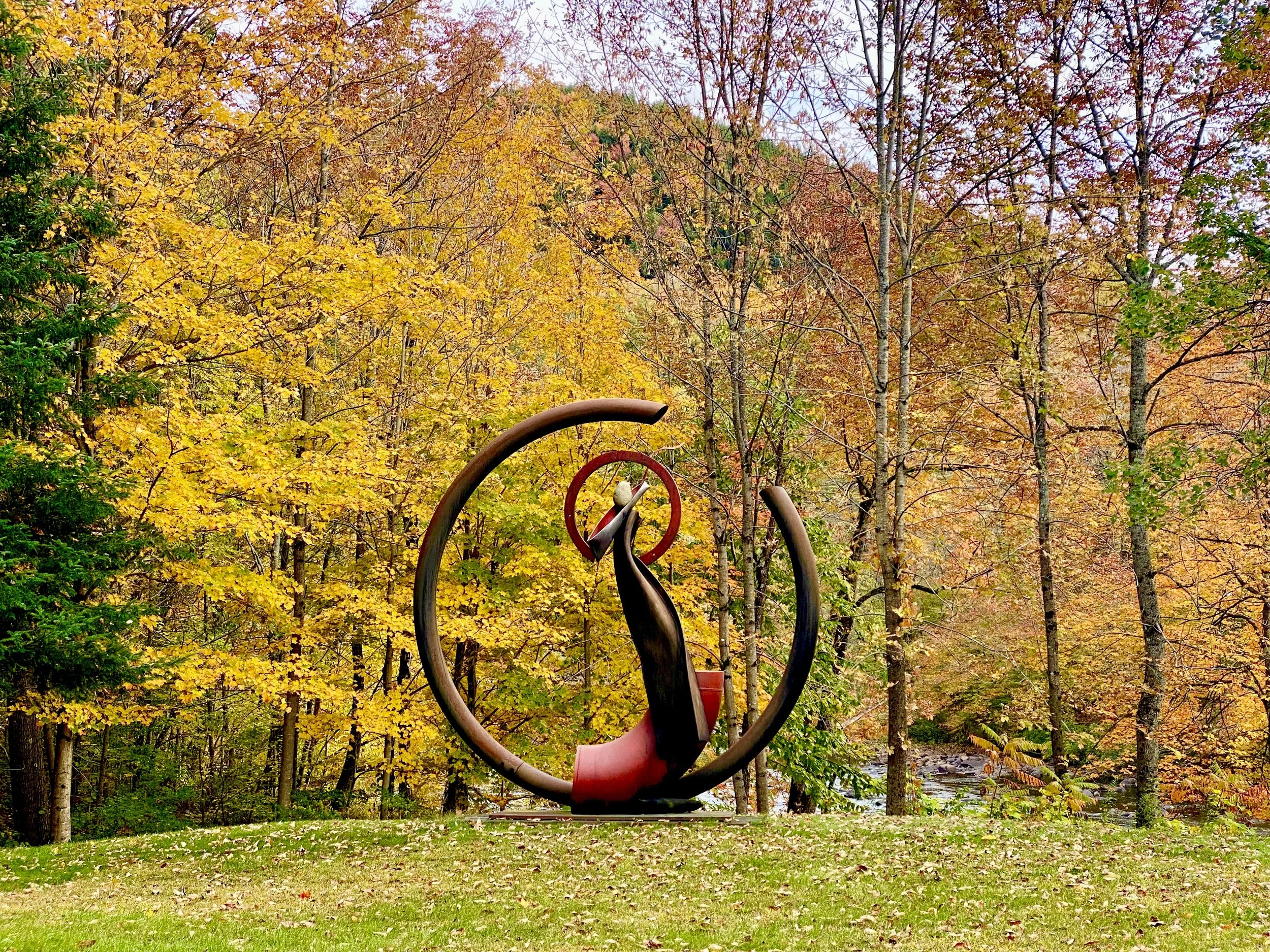
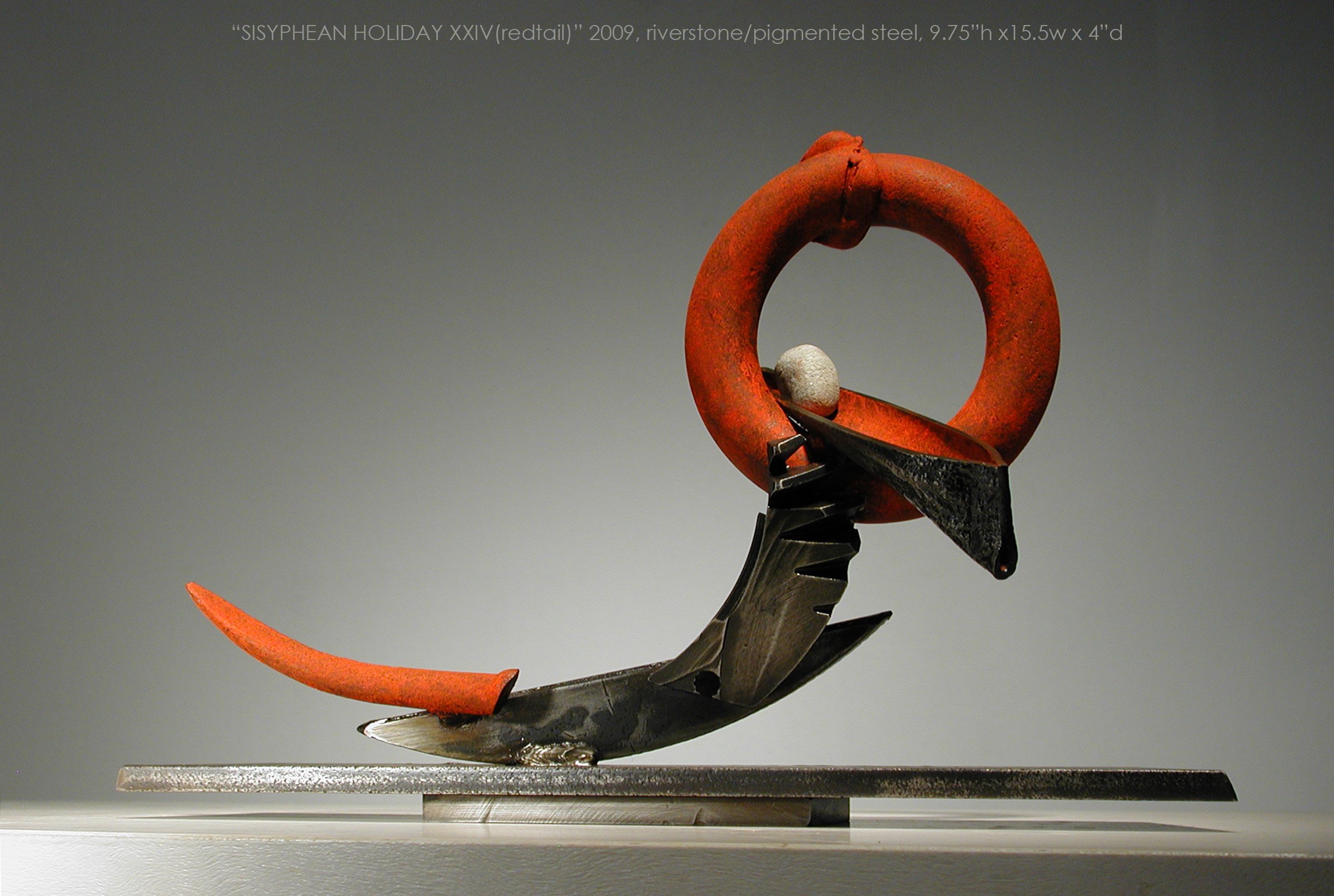
September 2009. River stone, pigmented and sealed steel. Dimensions: 9.75 x 15.5 x 4 in (25 x 39 x 10 cm). Private Collection San Francisco.
After completing more than 150 sculptures in the original Sisyphean Circle series, a new direction emerged—the Sisyphean Holiday series. These works take a lighthearted, tongue-in-cheek approach, suggesting that Sisyphus (and perhaps the artist) might finally deserve a break—a holiday from the endless task.
Here, the familiar “Sisyphean stone” is placed within a vessel form reminiscent of an Adirondack guideboat or canoe. The shift offers a playful twist, transforming the symbol of perpetual struggle into one of pause, reflection, and perhaps even leisure.
—John Van Alstine
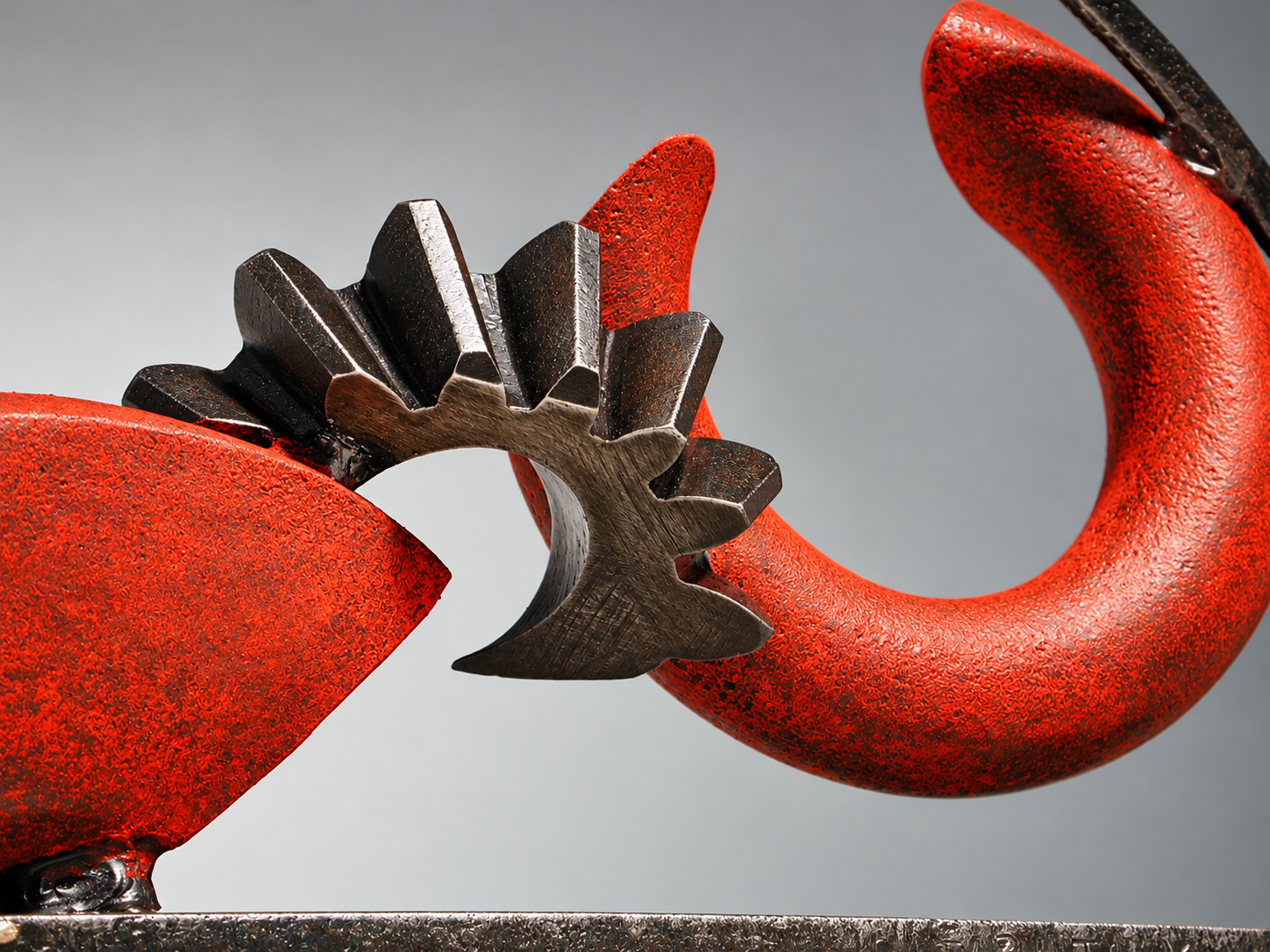
September 2009. River stone, pigmented and sealed steel. Dimensions: 9 × 15.5 × 4 in (23 × 39 × 10 cm).
The title derives from the English word catapult, meaning “to launch forward.” The sculpture’s arrangement of stone and steel conveys a sense of arrested motion—energy captured and poised for release—a dynamic tension that has been a central focus of Van Alstine’s work throughout his career.
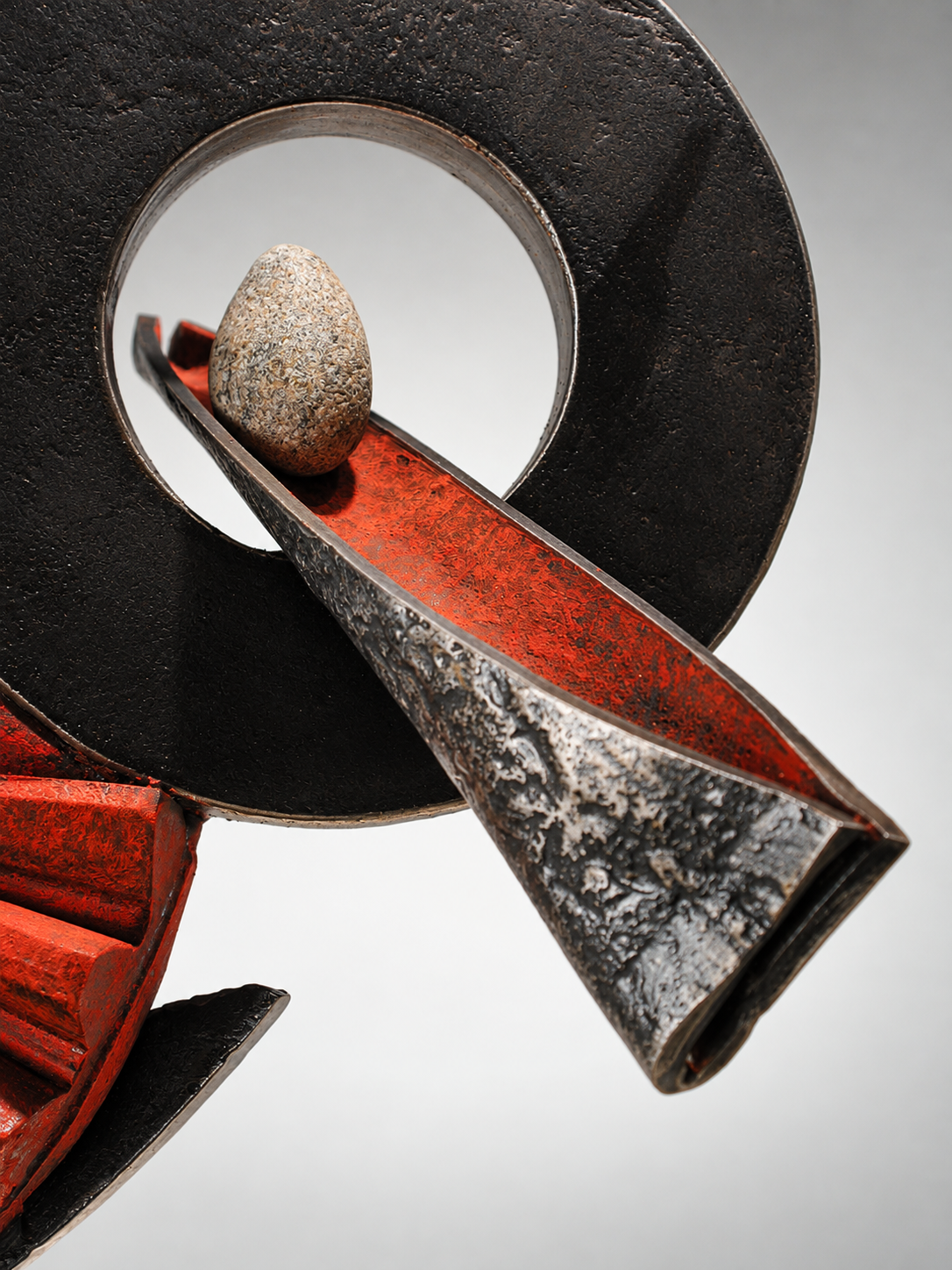
October 2009. River stone, pigmented and sealed steel. Dimensions: 9 × 16.5 × 6 in (23 × 42 × 15 cm). Private Collection.
Sisyphean Holiday Series
After completing more than 150 sculptures in the original Sisyphean Circle series, a new direction emerged—the Sisyphean Holiday series. These works are presented in a lighthearted, tongue-in-cheek spirit, suggesting that Sisyphus (and the artist) might finally deserve a break—a kind of holiday from the endless task.
In these sculptures, the familiar “Sisyphean stone” is placed within a vessel form reminiscent of an Adirondack guideboat or canoe. The shift introduces a playful twist, transforming the symbol of perpetual struggle into one of pause, reflection, and perhaps even leisure.
—John Van Alstine
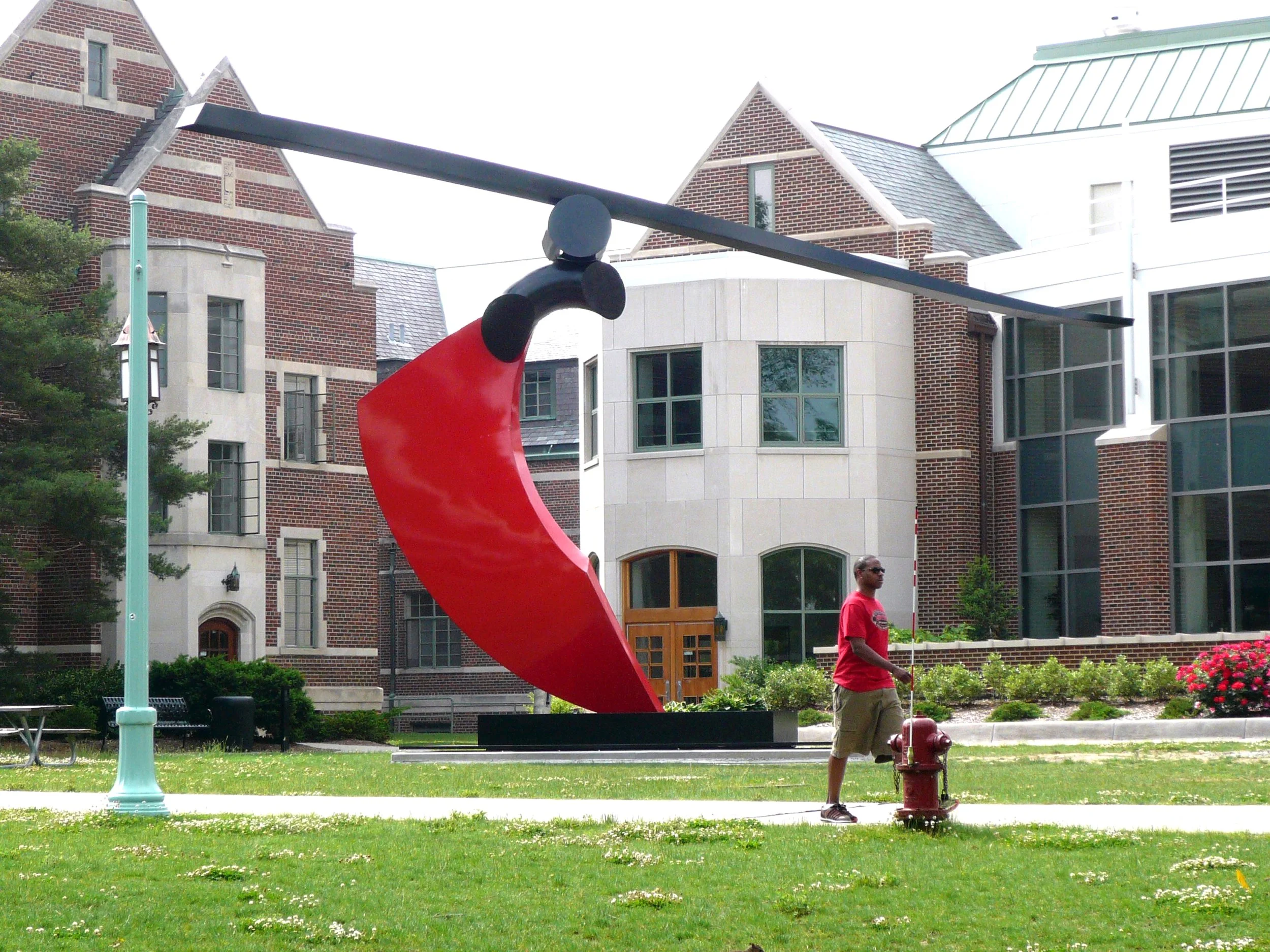
April 2009. Painted steel. Dimensions: 27 × 35 × 17 ft.
Funambulist, 2010
Funambulist was commissioned for Michigan State University in East Lansing and installed at Snyder–Phillips Hall in 2010. Rising approximately thirty feet, the painted-steel sculpture takes its title from the Latin funis, rope, and ambulare, to walk—a funambulist being a tightrope walker. The sweeping red form and long horizontal “balancing baton” suggest a figure poised in space, transforming the mass and weight of steel into an image of balance, movement, and physical agility. JOHN VAN ALSTINE SCULPTURE
The work extends my longstanding interest in the movement of the human body—particularly in dance, gymnastics, skating, and other activities requiring balance and control. Here physical equilibrium also becomes a metaphor for mental agility: the constant adjustments required to negotiate uncertainty and move forward. Situated within the daily activity of the campus, Funambulist connects this precarious but confident balancing act to the challenges, risks, and aspirations of student life. Spartan Stories
2008
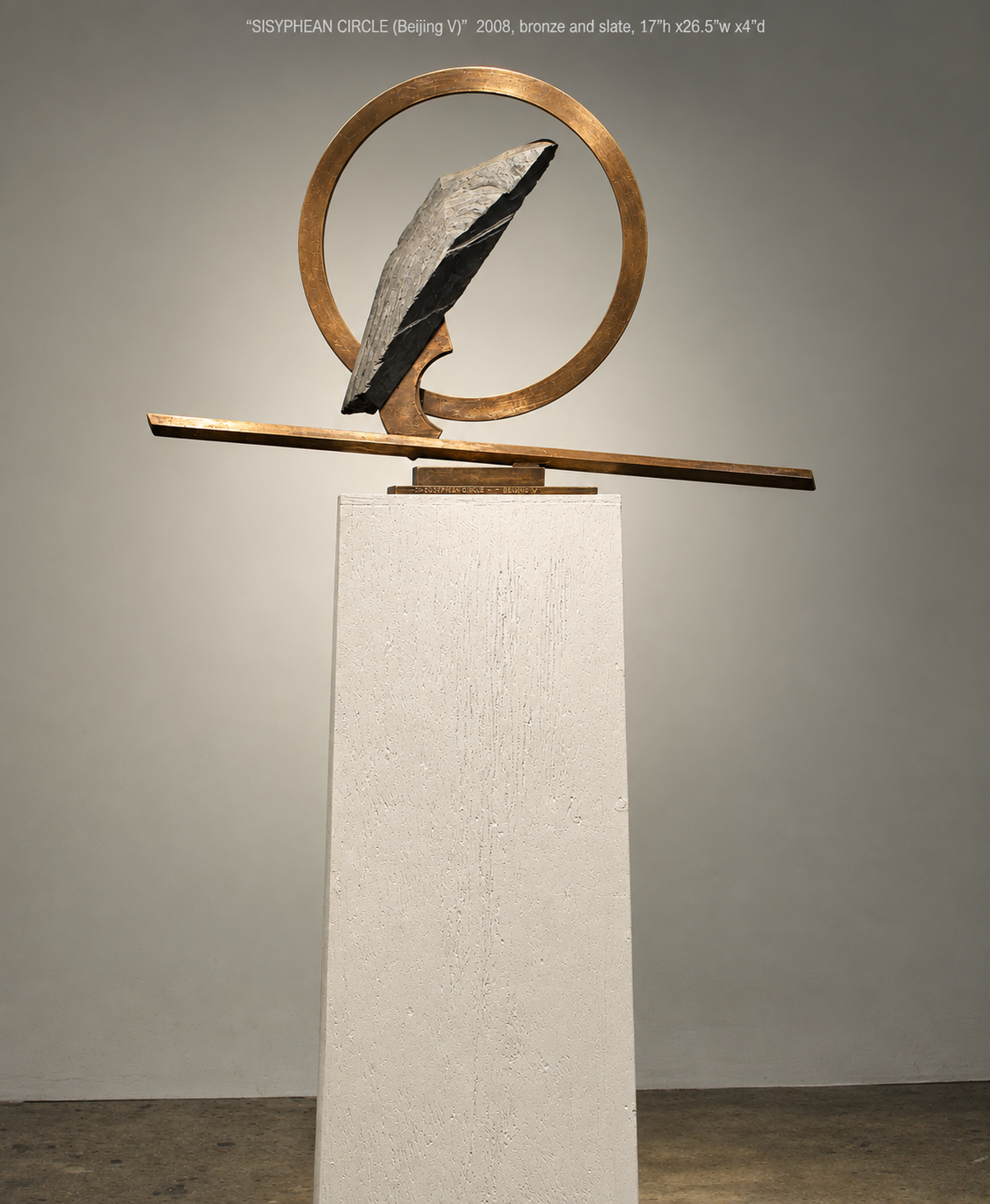
January 2008. Slate and bronze. Dimensions: 17 × 26.5 × 4 in (43 × 67 × 10 cm). Private Collection.
The Sisyphean Series
The Greek myth of Sisyphus, condemned to endlessly push a boulder uphill, has inspired more than 250 of my sculptures. Rather than seeing the myth as a symbol of futility, I share philosopher Albert Camus’s more positive interpretation—that meaning and fulfillment can be found in the struggle itself. In many ways, I see Sisyphus as autobiographical, reflecting my lifelong pursuit as an artist, confronting challenges, taking risks, and finding purpose in the act of creation.
My Sisyphean works bring stone and steel together in precarious yet stable arrangements, often incorporating circular forms suggesting perpetual motion. For me, they are metaphors for the creative process—an ongoing cycle of experimentation, discovery, setbacks, and renewal. Each completed sculpture is both an achievement and a starting point, celebrating the journey rather than simply the destination.
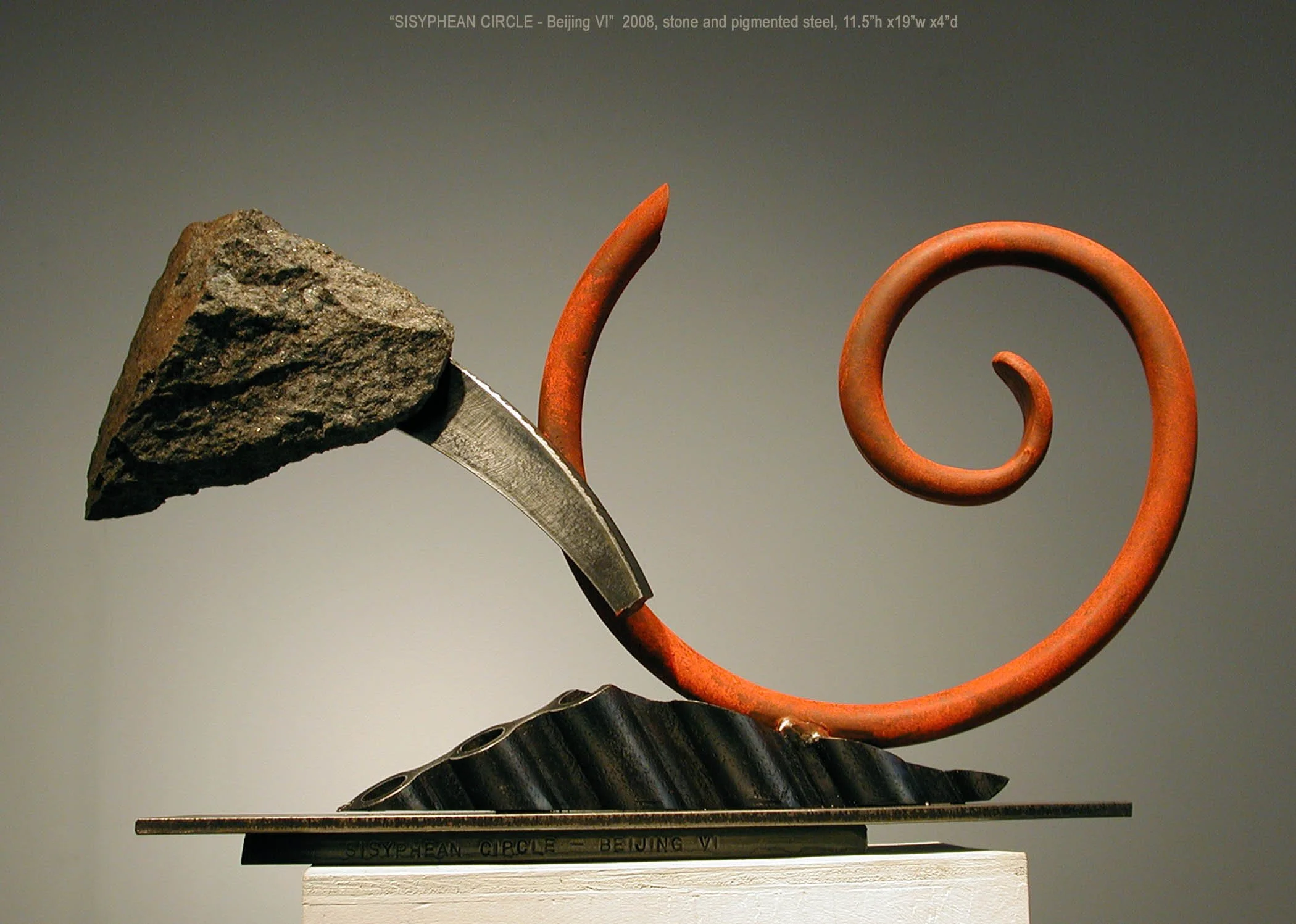
January 2008. Granite, pigmented and sealed steel. Dimensions: 11.5 × 19 × 4 in (29 × 48 × 10 cm). Private Collection.
The Sisyphean Series
The Greek myth of Sisyphus, condemned to endlessly push a boulder uphill, has inspired more than 250 of my sculptures. Rather than seeing the myth as a symbol of futility, I share philosopher Albert Camus’s more positive interpretation—that meaning and fulfillment can be found in the struggle itself. In many ways, I see Sisyphus as autobiographical, reflecting my lifelong pursuit as an artist, confronting challenges, taking risks, and finding purpose in the act of creation.
My Sisyphean works bring stone and steel together in precarious yet stable arrangements, often incorporating circular forms suggesting perpetual motion. For me, they are metaphors for the creative process—an ongoing cycle of experimentation, discovery, setbacks, and renewal. Each completed sculpture is both an achievement and a starting point, celebrating the journey rather than simply the destination.
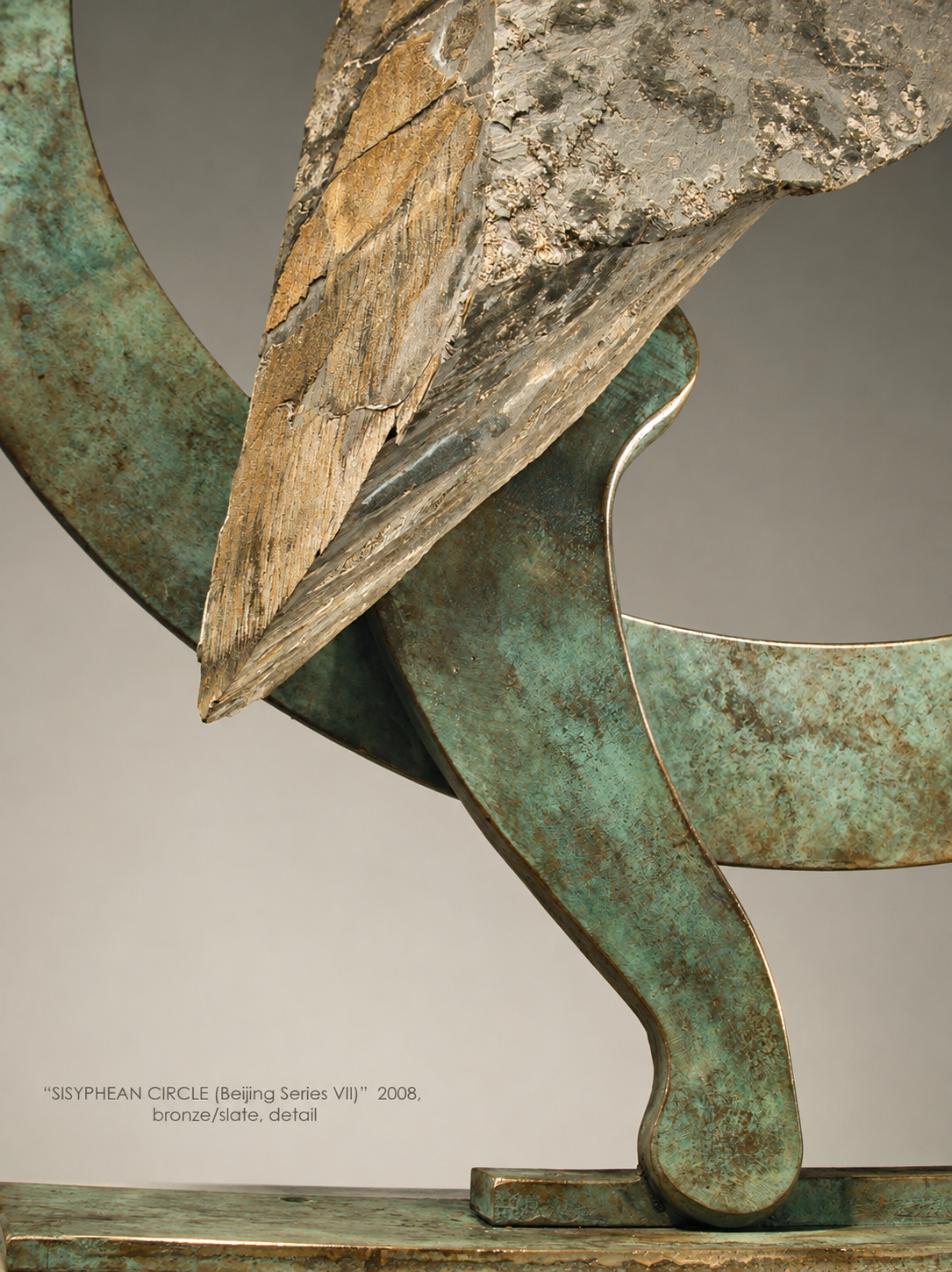
March 2008. Bronze and slate. Dimensions: 42 × 36 × 8 in (107 × 91 × 20 cm). Private Collection. Washington, DC.
The Sisyphean Series
The Greek myth of Sisyphus, condemned to endlessly push a boulder uphill, has inspired more than 250 of my sculptures. Rather than seeing the myth as a symbol of futility, I share philosopher Albert Camus’s more positive interpretation—that meaning and fulfillment can be found in the struggle itself. In many ways, I see Sisyphus as autobiographical, reflecting my lifelong pursuit as an artist, confronting challenges, taking risks, and finding purpose in the act of creation.
My Sisyphean works bring stone and steel together in precarious yet stable arrangements, often incorporating circular forms suggesting perpetual motion. For me, they are metaphors for the creative process—an ongoing cycle of experimentation, discovery, setbacks, and renewal. Each completed sculpture is both an achievement and a starting point, celebrating the journey rather than simply the destination.
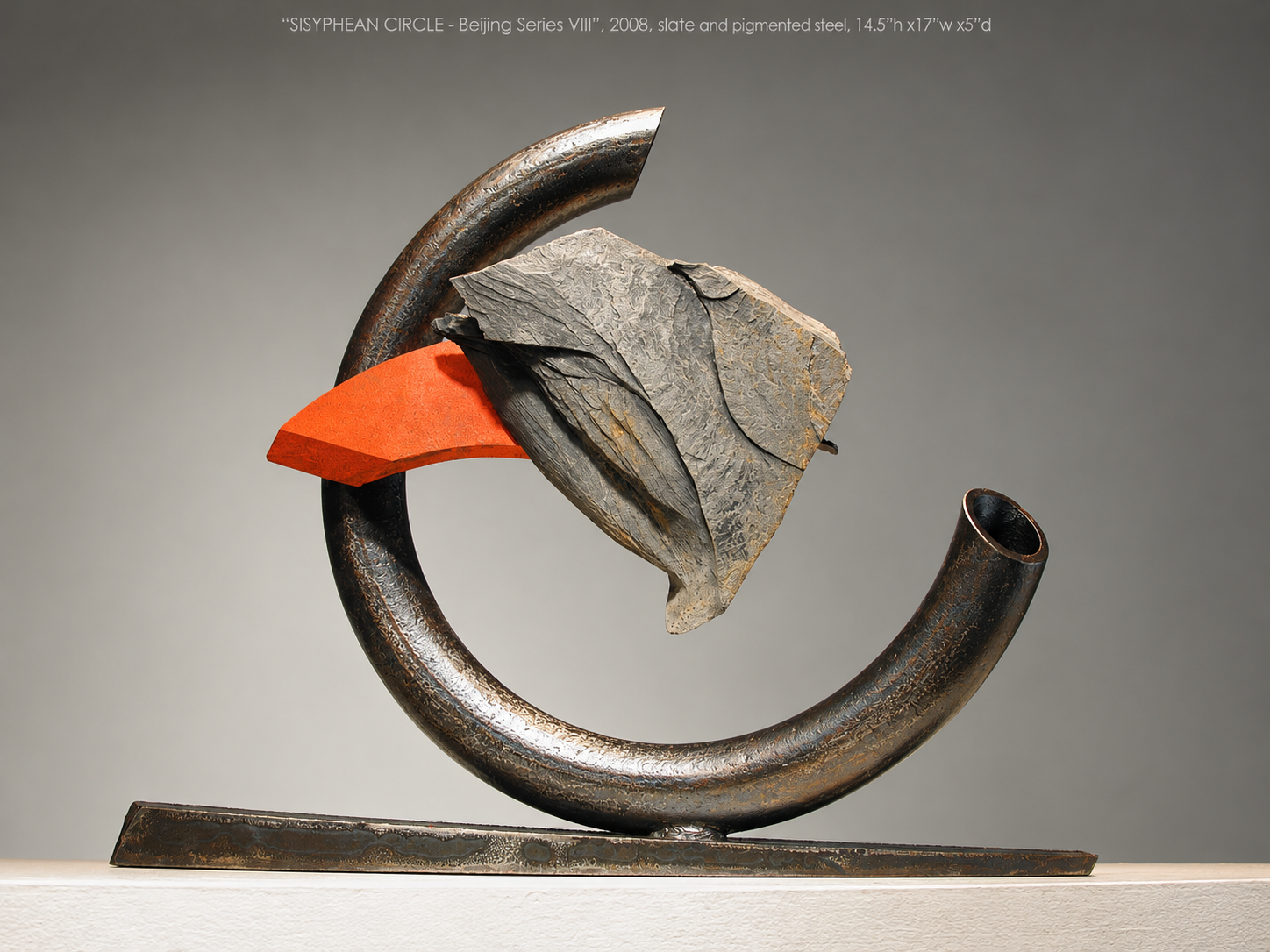
March 2008. Slate, pigmented steel. Dimensions: 14.5 × 17 × 5 in (37 × 43 × 13 cm). Private Collection.
The Sisyphean Series
The Greek myth of Sisyphus, condemned to endlessly push a boulder uphill, has inspired more than 250 of my sculptures. Rather than seeing the myth as a symbol of futility, I share philosopher Albert Camus’s more positive interpretation—that meaning and fulfillment can be found in the struggle itself. In many ways, I see Sisyphus as autobiographical, reflecting my lifelong pursuit as an artist, confronting challenges, taking risks, and finding purpose in the act of creation.
My Sisyphean works bring stone and steel together in precarious yet stable arrangements, often incorporating circular forms suggesting perpetual motion. For me, they are metaphors for the creative process—an ongoing cycle of experimentation, discovery, setbacks, and renewal. Each completed sculpture is both an achievement and a starting point, celebrating the journey rather than simply the destination.
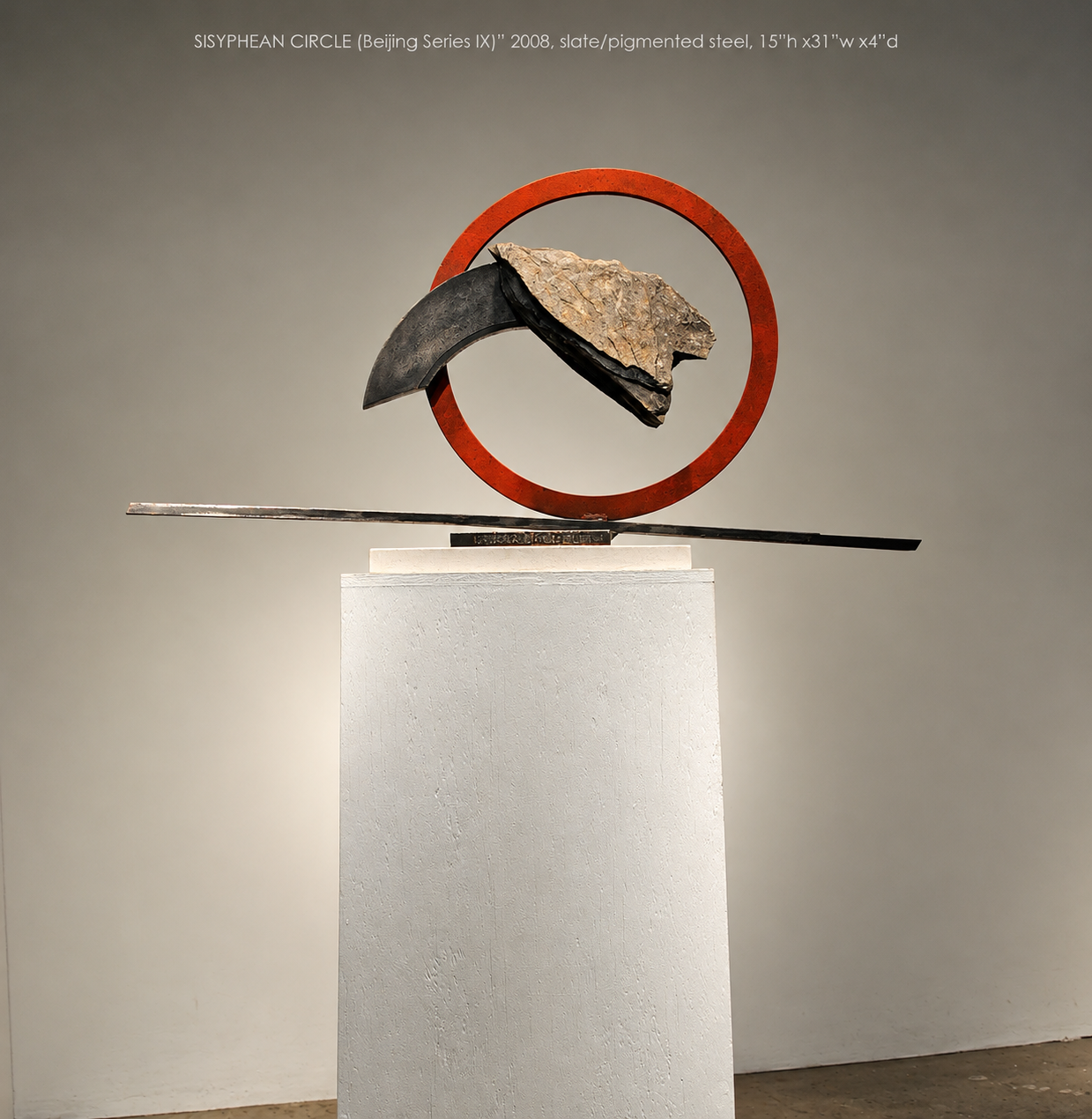
March 2008. Slate, pigmented steel. Dimensions: 15 × 31 × 4 in (38 × 79 × 10 cm). Private Collection Scottsdale, AZ.
The Sisyphean Series
The Greek myth of Sisyphus, condemned to endlessly push a boulder uphill, has inspired more than 250 of my sculptures. Rather than seeing the myth as a symbol of futility, I share philosopher Albert Camus’s more positive interpretation—that meaning and fulfillment can be found in the struggle itself. In many ways, I see Sisyphus as autobiographical, reflecting my lifelong pursuit as an artist, confronting challenges, taking risks, and finding purpose in the act of creation.
My Sisyphean works bring stone and steel together in precarious yet stable arrangements, often incorporating circular forms suggesting perpetual motion. For me, they are metaphors for the creative process—an ongoing cycle of experimentation, discovery, setbacks, and renewal. Each completed sculpture is both an achievement and a starting point, celebrating the journey rather than simply the destination.
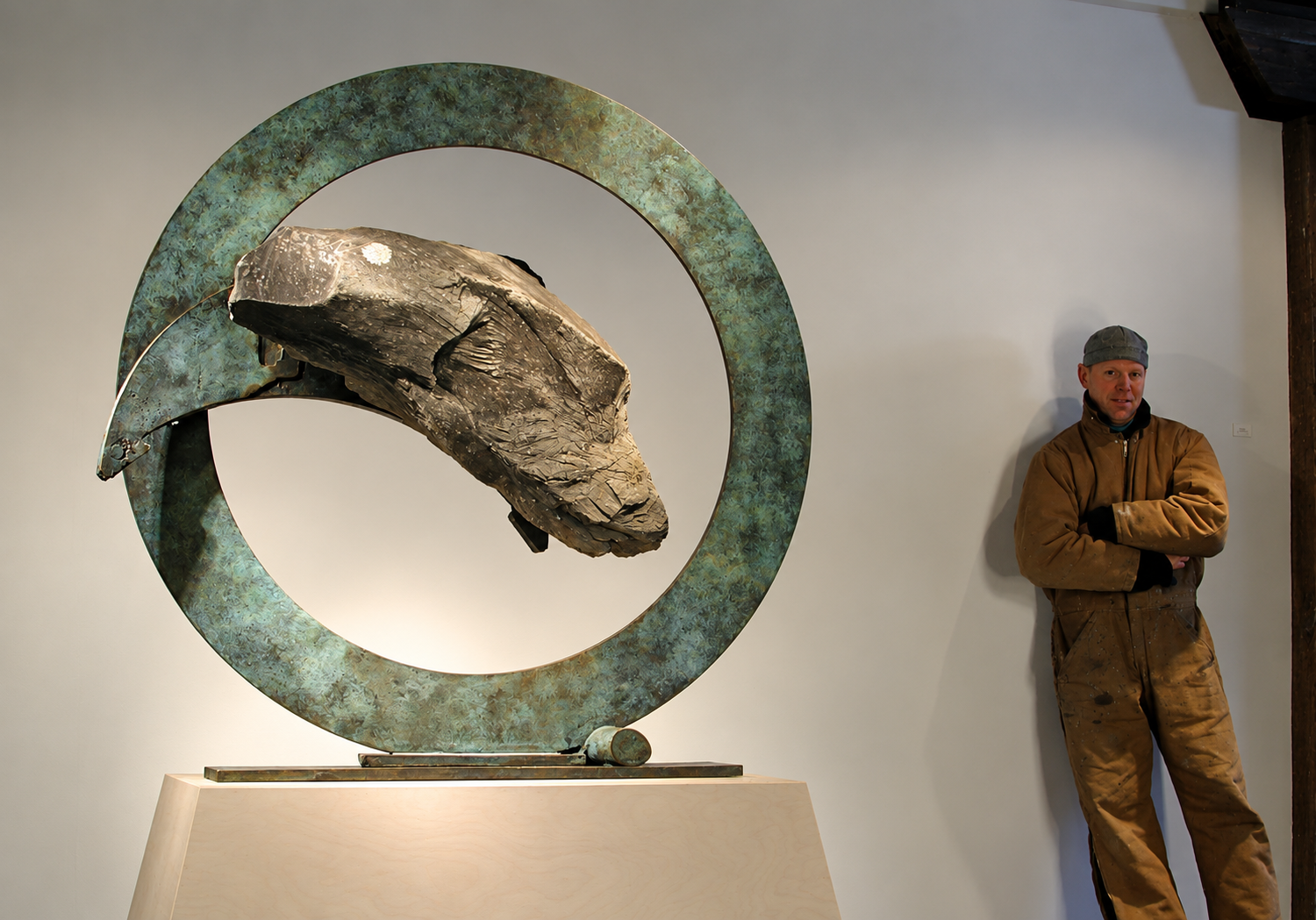
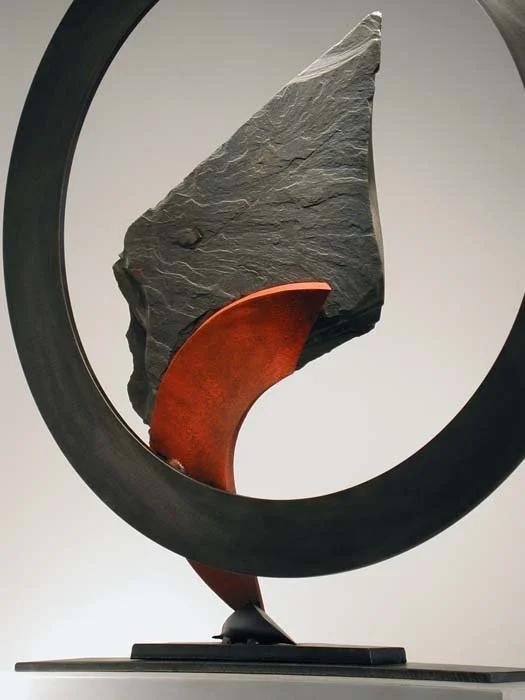
March 2008. Bronze, slate. Dimensions: 49 × 50 × 12 in (124 × 127 × 30 cm). Private Collection - China
The Sisyphean Series
The Greek myth of Sisyphus, condemned to endlessly push a boulder uphill, has inspired more than 250 of my sculptures. Rather than seeing the myth as a symbol of futility, I share philosopher Albert Camus’s more positive interpretation—that meaning and fulfillment can be found in the struggle itself. In many ways, I see Sisyphus as autobiographical, reflecting my lifelong pursuit as an artist, confronting challenges, taking risks, and finding purpose in the act of creation.
My Sisyphean works bring stone and steel together in precarious yet stable arrangements, often incorporating circular forms suggesting perpetual motion. For me, they are metaphors for the creative process—an ongoing cycle of experimentation, discovery, setbacks, and renewal. Each completed sculpture is both an achievement and a starting point, celebrating the journey rather than simply the destination.
SOLD
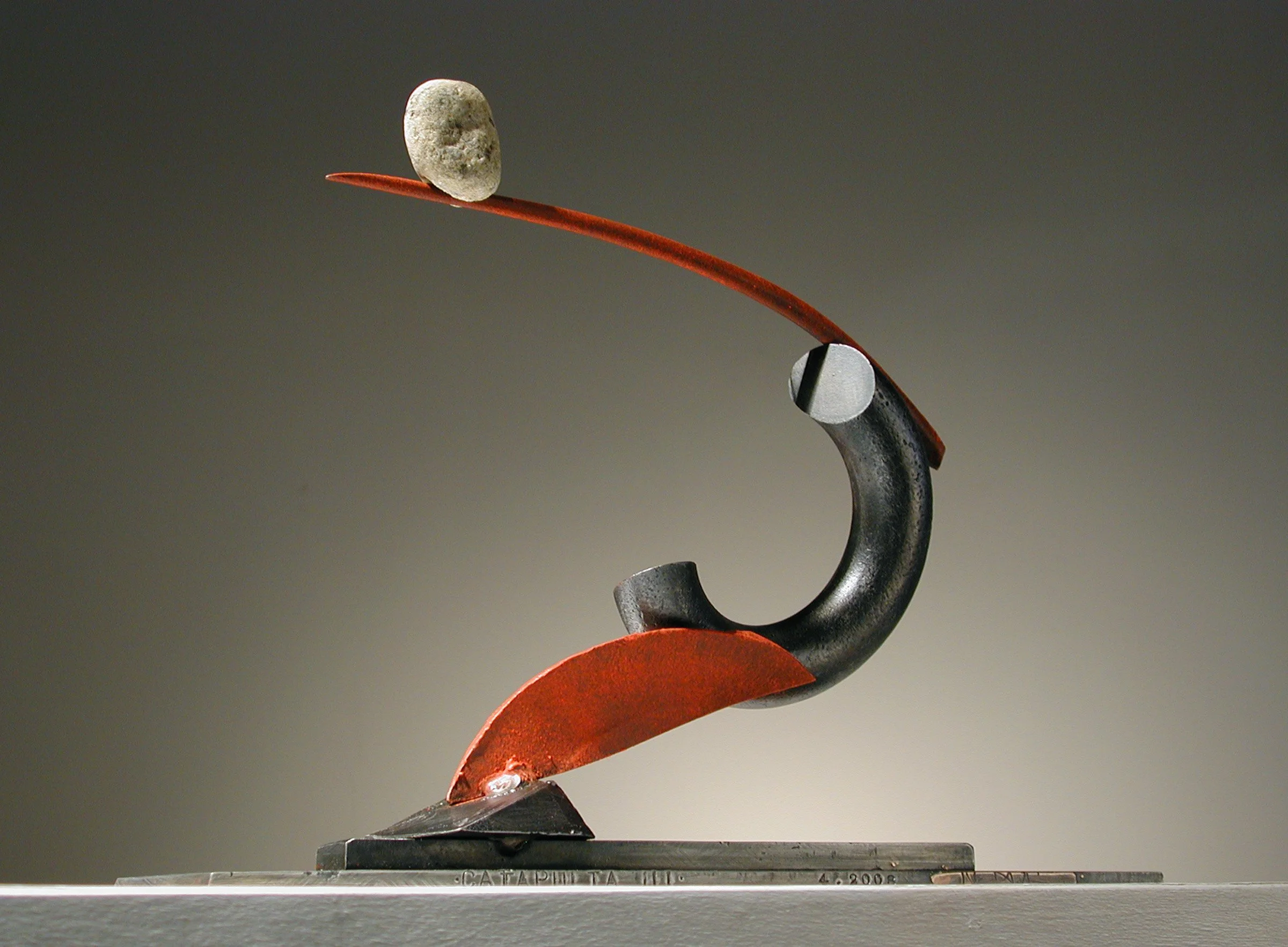
April 2008. River stone, pigmented steel. Dimensions: 10 × 13 × 4 in (25 × 33 × 10 cm). Private Collection.
The Catapulta series reflects my ongoing interest in tools and tool-like forms as expressive metaphors. Removed from their practical function, these familiar forms suggest human ingenuity, effort, and our impulse to act upon and transform the physical world.
These works also projects a sense of kinetic energy. Through the tension of weight, balance, and leverage, the forms appear poised for movement—as if something might pivot, swing, or release. Though physically static, Catalulta XII holds a sense of potential action and suspended energy.
John Van Alstine
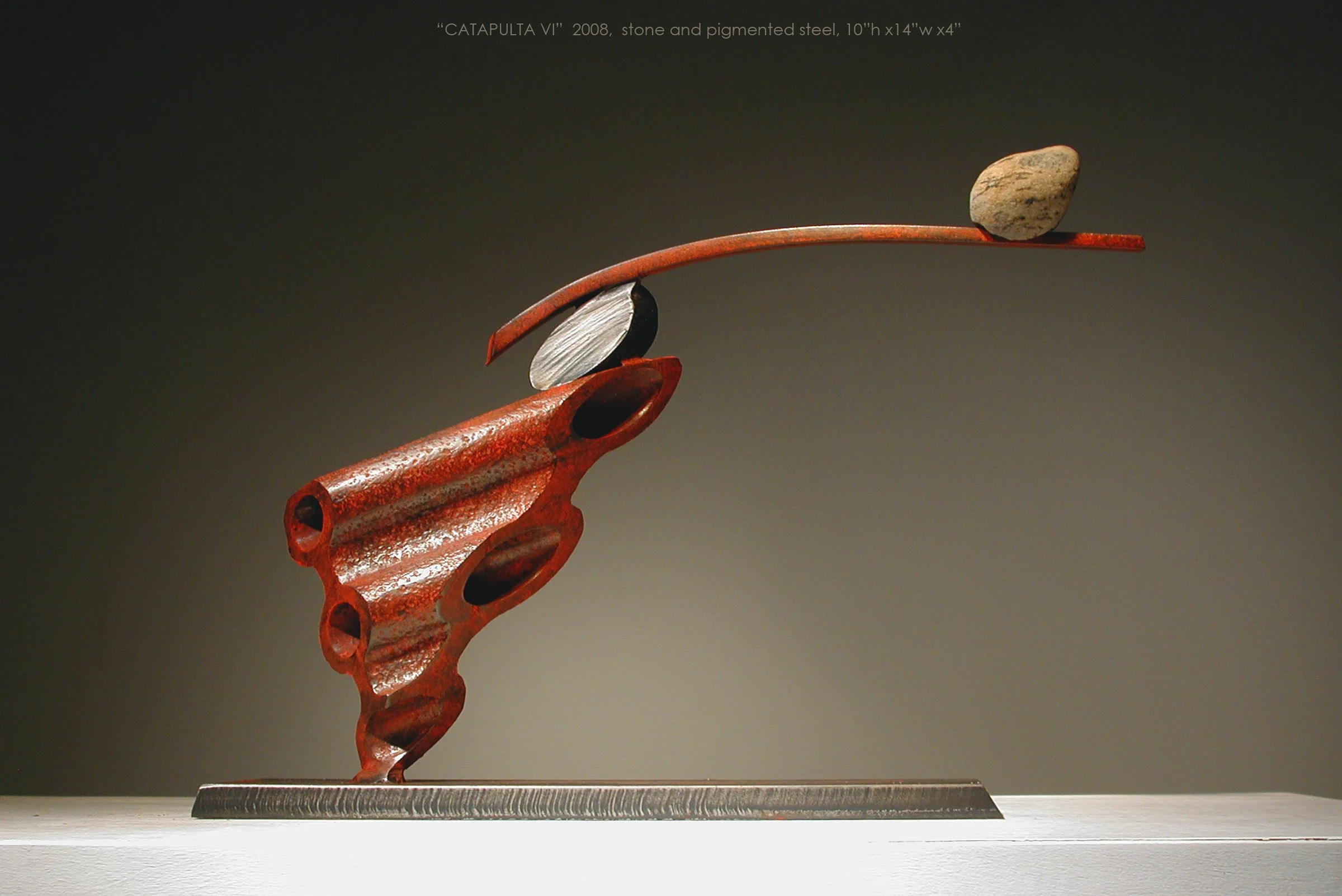
April 2008. River stone, pigmented steel. Dimensions: 10 × 14 × 4 in (25 × 36 × 10 cm). Private Collection - Puerto Rico.
The Catapulta series reflects my ongoing interest in tools and tool-like forms as expressive metaphors. Removed from their practical function, these familiar forms suggest human ingenuity, effort, and our impulse to act upon and transform the physical world.
These works also projects a sense of kinetic energy. Through the tension of weight, balance, and leverage, the forms appear poised for movement—as if something might pivot, swing, or release. Though physically static, Catalulta XII holds a sense of potential action and suspended energy.
John Van Alstine
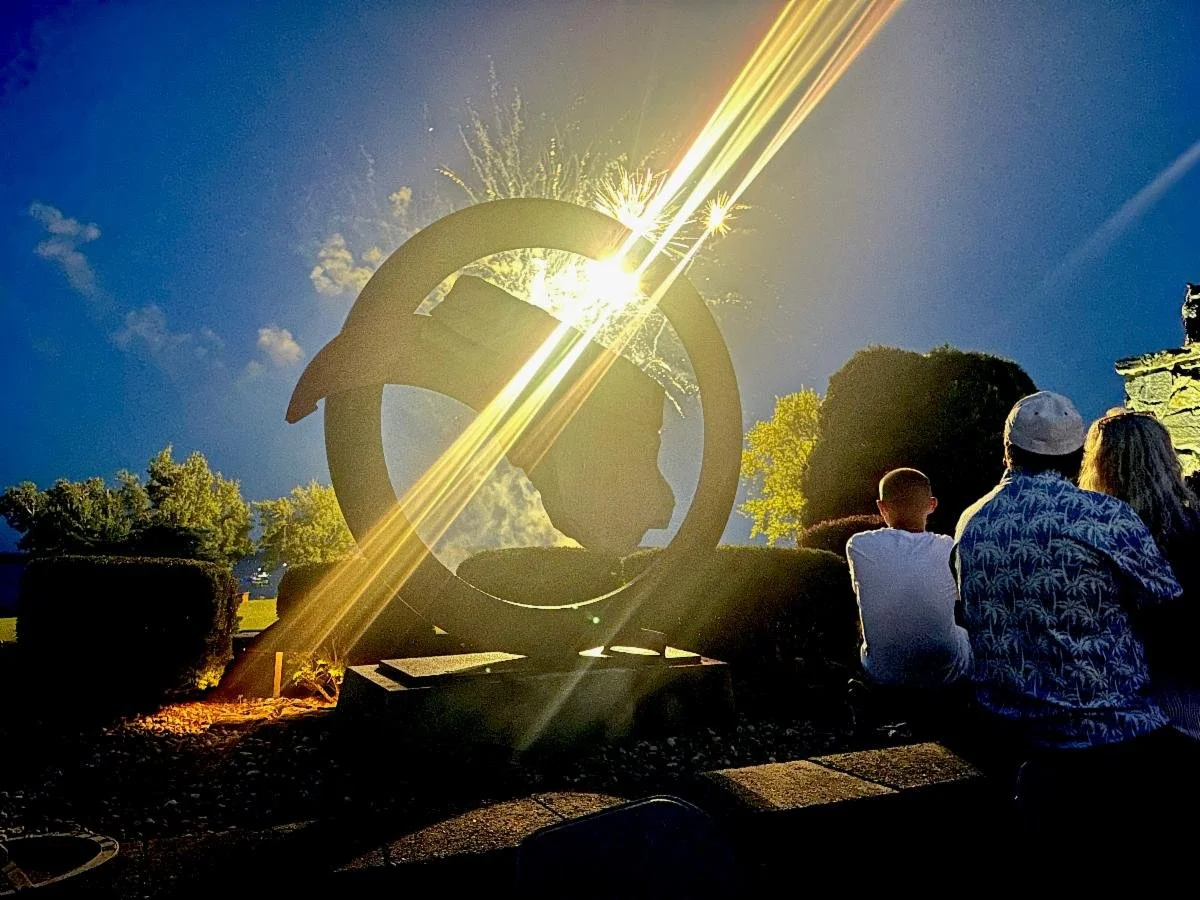
April 2008. Slate, pigmented and sealed steel. Dimensions: 60 × 65 × 14 in (152 × 165 × 36 cm). Private Collection.
The Sisyphean Series
The Greek myth of Sisyphus, condemned to endlessly push a boulder uphill, has inspired more than 250 of my sculptures. Rather than seeing the myth as a symbol of futility, I share philosopher Albert Camus’s more positive interpretation—that meaning and fulfillment can be found in the struggle itself. In many ways, I see Sisyphus as autobiographical, reflecting my lifelong pursuit as an artist, confronting challenges, taking risks, and finding purpose in the act of creation.
My Sisyphean works bring stone and steel together in precarious yet stable arrangements, often incorporating circular forms suggesting perpetual motion. For me, they are metaphors for the creative process—an ongoing cycle of experimentation, discovery, setbacks, and renewal. Each completed sculpture is both an achievement and a starting point, celebrating the journey rather than simply the destination.
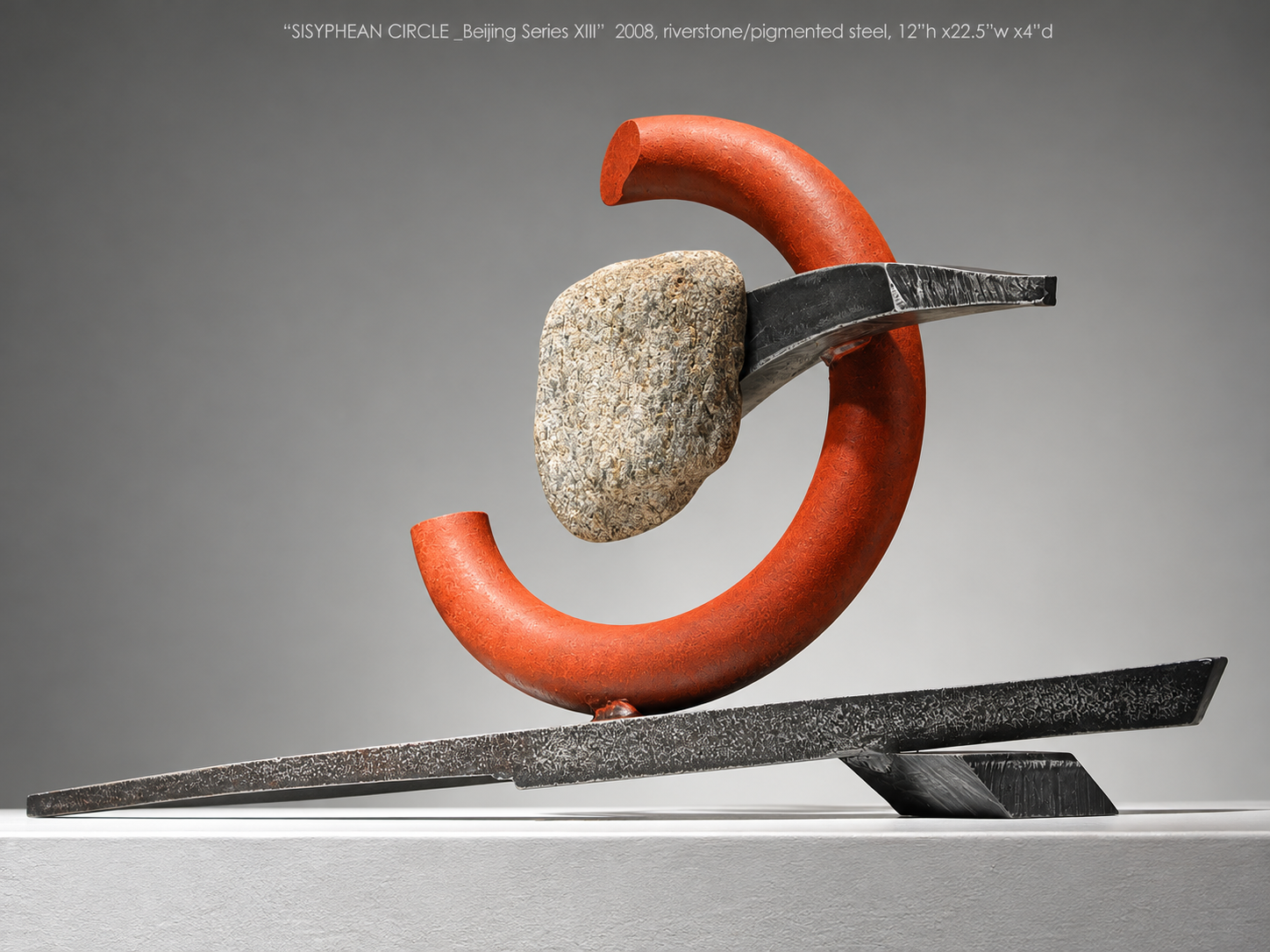
April 2008. River stone, pigmented steel. Dimensions: 12 × 22.5 × 4 in (30 × 57 × 10 cm). Private Collection - Sloan Kettering Cancer Center NYC.
The Sisyphean Series
The Greek myth of Sisyphus, condemned to endlessly push a boulder uphill, has inspired more than 250 of my sculptures. Rather than seeing the myth as a symbol of futility, I share philosopher Albert Camus’s more positive interpretation—that meaning and fulfillment can be found in the struggle itself. In many ways, I see Sisyphus as autobiographical, reflecting my lifelong pursuit as an artist, confronting challenges, taking risks, and finding purpose in the act of creation.
My Sisyphean works bring stone and steel together in precarious yet stable arrangements, often incorporating circular forms suggesting perpetual motion. For me, they are metaphors for the creative process—an ongoing cycle of experimentation, discovery, setbacks, and renewal. Each completed sculpture is both an achievement and a starting point, celebrating the journey rather than simply the destination.
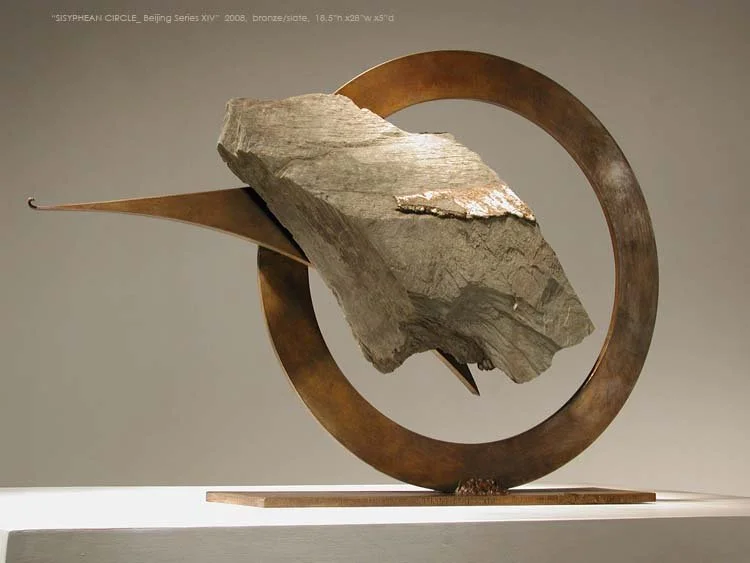
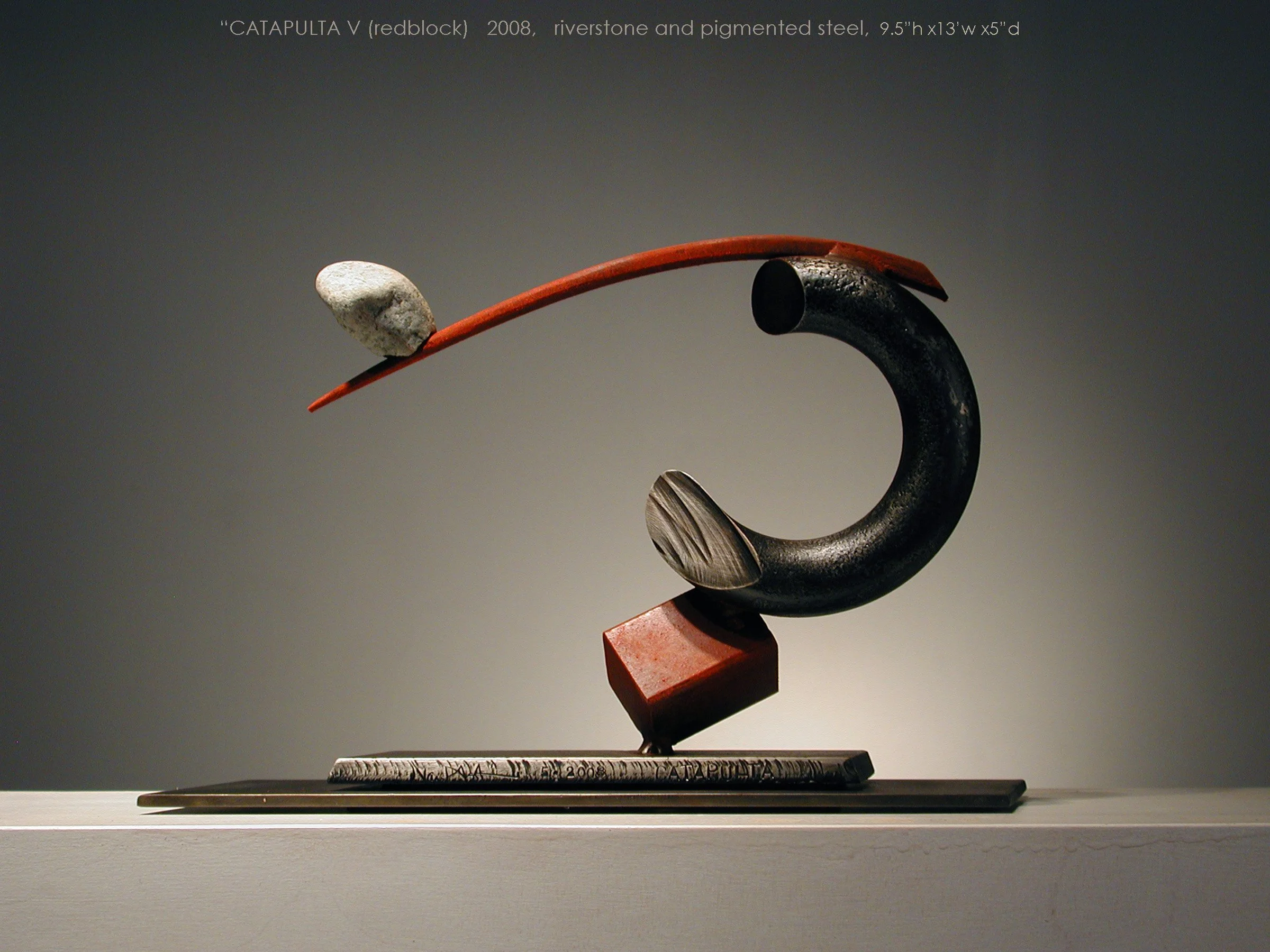
May 2008. River stone, pigmented steel. Dimensions: 8.5 × 13 × 4 in (22 × 33 × 10 cm). Private Collection.
The title derives from the English word catapult, meaning “to launch forward.” The sculpture’s arrangement of stone and steel conveys a sense of arrested motion—energy captured and poised for release—a dynamic tension that has been a central focus of Van Alstine’s work throughout his career.
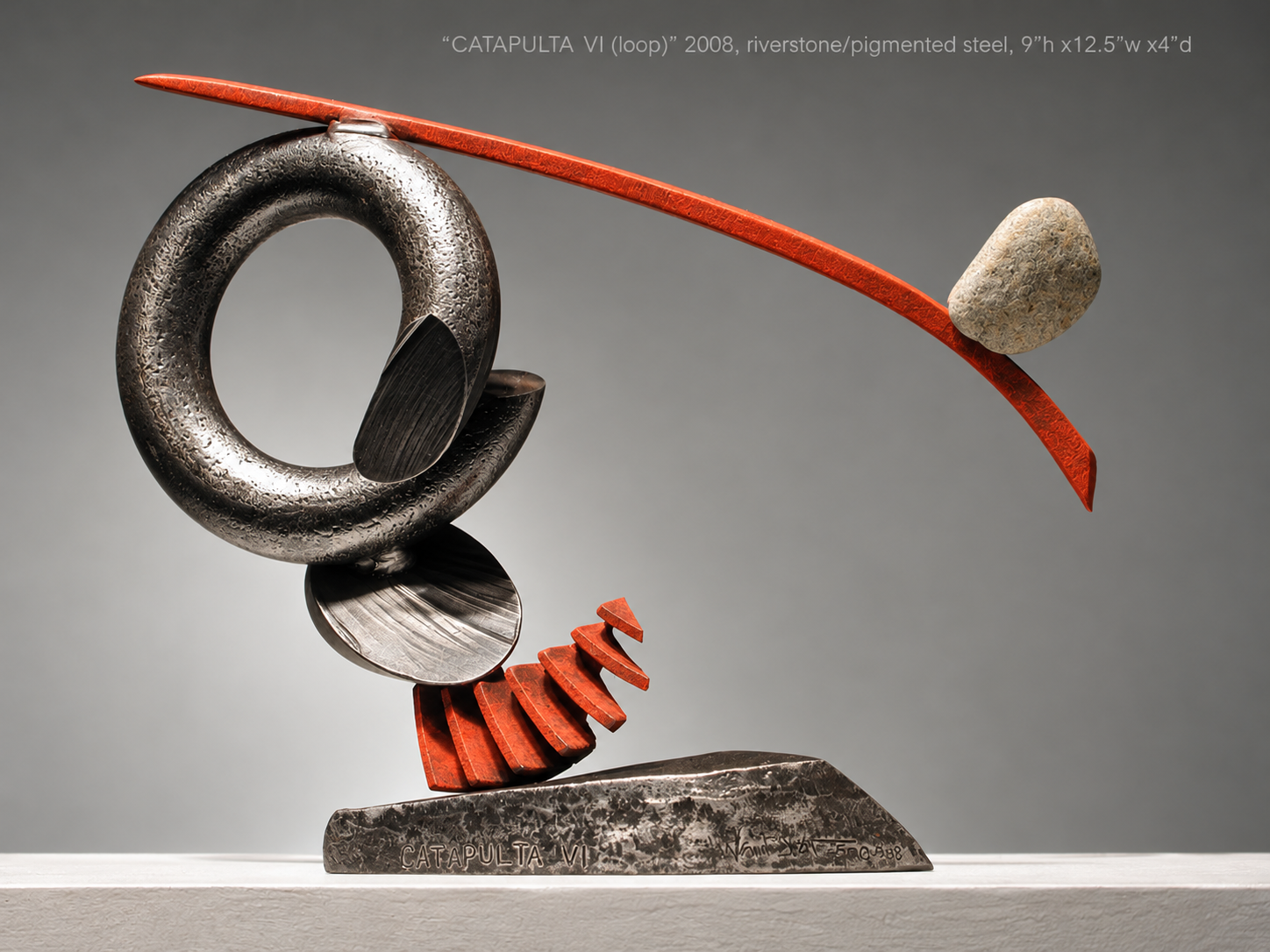
May 2008. River stone, pigmented steel. Dimensions: 9 × 12.5 × 4 in (23 × 32 × 10 cm). Private Collection
The title derives from the English word catapult, meaning “to launch forward.” The sculpture’s arrangement of stone and steel conveys a sense of arrested motion—energy captured and poised for release—a dynamic tension that has been a central focus of Van Alstine’s work throughout his career.
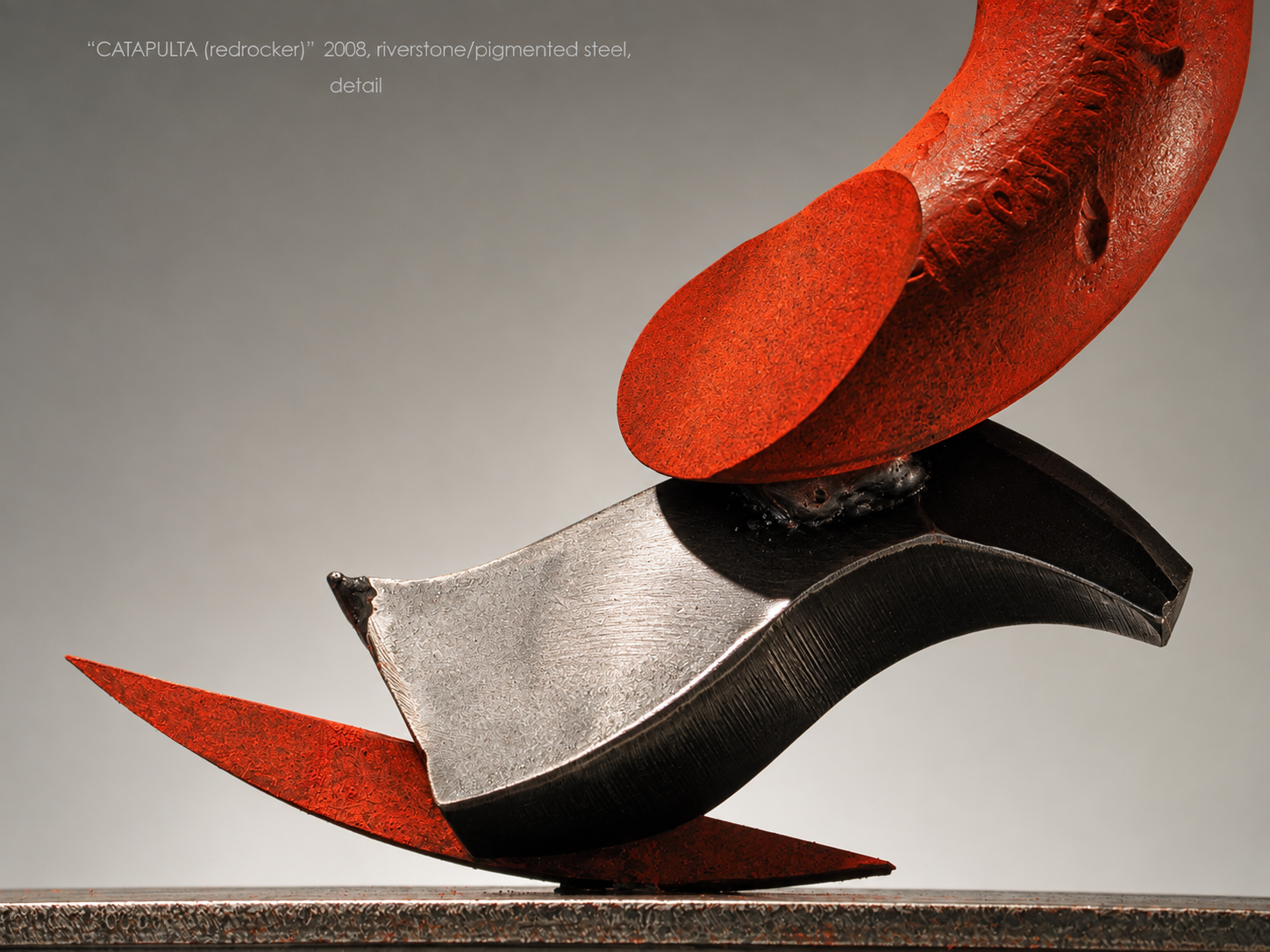
May 2008. River stone, pigmented steel. Dimensions: 9.5 × 13 × 5 in (24 × 33 × 13 cm). Private Collection.
The title derives from the English word catapult, meaning “to launch forward.” The sculpture’s arrangement of stone and steel conveys a sense of arrested motion—energy captured and poised for release—a dynamic tension that has been a central focus of Van Alstine’s work throughout his career.
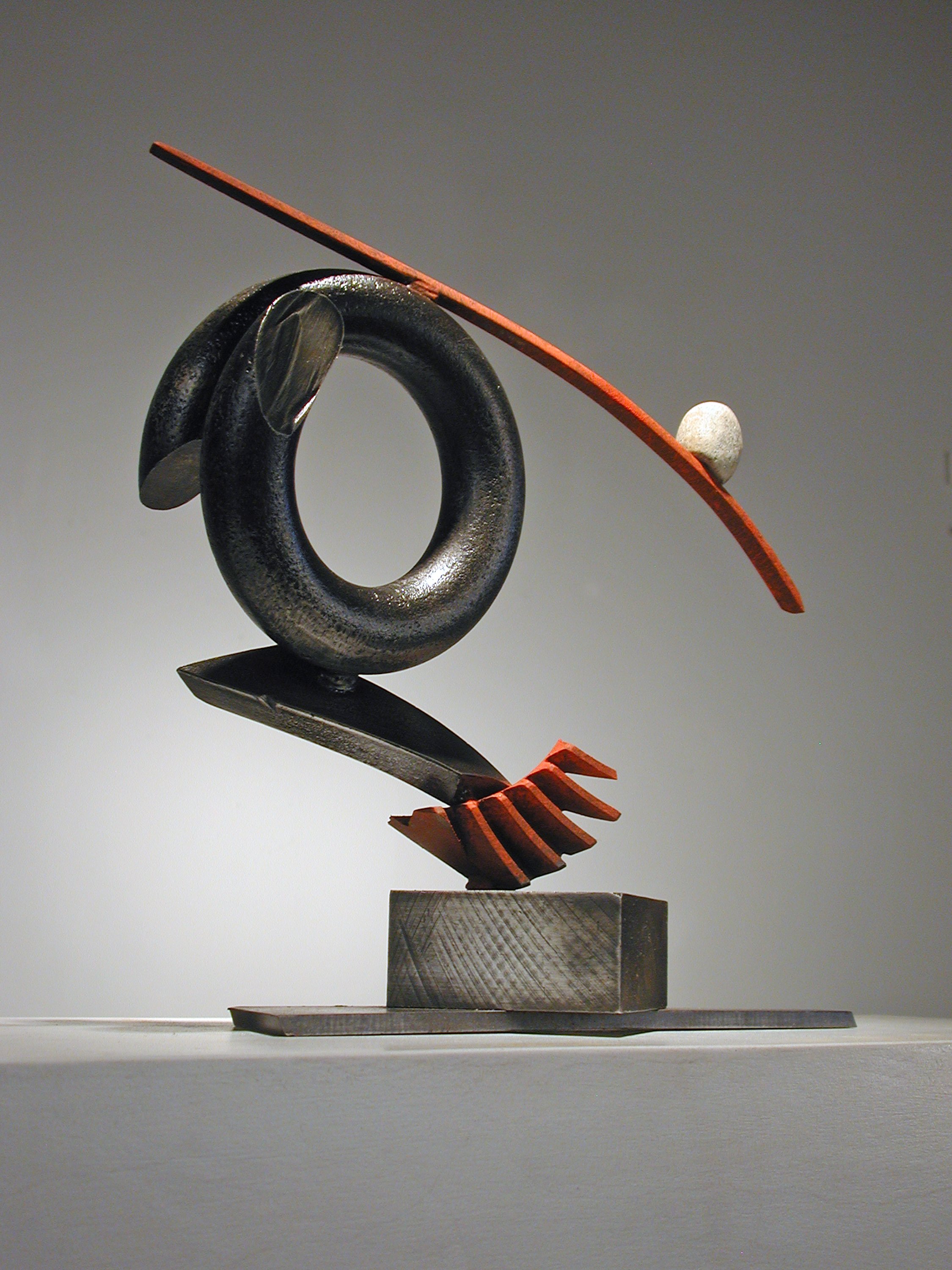
June 2008. River stone, pigmented steel. Dimensions: 10 × 12 × 4.5 in (25 × 30 × 11 cm). Private Collection.
The title derives from the English word catapult, meaning “to launch forward.” The sculpture’s arrangement of stone and steel conveys a sense of arrested motion—energy captured and poised for release—a dynamic tension that has been a central focus of Van Alstine’s work throughout his career.
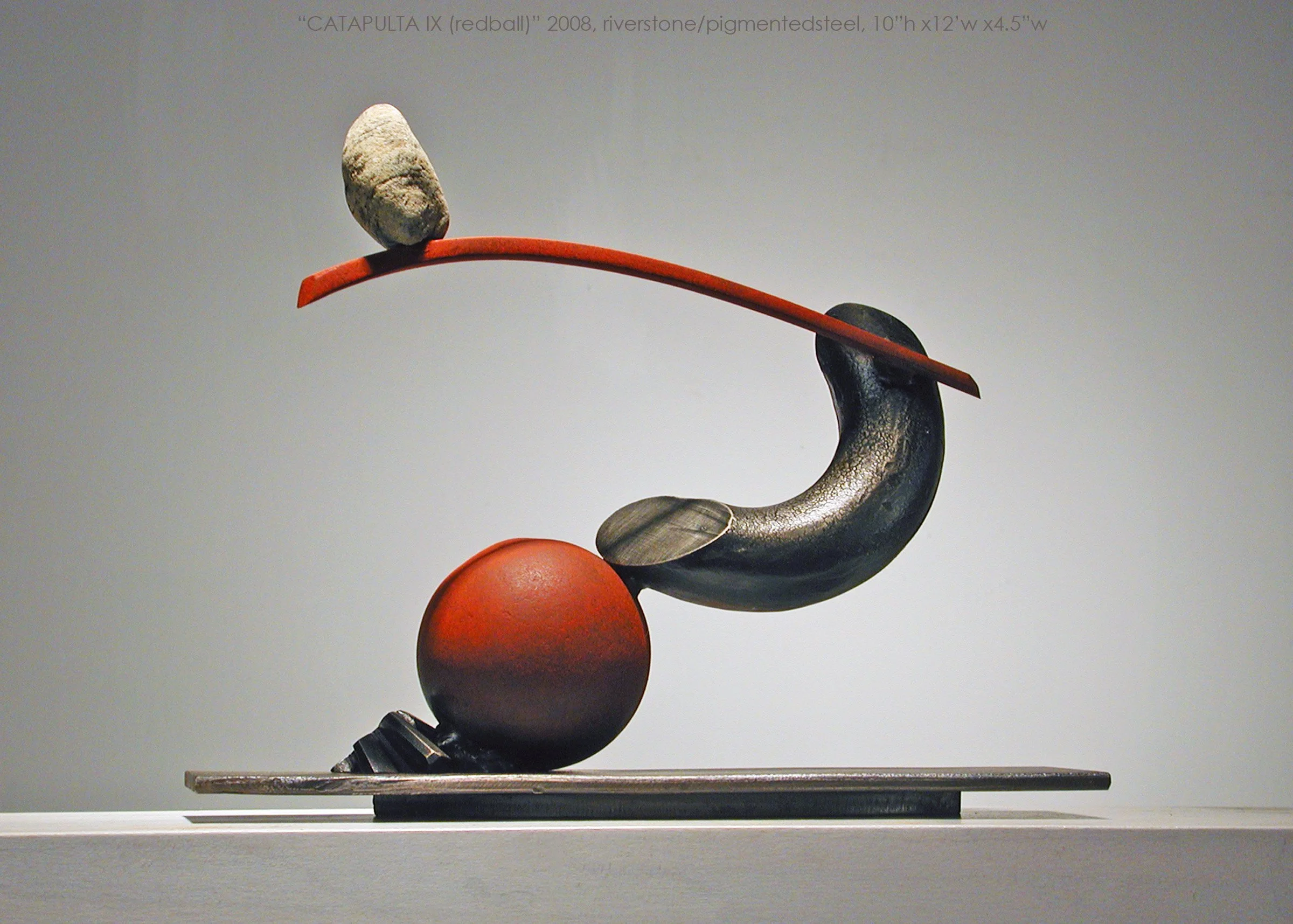
SOLD
June 2008. River stone, pigmented steel. Dimensions: 10 × 12 × 4.5 in (25 × 30 × 11 cm). Private Collection.
The title derives from the English word catapult, meaning “to launch forward.” The sculpture’s arrangement of stone and steel conveys a sense of arrested motion—energy captured and poised for release—a dynamic tension that has been a central focus of Van Alstine’s work throughout his career.
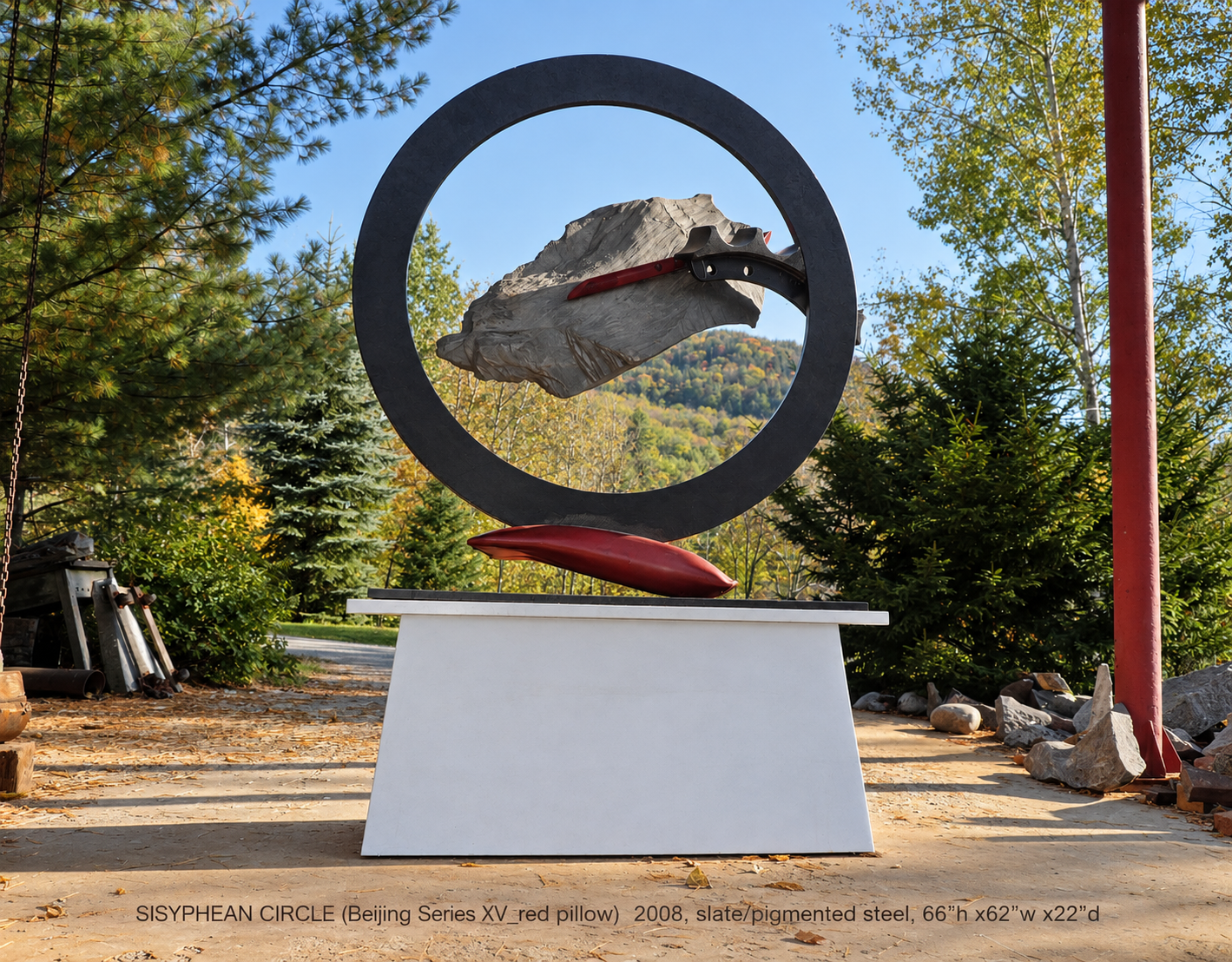
June 2008. Slate, pigmented steel. Dimensions: 66 × 61 × 22 in (168 × 155 × 56 cm). Private Collection - Greece.
The Sisyphean Series
The Greek myth of Sisyphus, condemned to endlessly push a boulder uphill, has inspired more than 250 of my sculptures. Rather than seeing the myth as a symbol of futility, I share philosopher Albert Camus’s more positive interpretation—that meaning and fulfillment can be found in the struggle itself. In many ways, I see Sisyphus as autobiographical, reflecting my lifelong pursuit as an artist, confronting challenges, taking risks, and finding purpose in the act of creation.
My Sisyphean works bring stone and steel together in precarious yet stable arrangements, often incorporating circular forms suggesting perpetual motion. For me, they are metaphors for the creative process—an ongoing cycle of experimentation, discovery, setbacks, and renewal. Each completed sculpture is both an achievement and a starting point, celebrating the journey rather than simply the destination.
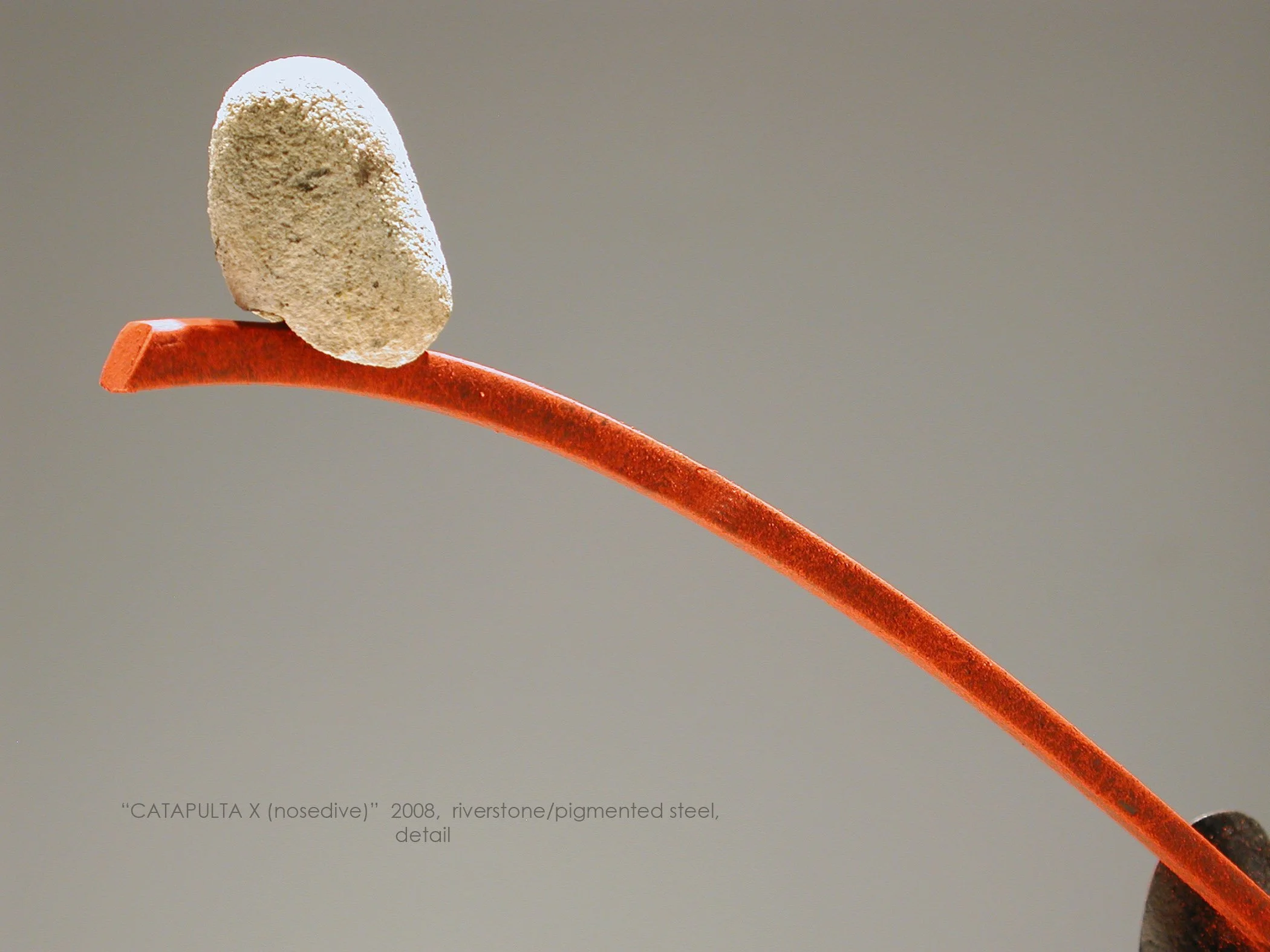
July 2008. River stone, pigmented steel. Dimensions: 9 × 15.5 × 4 in (23 × 39 × 10 cm). Private Collection.
The title derives from the English word catapult, meaning “to launch forward.” The sculpture’s arrangement of stone and steel conveys a sense of arrested motion—energy captured and poised for release—a dynamic tension that has been a central focus of Van Alstine’s work throughout his career.
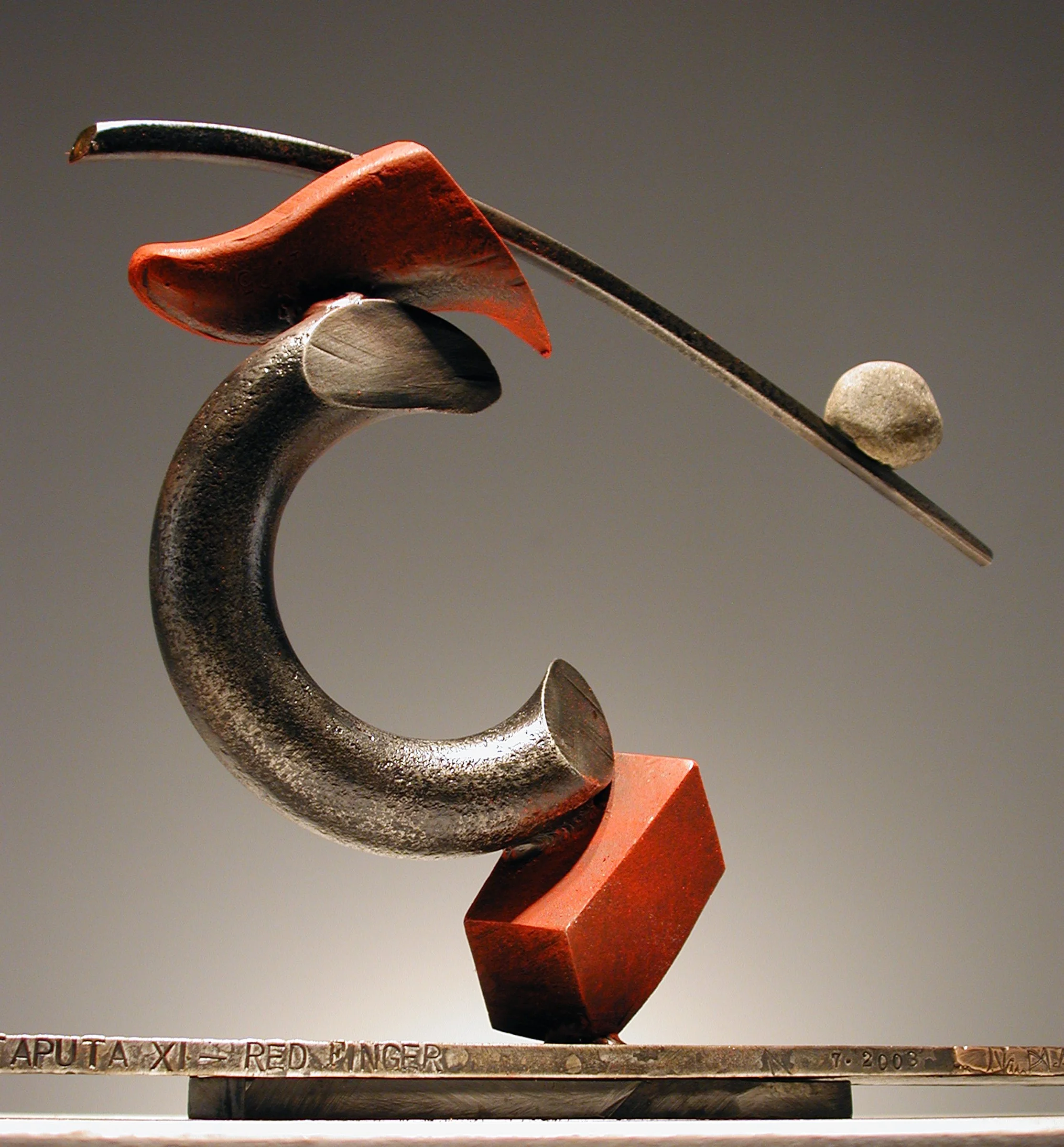
July 2008. River stone, pigmented steel. Dimensions: 9.5 × 15 × 4 in (24 × 38 × 10 cm). Private Collection.
The title derives from the English word catapult, meaning “to launch forward.” The sculpture’s arrangement of stone and steel conveys a sense of arrested motion—energy captured and poised for release—a dynamic tension that has been a central focus of Van Alstine’s work throughout his career.
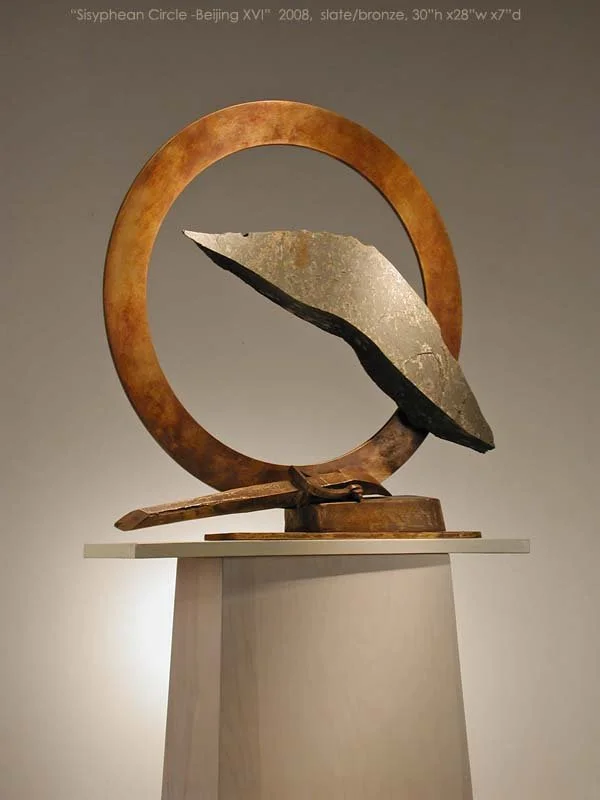
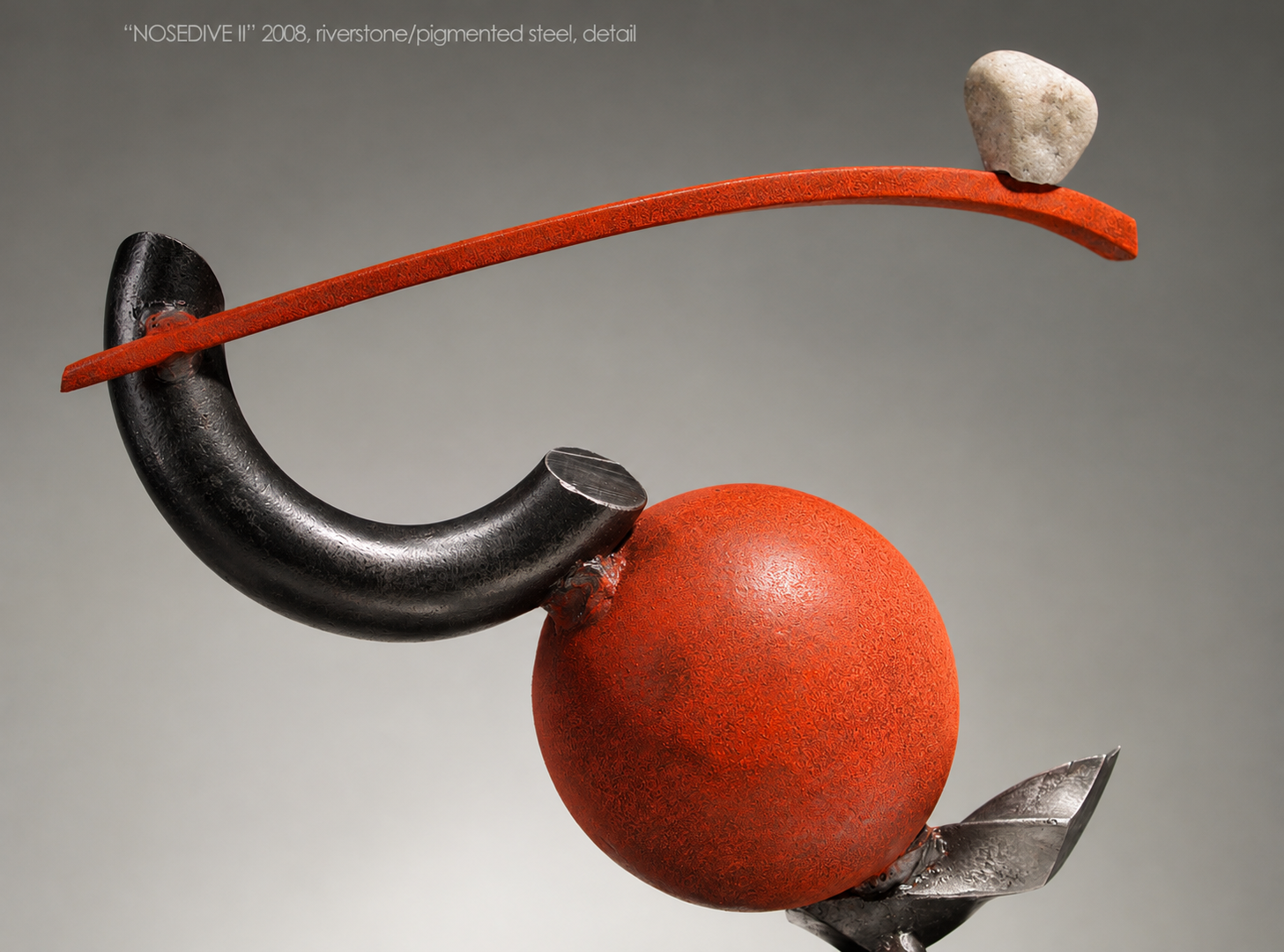
September 2008. River stone, pigmented steel. Dimensions: 10 × 15.5 × 4 in (25 × 39 × 10 cm). Private Collection.
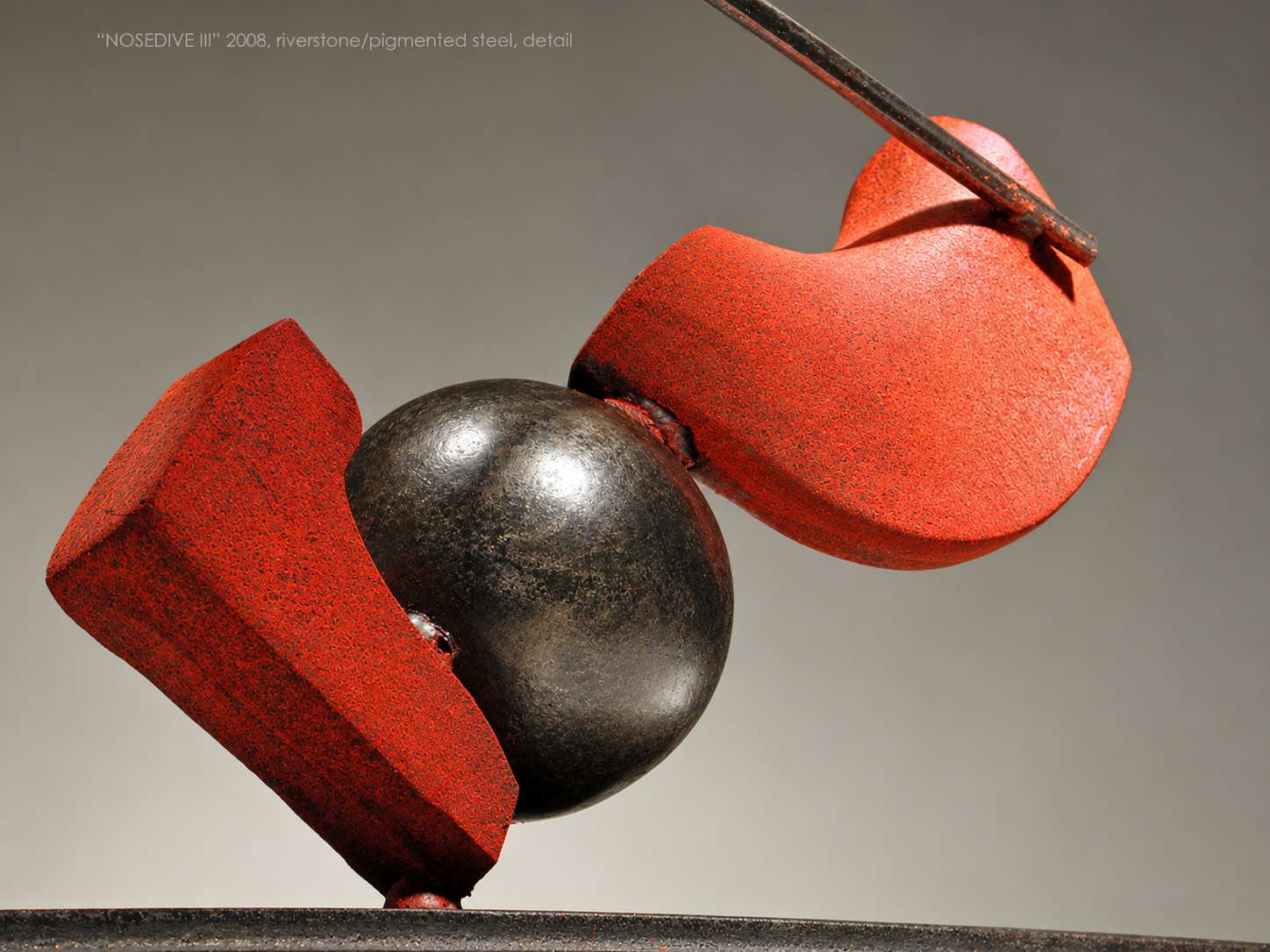
September 2008. River stone, pigmented steel. Dimensions: 10 × 18 × 4 in (25 × 46 × 10 cm). Private Collection.
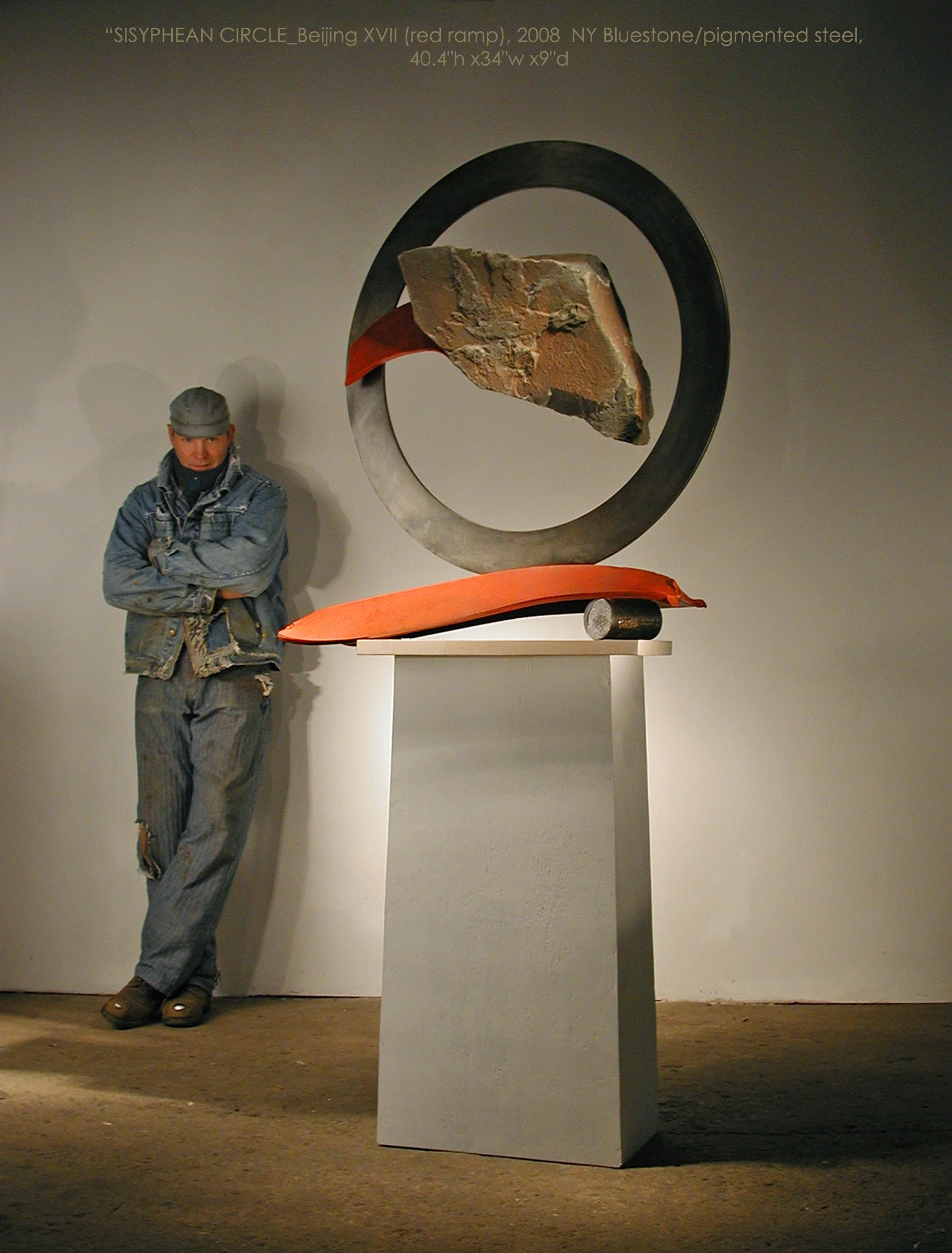
October 2008. NY bluestone, pigmented steel, 40.5 × 34 × 9 in (103 × 86 × 23 cm). Corporate Collection Pittsburgh, PA.
The Sisyphean Series
The Greek myth of Sisyphus, condemned to endlessly push a boulder uphill, has inspired more than 250 of my sculptures. Rather than seeing the myth as a symbol of futility, I share philosopher Albert Camus’s more positive interpretation—that meaning and fulfillment can be found in the struggle itself. In many ways, I see Sisyphus as autobiographical, reflecting my lifelong pursuit as an artist, confronting challenges, taking risks, and finding purpose in the act of creation.
My Sisyphean works bring stone and steel together in precarious yet stable arrangements, often incorporating circular forms suggesting perpetual motion. For me, they are metaphors for the creative process—an ongoing cycle of experimentation, discovery, setbacks, and renewal. Each completed sculpture is both an achievement and a starting point, celebrating the journey rather than simply the destination.
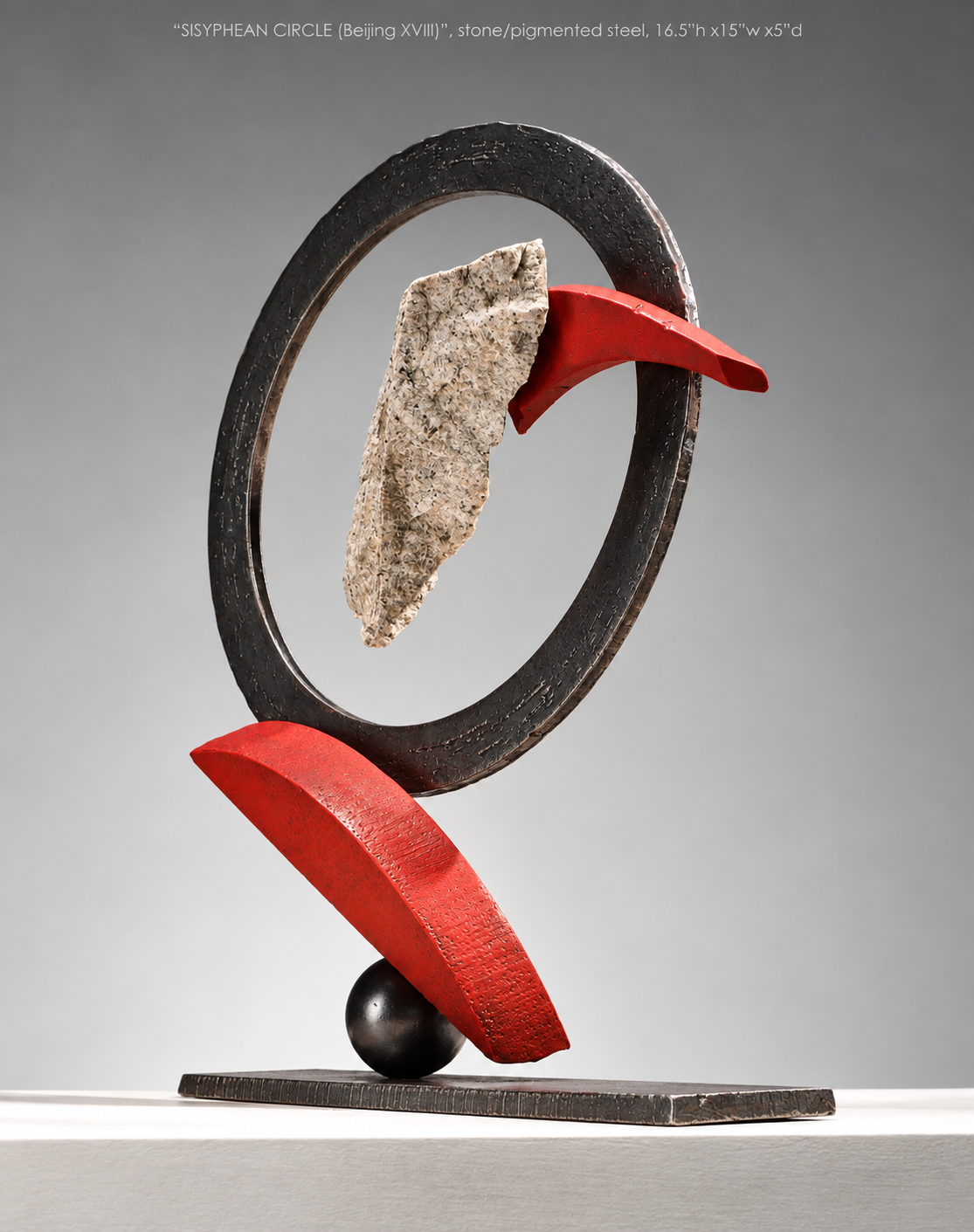
October 2008. Stone, steel. Dimensions: 16.5 × 15 × 5 in (42 × 38 × 13 cm). Private Collection.
The Sisyphean Series
The Greek myth of Sisyphus, condemned to endlessly push a boulder uphill, has inspired more than 250 of my sculptures. Rather than seeing the myth as a symbol of futility, I share philosopher Albert Camus’s more positive interpretation—that meaning and fulfillment can be found in the struggle itself. In many ways, I see Sisyphus as autobiographical, reflecting my lifelong pursuit as an artist, confronting challenges, taking risks, and finding purpose in the act of creation.
My Sisyphean works bring stone and steel together in precarious yet stable arrangements, often incorporating circular forms suggesting perpetual motion. For me, they are metaphors for the creative process—an ongoing cycle of experimentation, discovery, setbacks, and renewal. Each completed sculpture is both an achievement and a starting point, celebrating the journey rather than simply the destination.
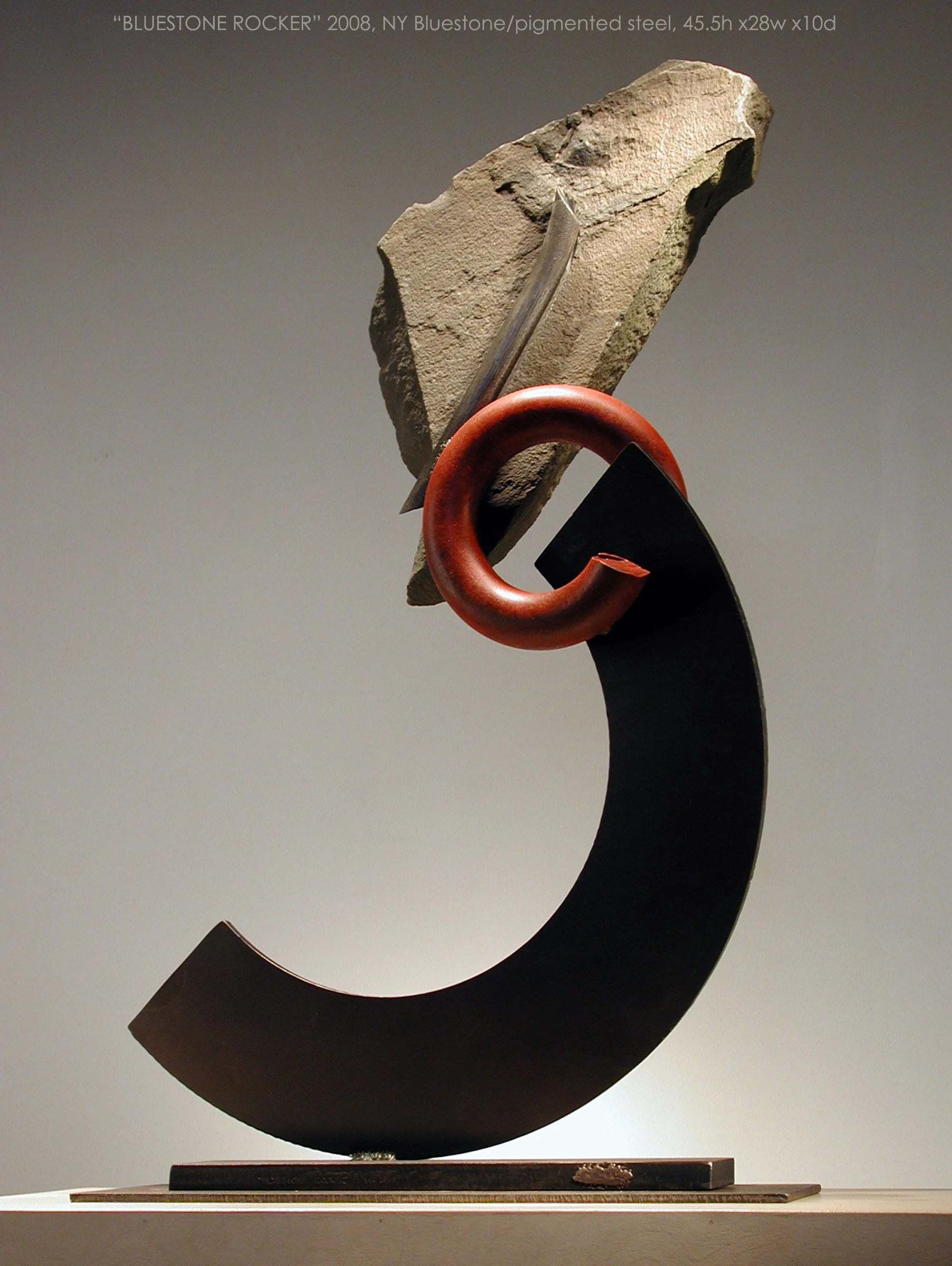
October 2008. NY Bluestone, pigmented steel. Dimensions: 45.5 × 28 × 10 in (116 × 71 × 25 cm). Private Collection Minnesota.
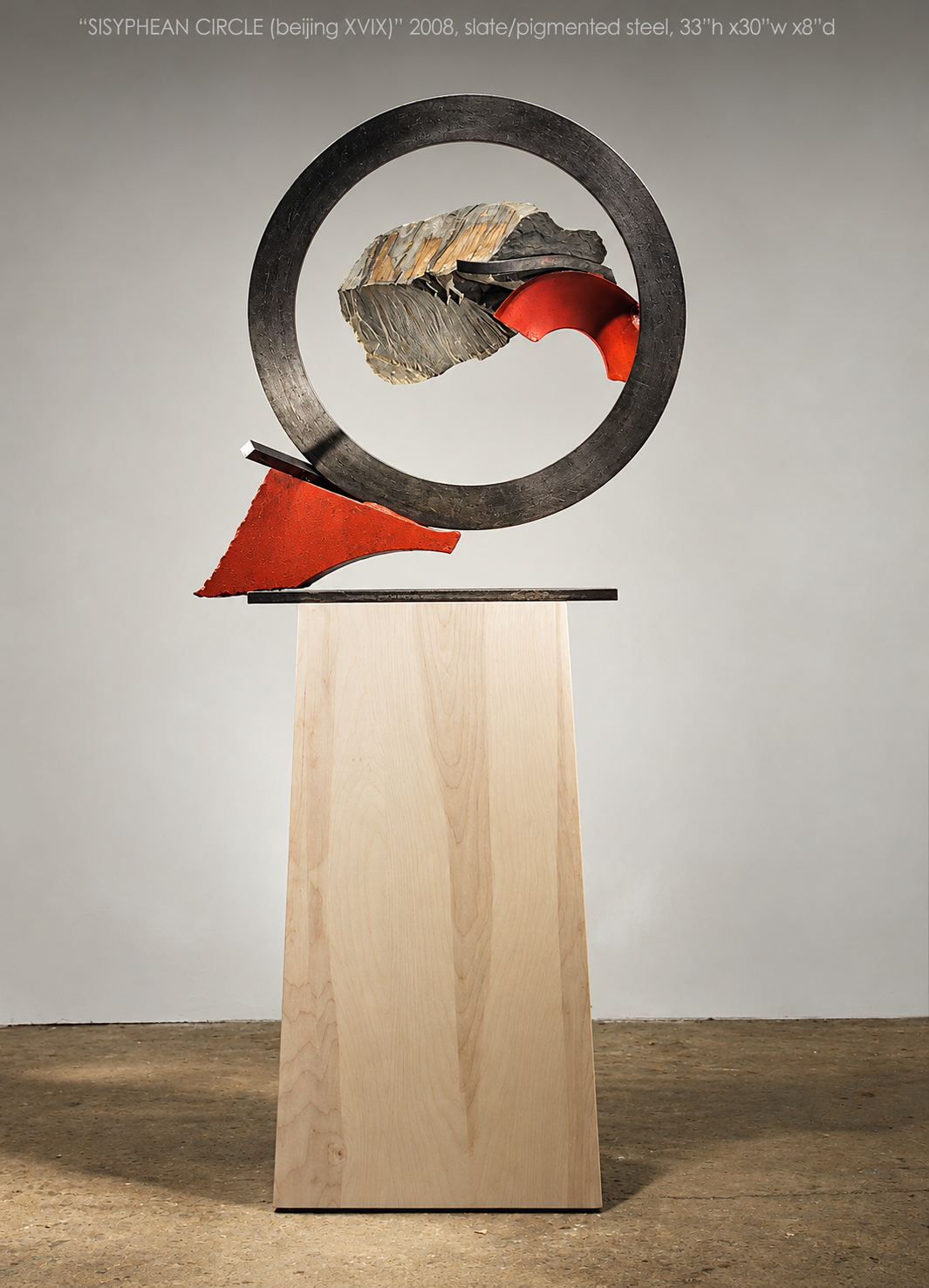
October 2008. Slate, pigmented steel. Dimensions: 33 × 30 × 8 in (84 × 76 × 20 cm). Private Collection.
The Sisyphean Series
The Greek myth of Sisyphus, condemned to endlessly push a boulder uphill, has inspired more than 250 of my sculptures. Rather than seeing the myth as a symbol of futility, I share philosopher Albert Camus’s more positive interpretation—that meaning and fulfillment can be found in the struggle itself. In many ways, I see Sisyphus as autobiographical, reflecting my lifelong pursuit as an artist, confronting challenges, taking risks, and finding purpose in the act of creation.
My Sisyphean works bring stone and steel together in precarious yet stable arrangements, often incorporating circular forms suggesting perpetual motion. For me, they are metaphors for the creative process—an ongoing cycle of experimentation, discovery, setbacks, and renewal. Each completed sculpture is both an achievement and a starting point, celebrating the journey rather than simply the destination.
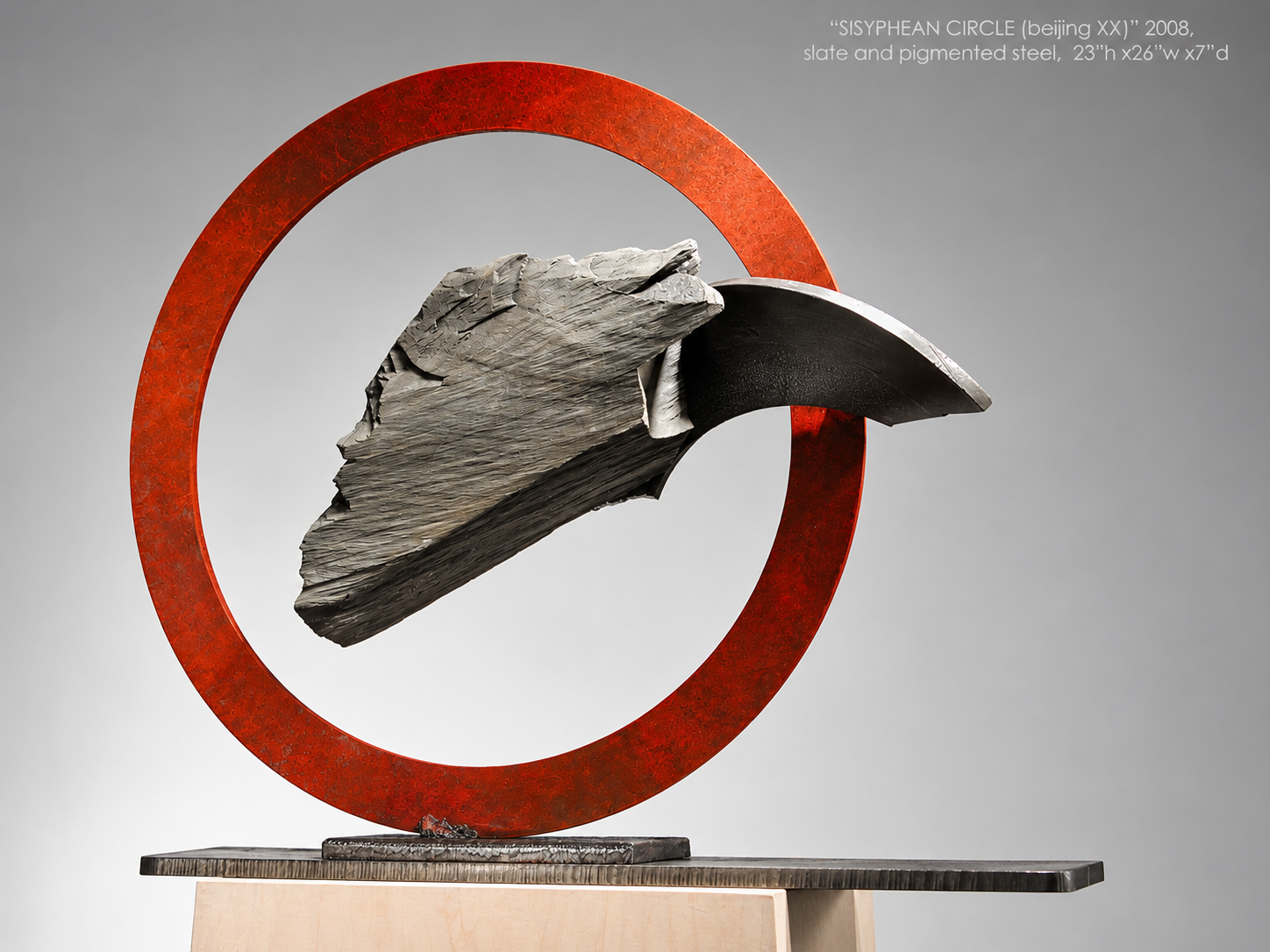
November 2008. Slate, pigmented steel. Dimensions: 23 × 26 × 7 in (58 × 66 × 18 cm). Private Collection.
The Sisyphean Series
The Greek myth of Sisyphus, condemned to endlessly push a boulder uphill, has inspired more than 250 of my sculptures. Rather than seeing the myth as a symbol of futility, I share philosopher Albert Camus’s more positive interpretation—that meaning and fulfillment can be found in the struggle itself. In many ways, I see Sisyphus as autobiographical, reflecting my lifelong pursuit as an artist, confronting challenges, taking risks, and finding purpose in the act of creation.
My Sisyphean works bring stone and steel together in precarious yet stable arrangements, often incorporating circular forms suggesting perpetual motion. For me, they are metaphors for the creative process—an ongoing cycle of experimentation, discovery, setbacks, and renewal. Each completed sculpture is both an achievement and a starting point, celebrating the journey rather than simply the destination.
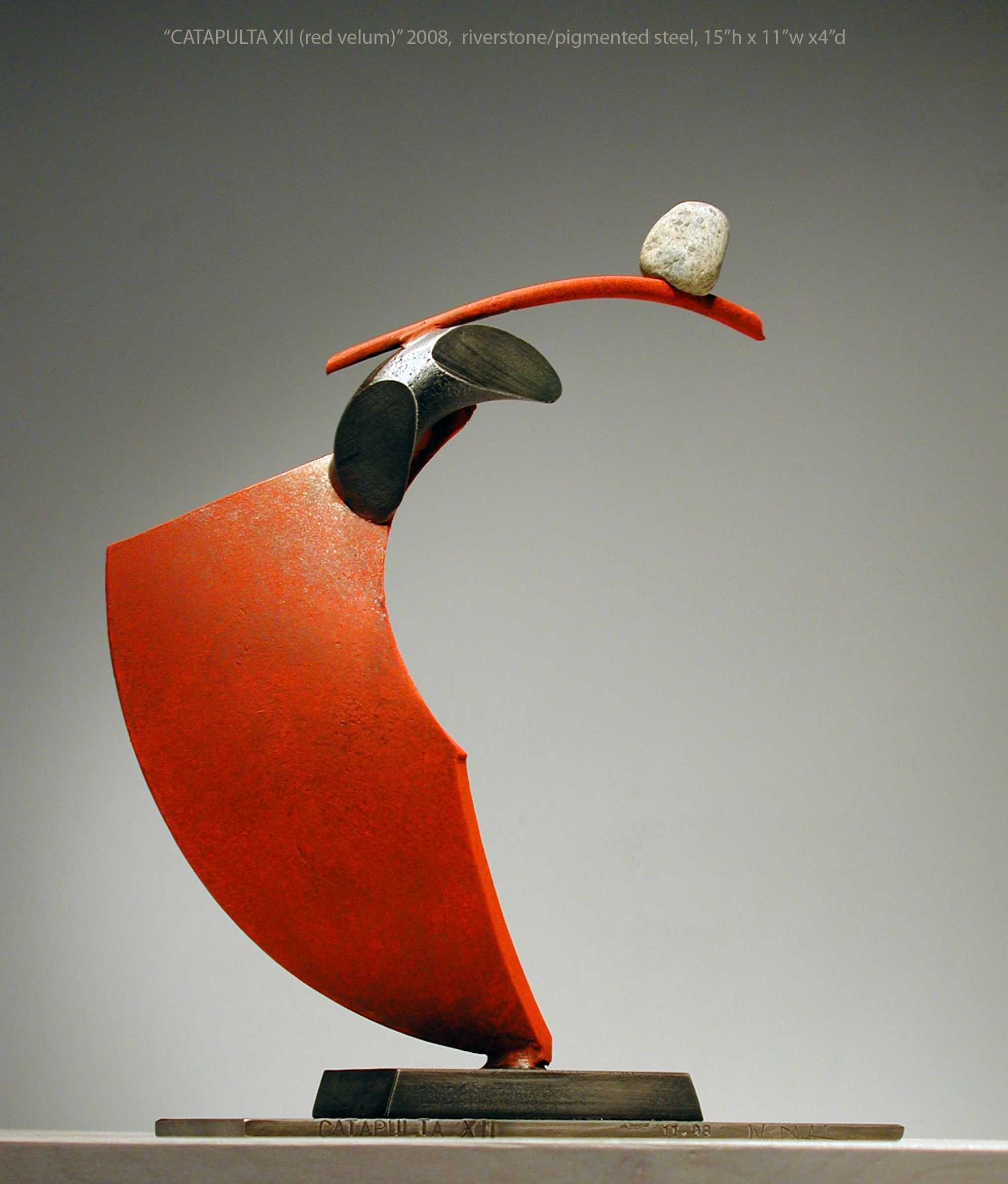
November 2008. River stone, pigmented steel. Dimensions: 14 × 10 × 4 in (36 × 25 × 10 cm). Private Collection.
The title derives from the English word catapult, meaning “to launch forward.” The sculpture’s arrangement of stone and steel conveys a sense of arrested motion—energy captured and poised for release—a dynamic tension that has been a central focus of Van Alstine’s work throughout his career.
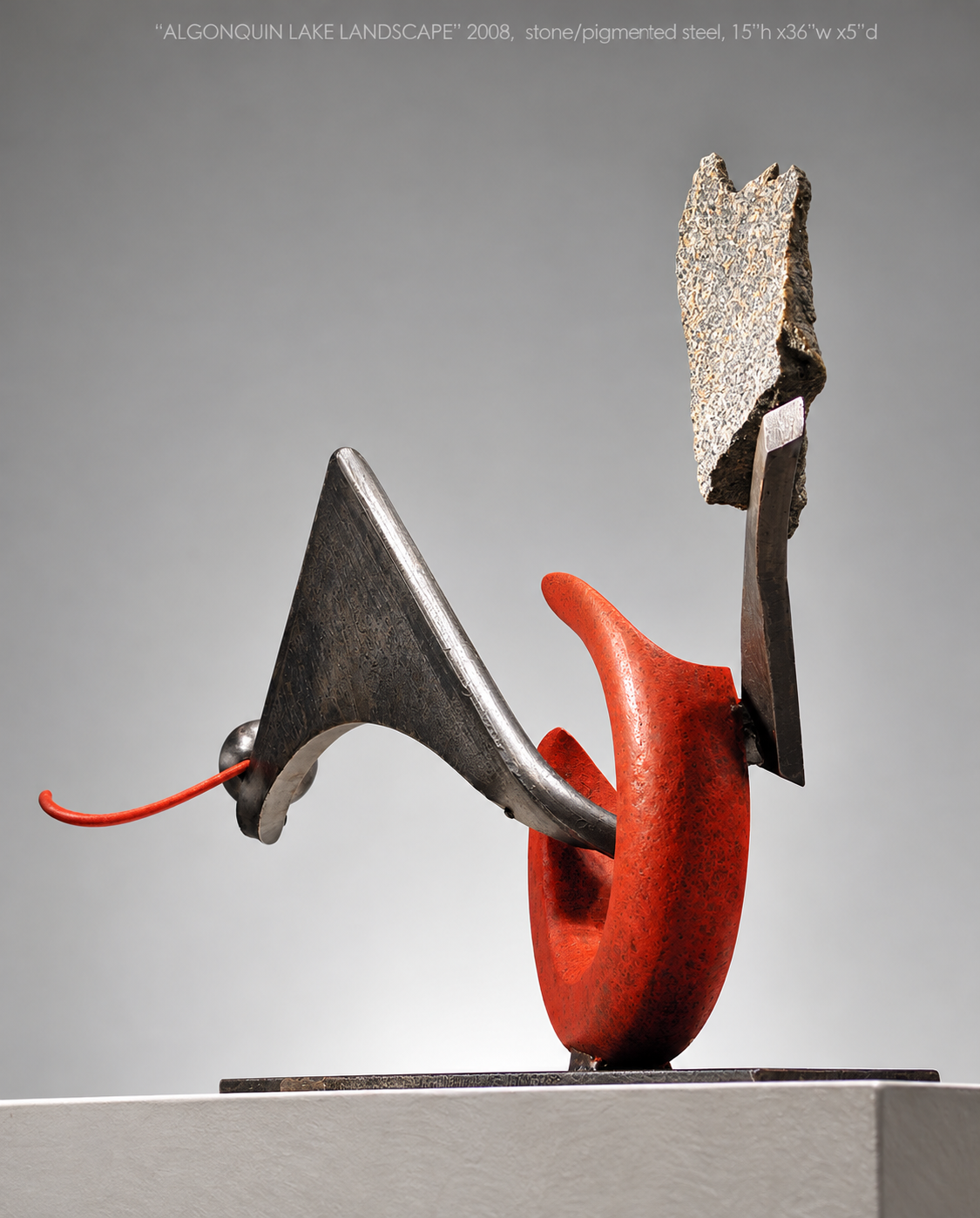
November 2008. Stone, pigmented steel, 15 × 36 × 5 in (38 × 91 × 13 cm). Private Collection New Jersey
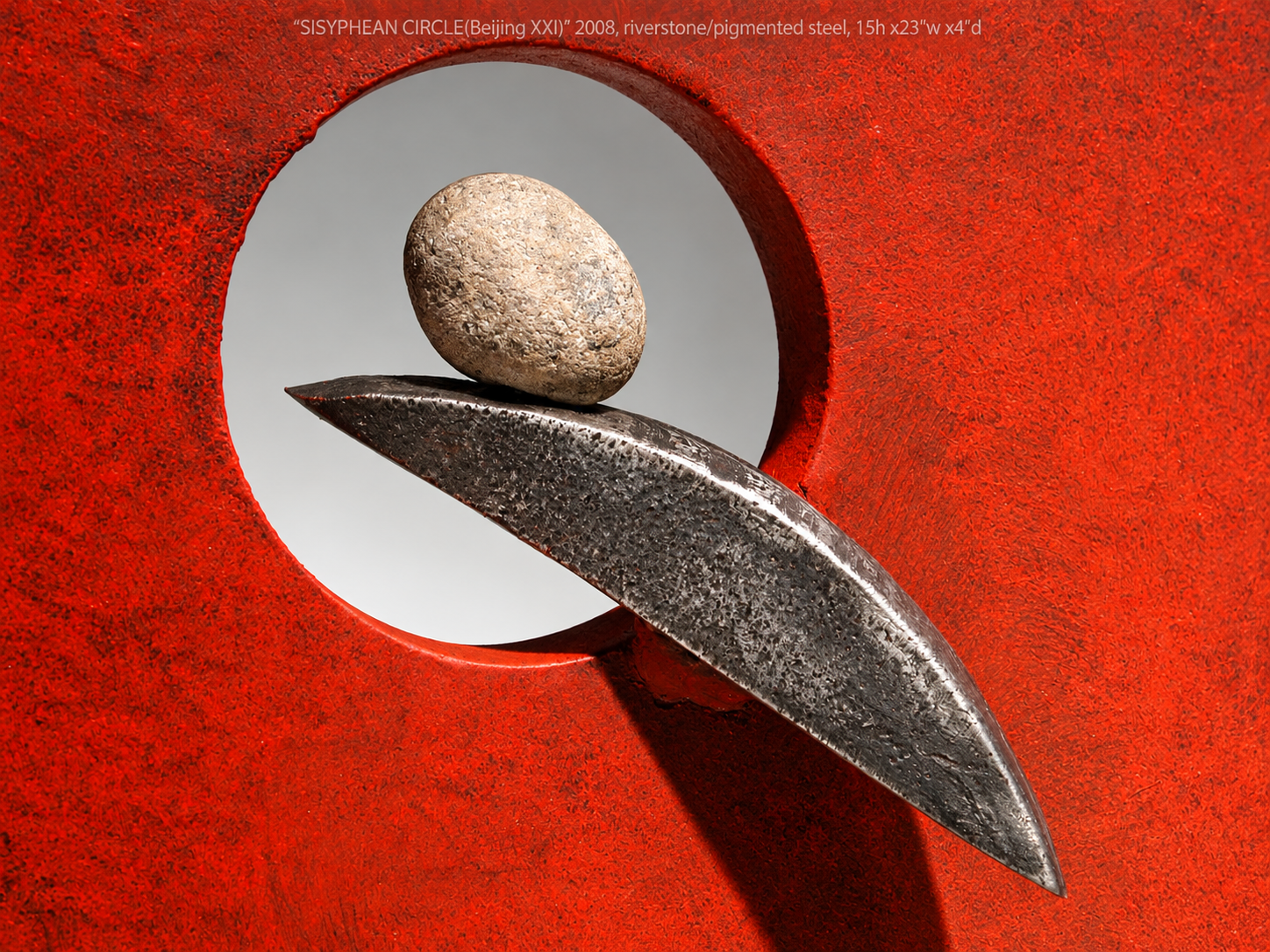
November 2008. River stone, pigmented steel. Dimensions: 15 × 23 × 4 in (38 × 58 × 10 cm). Private Collection Palm Beach, FL.
The Sisyphean Series
The Greek myth of Sisyphus, condemned to endlessly push a boulder uphill, has inspired more than 250 of my sculptures. Rather than seeing the myth as a symbol of futility, I share philosopher Albert Camus’s more positive interpretation—that meaning and fulfillment can be found in the struggle itself. In many ways, I see Sisyphus as autobiographical, reflecting my lifelong pursuit as an artist, confronting challenges, taking risks, and finding purpose in the act of creation.
My Sisyphean works bring stone and steel together in precarious yet stable arrangements, often incorporating circular forms suggesting perpetual motion. For me, they are metaphors for the creative process—an ongoing cycle of experimentation, discovery, setbacks, and renewal. Each completed sculpture is both an achievement and a starting point, celebrating the journey rather than simply the destination.
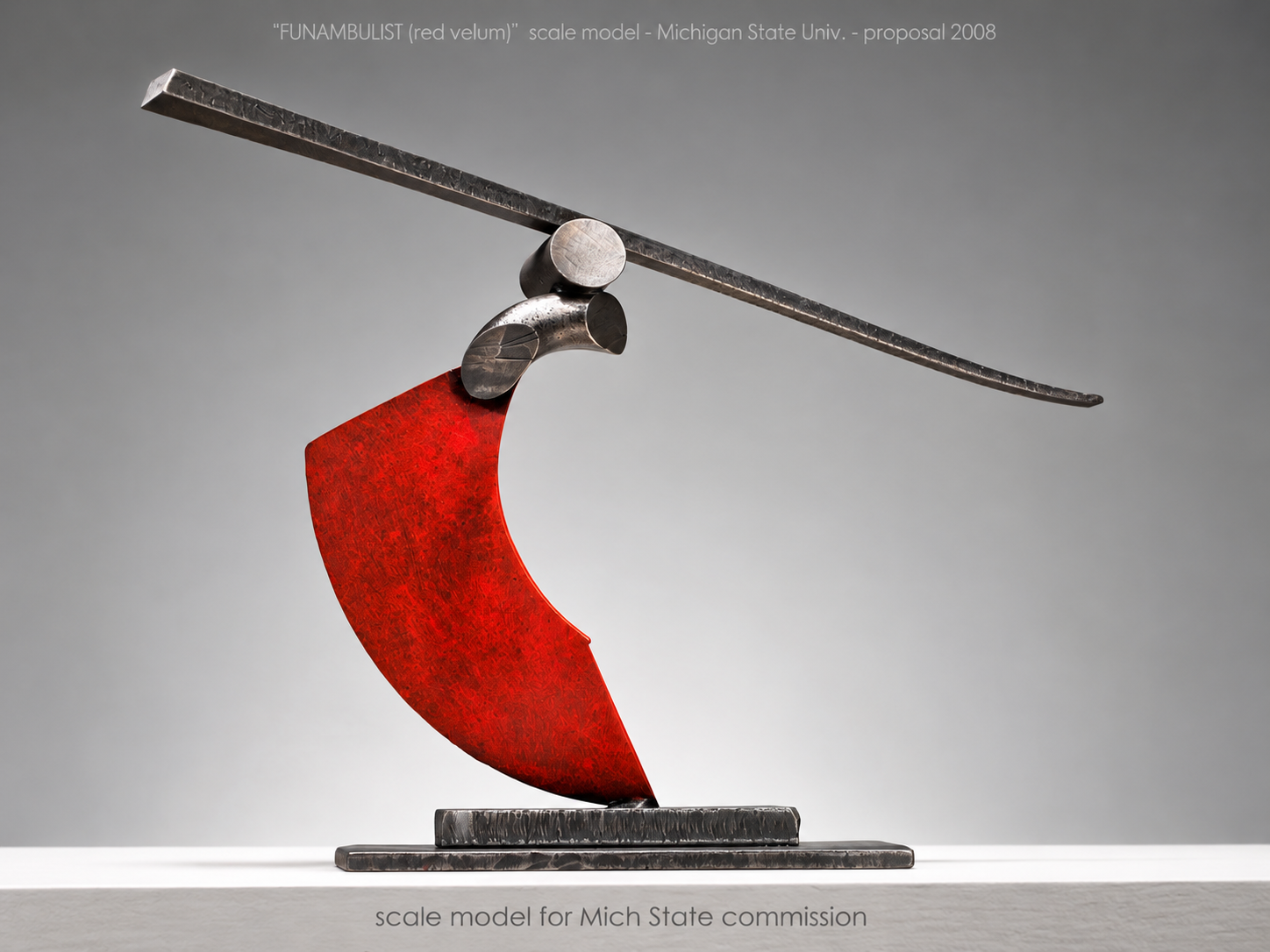
November 2008. Pigmented and sealed steel. Dimensions: 14.5 × 21 × 12 in (37 × 53 × 30 cm).
The title derives from two Latin words—fūnis, meaning “rope,” and ambulāre, “to walk”—and refers to a tightrope walker. The meaning is reinforced by the sculpture’s dynamic horizontal “balancing baton” and its overall sense of precarious poise. It evokes the physical balance, agility, and daring of a circus performer, while perhaps more poignantly suggesting mental agility—the ability to maintain equilibrium amid uncertainty and change.
A celebrated modern funambulist is Philippe Petit, who became famous for his unauthorized high-wire walk between the Twin Towers of New York’s World Trade Center on August 7, 1974. His feat became an enduring image of extraordinary balance, concentration, risk, and resolve.
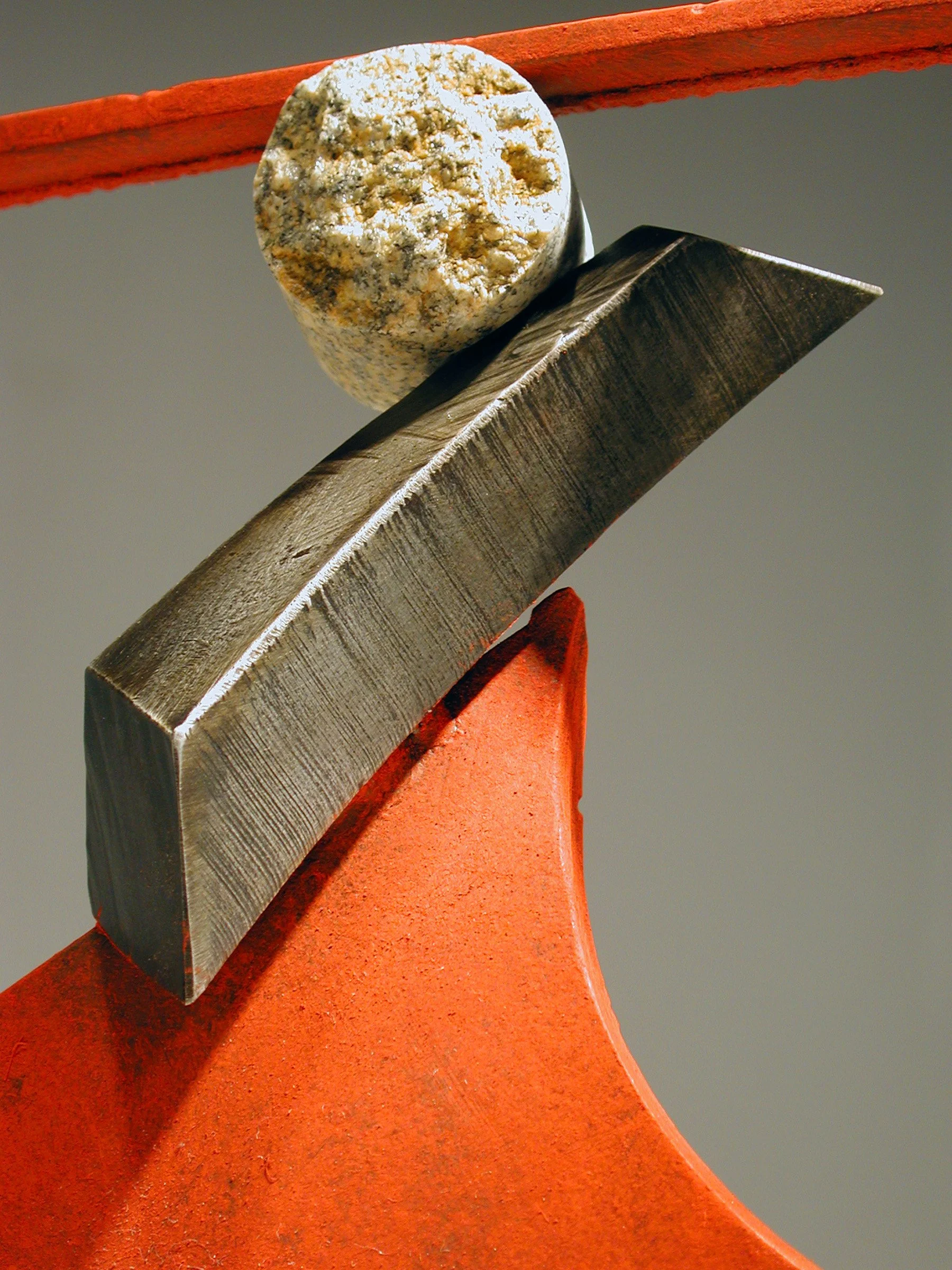
November 2008. Granite, pigmented steel. Dimensions: 14 × 24 × 4 in (36 × 61 × 10 cm). Private Collection.
The title derives from two Latin words—fūnis, meaning “rope,” and ambulāre, “to walk”—and refers to a tightrope walker. The meaning is reinforced by the sculpture’s dynamic horizontal “balancing baton” and its overall sense of precarious poise. It evokes the physical balance, agility, and daring of a circus performer, while perhaps more poignantly suggesting mental agility—the ability to maintain equilibrium amid uncertainty and change.
A celebrated modern funambulist is Philippe Petit, who became famous for his unauthorized high-wire walk between the Twin Towers of New York’s World Trade Center on August 7, 1974. His feat became an enduring image of extraordinary balance, concentration, risk, and resolve.
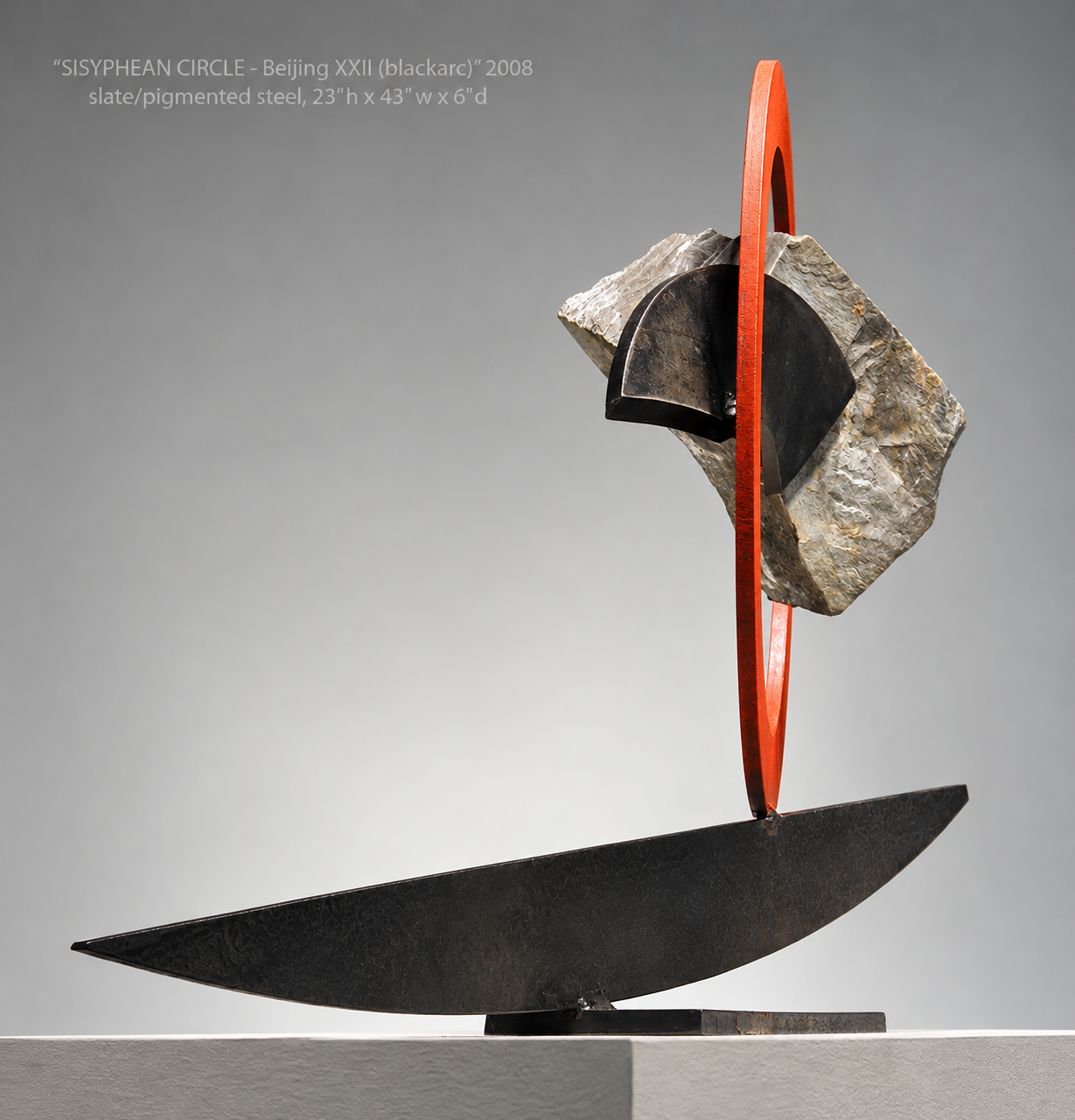
November 2008. Slate, pigmented steel. Dimensions: 23 × 43 × 6 in (58 × 109 × 15 cm).
The Sisyphean Series
The Greek myth of Sisyphus, condemned to endlessly push a boulder uphill, has inspired more than 250 of my sculptures. Rather than seeing the myth as a symbol of futility, I share philosopher Albert Camus’s more positive interpretation—that meaning and fulfillment can be found in the struggle itself. In many ways, I see Sisyphus as autobiographical, reflecting my lifelong pursuit as an artist, confronting challenges, taking risks, and finding purpose in the act of creation.
My Sisyphean works bring stone and steel together in precarious yet stable arrangements, often incorporating circular forms suggesting perpetual motion. For me, they are metaphors for the creative process—an ongoing cycle of experimentation, discovery, setbacks, and renewal. Each completed sculpture is both an achievement and a starting point, celebrating the journey rather than simply the destination.
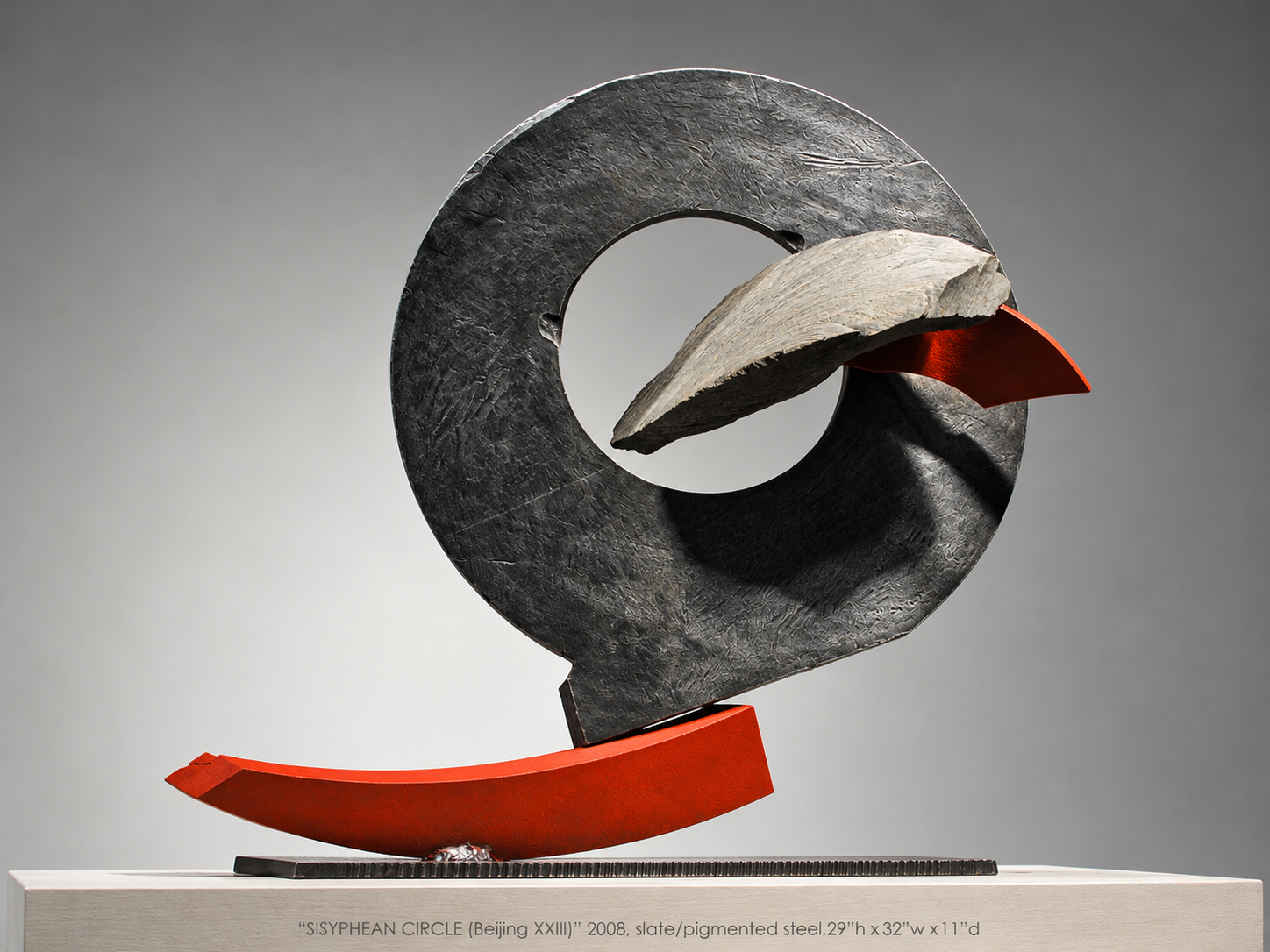
December 2008. Slate, pigmented steel. Dimensions: 29 × 32 × 11 in (74 × 81 × 28 cm).
The Sisyphean Series
The Greek myth of Sisyphus, condemned to endlessly push a boulder uphill, has inspired more than 250 of my sculptures. Rather than seeing the myth as a symbol of futility, I share philosopher Albert Camus’s more positive interpretation—that meaning and fulfillment can be found in the struggle itself. In many ways, I see Sisyphus as autobiographical, reflecting my lifelong pursuit as an artist, confronting challenges, taking risks, and finding purpose in the act of creation.
My Sisyphean works bring stone and steel together in precarious yet stable arrangements, often incorporating circular forms suggesting perpetual motion. For me, they are metaphors for the creative process—an ongoing cycle of experimentation, discovery, setbacks, and renewal. Each completed sculpture is both an achievement and a starting point, celebrating the journey rather than simply the destination.
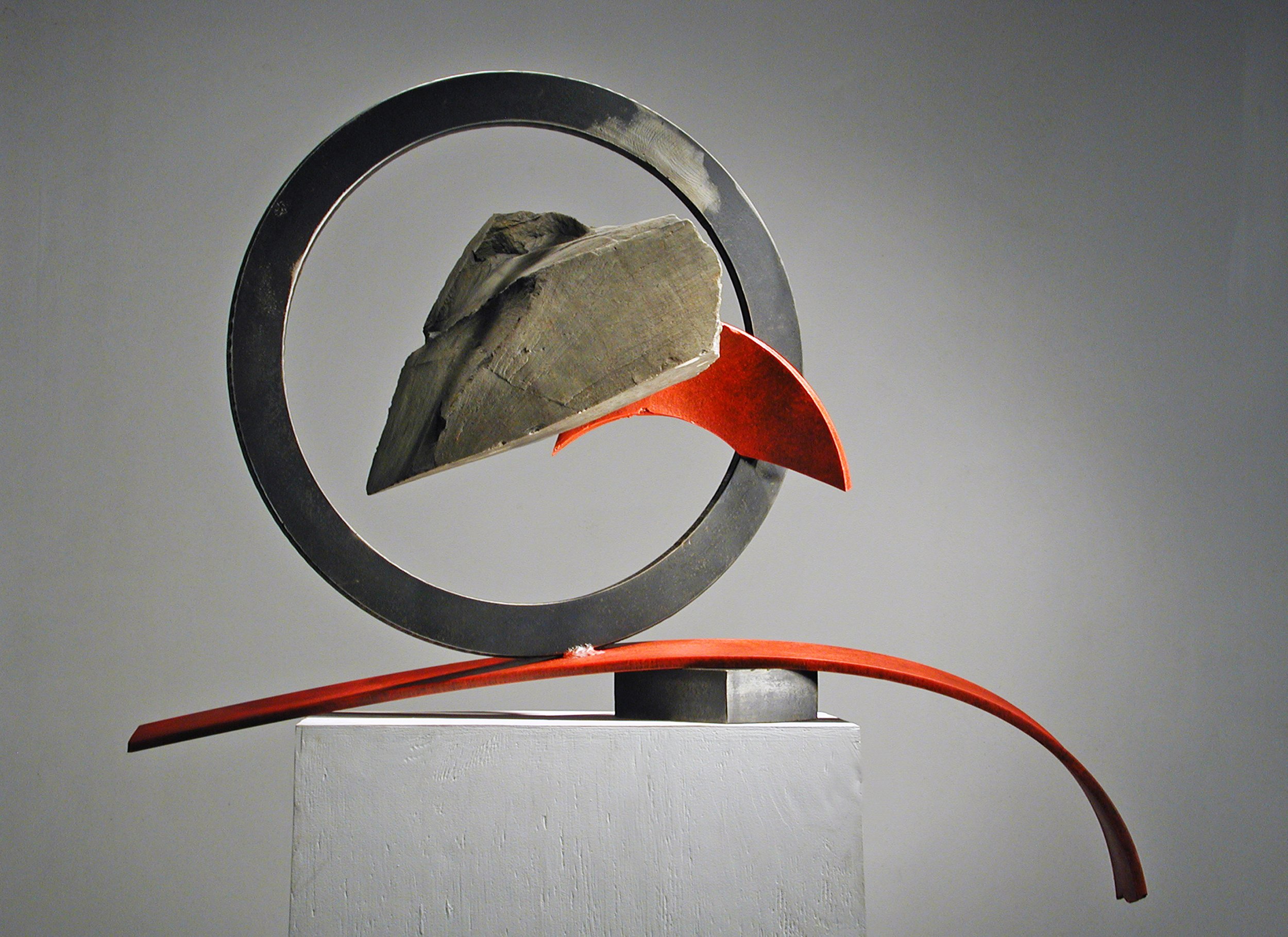
December 2008. River stone, pigmented steel, 11.5 × 16 × 5 in (29 × 41 × 13 cm). Private Collection-Germany.
The Sisyphean Series
The Greek myth of Sisyphus, condemned to endlessly push a boulder uphill, has inspired more than 250 of my sculptures. Rather than seeing the myth as a symbol of futility, I share philosopher Albert Camus’s more positive interpretation—that meaning and fulfillment can be found in the struggle itself. In many ways, I see Sisyphus as autobiographical, reflecting my lifelong pursuit as an artist, confronting challenges, taking risks, and finding purpose in the act of creation.
My Sisyphean works bring stone and steel together in precarious yet stable arrangements, often incorporating circular forms suggesting perpetual motion. For me, they are metaphors for the creative process—an ongoing cycle of experimentation, discovery, setbacks, and renewal. Each completed sculpture is both an achievement and a starting point, celebrating the journey rather than simply the destination.
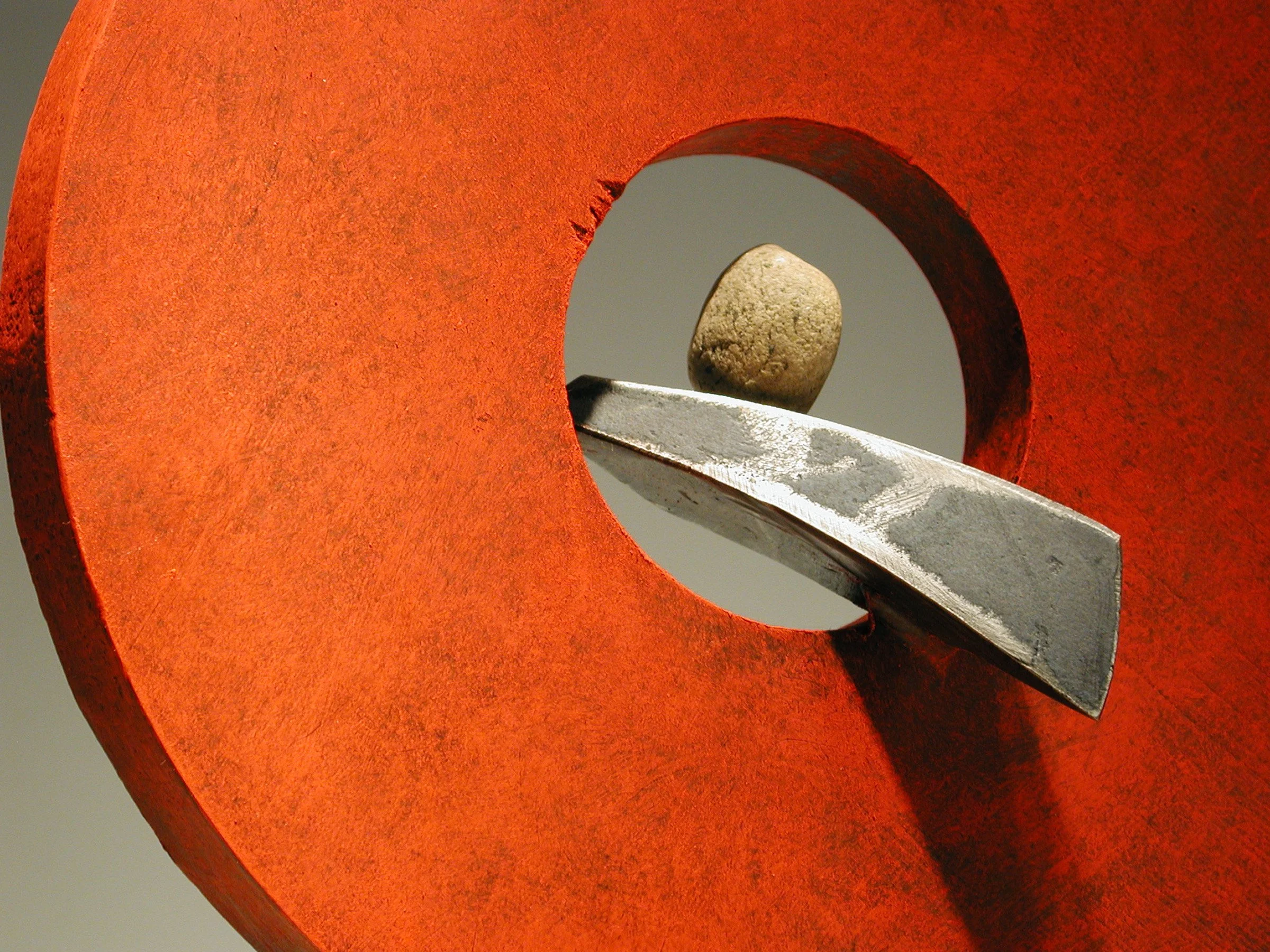
December 2008. Slate, pigmented steel. Dimensions: 22 × 35 × 0 in (56 × 89 × 0 cm). Private Collection.
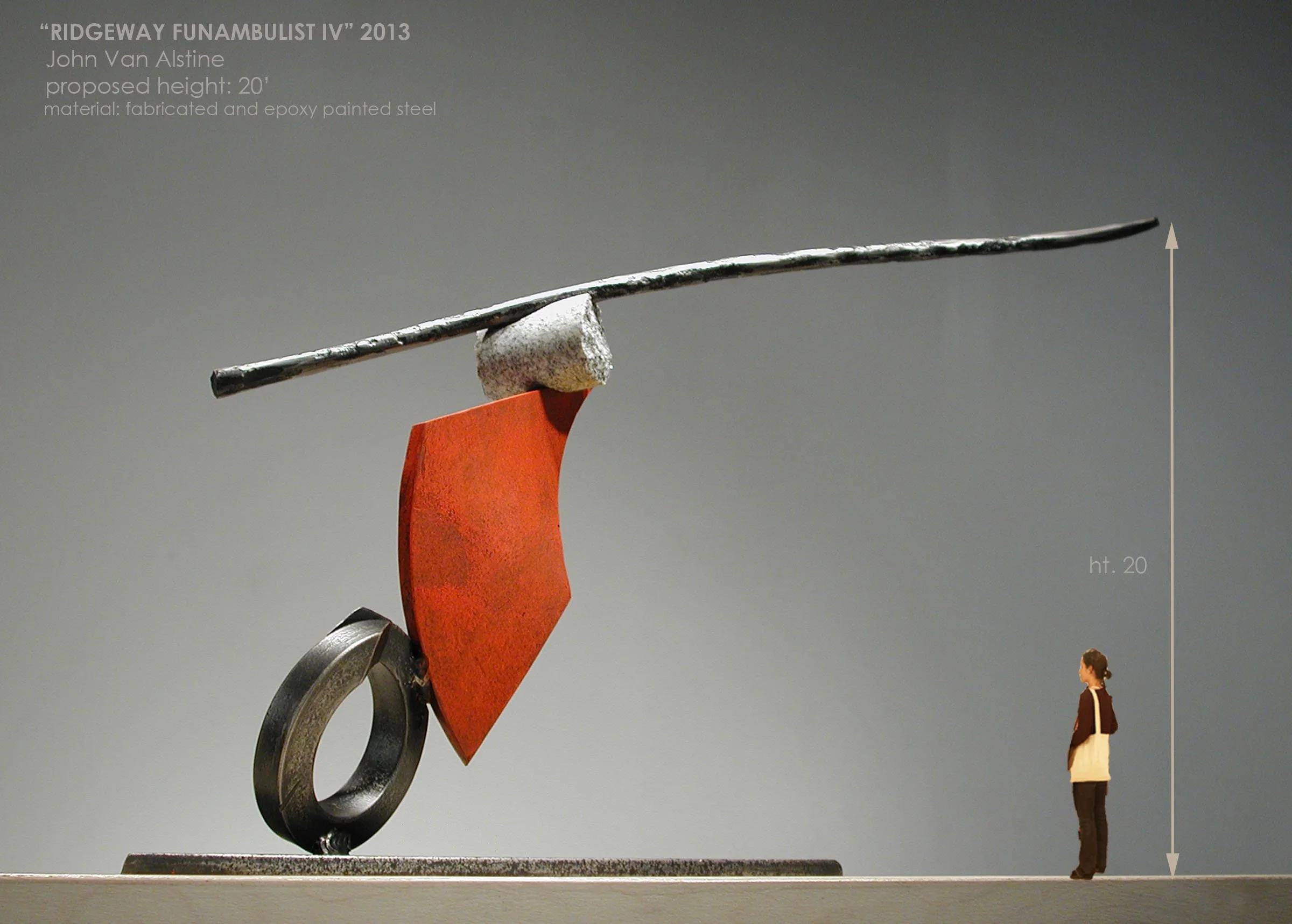
December 2008. Granite, pigmented and sealed steel. Dimensions: 13 × 20 × 6 in (33 × 51 × 15 cm). Private Collection - Ohio
The title derives from two Latin words—fūnis, meaning “rope,” and ambulāre, “to walk”—and refers to a tightrope walker. The meaning is reinforced by the sculpture’s dynamic horizontal “balancing baton” and its overall sense of precarious poise. It evokes the physical balance, agility, and daring of a circus performer, while perhaps more poignantly suggesting mental agility—the ability to maintain equilibrium amid uncertainty and change.
A celebrated modern funambulist is Philippe Petit, who became famous for his unauthorized high-wire walk between the Twin Towers of New York’s World Trade Center on August 7, 1974. His feat became an enduring image of extraordinary balance, concentration, risk, and resolve.
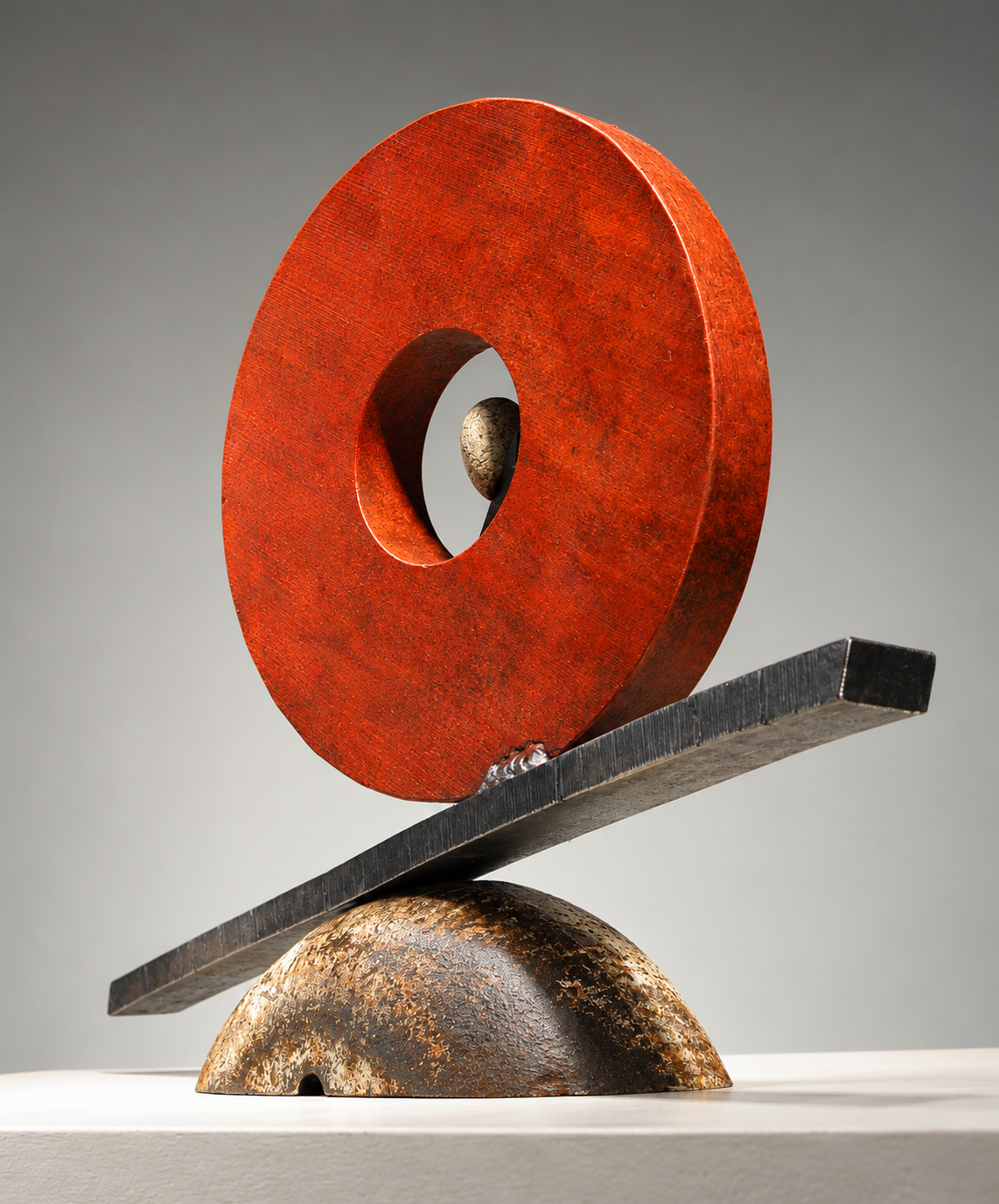
December 2008. River stone, pigmented steel. Dimensions: 13 × 31 × 6 in (33 × 79 × 15 cm). Private Collection Scottsdale, AZ.
The Sisyphean Series
The Greek myth of Sisyphus, condemned to endlessly push a boulder uphill, has inspired more than 250 of my sculptures. Rather than seeing the myth as a symbol of futility, I share philosopher Albert Camus’s more positive interpretation—that meaning and fulfillment can be found in the struggle itself. In many ways, I see Sisyphus as autobiographical, reflecting my lifelong pursuit as an artist, confronting challenges, taking risks, and finding purpose in the act of creation.
My Sisyphean works bring stone and steel together in precarious yet stable arrangements, often incorporating circular forms suggesting perpetual motion. For me, they are metaphors for the creative process—an ongoing cycle of experimentation, discovery, setbacks, and renewal. Each completed sculpture is both an achievement and a starting point, celebrating the journey rather than simply the destination.
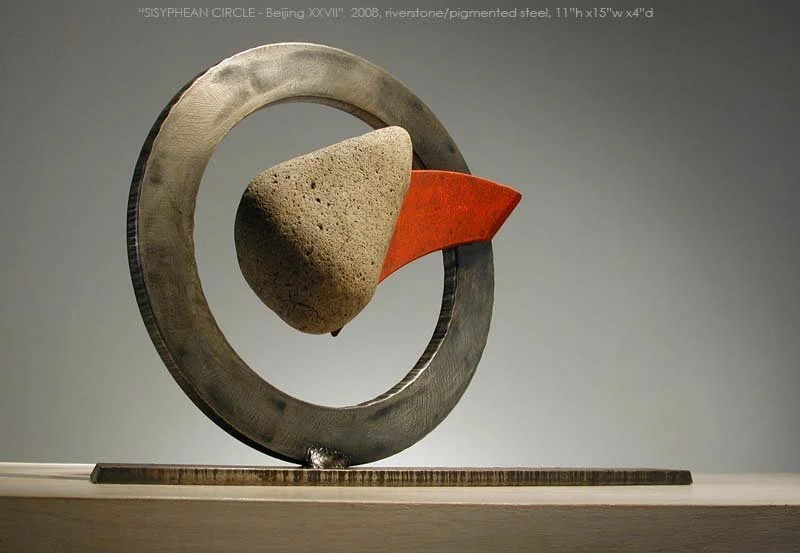
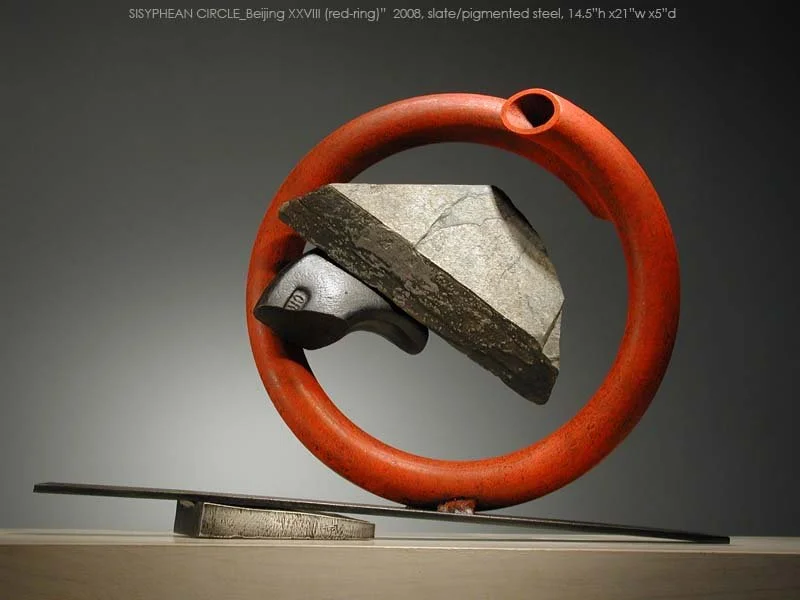
December 2008. Slate, pigmented steel. Dimensions: 14.5 × 21 × 5 in (37 × 53 × 13 cm). Private Collection.
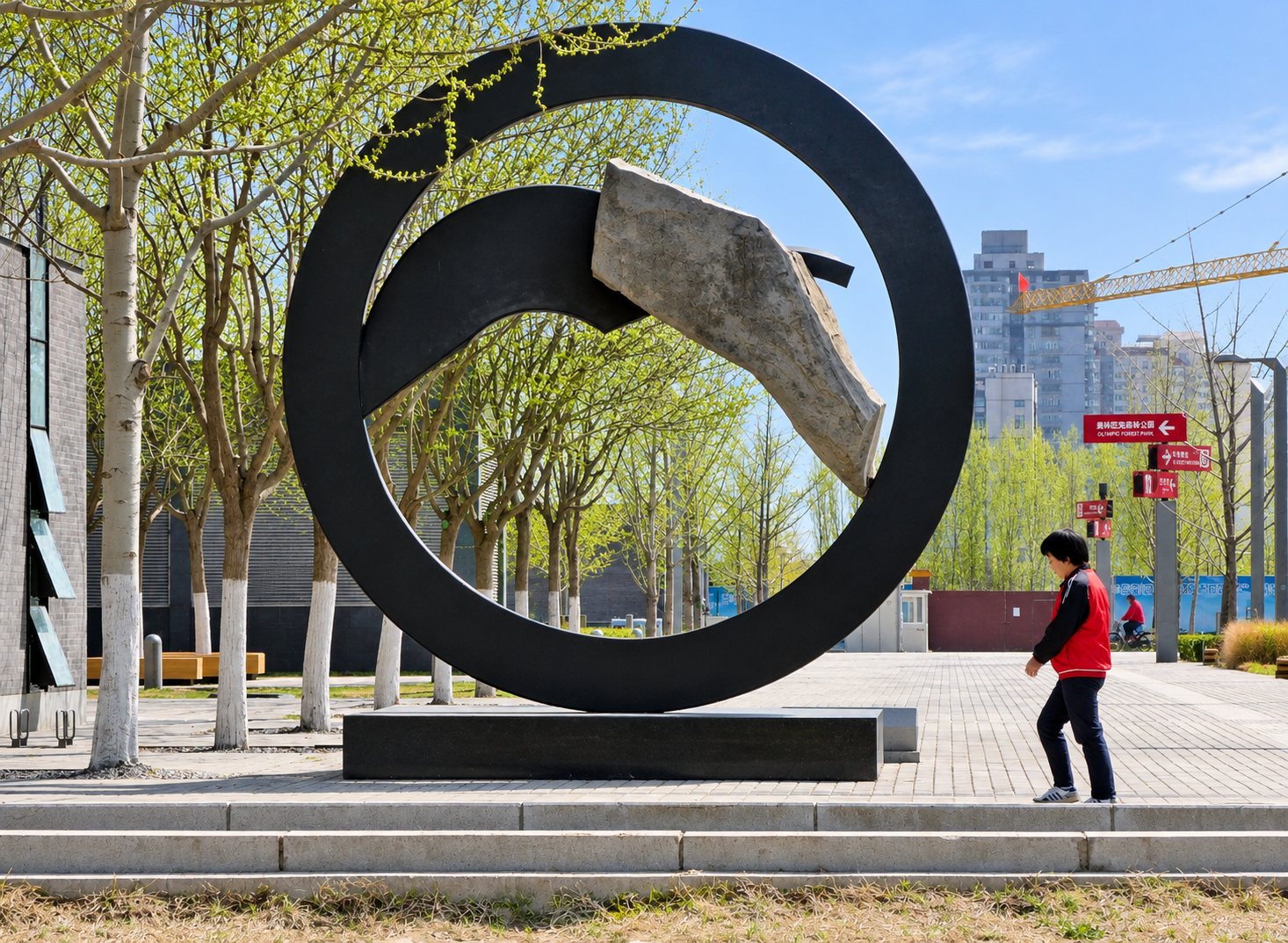
January 2008. steel, stone. Dimensions: 16 × 16 × 6 in (41 × 41 × 15 cm).
More info see: 2008 Beijing Olympic Commission
2007
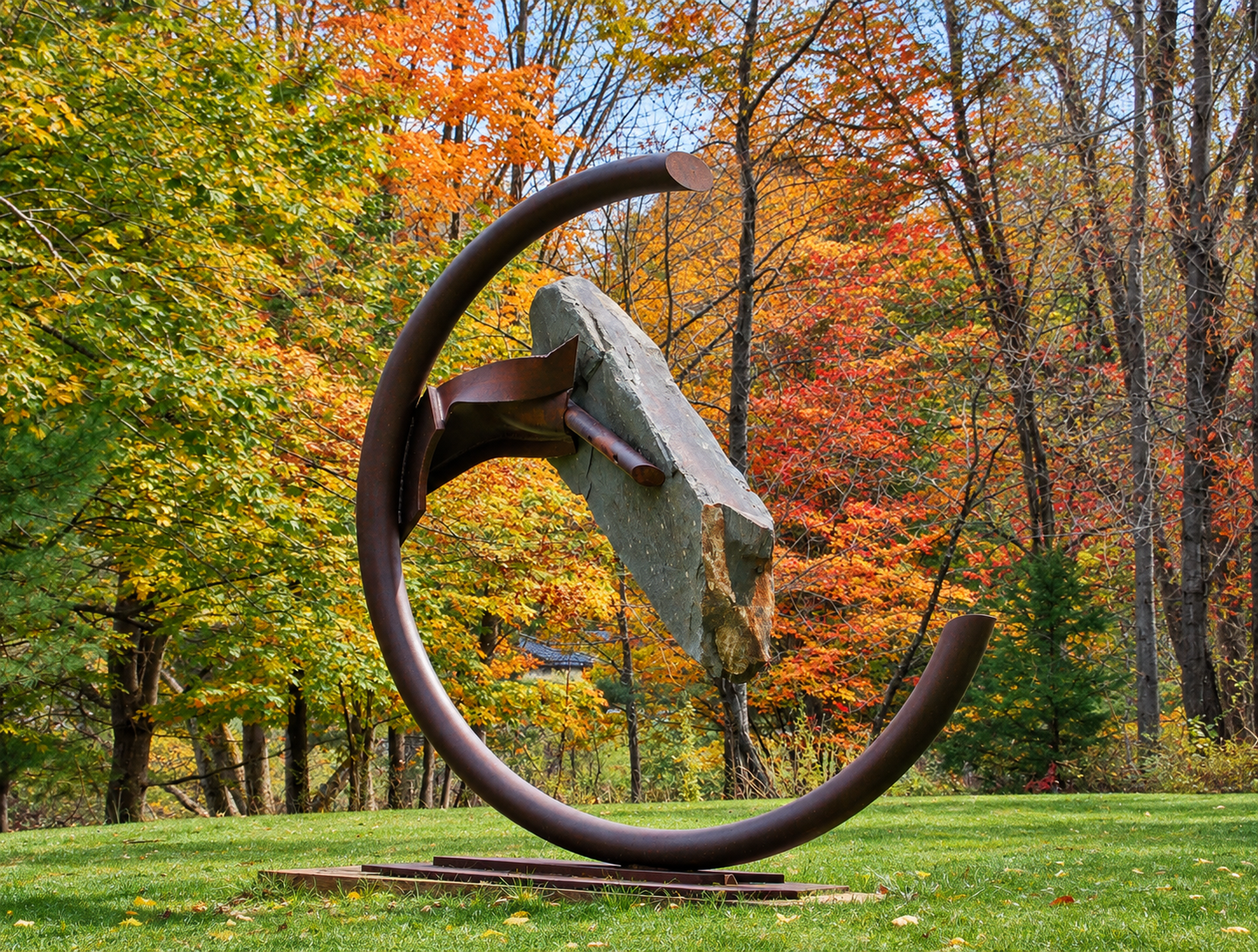
January 2007. Slate, steel. Dimensions: 78 × 82 × 24 in (198 × 208 × 61 cm).
The Sisyphean Series
The Greek myth of Sisyphus, condemned to endlessly push a boulder uphill, has inspired more than 250 of my sculptures. Rather than seeing the myth as a symbol of futility, I share philosopher Albert Camus’s more positive interpretation—that meaning and fulfillment can be found in the struggle itself. In many ways, I see Sisyphus as autobiographical, reflecting my lifelong pursuit as an artist, confronting challenges, taking risks, and finding purpose in the act of creation.
My Sisyphean works bring stone and steel together in precarious yet stable arrangements, often incorporating circular forms suggesting perpetual motion. For me, they are metaphors for the creative process—an ongoing cycle of experimentation, discovery, setbacks, and renewal. Each completed sculpture is both an achievement and a starting point, celebrating the journey rather than simply the destination.
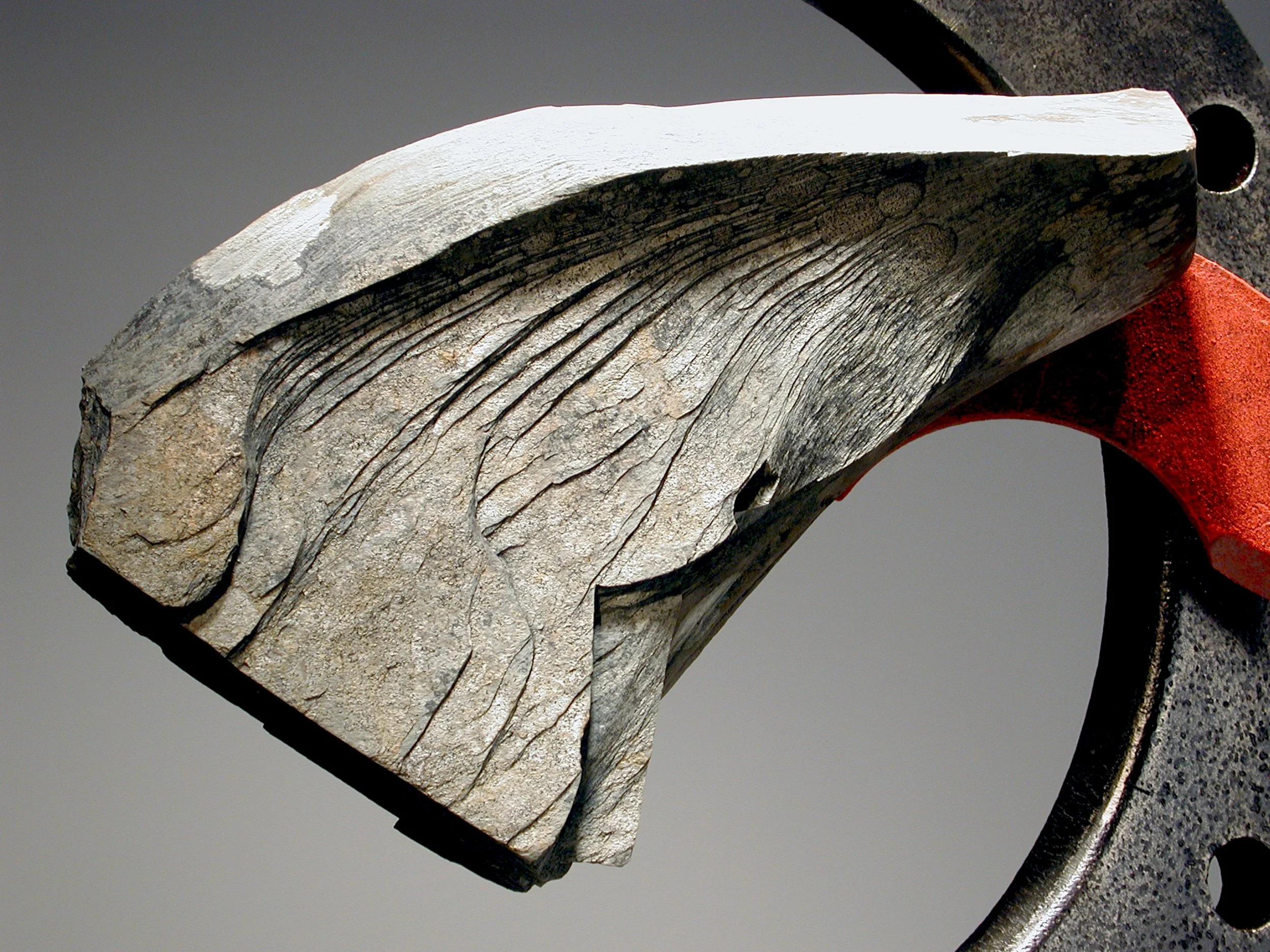
January 2007. Slate, pigmented steel. Dimensions: 15.5 × 23 × 8 in (39 × 58 × 20 cm). Private Collection.
The Sisyphean Series
The Greek myth of Sisyphus, condemned to endlessly push a boulder uphill, has inspired more than 250 of my sculptures. Rather than seeing the myth as a symbol of futility, I share philosopher Albert Camus’s more positive interpretation—that meaning and fulfillment can be found in the struggle itself. In many ways, I see Sisyphus as autobiographical, reflecting my lifelong pursuit as an artist, confronting challenges, taking risks, and finding purpose in the act of creation.
My Sisyphean works bring stone and steel together in precarious yet stable arrangements, often incorporating circular forms suggesting perpetual motion. For me, they are metaphors for the creative process—an ongoing cycle of experimentation, discovery, setbacks, and renewal. Each completed sculpture is both an achievement and a starting point, celebrating the journey rather than simply the destination.
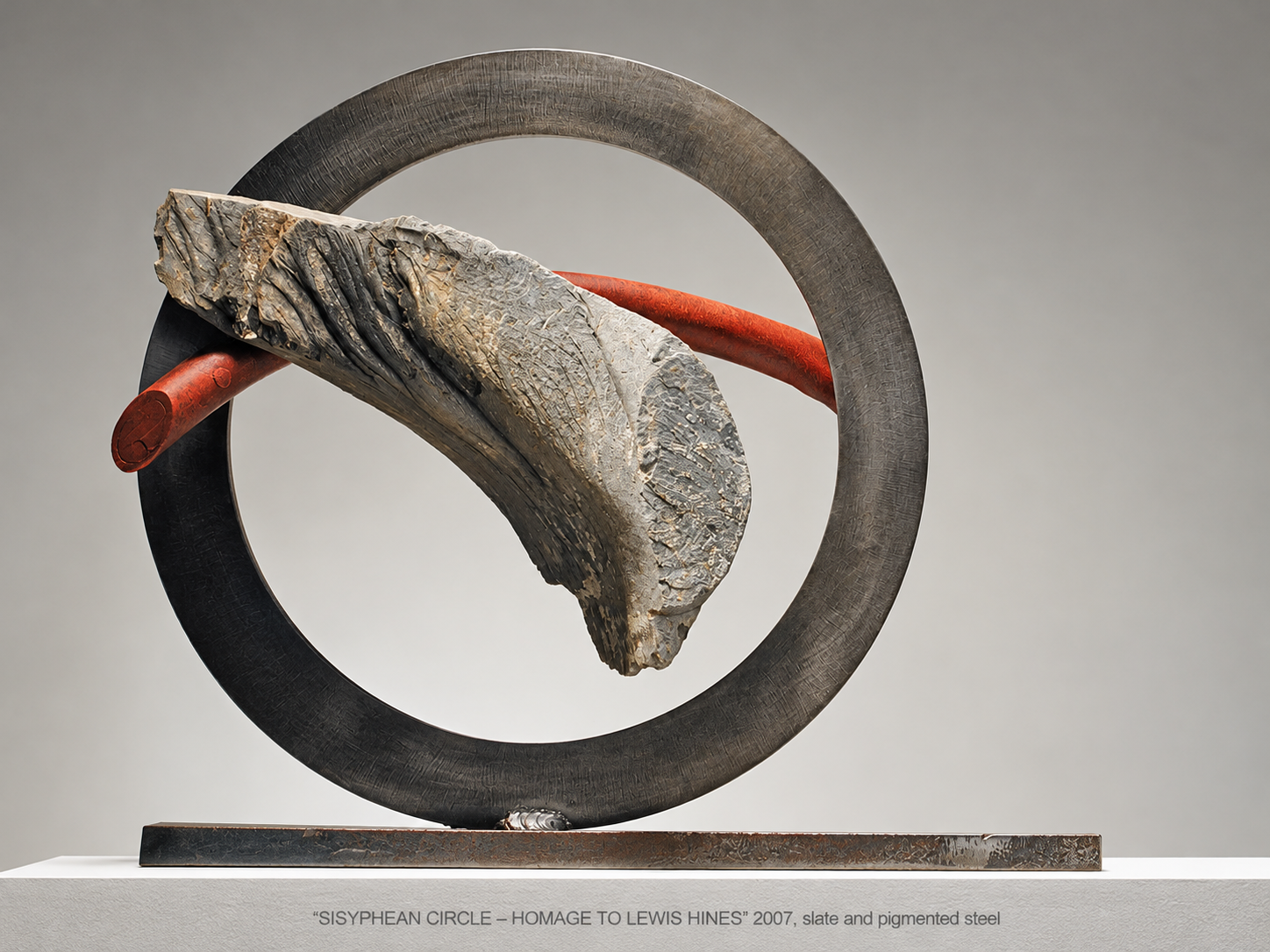
January 2007. Slate, steel. Dimensions: 21 × 29 × 7 in (53 × 74 × 18 cm). Private Collection.
Sisyphean Circle – Homage to Lewis Hine (2007) pays tribute to photographer Lewis W. Hine and his iconic image Powerhouse Mechanic (1920). The sculpture echoes the photograph’s powerful circular composition and the physical relationship between the worker and industrial machinery. Beyond this visual connection, the work honors Hine’s celebration of the dignity, strength, and perseverance of working people—qualities that resonate with my broader interpretation of the Sisyphean myth.
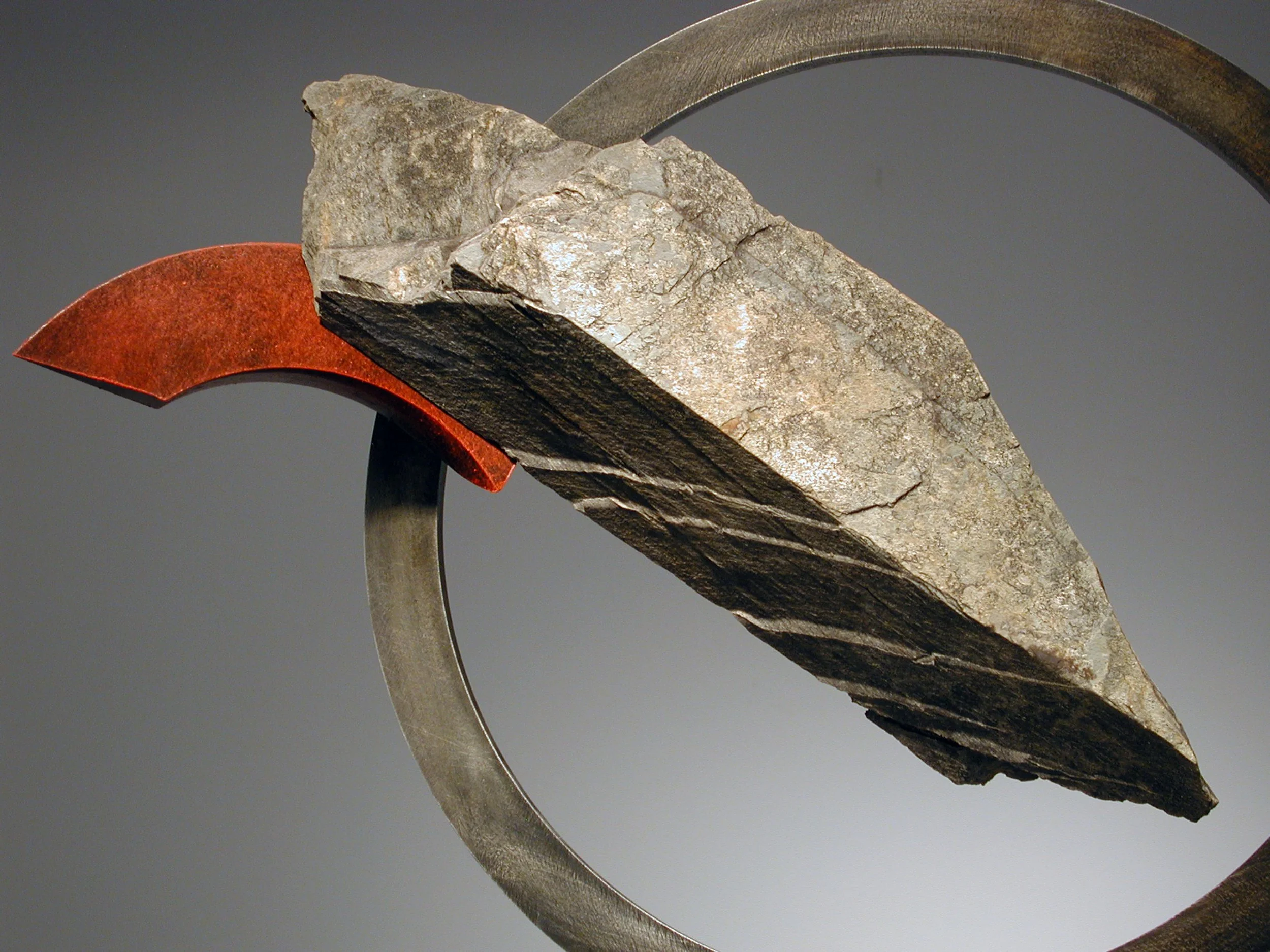
February 2007. Slate, steel. Dimensions: 19 × 24 × 14 in (48 × 61 × 36 cm). Private Collection California.
The Sisyphean Series
The Greek myth of Sisyphus, condemned to endlessly push a boulder uphill, has inspired more than 250 of my sculptures. Rather than seeing the myth as a symbol of futility, I share philosopher Albert Camus’s more positive interpretation—that meaning and fulfillment can be found in the struggle itself. In many ways, I see Sisyphus as autobiographical, reflecting my lifelong pursuit as an artist, confronting challenges, taking risks, and finding purpose in the act of creation.
My Sisyphean works bring stone and steel together in precarious yet stable arrangements, often incorporating circular forms suggesting perpetual motion. For me, they are metaphors for the creative process—an ongoing cycle of experimentation, discovery, setbacks, and renewal. Each completed sculpture is both an achievement and a starting point, celebrating the journey rather than simply the destination.
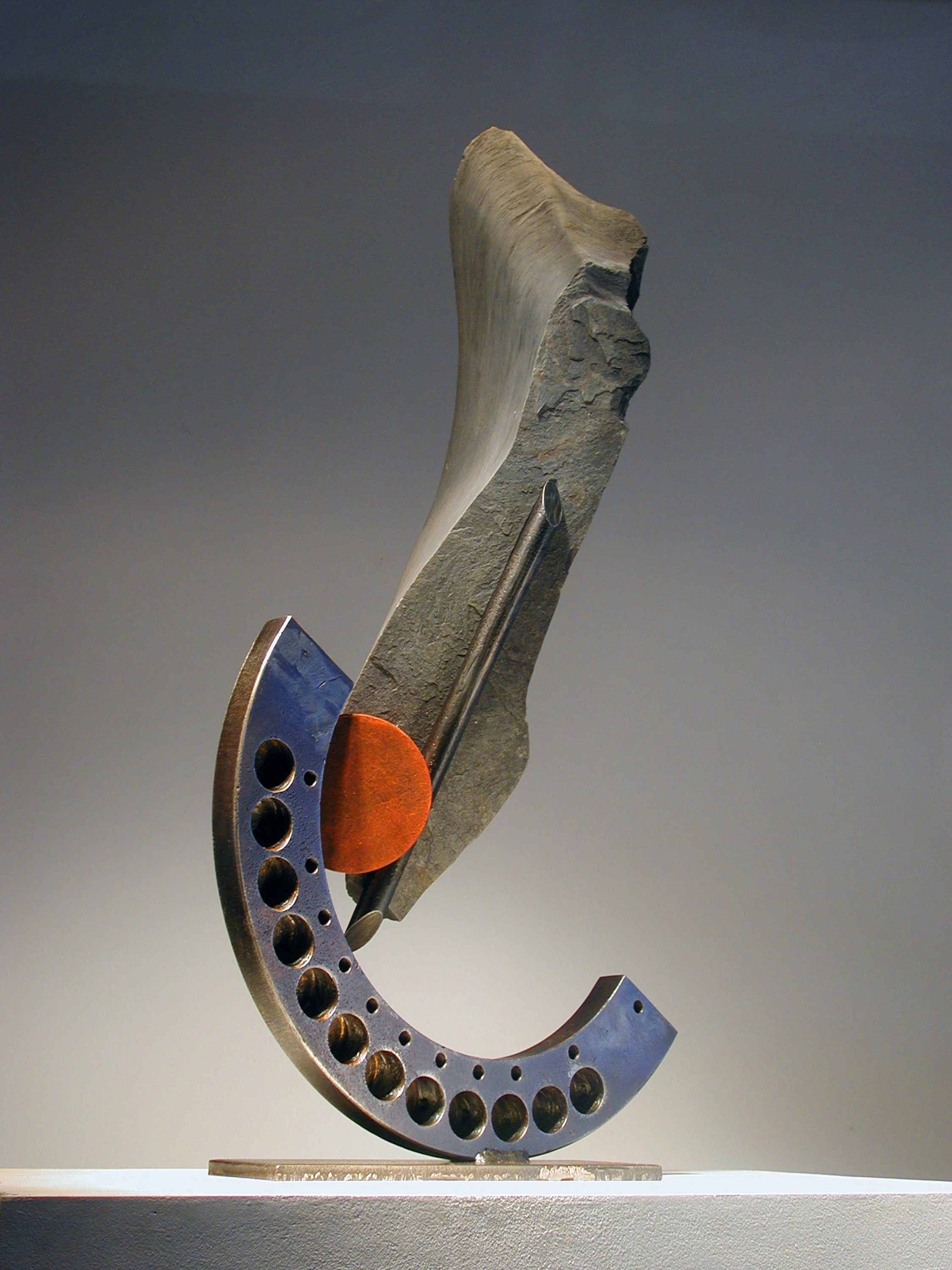
March 2007. Slate, steel. Dimensions: 39 × 20 × 8 in (99 × 51 × 20 cm). Private Collection.
Hula V, is part of a long-running series exploring my interest in the expressive movement of the human body. Like works inspired by dance, gymnastics, and fencing, it uses balance, gesture, and implied motion rather than literal figuration. The circular steel element and sweeping base suggest the rhythmic rotation associated with the hula hoop, while the vertical slate gives the composition a bodily presence.
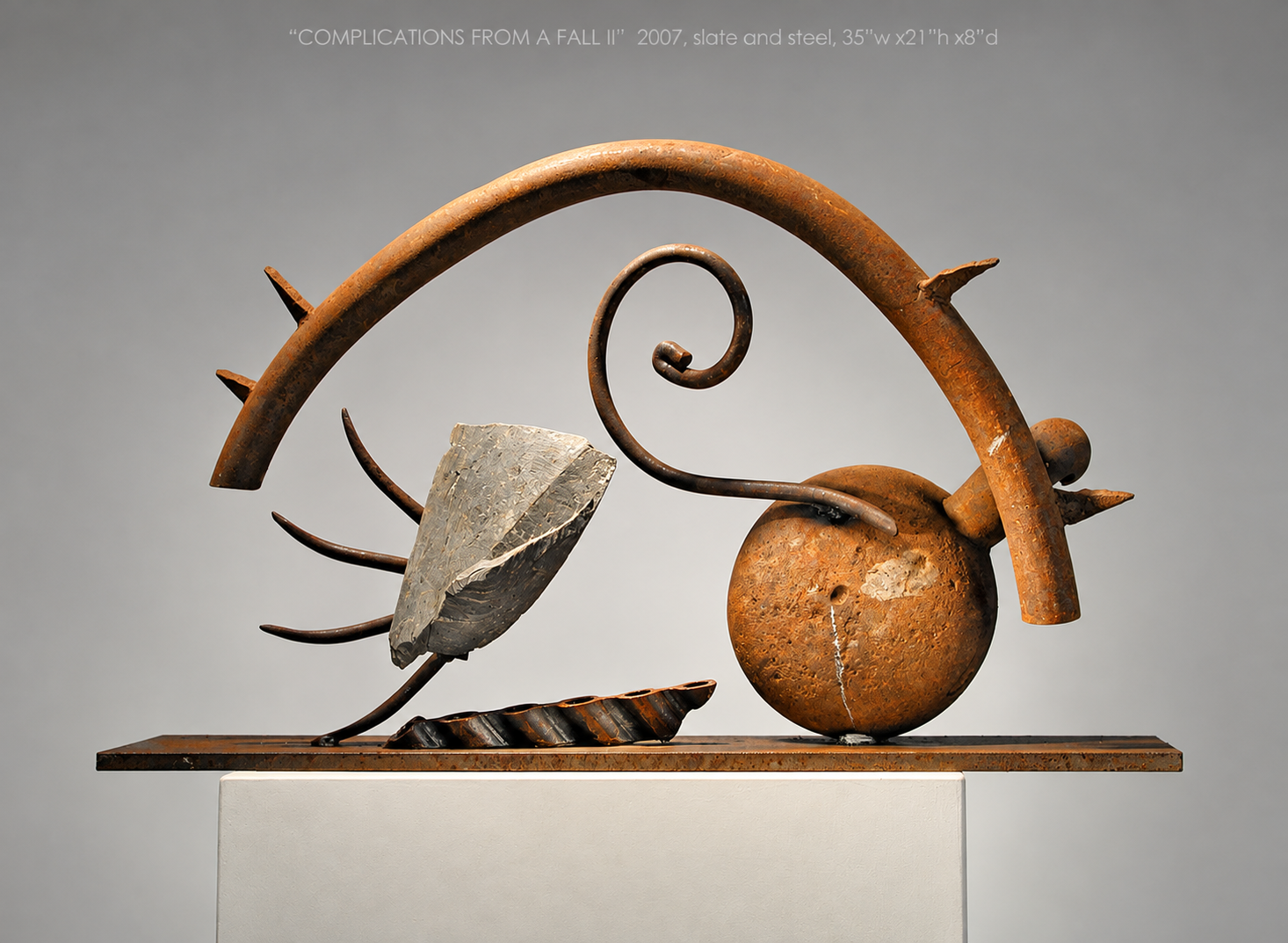
March 2007. Vermont slate, steel. Dimensions: 21 × 35 × 8 in (53 × 89 × 20 cm). Private Collection.
Complications from a Fall II (2007)
Complications from a Fall II is a more narrative and autobiographical work than most of my sculptures, inspired by an unfortunate experience involving a good friend. After a long hiatus from skiing, he purchased an array of expensive equipment, only to fall before taking his first run. He was evacuated by medical helicopter and never skied again. Ironically, he had been with me when I found several of the objects incorporated into this sculpture.
The swirling, precariously balanced elements suggest a chaotic moment of arrested motion, with the curved steel, spiraling forms, and heavy objects implying a sudden loss of control. While rooted in a personal experience, the sculpture speaks more broadly to the familiar phrase “complications from a fall” and the unexpected consequences of a single misstep—particularly relevant to those of us living in northern climates.
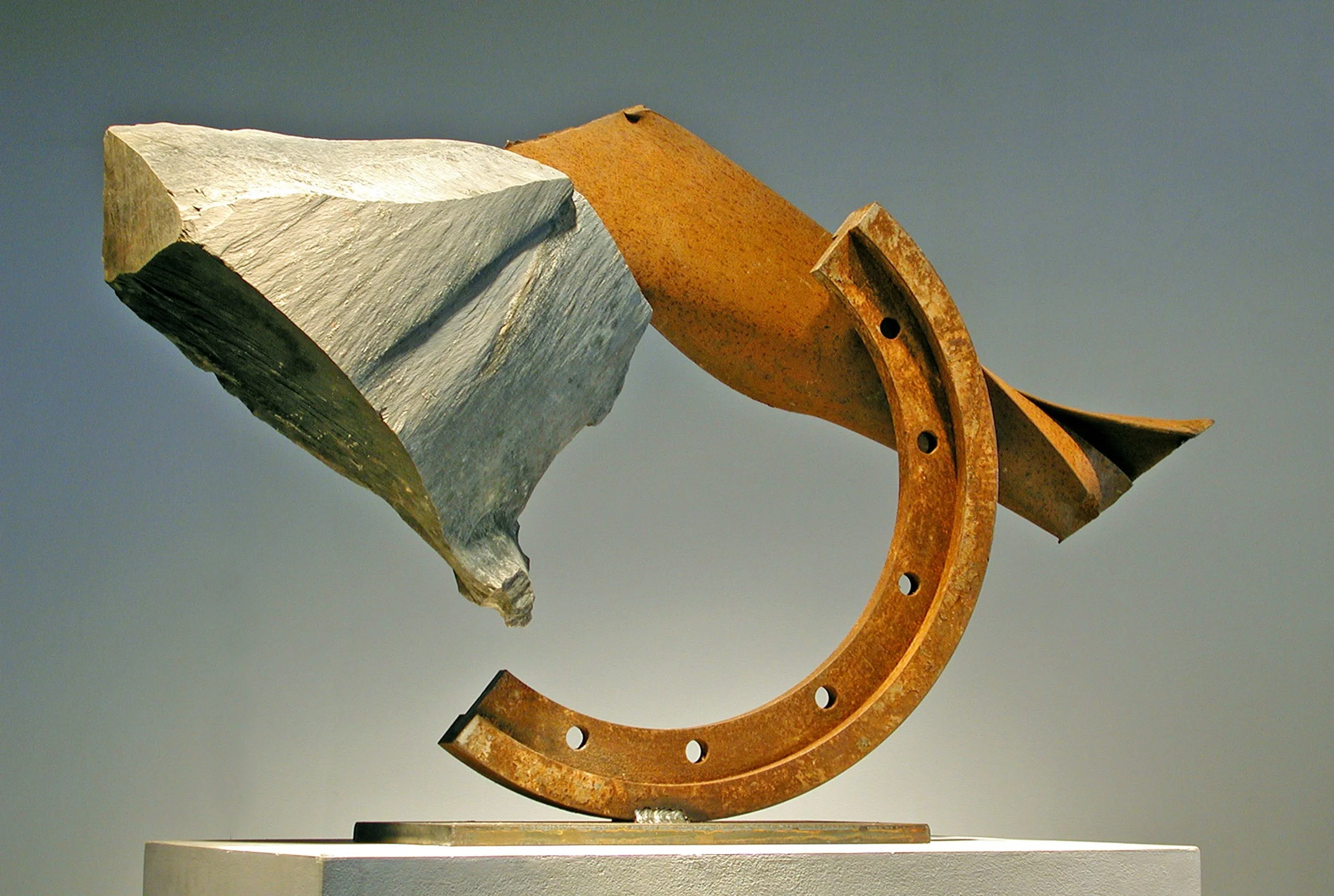
March 2007. Slate, pigmented steel. Dimensions: 29 × 48 × 10 in (74 × 122 × 25 cm). Private Collection.
The Sisyphean Series
The Greek myth of Sisyphus, condemned to endlessly push a boulder uphill, has inspired more than 250 of my sculptures. Rather than seeing the myth as a symbol of futility, I share philosopher Albert Camus’s more positive interpretation—that meaning and fulfillment can be found in the struggle itself. In many ways, I see Sisyphus as autobiographical, reflecting my lifelong pursuit as an artist, confronting challenges, taking risks, and finding purpose in the act of creation.
My Sisyphean works bring stone and steel together in precarious yet stable arrangements, often incorporating circular forms suggesting perpetual motion. For me, they are metaphors for the creative process—an ongoing cycle of experimentation, discovery, setbacks, and renewal. Each completed sculpture is both an achievement and a starting point, celebrating the journey rather than simply the destination.
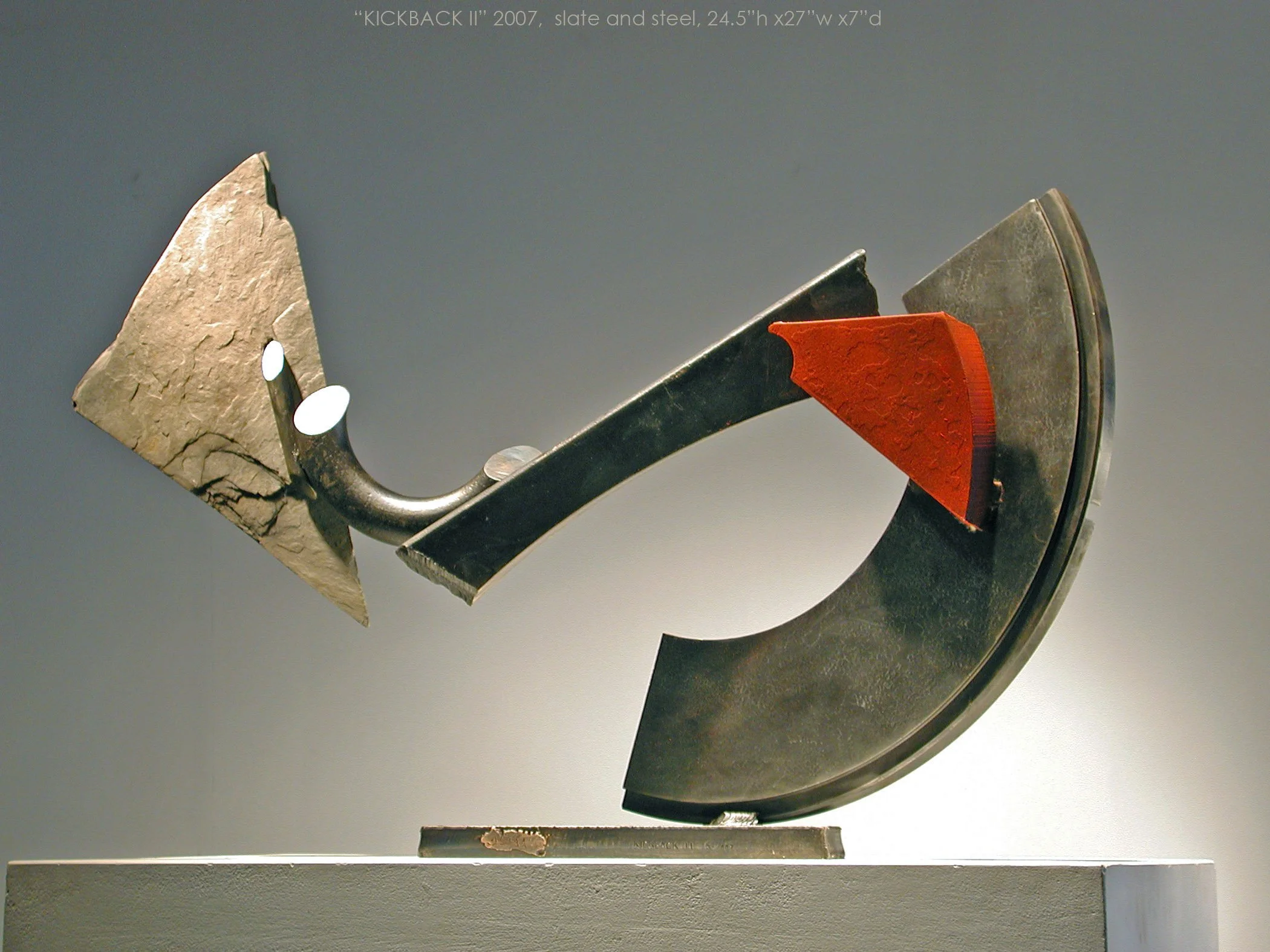
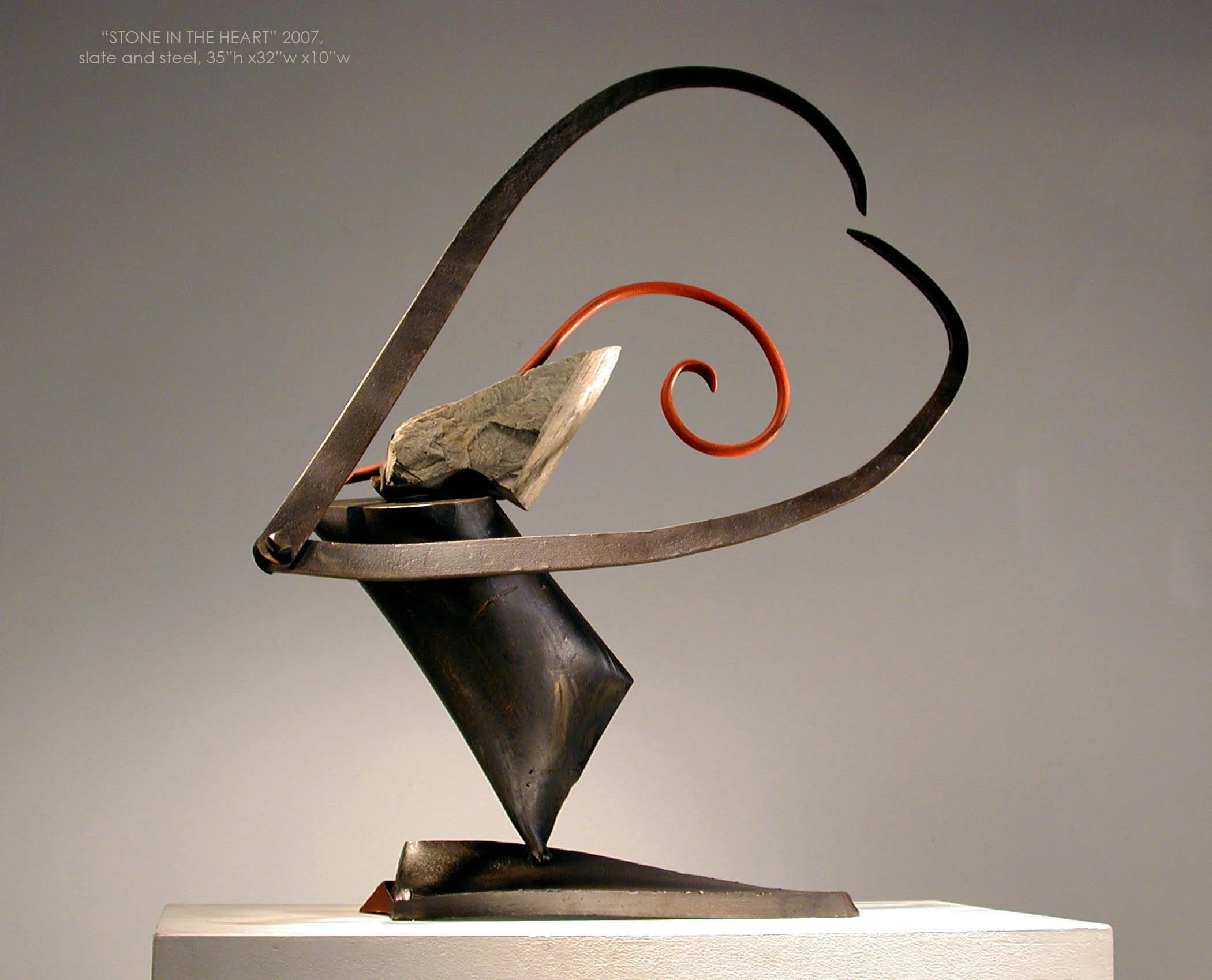
March 2007. Slate and pigmented steel, 35.5 x 32 x10 in (90 x 81 x 25 cm). Private Collection Vermont.
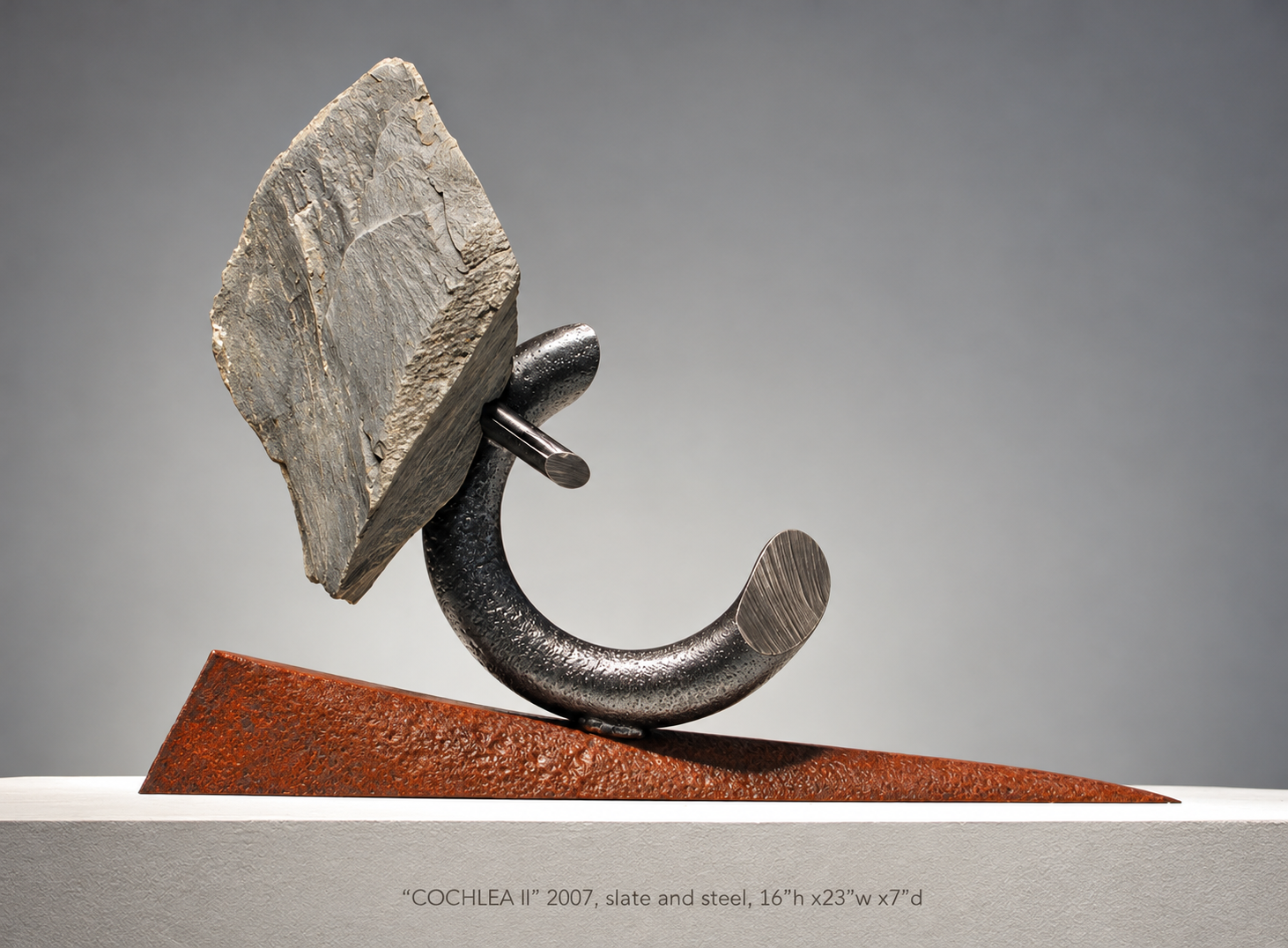
March 2007. Slate, steel. Dimensions: 16 × 23 × 7 in (41 × 58 × 18 cm).
Cochlea comes from Latin, meaning “snail” or “snail shell.” The word derives from Greek kokhlias, also referring to a spiral snail shell.
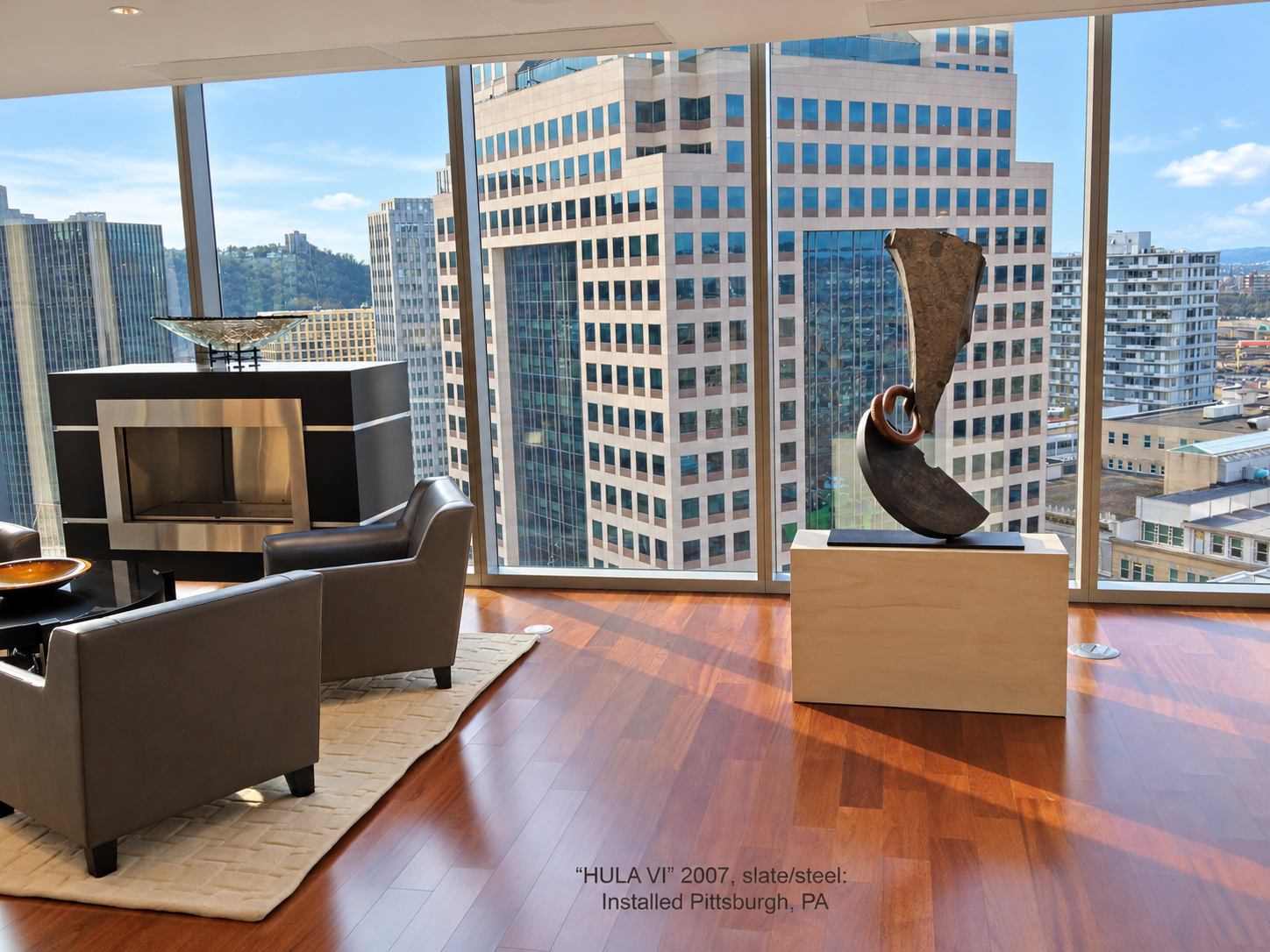
March 2007. Slate, pigmented steel. Dimensions: 47 × 21 × 13 in (119 × 53 × 33 cm). Corporate Collection: Pittsburgh, PA
Hula VI (Heavy Hips), is part of a long-running series exploring my interest in the expressive movement of the human body. Like works inspired by dance, gymnastics, and fencing, it uses balance, gesture, and implied motion rather than literal figuration. The circular steel element and sweeping base suggest the rhythmic rotation associated with the hula hoop, while the vertical slate gives the composition a bodily presence.
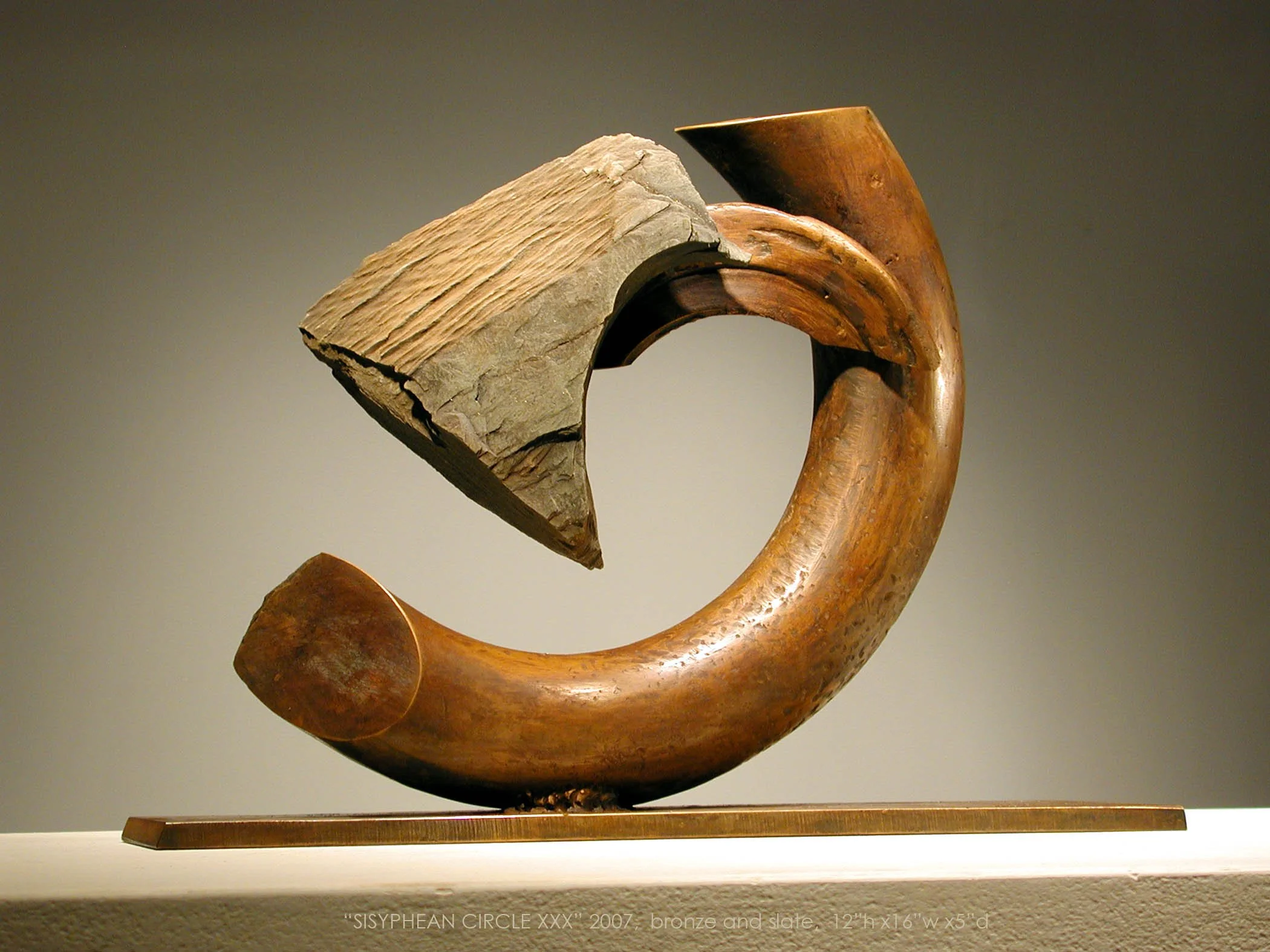
April 2007. Bronze, slate. Dimensions: 12 × 16 × 5 in (30 × 41 × 13 cm). Private Collection.
The Sisyphean Series
The Greek myth of Sisyphus, condemned to endlessly push a boulder uphill, has inspired more than 250 of my sculptures. Rather than seeing the myth as a symbol of futility, I share philosopher Albert Camus’s more positive interpretation—that meaning and fulfillment can be found in the struggle itself. In many ways, I see Sisyphus as autobiographical, reflecting my lifelong pursuit as an artist, confronting challenges, taking risks, and finding purpose in the act of creation.
My Sisyphean works bring stone and steel together in precarious yet stable arrangements, often incorporating circular forms suggesting perpetual motion. For me, they are metaphors for the creative process—an ongoing cycle of experimentation, discovery, setbacks, and renewal. Each completed sculpture is both an achievement and a starting point, celebrating the journey rather than simply the destination.
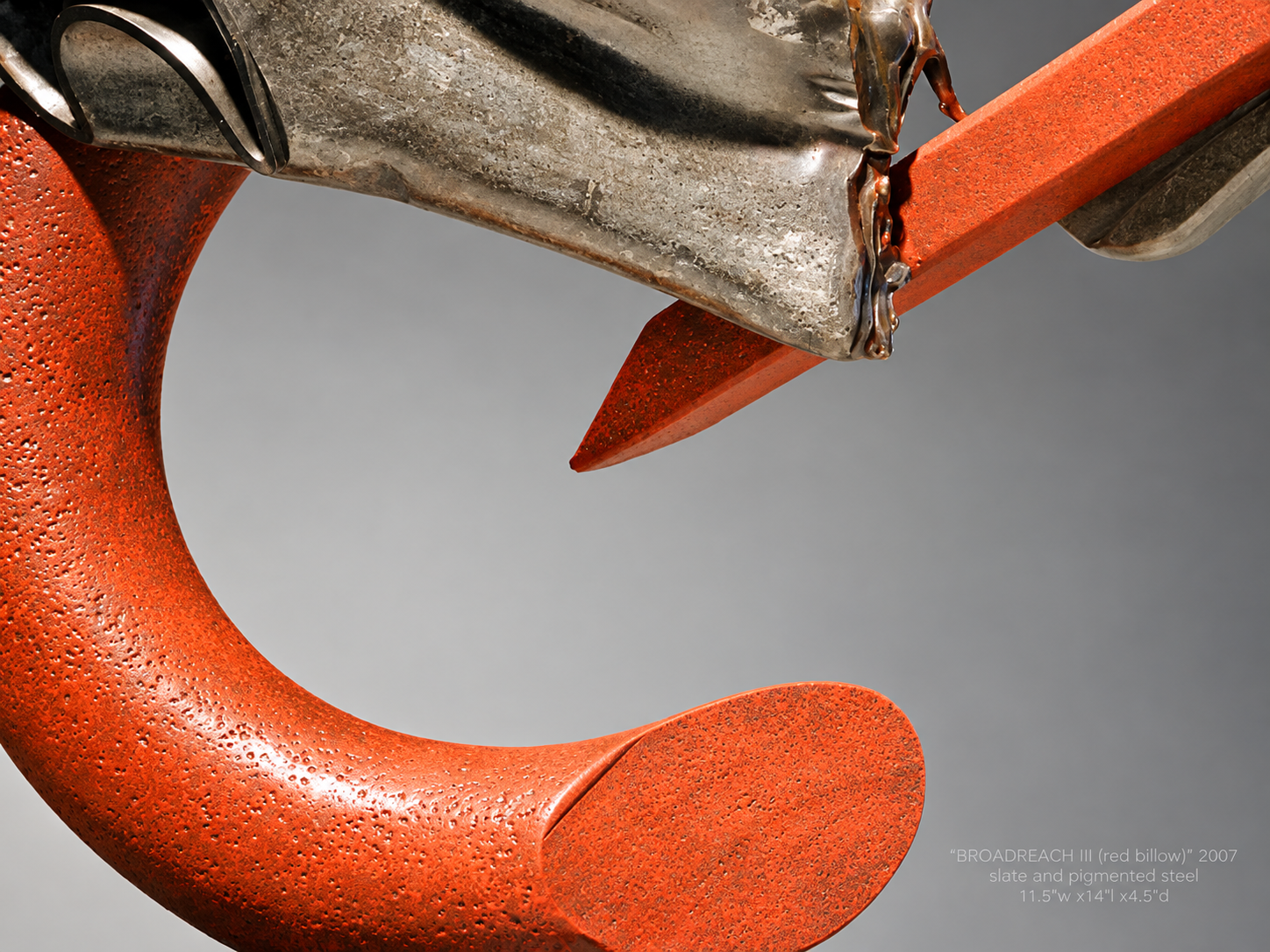
April 2007. Slate, steel. Dimensions: 11.5 × 14 × 4.5 in (29 × 36 × 11 cm). Collection: Adirondack Museum, Blue Mt. Lake, NY
The Broadreach Series and specifically Broadreach III (Red Billow), was inspired by my sailing in the Adirondack. As I understand the term, it is the “run” you make after you have worked hard tacking back and forth and finally reach a point when you can let out the big spinnaker sail (abstractly portrayed in the sculpture by the curving red round element), lean back and “go with the wind”. It is the time to kick back and enjoy the fruits of ones labors. “Millertime!”
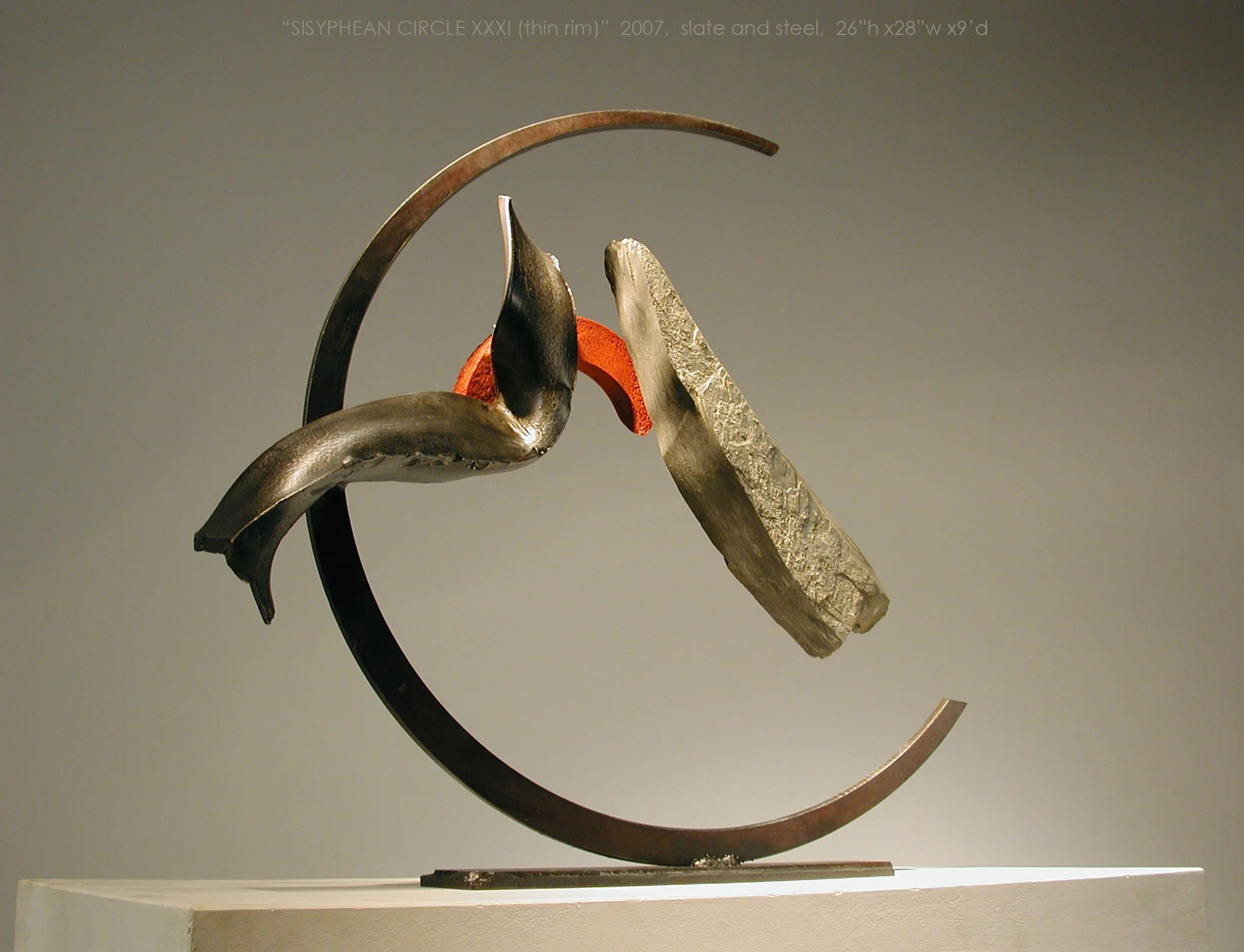
April 2007. Slate, steel. Dimensions: 26 × 29 × 8 in (66 × 74 × 20 cm). Private Collection.
The Sisyphean Series
The Greek myth of Sisyphus, condemned to endlessly push a boulder uphill, has inspired more than 250 of my sculptures. Rather than seeing the myth as a symbol of futility, I share philosopher Albert Camus’s more positive interpretation—that meaning and fulfillment can be found in the struggle itself. In many ways, I see Sisyphus as autobiographical, reflecting my lifelong pursuit as an artist, confronting challenges, taking risks, and finding purpose in the act of creation.
My Sisyphean works bring stone and steel together in precarious yet stable arrangements, often incorporating circular forms suggesting perpetual motion. For me, they are metaphors for the creative process—an ongoing cycle of experimentation, discovery, setbacks, and renewal. Each completed sculpture is both an achievement and a starting point, celebrating the journey rather than simply the destination.
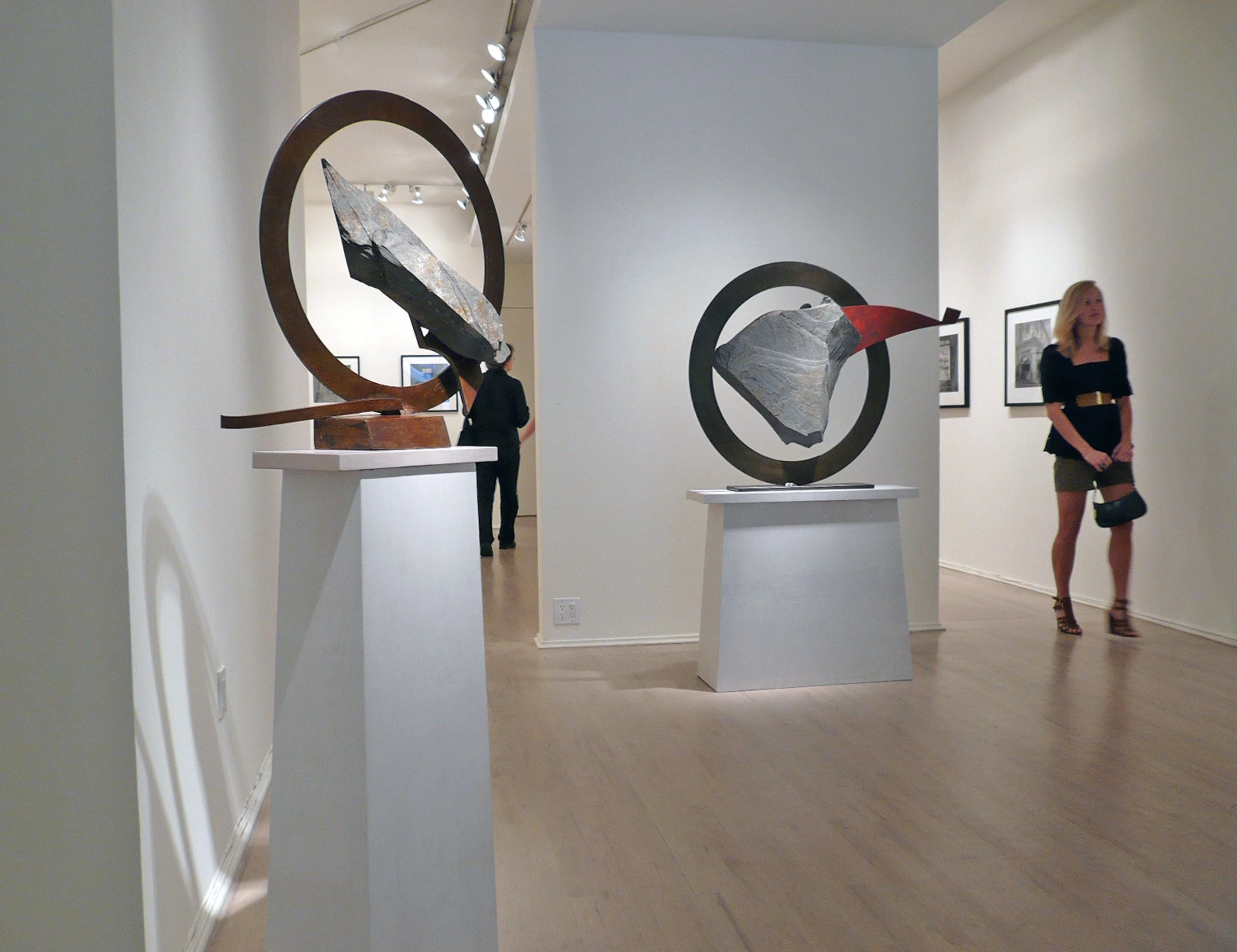
May 2007. Slate, steel. Dimensions: 37 × 47 × 10 in (94 × 119 × 25 cm). Private Collection.
The Sisyphean Series
The Greek myth of Sisyphus, condemned to endlessly push a boulder uphill, has inspired more than 250 of my sculptures. Rather than seeing the myth as a symbol of futility, I share philosopher Albert Camus’s more positive interpretation—that meaning and fulfillment can be found in the struggle itself. In many ways, I see Sisyphus as autobiographical, reflecting my lifelong pursuit as an artist, confronting challenges, taking risks, and finding purpose in the act of creation.
My Sisyphean works bring stone and steel together in precarious yet stable arrangements, often incorporating circular forms suggesting perpetual motion. For me, they are metaphors for the creative process—an ongoing cycle of experimentation, discovery, setbacks, and renewal. Each completed sculpture is both an achievement and a starting point, celebrating the journey rather than simply the destination.
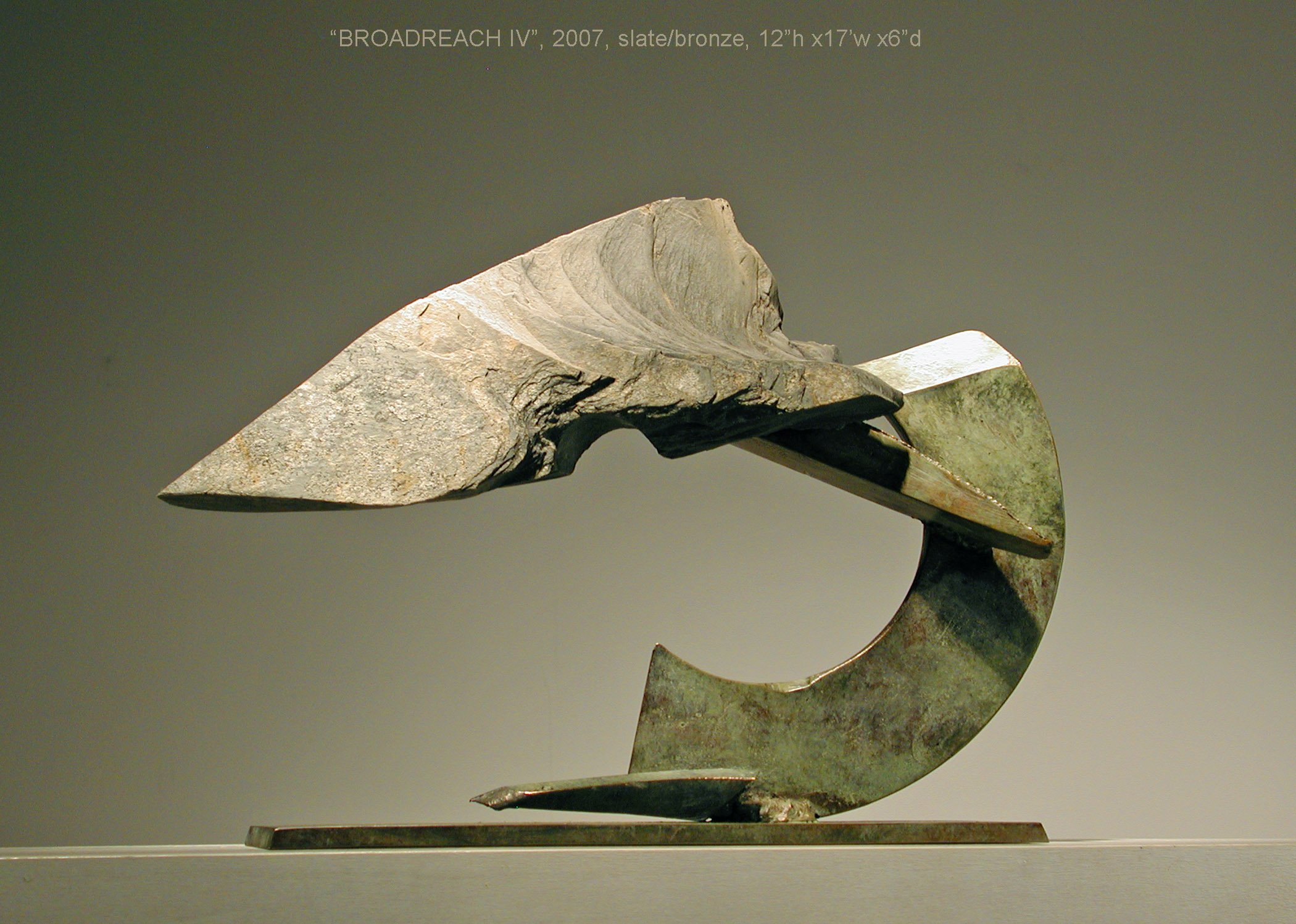
May 2007. Bronze, slate. Dimensions: 12 × 17 × 6 in (30 × 43 × 15 cm). Private Collection.
The Broadreach Series was inspired by my sailing in the Adirondack. As I understand the term, it is the “run” you make after you have worked hard tacking back and forth and finally reach a point when you can let out the big spinnaker sail (abstractly portrayed in the sculpture by the curving red round element), lean back and “go with the wind”. It is the time to kick back and enjoy the fruits of ones labors. “Millertime!”
The piece originally had a brown patina and later was rework green.
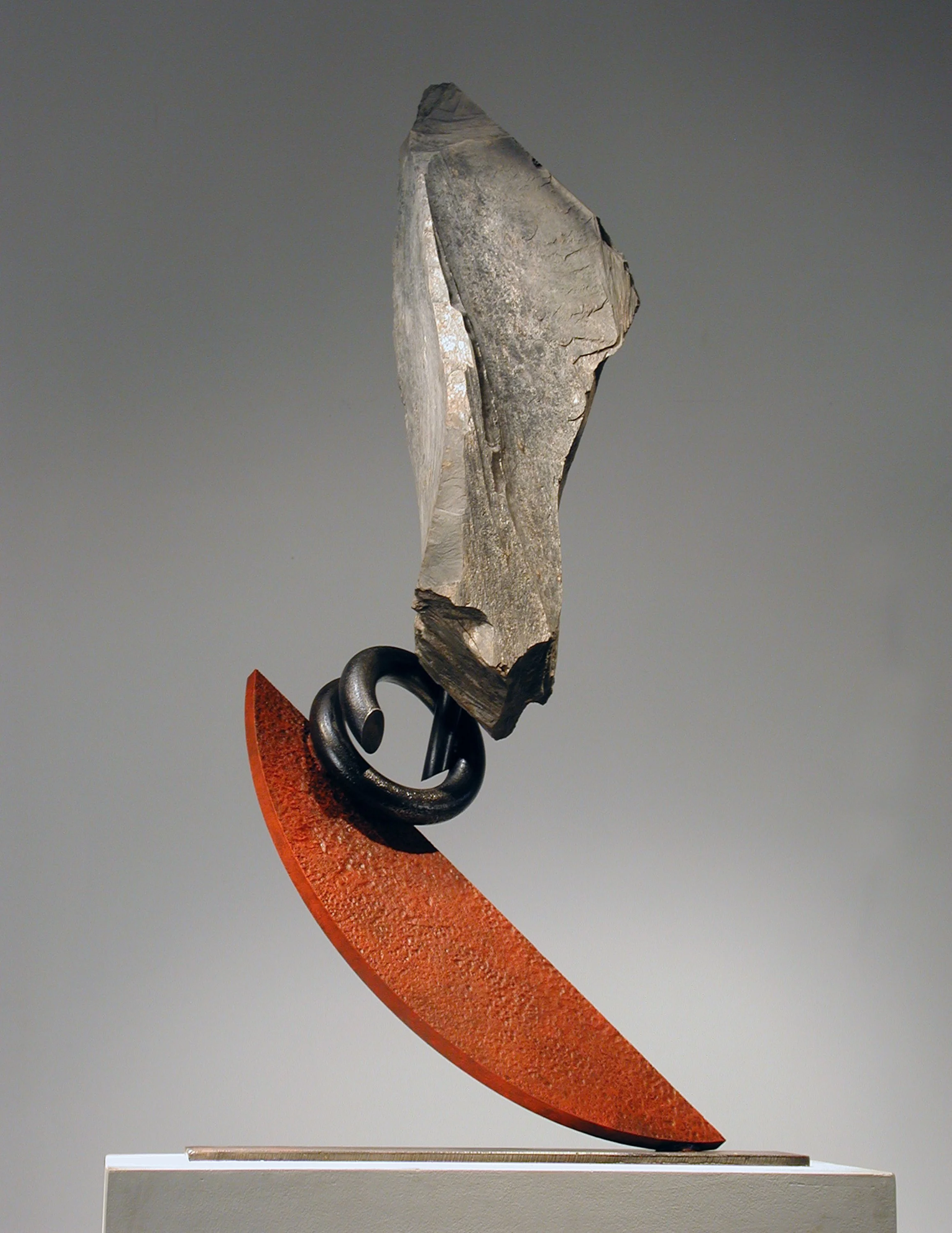
May 2007. Slate, steel. Dimensions: 52 × 22 × 13 in (132 × 56 × 33 cm). Private Collection.
Red Hips Hula, is part of long-running series exploring my interest in the expressive movement of the human body. Like works inspired by dance, gymnastics, and fencing, it uses balance, gesture, and implied motion rather than literal figuration. The circular steel element and sweeping base suggest the rhythmic rotation associated with the hula hoop, while the vertical slate gives the composition a bodily presence.
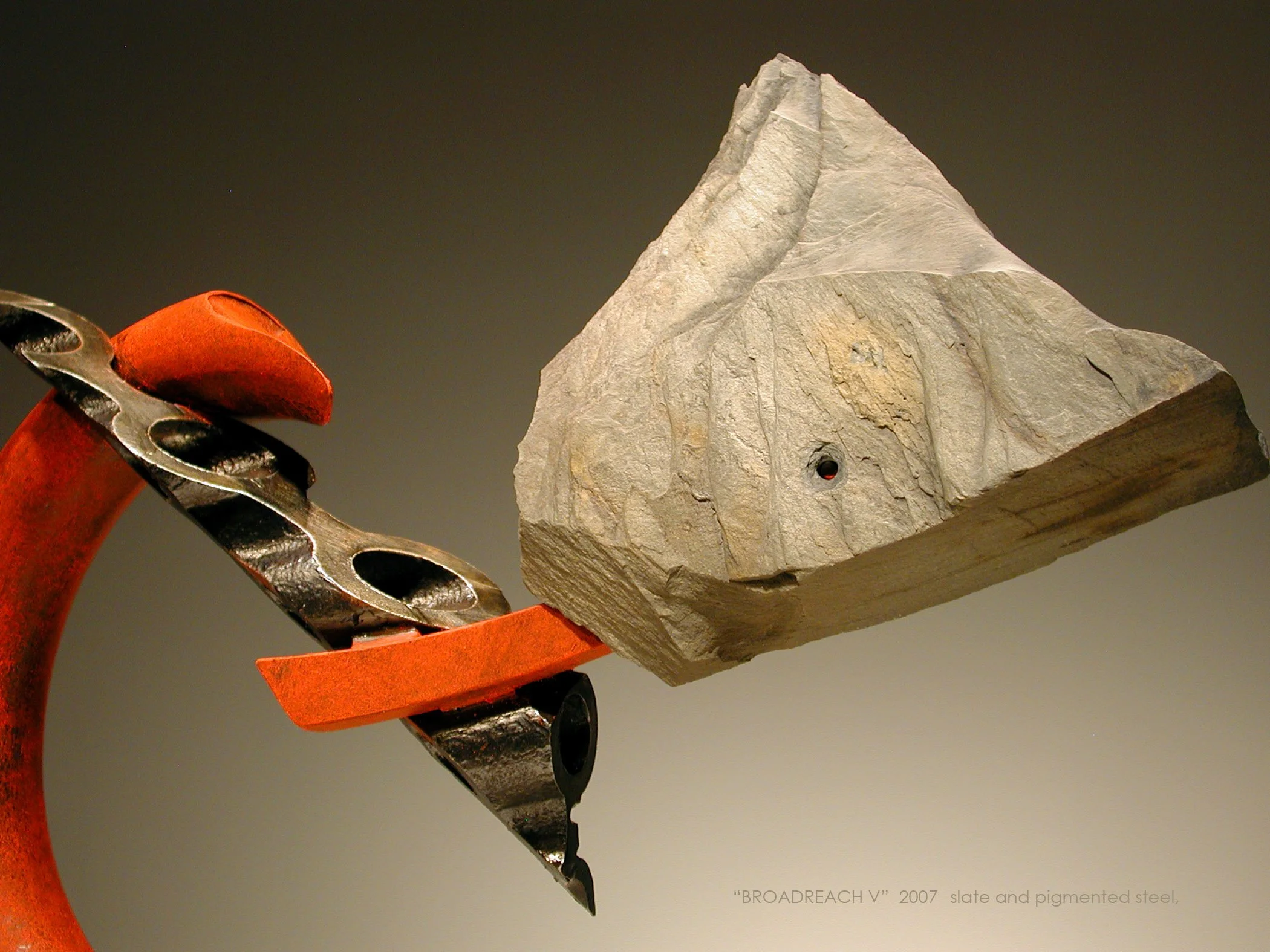
January 2007. Slate, steel. Dimensions: 11.5 × 16 × 4 in (29 × 41 × 10 cm). Private collection.
The Broadreach Series was inspired by my sailing in the Adirondack. As I understand the term, it is the “run” you make after you have worked hard tacking back and forth and finally reach a point when you can let out the big spinnaker sail (abstractly portrayed in the sculpture by the curving red round element), lean back and “go with the wind”. It is the time to kick back and enjoy the fruits of ones labors. “Millertime!”
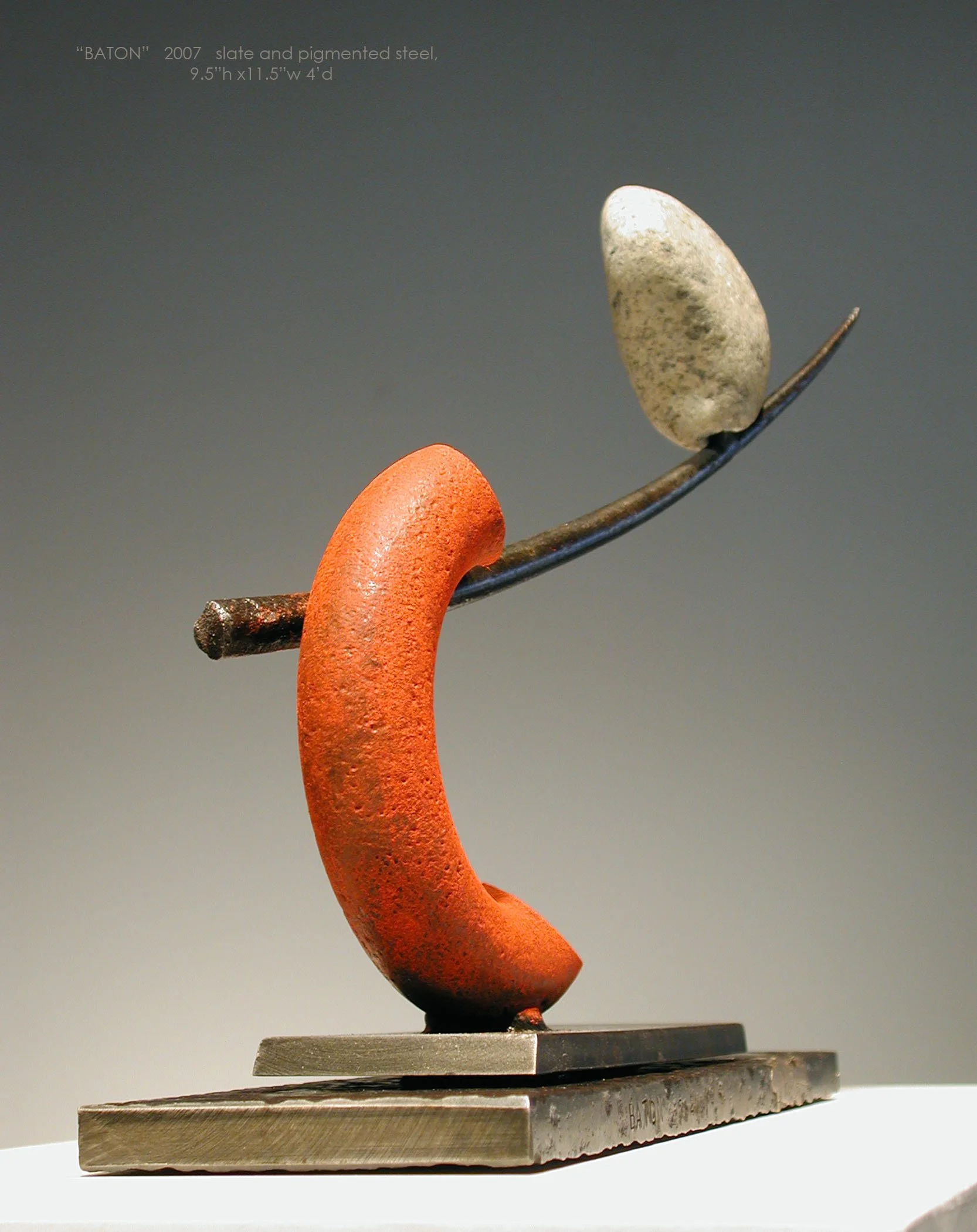
May 2007. River stone, steel. Dimensions: 9.5 × 11.5 × 4 in (24 × 29 × 10 cm). Private Collection.
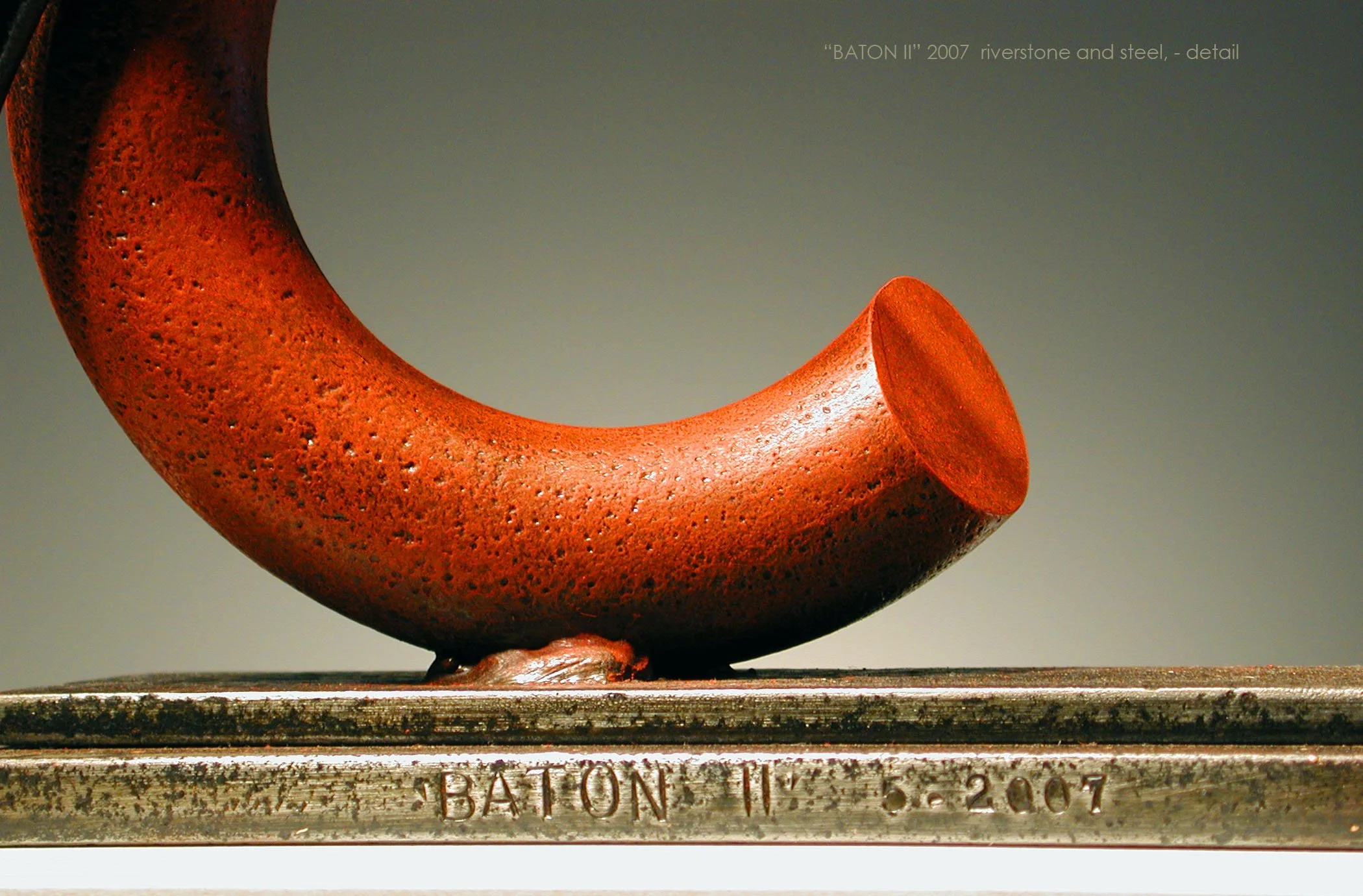
May 2007. River stone, steel. Dimensions: 10 × 11 × 3.5 in (25 × 28 × 9 cm). Private collection.
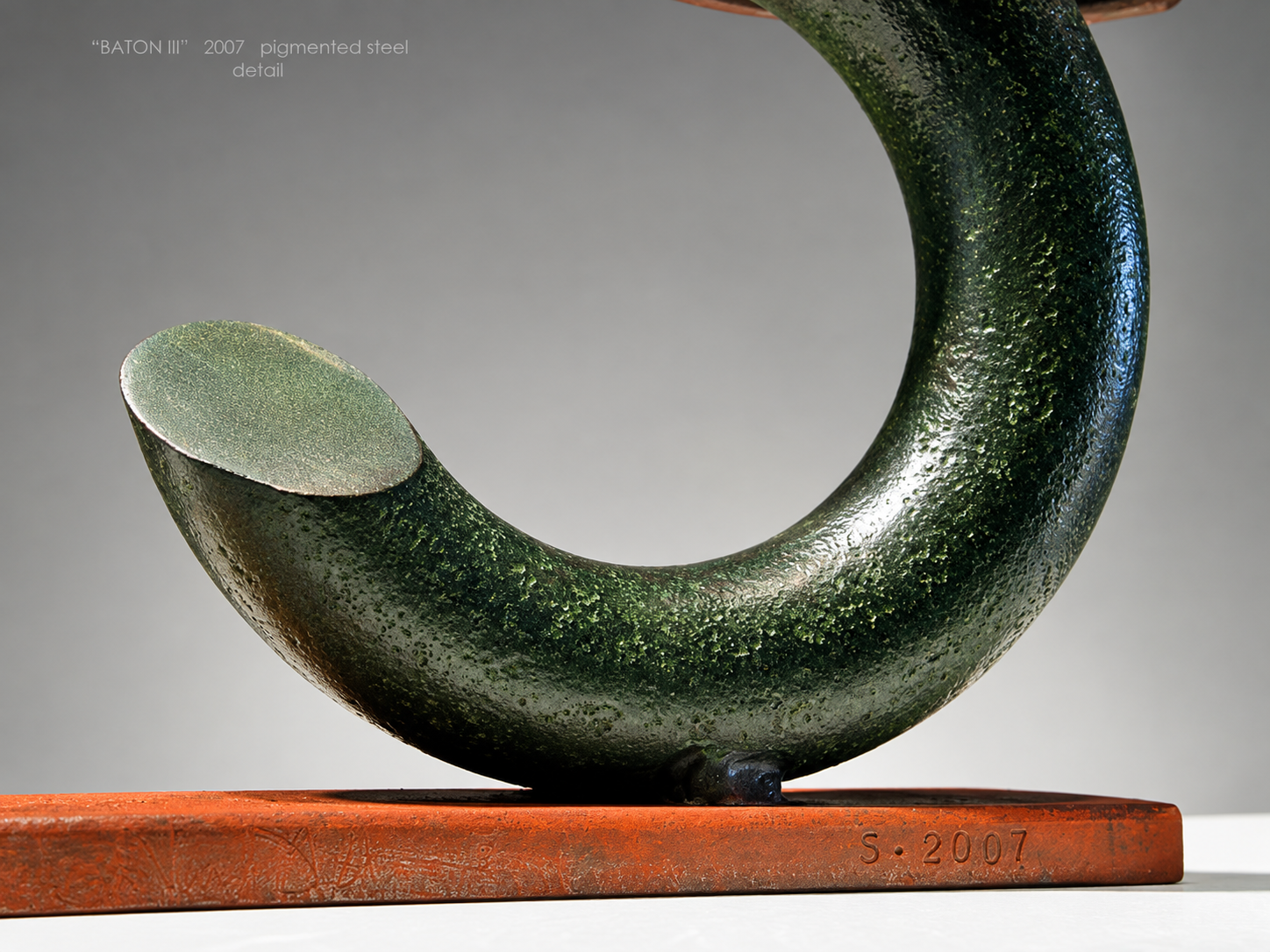
May 2007. River stone, pigmented and sealed steel, 10 × 10 × 3 in (25 × 25 × 8 cm). Private Collection
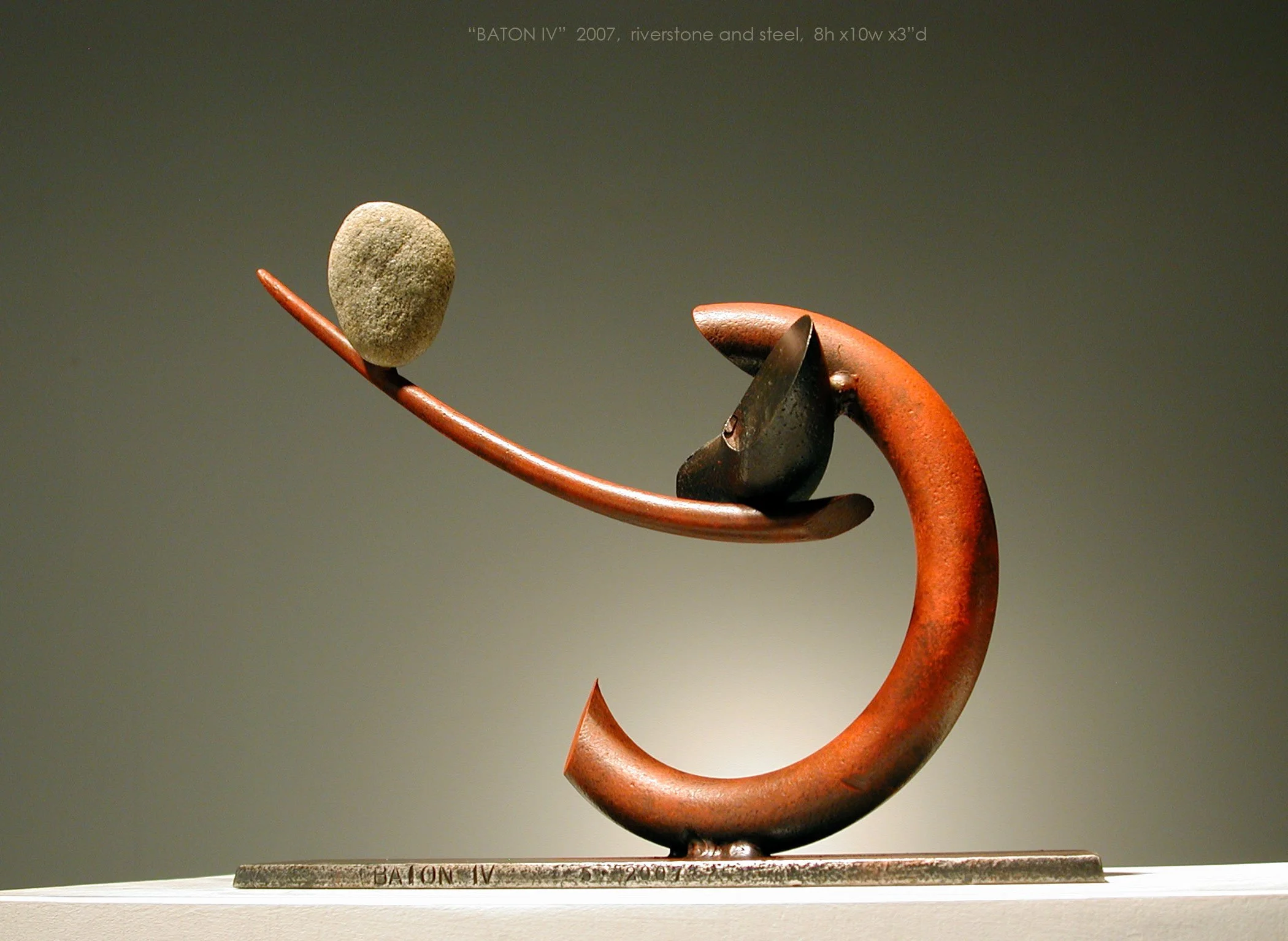
May 2007. River stone, steel. Dimensions: 8 × 10 × 3 in (20 × 25 × 8 cm). Private Collection.
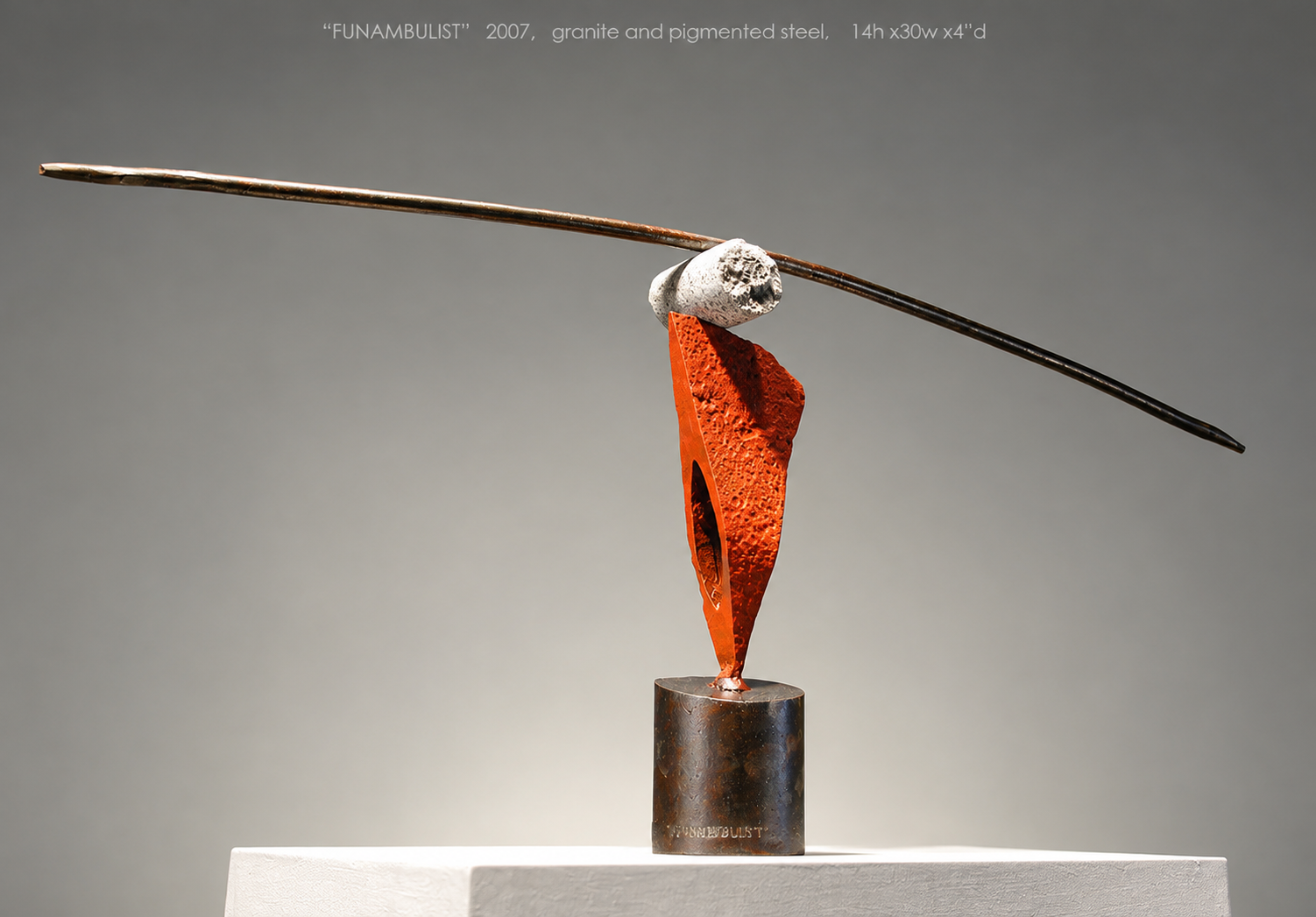
May 2007. River stone, steel. Dimensions: 14 × 30 × 4 in (36 × 76 × 10 cm). Private collection.
The title derives from two Latin words—fūnis, meaning “rope,” and ambulāre, “to walk”—and refers to a tightrope walker. The meaning is reinforced by the sculpture’s dynamic horizontal “balancing baton” and its overall sense of precarious poise. It evokes the physical balance, agility, and daring of a circus performer, while perhaps more poignantly suggesting mental agility—the ability to maintain equilibrium amid uncertainty and change.
A celebrated modern funambulist is Philippe Petit, who became famous for his unauthorized high-wire walk between the Twin Towers of New York’s World Trade Center on August 7, 1974. His feat became an enduring image of extraordinary balance, concentration, risk, and resolve.
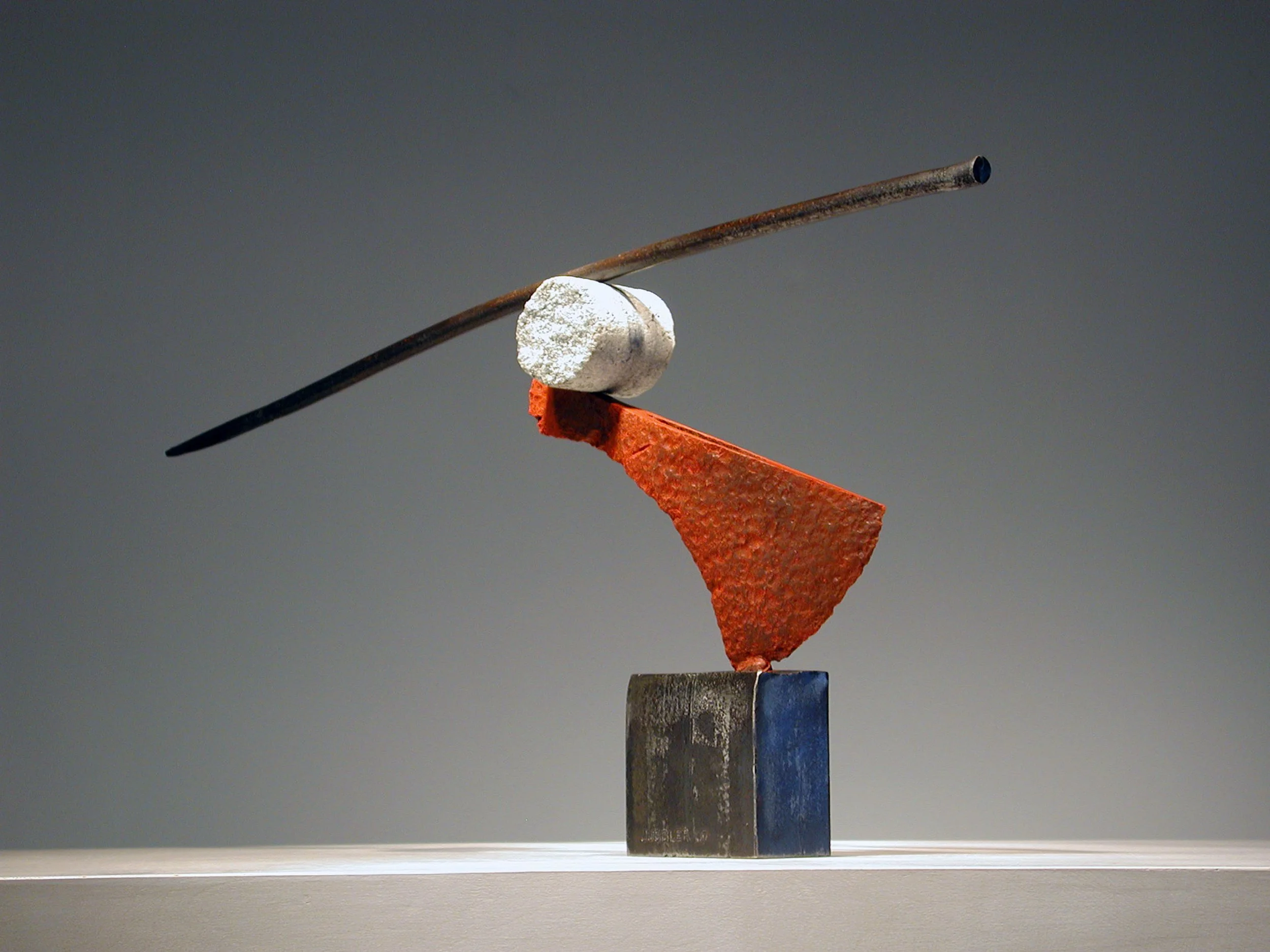
May 2007. River stone, steel. Dimensions: 12 × 24 × 3.5 in (30 × 61 × 9 cm). Private collection.
The title derives from two Latin words—fūnis, meaning “rope,” and ambulāre, “to walk”—and refers to a tightrope walker. The meaning is reinforced by the sculpture’s dynamic horizontal “balancing baton” and its overall sense of precarious poise. It evokes the physical balance, agility, and daring of a circus performer, while perhaps more poignantly suggesting mental agility—the ability to maintain equilibrium amid uncertainty and change.
A celebrated modern funambulist is Philippe Petit, who became famous for his unauthorized high-wire walk between the Twin Towers of New York’s World Trade Center on August 7, 1974. His feat became an enduring image of extraordinary balance, concentration, risk, and resolve.
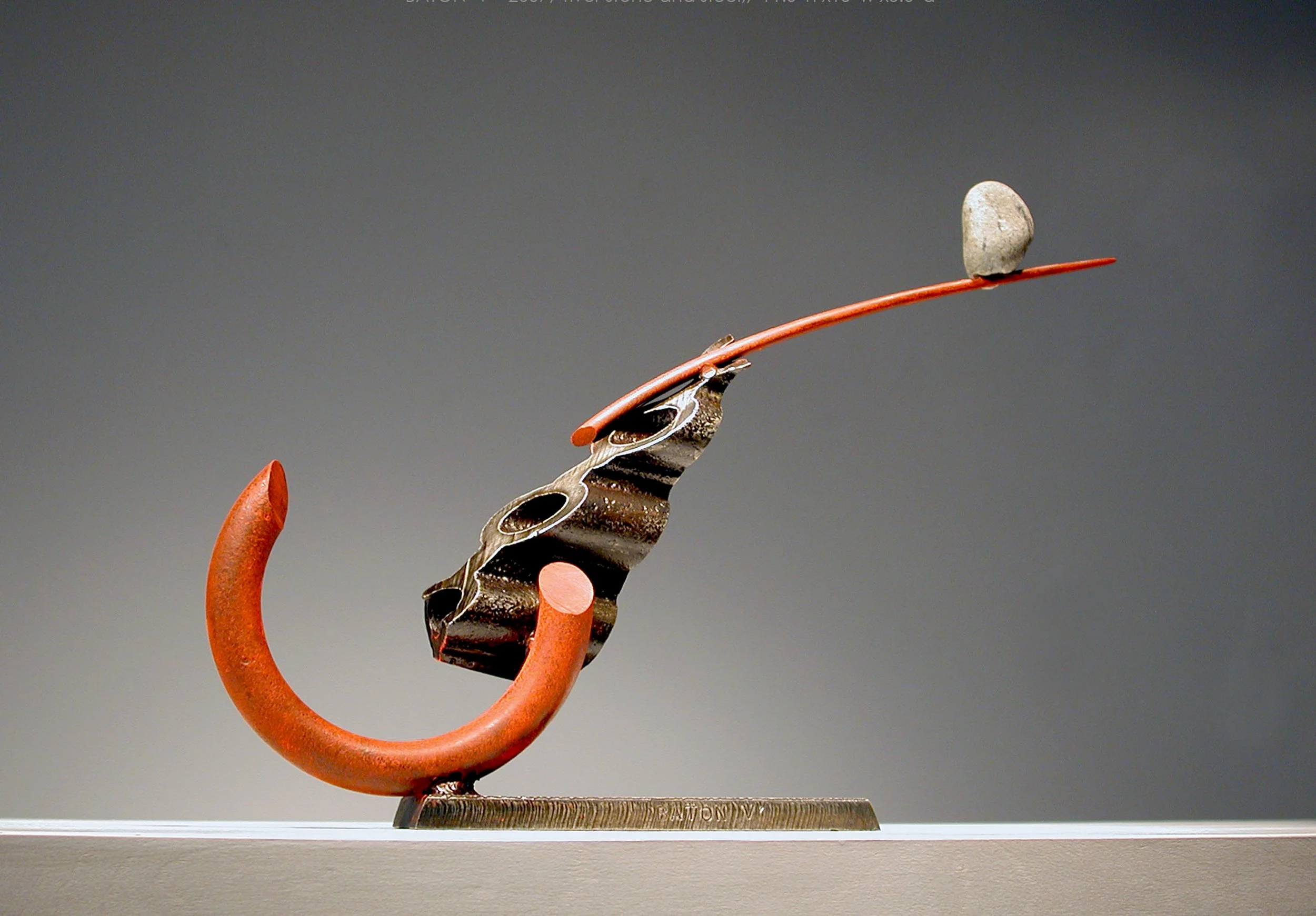
May 2007. River stone, steel. Dimensions: 11.5 × 15 × 3.5 in (29 × 38 × 9 cm). Private Collection - Washington, DC.
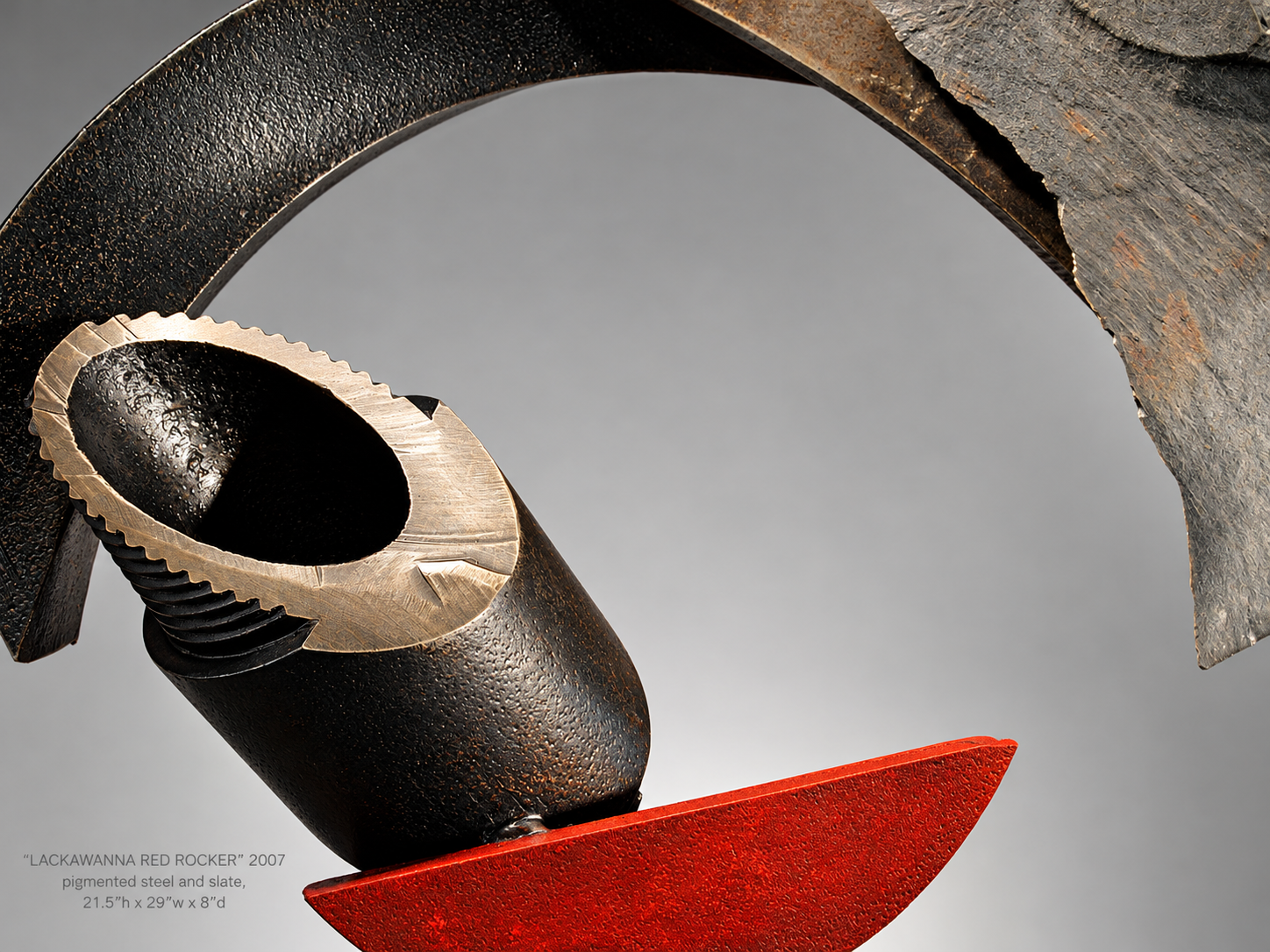
June 2007. Slate, pigmented and sealed steel. Dimensions: 21.5 × 29 × 8 in (55 × 74 × 20 cm). Private Collection.
Title is a reference to the steel stamp Lackawanna indicating its origin.
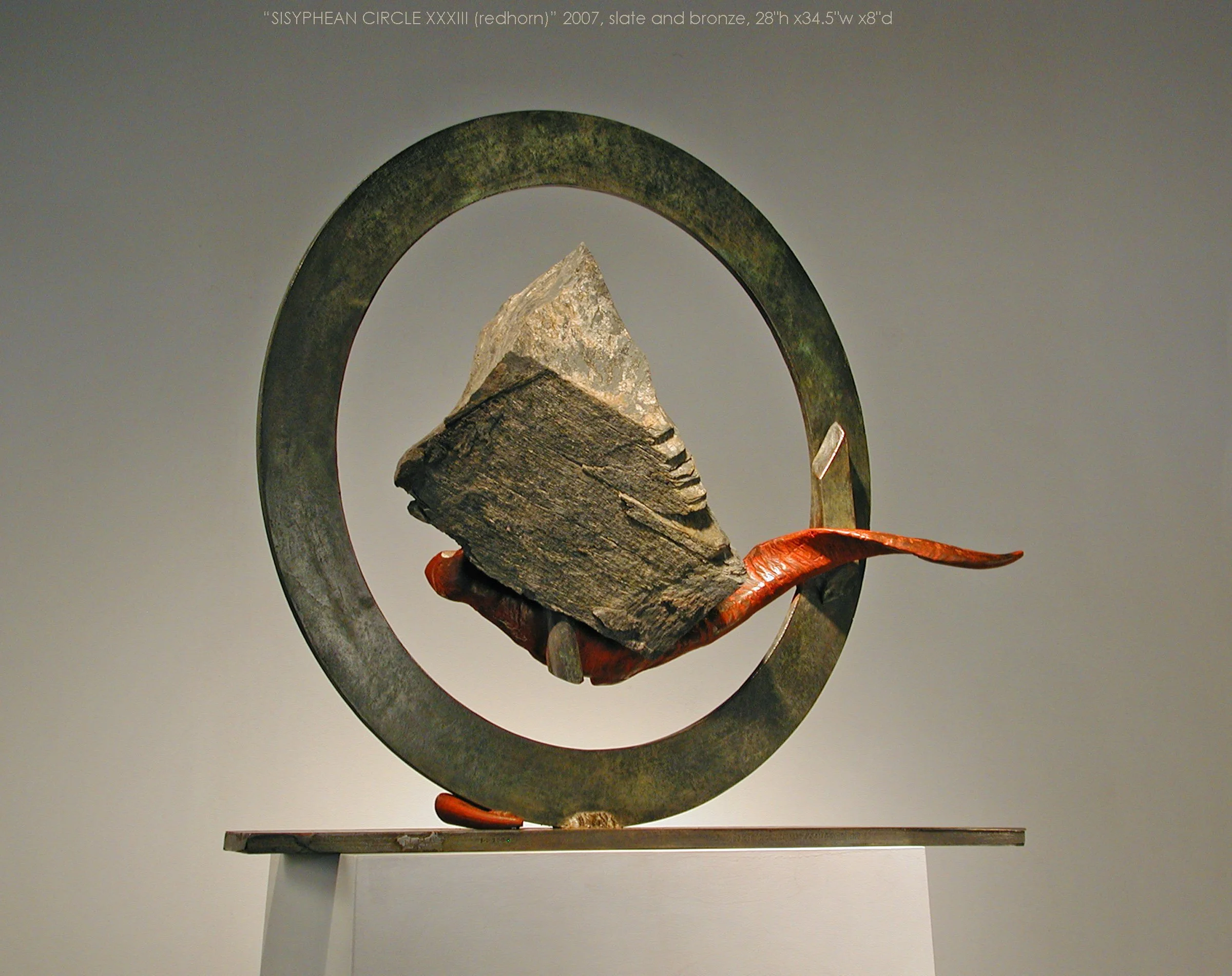
July 2007. Slate, bronze. Dimensions: 28 × 34.5 × 8 in (71 × 88 × 20 cm). Collection Adirondack Museum, Blue Mountain Lake, New York.
The Sisyphean Series
The Greek myth of Sisyphus, condemned to endlessly push a boulder uphill, has inspired more than 250 of my sculptures. Rather than seeing the myth as a symbol of futility, I share philosopher Albert Camus’s more positive interpretation—that meaning and fulfillment can be found in the struggle itself. In many ways, I see Sisyphus as autobiographical, reflecting my lifelong pursuit as an artist, confronting challenges, taking risks, and finding purpose in the act of creation.
My Sisyphean works bring stone and steel together in precarious yet stable arrangements, often incorporating circular forms suggesting perpetual motion. For me, they are metaphors for the creative process—an ongoing cycle of experimentation, discovery, setbacks, and renewal. Each completed sculpture is both an achievement and a starting point, celebrating the journey rather than simply the destination.
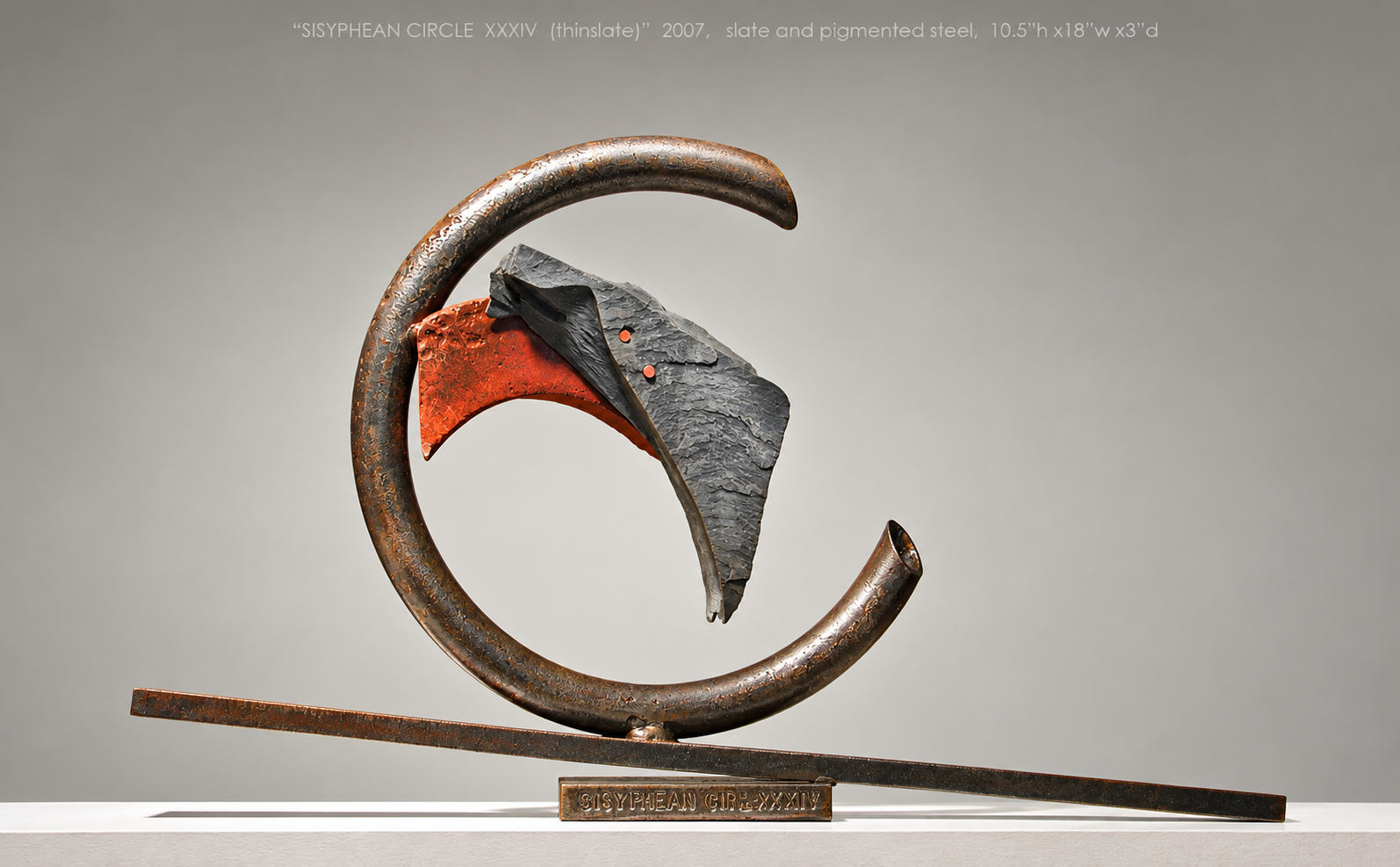
July 2007. Slate, pigmented steel. Dimensions: 10.5 × 18 × 3 in (27 × 46 × 8 cm). Private Collection.
The Sisyphean Series
The Greek myth of Sisyphus, condemned to endlessly push a boulder uphill, has inspired more than 250 of my sculptures. Rather than seeing the myth as a symbol of futility, I share philosopher Albert Camus’s more positive interpretation—that meaning and fulfillment can be found in the struggle itself. In many ways, I see Sisyphus as autobiographical, reflecting my lifelong pursuit as an artist, confronting challenges, taking risks, and finding purpose in the act of creation.
My Sisyphean works bring stone and steel together in precarious yet stable arrangements, often incorporating circular forms suggesting perpetual motion. For me, they are metaphors for the creative process—an ongoing cycle of experimentation, discovery, setbacks, and renewal. Each completed sculpture is both an achievement and a starting point, celebrating the journey rather than simply the destination.
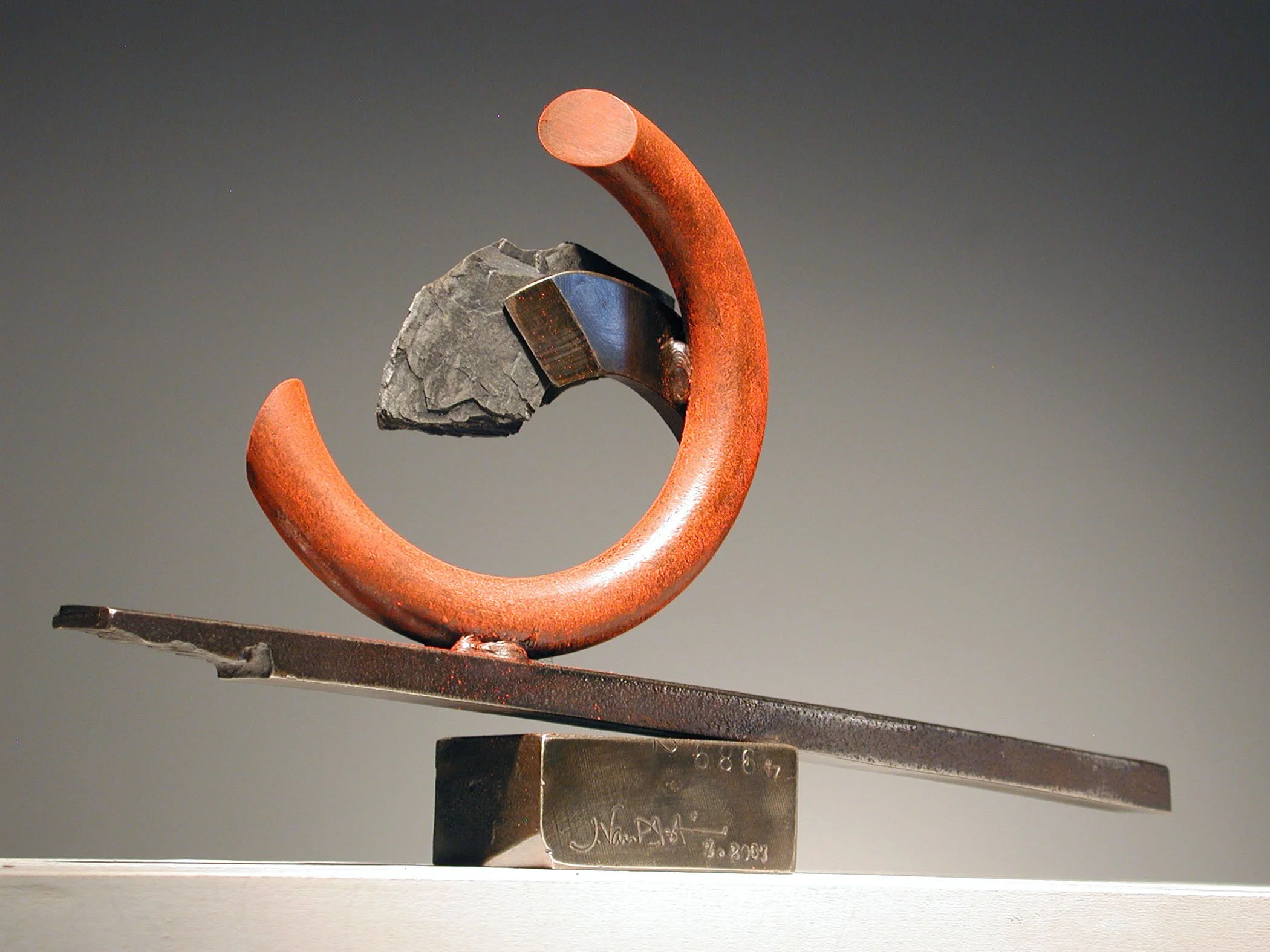
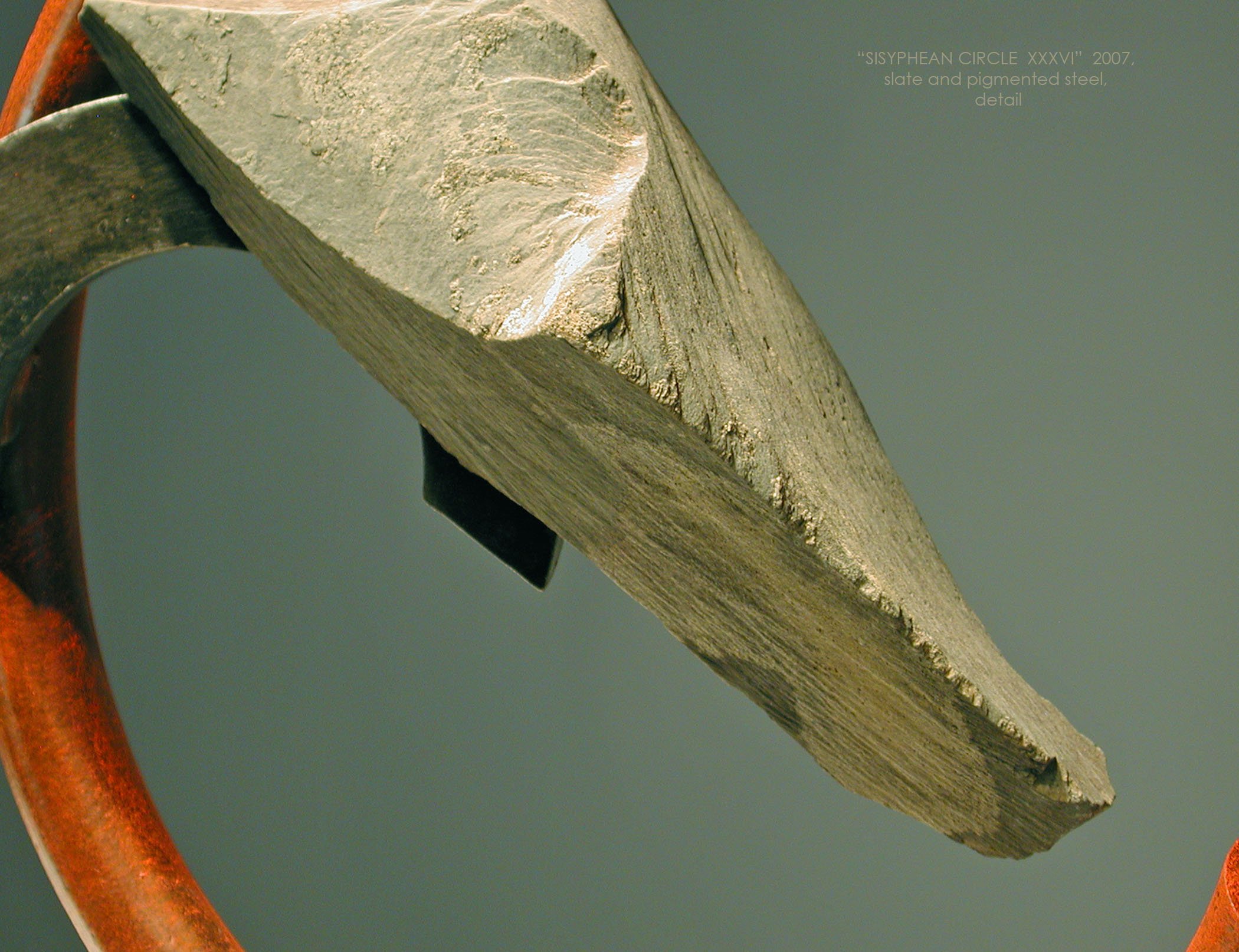
July 2007. Slate, pigmented steel. Dimensions: 13 × 22 × 3.5 in (33 × 56 × 9 cm). Private Collection.
The Sisyphean Series
The Greek myth of Sisyphus, condemned to endlessly push a boulder uphill, has inspired more than 250 of my sculptures. Rather than seeing the myth as a symbol of futility, I share philosopher Albert Camus’s more positive interpretation—that meaning and fulfillment can be found in the struggle itself. In many ways, I see Sisyphus as autobiographical, reflecting my lifelong pursuit as an artist, confronting challenges, taking risks, and finding purpose in the act of creation.
My Sisyphean works bring stone and steel together in precarious yet stable arrangements, often incorporating circular forms suggesting perpetual motion. For me, they are metaphors for the creative process—an ongoing cycle of experimentation, discovery, setbacks, and renewal. Each completed sculpture is both an achievement and a starting point, celebrating the journey rather than simply the destination.
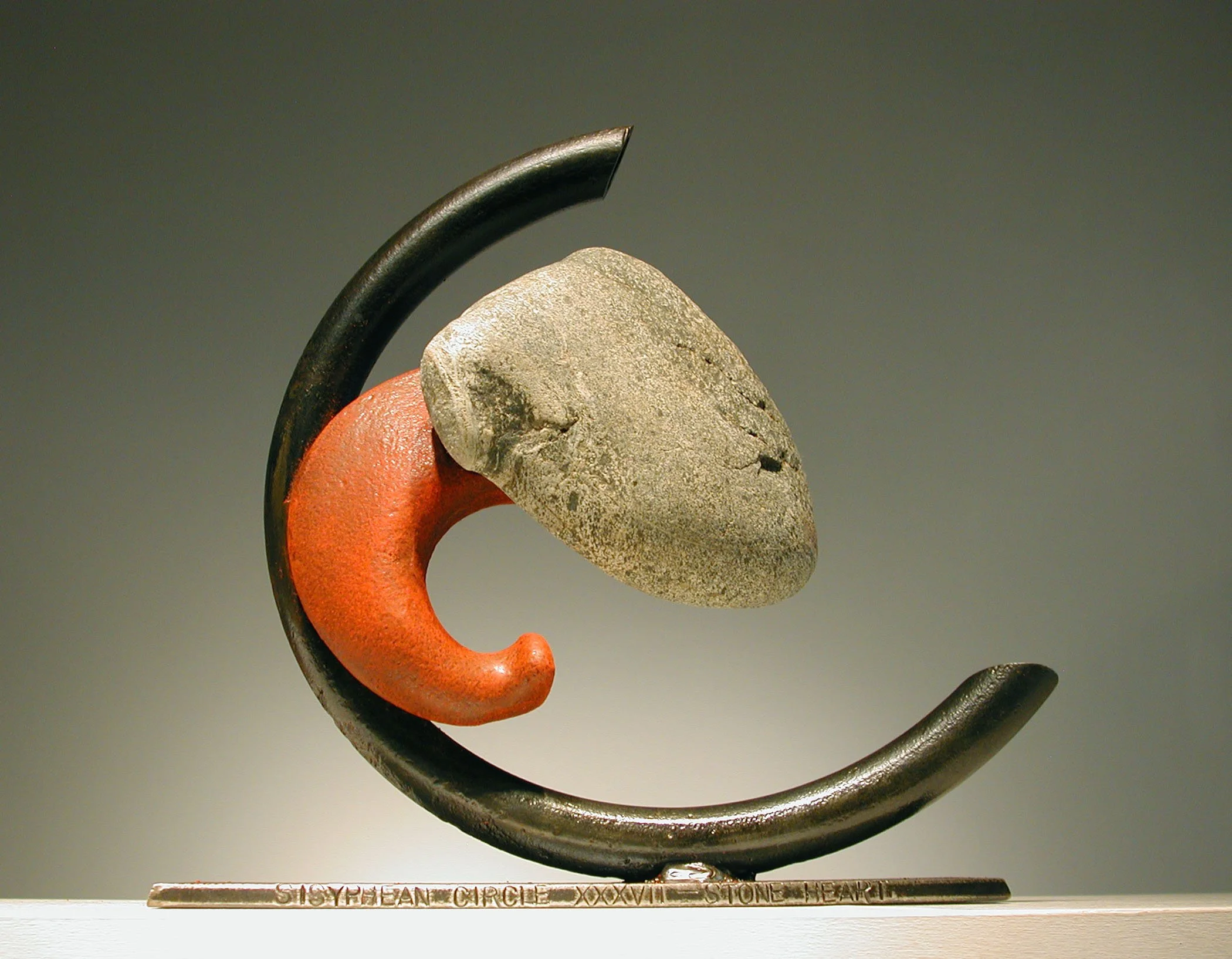
August 2007. Slate, pigmented steel. Dimensions: 9 × 10 × 3 in (23 × 25 × 8 cm). Private Collection.
The Sisyphean Series
The Greek myth of Sisyphus, condemned to endlessly push a boulder uphill, has inspired more than 250 of my sculptures. Rather than seeing the myth as a symbol of futility, I share philosopher Albert Camus’s more positive interpretation—that meaning and fulfillment can be found in the struggle itself. In many ways, I see Sisyphus as autobiographical, reflecting my lifelong pursuit as an artist, confronting challenges, taking risks, and finding purpose in the act of creation.
My Sisyphean works bring stone and steel together in precarious yet stable arrangements, often incorporating circular forms suggesting perpetual motion. For me, they are metaphors for the creative process—an ongoing cycle of experimentation, discovery, setbacks, and renewal. Each completed sculpture is both an achievement and a starting point, celebrating the journey rather than simply the destination.
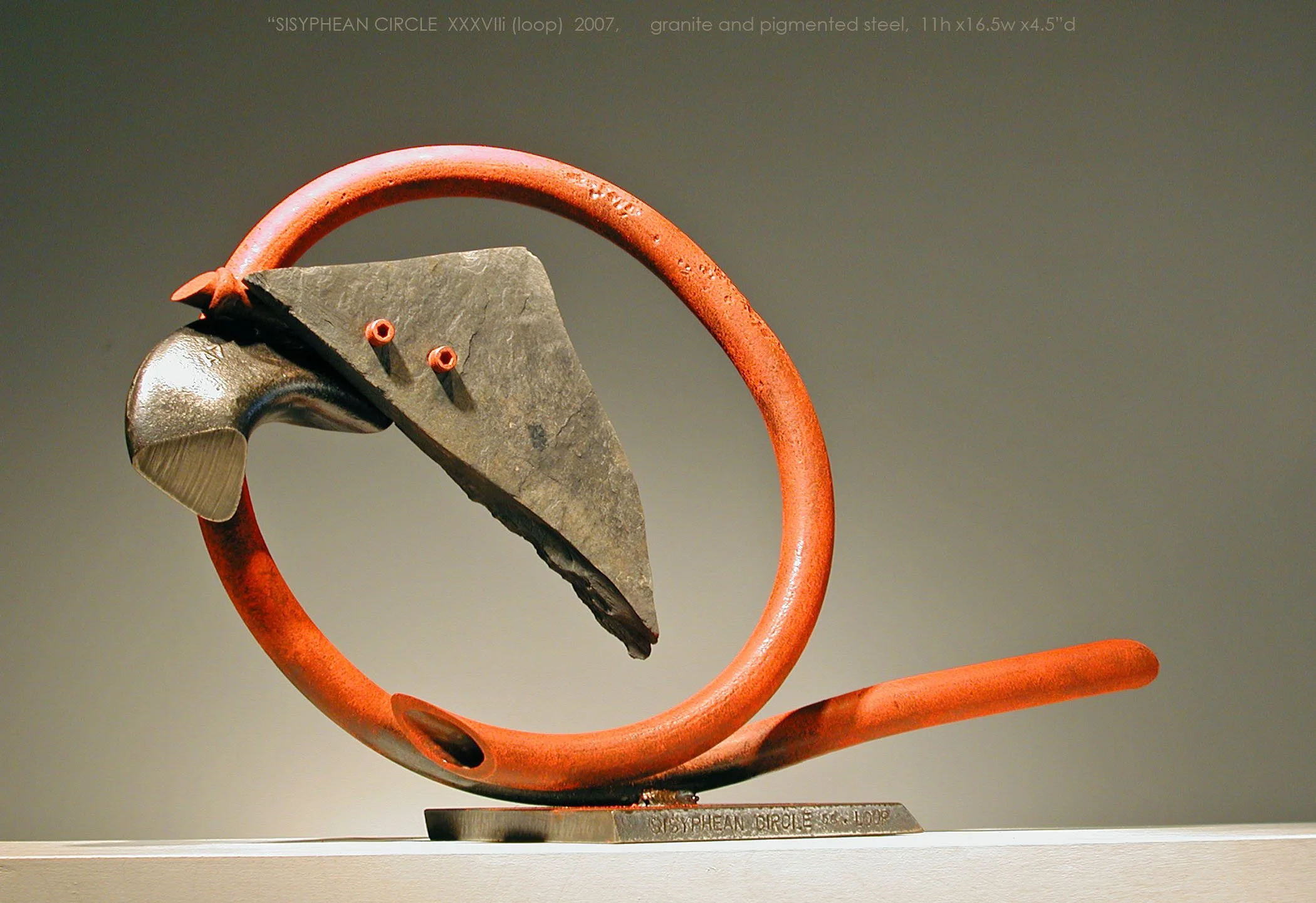
August 2007. Slate, pigmented steel. Dimensions: 11 × 16.5 × 4.5 in (28 × 42 × 11 cm).
The Sisyphean Series
The Greek myth of Sisyphus, condemned to endlessly push a boulder uphill, has inspired more than 250 of my sculptures. Rather than seeing the myth as a symbol of futility, I share philosopher Albert Camus’s more positive interpretation—that meaning and fulfillment can be found in the struggle itself. In many ways, I see Sisyphus as autobiographical, reflecting my lifelong pursuit as an artist, confronting challenges, taking risks, and finding purpose in the act of creation.
My Sisyphean works bring stone and steel together in precarious yet stable arrangements, often incorporating circular forms suggesting perpetual motion. For me, they are metaphors for the creative process—an ongoing cycle of experimentation, discovery, setbacks, and renewal. Each completed sculpture is both an achievement and a starting point, celebrating the journey rather than simply the destination.
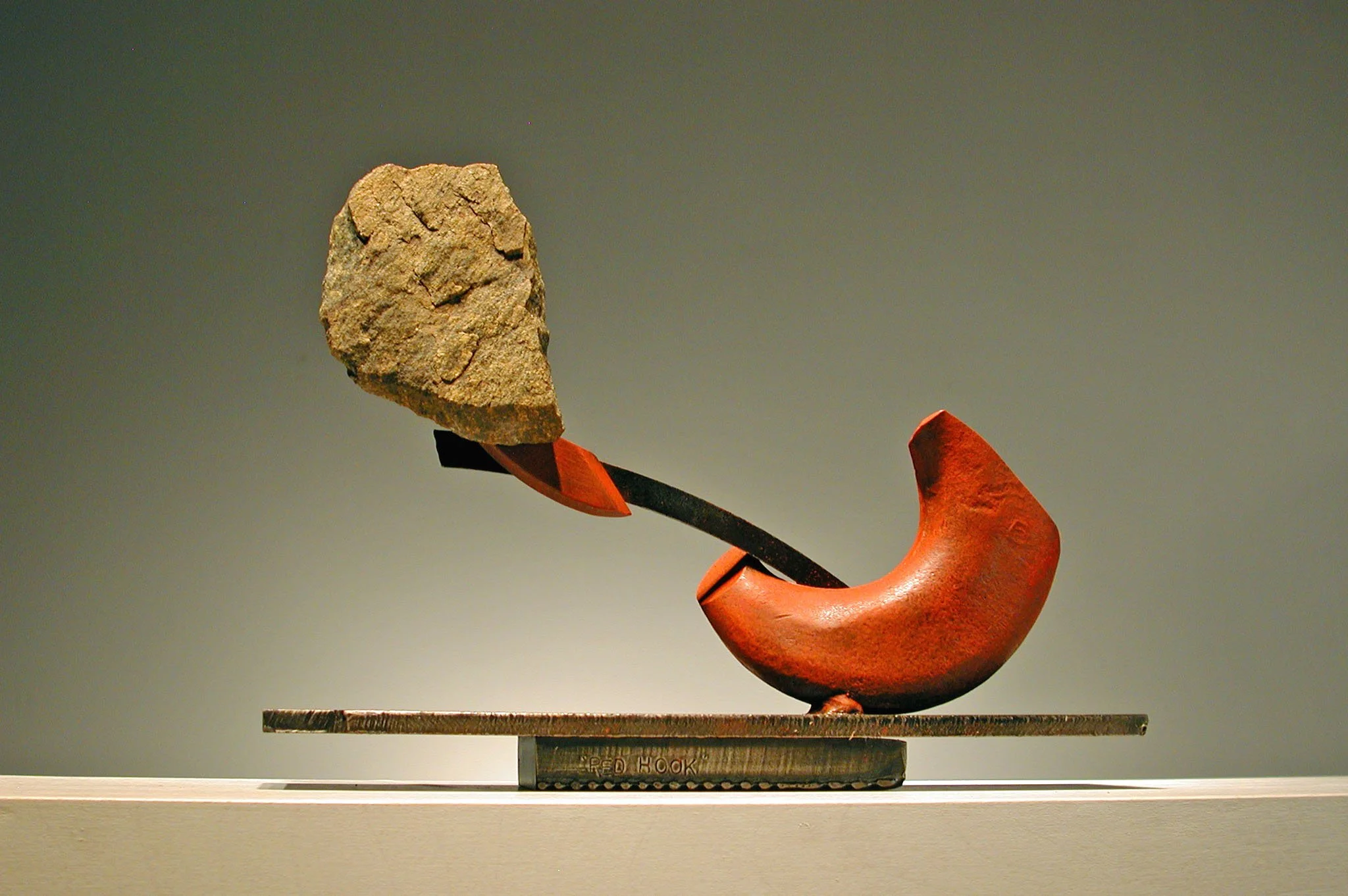
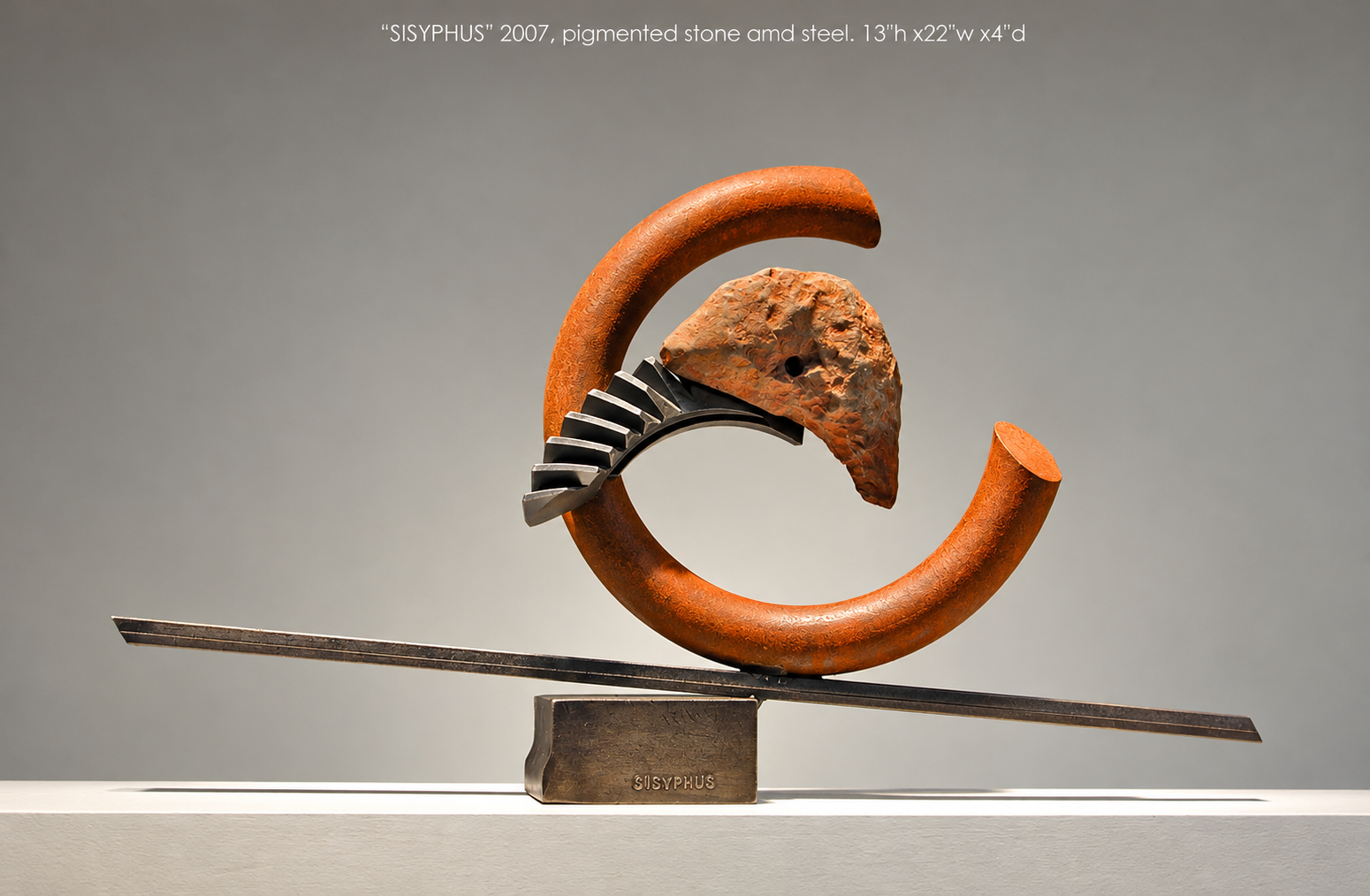
August 2007. Pigmented stone, steel. Dimensions: 13 × 22 × 4 in (33 × 56 × 10 cm). Private collection.
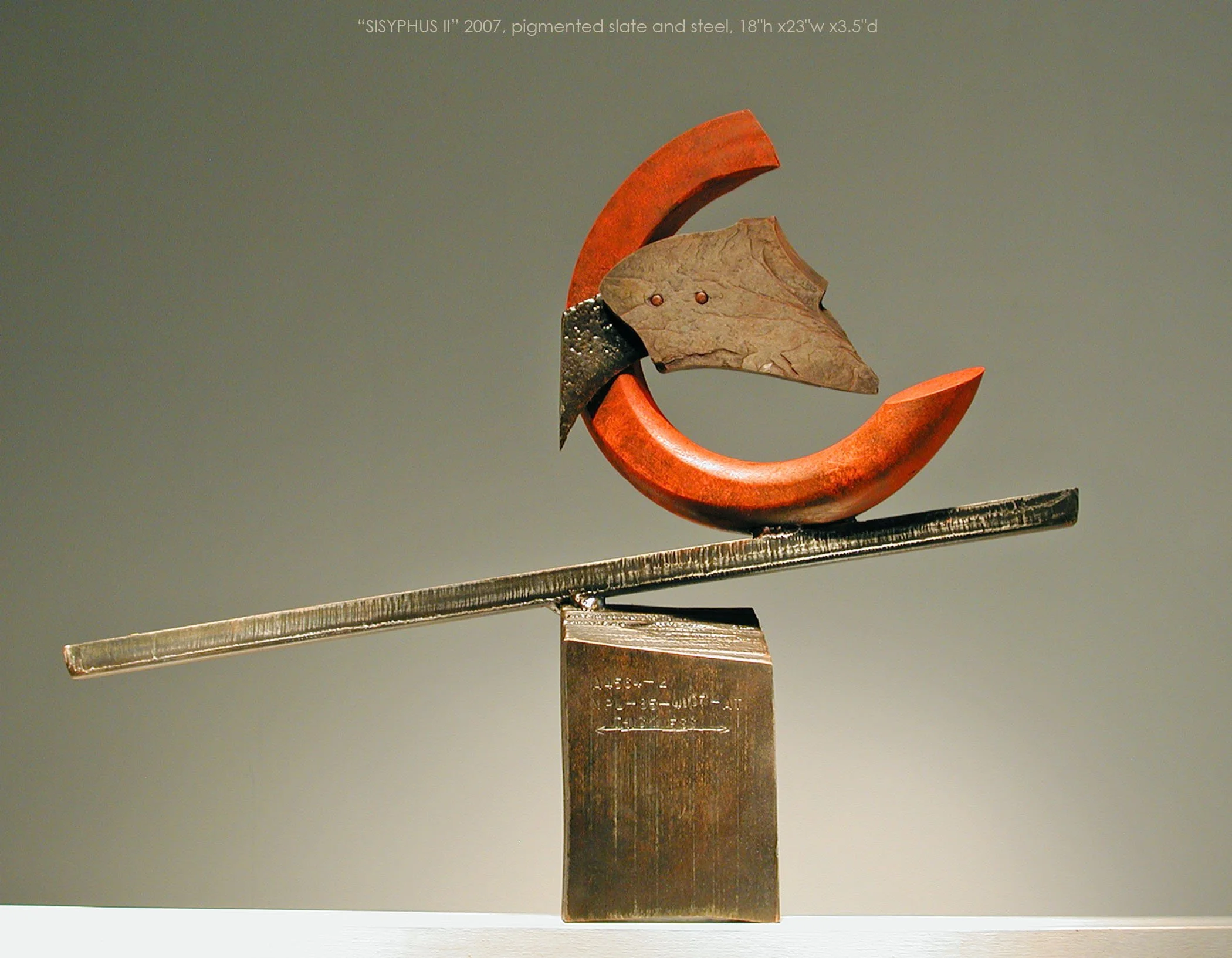
August 2007. Pigmented slate, steel. Dimensions: 18 × 23 × 3.5 in (46 × 58 × 9 cm). Private Collection.
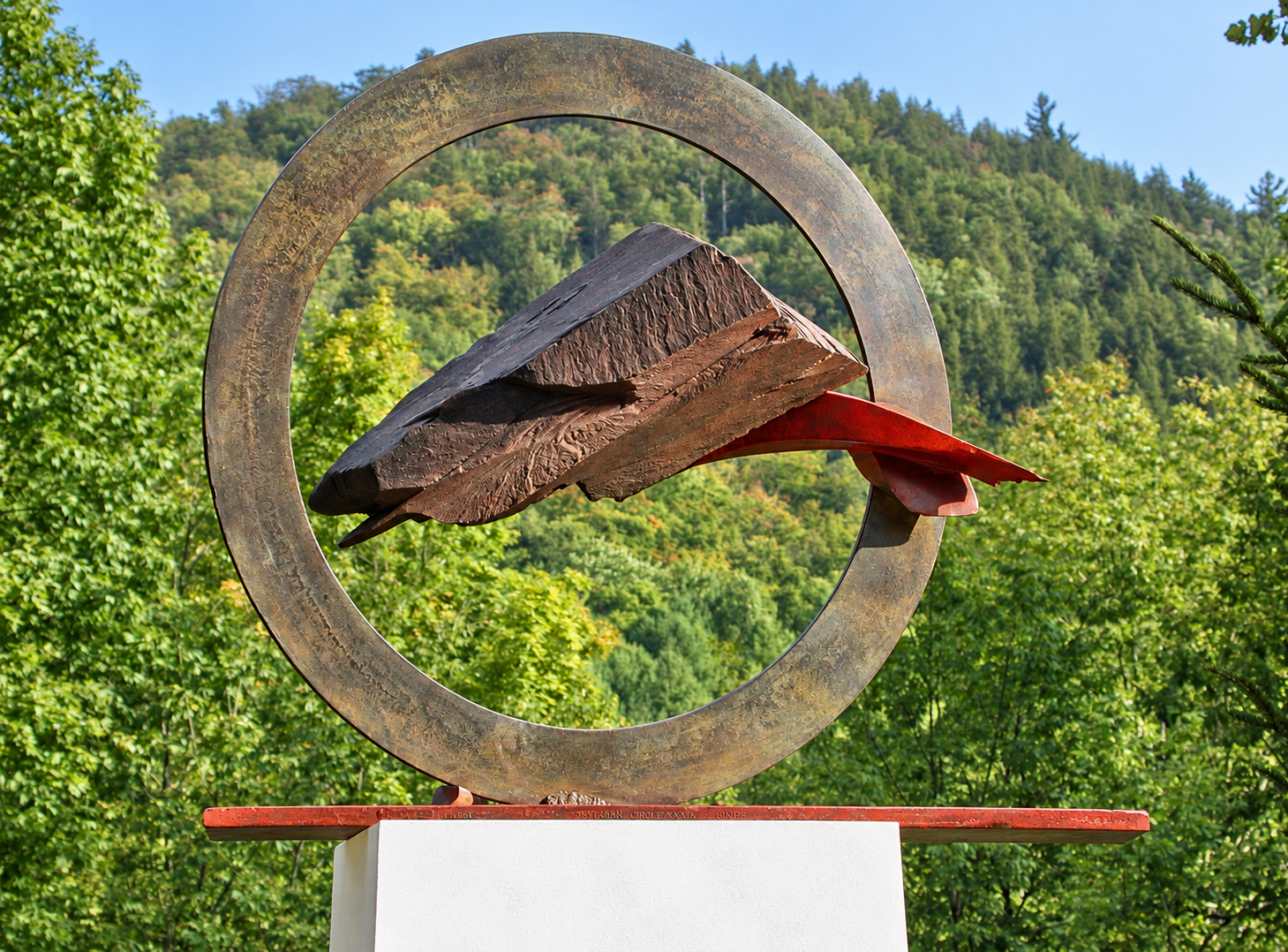
August 2007. Bronze, slate. Dimensions: 28 × 34.5 × 8 in (71 × 88 × 20 cm). Private Collection.
The Sisyphean Series
The Greek myth of Sisyphus, condemned to endlessly push a boulder uphill, has inspired more than 250 of my sculptures. Rather than seeing the myth as a symbol of futility, I share philosopher Albert Camus’s more positive interpretation—that meaning and fulfillment can be found in the struggle itself. In many ways, I see Sisyphus as autobiographical, reflecting my lifelong pursuit as an artist, confronting challenges, taking risks, and finding purpose in the act of creation.
My Sisyphean works bring stone and steel together in precarious yet stable arrangements, often incorporating circular forms suggesting perpetual motion. For me, they are metaphors for the creative process—an ongoing cycle of experimentation, discovery, setbacks, and renewal. Each completed sculpture is both an achievement and a starting point, celebrating the journey rather than simply the destination.
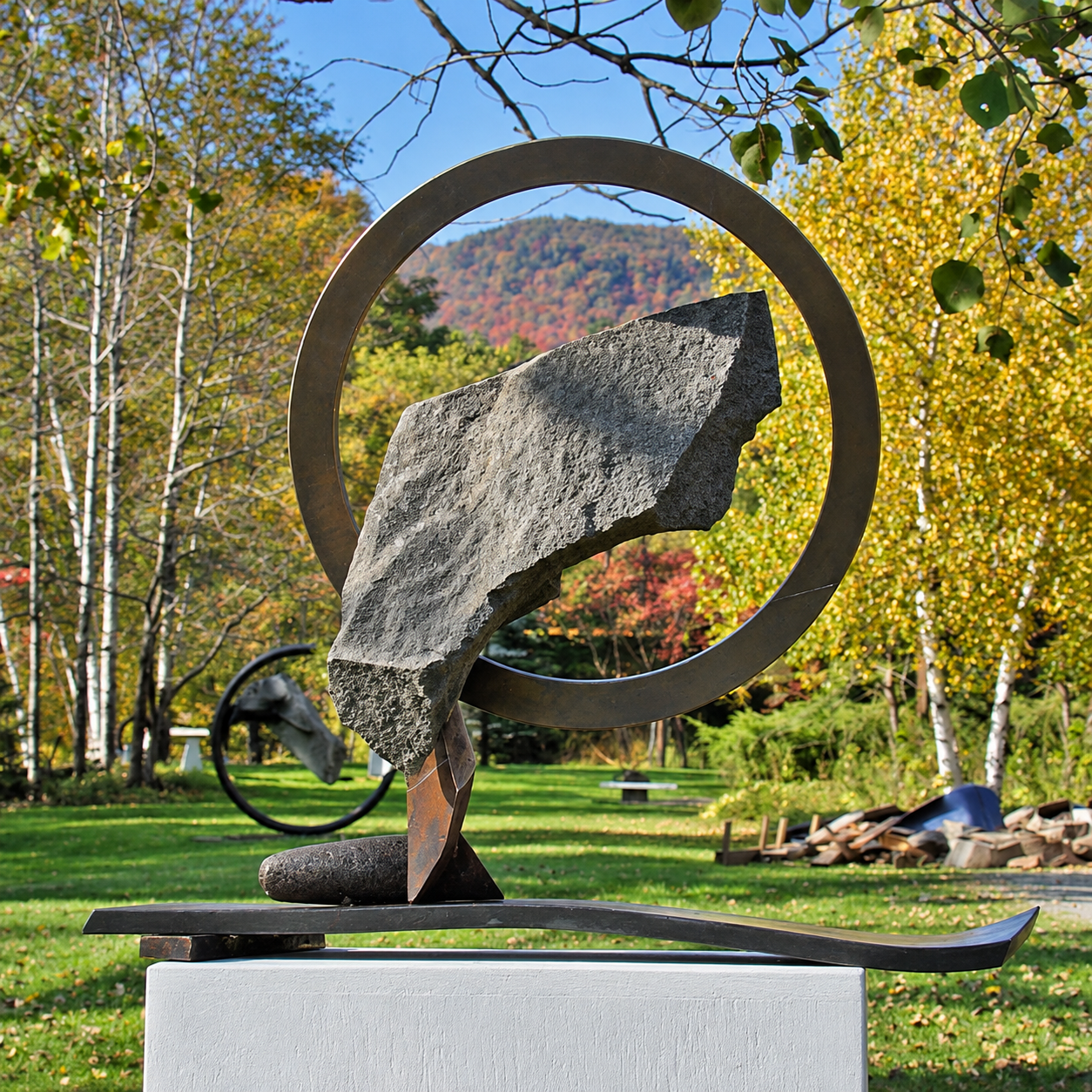
October 2007. Bronze, stone, steel. Dimensions: 16.5 × 19 × 5 in (42 × 48 × 13 cm). Private Collection.
The Sisyphean Series
The Greek myth of Sisyphus, condemned to endlessly push a boulder uphill, has inspired more than 250 of my sculptures. Rather than seeing the myth as a symbol of futility, I share philosopher Albert Camus’s more positive interpretation—that meaning and fulfillment can be found in the struggle itself. In many ways, I see Sisyphus as autobiographical, reflecting my lifelong pursuit as an artist, confronting challenges, taking risks, and finding purpose in the act of creation.
My Sisyphean works bring stone and steel together in precarious yet stable arrangements, often incorporating circular forms suggesting perpetual motion. For me, they are metaphors for the creative process—an ongoing cycle of experimentation, discovery, setbacks, and renewal. Each completed sculpture is both an achievement and a starting point, celebrating the journey rather than simply the destination.
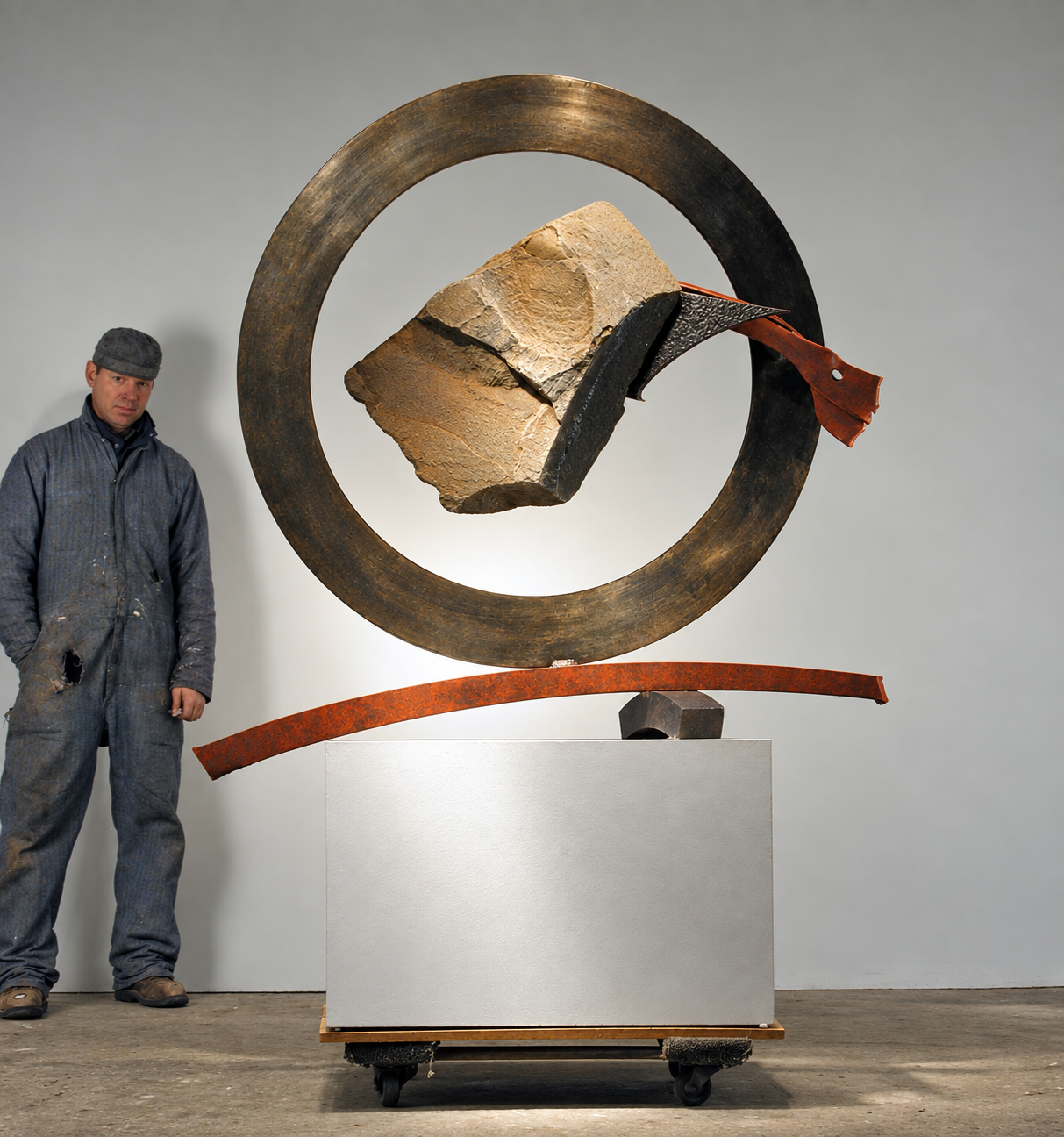
November 2007. Bluestone, pigmented steel. Dimensions: 54 × 57 × 16 in (137 × 145 × 41 cm). (Private Collection.
The Sisyphean Series
The Greek myth of Sisyphus, condemned to endlessly push a boulder uphill, has inspired more than 250 of my sculptures. Rather than seeing the myth as a symbol of futility, I share philosopher Albert Camus’s more positive interpretation—that meaning and fulfillment can be found in the struggle itself. In many ways, I see Sisyphus as autobiographical, reflecting my lifelong pursuit as an artist, confronting challenges, taking risks, and finding purpose in the act of creation.
My Sisyphean works bring stone and steel together in precarious yet stable arrangements, often incorporating circular forms suggesting perpetual motion. For me, they are metaphors for the creative process—an ongoing cycle of experimentation, discovery, setbacks, and renewal. Each completed sculpture is both an achievement and a starting point, celebrating the journey rather than simply the destination.
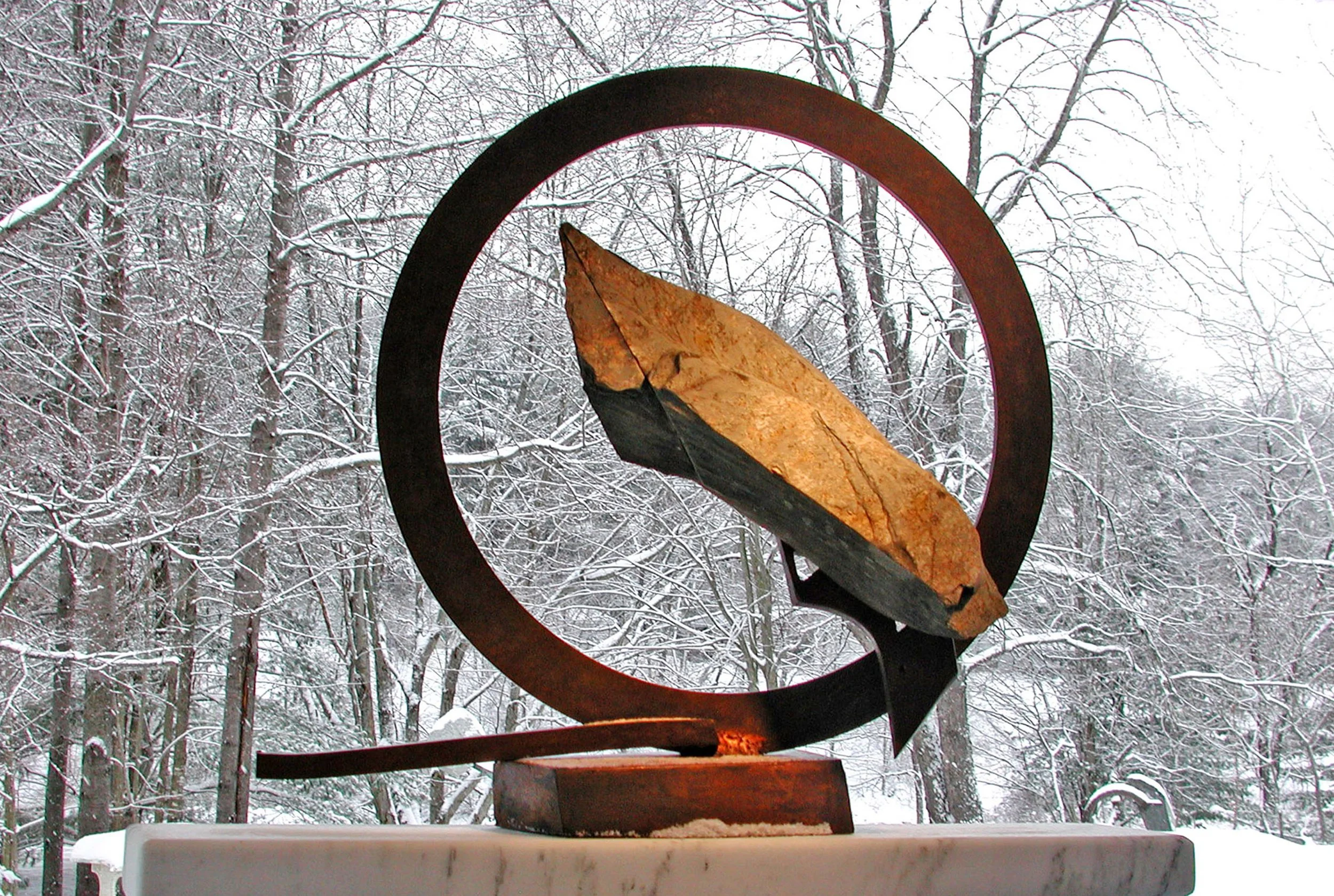
November 2007. Slate, bronze. Dimensions: 24.5 × 25 × 6 in (62 × 64 × 15 cm). Private Collection.
The Sisyphean Series
The Greek myth of Sisyphus, condemned to endlessly push a boulder uphill, has inspired more than 250 of my sculptures. Rather than seeing the myth as a symbol of futility, I share philosopher Albert Camus’s more positive interpretation—that meaning and fulfillment can be found in the struggle itself. In many ways, I see Sisyphus as autobiographical, reflecting my lifelong pursuit as an artist, confronting challenges, taking risks, and finding purpose in the act of creation.
My Sisyphean works bring stone and steel together in precarious yet stable arrangements, often incorporating circular forms suggesting perpetual motion. For me, they are metaphors for the creative process—an ongoing cycle of experimentation, discovery, setbacks, and renewal. Each completed sculpture is both an achievement and a starting point, celebrating the journey rather than simply the destination.
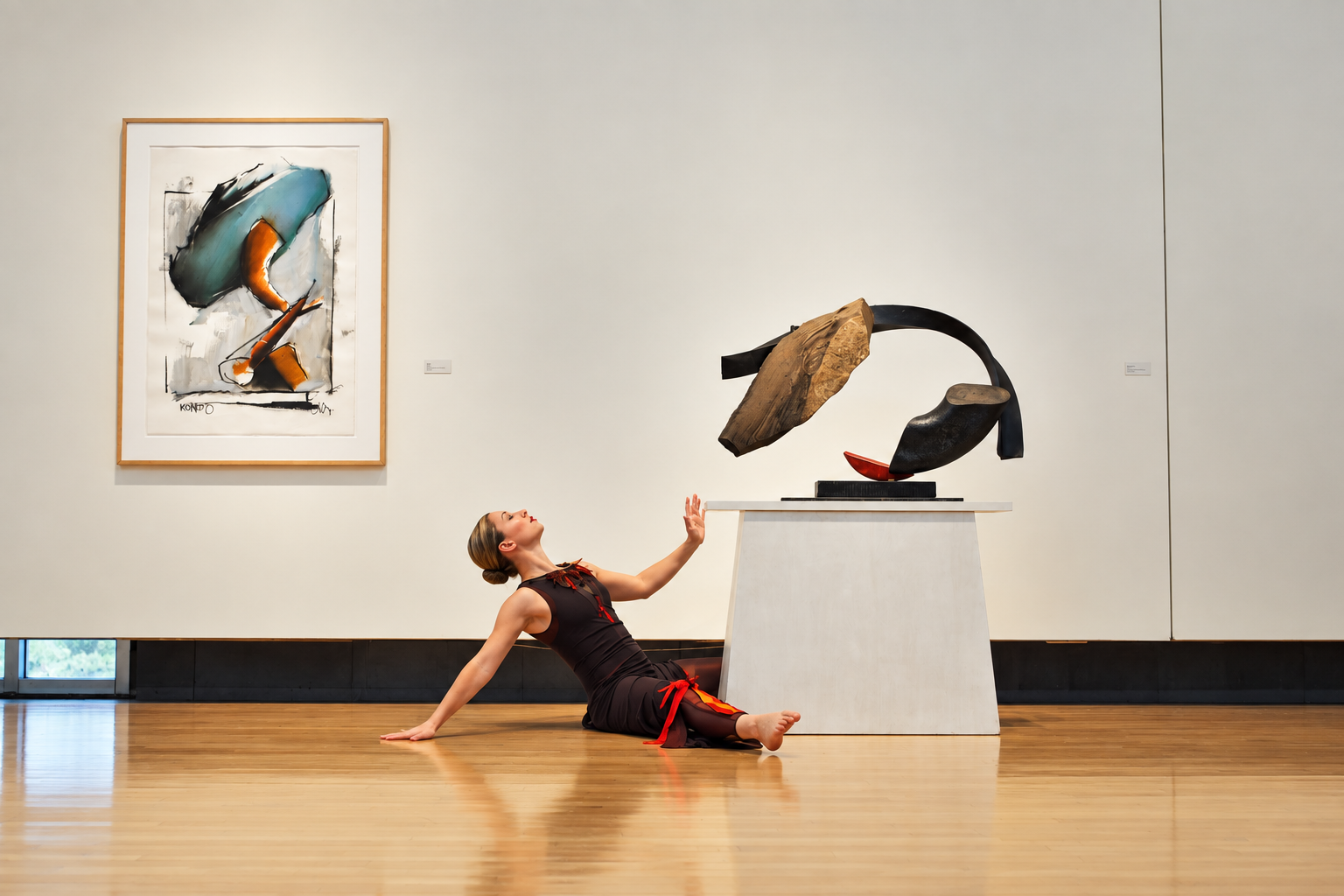
November 2007. Slate, pigmented and sealed steel. Dimensions: 27 × 40 × 12 in (69 × 102 × 30 cm).
Sidewinder ’07, 2007
Sidewinder ’07 returns to a sculptural idea I first explored more than two decades earlier, bringing the circular movement of the Sidewinder Series into a more fluid and expressive configuration. A broad arc of steel sweeps between contrasting forms of slate and steel, creating a strong sense of weight, balance, and suspended motion. The rough, layered character of the slate is set against the dark curved steel, while the small rust-colored element at the base introduces a sharp visual accent.
Created in 2007, the sculpture demonstrates my continuing interest in revisiting earlier ideas rather than considering them exhausted by a particular period or series. Sidewinder ’07 was exhibited in my 2008 solo exhibition at Gerald Peters Gallery in Santa Fe. As of 2026, the work remains available.
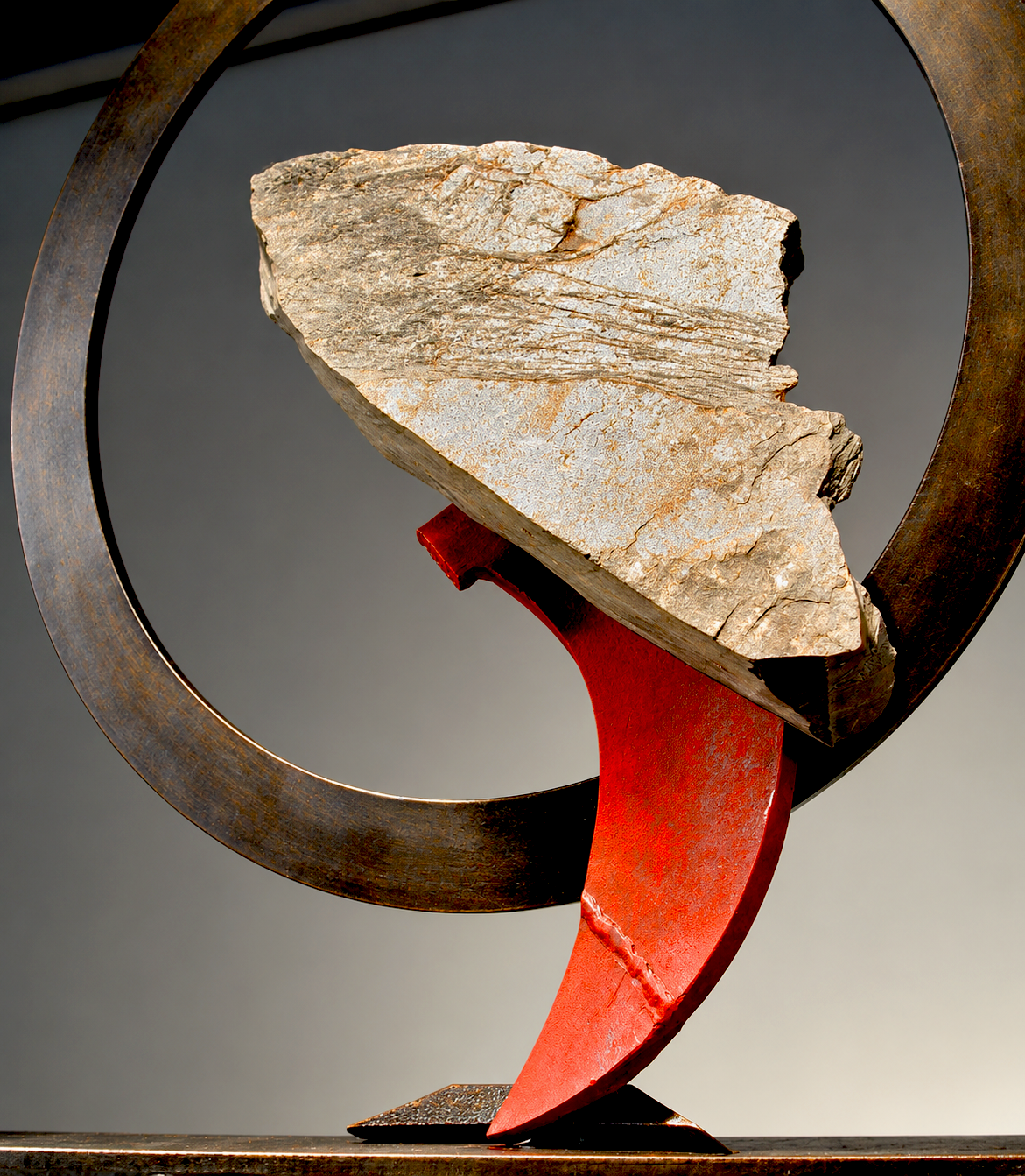
November 2007. Slate, pigmented steel. Dimensions: 27 × 24 × 7 in (69 × 61 × 18 cm). Private collection.
The Sisyphean Series
The Greek myth of Sisyphus, condemned to endlessly push a boulder uphill, has inspired more than 250 of my sculptures. Rather than seeing the myth as a symbol of futility, I share philosopher Albert Camus’s more positive interpretation—that meaning and fulfillment can be found in the struggle itself. In many ways, I see Sisyphus as autobiographical, reflecting my lifelong pursuit as an artist, confronting challenges, taking risks, and finding purpose in the act of creation.
My Sisyphean works bring stone and steel together in precarious yet stable arrangements, often incorporating circular forms suggesting perpetual motion. For me, they are metaphors for the creative process—an ongoing cycle of experimentation, discovery, setbacks, and renewal. Each completed sculpture is both an achievement and a starting point, celebrating the journey rather than simply the destination.
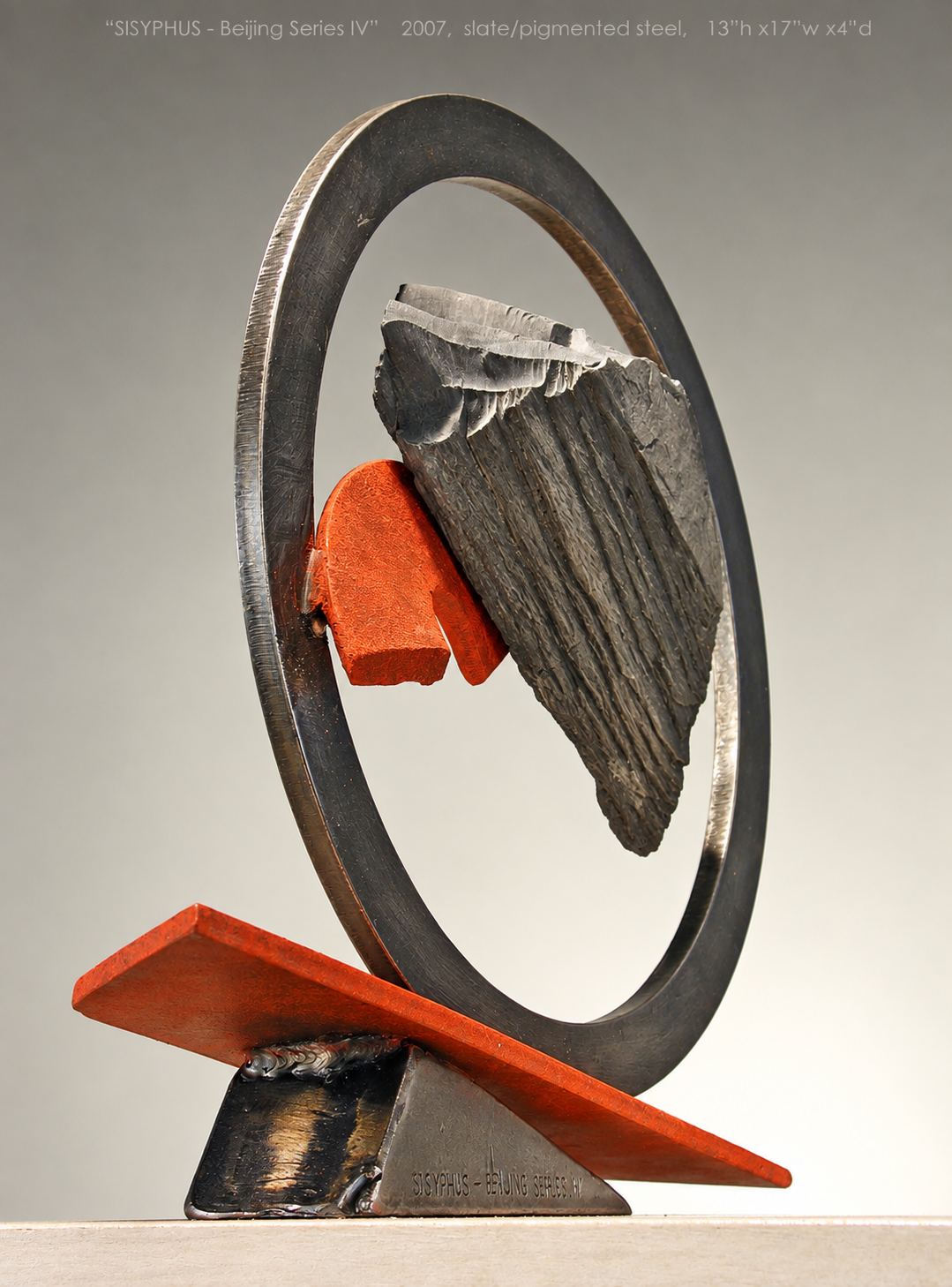
December 2007. Slate, pigmented steel. Dimensions: 13 × 17 × 4 in (33 × 43 × 10 cm). Private Collection.
The Sisyphean Series
The Greek myth of Sisyphus, condemned to endlessly push a boulder uphill, has inspired more than 250 of my sculptures. Rather than seeing the myth as a symbol of futility, I share philosopher Albert Camus’s more positive interpretation—that meaning and fulfillment can be found in the struggle itself. In many ways, I see Sisyphus as autobiographical, reflecting my lifelong pursuit as an artist, confronting challenges, taking risks, and finding purpose in the act of creation.
My Sisyphean works bring stone and steel together in precarious yet stable arrangements, often incorporating circular forms suggesting perpetual motion. For me, they are metaphors for the creative process—an ongoing cycle of experimentation, discovery, setbacks, and renewal. Each completed sculpture is both an achievement and a starting point, celebrating the journey rather than simply the destination.
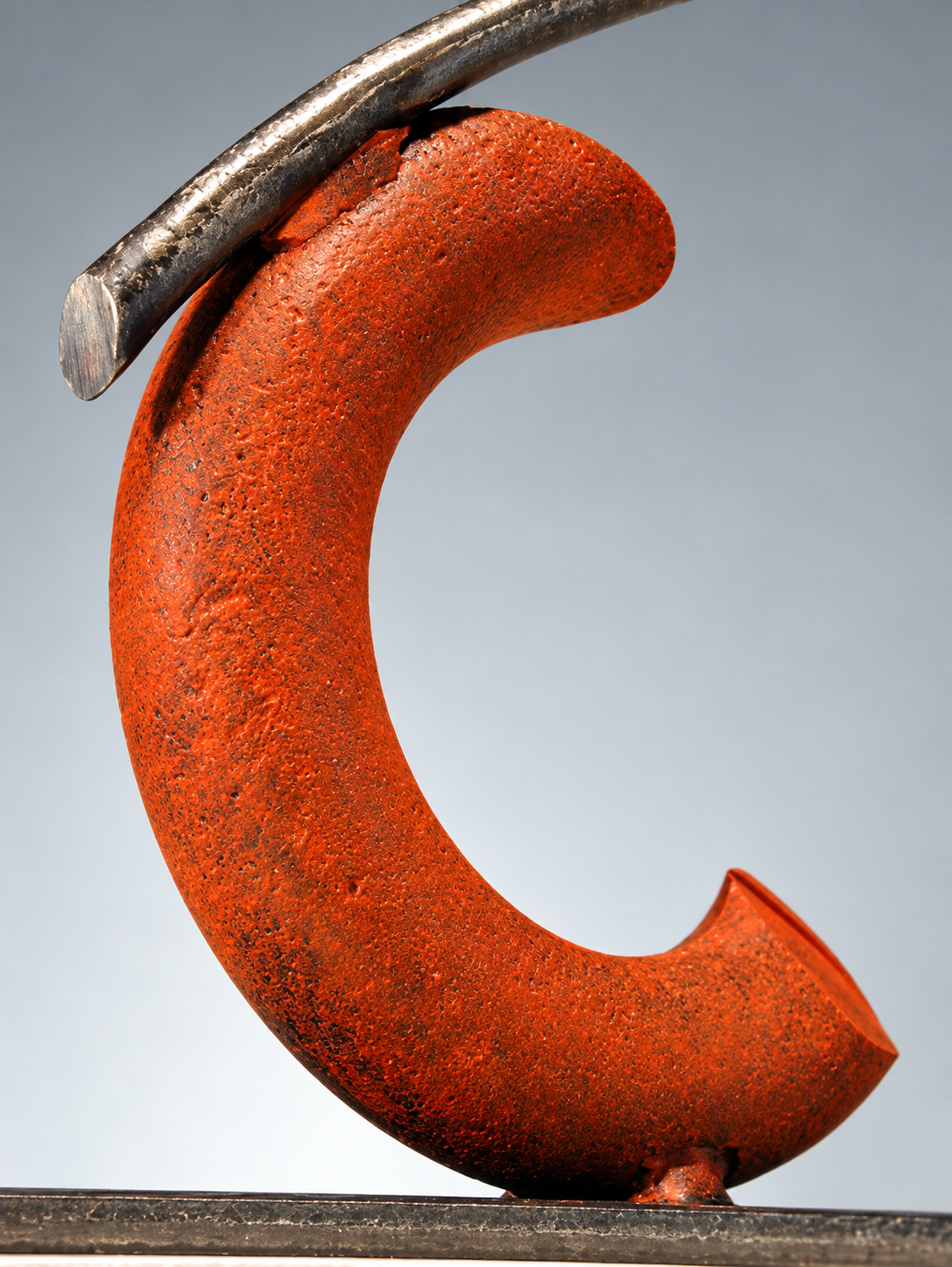
December 2007. Stone pigmented steel. Dimensions: 9 × 10 × 3 in (23 × 25 × 8 cm). Private Collection.
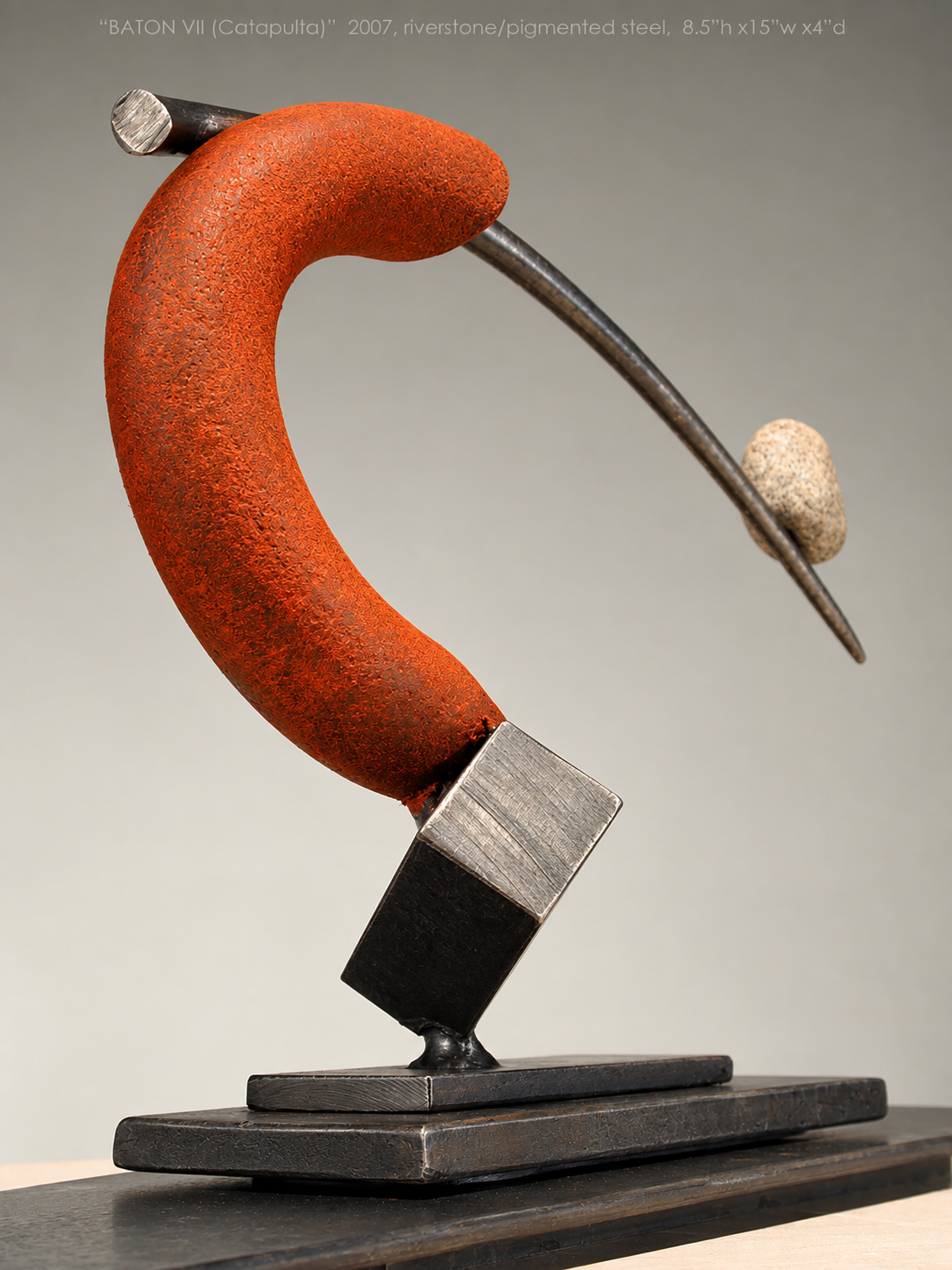
December 2007. Stone, pigmented steel. Dimensions: 8.5 × 15 × 4 in (22 × 38 × 10 cm). private collection
The title derives from the English word catapult, meaning “to launch forward.” The sculpture’s arrangement of stone and steel conveys a sense of arrested motion—energy captured and poised for release—a dynamic tension that has been a central focus of Van Alstine’s work throughout his career.
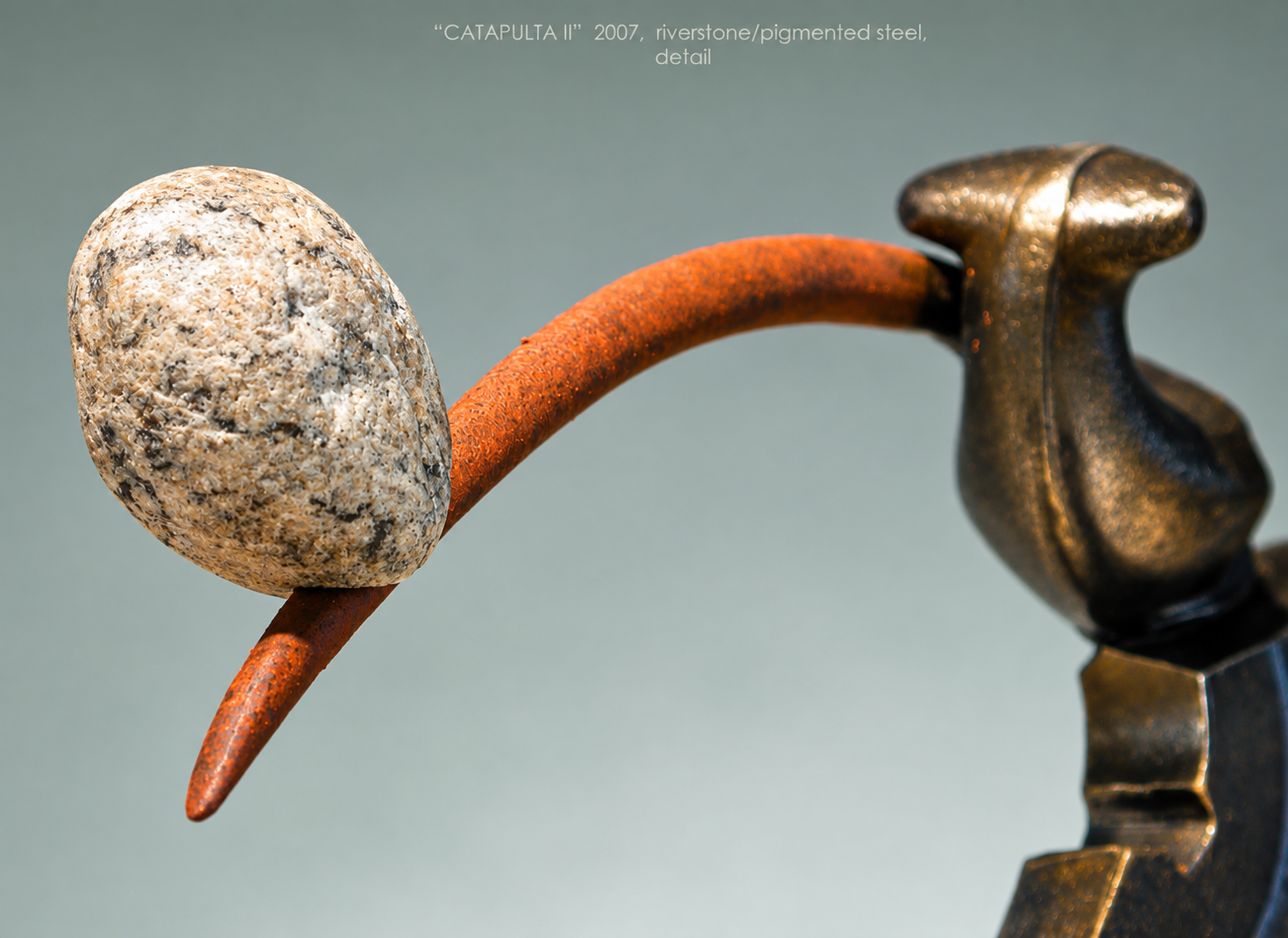
December 2007. River stone, pigmented steel. Dimensions: 7.7 × 15 × 4.5 in (20 × 38 × 11 cm). Private Collection
The title derives from the English word catapult, meaning “to launch forward.” The sculpture’s arrangement of stone and steel conveys a sense of arrested motion—energy captured and poised for release—a dynamic tension that has been a central focus of Van Alstine’s work throughout his career.
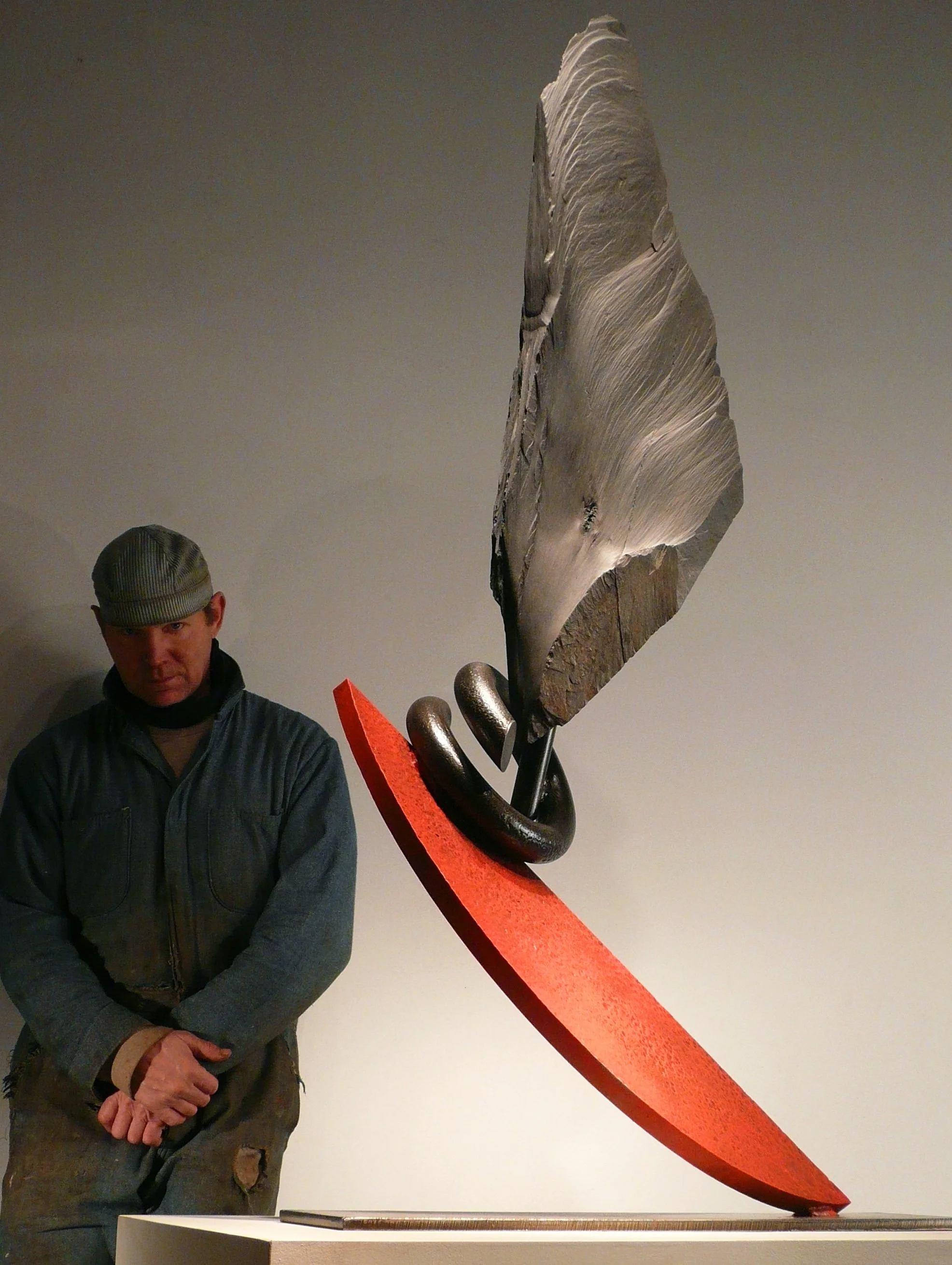
October 2011. Slate, pigmented and sealed steel. Dimensions: 52 × 28 × 13 in (132 × 71 × 33 cm). Private Collection.
Red Hips Hula II, is part of a long-running series exploring my interest in the expressive movement of the human body. Like works inspired by dance, gymnastics, and fencing, it uses balance, gesture, and implied motion rather than literal figuration. The circular steel element and sweeping base suggest the rhythmic rotation associated with the hula hoop, while the vertical slate gives the composition a bodily presence.
The work reflects my broader interest in “choreographing” heavy, earthbound materials—using steel to lift and animate stone. JOHN VAN ALSTINE SCULPTURE Here the massive slate appears almost weightless, poised above the circular steel form in a moment of arrested motion, transforming physical weight into a sense of balance, rhythm, and movement.
2006
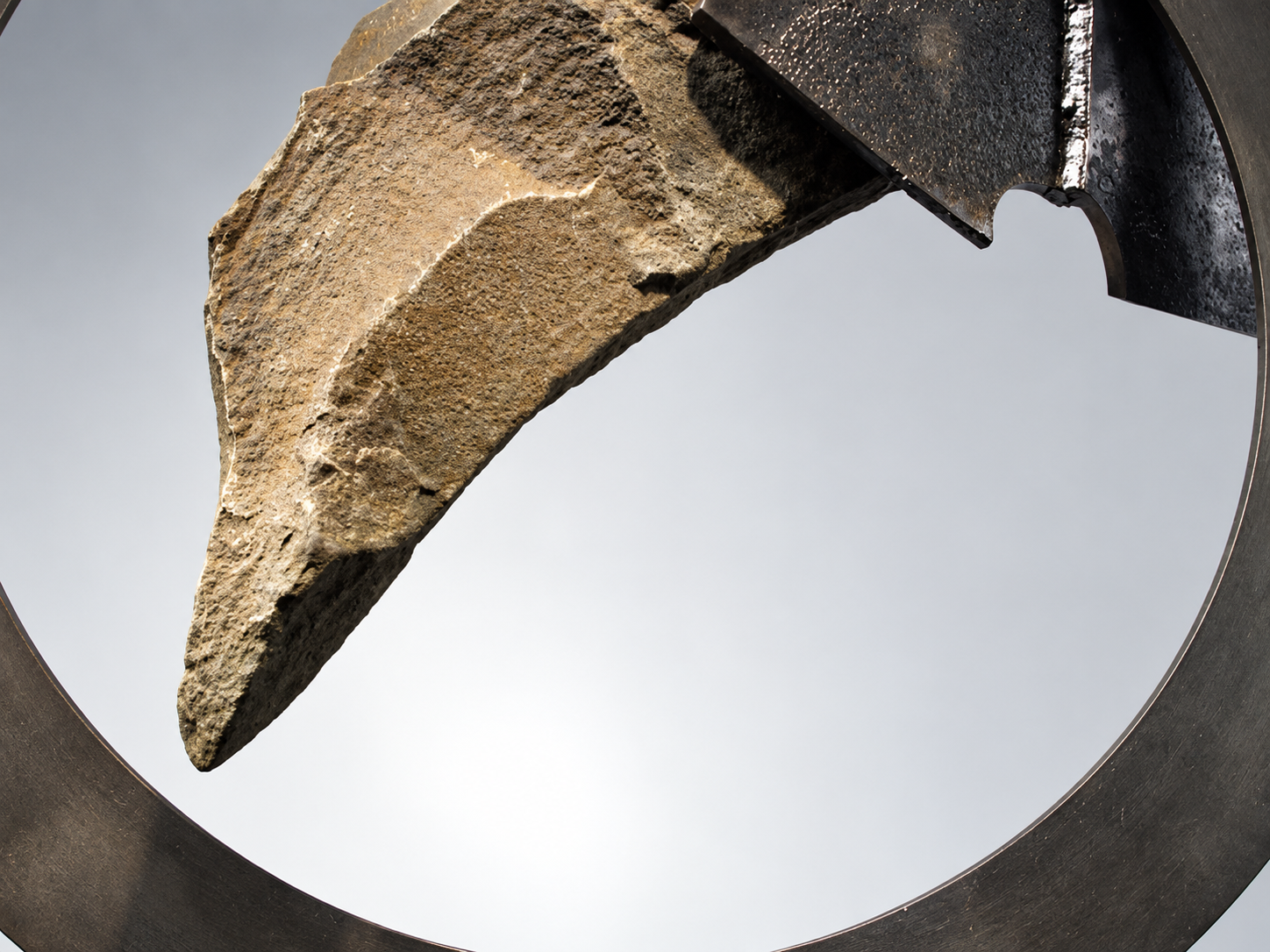
January 2006. Bluestone, steel. Dimensions: 37 × 37 × 10 in (94 × 94 × 25 cm). Private Collection - South Carolina.
The Sisyphean Series
The Greek myth of Sisyphus, condemned to endlessly push a boulder uphill, has inspired more than 250 of my sculptures. Rather than seeing the myth as a symbol of futility, I share philosopher Albert Camus’s more positive interpretation—that meaning and fulfillment can be found in the struggle itself. In many ways, I see Sisyphus as autobiographical, reflecting my lifelong pursuit as an artist, confronting challenges, taking risks, and finding purpose in the act of creation.
My Sisyphean works bring stone and steel together in precarious yet stable arrangements, often incorporating circular forms suggesting perpetual motion. For me, they are metaphors for the creative process—an ongoing cycle of experimentation, discovery, setbacks, and renewal. Each completed sculpture is both an achievement and a starting point, celebrating the journey rather than simply the destination.
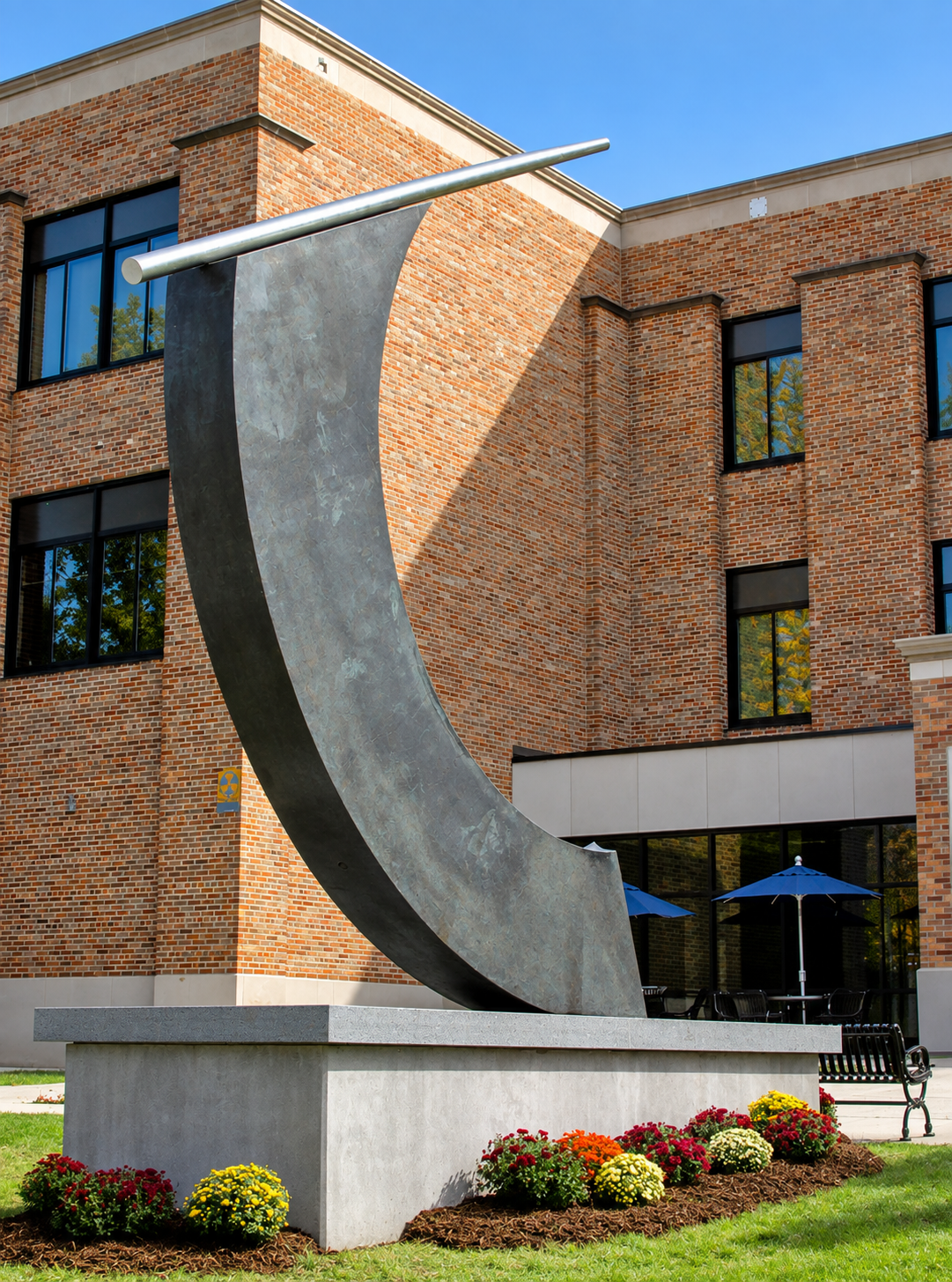
February 2006. Bronze, stainless steel, sunlight. Dimensions: 18 × 20 × 10 ft.
Via Solaris, 2006
Via Solaris was commissioned for Indiana State University in Terre Haute and represents a culmination of my Celestial Works, begun with Solstice Calendar in 1986. The monumental bronze, granite, and stainless-steel sculpture combines the language of contemporary sculpture with one of humankind’s oldest scientific instruments—the solar calendar. Its sweeping crescent form and stainless-steel element engage the movement of the sun, bringing together art, astronomy, and the passage of time. JOHN VAN ALSTINE SCULPTURE
At the spring and fall equinoxes, the sun’s angle at solar noon aligns with a specially positioned opening, allowing a spot of sunlight to illuminate a marker on the granite base—signaling the moment in the annual cycle when day and night are approximately equal. More broadly, Via Solaris is intended to reconnect us with the natural rhythms of light and darkness, seasons and time—forces that shaped human experience long before the modern calendar.
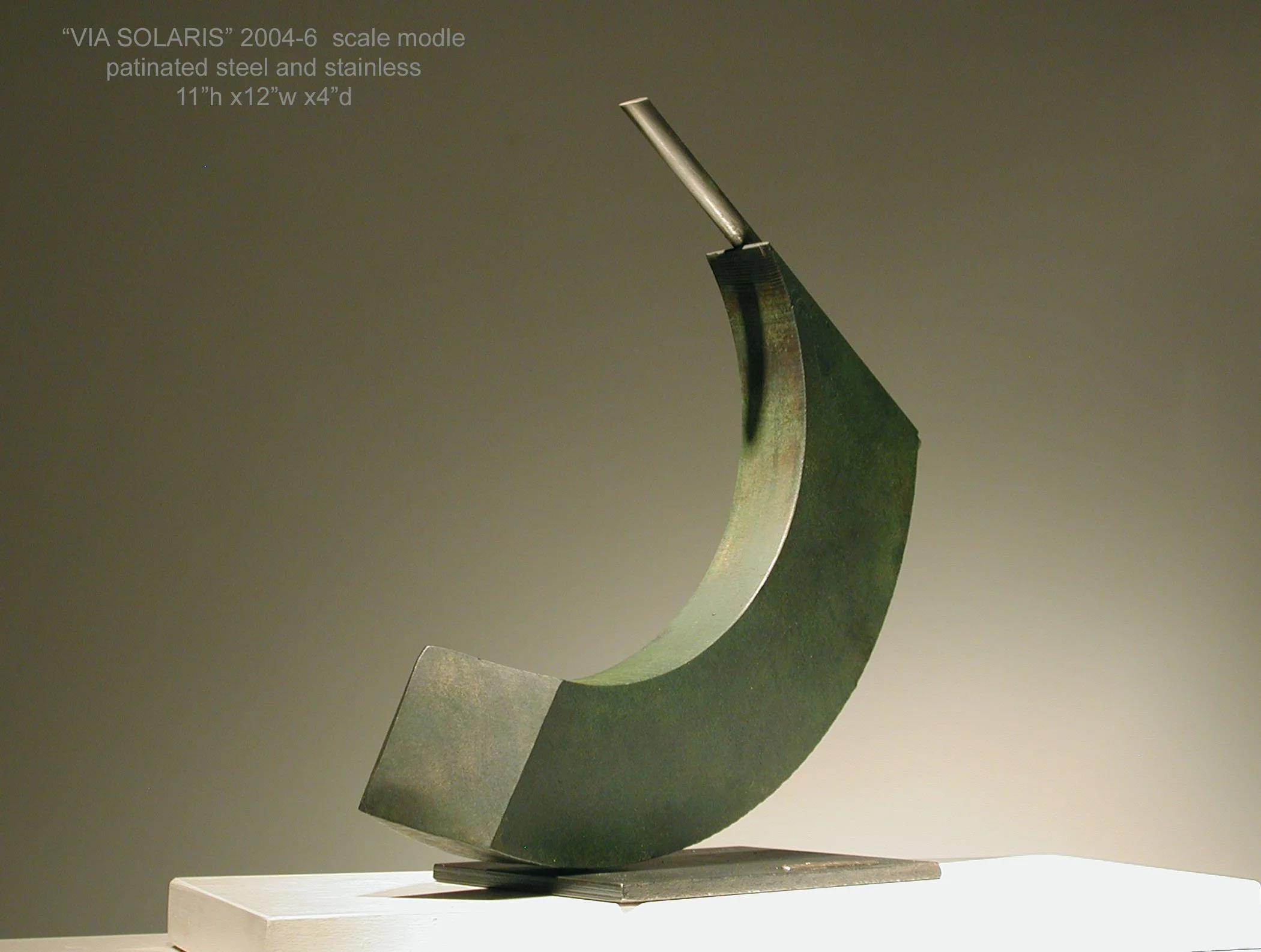
April 2006. Patinated steel, stainless steel. Dimensions: 11 × 10 × 4 in (28 × 25 × 10 cm). Collection - Art Museum Univ. of Indiana Terre Haute.
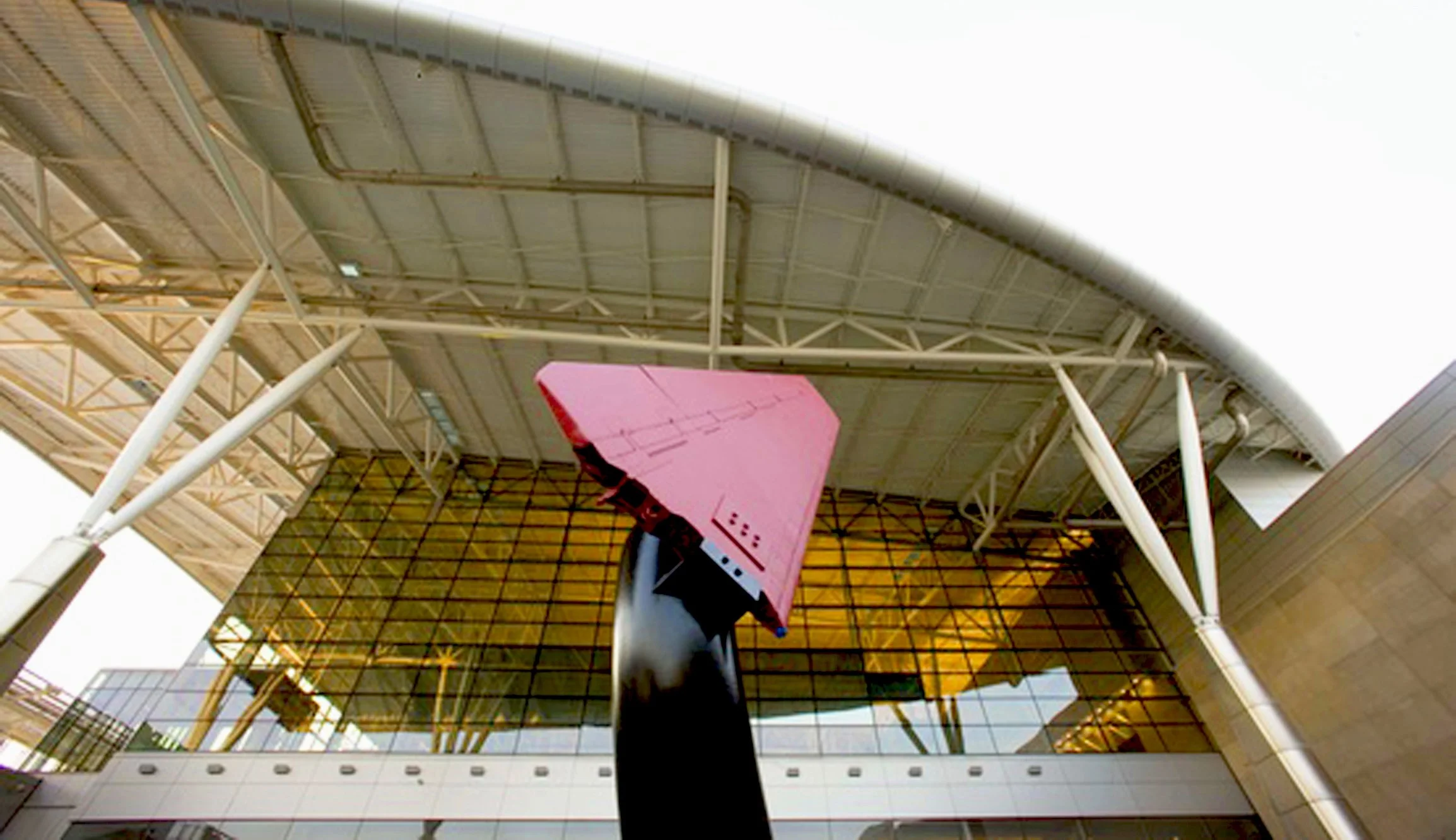
begun 2006. Steel, titanium, aluminum. Dimensions: 35 × 20 × 10ft.
Cardinalis (Redwing for Wilbur and Orville), 2008
Commissioned for the new Indianapolis International Airport, Cardinalis is a 35-foot-high sculpture that connects several ideas specific to its site. Its sweeping red form evokes Indiana’s state bird, the cardinal, while the sculpture incorporates an actual titanium wing from an F-14 Tomcat. Transforming part of a military aircraft into a work of art allowed me to address flight while paying homage to aviation pioneers Wilbur and Orville Wright and, more broadly, to the people whose skill and ingenuity make flight possible. Indianapolis Airport Authority
The dynamically positioned wing, joined to the earth by a sweeping black steel arc, creates an image of lift, movement, and imminent flight. For me, the airport itself is a kind of “middle ground”—a place connecting earth and sky, departure and arrival. The sculpture’s remarkably small point of contact with the ground heightens its sense of precarious balance and upward energy, suggesting both the physical drama and the seeming magic of taking off and landing. Indy Arts
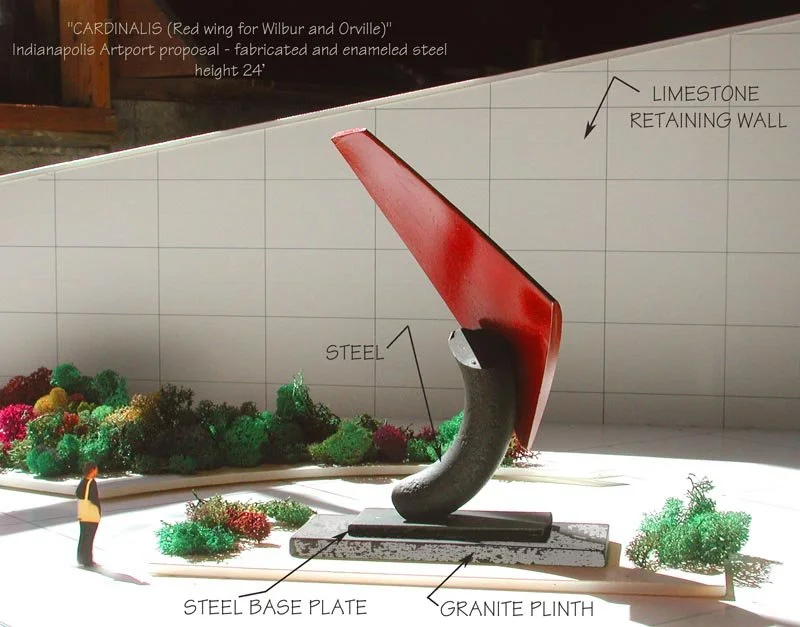
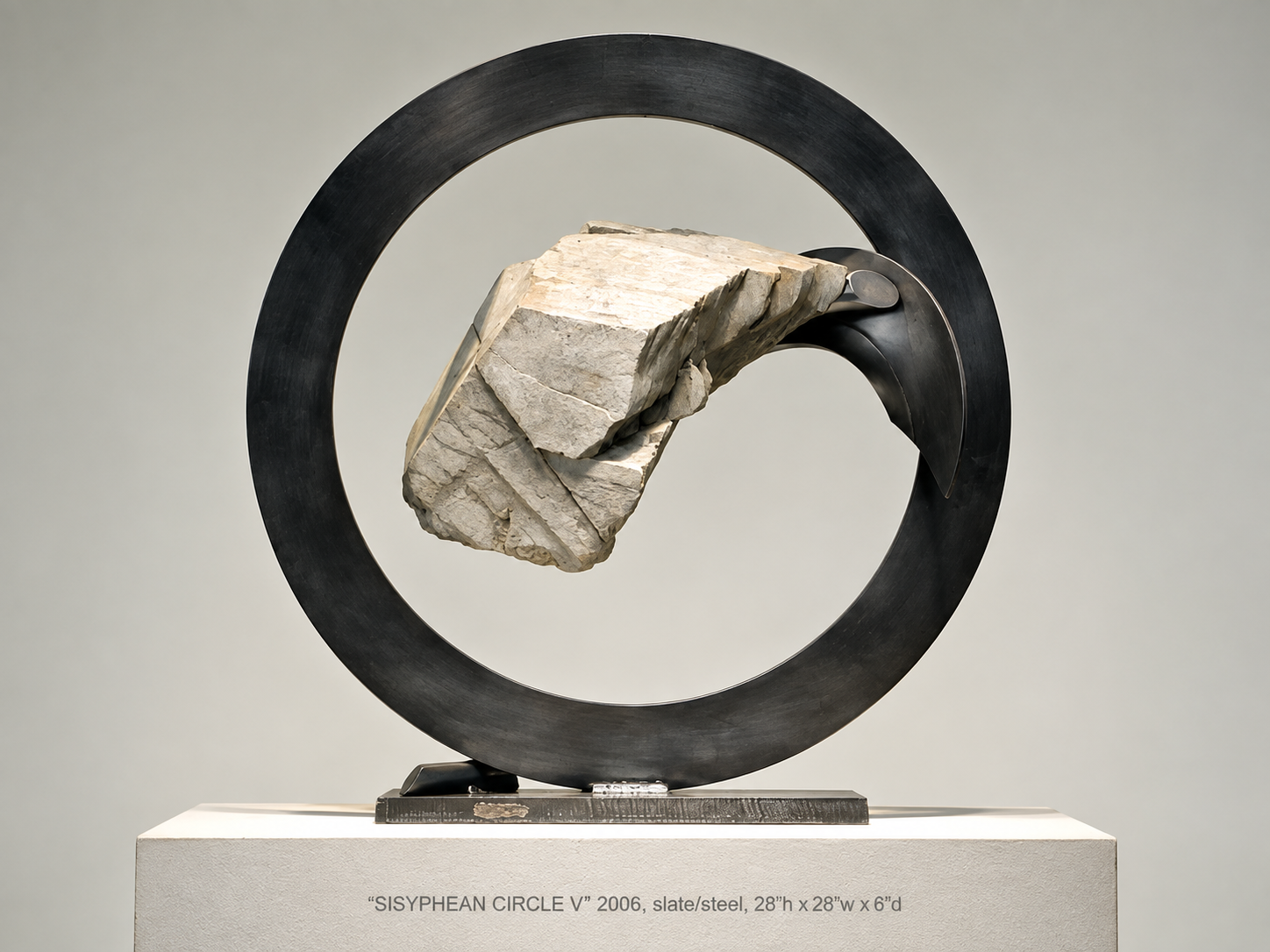
April 2006. Slate, steel. Dimensions: 28 × 28 × 6 in (71 × 71 × 15 cm).
Collection: US Stae Department - Art in Embassies - Kingston, Jamaica
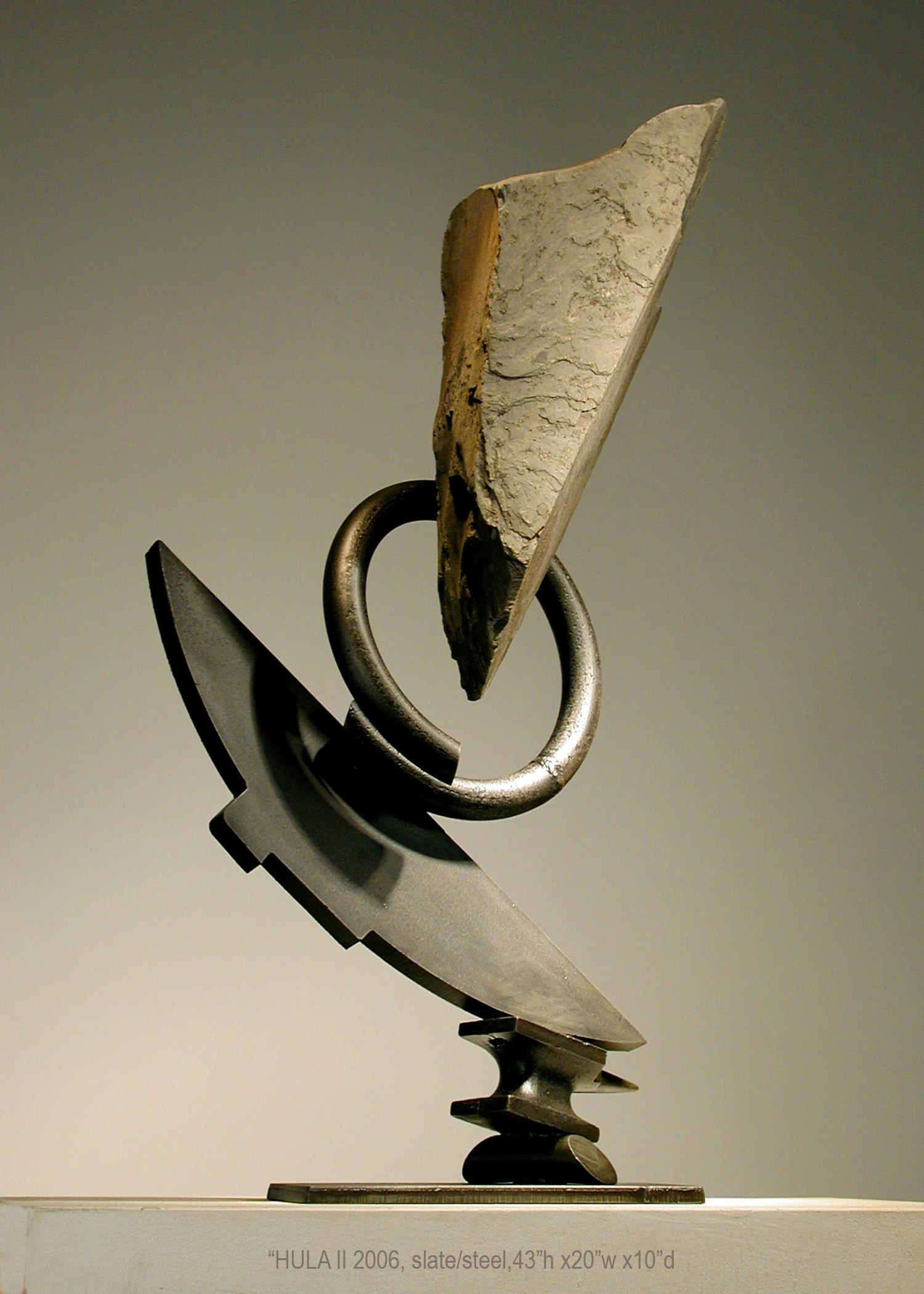
April 2006. Slate, steel. Dimensions: 43 × 20 × 10 in (109 × 51 × 25 cm). Private Collection - Baltimore
Hula II, 2006, is the second in what became a long-running series exploring my interest in the expressive movement of the human body. Like works inspired by dance, gymnastics, and fencing, it uses balance, gesture, and implied motion rather than literal figuration. The circular steel element and sweeping base suggest the rhythmic rotation associated with the hula hoop, while the vertical slate gives the composition a bodily presence.
The work reflects my broader interest in “choreographing” heavy, earthbound materials—using steel to lift and animate stone. JOHN VAN ALSTINE SCULPTURE Here the massive slate appears almost weightless, poised above the circular steel form in a moment of arrested motion, transforming physical weight into a sense of balance, rhythm, and movement
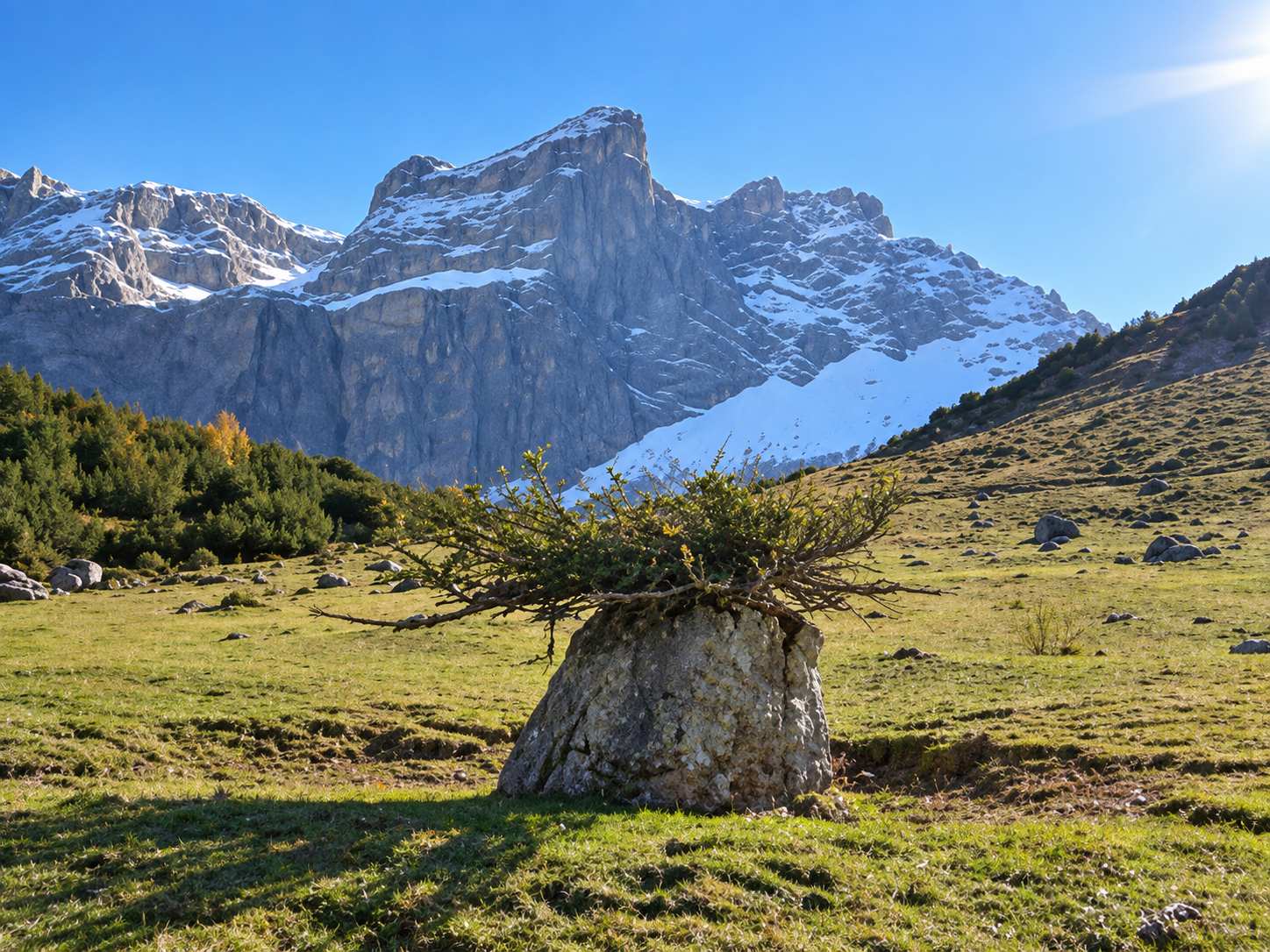
April 2006. Steel, stone. Dimensions: 11.5 × 8 × 4 in (29 × 20 × 10 cm). Private Collection.
Stone from Drei Türme. (Three Towers) are a prominent 2,830-meter mountain massif in the Rätikon range, serving as a landmark of the Montafon valley in Austria. Located on the Swiss border, they consist of three main peaks, popular for hiking and climbing, particularly accessible via the Lindauer Hütte
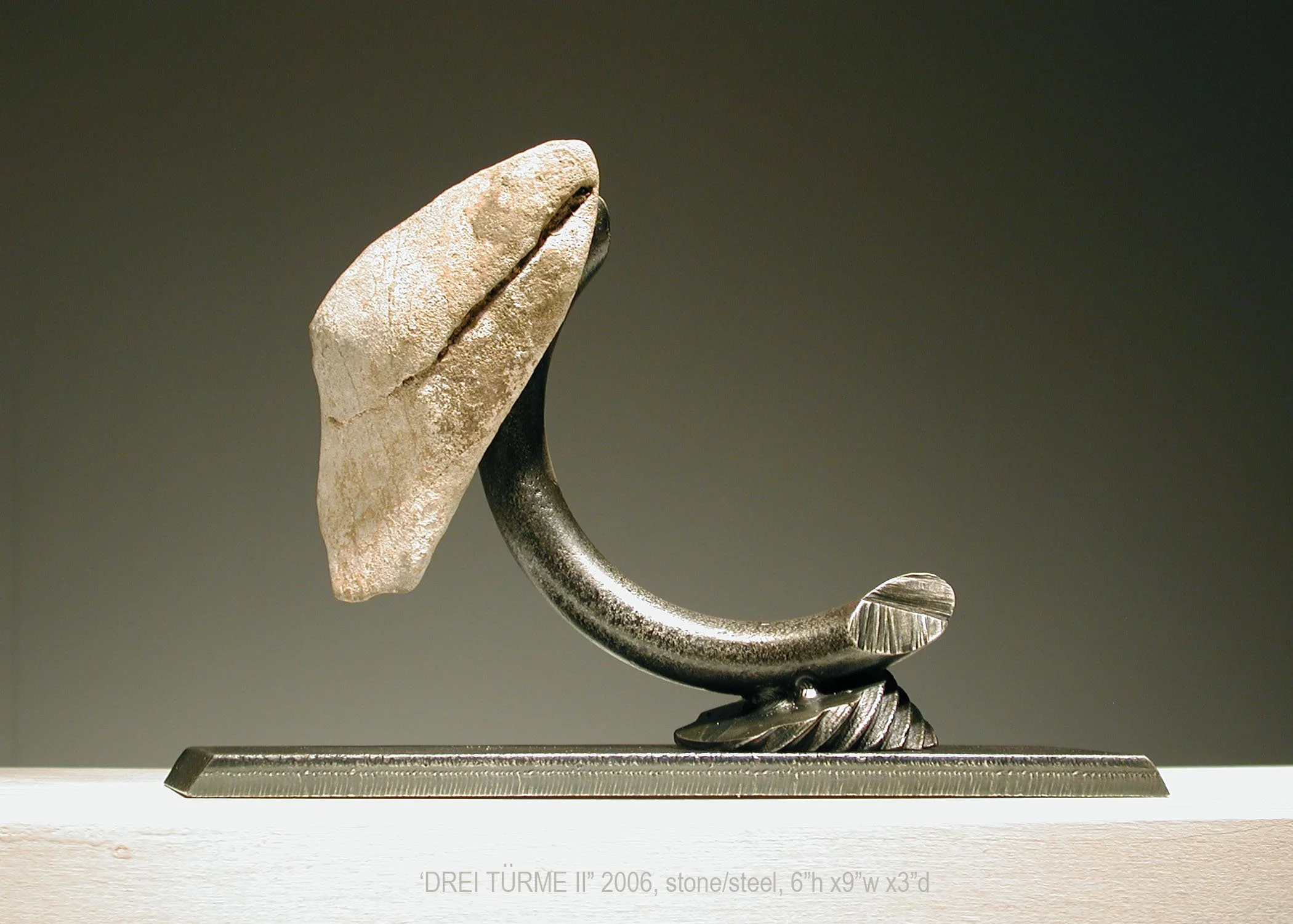
April 2006. Steel, stone. Dimensions: 6 × 9 × 3 in (15 × 23 × 8 cm). Private Collection.
Stone from Drei Türme (Three Towers) are a prominent 2,830-meter mountain massif in the Rätikon range, serving as a landmark of the Montafon valley in Austria. Located on the Swiss border, they consist of three main peaks, popular for hiking and climbing, particularly accessible via the Lindauer Hütte
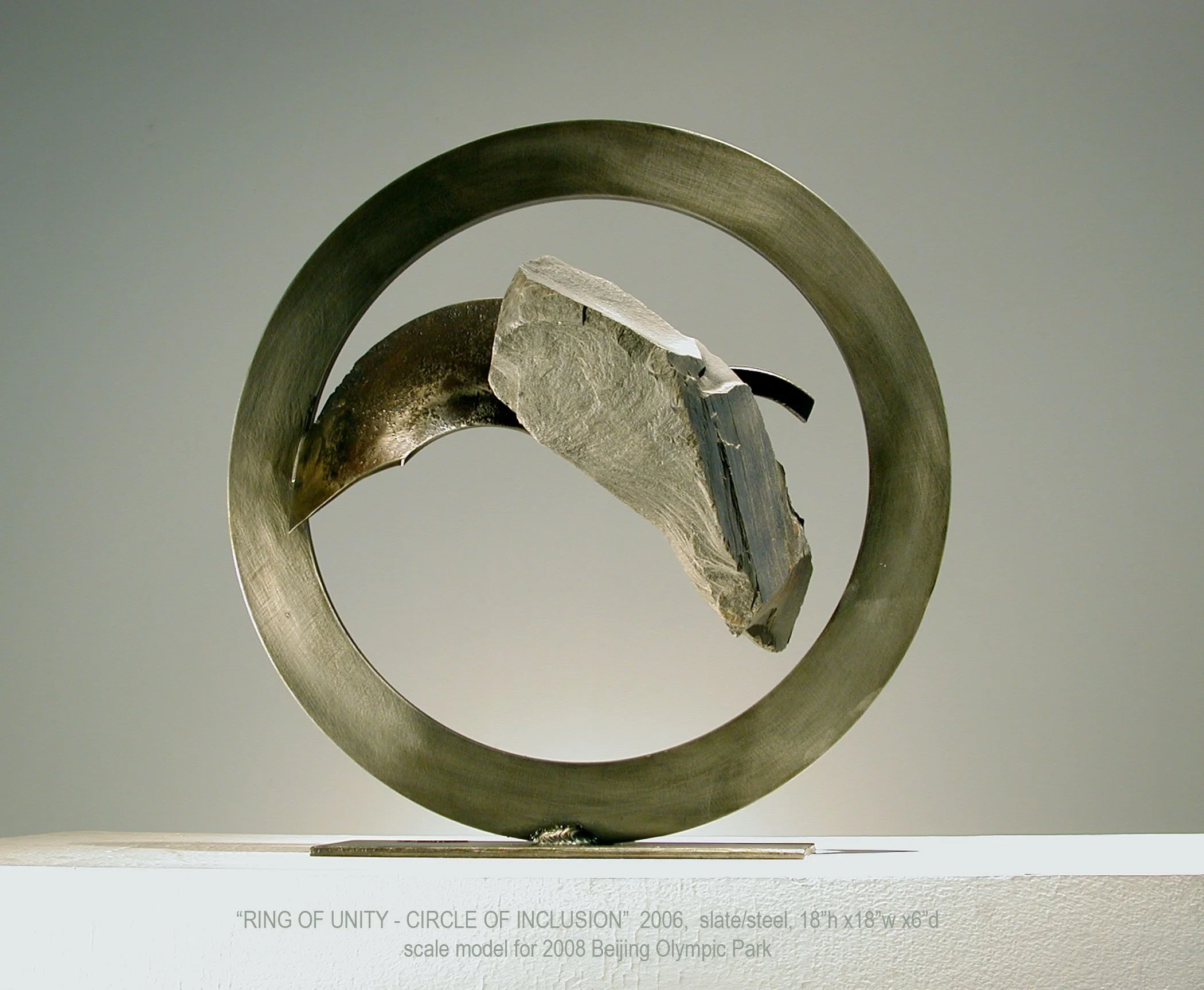
April 2006. Slate, steel. Scale model for 2008 Beijing Olympic piece. Installed in Olympic park and as of 2026 still there.
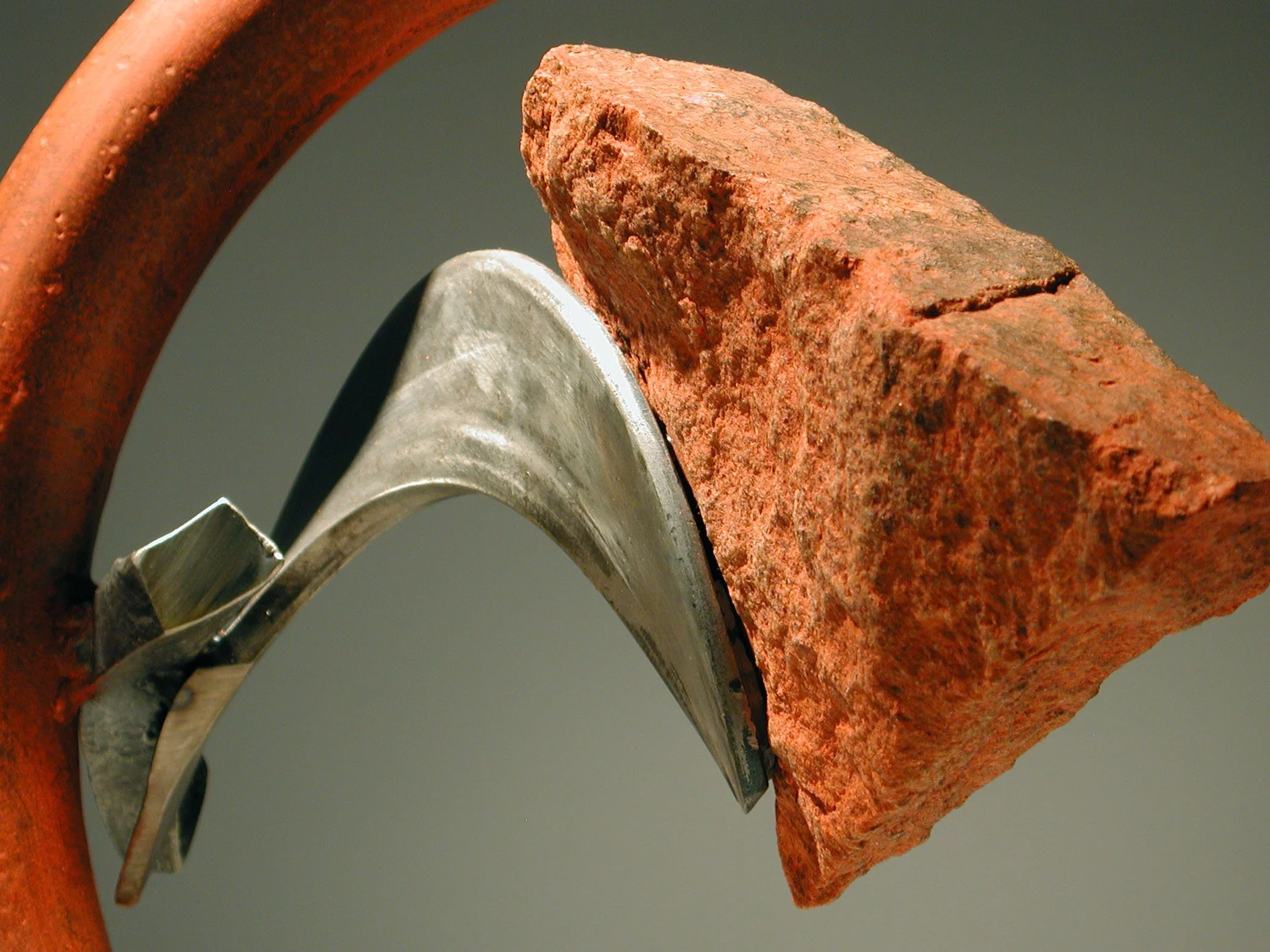
April 2006. Slate, steel. Dimensions: 14 × 12 × 5 in (36 × 30 × 13 cm). Private Collection.
The Sisyphean Series
The Greek myth of Sisyphus, condemned to endlessly push a boulder uphill, has inspired more than 250 of my sculptures. Rather than seeing the myth as a symbol of futility, I share philosopher Albert Camus’s more positive interpretation—that meaning and fulfillment can be found in the struggle itself. In many ways, I see Sisyphus as autobiographical, reflecting my lifelong pursuit as an artist, confronting challenges, taking risks, and finding purpose in the act of creation.
My Sisyphean works bring stone and steel together in precarious yet stable arrangements, often incorporating circular forms suggesting perpetual motion. For me, they are metaphors for the creative process—an ongoing cycle of experimentation, discovery, setbacks, and renewal. Each completed sculpture is both an achievement and a starting point, celebrating the journey rather than simply the destination.
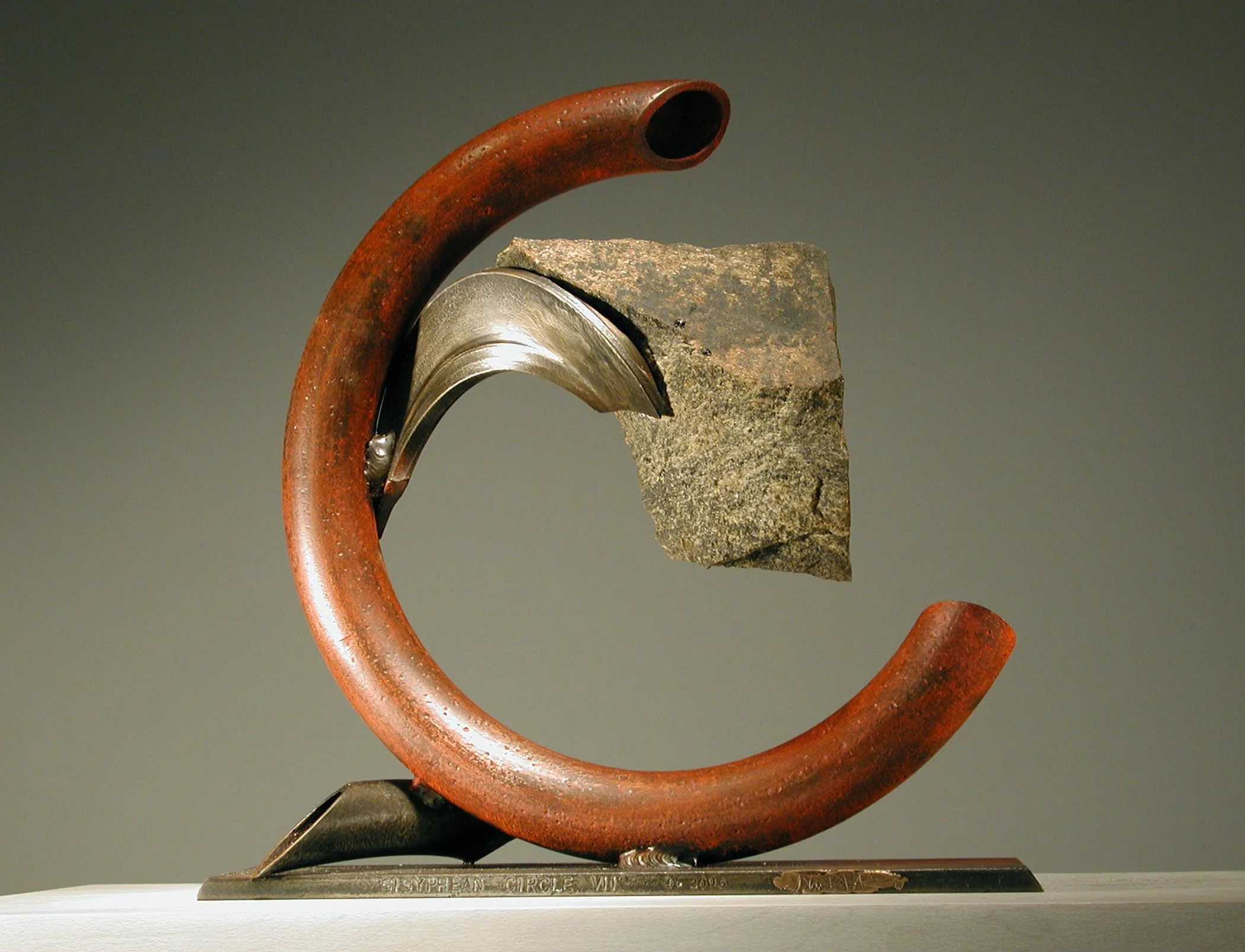
April 2006. Slate, steel. Dimensions: 14 × 14 × 6 in (36 × 36 × 15 cm). Private Collection.
The Sisyphean Series
The Greek myth of Sisyphus, condemned to endlessly push a boulder uphill, has inspired more than 250 of my sculptures. Rather than seeing the myth as a symbol of futility, I share philosopher Albert Camus’s more positive interpretation—that meaning and fulfillment can be found in the struggle itself. In many ways, I see Sisyphus as autobiographical, reflecting my lifelong pursuit as an artist, confronting challenges, taking risks, and finding purpose in the act of creation.
My Sisyphean works bring stone and steel together in precarious yet stable arrangements, often incorporating circular forms suggesting perpetual motion. For me, they are metaphors for the creative process—an ongoing cycle of experimentation, discovery, setbacks, and renewal. Each completed sculpture is both an achievement and a starting point, celebrating the journey rather than simply the destination.
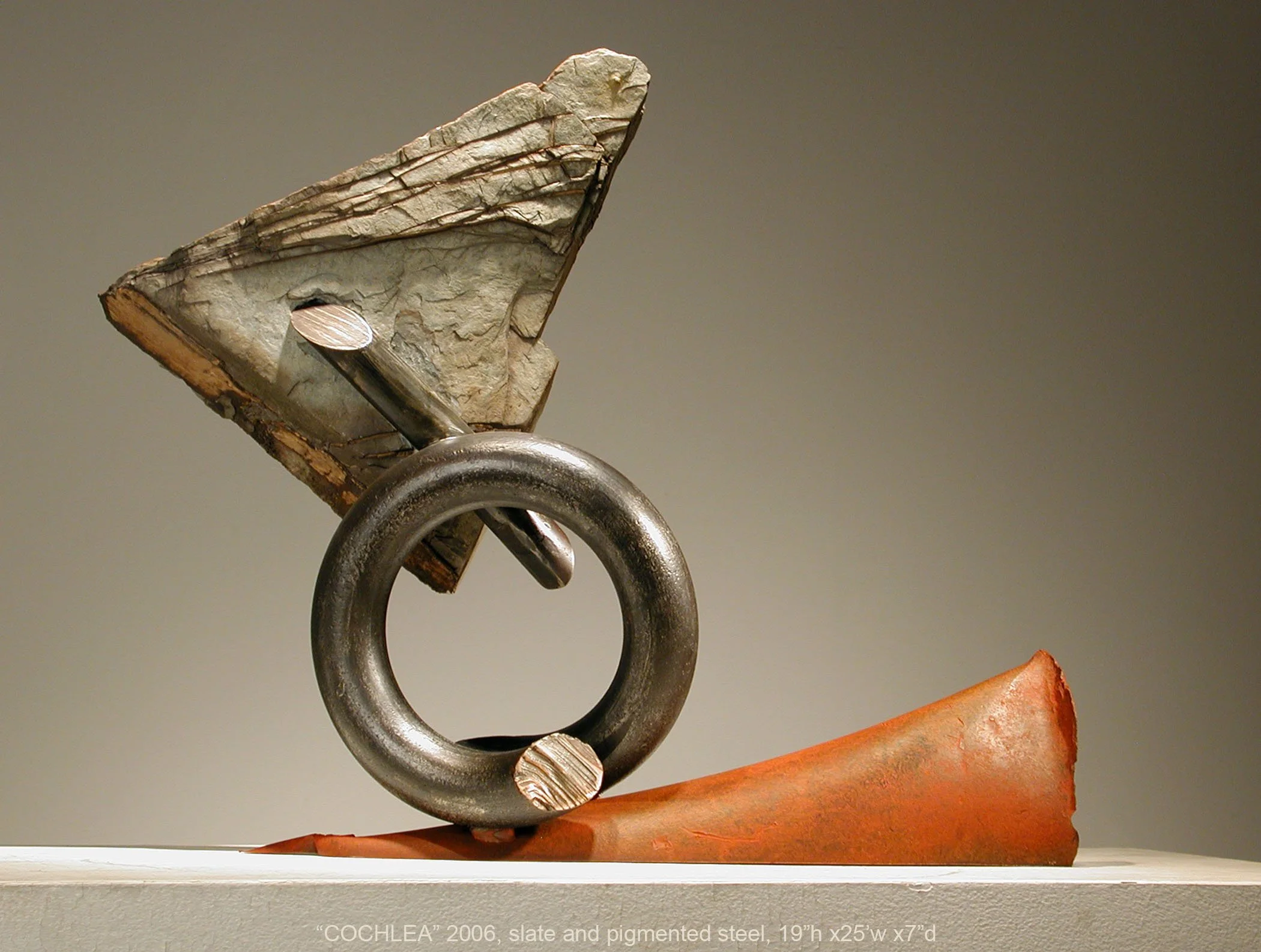
May 2006. Slate, steel. Dimensions: 19 × 25 × 7 in (48 × 64 × 18 cm). Private Collection.
Cochlea comes from Latin, meaning “snail” or “snail shell.” The word derives from Greek kokhlias, also referring to a spiral snail shell.
In anatomy, the cochlea is the spiral-shaped, fluid-filled structure of the inner ear responsible for hearing. Its name comes directly from its resemblance to a coiled snail shell.
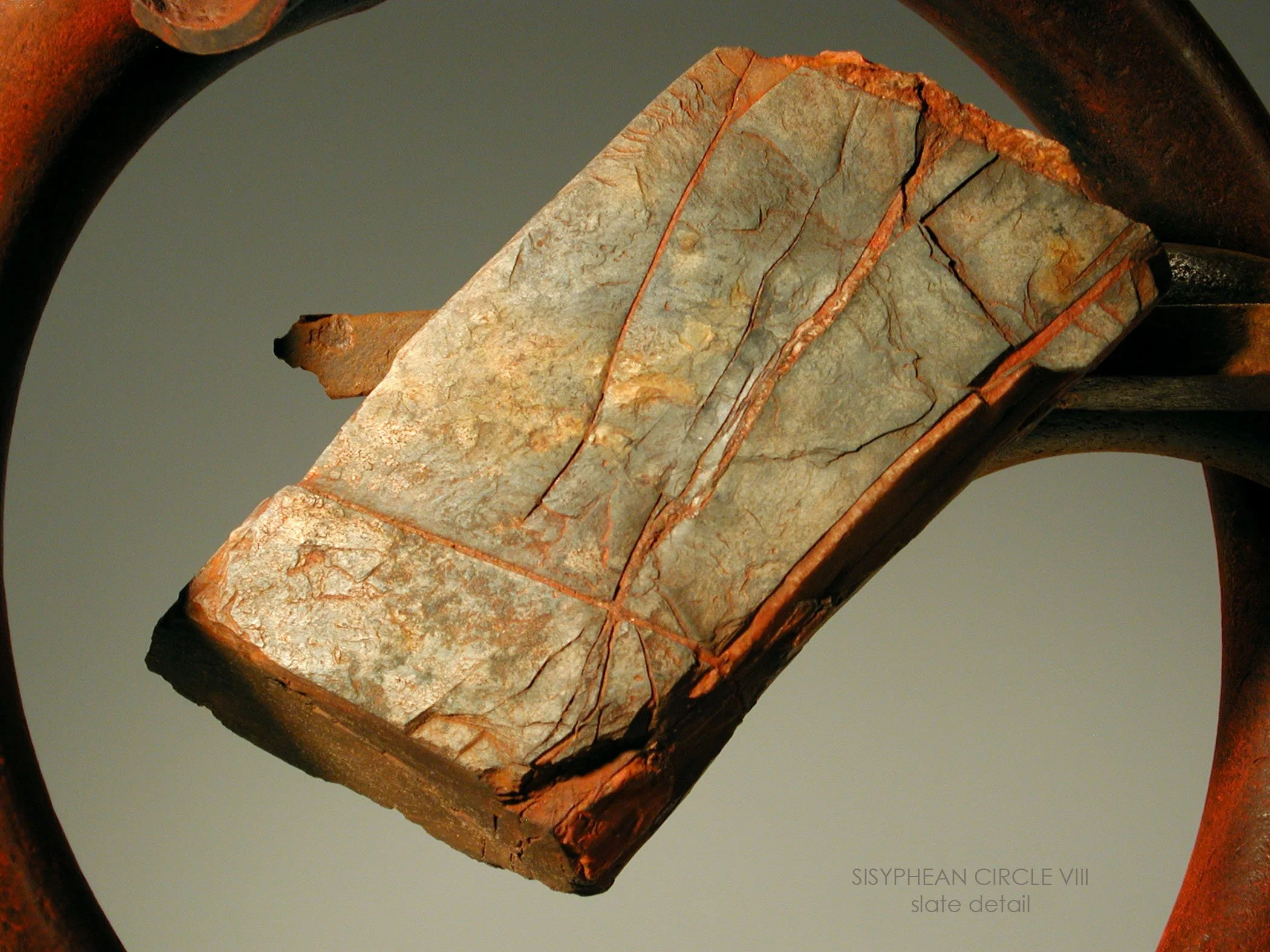
May 2006. Pigmented slate and steel. Dimensions: 14 × 14 × 5 in (36 × 36 × 13 cm). Private Collection.
The Sisyphean Series
The Greek myth of Sisyphus, condemned to endlessly push a boulder uphill, has inspired more than 250 of my sculptures. Rather than seeing the myth as a symbol of futility, I share philosopher Albert Camus’s more positive interpretation—that meaning and fulfillment can be found in the struggle itself. In many ways, I see Sisyphus as autobiographical, reflecting my lifelong pursuit as an artist, confronting challenges, taking risks, and finding purpose in the act of creation.
My Sisyphean works bring stone and steel together in precarious yet stable arrangements, often incorporating circular forms suggesting perpetual motion. For me, they are metaphors for the creative process—an ongoing cycle of experimentation, discovery, setbacks, and renewal. Each completed sculpture is both an achievement and a starting point, celebrating the journey rather than simply the destination.
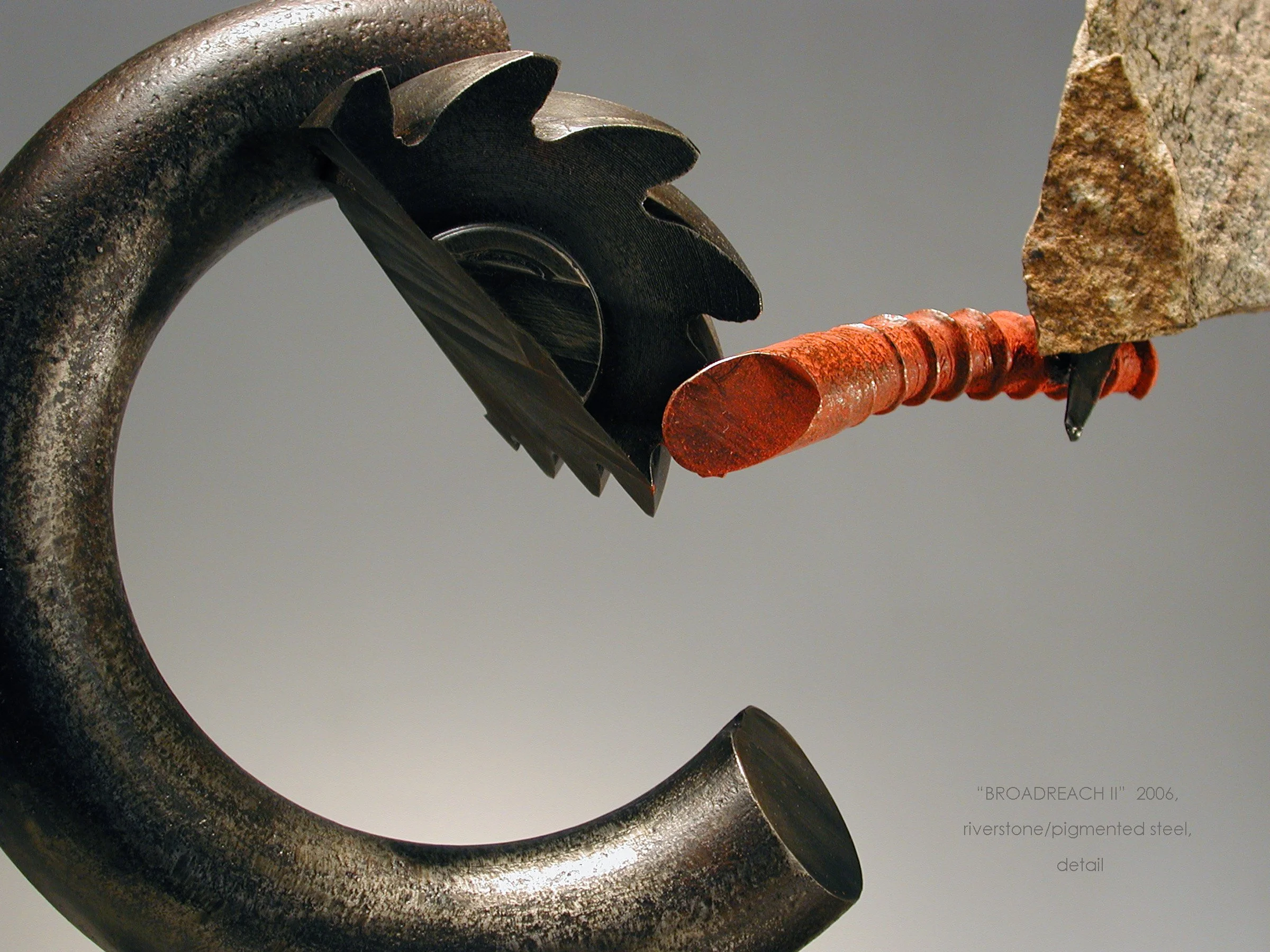
May 2006. Granite, steel. Dimensions: 12 × 14 × 4 in (30 × 36 × 10 cm). Private Collection Alexandria, VA
broad reach - sailing term - wind to your back, large spinnaker sails up, in a general sense it is a time to lean back, relax and savor.
The Broadreach Series was inspired by my sailing in the Adirondack. As I understand the term, it is the “run” you make after you have worked hard tacking back and forth and finally reach a point when you can let out the big spinnaker sail (abstractly portrayed in the sculpture by the curving red round element), lean back and “go with the wind”. It is the time to kick back and enjoy the fruits of ones labors. “Millertime!”
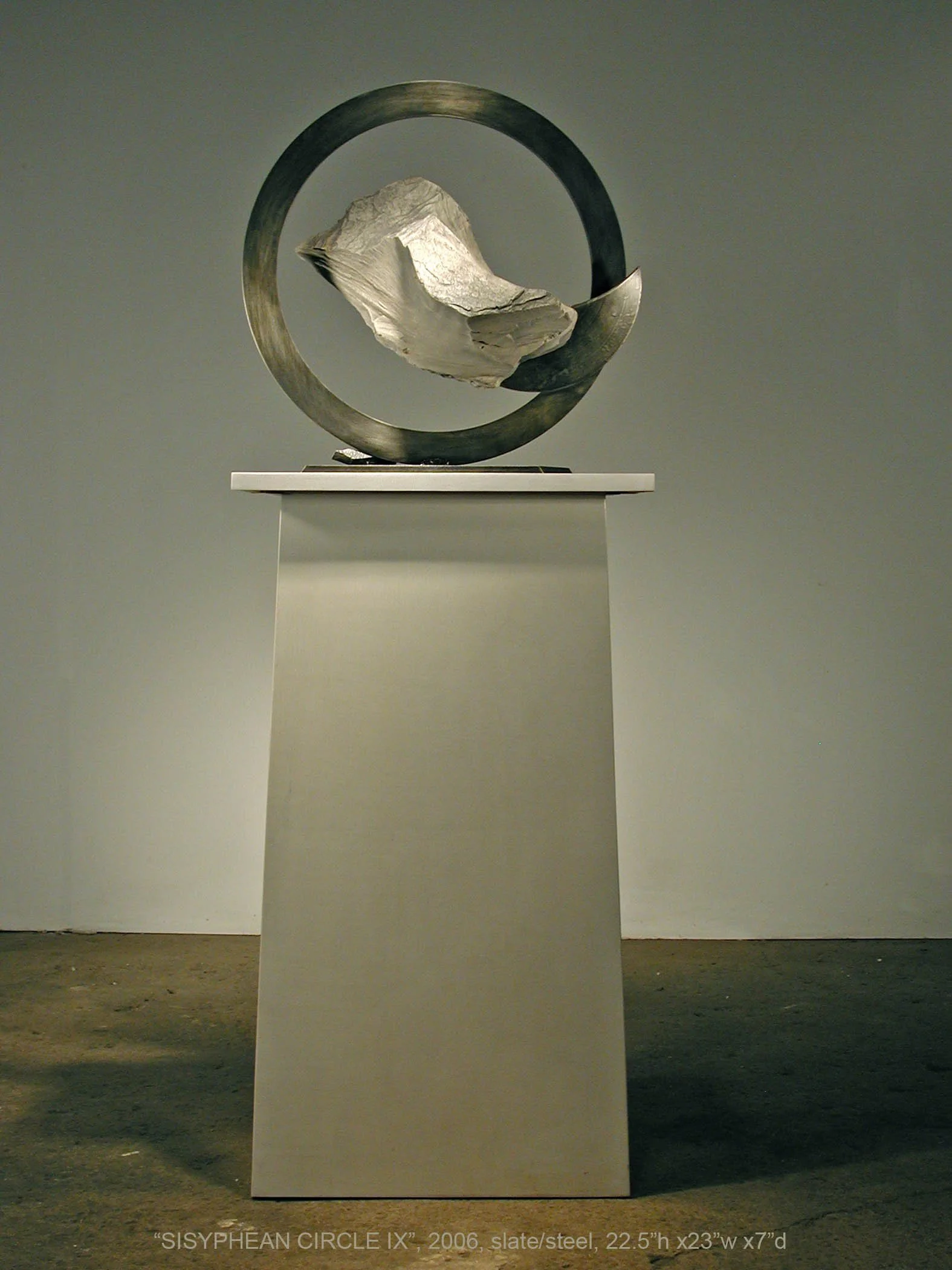
May 2006. Slate, steel. Dimensions: 22.5 × 23 × 7 in (57 × 58 × 18 cm). Private Collection.
The Sisyphean Series
The Greek myth of Sisyphus, condemned to endlessly push a boulder uphill, has inspired more than 250 of my sculptures. Rather than seeing the myth as a symbol of futility, I share philosopher Albert Camus’s more positive interpretation—that meaning and fulfillment can be found in the struggle itself. In many ways, I see Sisyphus as autobiographical, reflecting my lifelong pursuit as an artist, confronting challenges, taking risks, and finding purpose in the act of creation.
My Sisyphean works bring stone and steel together in precarious yet stable arrangements, often incorporating circular forms suggesting perpetual motion. For me, they are metaphors for the creative process—an ongoing cycle of experimentation, discovery, setbacks, and renewal. Each completed sculpture is both an achievement and a starting point, celebrating the journey rather than simply the destination.
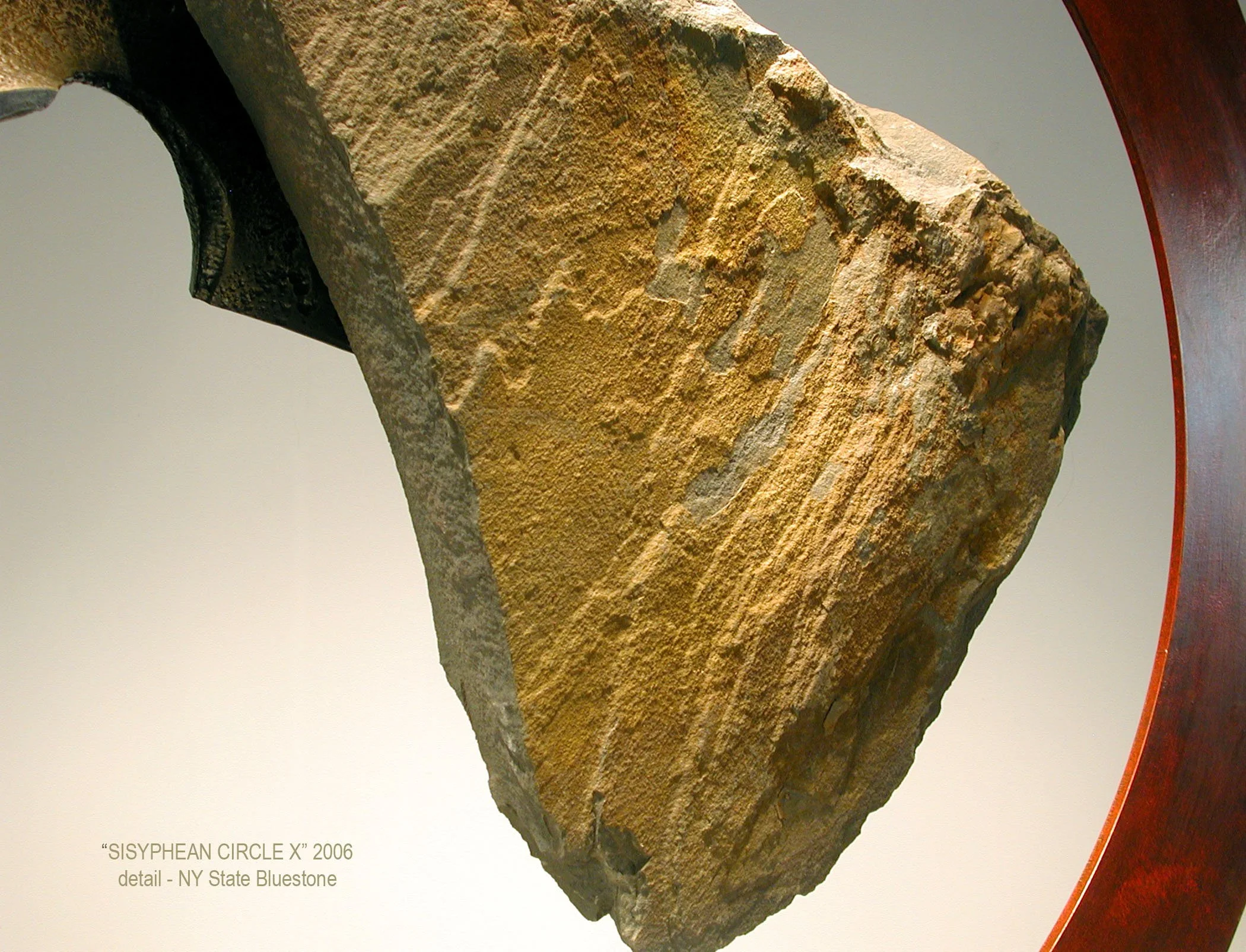
May 2006. Bluestone, steel. Dimensions: 49 × 48 × 14 in (124 × 122 × 36 cm). Private Collection Baltimore, MD.
The Sisyphean Series
The Greek myth of Sisyphus, condemned to endlessly push a boulder uphill, has inspired more than 250 of my sculptures. Rather than seeing the myth as a symbol of futility, I share philosopher Albert Camus’s more positive interpretation—that meaning and fulfillment can be found in the struggle itself. In many ways, I see Sisyphus as autobiographical, reflecting my lifelong pursuit as an artist, confronting challenges, taking risks, and finding purpose in the act of creation.
My Sisyphean works bring stone and steel together in precarious yet stable arrangements, often incorporating circular forms suggesting perpetual motion. For me, they are metaphors for the creative process—an ongoing cycle of experimentation, discovery, setbacks, and renewal. Each completed sculpture is both an achievement and a starting point, celebrating the journey rather than simply the destination.
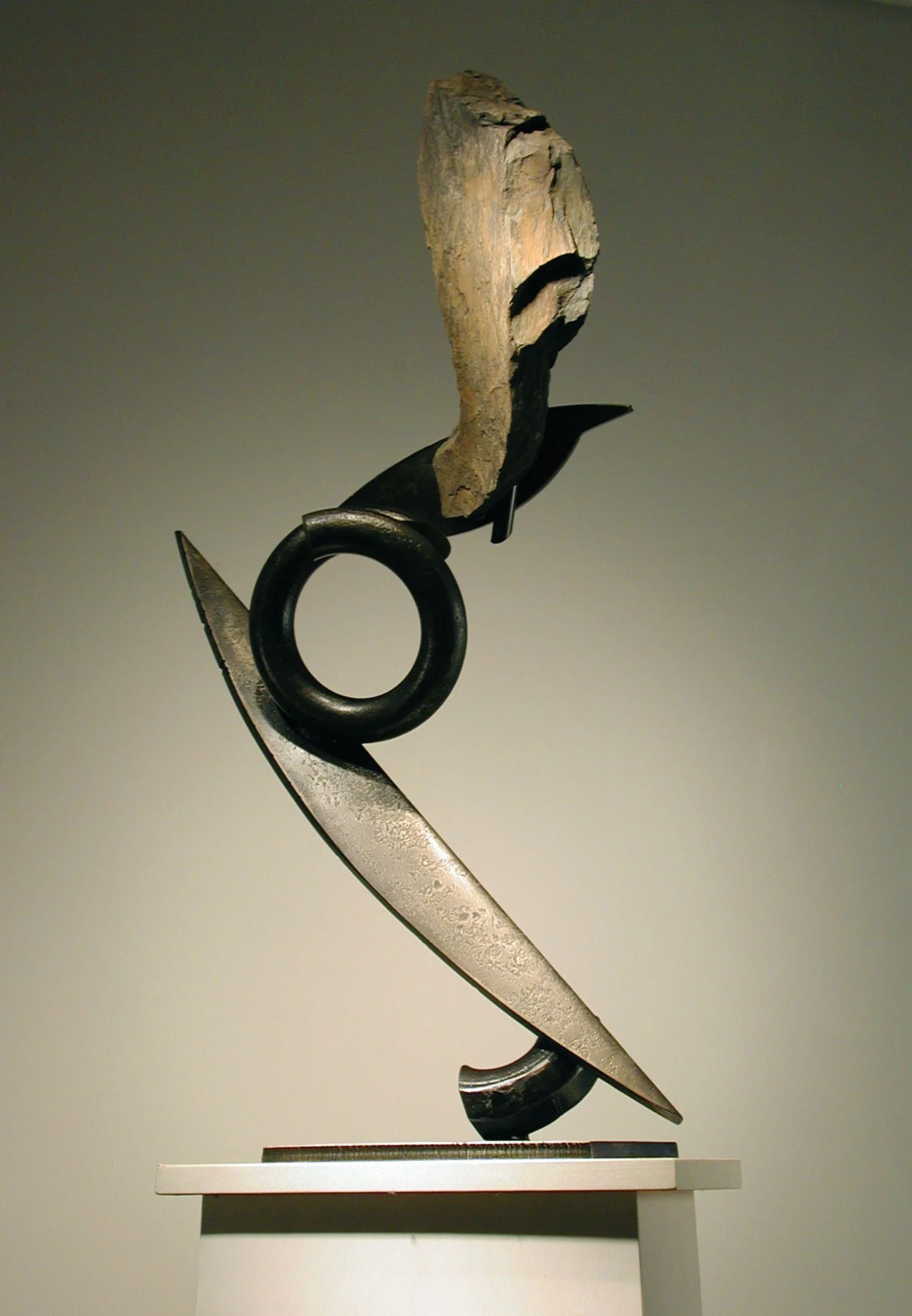
June 2006. Slate, steel. Dimensions: 40 × 20 × 10 in (102 × 51 × 25 cm). Private Collection.
Hula III, 2006, is the third in what became a long-running series exploring my interest in the expressive movement of the human body. Like works inspired by dance, gymnastics, and fencing, it uses balance, gesture, and implied motion rather than literal figuration. The circular steel element and sweeping base suggest the rhythmic rotation associated with the hula hoop, while the vertical slate gives the composition a bodily presence.
The work reflects my broader interest in “choreographing” heavy, earthbound materials—using steel to lift and animate stone. JOHN VAN ALSTINE SCULPTURE Here the massive slate appears almost weightless, poised above the circular steel form in a moment of arrested motion, transforming physical weight into a sense of balance, rhythm, and movement.
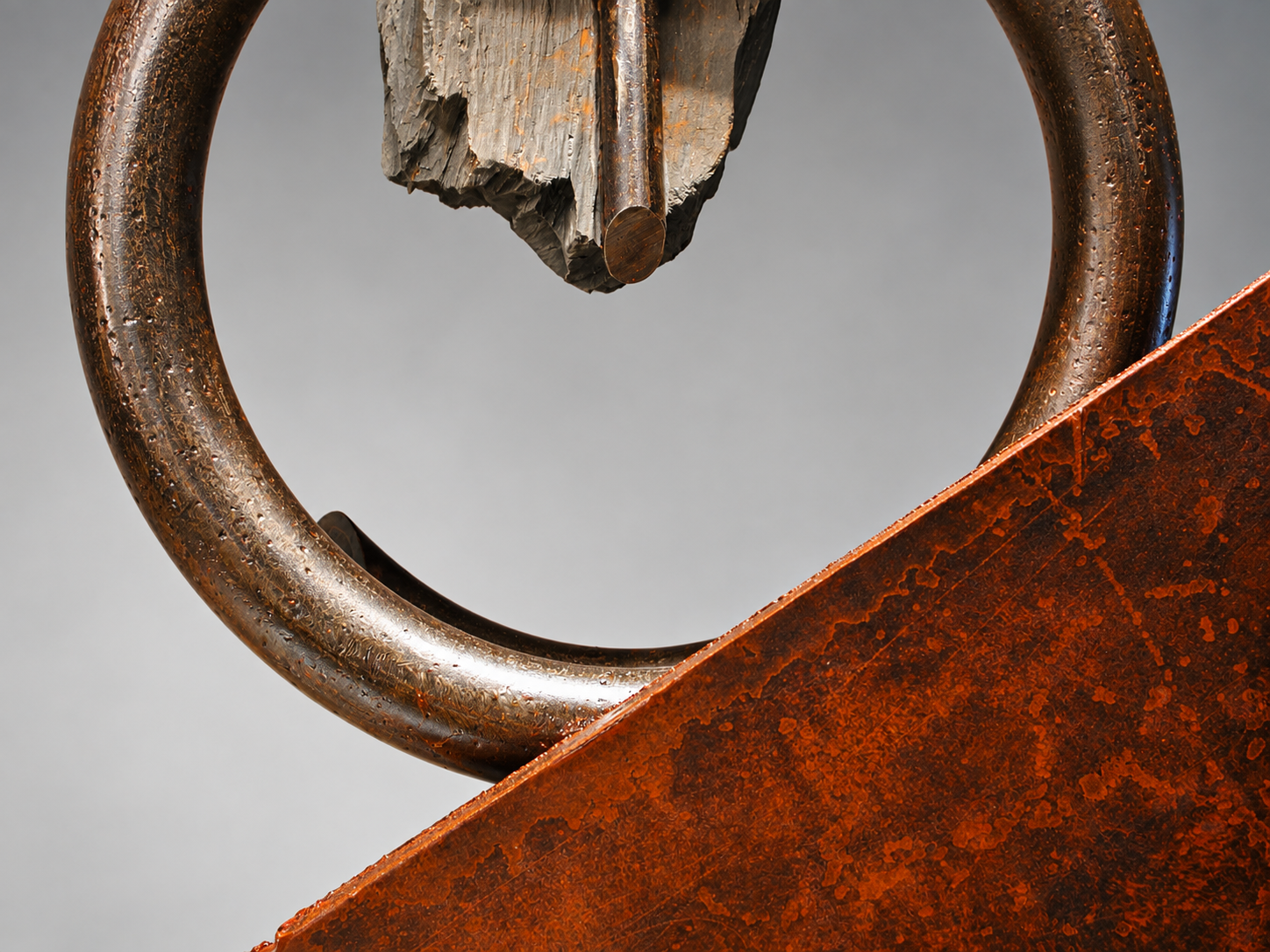
June 2006. Slate, steel. Dimensions: 51 × 22 × 15 in (130 × 56 × 38 cm). Private Collection - St. Louis, MO
Hula IV, 2006, is from long-running series exploring my interest in the expressive movement of the human body. Like works inspired by dance, gymnastics, and fencing, it uses balance, gesture, and implied motion rather than literal figuration. The circular steel element and sweeping base suggest the rhythmic rotation associated with the hula hoop, while the vertical slate gives the composition a bodily presence.
The work reflects my broader interest in “choreographing” heavy, earthbound materials—using steel to lift and animate stone. JOHN VAN ALSTINE SCULPTURE Here the massive slate appears almost weightless, poised above the circular steel form in a moment of arrested motion, transforming physical weight into a sense of balance, rhythm, and movement
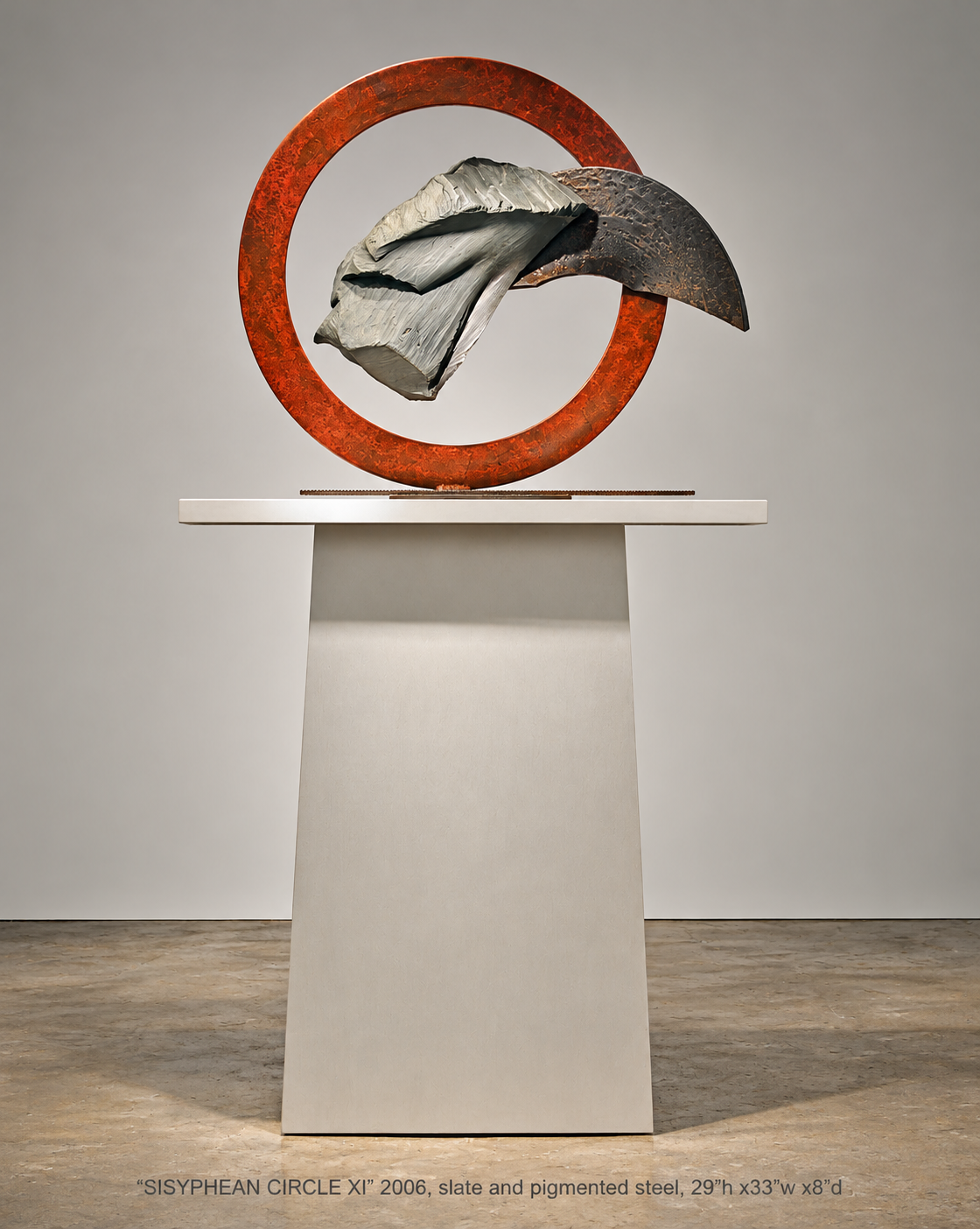
June 2006. Slate, pigmented steel. Dimensions: 29 × 33 × 8 in (74 × 84 × 20 cm). Private Collection.
The Sisyphean Series
The Greek myth of Sisyphus, condemned to endlessly push a boulder uphill, has inspired more than 250 of my sculptures. Rather than seeing the myth as a symbol of futility, I share philosopher Albert Camus’s more positive interpretation—that meaning and fulfillment can be found in the struggle itself. In many ways, I see Sisyphus as autobiographical, reflecting my lifelong pursuit as an artist, confronting challenges, taking risks, and finding purpose in the act of creation.
My Sisyphean works bring stone and steel together in precarious yet stable arrangements, often incorporating circular forms suggesting perpetual motion. For me, they are metaphors for the creative process—an ongoing cycle of experimentation, discovery, setbacks, and renewal. Each completed sculpture is both an achievement and a starting point, celebrating the journey rather than simply the destination.
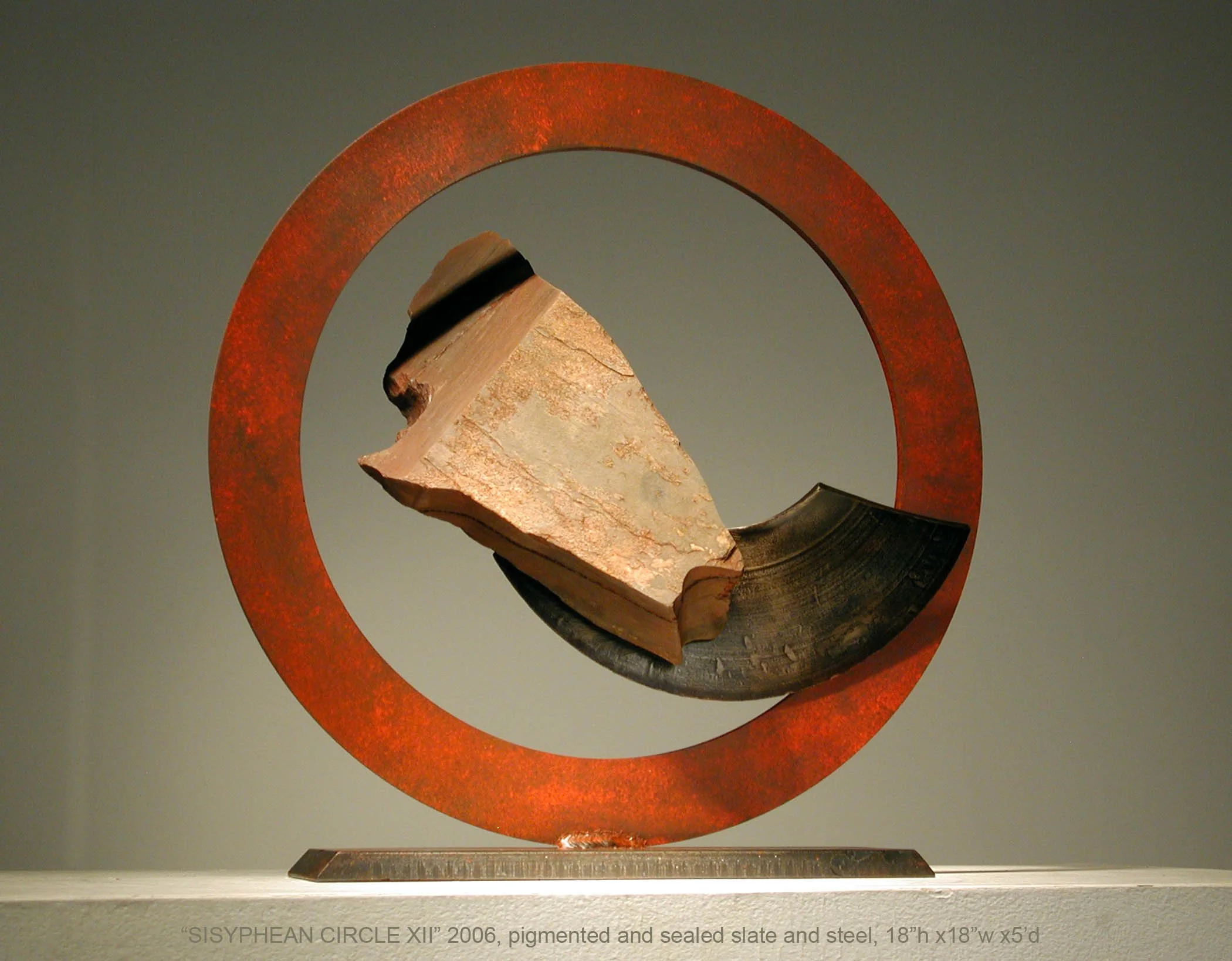
July 2006. Slate, pigmented steel. Dimensions: 18 × 18 × 5 in (46 × 46 × 13 cm). Private Collection.
The Sisyphean Series
The Greek myth of Sisyphus, condemned to endlessly push a boulder uphill, has inspired more than 250 of my sculptures. Rather than seeing the myth as a symbol of futility, I share philosopher Albert Camus’s more positive interpretation—that meaning and fulfillment can be found in the struggle itself. In many ways, I see Sisyphus as autobiographical, reflecting my lifelong pursuit as an artist, confronting challenges, taking risks, and finding purpose in the act of creation.
My Sisyphean works bring stone and steel together in precarious yet stable arrangements, often incorporating circular forms suggesting perpetual motion. For me, they are metaphors for the creative process—an ongoing cycle of experimentation, discovery, setbacks, and renewal. Each completed sculpture is both an achievement and a starting point, celebrating the journey rather than simply the destination.
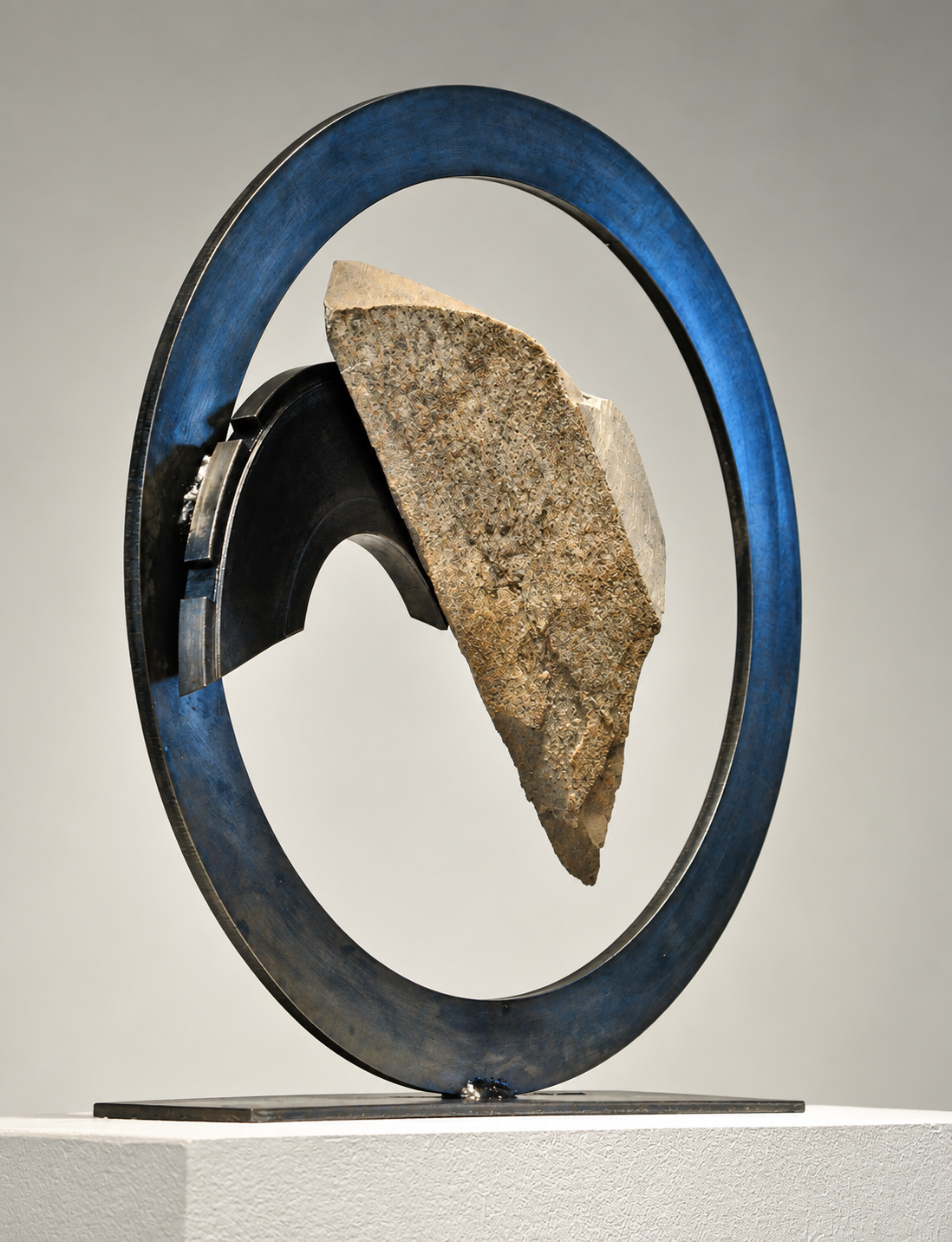
July 2006. Slate, steel. Dimensions: 22 × 22 × 6 in (56 × 56 × 15 cm). Private Collection.
The Sisyphean Series
The Greek myth of Sisyphus, condemned to endlessly push a boulder uphill, has inspired more than 250 of my sculptures. Rather than seeing the myth as a symbol of futility, I share philosopher Albert Camus’s more positive interpretation—that meaning and fulfillment can be found in the struggle itself. In many ways, I see Sisyphus as autobiographical, reflecting my lifelong pursuit as an artist, confronting challenges, taking risks, and finding purpose in the act of creation.
My Sisyphean works bring stone and steel together in precarious yet stable arrangements, often incorporating circular forms suggesting perpetual motion. For me, they are metaphors for the creative process—an ongoing cycle of experimentation, discovery, setbacks, and renewal. Each completed sculpture is both an achievement and a starting point, celebrating the journey rather than simply the destination.
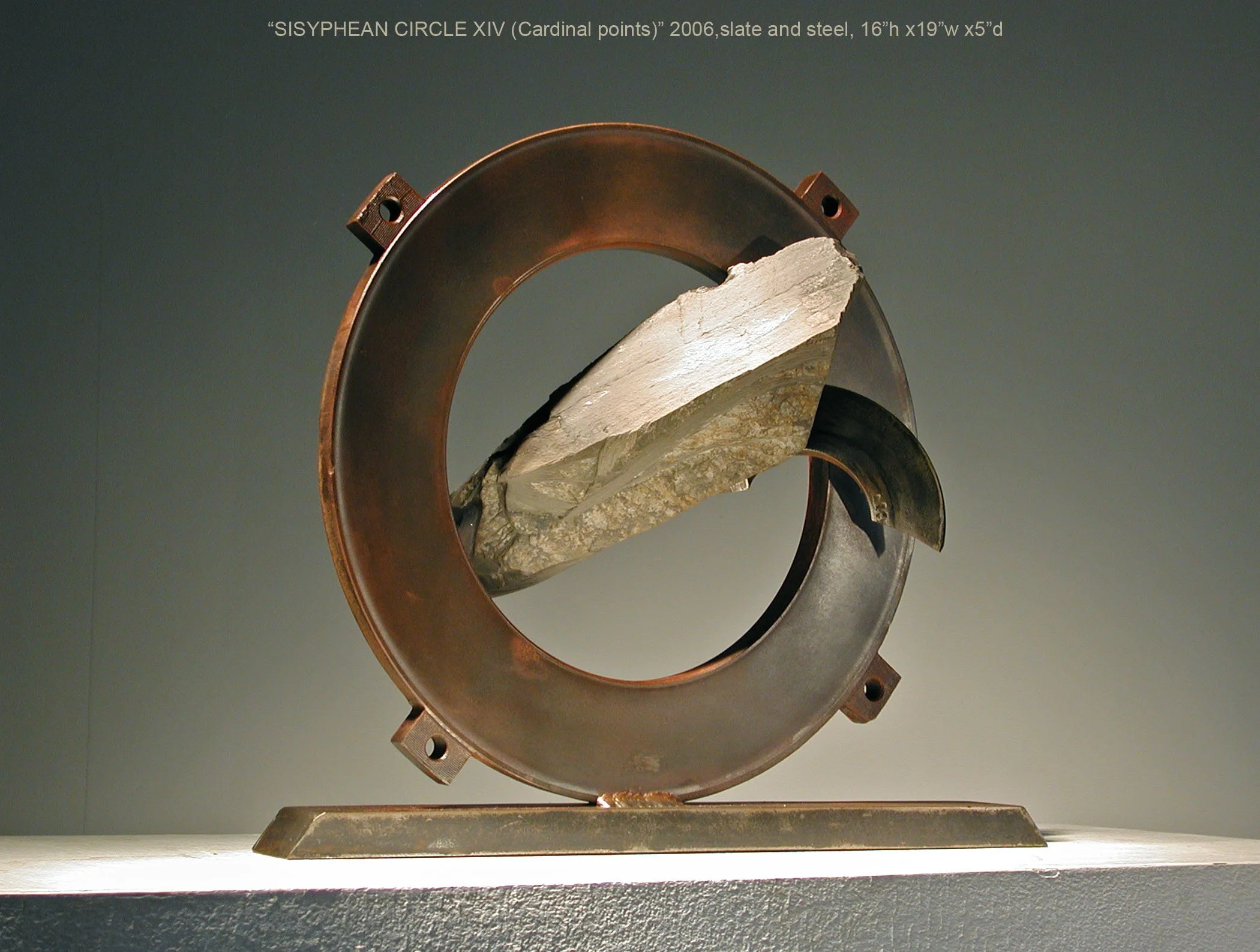
July 2006. Slate, steel. Dimensions: 16 × 19 × 5 in (41 × 48 × 13 cm). Private Collection - South Carolina.
The Sisyphean Series
The Greek myth of Sisyphus, condemned to endlessly push a boulder uphill, has inspired more than 250 of my sculptures. Rather than seeing the myth as a symbol of futility, I share philosopher Albert Camus’s more positive interpretation—that meaning and fulfillment can be found in the struggle itself. In many ways, I see Sisyphus as autobiographical, reflecting my lifelong pursuit as an artist, confronting challenges, taking risks, and finding purpose in the act of creation.
My Sisyphean works bring stone and steel together in precarious yet stable arrangements, often incorporating circular forms suggesting perpetual motion. For me, they are metaphors for the creative process—an ongoing cycle of experimentation, discovery, setbacks, and renewal. Each completed sculpture is both an achievement and a starting point, celebrating the journey rather than simply the destination.
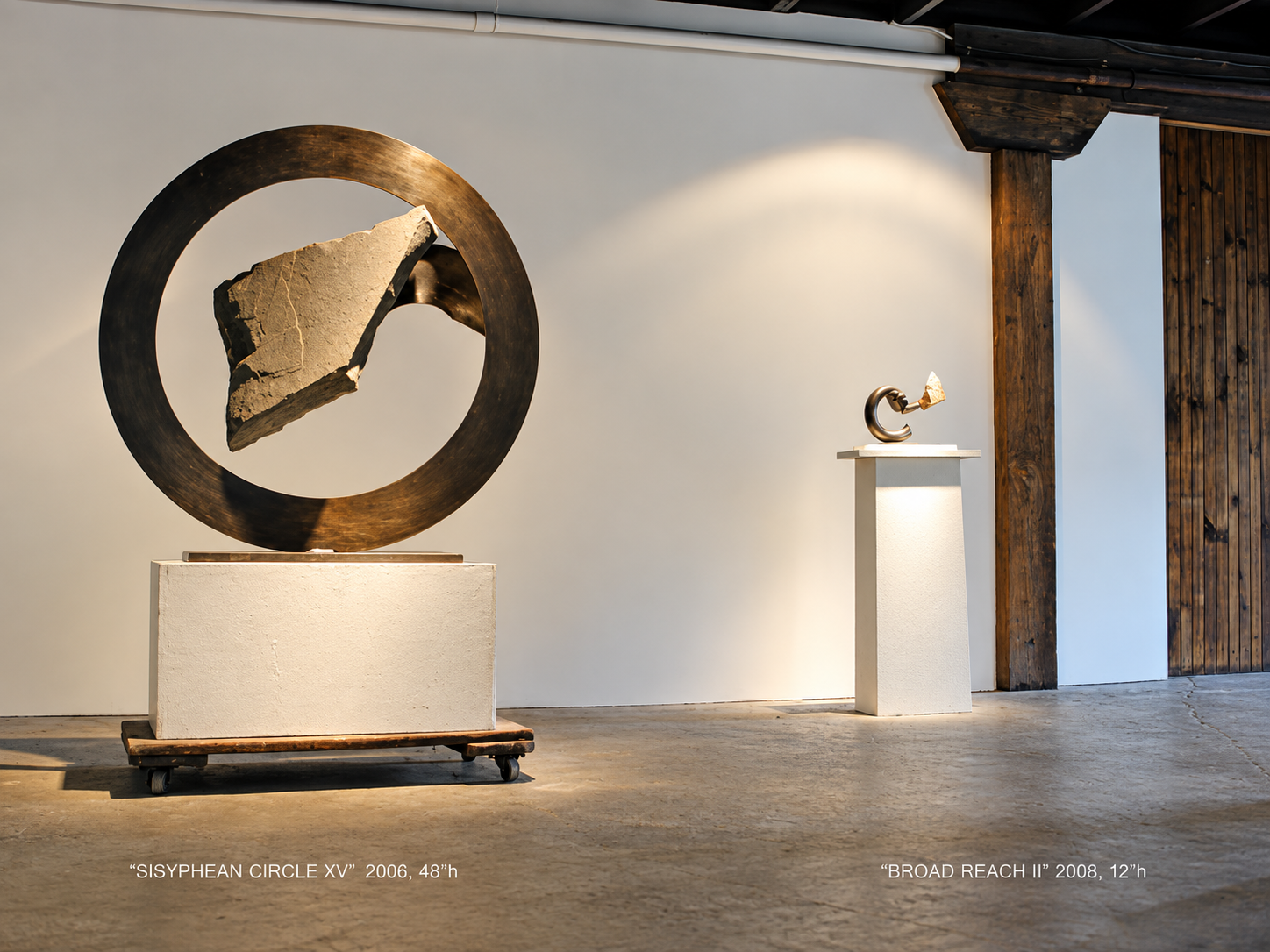
July 2006. Bluestone, steel. Dimensions: 49 × 48 × 12 in (124 × 122 × 30 cm). Private Collection.
The Sisyphean Series
The Greek myth of Sisyphus, condemned to endlessly push a boulder uphill, has inspired more than 250 of my sculptures. Rather than seeing the myth as a symbol of futility, I share philosopher Albert Camus’s more positive interpretation—that meaning and fulfillment can be found in the struggle itself. In many ways, I see Sisyphus as autobiographical, reflecting my lifelong pursuit as an artist, confronting challenges, taking risks, and finding purpose in the act of creation.
My Sisyphean works bring stone and steel together in precarious yet stable arrangements, often incorporating circular forms suggesting perpetual motion. For me, they are metaphors for the creative process—an ongoing cycle of experimentation, discovery, setbacks, and renewal. Each completed sculpture is both an achievement and a starting point, celebrating the journey rather than simply the destination.
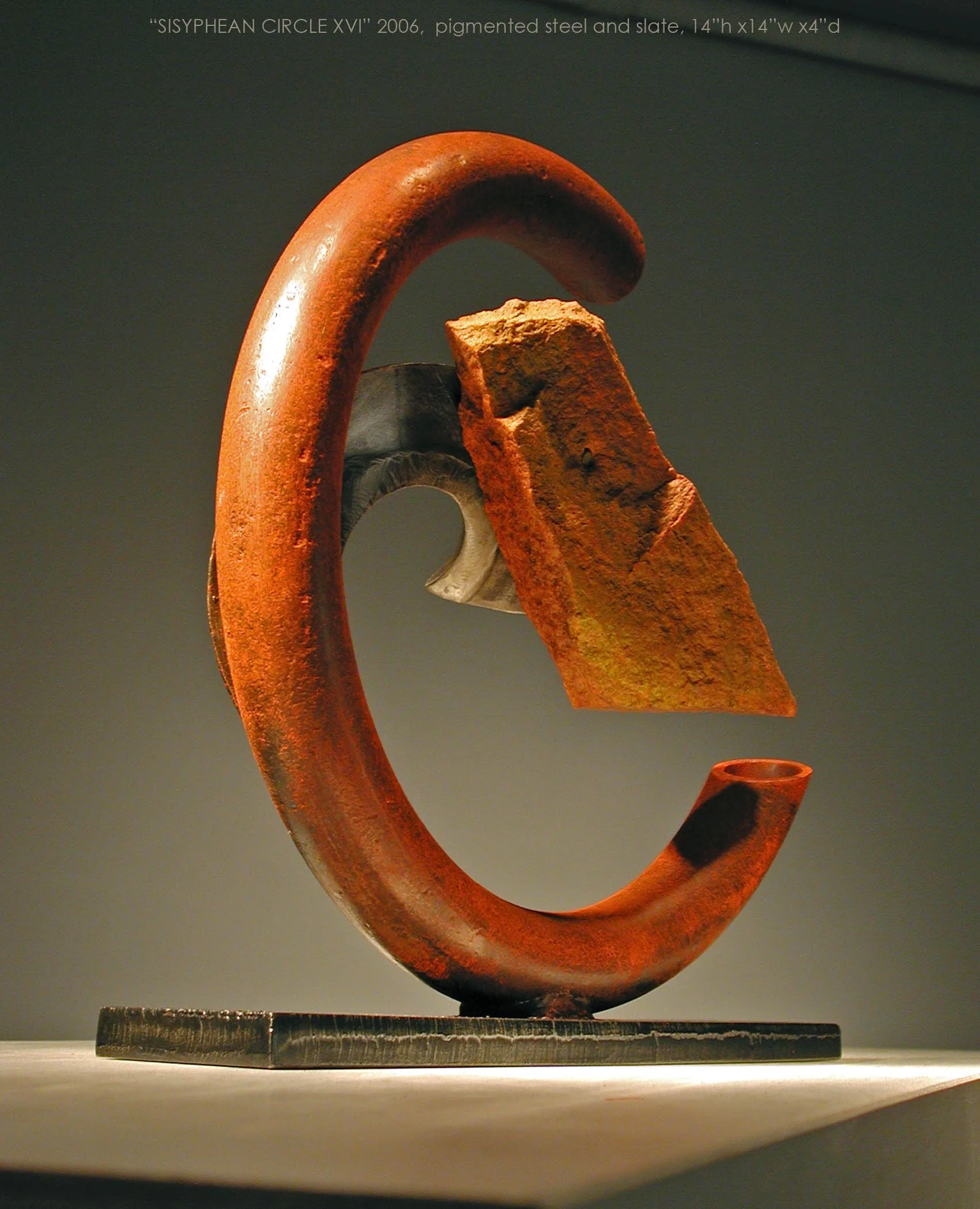
August 2006. Pigmented slate, steel. Dimensions: 14 × 14 × 4 in (36 × 36 × 10 cm). Private Collection.
The Sisyphean Series
The Greek myth of Sisyphus, condemned to endlessly push a boulder uphill, has inspired more than 250 of my sculptures. Rather than seeing the myth as a symbol of futility, I share philosopher Albert Camus’s more positive interpretation—that meaning and fulfillment can be found in the struggle itself. In many ways, I see Sisyphus as autobiographical, reflecting my lifelong pursuit as an artist, confronting challenges, taking risks, and finding purpose in the act of creation.
My Sisyphean works bring stone and steel together in precarious yet stable arrangements, often incorporating circular forms suggesting perpetual motion. For me, they are metaphors for the creative process—an ongoing cycle of experimentation, discovery, setbacks, and renewal. Each completed sculpture is both an achievement and a starting point, celebrating the journey rather than simply the destination.
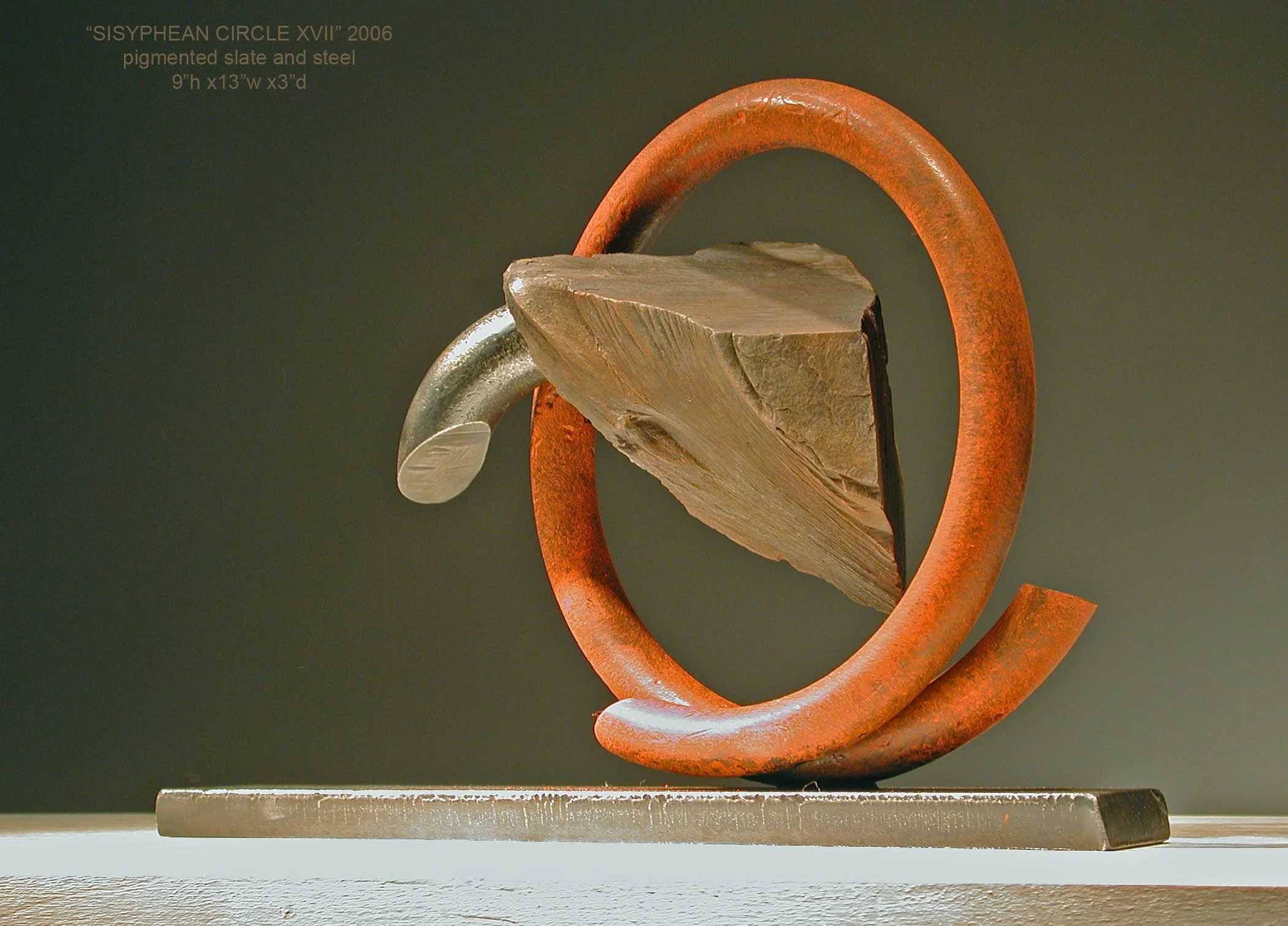
August 2006. Pigmented slate, steel. Dimensions: 9 × 13 × 3 in (23 × 33 × 8 cm).
Collection US Embassy - Katmandu, Nepal
The Sisyphean Series
The Greek myth of Sisyphus, condemned to endlessly push a boulder uphill, has inspired more than 250 of my sculptures. Rather than seeing the myth as a symbol of futility, I share philosopher Albert Camus’s more positive interpretation—that meaning and fulfillment can be found in the struggle itself. In many ways, I see Sisyphus as autobiographical, reflecting my lifelong pursuit as an artist, confronting challenges, taking risks, and finding purpose in the act of creation.
My Sisyphean works bring stone and steel together in precarious yet stable arrangements, often incorporating circular forms suggesting perpetual motion. For me, they are metaphors for the creative process—an ongoing cycle of experimentation, discovery, setbacks, and renewal. Each completed sculpture is both an achievement and a starting point, celebrating the journey rather than simply the destination.
August 2006. Pigmented slate, steel. Dimensions: 10 × 13 × 4 in (25 × 33 × 10 cm).
No photo available.
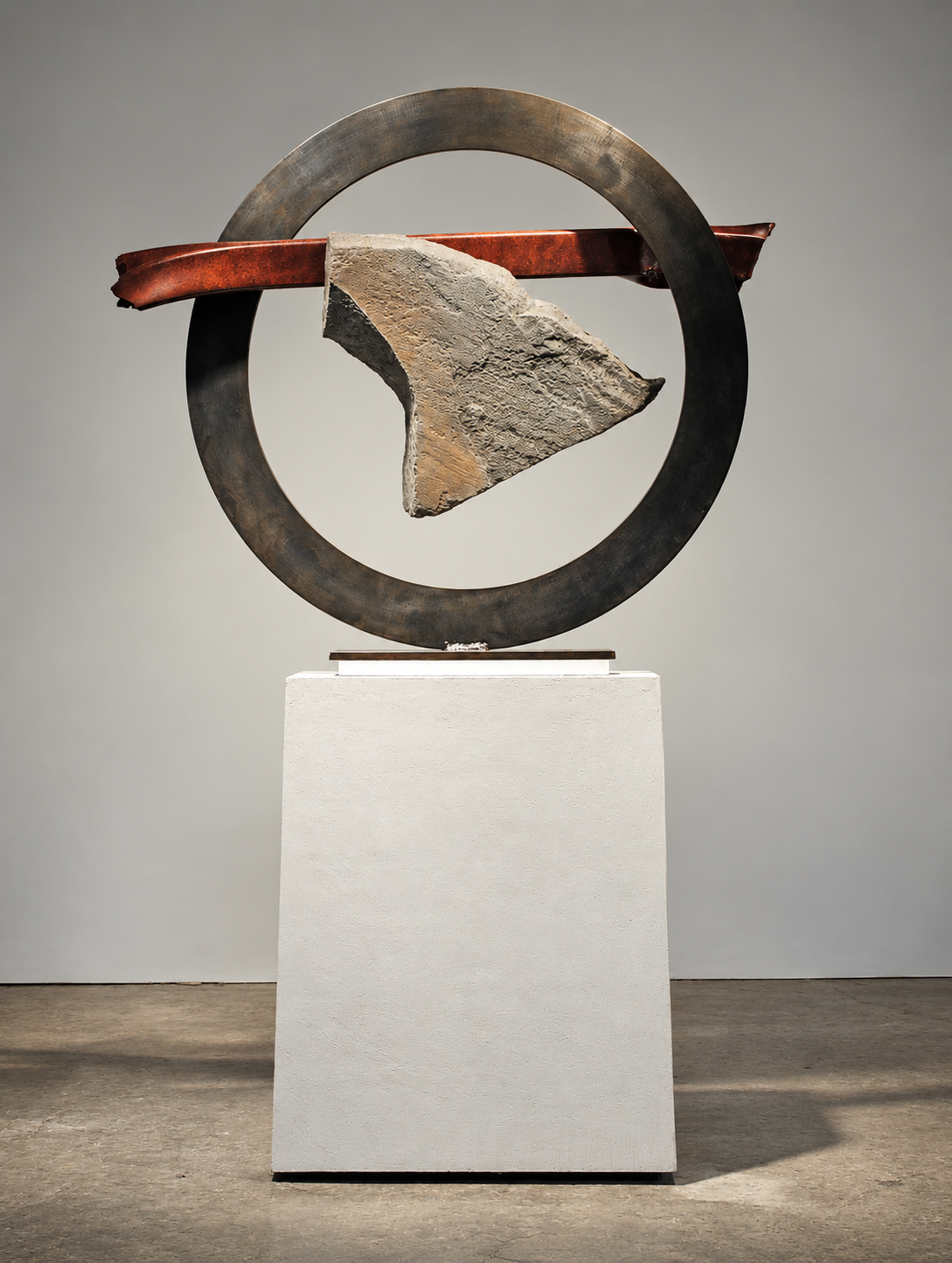
October 2006. NY blue stone, steel. Dimensions: 37 × 44 × 12 in (94 × 112 × 30 cm). Private Collection Scottsdale, AZ
The Sisyphean Series
The Greek myth of Sisyphus, condemned to endlessly push a boulder uphill, has inspired more than 250 of my sculptures. Rather than seeing the myth as a symbol of futility, I share philosopher Albert Camus’s more positive interpretation—that meaning and fulfillment can be found in the struggle itself. In many ways, I see Sisyphus as autobiographical, reflecting my lifelong pursuit as an artist, confronting challenges, taking risks, and finding purpose in the act of creation.
My Sisyphean works bring stone and steel together in precarious yet stable arrangements, often incorporating circular forms suggesting perpetual motion. For me, they are metaphors for the creative process—an ongoing cycle of experimentation, discovery, setbacks, and renewal. Each completed sculpture is both an achievement and a starting point, celebrating the journey rather than simply the destination.
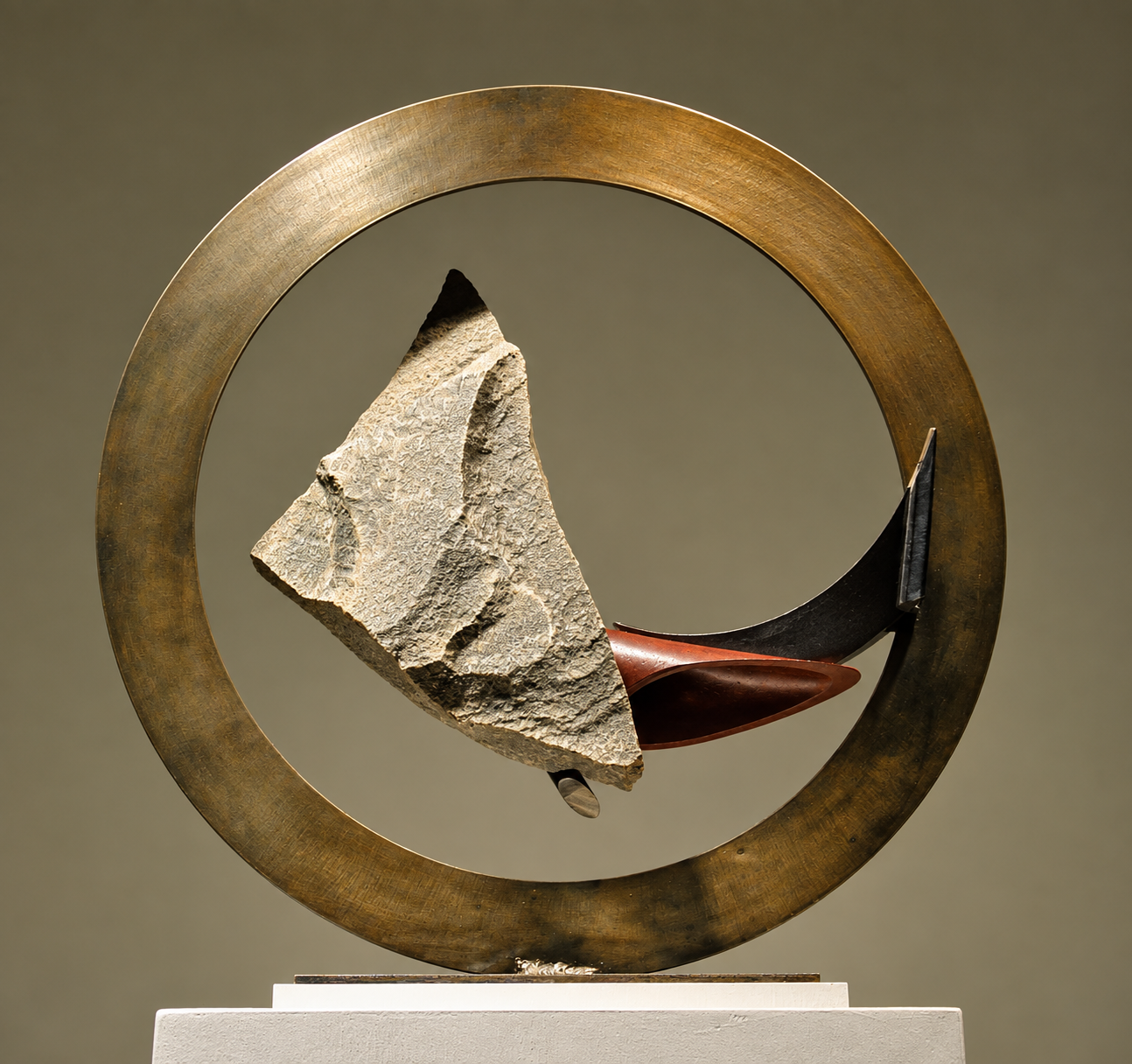
October 2006. NY bluestone, steel. Dimensions: 28 × 28 × 5 in (71 × 71 × 13 cm). Private Collection - Potomac, MD.
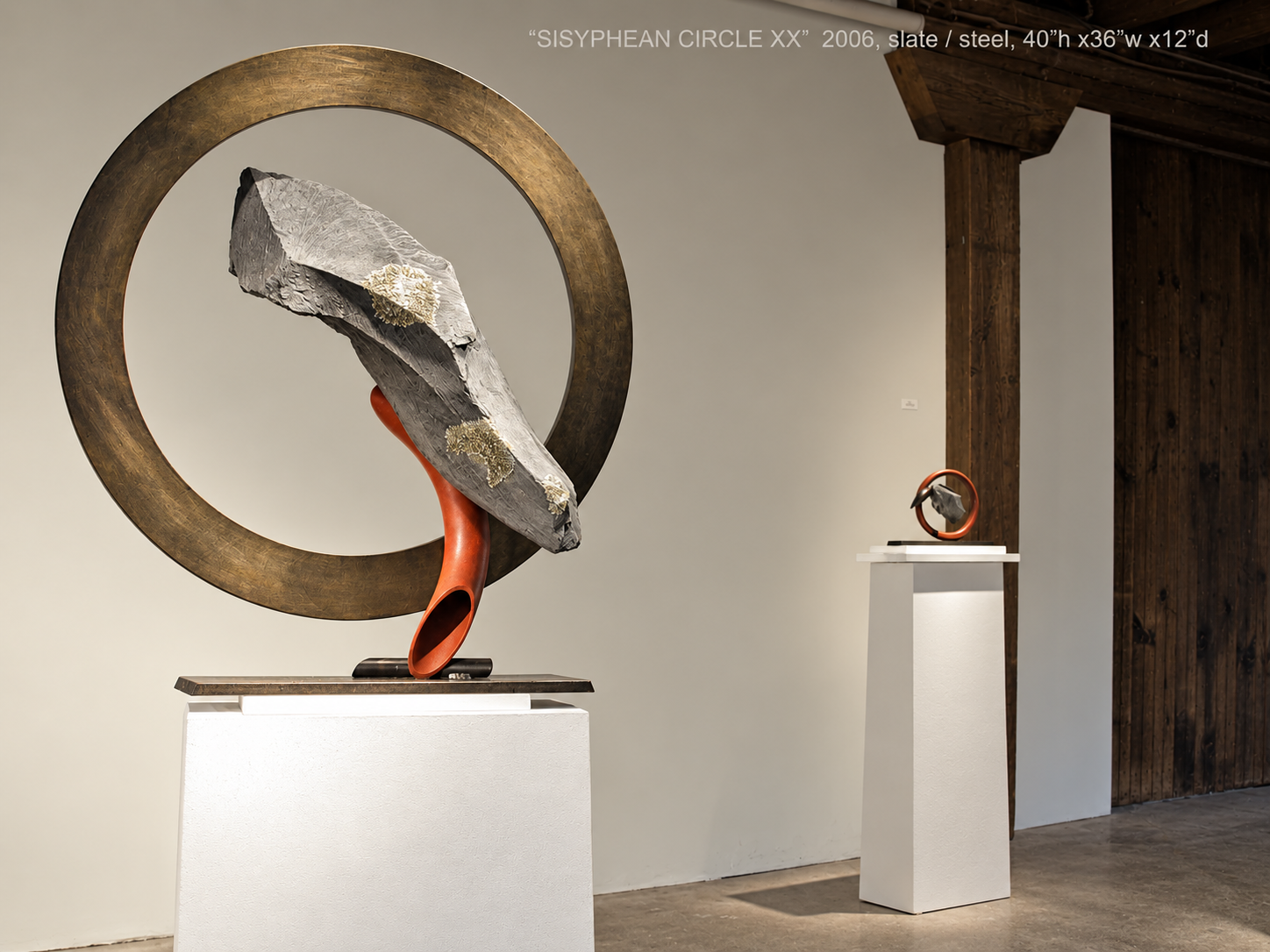
October 2006. Slate, steel. Dimensions: 40 × 36 × 12 in (102 × 91 × 30 cm). Private Collection.
The Sisyphean Series
The Greek myth of Sisyphus, condemned to endlessly push a boulder uphill, has inspired more than 250 of my sculptures. Rather than seeing the myth as a symbol of futility, I share philosopher Albert Camus’s more positive interpretation—that meaning and fulfillment can be found in the struggle itself. In many ways, I see Sisyphus as autobiographical, reflecting my lifelong pursuit as an artist, confronting challenges, taking risks, and finding purpose in the act of creation.
My Sisyphean works bring stone and steel together in precarious yet stable arrangements, often incorporating circular forms suggesting perpetual motion. For me, they are metaphors for the creative process—an ongoing cycle of experimentation, discovery, setbacks, and renewal. Each completed sculpture is both an achievement and a starting point, celebrating the journey rather than simply the destination.
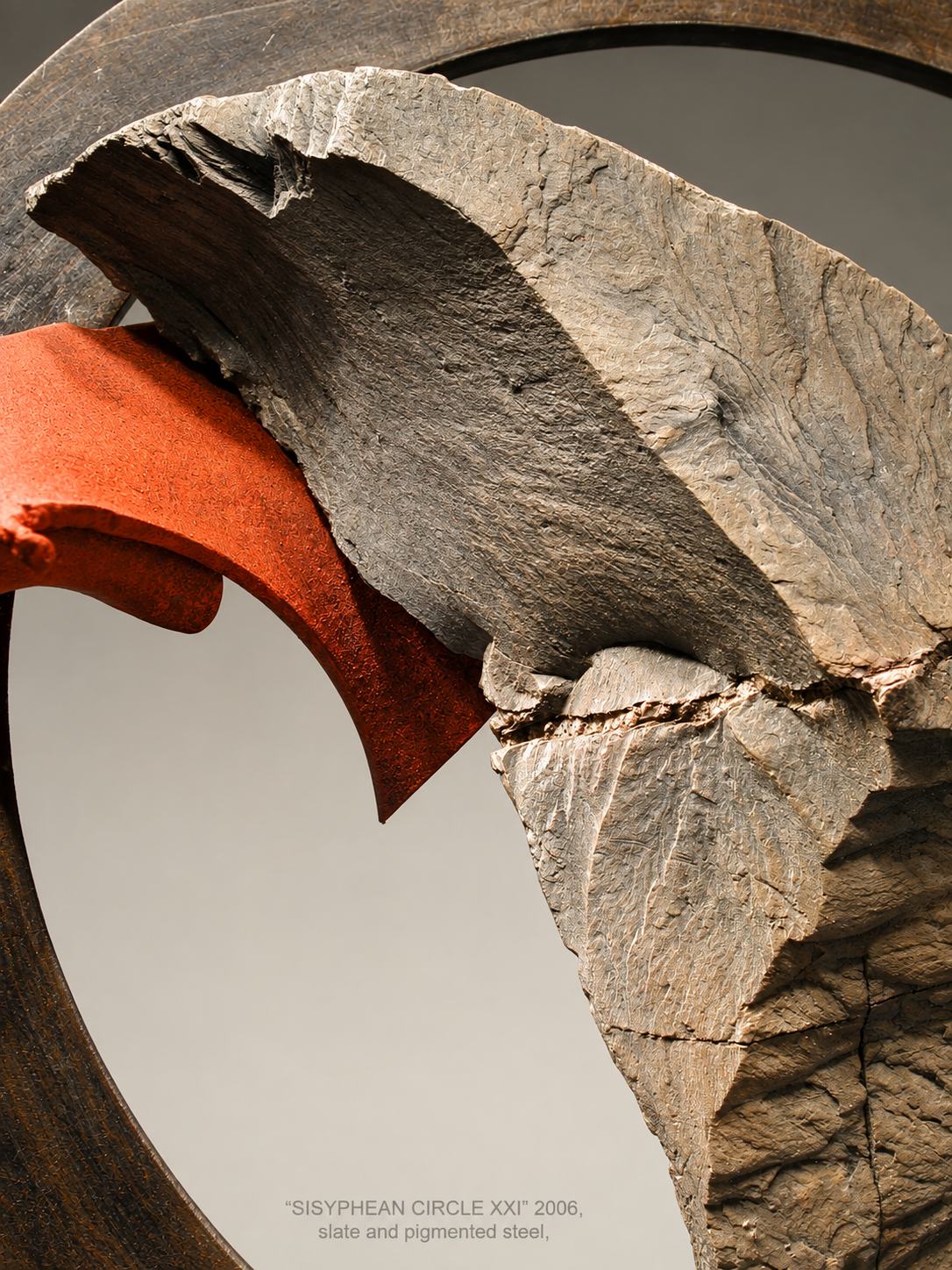
October 2006. Slate, pigmented steel. Dimensions: 20 × 20 × 5 in (51 × 51 × 13 cm). Private Collection.
The Sisyphean Series
The Greek myth of Sisyphus, condemned to endlessly push a boulder uphill, has inspired more than 250 of my sculptures. Rather than seeing the myth as a symbol of futility, I share philosopher Albert Camus’s more positive interpretation—that meaning and fulfillment can be found in the struggle itself. In many ways, I see Sisyphus as autobiographical, reflecting my lifelong pursuit as an artist, confronting challenges, taking risks, and finding purpose in the act of creation.
My Sisyphean works bring stone and steel together in precarious yet stable arrangements, often incorporating circular forms suggesting perpetual motion. For me, they are metaphors for the creative process—an ongoing cycle of experimentation, discovery, setbacks, and renewal. Each completed sculpture is both an achievement and a starting point, celebrating the journey rather than simply the destination.
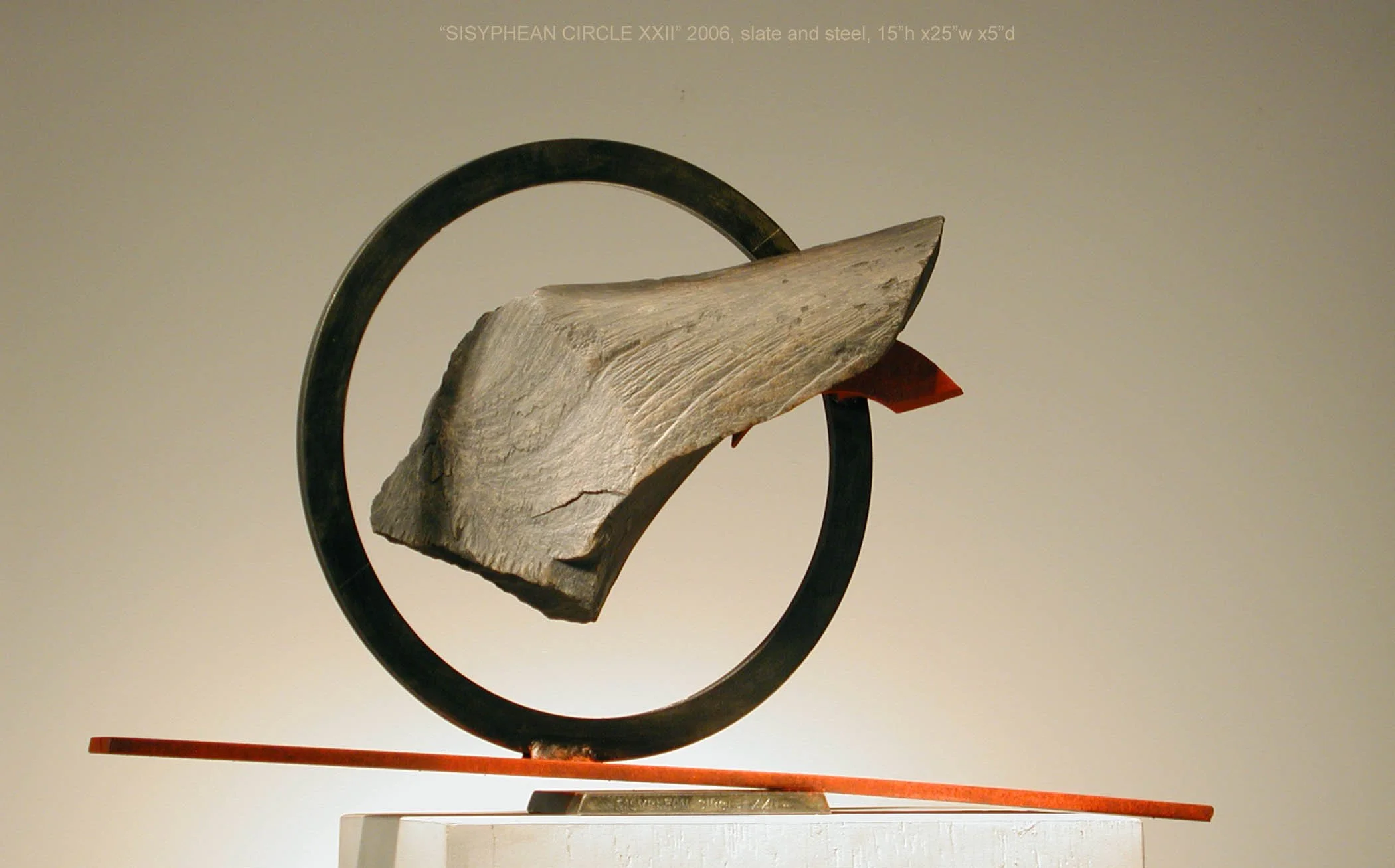
October 2006. Slate, pigmented steel. Dimensions: 15 × 25 × 5 in (38 × 64 × 13 cm). Private Collection.
The Sisyphean Series
The Greek myth of Sisyphus, condemned to endlessly push a boulder uphill, has inspired more than 250 of my sculptures. Rather than seeing the myth as a symbol of futility, I share philosopher Albert Camus’s more positive interpretation—that meaning and fulfillment can be found in the struggle itself. In many ways, I see Sisyphus as autobiographical, reflecting my lifelong pursuit as an artist, confronting challenges, taking risks, and finding purpose in the act of creation.
My Sisyphean works bring stone and steel together in precarious yet stable arrangements, often incorporating circular forms suggesting perpetual motion. For me, they are metaphors for the creative process—an ongoing cycle of experimentation, discovery, setbacks, and renewal. Each completed sculpture is both an achievement and a starting point, celebrating the journey rather than simply the destination.
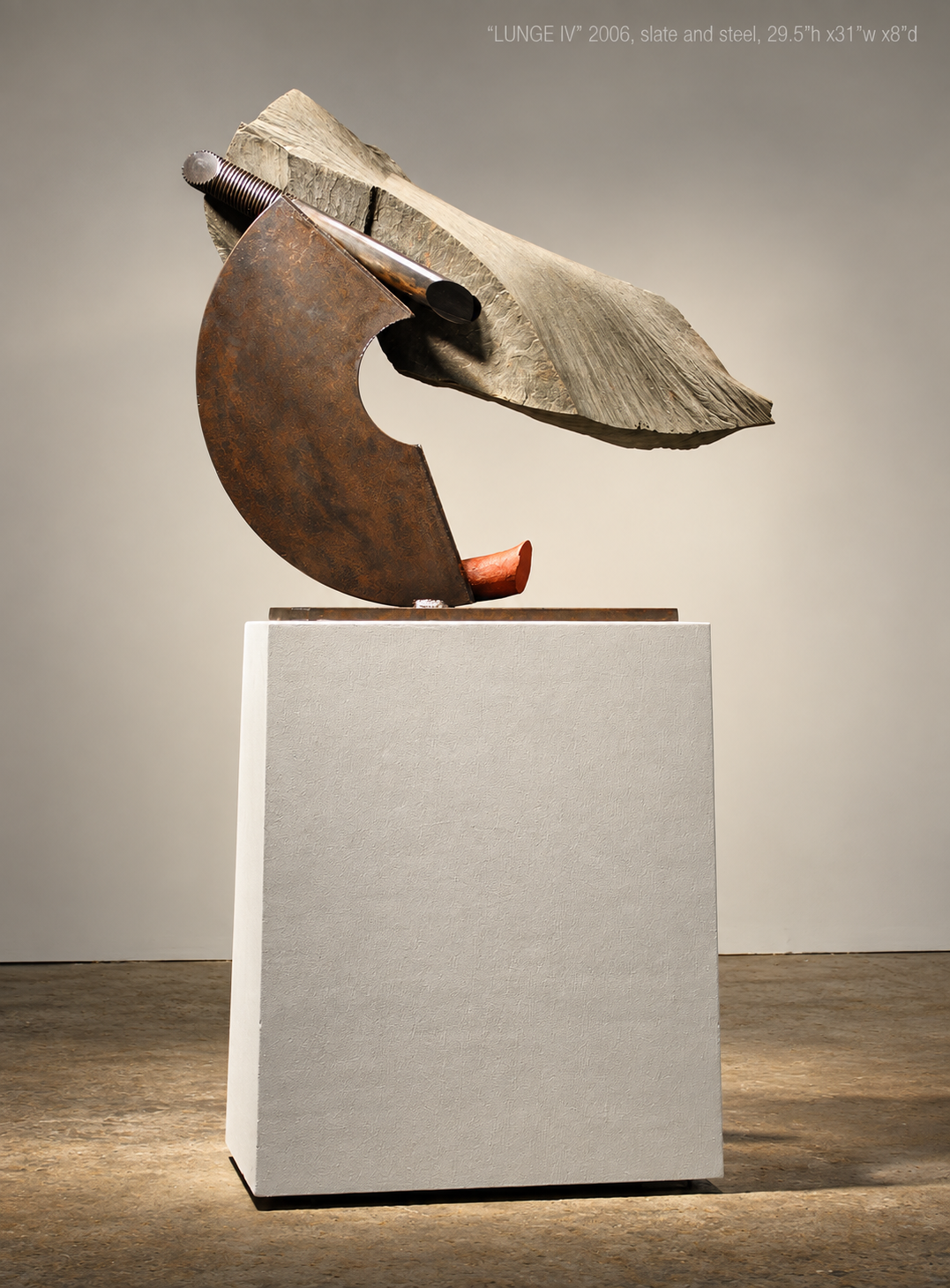
November 2006. Slate, pigmented steel. Dimensions: 29.5 × 31 × 8 in (75 × 79 × 20 cm).
The Lunge series explores implied movement and gesture through an abstract sculptural language. The title Lunge suggests a sudden extension of the body—a reaching, thrusting, or shifting of weight that gives the sculpture a sense of physical momentum and directed energy.
While not figurative in a literal sense, the work draws on my interest in the expressiveness of the human figure. Its balance, tension, and spatial gesture suggest a body caught in motion, allowing the sculpture to convey a human presence through posture and movement rather than recognizable form.
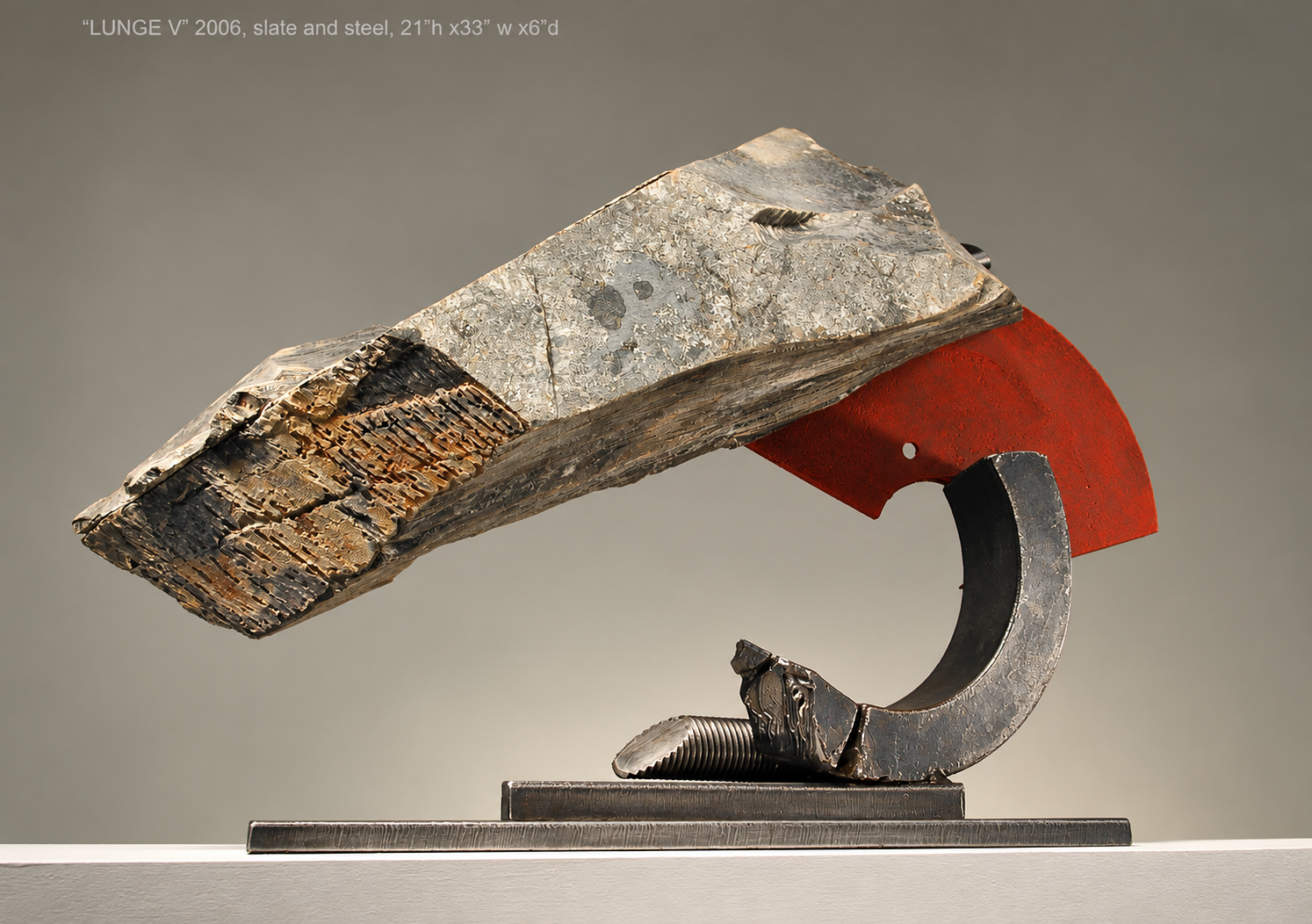
November 2006. Slate, steel. Dimensions: 21 × 33 × 6 in (53 × 84 × 15 cm).
The Lunge series explores implied movement and gesture through an abstract sculptural language. The title Lunge suggests a sudden extension of the body—a reaching, thrusting, or shifting of weight that gives the sculpture a sense of physical momentum and directed energy.
While not figurative in a literal sense, the work draws on my interest in the expressiveness of the human figure. Its balance, tension, and spatial gesture suggest a body caught in motion, allowing the sculpture to convey a human presence through posture and movement rather than recognizable form.
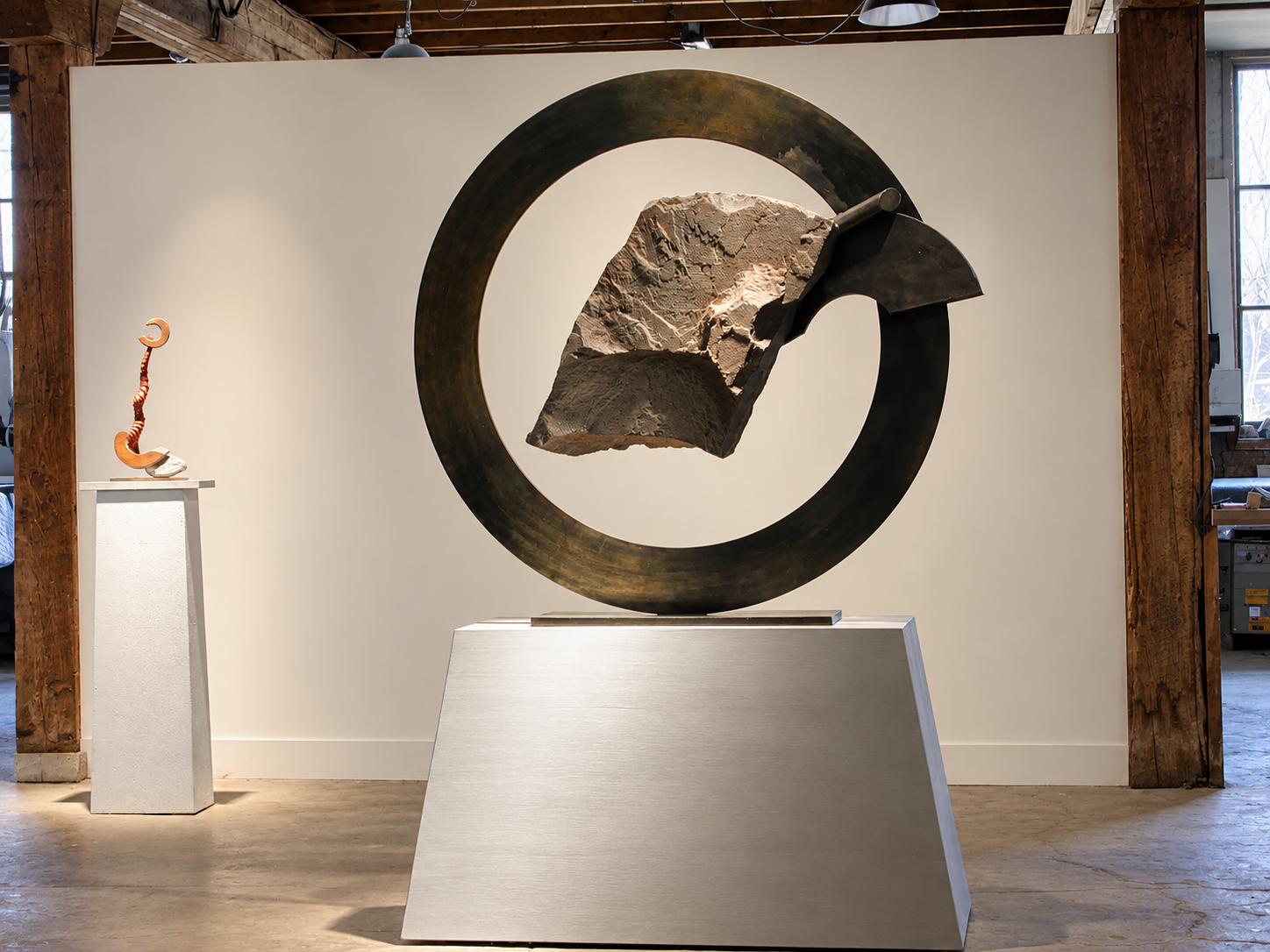
November 2006. Bluestone, steel. Dimensions: 48 × 48 × 2 in (122 × 122 × 5 cm). Private Collection. Two versions (1st stone replaced)
The Sisyphean Series
The Greek myth of Sisyphus, condemned to endlessly push a boulder uphill, has inspired more than 250 of my sculptures. Rather than seeing the myth as a symbol of futility, I share philosopher Albert Camus’s more positive interpretation—that meaning and fulfillment can be found in the struggle itself. In many ways, I see Sisyphus as autobiographical, reflecting my lifelong pursuit as an artist, confronting challenges, taking risks, and finding purpose in the act of creation.
My Sisyphean works bring stone and steel together in precarious yet stable arrangements, often incorporating circular forms suggesting perpetual motion. For me, they are metaphors for the creative process—an ongoing cycle of experimentation, discovery, setbacks, and renewal. Each completed sculpture is both an achievement and a starting point, celebrating the journey rather than simply the destination.
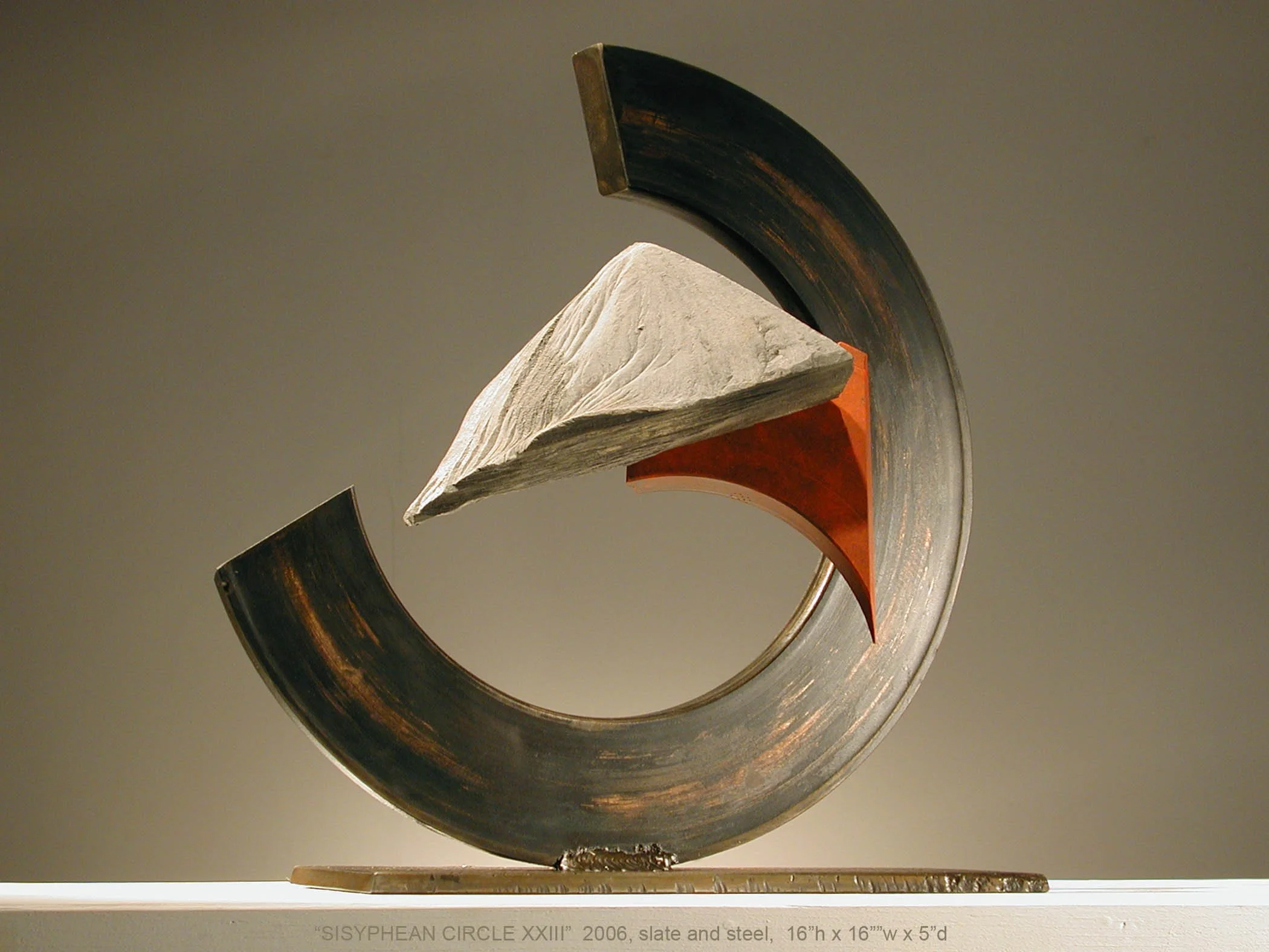
November 2006. Slate, steel. Dimensions: 16 × 16 × 4 in (41 × 41 × 10 cm). Private Collection.
The Sisyphean Series
The Greek myth of Sisyphus, condemned to endlessly push a boulder uphill, has inspired more than 250 of my sculptures. Rather than seeing the myth as a symbol of futility, I share philosopher Albert Camus’s more positive interpretation—that meaning and fulfillment can be found in the struggle itself. In many ways, I see Sisyphus as autobiographical, reflecting my lifelong pursuit as an artist, confronting challenges, taking risks, and finding purpose in the act of creation.
My Sisyphean works bring stone and steel together in precarious yet stable arrangements, often incorporating circular forms suggesting perpetual motion. For me, they are metaphors for the creative process—an ongoing cycle of experimentation, discovery, setbacks, and renewal. Each completed sculpture is both an achievement and a starting point, celebrating the journey rather than simply the destination.
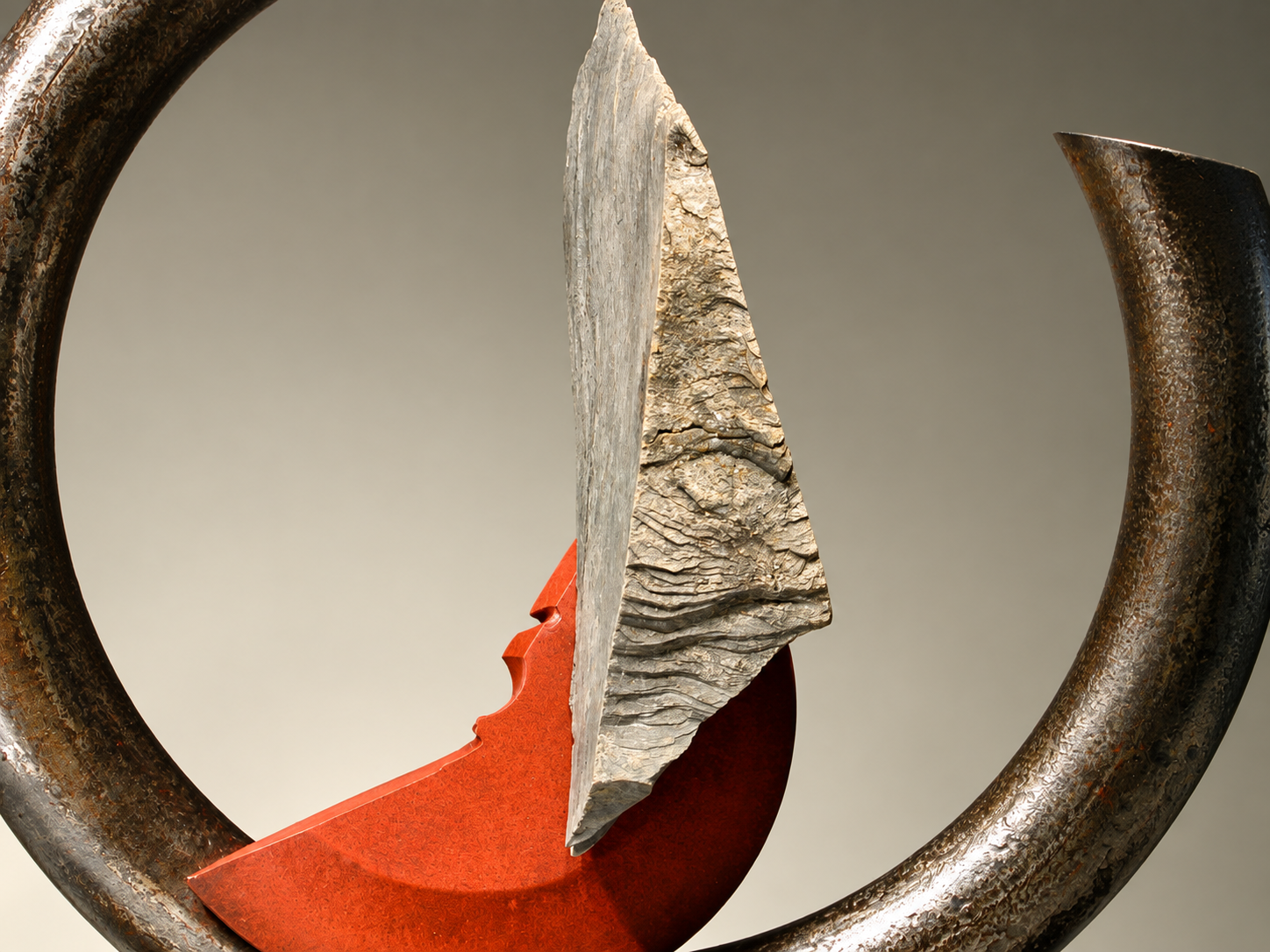
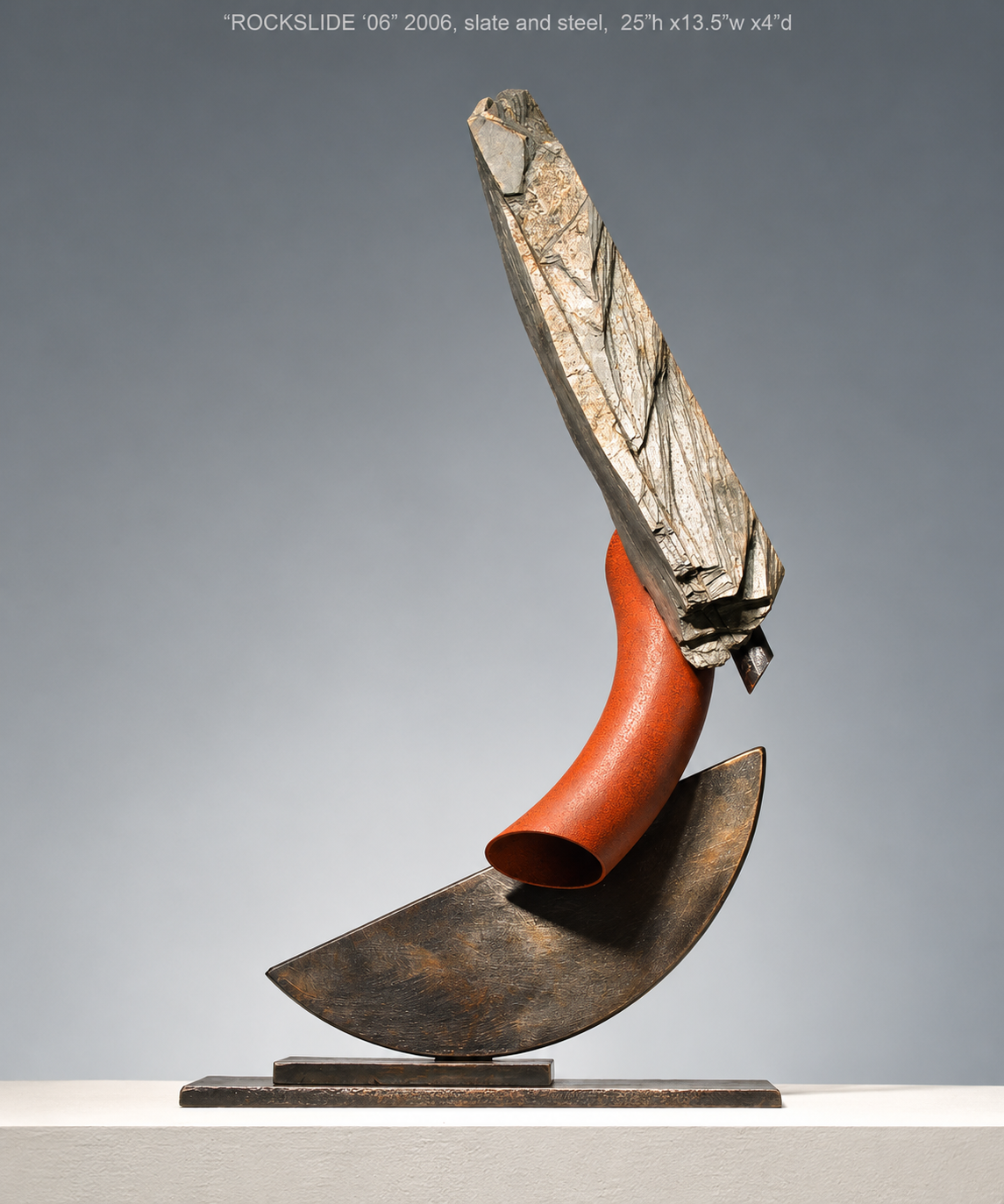
November 2006. Slate, steel. Dimensions: 25 × 13.5 × 4 in (64 × 34 × 10 cm).
Stone has been a constant in John Van Alstine’s work for more than fifty years. He often focuses on the material’s inherent qualities—especially its weight—choreographing stone and steel to create moments of visual and physical tension.
Landscape, particularly the mountain terrain where the artist has spent much of his life, has also been a powerful influence. In the Rockslide series, the shape and placement of stone, and its dynamic interaction with steel, evoke the drama of a familiar alpine event: a rock caught in mid-fall.
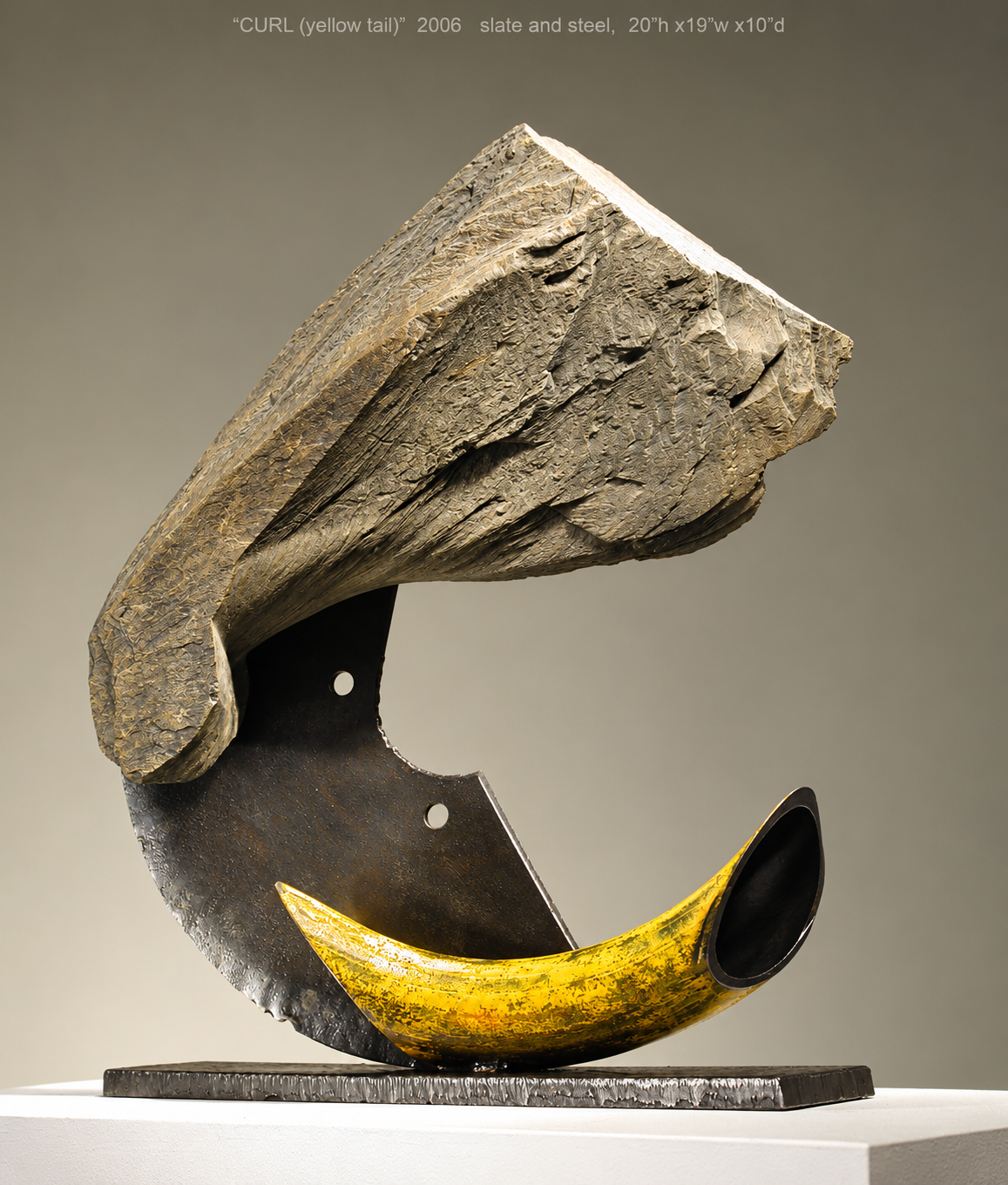
2005
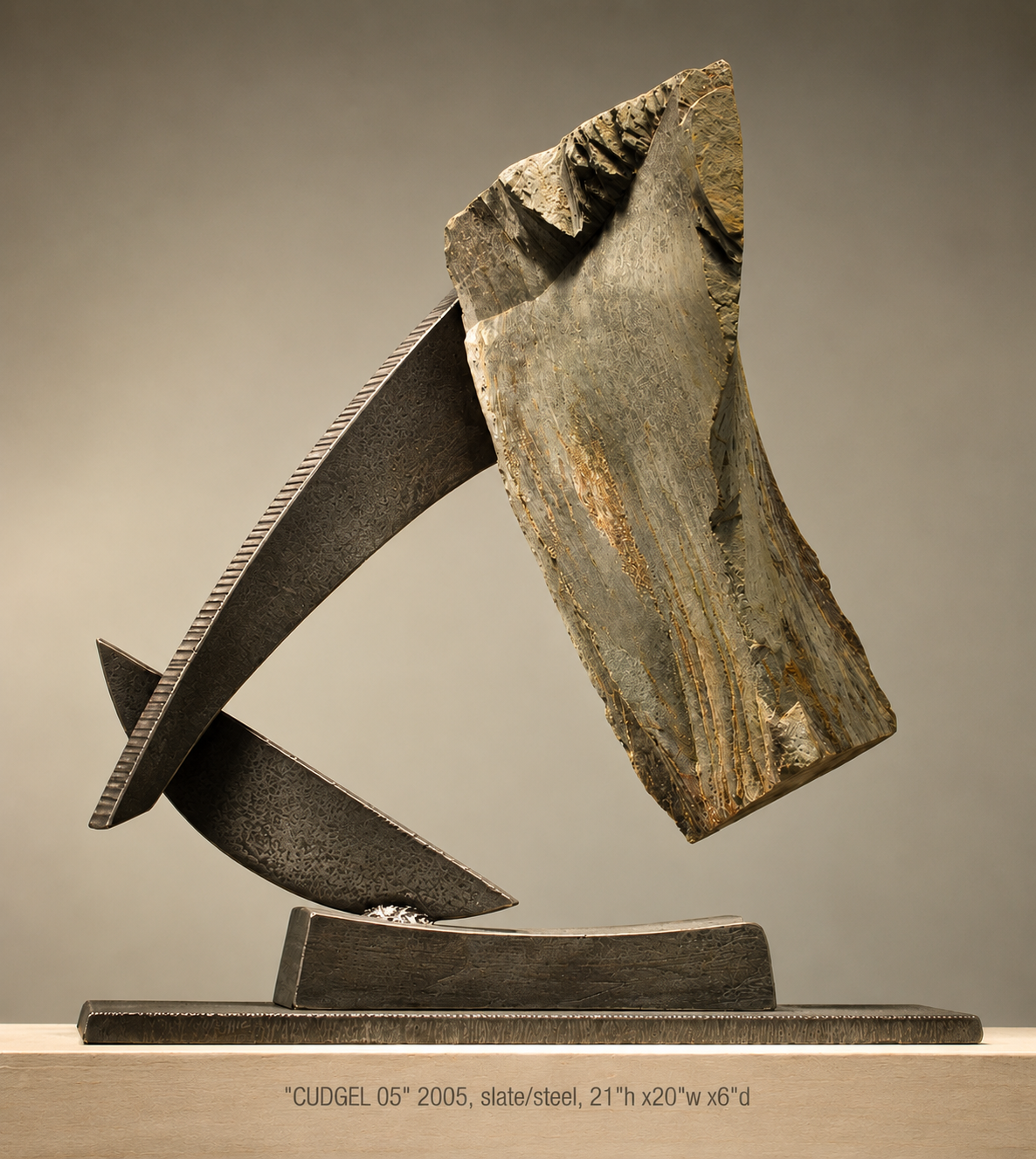
January 2005. Slate, steel. Dimensions: 21 × 20 × 6 in (53 × 51 × 15 cm). Private Collection.
Cudgel ’05, 2005
Cudgel ’05 is part of my long-running Cudgel Series and continues my interest in tools and implements as expressive sculptural forms. I have long thought of tools as extensions of the hand and am drawn to their forms shaped by function. Here the sweeping curved steel suggests a handle, while the slate assumes the weight and presence of the head or blade of a primitive hand tool or weapon—a cudgel.
The sculpture also reflects my continuing effort to “choreograph” traditionally earthbound stone. The steel lifts and suspends the slate, giving the heavy material an unexpected sense of movement while suggesting the physical action of a tool being raised or swung.
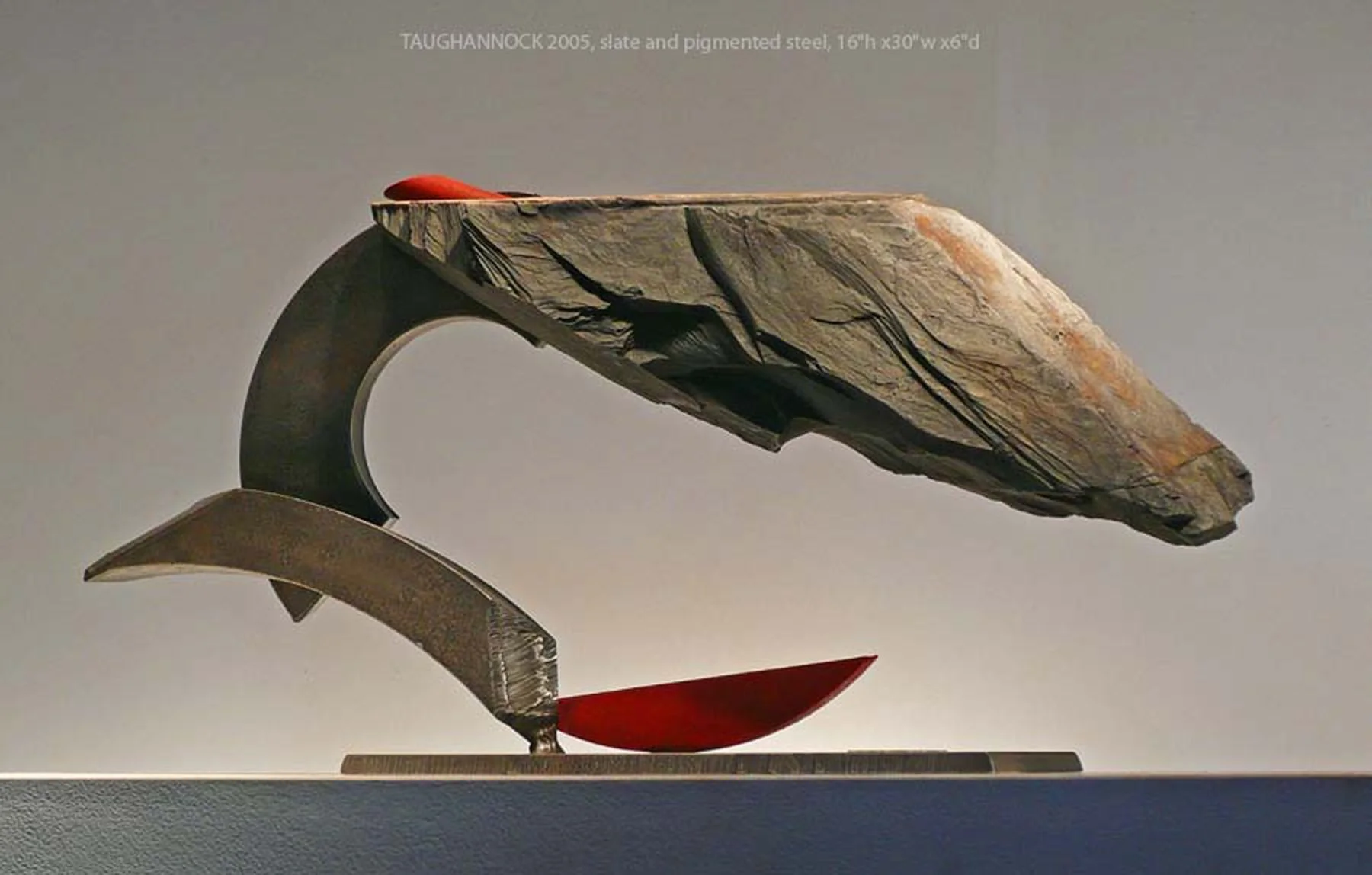
January 2005. Slate, steel. Dimensions: 16 × 30 × 6 in (41 × 76 × 15 cm).
Title references Taughannock Falls in the Finger Lakes region of upstate New York know for it abundance of geologic slate formations.
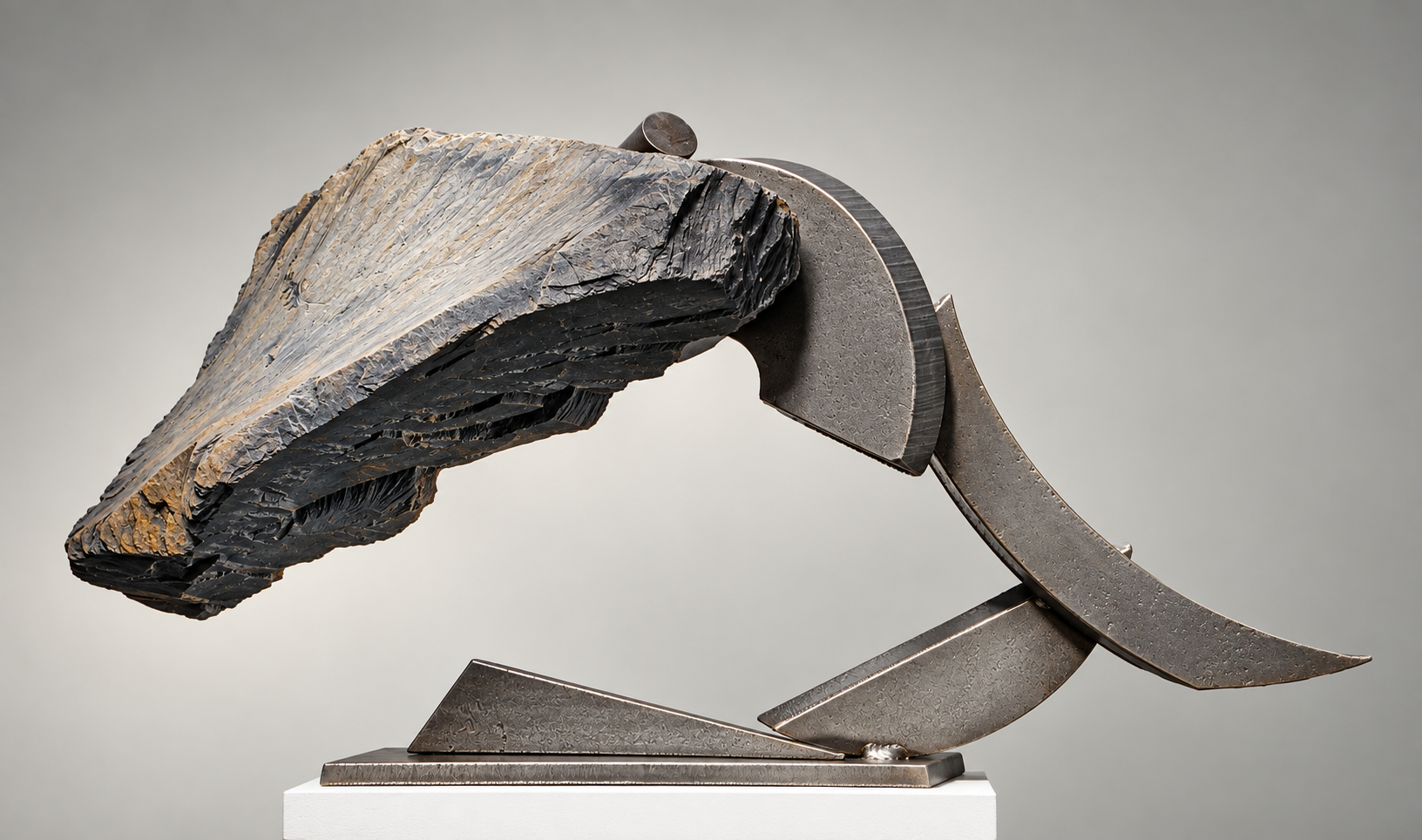
January 2005. Slate, steel. Dimensions: 19 × 35 × 9 in (48 × 89 × 23 cm).
Flèche, 2005, is the first in what became a long-running series exploring my interest in the expressive movement of the human body. Rather than depicting the figure literally, I use stone and steel to suggest the physical dynamics of activities such as dance, gymnastics, and fencing—balance, extension, tension, and movement held in arrested action.
Flèche is French for “arrow” and, in fencing, describes a running attack with the weapon arm extended. The sculpture translates that gesture into material form: sweeping steel thrusts through space while the heavy slate appears lifted and suspended, creating a tension between weight and movement.
Flèche
Pronunciation: 'flesh, flèche
Function: noun
Etymology: French, literally, arrow, from Old French fleche, of Germanic origin; akin to Middle Dutch vlieke arrow, Old English flEogan to fly
: SPIRE ; especially : a slender spire above the intersection of the nave and transepts of a church
also: in the sport of Fencing : defined as a running attack with arm extended
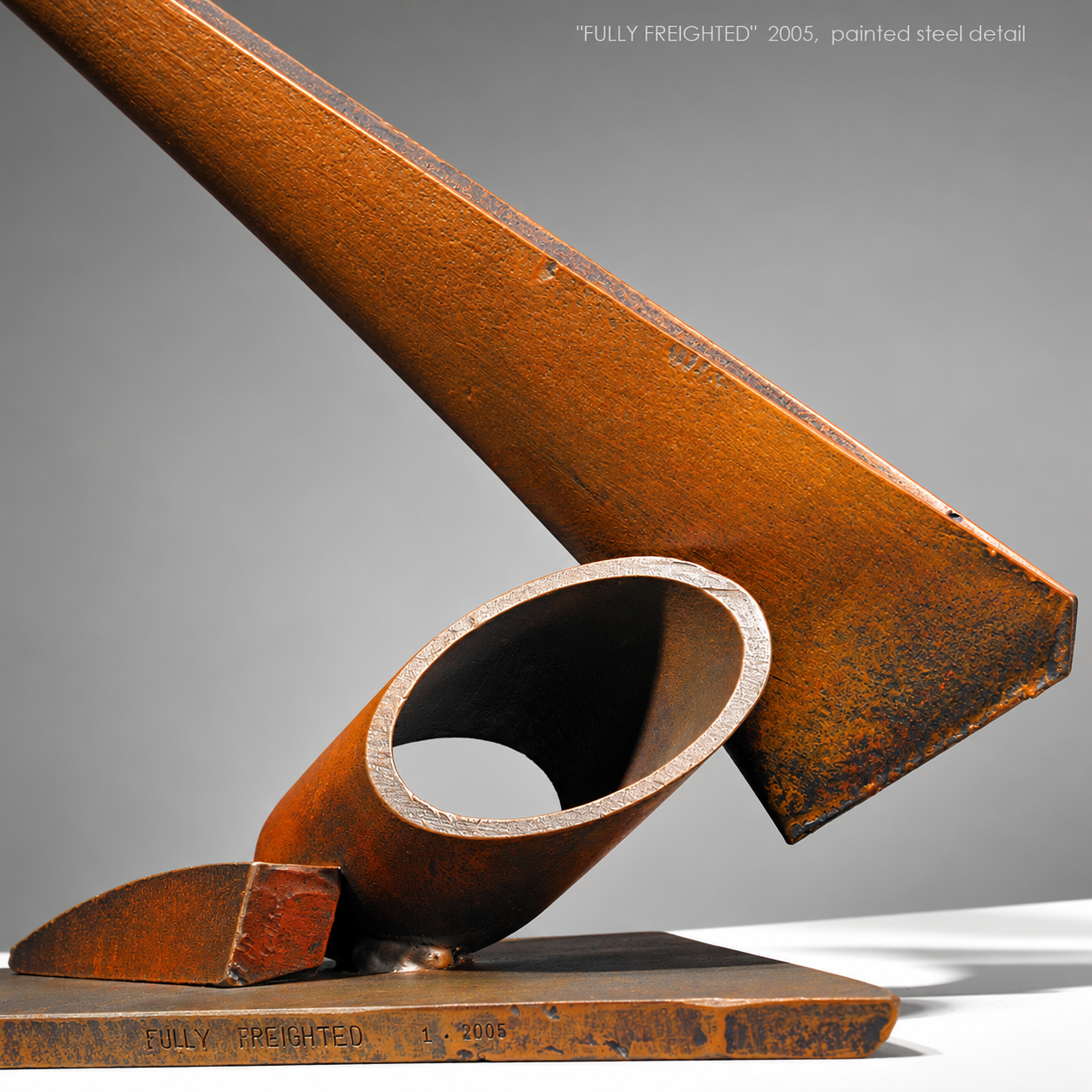
January 2005. Painted slate and steel. Dimensions: 31 × 19 × 7 in (79 × 48 × 18 cm).
Private Collection - Baltimore, MD.
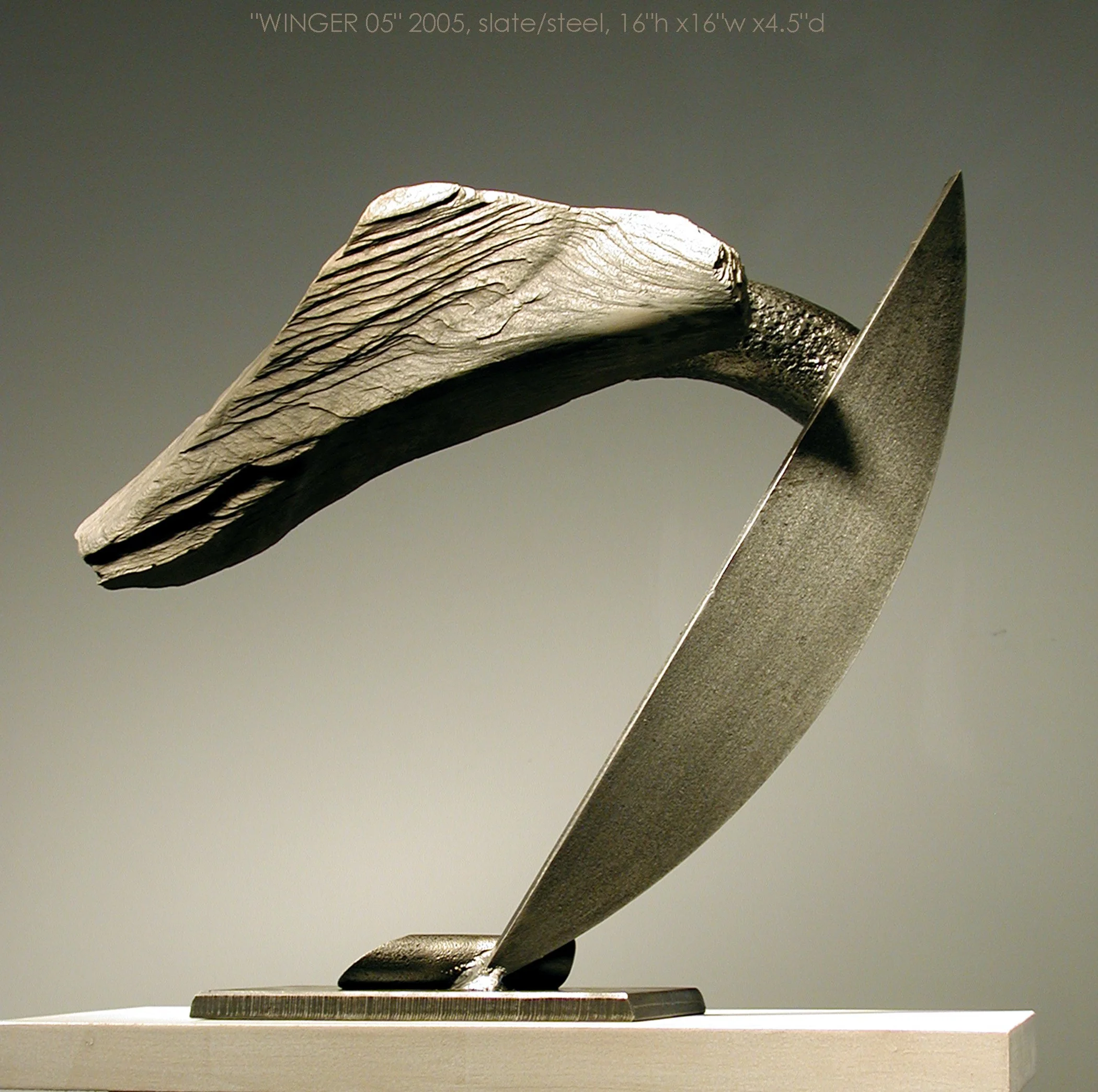
February 2005. Slate, steel. Dimensions: 16 × 16 × 4.5 in (41 × 41 × 11 cm).
Private Collection - Alexandria, VA
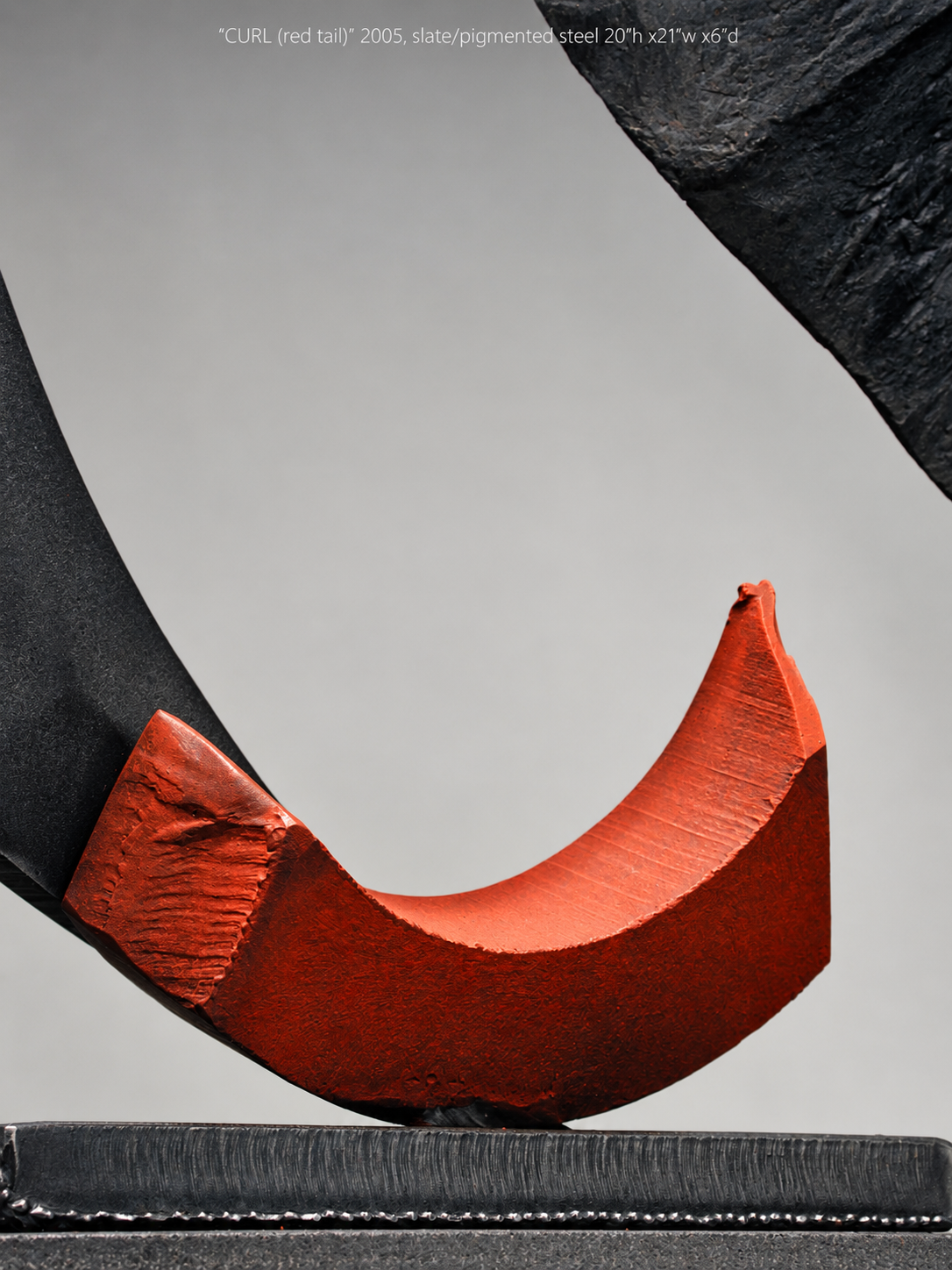
May 2005. Slate, pigmented and sealed steel. Dimensions: 20 × 21 × 6 in (51 × 53 × 15 cm).
Private Collection.
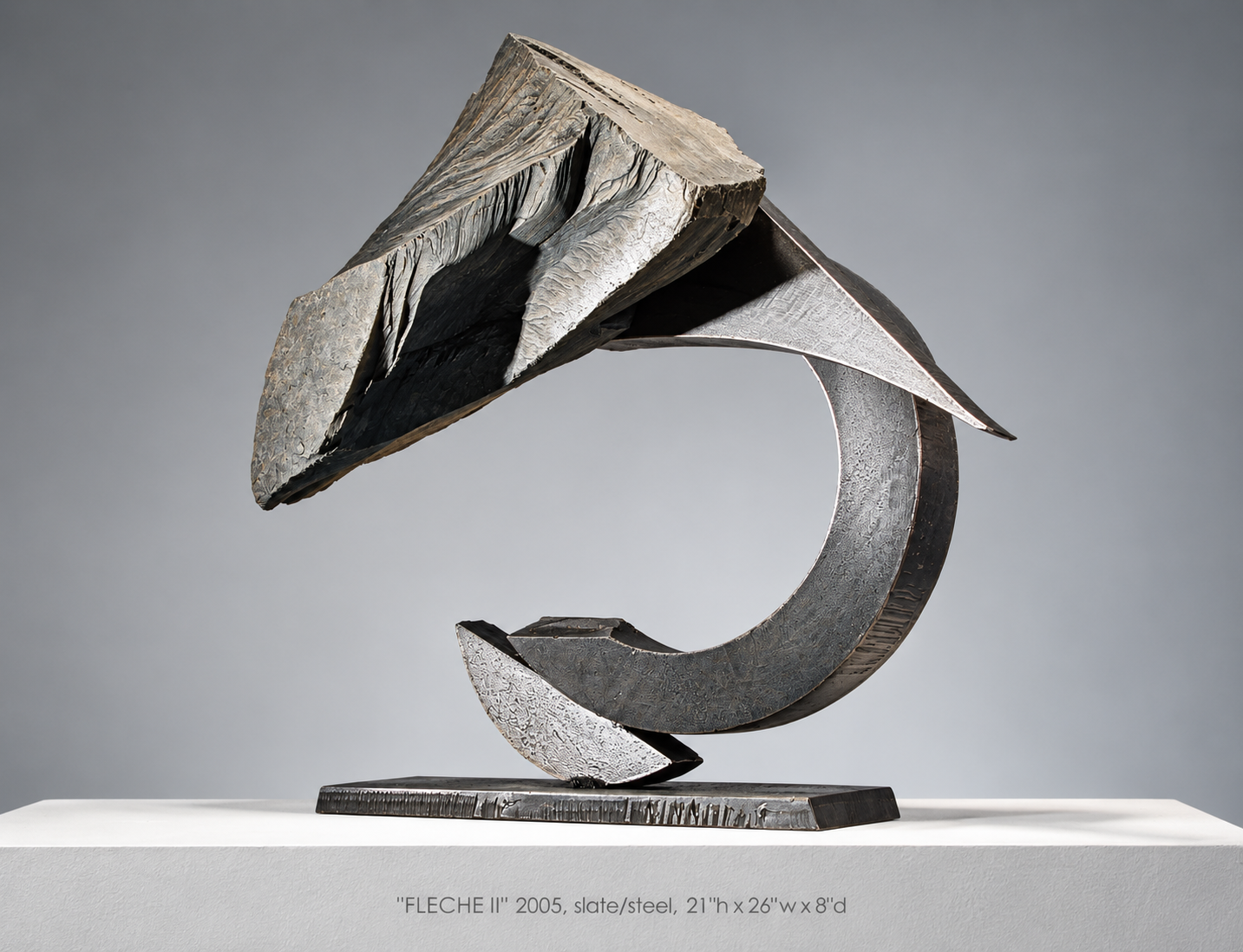
May 2005. Slate, steel. Dimensions: 21 × 26 × 8 in (53 × 66 × 20 cm). Private Collection.
flèche
Pronunciation: 'flesh, flèche
Function: noun
Etymology: French, literally, arrow, from Old French fleche, of Germanic origin; akin to Middle Dutch vlieke arrow, Old English flEogan to fly
: SPIRE ; especially : a slender spire above the intersection of the nave and transepts of a church
also: in the sport of Fencing : defined as a running attack with arm extended
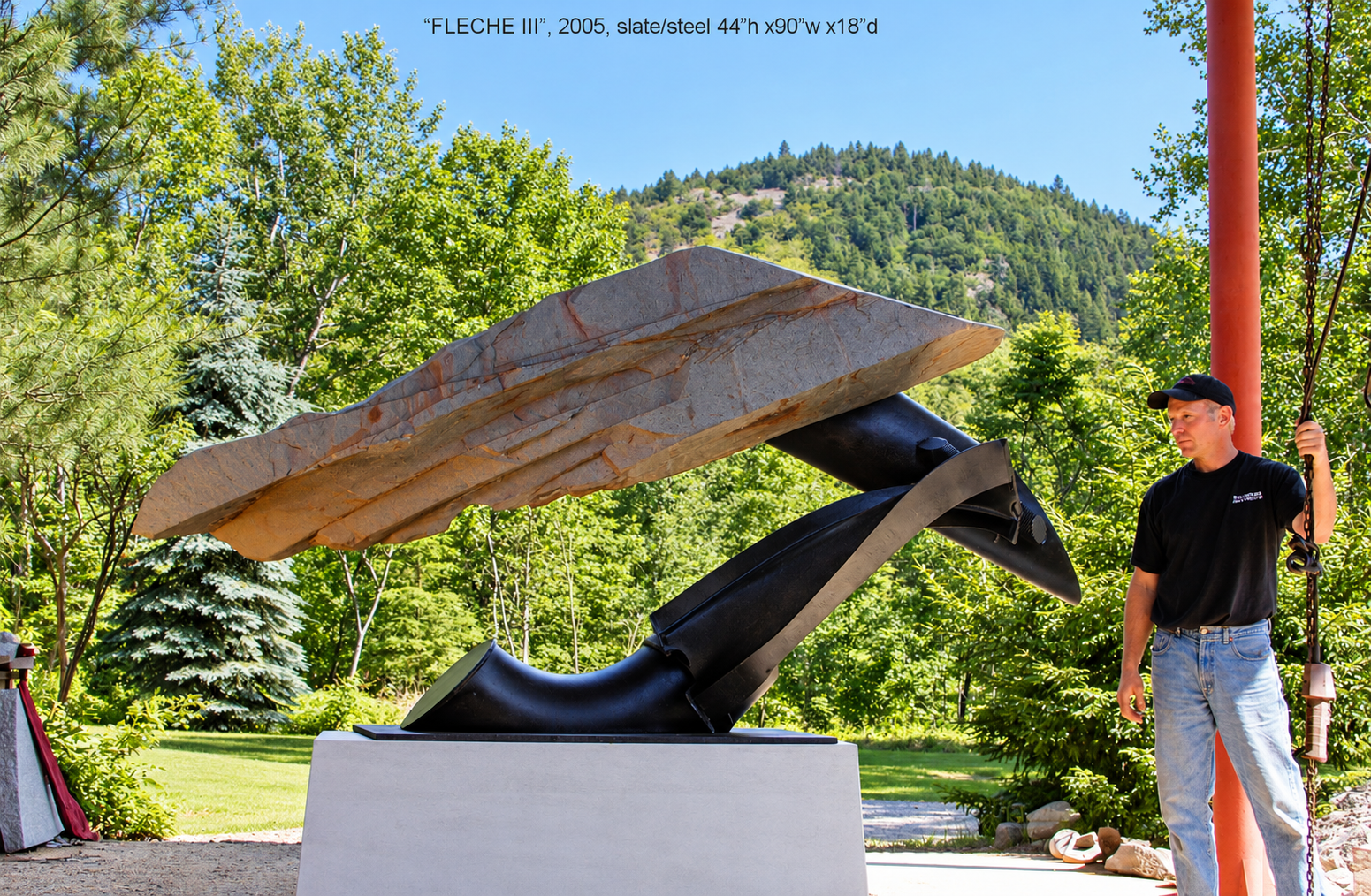
June 2005. Slate, sealed steel. Dimensions: 44 × 90 × 18 in (112 × 229 × 46 cm). Private Collection - California
flèche
Pronunciation: 'flesh, flèche
Function: noun
Etymology: French, literally, arrow, from Old French fleche, of Germanic origin; akin to Middle Dutch vlieke arrow, Old English flEogan to fly
: SPIRE ; especially : a slender spire above the intersection of the nave and transepts of a church
also: in the sport of Fencing : defined as a running attack with arm extended
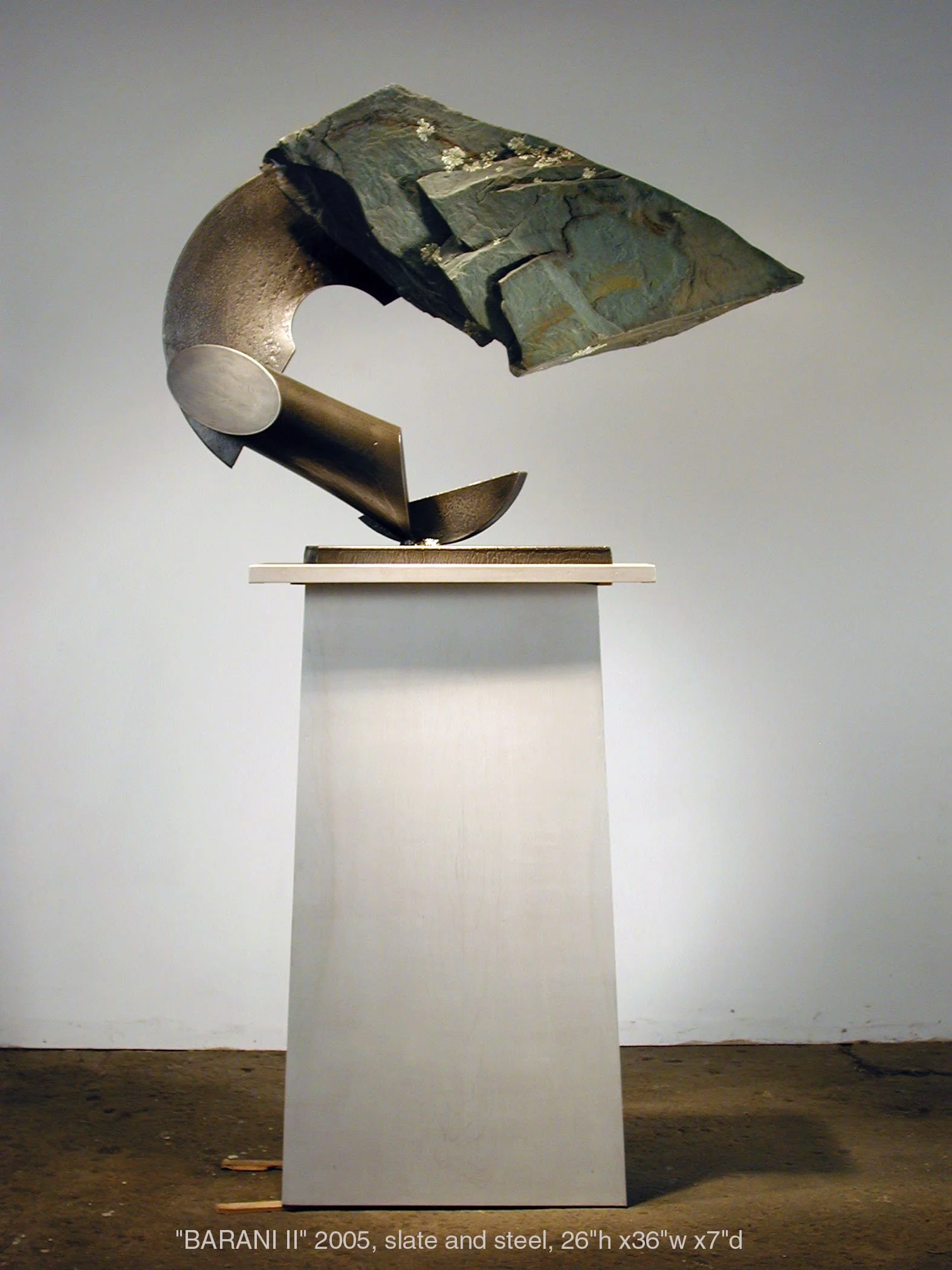
June 2005. Slate, steel. Dimensions: 26 × 36 × 7 in (66 × 91 × 18 cm).
The title comes from the gymnastic term barani, a half-twisting front somersault. The arrangement of stone and steel suggests a body caught mid-rotation, suspended between ascent and descent. As in much of Van Alstine’s work, the sculpture captures a moment of arrested motion—balancing weight, tension, and gravity while suggesting energy poised in mid-action.
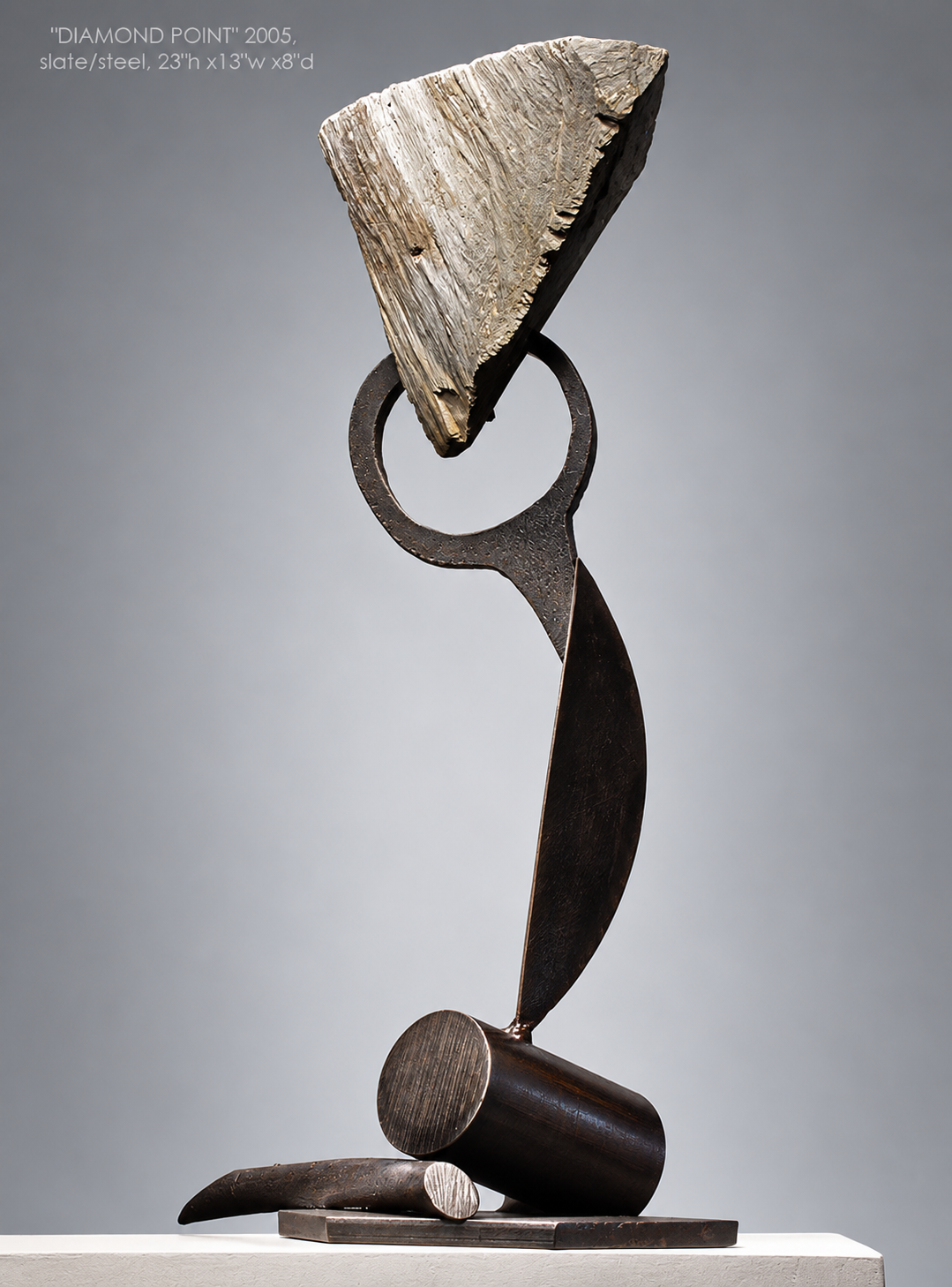
June 2005. Slate, steel. Dimensions: 25 × 13 × 16 in (64 × 33 × 41 cm). Private Collection.
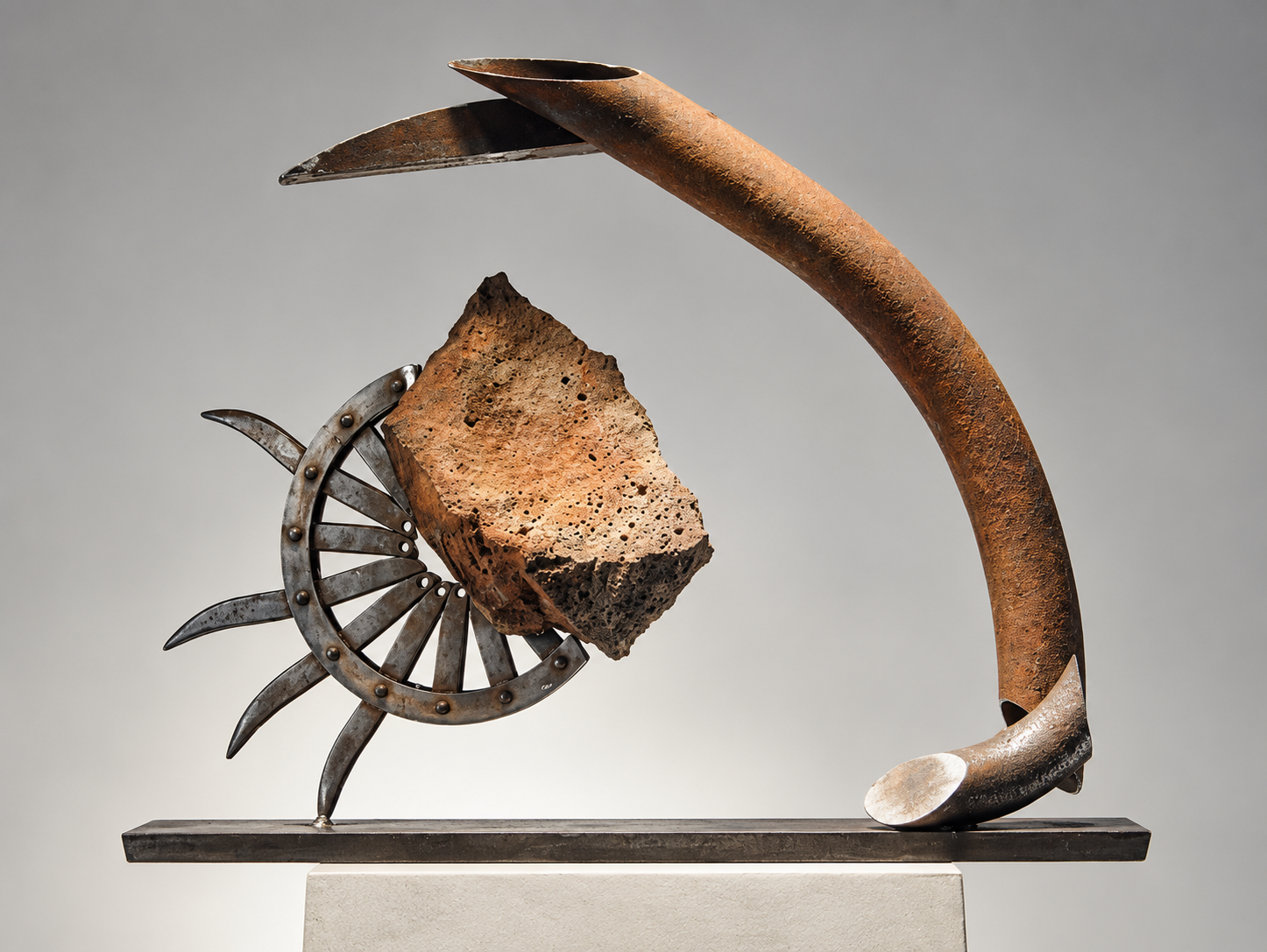
June 2005. Volcanic stone, steel. Dimensions: 25 × 30 × 6 in (64 × 76 × 15 cm).
Private Collection.
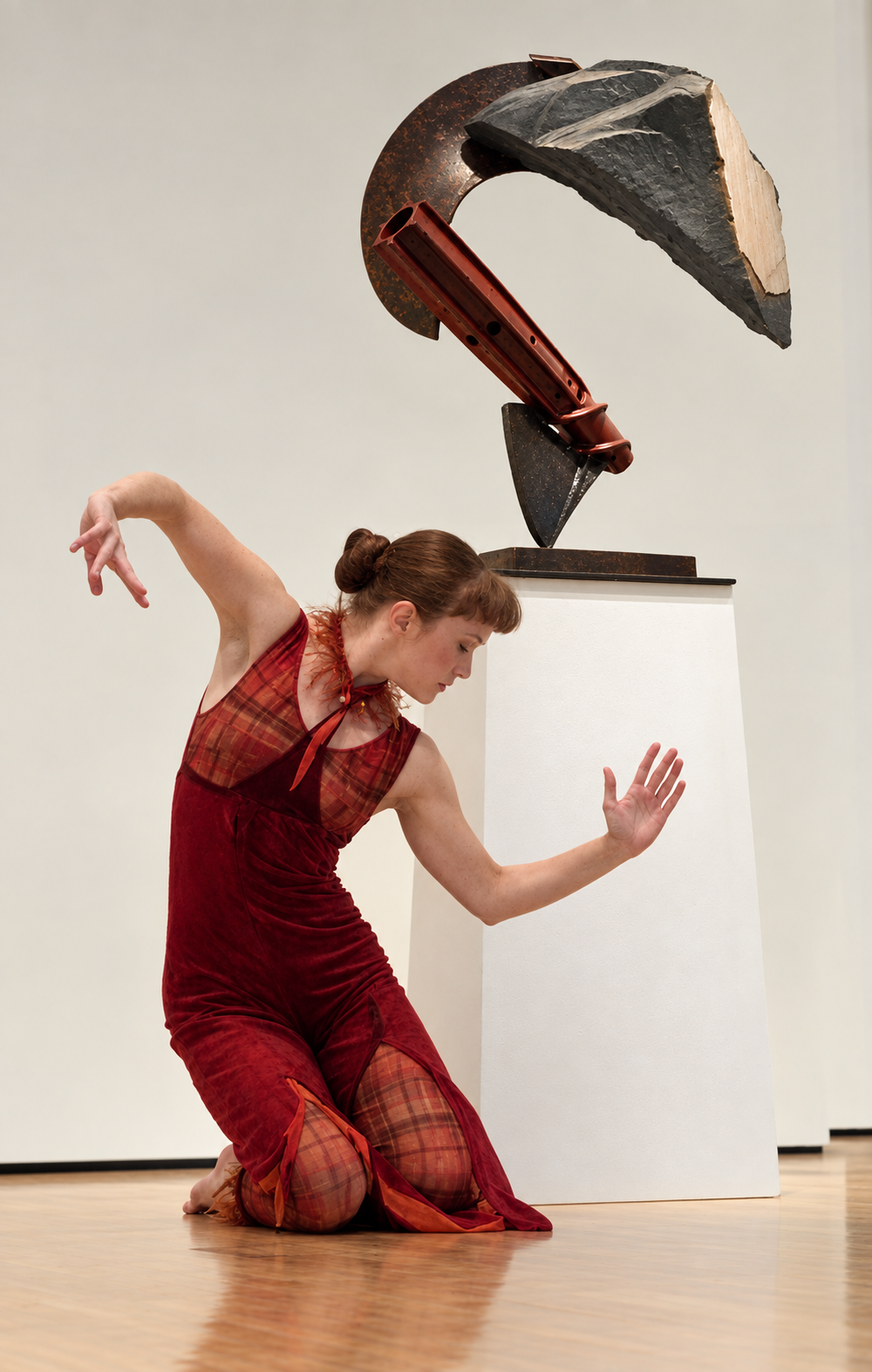
August 2005. Slate, pigmented and sealed steel. Dimensions: 34 × 28 × 15 in (86 × 71 × 38 cm). Private Collection Chicago.
< Dancer: Laura Teeter - Ellen Sinopoli Dance Company - 2012 Opalka Gallery, Sage College, Albany, NY.
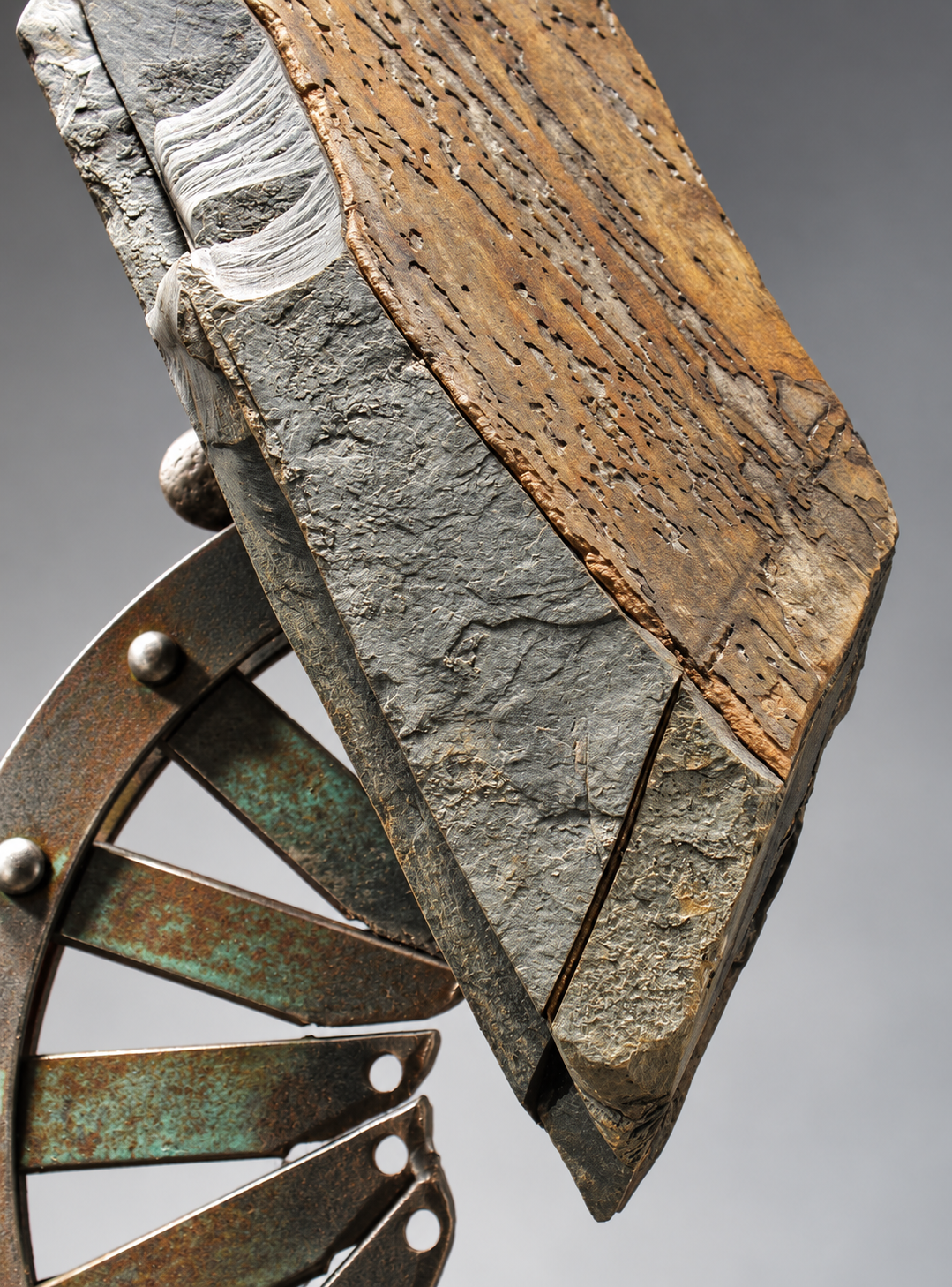
September 2005. Slate, steel. Dimensions: 24.5 × 15 × 7 in (62 × 38 × 18 cm). Private Collection.
En Pointe - in dance means to be on toes.
En Pointe, 2005, is the first in what became a long-running series exploring my interest in the expressive movement of the human body. As in works such as Flèche, the sculpture draws on the physical dynamics of dance, gymnastics, and fencing—balance, extension, tension, and movement held in arrested action.
The title comes from classical ballet: to dance en pointe is to balance with the body’s weight supported on the tips of the toes. Cambridge Dictionary Here, the sculpture appears to rise from a single point, while the heavy slate is lifted upward through the articulated steel structure. The contrast between weight and apparent lightness transforms stone and steel into a suggestion of a body poised in motion.
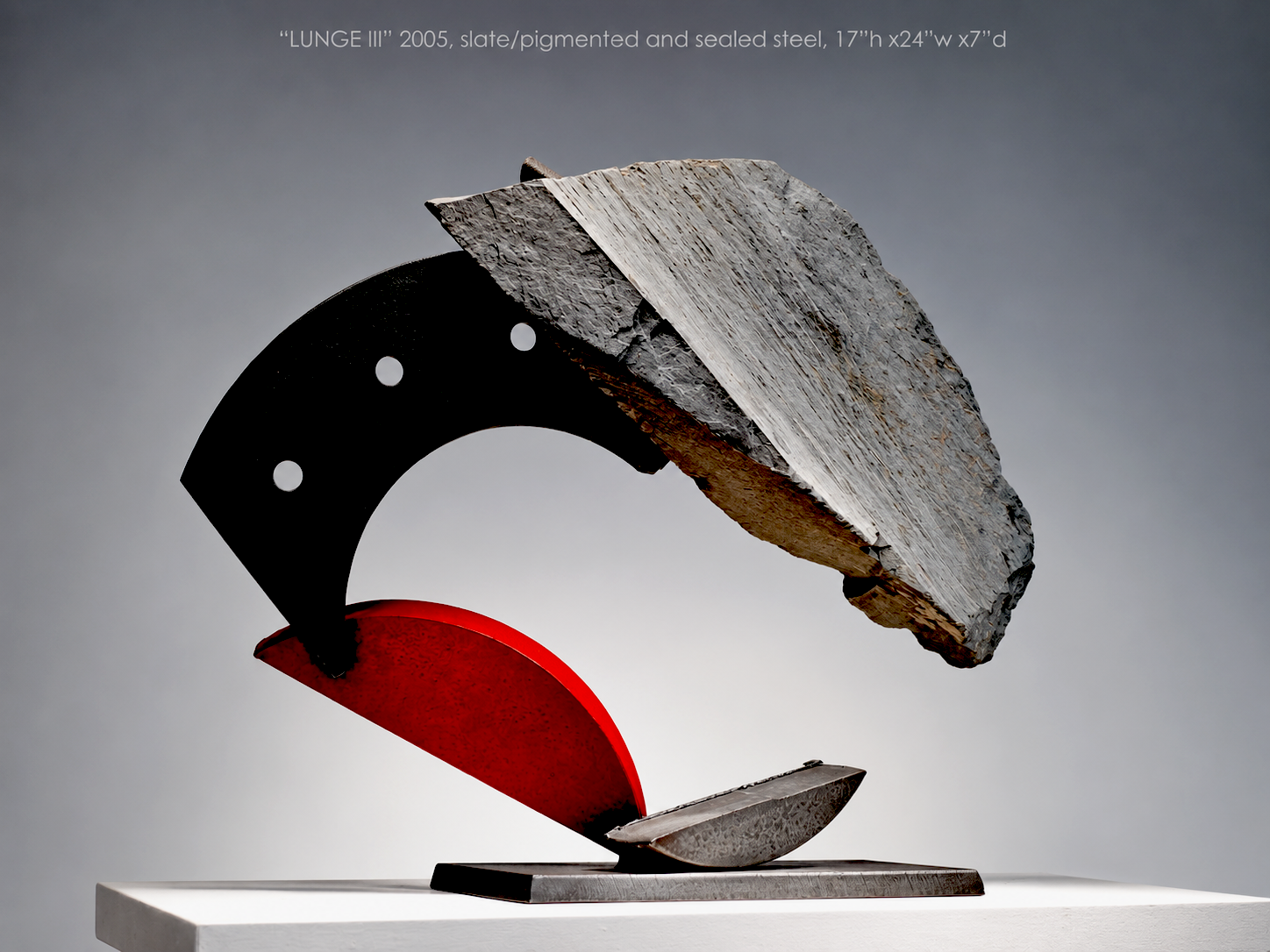
September 2005. Slate, steel. Dimensions: 17 × 24 × 7 in (43 × 61 × 18 cm).
The Lunge series explores implied movement and gesture through an abstract sculptural language. The title suggests a sudden extension of the body—a reaching, thrusting, or shifting of weight that gives the sculpture a sense of physical momentum and directed energy.
While not figurative in a literal sense, the work draws on my interest in the expressiveness of the human figure. Its balance, tension, and spatial gesture suggest a body caught in motion, allowing the sculpture to convey a human presence through posture and movement rather than recognizable form.
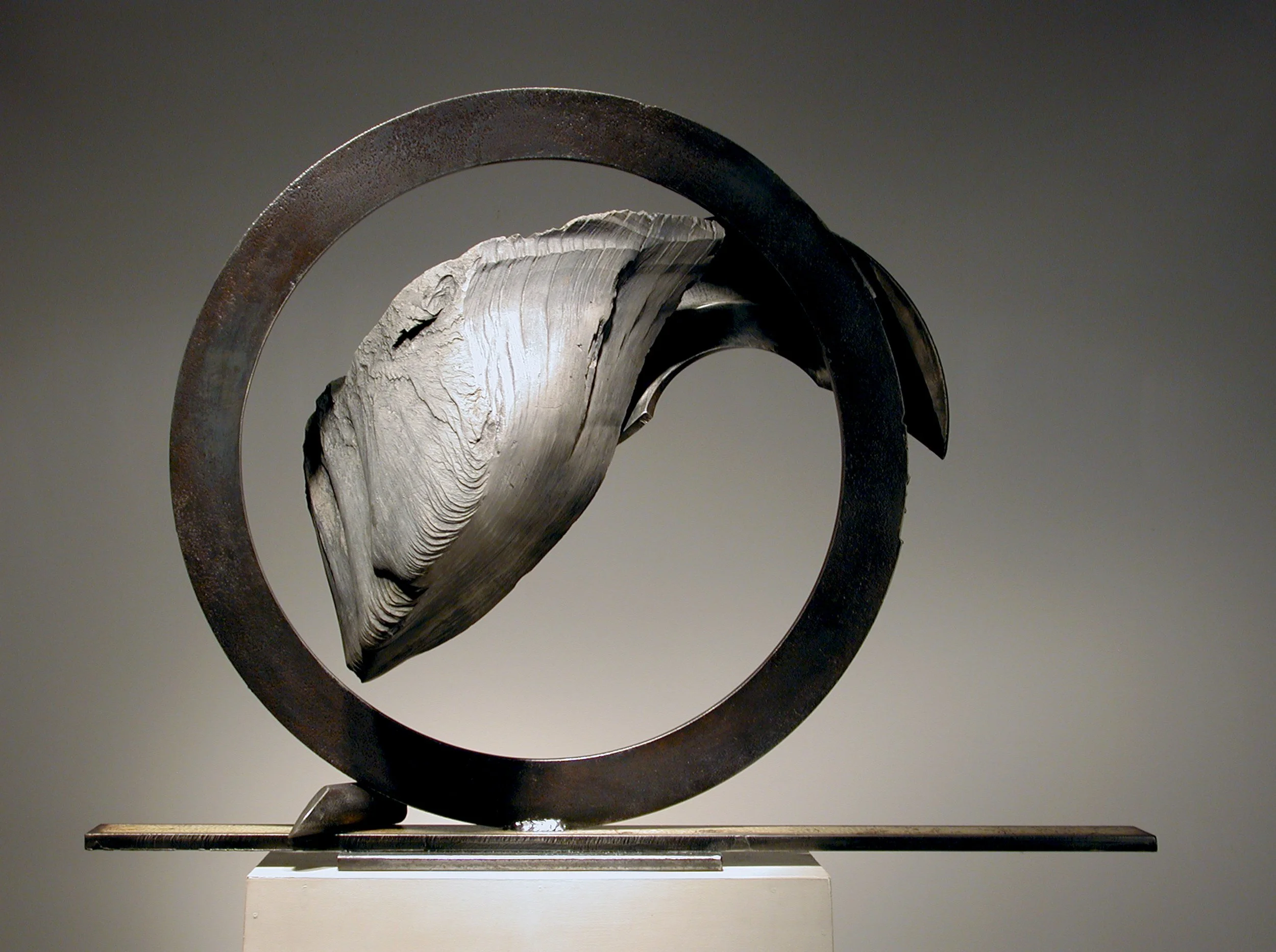
September 2005. Slate, steel. Dimensions: 25 × 34 × 9 in (64 × 86 × 23 cm).
The first Sisyphean Circle. Collection US State Department - Art in Embassies, Santiago Chile.
The Sisyphean Series
The Greek myth of Sisyphus, condemned to endlessly push a boulder uphill, has inspired more than 250 of my sculptures. Rather than seeing the myth as a symbol of futility, I share philosopher Albert Camus’s more positive interpretation—that meaning and fulfillment can be found in the struggle itself. In many ways, I see Sisyphus as autobiographical, reflecting my lifelong pursuit as an artist, confronting challenges, taking risks, and finding purpose in the act of creation.
My Sisyphean works bring stone and steel together in precarious yet stable arrangements, often incorporating circular forms suggesting perpetual motion. For me, they are metaphors for the creative process—an ongoing cycle of experimentation, discovery, setbacks, and renewal. Each completed sculpture is both an achievement and a starting point, celebrating the journey rather than simply the destination.
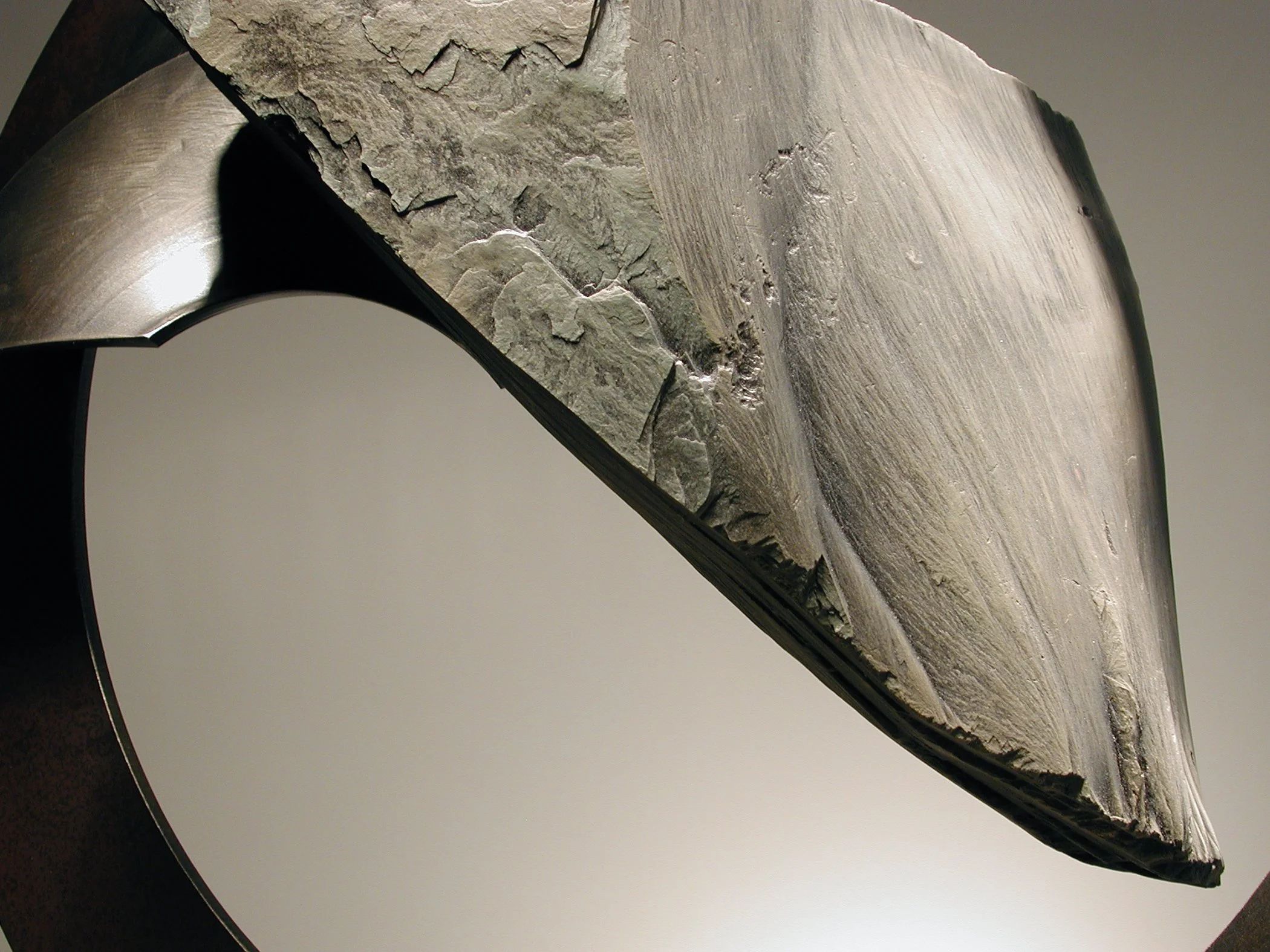
September 2005. Slate, steel. Dimensions: 24.5 × 24 × 10 in (62 × 61 × 25 cm). Private Collection.
The Sisyphean Series
The Greek myth of Sisyphus, condemned to endlessly push a boulder uphill, has inspired more than 250 of my sculptures. Rather than seeing the myth as a symbol of futility, I share philosopher Albert Camus’s more positive interpretation—that meaning and fulfillment can be found in the struggle itself. In many ways, I see Sisyphus as autobiographical, reflecting my lifelong pursuit as an artist, confronting challenges, taking risks, and finding purpose in the act of creation.
My Sisyphean works bring stone and steel together in precarious yet stable arrangements, often incorporating circular forms suggesting perpetual motion. For me, they are metaphors for the creative process—an ongoing cycle of experimentation, discovery, setbacks, and renewal. Each completed sculpture is both an achievement and a starting point, celebrating the journey rather than simply the destination.
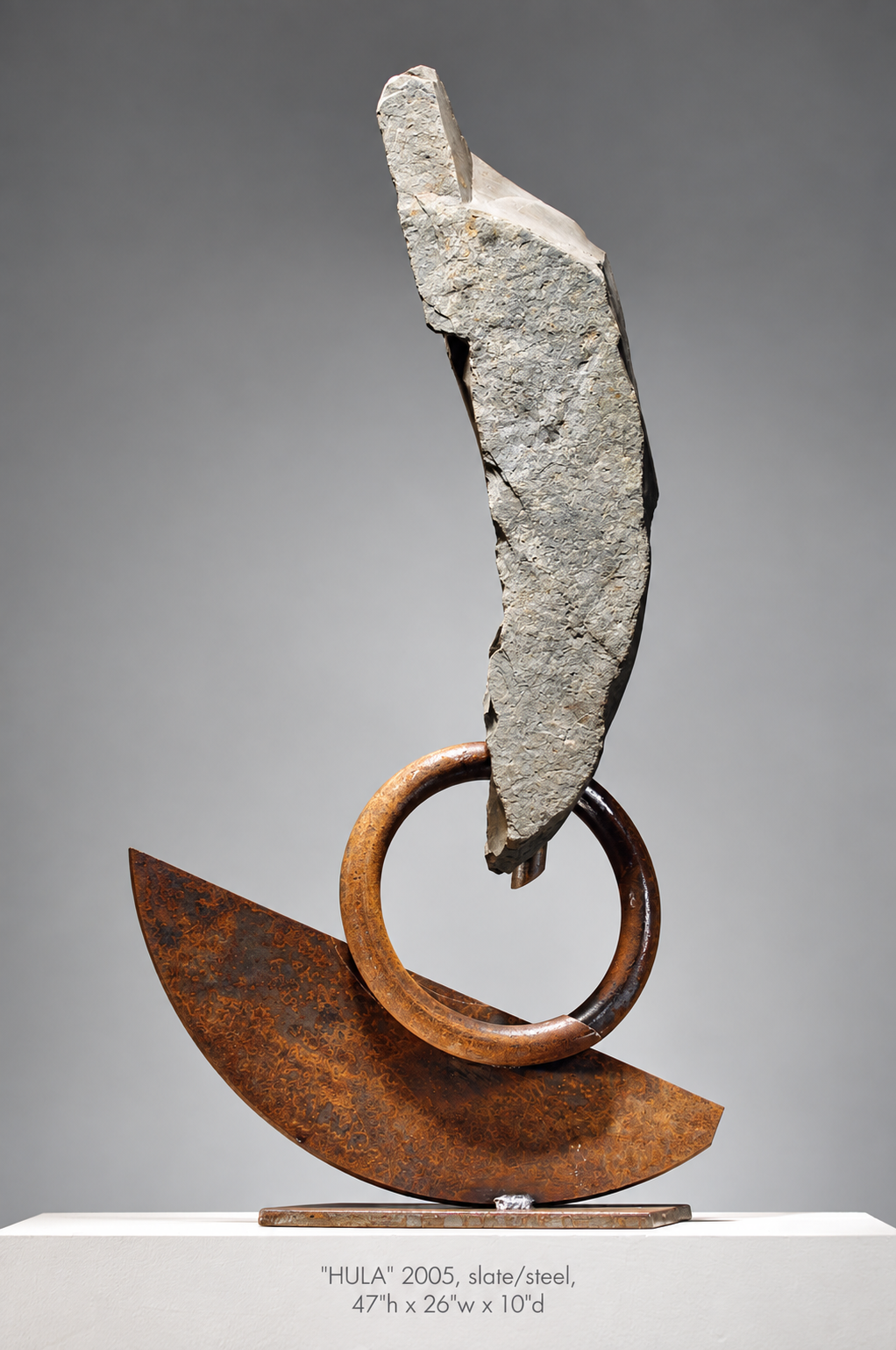
September 2005. Slate, steel. Dimensions: 47 × 26 × 10 in (119 × 66 × 25 cm). Private Collection
Hula, 2005, is the first in what became a long-running series exploring my interest in the expressive movement of the human body. Like works inspired by dance, gymnastics, and fencing, it uses balance, gesture, and implied motion rather than literal figuration. The circular steel element and sweeping base suggest the rhythmic rotation associated with the hula hoop, while the vertical slate gives the composition a bodily presence.
The work reflects my broader interest in “choreographing” heavy, earthbound materials—using steel to lift and animate stone. JOHN VAN ALSTINE SCULPTURE Here the massive slate appears almost weightless, poised above the circular steel form in a moment of arrested motion, transforming physical weight into a sense of balance, rhythm, and movement.
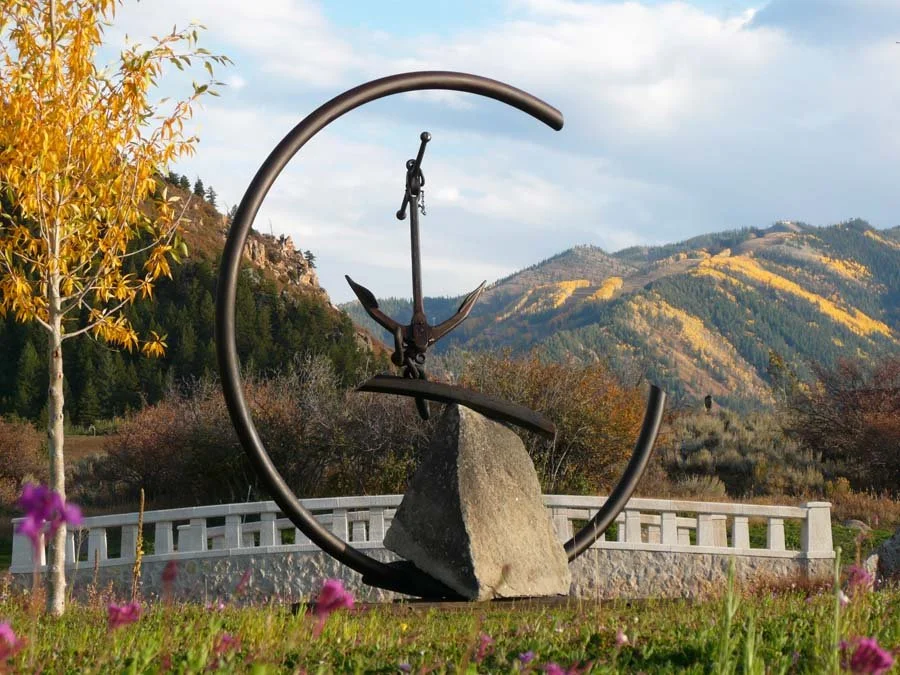
October 2005. Slate, steel. Dimensions: 44 × 42 × 19 in (112 × 107 × 48 cm).
A statio was a Roman road station, post, or anchorage, offering accommodation for travelers and messengers.
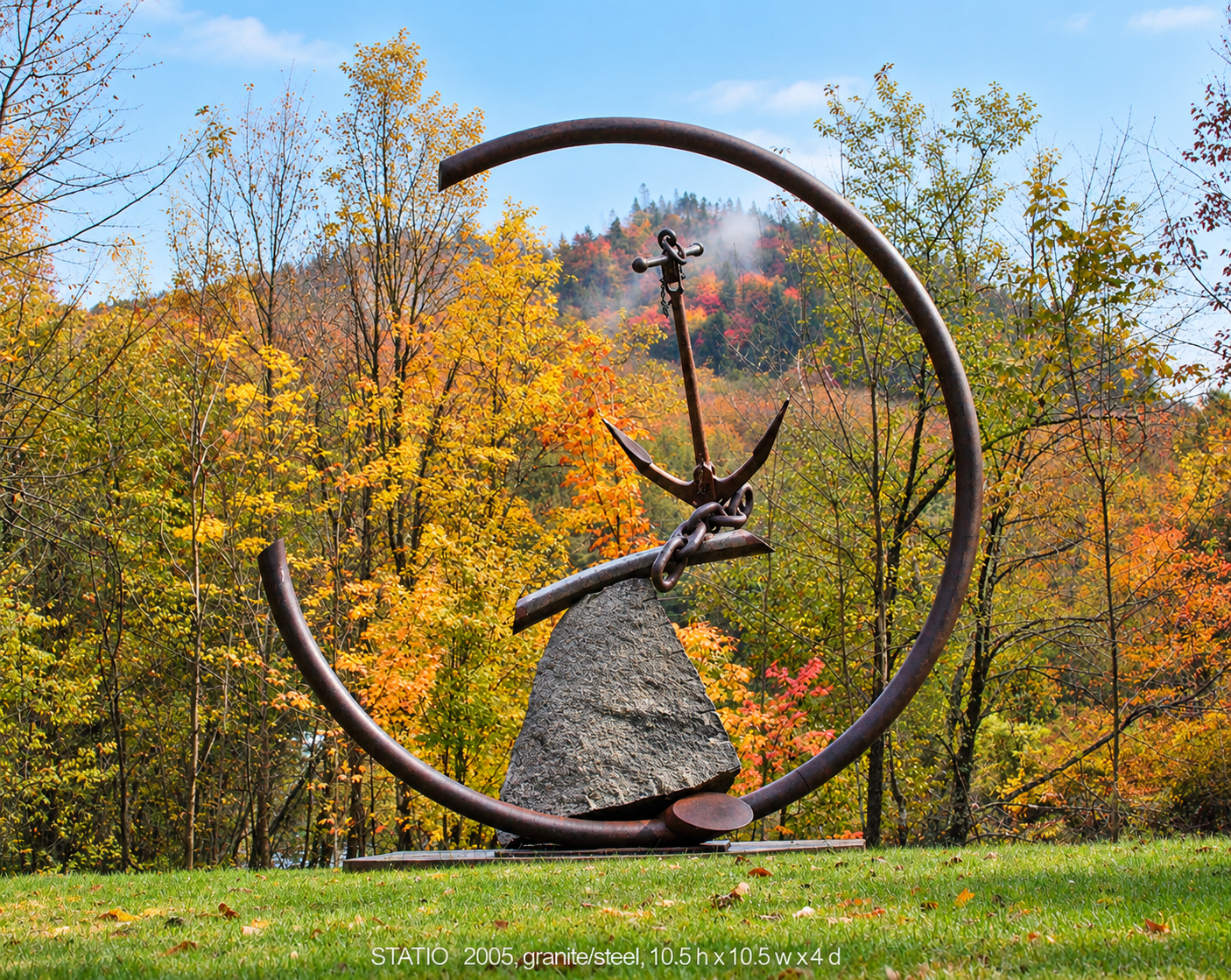
December 2005. Granite, steel. Dimensions: 10.5 × 10.5 × 6 ft.
Private collection - Aspen, Co
statio is a Latin word that can carry the sense of “anchorage” or “harbor,” Its basic meanings come from stare, “to stand,” and include a standing place, station, post, position, stopping place, or anchorage. In a nautical context, statio can specifically mean a place where ships lie at anchor—a roadstead or anchorage.
2004
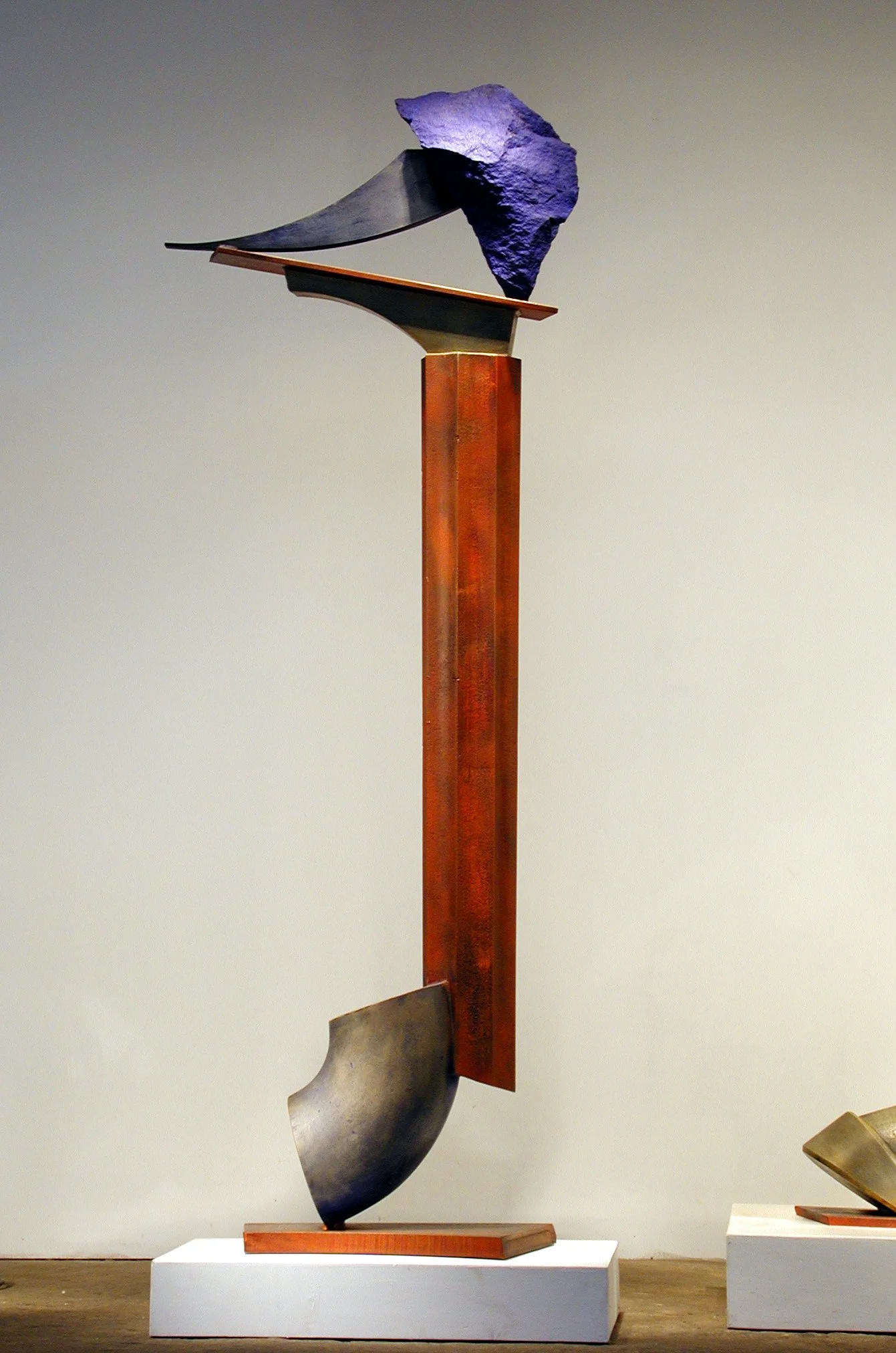
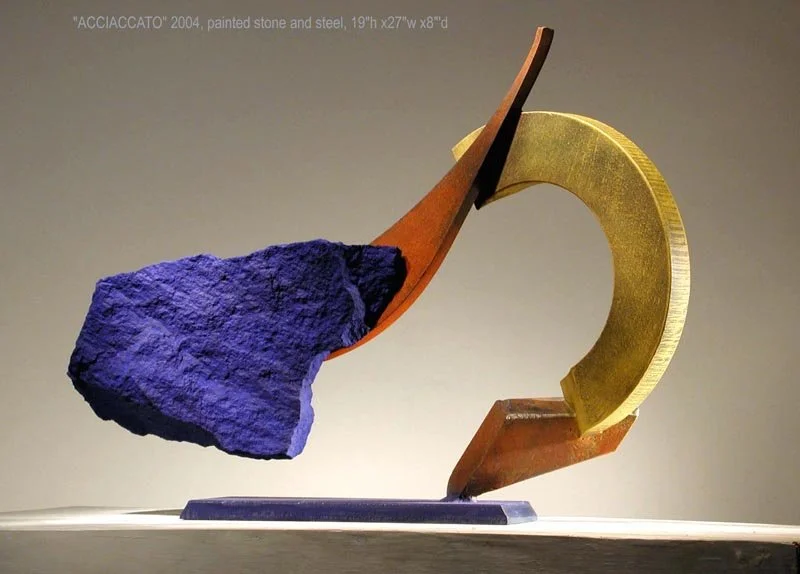
January 2004. Oil enamel on stone and steel. Dimensions: 19 × 27 × 8 in (48 × 69 × 20 cm). Private Collection - Baltimore, MD
Acciaccato, 2004
Acciaccato takes its title from an Italian musical term describing the notes of a chord sounded in rapid succession, typically from bottom to top—ascending. JOHN VAN ALSTINE SCULPTURE That musical idea is translated into physical form as the steel elements sweep upward, lifting the heavy stone and giving the sculpture a strong sense of rising movement.
The work continues my interest in bringing together the natural and human-made—rough stone and industrial steel—while using the strength and curve of the metal to visually “choreograph” and lift an earthbound material. 1stDibs Color further separates and animates the elements, reinforcing the upward progression and transforming weight and mass into a suspended, energetic event.
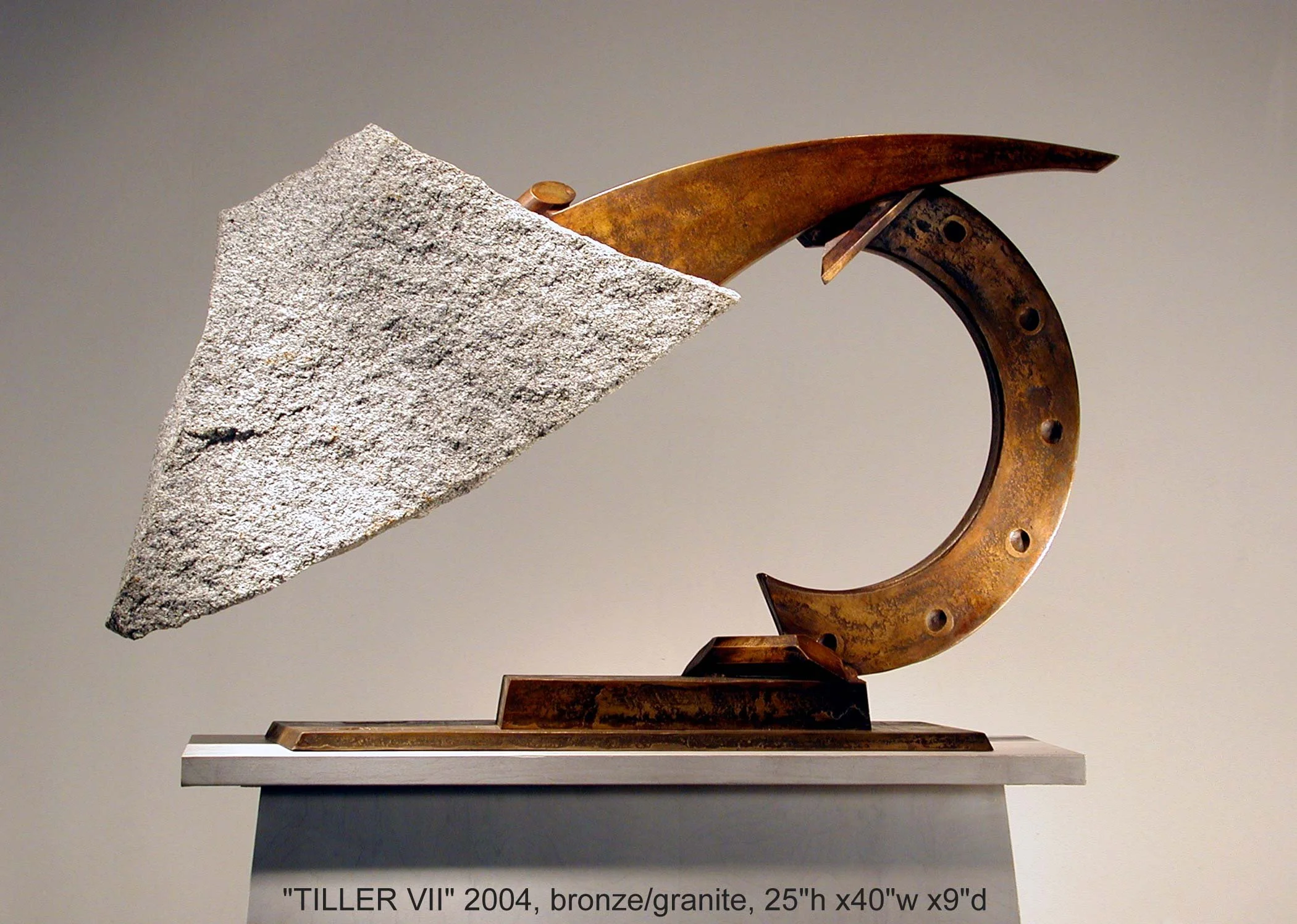
March 2004. Bronze, granite. Dimensions: 25 × 45 × 9 in (64 × 114 × 23 cm).
Private collection - Washington, DC
The Tiller series grows from my interest in tools and agricultural implements as extensions of the human hand—objects that cultivate, shape, and engage the land. The title also evokes the tiller of a boat, a simple device used to steer and determine direction. Bringing these meanings together, the works explore the relationship between cultivation and navigation—our impulse both to shape the world around us and to chart a course through it.
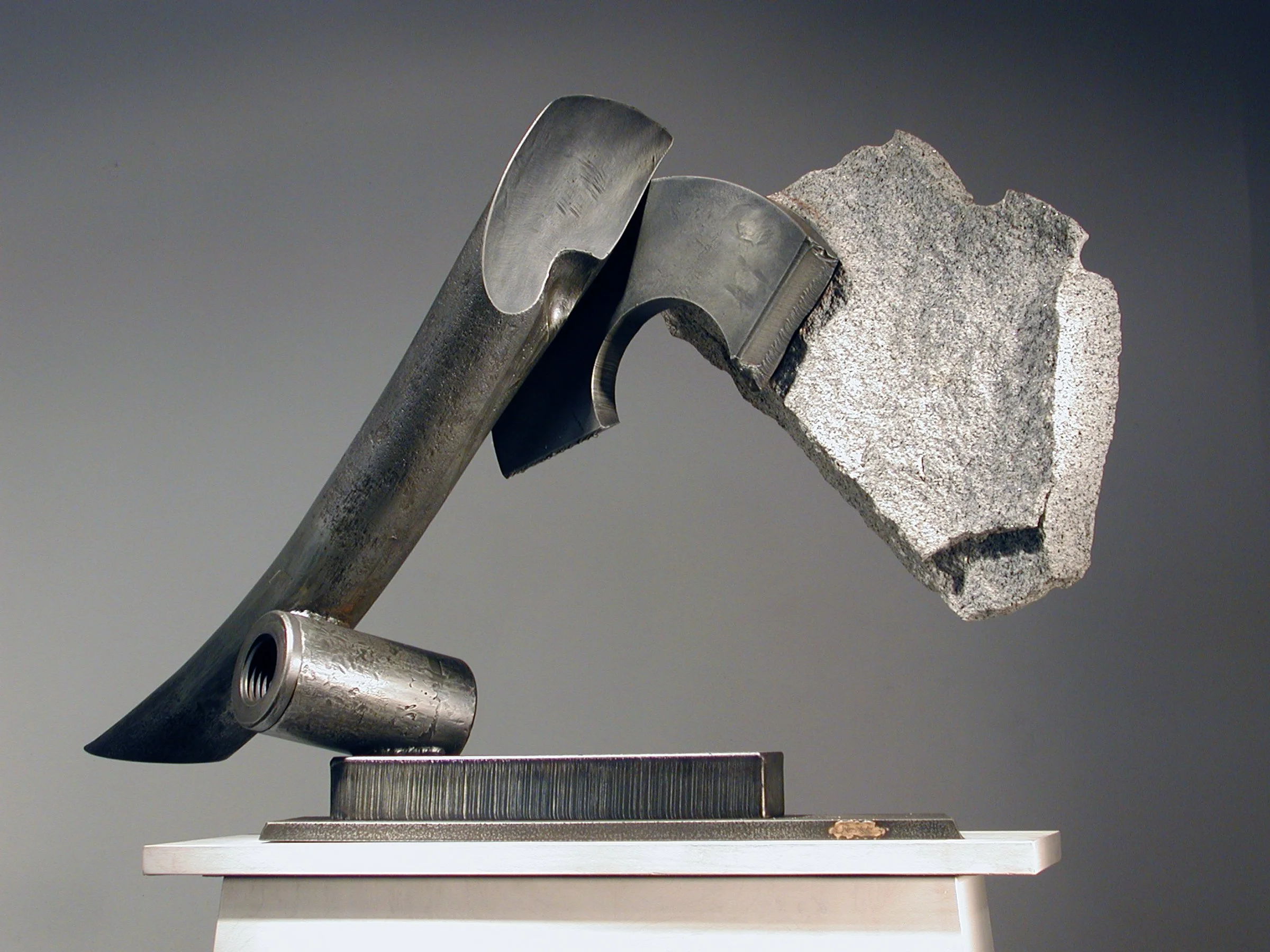
January 2004. Granite, steel. Dimensions: 29 × 50 × 14 in (74 × 127 × 36 cm).
Private collection - Aikens, SC
Glissando, 2004
Glissando takes its title from the musical term for a continuous slide from one pitch to another. Here that idea becomes physical: the sweeping steel elements appear to slide and glide across one another, creating a continuous sense of movement through otherwise heavy, static materials.
The rough granite provides a counterweight to this fluid motion, while the curved steel suggests shifting balance and arrested movement. The pairing of natural stone and fabricated steel becomes almost musical—a progression of forms flowing from one element to the next.
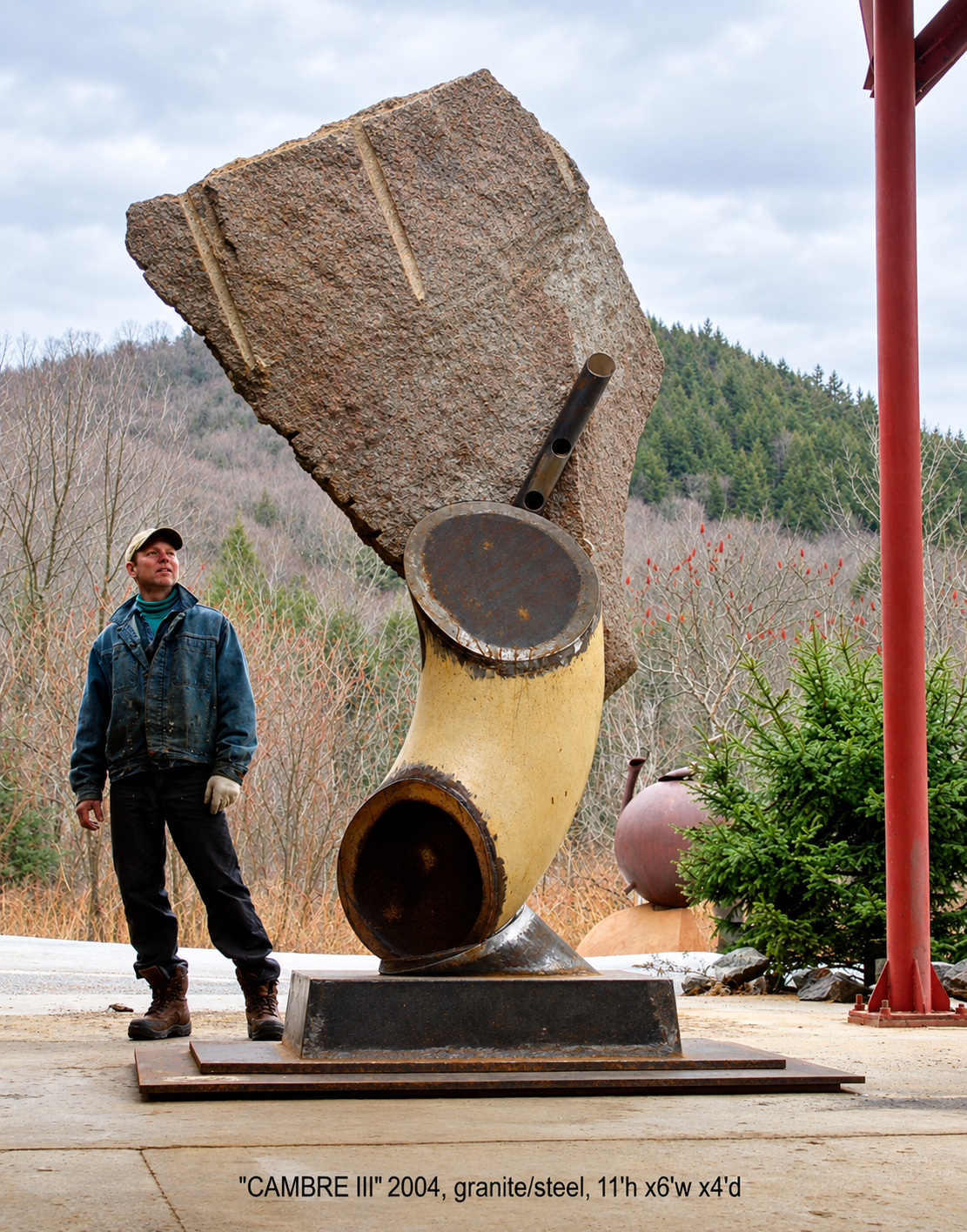
March 2004. Granite, powder coated steel. Dimensions: 10 × 6 × 4 in (25 × 15 × 10 cm). Private Collection - Bellini Hotel Miami Beach, FL.
Cambre III takes its title from the classical ballet term cambré, meaning “arched”—a movement in which the body bends from the waist, with the head following. The sculpture translates this gesture into granite and steel, its sweeping form bending upward while supporting the massive stone in a seemingly precarious position.
The work reflects my interest in the connections between artistic disciplines, particularly sculpture and dance. By “choreographing” the typically earthbound materials of stone and steel through balance, tension, and arrested motion, I seek to transform their physical weight into a sense of gesture and movement.
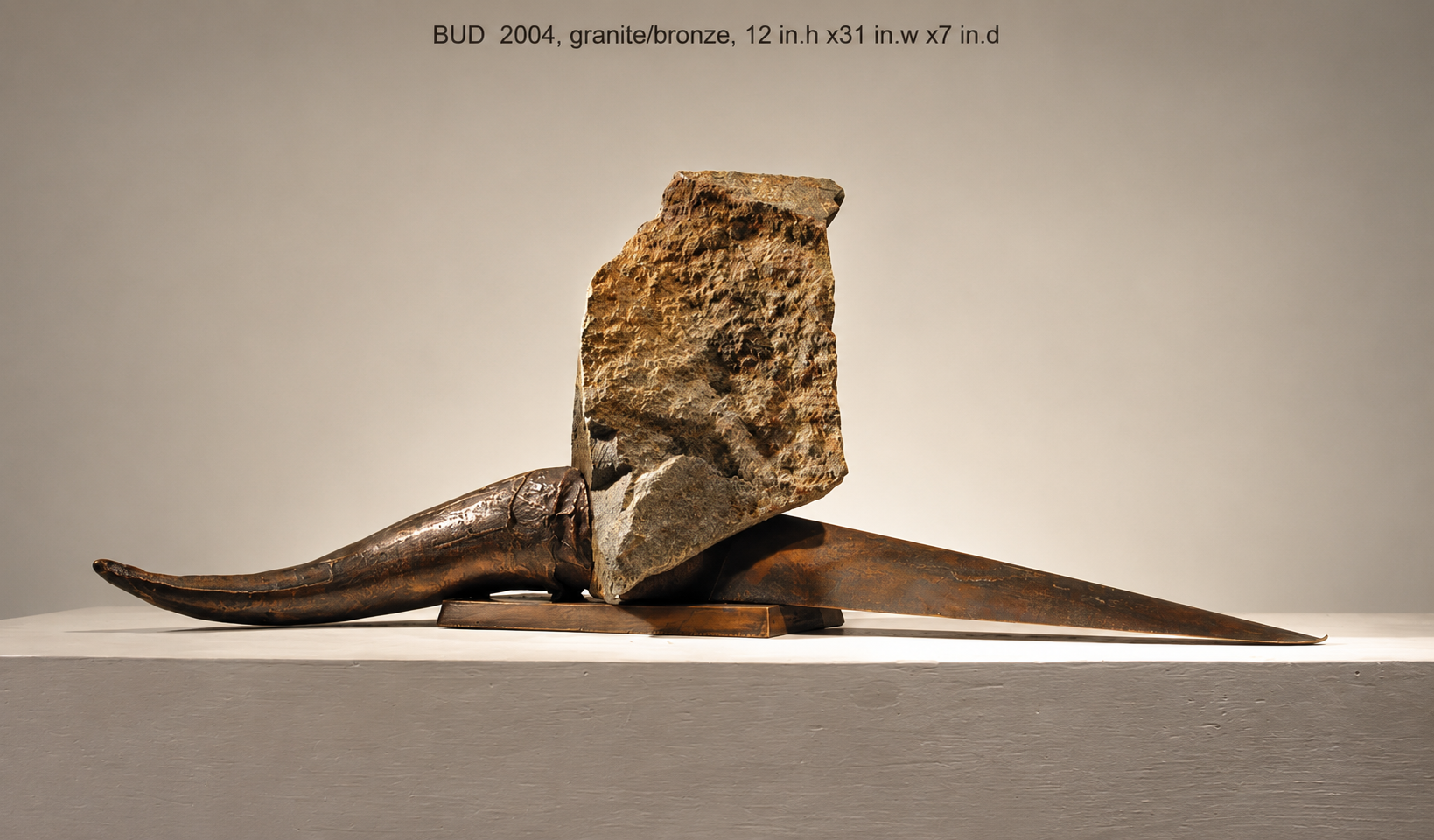
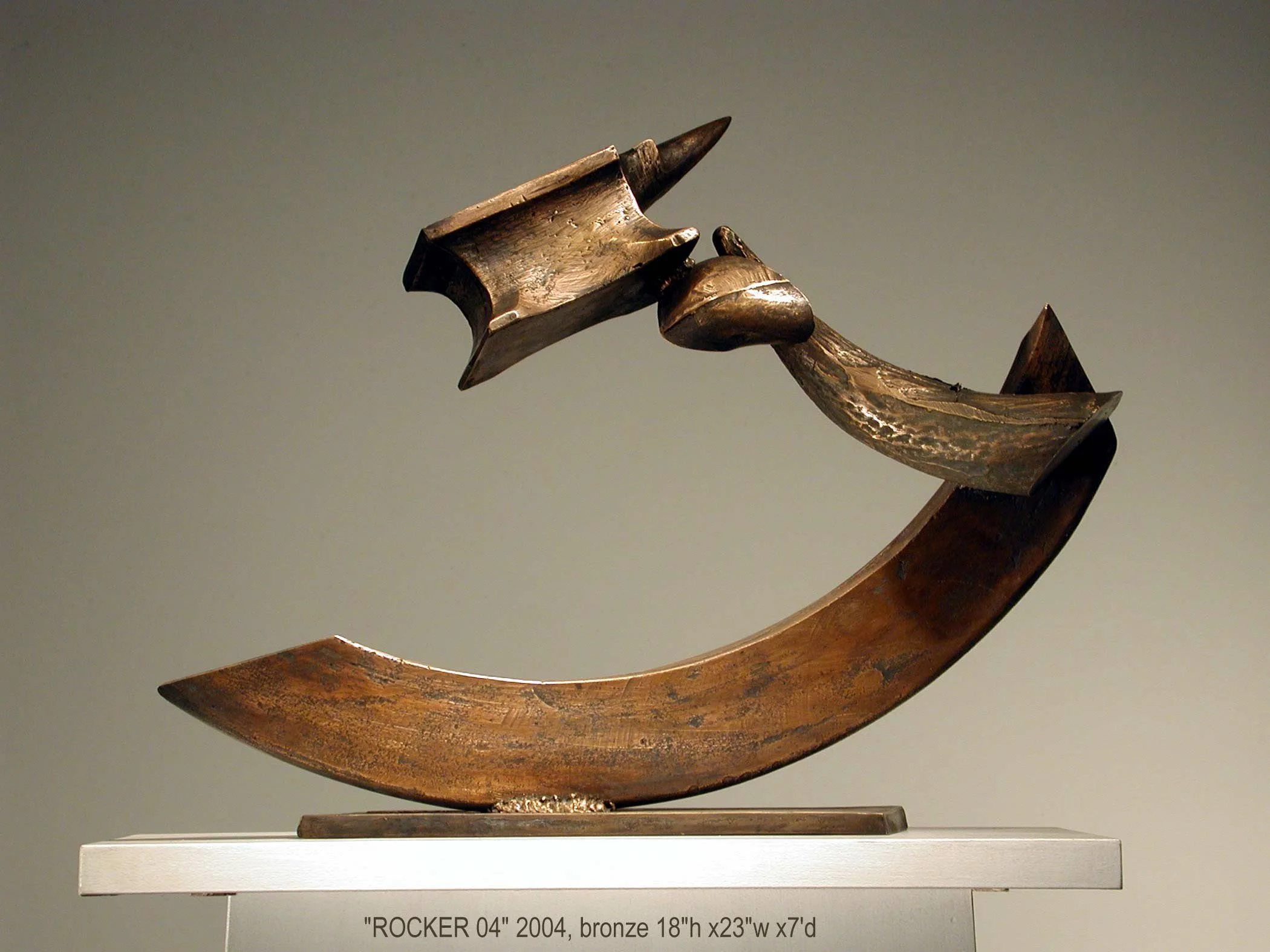
April 2004. Bronze. Dimensions: 18 × 23 × 7 in (46 × 58 × 18 cm).
Cannibalized to make "Rocker 04-20" (T-20-21)
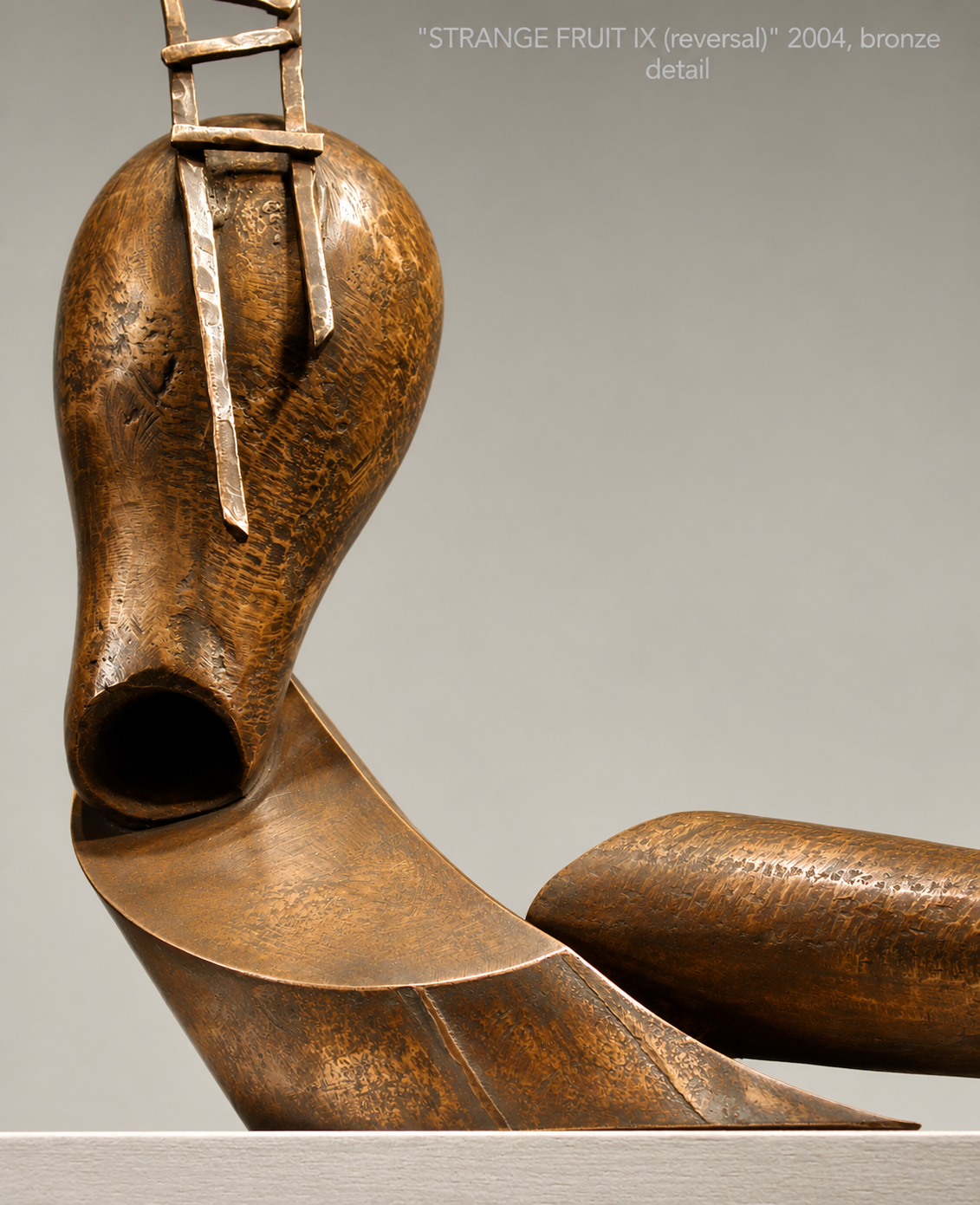
May 2004. Bronze. Dimensions: 24 × 21 × 7 in (61 × 53 × 18 cm).
Private Collection.
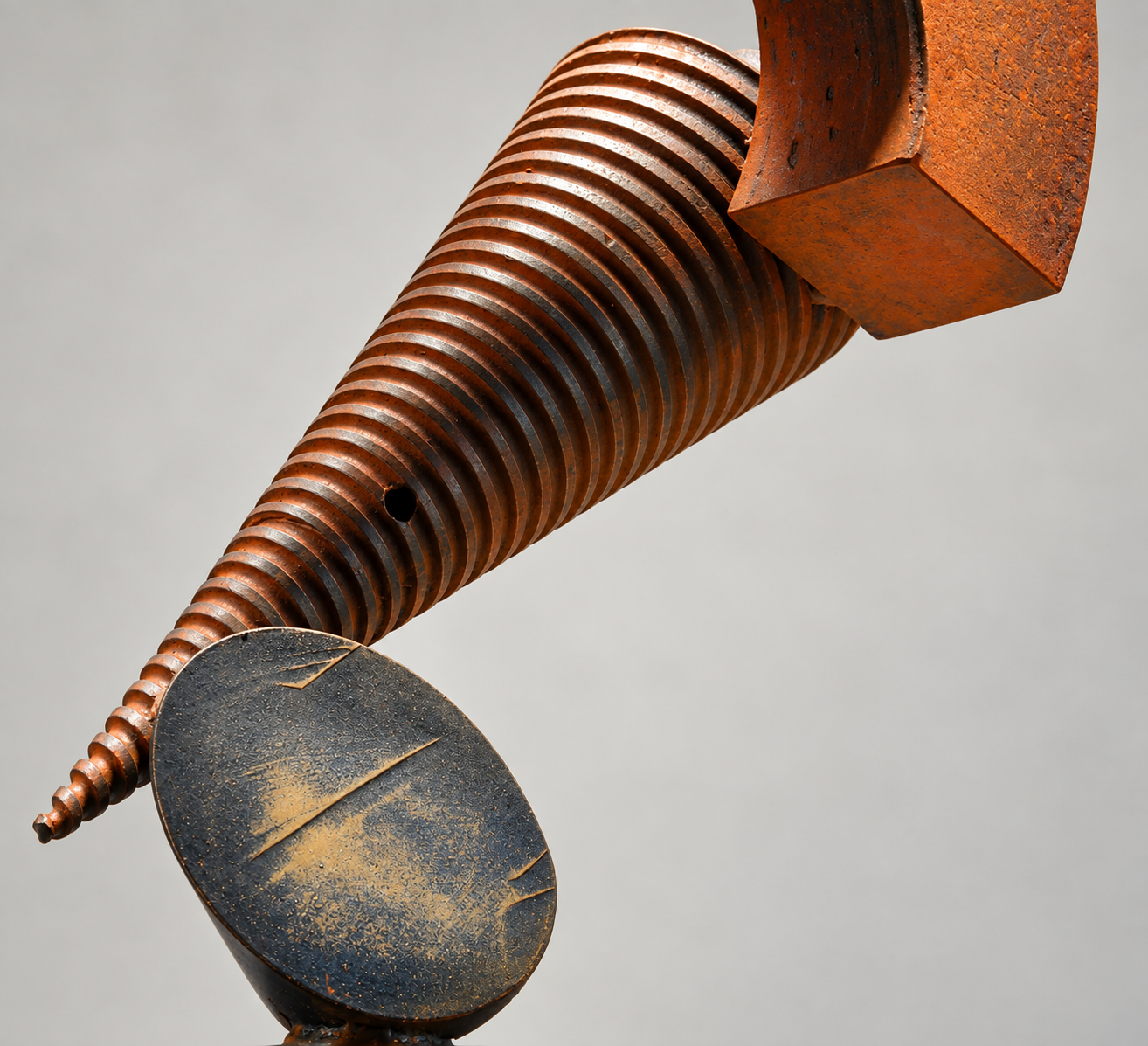
May 2004. Oil enamel on steel. Dimensions: 20 × 34 × 8 in (51 × 86 × 20 cm).
Private collection - Pittsburgh
Arabesque - dance position where the body is balanced on one leg or toe, the other leg extended.
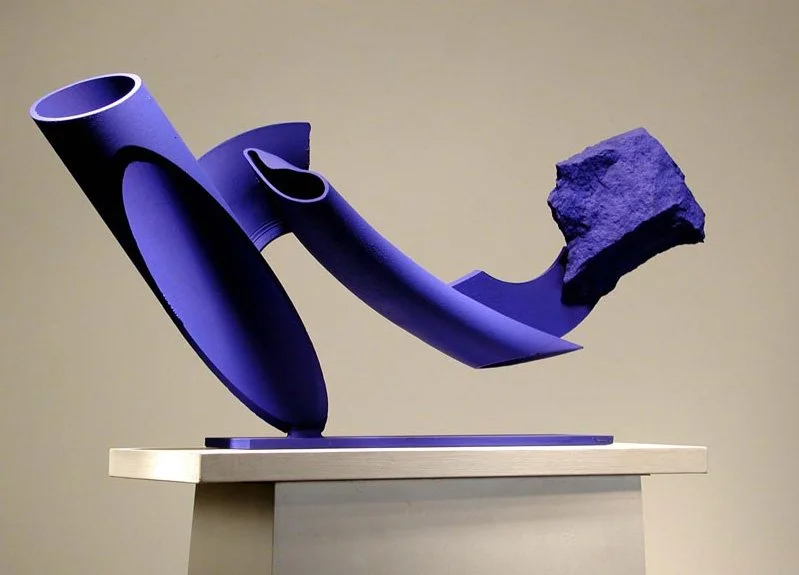
May 2004. Oil enamel on steel, stone. Dimensions: 14 × 31 × 7 in (36 × 79 × 18 cm).
"Acciacato" - musical term: Broken down, crushed; the sounding of the notes of a chord not quite simultaneously, but from bottom to top.
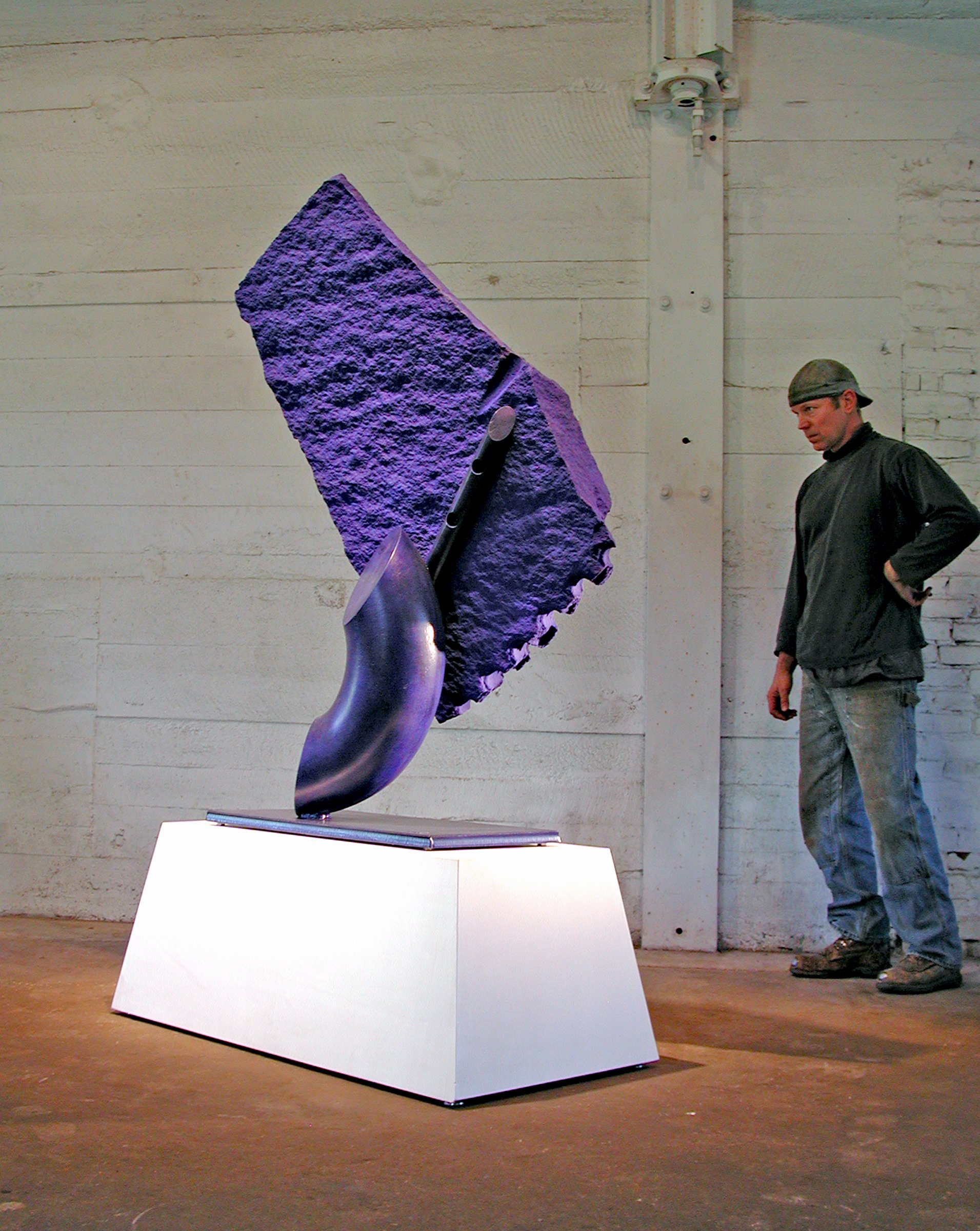
May 2004. Enamel on steel, granite. Dimensions: 60 × 40 × 22 in (152 × 102 × 56 cm).
A Cambré describes an arched movement of a dancer’s upper body, bending from the waist upwards; the movement can be done forwards, backwards or sideways. I use dance references in many of my works to create a conceptual framework to view and understand the heavy assemblage of earth-bound elements bringing life and meaning to its choreography.
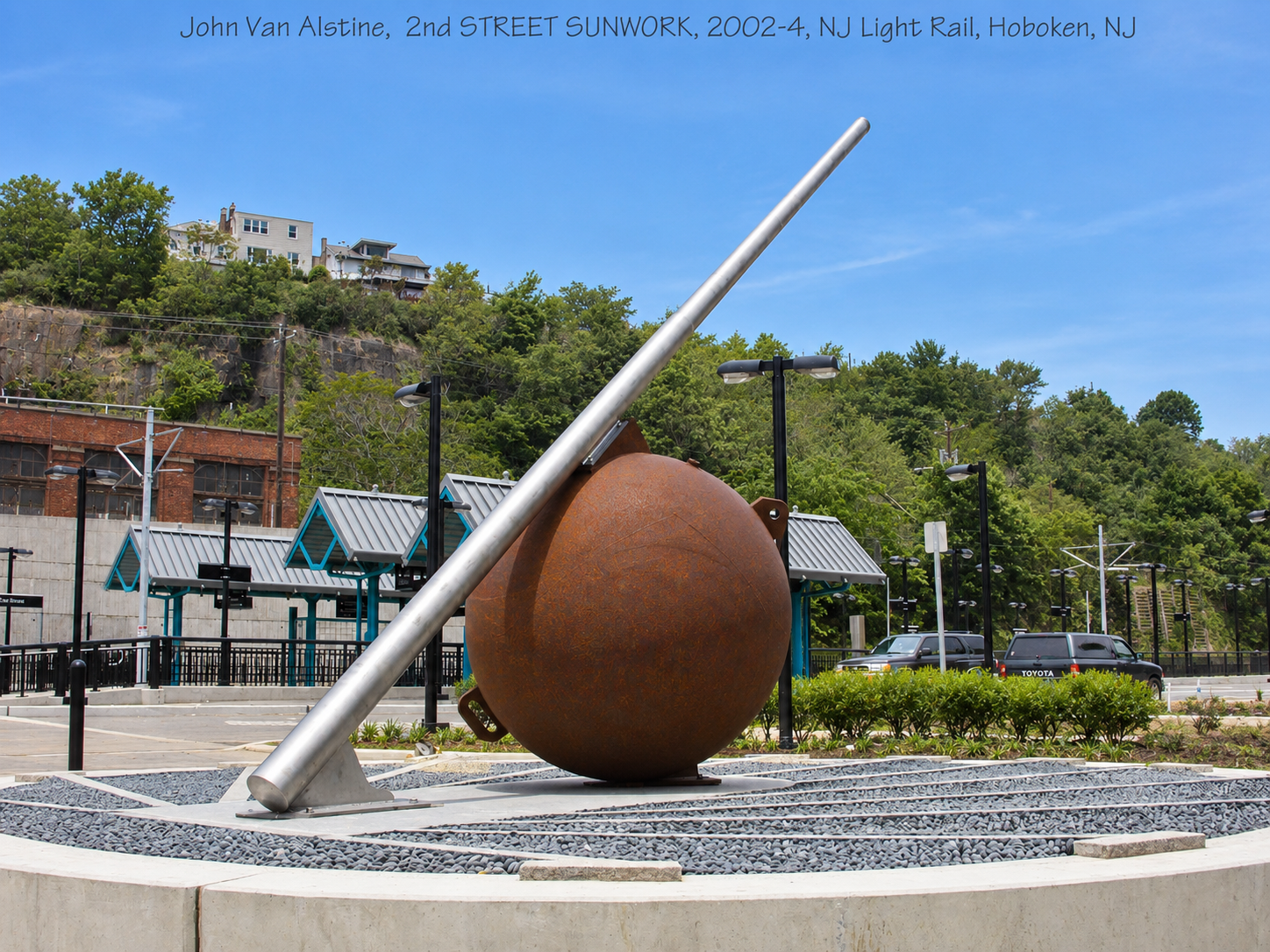
2nd Street Sunwork
2003–04
Steel, aluminum, stone, and sunlight
30 × 30 × 12 ft (9.1 × 9.1 × 3.7 m)
Commissioned by NJ TRANSIT, with funding provided by the Federal Transit Administration and the New Jersey State Council on the Arts.
2nd Street Sunwork (2003–04) was commissioned for the Hudson-Bergen Light Rail station in Hoboken, New Jersey. Unlike Van Alstine's earlier solar calendars, which employed monumental granite blocks, this work incorporates salvaged maritime artifacts—including a large ocean buoy and other industrial steel elements—that reflect Hoboken's rich waterfront and shipbuilding heritage. Functioning as both a traditional sundial and a solar calendar, the sculpture tells the hours of the day while, at solar noon, its shadow records the changing seasons.
By combining found industrial objects with the ancient concept of a solar calendar, 2nd Street Sunwork bridges the city's maritime history with the timeless rhythms of the natural world. The commission demonstrates Van Alstine's ability to adapt his artistic vocabulary to the unique character of a place, creating a work that is both deeply rooted in local history and universal in its celebration of time, light, and landscape.
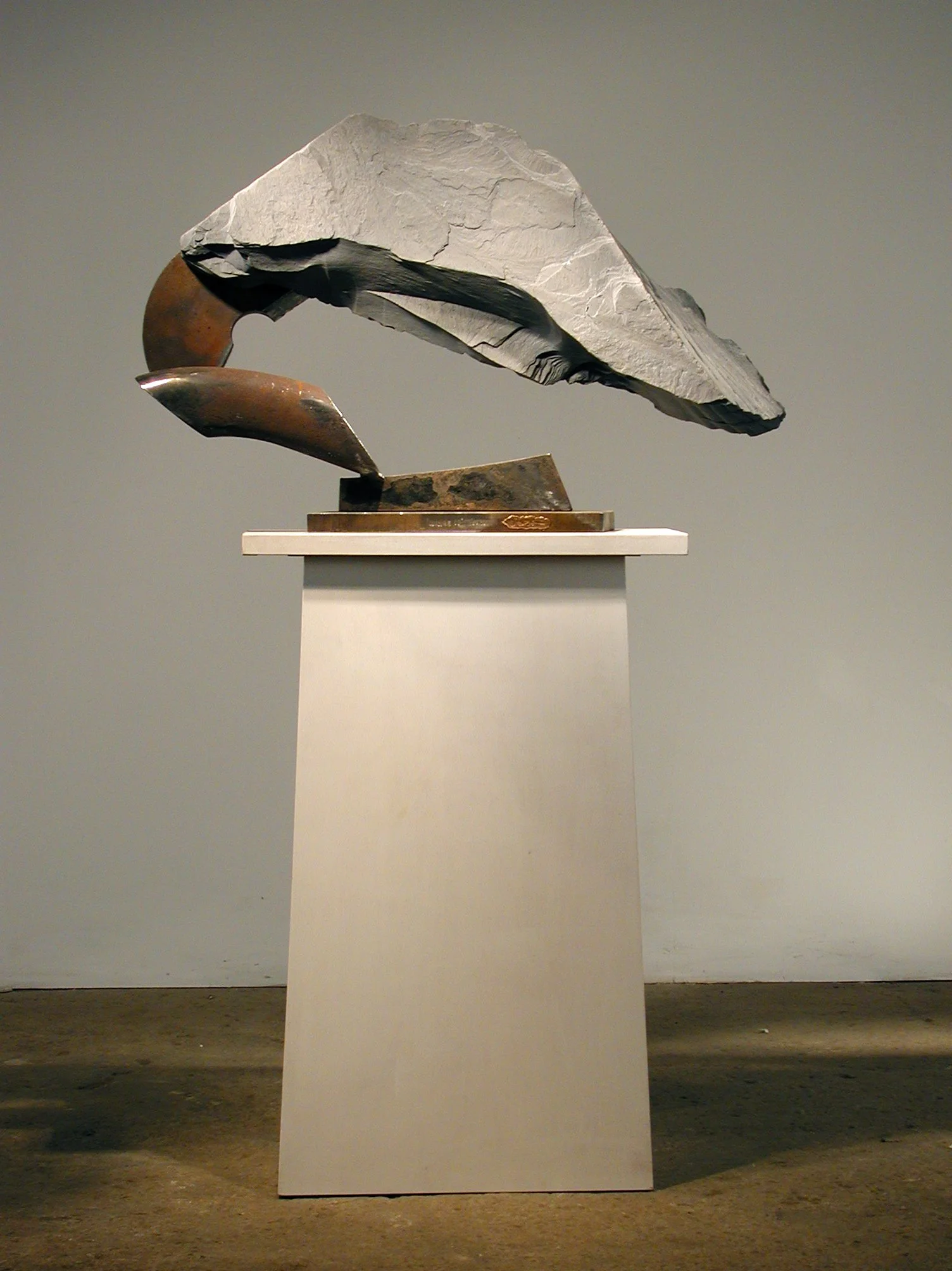
SOLD
December 2004. Slate, steel. Dimensions: 22 × 29 × 8 in (56 × 74 × 20 cm). Private Collection.
The Lunge series explores implied movement and gesture through an abstract sculptural language. The title Lunge suggests a sudden extension of the body—a reaching, thrusting, or shifting of weight that gives the sculpture a sense of physical momentum and directed energy.
While not figurative in a literal sense, the work draws on my interest in the expressiveness of the human figure. Its balance, tension, and spatial gesture suggest a body caught in motion, allowing the sculpture to convey a human presence through posture and movement rather than recognizable form.
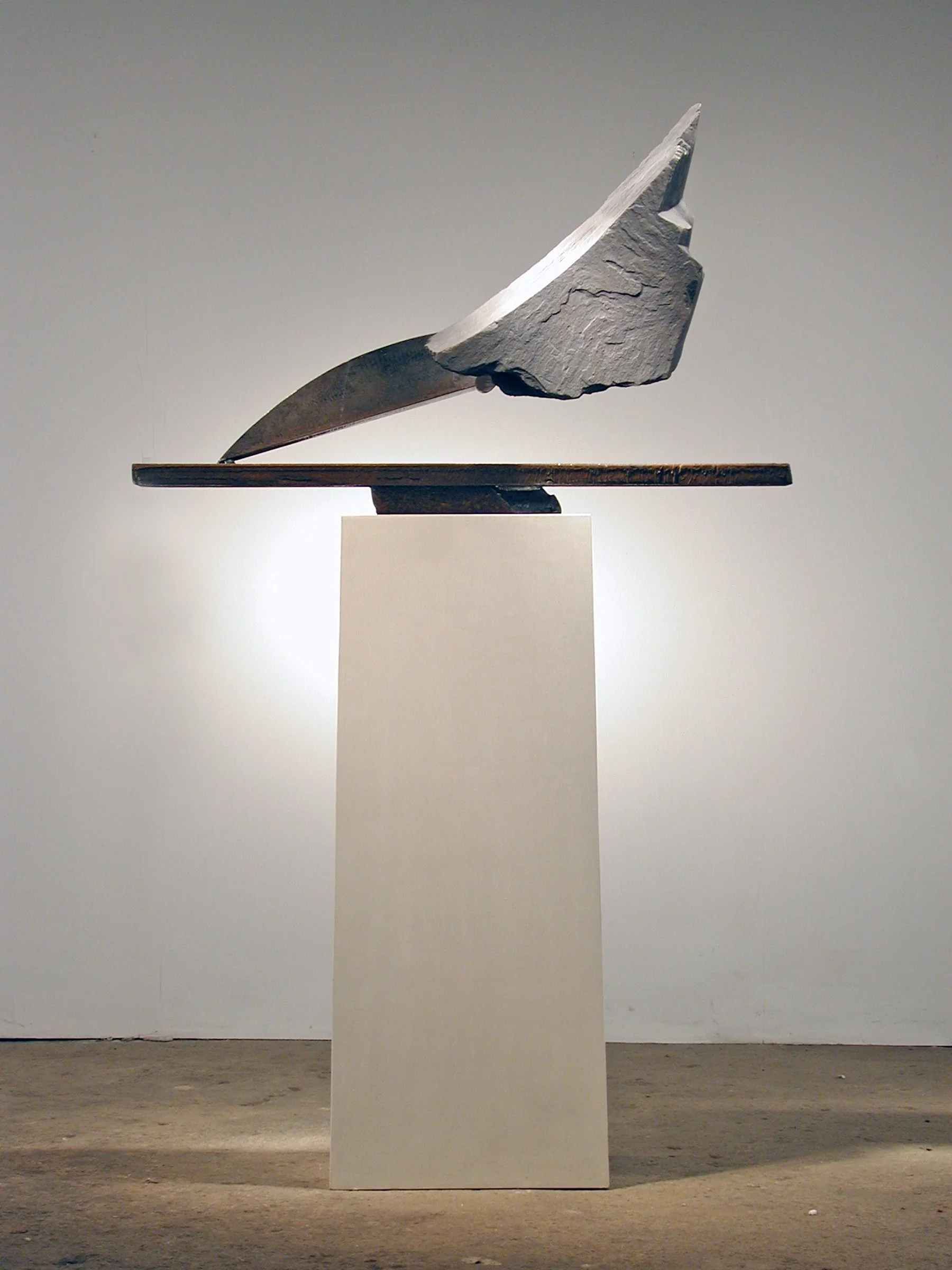
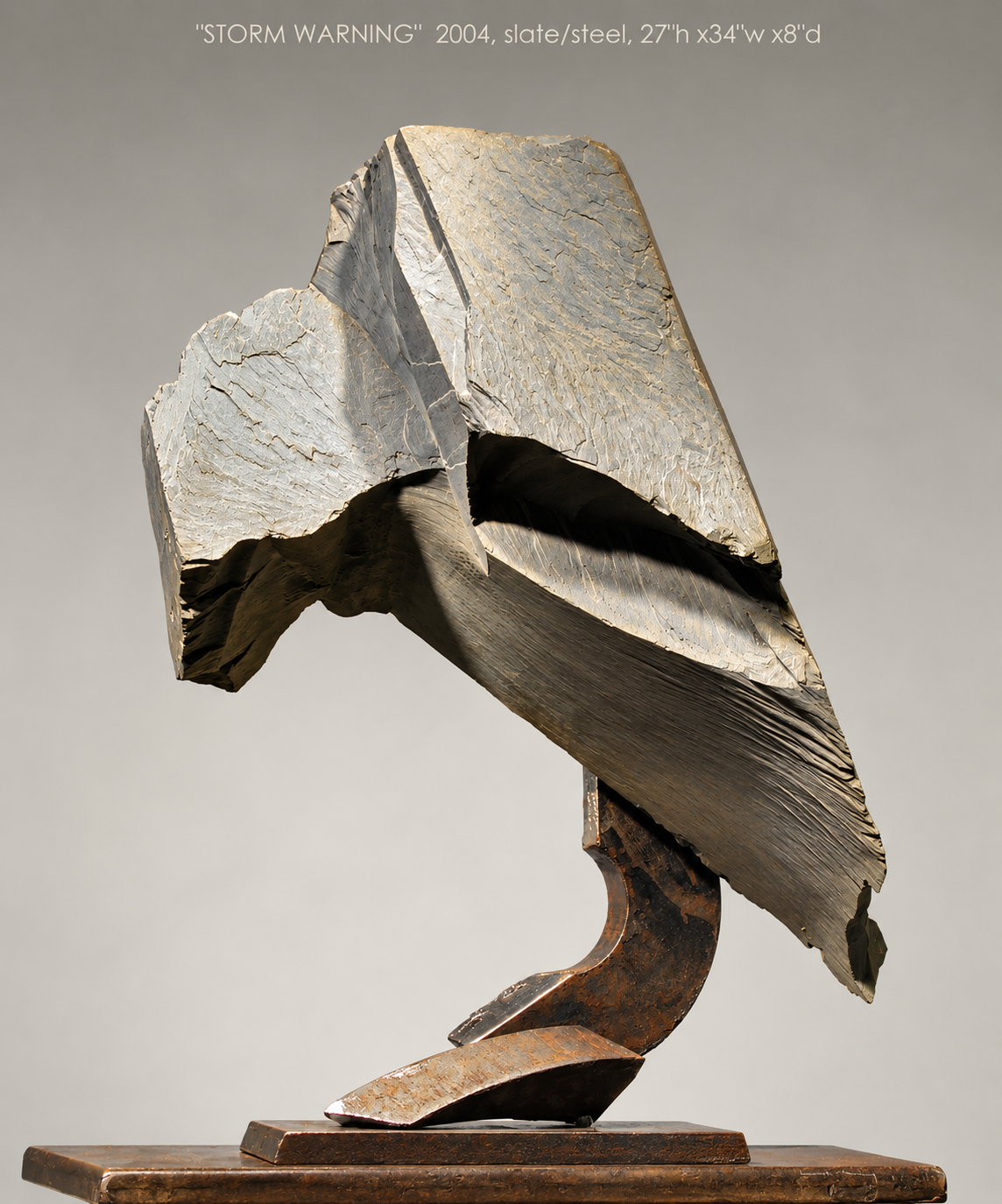
December 2004. Slate, steel. Dimensions: 27 × 23 × 7 in (69 × 58 × 18 cm).
Private collection — Santa Fe
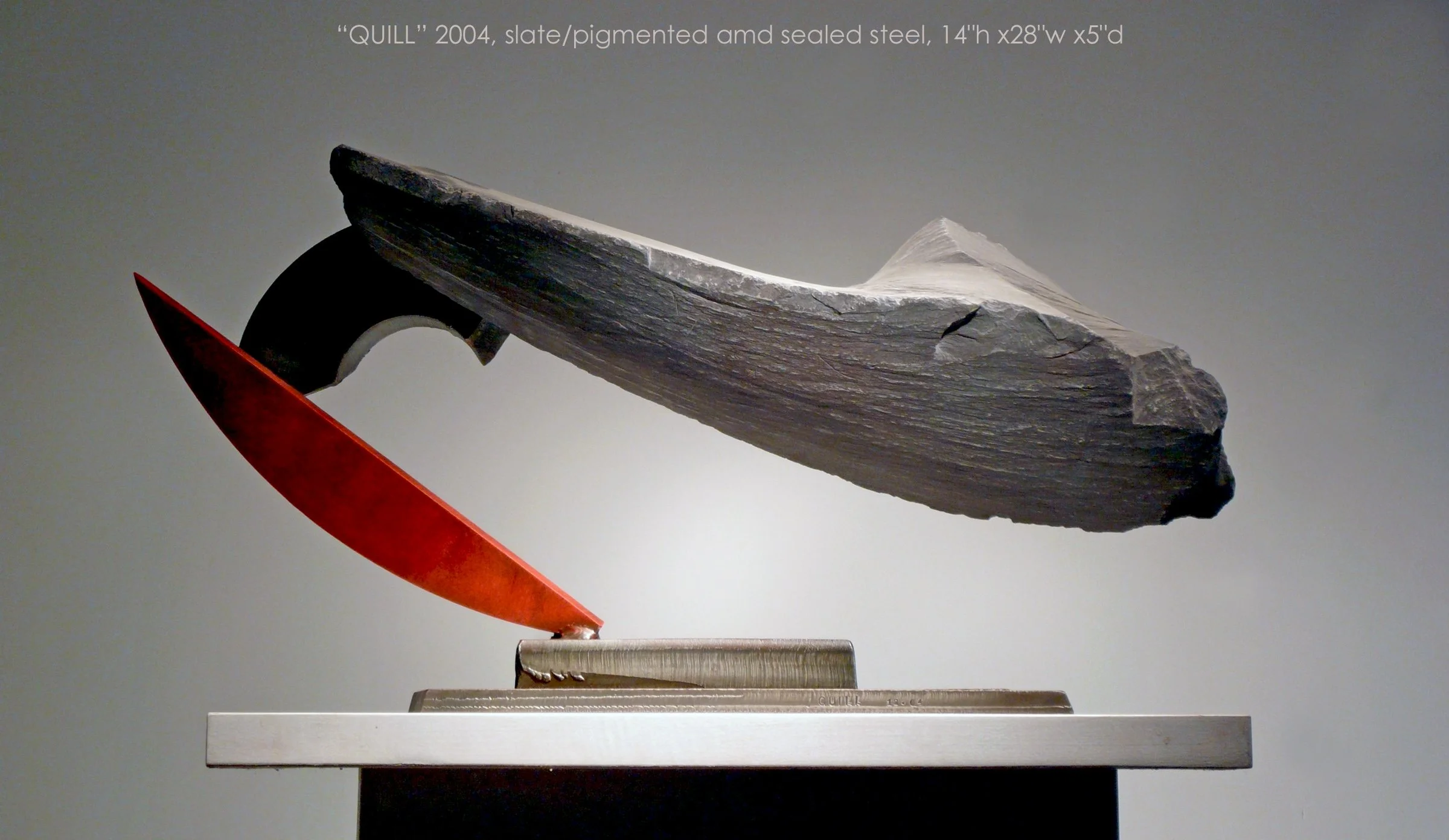
December 2004. Slate, steel. Dimensions: 14 × 28 × 5 in (36 × 71 × 13 cm).
Private Collection.
2003
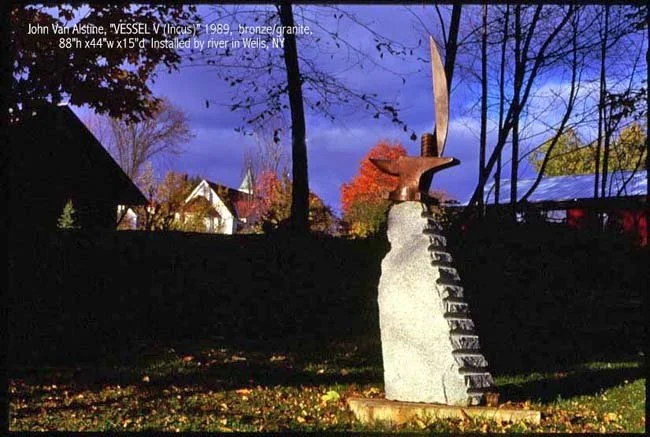
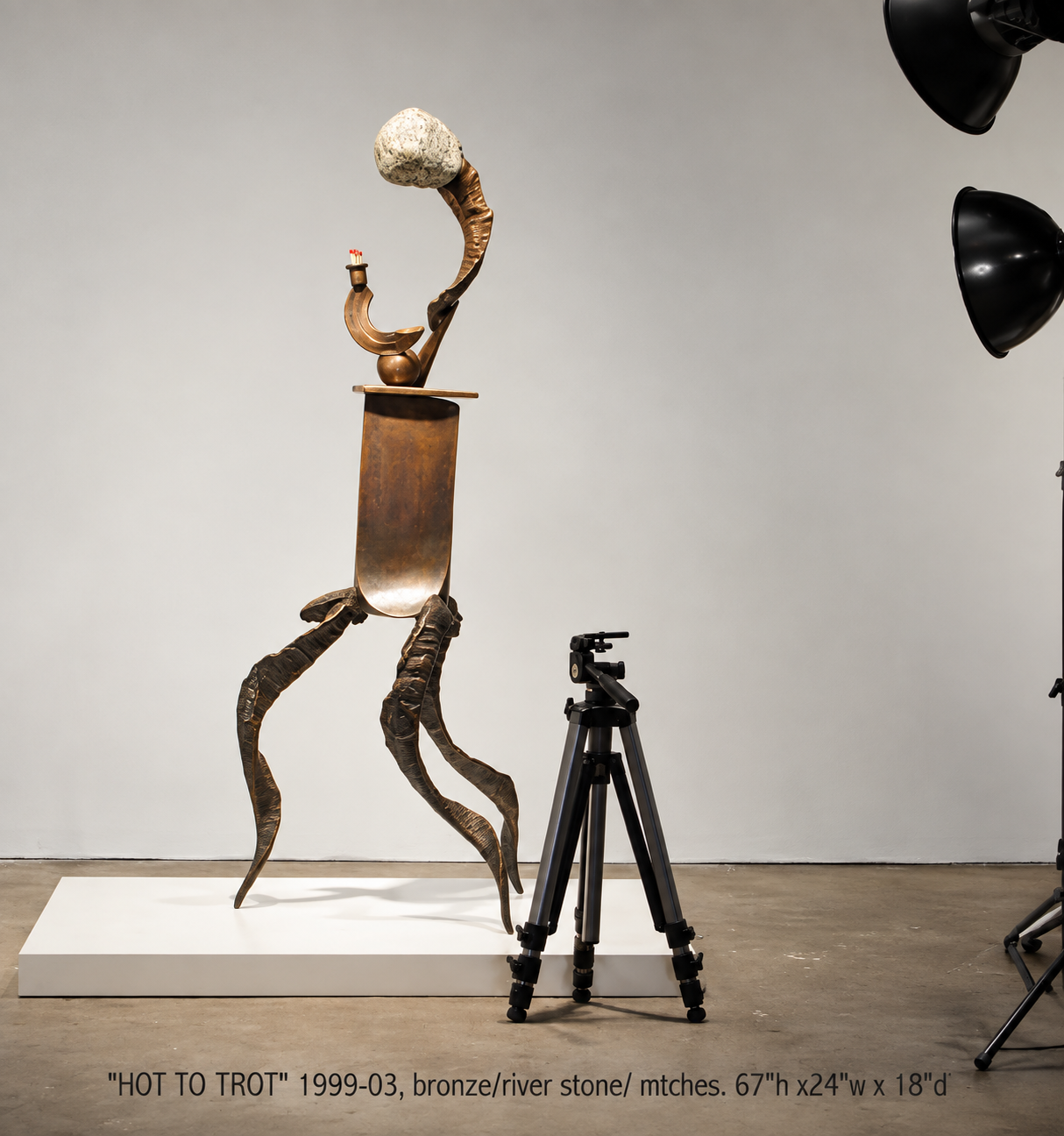
February 2003. Bronze, river stone. Dimensions: 68 × 36 × 24 in (173 × 91 × 61 cm).
Cannabilized
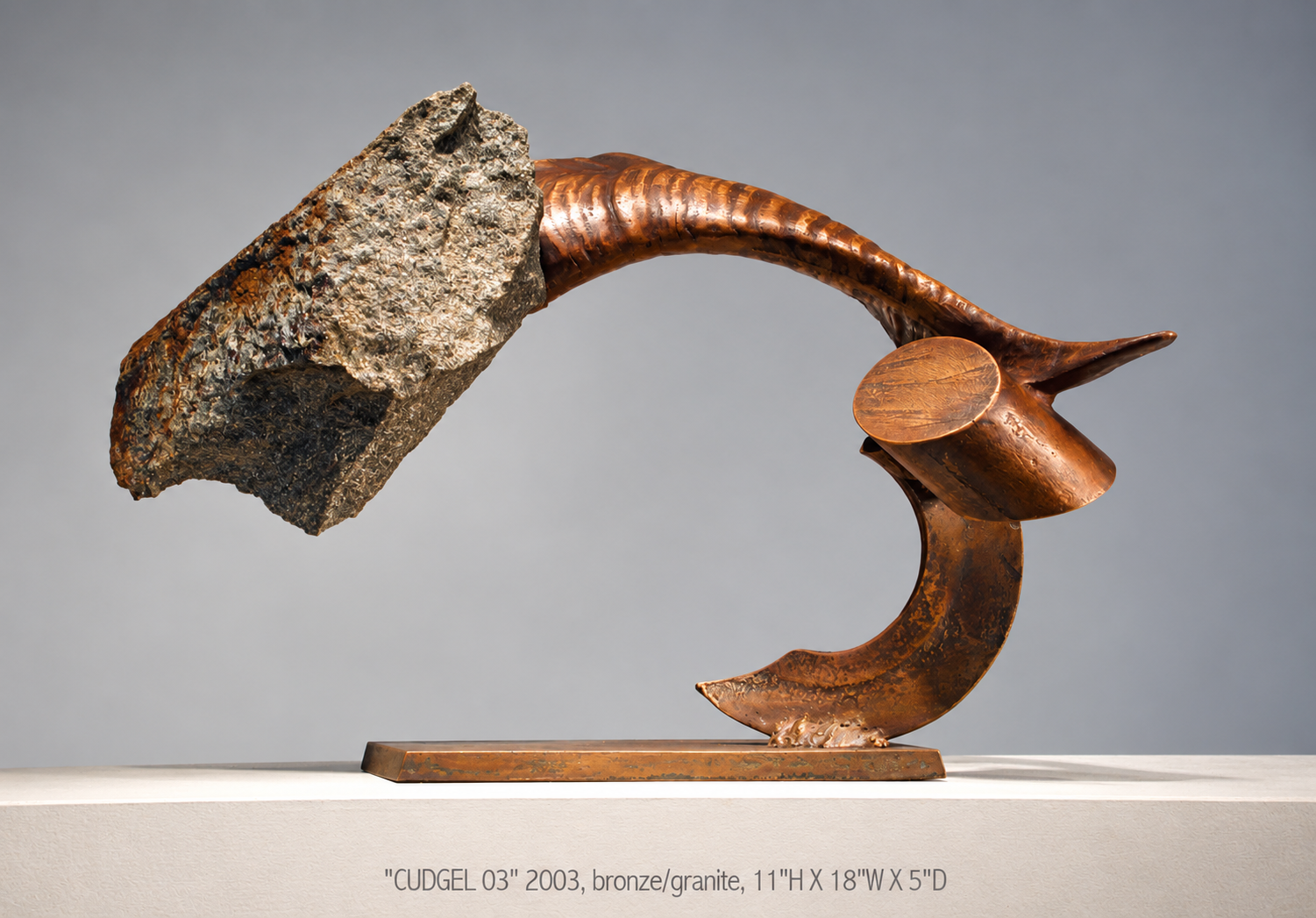
February 2003. Bronze, granite. Dimensions: 11 × 18 × 5 in (28 × 46 × 13 cm). Private collection.
Cudgel ’03 continues my long-running Cudgel Series and my interest in tools and implements as expressive sculptural forms—extensions of the hand associated with physical action, strength, and force. The sweeping bronze horn functions as a handle, while the rough granite becomes the head of a primitive tool or club.
The cast horn continues my interest in the natural, spiraling geometry of organic forms and the associations they bring to the work. The bronze was reused from Cudgel Arch (2000) after its original rounded stone broke; replacing it with this sharper green granite shifts the sculpture from the club-like character of the earlier work toward something more suggestive of a blade.
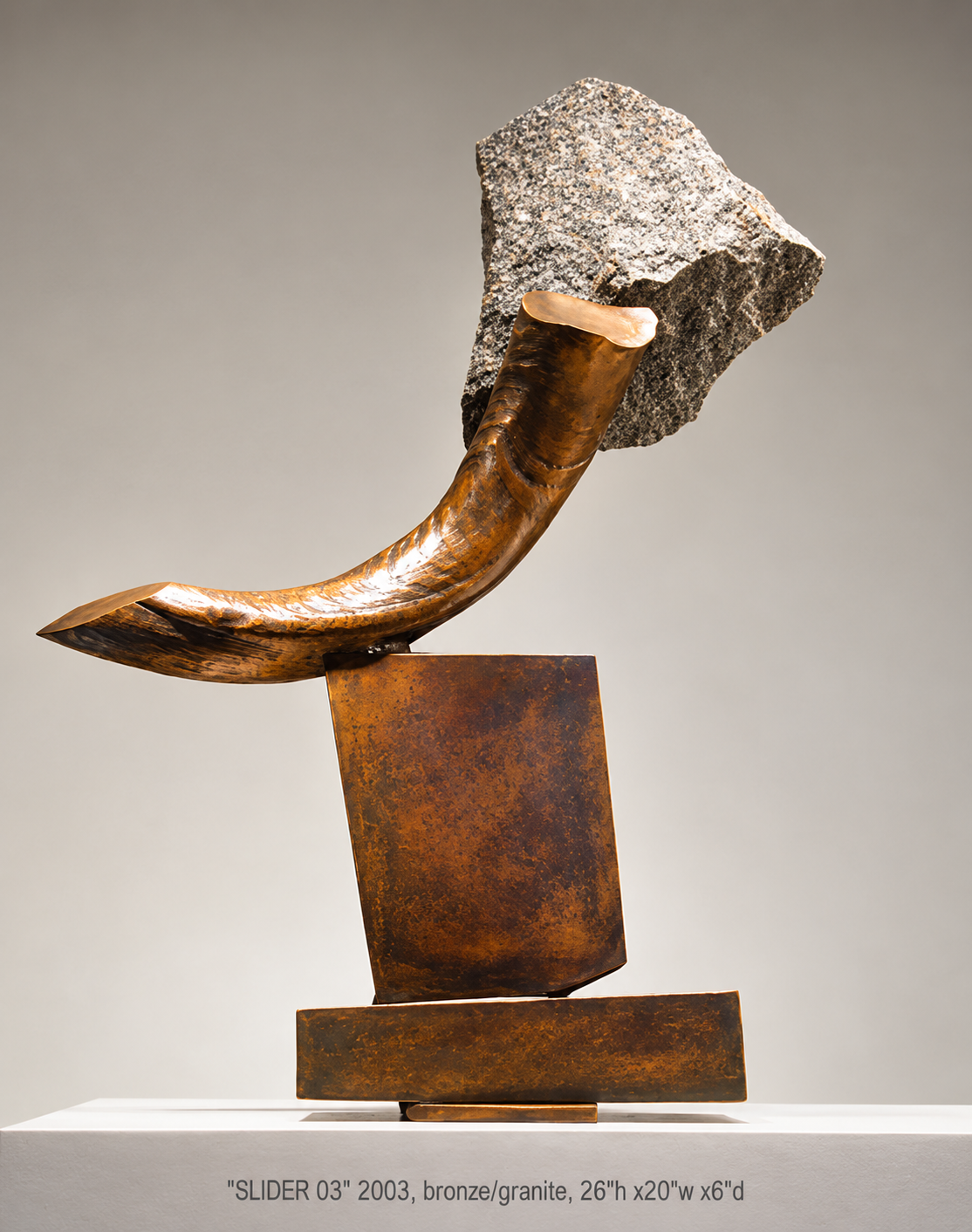
March 2003. Bronze, black granite. Dimensions: 26 × 21 × 6 in (66 × 53 × 15 cm).
Private collection
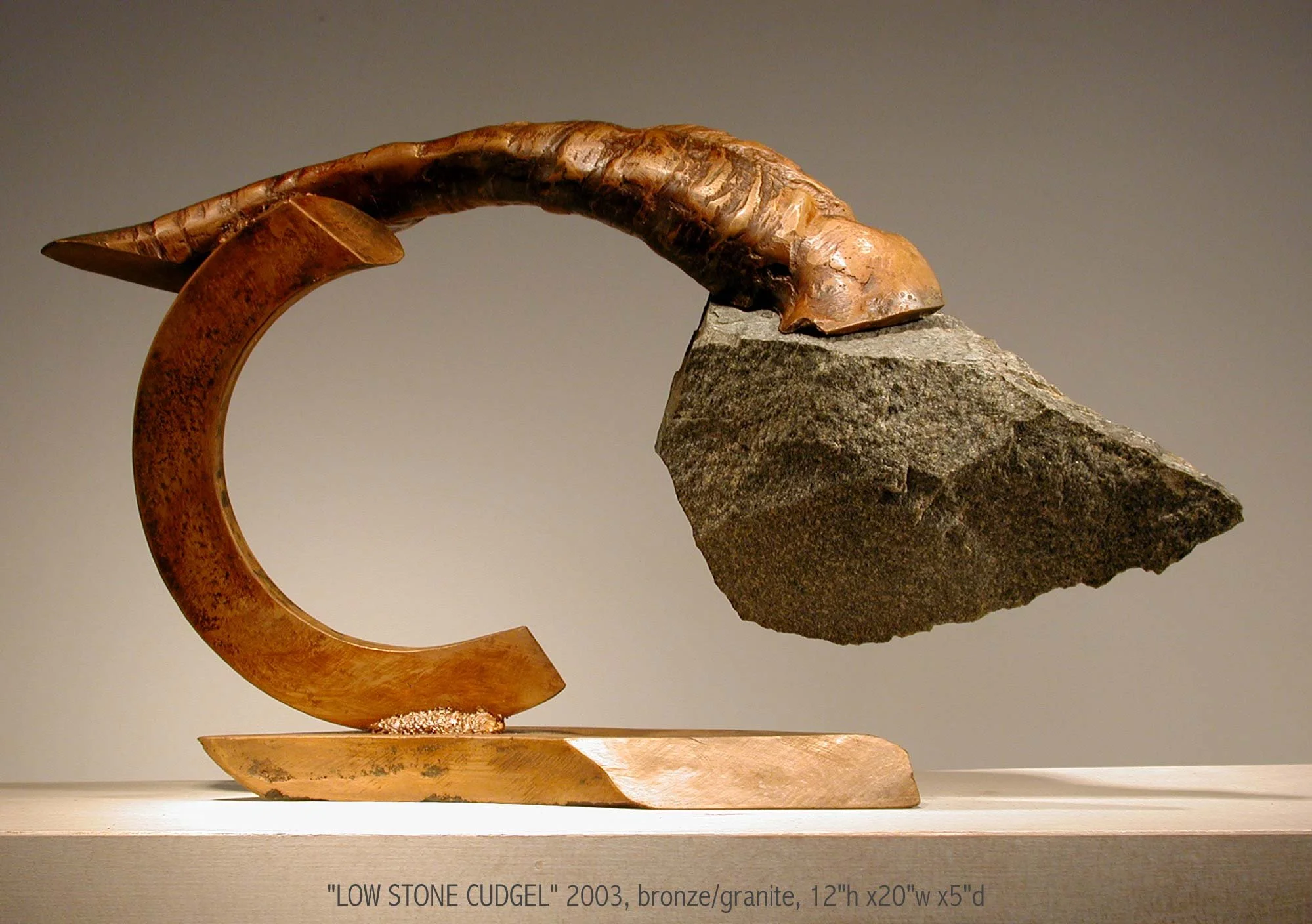
January 2003. Bronze, granite. Dimensions: 12 × 21 × 4 in (30 × 53 × 10 cm). Private Collection - NJ
Low Stone Cudgel, 2003
Low Stone Cudgel is part of my ongoing Cudgel Series and continues my interest in tools and implements as expressive sculptural forms—extensions of the hand associated with physical action, strength, and force. Here the sweeping bronze form suggests a handle, while the granite becomes the head or blade of a primitive hand tool or cudgel.
The cast bronze horn extends the handle and reinforces the primitive, organic character of the imagined tool. Its natural curvature also reflects my interest in horns as an expansion of the arc forms that have long appeared in my work. The title refers directly to the relatively low position of the stone, suspended horizontally beside the bronze handle.
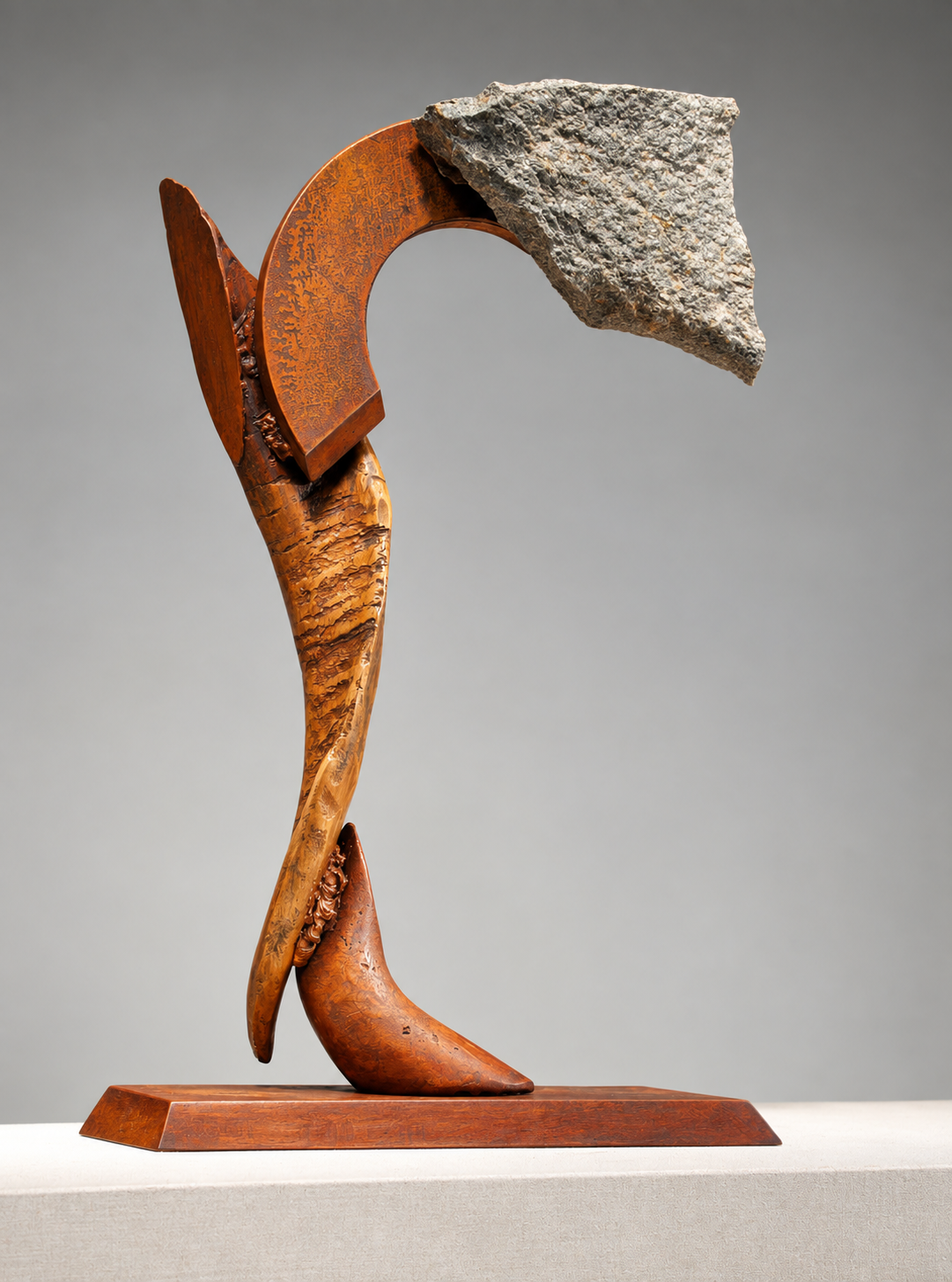
January 2003. Bronze, granite. Dimensions: 15.5 × 9 × 4 in (39 × 23 × 10 cm). Private Collection California.
A Cambré describes an arched movement of a dancer’s upper body, bending from the waist upwards; the movement can be done forwards, backwards or sideways. I use dance references in many of my works to create a conceptual framework to view and understand the heavy assemblage of earth-bound elements bringing life and meaning to its choreography.
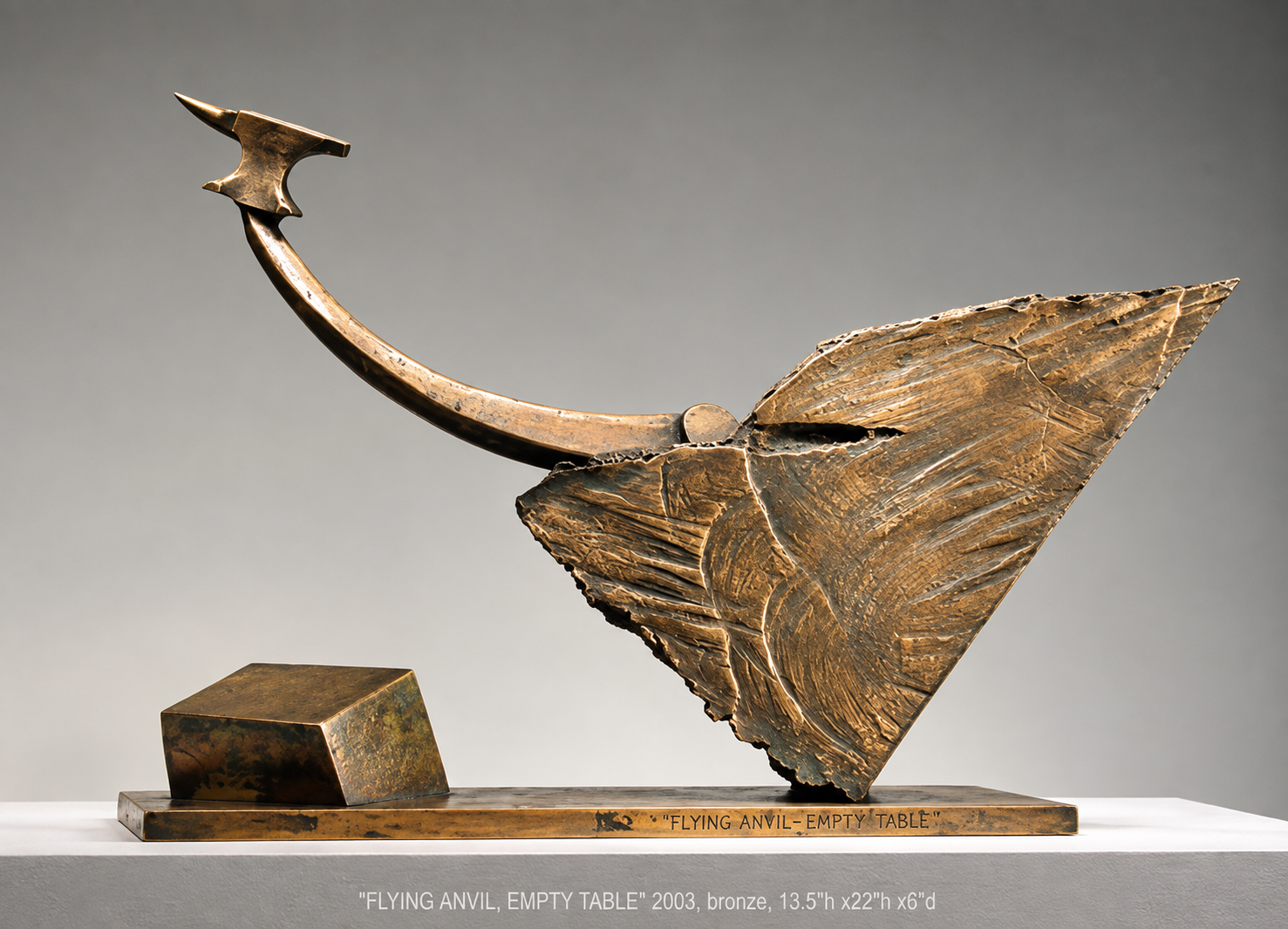
January 2003. Bronze. Dimensions: 13.5 × 22 × 6 in (34 × 56 × 15 cm).
Private collection - Pittsburgh, PA
Flying Anvil, Empty Table grew out of a turbulent period in my life when two parts of my world seemed to be moving in opposite directions. My studio practice and career were “flying high,” represented by the anvil rising at the end of the sweeping arc, while circumstances at home—the “empty table”—were far less settled. The work transforms that personal tension into a precarious balance between ascent and absence, optimism and uncertainty. As in much of my sculpture, the anvil functions both as a familiar tool of making and as metaphor, allowing a specific autobiographical moment to open onto the more universal experience of trying to hold conflicting parts of one’s life in balance.
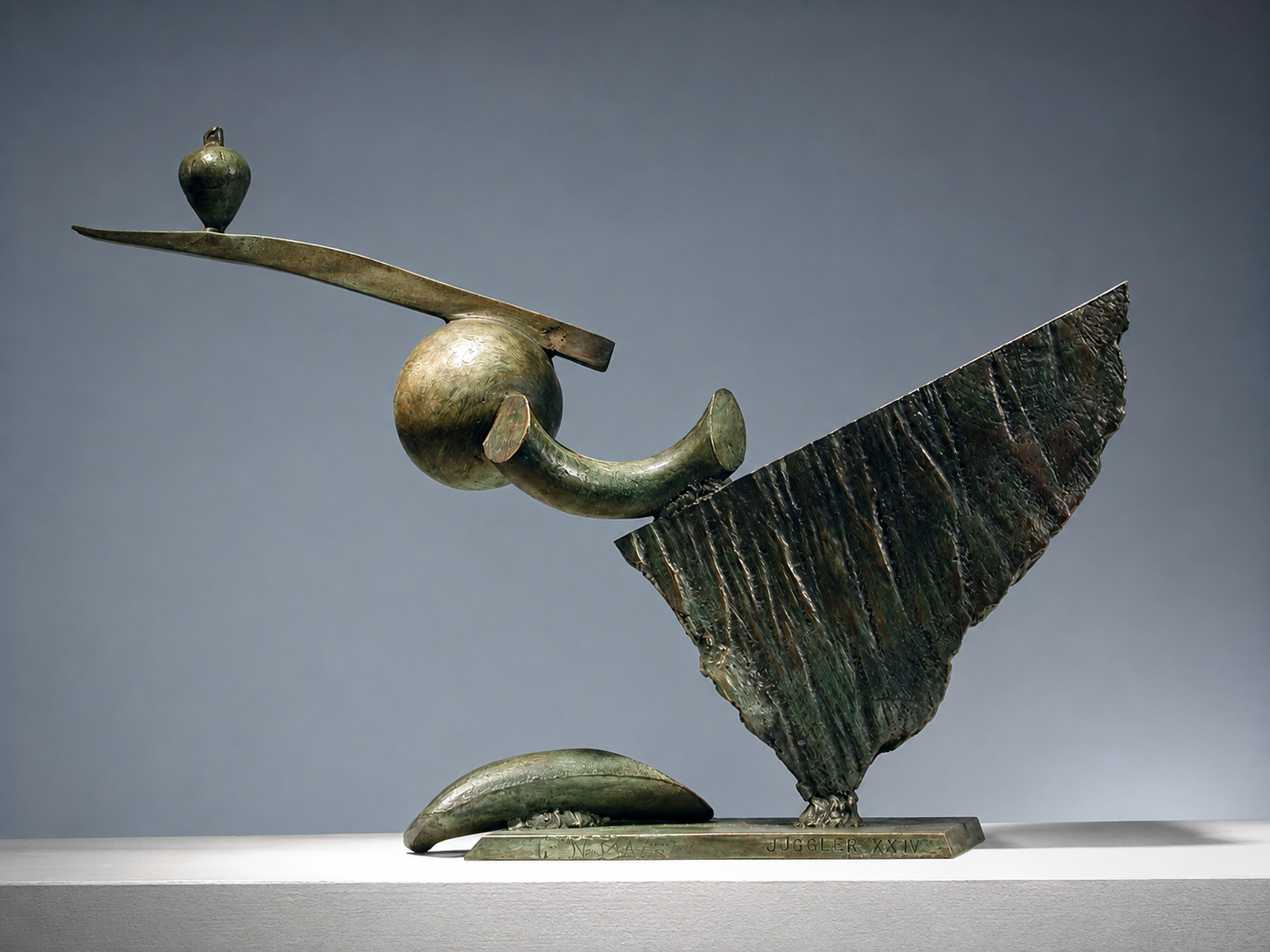
January 2003. Bronze. Dimensions: 13 × 19 × 5 in (33 × 48 × 13 cm). Private collection - New York
Many of Van Alstine’s works take inspiration from the movement of the human body. This work can be seen as a kind of self-portrait, suggesting his studio process—literally juggling and repositioning the individual elements of a sculpture until they achieve a moment of perfect balance, then freezing that moment in space through welding. More universally, juggling becomes a metaphor for the way we all balance the competing demands of family, work, play, and responsibility.
The anvil, which appears in a number of the artist’s works, represents both the ultimate heavy object to “juggle” and the act of assembly itself—the forging together of object, material, and ideas that is central to Van Alstine’s work.
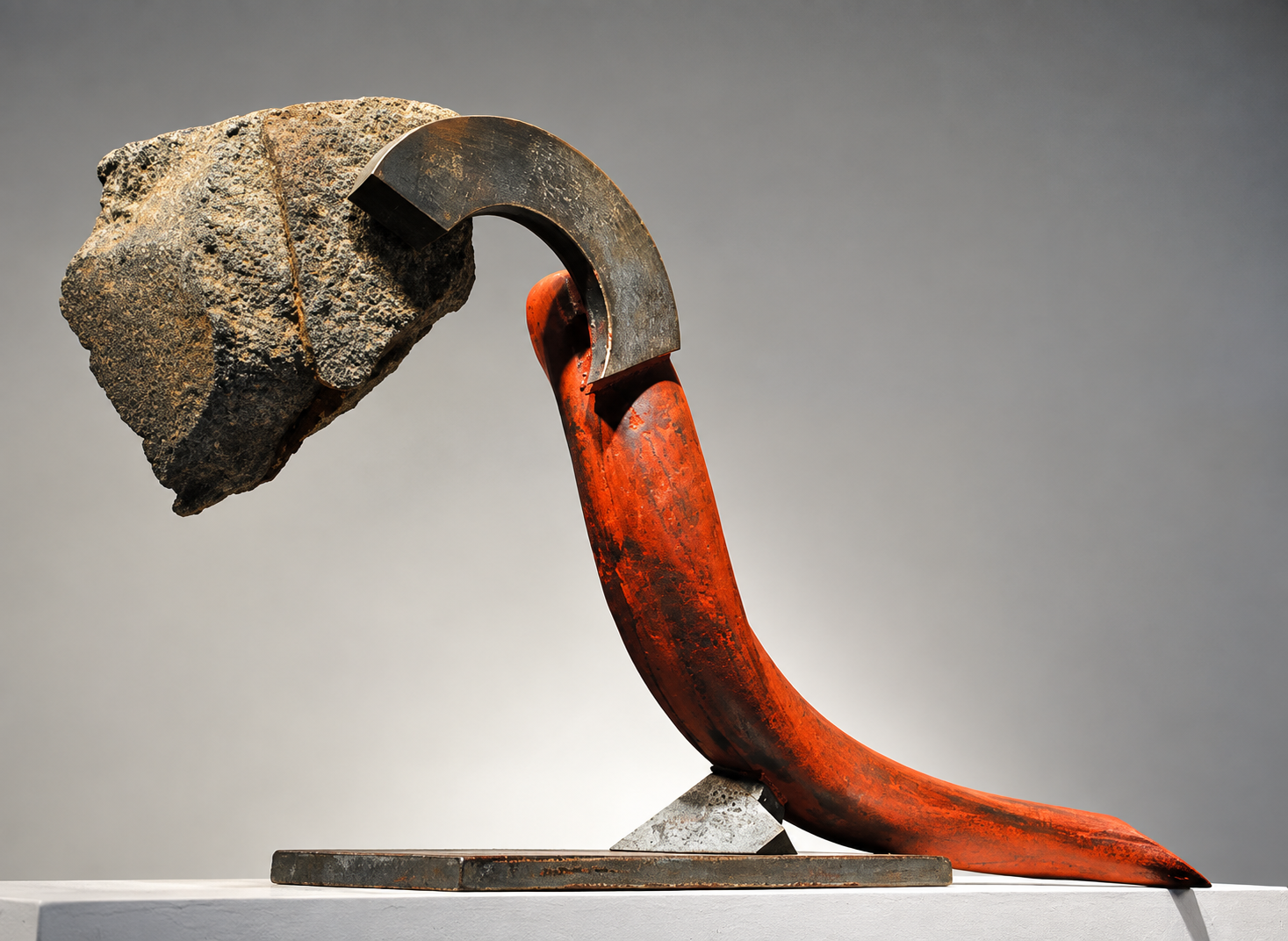
January 2003. Bronze, granite. Dimensions: 13 × 20 × 5 in (33 × 51 × 13 cm).
Cannibalized 2020
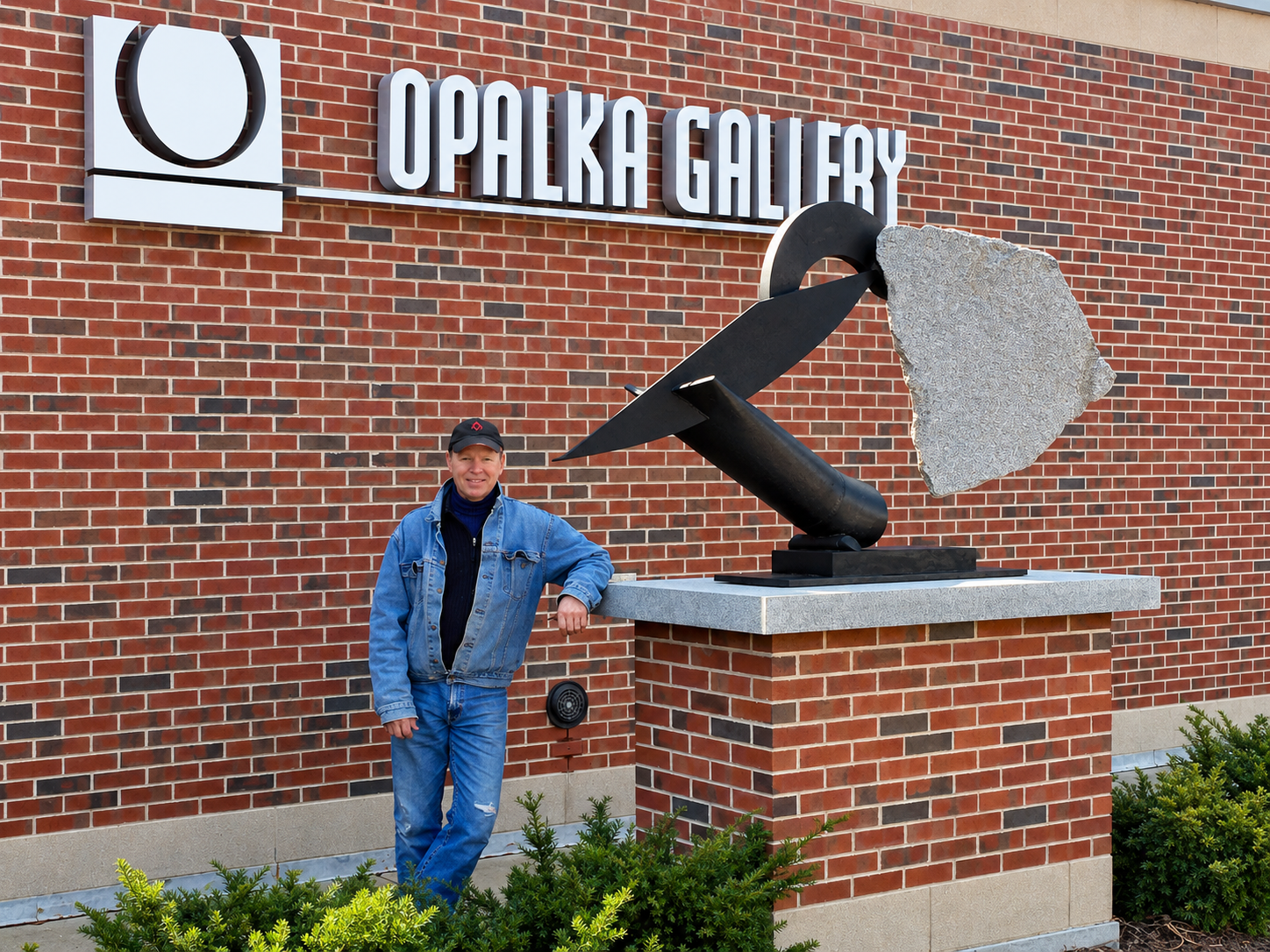
January 2003. Granite, powder coated steel. Dimensions: 48 × 90 × 16 in (122 × 229 × 41 cm).
Collection: Opalka Gallery Sage College Albany - in honor of founding director Jim Richard Wilson.
Steel collected from Dayton, OH scrapyards while there for Kettering Stone Symposium 2002
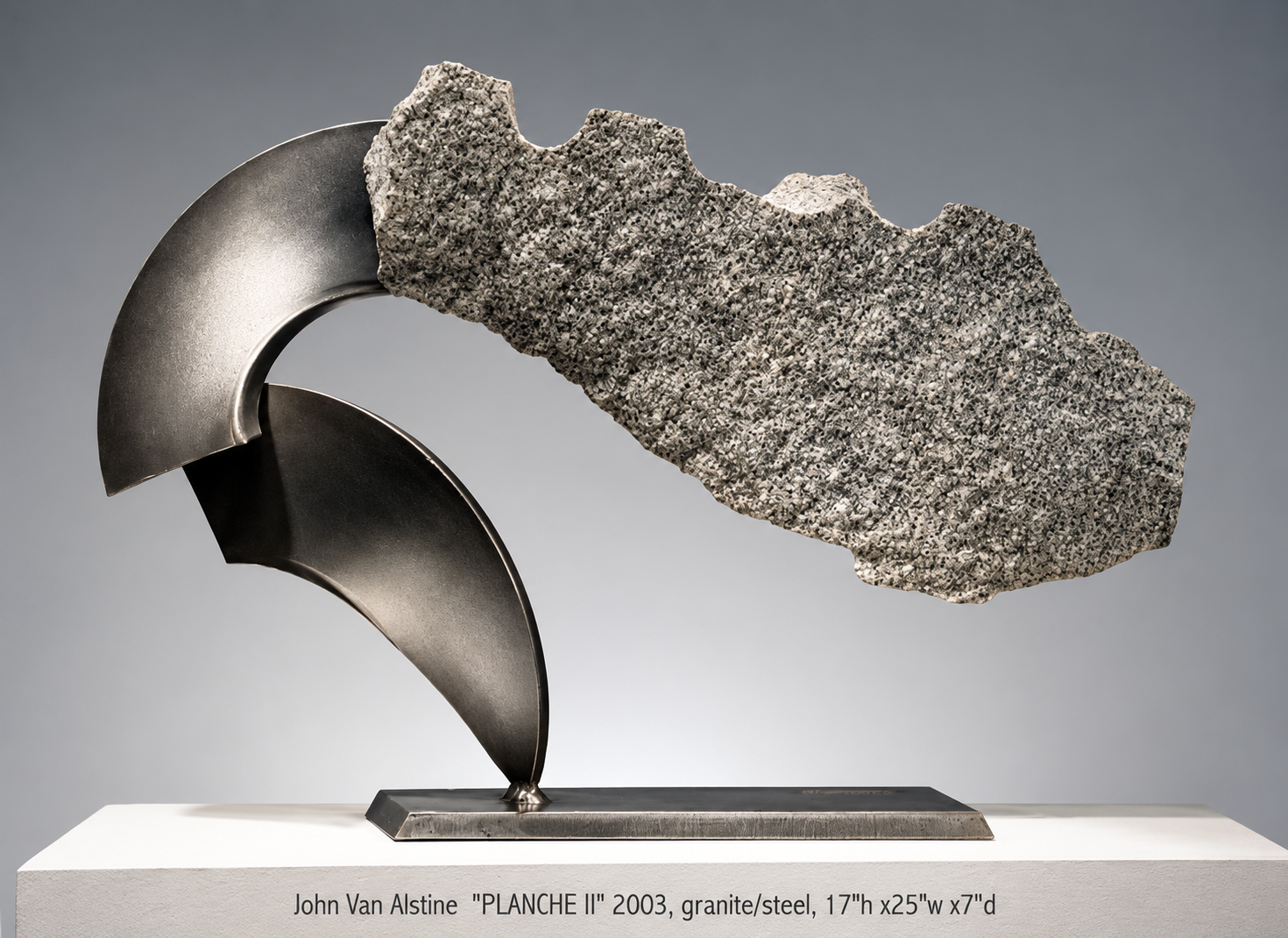
January 2003. Granite, steel. Dimensions: 17 × 25 × 7 in (43 × 64 × 18 cm).
Private collection - California
The title referenced a horizonal handstand. Please tell me more how this gymnastic maneuver is a bridge or metaphor for John Van Alstine sculpture in terms of how he addresses the figure and particularly movement such ad dance, gymnastics fencing, etc.
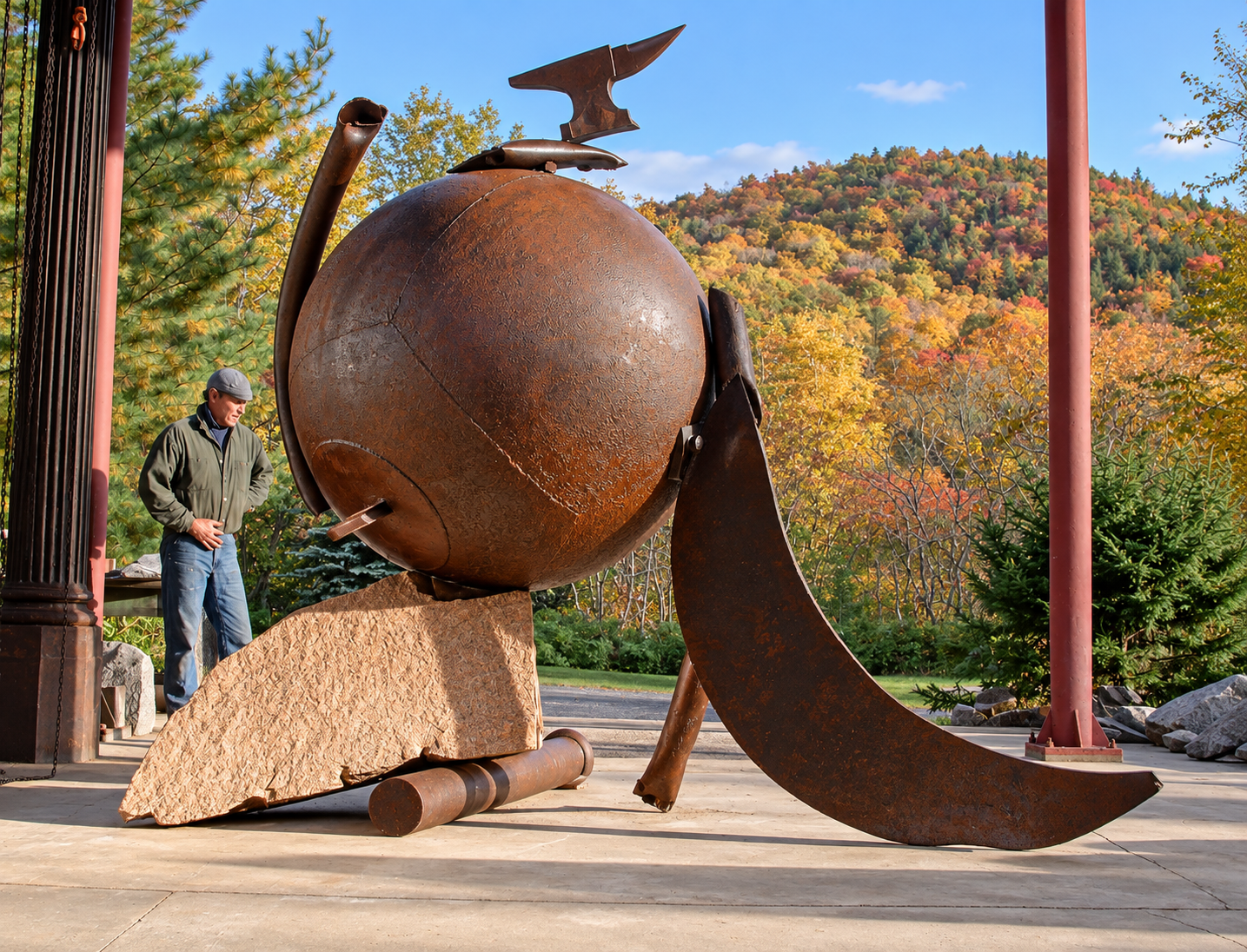
January 2003. Stained granite, steel. Dimensions: 9 × 11 × 6 in (23 × 28 × 15 cm).
Private collection Greenwich, Conn.
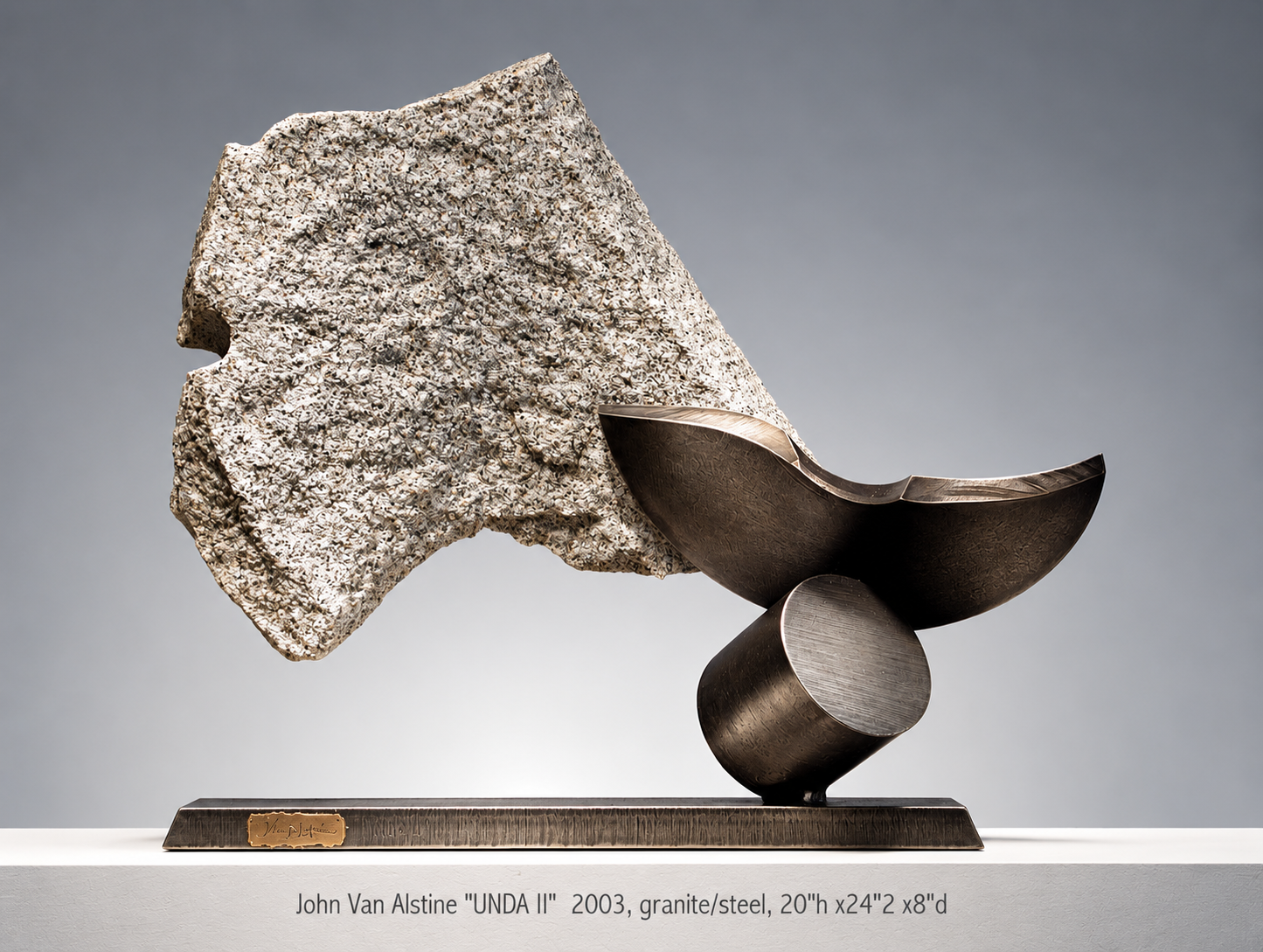
January 2003. Granite, steel. Dimensions: 20 × 24 × 8 in (51 × 61 × 20 cm).
Private collection - Austin, TX
Unda is the Latin word for wave.
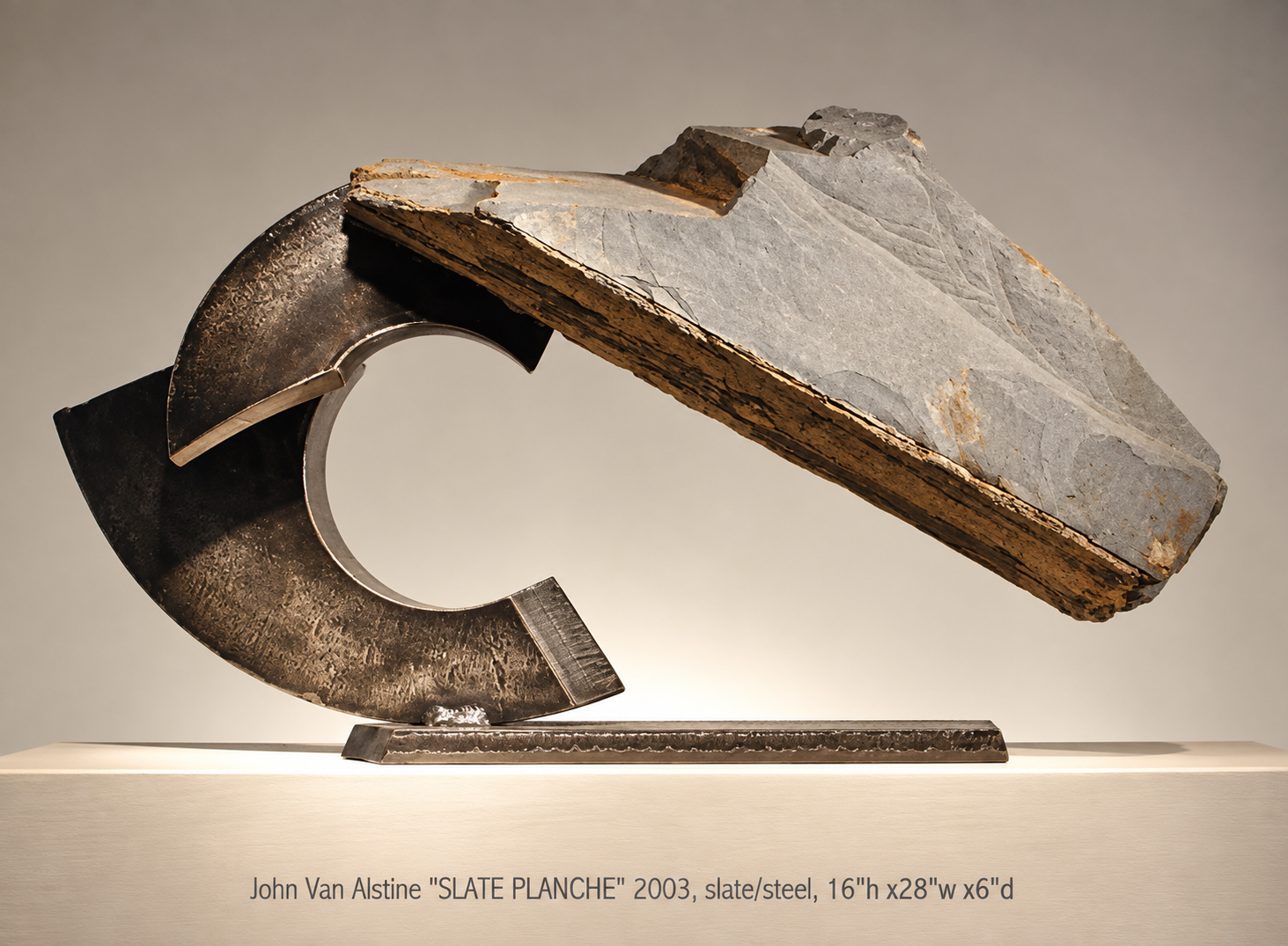
January 2003. Slate, steel. Dimensions: 16 × 28 × 6 in (41 × 71 × 15 cm).
Private collection
planche is a gymnastic term - a horizonal handstand
Slate Planche, 2003
Slate Planche reflects my longstanding interest in the movement of the human figure, often explored through dance, gymnastics, and fencing. The title refers to the gymnastic planche, a horizontal handstand in which the body is suspended through strength, balance, and control.
Here the broad slate form extends outward as if suspended in space, while the curving steel supports its considerable weight. The work transforms heavy, earthbound materials into a gesture of arrested motion, using gravity, balance, and tension to suggest the poised energy of the human body.
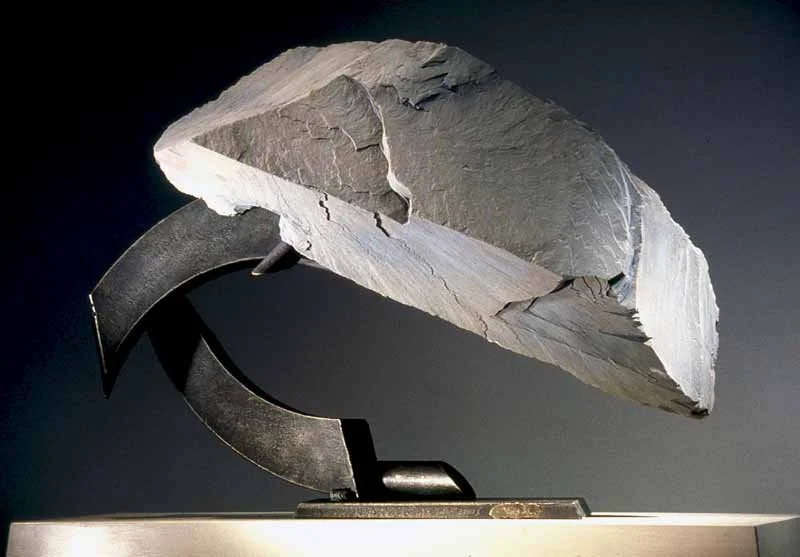
SOLD
January 2003. Slate, steel. Dimensions: 22 × 29 × 8 in (56 × 74 × 20 cm). Private Collection, Washington, DC.
The Lunge series explores implied movement and gesture through an abstract sculptural language. The title Lunge suggests a sudden extension of the body—a reaching, thrusting, or shifting of weight that gives the sculpture a sense of physical momentum and directed energy.
While not figurative in a literal sense, the work draws on my interest in the expressiveness of the human figure. Its balance, tension, and spatial gesture suggest a body caught in motion, allowing the sculpture to convey a human presence through posture and movement rather than recognizable form.
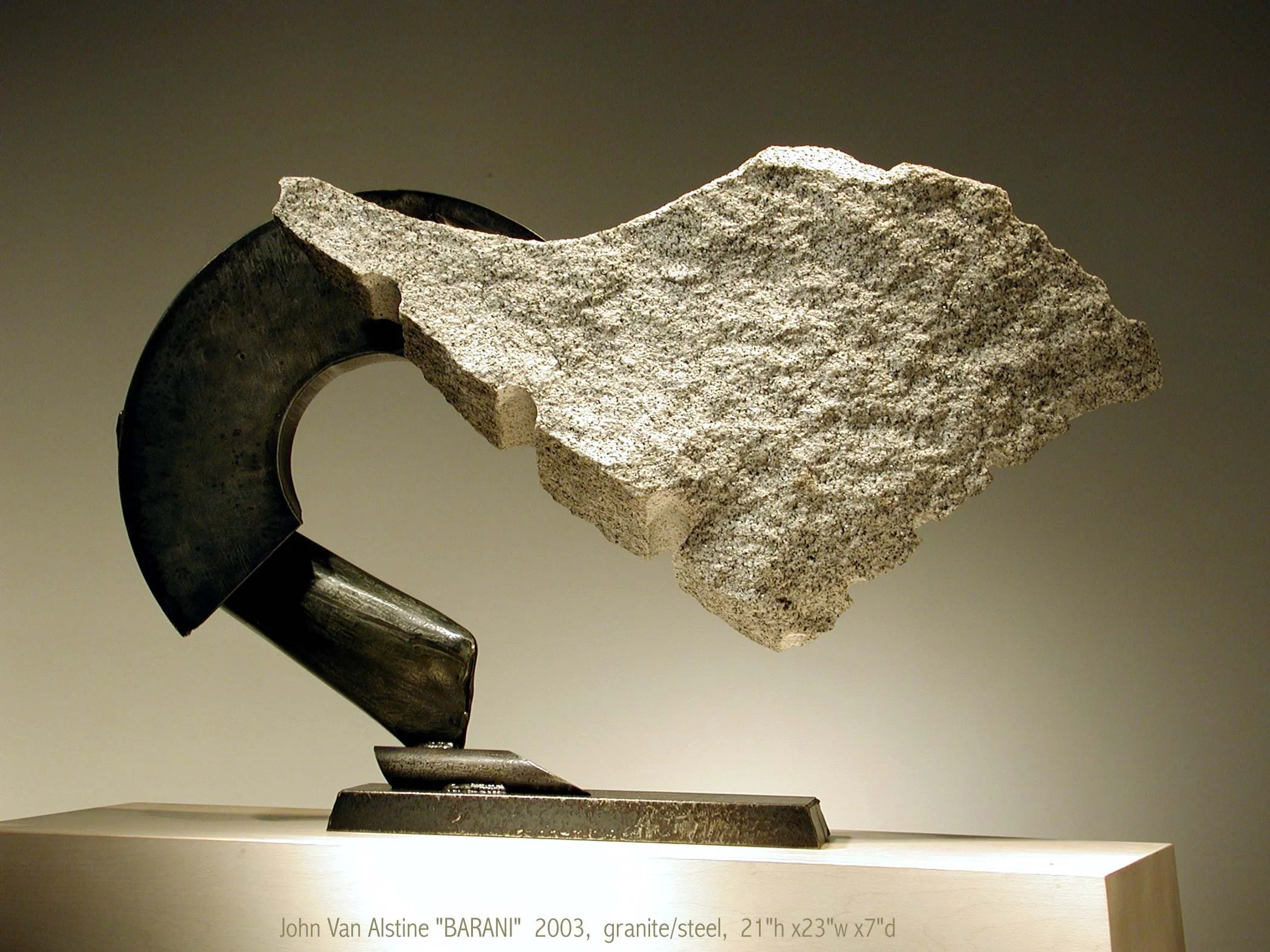
July 2003. Granite, steel. Dimensions: 21 × 33 × 7 in (53 × 84 × 18 cm). Private Collection.
The title comes from the gymnastic term barani, a half-twisting front somersault. The arrangement of stone and steel suggests a body caught mid-rotation, suspended between ascent and descent. As in much of Van Alstine’s work, the sculpture captures a moment of arrested motion—balancing weight, tension, and gravity while suggesting energy poised in mid-action.
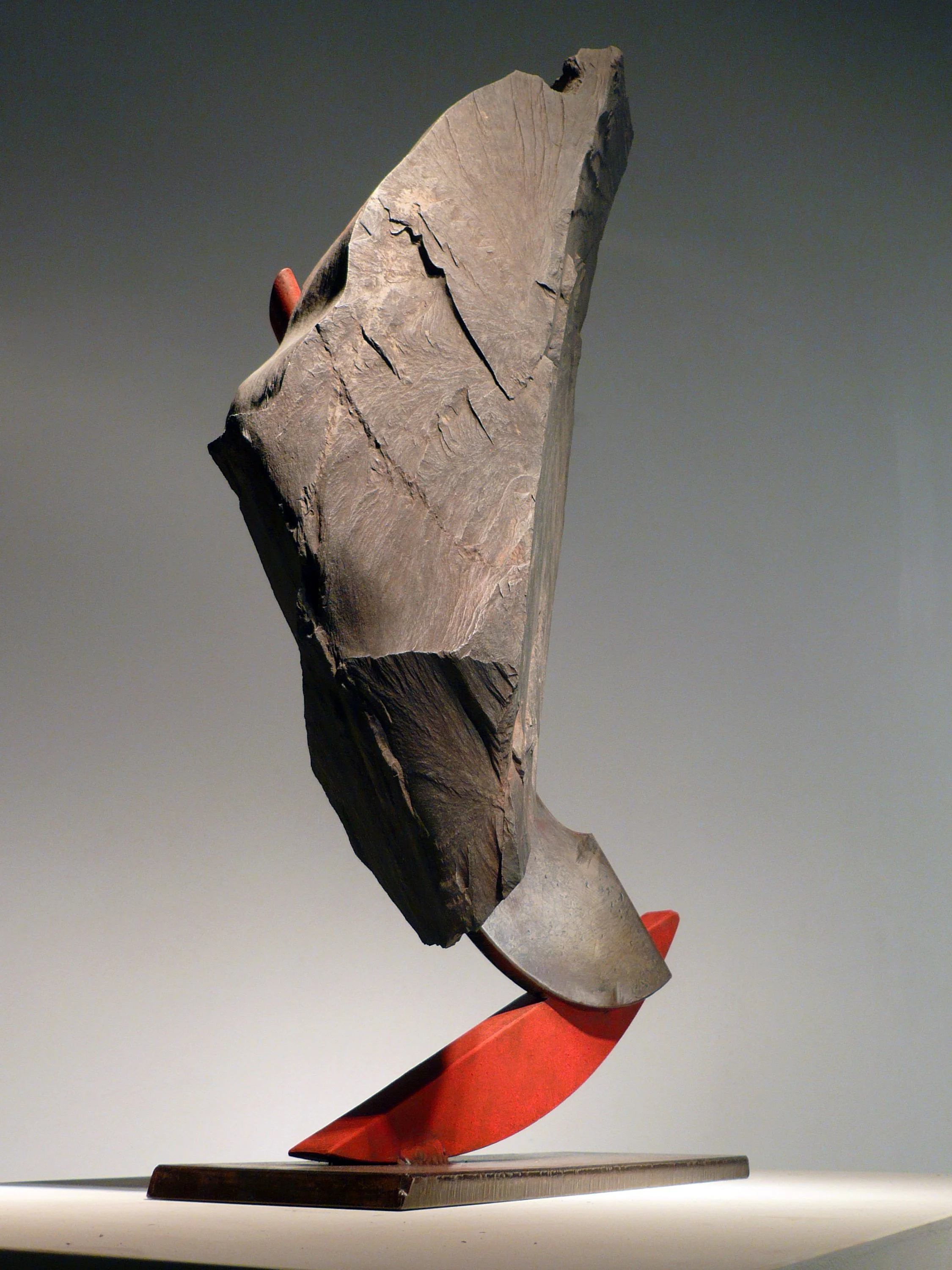
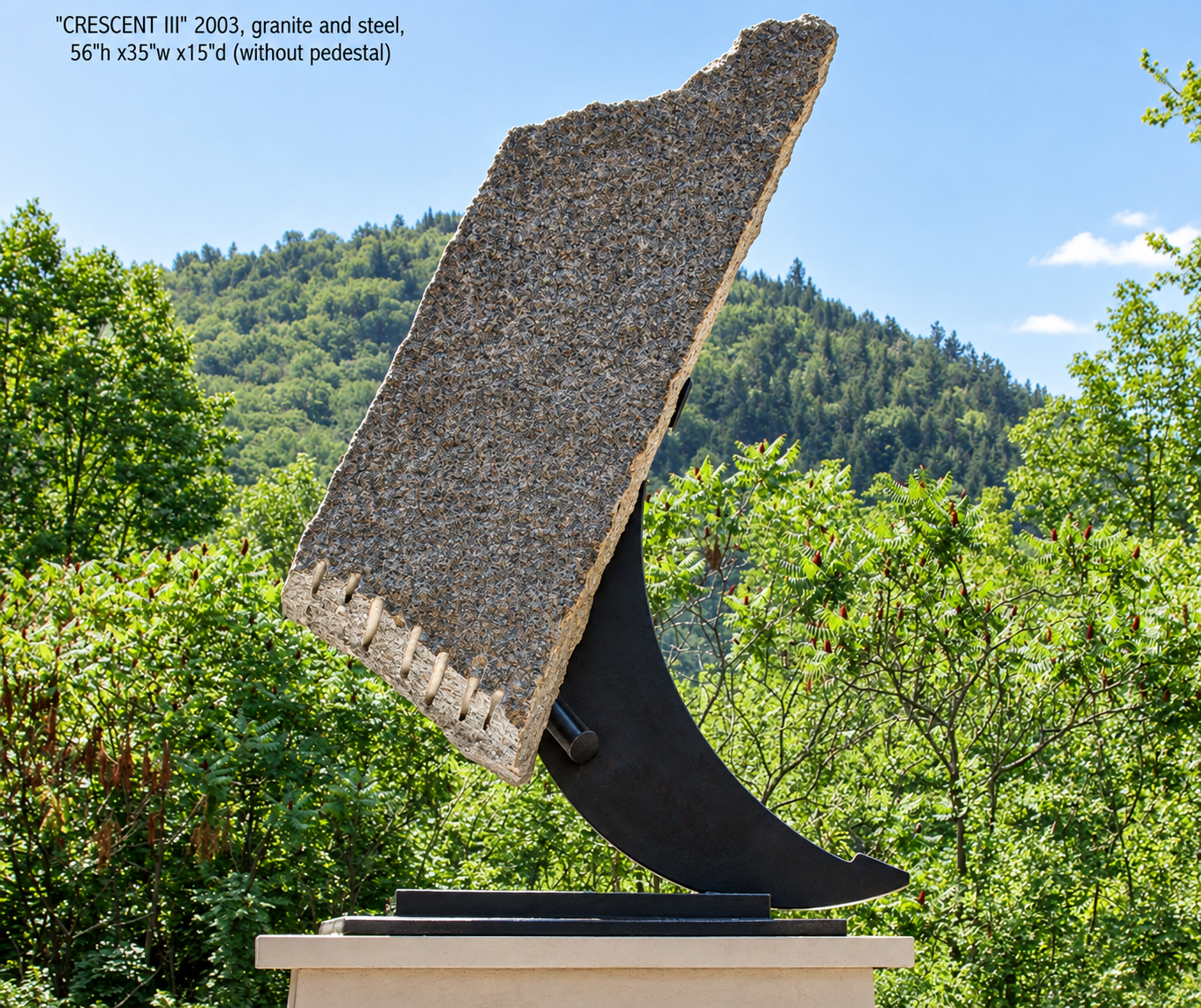
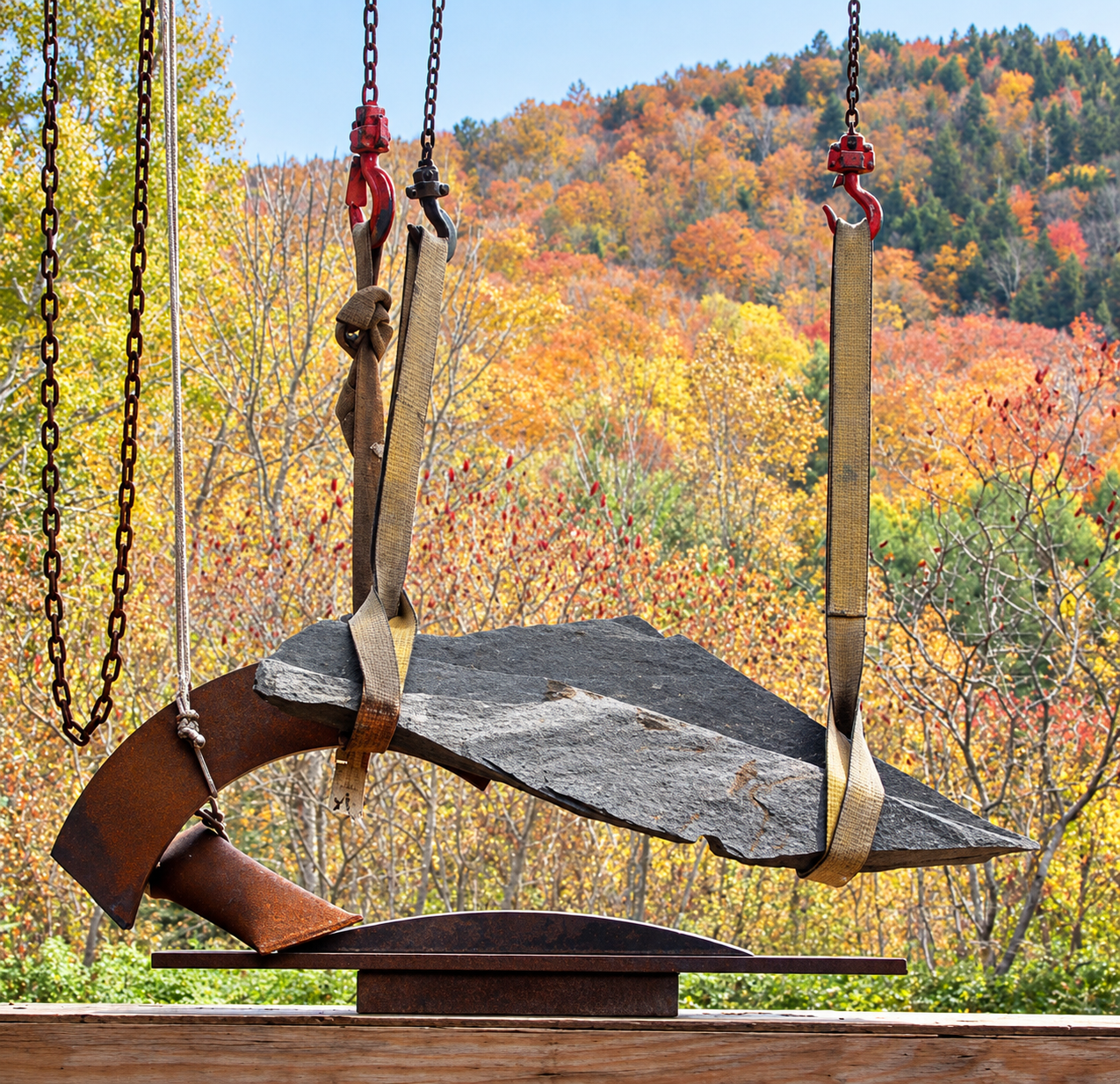
October 2003. Slate, steel. Dimensions: 20 × 50 × 12 in (51 × 127 × 30 cm).
Collection: SUNY Amherst, Buffalo, New York, President's office
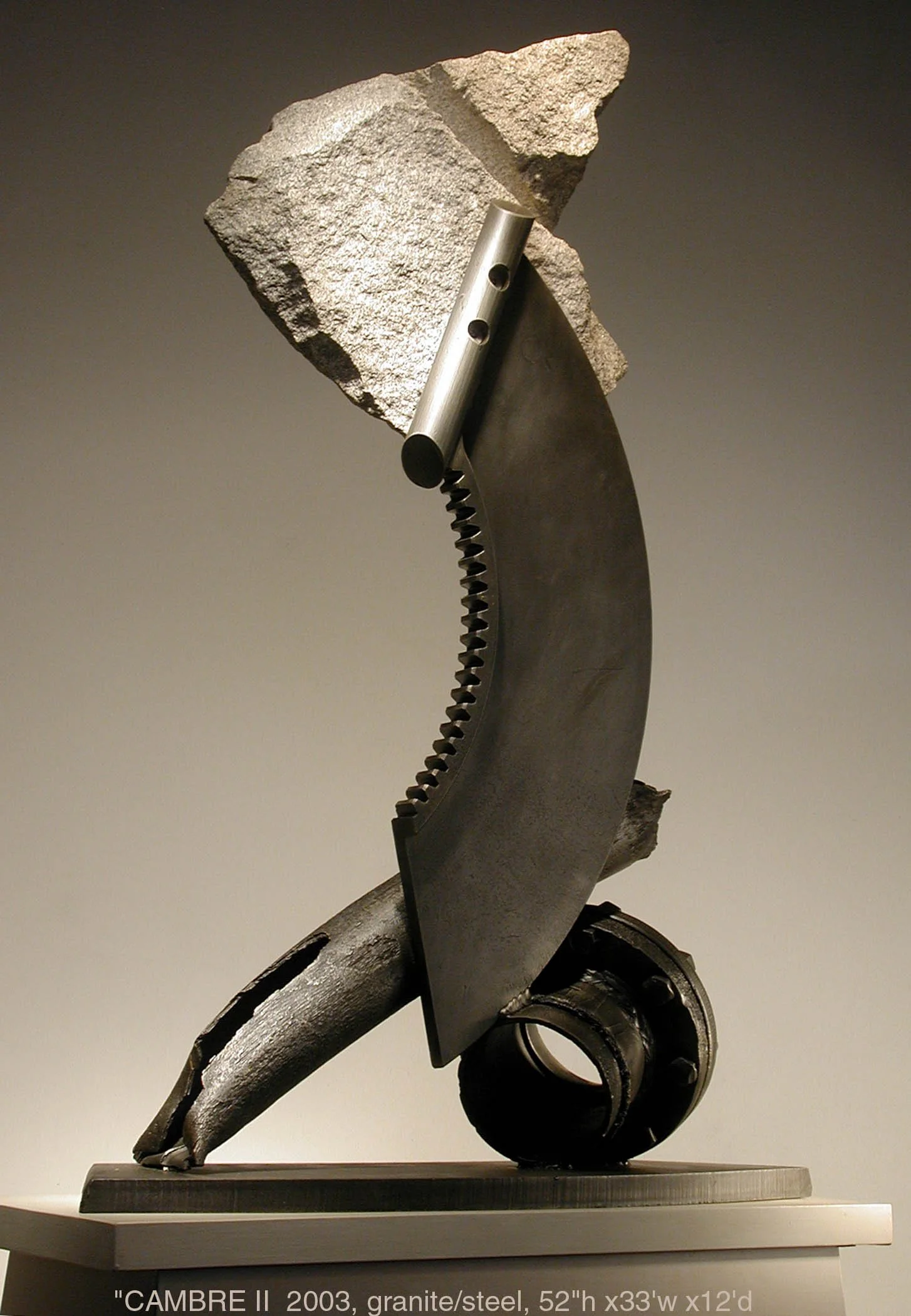
December 2003. Granite, steel. Dimensions: 52 × 33 × 14 in (132 × 84 × 36 cm).
Cambre II takes its title from the classical ballet term cambré, meaning “arched”—a movement in which the body bends from the waist, with the head following. The sculpture translates this gesture into granite and steel, its sweeping form bending upward while supporting the massive stone in a seemingly precarious position.
The work reflects my interest in the connections between artistic disciplines, particularly sculpture and dance. By “choreographing” the typically earthbound materials of stone and steel through balance, tension, and arrested motion, I seek to transform their physical weight into a sense of gesture and movement.
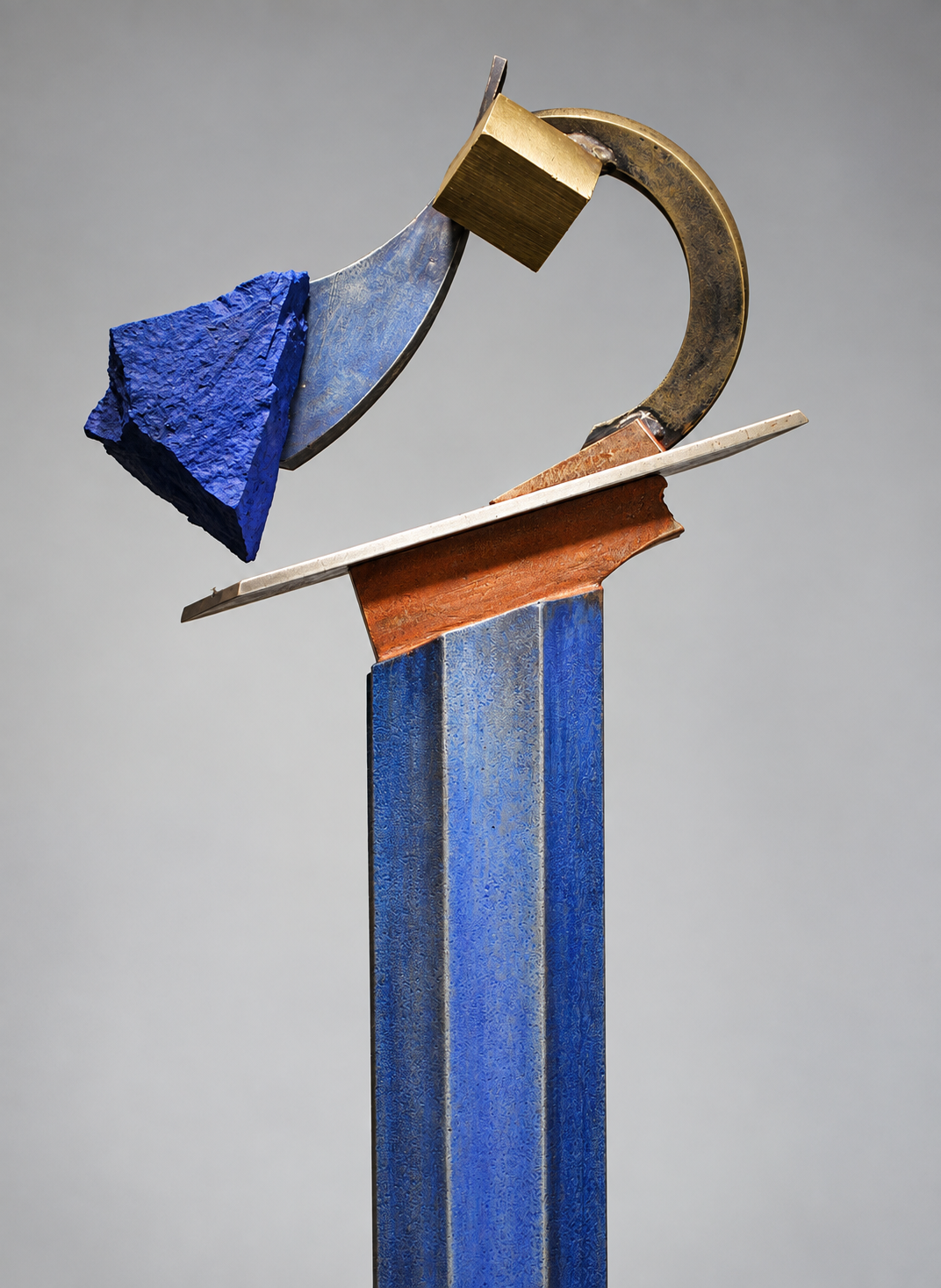
December 2003. Oil enamel on stone and steel. Dimensions: 84 × 31 × 18 in (213 × 79 × 46 cm).
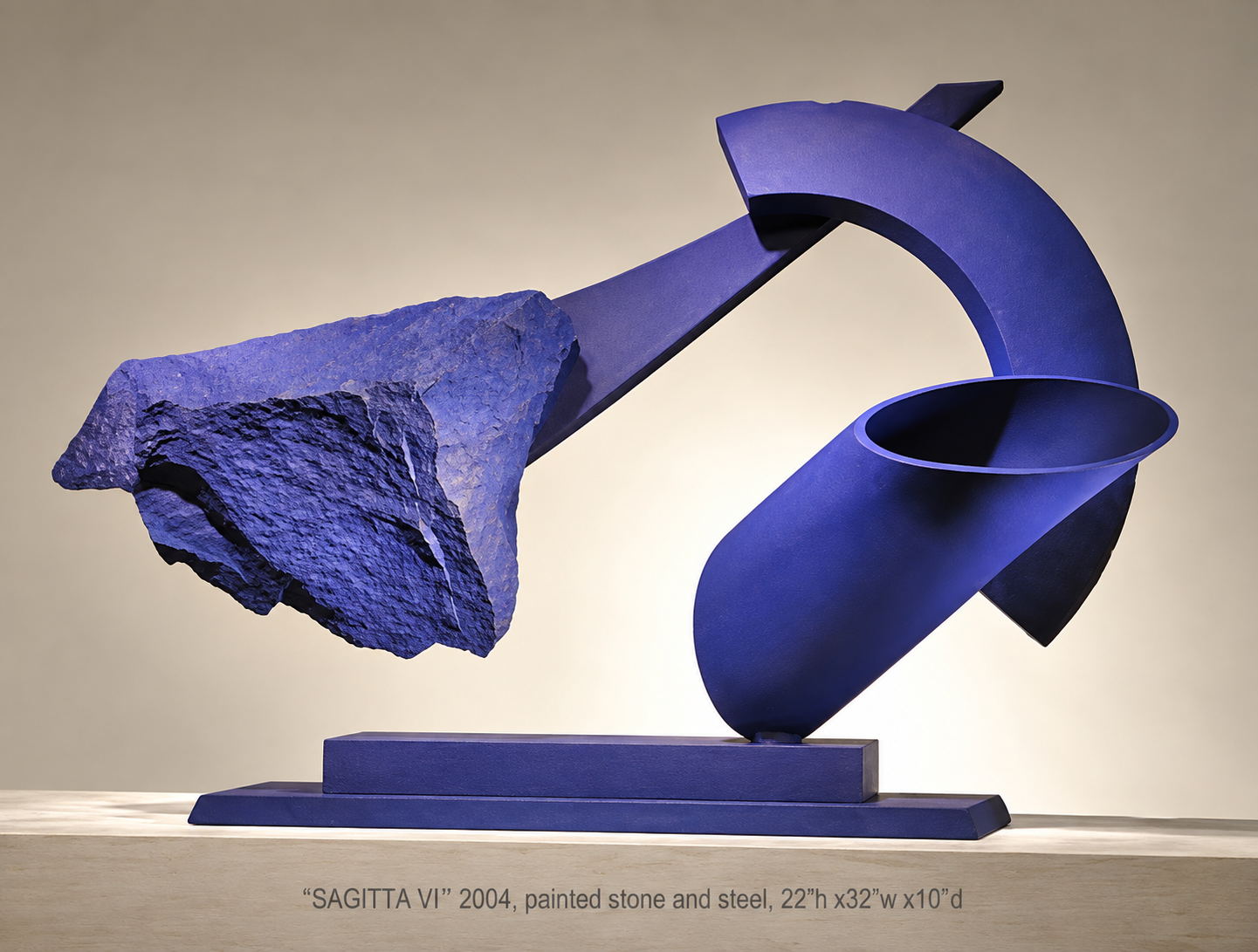
December 2003. Oil enamel on stone, steel. Dimensions: 22 × 32 × 10 in (56 × 81 × 25 cm).
SAGITTA: Latin for arrow
Constellation: A dim but distinctive constellation in the northern sky, representing an arrow and included in the original 48 constellations listed by Ptolemy. It is not to be confused with the larger constellation Sagittarius.
Mythology: The constellation is associated with the arrow of Hercules, the arrow of Apollo, or the arrow of Eros (Cupid).
2002
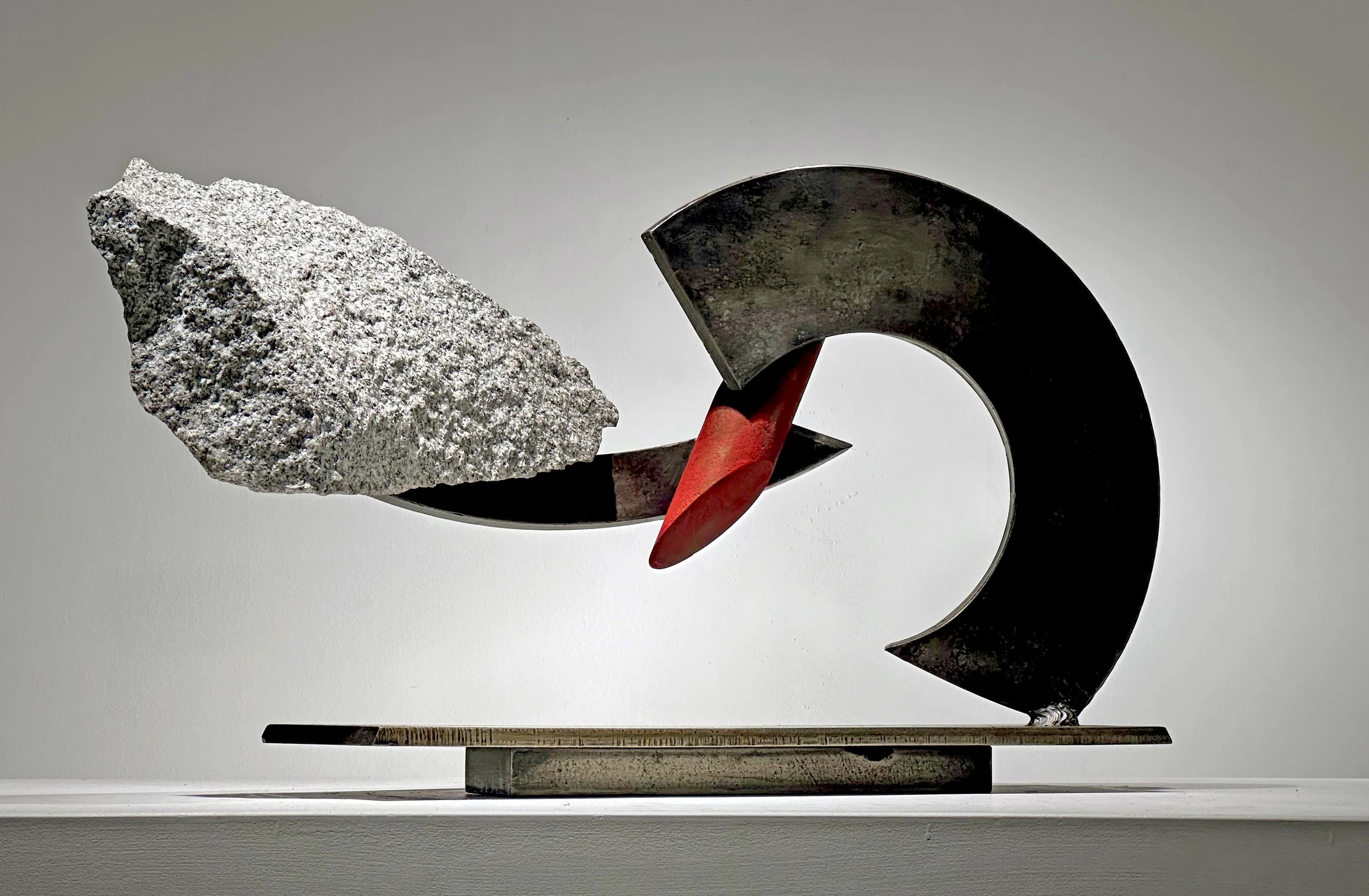
January 2002. Granite, steel. Dimensions: 13.5 × 24 × 6 in (34 × 61 × 15 cm).
Private collection
Planche, 2002
Taking its title from the gymnastic planche—a horizontal handstand in which the body appears suspended against gravity—Planche exemplifies John Van Alstine’s exploration of the implied human figure. Rather than depicting the body literally, Van Alstine translates its physical dynamics into stone and steel. Weight, extension, tension, balance, and counterbalance transform the sculpture into a kind of arrested gesture. Like the gymnast, whose apparent stillness depends upon extraordinary exertion, the work suggests movement held momentarily in equilibrium. Throughout Van Alstine’s sculpture, references to dance, gymnastics, and fencing provide a vocabulary for this choreography of materials: granite assumes the weight and gravitational presence of the body, while steel extends, braces, pivots, and reaches. Planche thus occupies a space between abstraction and figuration, inviting the viewer to experience sculpture not simply as an arrangement of materials, but as a body negotiating gravity.
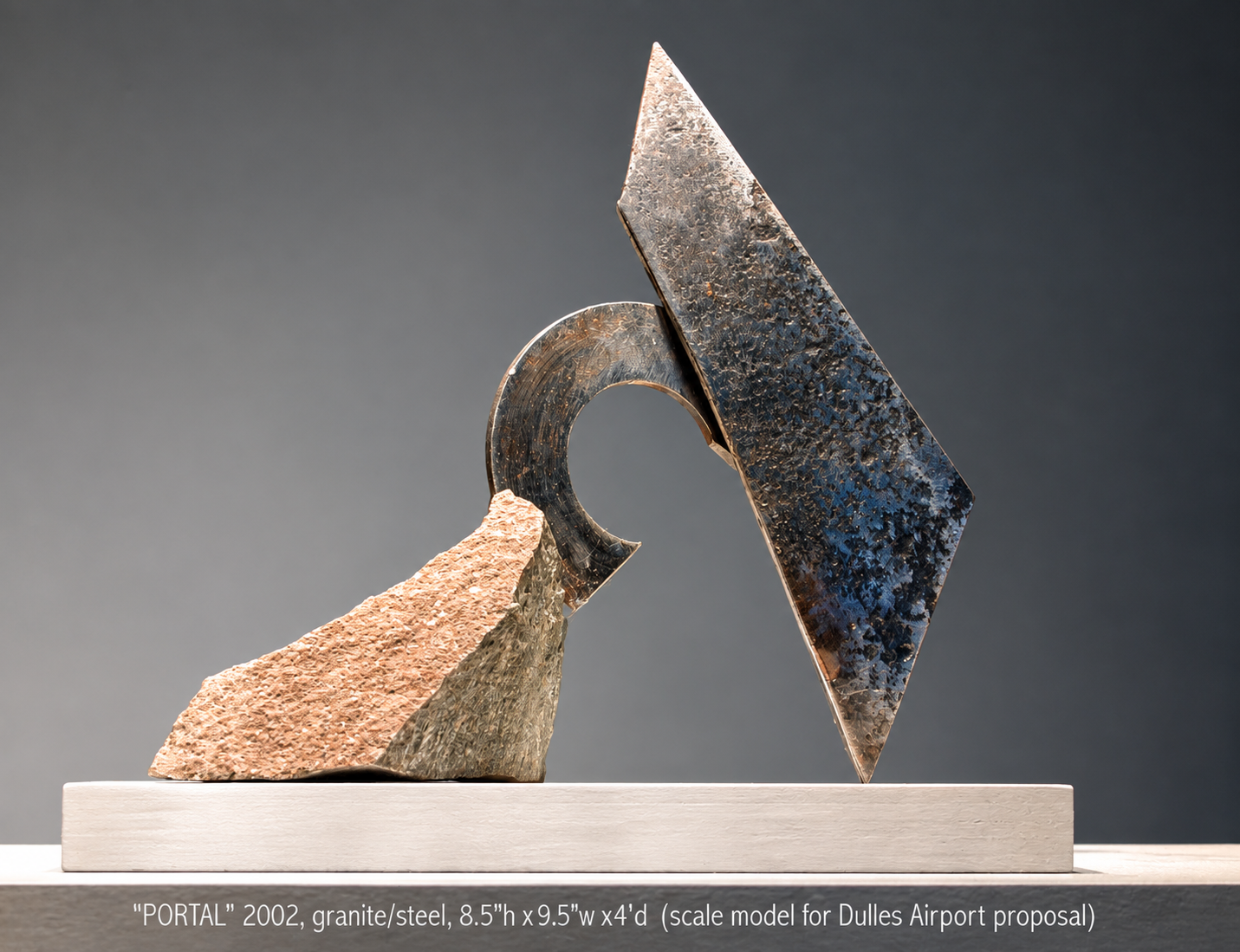
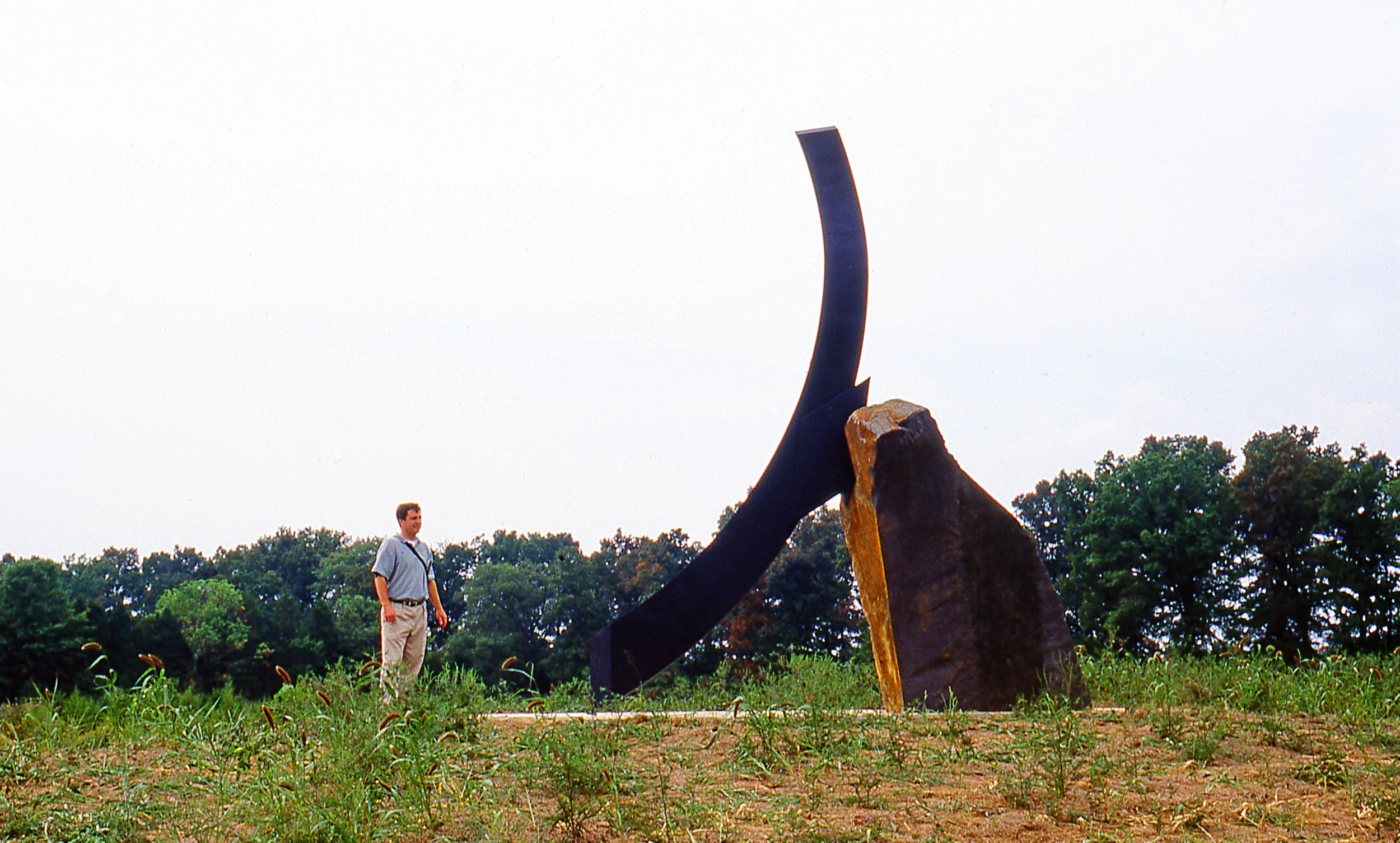
2002. Black granite and painted steel, 16íh
Installed at the entrance of the Dulles Trade Center, near Dulles Airport in the Washington DC area. Commissioned by Buchanan Partners, Inc. Washington, DC, it was designed to suggest and convey the soaring activities of the airport. (Photos here were taken before final landscaping.)
Updraft(1995) celebrates movement, aspiration, and flight. Combining monumental granite with stainless steel, the work captures the moment of upward lift, its sweeping forms suggesting both the aerodynamic forces of flight and the natural currents of rising air. Positioned at the entrance to a major business campus near Washington Dulles International Airport, the sculpture establishes a strong dialogue between art, architecture, and its surrounding landscape.
Drawing inspiration from both nature and technology, Updraft reflects John Van Alstine's continuing exploration of balance, tension, and transformation. The commission marks an important evolution in his public work, as increasingly dynamic forms began to express not only the enduring strength of stone, but also the energy and motion contained within it.
MORE INFO: Updraft chapter in AMERICAN MONUMENTS
March 2002. Granite, steel. Dimensions: 13 × 15 × 4 in (33 × 38 × 10 cm).
Private Collection
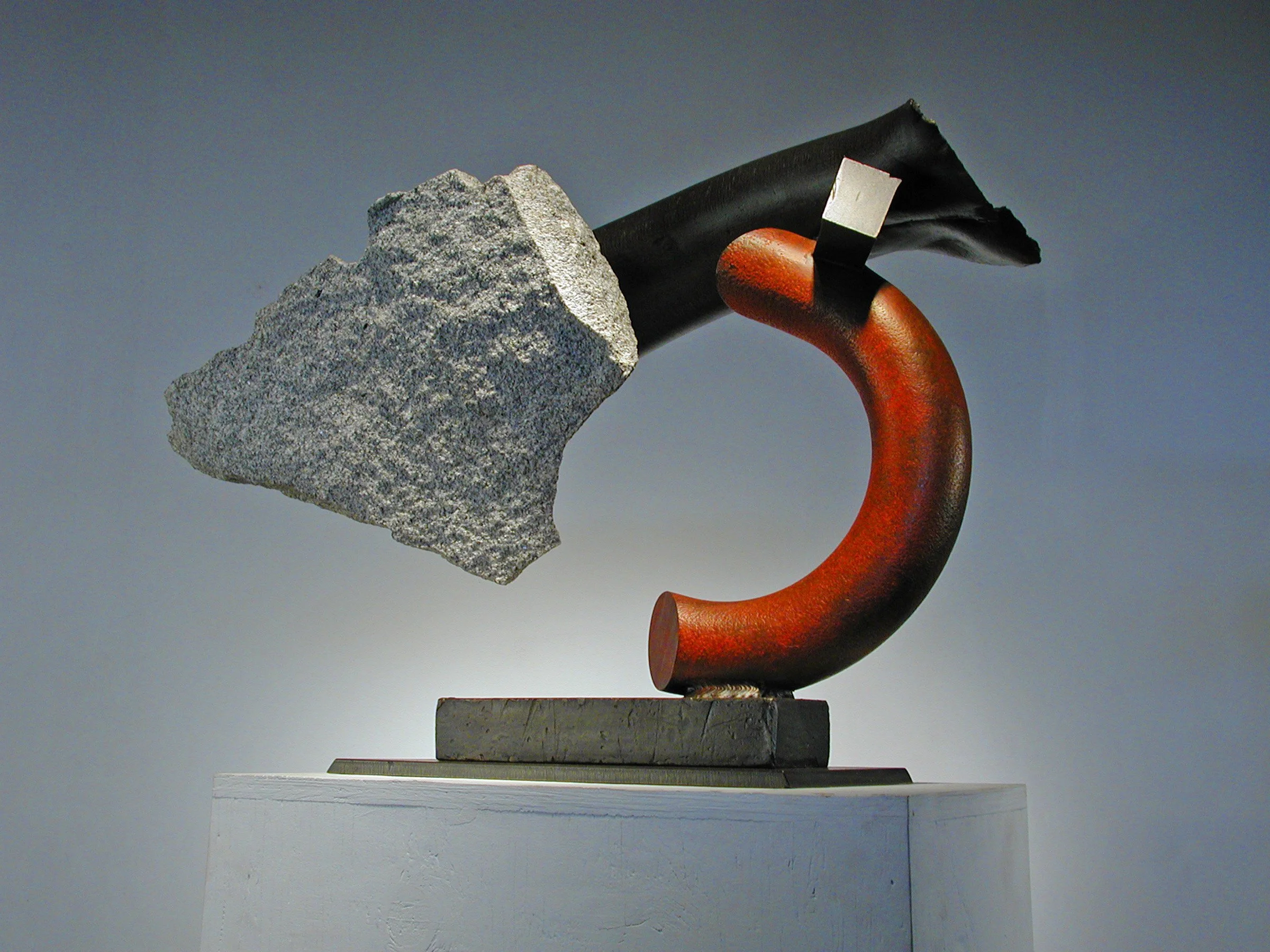
March 2002. Granite, steel. Dimensions: 21 × 31 × 9 in (53 × 79 × 23 cm).
Sa*git"ta, n. [L., an arrow.] 1. (Astron.) A small constellation north of Aquila; the Arrow.
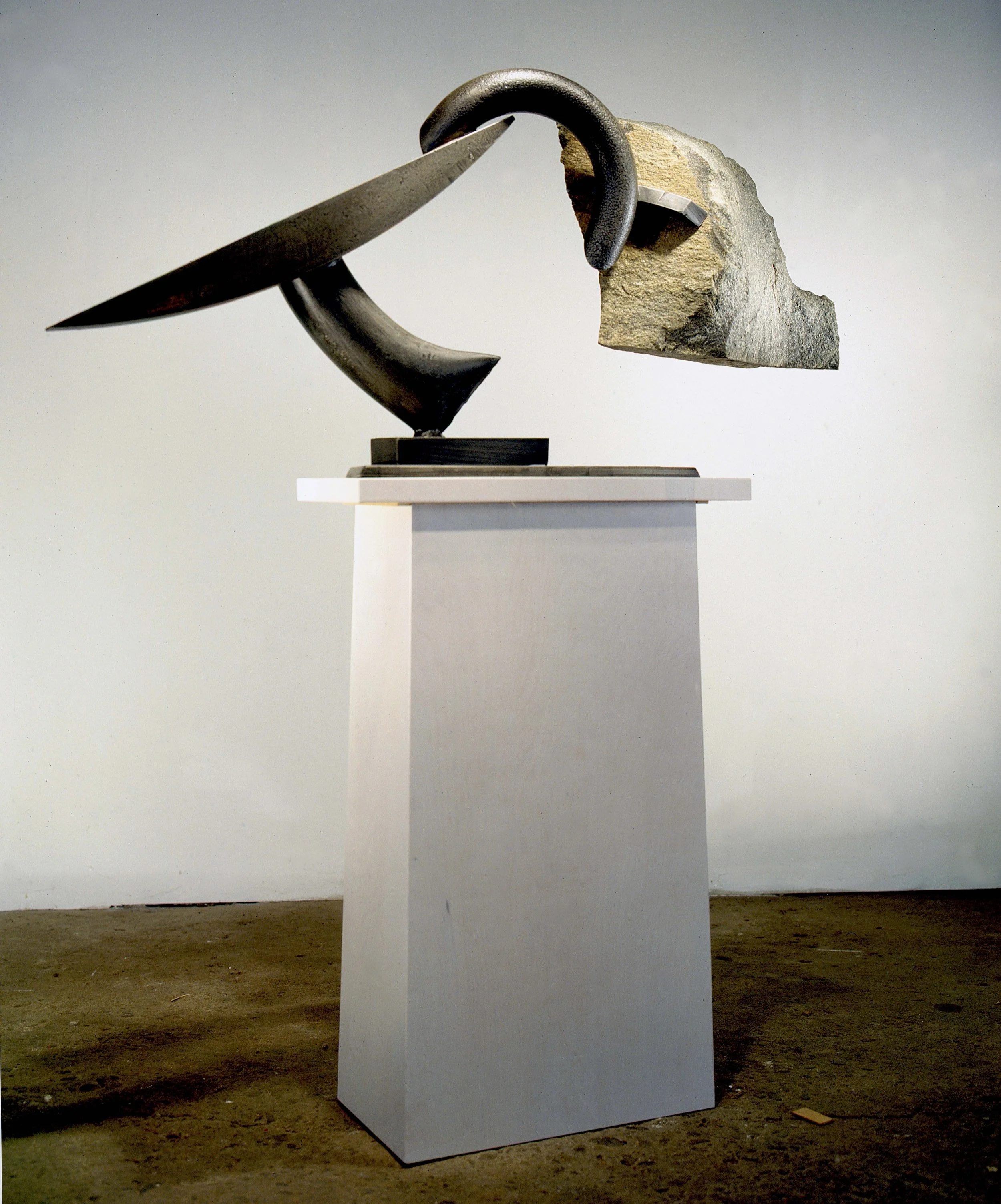
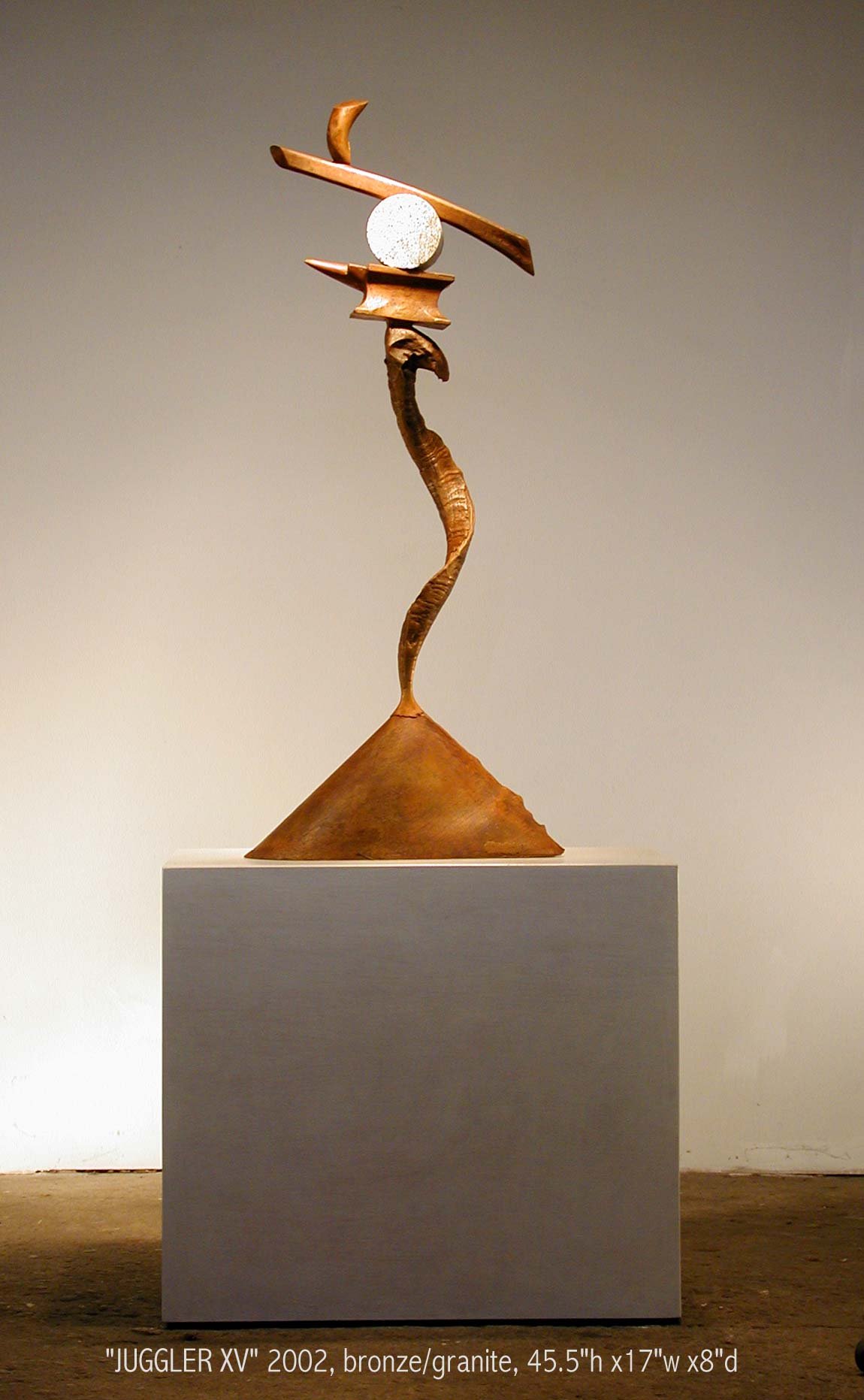
April 2002. Bronze, granite. Dimensions: 45.5 × 17 × 8 in (116 × 43 × 20 cm). private collection
Many of Van Alstine’s works take inspiration from the movement of the human body. This work can be seen as a kind of self-portrait, suggesting his studio process—literally juggling and repositioning the individual elements of a sculpture until they achieve a moment of perfect balance, then freezing that moment in space through welding. More universally, juggling becomes a metaphor for the way we all balance the competing demands of family, work, play, and responsibility.
The anvil, which appears in a number of the artist’s works, represents both the ultimate heavy object to “juggle” and the act of assembly itself—the forging together of object, material, and ideas that is central to Van Alstine’s work.
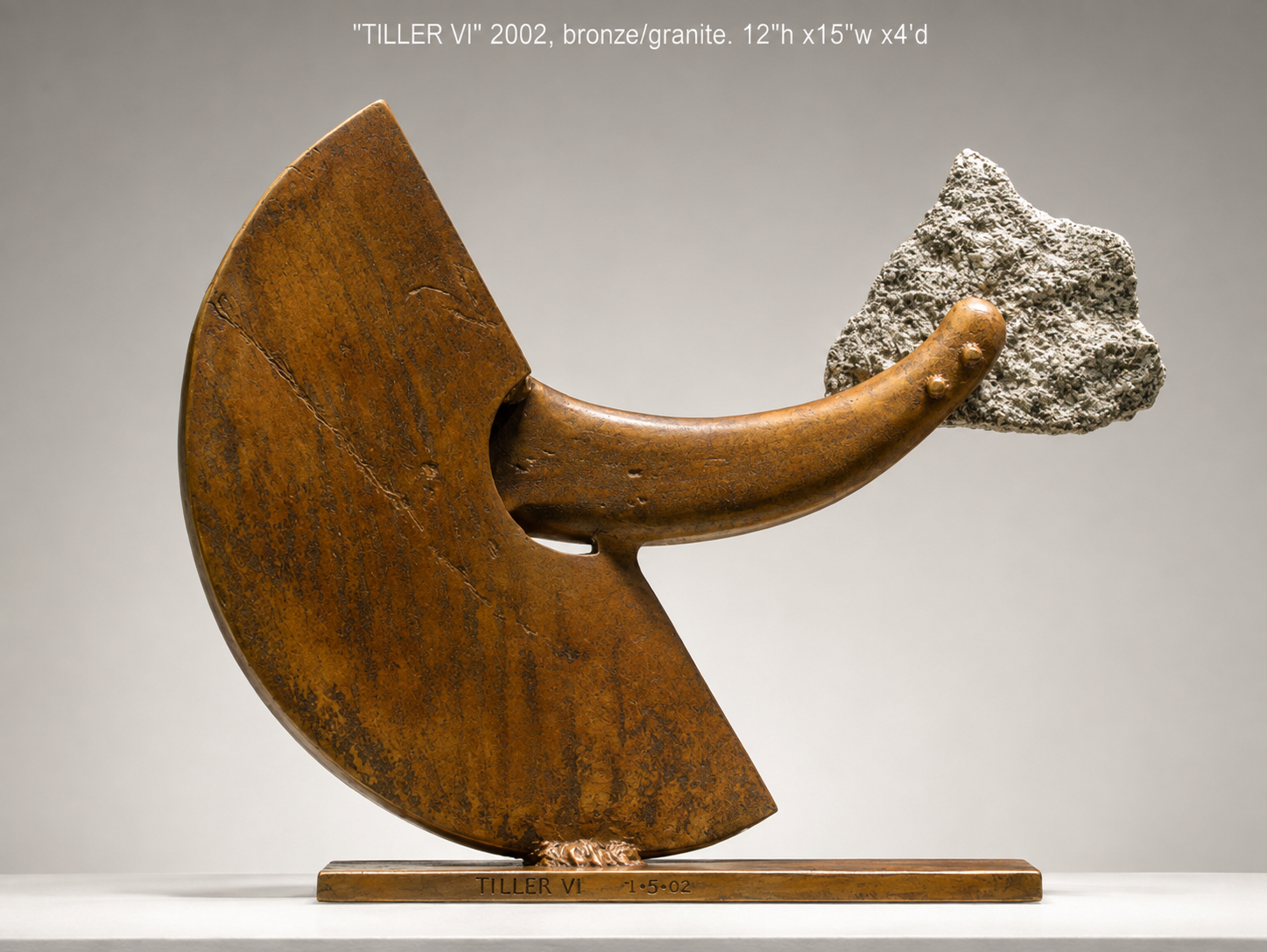
April 2002. Bronze, granite. Dimensions: 12 × 15 × 4 in (30 × 38 × 10 cm).
The Tiller series grows from my interest in tools and agricultural implements as extensions of the human hand—objects that cultivate, shape, and engage the land. The title also evokes the tiller of a boat, a simple device used to steer and determine direction. Bringing these meanings together, the works explore the relationship between cultivation and navigation—our impulse both to shape the world around us and to chart a course through it.
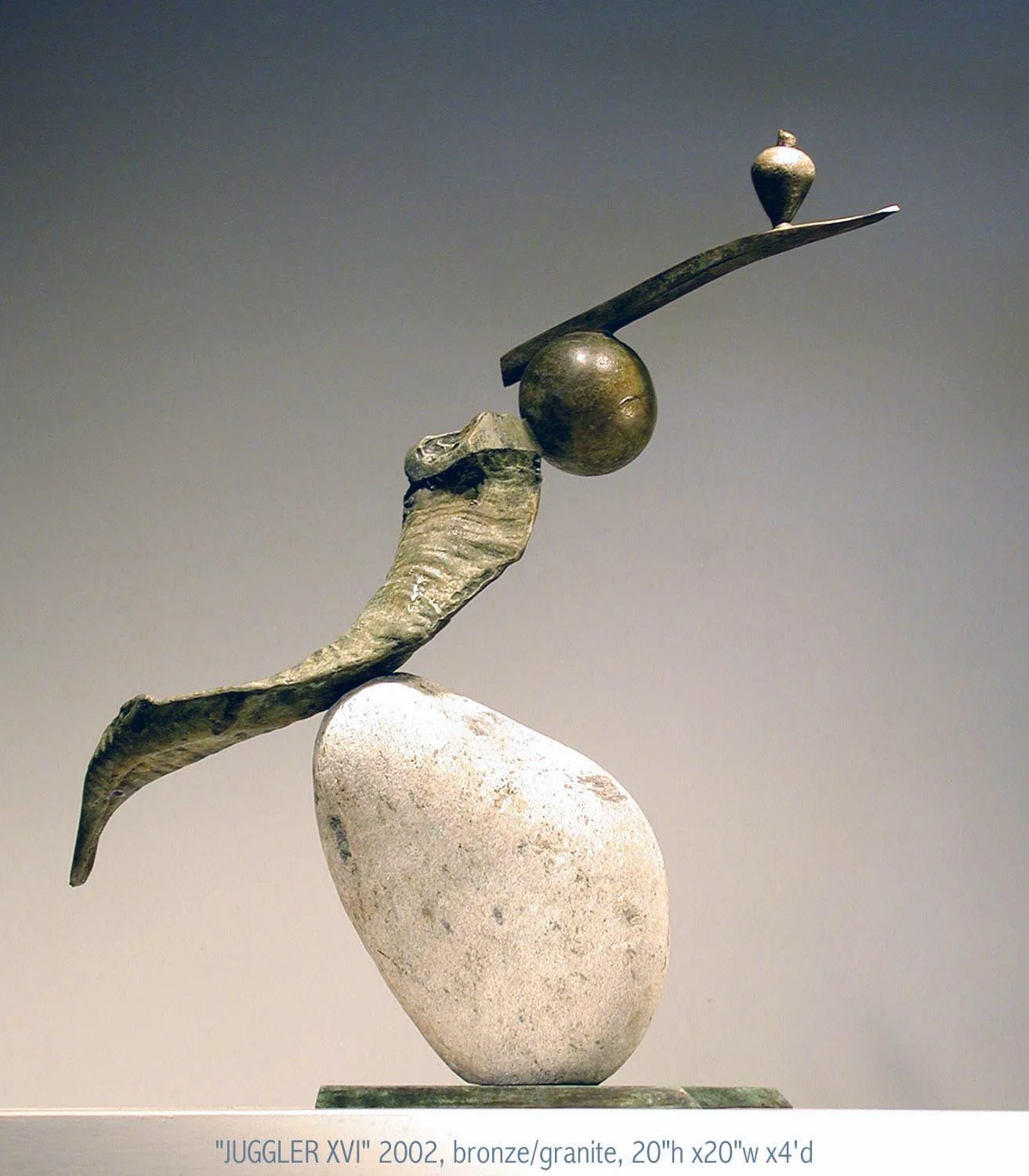
April 2002. Bronze, granite. Dimensions: 20 × 20 × 4 in (51 × 51 × 10 cm). Cannibalized
Many of Van Alstine’s works take inspiration from the movement of the human body. This work can be seen as a kind of self-portrait, suggesting his studio process—literally juggling and repositioning the individual elements of a sculpture until they achieve a moment of perfect balance, then freezing that moment in space through welding. More universally, juggling becomes a metaphor for the way we all balance the competing demands of family, work, play, and responsibility.
The anvil, which appears in a number of the artist’s works, represents both the ultimate heavy object to “juggle” and the act of assembly itself—the forging together of object, material, and ideas that is central to Van Alstine’s work.
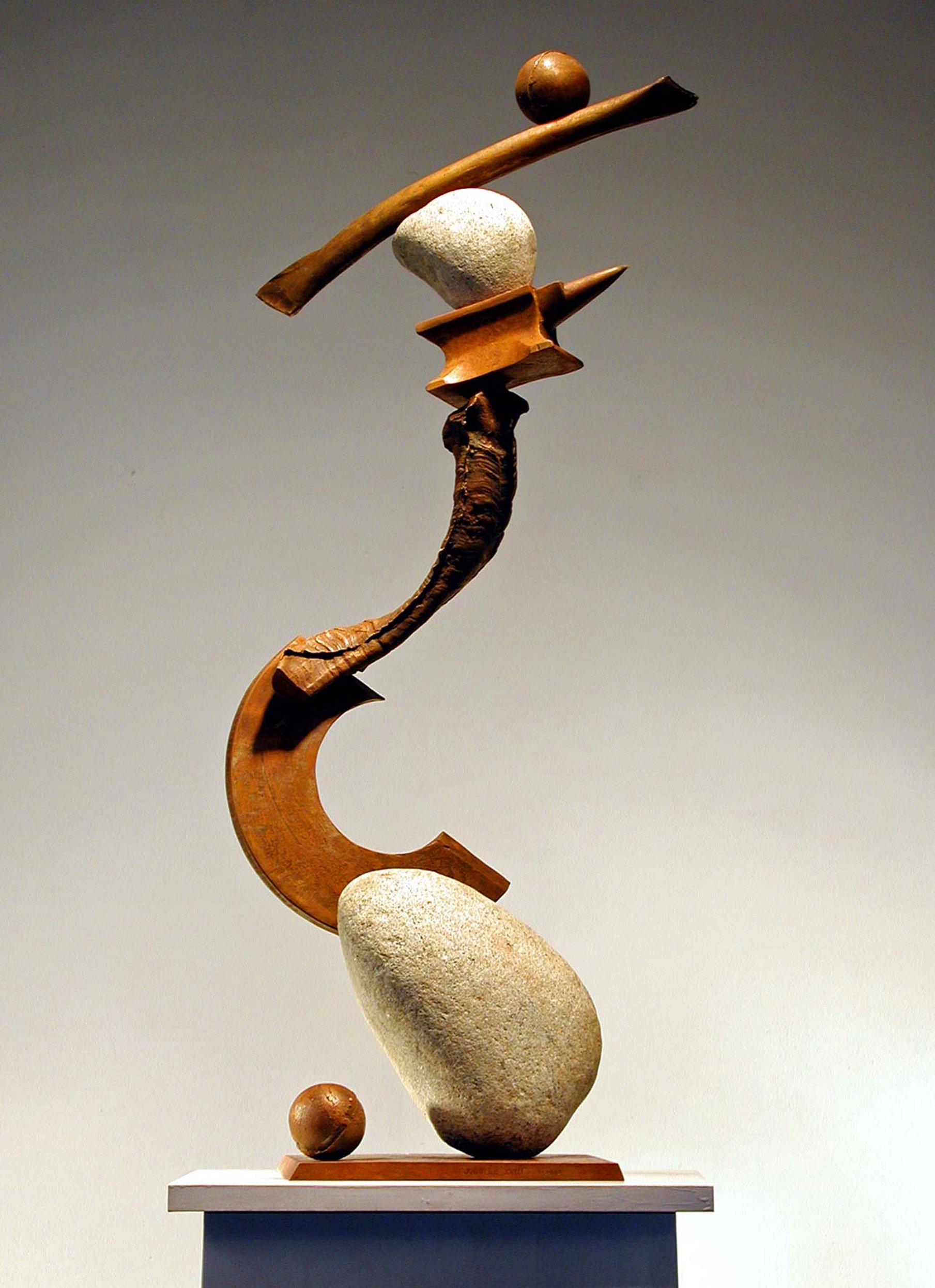
May 2002. River stone, bronze. Dimensions: 47 × 18 × 10 in (119 × 46 × 25 cm).
Private collection - Santa fe, NM
Artist Statement – John Van Alstine
“Many of my works incorporate anvils, either real or cast. The anvil's form, reminiscent of a boat or vessel, carries an inherent suggestion of journey—an idea that has long fascinated me. As a metalworker and “assembler,” I regard the anvil as both a physical and conceptual forge, the place where things come together and where the act of making transforms into art. For me, it holds an almost sacred presence—an altar of creation. In fact, I've titled a number of these works Ara, the Latin word for “altar.”
Throughout my practice, I strive to breathe a sense of life and airiness into materials that are otherwise dense and earthbound—rough granite, industrial-scale steel, and other heavy elements. The anvil, perhaps the ultimate emblem of weight and solidity, becomes especially compelling when lifted into the air. That gesture introduces a dynamic tension, a sense of levitation that animates the work and challenges our expectations of gravity and mass.”
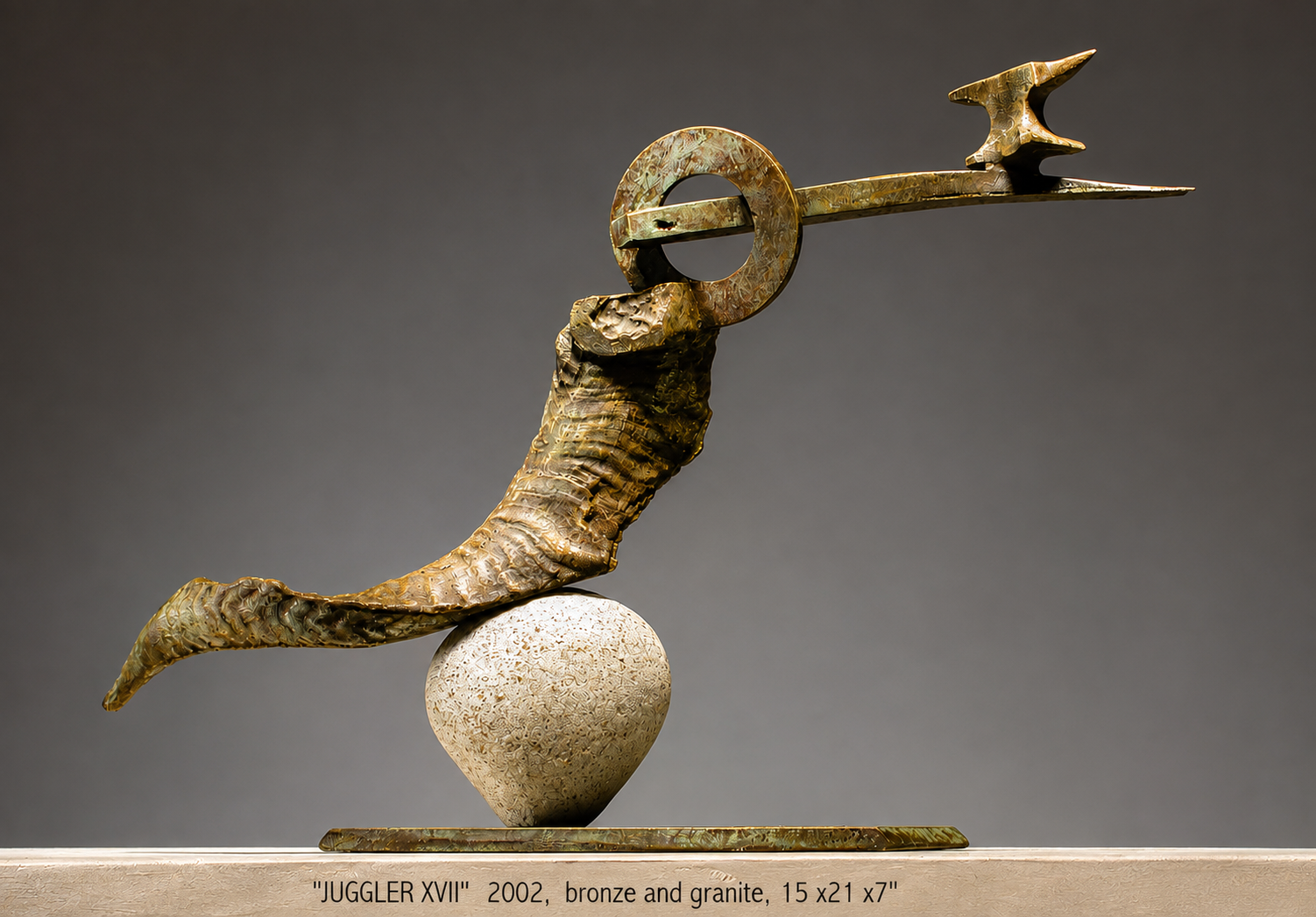
May 2002. River stone, bronze. Dimensions: 15 × 21 × 7 in (38 × 53 × 18 cm)
Private collection
Artist Statement – John Van Alstine
“Many of my works incorporate anvils, either real or cast. The anvil's form, reminiscent of a boat or vessel, carries an inherent suggestion of journey—an idea that has long fascinated me. As a metalworker and “assembler,” I regard the anvil as both a physical and conceptual forge, the place where things come together and where the act of making transforms into art. For me, it holds an almost sacred presence—an altar of creation. In fact, I've titled a number of these works Ara, the Latin word for “altar.”
Throughout my practice, I strive to breathe a sense of life and airiness into materials that are otherwise dense and earthbound—rough granite, industrial-scale steel, and other heavy elements. The anvil, perhaps the ultimate emblem of weight and solidity, becomes especially compelling when lifted into the air. That gesture introduces a dynamic tension, a sense of levitation that animates the work and challenges our expectations of gravity and mass.”
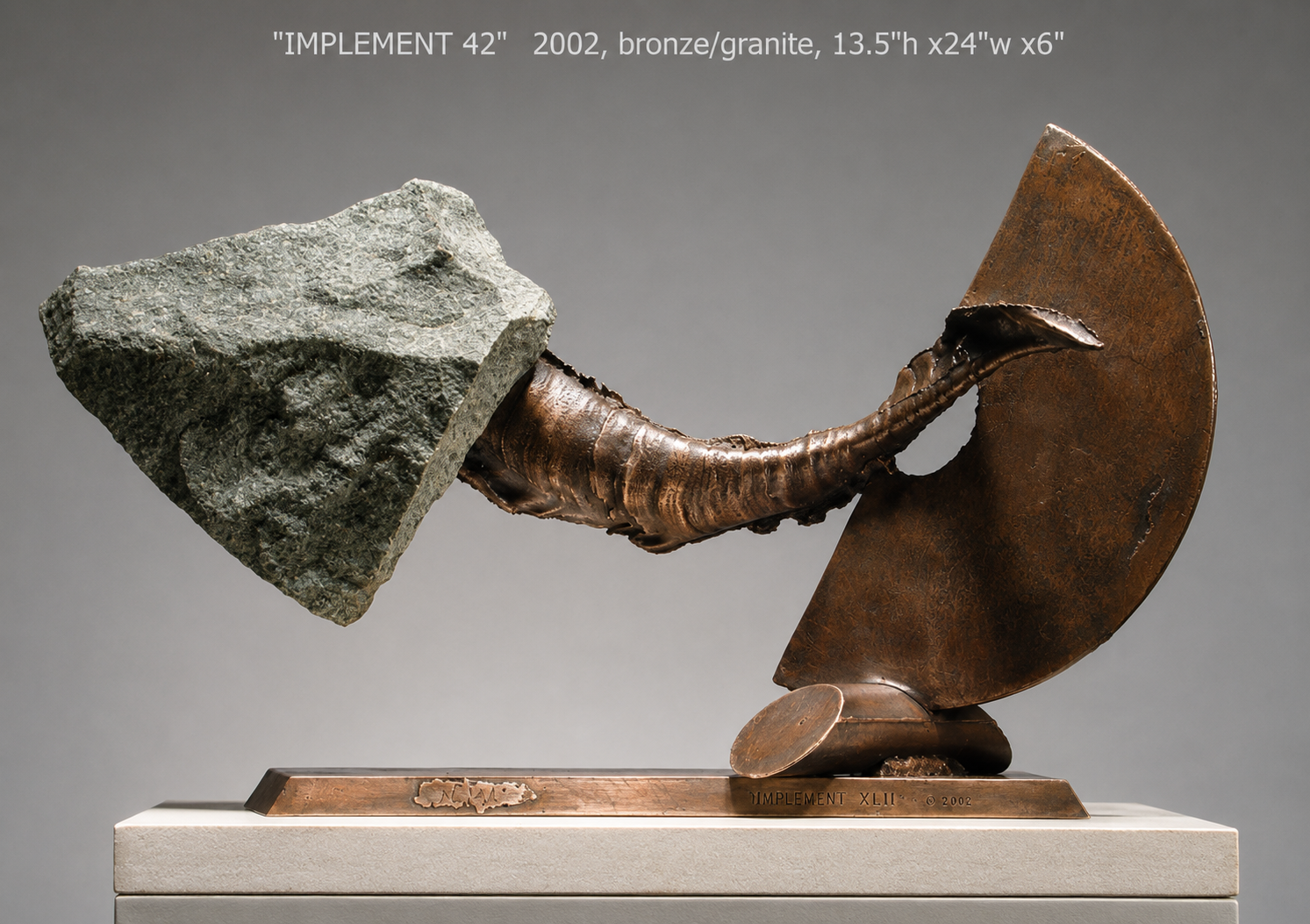
May 2002. Bronze, green granite. Dimensions: 13.5 × 24 × 6 in (34 × 61 × 15 cm).
Private collection
As a sculptor, I have always been fascinated by tools, implements, and instruments. I see them as extensions of the hand—essential allies in the act of making—and am drawn to their raw, efficient beauty, shaped over time by function and necessity. They also embody human ingenuity, labor, and our impulse to shape and engage the world around us.
Throughout my work, agricultural implements—rakes, plow blades, sledges, and tillers—as well as anvils, scales, compasses, and other instruments become both sculptural forms and vehicles for metaphor, suggesting ideas of balance, navigation, transformation, and our relationship to the natural world.
John Van Alstine
Horns, antlers, and nautilus-like forms fascinate Van Alstine for the natural geometry embodied in their arcs, spirals, and tapering curves. Cast in bronze, these organic forms become sculptural building blocks that can suggest both nature’s functional ingenuity and human-made tools—hooks, hammers, blades, and other implements.
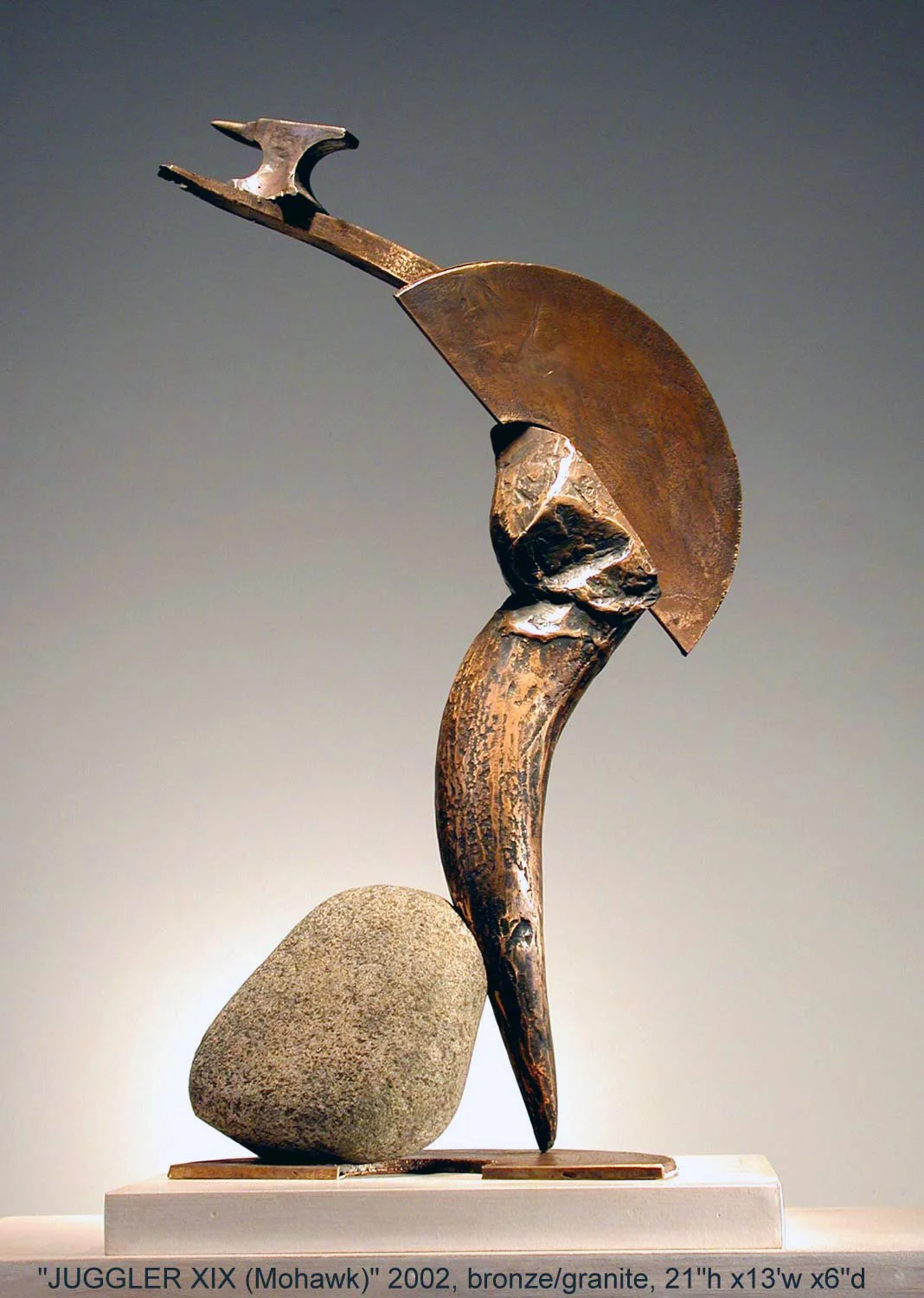
May 2002. River stone, bronze. Dimensions: 21 × 13 × 6 in (53 × 33 × 15 cm).
Artist Statement – John Van Alstine
“Many of my works incorporate anvils, either real or cast. The anvil's form, reminiscent of a boat or vessel, carries an inherent suggestion of journey—an idea that has long fascinated me. As a metalworker and “assembler,” I regard the anvil as both a physical and conceptual forge, the place where things come together and where the act of making transforms into art. For me, it holds an almost sacred presence—an altar of creation. In fact, I've titled a number of these works Ara, the Latin word for “altar.”
Throughout my practice, I strive to breathe a sense of life and airiness into materials that are otherwise dense and earthbound—rough granite, industrial-scale steel, and other heavy elements. The anvil, perhaps the ultimate emblem of weight and solidity, becomes especially compelling when lifted into the air. That gesture introduces a dynamic tension, a sense of levitation that animates the work and challenges our expectations of gravity and mass.”
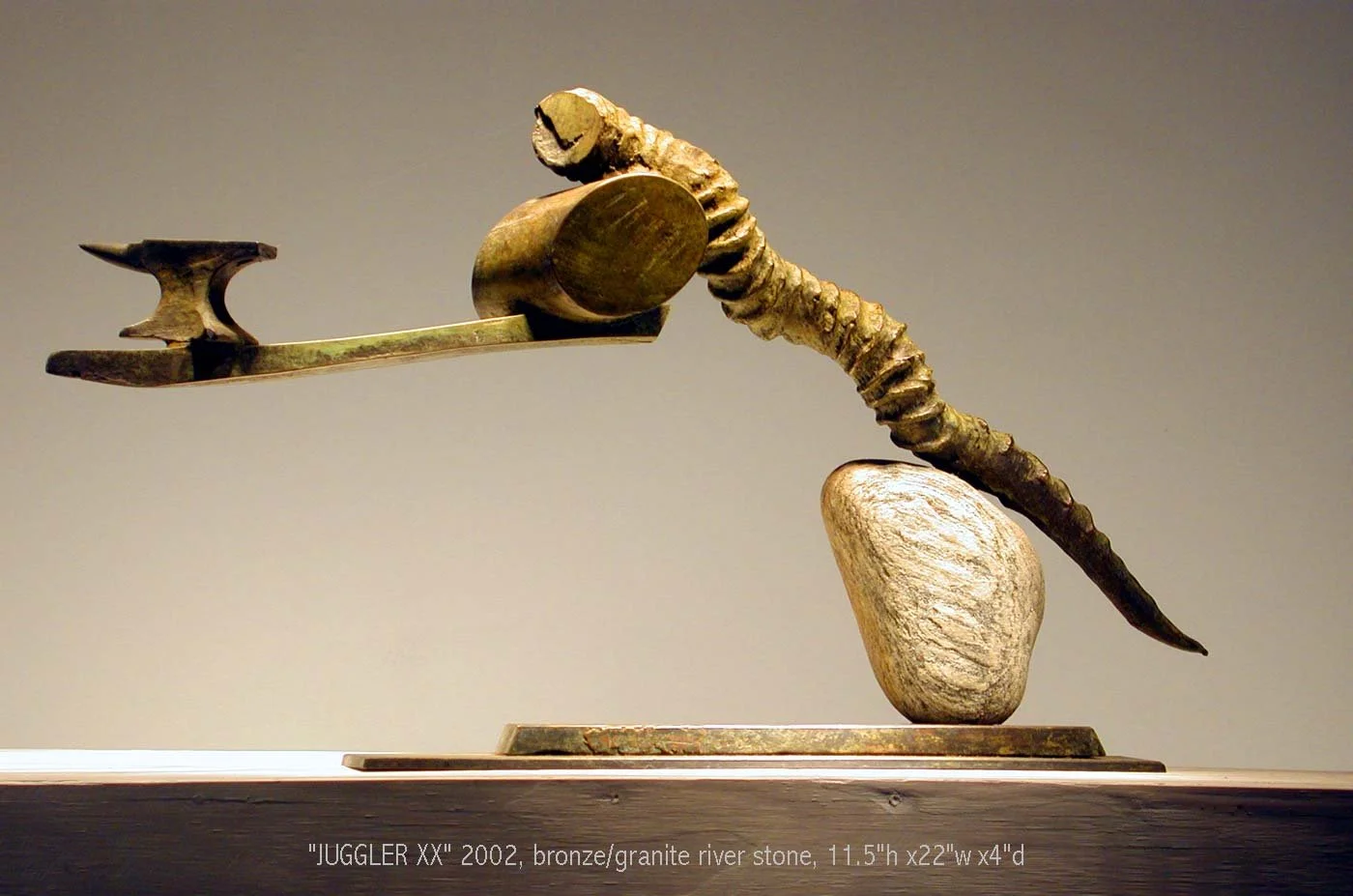
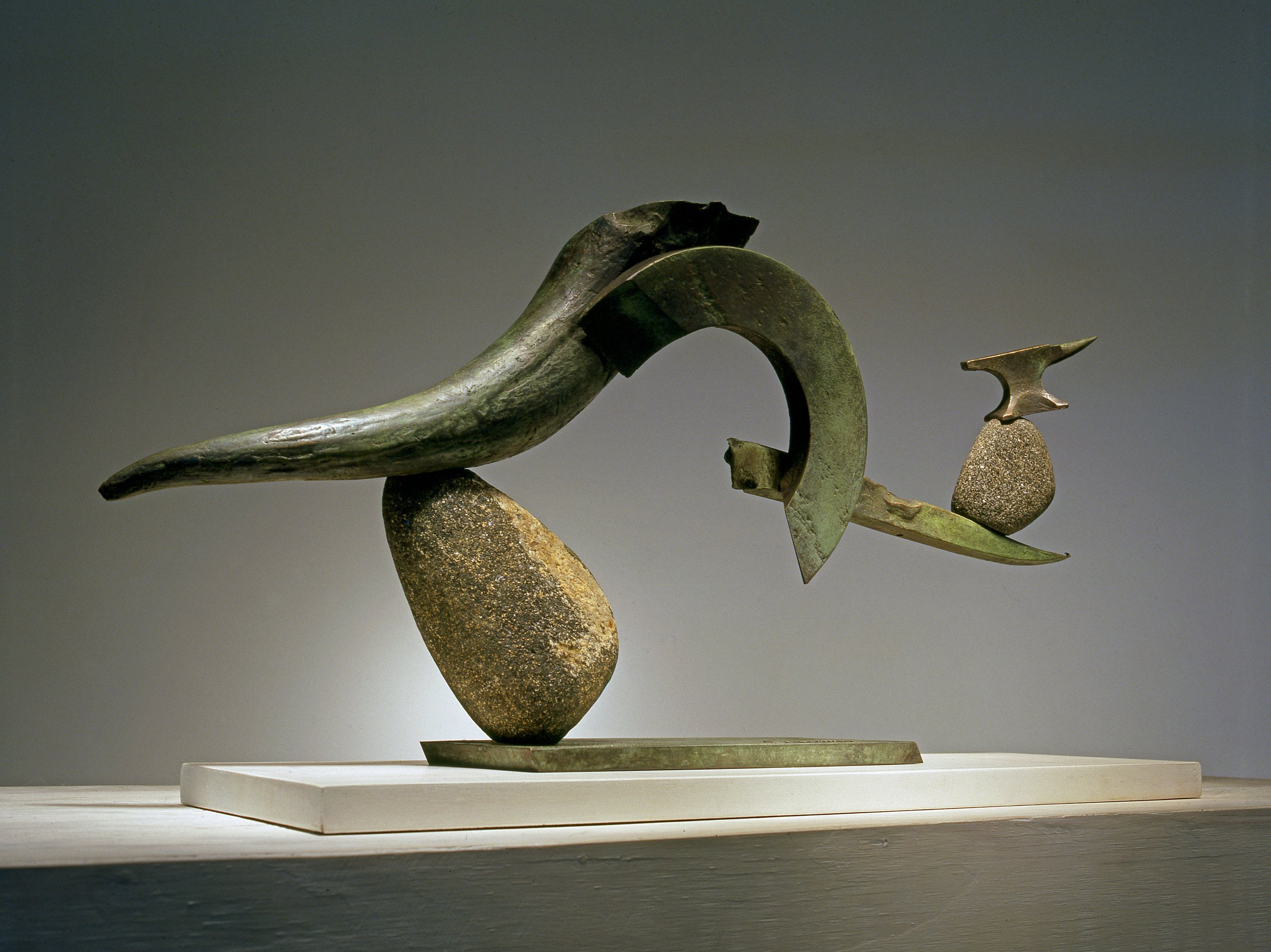
May 2002. River stone, bronze. Dimensions: 12 × 24 × 4 in (30 × 61 × 10 cm).
Artist Statement – John Van Alstine
"Many of my works incorporate anvils, either real or cast. The anvil's form, reminiscent of a boat or vessel, carries an inherent suggestion of journey—an idea that has long fascinated me. As a metalworker and “assembler,” I regard the anvil as both a physical and conceptual forge, the place where things come together and where the act of making transforms into art. For me, it holds an almost sacred presence—an altar of creation. In fact, I've titled a number of these works Ara, the Latin word for “altar.”
Throughout my practice, I strive to breathe a sense of life and airiness into materials that are otherwise dense and earthbound—rough granite, industrial-scale steel, and other heavy elements. The anvil, perhaps the ultimate emblem of weight and solidity, becomes especially compelling when lifted into the air. That gesture introduces a dynamic tension, a sense of levitation that animates the work and challenges our expectations of gravity and mass.”
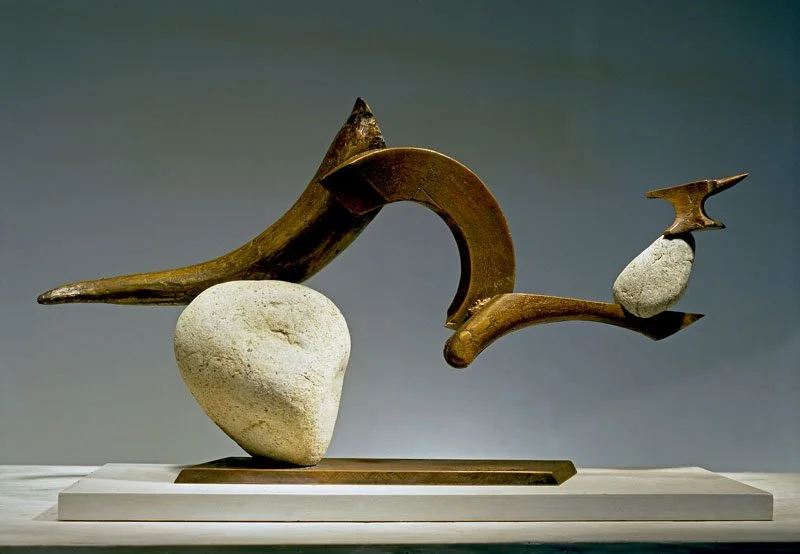
June 2002. River stone, bronze. Dimensions: 12 × 22 × 5 in (30 × 56 × 13 cm).
Private collection - San Francisco
Artist Statement – John Van Alstine
“Many of my works incorporate anvils, either real or cast. The anvil's form, reminiscent of a boat or vessel, carries an inherent suggestion of journey—an idea that has long fascinated me. As a metalworker and “assembler,” I regard the anvil as both a physical and conceptual forge, the place where things come together and where the act of making transforms into art. For me, it holds an almost sacred presence—an altar of creation. In fact, I've titled a number of these works Ara, the Latin word for “altar.”
Throughout my practice, I strive to breathe a sense of life and airiness into materials that are otherwise dense and earthbound—rough granite, industrial-scale steel, and other heavy elements. The anvil, perhaps the ultimate emblem of weight and solidity, becomes especially compelling when lifted into the air. That gesture introduces a dynamic tension, a sense of levitation that animates the work and challenges our expectations of gravity and mass.”
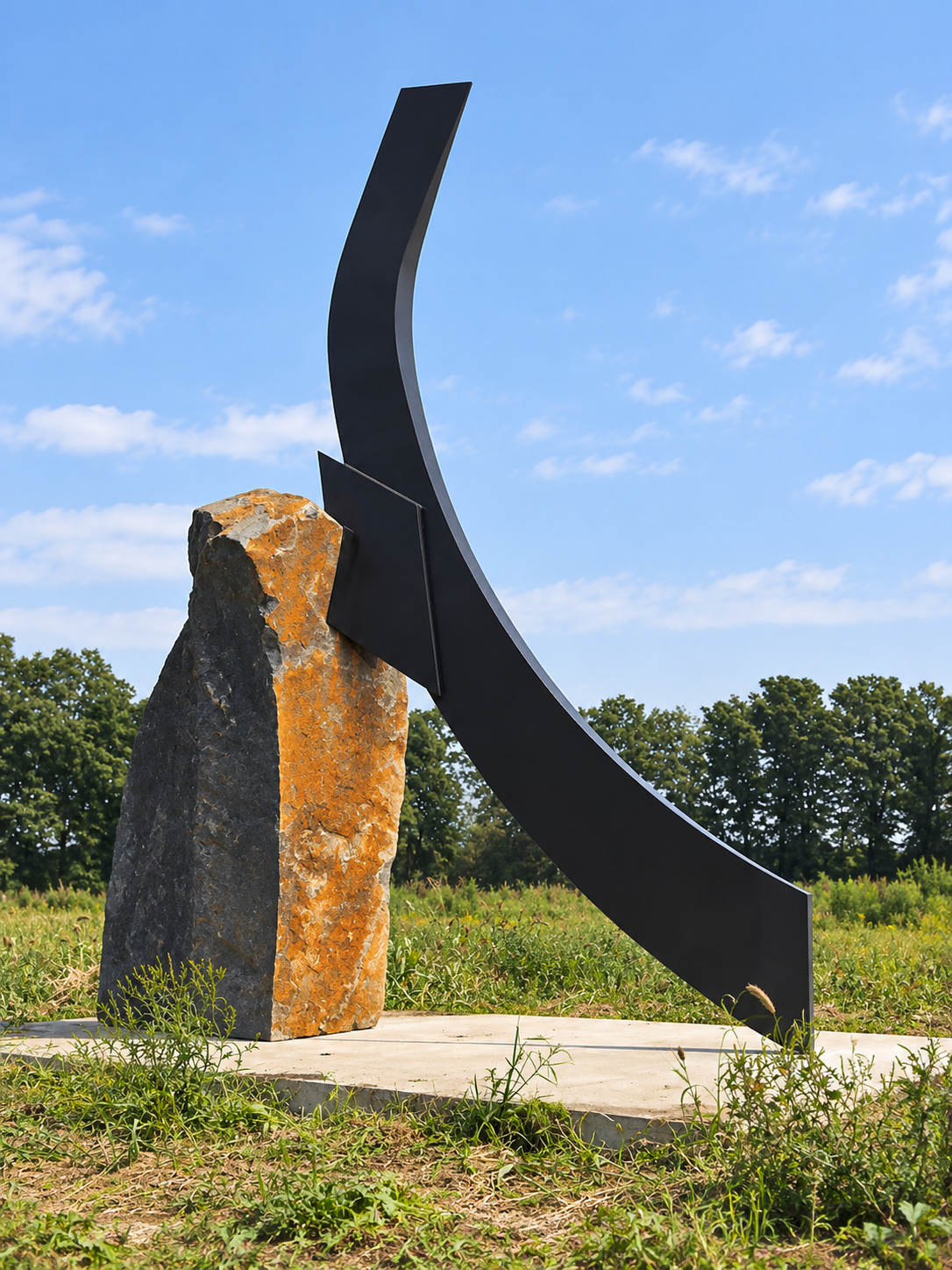
August 2002. Black granite, steel. Dimensions: 16 × 16 × 10 ft.
Installed at the Dulles Trade Center, Virginia.
Updraft mirrors the activities at the nearby airport. The dynamic interaction between the earth-bound stone and the strength and structure of the steel embodies the sensation of launching.
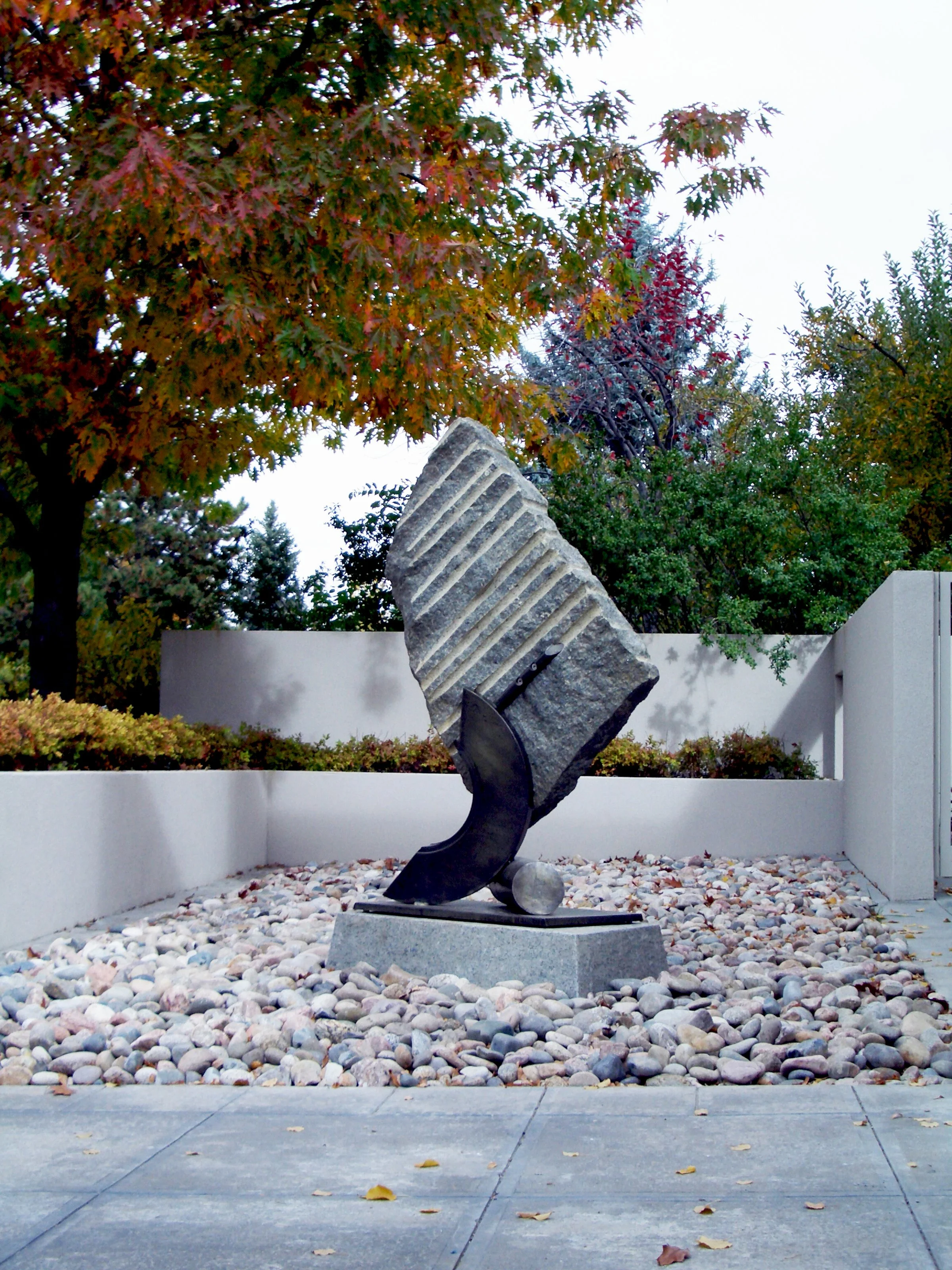
July 2002. Green granite, steel. Dimensions: 67 × 36 × 16 in (170 × 91 × 41 cm).
Private collection - Denver
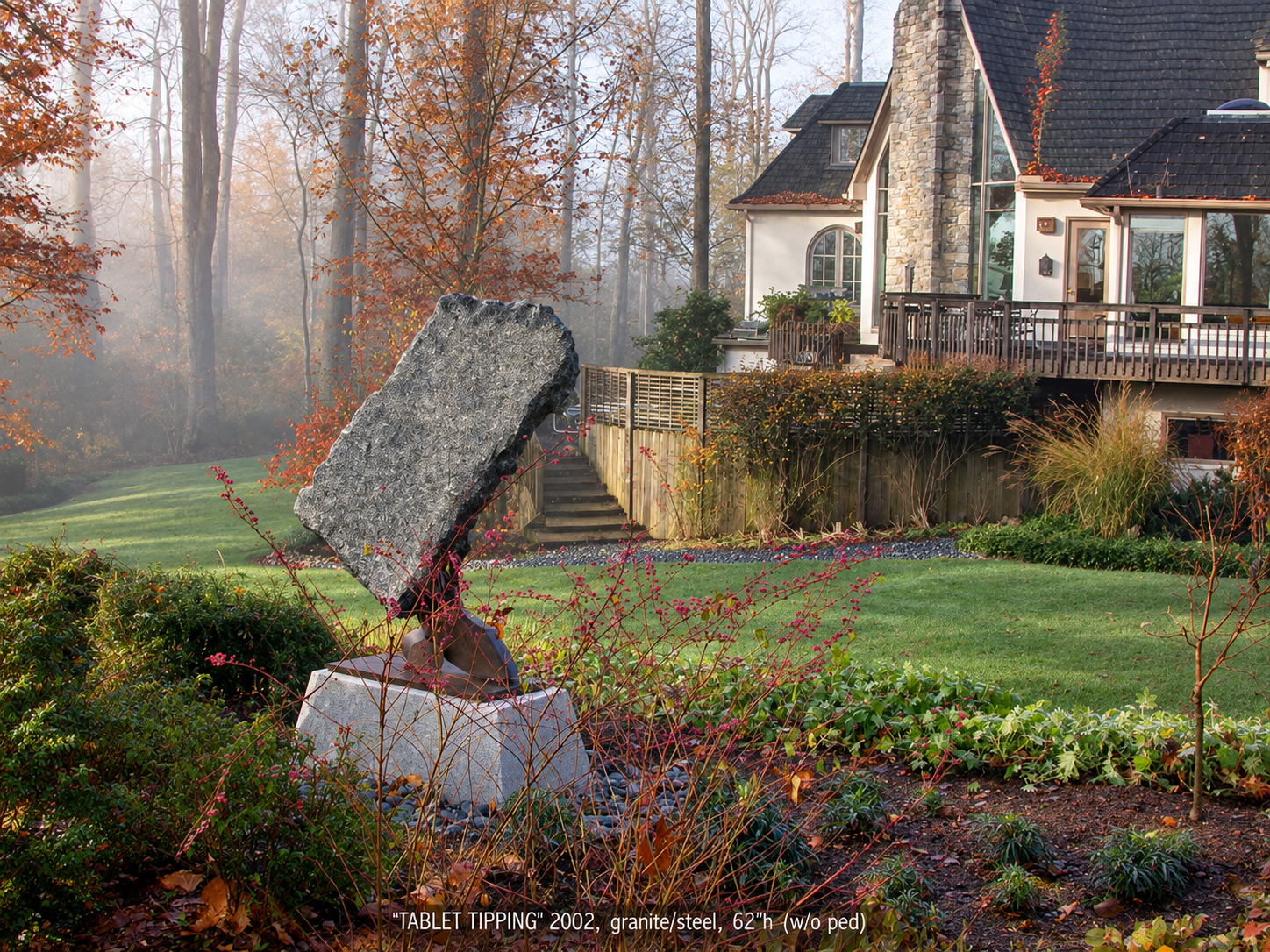
July 2002. Green granite, steel. Dimensions: 62 × 48 × 20 in (157 × 122 × 51 cm).
Private collection - Washington, DC
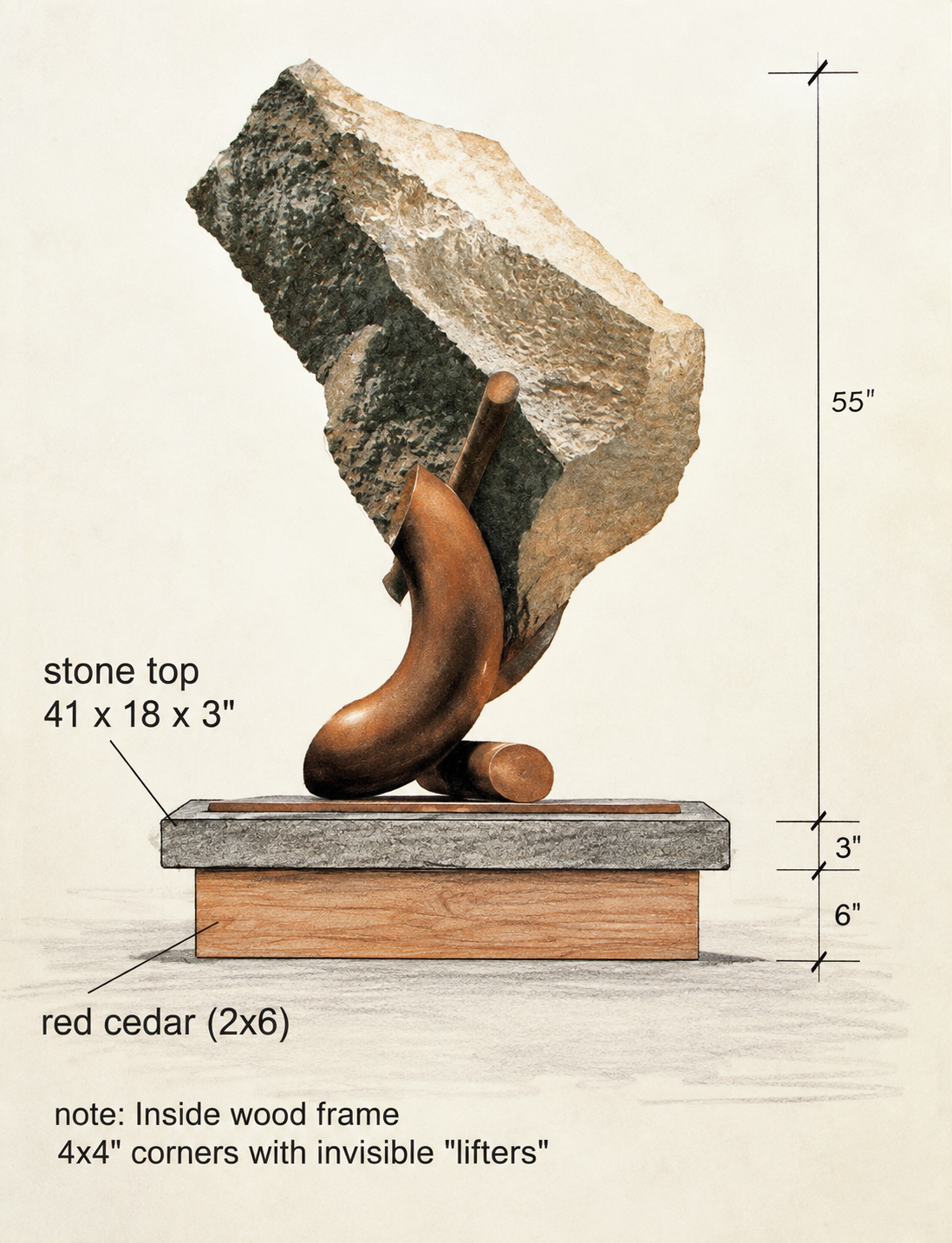
October 2002. Black granite, bronze. Dimensions: 55 × 44 × 15 in (140 × 112 × 38 cm).
Private collection - Kettering, OH
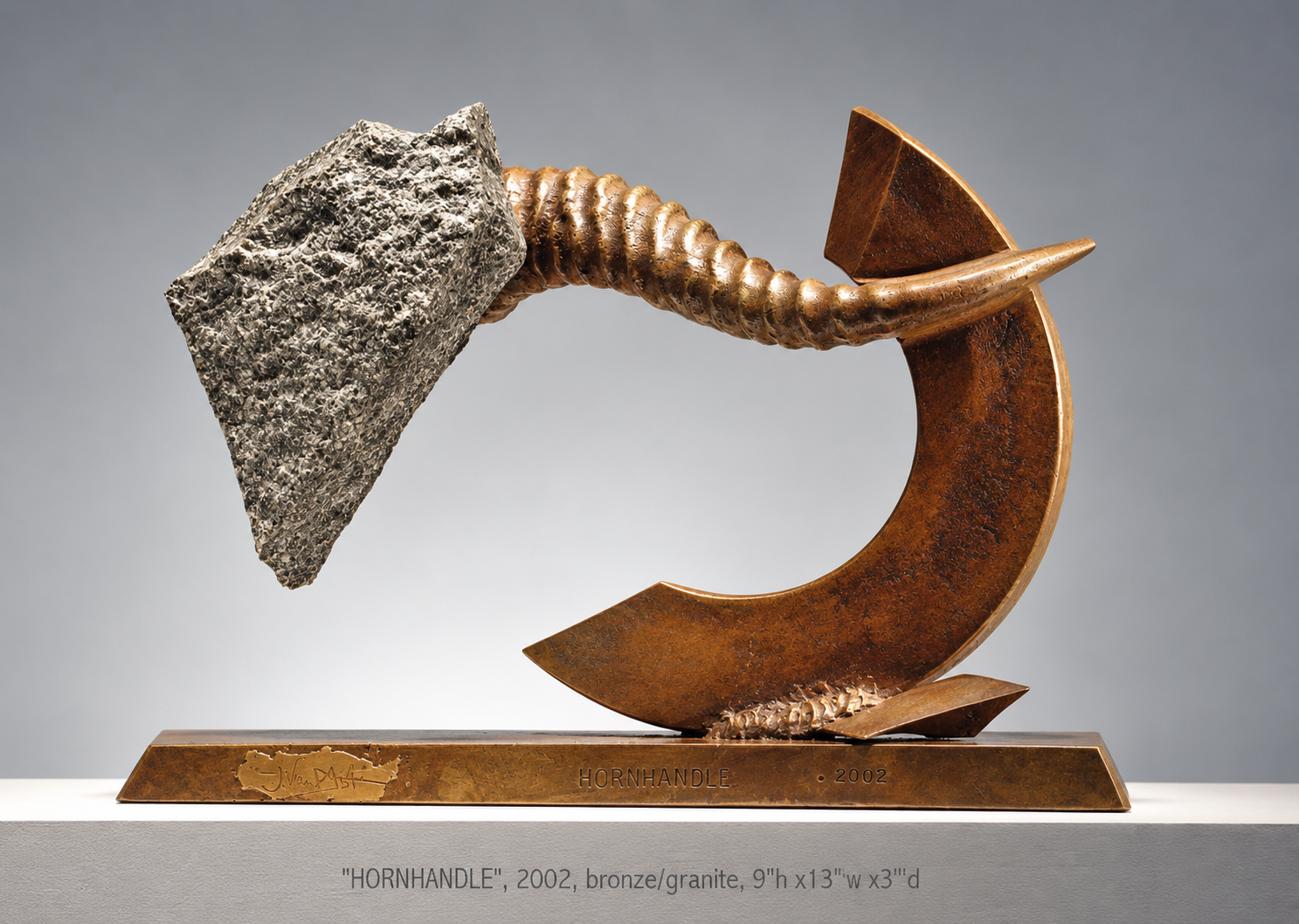
August 2002. Bronze, granite. Dimensions: 9 × 13 × 3 in (23 × 33 × 8 cm).
Private Collection - Baltimore.
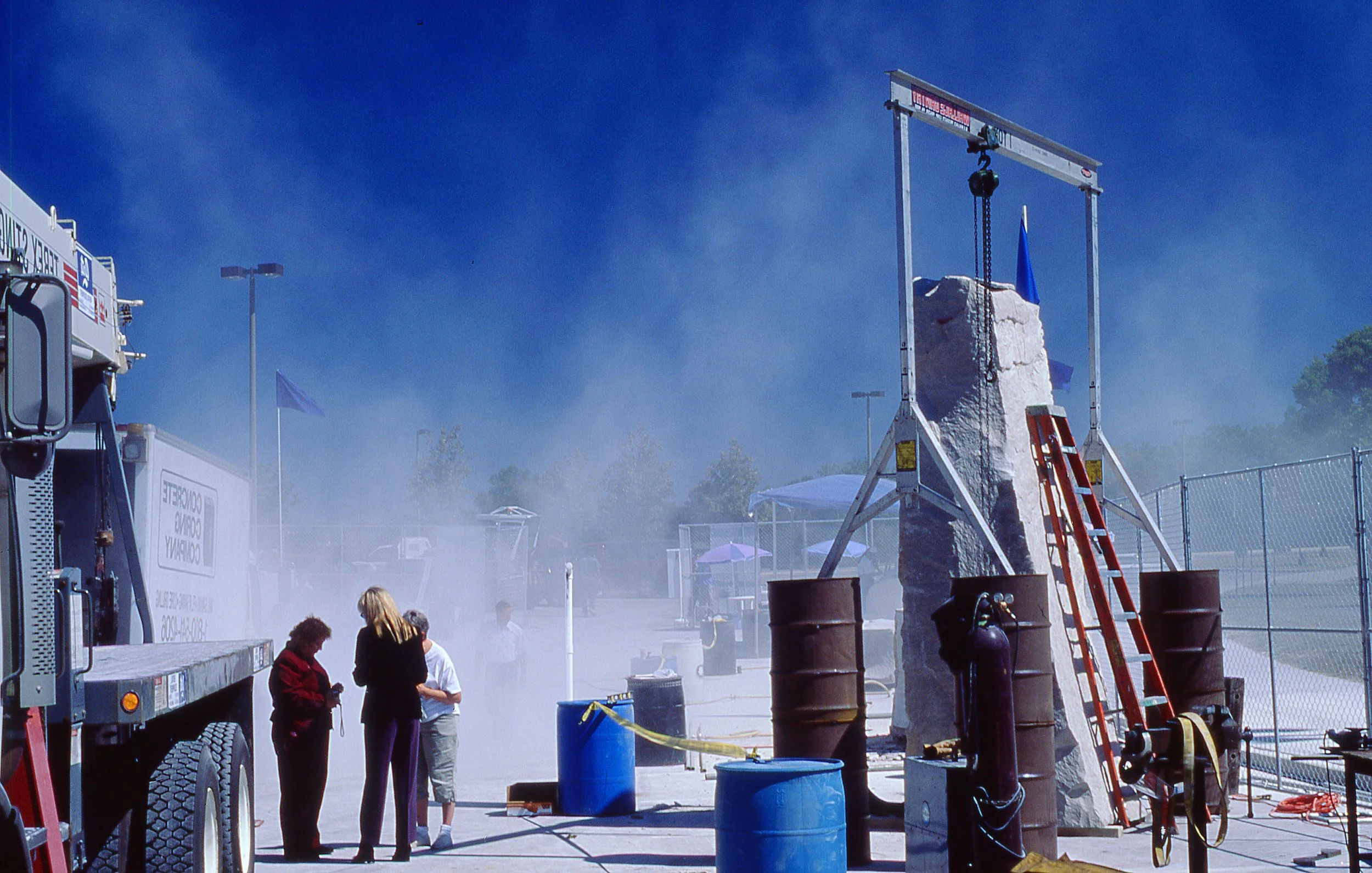
September 2002. Indiana Limestone, steel. Dimensions: 12’ high.
From: American Monuments 2025:
The monument is a living memorial to the memory of September 11, 2001. The sculpture heavy with stone, reflecting both the weightiness of the date in American history and the sturdiness of the people’s resolve in confronting the largest attack ever on the nation’s soil.
Every year on September 11, local crowds gather around the Kettering 9-11 Memorial. At solar noon, as the tip of the noon shadow slides across the stainless-steel marker, they collectively and solemnly remember the events of that day.
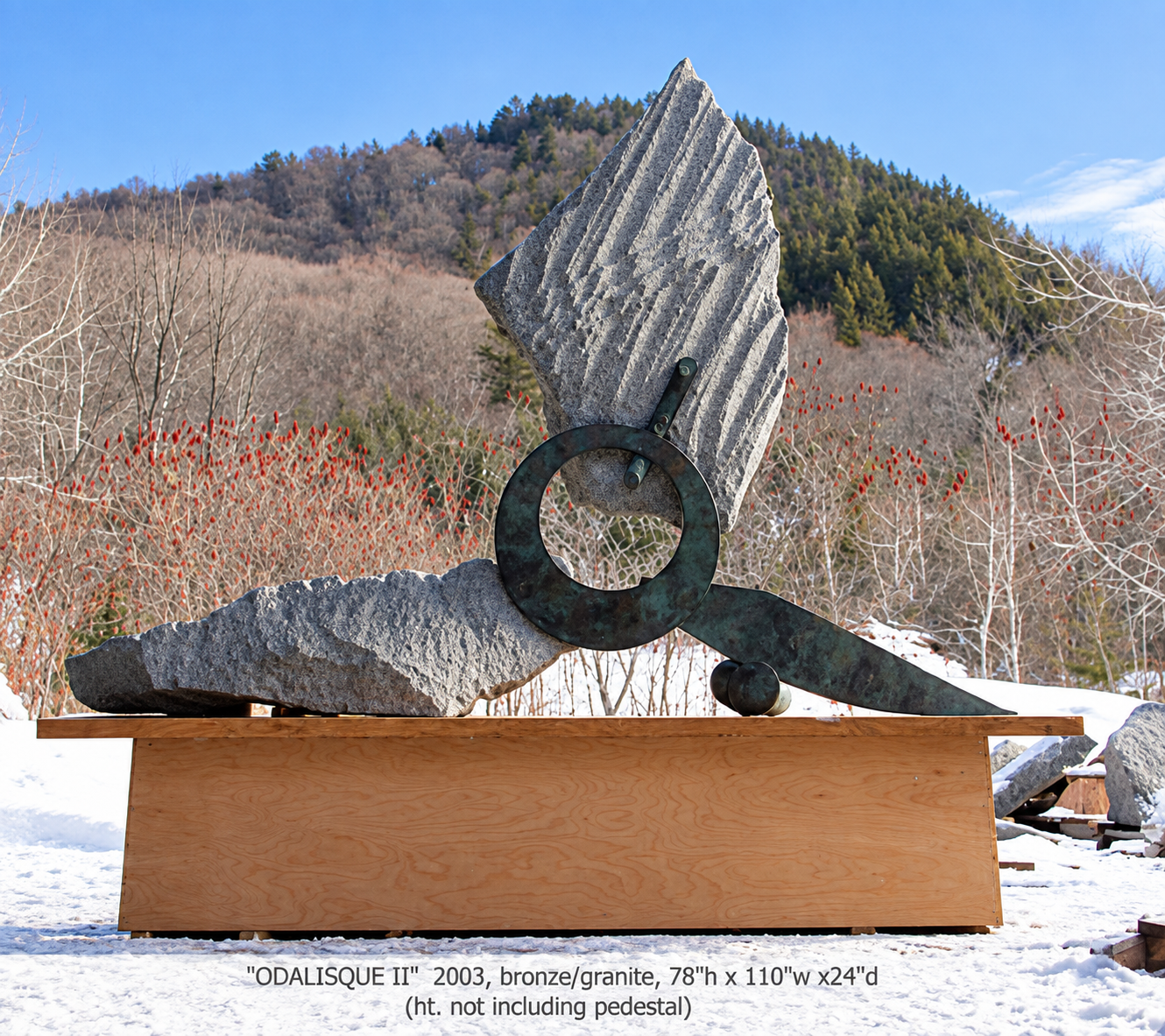
Odalisque II, 2003
Bronze, granite. 72 × 110 × 24 in. (183 × 279 × 61 cm). Private Collection, Virginia.
Odalisque II continues my interest in the human figure as a framework for abstraction and makes a direct reference to the long tradition of paintings and sculpture depicting the reclining female form. Like Odalisque I (1989), the work was inspired in part by Ingres’s La Grande Odalisque and its elongated, sensuous figure. Rather than describing the body literally, the arrangement of granite and bronze suggests a reclining figure through gesture, rhythm, and proportion. JOHN VAN ALSTINE SCULPTURE
The massive granite forms become surprisingly animated: one stretches horizontally while another rises and turns above it, joined by the circular bronze element and sweeping diagonal. The contrast between this implied bodily movement and the weight of the materials reflects my continuing interest in breathing life into heavy, earthbound stone and metal—using balance and arrested motion to transform mass into something figurative and alive.
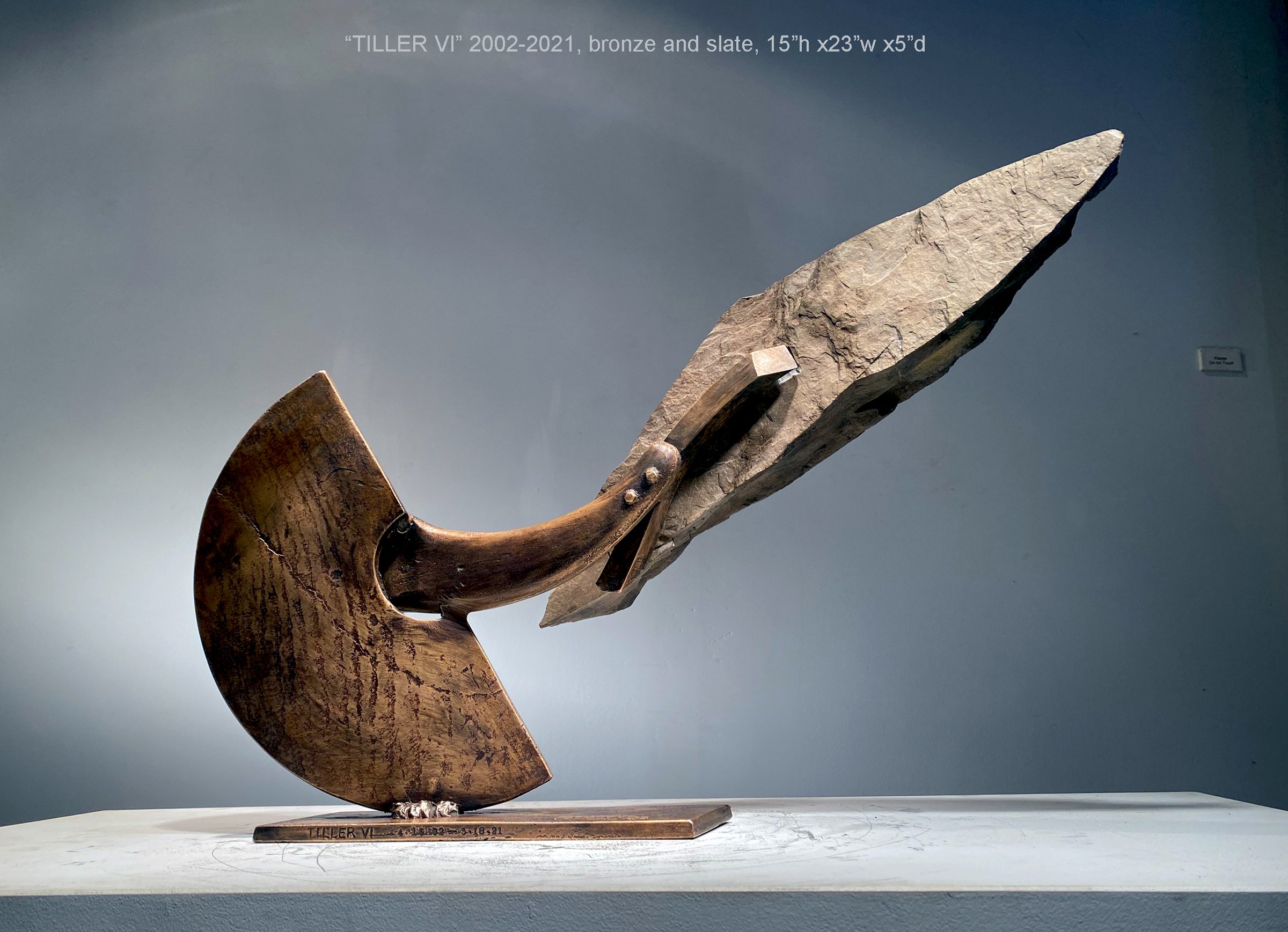
April 2002. Bronze, slate. Dimensions: 15 × 23 × 5 in (38 × 58 × 13 cm). (2021 Slate version)
The Tiller series grows from my interest in tools and agricultural implements as extensions of the human hand—objects that cultivate, shape, and engage the land. The title also evokes the tiller of a boat, a simple device used to steer and determine direction. Bringing these meanings together, the works explore the relationship between cultivation and navigation—our impulse both to shape the world around us and to chart a course through it.
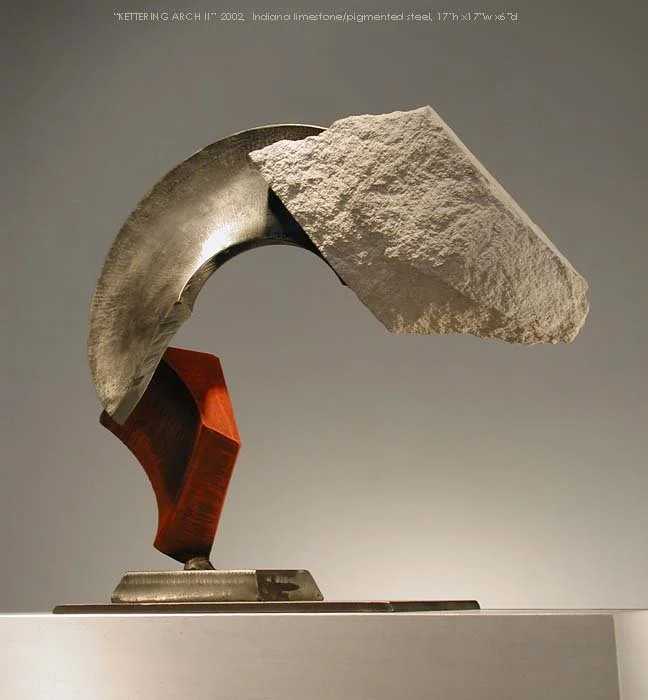
September 2001. Indiana Limestone, steel. Dimensions: 17 × 17 × 6 in (43 × 43 × 15 cm).
Private collection
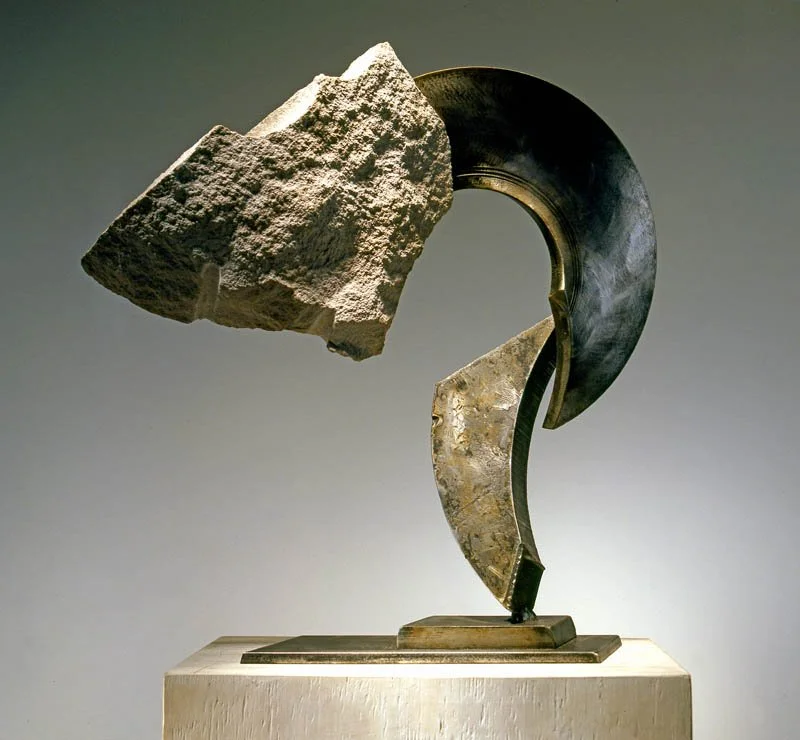
September 2002. Indiana Limestone, steel. Dimensions: 21 × 20 × 7 in (53 × 51 × 18 cm).
Private collection - Kettering, OH
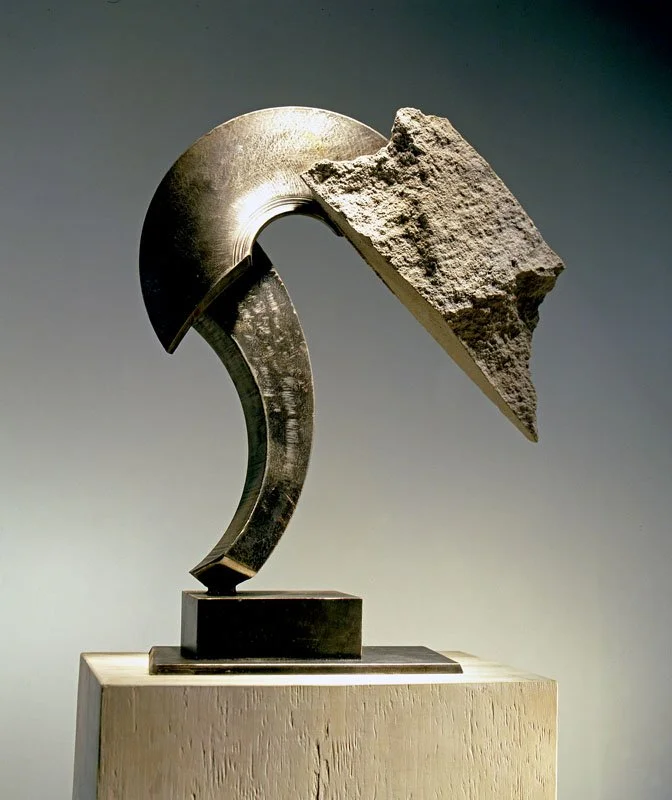
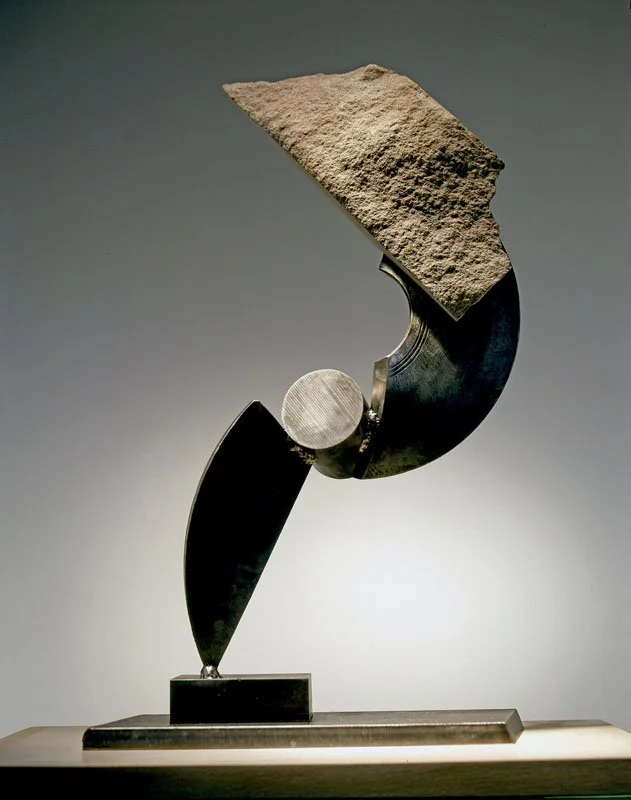
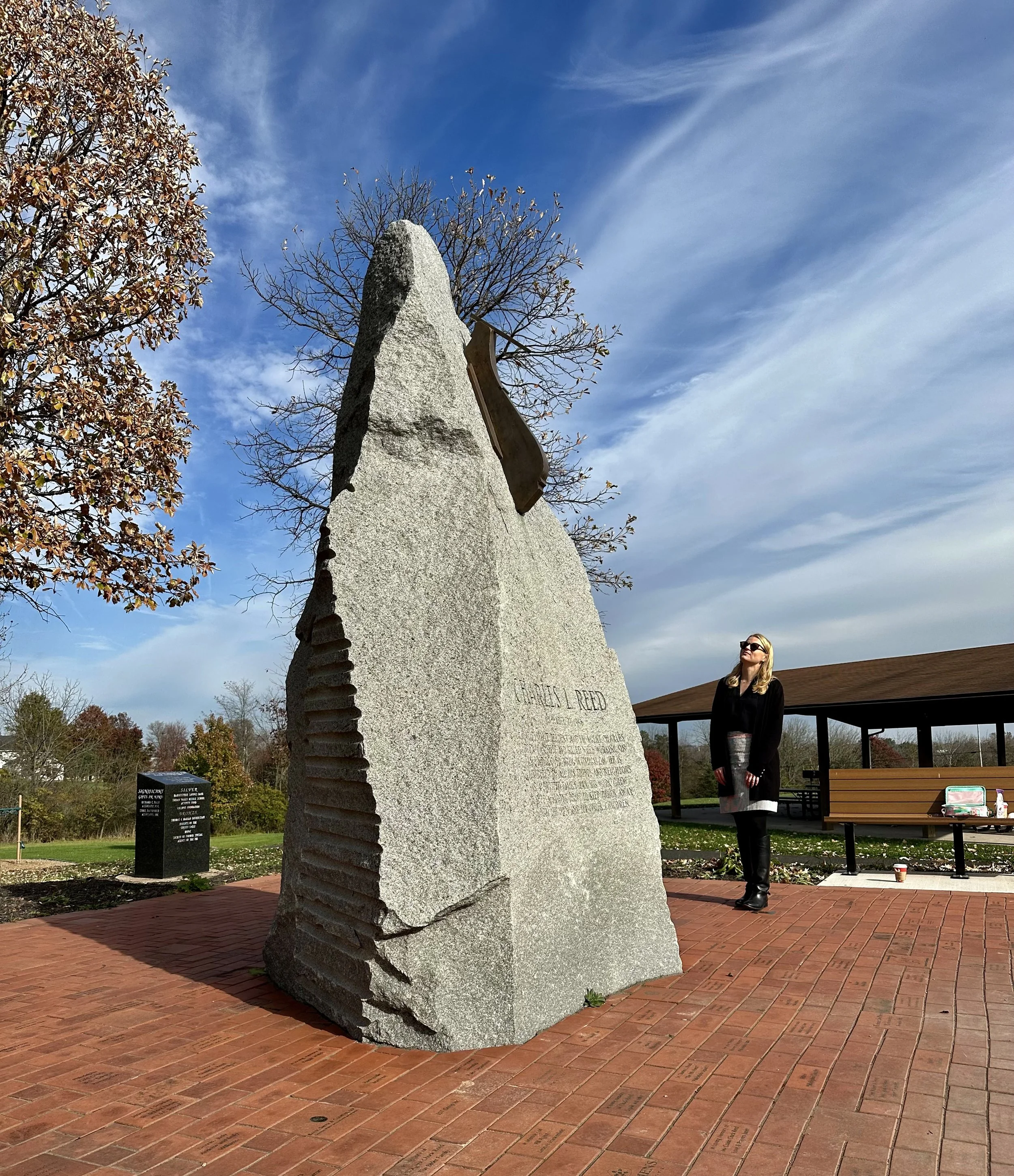
August 2002. Bronze, granite. Dimensions: 12’ × 5’ × 5’.
Dedicated March 22, 2003 to Charles L Reed, FBI Agent killed in the line of duty March 22, 1996, Reed Memorial Park, Harleysville, PA.
The Reed Memorial was Van Alstine’s first of three memorial projects and an extension of his Calendar series, with the first completed in 1986. Using the concept of marking the sun’s position with a metal "stylus" that records the placement of its shadow on a specific day and time, the Charles Reed Memorial commemorates the death of undercover FBI agent Charles Reed, who was killed in the line of duty on March 22, 1996, in Philadelphia. The sculpture was dedicated on the same date seven years later, in 2003, in Reed’s hometown of Harleysville, PA.
MORE INFO: Reed Memorial chapter in AMERICAN MONUMENTS
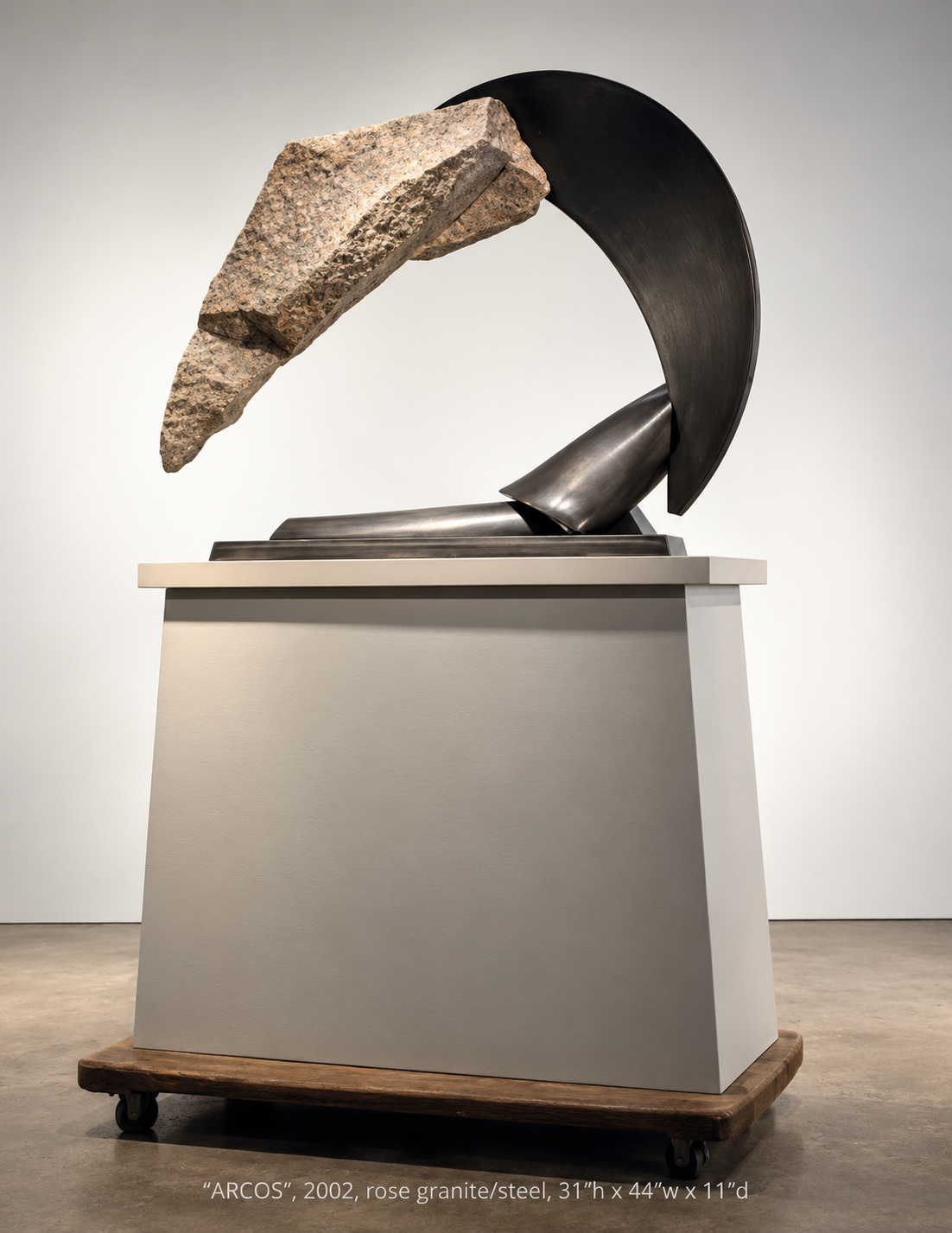
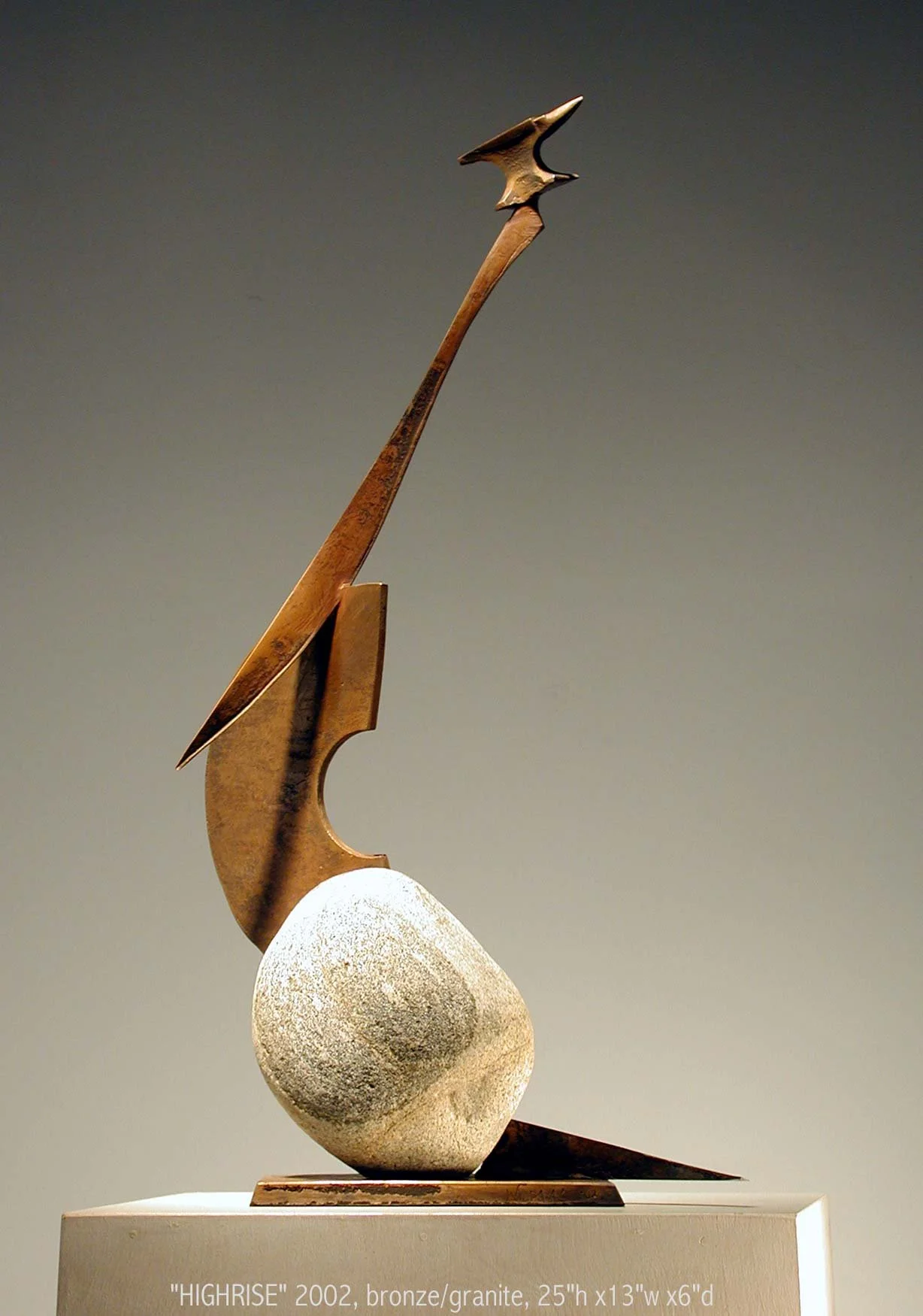
December 2002. Bronze, river stone. Dimensions: 25 × 13 × 6 in (64 × 33 × 15 cm).
Private collection Saudia Arabia
Artist Statement – John Van Alstine
“Many of my works incorporate anvils, either real or cast. The anvil's form, reminiscent of a boat or vessel, carries an inherent suggestion of journey—an idea that has long fascinated me. As a metalworker and “assembler,” I regard the anvil as both a physical and conceptual forge, the place where things come together and where the act of making transforms into art. For me, it holds an almost sacred presence—an altar of creation. In fact, I've titled a number of these works Ara, the Latin word for “altar.”
Throughout my practice, I strive to breathe a sense of life and airiness into materials that are otherwise dense and earthbound—rough granite, industrial-scale steel, and other heavy elements. The anvil, perhaps the ultimate emblem of weight and solidity, becomes especially compelling when lifted into the air. That gesture introduces a dynamic tension, a sense of levitation that animates the work and challenges our expectations of gravity and mass.”
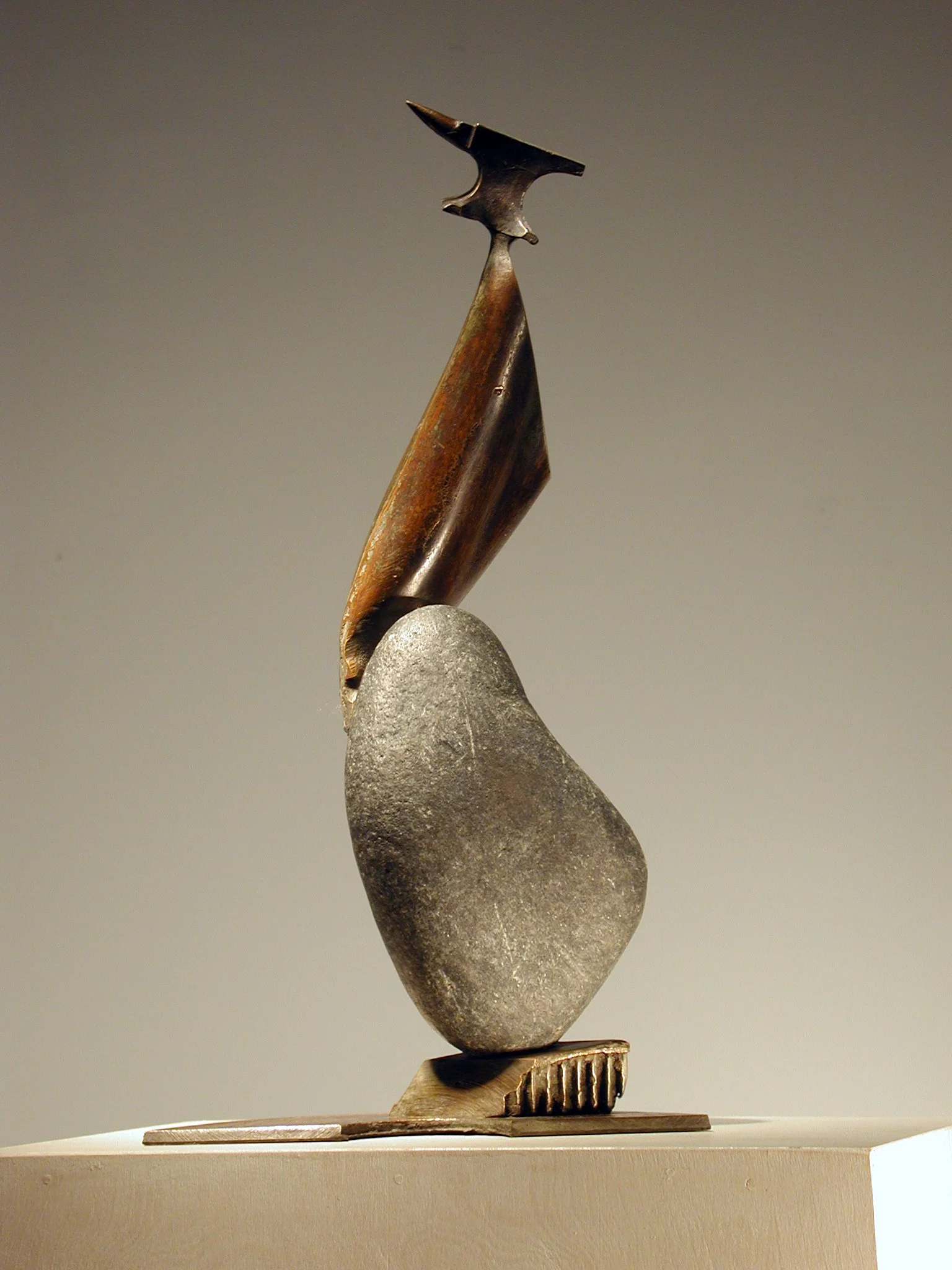
December 2002. Bronze, granite. Dimensions: 18 × 9 × 5 in (46 × 23 × 13 cm).
Private collection - New York State
Artist Statement – John Van Alstine
“Many of my works incorporate anvils, either real or cast. The anvil's form, reminiscent of a boat or vessel, carries an inherent suggestion of journey—an idea that has long fascinated me. As a metalworker and “assembler,” I regard the anvil as both a physical and conceptual forge, the place where things come together and where the act of making transforms into art. For me, it holds an almost sacred presence—an altar of creation. In fact, I've titled a number of these works Ara, the Latin word for “altar.”
Throughout my practice, I strive to breathe a sense of life and airiness into materials that are otherwise dense and earthbound—rough granite, industrial-scale steel, and other heavy elements. The anvil, perhaps the ultimate emblem of weight and solidity, becomes especially compelling when lifted into the air. That gesture introduces a dynamic tension, a sense of levitation that animates the work and challenges our expectations of gravity and mass.”
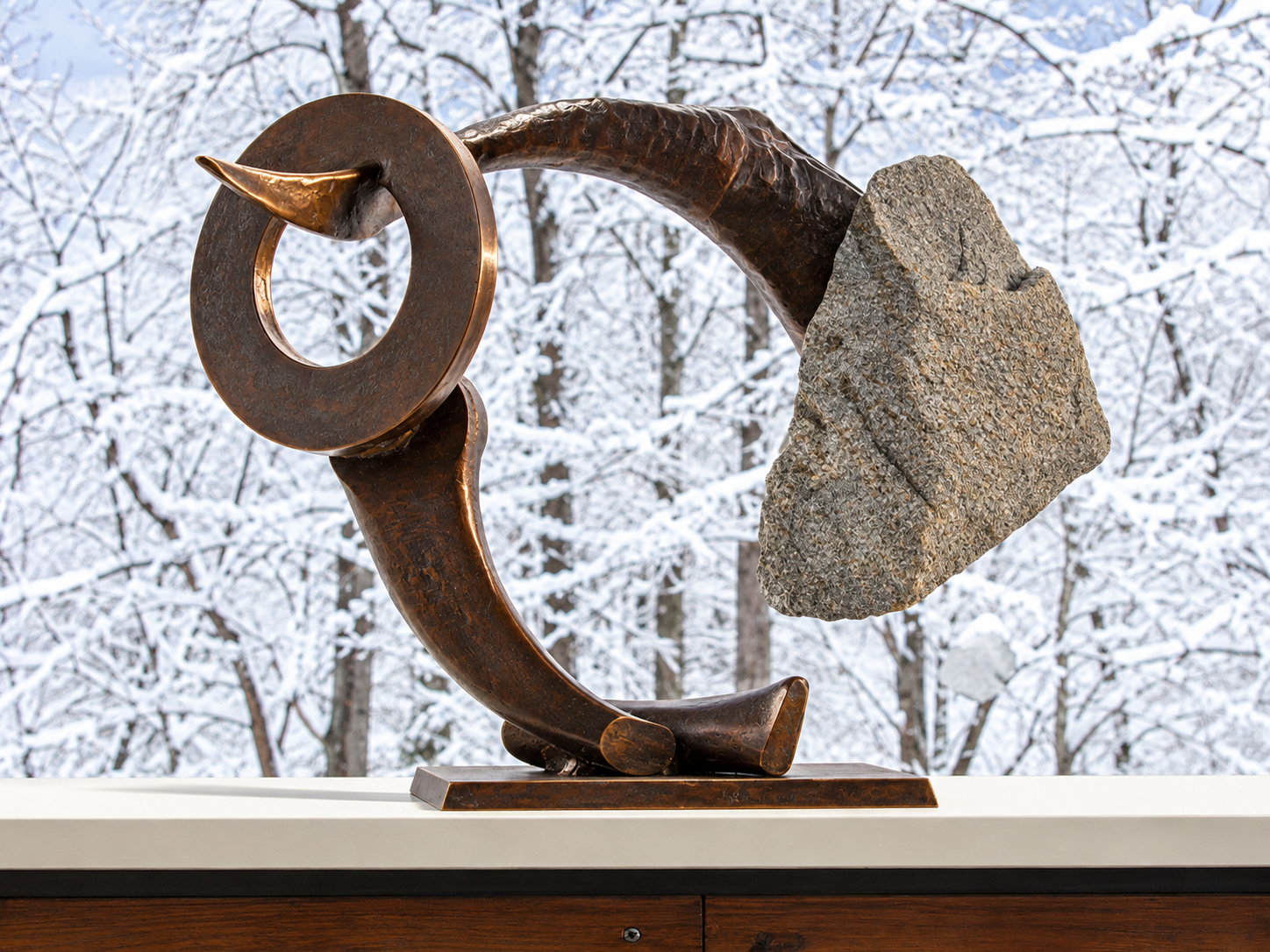
December 2002. Bronze, granite. Dimensions: 14 × 17 × 6 in (36 × 43 × 15 cm).
Private collection - Montreal
2001
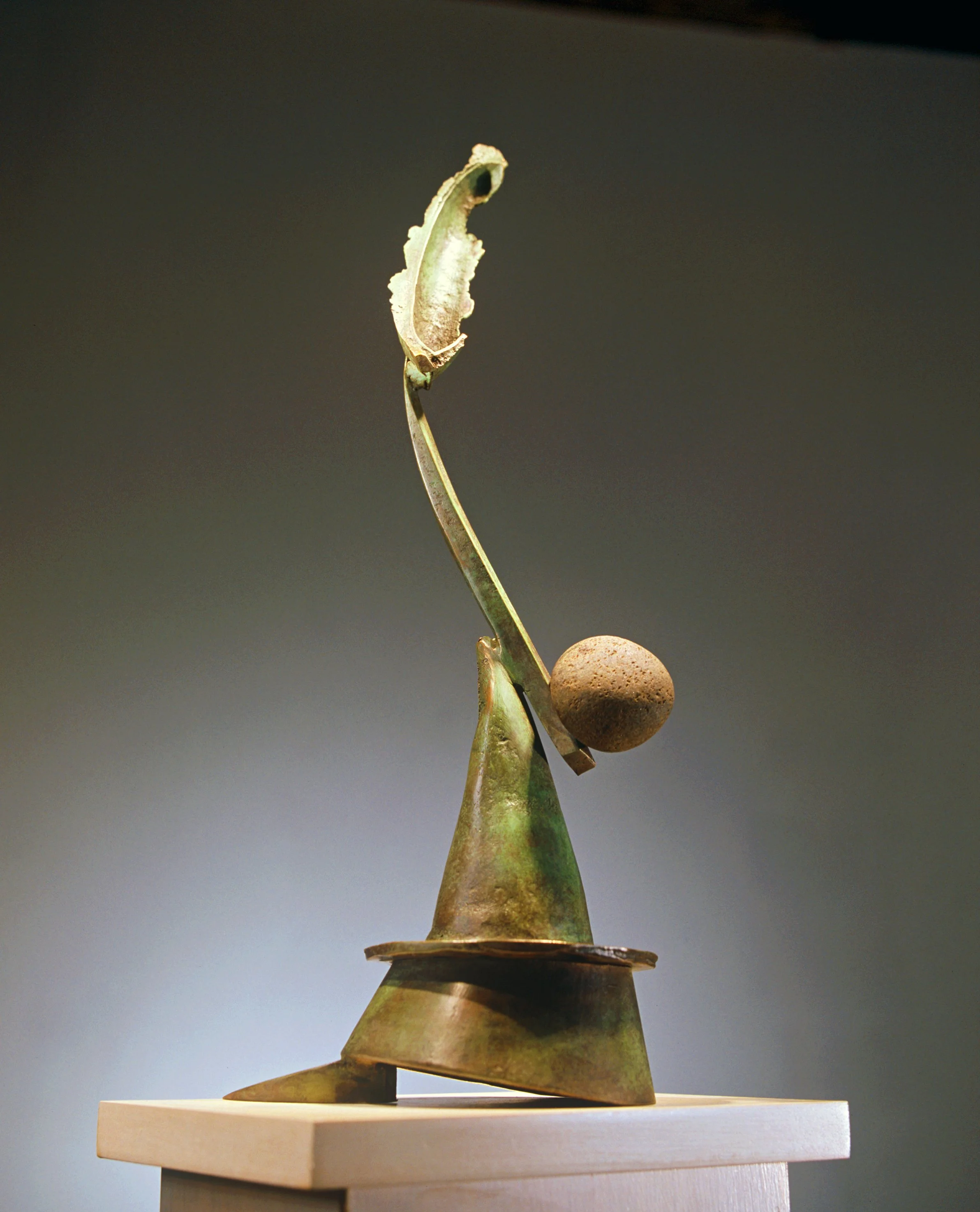
January 2001. Bronze, river stone. Dimensions: 21 × 9 × 6 in (53 × 23 × 15 cm).
Private collection
bal·last /'bal?st/
verb;
give stability to (a ship) by putting a heavy substance in its bilge.
"the vessel has been ballasted to give the necessary floating stability"
noun;
heavy material, such as gravel, sand, iron, or lead, placed low in a vessel to improve its stability.
"the hull had insufficient ballast"
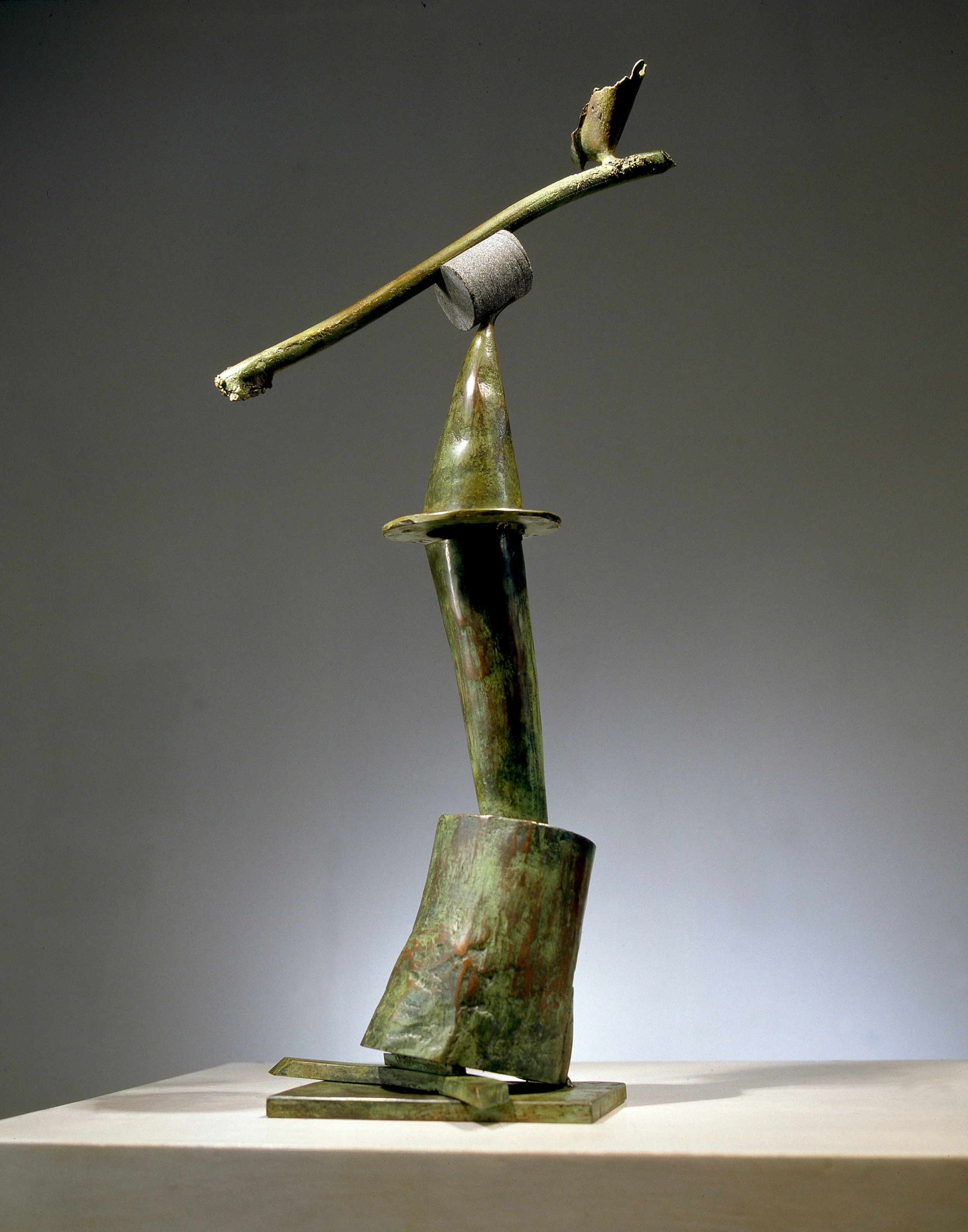
January 2001. Bronze, granite. Dimensions: 33 × 16 × 9 in (84 × 41 × 23 cm). Private Collection
Many of Van Alstine’s works take inspiration from the movement of the human body. This work can be seen as a kind of self-portrait, suggesting his studio process—literally juggling and repositioning the individual elements of a sculpture until they achieve a moment of perfect balance, then freezing that moment in space through welding. More universally, juggling becomes a metaphor for the way we all balance the competing demands of family, work, play, and responsibility.
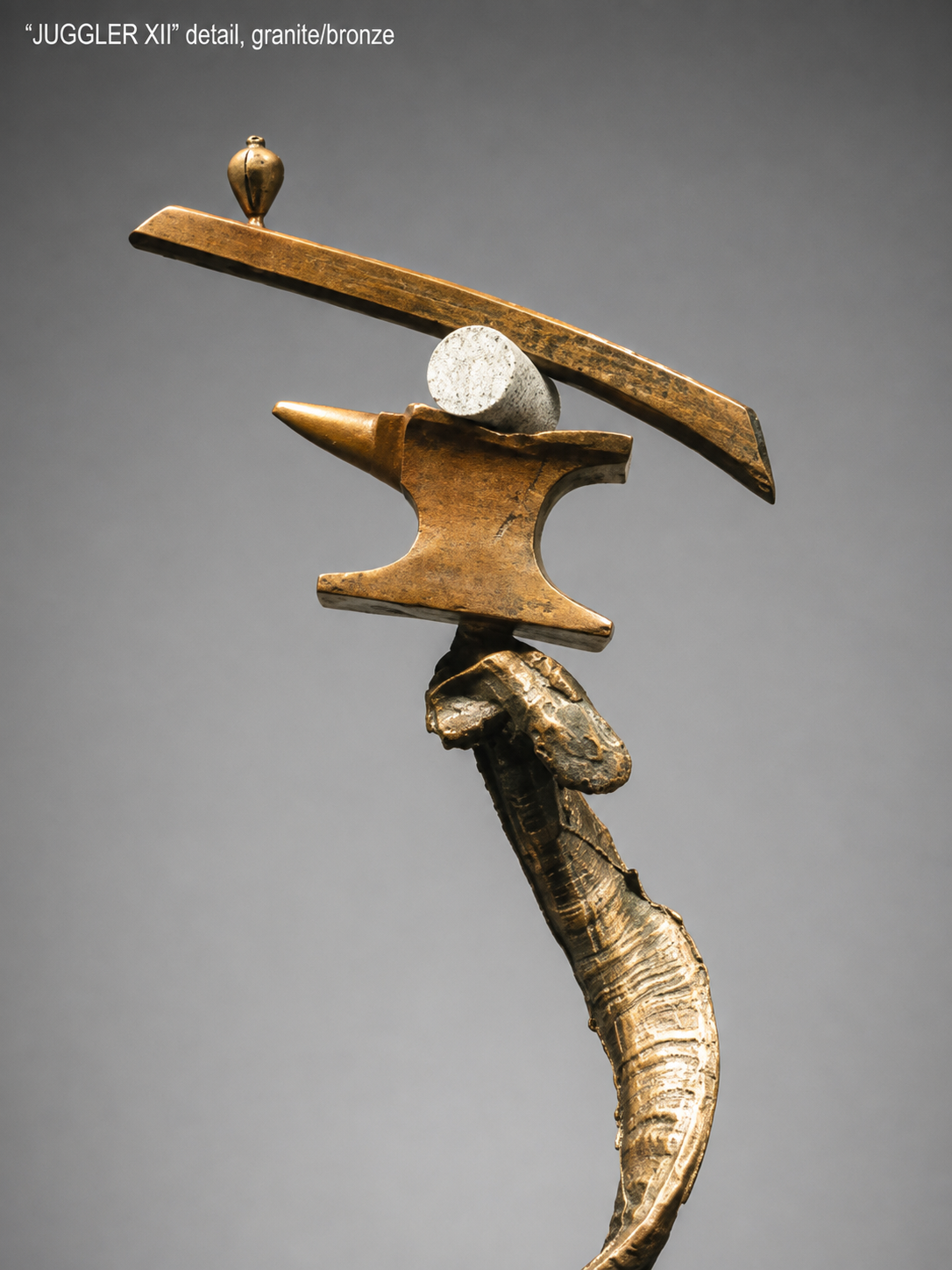
February 2001. Bronze, granite. Dimensions: 44 × 22 × 8 in (112 × 56 × 20 cm).
Private collection - Scottsdale, AZ
Artist Statement – John Van Alstine
“Many of my works incorporate anvils, either real or cast. The anvil's form, reminiscent of a boat or vessel, carries an inherent suggestion of journey—an idea that has long fascinated me. As a metalworker and “assembler,” I regard the anvil as both a physical and conceptual forge, the place where things come together and where the act of making transforms into art. For me, it holds an almost sacred presence—an altar of creation. In fact, I've titled a number of these works Ara, the Latin word for “altar.”
Throughout my practice, I strive to breathe a sense of life and airiness into materials that are otherwise dense and earthbound—rough granite, industrial-scale steel, and other heavy elements. The anvil, perhaps the ultimate emblem of weight and solidity, becomes especially compelling when lifted into the air. That gesture introduces a dynamic tension, a sense of levitation that animates the work and challenges our expectations of gravity and mass.”
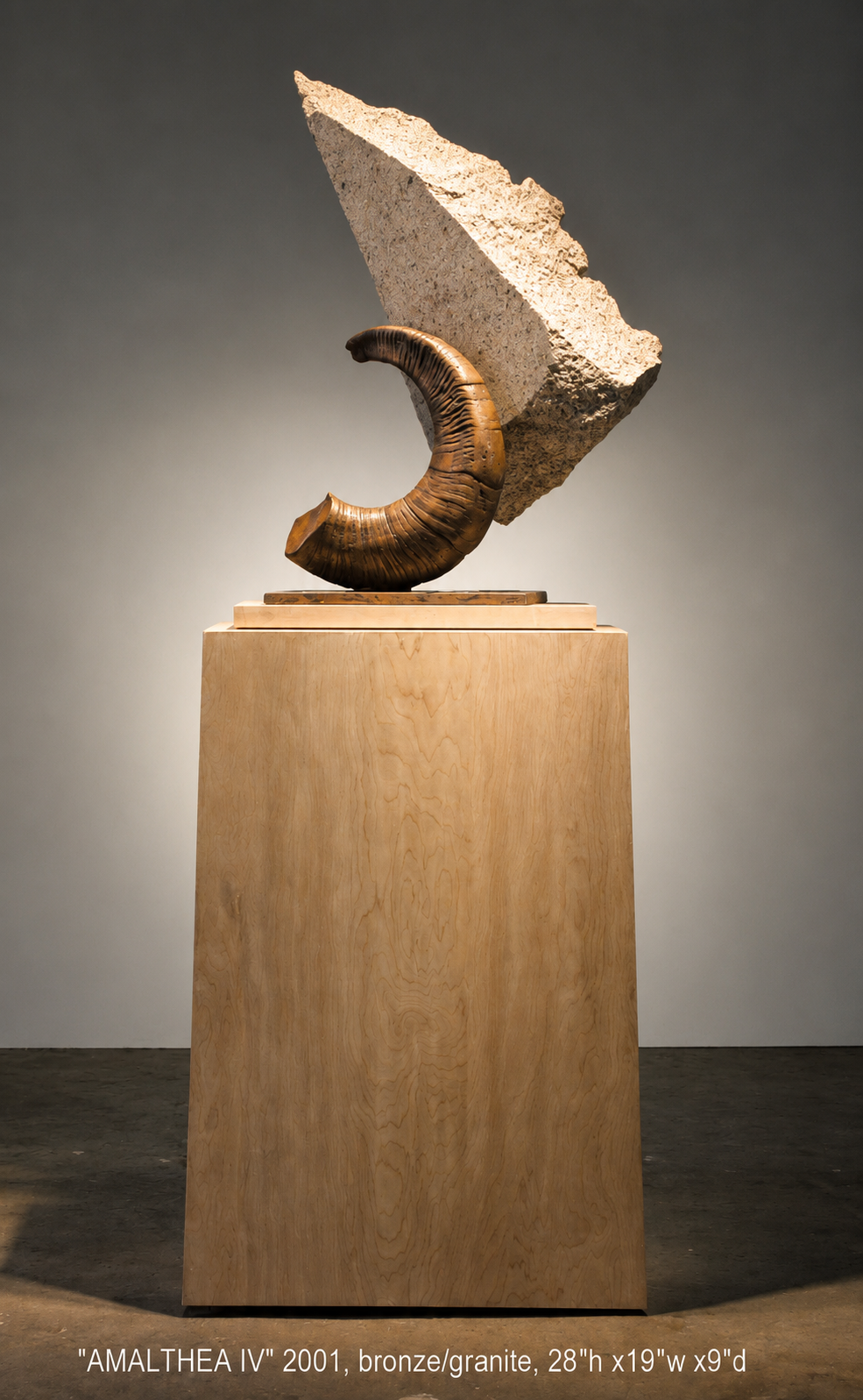
February 2001. Bronze, granite. Dimensions: 28 × 19 × 9 in (71 × 48 × 23 cm).
Amalthea IV is the forth work in my Amalthea Series and reflects my growing interest in combining the natural forms of animal horns with stone. Cast in bronze, the horn becomes both a structural and expressive element, supporting and visually lifting the rough granite while bringing organic form into dialogue with stone.
The title refers to Amalthea, the nurturing figure in Greek mythology who fed the infant Zeus. One of her horns became the cornucopia, or horn of plenty, a symbol of nourishment and abundance. I use the myth as a metaphor for the sustaining power of art—my belief that art and culture nourish and sustain the human spirit.
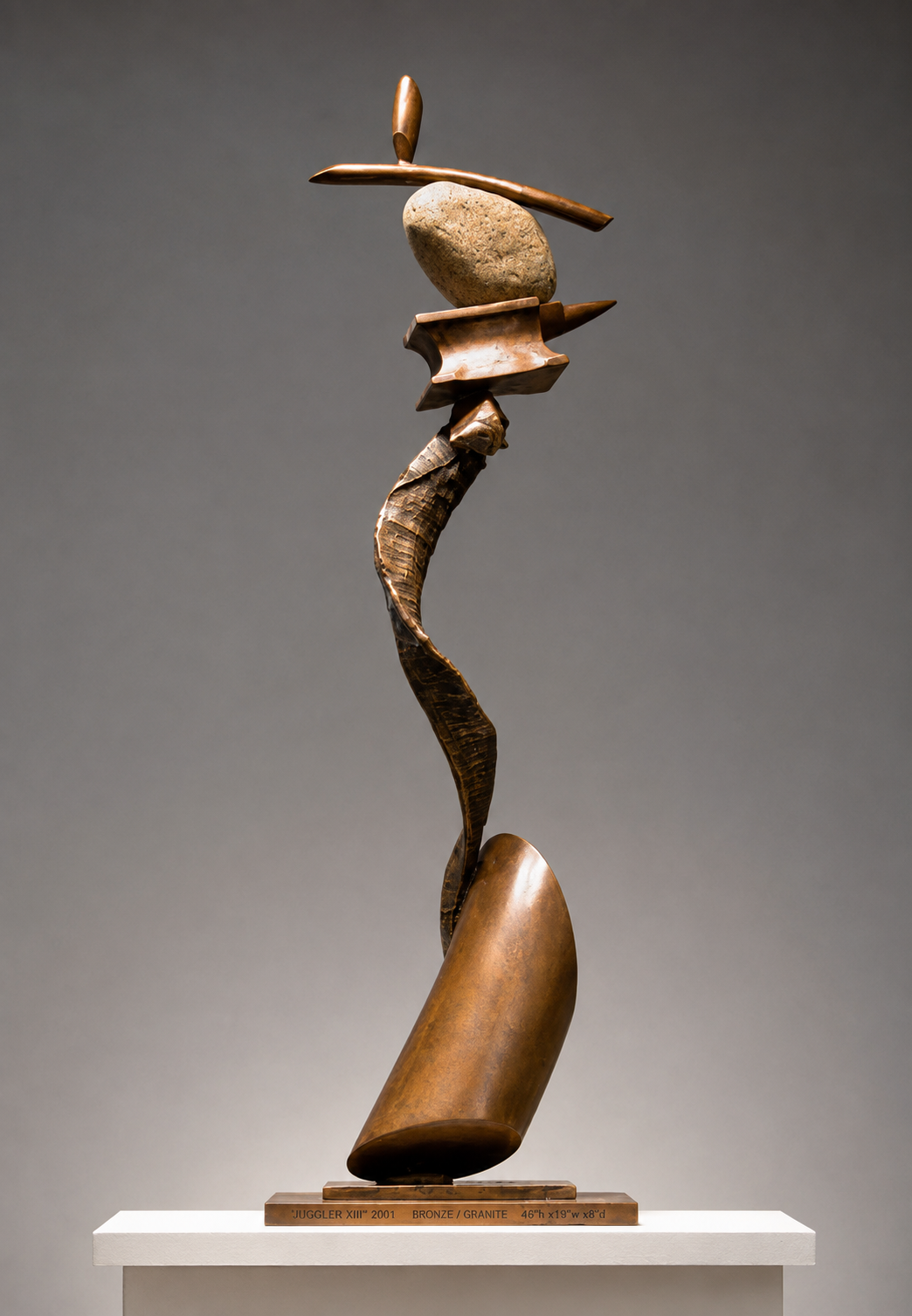
February 2001. Bronze, granite. Dimensions: 46 × 19 × 8 in (117 × 48 × 20 cm).
Corporate collection - Four seasons Hotel, St Louis
Artist Statement – John Van Alstine
“Many of my works incorporate anvils, either real or cast. The anvil's form, reminiscent of a boat or vessel, carries an inherent suggestion of journey—an idea that has long fascinated me. As a metalworker and “assembler,” I regard the anvil as both a physical and conceptual forge, the place where things come together and where the act of making transforms into art. For me, it holds an almost sacred presence—an altar of creation. In fact, I've titled a number of these works Ara, the Latin word for “altar.”
Throughout my practice, I strive to breathe a sense of life and airiness into materials that are otherwise dense and earthbound—rough granite, industrial-scale steel, and other heavy elements. The anvil, perhaps the ultimate emblem of weight and solidity, becomes especially compelling when lifted into the air. That gesture introduces a dynamic tension, a sense of levitation that animates the work and challenges our expectations of gravity and mass.”
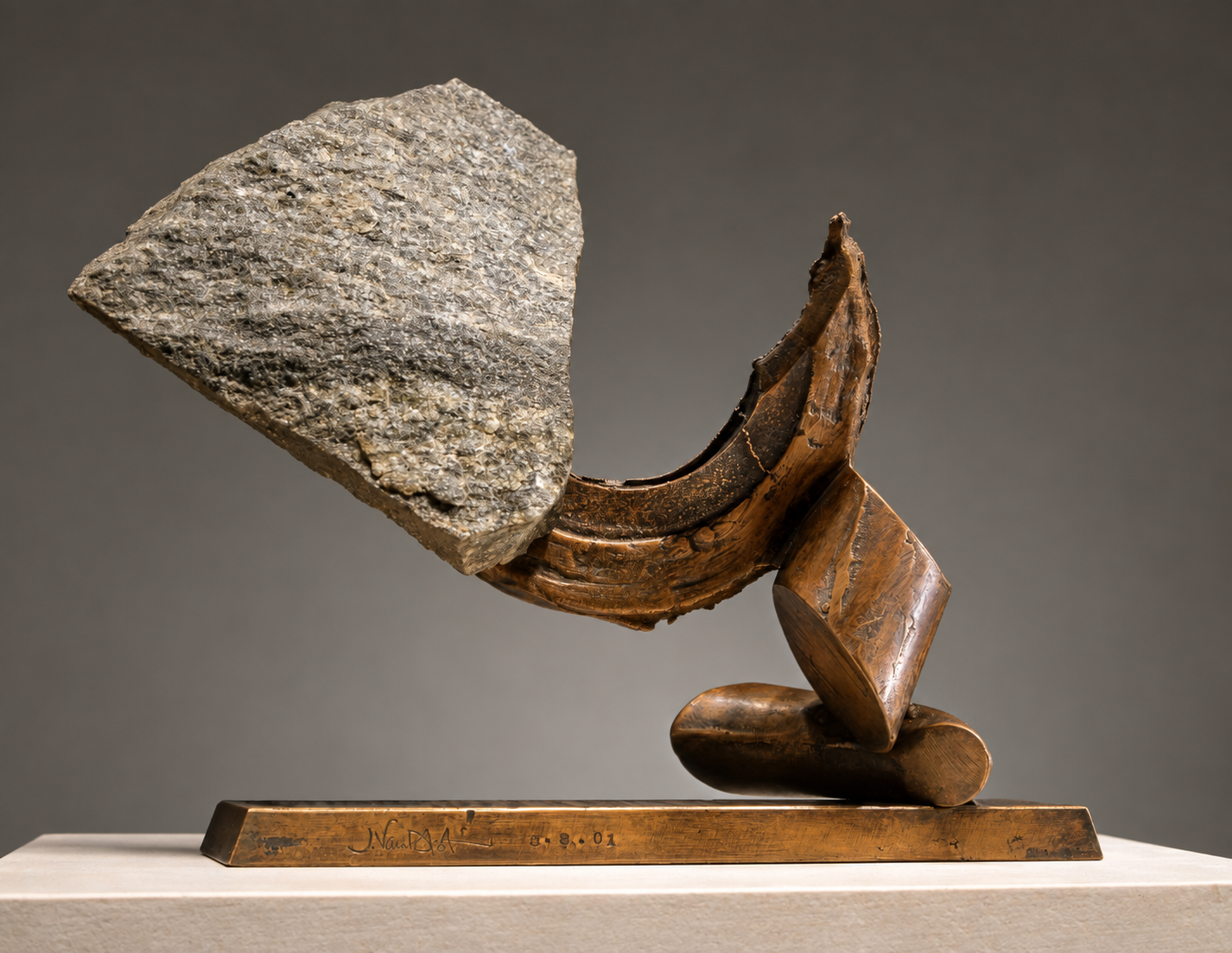
March 2001. Bronze, green granite. Dimensions: 10.5 × 12 × 4 in (27 × 30 × 10 cm).
Private collection - Pittsburgh, PA
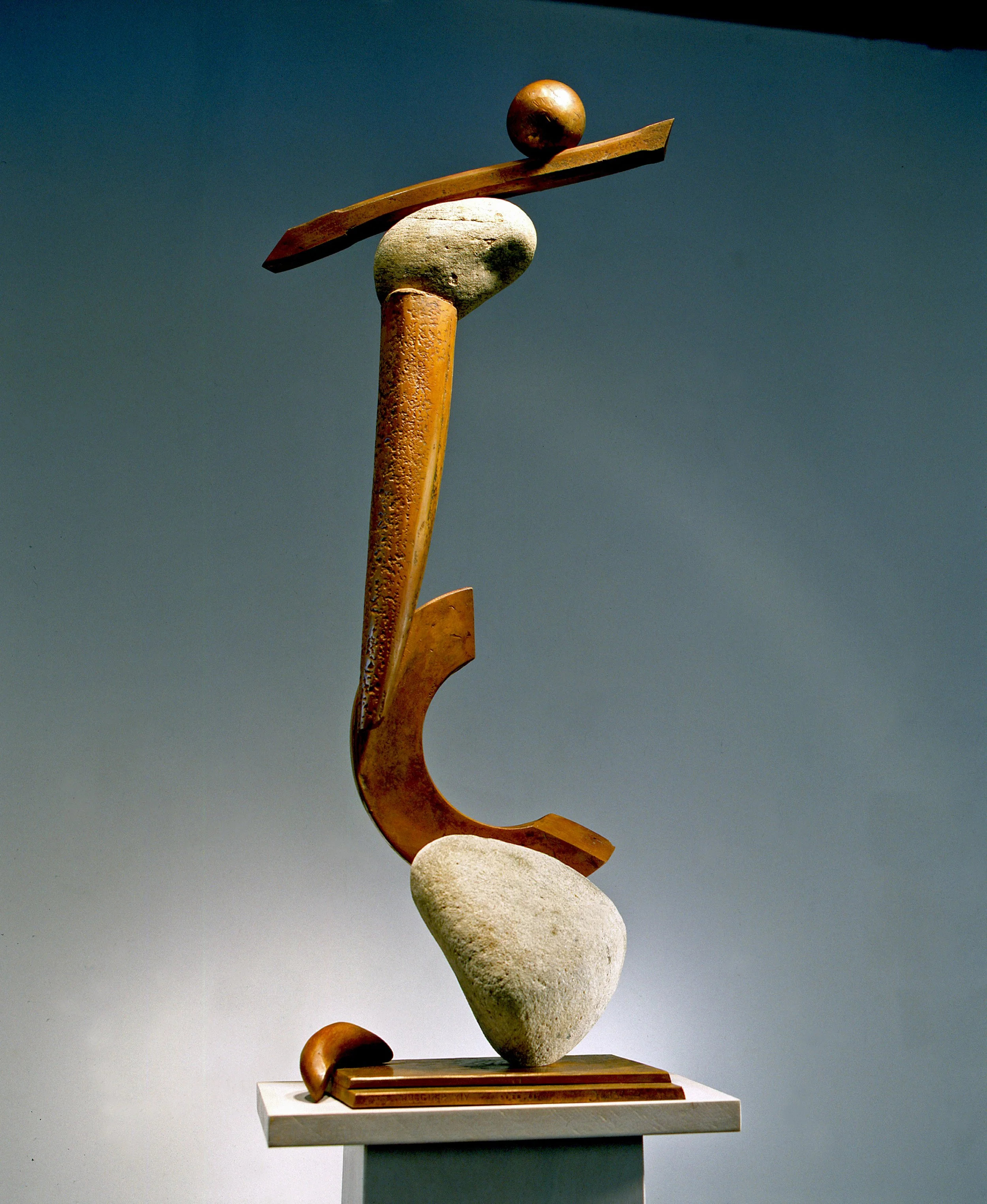
March 2001. Bronze granite. Dimensions: 38 × 16 × 8 in (97 × 41 × 20 cm). Private collection - Scottsdale, AZ
Many of Van Alstine’s works take inspiration from the movement of the human body. This work can be seen as a kind of self-portrait, suggesting his studio process—literally juggling and repositioning the individual elements of a sculpture until they achieve a moment of perfect balance, then freezing that moment in space through welding. More universally, juggling becomes a metaphor for the way we all balance the competing demands of family, work, play, and responsibility.
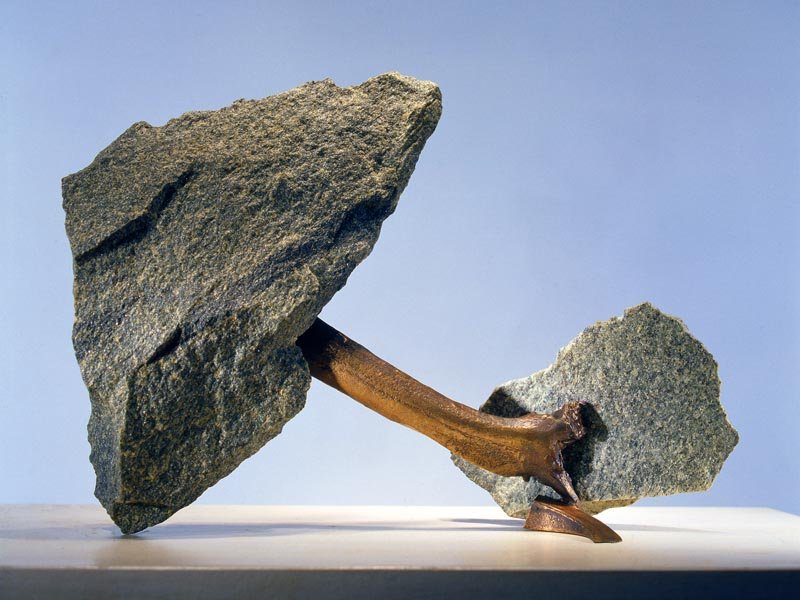
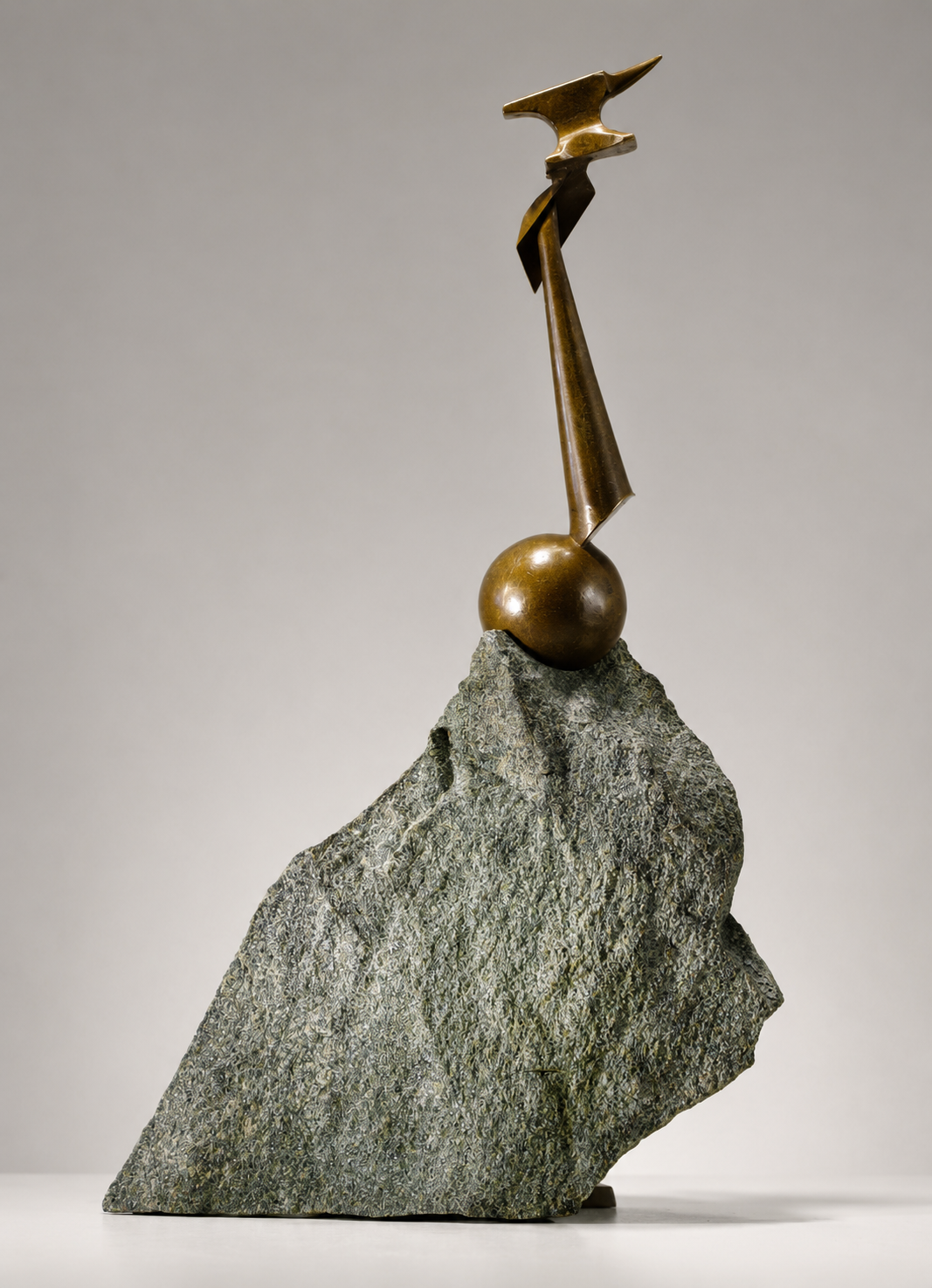
April 2001. Green granite, bronze. Dimensions: 24 × 15 × 6 in (61 × 38 × 15 cm).
Corporate collection - St. Louis, MO
Artist Statement – John Van Alstine
“Many of my works incorporate anvils, either real or cast. The anvil's form, reminiscent of a boat or vessel, carries an inherent suggestion of journey—an idea that has long fascinated me. As a metalworker and “assembler,” I regard the anvil as both a physical and conceptual forge, the place where things come together and where the act of making transforms into art. For me, it holds an almost sacred presence—an altar of creation. In fact, I've titled a number of these works Ara, the Latin word for “altar.”
Throughout my practice, I strive to breathe a sense of life and airiness into materials that are otherwise dense and earthbound—rough granite, industrial-scale steel, and other heavy elements. The anvil, perhaps the ultimate emblem of weight and solidity, becomes especially compelling when lifted into the air. That gesture introduces a dynamic tension, a sense of levitation that animates the work and challenges our expectations of gravity and mass.”
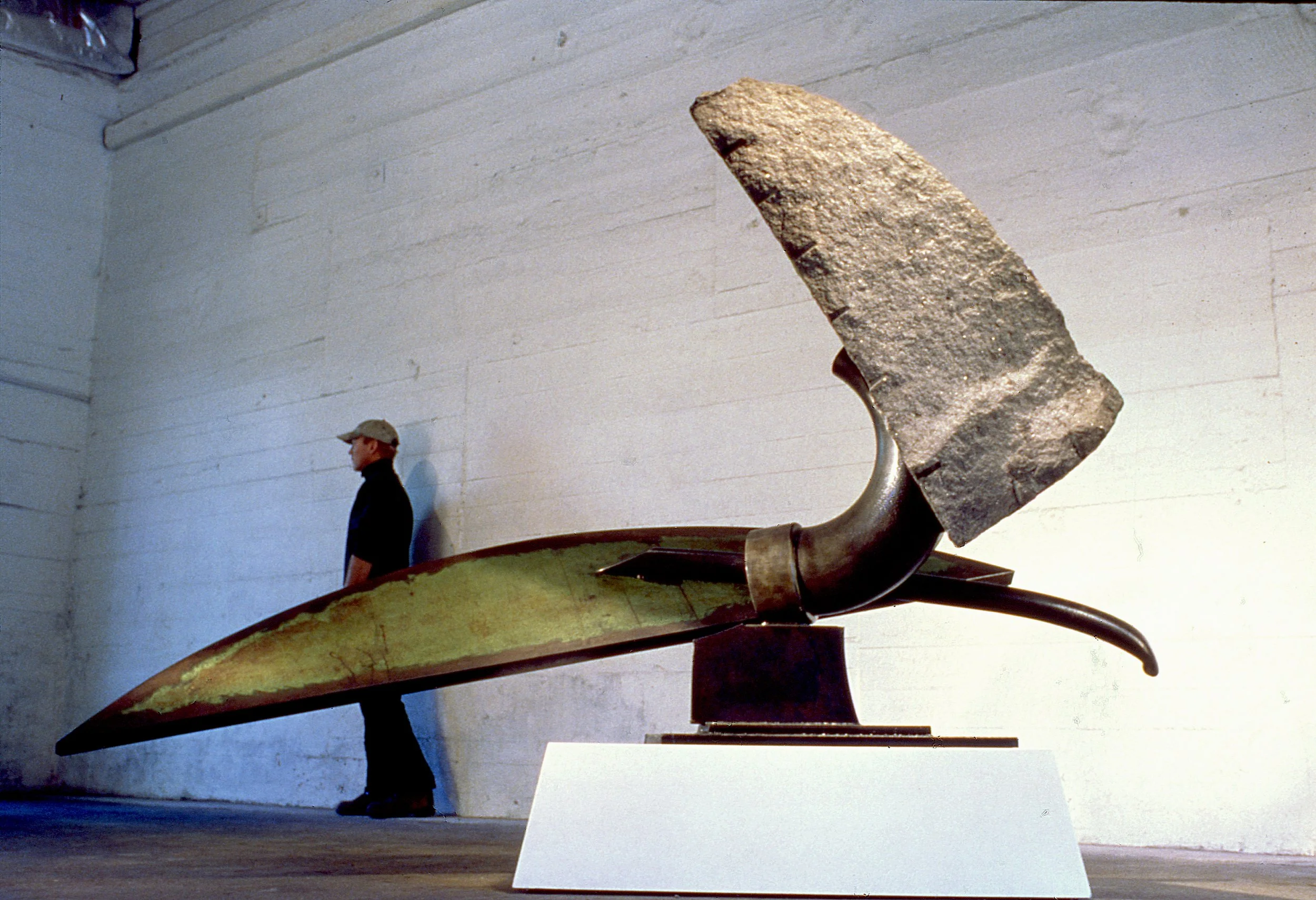
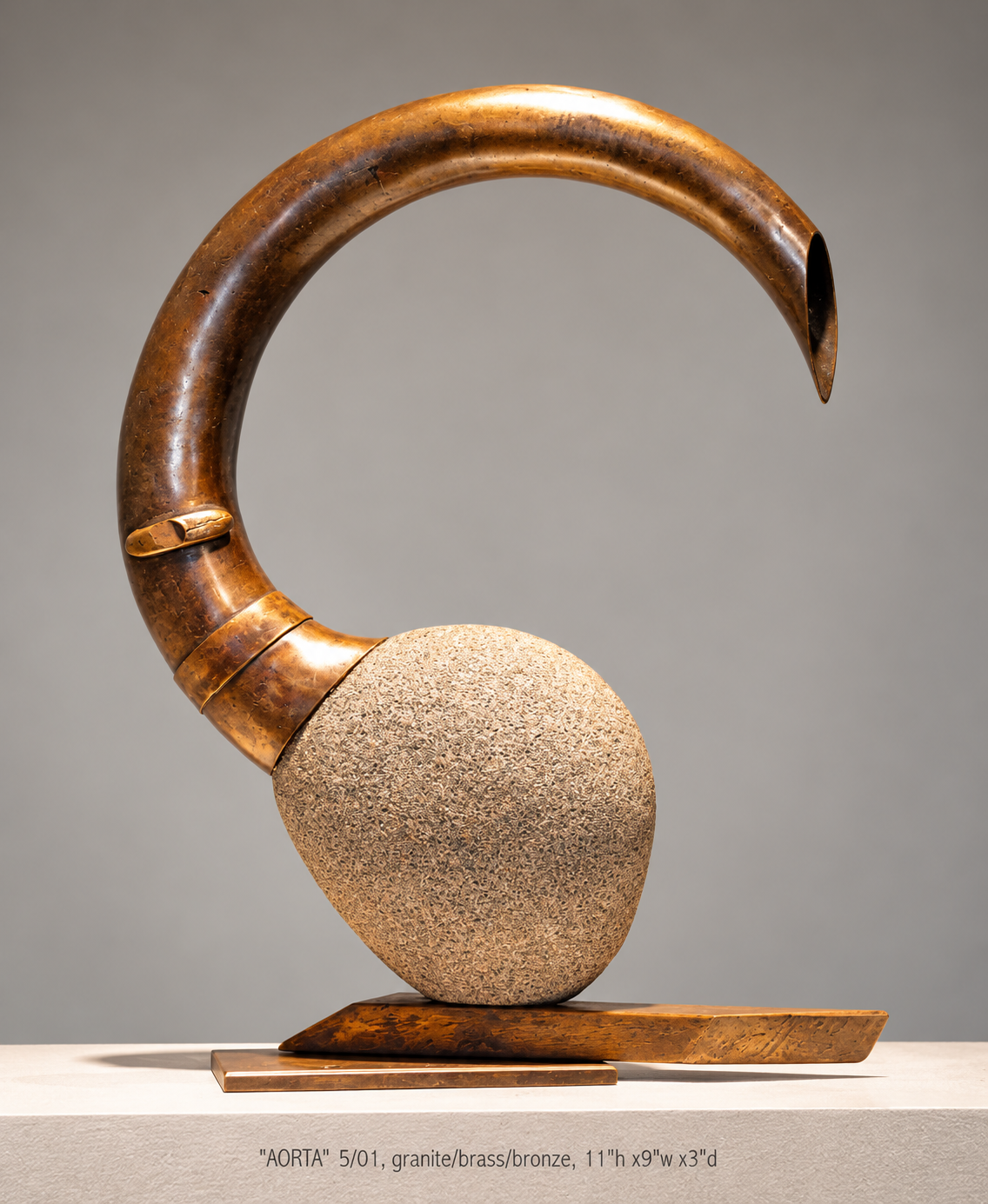
May 2001. Granite, brass, bronze. Dimensions: 11 × 9 × 3 in (28 × 23 × 8 cm). Private Collection.
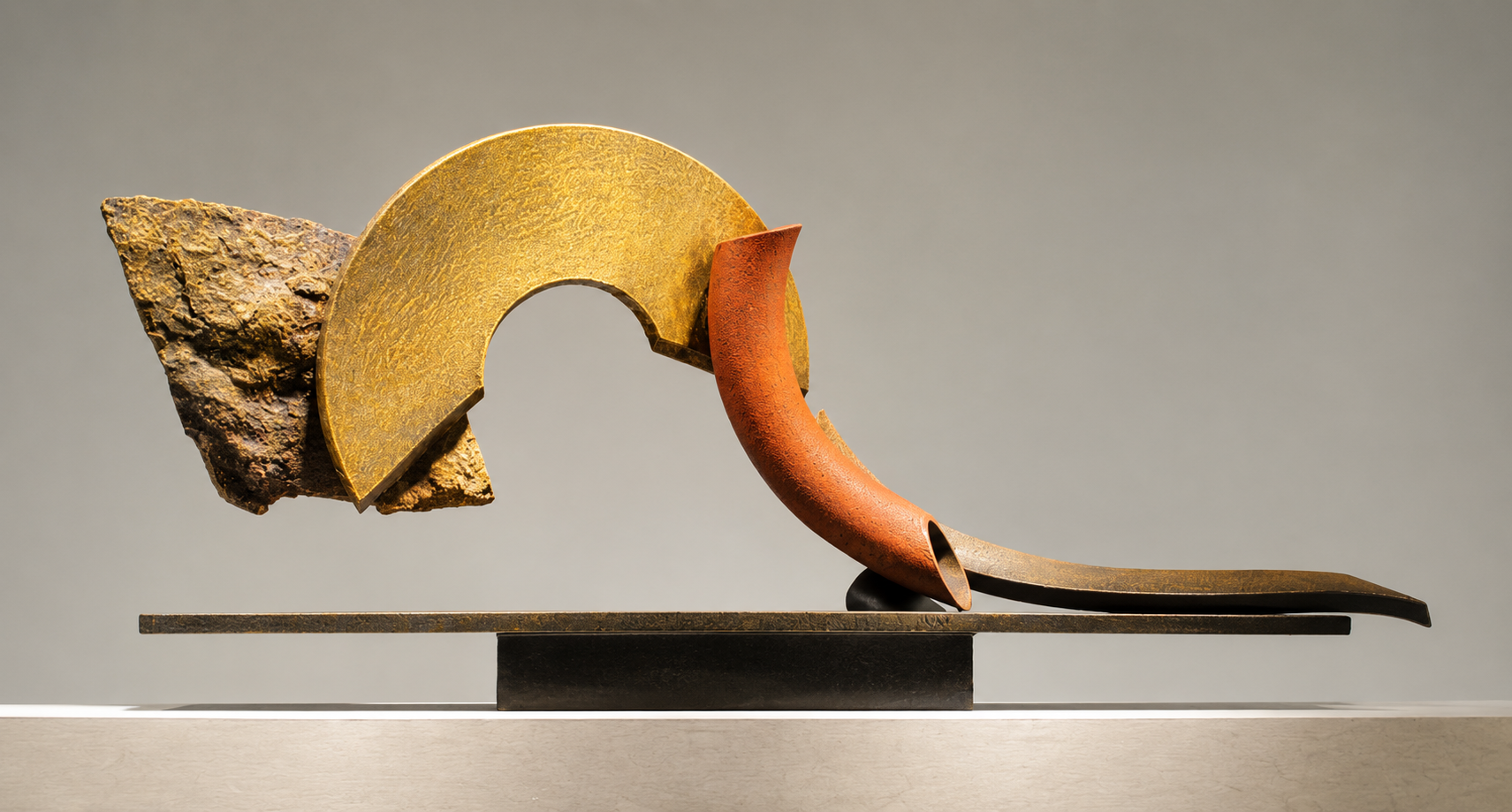
May 2001. painted granite and painted steel steel. Dimensions: 15.5 × 34 × 4 in (39 × 86 × 10 cm).
Private collection -St. Paul, MN
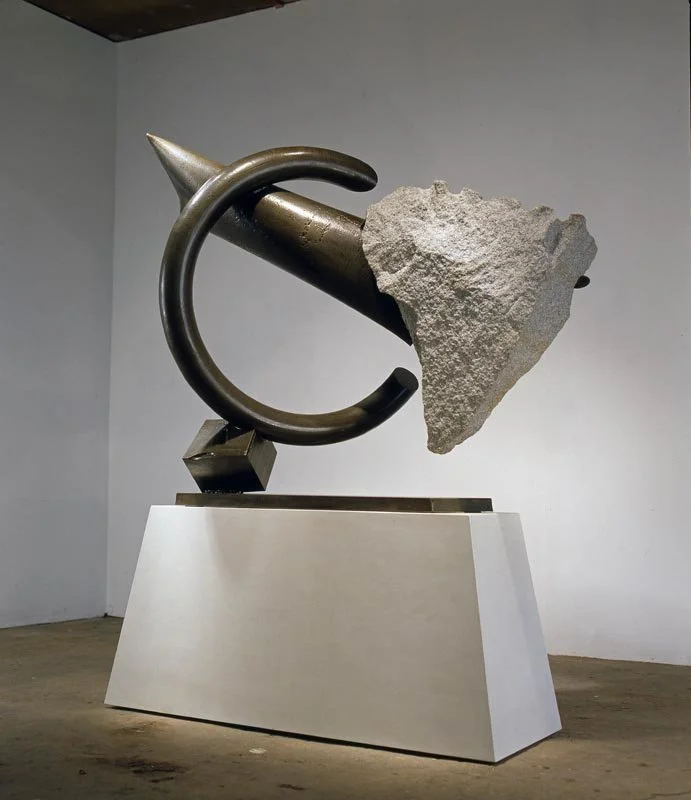
SOLD
July 2001. Granite, steel. Dimensions: 45 × 55 × 29 in (114 × 140 × 74 cm).
Collection - State University of New York, Potsdam
SAGITTA: Latin for arrow
Constellation: A dim but distinctive constellation in the northern sky, representing an arrow and included in the original 48 constellations listed by Ptolemy. It is not to be confused with the larger constellation Sagittarius.
Mythology: The constellation is associated with the arrow of Hercules, the arrow of Apollo, or the arrow of Eros (Cupid).
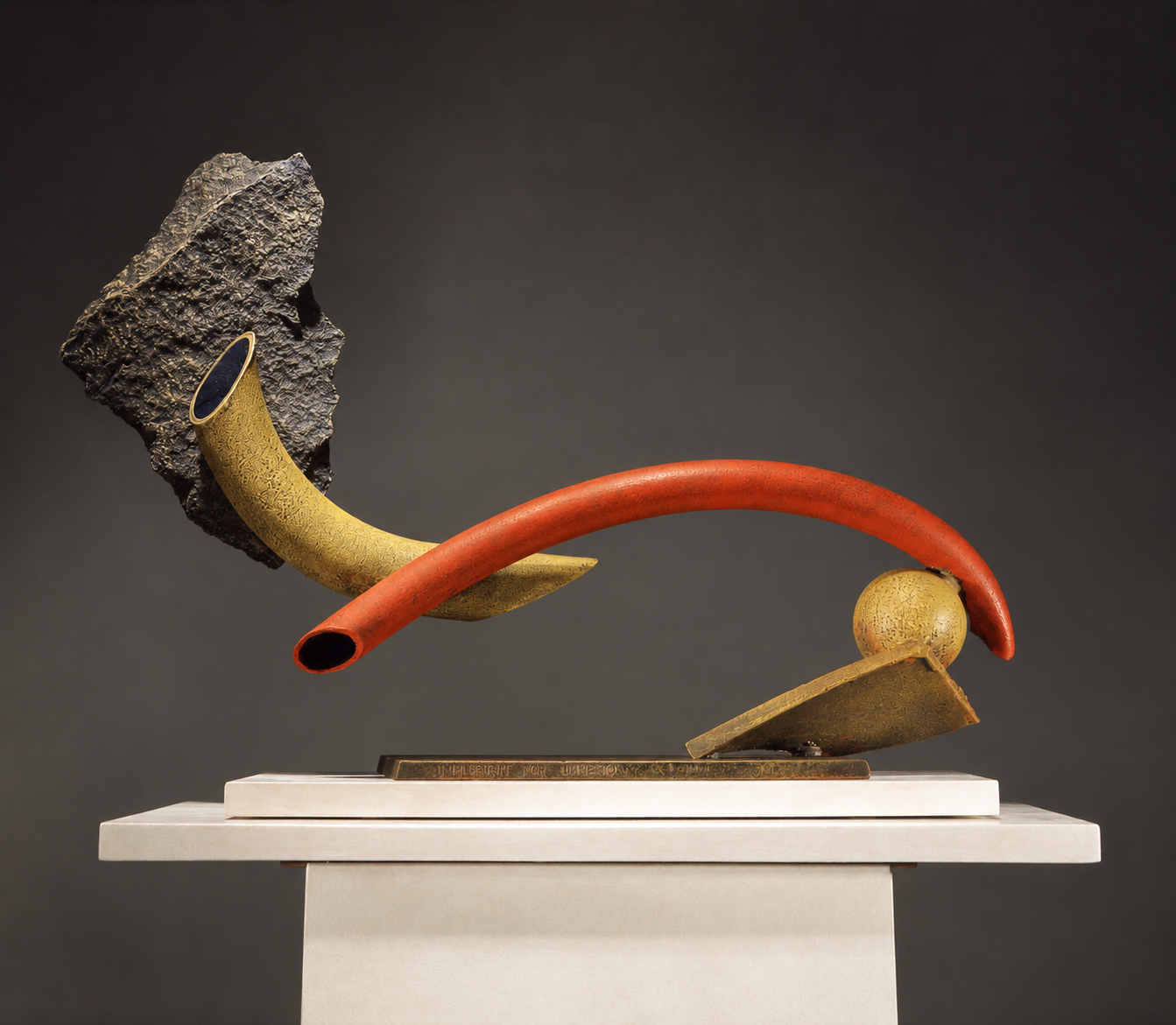
August 2001. Granite, painted steel. Dimensions: 17 × 27 × 5 in (43 × 69 × 13 cm).
Umberto references the Itailan futurist sculptor Umberto Boccioni
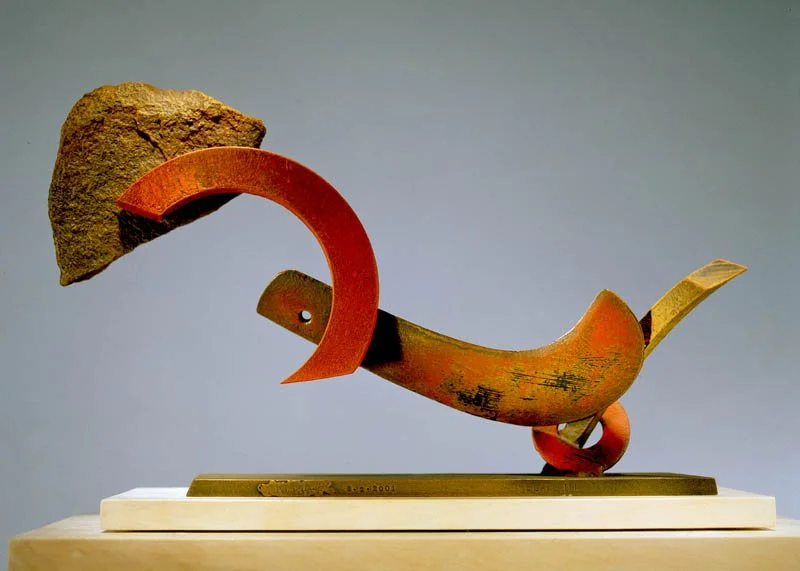
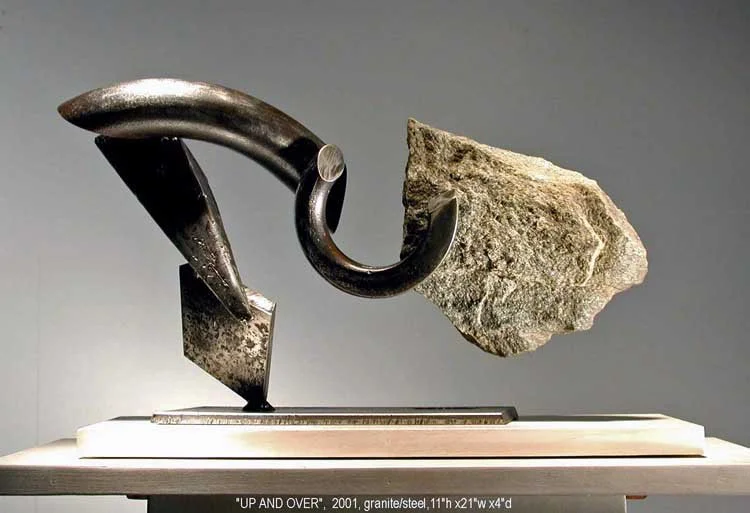
August 2001. Granite, steel. Dimensions: 11 × 21 × 4 in (28 × 53 × 10 cm).
Private collection - South Carolina
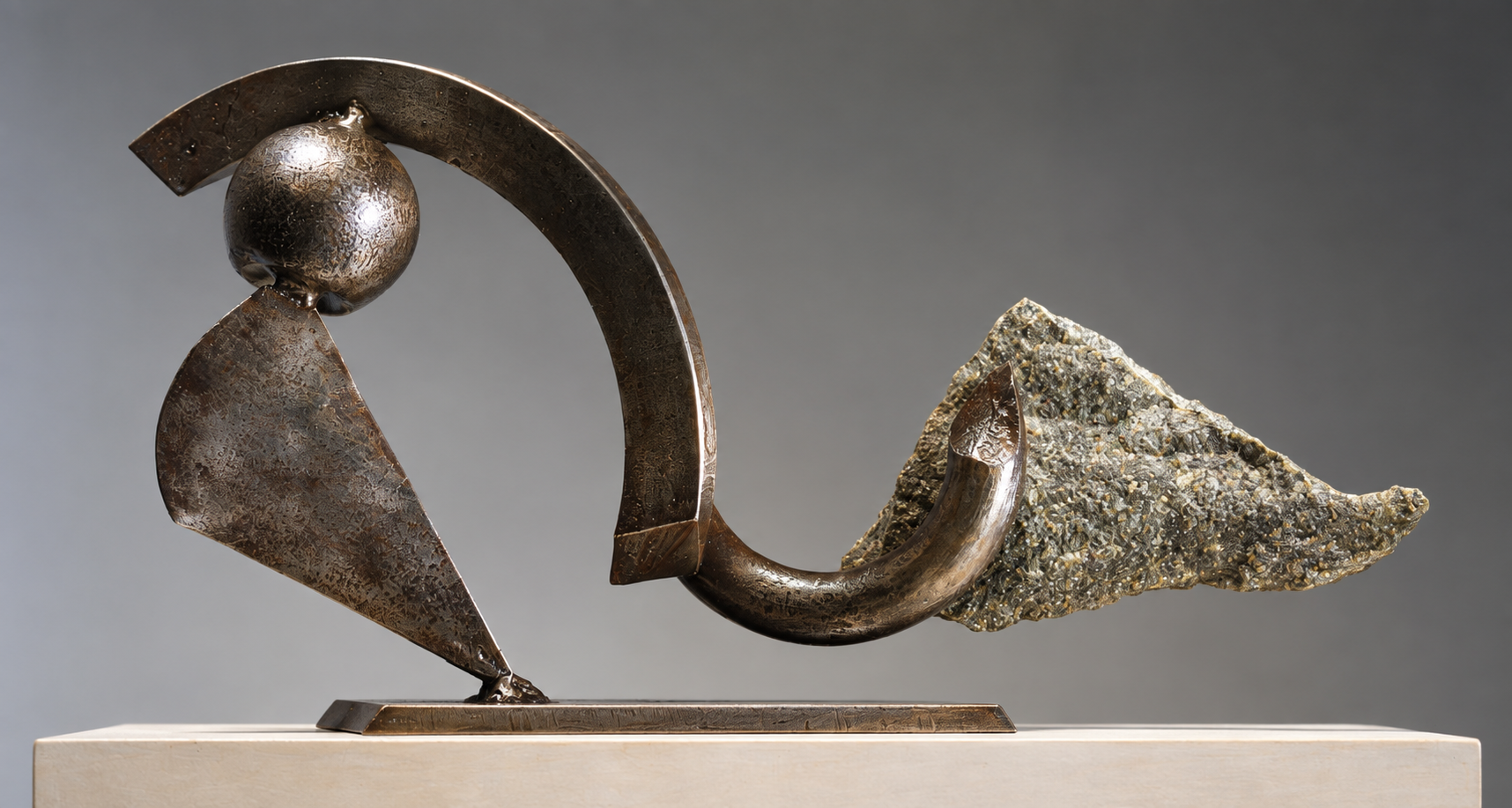
August 2001. Granite, steel. Dimensions: 10 × 18 × 4 in (25 × 46 × 10 cm).
Private collection
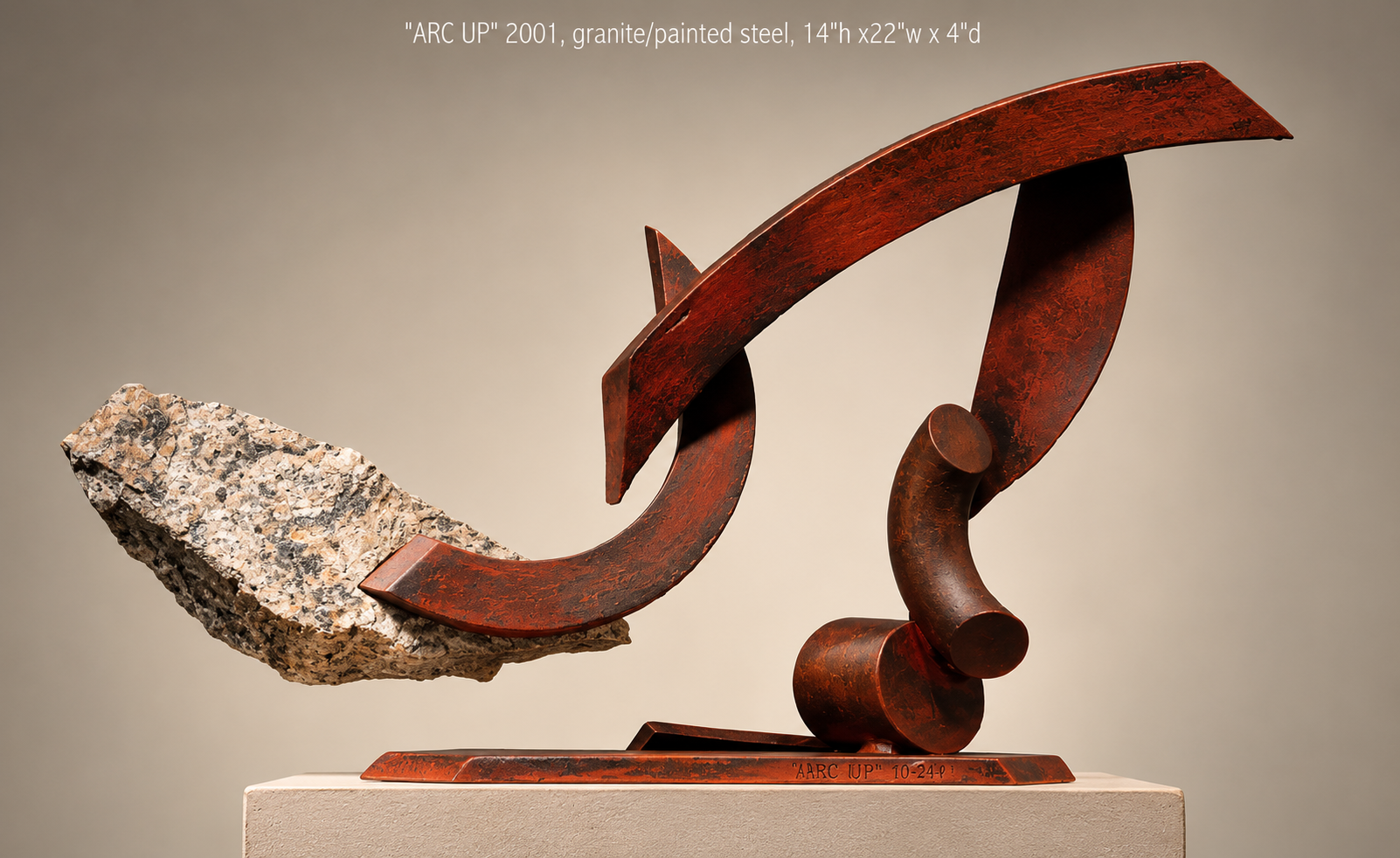
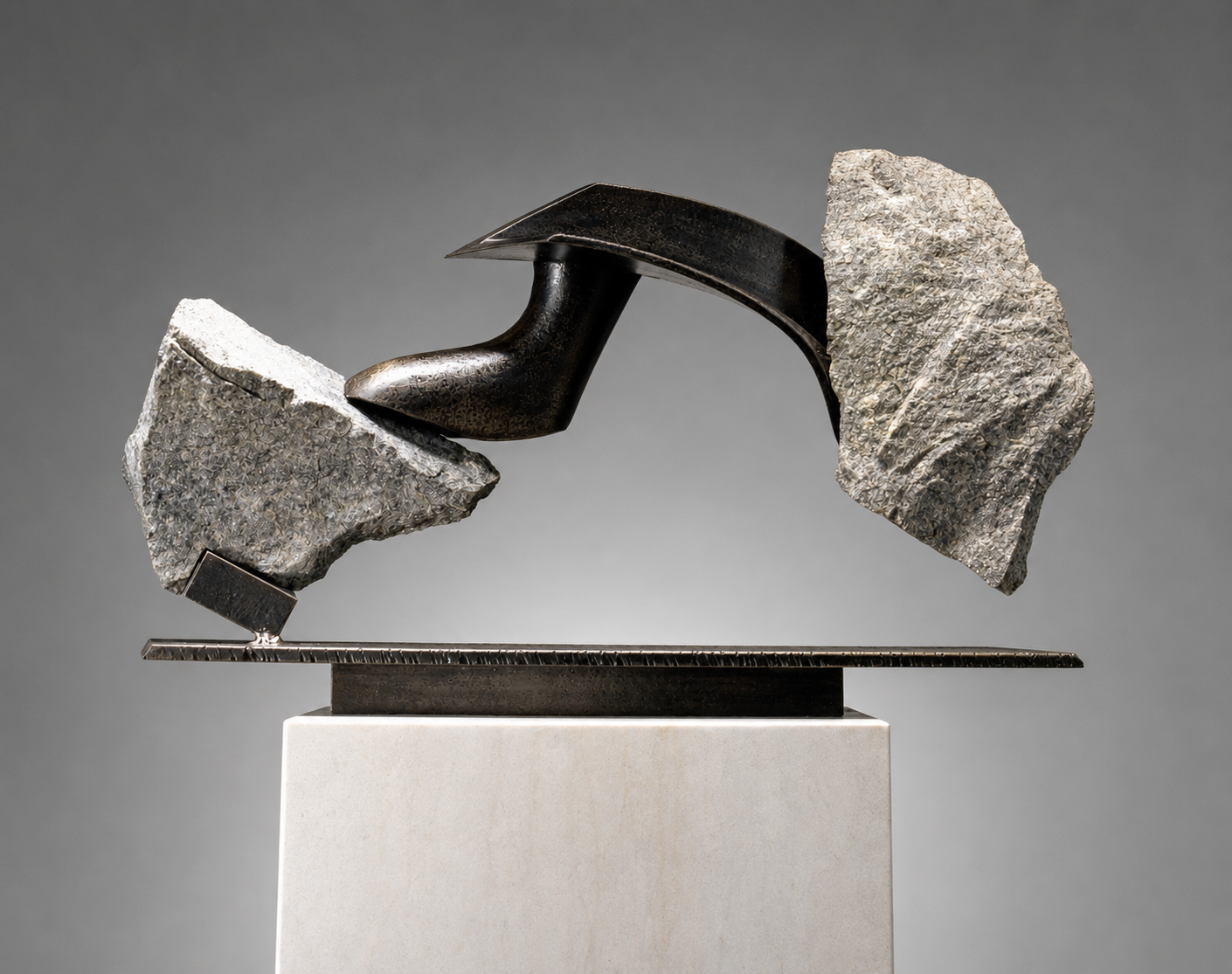
September 2001. Granite, steel. Dimensions: 13.5 × 22 × 4 in (34 × 56 × 10 cm).
Private collection - CA
Arabesque - dance position where the body is balanced on one leg or toe, the other leg extended.
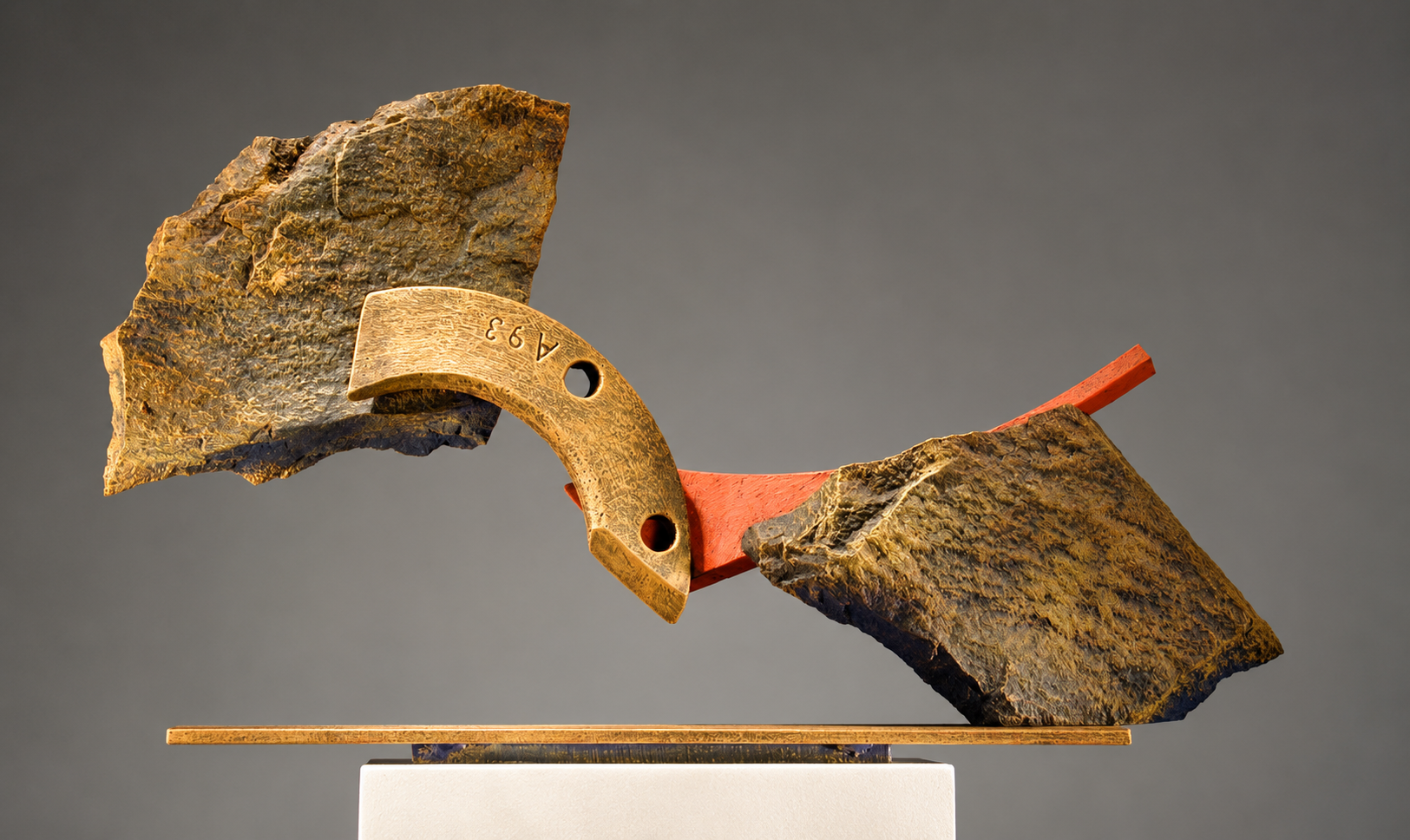
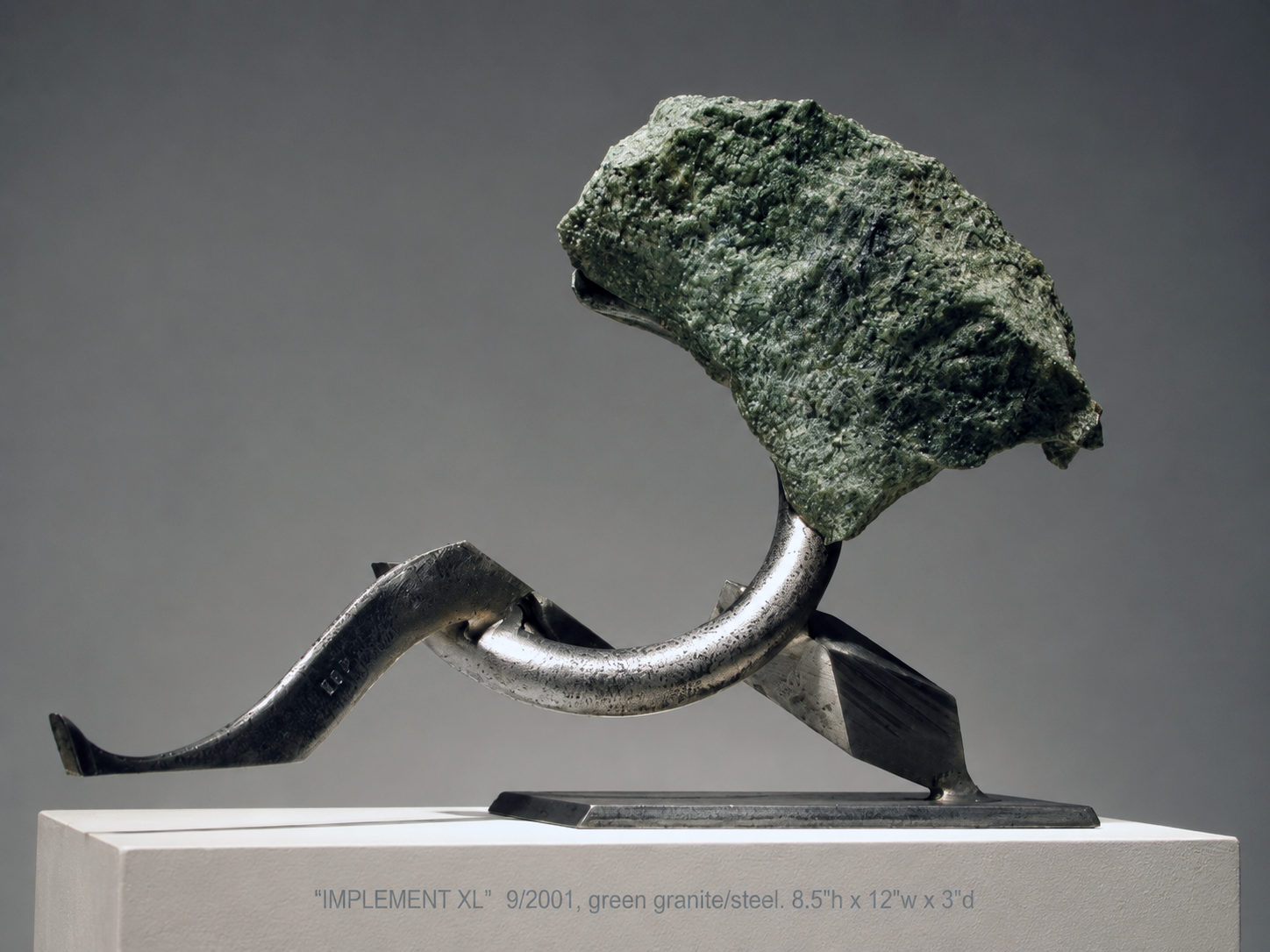
September 2001. Granite, steel. Dimensions: 8.5 × 12 × 3 in (22 × 30 × 8 cm).
Private collection - Chicago, IL
As a sculptor, I have always been fascinated by tools, implements, and instruments. I see them as extensions of the hand—essential allies in the act of making—and am drawn to their raw, efficient beauty, shaped over time by function and necessity. They also embody human ingenuity, labor, and our impulse to shape and engage the world around us.
Throughout my work, agricultural implements—rakes, plow blades, sledges, and tillers—as well as anvils, scales, compasses, and other instruments become both sculptural forms and vehicles for metaphor, suggesting ideas of balance, navigation, transformation, and our relationship to the natural world.
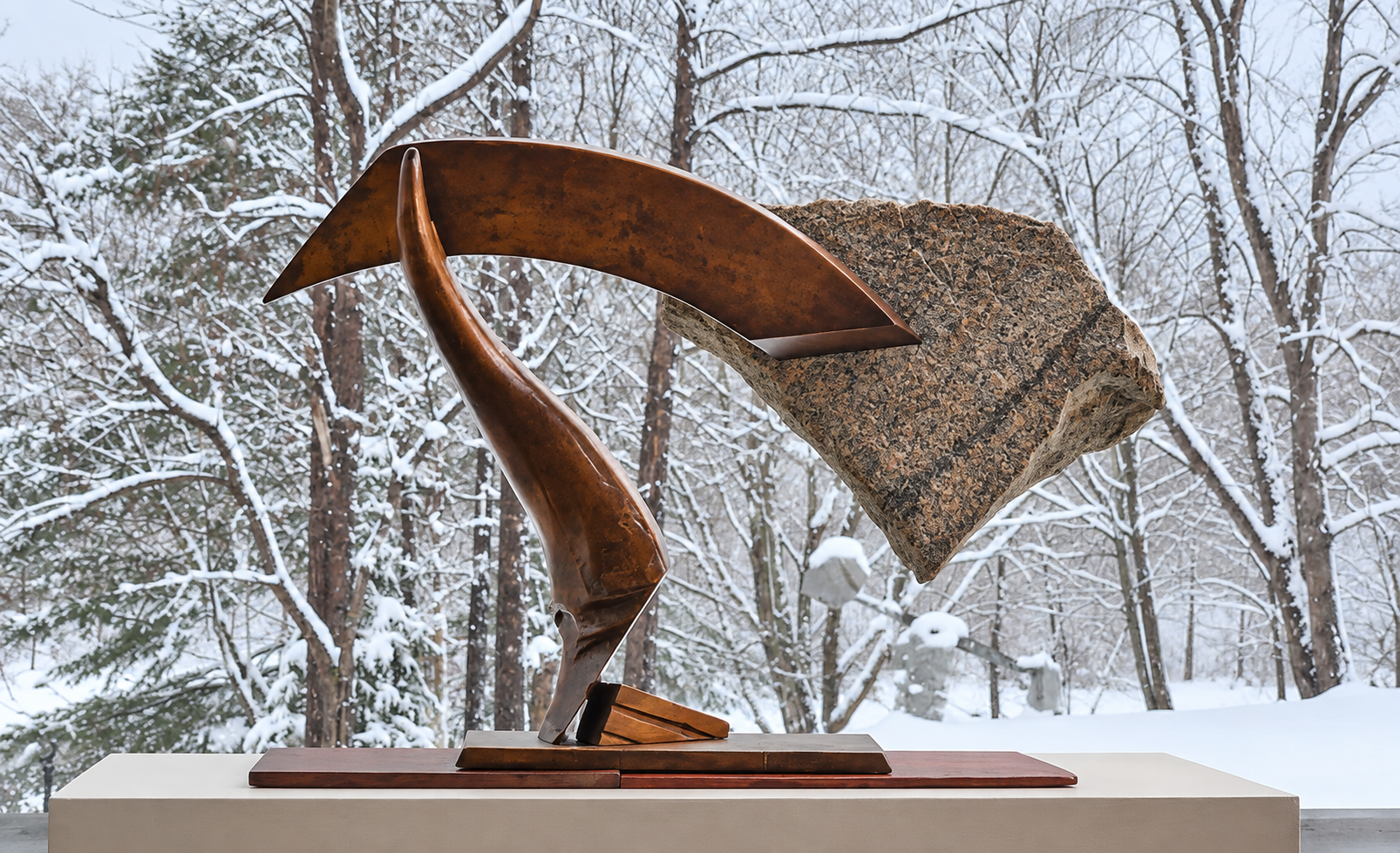
October 2001. Bronze, granite. Dimensions: 16 × 24 × 5 in (41 × 61 × 13 cm). Private Collection - New York State.
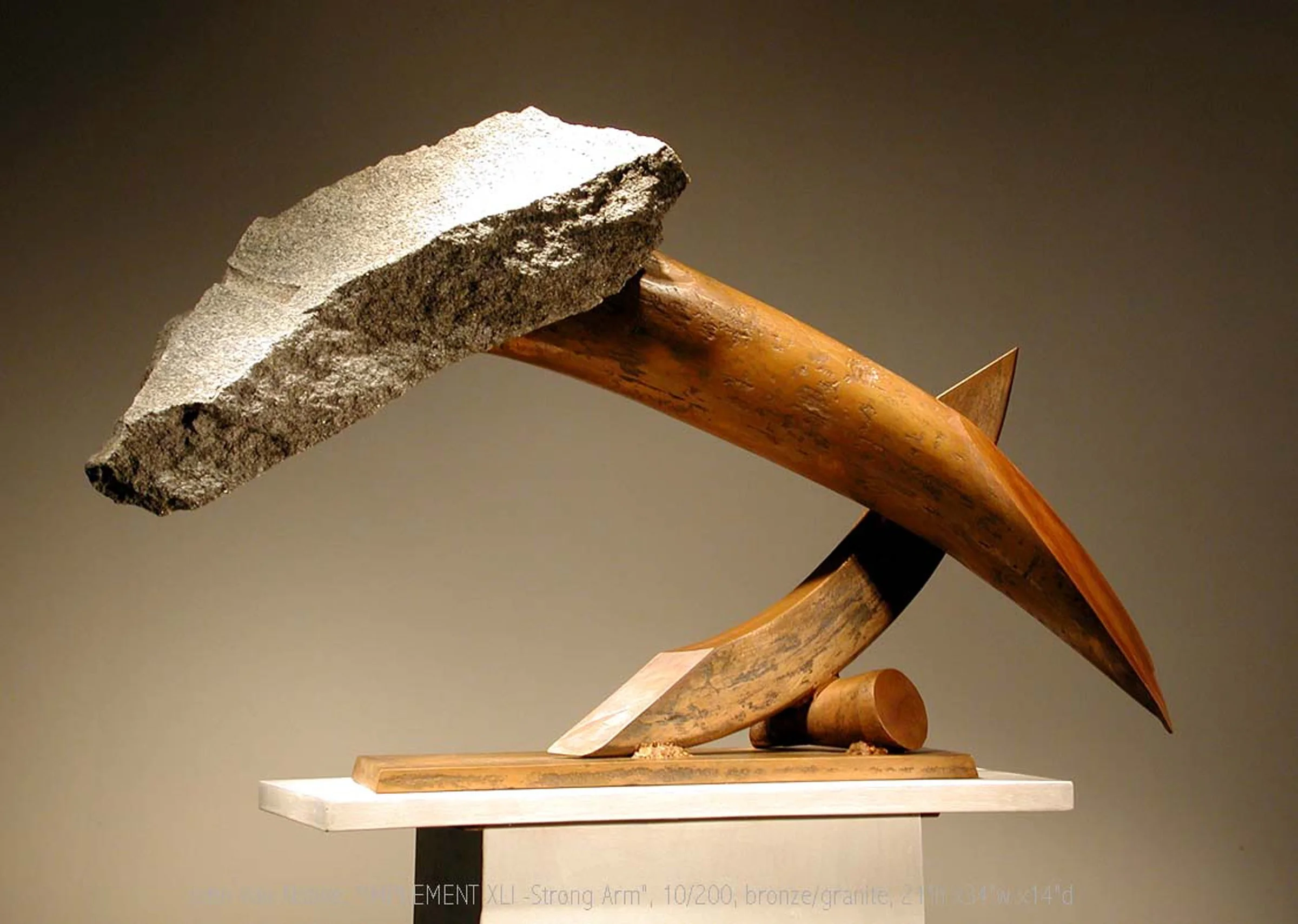
October 2001. Bronze, granite. Dimensions: 21 × 34 × 14 in (53 × 86 × 36 cm).
Private collection - CA
As a sculptor, I have always been fascinated by tools, implements, and instruments. I see them as extensions of the hand—essential allies in the act of making—and am drawn to their raw, efficient beauty, shaped over time by function and necessity. They also embody human ingenuity, labor, and our impulse to shape and engage the world around us.
Throughout my work, agricultural implements—rakes, plow blades, sledges, and tillers—as well as anvils, scales, compasses, and other instruments become both sculptural forms and vehicles for metaphor, suggesting ideas of balance, navigation, transformation, and our relationship to the natural world.
John Van Alstine
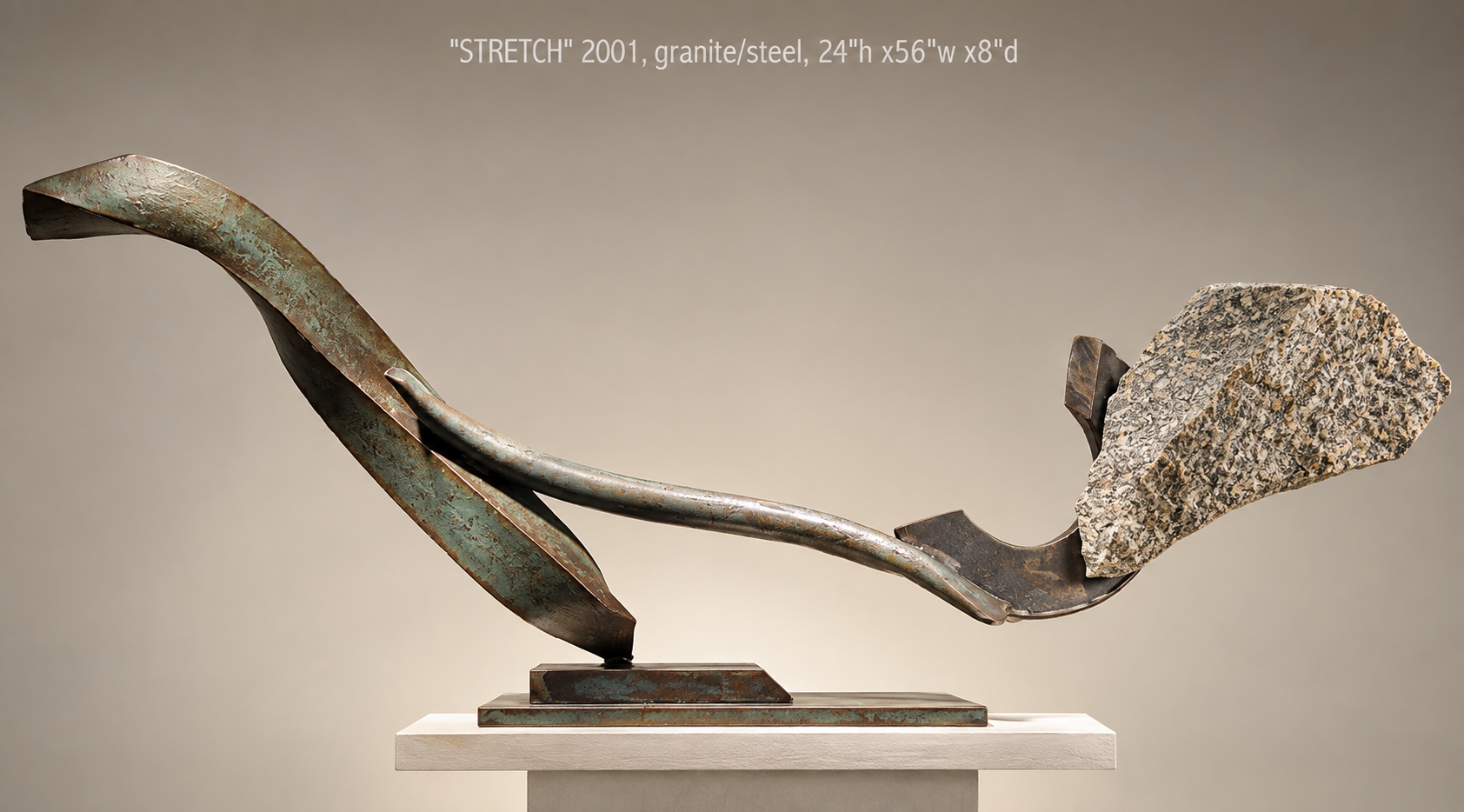
November 2001. Granite, steel. Dimensions: 24 × 56 × 8 in (61 × 142 × 20 cm).
Cannabalized
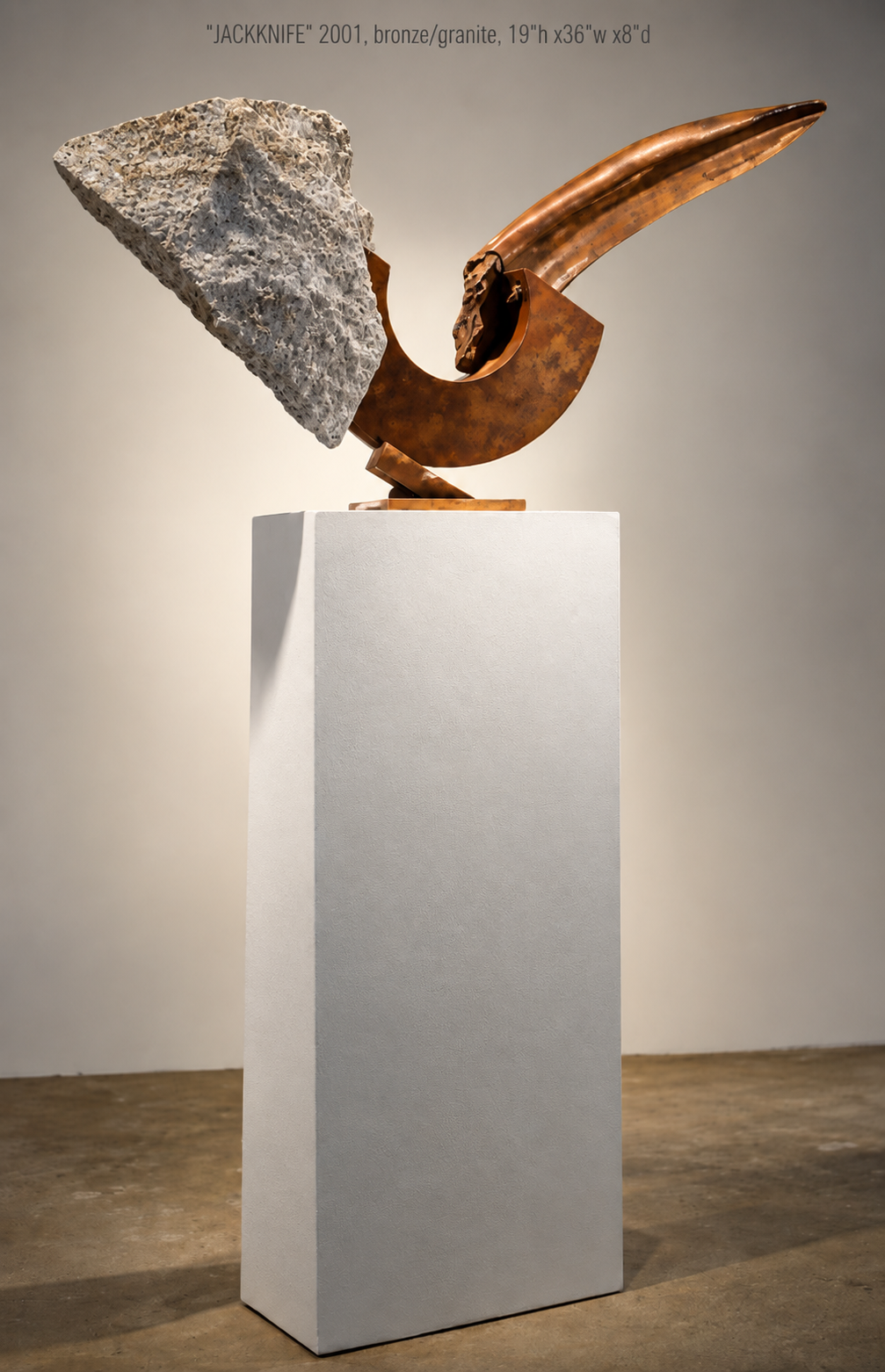
December 2001. Bronze and granite. Dimensions: 19 × 36 × 8 in (48 × 91 × 20 cm).
Corporate collection - St. Louis, MO
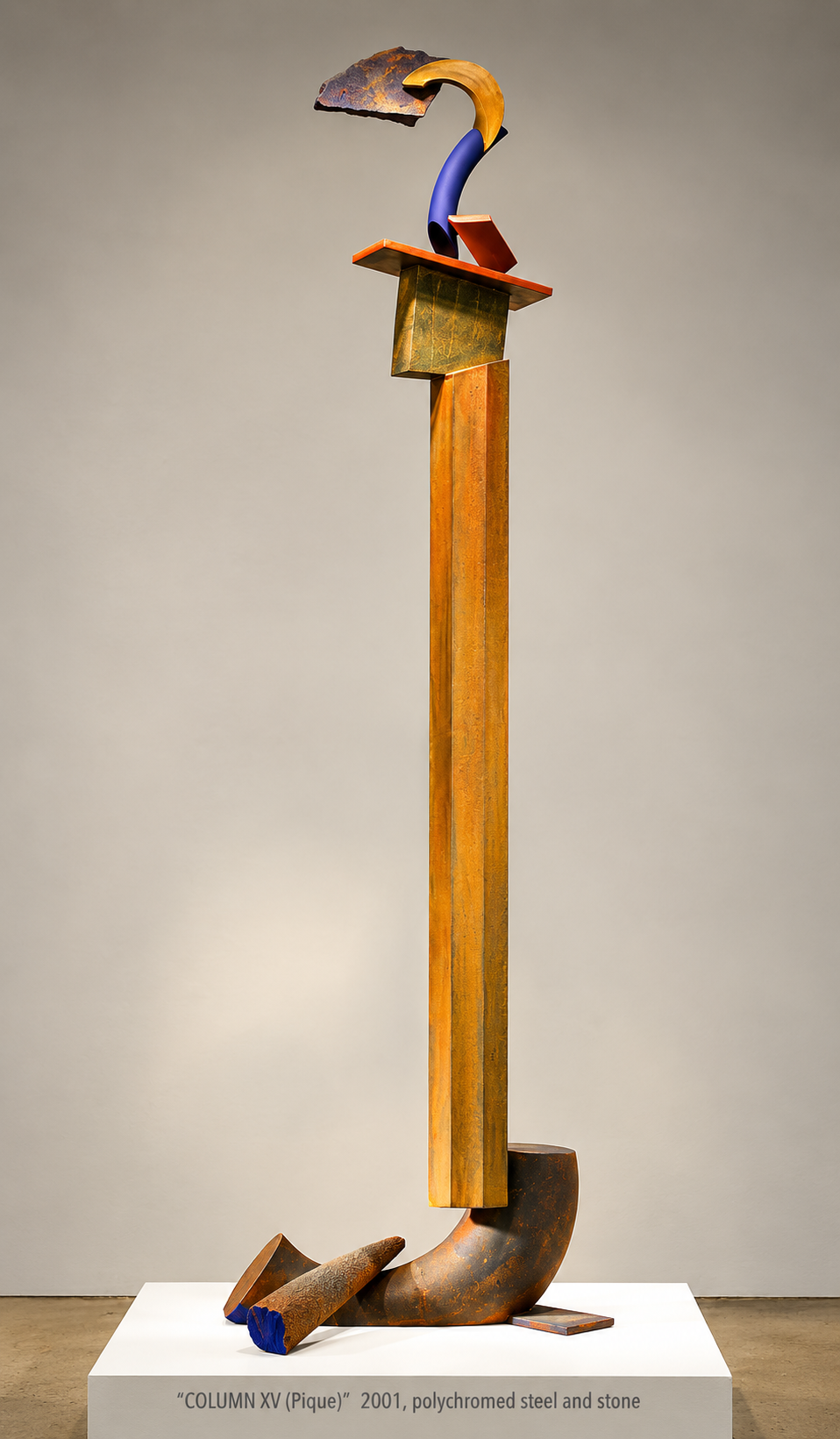
December 2001. Painted granite, steel. Dimensions: 84 × 24 × 16 in (213 × 61 × 41 cm). Private Collection - Potomac, MD
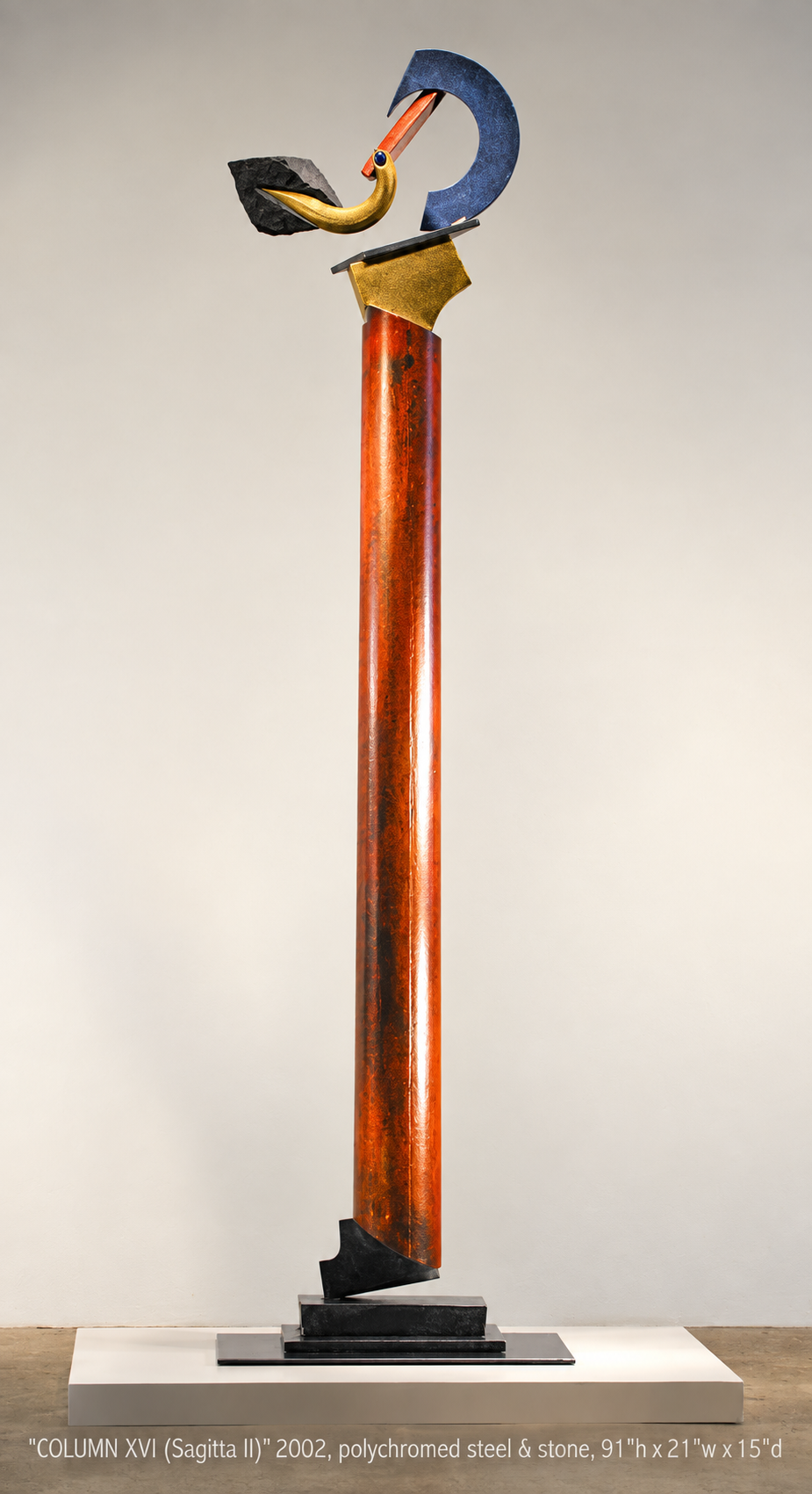
SOLD
January 2002. Painted granite, steel. Dimensions: 91 × 21 × 15 in (231 × 53 × 38 cm). Private Collection Kettering, OH
SAGITTA: Latin for arrow
Constellation: A dim but distinctive constellation in the northern sky, representing an arrow and included in the original 48 constellations listed by Ptolemy. It is not to be confused with the larger constellation Sagittarius.
Mythology: The constellation is associated with the arrow of Hercules, the arrow of Apollo, or the arrow of Eros (Cupid).