1990
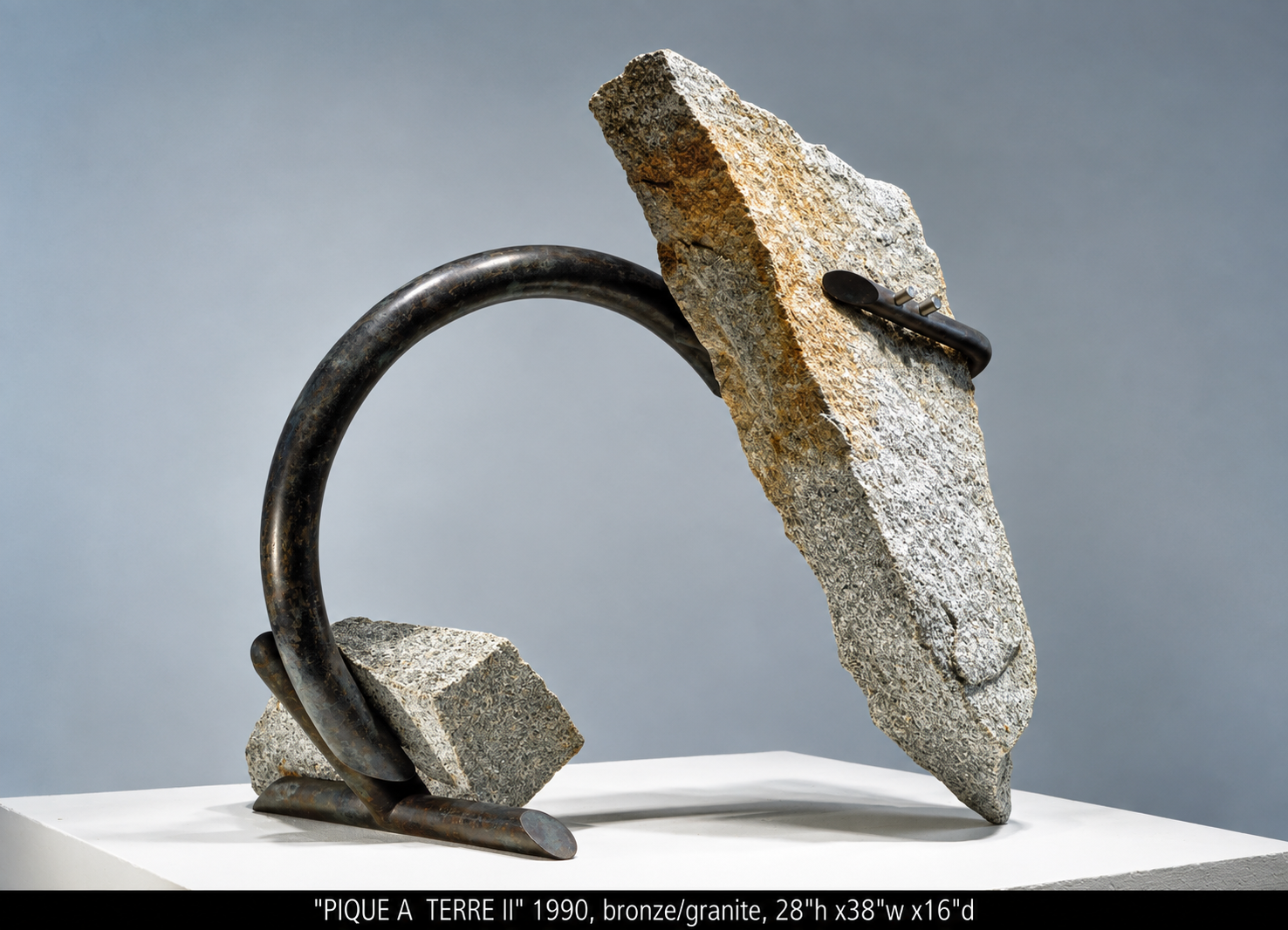
1990. Granite, bronze. Dimensions: 28 × 35 × 16 in (71 × 89 × 41 cm).
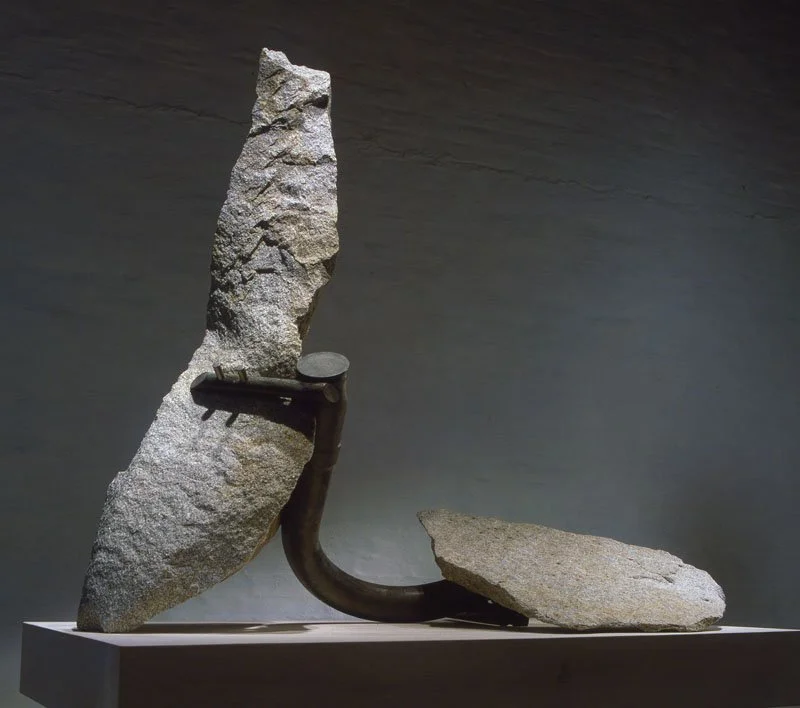
Pique à Terre II, 1990
Pique à Terre II, the second work in the series, developed as a spin-off from my earlier Rounder and Go-Round Series, continuing their circular vocabulary and my ongoing interest in combining stone and metal. Here, the sweeping bronze arc supports and connects two granite elements, allowing the larger stone to rise dramatically onto a single point. The dense, earthbound materials appear suspended in a moment of precarious but graceful movement—an idea central to my work during this period.
The title comes from classical ballet, referring to a pose in which one toe lightly touches the ground, the other foot remains firmly planted, and an arm makes a sweeping gesture. This became a metaphor for what I was attempting sculpturally: to act as a choreographer, arranging heavy stone and metal so that they seem almost to dance. Rather than denying the inherent weight of the materials, I use balance, suspension, and gesture to transform that weight into a sense of movement and levity.
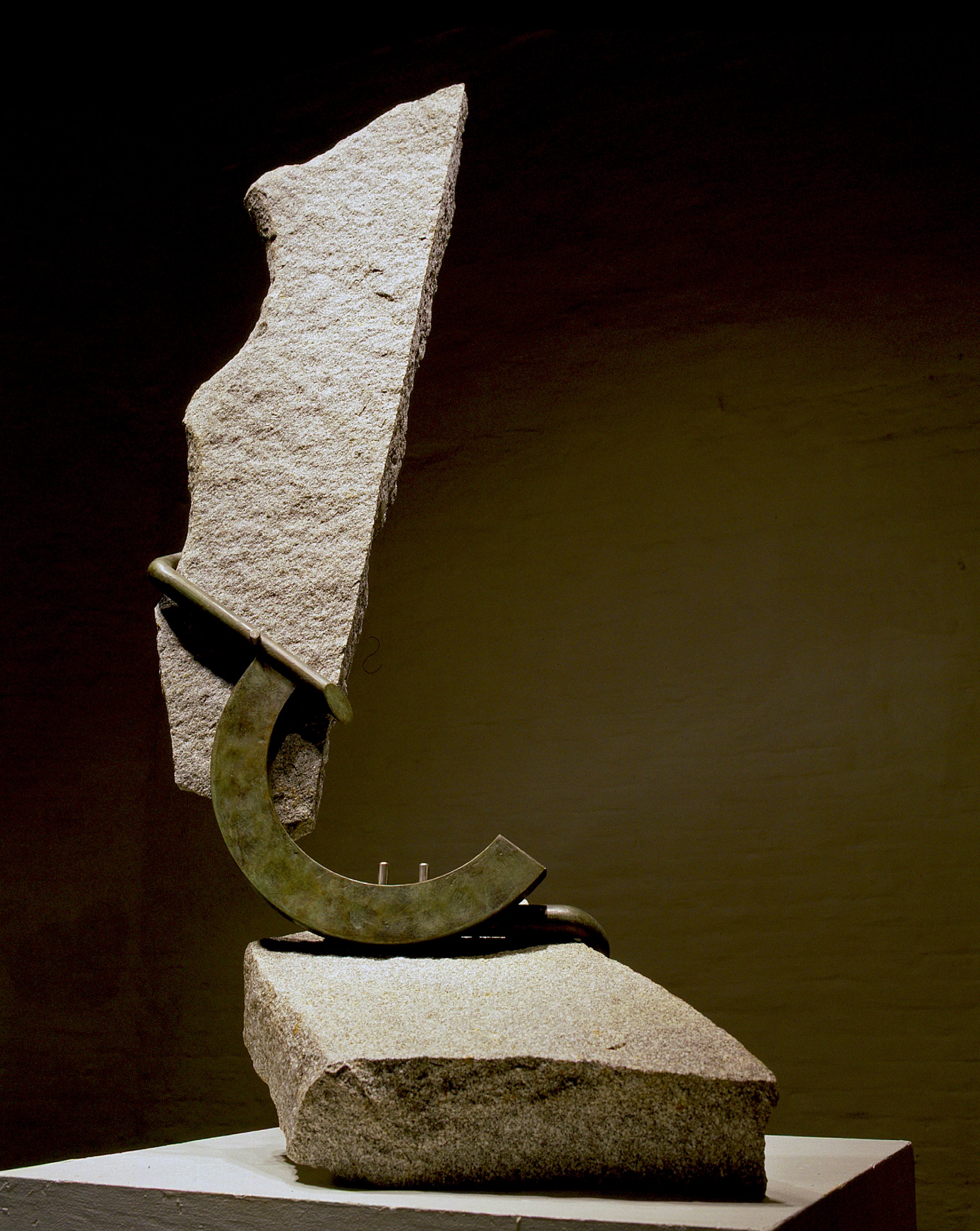
February 1990. Granite, bronze. Dimensions: 69 × 44 × 39 in (175 × 112 × 99 cm).
Private collection.
Stone has been a constant in John Van Alstine’s work for more than fifty years. He often focuses on the material’s inherent qualities—especially its weight—choreographing stone and steel to create moments of visual and physical tension.
Landscape, particularly the mountain terrain where the artist has spent much of his life, has also been a powerful influence. In the Rockslide series, the shape and placement of stone, and its dynamic interaction with steel, evoke the drama of a familiar alpine event: a rock caught in mid-fall.
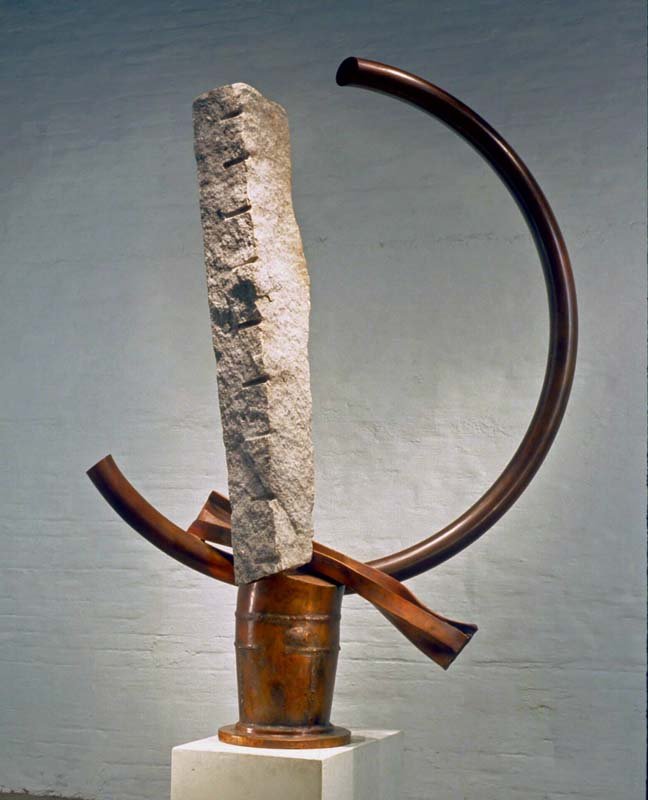
February 1990. Granite, bronze. Dimensions: 86 × 30 × 36 in (218 × 76 × 91 cm).
Private collection - Washington, DC
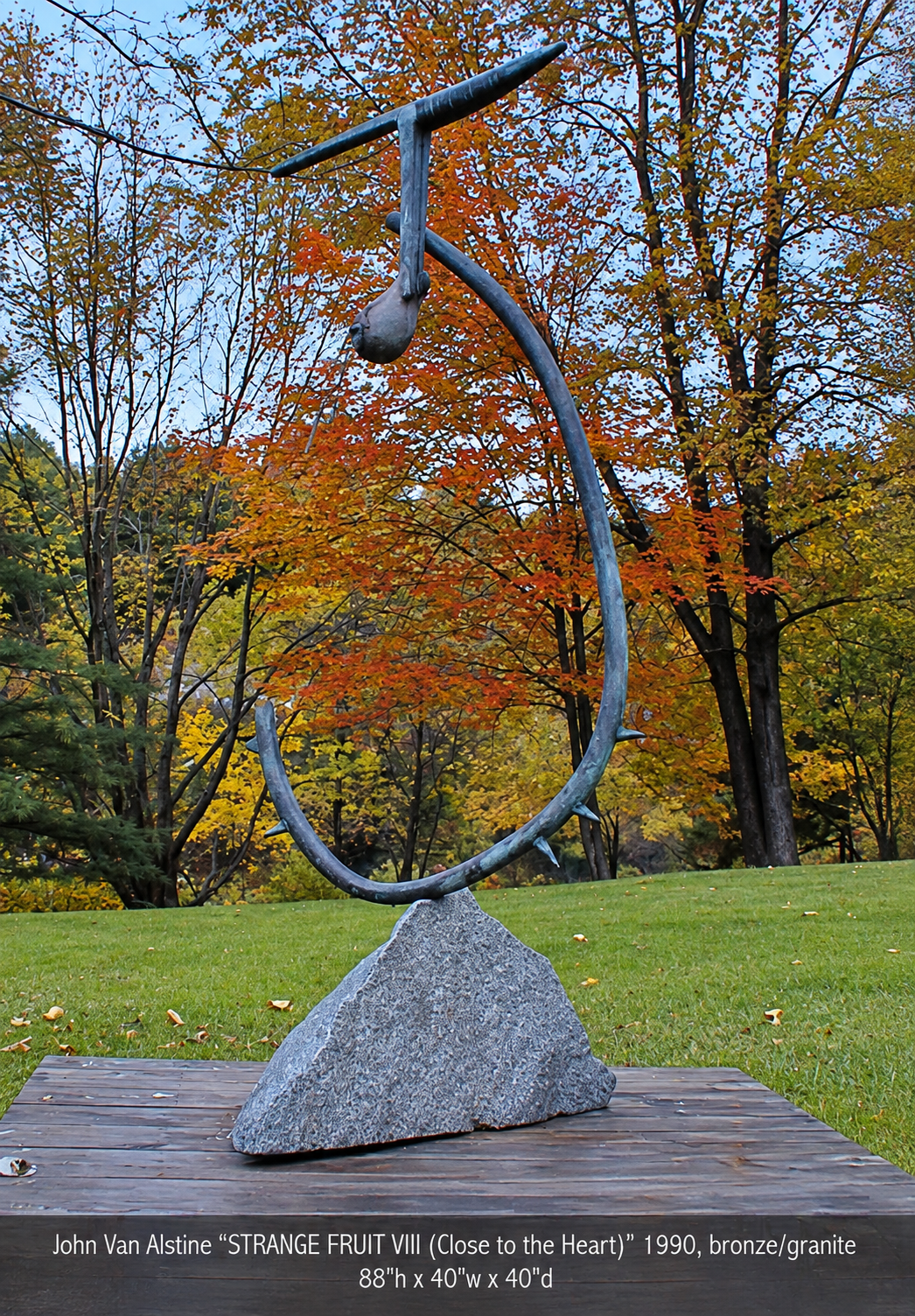
March 1990. Granite, bronze. Dimensions: 88 × 40 × 40 in (224 × 102 × 102 cm). Cannibalized by artist.
Strange Fruit—Close to the Heart, 1990
Strange Fruit—Close to the Heart grew directly from the experience of my wife’s pregnancy with our first child. Her changing body seemed to me like a wonderful ripe fruit—both physically and conceptually—and extended the ideas of ripeness, production, and reproduction already developing in my Strange Fruit Series. The pear-shaped bronze element suggests the growing fruit within, while the sweeping outer arc describes a much larger fruit-like form.
The small ladder introduces another personal metaphor. As I came to terms with the new reality of becoming a father, it suggested climbing to a new level—a passage into a different stage of life. The sculpture became a way of transforming an intimate experience into a broader image of growth, change, and new life.
March 1990. Granite, steel. Dimensions: 8 × 3 × 3 ft. Corp Collection - MCI headquarters, Crystal City, VA
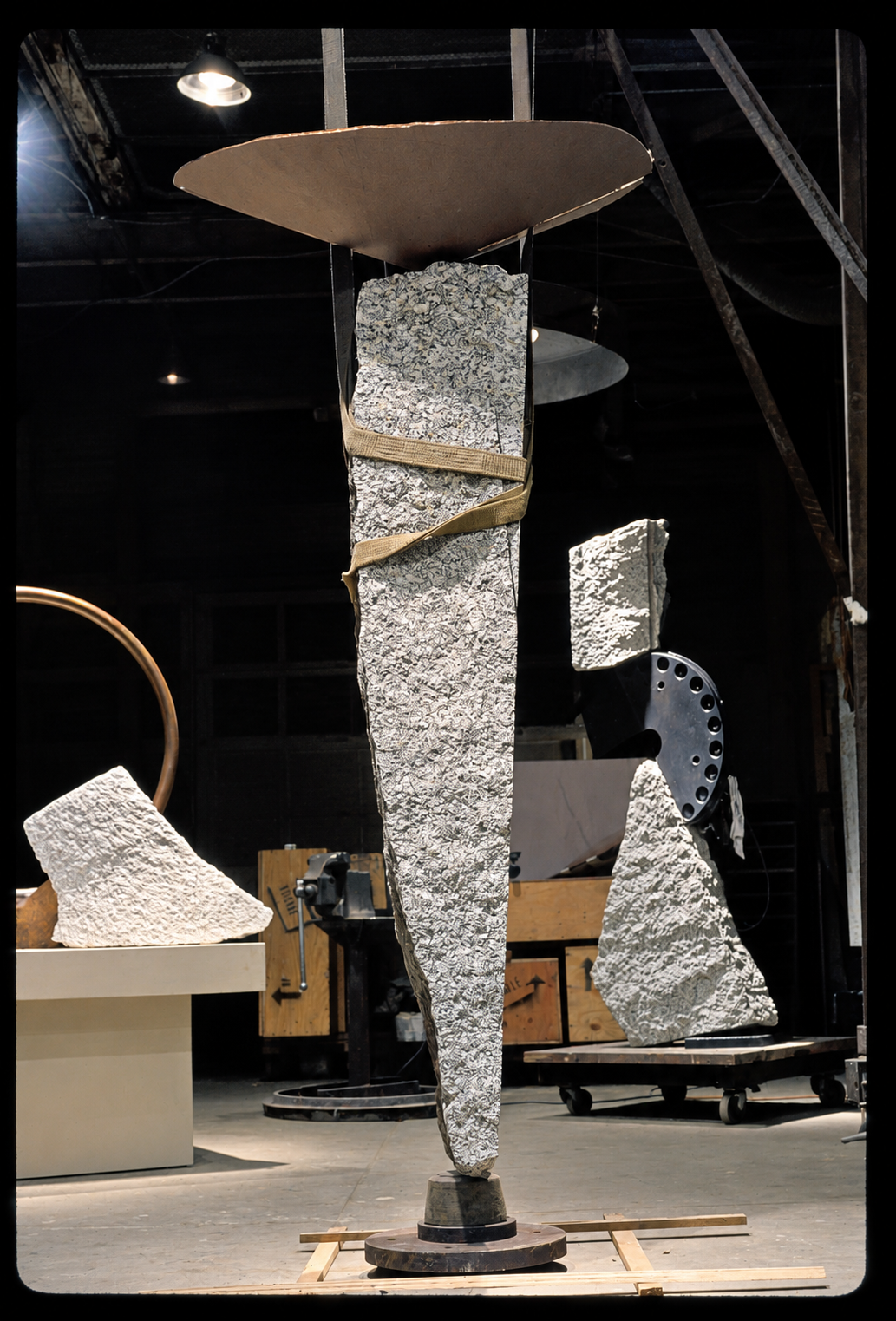
Vas, 1990
Vas grew from my increasing interest in the vessel as both sculptural form and metaphor. A tall granite element rises vertically while the broad vessel above creates a strong horizontal counterpoint, continuing my exploration of balancing the weight of stone with the structural possibilities of metal.
The work was commissioned for the MCI corporate headquarters in Crystal City, Virginia. This photograph shows the sculpture during the studio mock-up stage: the broad vessel is a cardboard template that was later cast in bronze, as were the steel elements forming the anchoring base.
March 1990. Granite, steel. Dimensions: 21 × 35 × 13 in (53 × 89 × 33 cm).
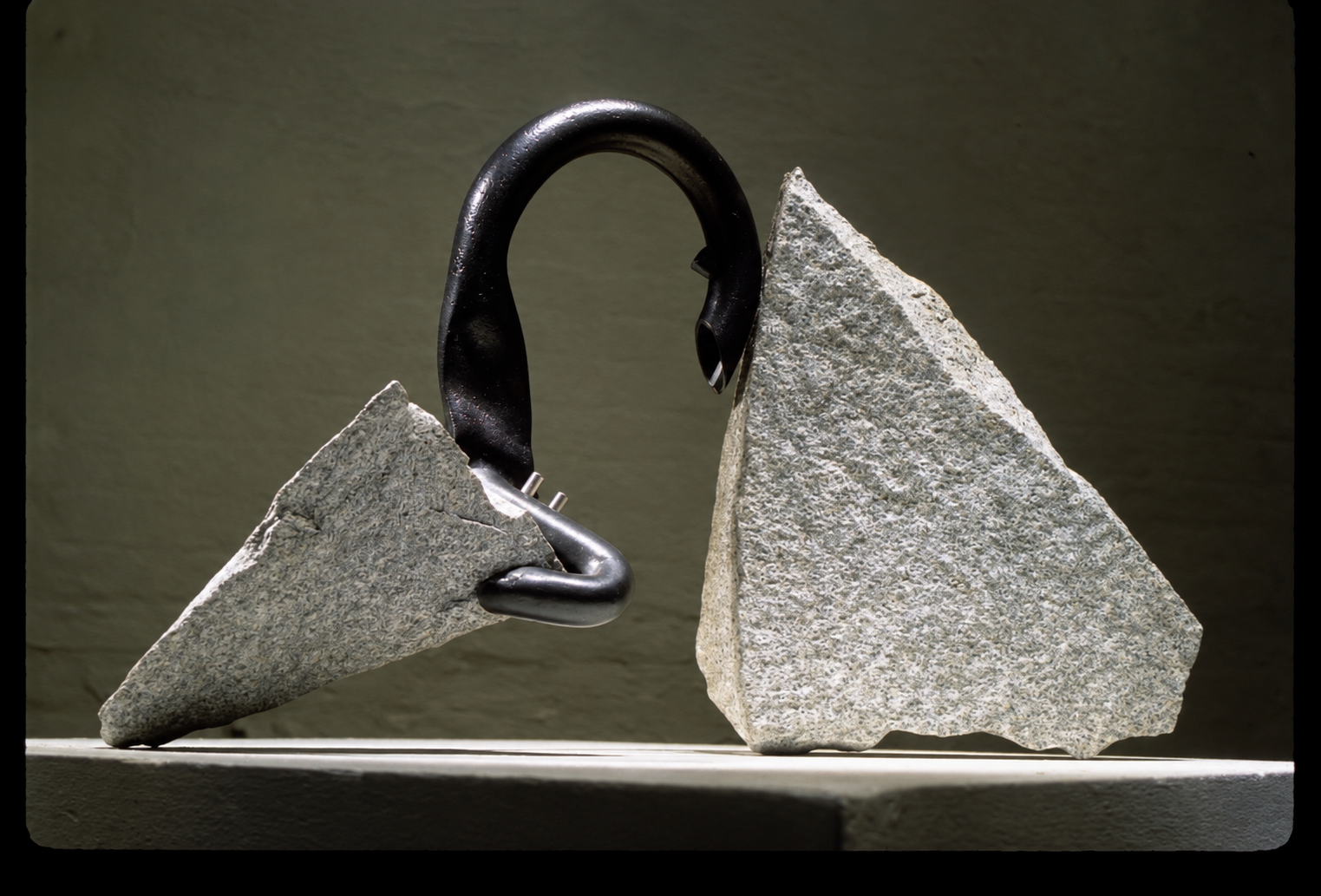
Over the years I have created many sculptures that feature openings or portals suggesting entrance or passages into spaces and places, both real and figurative. In Portal (ad augusta per ad augusta)” 1990, a small, narrow “portal” or archway is created by an arc of steel bookended by two pieces of found granite.
Occasionally I use Latin (the one foreign language I briefly studied) in my titles as a way to “bridge” the romance languages and expand the work’s communicative power. The sub title literally translates “to honors through difficulties” (augusta refers to holy places, angusta to narrow places) all suggesting that to achieve great results, we must pay the price, a maxim that was very much a part of my upbringing and perhaps a fit motto for dieters.
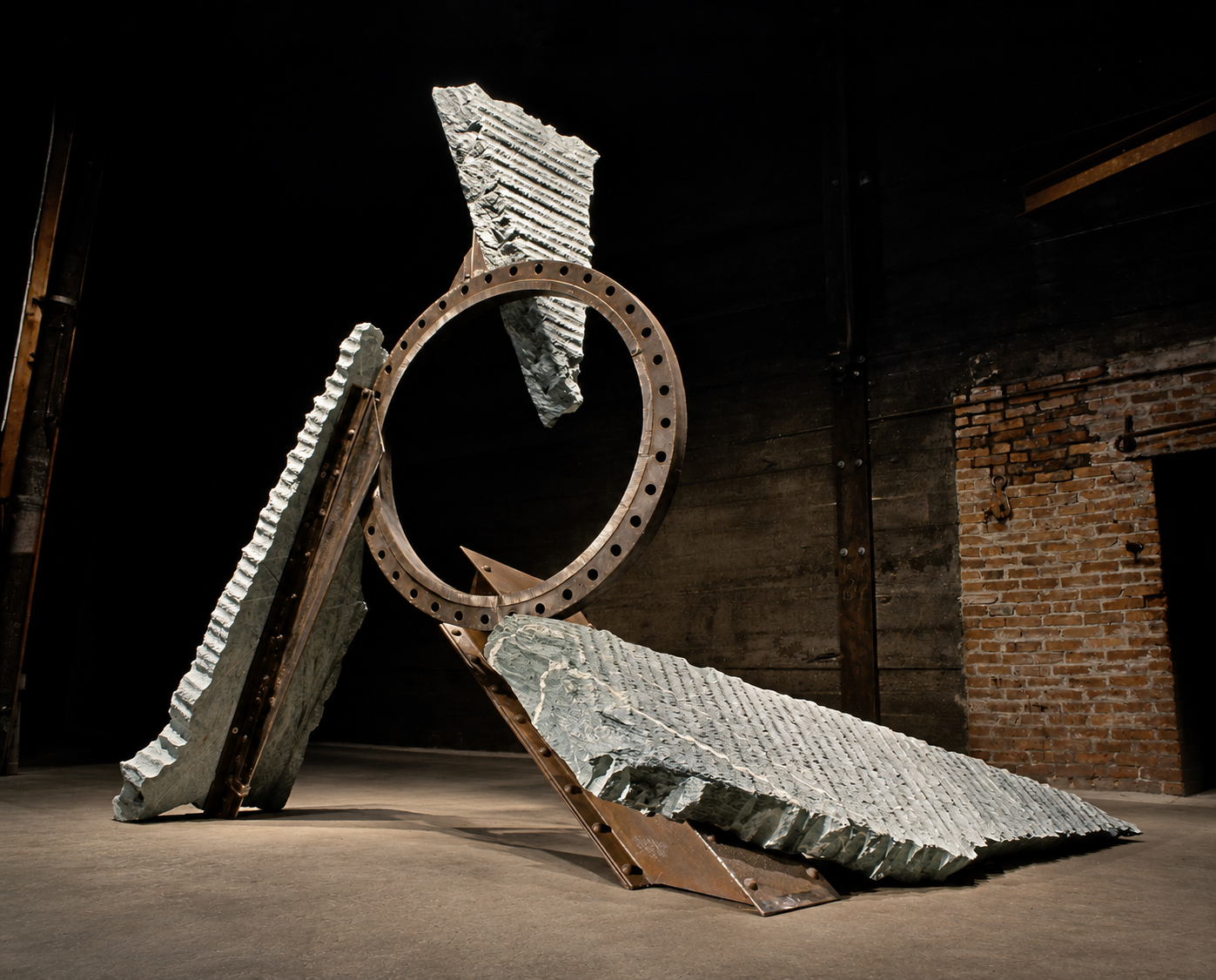
August 1990. Green marble, steel. Dimensions: 107 × 131 × 72 in (272 × 333 × 183 cm).
Private Collection: Sold from Grimaldis Gallery 2 person show with John Ruppert 4/1991.
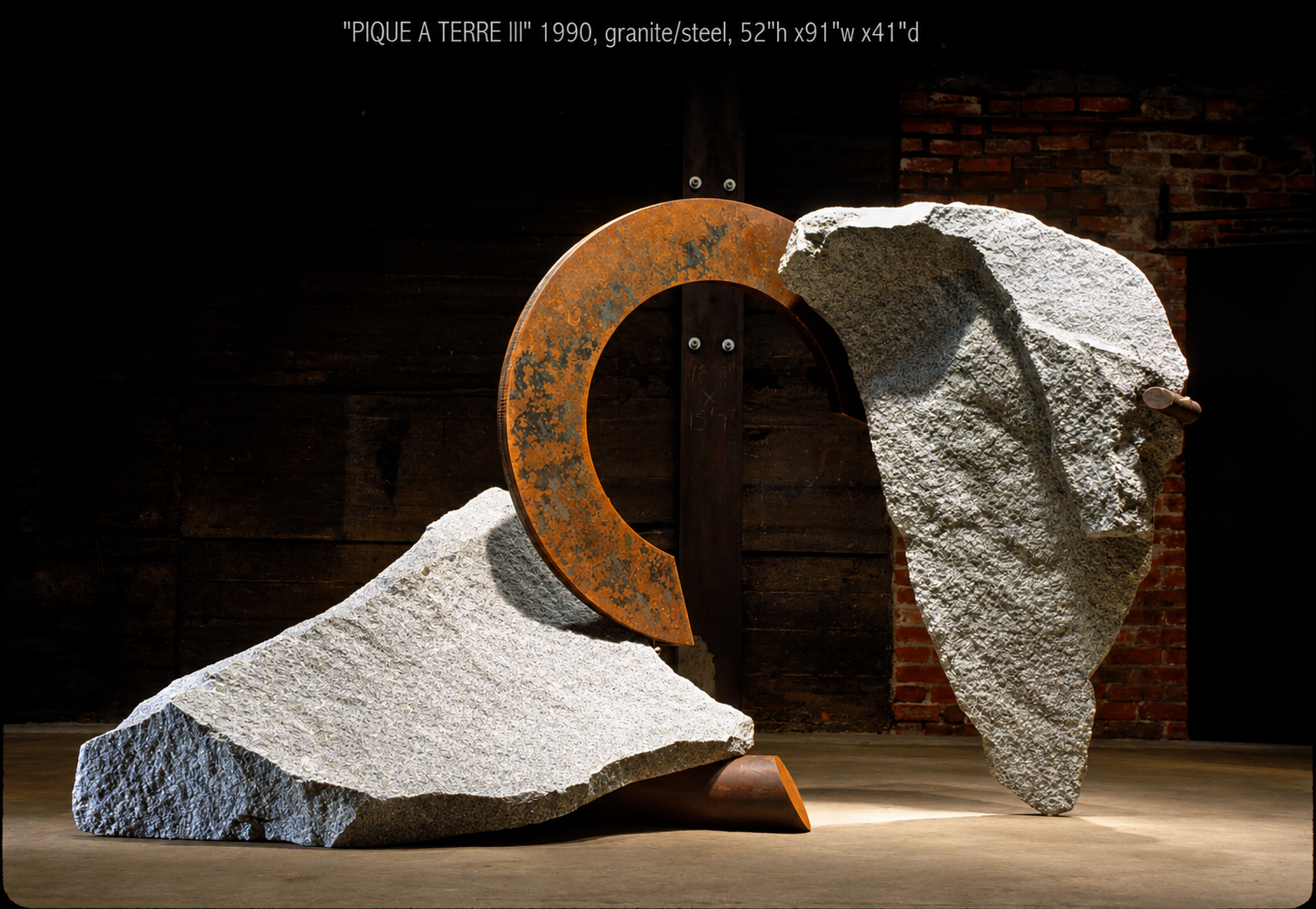
August 1990. Granite, steel. Dimensions: 52 × 91 × 41 in (132 × 231 × 104 cm). Private collection - Palo Alto
Pique à Terre III, 1990
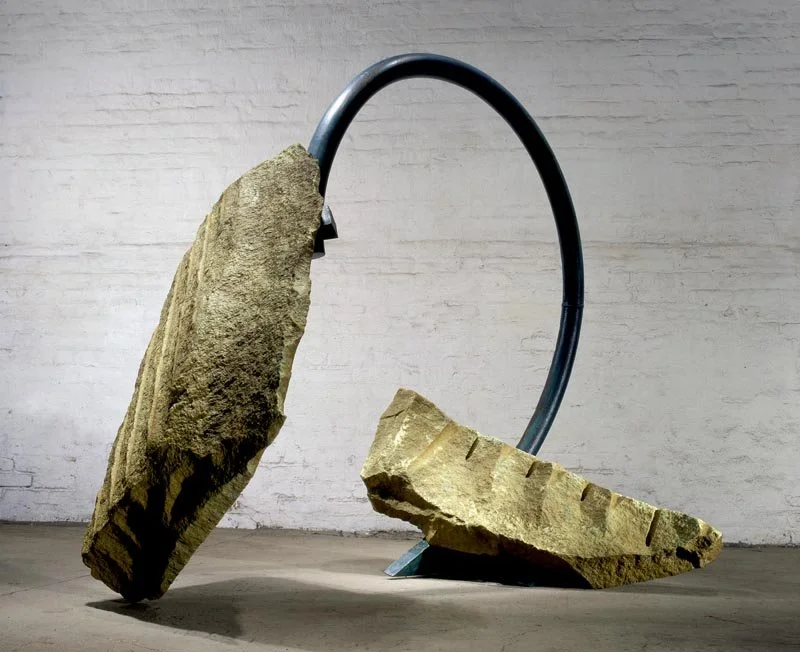
Pique à Terre III, the third work in the series, developed as a spin-off from my earlier Rounder and Go-Round Series, carrying forward their circular vocabulary and my ongoing interest in combining stone and metal. Here, two massive granite forms are brought into an unexpectedly animated relationship by the sweeping steel arc. Weight, balance, and suspension transform these inherently earthbound materials into a composition suggesting gesture and arrested movement—what I have described as the “choreographing” of stone.
The title comes from classical French ballet and refers to a pose in which one toe lightly touches the ground, the other foot remains firmly planted, and the arm makes a sweeping gesture. In this series I began thinking of myself almost as a choreographer, arranging heavy stone and metal so that they appear to dance. Pique à Terre III makes that idea especially physical: the granite seems to pivot, reach, and balance around the circular steel form, turning mass and gravity into a sense of movement and levity.
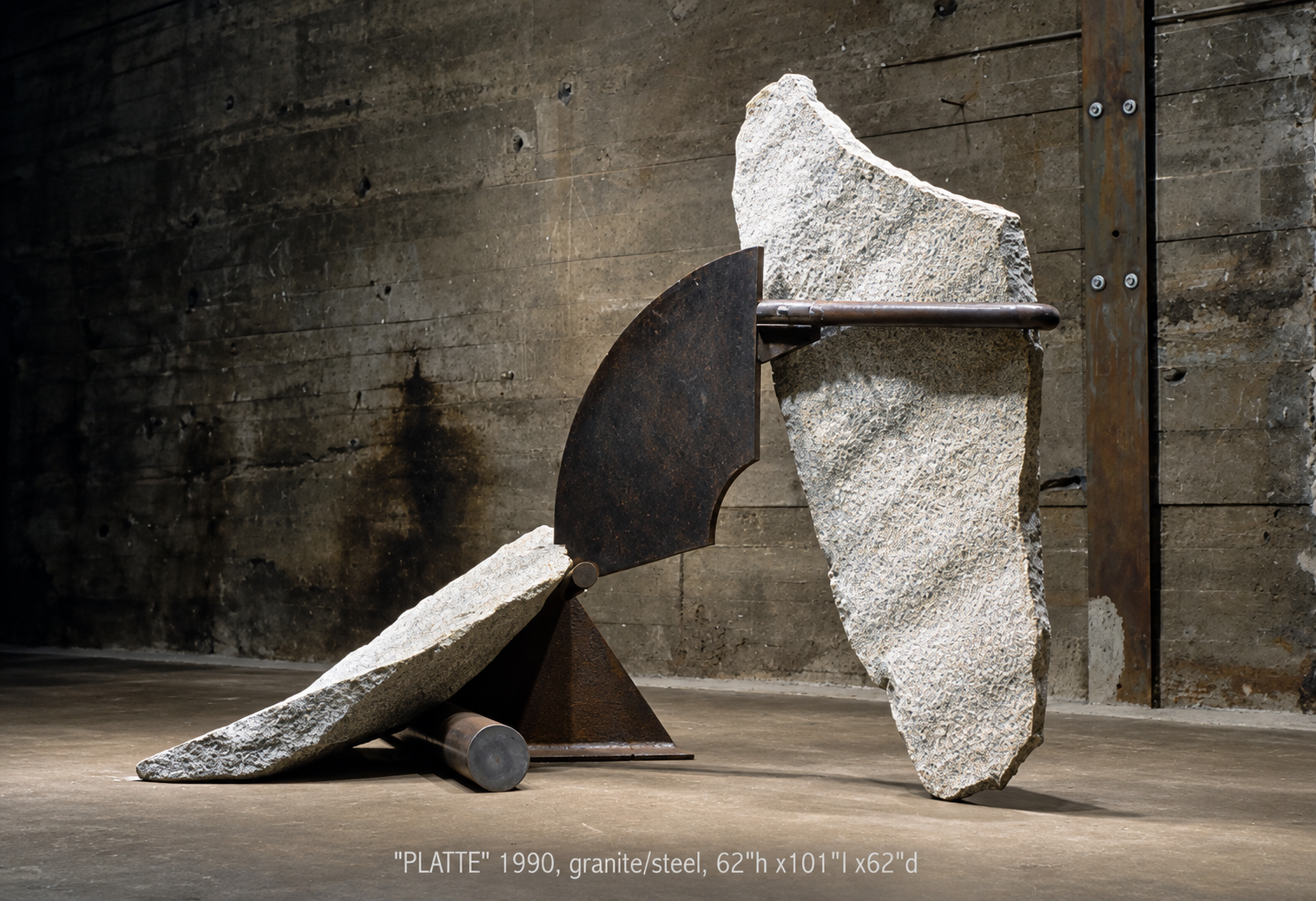
October 1990. Granite, steel. Dimensions: 62 × 101 × 62 in (157 × 257 × 157 cm).
Platte, 1990
Platte developed as a spin-off from my earlier Rounder and Go-Round Series, continuing their exploration of circular forms, balance, and the relationship between stone and metal. Broad slabs of rough granite are joined with curved and linear steel, allowing their natural shape, mass, and weight to remain central to the sculpture.
The title Platte refers to the flat, plate-like character of the granite stones. Their broad planes contrast with the curving steel, which lifts and positions the stone in ways that challenge its normally earthbound nature, transforming weight and gravity into balance and movement.
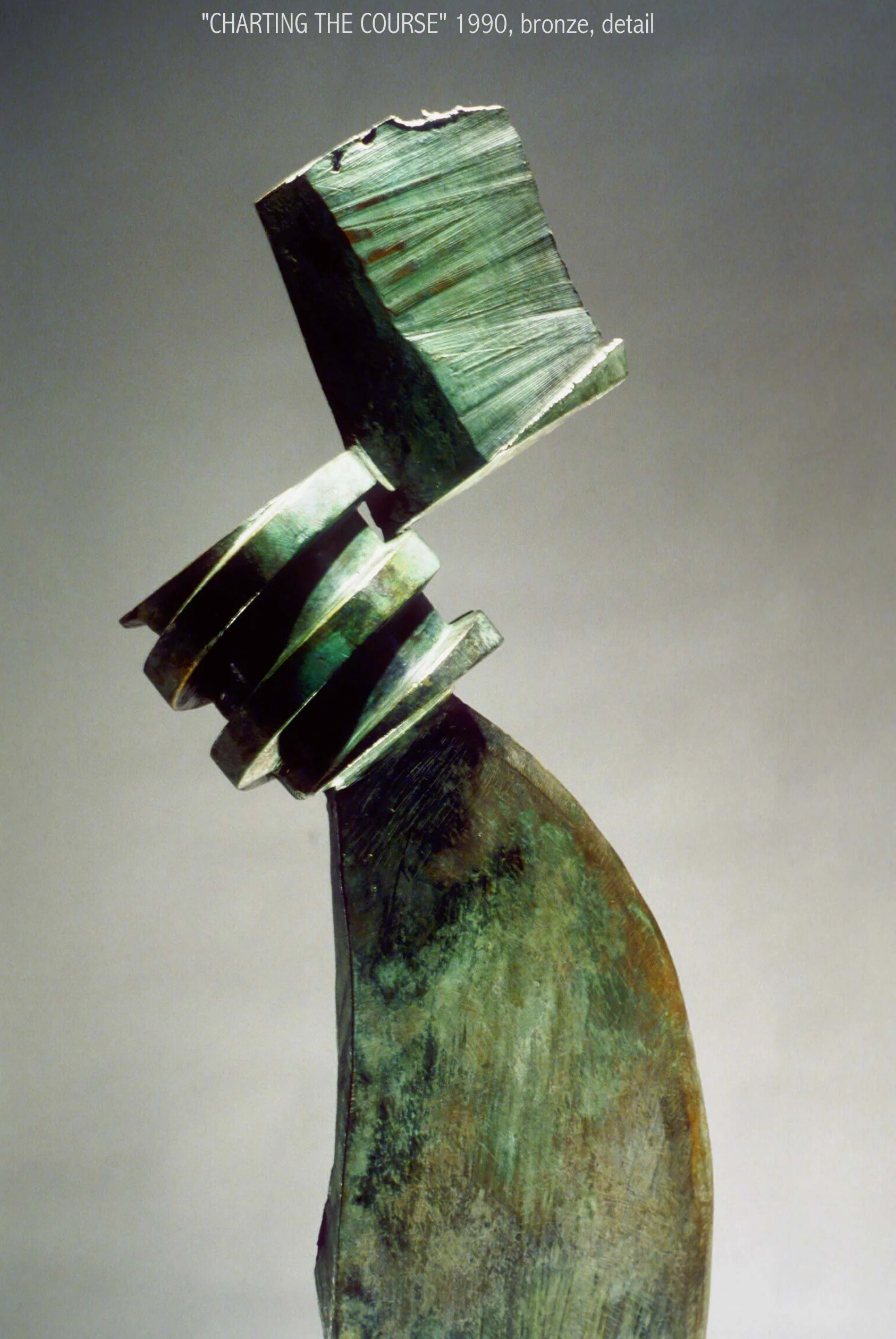
October 1990. Granite, bronze. Dimensions: 65 × 56 × 29 in (165 × 142 × 74 cm).
Private collection - New York
Charting the Course (1990), in bronze and granite, encapsulates John Van Alstine’s exploration of navigation as a metaphor for human agency and the necessity of choosing one’s path in life. Anchored by a grounded granite base and animated by outward-reaching bronze elements, the sculpture suggests a moment of poised decision—where direction is not predetermined but actively set. Reflecting his broader use of tools and structural tension, Van Alstine evokes navigation as an engaged, responsible act requiring balance, adjustment, and intention. Like related works such as the Tiller series and Charting the Course II, the piece embodies his belief that life is a continual process of orientation and movement, shaped by the risks we accept and the courses we choose to follow.
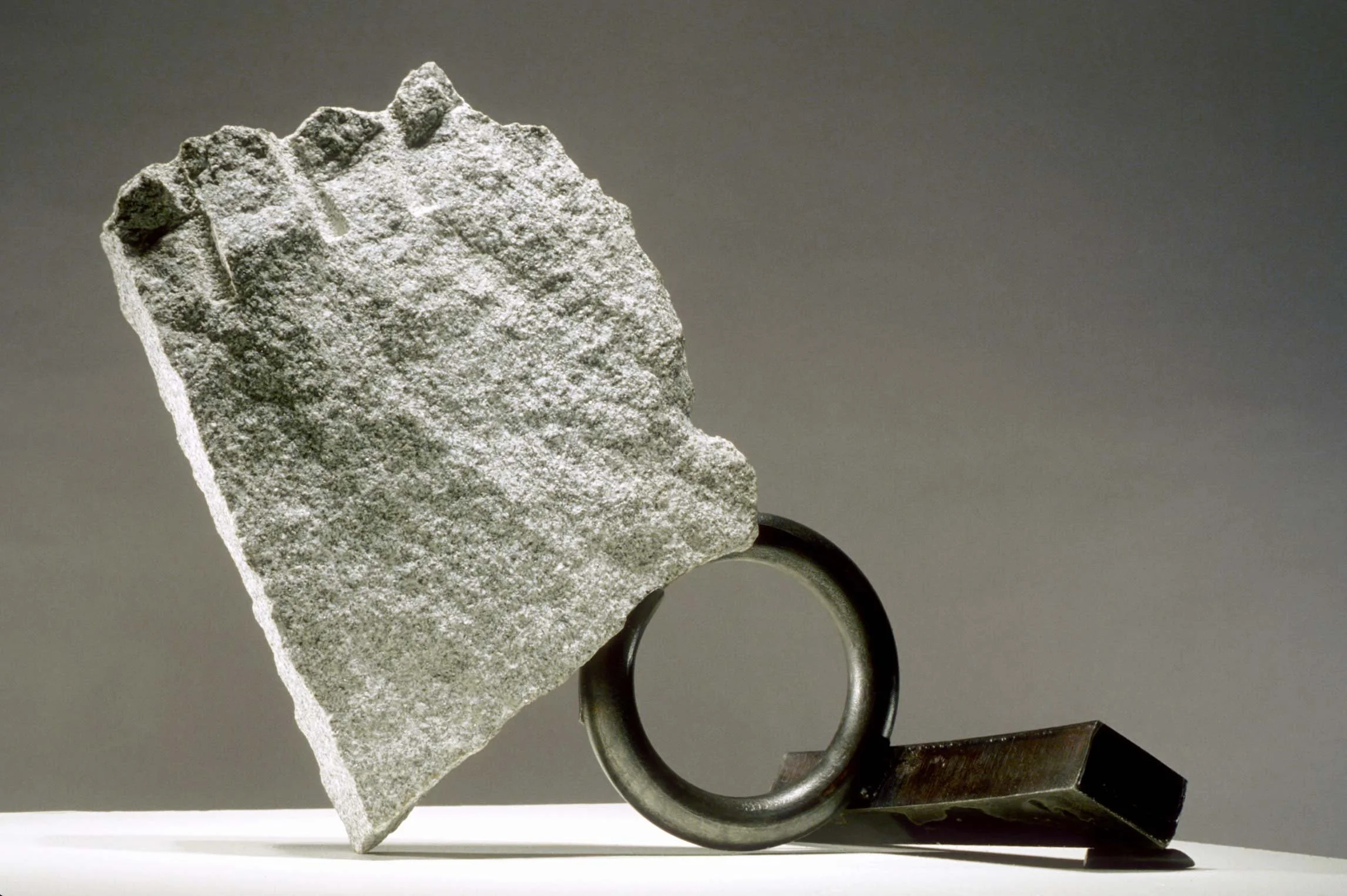
October 1990. Granite, steel. Dimensions: 21 × 28 × 12 in (53 × 71 × 30 cm).
Fenestra (Latin for "window") refers to a small opening, pore, or perforation, primarily used in biology to describe openings in bones (e.g., ear fenestrae) or cells. It also refers to a window-like architectural opening, transparent spots on insect wings, or specialized medical imaging tools.
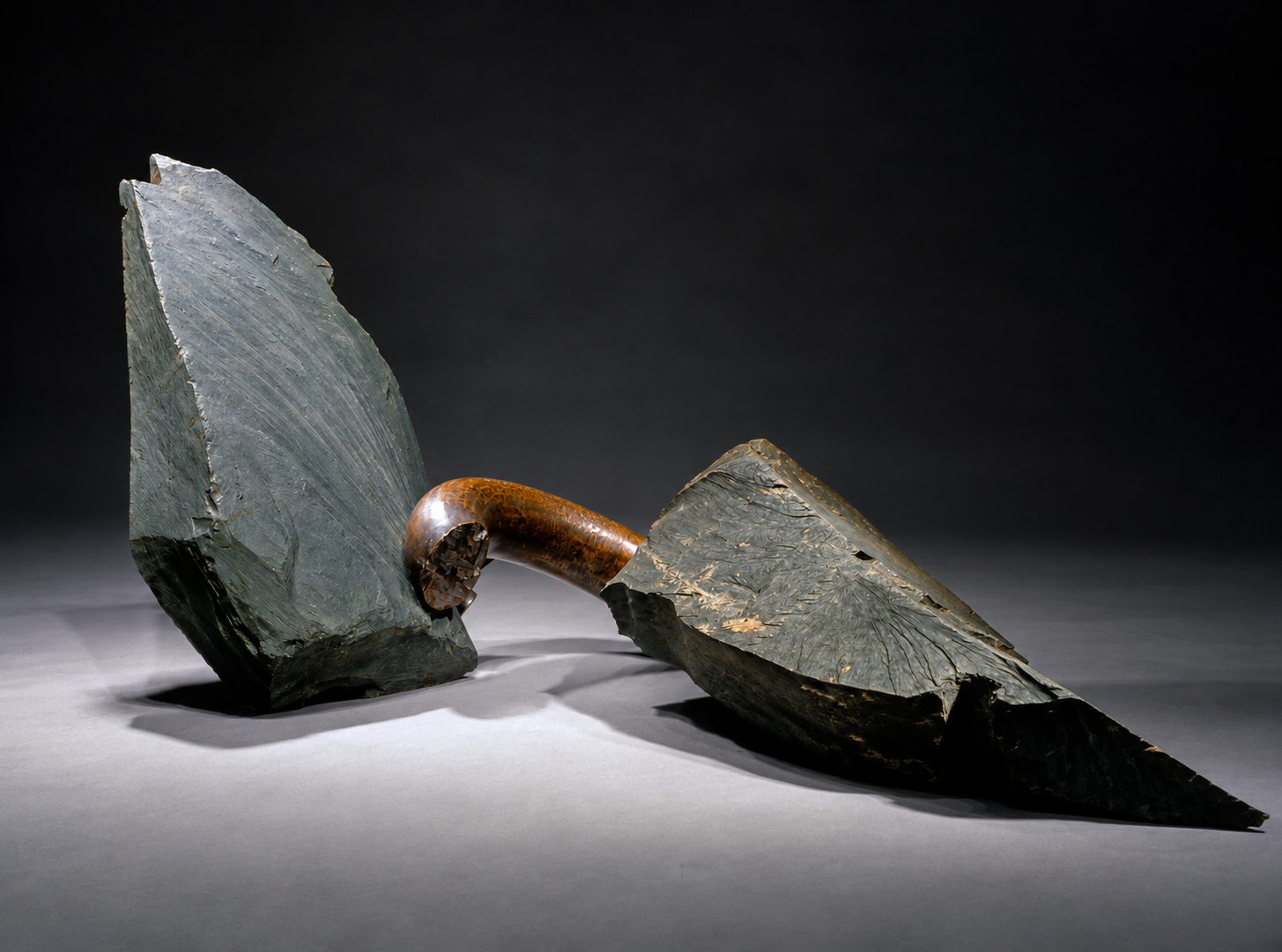
October 1990. Slate, bronze. Dimensions: 23 × 50 × 26 in (58 × 127 × 66 cm). Cannibalized by artist.
Corvus (ˈkȯr-vəs) — A small constellation adjoining Virgo to the south. The name derives from the Latin corvus, meaning “raven.”
Corvus combines two rough stone forms with a sweeping arc of steel, bringing natural and industrial materials into an active relationship. The found character of the stone and gestural curve of the steel create a sense of weight, tension, and movement.
The title Corvus is Latin for “crow” or “raven” and also the name of a constellation. The arrangement loosely suggests a bird-like presence without becoming literal, while the celestial association connects the work to my continuing interest in looking to the sky for imagery and metaphor.
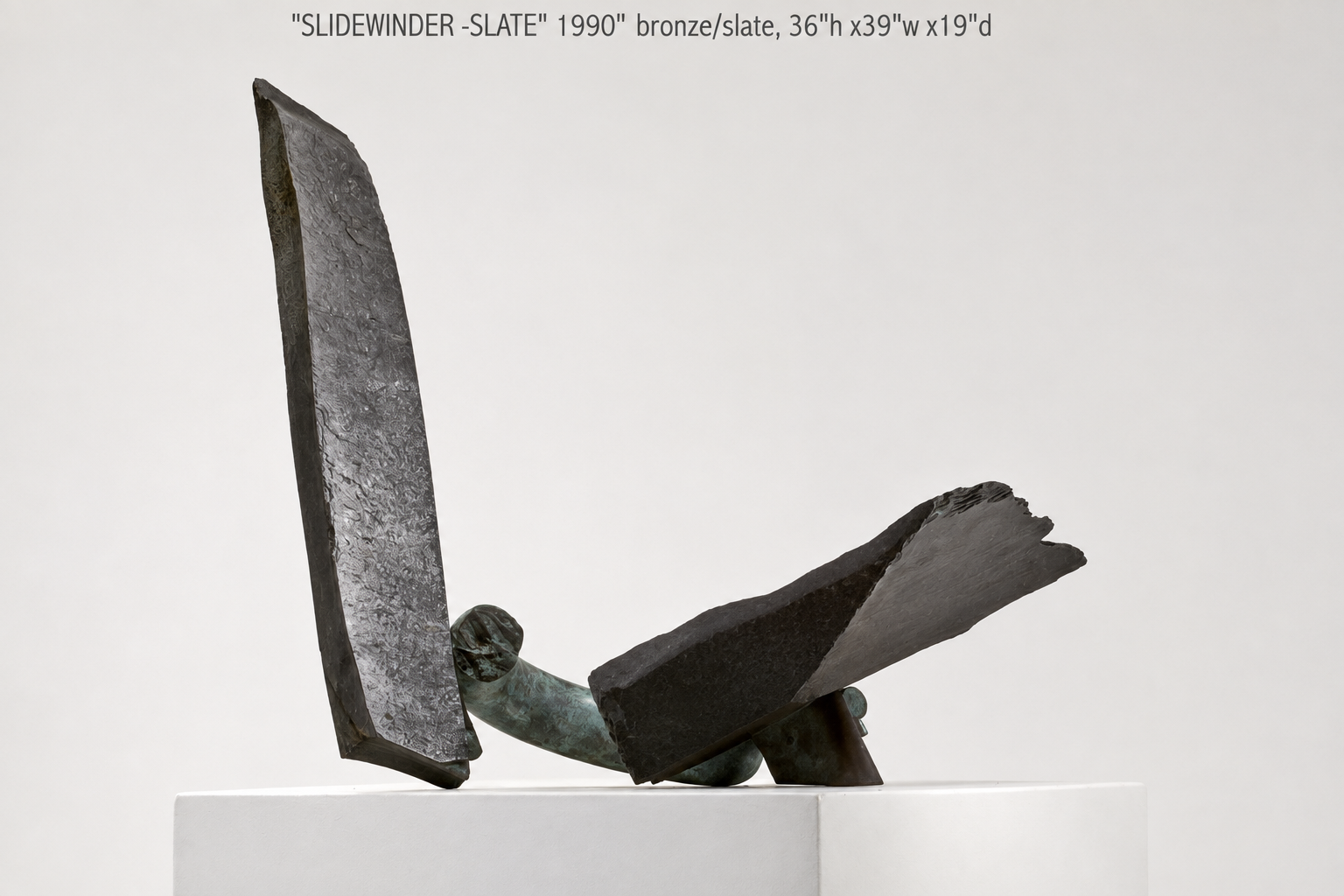
October 1990. Slate, bronze. Dimensions: 36 × 39 × 19 in (91 × 99 × 48 cm). Private collection - Aspen, CO
Sidewinder Slate, 1990 (S-90-15)
Sidewinder Slate continues my exploration of circular movement, balance, and physical connection within the Sidewinder Series. It was one of my first sculptures to incorporate New York State slate, whose dark, layered character contrasts with the sweeping, green-patinated bronze. The tall rising slab and smaller horizontal stone are brought into an active relationship by the curving bronze form, creating a sense of movement while maintaining my ongoing interest in visible connections and precarious balance.
The sculpture was exhibited in my 1990 solo exhibitions at Gerald Peters Gallery in Santa Fe and the Morris Museum in Morristown, New Jersey. It was later purchased by Marty and Debby Flug of Aspen, Colorado.
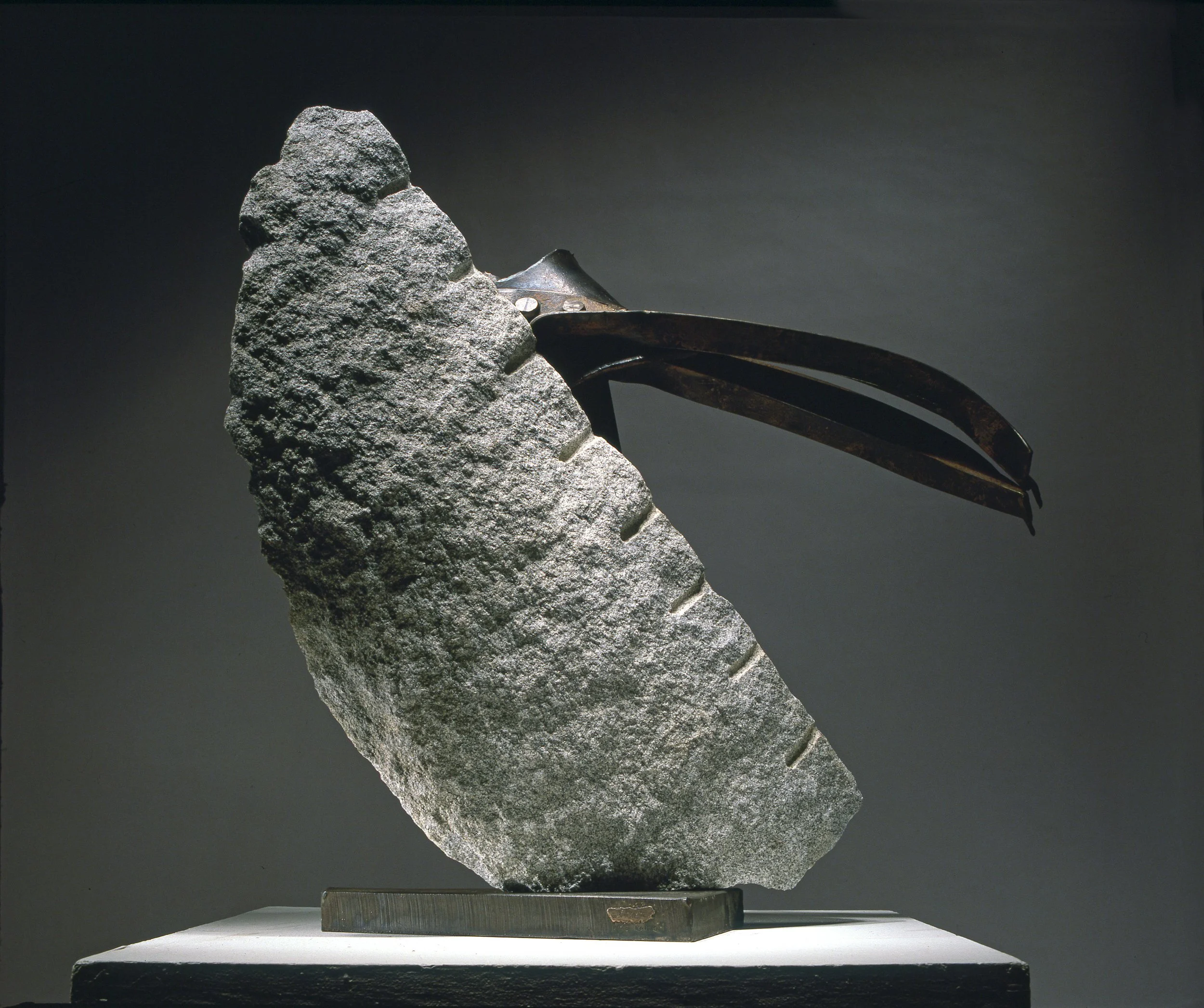
October 1990. Granite, steel. Dimensions: 42 × 41 × 18 in (107 × 104 × 46 cm).
An adze (/ædz/) or adz is an ancient and versatile cutting tool similar to an axe but with the cutting edge perpendicular to the handle rather than parallel.
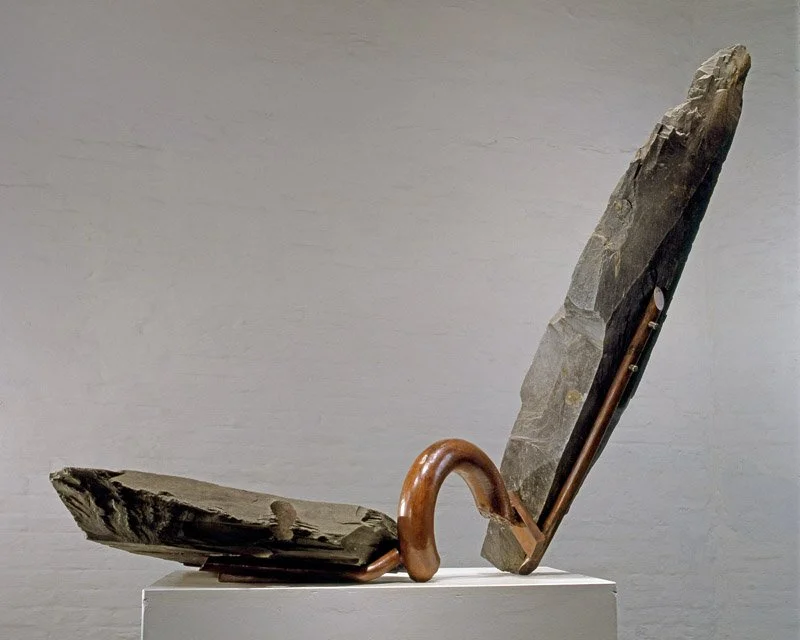
November 1990. Slate, bronze. Dimensions: 46 × 56 × 26 in (117 × 142 × 66 cm).
Fornix is a Latin noun (masculine, third declension) meaning "arch," "vault," or "vaulted chamber".
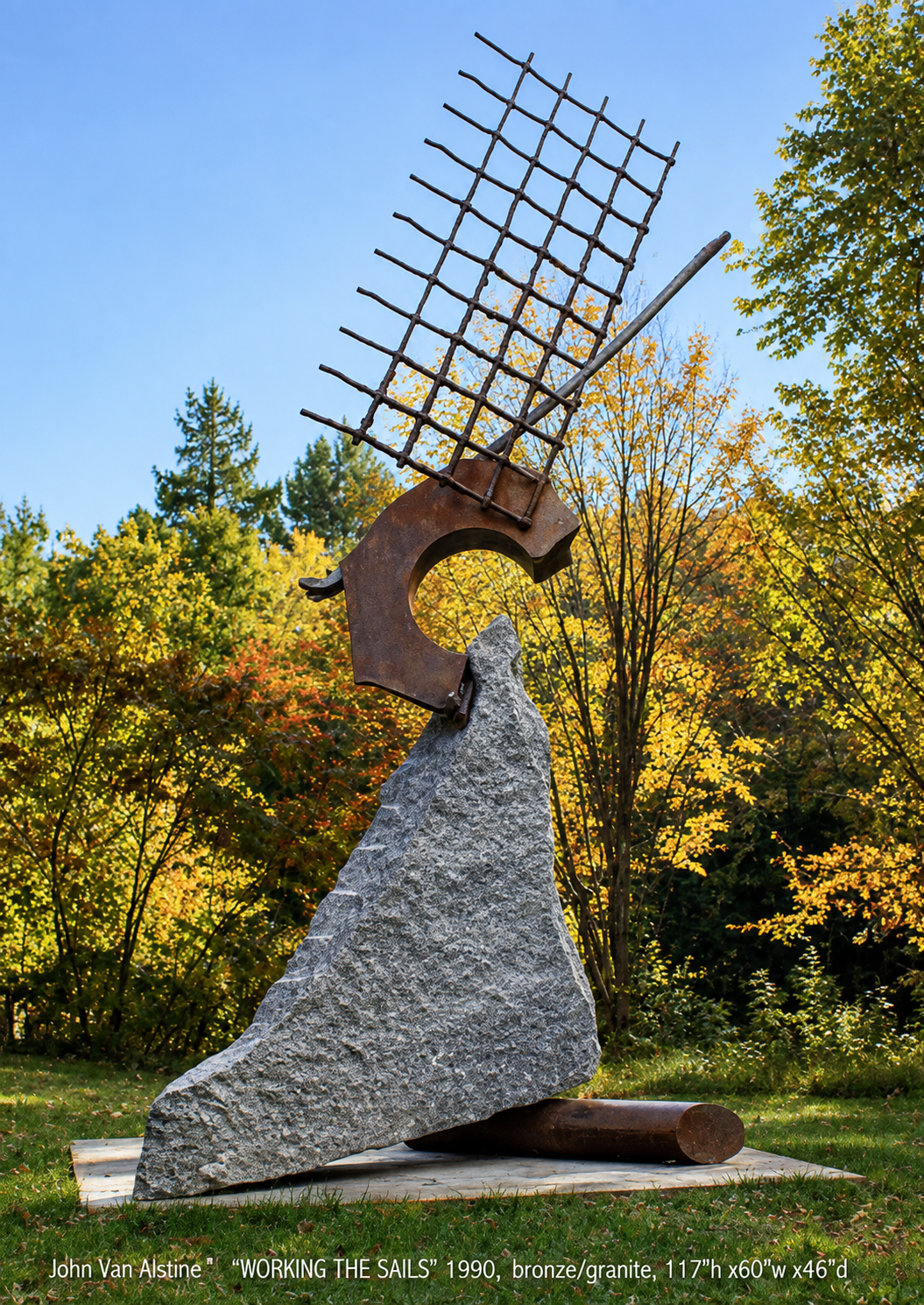
November 1990. Green granite, bronze. Dimensions: 117 × 60 × 46 in (297 × 152 × 117 cm). Collection: Albany Museum of History and Art, Albany, NY. Gift of Philip M. Smith.
Working the Sails, 1990
Working the Sails extends the vessel and navigation imagery that entered my work in the late 1980s. A massive granite form supports a bronze arc and open grid suggesting a sail, bringing the weight and permanence of stone into contrast with the implied movement of wind and water. The vessel and sailing references became metaphors for passage, navigation, and charting a course.
The title refers to the active process of adjusting sails to changing conditions—a metaphor for navigating the forces and circumstances that shape our lives. The work also carries a specific maritime association: it has been described as paying homage to the sailing vessels that traveled the Hudson River.
Installed at the Albany Museum of History and Art 2015
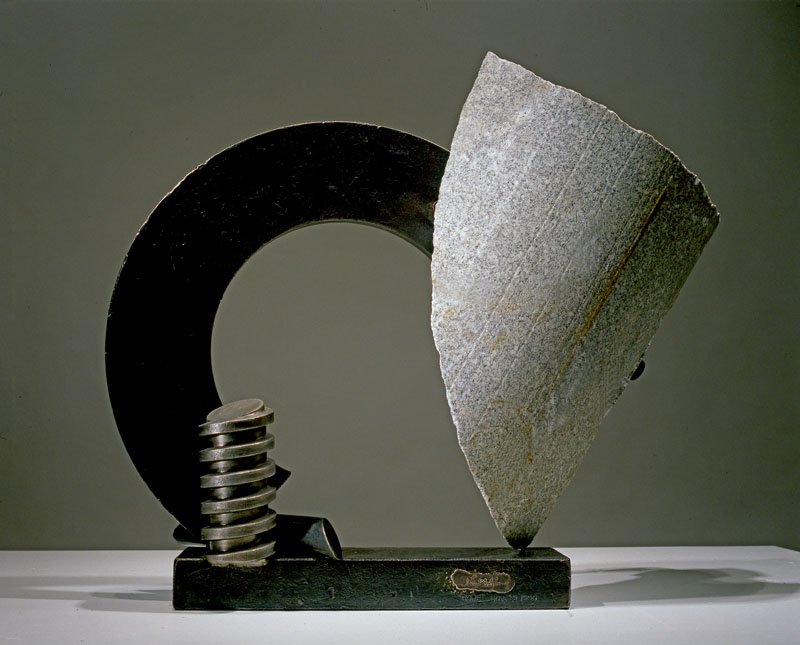
November 1990. Granite, steel. Dimensions: 24 × 25 × 12 in (61 × 64 × 30 cm).
Private Collection
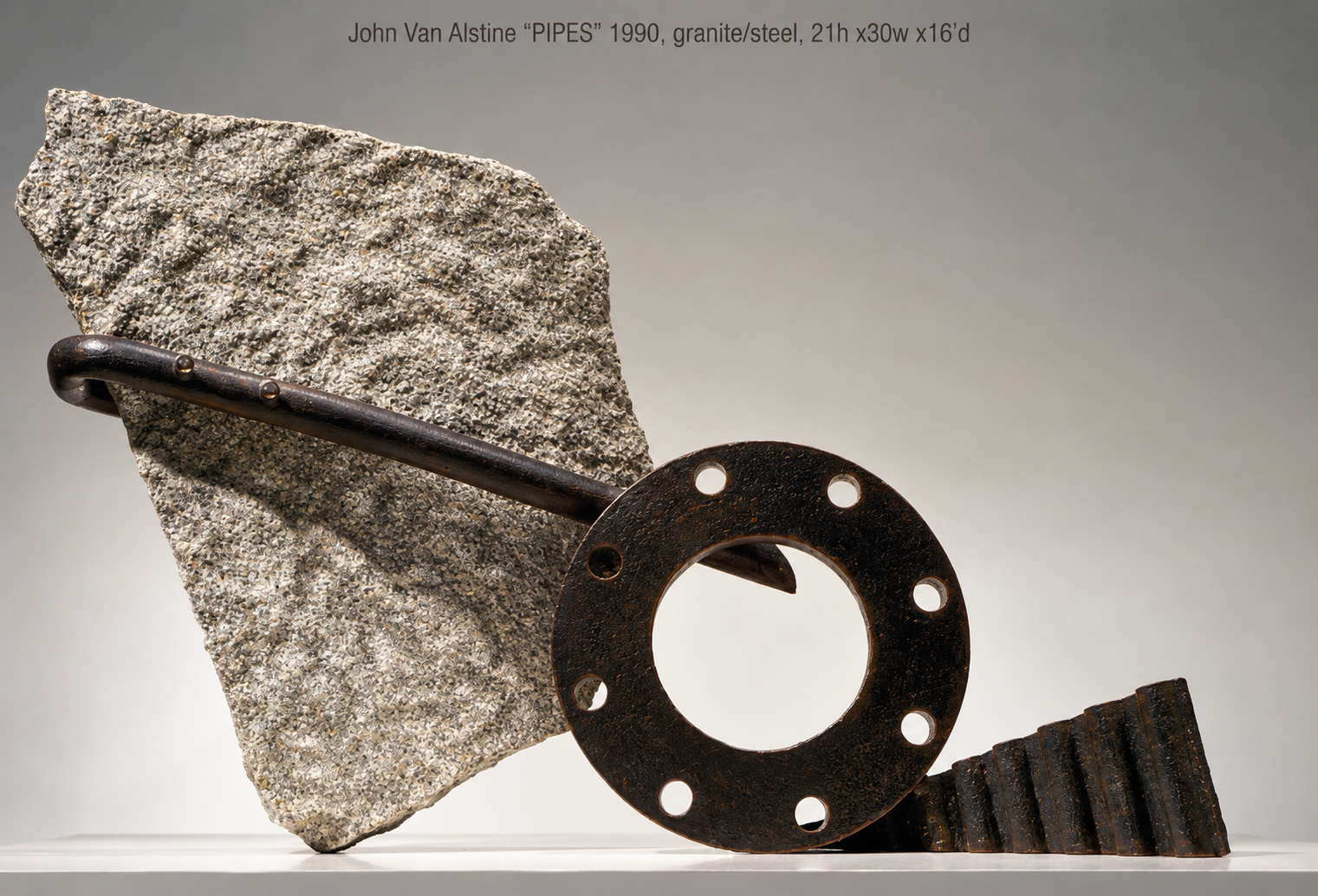
November 1990. . Dimensions: 21 × 30 × 16 in (53 × 76 × 41 cm).
Pipes, 1990
Pipes combines rough granite with found industrial steel—a pipe, flange, and ribbed section—bringing natural and human-made materials into an active relationship. Their original forms remain visible while taking on new structural and expressive roles.
The title refers directly to the pipe elements while also suggesting Pan pipes, the ancient wind instrument made from a series of pipes of different lengths. This association introduces a musical dimension, transforming the industrial forms into something suggestive of sound, rhythm, and breath.
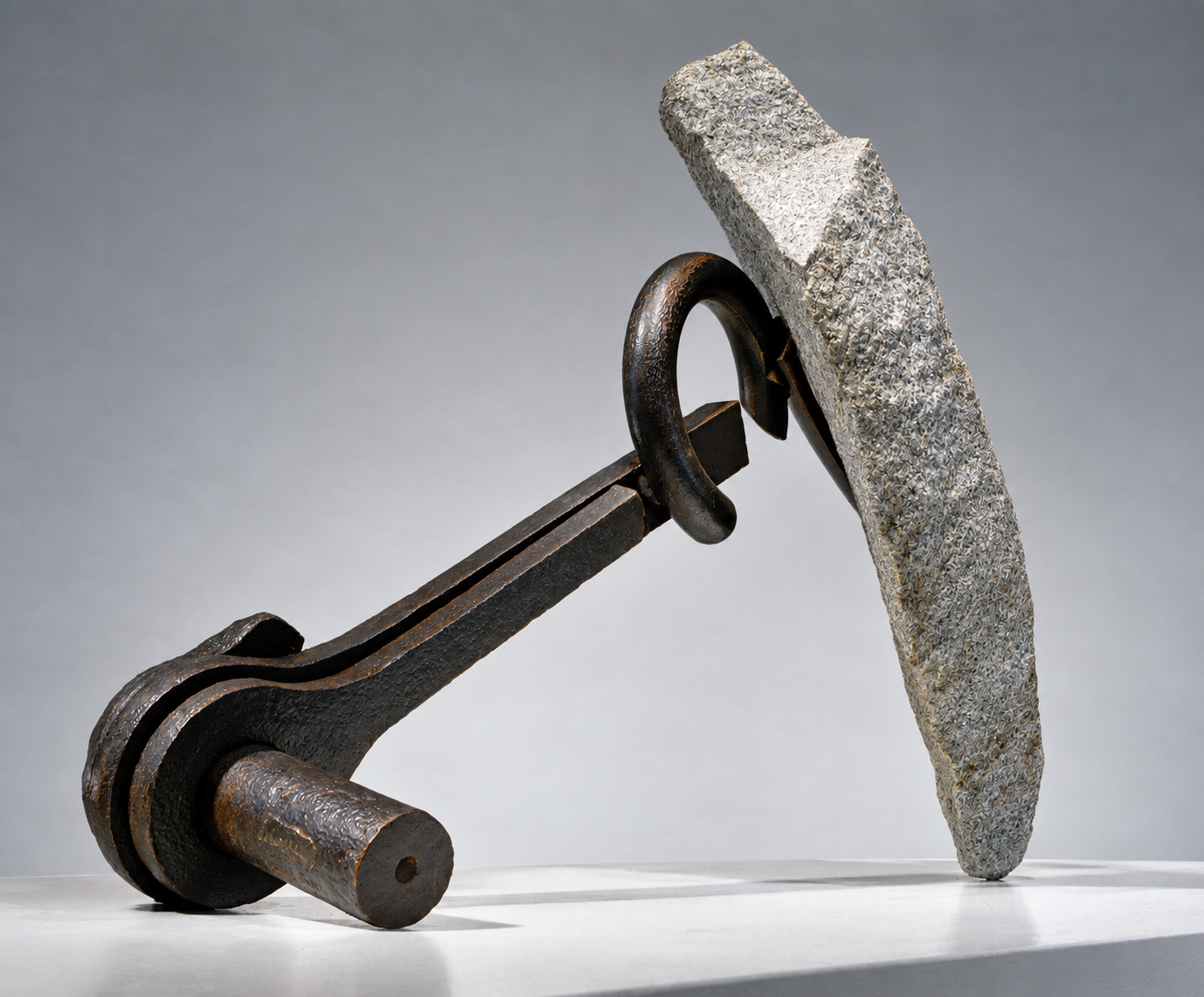
December 1990. Granite, steel. Dimensions: 28 × 48 × 16 in (71 × 122 × 41 cm).
Pes is the Latin word for "foot". Anatomy: Defines the foot or footlike structure of humans and four-legged animals.
Pes, 1990
Pes combines rough granite with forged steel forms suggesting a tool or mechanical implement. The natural and industrial materials interact through weight, leverage, and balance, giving the sculpture a strong sense of physical action.
The title Pes, Latin for “foot,” reinforces this bodily association. The tool-like steel becomes an extension of the body, reflecting my continuing interest in tools and implements as metaphors for human labor and ingenuity.
1989
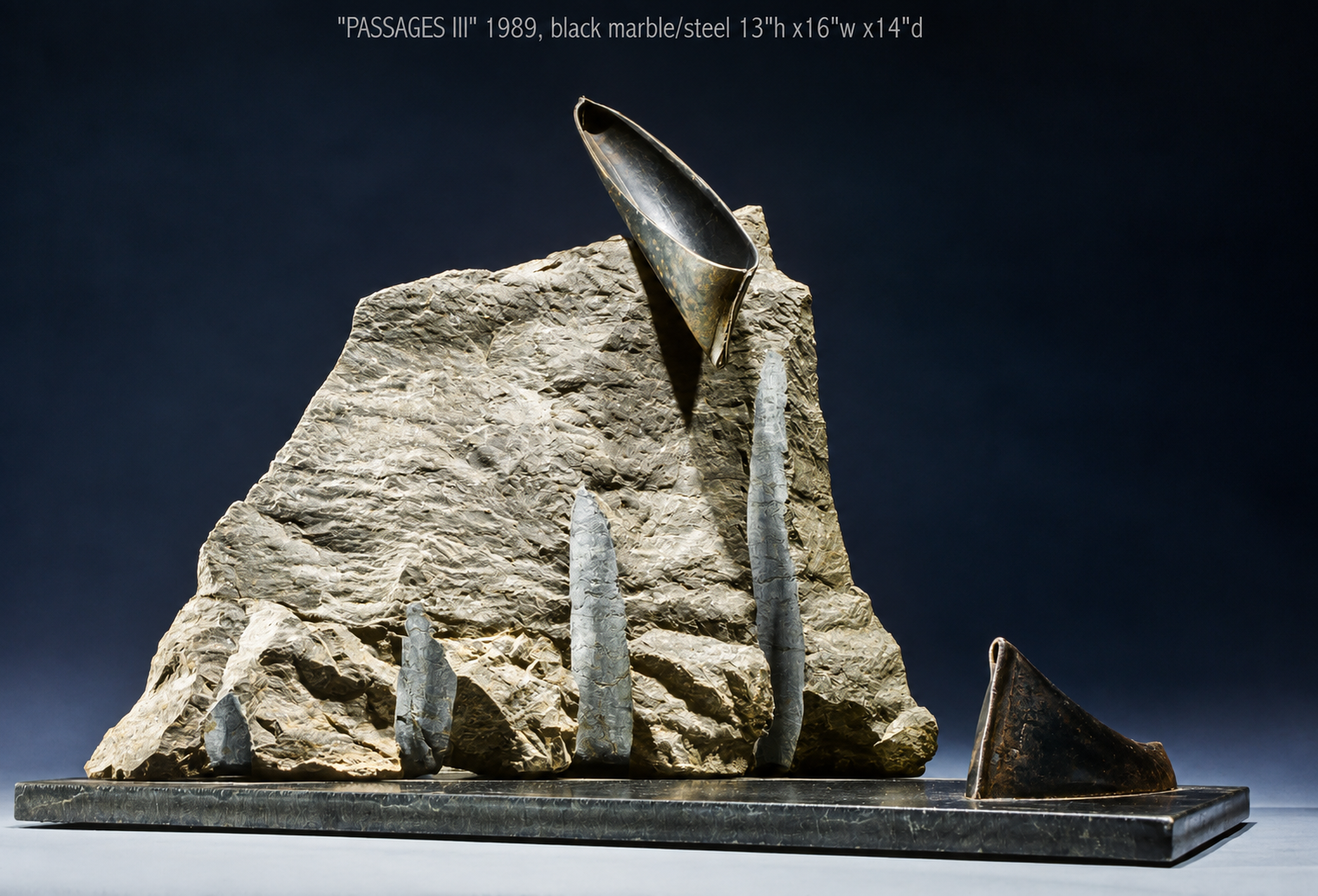
April 1988. Black marble, steel. Dimensions: 13 × 16 × 14 in (33 × 41 × 36 cm). Private Collection.
Passages III, 1989
Passages III continues my exploration of the vessel as an expressive metaphor for passage, journey, and the self—an image that grew partly from my attraction to the boat form for both its beauty and functionality, and from the vessel’s long history as a carrier through physical and metaphorical space. Here, the massive black marble form becomes a kind of landscape through which the vessels move, contrasting the permanence and weight of stone with the suggestion of travel and transition.
The two vessels occupy very different moments in that journey: one is caught in mid-descent, poised against the stone as if its passage is still underway, while the other has come to rest below, overturned and bottom-side up. Their contrasting positions introduce uncertainty into the idea of passage—the journey may involve movement, imbalance, arrival, or disorientation—while leaving the ultimate destination unresolved.
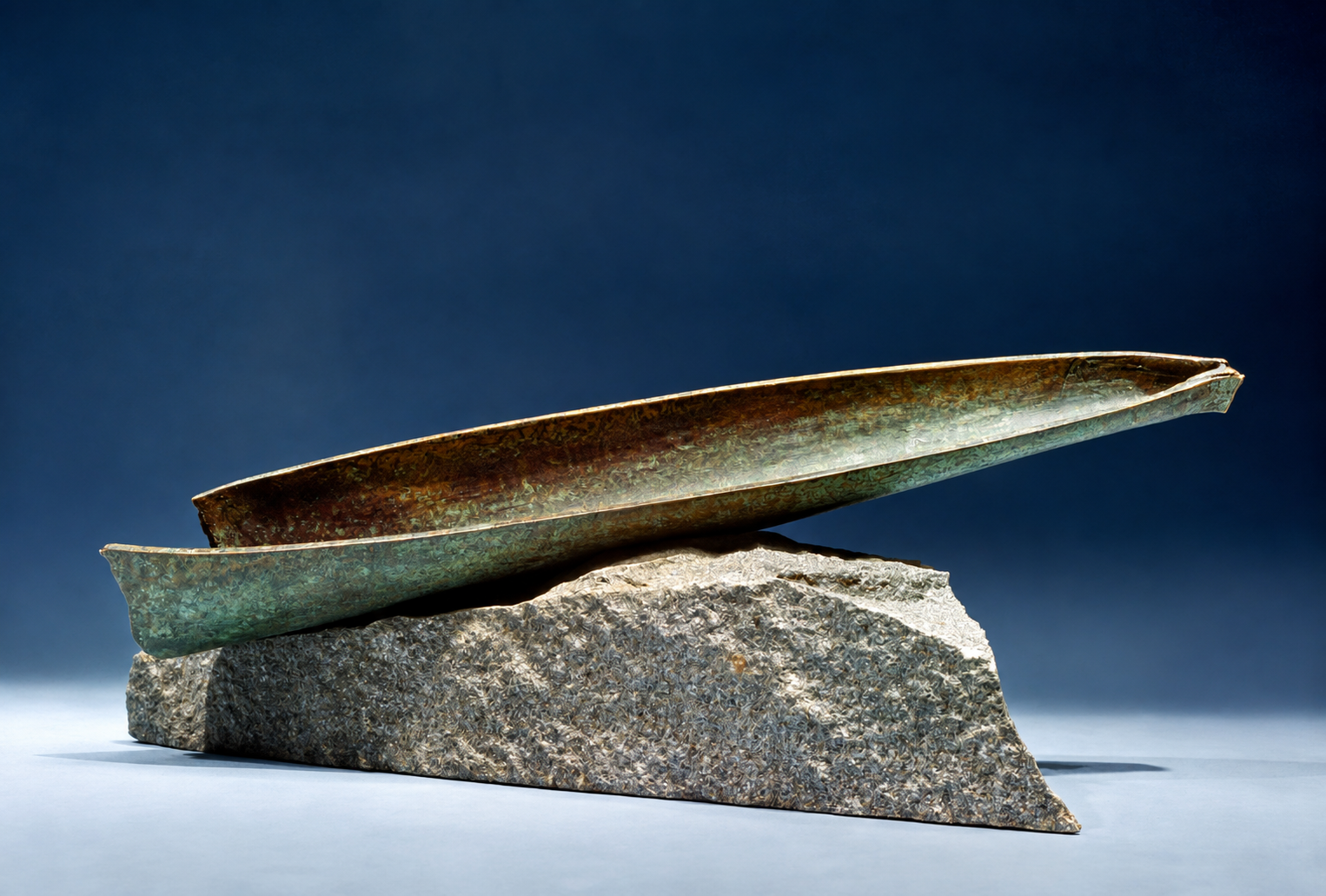
January 1989. Black granite, bronze. Dimensions: 9 × 26 × 17 in (23 × 66 × 43 cm).
Collection of the artist.
Employing the universal metaphor of the vessel or boat—associated with passage and as a container of the “self”—Eden (1989) makes both a personal and universal statement. The title shares the name of my daughter, born on the last day of 1988, while also evoking the biblical Eden and its associations with purity and the “garden of paradise.”
Looking down at my newborn child, I saw an open vessel. Like the open cast-bronze form of the sculpture, she suggested a shell or container—unfilled and untainted. I associated this open, placid form with our newborn: pure, receptive, and poised to stake out her own destiny, yet to be filled with society’s contaminations, impurities, burdens, rules, and expectations.
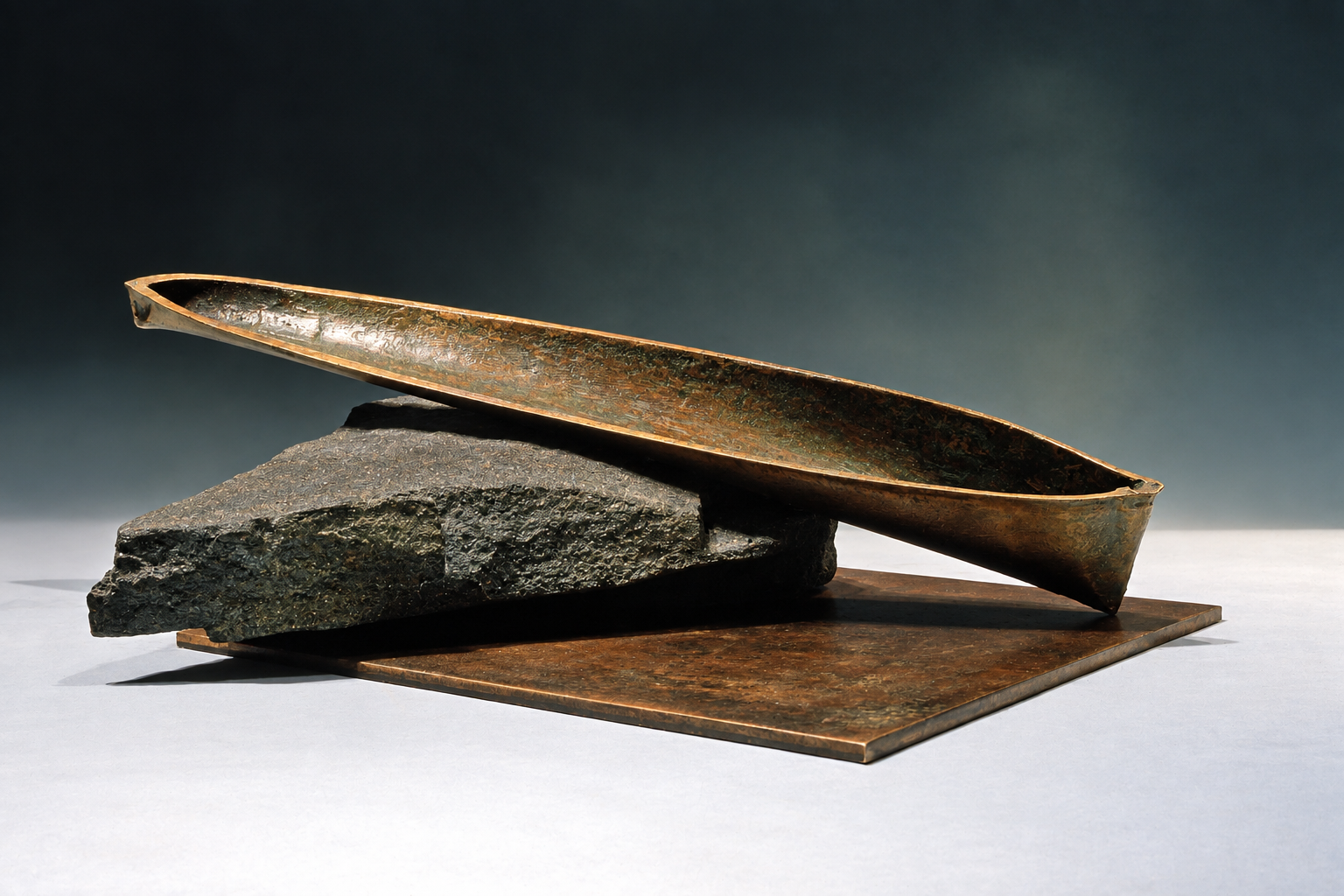
January 1989. Granite, bronze. Dimensions: 6 × 15 × 16 in (15 × 38 × 41 cm).
Private collection - Washington, DC
Pyxis (/'p?ks?s/; Greek: box) is a small and faint constellation in the southern sky. Abbreviated from Pyxis Nautica, its name is Latin for a mariner's compass
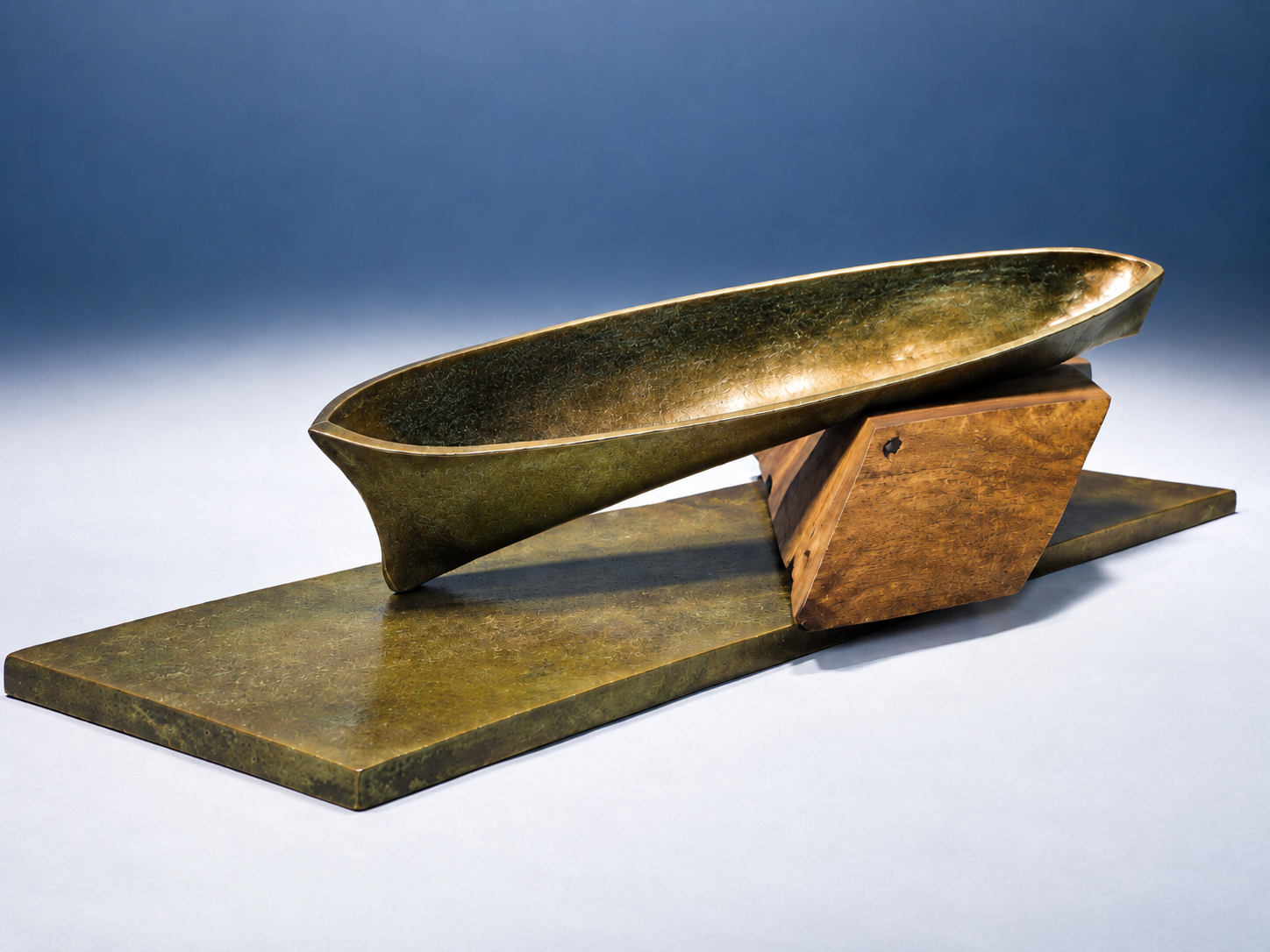
January 1989. Red stone, bronze. Dimensions: 3 × 10 × 6 in (8 × 25 × 15 cm). Private Collection.
Private collection - Washington, DC
Pyxis (/'p?ks?s/; Greek: box) is a small and faint constellation in the southern sky. Abbreviated from Pyxis Nautica, its name is Latin for a mariner's compass
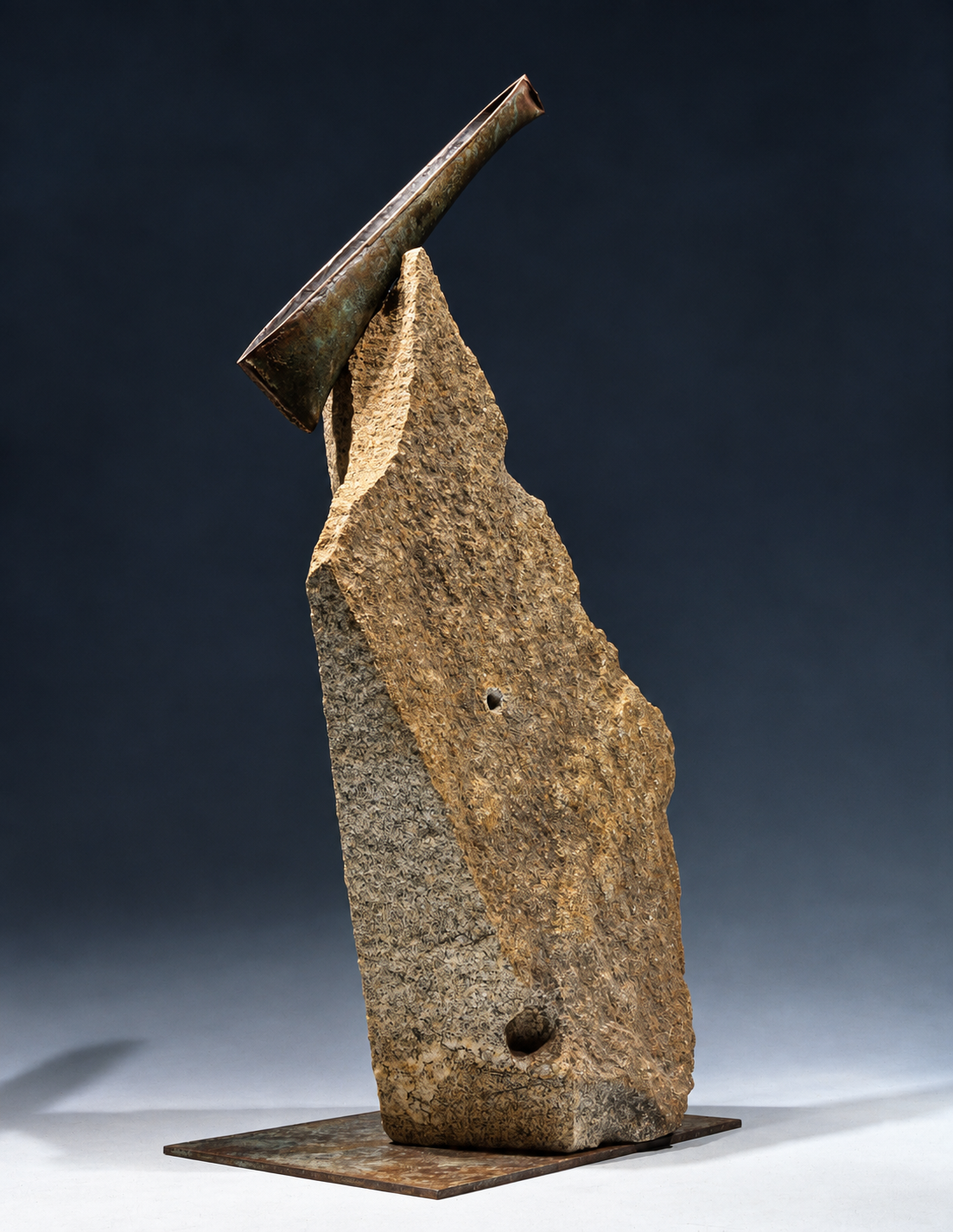
January 1989. Granite, bronze. Dimensions: 36 × 17 × 19 in (91 × 43 × 48 cm). Private Collection.
Passage ’89, 1989
Passage ’89 continues my exploration of the vessel as an expressive metaphor for passage, journey, and the self. My attraction to the vessel grew from both the beauty and functionality of boat forms and their long history as carriers through physical and metaphorical space. Here, a vessel is caught in mid-descent, its strong diagonal movement contrasting with the weight and permanence of the upright stone.
The vessel appears poised between departure and arrival—its passage still underway and its destination unknown. This sense of a journey suspended in progress became increasingly important in my work during this period, allowing the vessel to suggest movement through changing places, circumstances, and states of being.
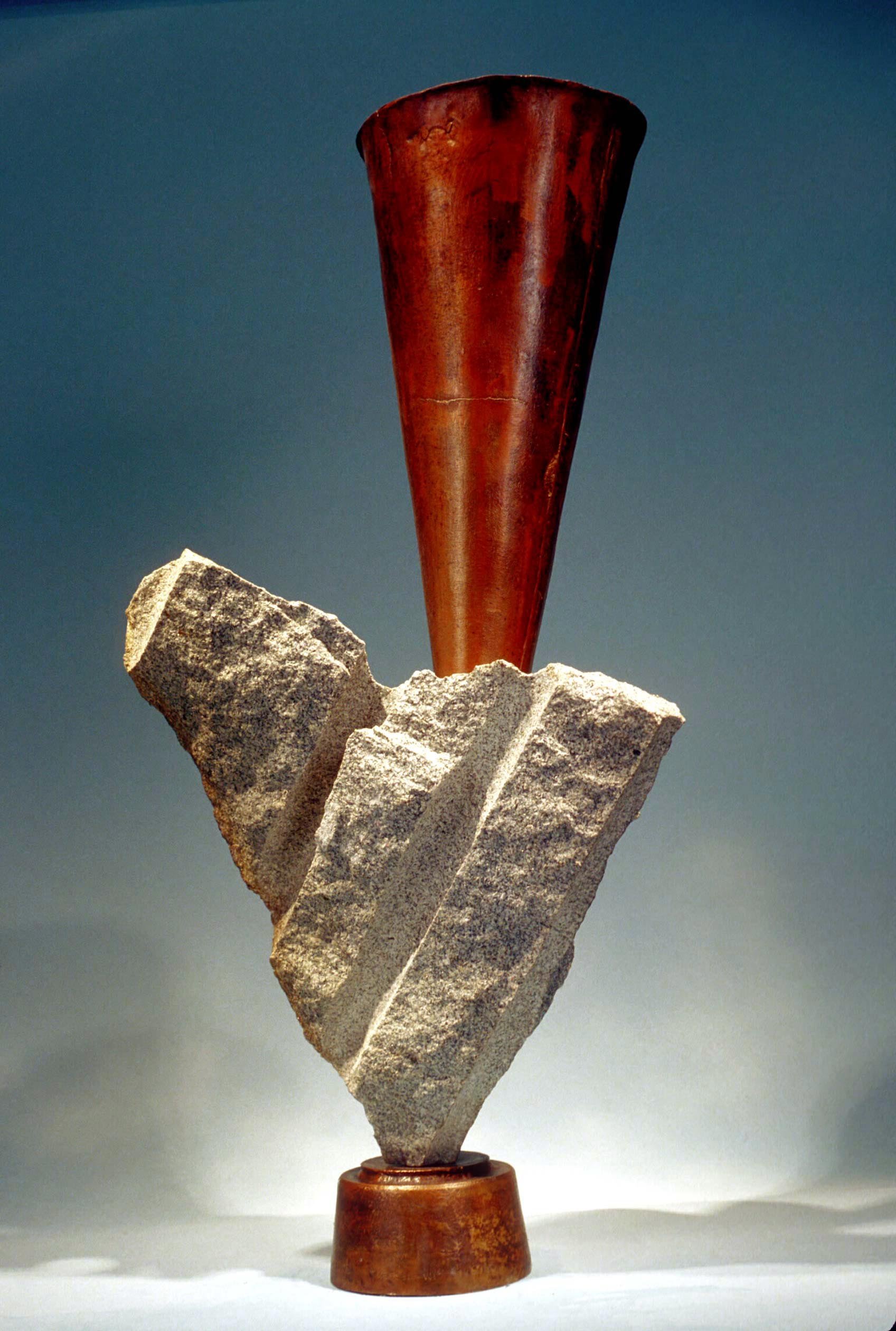
January 1989. Granite, bronze. Dimensions: 40 × 20 × 12 in (102 × 51 × 30 cm). Private Collection
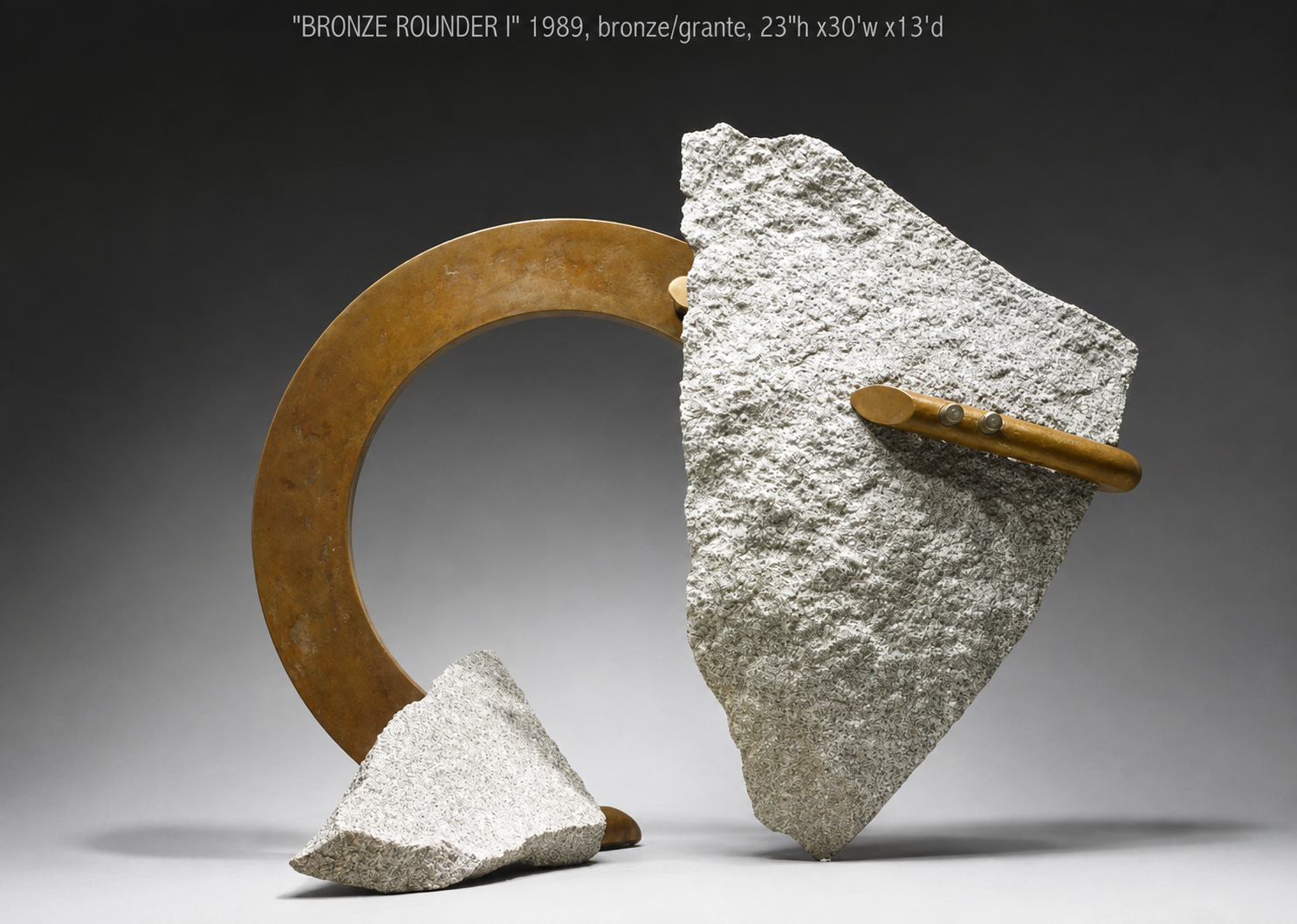
January 1989. Granite, bronze. Dimensions: 23 × 30 × 13 in (58 × 76 × 33 cm).
Bronze Rounder I continues the circular language of my earlier Rounder Series, joining two contrasting pieces of stone through a broad curving arc. The large upright stone balances on a narrow point while the smaller stone anchors the opposite end, creating tension between weight, balance, and implied movement. Visible connections remain an important part of both the structure and the image.
The sweeping arc reflects my move from the structural concerns of the earlier tensegrity, or Brute Series, toward a more expressive sculptural vocabulary. Its combination of stone, circular movement, and precarious balance also anticipates ideas that would later develop in my Sisyphean Circle Series.
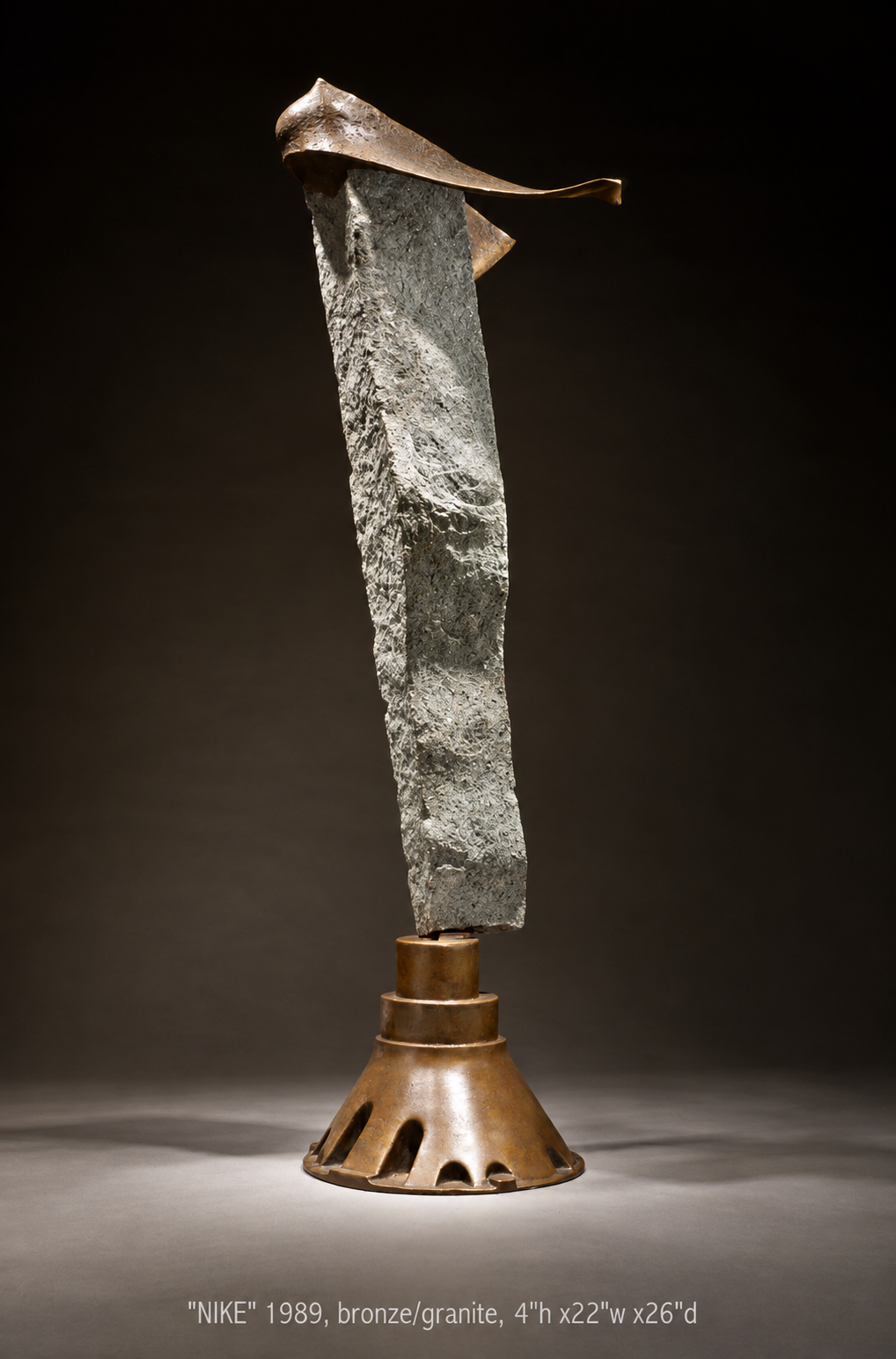
1989. Granite, bronze. Dimensions: 84 × 22 × 26 in (213 × 56 × 66 cm). Private Collection Aspen, CO.
Nike, 1989
Nike continues my interest in combining raw granite with metal, here using bronze for its color and patina. The tall stone rises from a bronze base, while the sweeping bronze element above introduces movement and lightness, countering the granite’s weight and verticality.
The title refers to Nike, the Greek goddess of victory, and the famous Winged Victory of Samothrace. The wing-like bronze form and forward-leaning stone suggest a figure moving into space. Rather than depicting the figure literally, these elements bring a subtle figurative and mythological association to an otherwise abstract work.
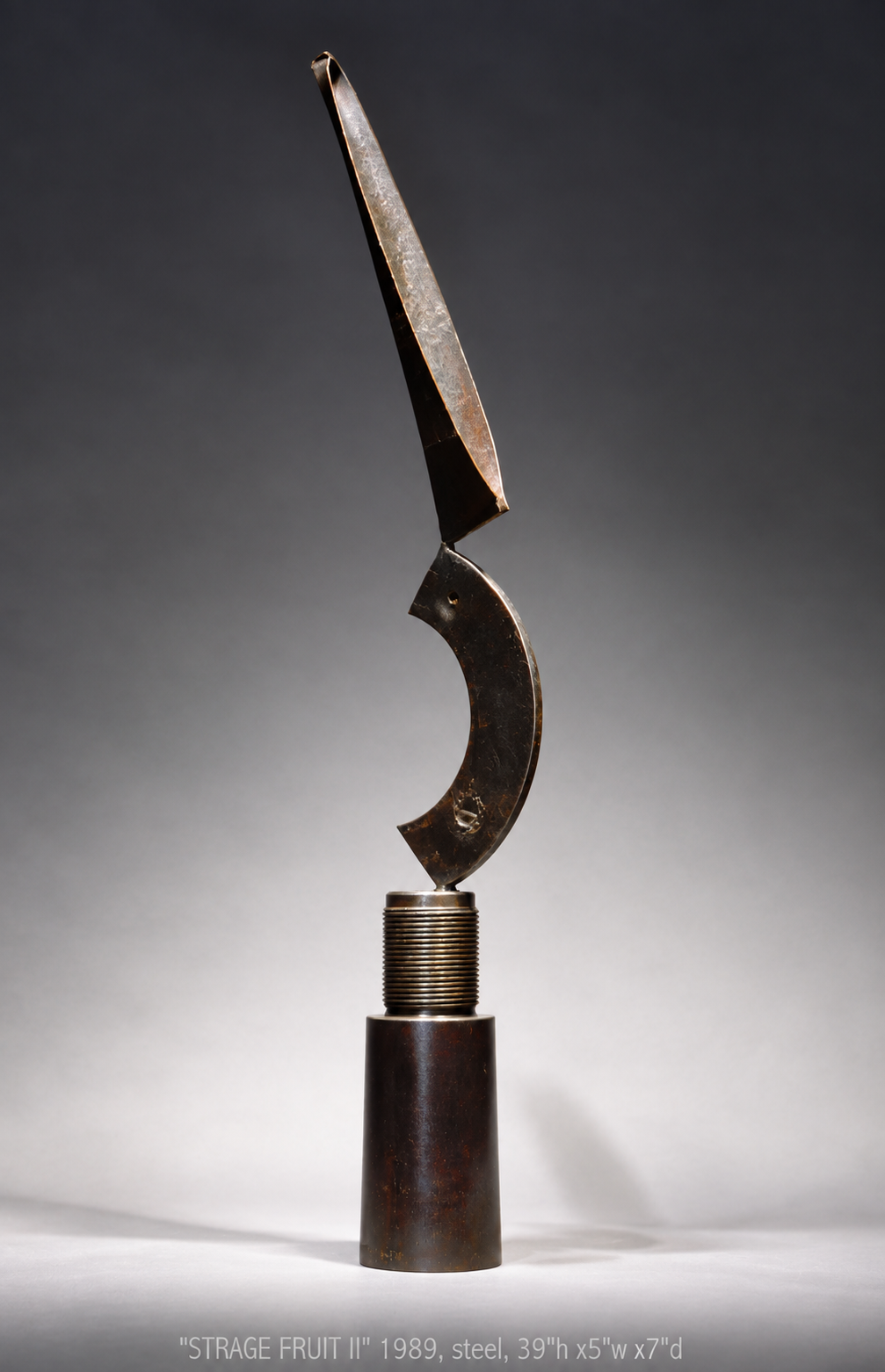
February 1989. Steel. Dimensions: 39 × 5 × 7 in (99 × 13 × 18 cm).
Strange Fruit II, 1989
Strange Fruit II, the second work in the series, continues the departure from my more familiar combinations of substantial stone and steel. Here stone is eliminated entirely, allowing steel to rise in a slender, almost calligraphic gesture. The elongated upper form opens like a fruit or seed pod, introducing the organic and bodily associations becoming increasingly important in my work.
The title adds a darker, deliberately oblique meaning, recalling Billie Holiday’s haunting performance of “Strange Fruit,” confronting the lynching of African Americans in the American South. Rather than illustrating the song, the reference creates a tension between growth and violence, beauty and brutality. The sculpture was later cast in bronze and combined with a vertically positioned stone to create Strange Fruit III.
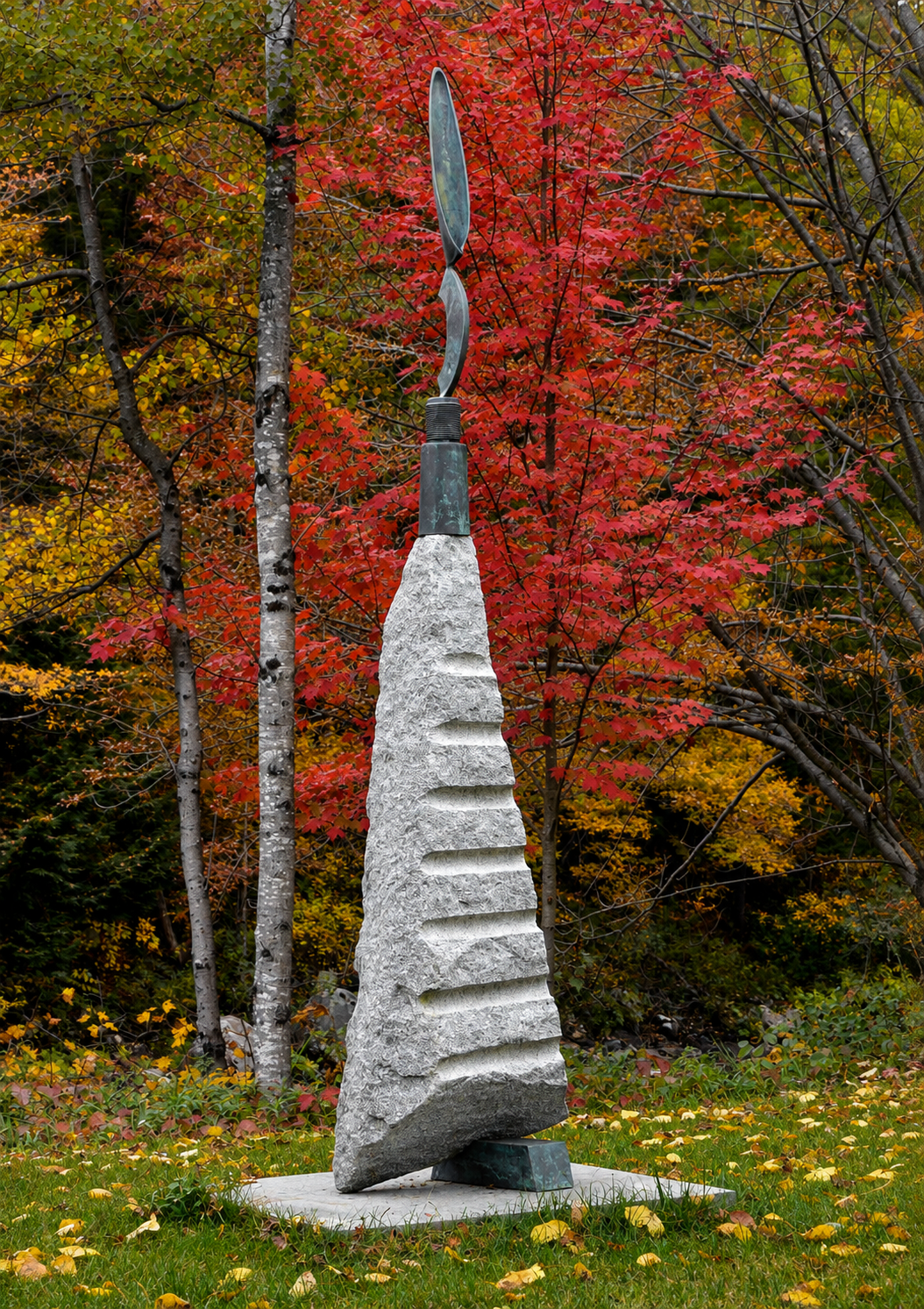
February 1989. Granite, bronze. Dimensions: 95 × 21 × 16 in (241 × 53 × 41 cm). Bronze cannibalized 2020.
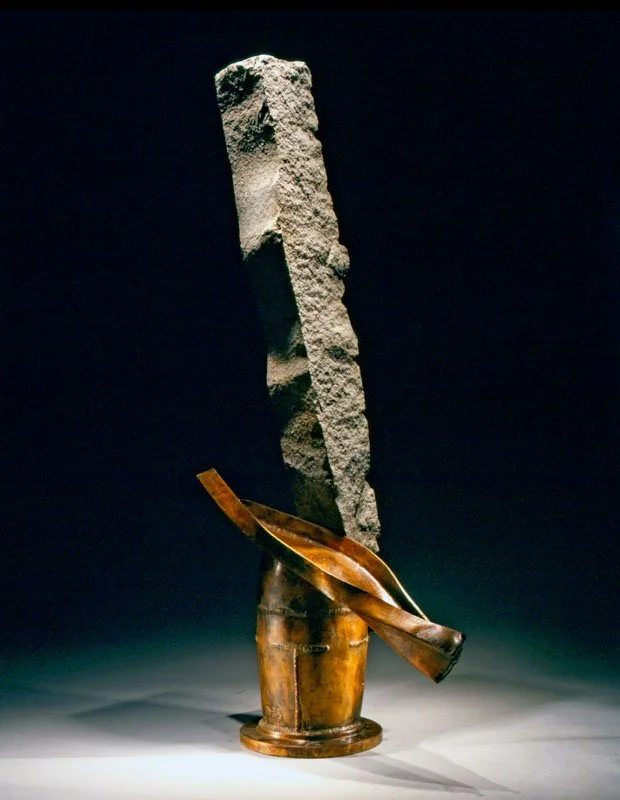
Strange Fruit III
Strange Fruit III, the third work in the series, resumes my combination of metal and found stone. Here the bronze element rises from the vertically positioned stone in a slender, almost calligraphic gesture, opening at the top like a fruit or seed pod. The form introduces organic and bodily associations while also recalling the vessel imagery that was becoming increasingly important in my work.
The title adds a darker, deliberately oblique meaning, recalling Billie Holiday’s haunting performance of “Strange Fruit,” confronting the lynching of African Americans in the American South. Rather than illustrating the song, the reference gives the organic form an unsettling dimension, creating a tension between growth and violence, beauty and brutality.
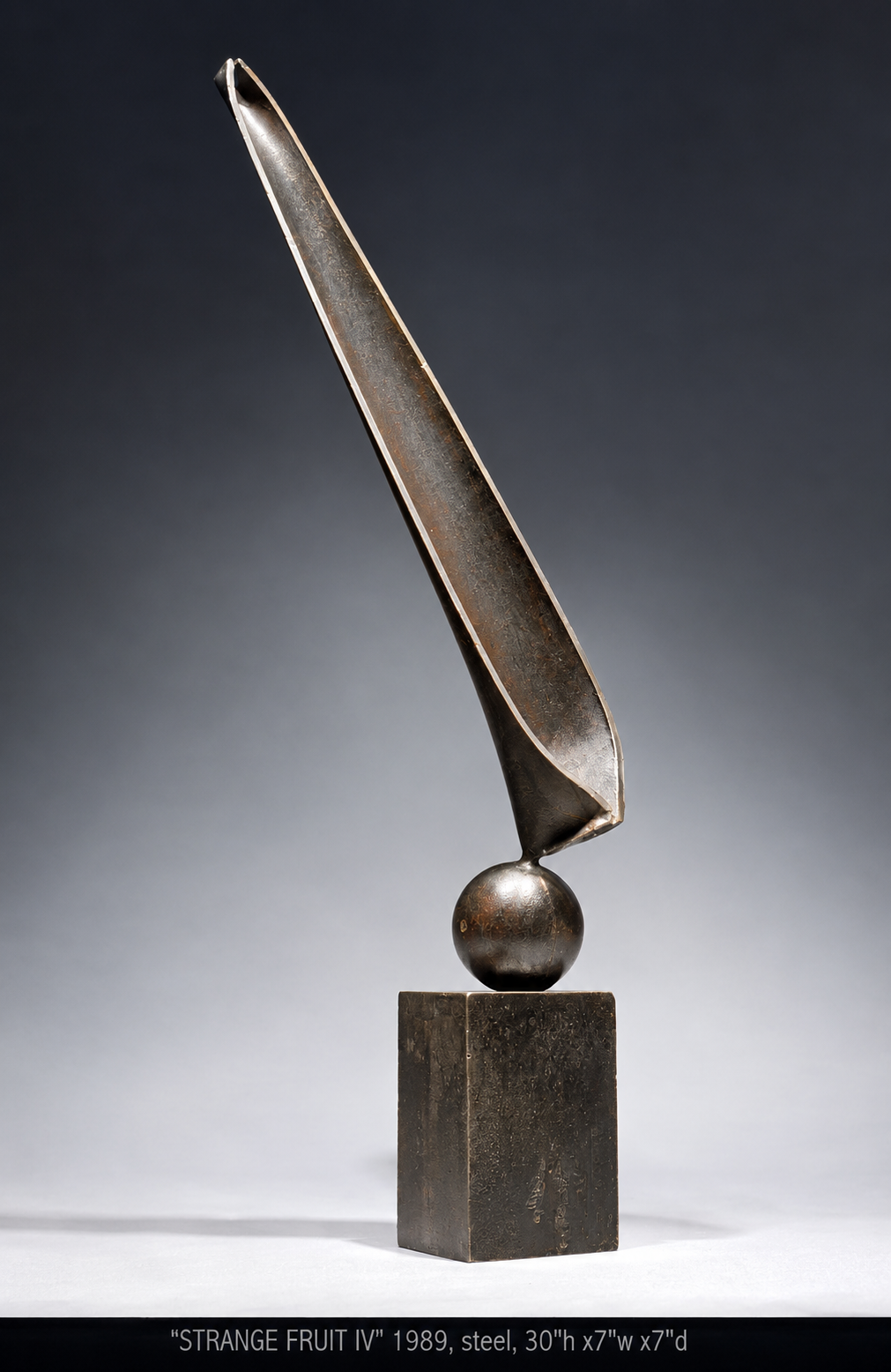
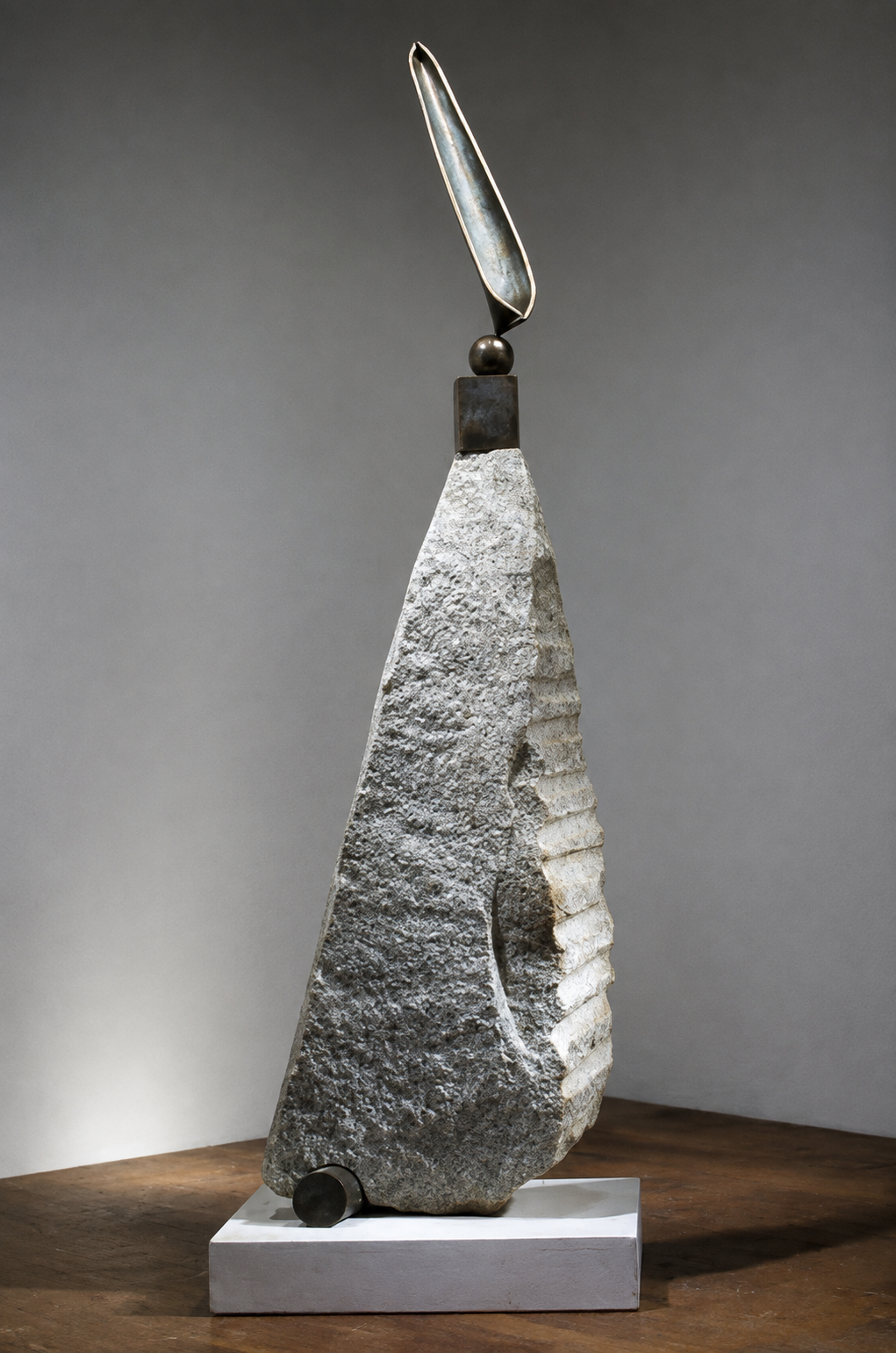
February 1989. Granite, bronze. Dimensions: 78 × 22 × 10 in (198 × 56 × 25 cm).
Corporate collection - Health South Inc., Birmingham, AL
Strange Fruit V the fifth work in the series, resumes my combination of metal and found stone. Here the bronze element rises from the vertically positioned stone in a slender, almost calligraphic gesture, opening at the top like a fruit or seed pod. The form introduces organic and bodily associations while also recalling the vessel imagery that was becoming increasingly important in my work.
The title adds a darker, deliberately oblique meaning, recalling Billie Holiday’s haunting performance of “Strange Fruit,” confronting the lynching of African Americans in the American South. Rather than illustrating the song, the reference gives the organic form an unsettling dimension, creating a tension between growth and violence, beauty and brutality.
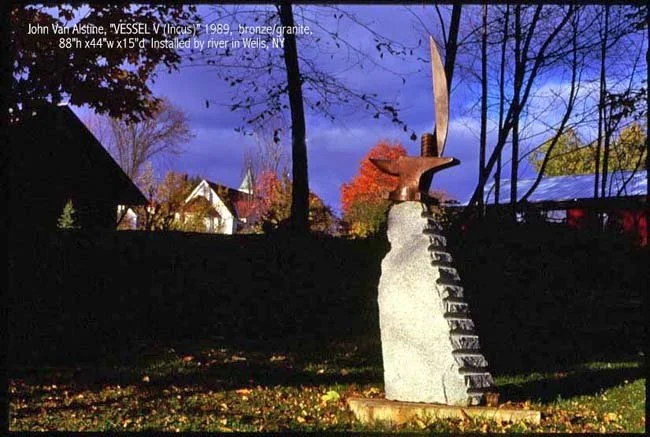
February 1989. Granite, bronze. Dimensions: 78 × 29 × 38 in (198 × 74 × 97 cm).
Collection - the Hyde Collection, Glens Falls, New York
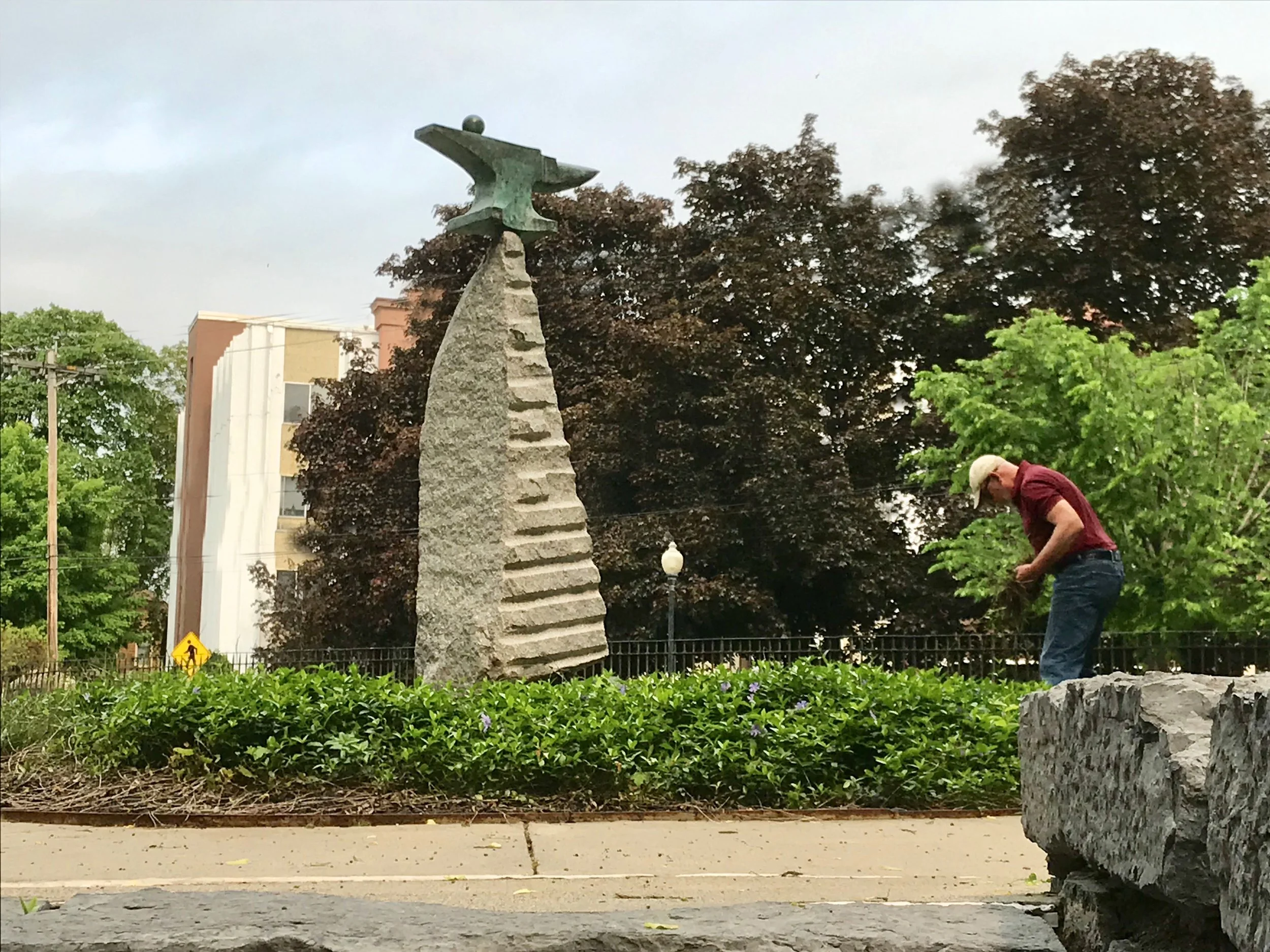
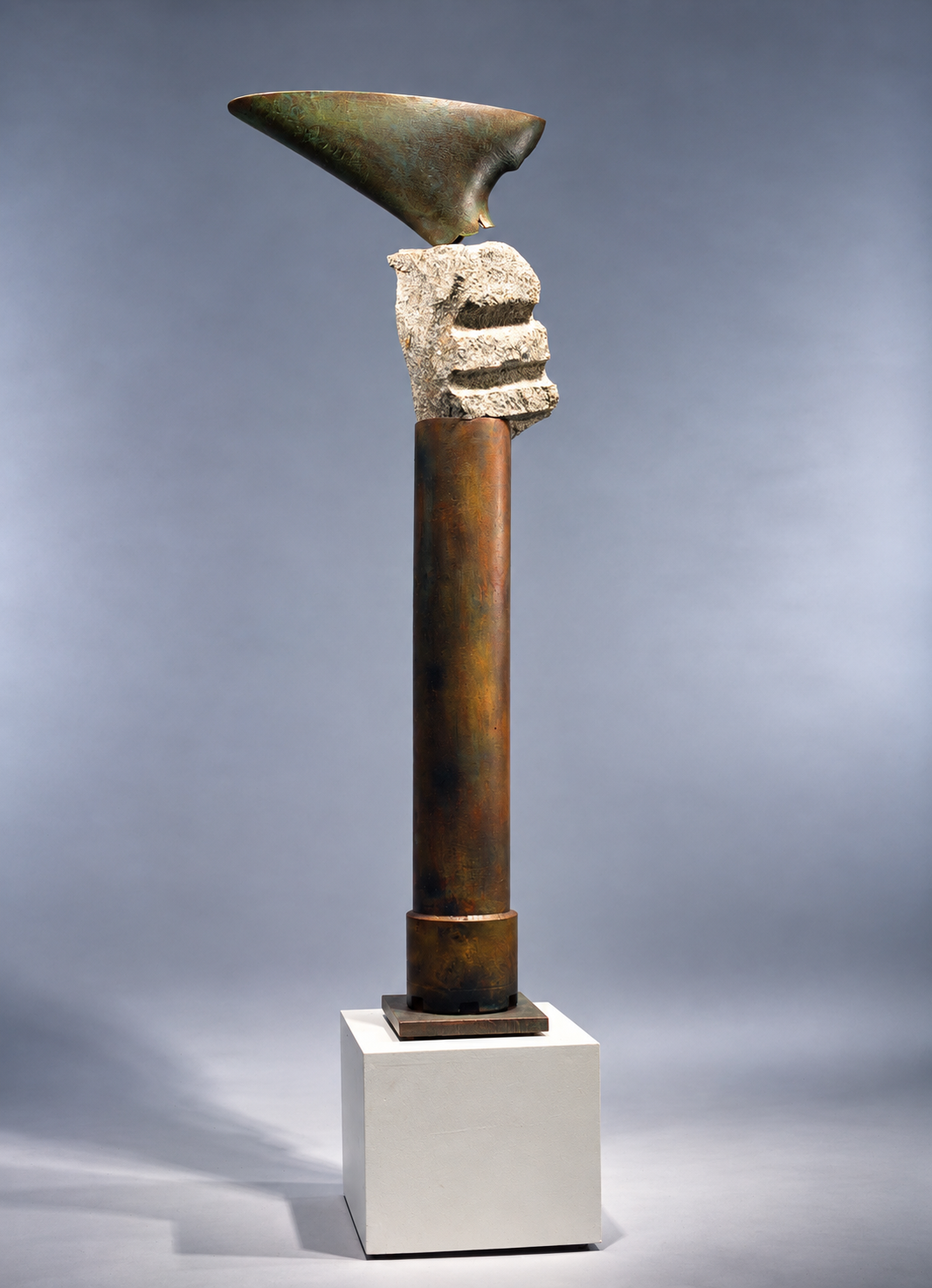
“Many of my works incorporate anvils, either real or cast. Anvils have the shape suggestive of a boat or vessel which implies journey which interests me. But further, as a metal worker, the anvil is the place where I physically and conceptually forge things together, there is an art spirit that comes off the anvil. It‘s almost like an altar. I've titled many of these pieces Ara, which is Latin for altar. Also, to me the anvil is the quintessential heavy object, and to get it up in the air creates a wonderful sense of tension.”
John Van Alstine
from, Bones of the Earth: Spirit of the Land
Grayson Press, 1999
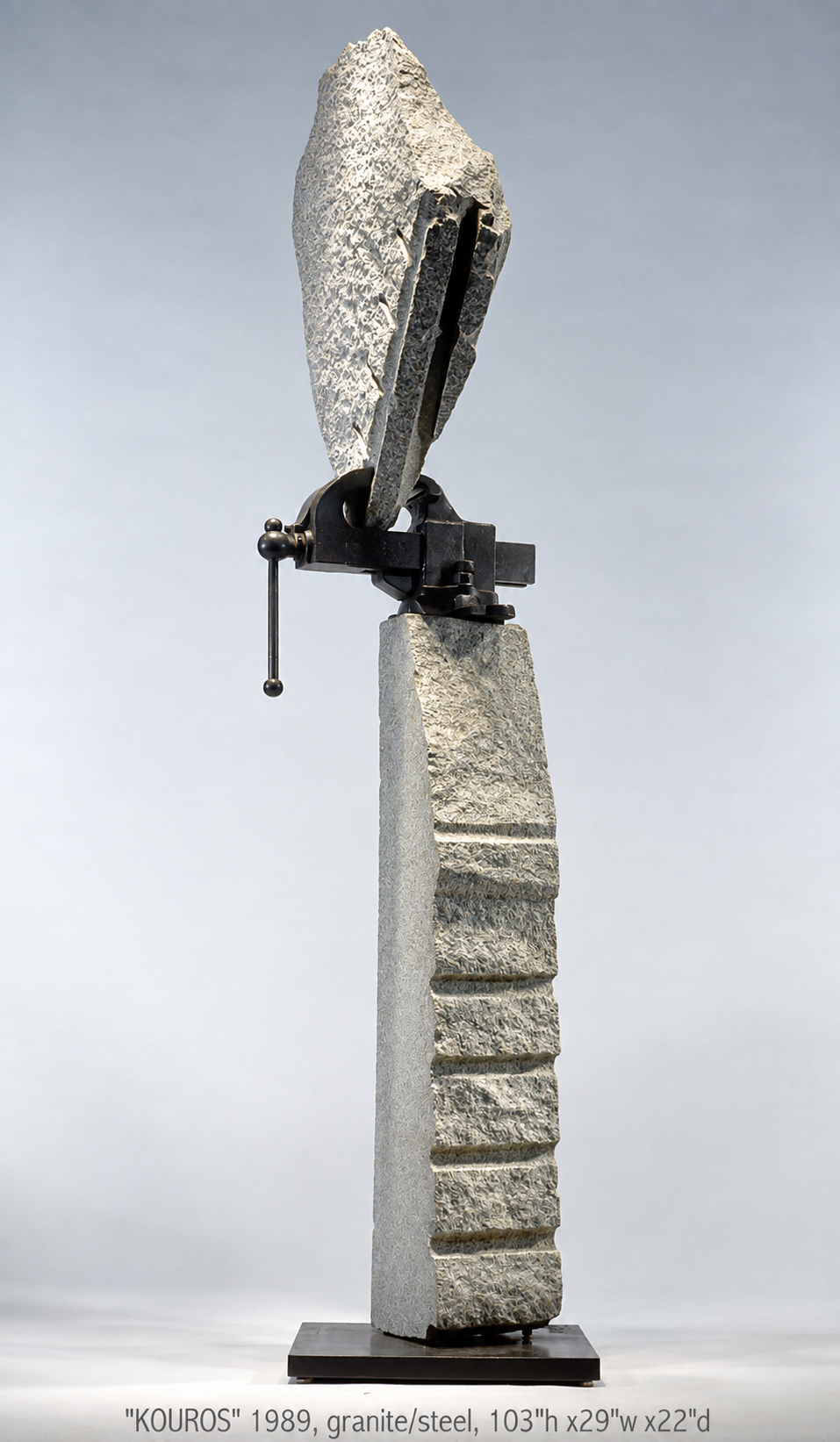
April 1989. Granite, steel, found object. Dimensions: 103 × 29 × 22 in (262 × 74 × 56 cm).
Kouros, 1989
Kouros expands my growing interest in the human figure through an abstract language of granite and steel. The sculpture’s tall, rigid stance recalls the frontal positioning of the kouros, the standing male figures of Archaic Greek sculpture, while allowing the natural character of the stone to suggest the body without literally depicting it.
A real, functioning vise grips and holds the upper stone upright, continuing my interest in tools as extensions of the hand and as expressive sculptural forms. Its hanging handle subtly suggests the male member, reinforcing the sculpture’s reference to the nude male body and the prominence accorded to the male figure in ancient Greek art and culture.
Kouros statues are iconic Archaic Greek sculptures (c. 615–460 BC) representing nude male youths, serving as votive offerings to gods or grave markers for elite individuals. Influenced by Egyptian art, they feature a rigid, frontal pose with one foot forward and stylized hair. These figures symbolize idealized youth, strength, and aristocratic honor rather than realistic portraits.
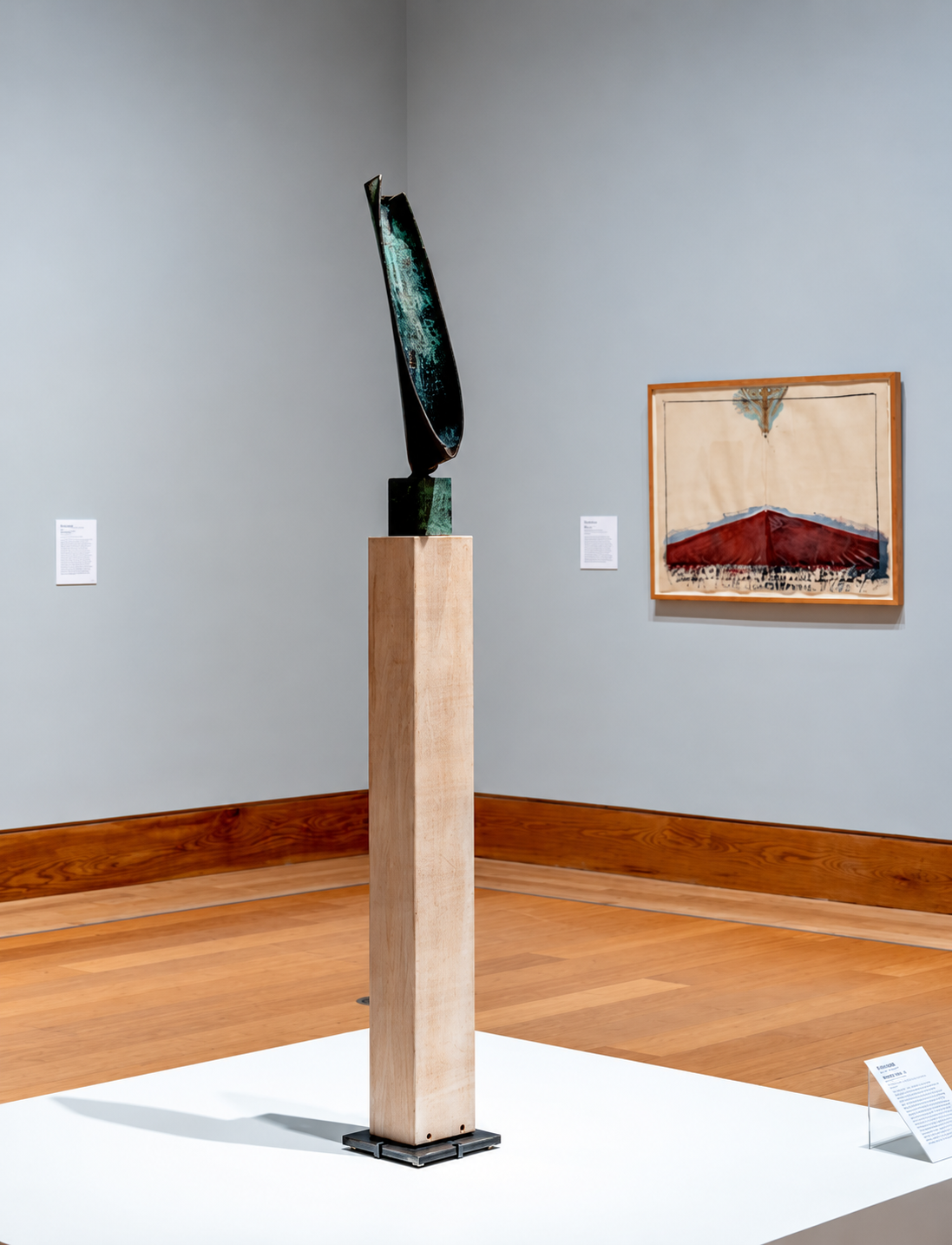
April 1989. Wood, bronze. Dimensions: 85 × 12 × 8 in (216 × 30 × 20 cm). Collection: Ringling Museum of Art, Sarasota, FL, gift of Murray Bring and Kay Delaney.
Strange Fruit VI, 1989
Strange Fruit VI continues the series while eliminating stone entirely. By this point I had cast a number of the vessel/pod forms in bronze and was creating unique but related variations by changing the bronze base block or support to which each was attached. The elongated, opening form suggests a fruit or seed pod—something like a pea pod—while also carrying the organic, bodily and vessel associations that were becoming increasingly important in my work. In my later writing I described Strange Fruit III and VI as suggesting “fruits of labor” from the studio, with forms carrying simultaneous male and female associations connected to ripeness, production, and reproduction.
In Strange Fruit VI, John Van Alstine brings together industrial and organic materials to explore tension, balance, and metaphor. Cast bronze forms—reminiscent of tools or bones—are fused with raw steel and wood, evoking both the weight of labor and the fragility of memory. Part of a series, Strange Fruit VI draws its title from the haunting protest song made famous by Billie Holiday, adding a layer of historical and emotional gravity. While not a literal illustration, the work resonates with themes of violence, rupture, and reckoning. The combination of hard, forged metals and warm, organic wood suggests a confrontation between human-made power and natural form. Strange Fruit VI becomes both an object and a metaphor, inviting us to consider what is suspended, what is held, and what is ultimately at risk of falling. (<From Ringling Museum Exhibit text panel).
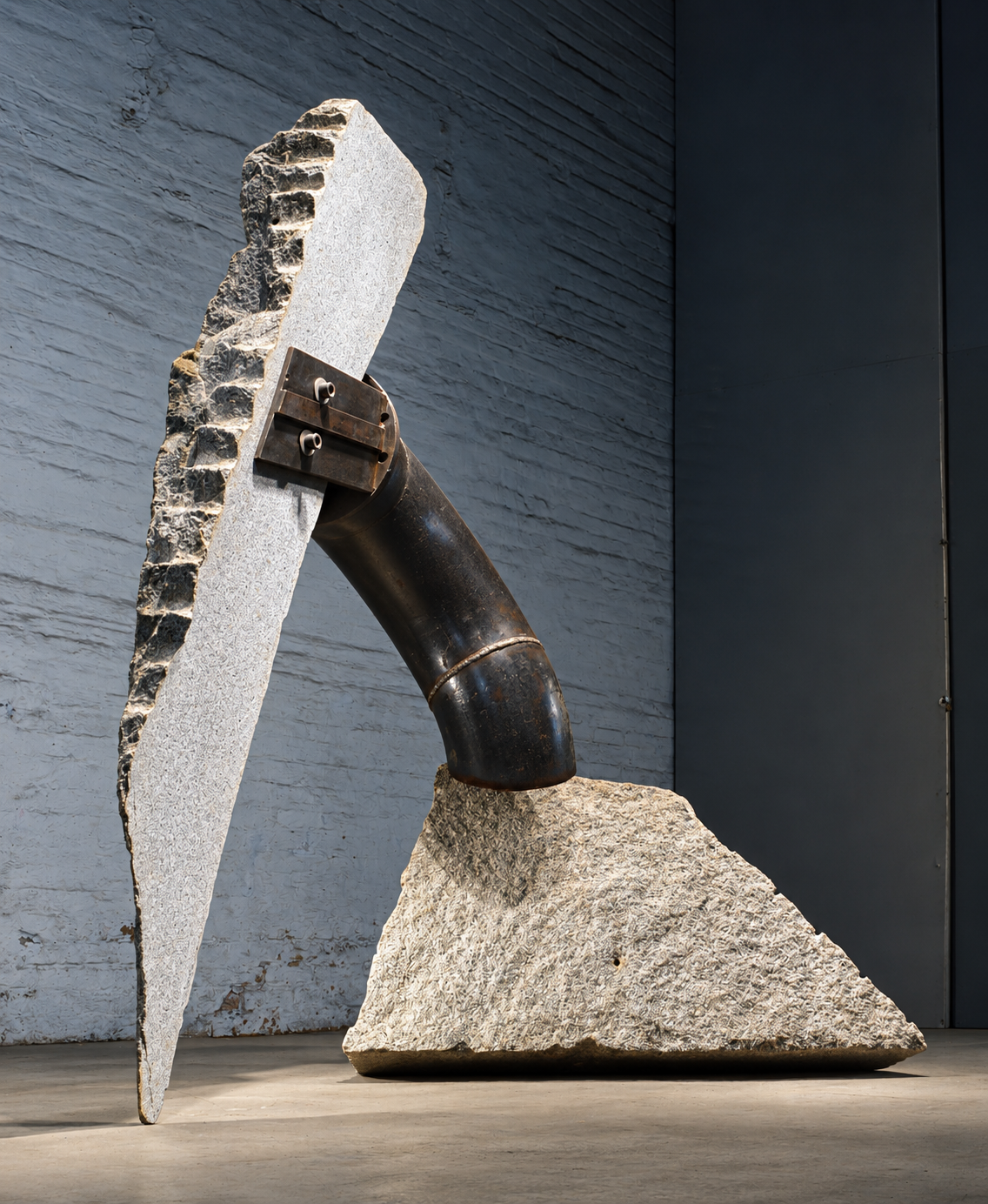
August 1989. Granite, steel. Dimensions: 86 × 86 × 42 in (218 × 218 × 107 cm). Private Collection, Aspen CO.
Hamilton Go-Round II, 1989
Hamilton Go-Round II continues the circle-and-stone language of the Go-Round Series at a larger, more architectural scale. Two massive granite elements are joined by a broad curve of industrial steel pipe, creating an open arc charged by weight, balance, and implied movement. The tall granite slab appears precariously poised on a narrow point, while the exposed hardware makes the means of assembly clearly visible.
The title simply refers to Hamilton County, New York, where I live, without any deeper metaphorical meaning. Like the earlier Go-Rounds, the work reflects the idea of returning repeatedly to a sculptural theme through a series of variations, further developing the circle-and-stone imagery that would continue into my Sisyphean Circles.
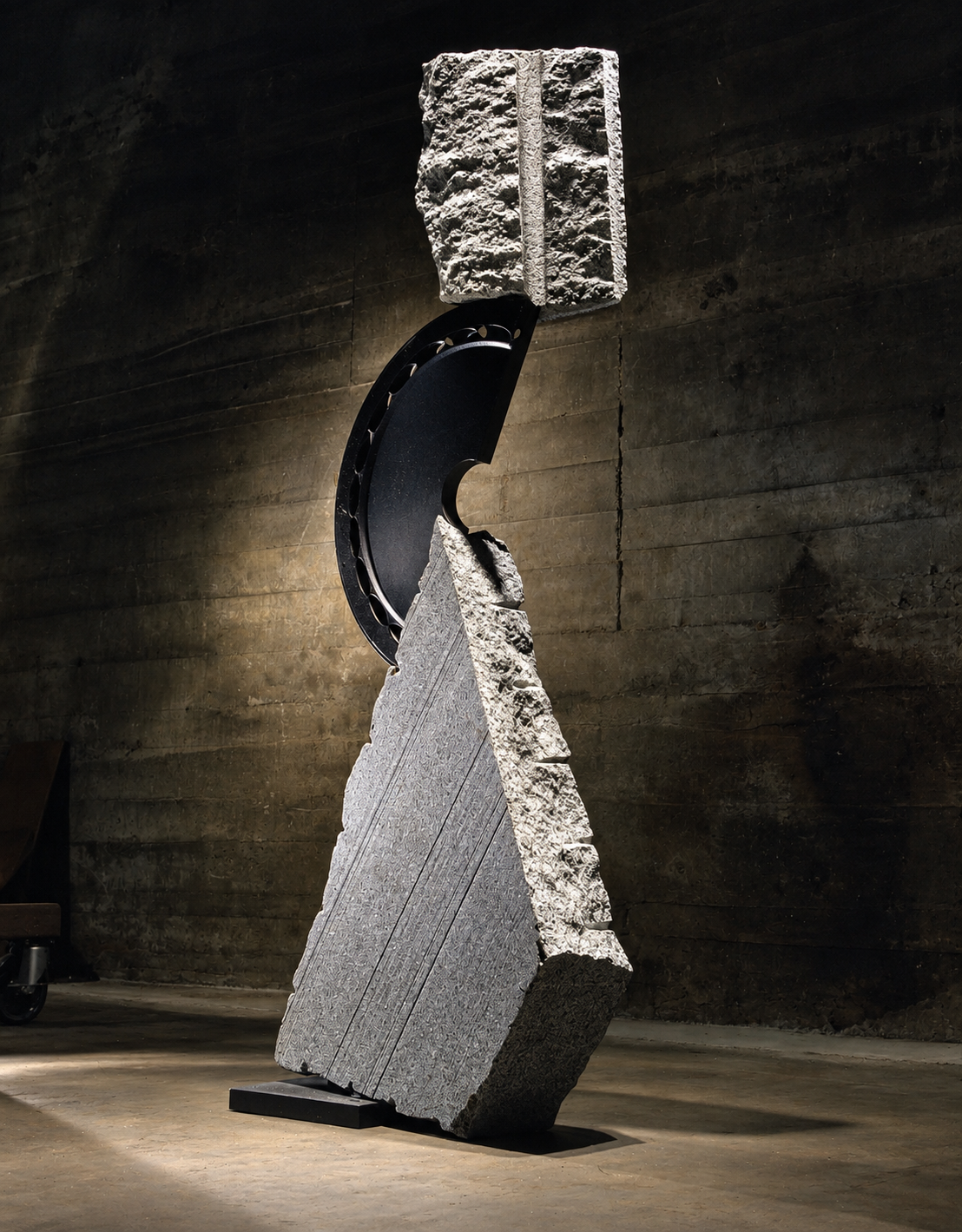
August 1989. Granite, steel. Dimensions: 82 × 32 × 19 in (208 × 81 × 48 cm).
Carina (The Keel), 1989
Carina combines rough granite with a sweeping perforated steel arc whose shape suggests the hull or keel of a ship. The work extends my growing interest in vessels and navigation, both physical and personal, as metaphors for passage and charting one’s course.
The title refers to Carina, the constellation whose Latin name means “the keel,” originally part of Argo Navis, the ship of Jason and the Argonauts. The celestial reference joins the sculpture’s keel-like form with my continuing interest in navigation and looking to the sky for imagery.
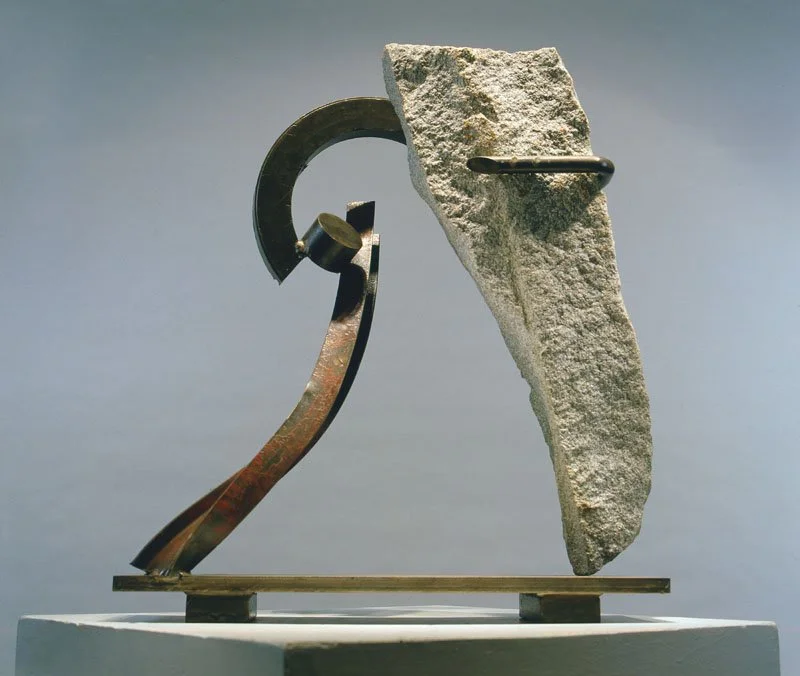
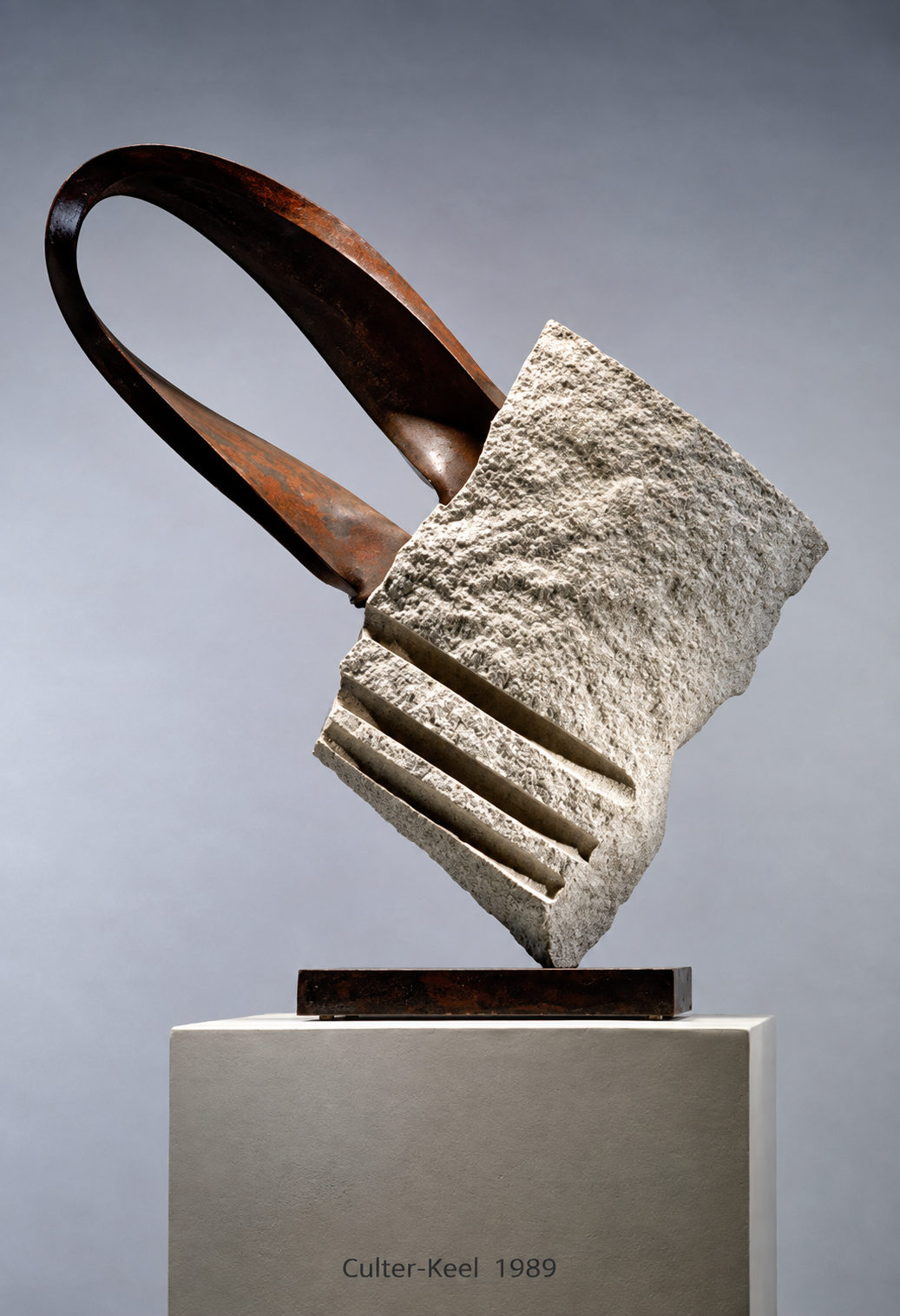
October 1989. Granite, steel. Dimensions: 48 × 48 × 18 in (122 × 122 × 46 cm). Private collection - Washington, DC. Culter (Keel), 1989
Culter (Keel) brings together my interest in tools and implements with the vessel and ideas of navigation that were becoming increasingly important in my work. Culter, from the Latin for a knife or cutting instrument, is the root of “coulter,” the blade that cuts the earth ahead of a plow. Here the sweeping steel form combines with the rough granite to suggest both an implement and the keel of a vessel.
The dual reference extends the sculpture toward what I think of as personal navigation—the choices and instruments we use to establish direction and chart a course through life. Rather than illustrating a particular tool or boat, the work uses these associations as metaphors for movement, decision-making, and the ongoing process of finding one’s way.
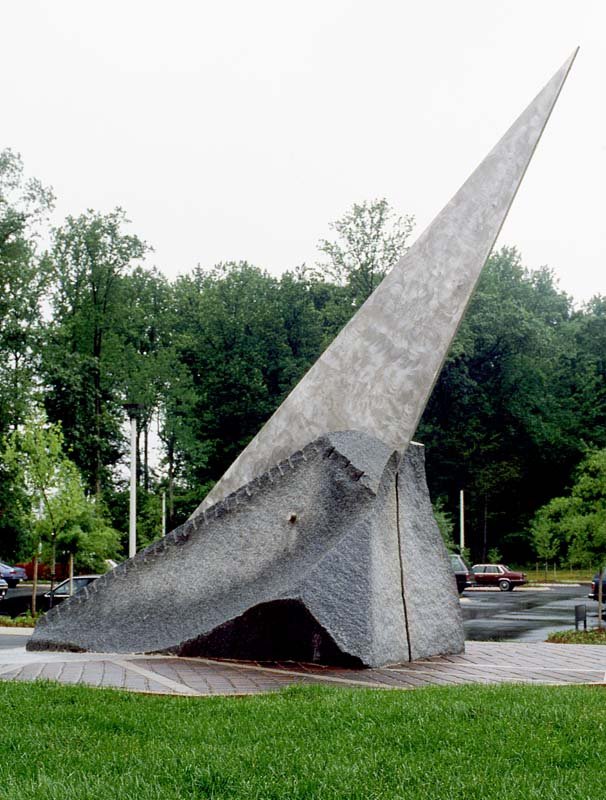
1989-91. Aluminum, granite, stainless steel. Dimensions: 12 × 30 × 45 in (30 × 76 × 114 cm).
Commissioned by the Super Computer Research Center and installed in Bowie, MD just outside of Washington, DC. The work is a sundial and solstice calendar with the unique feature of a correction analemma which compensates for the difference between local solar time and Eastern Standard Time. Located at the entrance of the building, the hour dial and calendar features can be seen and enjoyed from many locations inside the building.
In SCR Sunwork John Van Alstine expanded the concepts first explored in Solstice Calendar at Austin College. Designed for one of the nation's leading scientific research institutions, the sculpture functions simultaneously as monumental public art and a celestial instrument. Through the movement of sunlight and shadow, it records the changing seasons, inviting viewers to experience the ancient rhythms of the sun within the context of a cutting-edge center devoted to scientific discovery.
The commission reflects Van Alstine's enduring belief that art and science share a common pursuit—the search for meaning through observation, curiosity, and discovery. Inspired by prehistoric observatories such as Stonehenge and the ceremonial architecture of Mesoamerica, SCR Sunwork transforms a contemporary research campus into a place of reflection, reminding us that long before computers and satellites, humanity looked to the sky to measure time and understand its place in the universe. The project further established Van Alstine's Celestial Works series, leading to later commissions including Artery Sunwork, 2nd Street Sunwork, and Via Solaris.
MORE INFO: SCR Sunwork chapter in AMERICAN MONUMENTS
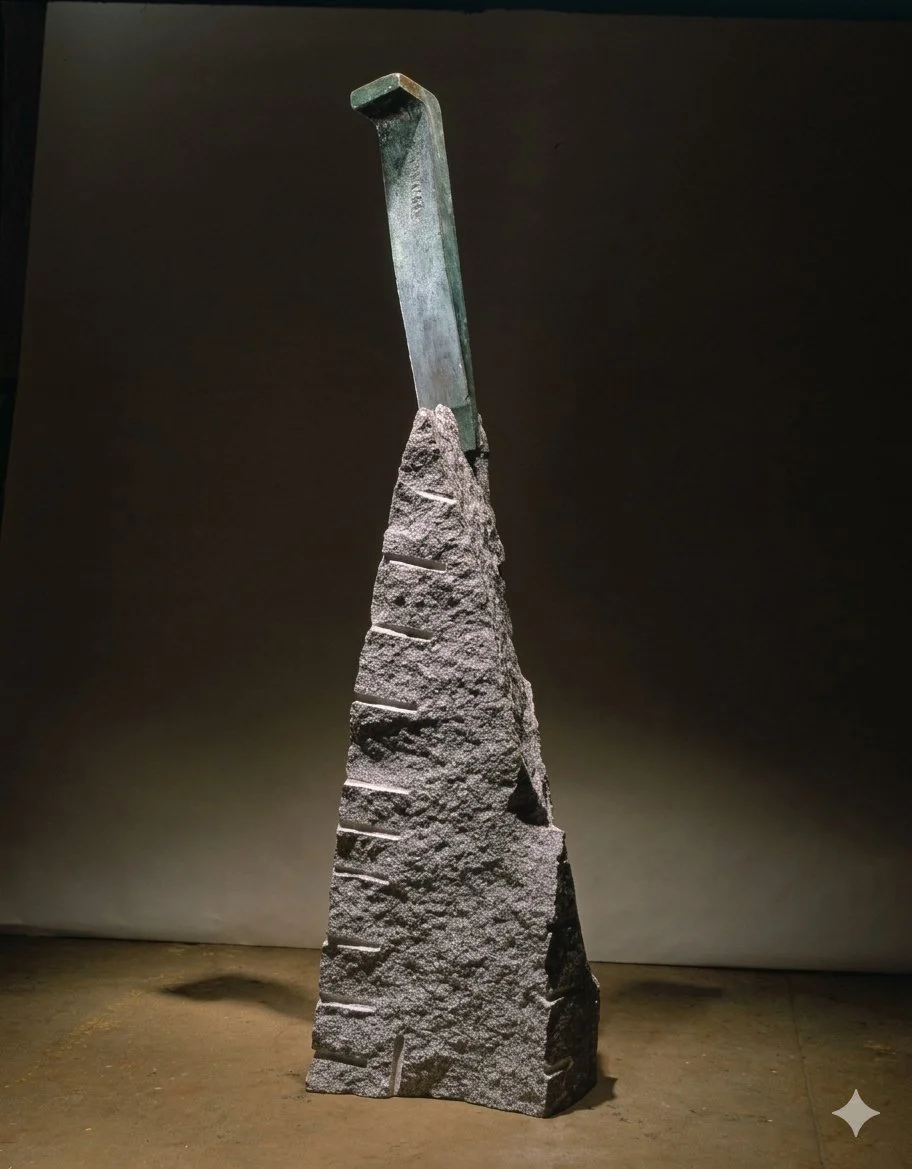
October 1989. Granite, bronze. Dimensions: 67 × 19 × 9 in (170 × 48 × 23 cm). Disassemble - parts used for new work.
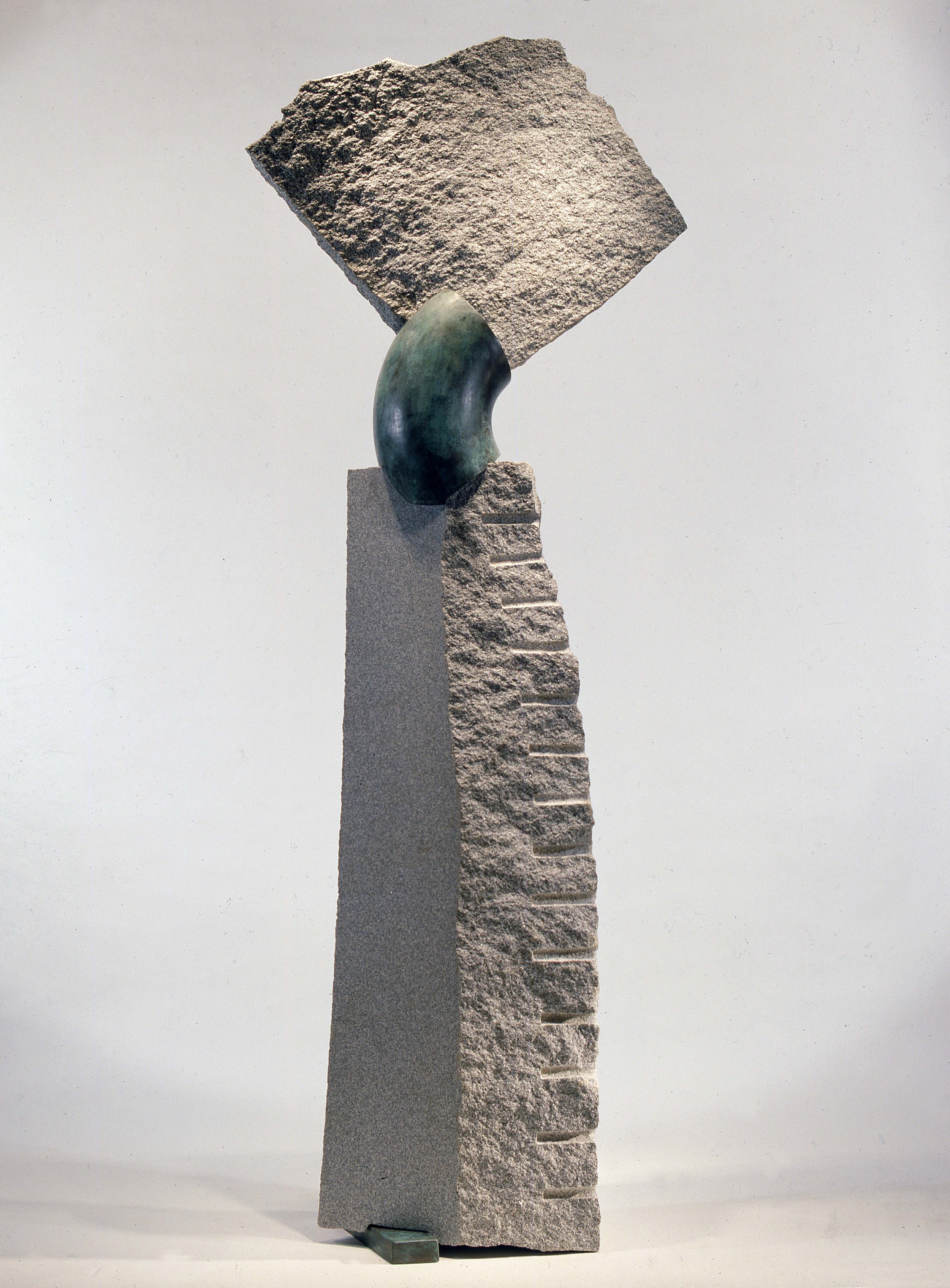
October 1989. Granite, bronze. Dimensions: 88 × 35 × 12 in (224 × 89 × 30 cm). Private Collection; Lewisberry, PA.
Mohawk, 1989
Mohawk continues my long-standing interest in combining rough-hewn granite with metal. A curved bronze element joins and appears to balance two massive pieces of stone, countering their weight with a sense of lift and precarious movement. The bronze also introduces color and surface through its green patina.
Like several works from this period, Mohawk introduces a figurative reference. The dramatically tilted upper stone suggests the raised profile of a traditional Mohawk hairstyle, giving the abstract sculpture a subtle human presence. Rather than depicting the figure literally, the reference adds another layer of association while maintaining my central concerns with material, balance, and assemblage.
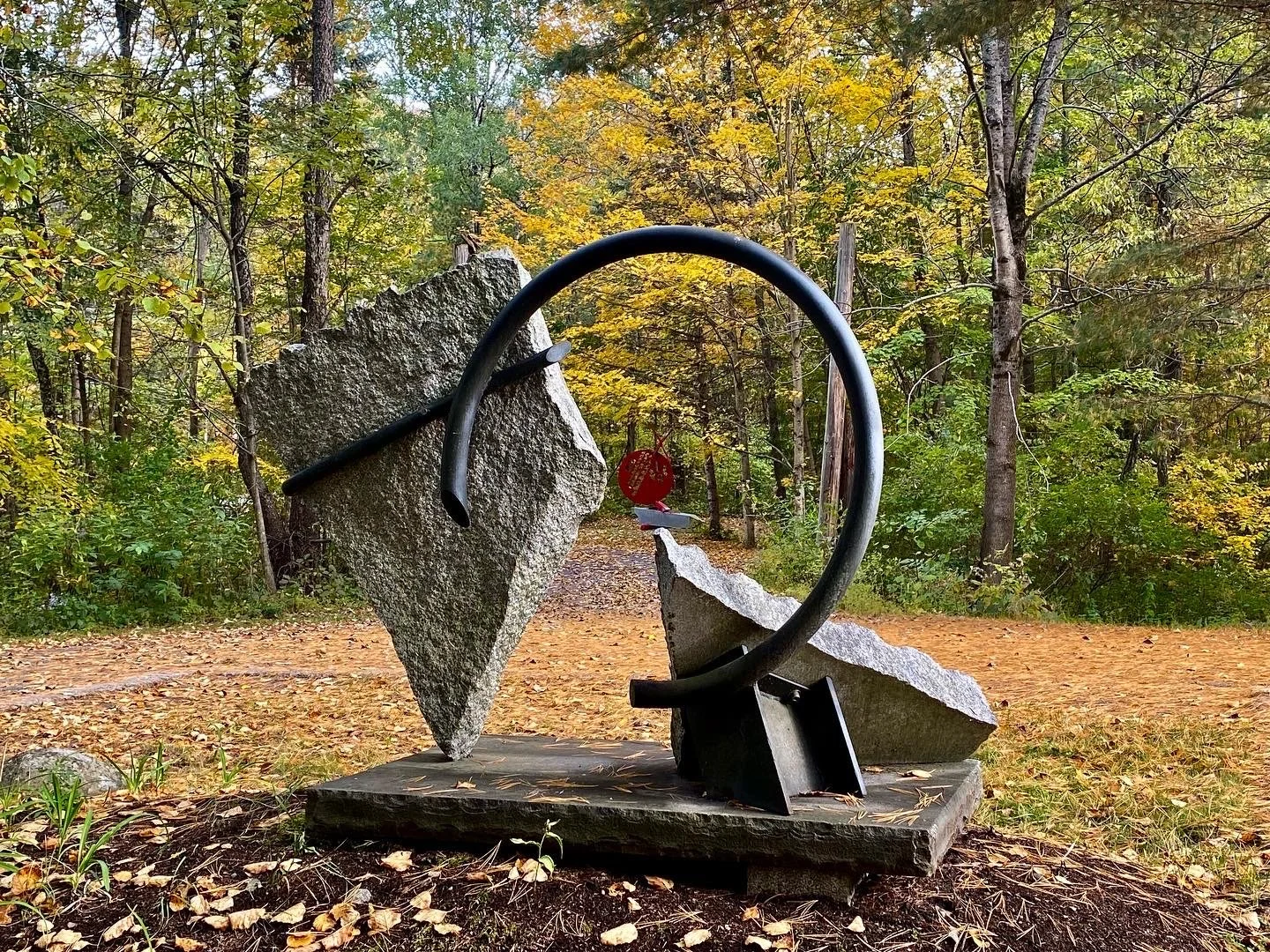
December 1989. Granite, steel. Dimensions: 48 × 75 × 32 in (122 × 191 × 81 cm).
Sidewinder ’89, 1989
Sidewinder ’89 revisits and expands the circular language of my earlier Sidewinder Series. Here, a large sweeping bronze arc links two contrasting granite forms, creating an open circle charged by weight, balance, and implied movement. The larger stone is poised dramatically on a single point, while the bronze curve and visible steel pin emphasize the physical connections that had remained an important part of my sculptural vocabulary.
Sidewinder ’89 was exhibited in my May 1990 solo exhibition at Norha Haime Gallery in New York City, where it was purchased by collector Ruth Baum. She later exchanged the sculpture for a larger outdoor work, Pique à Terre VII (S-99-07).
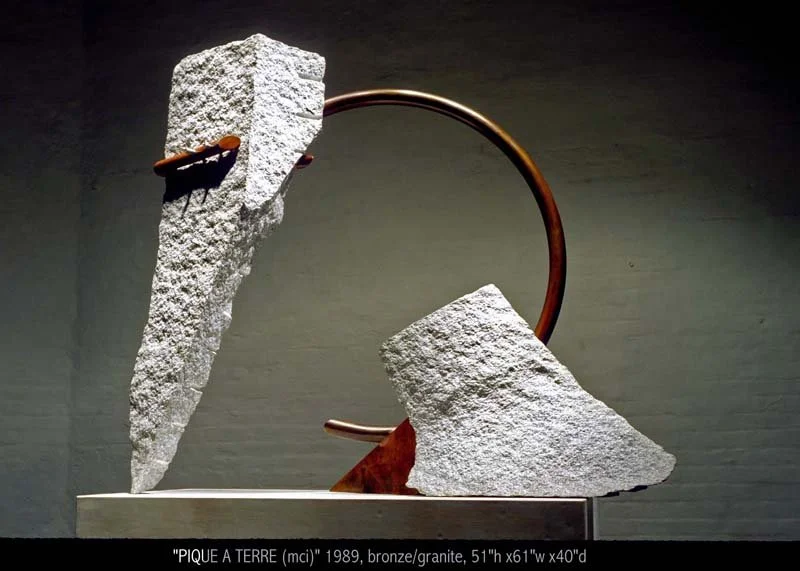
December 1989. Granite, bronze. Dimensions: 51 × 63 × 40 in (130 × 160 × 102 cm).
Corporate collection - Washington, DC
Pique à terre is a term from classical French ballet for a pose with one toe touching the ground, the other foot firmly planted, and a sweeping arm gesture. Once you are aware of the title, when you see the piece the connection is clear. I am in a sense choreographing these works, getting a heavy weight off the ground and making it dance—taking what is often seen as a negative, the fact that stone is damn heavy and a big hassle to move around, and turning it into a positive. It is this transition that helps give theses pieces their magic.
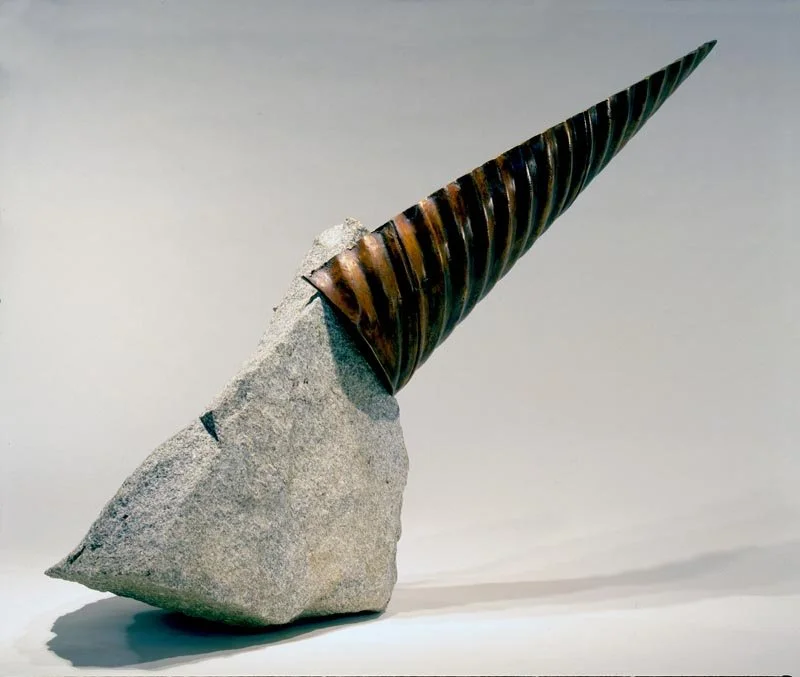
December 1989. Granite, bronze. Dimensions: 32 × 44 × 24 in (81 × 112 × 61 cm). Private collection.
Urceus (plural: urcei) is a Latin term for an ancient Roman one-handled jug or pitcher.
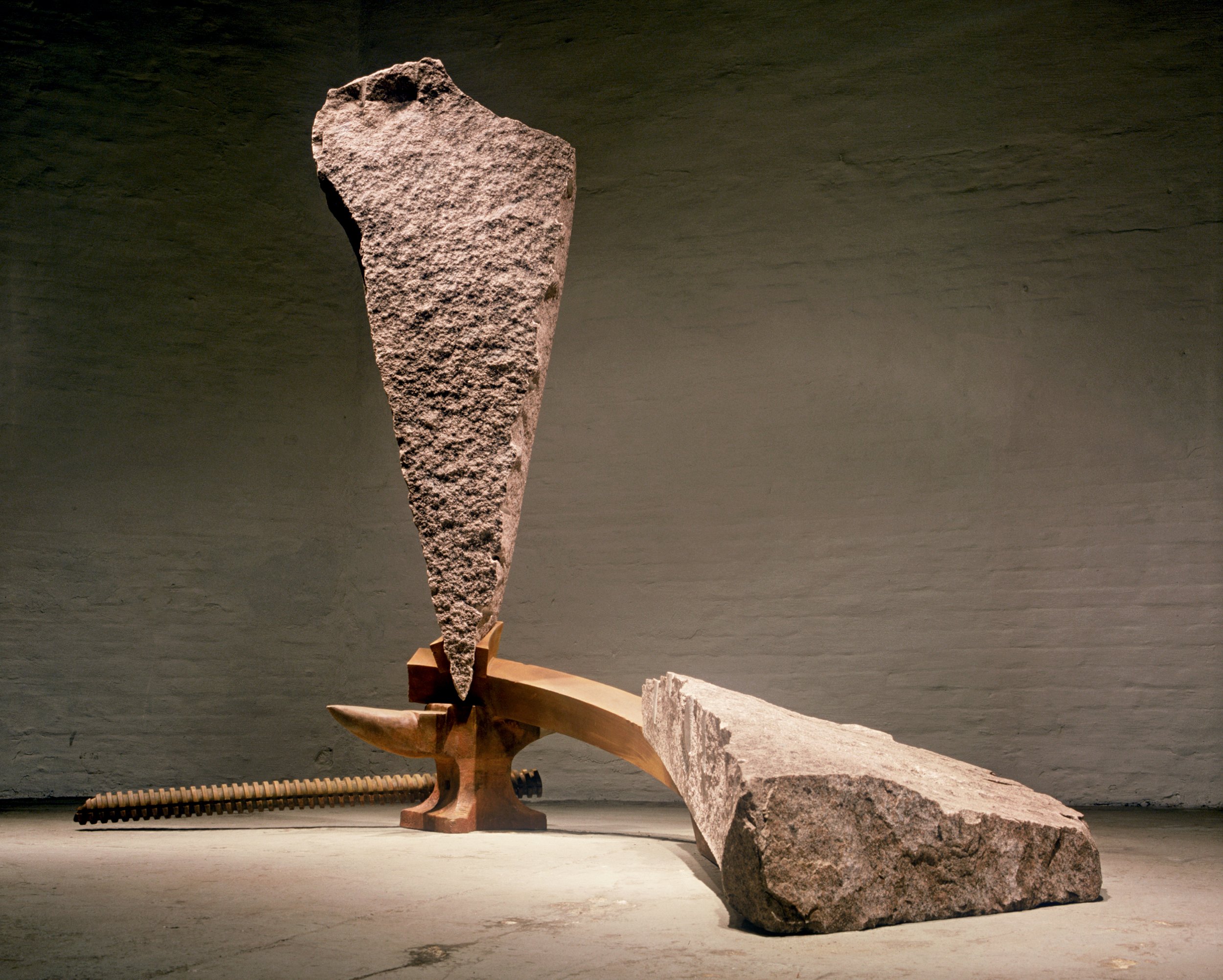
December 1989. Granite, steel. Dimensions: 81 × 98 × 60 in (206 × 249 × 152 cm).
The title Odalisque refers to a long tradition in Western art in which the reclining female figure has served as a vehicle for exploring beauty, proportion, and the expressive possibilities of the human form. From Titian and Ingres to Matisse, Picasso, and Henry Moore, artists have continually reinterpreted this enduring subject, each bringing a new perspective to the relationship between figure and abstraction.
For many years, the landscape was my primary source of inspiration. Gradually I came to see the human figure as another kind of landscape—one shaped by gravity, balance, movement, and gesture. Rather than creating a literal representation, Odalisque I suggests the body through the abstract dialogue of granite and steel. Existing somewhere between recognition and ambiguity, the sculpture invites viewers to complete the image through their own imagination. It marked the beginning of an exploration that continues throughout my work, where the figure emerges not through anatomy, but through balance, rhythm, and the expressive relationship between natural and fabricated materials.
— John Van Alstine
1988
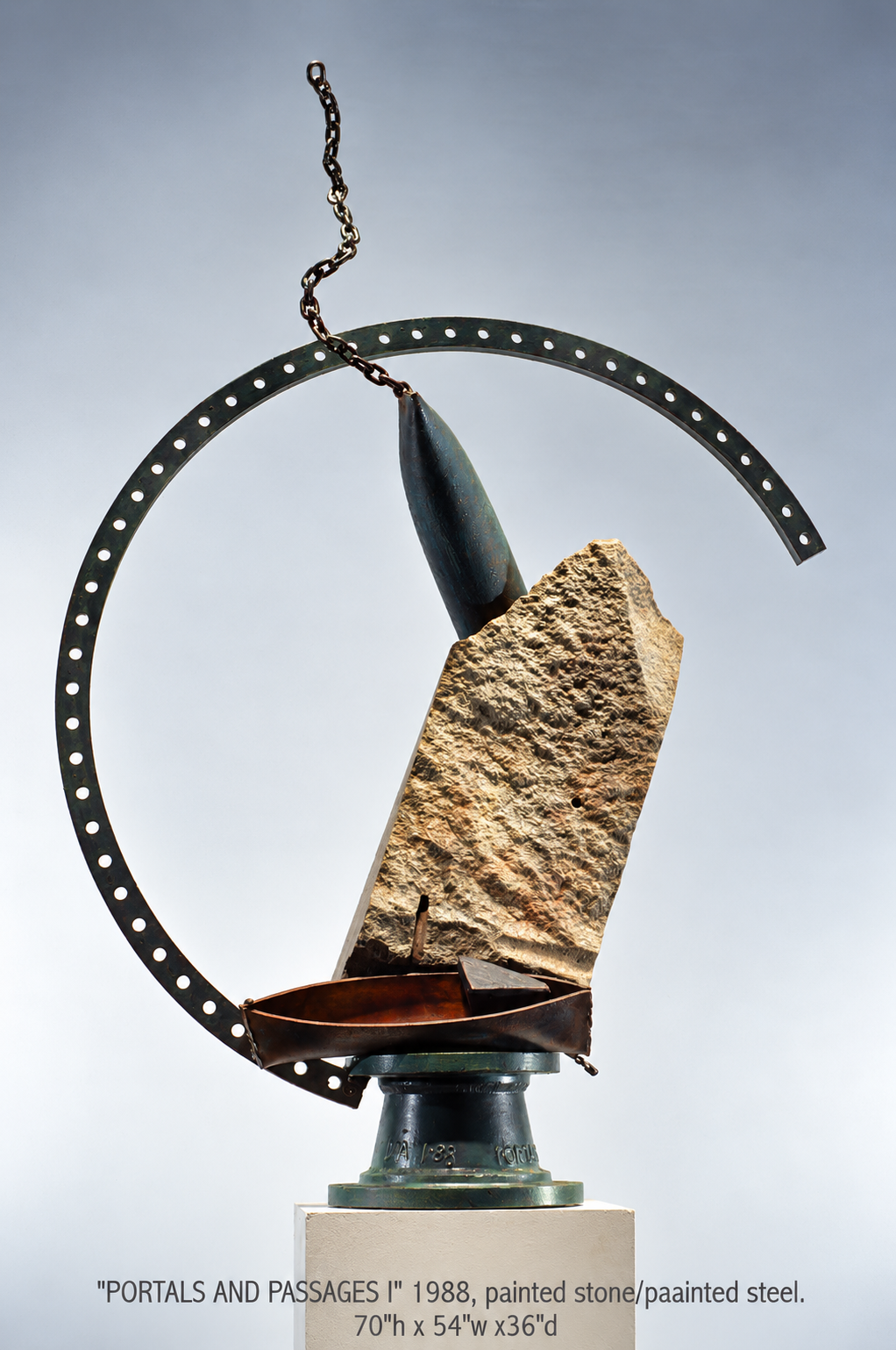
January 1988. Pink granite, painted steel. Dimensions: 70 × 54 × 36 in (178 × 137 × 91 cm).
Private collection - Los Angles, CA
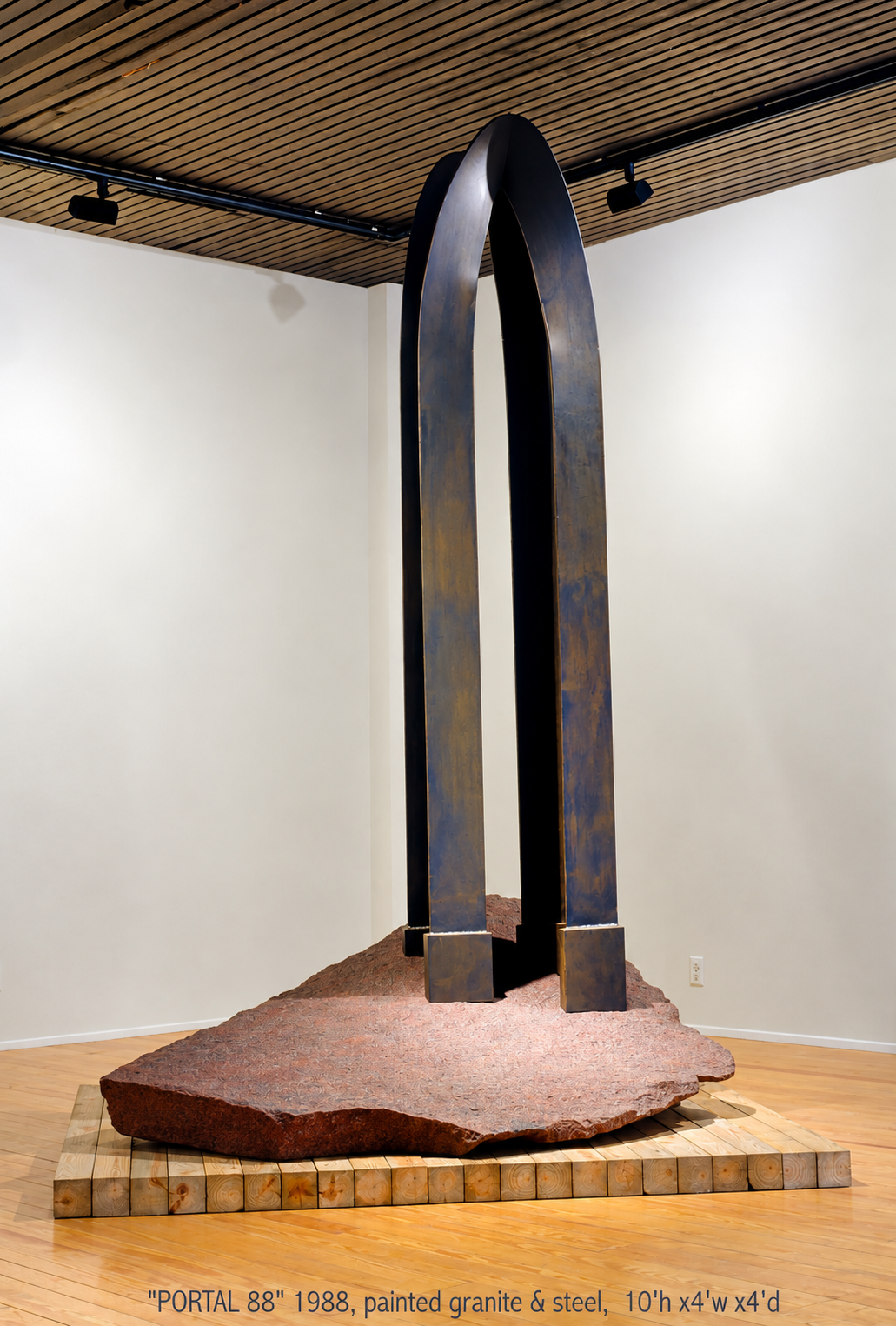
Over the years, I have created many sculptures featuring openings or portals, suggesting entrances, thresholds, and passages into spaces and places, both real and figurative. Often, a vessel form—a metaphor for the individual and a carrier of our experiences, memories, and aspirations—moves toward or through a portal or gateway.
This passage suggests a moment of personal transition or breakthrough: moving beyond obstacles and from the known toward the unknown. The portal becomes both a barrier and an opening, while the vessel embodies the energy and determination required to pass through it toward discovery, transformation, and new possibilities.
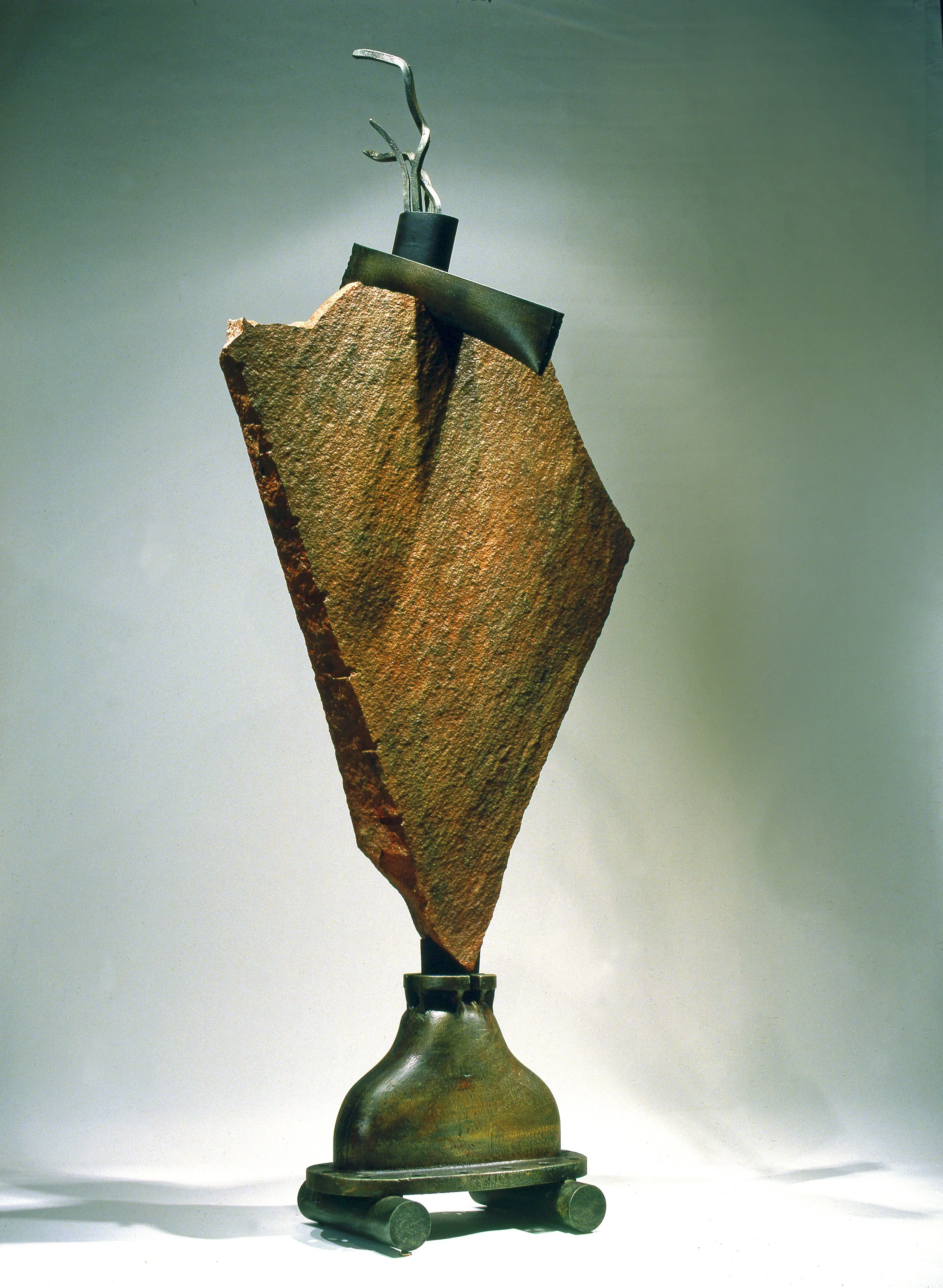
February 1988. painted granite, painted steel. Dimensions: 98 × 41 × 30 in (249 × 104 × 76 cm).
On the Edge I (Artist Passage) marks an early development of the vessel and passage imagery that would become increasingly important in my work. A large, rough-edged stone rises vertically from a steel base set on rollers, while a fabricated steel vessel at its top appears to lunge forward with animated, almost gestural energy. The juxtaposition of the massive, earthbound stone, the suggestion of mobility below, and the vessel poised precariously above creates a sense of movement, instability, and transition—a journey caught in progress.
The title turns the idea of passage toward the artist’s own journey—the continual movement through ideas, materials, discoveries, and uncertainties that accompanies a creative life. My use of the vessel grew partly from my early experience as a potter and from its longstanding role as a metaphor for the self and for passage from one state or place to another. Here, the vessel becomes both cargo and traveler, suggesting the artist carrying the accumulated weight of experience while moving forward into unknown territory—on the edge between what has been established and what is yet to be discovered. These ideas would later expand into the Portals and Passages works and other sculptures centered on journey, transition, and transformation.

February 1988. polychromed granite and steel, 85 × 22 × 27 in (216 × 56 × 69 cm). Private collection.
On the Edge II (Artist’s Passage) follows On the Edge I and continues my exploration of the vessel as a metaphor for passage—a form historically understood in art and literature as a carrier or container for the self, a group, or even humankind. Here, a fabricated steel vessel appears to cascade precariously from the top of a tall, thin wedge of stone, itself balanced on a solid steel, ringed, planet-like “wrecking ball.” The deliberately unstable arrangement creates a sense of movement, risk, and imminent passage, as though the entire sculpture has been caught at the critical instant between balance and collapse.
The work is also autobiographical, reflecting what I thought of at the time as the “artist’s plight.” I had recently stepped away from the security of a university professorship and felt myself teetering on a professional and financial precipice. The precarious vessel therefore became a metaphor for my own passage into an uncertain future, while also addressing the broader experience of the artist—continually taking risks, making choices, and moving forward without knowing exactly where they will lead. The sculpture extends the ideas introduced in On the Edge I and anticipates my later Portals and Passages works, in which the vessel increasingly embodies the energy and determination required to move from the known toward the unknown.
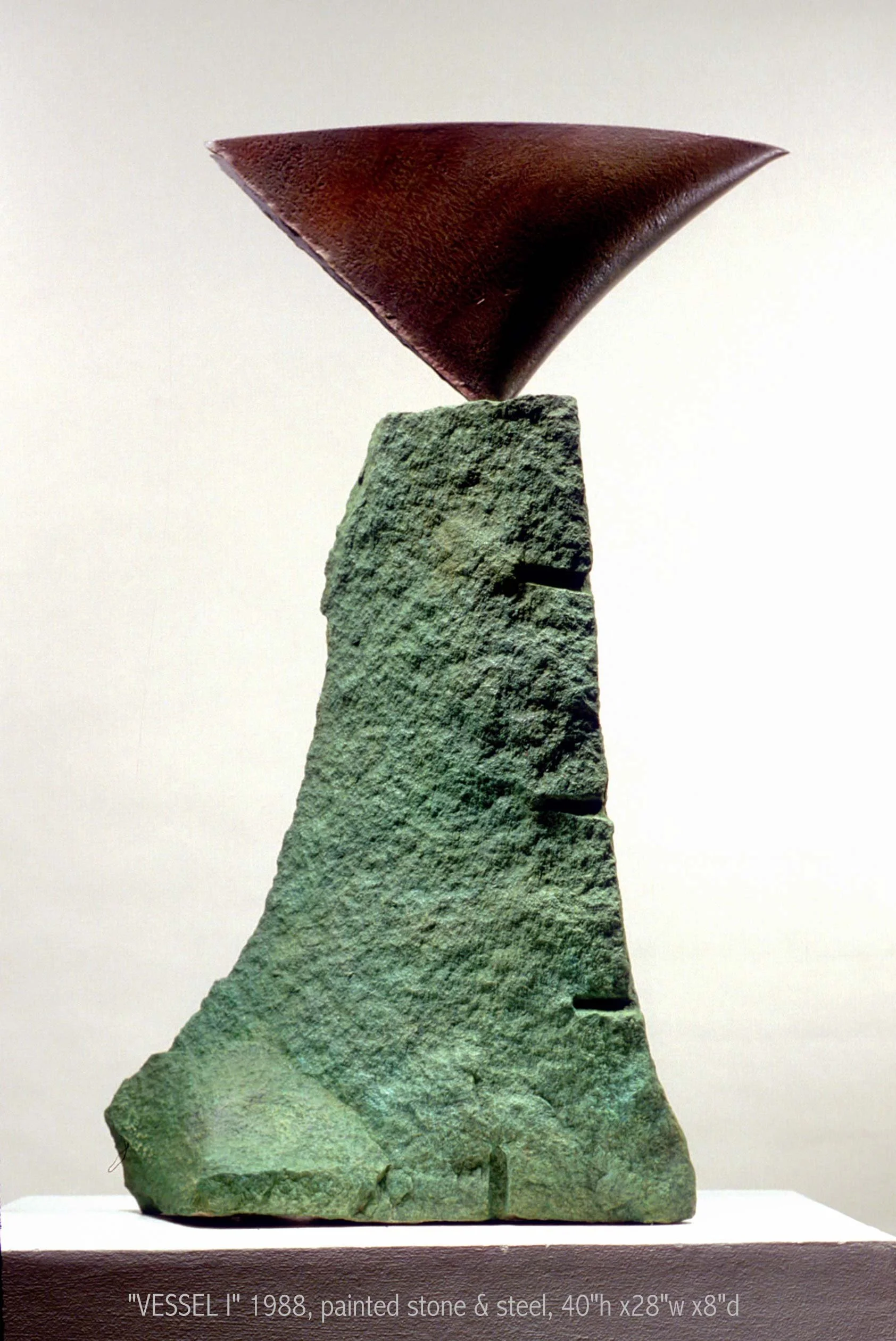
February 1988. Pink granite, painted steel. Dimensions: 40 × 28 × 8 in (102 × 71 × 20 cm). Private collection.
Vessel I, 1988
Vessel I was the first in an ongoing series exploring the vessel as both sculptural form and metaphor. The idea grew partly from my earlier work in ceramics and my longstanding interest in containers. Here, the steel “vessel” was cut from a found section of pinched steel tube or pipe and balanced on a roughly shaped stone, giving an industrial fragment a new, more associative identity.
The painted stone reflects my experiments with color in pastel drawings at the time, when I was beginning to move beyond the strict “truth to materials” approach of my earlier work. Color, found form, and the vessel introduced a more expressive vocabulary that would become increasingly important in later series concerned with passage, journey, and personal navigation.
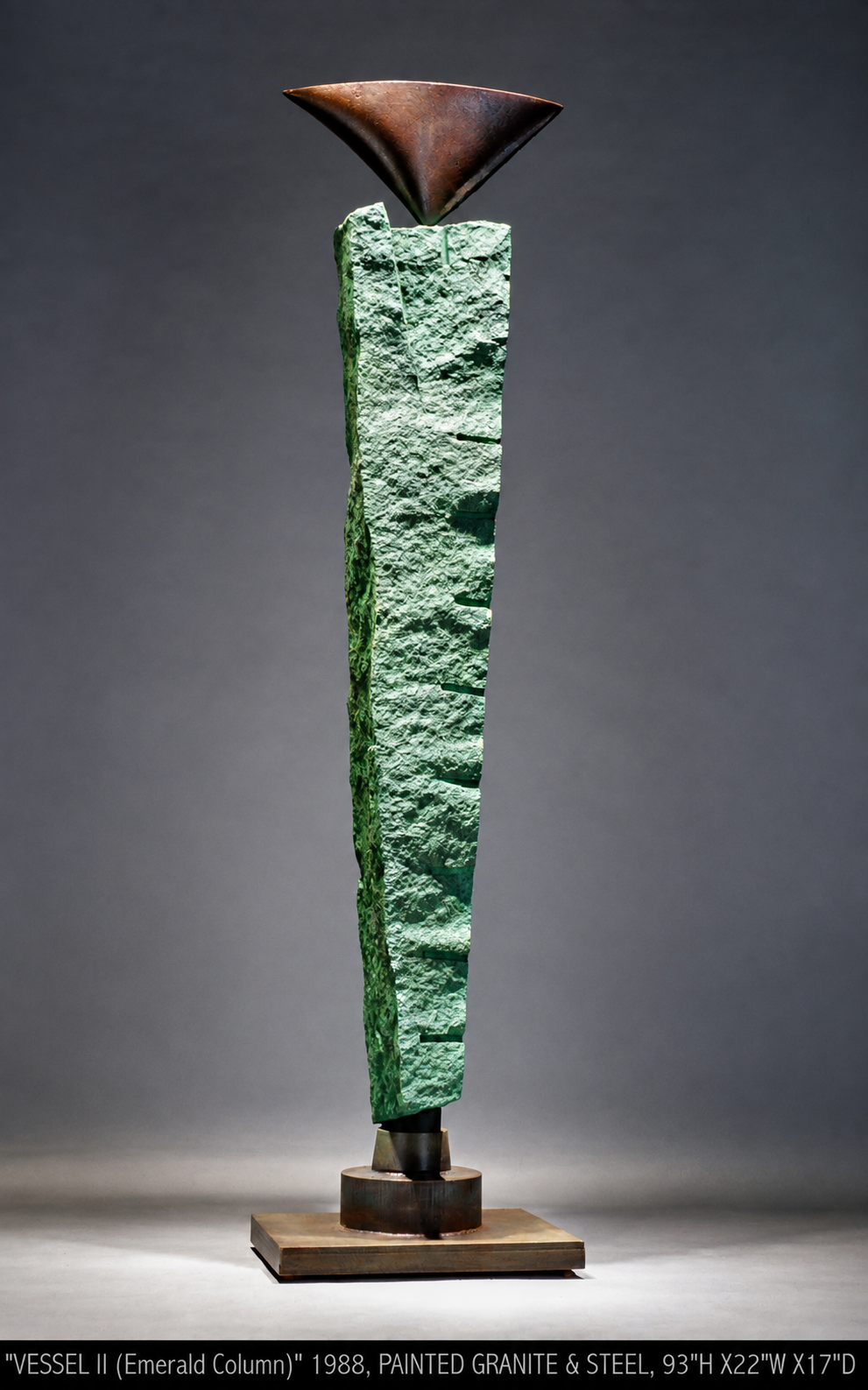
February 1988. Pink granite, painted steel, 93 × 22 ×17”. Private collection - Baltimore, MD
Vessel II (Emerald Column), 1988
Vessel II (Emerald Column) was the second in my ongoing Vessel Series, which grew from my earlier experience with ceramics and my interest in the container as both form and metaphor. The steel “container,” cut from a found section of pinched steel tube or pipe, rests atop the tall granite column, beginning an exploration of the vessel that would later expand into ideas of passage and journey.
The emerald color of the stone reflects my experiments with pastel drawing at the time. Those drawings encouraged me to move beyond the largely monochromatic stone and steel of my earlier work and use color as a more expressive element, here transforming the granite while retaining its rough-hewn character.
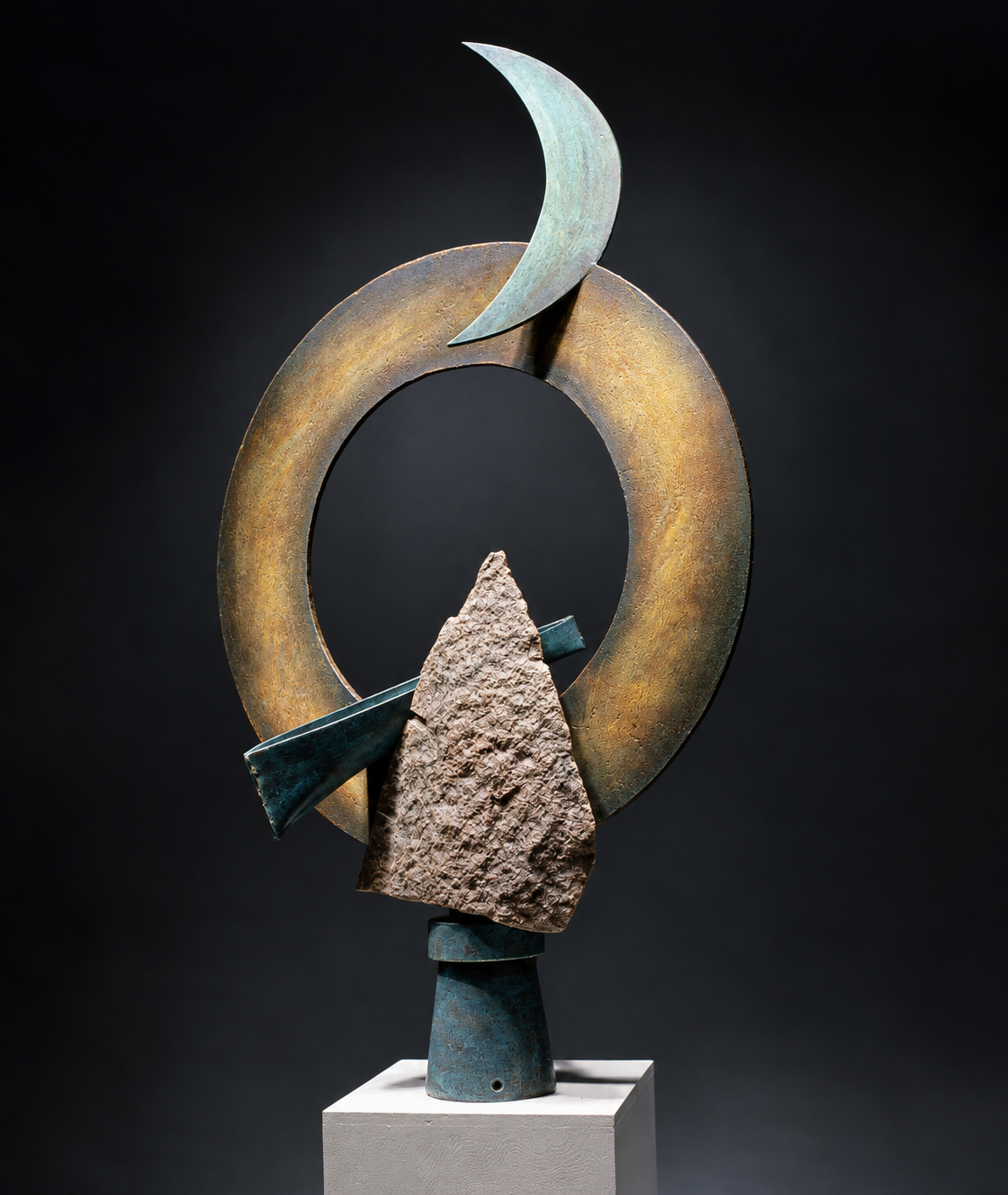
April 1988. Pink granite, painted steel. Dimensions: 67 × 40 × 24 in (170 × 102 × 61 cm). Private Collection Washington, DC.
Blue Moon Passage, 1988
Blue Moon Passage brings together several themes emerging in my work during the late 1980s—the vessel, passage, and celestial imagery. The circle and crescent establish a lunar presence, while the granite and vessel-like steel form contrast earthbound mass with movement through space.
The title links the celestial Blue Moon with Passage, suggesting a journey or transition. The vessel becomes a metaphor for the self navigating through space and change, anticipating my later Portals and Passages works.
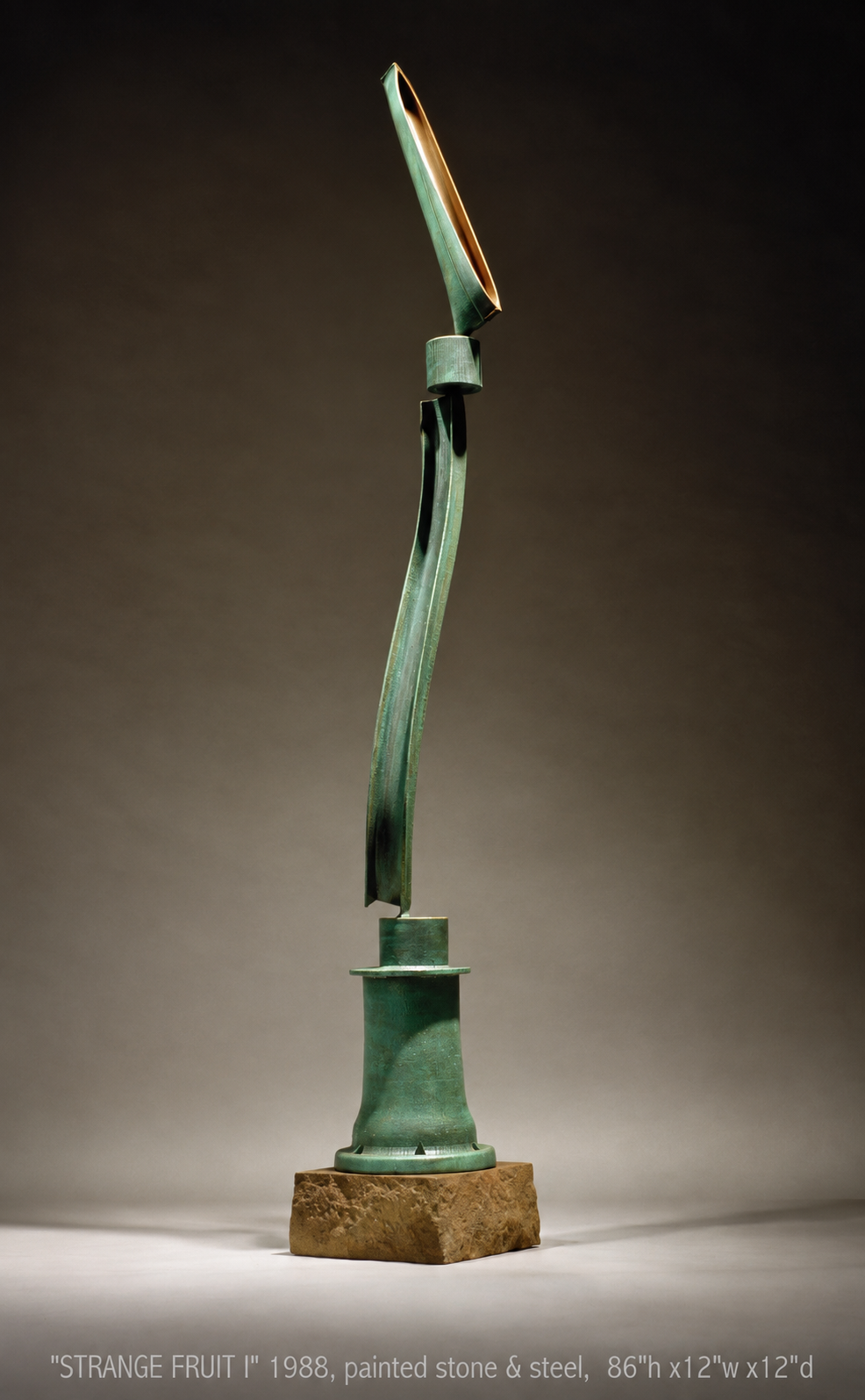
April 1988. Pink granite, painted steel. Dimensions: 86 × 12 × 12 in (218 × 30 × 30 cm).Private collection - Alexandria, VA
Strange Fruit I, 1988
Strange Fruit I marks the beginning of a series and a departure from my more familiar combinations of substantial stone and steel. Here stone is reduced to a small base, while painted steel rises in a slender, almost calligraphic gesture. The elongated upper form opens like a fruit or seed pod, introducing the organic and bodily associations becoming increasingly important in my work.
The title adds a darker, deliberately oblique meaning, recalling Billie Holiday’s haunting performance of “Strange Fruit,” a song confronting the lynching of African Americans in the American South. Rather than illustrating the song, the reference gives the organic form a more unsettling dimension, creating a tension between growth and violence, beauty and brutality.
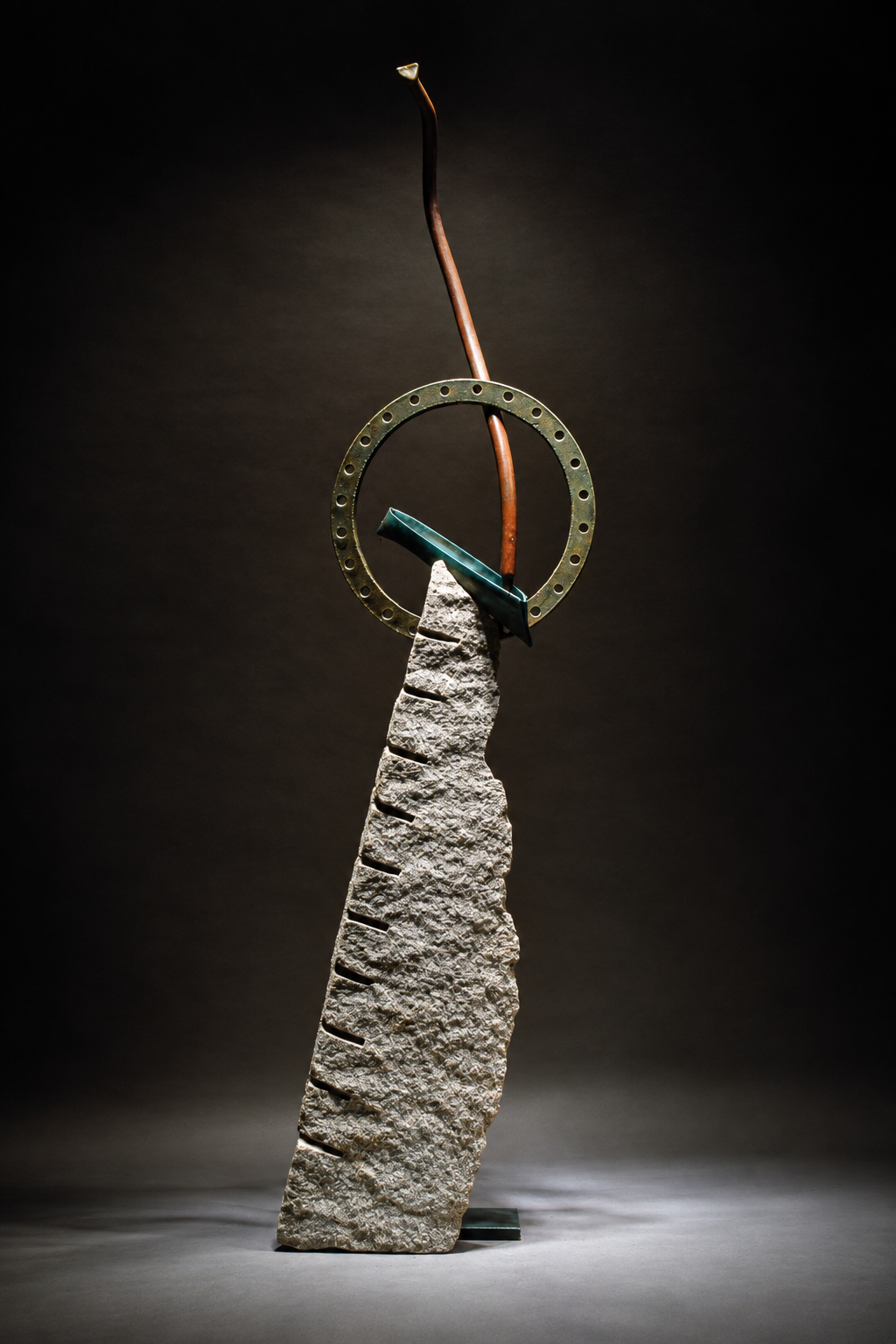
September 1988. Granite, painted steel. Dimensions: 103 × 24 × 15 in (262 × 61 × 38 cm). Private Collection Alexandria, VA
Over the years, I have created many sculptures featuring openings or portals, suggesting entrances, thresholds, and passages into spaces and places, both real and figurative. Often, a vessel form—a metaphor for the individual and a carrier of our experiences, memories, and aspirations—moves toward or through a portal or gateway.
This passage suggests a moment of personal transition or breakthrough: moving beyond obstacles and from the known toward the unknown. The portal becomes both a barrier and an opening, while the vessel embodies the energy and determination required to pass through it toward discovery, transformation, and new possibilities.
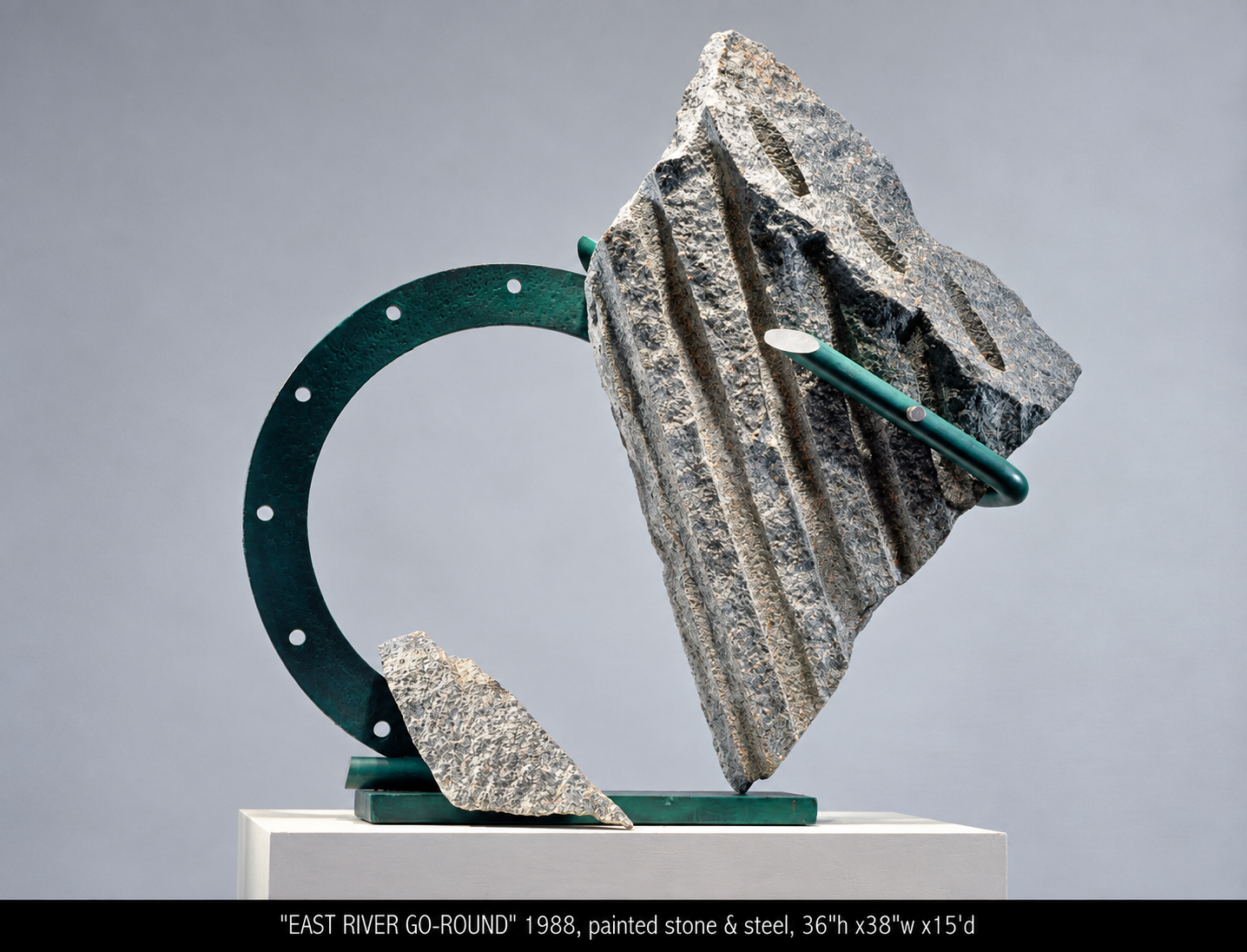
October 1988. Granite, painted steel. Dimensions: 36 × 38 × 15 in (91 × 97 × 38 cm).
Private collection, Santa Fe.
East River Go-Round I, 1988
East River Go-Round continues the circular language of the Go-Round Series, bringing a sweeping steel arc into tension with two pieces of granite. The large stone appears precariously suspended, its mass countered by the open circle and smaller stone below. Gravity, balance, and visible assembly remain connected to my earlier tensegrity, or Brute Series, while the painted steel and its more graphic character reflect the increasingly expressive direction my work had taken during the 1980s.
The title refers to the East Branch, or East River, of the Sacandaga River that runs through my studio property in Wells, New York. It connects the “go-round” idea of circular movement with the repetitive nature of working in a series—returning to an idea through successive variations. The river adds another sense of movement—flow and continuity—to the circle-and-stone imagery that would develop further in my Sisyphean Circles.
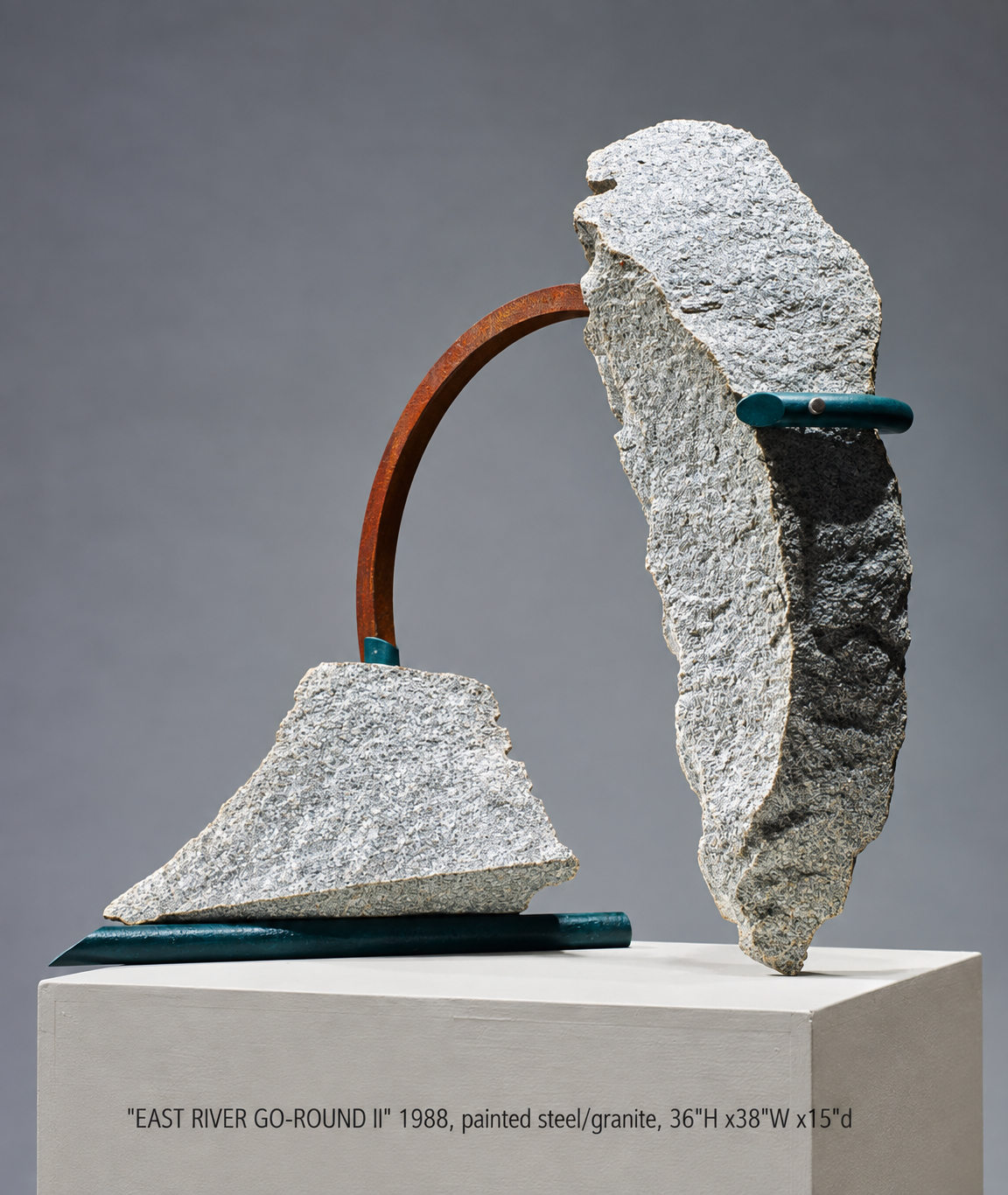
September 1988. Granite, painted steel. Dimensions: 36 × 38 × 15 in (91 × 97 × 38 cm).
Private collection - Santa Fe
East River Go-Round II, 1988
East River Go-Round II continues the formal and structural ideas of East River Go-Round I, but opens the composition into a taller, more vertical arrangement. Two contrasting granite forms are connected by a thin steel arc, with the larger stone poised dramatically on a single point. Gravity, balance, and visible assembly remain central, while the open circular form creates a strong sense of movement between the two stones and through the negative space they define.
As with the first work, the title refers to the East Branch, or East River, of the Sacandaga River that runs through my studio property in Wells, New York. The river adds ideas of flow and continuity to the Go-Round theme of circular movement and the repetitive nature of working in a series. Each sculpture becomes another passage through the same evolving idea, anticipating the circle, stone, repetition, and persistence that would become central to my later Sisyphean Circles.
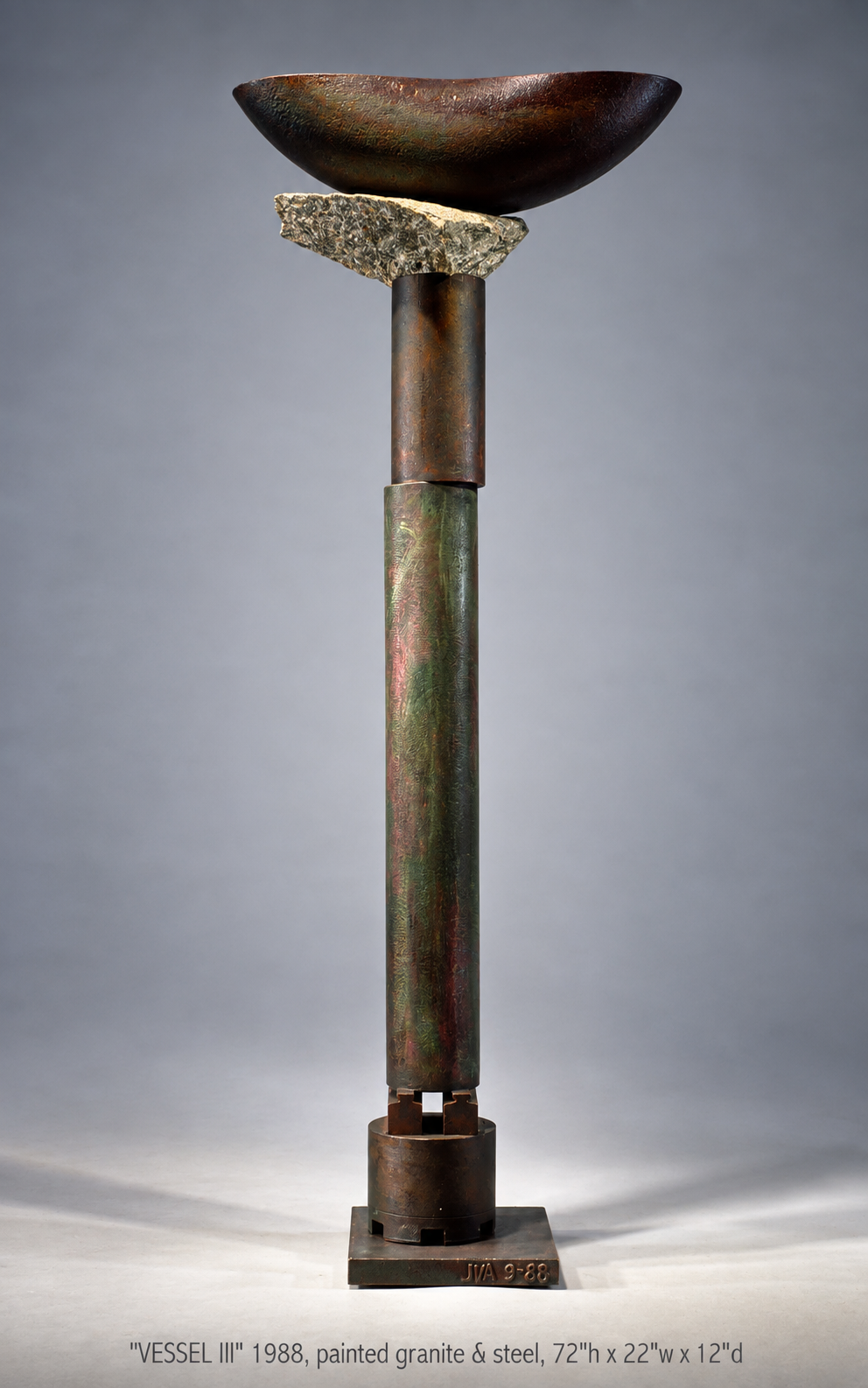
September 1988. Granite, painted steel. Dimensions: 72 × 28 × 12 in (183 × 71 × 30 cm). Private Collection.
Vessel III, 1988
Vessel III, the third work in my ongoing Vessel Series, grew from my earlier experience in ceramics and my interest in the container as both form and metaphor. The broad steel “container” was cut from a found steel pipe elbow and balanced above a small piece of granite, transforming an industrial fragment into a vessel-like form. My use of vessels initially grew from my background as a production potter.
Here the vessel sits high above a slender steel column, giving the sculpture a sense of elevation and balance. The series marked the beginning of an idea that would become increasingly important in my work—the vessel as a metaphor for the self, journey, and passage.
October 1988. Granite, painted steel. Dimensions: 79 × 26 × 10 in (201 × 66 × 25 cm). Private Collection.
Vessel VI, 1988
Vessel VI the sixth work in my ongoing Vessel Series, grew from my earlier work in ceramics and my interest in the container as both form and metaphor. The steel “container,” cut from a found section of pinched steel tube or pipe, balances above the rough granite, continuing my transformation of industrial fragments into vessel-like forms. My use of vessels initially developed from my background as a production potter.
The painted surfaces reflect my experiments with pastel drawings at the time. Working in pastel encouraged me to introduce color into the largely monochromatic stone and steel of my sculpture, using muted, earthy tones that were also influenced by my experience with ceramic glazes.
2nd image: Left to right : Vessel II 72"h - Vessel IV 70"h - Vessel VI 79"h
October 1988. Granite, painted steel. Dimensions: 72 × 28 × 16 in (183 × 71 × 41 cm). Private Collection.
Vessel IV, 1988
Vessel IV, the sixth work in my ongoing Vessel Series, grew from my earlier work in ceramics and my interest in the container as both form and metaphor. The steel “container,” cut from a found section of pinched steel tube or pipe, begins here to suggest the hull of a ship—extending the vessel from a functional container toward ideas of journey and passage. My use of vessel imagery grew directly from my earlier experience as a production potter.
The painted stone reflects my experiments with pastel drawings at the time, which encouraged me to bring more color into the largely monochromatic world of granite and steel. The muted color adds an expressive dimension while the elevated, ship-like vessel anticipates my continuing exploration of passage, movement, and personal journey.
Left to right : Vessel II 72"h - Vessel IV 70"h - Vessel VI 79"h

October 1988. Granite, stainless. Dimensions: 144 × 76 × 48 in (366 × 193 × 122 cm).
Corporate commission - Washington, DC.
East River Totem was commissioned for a prominent public site in Washington, DC, and represents the culmination of my Totem Series, begun more than a decade earlier. The tall granite form recalls the eroded rock spires that first inspired the series after my move West to Laramie, Wyoming, while the broad stainless-steel base gives the work a more architectural and monumental presence. Rising twelve feet, the sculpture functions as a visual landmark, connecting the weight and permanence of stone with an upward movement toward the sky. The title is a nod to the East Branch of the Sacandaga River that run along my studio property where it was created.
Much as the Billings Trough commission brought my tensegrity investigations to a culmination, East River Totem became the final and most monumental expression of the Totem Series. Its distilled relationship of stone and steel also points toward the increasingly architectural and celestial direction of my later public work, including SCR Sunwork, Artery Sunwork, and Passage. In this sense, the sculpture is both an ending and a transition—bringing together my longstanding concerns with geology, verticality, balance, and the relationship between natural and human-made forms while opening the way toward a new sculptural vocabulary.
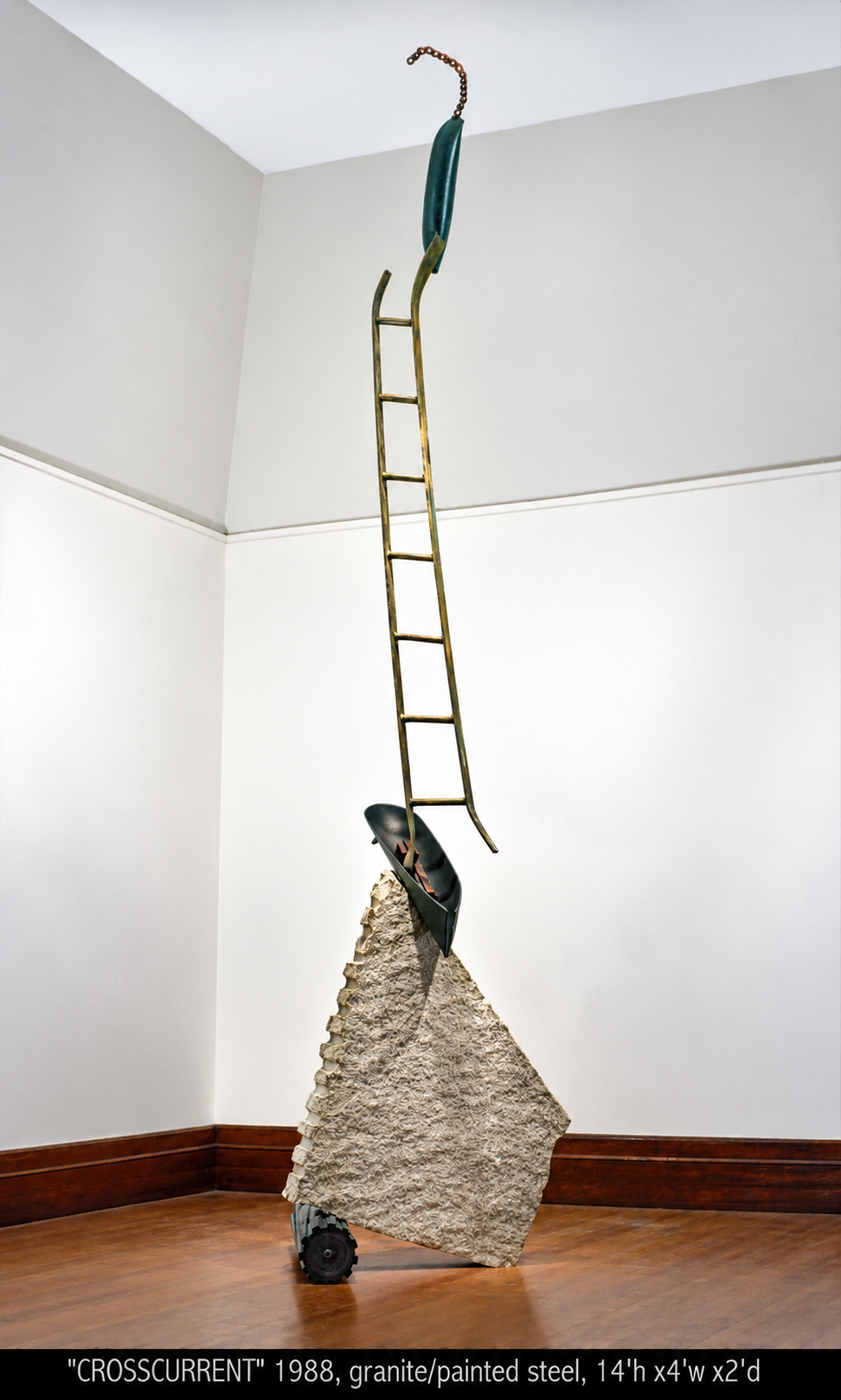
October 1988. Granite, painted steel. Dimensions: 168 × 48 × 24 in (427 × 122 × 61 cm). Private collection - Minneapolis, MN.
Crosscurrent, 1988
Crosscurrent develops the vessel imagery that entered my work in the late 1980s, growing from my earlier experience with ceramics and the functional container. The vessel-like steel forms were cut from found sections of pinched steel tube or pipe, but here they begin to read more clearly as ship hulls. The tall ladder-like structure and precarious arrangement give the work a strong sense of movement and passage—ideas that would become increasingly important in my sculpture.
The title Crosscurrent suggests forces moving in different directions—things at odds with one another and the difficulty of maintaining a course through them. The painted steel reflects my experiments with pastel drawing at the time, when color began moving from my works on paper into sculpture and expanding the expressive possibilities of the stone-and-steel vocabulary.
December 1988. Granite, bronze. Dimensions: 80 × 42 × 18 in (203 × 107 × 46 cm).
Private collection - Washington, DC
Symplegades (sim-PLEG-uh-deez)
The Clashing Rocks, which smashed together upon any ship passing between them. Jason and the Argonauts had been advised to avoid this trap by causing a bird to fly ahead of their vessel. The Symplegades clashed together on its tail feathers, then drew apart in readiness to clash again. At this moment, the Argonauts sailed through safely, with only minor damage to the very stern of their ship.
1988. Pink granite, painted steel. Dimensions: 10 × 4 × 4 in (25 × 10 × 10 cm). Corporate Collection: Huntmar Assoc LTD, Vienna, VA. 1988
1987
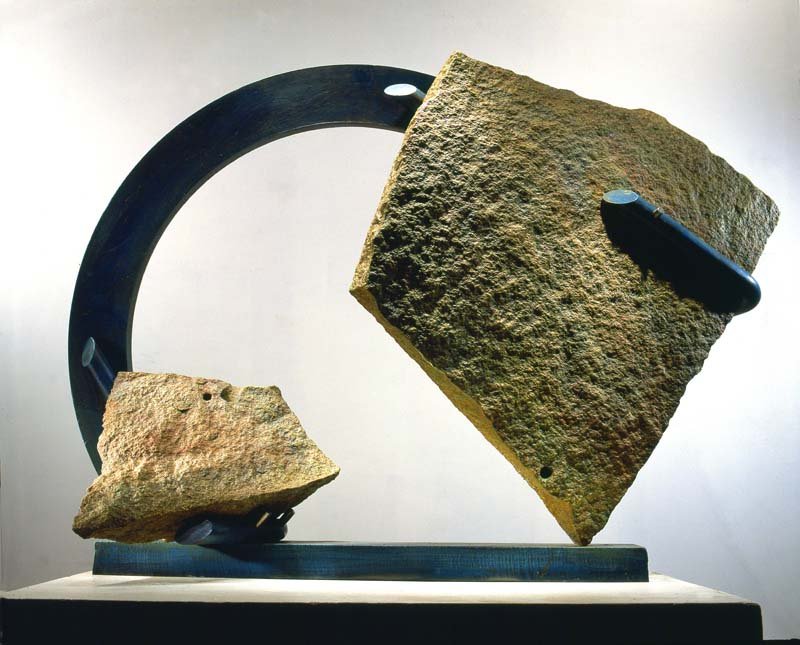
February 1987. Painted granite, painted steel. Dimensions: 35 × 54 × 18 in (89 × 137 × 46 cm).
Private collection.
Blue Rounder I, 1987
Blue Rounder I continues my exploration of the circle as a structural and visual device, bringing two pieces of stone into a precarious relationship with painted steel. The sweeping arc creates a sense of movement while gravity and balance remain active forces. The painted stone reflects my interest during this period in moving away from the modernist doctrine of truth to materials and toward color and a more expressive sculptural language.
The stainless-steel taper pins are intentionally prominent, both visually and conceptually. Rather than conceal how the sculpture is assembled, I make the connections part of the image—the bright stainless pins contrasting sharply with the darker painted steel and rough stone. They continue my long-standing interest in visible assembly, allowing the means by which the elements are joined and held in balance to become part of the sculpture itself.
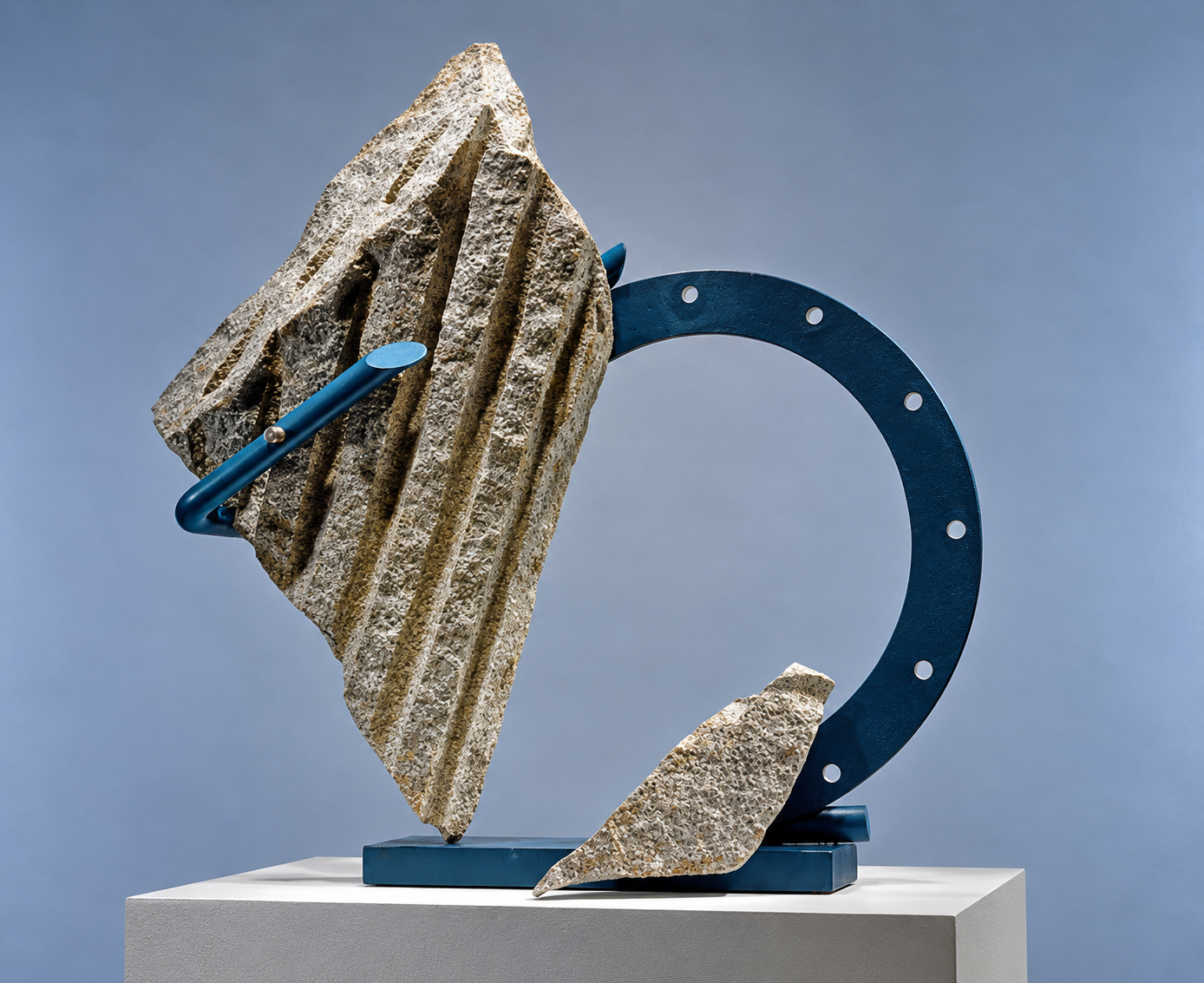
February 1987. Granite, painted steel. Dimensions: 16 × 17 × 7 in (41 × 43 × 18 cm).
Blue Rounder II, 1987
Blue Rounder II continues my exploration of the Rounder Series, bringing two pieces of granite into a dynamic relationship through a large circular steel arc. The stones appear precariously balanced while the circle visually and physically connects them. Visible pins and attachments continue my interest in revealing how the sculpture is assembled, while the circle introduces a sense of movement and arrested motion.
The blue-painted steel marks my growing interest during this period in using color to move beyond the natural character of the materials. Here, the blue unifies the structural elements and gives the circular form a stronger graphic presence against the rough granite. Blue Rounder II reflects the continuing evolution of the Rounder Series toward a more expressive use of circle, stone, balance, and movement.
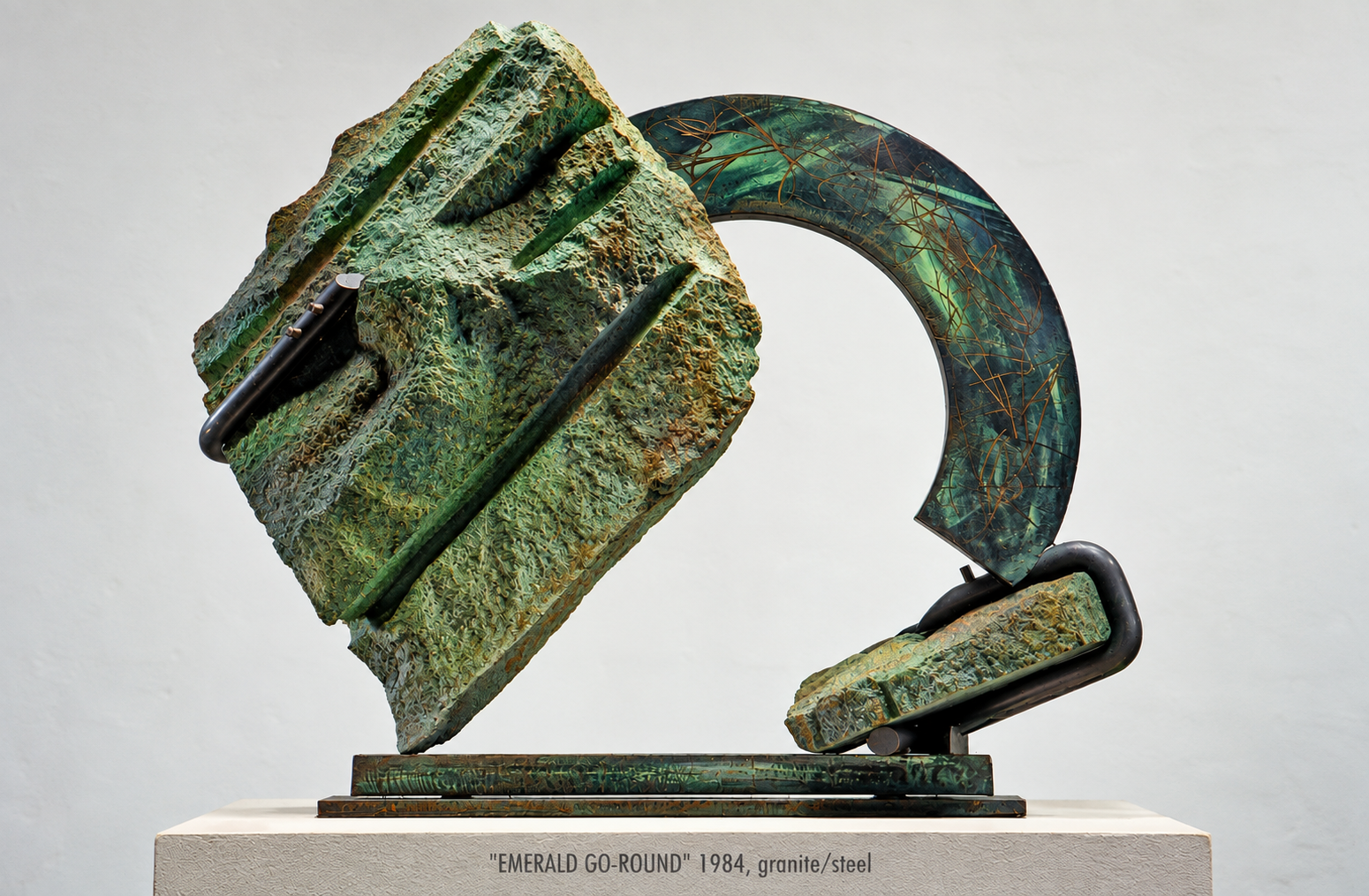
February 1987. Painted granite, painted steel. Dimensions: 48 × 53 × 21 in (122 × 135 × 53 cm).
Private collection
Emerald Go-Round, 1987
Emerald Go-Round extends the circular imagery of the earlier Go-Round Series, bringing found granite and a sweeping steel arc into a precarious relationship of weight, balance, and implied motion. By this point, however, color and surface had become increasingly important. I began polychroming the steel partly as protection against rust, but also painting the stone for visual interest—and, intentionally, for a certain element of shock. Applying color to stone represented a deliberate pushback against the modernist doctrine of “truth to materials” that I had adhered to almost religiously in my earlier work.
The green surface suggested by the title Emerald transforms the natural stone and reinforces the circular movement of the work. Although I soon returned largely to the natural character of stone, painting it continued to appear periodically in my work through 2006.
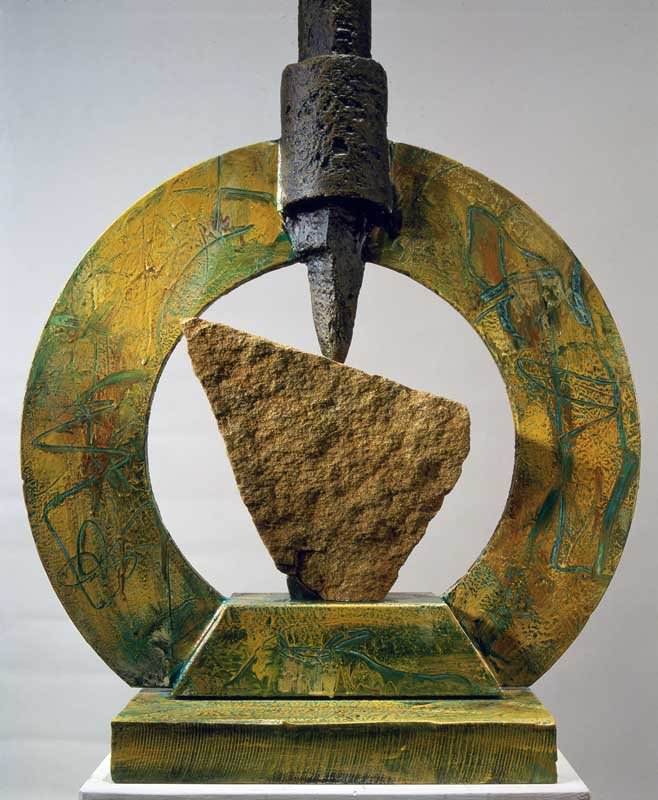
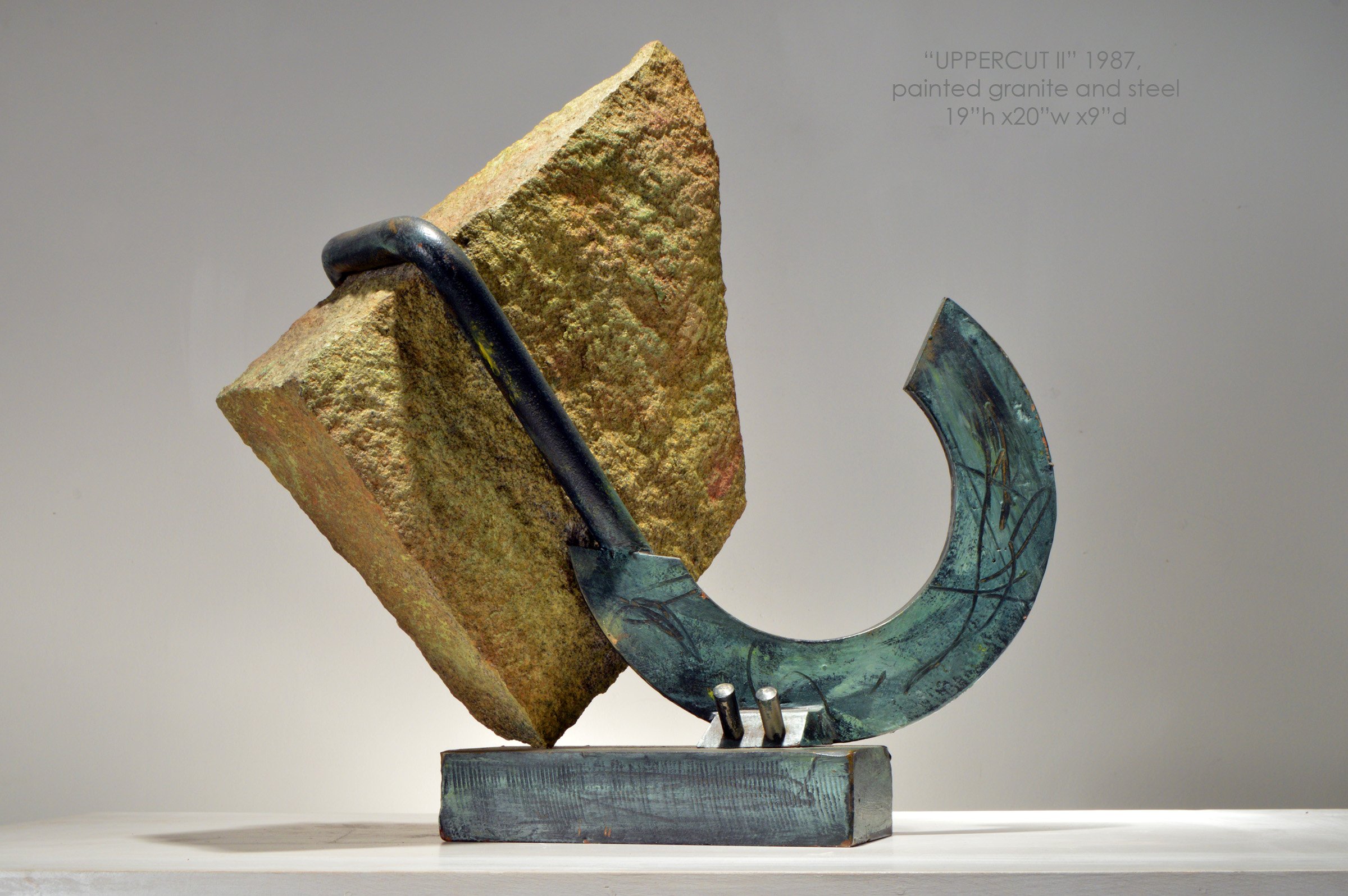
February 1987. Painted granite, painted steel. Dimensions: 4.5 × 6 × 4 in (11 × 15 × 10 cm). Collection of the artist.
Blue Loop/Fools Gold, 1987
Blue Loop/Fools Gold extends my exploration of the circle as a device for joining stone and steel through balance, tension, and implied movement. A large loop of painted steel rises between two granite forms, visually lifting and connecting their considerable mass. The blue steel and altered stone surface reflect my increasing use of color during this period and my move away from a strict adherence to “truth to materials.”
The second part of the title, Fools Gold, introduces an element of visual trickery. By covering the natural granite with gold paint, I deliberately disguise the material and question what the viewer thinks they are seeing—suggesting that things are not always what they appear to be.
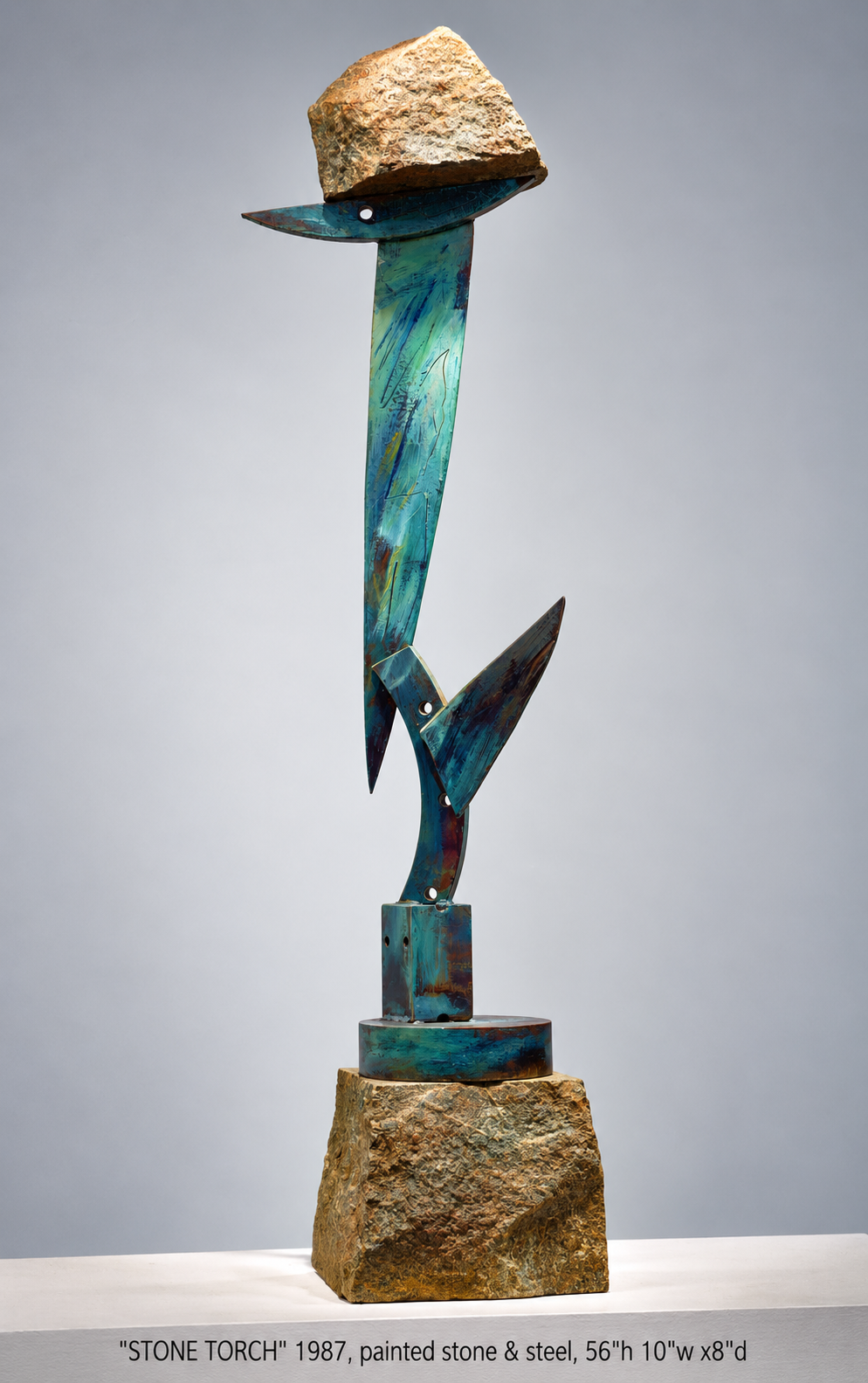
March 1987. Painted granite, painted steel. Dimensions: 56 × 10 × 8 in (142 × 25 × 20 cm).
Private collection - New York
Stone Torch, 1987
Stone Torch belongs to a period when I was moving away from the largely monochromatic stone and steel of my earlier work and experimenting more freely with color and expressive surface. Influenced in part by my pastel drawings, I applied color to both steel and stone, introducing a more painterly quality to the sculpture.
Unlike much of my earlier work, where stone carried considerable visual and physical weight, here it plays a minor role, primarily as a base and crowning element. The painted steel becomes the dominant, upward-moving form, while the title Stone Torch reinforces its vertical, flame-like presence.
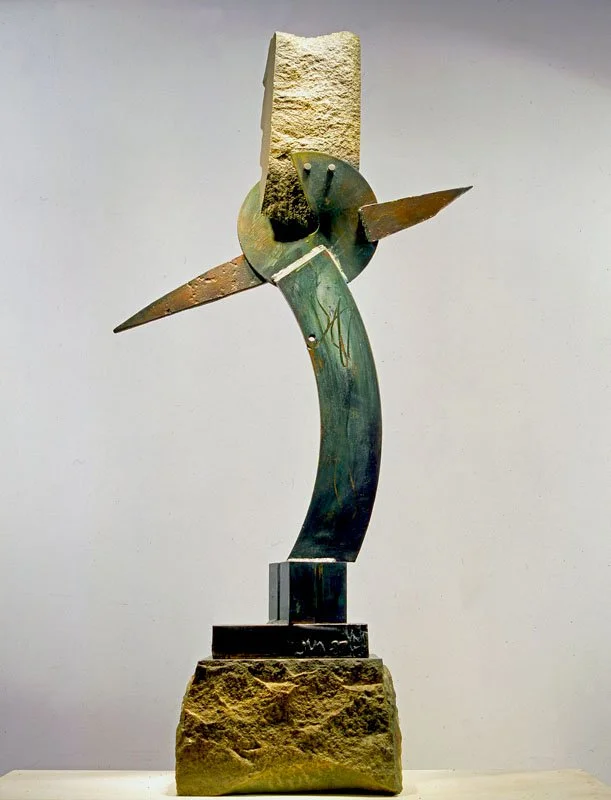
March 1987. Painted granite, painted steel. Dimensions: 53 × 27 × 8 in (135 × 69 × 20 cm). Private collection - New York
Naltar, 1987
Naltar comes from a period when I was experimenting more freely with color on both steel and stone. Influenced in part by my pastel drawings, I moved away from the predominantly gray granite and steel of my earlier work toward painted, more expressive surfaces. Here, as in several works from this period, stone plays a reduced role, serving primarily as a base and counterpoint to the more animated painted-steel structure.
The title comes from the extraordinary green and blue glacial lakes of Pakistan’s Naltar Valley, which I visited in 1986 while traveling through Pakistan and western China. The lakes are noted for their striking variations of green, blue, and azure, colors echoed in the painted surfaces of the sculpture.
The first Bashkiri Lake is located at a distance of 12 kilometers (8 mi) from Upper Naltar (or the Naltar Bala).
June 1987. Painted granite, painted steel. Dimensions: 16"h x17"w x7"d.
Private collection - Baltimore
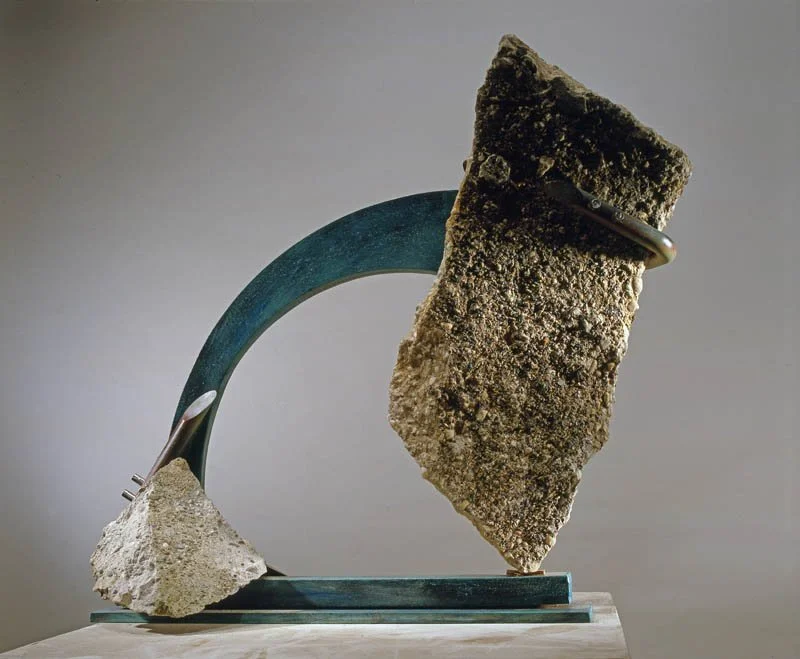
September 1987. Concrete, painted steel. Dimensions: 43 × 51 × 11 in (109 × 130 × 28 cm). Private collection.
Barr Rounder extends my exploration of circular movement, balance, and implied motion through a broad arc of painted steel connecting two contrasting pieces of found concrete. It is the only sculpture I have made using found chunks of concrete in combination with steel. As in other works from this period, the stainless-steel taper pins are deliberately exposed, becoming both a visual accent and a conceptual acknowledgment of how the sculpture is assembled and held together.
The work was commissioned by Mrs. Clay Barr for a garden in memory of her father, who had made his fortune in the cement business. The use of concrete therefore became particularly appropriate, giving the material a personal connection to the memorial while allowing me to incorporate it naturally into the evolving language of my Rounder Series.
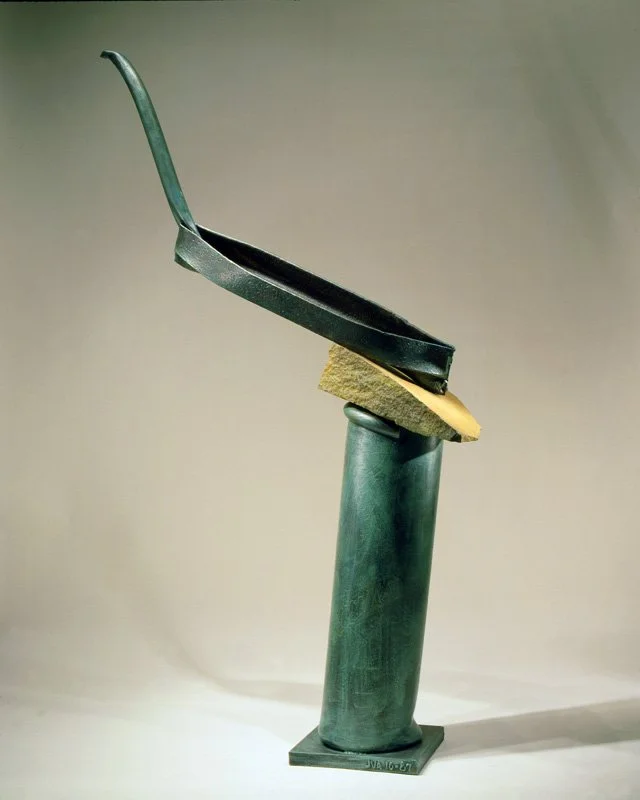
October 1987. Painted granite, painted steel. Dimensions: 85 × 57 × 22 in (216 × 145 × 56 cm).
Pyxis Awry, 1987
Pyxis Awry takes its title from Pyxis, the small southern constellation whose Latin name refers to a mariner’s compass, and awry—askew or off course. Created in 1987, it was the first work in what became my Pyxis series to feature the vessel form, historically understood in art and literature as a metaphor for the self, a group, or humankind. Here the vessel and the idea of a faulty compass come together: when our bearings are awry, we risk becoming adrift, untethered, and off course. It was created as a stealthy warning to the newly emerging awareness of what was then called “global warming”.
The sculpture established a metaphor that would reappear throughout my work, particularly in the Portals and Passages, Passage, and later Sisyphean Holiday series, where the vessel becomes a carrier through physical and metaphorical journeys. In Pyxis Awry, navigation becomes a way of questioning the choices and courses we set for ourselves, individually and collectively, and the consequences that follow. Those consequences may be personal, political, or environmental, allowing the sculpture to speak broadly about direction, responsibility, and the uncertainty of finding one’s way.
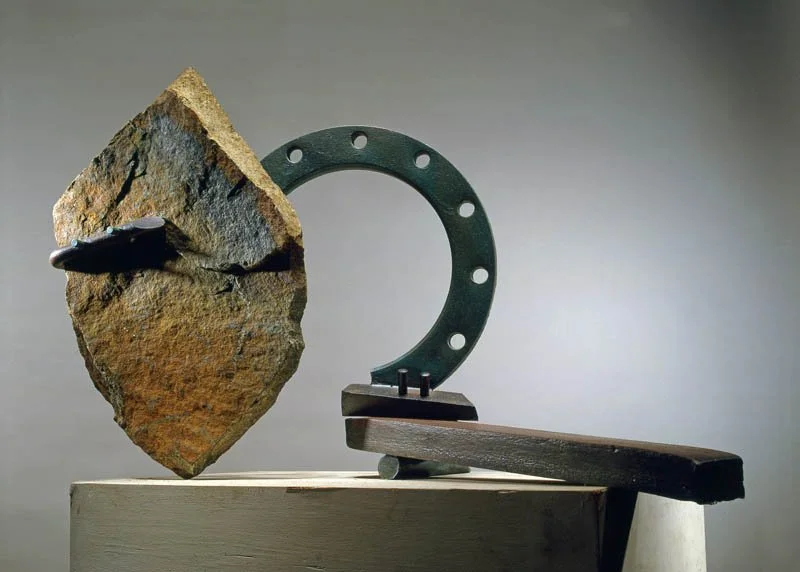
October 1987. Local granite, painted steel. Dimensions: 24 × 43 × 18 in (61 × 109 × 46 cm).
Private collection.
Indian Lake Rounder, 1987
Indian Lake Rounder brings a naturally colored found stone into the circular language of my Rounder Series. Its unusual rust, ochre, and gray coloration interested me as much as its shape, particularly because the colors were surprisingly close to those I had been applying to some of my painted stones. The discovery was another step that helped move my work away from the subdued, neutral gray granite I had relied on for years. The painted-steel arc and visible stainless-steel taper pins reinforce this shift, with the pins functioning both structurally and as deliberate visual and conceptual elements celebrating the sculpture’s assembly.
The title refers directly to where I found the stone—along the side of the highway near Indian Lake, New York, not far from where I live. As with many of my titles, it records something of the material’s history and origin, allowing the chance discovery of a local stone to become part of the identity of the sculpture.
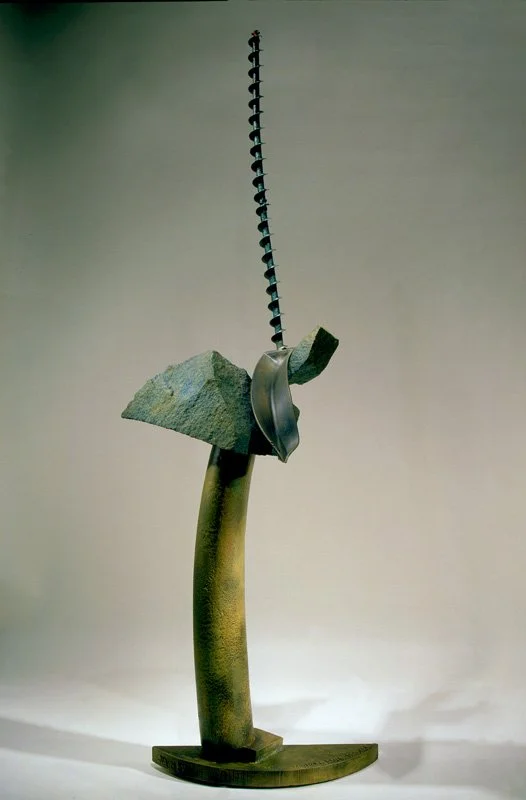
October 1987. Painted granite, painted steel. Dimensions: 87 × 32 × 34 in (221 × 81 × 86 cm).
Symplegades Passage
1987
polychromed granite and steel
Symplegades Passage draws its inspiration from the ancient Greek myth of the Symplegades, or "Clashing Rocks," two immense stone cliffs that relentlessly crashed together, destroying any vessel attempting to pass between them. According to legend, the hero Jason and the Argonauts successfully navigated the perilous passage with courage, skill, and a measure of divine assistance. In this sculpture, two granite forms are poised above a pedestal while a slender steel vessel slips between them, capturing the fleeting moment between danger and safe passage.
Rather than illustrating the myth literally, Symplegades Passage transforms it into a metaphor for life's pivotal moments of uncertainty and transition. The opposing stones suggest the forces that confront us throughout our lives, while the fragile vessel embodies determination, resilience, and hope. As in much of John Van Alstine's work, the ancient narrative becomes a contemporary reflection on the universal human journey—the courage to move forward despite the obstacles that stand in our way.
December 1987. Painted slate, painted steel. Dimensions: 10'h x5'w x4'd
Private collection.

December 1987. Painted granite, painted steel. Dimensions: 12'h x12'w x6'd, (Painted version - 1987)
Collection: Runy Mede Sculpture Garden, San Francisco, CA.
Drastic Measures, 1984–1987
Drastic Measures was initially created in 1984 and exhibited that year in my solo exhibition at Diane Brown Gallery in New York. The sculpture continues my exploration of stone, steel, gravity, and precarious balance, with the long sweeping steel arc and extended linear elements creating a strong sense of gesture and movement around the grounded mass of the granite. When I later wanted to exhibit the sculpture outdoors, I painted the steel surfaces to provide greater protection from the elements. What began as a practical decision also opened the possibility of using color as an expressive part of the sculpture.
This development was closely connected to my experimentation with pastel drawings during the same period. I had begun to feel that the predominantly gray palette of granite and steel needed what I described as more “color excitement,” and Drastic Measures became one of the important works in which ideas originating in the drawings moved into three dimensions. In Drastic Measures, color, line, mass, and gravity come together as active sculptural elements, extending my earlier structural concerns into a more painterly and expressive vocabulary.
January 1987. Painted granite, painted steel. Dimensions: 10’h x 7’w × 5’d
Private collection - Aspen
Luna I comes from a period when I was increasingly looking to the skies for inspiration. In 1986 I completed Solstice Calendar, my first large-scale public sculpture focused specifically on the celestial movement of the Earth in relation to the sun. That same year, the much-anticipated return of Halley’s Comet further heightened my interest in celestial movement. In Luna I, this appears most directly in the long diagonal element sweeping upward through the composition and the flame-like forms where it intersects the large lunar crescent.
The painted surfaces extend this celestial imagery through color, gesture, and movement, while the rough granite maintains the sculpture’s connection to the earth. Luna I became part of a broader direction in my work in which the moon, sun, night sky, and constellations provided a poetic framework for exploring time, space, movement, and our place within a larger cosmos. Drawings from 1986—including several Luna and Autumn Luna studies—show how actively these ideas were developing at the time.
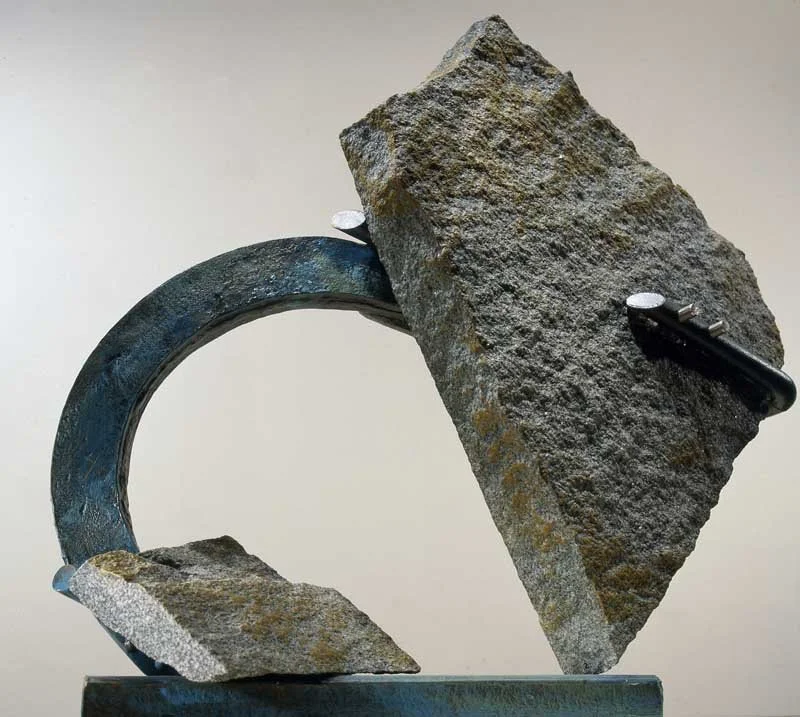
1987. Painted granite, painted steel. Dimensions: 16 × 17 × 7 in (41 × 43 × 18 cm).
Private collection.
Blue Rounder III, 1987
Blue Rounder III continues my exploration of the circle as a dynamic element connecting stone. A broad blue-painted steel arc joins two granite forms, creating a precarious balance between weight, movement, and stability.
The painted steel reflects my growing use of color during this period, moving beyond my earlier adherence to “truth to materials.” The circle-and-stone relationship also anticipates imagery that would later become central to my Sisyphean Circles.

January 1987. Granite, steel. Dimensions: 8 × 9 × 4 in (20 × 23 × 10 cm). (Destroyed by artist)
Ciscle Rounder, 1987
Ciscle Rounder was created in 1987 and exhibited in my solo exhibition at the George Ciscle Gallery in Baltimore—the title a playful reference to George Ciscle. The large perforated steel circle establishes a sense of rotation and movement, while the granite, curved steel, and diagonal elements create a dynamic interplay of weight, balance, and gesture. The work continues my interest in bringing the natural mass of stone into dialogue with the structural and spatial possibilities of steel.
The sculpture also reflects my practice of treating materials and forms as part of an evolving sculptural vocabulary. Although dismantling or recycling a work can be frowned upon by historians, artists sometimes do so for practical reasons—particularly the storage of large sculpture—or from the belief that its elements can find stronger expression in new work. I occasionally find myself in this situation, and, like several of my other sculptures, Ciscle Rounder was eventually “cannibalized,” with elements reappearing in Portals and Passages I (1988, S-88-01) and Unda (1995, S-95-01), giving parts of the original sculpture new life and meaning in later works.
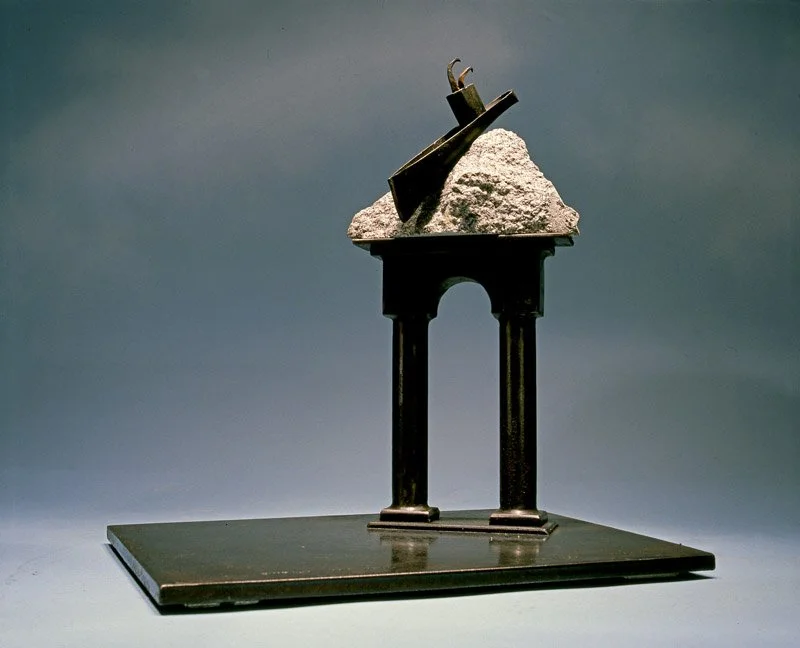
January 1988. Granite, steel. Dimensions: 16 × 12 × 9 in (41 × 30 × 23 cm).
Private collection: Washington, DC
1986
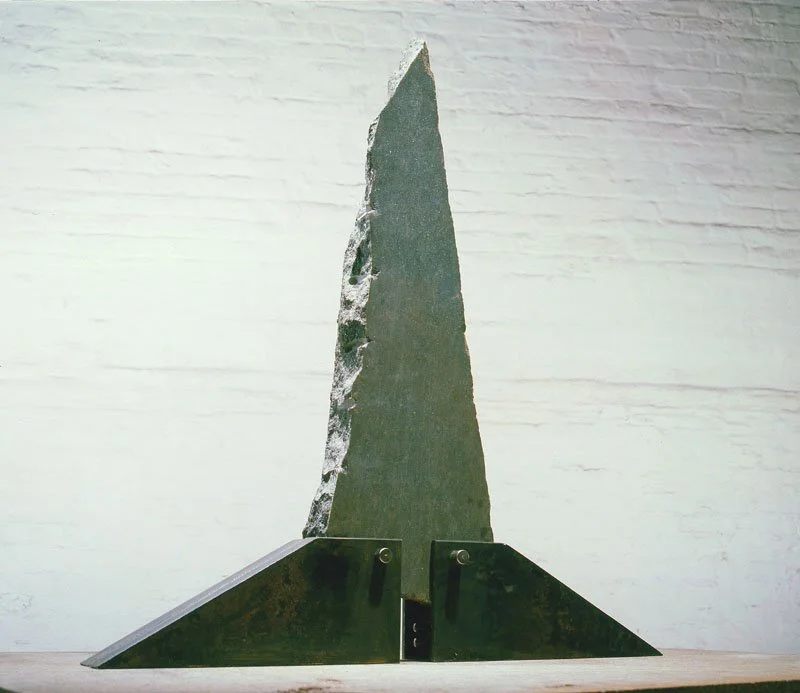
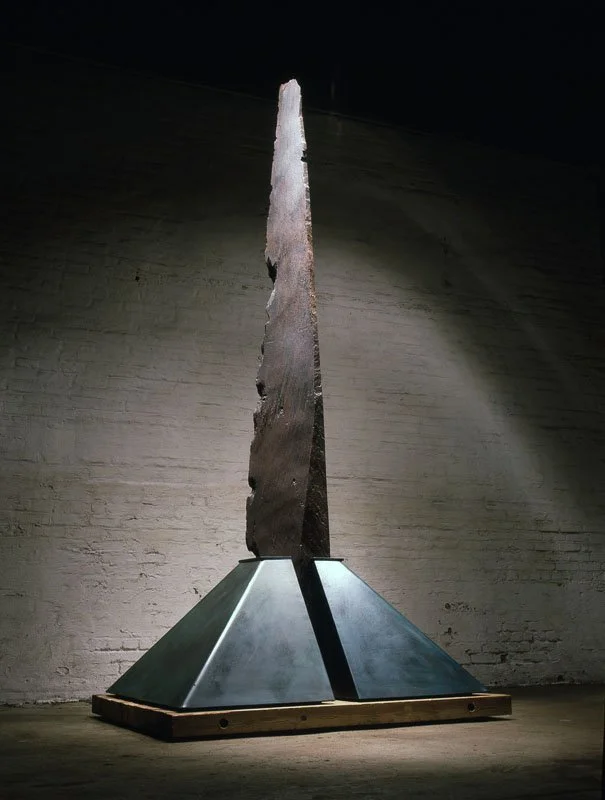
May 1986. Green granite, painted steel. Dimensions: 58 × 45 × 10 in (147 × 114 × 25 cm).
The AuSable Totem Series, begun in 1986, uses green granite from the quarry at AuSable Forks, New York, split into thin, rough-edged slabs whose naturally pointed forms suggest geological spires. The series extends an idea I first explored in my Totems of 1977 and returned to after moving back East in the early 1980s. The original inspiration came from the tall, eroded rock formations I encountered after moving West to Laramie, Wyoming. I was particularly struck by the way these vertical spires often rose from sloping accumulations of eroded and fallen material at their bases. In AuSable Totem I, that geological relationship is distilled into a stark sculptural structure: a single upright shard of granite rising from low, truncated triangular forms of steel.
The AuSable Totems are distinguished from the earlier works by the flat, slab-like character of the stone and the heavy, planar steel elements that anchor and frame it. Rather than disguising the means of attachment, I made the stainless-steel pins joining stone and steel deliberately prominent. They function structurally while also becoming visual punctuation, emphasizing the meeting of natural and fabricated forms. This direct expression of assembly continues a longstanding concern in my work—the physical and visual relationship between stone and steel—while the simplified, upward-thrusting composition gives the sculpture a distinctly geological and totemic presence
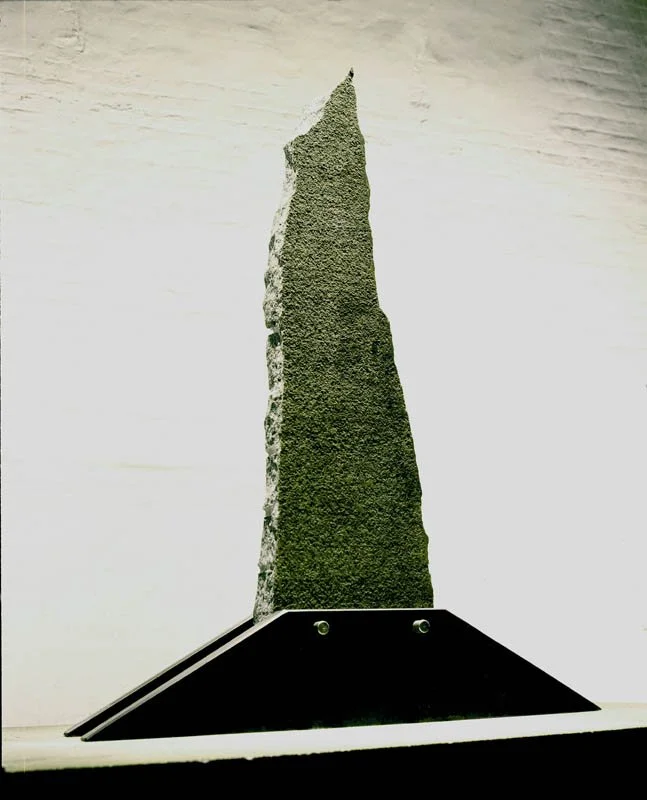
May 1986. Green granite, painted steel. Dimensions: 47 × 44 × 7 in (119 × 112 × 18 cm).
The AuSable Totem Series, begun in 1986, uses green granite from the quarry at AuSable Forks, New York, split into thin, rough-edged slabs whose naturally pointed forms suggest geological spires. The series extends an idea I first explored in my Totems of 1977 and returned to after moving back East in the early 1980s. The original inspiration came from the tall, eroded rock formations I encountered after moving West to Laramie, Wyoming. I was particularly struck by the way these vertical spires often rose from sloping accumulations of eroded and fallen material at their bases. In AuSable Totem II, that geological relationship is distilled into a stark sculptural structure: a single upright shard of granite rising from low, truncated triangular forms of steel.
The AuSable Totems are distinguished from the earlier works by the flat, slab-like character of the stone and the heavy, planar steel elements that anchor and frame it. Rather than disguising the means of attachment, I made the stainless-steel pins joining stone and steel deliberately prominent. They function structurally while also becoming visual punctuation, emphasizing the meeting of natural and fabricated forms. This direct expression of assembly continues a longstanding concern in my work—the physical and visual relationship between stone and steel—while the simplified, upward-thrusting composition gives the sculpture a distinctly geological and totemic presence.

June 1986. Granite, steel. Dimensions: 48 × 35 × 9 in (122 × 89 × 23 cm).
The AuSable Totem Series, begun in 1986, uses green granite from the quarry at AuSable Forks, New York, split into thin, rough-edged slabs whose naturally pointed forms suggest geological spires. The series extends an idea I first explored in my Totems of 1977 and returned to after moving back East in the early 1980s. The original inspiration came from the tall, eroded rock formations I encountered after moving West to Laramie, Wyoming. I was particularly struck by the way these vertical spires often rose from sloping accumulations of eroded and fallen material at their bases. In AuSable Totem III, that geological relationship is distilled into a stark sculptural structure: a single upright shard of granite rising from low, truncated triangular forms of steel.
The AuSable Totems are distinguished from the earlier works by the flat, slab-like character of the stone and the heavy, planar steel elements that anchor and frame it. Rather than disguising the means of attachment, I made the stainless-steel pins joining stone and steel deliberately prominent. They function structurally while also becoming visual punctuation, emphasizing the meeting of natural and fabricated forms. This direct expression of assembly continues a longstanding concern in my work—the physical and visual relationship between stone and steel—while the simplified, upward-thrusting composition gives the sculpture a distinctly geological and totemic presence
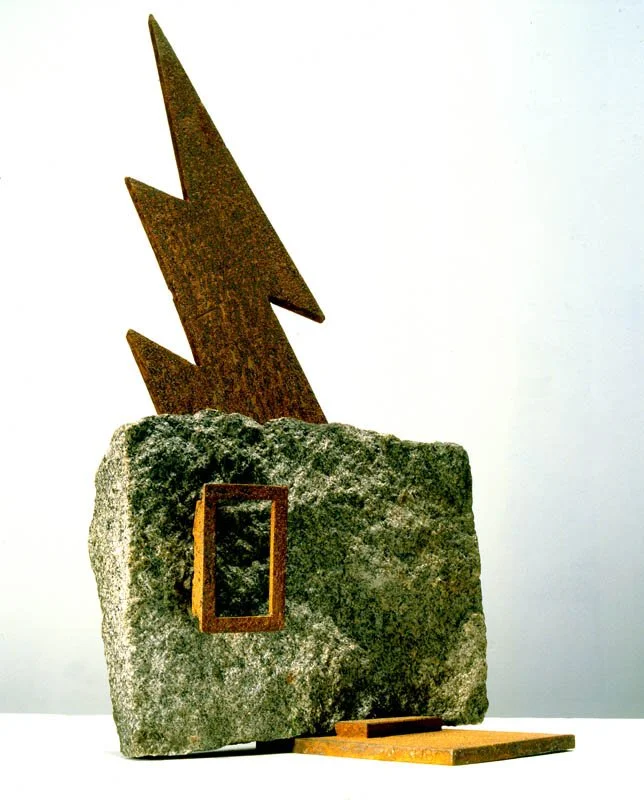
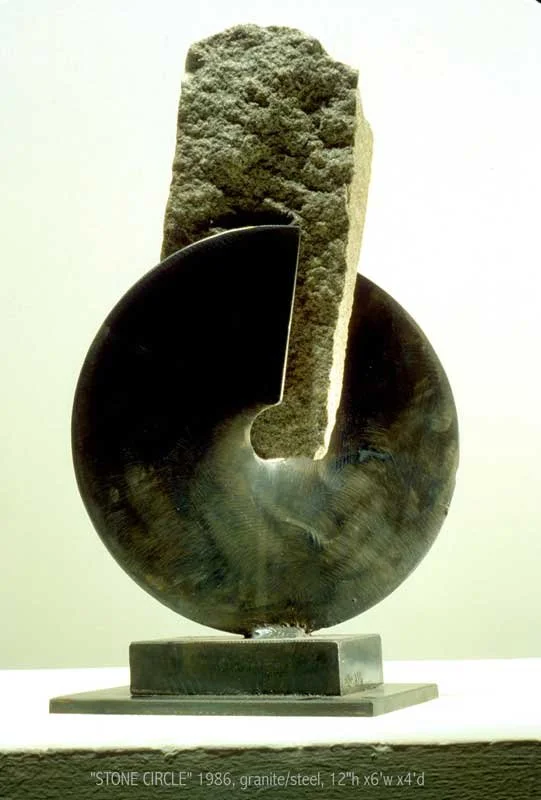
June 1986. Granite, steel. Dimensions: 12 × 6 × 4 in (30 × 15 × 10 cm).
Private collection - Philidelphia, PA
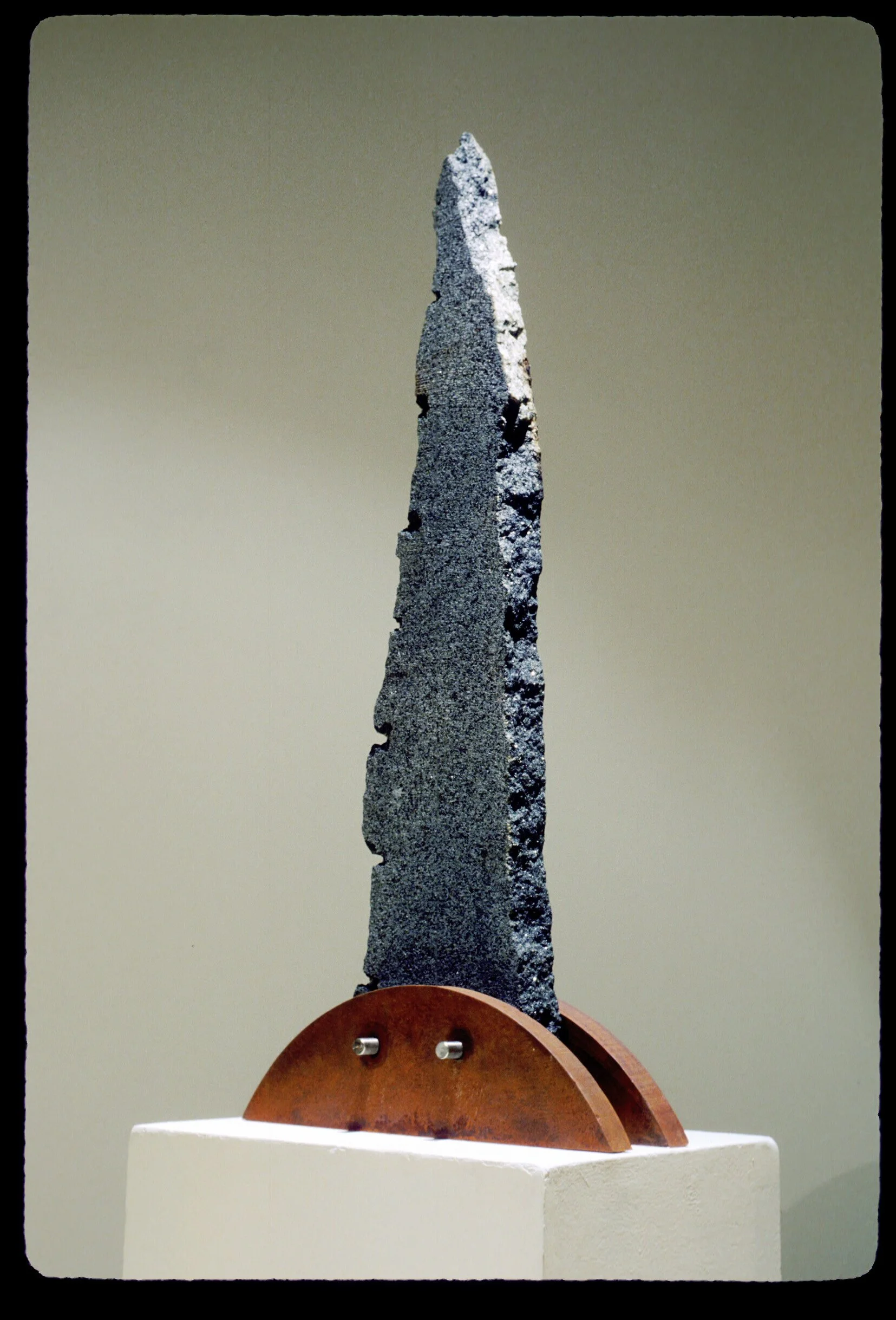
June 1986. Black granite, steel. Dimensions: 36 × 20 × 4 in (91 × 51 × 10 cm).
Black Totem I uses black granite split into thin, a rough-edged slab whose naturally pointed forms suggest geological spires. The series extends an idea I first explored in my Totems of 1977 and returned to after moving back East in the early 1980s. The original inspiration came from the tall, eroded rock formations I encountered after moving West to Laramie, Wyoming. I was particularly struck by the way these vertical spires often rose from sloping accumulations of eroded and fallen material at their bases.

May 1986. Black granite, steel. Dimensions: 50 × 37 × 7 in (127 × 94 × 18 cm).
Black Totem II uses black granite split into thin, a rough-edged slab whose naturally pointed forms suggest geological spires. The series extends an idea I first explored in my Totems of 1977 and returned to after moving back East in the early 1980s. The original inspiration came from the tall, eroded rock formations I encountered after moving West to Laramie, Wyoming. I was particularly struck by the way these vertical spires often rose from sloping accumulations of eroded and fallen material at their bases.

January 1986. Painted granite, painted steel. Dimensions: 51 × 46 × 16 in (130 × 117 × 41 cm).
Private collection - Washington, DC
Instrument for Understanding Celestial Movement reflects my growing tendency during this period to look to the skies for inspiration. The elevated circular form and diagonal linear element suggest an imagined scientific or navigational instrument—perhaps measuring an orbit, charting a trajectory, or locating our position within a larger celestial order. These ideas were developing simultaneously in my Luna Series and in the solar and celestial concepts I was incorporating into several large-scale public works. The title deliberately suggests an “instrument,” not as something literally functional, but as a sculptural device for contemplating movement, time, space, and our relationship to the cosmos.
The work also marks a transition in my use of color and expressive surface, stimulated in part by my increasing involvement with drawing, particularly color pastels. The painted granite and steel, layered color, and richly worked, almost impasto-like surfaces introduce a more gestural and painterly vocabulary, moving away from the spare “truth to materials” aesthetic of my earlier tensegrity, or Brute Series. Here, color and texture become active elements of the sculpture, working alongside mass, line, and balance to broaden its visual and expressive possibilities.
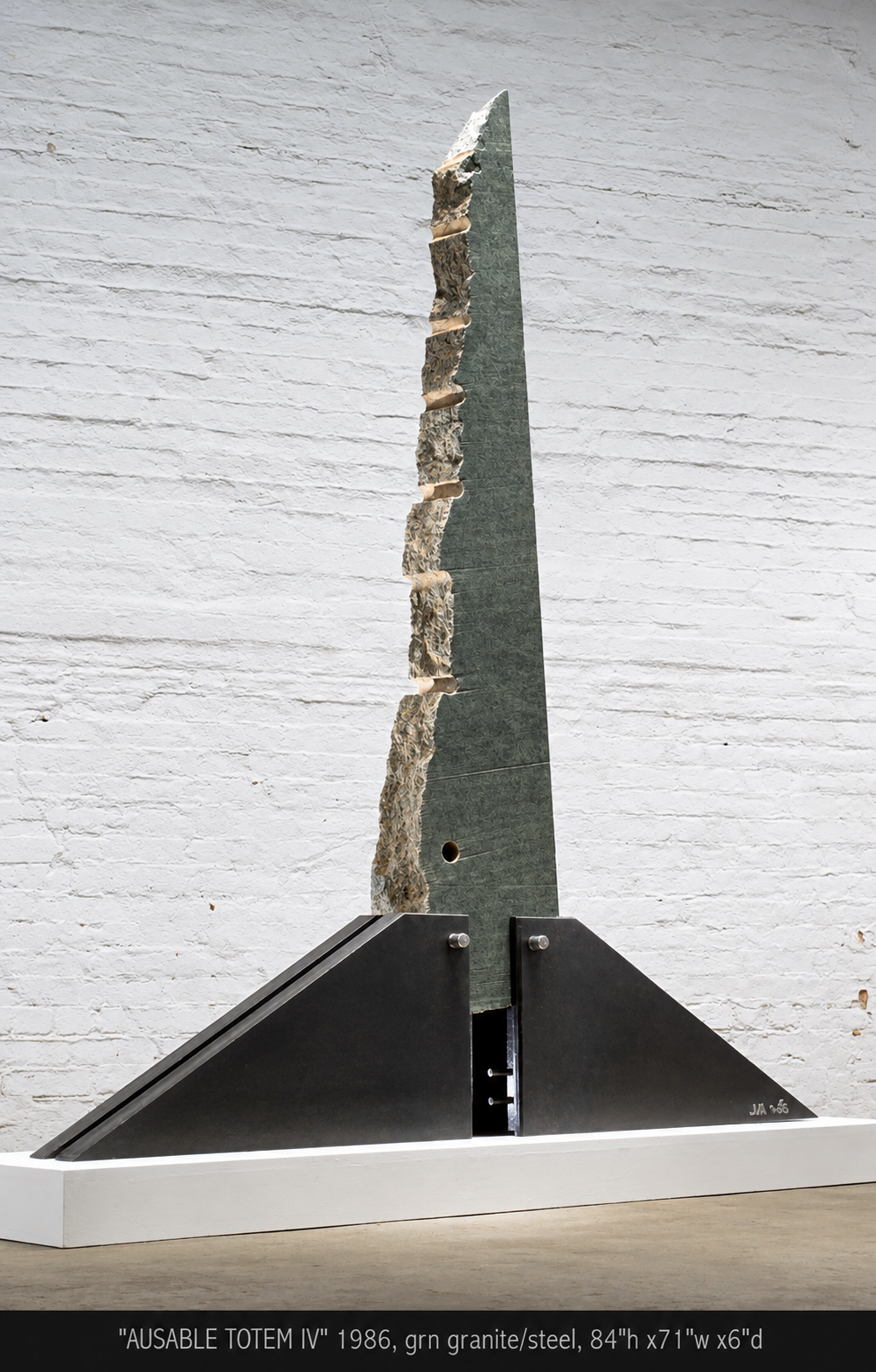
June 1986. Granite, steel. Dimensions: 84 × 71 × 6 in (213 × 180 × 15 cm).
The AuSable Totem Series, begun in 1986, uses green granite from the quarry at AuSable Forks, New York, split into thin, rough-edged slabs whose naturally pointed forms suggest geological spires. The series extends an idea I first explored in my Totems of 1977 and returned to after moving back East in the early 1980s. The original inspiration came from the tall, eroded rock formations I encountered after moving West to Laramie, Wyoming. I was particularly struck by the way these vertical spires often rose from sloping accumulations of eroded and fallen material at their bases. In AuSable Totem I, that geological relationship is distilled into a stark sculptural structure: a single upright shard of granite rising from low, truncated triangular forms of steel.
The AuSable Totems are distinguished from the earlier works by the flat, slab-like character of the stone and the heavy, planar steel elements that anchor and frame it. Rather than disguising the means of attachment, I made the stainless-steel pins joining stone and steel deliberately prominent. They function structurally while also becoming visual punctuation, emphasizing the meeting of natural and fabricated forms. This direct expression of assembly continues a longstanding concern in my work—the physical and visual relationship between stone and steel—while the simplified, upward-thrusting composition gives the sculpture a distinctly geological and totemic presence
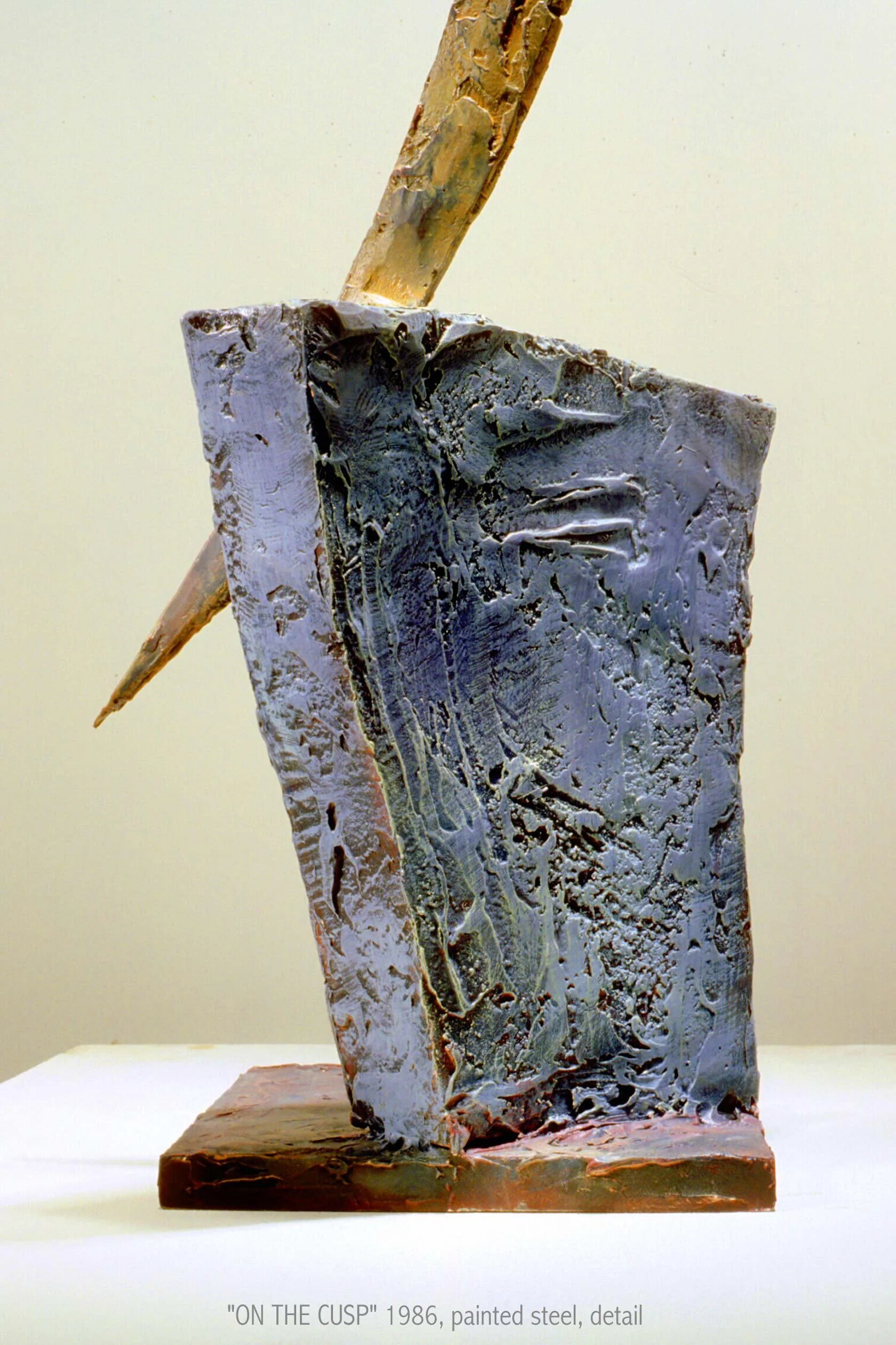
August 1986. Painted steel. Dimensions: 54 × 14 × 11 in (137 × 36 × 28 cm).
On the Cusp
On the Cusp reflects my growing tendency during this period to look to the skies for inspiration. The long, sweeping crescent-like form suggests a celestial trajectory—an orbit, lunar arc, or body in motion—and relates to ideas I was exploring simultaneously in the Luna Series and in the solar and celestial concepts incorporated into several of my large-scale public works. The title reinforces this sense of transition: to be “on the cusp” is to occupy a threshold, poised between one state and another.
The work also marks a transition in my approach to color and expressive surface, stimulated in part by my increasing involvement with drawing, particularly color pastels. Its richly worked, almost impasto-like surfaces and layered color introduce a gestural, painterly quality that departs from the spare “truth to materials” aesthetic of my earlier tensegrity, or Brute Series. Rather than relying primarily on the inherent character of steel, I was beginning to use color, texture, and surface as active expressive elements, expanding the visual and emotional vocabulary of my sculpture.
August 1986. Painted granite, painted steel. Dimensions: 8 × 4 × 2 in (20 × 10 × 5 cm).
No photos available.

January 1986. Painted steel. Dimensions: 63 × 33 × 12 in (160 × 84 × 30 cm). Private Collection.
Gallo
Gallo takes its title from the Spanish word for rooster, a reference suggested by the stylized, comb-like form at the top of the sculpture. Its heavily textured, almost impasto-like surface gives the steel a painterly quality, while the upright posture and sweeping circular element reinforce the proud, strutting character of a rooster. The reference remains suggestive rather than literal, allowing the sculpture to move between abstraction and recognizable imagery.
Created in 1986, Gallo also reflects my growing interest in color and expressive surface—an interest stimulated in part by my increasing involvement with drawing, particularly color pastels. Paint and richly worked surfaces began to introduce a more gestural, painterly vocabulary into my sculpture, marking a departure from the spare, “truth to materials” approach that characterized my earlier tensegrity, or Brute Series. Rather than allowing stone and steel to speak primarily through their inherent physical properties, I was beginning to use color, texture, and surface as active expressive elements, expanding the emotional and visual range of the work.

March 1986. Granite, steel. Dimensions: 72 × 24 × 24 in (183 × 61 × 61 cm).
Private collection - Baltimore, DC
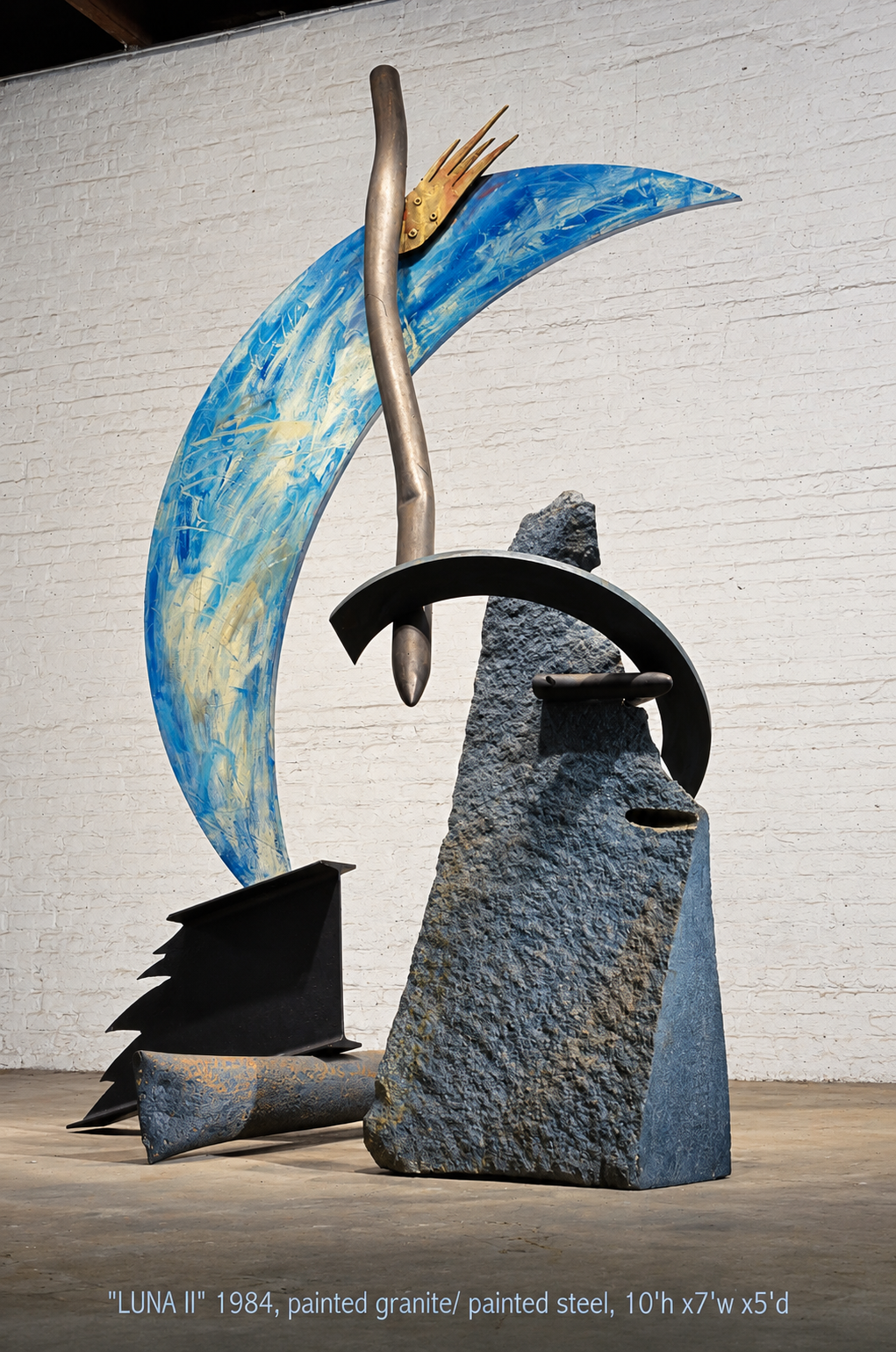
Luna II
Luna II comes from a period when I was increasingly looking to the skies for inspiration. In 1986 I completed Solstice Calendar, my first large-scale public sculpture focused specifically on the celestial movement of the Earth in relation to the sun. That same year, the much-anticipated return of Halley’s Comet, along with the tragic Challenger disaster and the unforgettable media images of its descent from the sky, further intensified my awareness of the heavens as a realm of both wonder and uncertainty. In Luna II, these ideas appear most directly in the large lunar crescent, the long diagonal element sweeping upward through the composition, and the flame-like forms at their intersection.
Luna II became part of a broader direction in my work in which the moon, sun, night sky, and constellations provided a poetic framework for exploring time, space, movement, and our place within a larger cosmos. Drawings from 1986—including several Luna and Autumn Luna studies—show how actively these ideas were developing. A related celestial concept also informed my proposal that year for a major commission in Boston’s Back Bay, extending these concerns from intimate drawings and sculpture into the scale of public art.

January 1986. Granite, stainless steel. Dimensions: 22 × 40 × 20 in (56 × 102 × 51 cm).
Solstice Calendar (1985–86) was John Van Alstine's third major public commission and the first in a series of monumental sculptures exploring the relationship between the earth, the sun, and the passage of time. Commissioned for Austin College in Sherman, Texas, the work consists of two monumental granite pylons joined by a horizontal stone element. At solar noon each day, a steel bar suspended between the pylons casts a shadow that marks the changing seasons, recording the winter and summer solstices and the spring and autumn equinoxes. Conceived as both sculpture and scientific instrument, the work bridges art, astronomy, and landscape.
Inspired by Van Alstine's travels among the prehistoric stone monuments of Britain and the ceremonial architecture of Mesoamerica, Solstice Calendarreflects his enduring interest in humankind's oldest methods of understanding the cosmos. Positioned between Austin College's arts and sciences buildings, the sculpture symbolizes the union of those disciplines while inviting viewers to experience the rhythms of the natural world. The success of the project established the foundation for Van Alstine's continuing Celestial Works series, including SCR Sunwork, Artery Sunwork, 2nd Street Sunwork, and Via Solaris.
1985
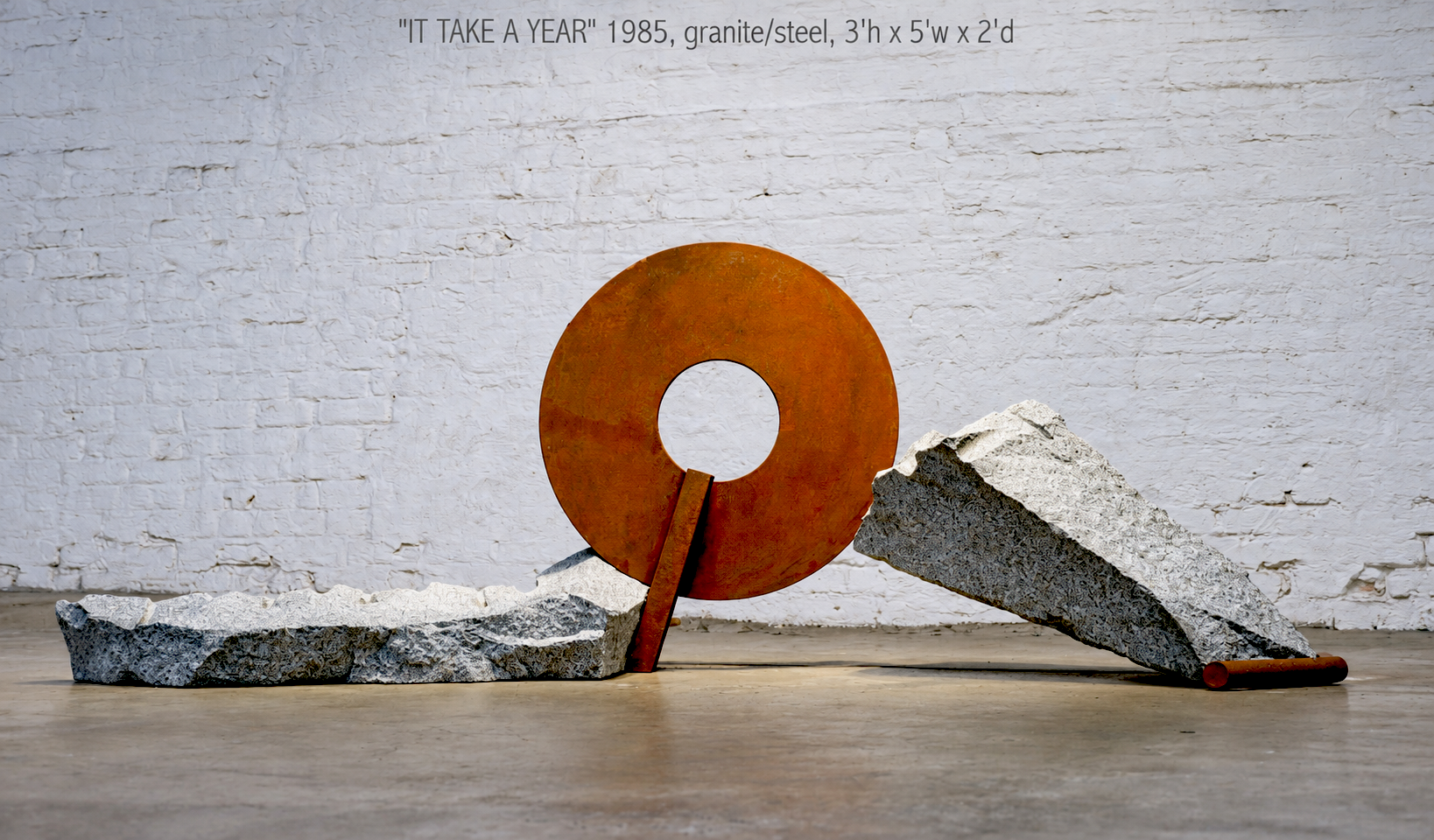
1985. Painted granite, painted steel. Dimensions: 3 × 5 × 2 ft. (destroyed)
It Takes a Year, 1985
It Takes a Year marks the very beginning of my interest in celestial ideas and the relationship between sculpture, the sun, and the passage of time. The large circular steel form suggests the sun or a celestial cycle, while the granite and steel create a landscape-like arrangement governed by weight, balance, and implied movement. At this stage, however, the work is a representation of these ideas rather than a functioning astronomical instrument.
That distinction became important the following year with my large-scale public commission Solstice Calendar at Austin College in Sherman, Texas. There I moved from suggesting celestial cycles to creating a sculpture that actually uses sunlight and shadow to mark the solstices, equinoxes, and annual passage of the sun. It Takes a Year can therefore be seen as an early conceptual step toward the Celestial Works that became a major focus of my public sculpture beginning in 1986.
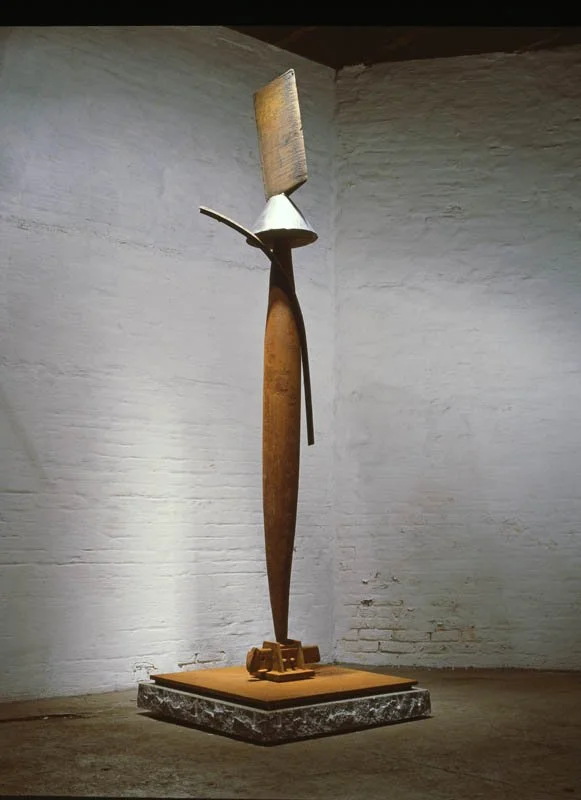
February 1985. Painted granite, painted steel. Dimensions: 9.5 × 3 × 3 in (24 × 8 × 8 cm). Private collection Washington, DC.
Blue Collar Column, 1985
Blue Collar Column represents another relatively rare use of the human figure in my sculpture during this period. Its tall, slender steel structure—with an implied body, shoulders, and head—suggests a standing figure without becoming literally representational. The title reinforces this association, while “blue collar” connects the figure to labor and the industrial character of the steel itself. The work retains my continuing interest in balance, assemblage, and the expressive possibilities of found and fabricated materials.
For many years I resisted acknowledging figurative references in my otherwise abstract work. By 1998, with my solo exhibition Acknowledging the Figure at SUNY Plattsburgh, I accepted the figure as a valid and important avenue of expression within my sculpture. As I wrote for that exhibition, the figure could provide a framework or “point of entrance” into an otherwise abstract work, adding another layer of association and meaning. Blue Collar Column, made thirteen years earlier, was an early indication of that developing direction.
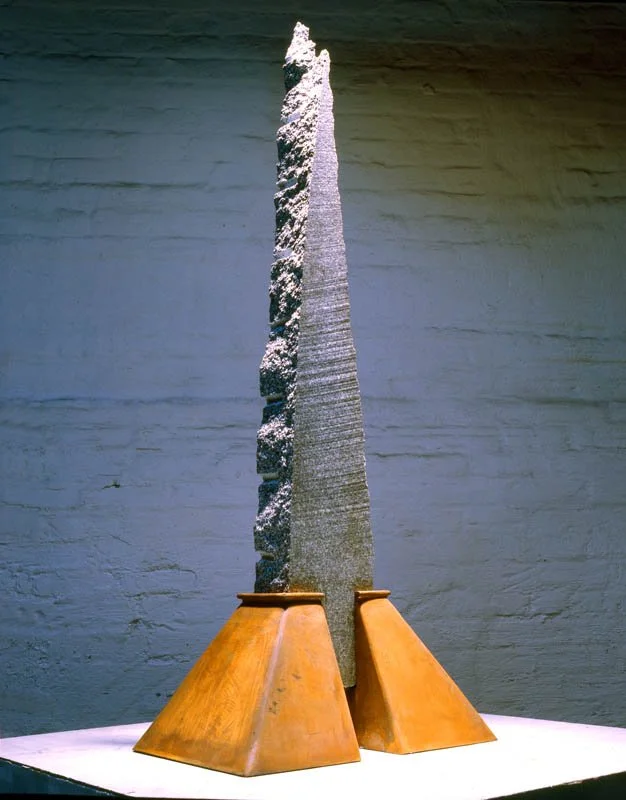
March 1985. Granite, steel. Dimensions: 51 × 19 × 13 in (130 × 48 × 33 cm).
Stone Totem III, is a continuation of the “closed-base” totems and the first one that is table size. The work reflects my transition away from the open, interlocking structures of the tensegrity, or Brute Series, toward more solid forms and a greater emphasis on overall image and visual presence.
The Totem Series grew from the tall, eroded rock spires I encountered after moving West to Laramie, Wyoming, particularly the way they rose from sloping accumulations of fallen material at their bases. Here that geological relationship is distilled into the contrast between the rugged vertical slate and low geoetric steel pyramid.
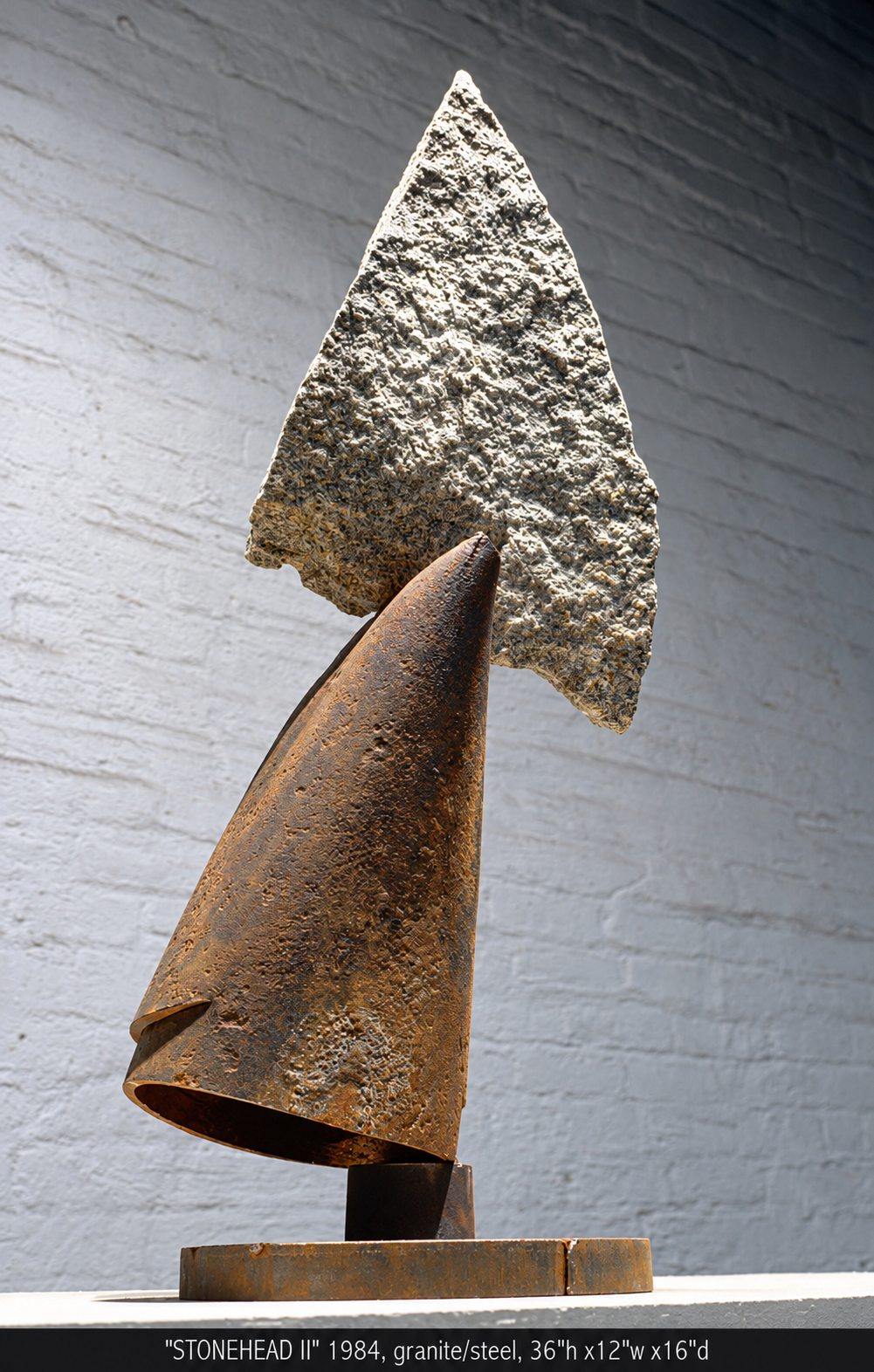
March 1985. Granite, painted steel. Dimensions: 36 × 12 × 16 in (91 × 30 × 41 cm).
Stone Head II, 1984
Stone Head II follows Stone Head I and represents a rare exploration of the figure in my work during this time. A rough, triangular granite form is poised above a tapered steel element, creating the suggestion of a head and body without becoming literally figurative. The precarious balance and contrasting weight of stone and steel retain concerns that had long been central to my sculpture.
The work was also a momentary break from the highly self-referential sculpture I had been making—work largely concerned with material, structure, gravity, and the act of assembly itself. Here those formal concerns remain, but they are used to evoke the human figure, briefly opening the work toward a more associative and expressive direction.
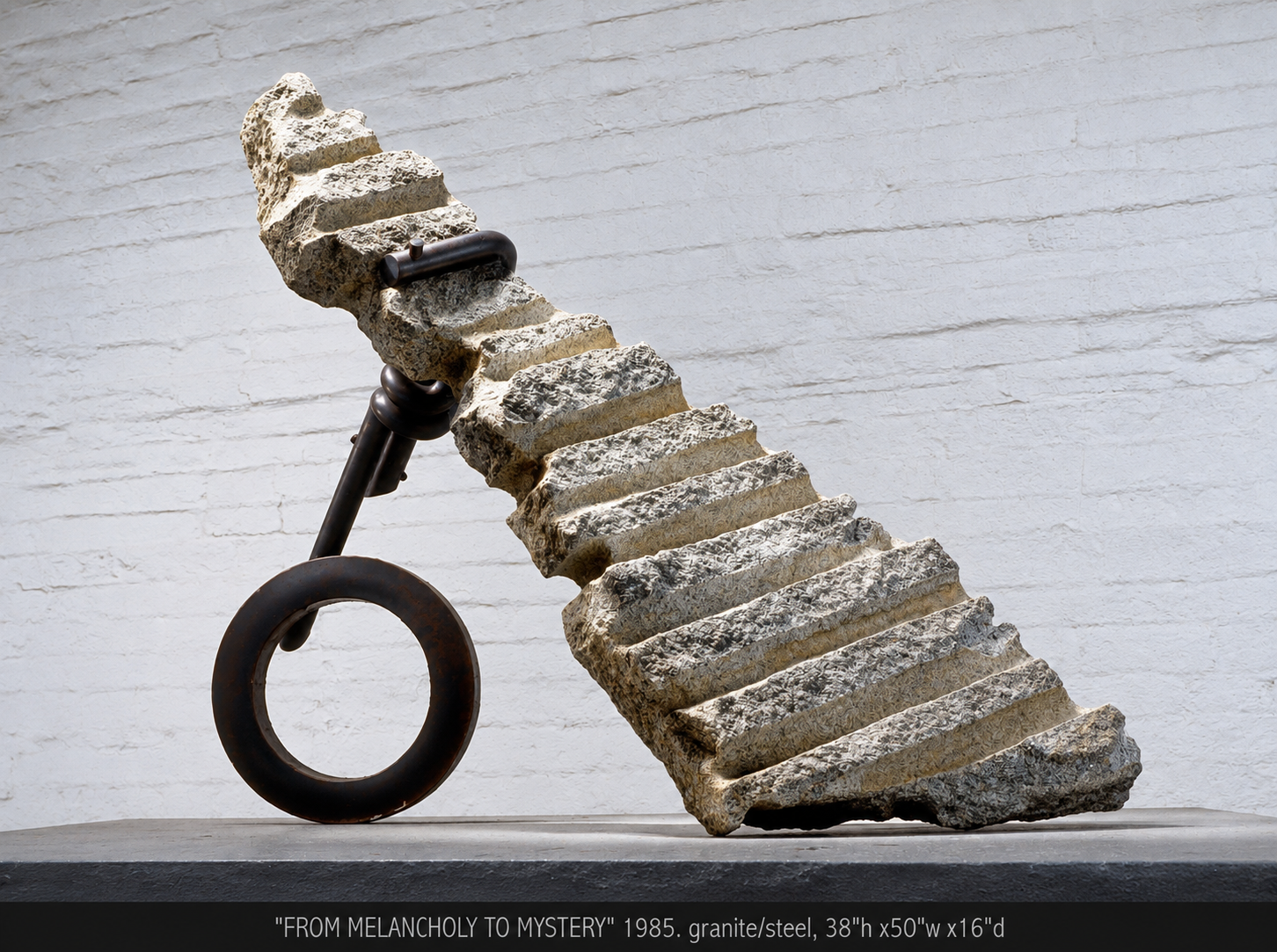
March 1985. Granite, steel. Dimensions: 38 × 50 × 16 in (97 × 127 × 41 cm). Private Collection - destroyed
From Melancholy to Mystery represents another relatively rare for the period use of the figure in my sculpture. The long, diagonally poised granite form, supported by a wheel-like steel element, suggests a body or figure caught in motion. The prominently placed forged-steel bars and loops are both structural and visual, deliberately revealing how the sculpture is held together—a continuation of my long-standing interest in making the act of assembly part of the work itself.
The title is a nod to Giorgio de Chirico’s 1914 painting Melancholy and Mystery of a Street, with its enigmatic atmosphere and small figure moving with a hoop. My sculpture takes that reference in a more playful direction: the circular steel form suggests a wheel and gives the massive stone an improbable, freewheeling energy. Weight and gravity remain present, but here they are countered by movement, humor, and a sense that the sculpture might somehow roll away.

March 1986. Granite, steel. Dimensions: 36 × 23 × 15 in (91 × 58 × 38 cm).
Slate Totem IV, is a continuation of the “closed-base” totems and the first one that is table size. The work reflects my transition away from the open, interlocking structures of the tensegrity, or Brute Series, toward more solid forms and a greater emphasis on overall image and visual presence.
The Totem Series grew from the tall, eroded rock spires I encountered after moving West to Laramie, Wyoming, particularly the way they rose from sloping accumulations of fallen material at their bases. Here that geological relationship is distilled into the contrast between the rugged vertical slate and low geometric steel pyramid.
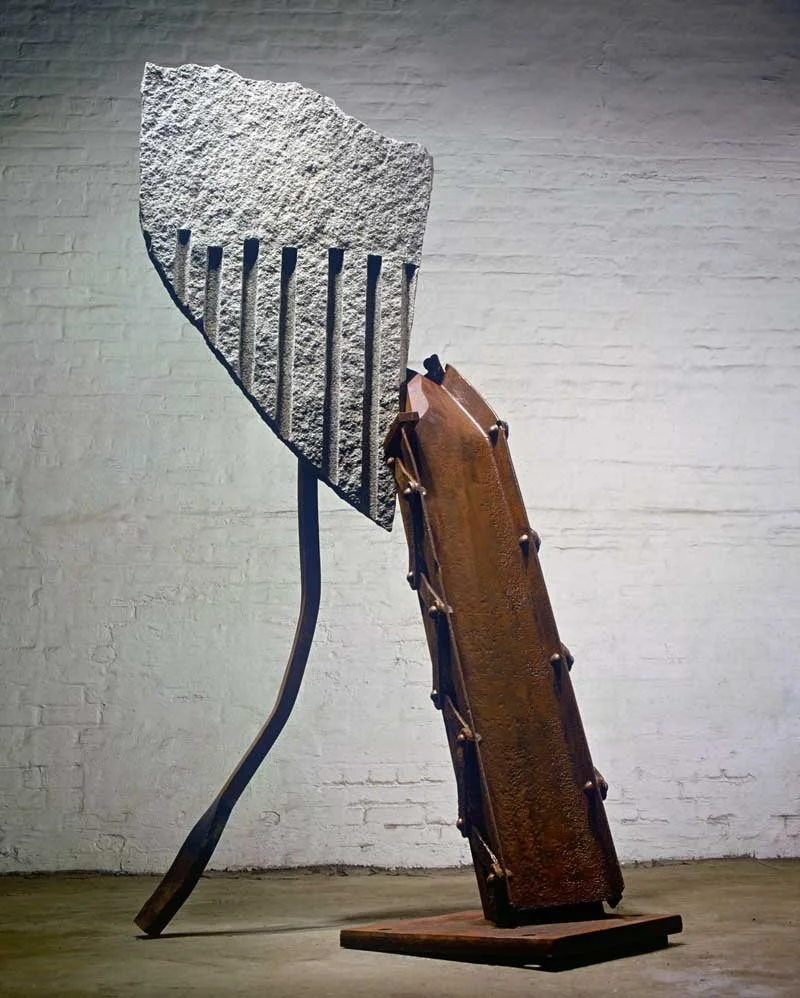
March 1985. later Painted granite, painted steel. Dimensions: 7.5 × 4 × 4 in (19 × 10 × 10 cm).
Gimp, 1985
Gimp represents a relatively rare use of the human figure in my sculpture. The granite form and leaning steel structure suggest a body caught in an awkward, off-balance stance—a limping or “gimping” gait. Rather than depicting the figure literally, I use weight, balance, and gesture to give the static materials a sense of bodily movement. This exploration became an important expressive thread in my work, fully acknowledged in my 1998 exhibition, Acknowledging the Figure.
The sculpture retains concerns central to my work—gravity, tension, structural interdependence, and the contrast of stone and steel—but turns them toward a more figurative and expressive end. The granite and steel were later painted, further emphasizing this shift, and the work was exhibited in the late 1980s at Gerald Peters Gallery in Santa Fe.
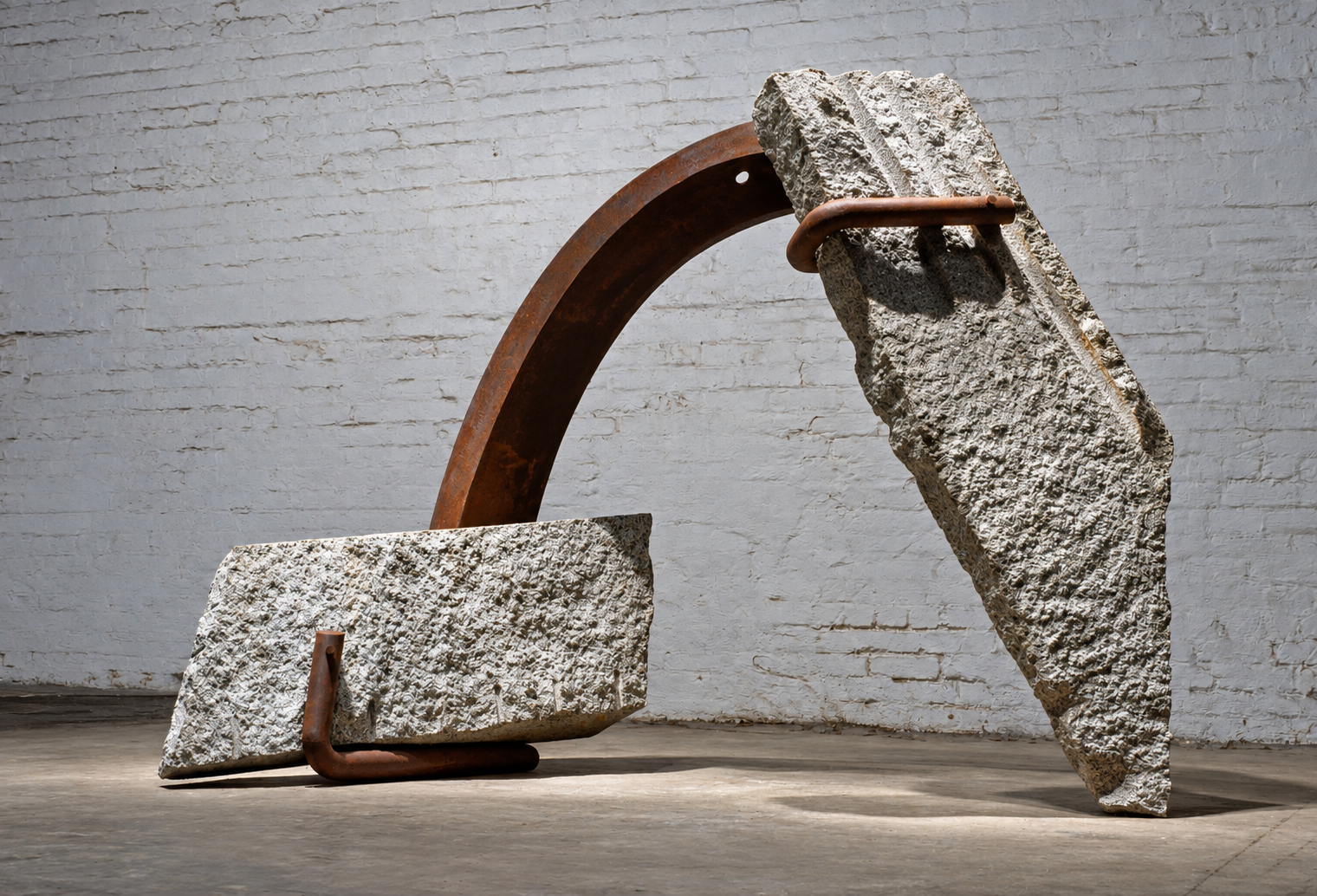
March 1985. Granite, steel. Dimensions: 5 × 7 × 4 in (13 × 18 × 10 cm). Collection: Baltimore Museum of Art.
Carnegie Rounder, 1985
Carnegie Rounder extends the ideas begun with Rounder I. Two granite elements are joined by a sweeping curved I-beam, creating an open circular movement while engaging weight, balance, and suspension. The title Rounder refers both to this circular structure and to the word’s slightly disreputable association with a drifter or someone from “the other side of the tracks.”
The Carnegie reference comes simply from the steel itself. I salvaged the curved I-beam from a Chicago demolition site where a fire and building collapse had bent the heavy beams into smooth arcs. The beam carried a “Carnegie” stamp identifying its maker, so I used the name simply as an identifier, without symbolic meaning. Other works, including Los Arcos later that year, used beams salvaged from the same site.
The work sold to Robert and Ryda Levy and was exhibited in their highly respected sculpture garden in Lutherville, MD. It was later gifted to the Baltimore Museum of Art and is part of their permanent collection.
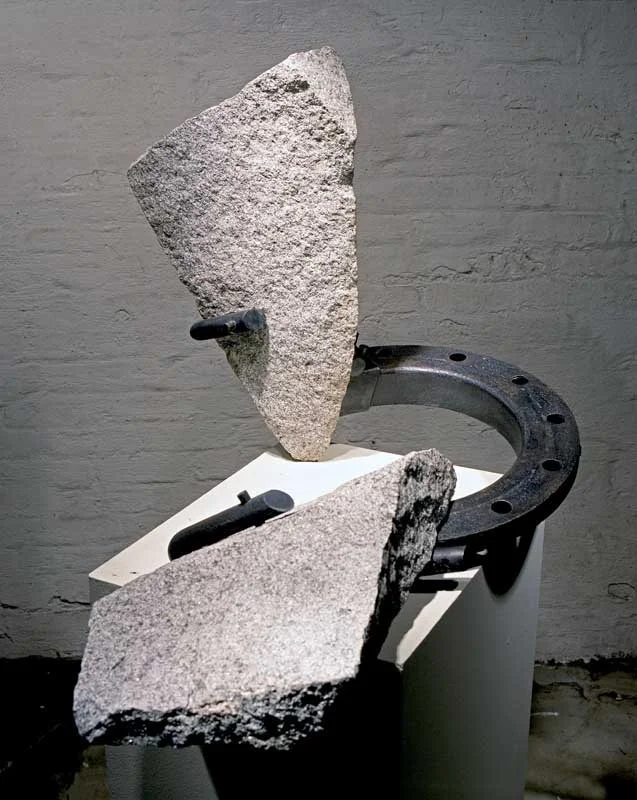
June 1985. Granite, steel. Dimensions: 23 × 35 × 26 in (58 × 89 × 66 cm). Private Collection Washington, DC.
Sidewinder III, 1984
Sidewinder III continues my exploration of stone and steel as contrasting but interdependent elements. Two granite forms are linked by a heavy curved steel section, creating a composition that seems to twist and move laterally through space. As in the earlier Sidewinders, gravity and balance remain important, while the visible pins and steel fastenings make the physical act of joining the elements an integral part of the sculpture’s visual language.
The title Sidewinder refers to the work’s curving, sideways movement and the serpentine character suggested by the steel. Sidewinder III was included in the 1986 benefit auction for the Children’s Museum of Washington, DC, where it was purchased by Washington collector George Frampton.
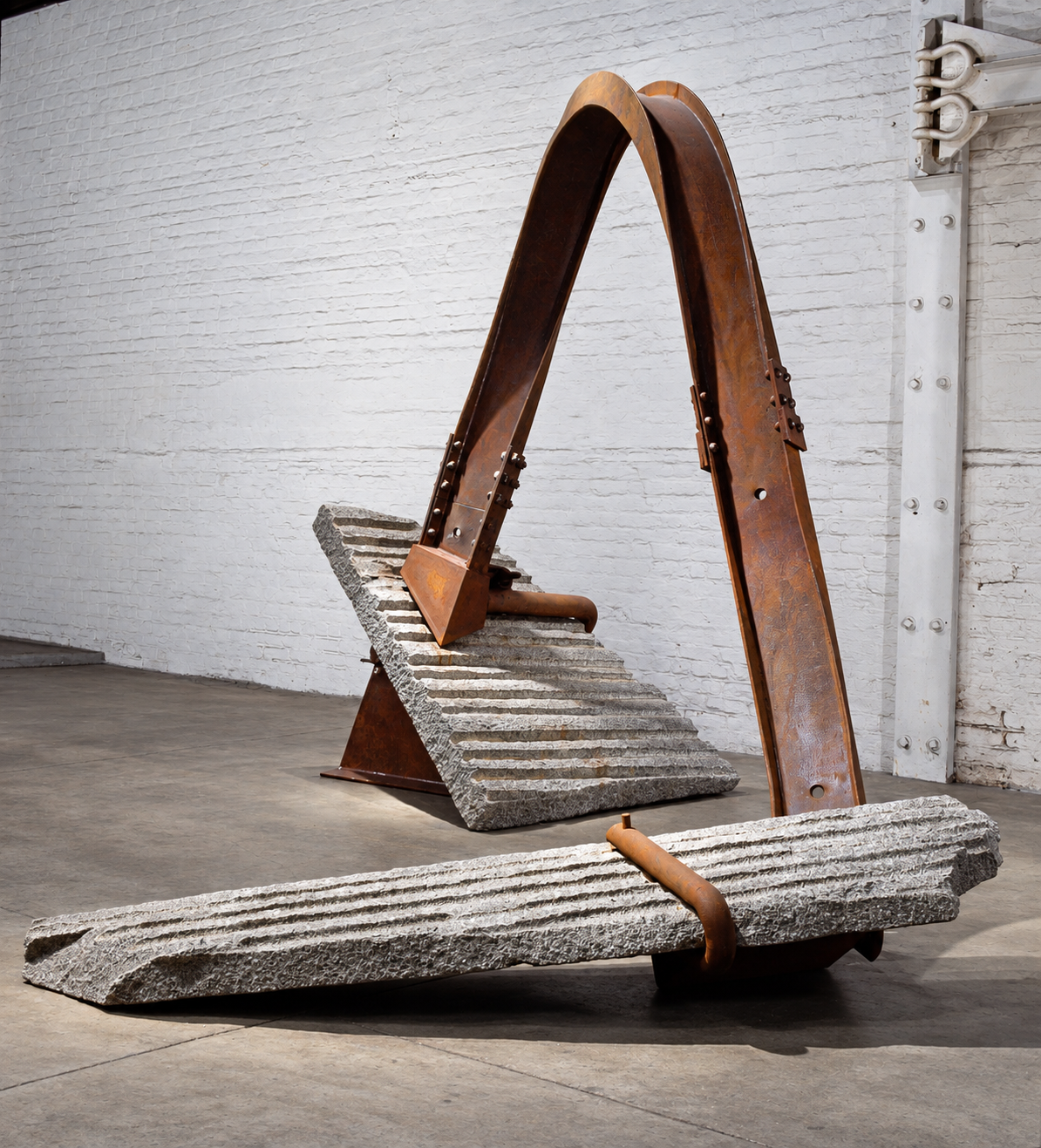
February 1985. Granite, steel. Dimensions: 8 × 12 × 11 in (20 × 30 × 28 cm). Destroyed by artist.
Rockslide III, 1985
Rockslide III, the third work in my Rockslide Series, expands the series into a broader, more architectural composition. Two granite slabs are connected by a sweeping arch of curved steel I-beam, creating a strong sense of movement between the grounded stones. As in the earlier Rockslides, visible pins, brackets, and fastening devices deliberately emphasize how the sculpture is held together, making the connection itself both a visual and conceptual focus.
The work continues my earlier concerns with gravity, balance, and visible assembly while allowing the steel to become increasingly gestural and expressive. Rockslide III was cannibalized later in 1985, and its large arching I-beam was reused to create Los Arcos (S-85-20) and rectangular granite slab in Ciscle Rounder (S-87-20)—an example of how found materials and even earlier sculptures could become the starting point for new work.
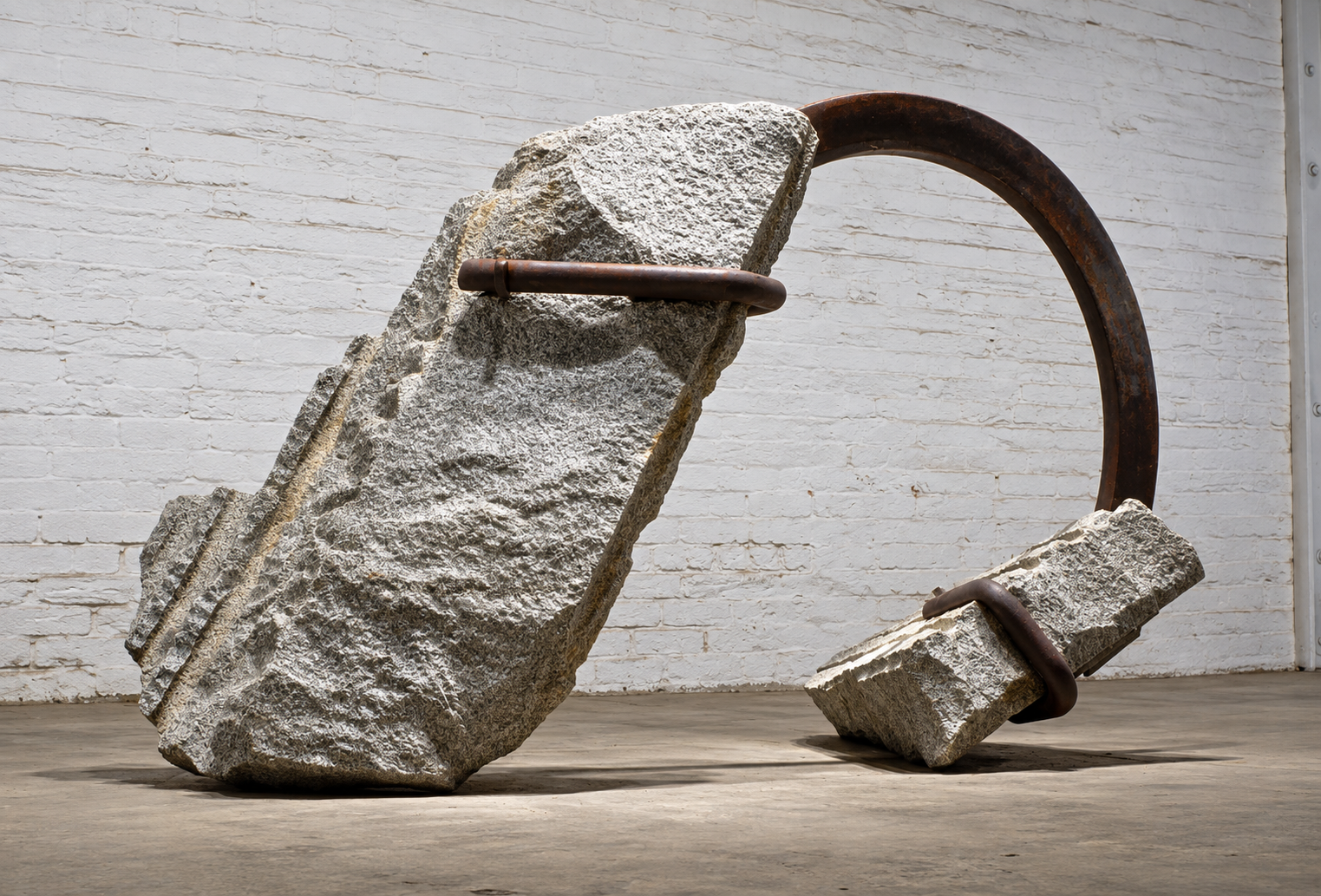
June 1985. Granite, steel. Dimensions: 44 × 77 × 40 in (112 × 196 × 102 cm).
Collection: Grounds for Sculpture, Hamilton, NJ
Schiabo Rounder, 1985
Schiabo Rounder continues the formal and structural ideas of the Rounder Series. Two contrasting granite elements are connected by a broad steel arc, creating circular movement while engaging weight, balance, and suspension. Visible brackets, pins, and forged-steel elements emphasize the means of assembly, carrying forward concerns from my earlier tensegrity, or Brute Series. As with Rounder I, the title also plays on the slightly disreputable meaning of “rounder”—a drifter or someone from “the other side of the tracks.”
Schiabo simply identifies the source of the steel, which I salvaged from the Schiabo scrap recycling yard at the Port of Albany, New York; the name has no further symbolic meaning. The sculpture was originally purchased by Washington, DC collector Murray Bring and later acquired by his law partner Jim Dobkin when Bring moved to New York City. Following Dobkin’s death, the work was donated from his estate to the collection of Grounds For Sculpture in Hamilton, New Jersey.
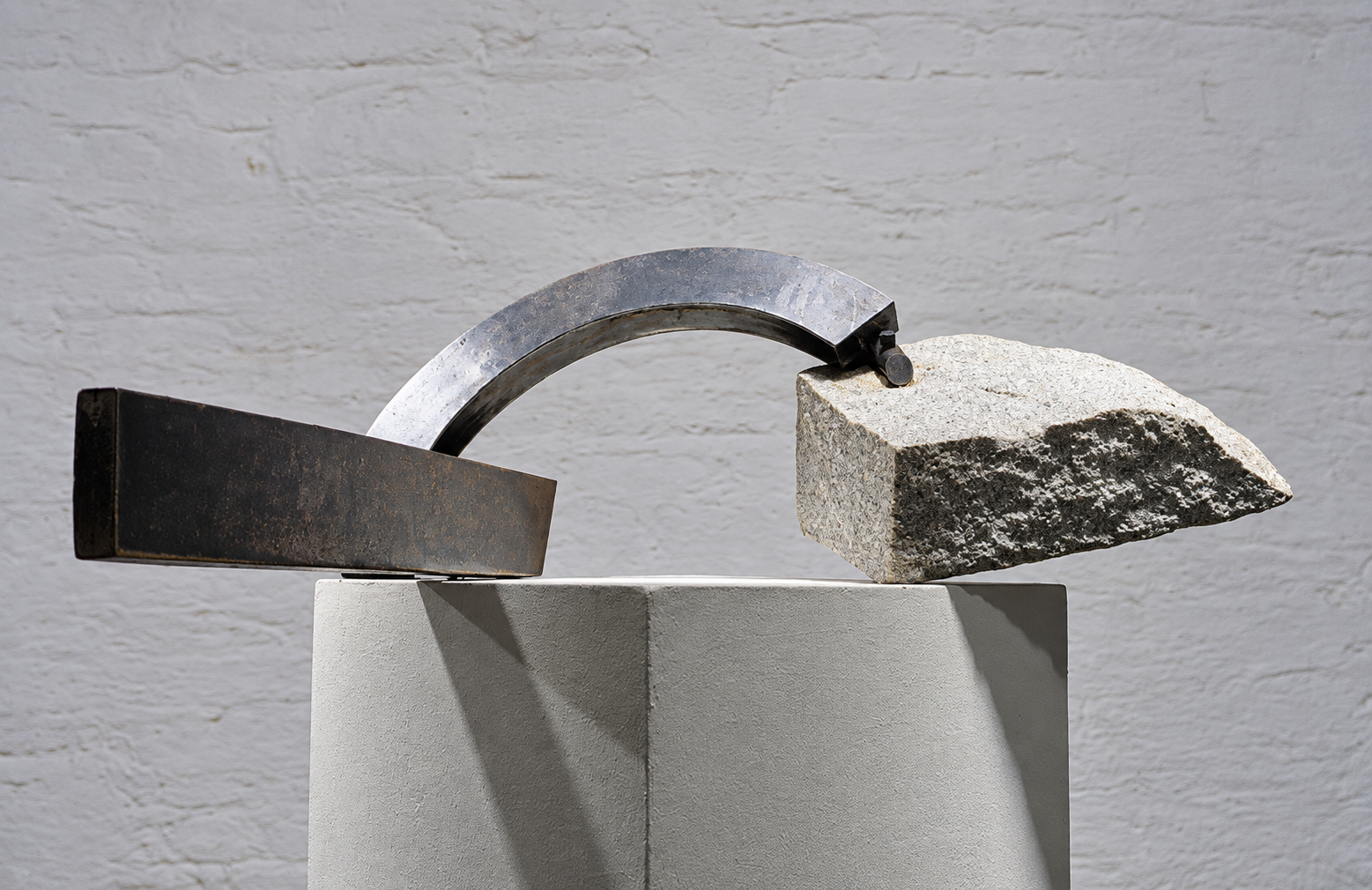
June 1985. Granite, steel. Dimensions: 12 × 34 × 48 in (30 × 86 × 122 cm).
St. Lawrence University Collection, Canton, New York
Sidewinder II, 1985
Sidewinder II continues the circular, gestural language I was exploring during this period. A curved steel arc reaches from an angular steel base to engage a suspended granite form, creating a strong horizontal tension and sense of movement. Gravity and balance remain important, while the visible steel pin embracing the stone continues my interest in making the physical connection an integral visual and conceptual part of the sculpture.
The title Sidewinder refers to the work’s curving, almost serpentine movement, here expressed in a more compact and open composition than Sidewinder ’84. Sidewinder II was included in my 1986 solo exhibition at the Brush Art Gallery, St. Lawrence University, where it was acquired for the university’s permanent collection.
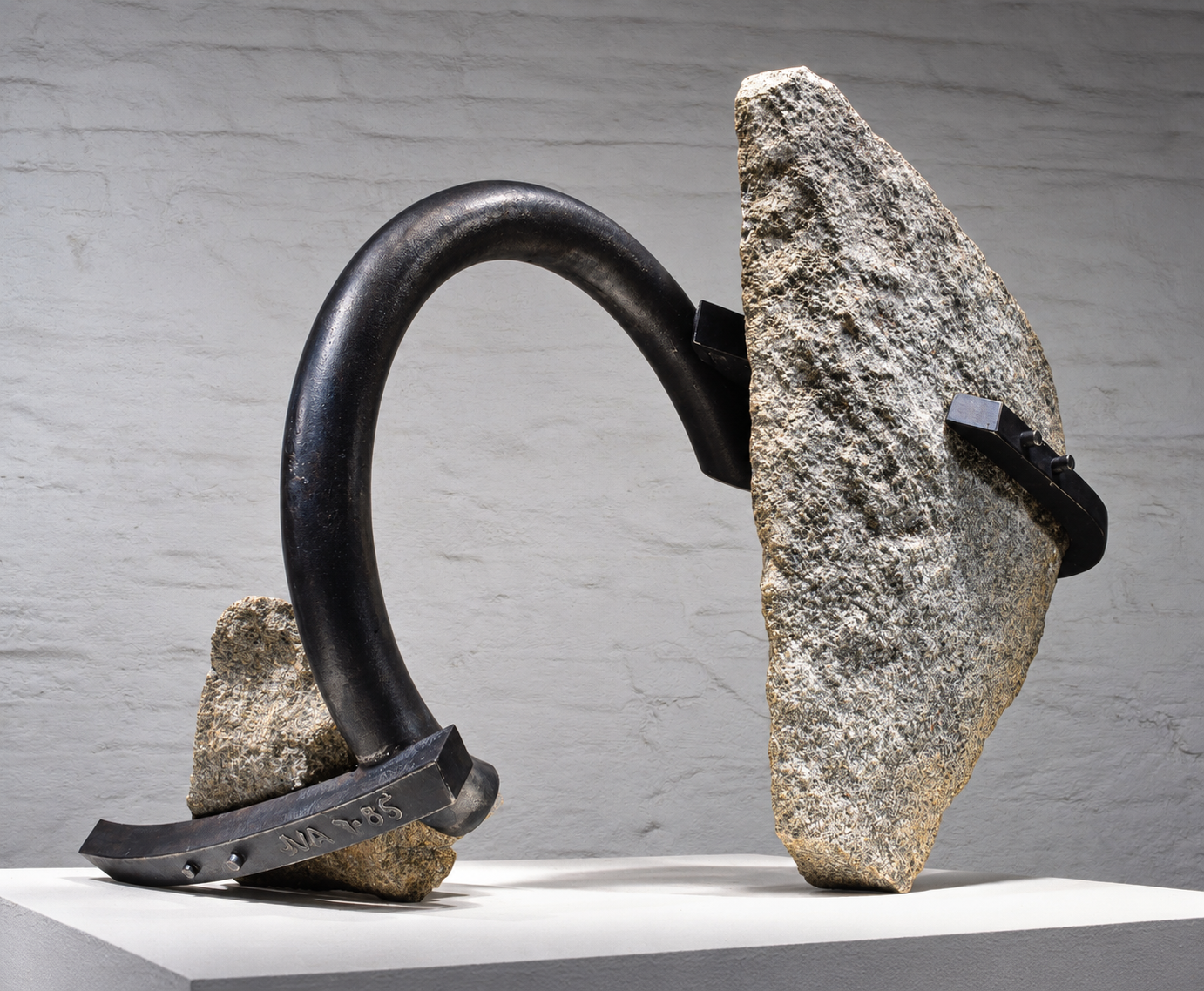
July 1985. Granite, steel. Dimensions: 31 × 41 × 28 in (79 × 104 × 71 cm).
Private collection Washington, DC
Yaddo Rounder I, 1985
Yaddo Rounder I continues my exploration of circular forms, bringing stone and steel together through weight, balance, and implied movement. The sweeping steel arc connects two contrasting stones, while visible pins and attachments emphasize the physical act of assembly.
The title refers to Yaddo, the artists’ retreat in Saratoga Springs, New York, where I created the work as a resident fellow in the summer of 1985. Its circular form continues ideas begun in the Go-Round Series and anticipates imagery that would recur throughout my later work.
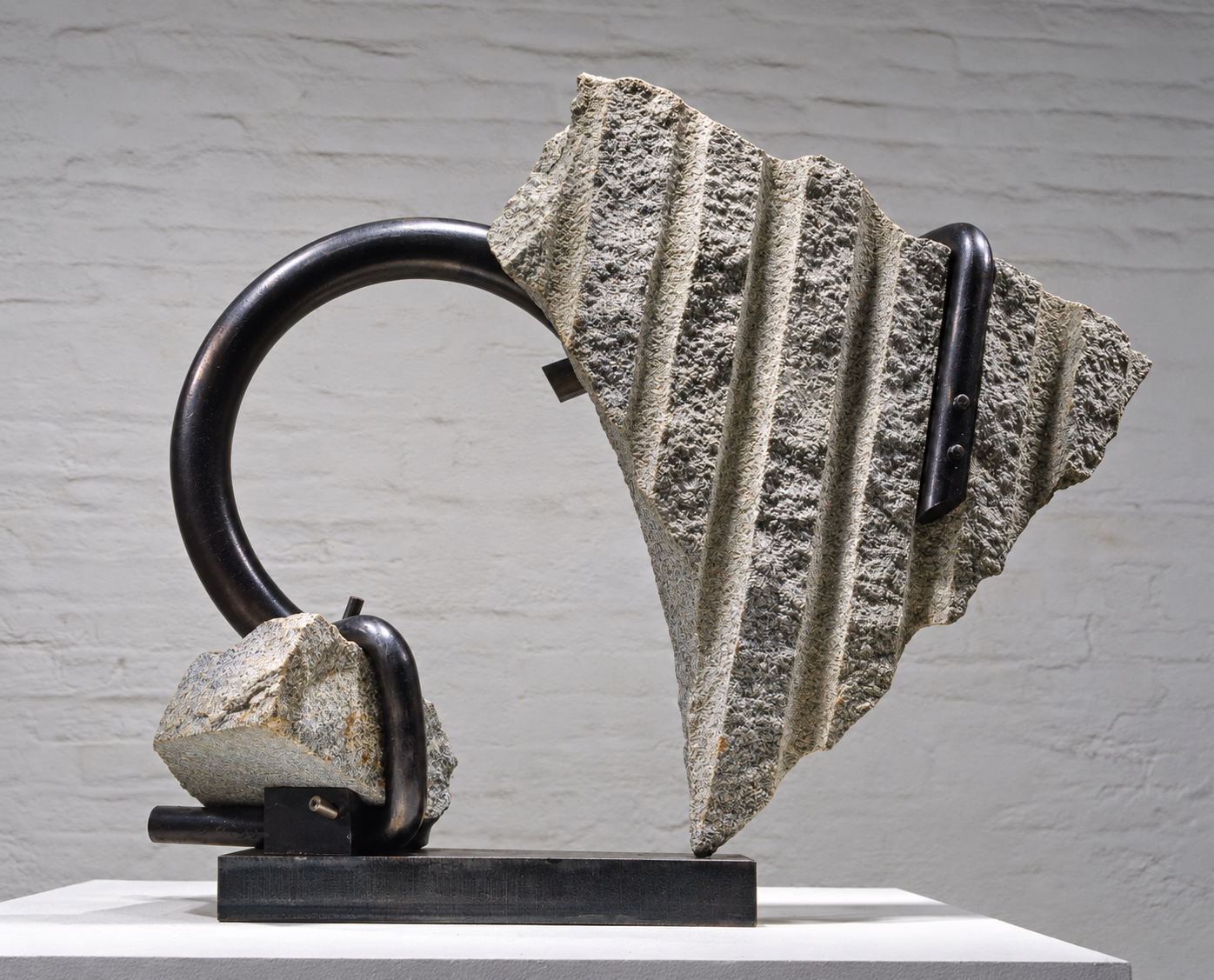
August 1985. Granite, steel. Dimensions: 32 × 42 × 12 in (81 × 107 × 30 cm).
Private collection - Washington, DC
Yaddo Rounder II, 1985
Yaddo Rounder II continues my exploration of circular forms, bringing granite and steel together through weight, balance, and physical connection. A sweeping steel arc links two contrasting stones, while visible pins and attachments emphasize the act of assembly. The larger stone, poised on a narrow point, gives the work a sense of precarious, arrested motion.
The title refers to Yaddo, the artists’ retreat in Saratoga Springs, New York, where I created the work as a resident fellow in the summer of 1985. Like Yaddo Rounder I, it extends ideas developed in the Go-Round Series, using the circle as both a structural and increasingly expressive element.
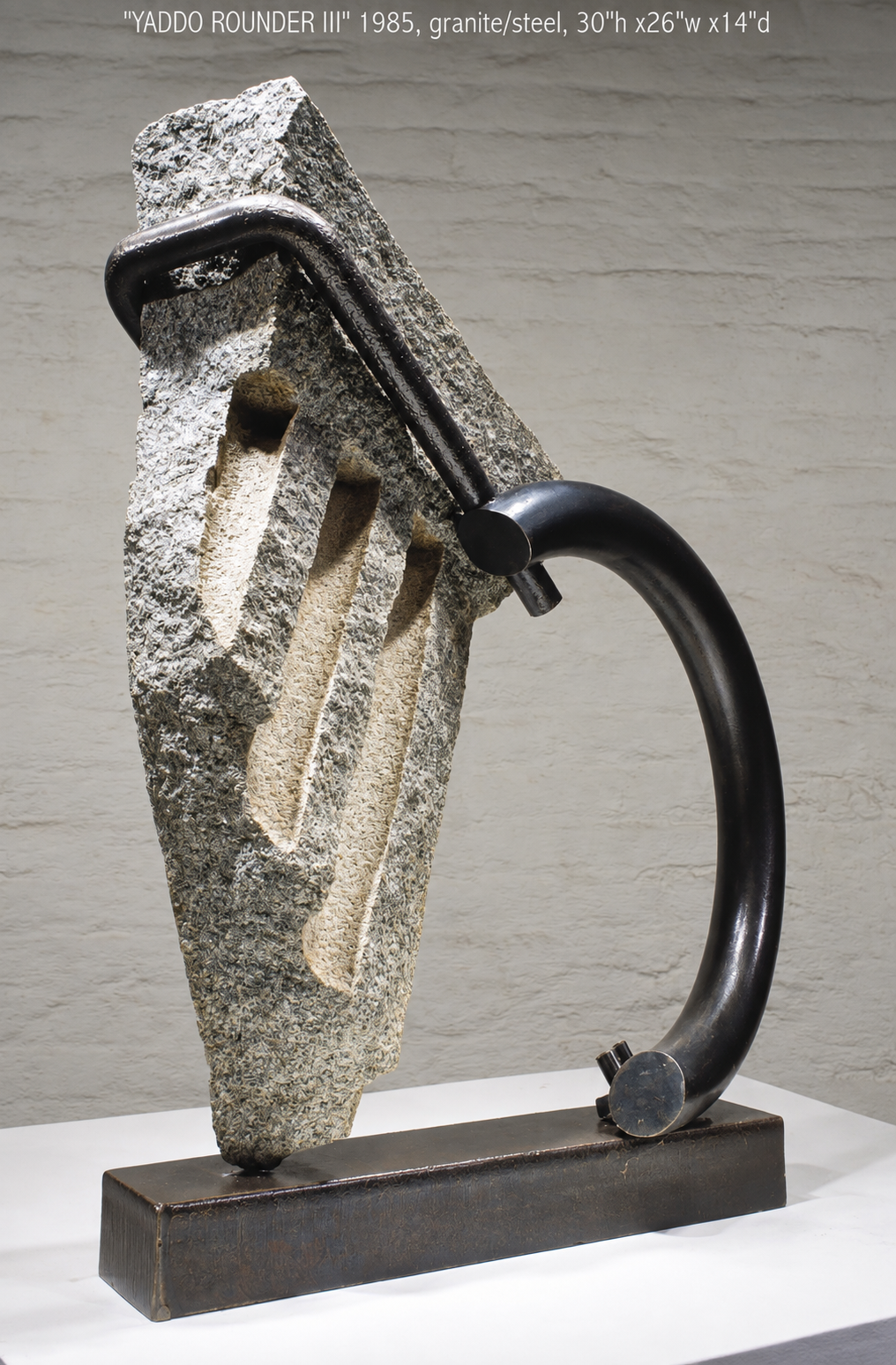
August 1985. Granite, steel. Dimensions: 30 × 26 × 14 in (76 × 66 × 36 cm). Private Collection.
Yaddo Rounder III, 1985
Yaddo Rounder III continues my exploration of the Rounder Series, combining a sweeping curved steel element with a single upright stone. The stone is poised on a narrow point while the steel arc rises from the base and physically engages it through visible pins and forged attachments. Gravity, balance, and the mechanics of assembly remain central, while the circular form introduces a stronger sense of movement.
Like the other Yaddo Rounders, the sculpture was created during my residency at Yaddo in Saratoga Springs, New York, in the summer of 1985. The work reflects a period when the circle was becoming an increasingly important element in my sculpture—linking stone and steel while suggesting rotation, repetition, and arrested motion.
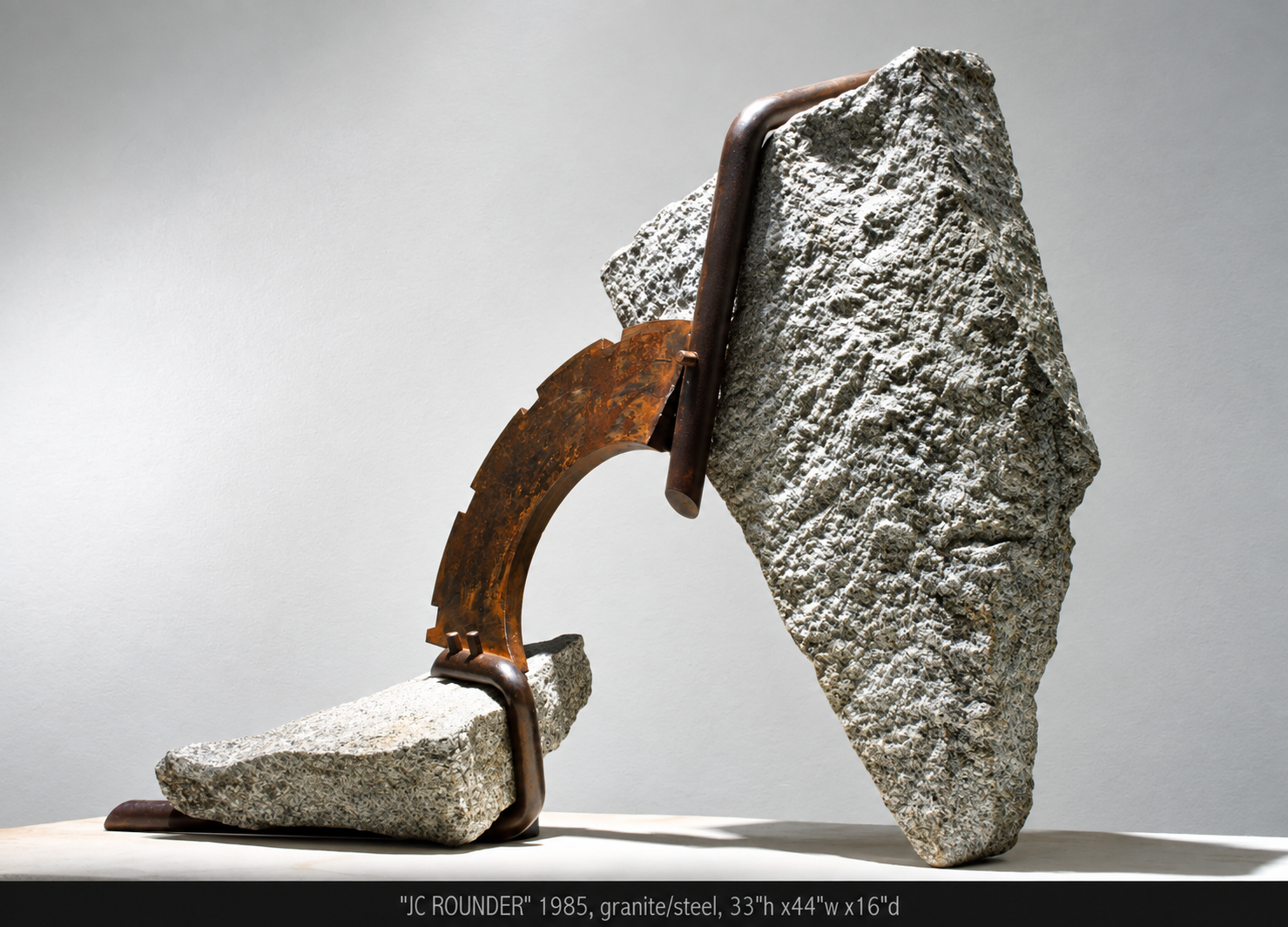
August 1985. Granite, steel. Dimensions: 28 × 26 × 12 in (71 × 66 × 30 cm).
Private collection - Baltimore
JC Rounder, 1985
JC Rounder continues my exploration of the circle as a way of introducing movement and implied rotation into the physical weight of stone. A broad steel arc bridges two contrasting pieces of granite, while the forged-steel bars visibly clasp and support the stones. Rather than concealing the connections, I make the means of assembly an active part of the image—a continuation of my interest in gravity, balance, and the physical dialogue between natural stone and industrial steel. These concerns remain central throughout my work.
The initials “JC” refer simply to my Jersey City studio, where the sculpture was created, distinguishing it from the other works in the expanding Rounder Series. I lived and worked in Jersey City during this period, and the studio became an important setting for developing the increasingly circular, gestural vocabulary of my mid-1980s sculpture.
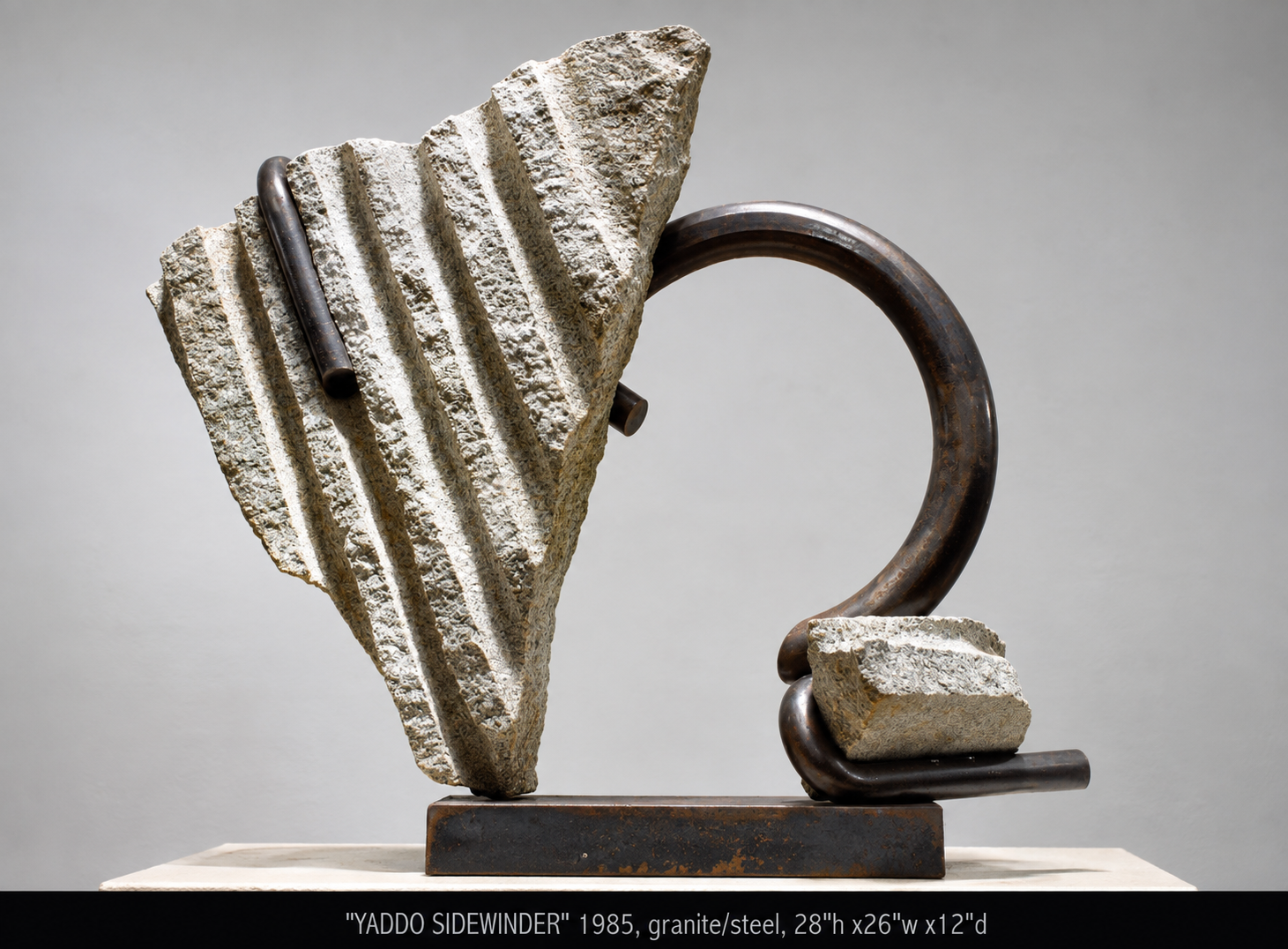
August 1985. Pink granite, steel. Dimensions: 28 × 26 × 12 in (71 × 66 × 30 cm).
Yaddo Sidewinder, 1985
Yaddo Sidewinder continues the Sidewinder Series, bringing contrasting granite forms into an active relationship through a sweeping arc of steel. The large stone rises precariously from a single point while the smaller stone anchors the opposite end, creating a sense of circular movement, tension, and balance. As in related works of this period, the visible steel pins and attachments remain an important part of the sculpture, making the means of connection both a structural and visual element.
The title Yaddo, like other works of mine bearing the name, refers to the Yaddo Artist retreat in Saratoga Springs, New York, where I created the sculpture while a resident fellow in the summer of 1985. It was exhibited in my 1986 solo exhibition at the George Ciscle Gallery in Baltimore and was later purchased from my Jersey City studio by Saul Dennison of Bernardsville, New Jersey.
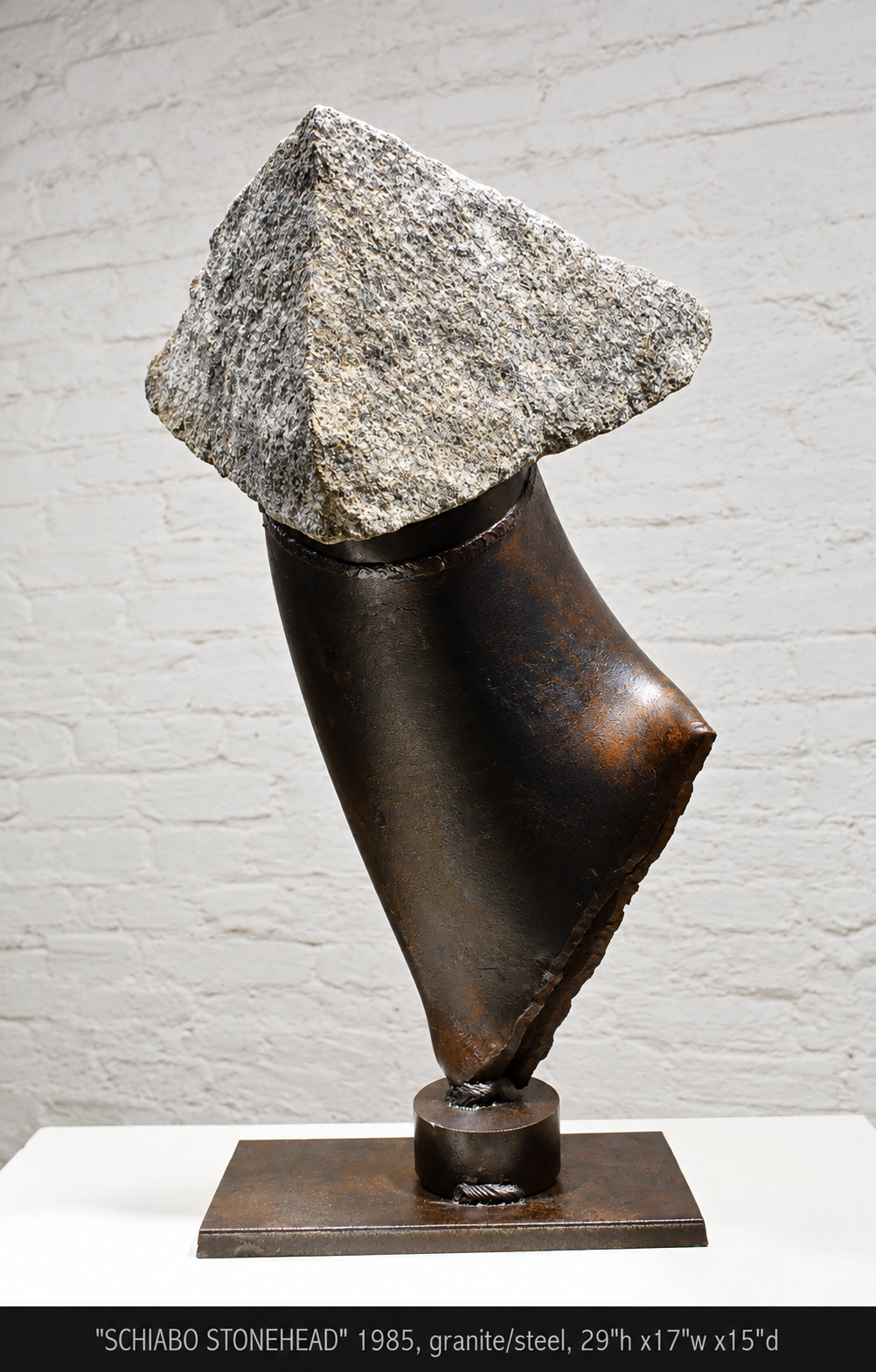
July 1985. Granite, steel. Dimensions: 29 × 17 × 15 in (74 × 43 × 38 cm). Private Collection
Schiabo Stonehead, 1985
Schiabo Stonehead reflects the increasingly frequent figurative references appearing in my work at the time, an interest that would ultimately lead to my 1998 exhibition Acknowledging the Figure. A rough granite mass suggests a head poised atop a curved steel body. Rather than depicting the figure literally, the contrast of heavy stone and gestural steel creates a sense of posture, character, and movement.
The title refers to the Schiabo scrap yard in the Port of Albany, where I salvaged the steel. Its distinctive curved form helped generate the sculpture’s figurative character, illustrating how found industrial material could become both a structural element and a catalyst for image and meaning.
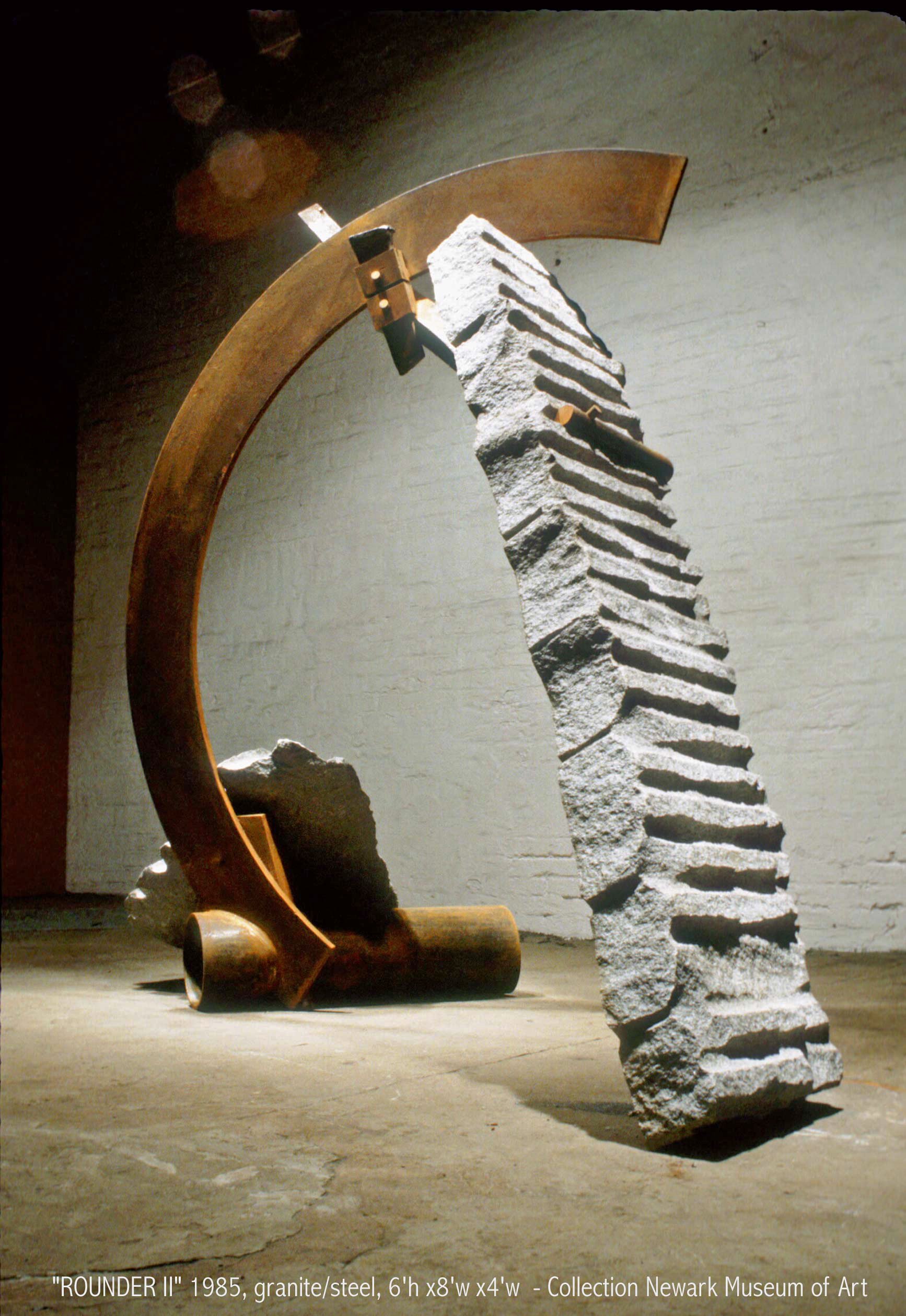
January 1985. Granite, steel. Dimensions: 6 × 8 × 4 in (15 × 20 × 10 cm).
Collection: Newark Museum of Art, Newark, NJ
Rounder II, 1985
Rounder II, the second work in my Rounder Series, continues my exploration of circular movement, gravity, and balance. A broad curving steel arc brings the granite elements into a dynamic relationship, while the sculpture’s physical connections—visible pins, brackets, and fastening devices—remain an important visual and conceptual focus. These exposed connections carry forward my earlier interest in making the way a sculpture is held together part of the work itself.
As in Rounder I, the title refers both to the circular character of the sculpture and to the slightly disreputable meaning of “rounder”—a drifter or someone from “the other side of the tracks.” Rounder II was exhibited at the Newark Museum of Art and subsequently acquired for its permanent collection.
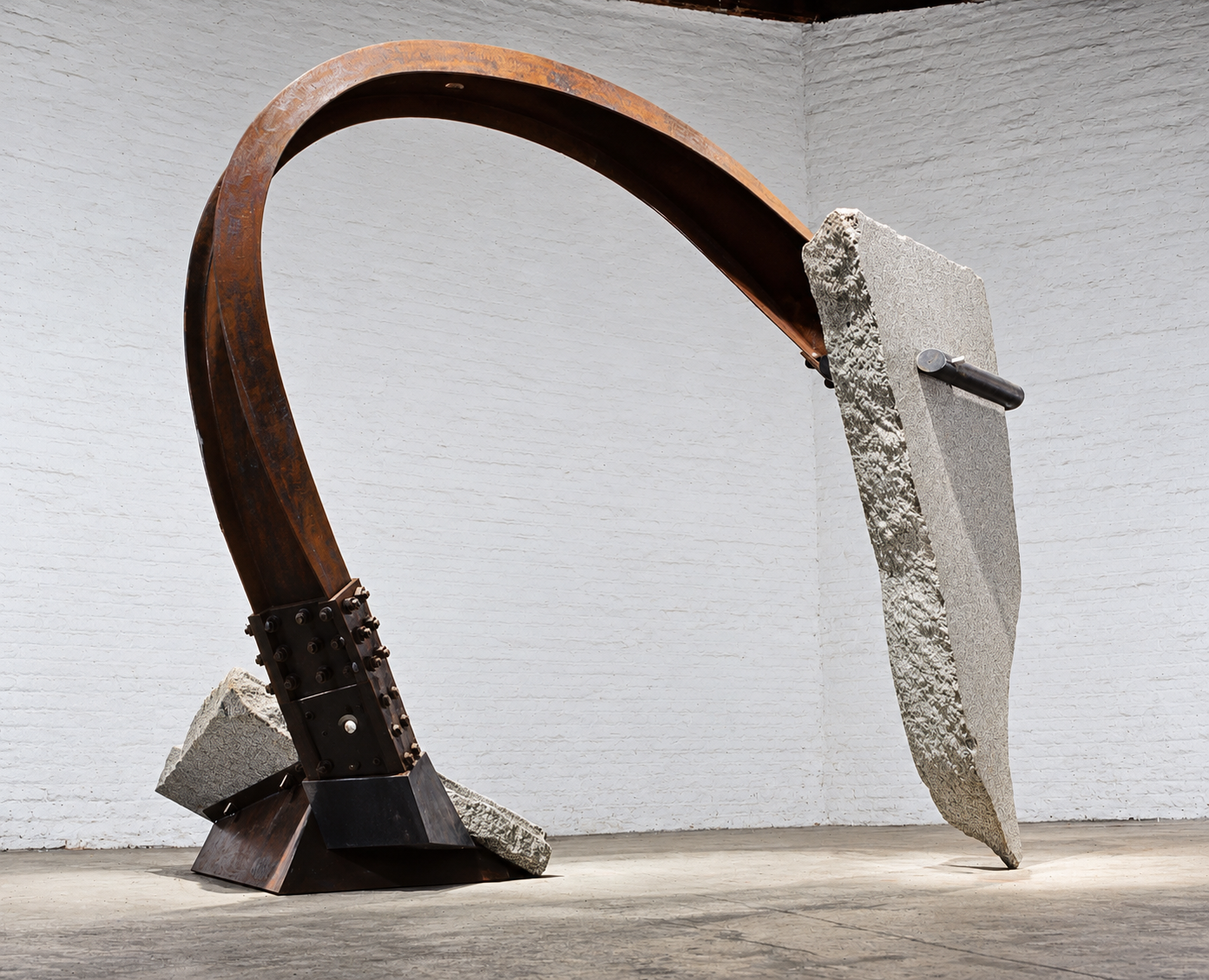
November 1985. Granite, steel. Dimensions: 7 × 10 × 5 in (18 × 25 × 13 cm).
Private collection - Baltimore MD.
Los Arcos, 1985
Los Arcos grew directly from the Rockslide Series, reusing the large curved I-beam from Rockslide III. The sweeping steel arch connects two contrasting granite elements, creating a broad circular movement while engaging gravity, balance, and suspension. Visible pins, plates, and brackets continue my interest in making the means of assembly an important visual and conceptual part of the sculpture.
The title was inspired by Los Arcos, the well-known rock formations off the coast near Puerto Vallarta, Mexico, which I had visited. Their dramatic natural arches suggested an association with the sculpture’s large curving form, though the work is not intended as a literal representation. Los Arcos was exhibited in my 1986 solo exhibition at the George Ciscle Gallery in Baltimore and was subsequently purchased by a Maryland collector.
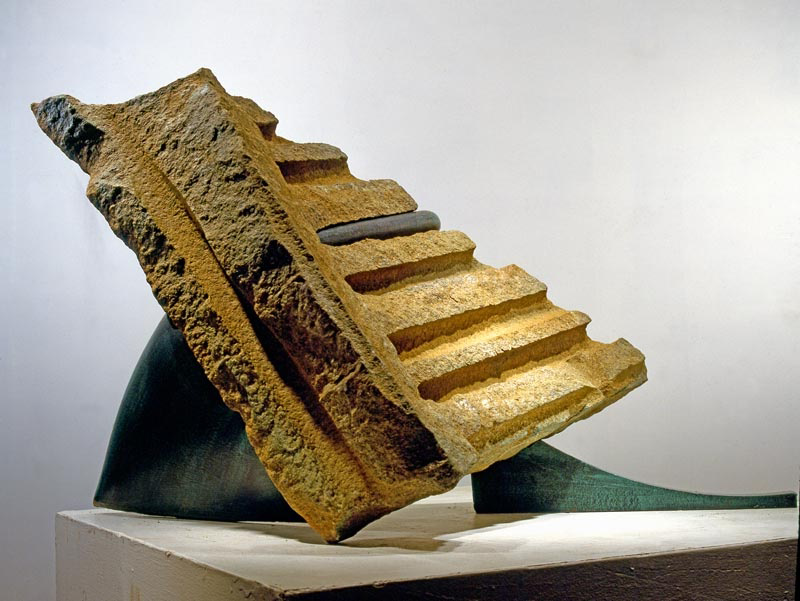
May 1985. Painted granite, painted steel. Dimensions: 24 × 36 × 33 in (61 × 91 × 84 cm).
Private collection - Washington, DC
Leg Lift, 1985
Leg Lift reflects the increasingly frequent figurative references entering my work during this period. The extended steel element running along the floor acts somewhat like a foot or leg lifting one end of the stone. Rather than depicting the figure literally, I use weight, balance, and the contrasting character of stone and steel to evoke bodily movement—an interest that would become increasingly important in later work.
Both the granite and steel are painted, marking another shift in my work of the mid-1980s. Color allowed me to move beyond the largely monochromatic gray granite and raw steel I had used for years, adding another expressive element while loosening my earlier allegiance to the natural appearance of materials. Combined with the title Leg Lift, the painted surfaces reinforce the sculpture’s playful sense of gesture and movement.
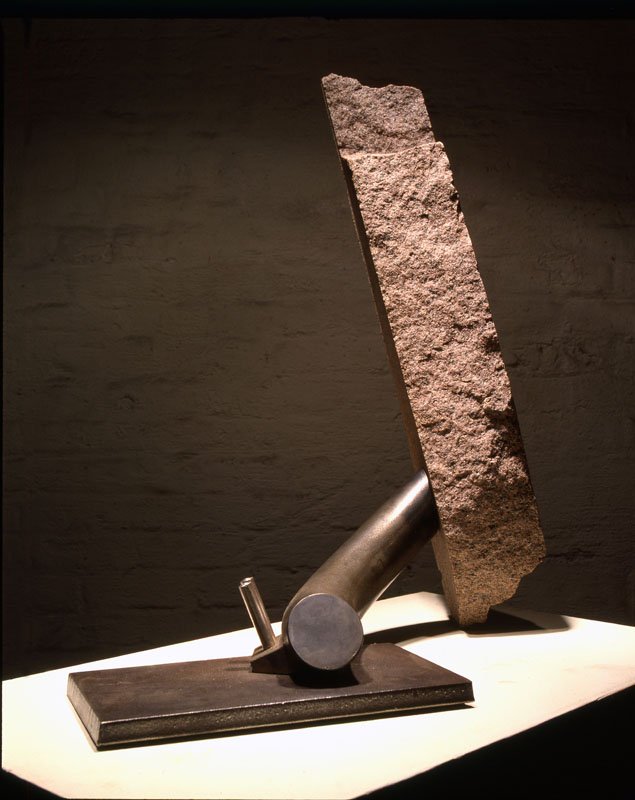
August 1985. Pink granite, steel. Dimensions: 18 × 12 × 10 in.
Yaddo Sidewinder (Pink), 1985
Yaddo Sidewinder (Pink) continues my exploration of the Sidewinder Series, bringing stone and steel together through balance, leverage, and implied movement. A long slab of pink granite is poised against an arching section of solid steel anchored to a low rectangular base using taper pins, a fastening technique I frequently employed during this period. The spare construction emphasizes the physical relationship between the materials, while the leaning stone and curved steel create a sense of precarious, arrested motion.
Like all of my works with Yaddo in the title, the name refers to the Yaddo artists’ retreat in Saratoga Springs, New York, where I created the sculpture while a resident fellow during the summer of 1985. Pink simply refers to the color of the granite and distinguishes this work from Yaddo Sidewinder, created during the same residency.
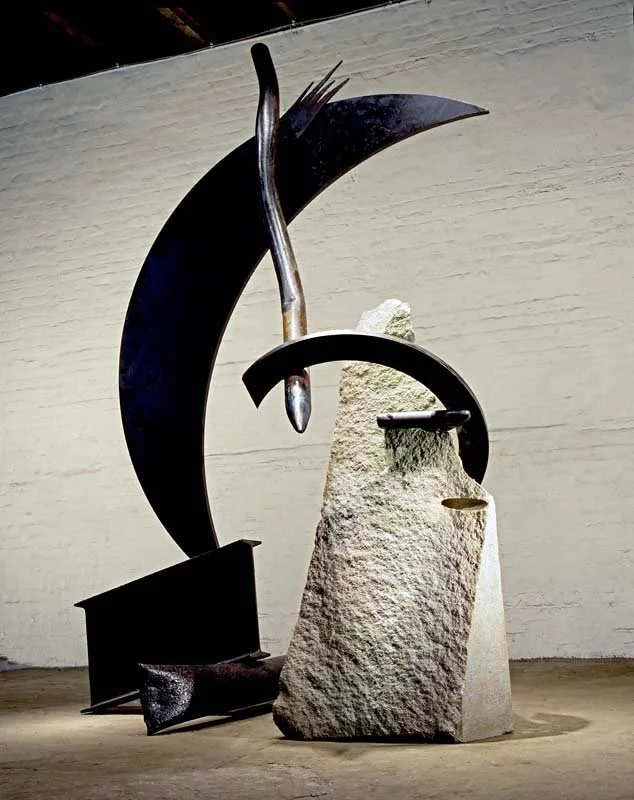
LUNA I, 1985, granite and steel, 10'h x7'w x5'd
(Original 1985 unpainted version)
Private collection - Aspen
1984
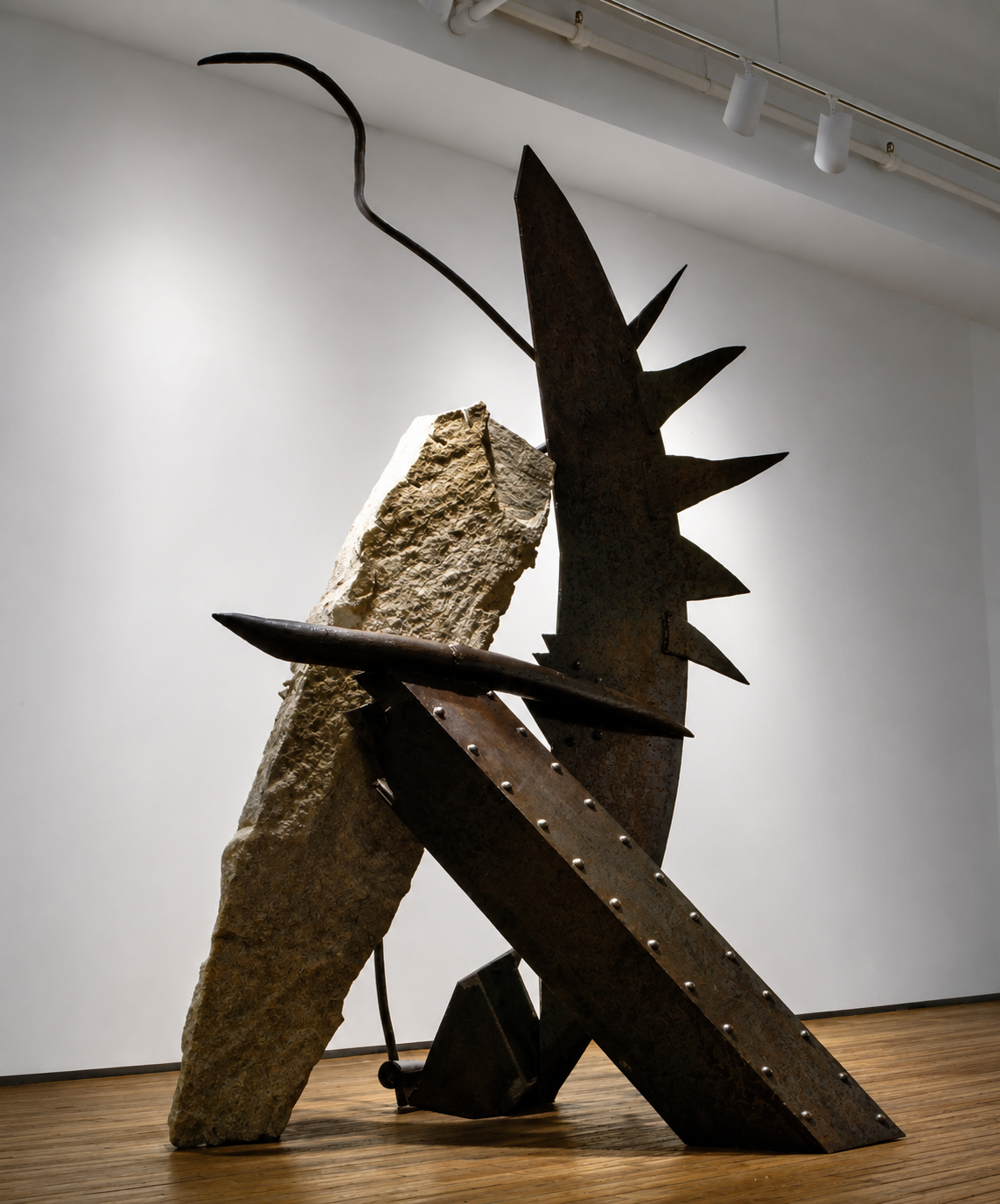
January 1984. Granite, steel. Dimensions: 12 × 12 × 8 in (30 × 30 × 20 cm).
Collection: Runy Mede Sculpture Garden, San Francisco, CA
Drastic Measures was initially created in 1984 and exhibited that year in my solo exhibition at Diane Brown Gallery in New York. The sculpture continues my exploration of stone, steel, gravity, and precarious balance, with the long sweeping steel arc and extended linear elements creating a strong sense of gesture and movement around the grounded mass of the granite. When I later wanted to exhibit the sculpture outdoors, I painted the steel surfaces to provide greater protection from the elements. What began as a practical decision also opened the possibility of using color as an expressive part of the sculpture.
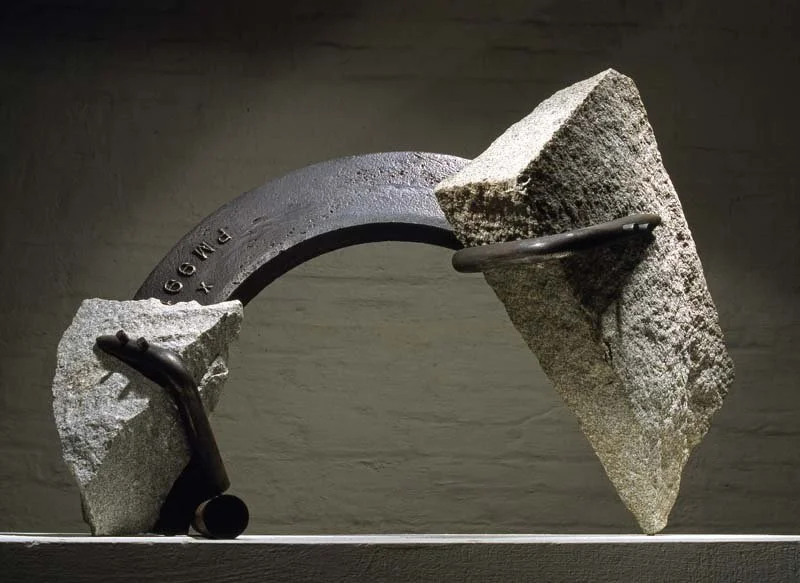
1984. Granite, steel. Dimensions: 20 × 30 × 15 in (51 × 76 × 38 cm).
Private Collection
3rd Go-Round, 1984
3rd Go-Round continues the exploration begun with 1st Go-Round and 2nd Go-Round, using a sweeping arc of steel to establish a physical and visual relationship between two found granite forms. Here the arc becomes broader and more substantial, rising from the smaller stone and reaching outward to support the larger granite mass in a seemingly precarious state of balance. The sculpture retains aspects of my earlier tensegrity, or Brute Series—gravity, weight, and structural interdependence—while moving toward a more gestural and expressive use of steel.
The title again draws on the language of rodeo that I encountered while living in Wyoming, where another “go-round” represents another attempt. For me, it also describes the process of working through a sculptural idea in a series: each piece is another approach rather than a final solution. The circular movement developed in the Go-Round Series would become increasingly important in my work, eventually evolving into the recurring circle-and-stone imagery of the Sisyphean Circles.
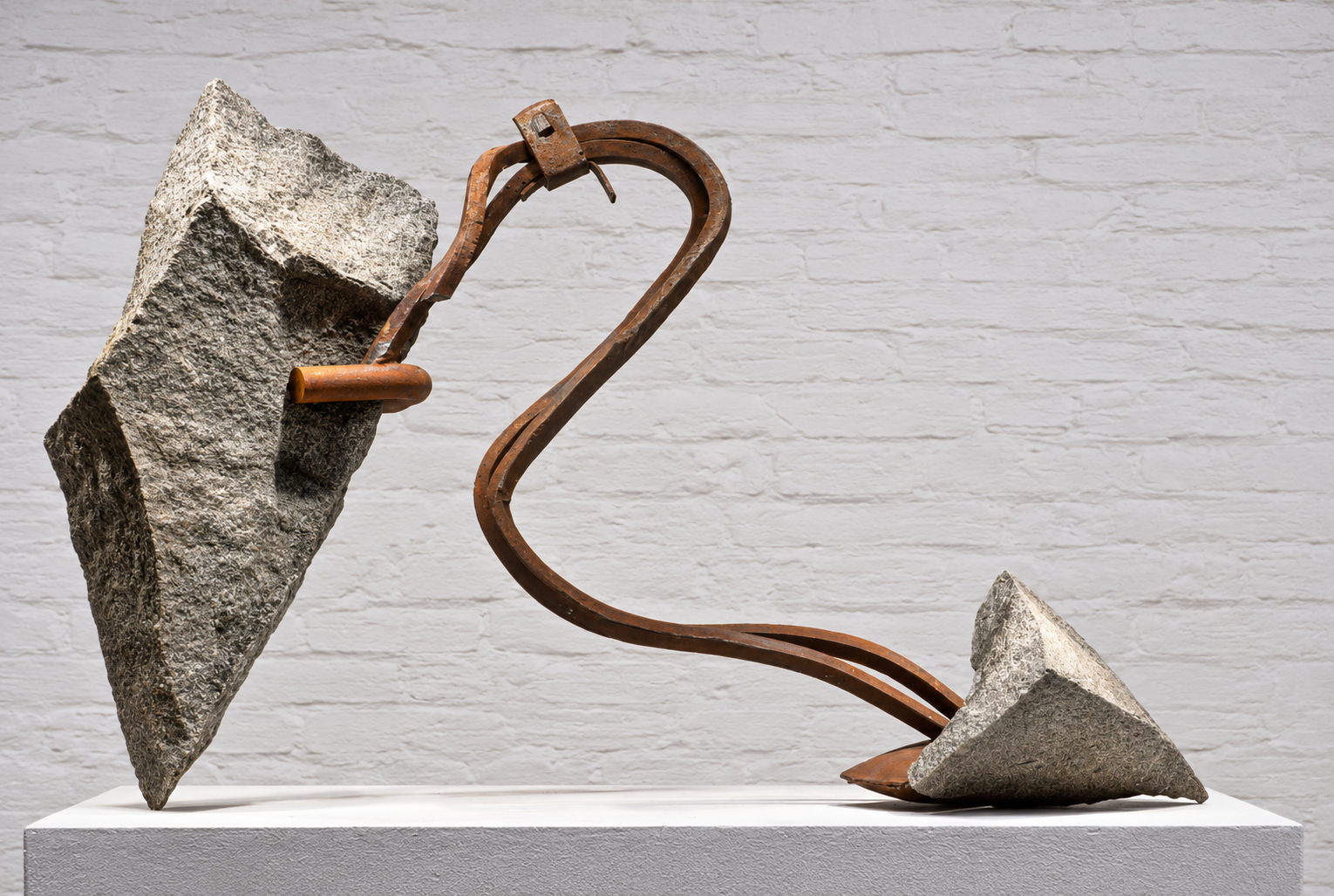
January 1984. Granite, steel. Dimensions: 22 × 42 × 10 in (56 × 107 × 25 cm).
Private collection - Baltimore
Wrangler, 1984
Wrangler marks an unusual figurative reference in my work at the time. Two pieces of granite are joined by long, looping found-steel elements whose sweeping gesture suggests a figure—or perhaps the action of handling and controlling something larger and more powerful. The work retains my interest in gravity, balance, and visible assembly, but moves beyond the tightly structured, self-referential concerns of my earlier tensegrity, or Brute Series. This gradual opening toward figurative association would become increasingly important in my work.
The title Wrangler reaches back to my years in Wyoming and to the world of cowboys, rodeo ropers, and wranglers. The looping steel suggests a rope or lariat, allowing the materials to carry associations beyond their purely structural function. In this sense, Wrangler represents a loosening of my earlier, almost dogmatic adherence to “truth to materials”—a move toward a more playful and expressive vocabulary in which gesture, metaphor, and association could become part of the sculpture.
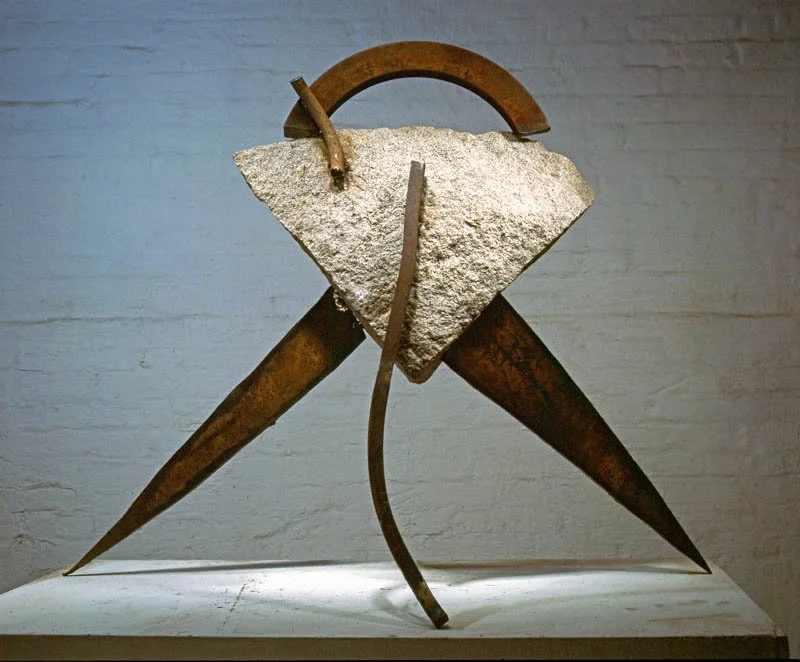
January 1984. Granite, steel. Dimensions: 32 × 39 × 18 in (81 × 99 × 46 cm).
Private collection - Baltimore
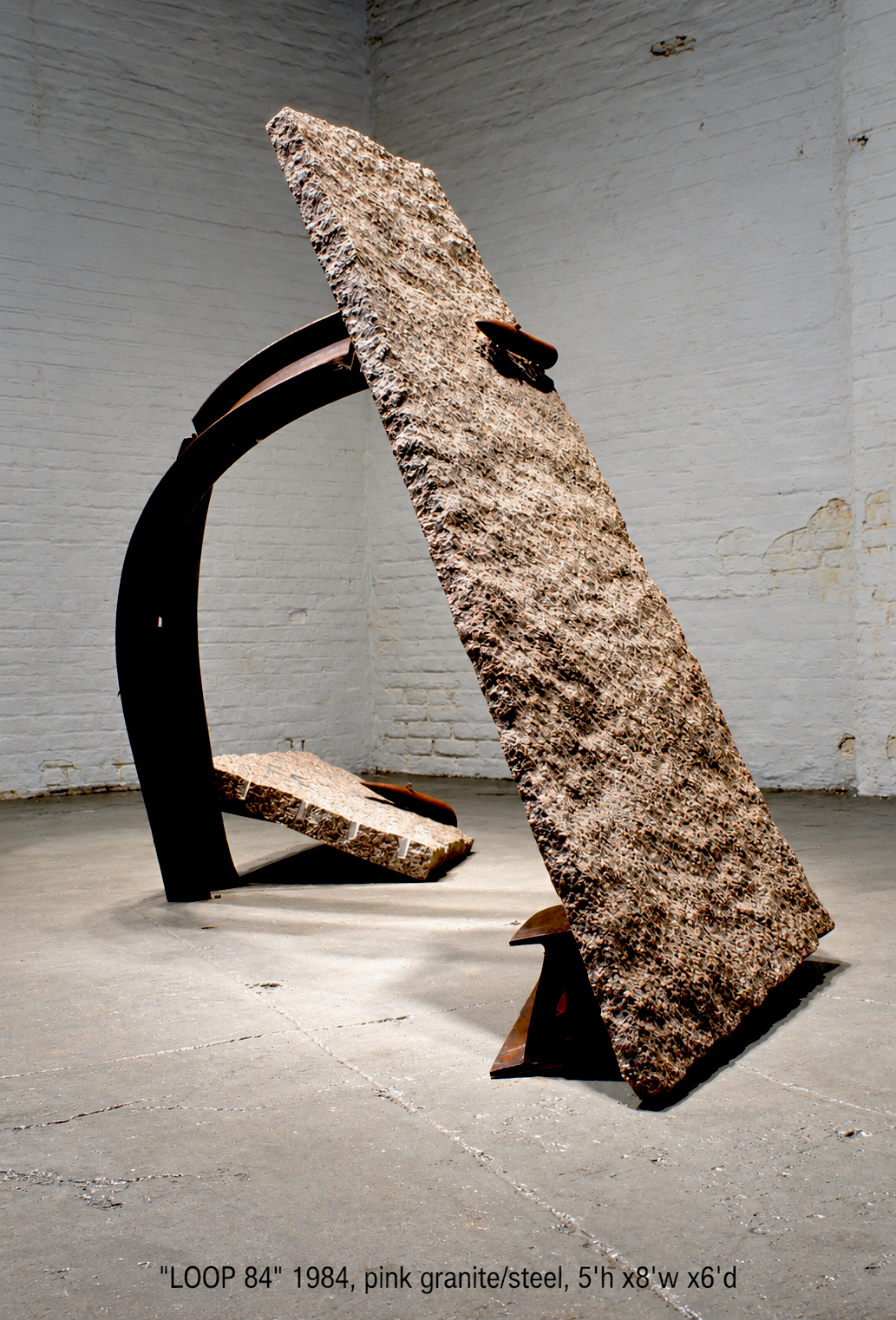
April 1984. Granite, steel. Dimensions: 5 × 8 × 6 ft.
Loop, 1984
Loop brings two large granite slabs into a dynamic relationship through a sweeping curved steel I-beam that literally “loops” between them, giving the sculpture its title. The beam recovered from the same Chicago fire-demolition site that later provided the curved steel for Carnegie Rounder. (S-84-05) and Los Arcos (S-85-20). Its naturally bent form allowed me to move beyond the stricter structural language of my earlier work toward the more circular, gestural vocabulary that was developing in the Go-Round and Rounder works.
Equally important is the way the sculpture is put together. The exposed pins, plates, brackets, and other fastening devices are deliberately brought forward as both visual and conceptual elements rather than concealed. This emphasis on visible assembly is a vestige of my earlier tensegrity, or Brute Series, where the forces holding a sculpture together were an essential part of its meaning. In Loop, that structural honesty becomes integrated with a more expressive sense of movement and gesture.
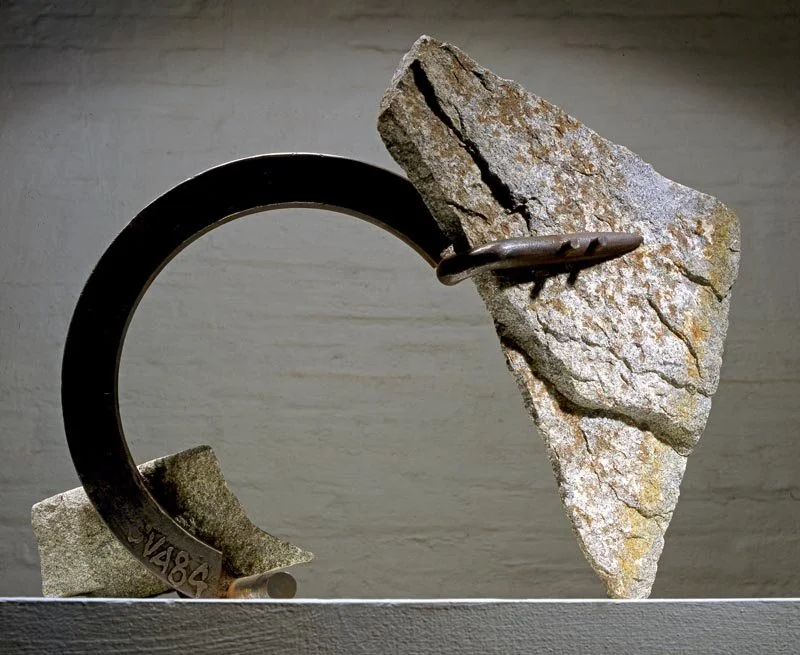
1984. Granite, steel. Dimensions: 19 × 23 × 13 in (48 × 58 × 33 cm).
4th Go-Round, 1984
4th Go-Round continues my exploration of the circular steel form as a means of joining and activating found stone. Here the sweeping arc rises from a small granite element and appears to carry the much larger stone in a precarious state of suspension. Gravity, weight, and balance—central concerns of my earlier tensegrity, or Brute Series—remain active, but the steel has become increasingly gestural and expressive. The visible steel pin wrapping across the granite continues my interest in making the means of assembly an integral part of the sculpture.
As the fourth work in the Go-Round Series, the title again draws on the language of rodeo I encountered while living in Wyoming—another “go-round,” or another attempt. For me, it also describes the circular movement of the sculpture and the process of repeatedly approaching an idea through a series, with each work revealing another possibility. This evolving relationship between circle, stone, gravity, and repetition would soon become central to my Sisyphean Circles, where the circle takes on an increasingly metaphorical dimension.
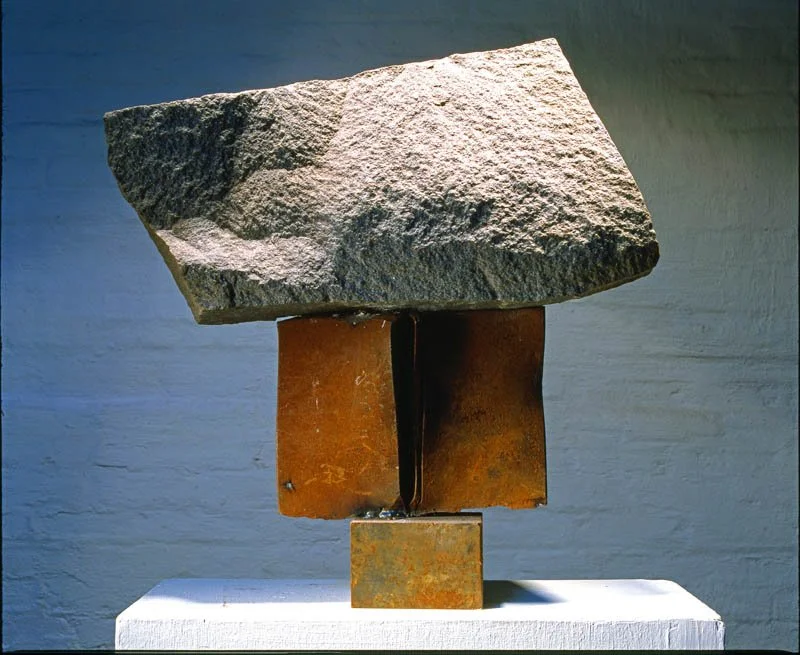
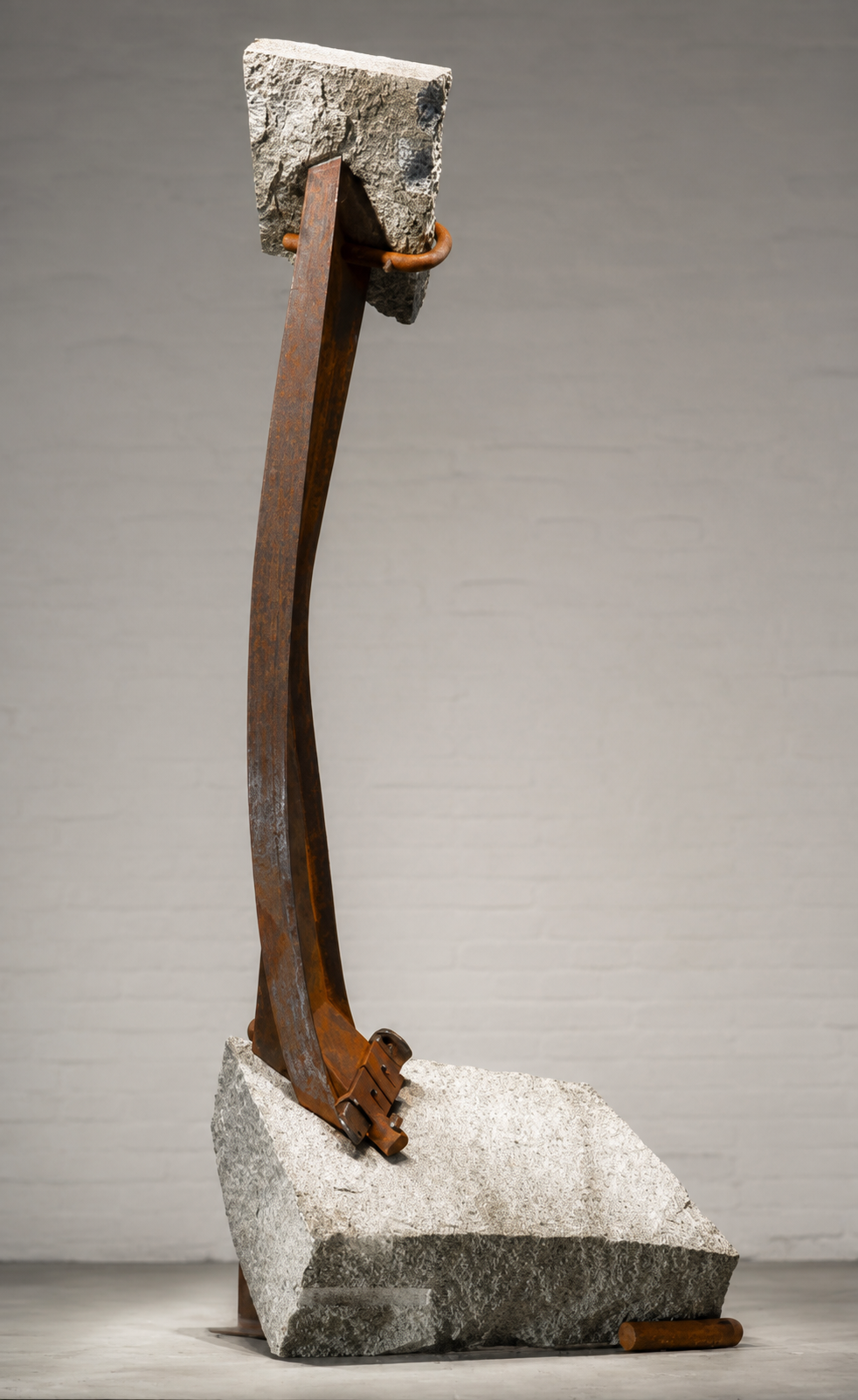
April 1984. Granite, steel. Dimensions: 10 × 4 × 4 in (25 × 10 × 10 cm).
Corporate collection. NJ.
Rockslide I, 1984 (S-84-09)
Rockslide I was the first work in my Rockslide Series and continues my exploration of gravity, balance, and visible assembly. Two granite elements are connected by a tall, upstretched steel form, creating a precarious relationship between the grounded stone and the smaller stone held high above. Of particular importance is the connection at the base, where visible pins and a large steel wedge salvaged from a piece of heavy machinery make the means of assembly a strong visual and conceptual focus.
The exposed connection carries forward ideas from my earlier tensegrity, or Brute Series, where how a sculpture is held together was central to its meaning. Here, however, those structural concerns become part of a more expressive sense of movement suggested by the title Rockslide. The sculpture exhibited in 1984 solo show at the Diane Brown Gallery, NYC.
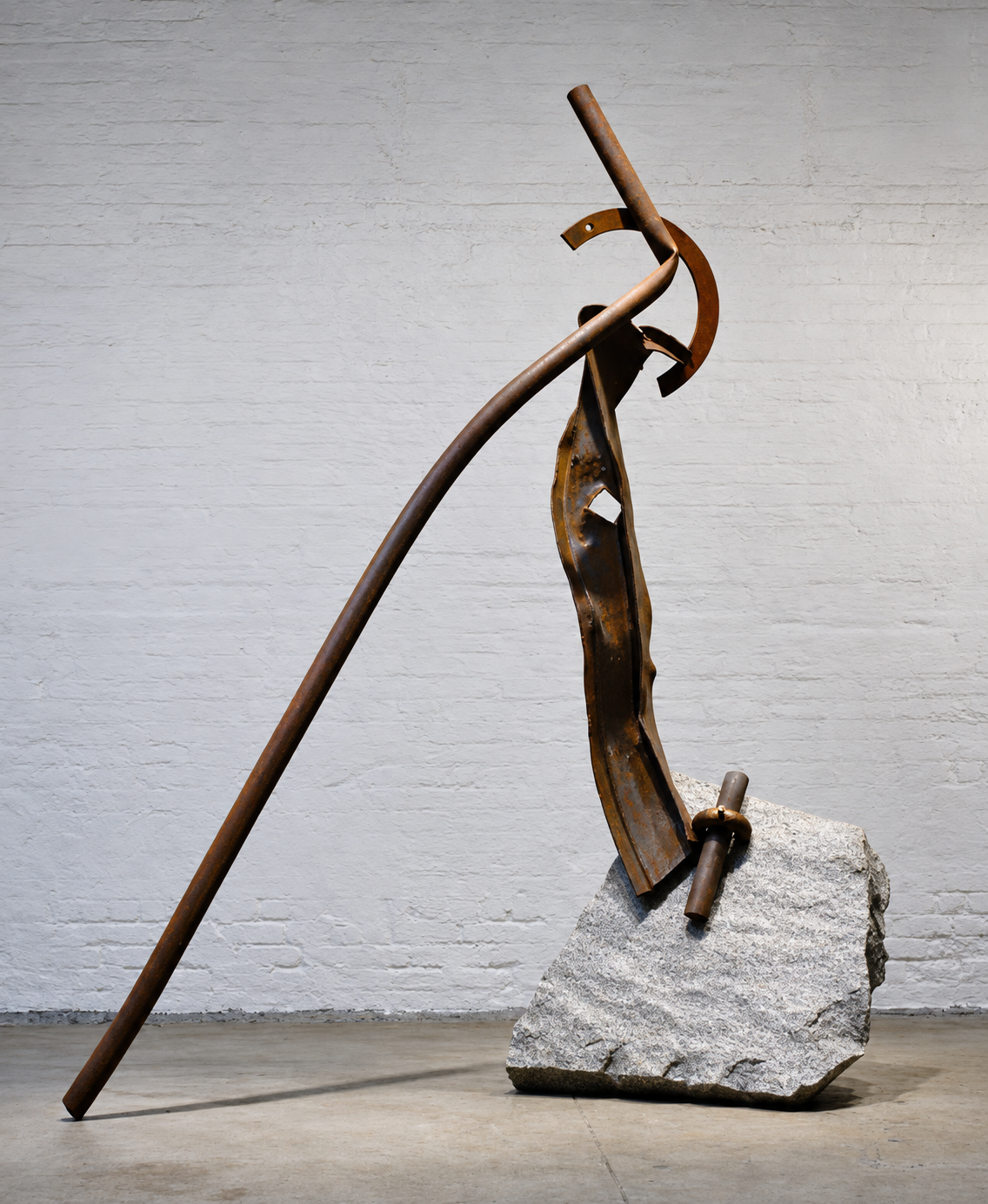
April 1984. Granite, steel. Dimensions: 8.5 × 7 × 3.5 ft. Private collection - Los Angeles.
Rockbottom, 1984
Rockbottom reflects my movement away from the tightly structured concerns of my earlier work toward a more associative and expressive vocabulary. Granite and salvaged steel remain joined through gravity, balance, and visible assembly, while the title carries a double meaning: literally, the rock forms the bottom of the sculpture; figuratively, it refers to the familiar expression of “hitting rock bottom.” The work was later traded to Resources Exchange, a California “barter bank,” and installed in the garden of a Los Angeles hotel.
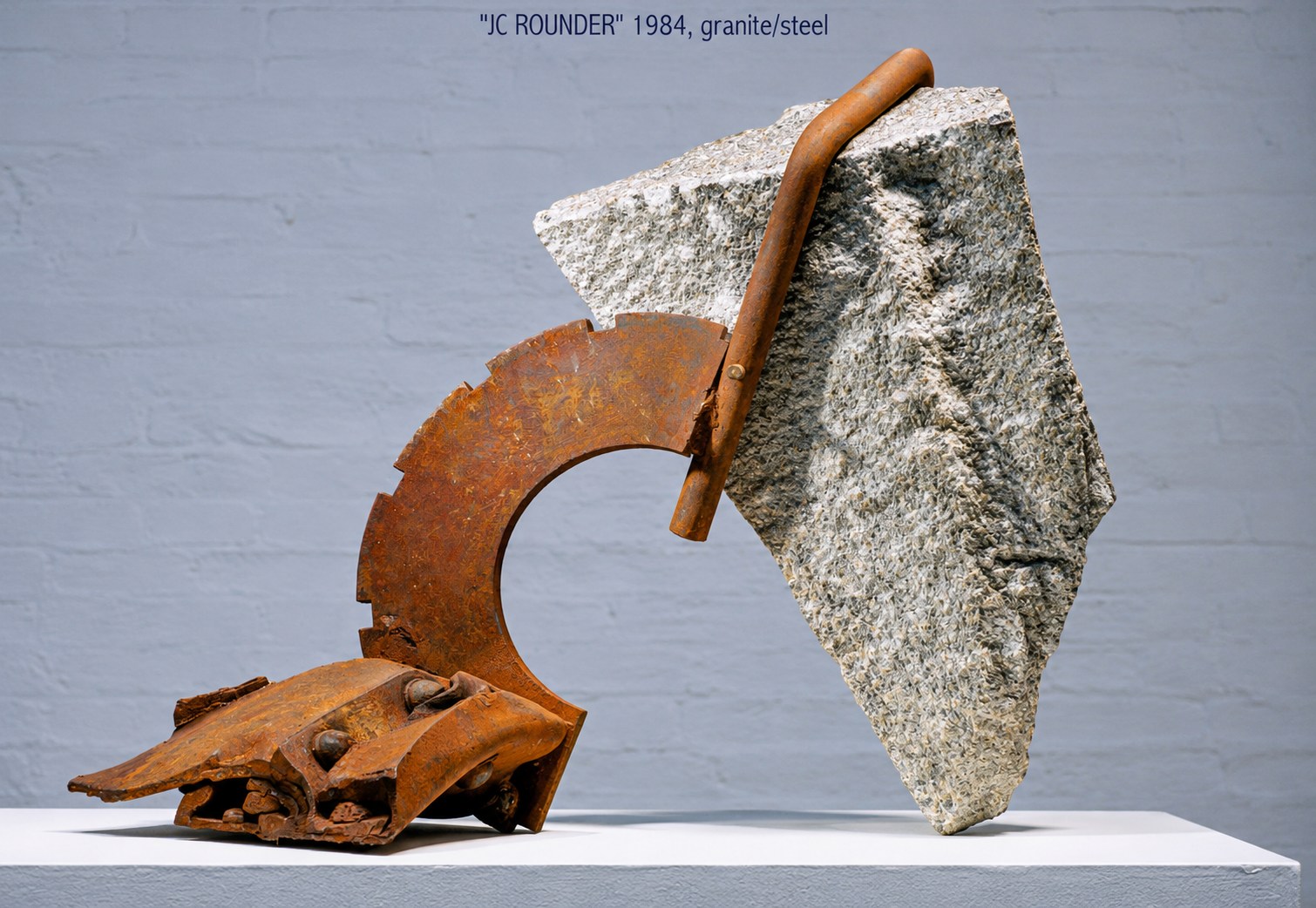
May 1984. Granite, steel. Dimensions: 21 × 32 × 11 in (53 × 81 × 28 cm).
6th Go-Round, 1984
6th Go-Round pushes the series toward a more complex and expressive use of found material. A partial circular steel form rises from a crushed and folded piece of industrial steel to engage a large granite slab balanced dramatically on a single point. The curved rod wrapping over the stone acts both structurally and visually, recalling the visible fastenings of my earlier tensegrity, or Brute Series. Here, however, the contrast between the raw, irregular stone and battered, rusted steel introduces a more aggressive energy and a stronger sense of history embedded in the materials.
As another “go-round,” the work continues my idea that a sculptural theme is developed through repeated attempts rather than resolved in a single object. The circle is now incomplete and irregular, suggesting movement and continuation rather than a closed geometric form. Combined with the precariously balanced stone, it moves the Go-Round Series closer to the imagery that would become central to my Sisyphean Circles—the recurring relationship between stone, circular motion, repetition, struggle, and persistence.
DESTROYED altered to make "JC ROUNDER" #S-85-18
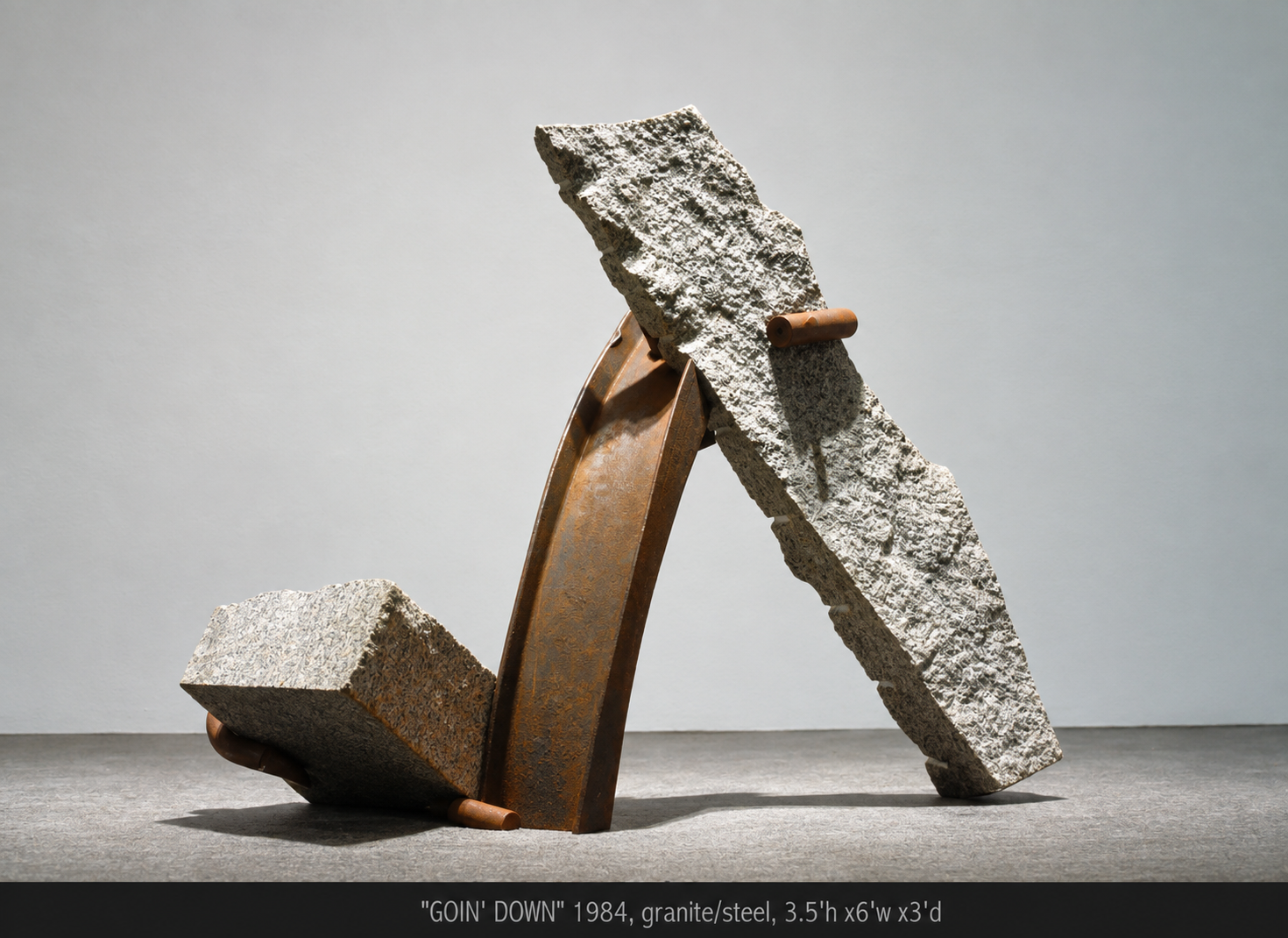
April 1984. Granite, steel. Dimensions: 3.5 × 6 × 3 ft.
Goin’ Down, 1984
Goin’ Down is an example of my movement during this period away from the strict “truth to materials” ideas that had governed much of my earlier work. The two granite forms and arching steel element suggest a body caught in the act of bending, descending, or shifting its weight. The title reinforces this sense of action and movement, while the sculpture remains grounded in my continuing concerns with gravity, balance, and the physical relationship between stone and steel. These early figurative associations anticipated a direction I would later openly acknowledge in my work.
The sculpture eventually took an unusual journey of its own. I traded Goin’ Down to Resources Exchange, a California “barter bank,” and it was subsequently installed in the garden of a Los Angeles hotel. In exchange, I received credit that could be used for hotel stays and other goods and services, including restaurants, air travel, and tools.

June 1984. Slate, steel. Dimensions: 102 × 44 × 41 in (259 × 112 × 104 cm).
Private collection - New Jersey
Slate Totem I, created at my Jersey City studio, was the third of the “closed-base” totems and the first to use slate rather than granite. The work reflects my transition away from the open, interlocking structures of the tensegrity, or Brute Series, toward more solid forms and a greater emphasis on overall image and visual presence. A steel wedge salvaged from heavy construction machinery is prominently integrated between the two halves of the pyramidal base, acting as a structural fastener that prevents them from spreading. Its exposed function deliberately recalls my earlier work, where how a sculpture held itself together was central to both its structure and meaning.
The Totem Series grew from the tall, eroded rock spires I encountered after moving West to Laramie, Wyoming, particularly the way they rose from sloping accumulations of fallen material at their bases. Here that geological relationship is distilled into the contrast between the rugged vertical slate and low geometric steel pyramid. While Slate Totem I retains the structural emphasis of my earlier work through its exposed wedge connector, structure is increasingly placed in service of a more unified and evocative sculptural image.
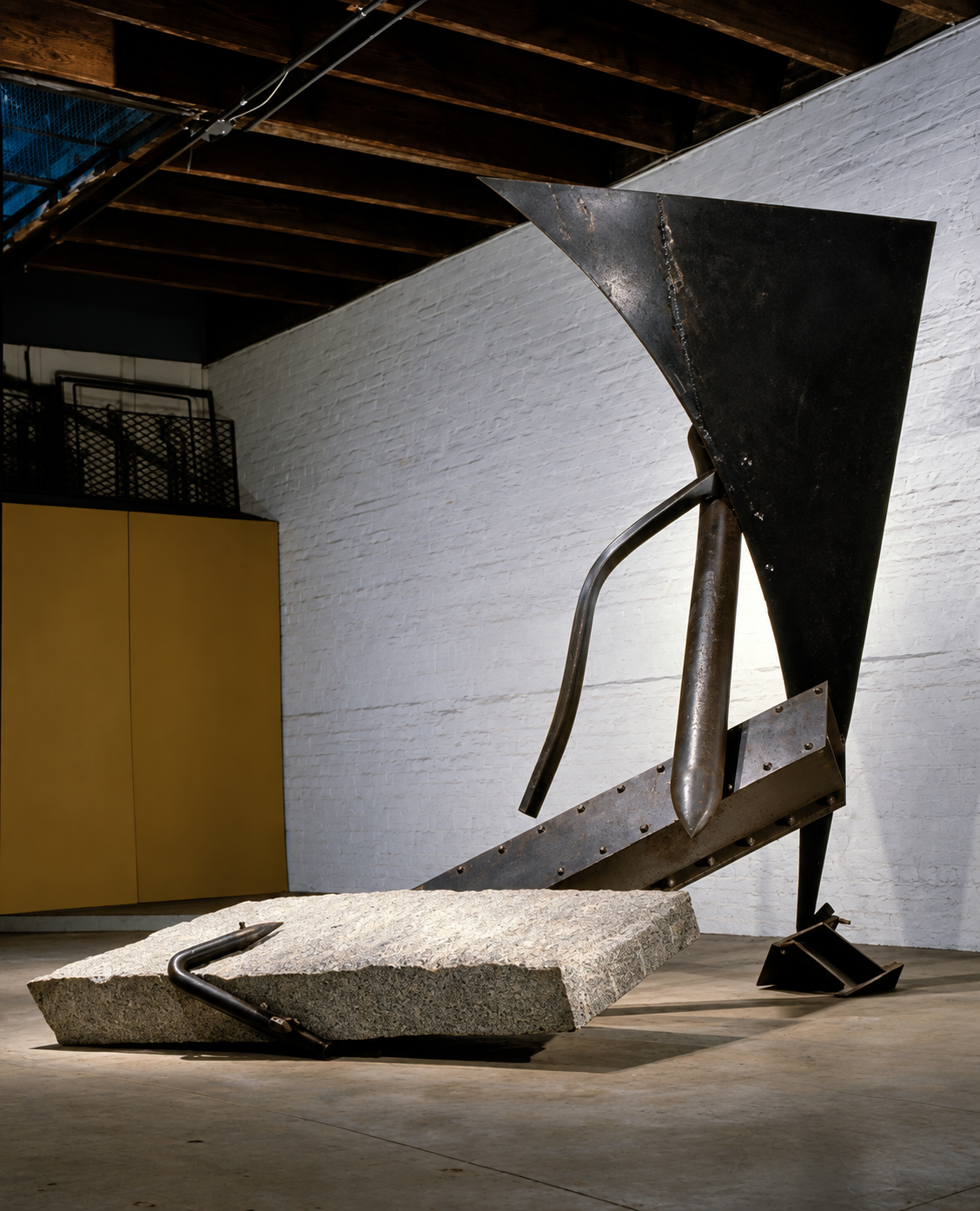
February 1984. Granite, steel. Dimensions: 10 × 9 × 6 ft. Cannibalized by the artist.
Straight from the Top, 1984
Straight from the Top continues my interest in combining raw stone and industrial steel—the natural and human-made—as contrasting but interdependent elements. During this period, however, I was beginning to move beyond sculpture driven primarily by structure. The steel becomes increasingly graphic and gestural, creating a strong directional flow around the massive granite. This shift toward more associative imagery was part of a broader opening in my work during the early 1980s.
The title adds a more expressive dimension to the physical arrangement. Straight from the Top suggests something moving or descending “from above,” reinforced by the sculpture’s dramatic downward thrust from the large elevated steel form toward the stone below. At the same time, “from the top” can imply a higher authority or power, allowing the title to open the abstract arrangement toward a more psychological or spiritual reading without defining it literally.
The work was exhibited in my 1984 solo exhibit at the Diane Brown Gallery, Soho, NYC.
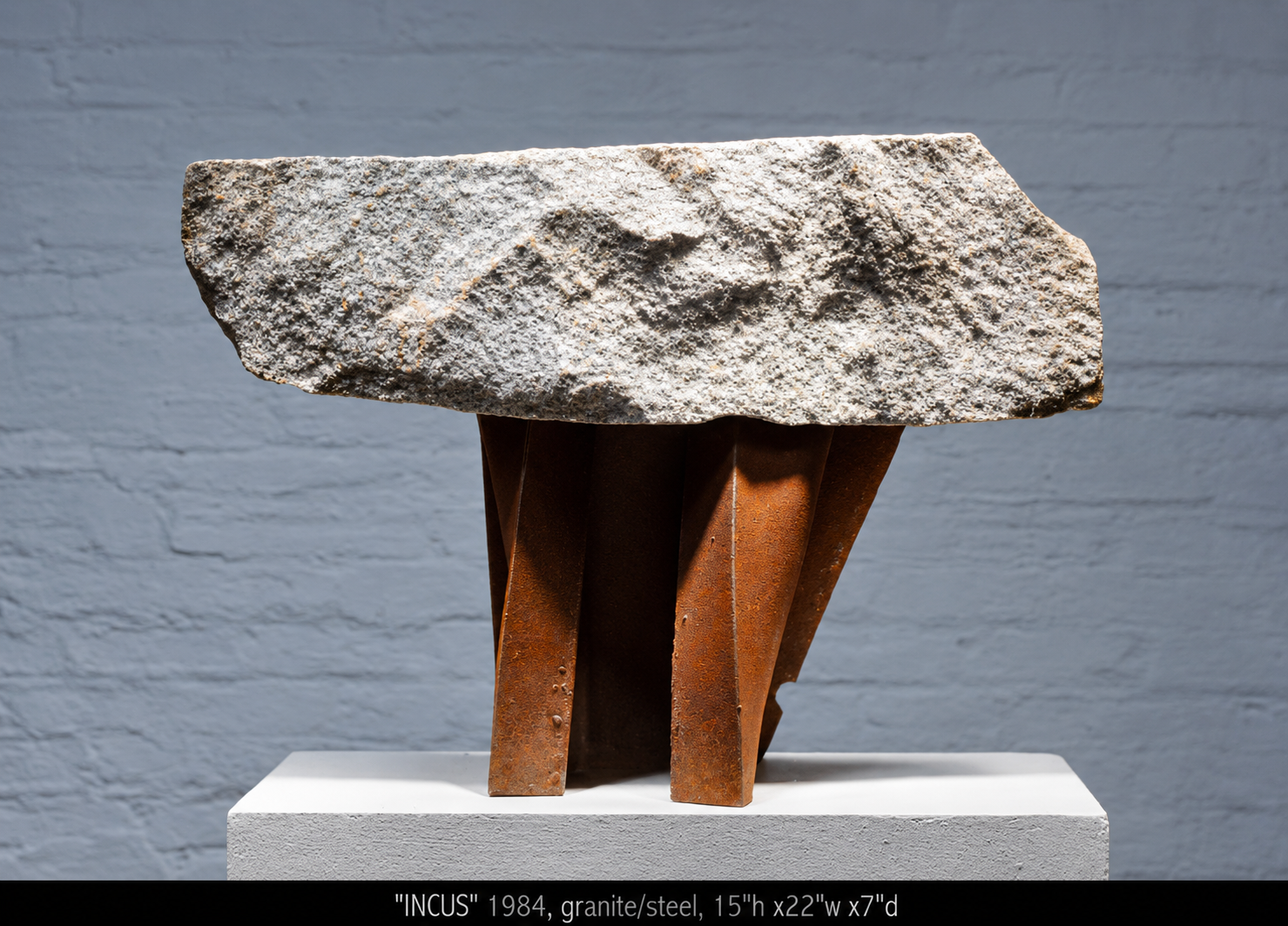
May 1984. Granite, steel. Dimensions: 15 × 22 × 7 in (38 × 56 × 18 cm). Private Collection Bill Base NYC.
Incus, 1984
Incus reflects my long-standing interest in tools and implements as both sculptural forms and extensions of the hand. The title is Latin for “anvil,” and the broad granite slab resting on the compact steel structure suggests that familiar tool while reversing its traditional materials. Weight, balance, and the contrast between natural stone and industrial steel remain central to the work—concerns that would continue throughout my sculpture.
My interest in the anvil later developed beyond its function as a tool. As a metalworker, I came to see it as a place where things are physically and conceptually forged together—almost like an altar where the creative act occurs. This association eventually led to my Ara Series, named for the constellation Ara, whose Latin name means “altar,” extending the imagery of the anvil from a tool of physical transformation to a metaphor for the creative process.
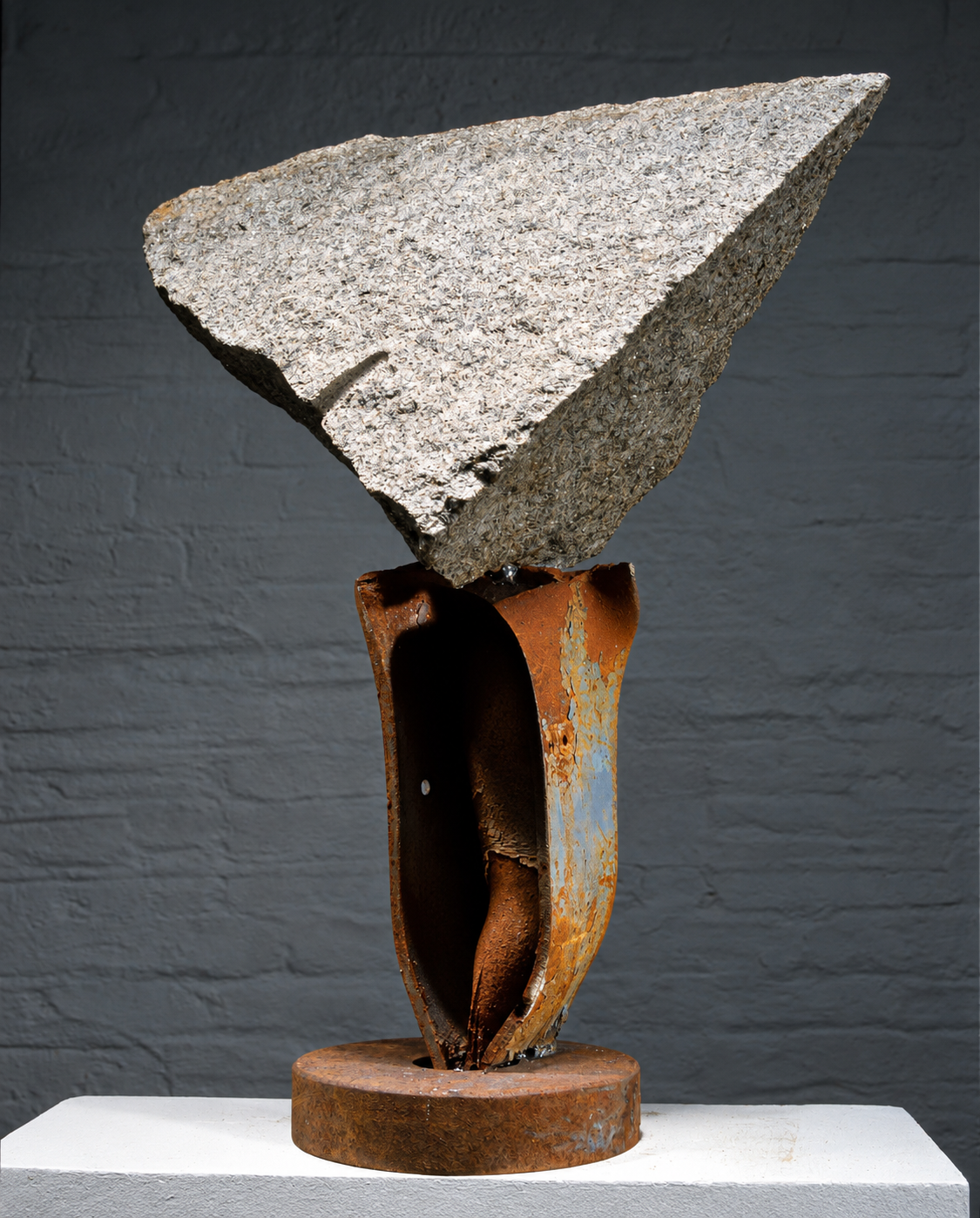
May 1984. Granite, steel. Dimensions: 30 × 22 × 9 in (76 × 56 × 23 cm).
Blue Collar, 1984
Blue Collar is an early example of the figurative references beginning to enter my work. A broad triangular granite form balances atop a narrow section of salvaged steel, suggesting an oversized head and slender body. Gravity, balance, and contrasting materials remain central, while the work opens toward a more associative reading.
The title plays on this suggestion of a figure while referencing the industrial, working-class character of the steel. Traces of blue paint reinforce the title, while the battered found material carries its own history of labor and fabrication.
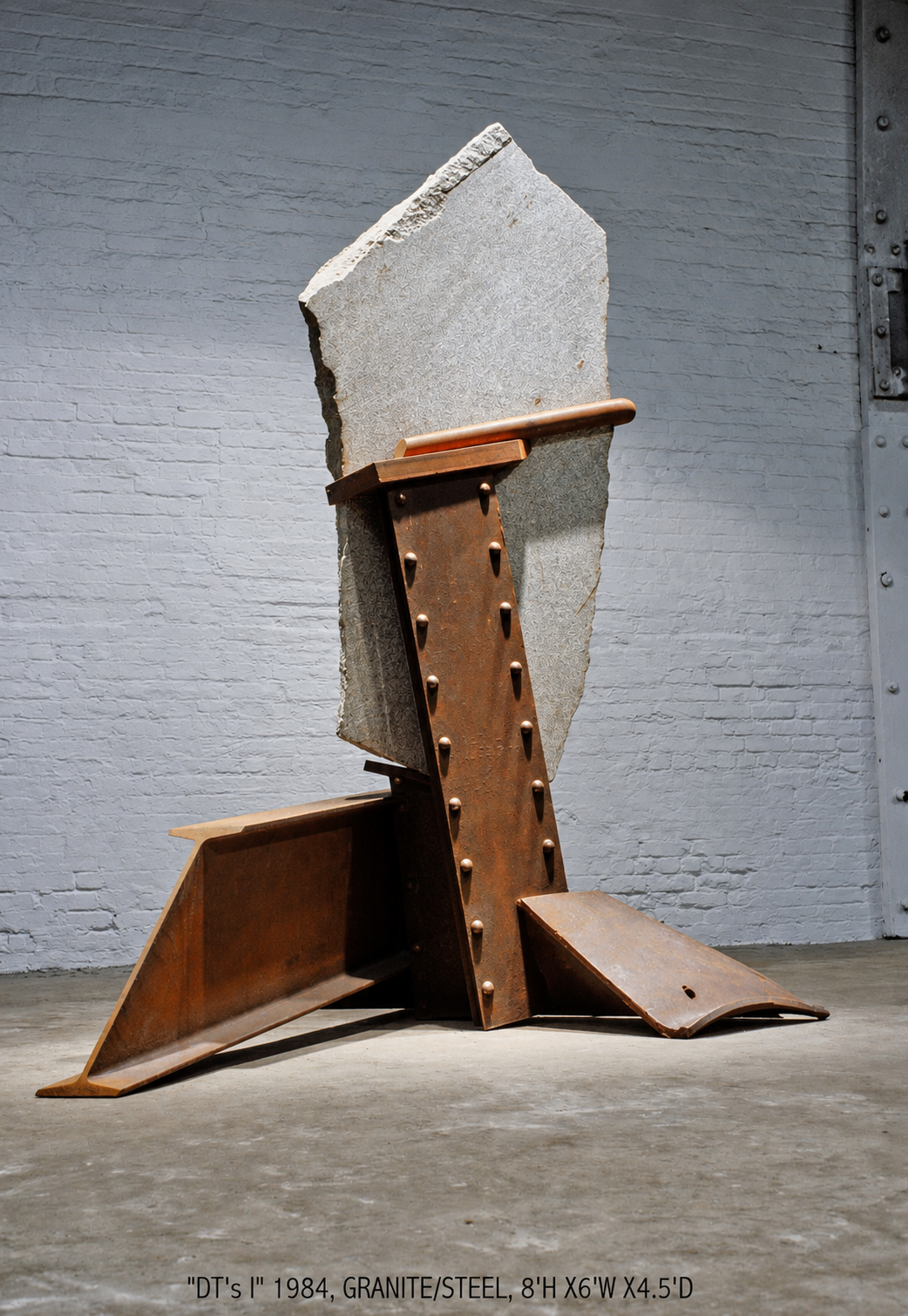
December 1984. Granite, steel. (painted in 1987). Dimensions: 8 × 6 × 4.5 ft.
D.T.’s I (Diagonal Tendencies), 1984
D.T.’s I (Diagonal Tendencies) is the first in a series that would eventually include six additional works. It continues my fundamental concern with physically combining stone and steel, while reflecting the more expressive vocabulary emerging in my work at the time. The title has a dual meaning: “Diagonal Tendencies” refers to the prominent diagonal drilling channels left by the quarrying process, whose concentrated rhythm becomes an active visual element.
The initials “D.T.’s” also refer to delirium tremens, a condition associated with severe trembling—echoed in the visual vibration of the stone’s repeated diagonals and introducing a darker psychological dimension. The sculpture was shown at Osuna Gallery in Washington, D.C., in my 1985 solo exhibition. In 1987, both stone and steel were painted, and the work went to Gerald Peters Gallery in Santa Fe, where it remained for several years. It eventually returned to me and, as of 2026, remains in Wells, New York.
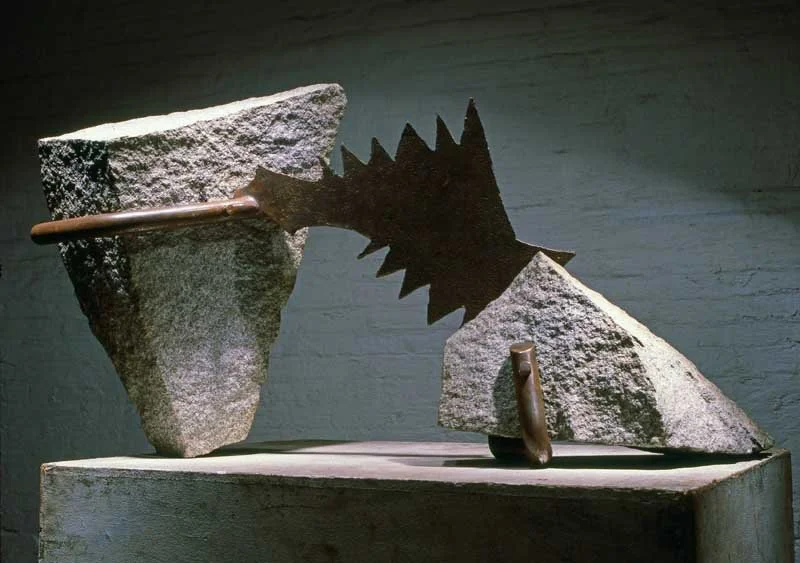
October 1984. Granite, steel. Dimensions: 24 × 50 × 12 in (61 × 127 × 30 cm). Cannibalized
Holding Pattern, 1984
Holding Pattern reflects my move away from the strictly structural concerns of my earlier work toward a more expressive use of stone and steel. Two granite forms are held in tension by a jagged steel element and forged bars. Gravity, balance, and visible assembly remain central, while the steel becomes increasingly gestural and image-driven.
The title plays on the sculpture’s physical and psychological character: the elements are literally held in a precarious arrangement, while “holding pattern” suggests waiting or circling without moving forward—a state of suspended or arrested motion.
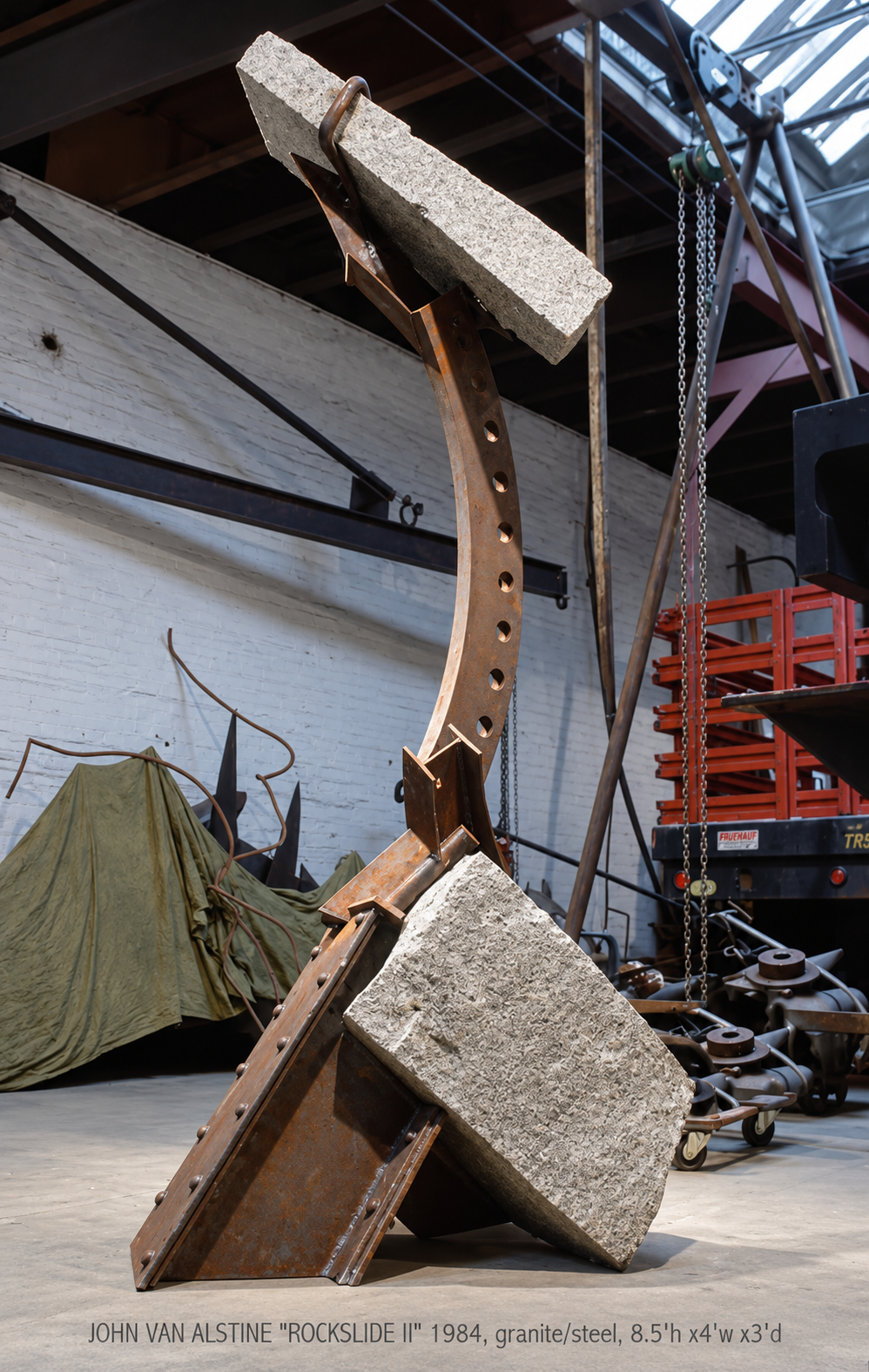
September 1984. Granite, steel. Dimensions: 8.5 × 4 × 3.5 in (22 × 10 × 9 cm).
Collection: Dayton Institute of Art, Dayton, OH
Rockslide II, 1984
Rockslide II, the second work in my Rockslide Series, continues my exploration of gravity, balance, and precarious suspension. Granite elements are held within a more complex steel structure, with a tall curving form creating a strong upward movement. As in Rockslide I, the connections are deliberately emphasized: visible pins, plates, and brackets make the way the sculpture is held together an important visual and conceptual part of the work.
This emphasis on visible assembly carries forward concerns from my earlier tensegrity, or Brute Series, while the sweeping steel and implied instability reflect the more expressive direction my work was taking during this period. Rockslide II was purchased by Washington, DC collector Philip M. Smith and later gifted to the Dayton Art Institute in Dayton, Ohio, where it is part of the permanent collection.
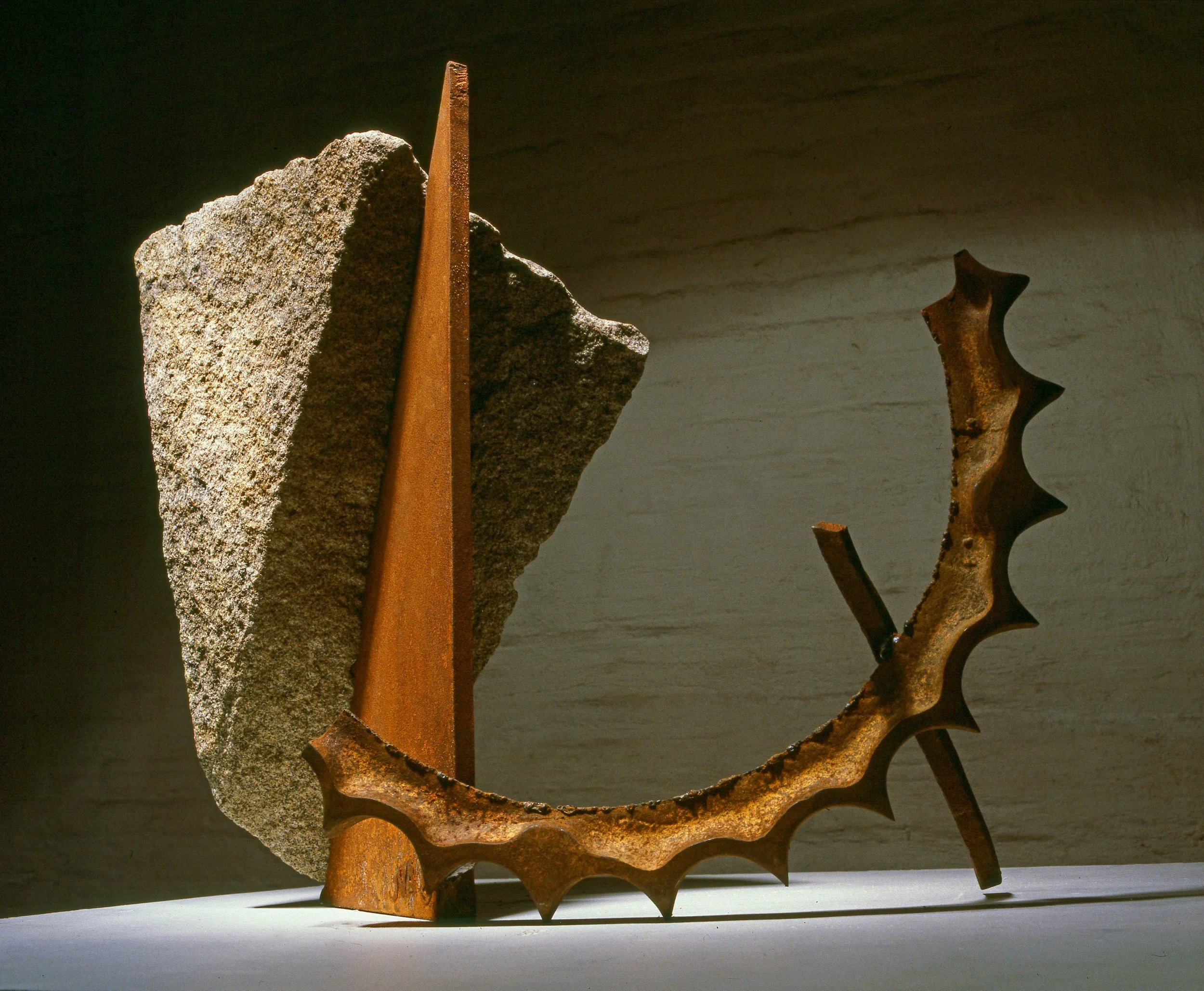
October 1984. Granite, steel. Dimensions: 24 × 30 × 16 in (61 × 76 × 41 cm).
Private collection - Baltimore
Uppercut, 1984
Uppercut continues my interest in combining raw stone and industrial steel—the natural and human-made—as contrasting but interdependent sculptural elements. The granite retains its mass and natural character, while the sweeping, serrated steel introduces a more animated, expressive gesture. Gravity, balance, and assembly remain important, but the steel moves beyond a purely structural role.
Like several works from this period, Uppercut also introduces a figurative association. The title refers to the upward swing of a boxer’s fist, echoed in the forceful arc of the steel. Rather than depicting the body literally, the sculpture uses human movement and gesture to animate otherwise static materials—an expressive direction that became increasingly important in my work.

December 1984. Slate, steel. Dimensions: 10.5 × 4 × 3 in (27 × 10 × 8 cm).
Collection: Delaware Museum, Wilmington, DE
Slate Totem II, created at my Jersey City studio, was the fourth of the “closed-base” totems and the second to use slate rather than granite. The work continues my transition away from the open, interlocking structures of the tensegrity, or Brute Series, toward more solid forms and a greater emphasis on overall image and visual presence. A large steel locking pin, salvaged from heavy construction machinery, is prominently positioned between the two halves of the pyramidal base, structurally preventing them from spreading. Welded flanges give the connector a cross-like or cruciform appearance. While its exposed function recalls my earlier concern with making how a sculpture holds itself together central to the work, its religious associations introduce a more ritualistic and mystical presence.
The Totem Series grew from the tall, eroded rock spires I encountered after moving West to Laramie, Wyoming, particularly the way they rose from sloping accumulations of fallen material at their bases. In Slate Totem II, that geological relationship is distilled into the contrast between the rugged vertical slate and low geometric steel pyramid. The prominent cruciform connector occupies a threshold between function and symbol: it physically locks the sculpture together while suggesting meanings beyond its structural role. In this sense, the work marks a further movement away from the “truth to materials” emphasis of my earlier sculpture toward a more evocative, symbolic, and ritualistic visual language.
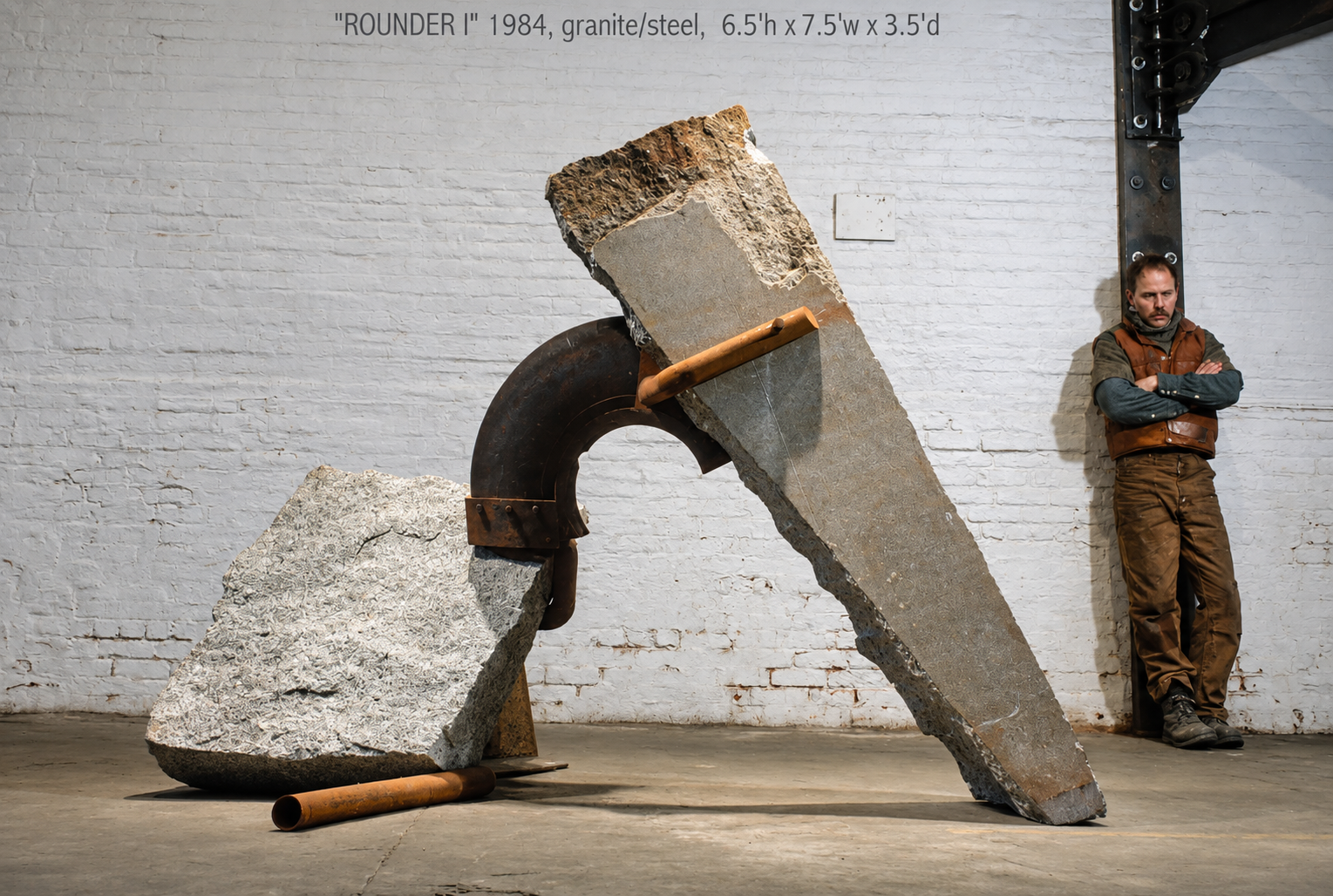
December 1984. Granite, steel. Dimensions: 6.5 × 7.5 × 3.5 ft (1.98 × 2.29 × 1.07 m).
Private collection, Chicago, IL.
Rounder I, 1984
Rounder I is the first work in my Rounder Series and grew directly from many of the formal concerns of the Go-Rounds. Two massive granite elements are joined by a broad steel arc, creating a physically charged relationship of weight, balance, and suspension. The curved steel both connects and separates the stones, while the exposed bolts, brackets, and forged elements make the act of assembly an integral part of the sculpture. These concerns evolved from my earlier tensegrity, or Brute Series, in which the mass and weight of stone became active sculptural forces.
The title first refers to the rounded steel form and circular movement of the composition, but “rounder” also describes a person of dubious character—a drifter or someone who does not quite belong to respectable society. I liked that slightly disreputable, “other side of the tracks” association and the unexpected character it gives the work. It reflects my growing interest during this period in moving beyond purely structural concerns and allowing titles and materials to introduce a more associative and metaphorical dimension.
The work was exhibited in 1984 at the Grimaldis Gallery in Baltimore, sold and delivered to the Lauder Family in Chicago.
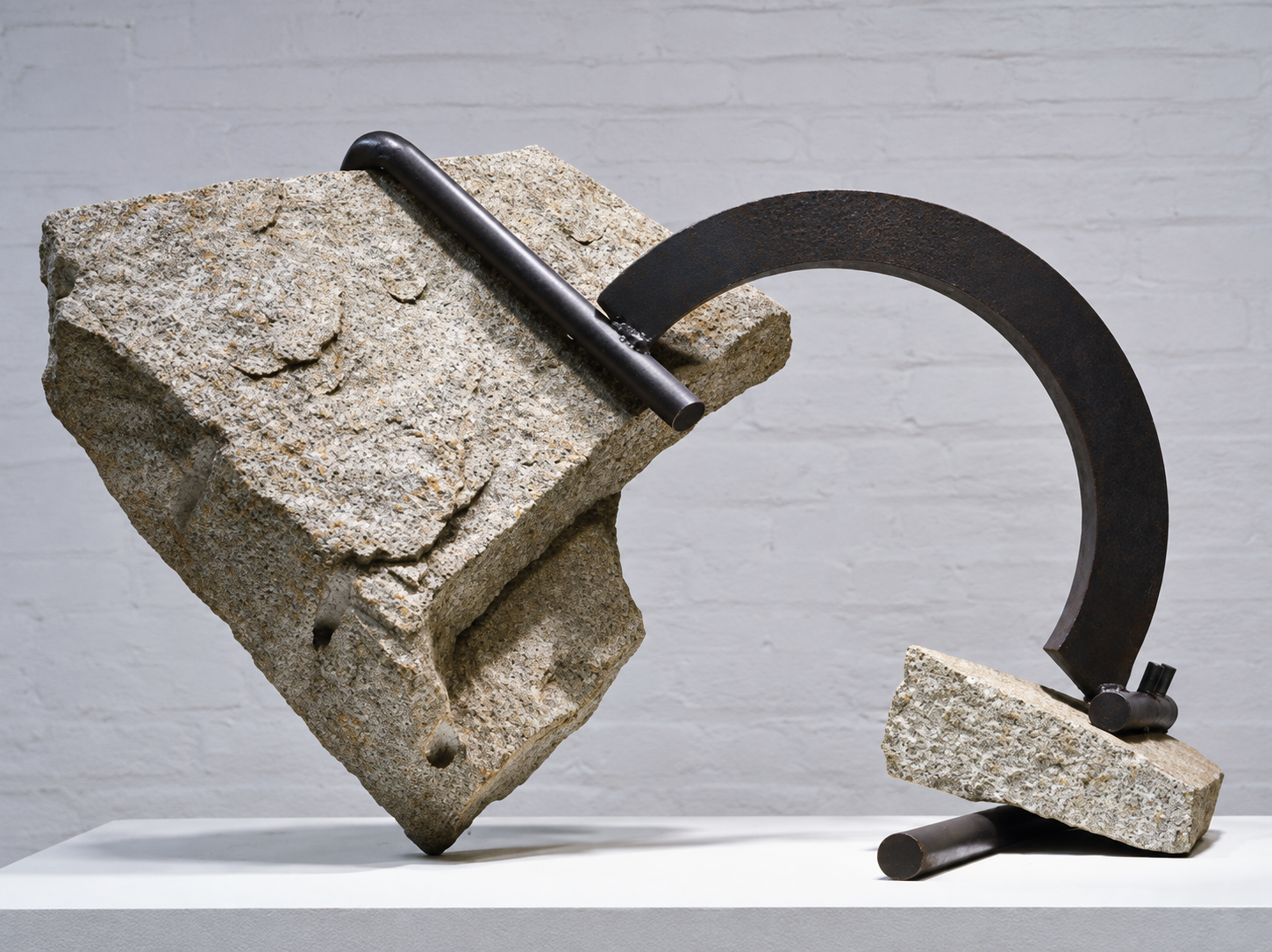
1984. Granite, steel. Dimensions: 20 × 34 × 14 in (51 × 86 × 36 cm).
5th Go-Round, 1984
5th Go-Round continues my exploration of the circular steel form joining two found granite elements, but here the relationship becomes more open and dynamic. A broad steel arc rises from the smaller stone and reaches toward the much larger granite mass, which is poised precariously on a single point. Gravity, weight, and balance—concerns carried forward from my earlier tensegrity, or Brute Series—remain essential, while the sweeping curve and strong diagonal steel bar introduce a more gestural sense of movement and arrested motion.
As in the earlier Go-Rounds, the title refers both to the circular movement of the sculpture and to the rodeo expression I encountered while living in Wyoming—another “go-round,” or another attempt. The series reflects my belief that a sculptural idea is rarely exhausted in a single work; instead, it develops through repeated approaches and variations. By 5th Go-Round, the circle, stone, and idea of repetition had become increasingly interconnected, anticipating the more metaphorical language of my later Sisyphean Circles.
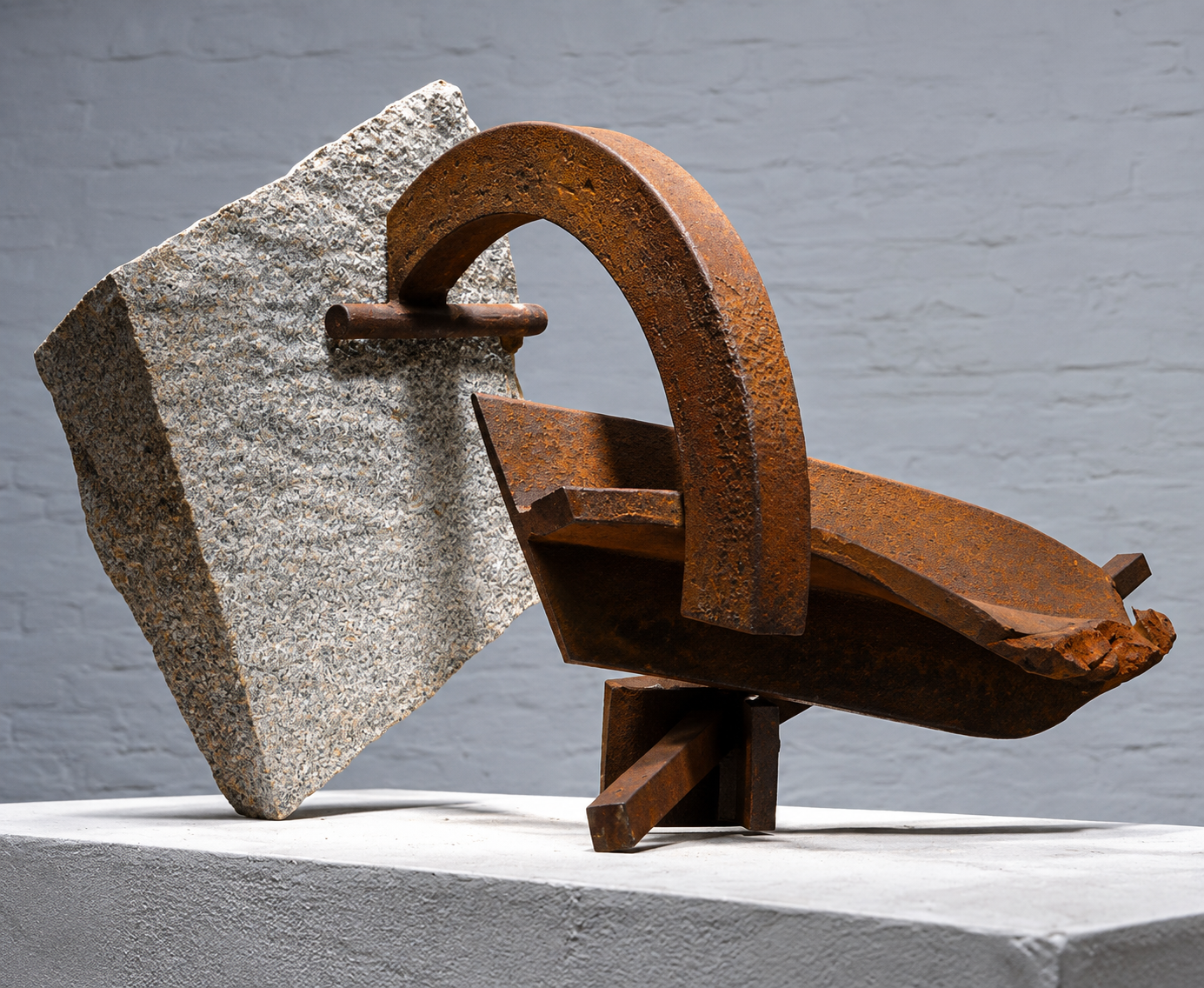
1984. Granite, steel. Dimensions: 18 × 23 × 28 in (46 × 58 × 71 cm).
Sidewinder ’84, 1984
Sidewinder ’84 brings a large granite form into tension with a sweeping semicircular steel arc and an assemblage of found industrial steel. Gravity and balance remain central, but the steel has moved beyond the primarily structural role of my earlier tensegrity, or Brute Series, becoming more gestural and expressive. The visible pin wrapping the stone continues my interest in making the physical connection an active part of the sculpture.
The title Sidewinder refers to the work’s sense of coiling, curving movement, suggested most directly by the large steel arc and the angular, almost serpentine progression of forms. Like the Go-Round and Rounder works of this period, the sculpture reflects my growing interest in circular movement and found materials while retaining the physical tension between stone, steel, weight, and implied motion.
1983

May 1983. Granite, steel. Dimensions: 3.5 × 3.5 × 2 ft.
Private Collection
Off and Running, 1983
Off and Running belongs to a transitional period when the structural concerns of my earlier tensegrity, or Brute Series, were becoming increasingly gestural and associative. The granite remains a substantial physical presence, held in an active relationship with forged and fabricated steel, but the steel now sweeps outward and upward in animated, almost organic forms. Weight and balance remain important, while the composition suggests movement rather than structural equilibrium alone.
The title reinforces this sense of release and forward motion. The crescent-like steel form and long branching element seem to propel the stone upward and ahead, giving the sculpture an almost running or leaping character. Rather than depicting movement literally, Off and Running uses the contrast between heavy granite and energetic steel to create a sense of momentum—an appropriate metaphor for my work at the time as it moved into a more expressive sculptural language.
Work was exhibited in my 1984 solo show with Diane Brown Gallery, 100 Green Street, SOHO, NYC and sold to private collector.
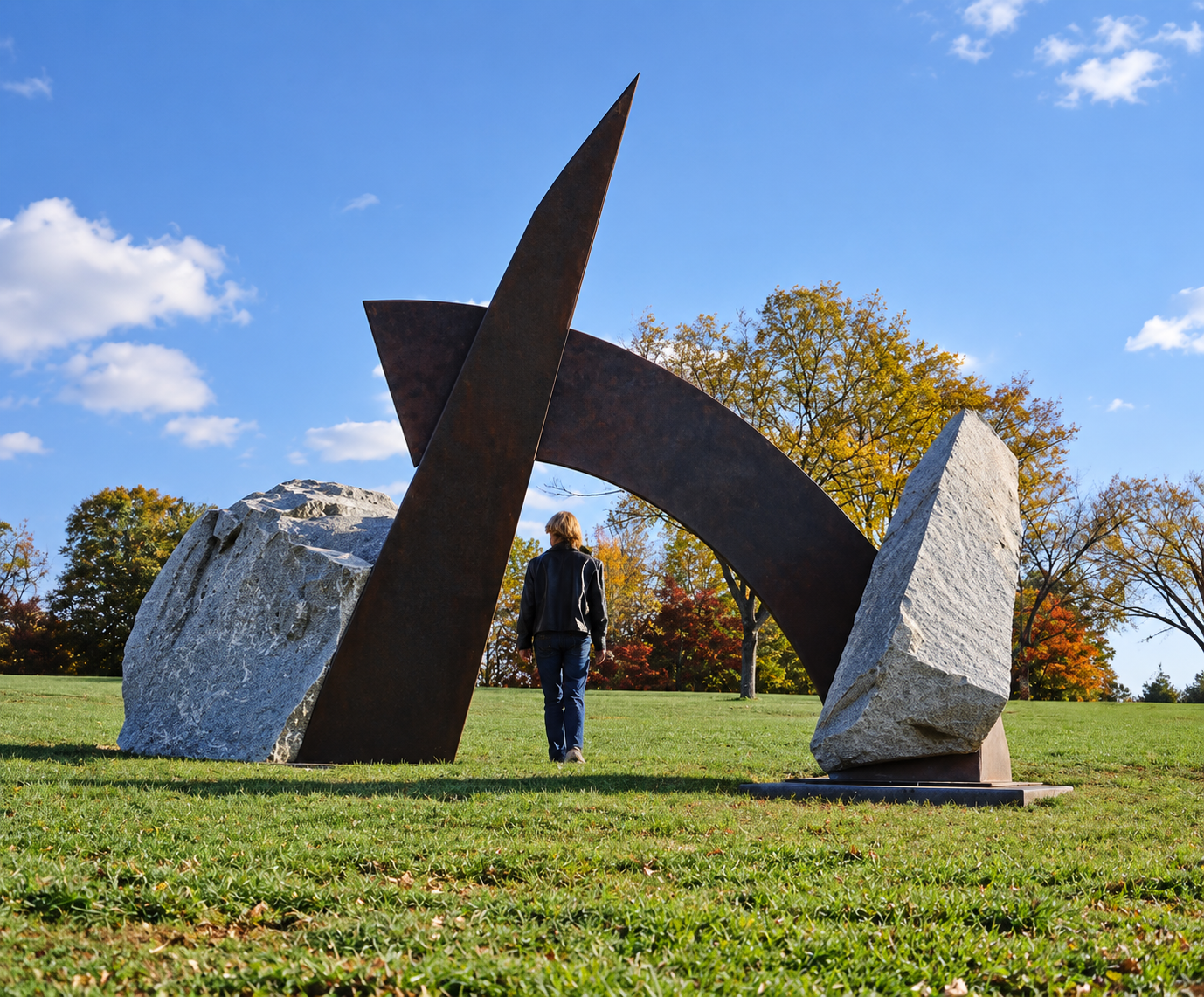
October 1983. Granite, steel. Dimensions: 16 × 25 × 15 in (41 × 64 × 38 cm).
Corporate Collection: Luck Stone Corp. - Richmond, VA
Big Go-Round (1983) was John Van Alstine's second major public commission and his first corporate installation, created for the headquarters of Luck Stone Corporation in Richmond, Virginia. Standing approximately sixteen feet high, the sculpture combines massive granite with fabricated steel in a sweeping circular composition that marked a pivotal shift in the artist's work—from the tightly structured "Nature of Stone" sculptures of the 1970s toward a more fluid, lyrical vocabulary inspired by landscape, motion, and organic growth.
Commissioned by one of the nation's leading producers of crushed stone, Big Go-Round celebrates both the material from which it is made and the dynamic forces that shape the earth. Rather than depicting industry directly, the sculpture transforms stone and steel into an image of balance, movement, and renewal. The project proved to be an important milestone, leading to a long series of large-scale public commissions that would define Van Alstine's career over the following four decades.
MORE INFO: Big Go-Round chapter in AMERICAN MONUMENTS

March 1983. Granite, steel. Dimensions: 8 × 12 × 5 in (20 × 30 × 13 cm).
Collection of Hirshhorn Museum, Smithsonian Institution, Washington, DC.
4th Beast of Daniel, 1983
4th Beast of Daniel belongs to a transitional period in my work when the structural concerns of my earlier tensegrity, or Brute Series, were becoming more expressive and metaphorical. The massive granite slabs still rely upon steel, gravity, weight, and balance to establish an interdependent structure, but the steel has taken on a distinctly aggressive character. Long tubular elements bend and thrust through the composition, while welded spikes transform what might otherwise be purely structural forms into something animated and threatening.
The title refers to the fourth beast in the Book of Daniel—a terrifying creature described as extraordinarily powerful, with iron teeth and ten horns. Rather than illustrating the biblical passage literally, I use its imagery as a metaphorical framework for the sculpture’s sense of menace and power. The rough granite and fabricated steel—with its spikes and horn-like projections—suggest a form somewhere between architecture, machine, and beast, signaling my growing interest in using structural forces to carry psychological and mythological associations.

January 1983. Granite, steel. Dimensions: 7.5 × 4 × 3 ft.
Private collection - Washington, DC
Totem II was created at my N Street studio in Washington, DC, and was the second of what I think of as the “closed-base” totems, marking an important transition in my work. I was moving away from the open, interlocking forged-steel structures of the tensegrity, or Brute Series, toward more solid supporting forms and a greater emphasis on the sculpture’s overall image and visual presence. The pyramidal steel base supports the tall vertical stone while recalling the sloping geological formations that originally inspired the Totem Series.
The original inspiration for the Totems came from the tall, eroded rock spires I encountered after moving West to Laramie, Wyoming. I was particularly struck by the way these vertical formations often rose from broad, sloping accumulations of eroded and fallen material gathered at their bases over time. In Totem II, that geological relationship is transformed into the contrast between the rugged, vertical stone and the low, geometric steel pyramid. Rather than focusing primarily on making physical forces visible, as I had in the tensegrity works, I was beginning to use structure in service of a more unified and evocative sculptural image. Totem I established this new direction and was followed by six additional closed-base totems.

April 1983. Granite, painted steel. Dimensions: 9 × 4 × 4 ft. Private Collection
Sea Stem, 1983
Sea Stem belongs to a transitional period when the structural concerns of my earlier tensegrity, or Brute Series, were becoming more expressive and metaphorical. A long slab of granite rises at a steep diagonal, its weight countered by a dark tubular steel element with small welded projections. Gravity, balance, and arrested motion remain central, but the forms have begun to move beyond purely structural concerns.
The title Sea Stem suggests both the organic growth of a plant and the structural stem of a vessel, bringing together references to nature and navigation. The rising stone and branching steel evoke a mast, stalk, or marine form without becoming literally representational, reflecting my growing interest in allowing stone and steel to carry broader associations while retaining their inherent physical character.
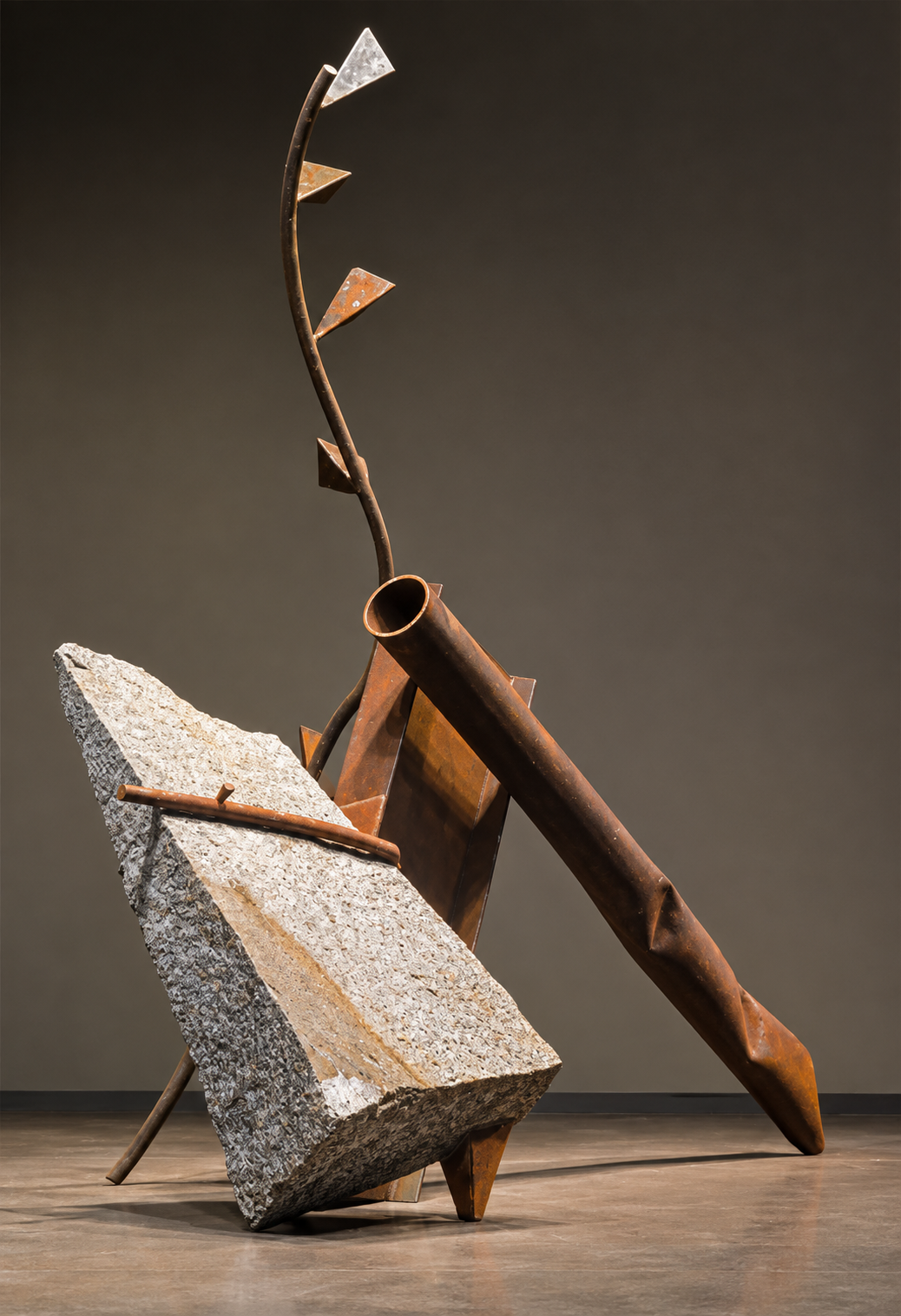
1982/83. Granite, steel. Dimensions: 8 × 10 × 6 ft.
Collection: GULBENKIAN MUSEUM, Lisbon, Portugal
In the Clear, 1982/83
In the Clear marks an important transition in my work as I began moving beyond the tightly structured, gravity-driven concerns of my earlier tensegrity, or Brute Series. After moving to Washington, DC, I became increasingly responsive to the urban environment and to found industrial materials. A timely discovery of crushed I-beams, pipes, and other steel remnants in a subway construction yard provided a new vocabulary of forms. Here, stone and steel remain physically interdependent, but the steel begins to move more freely—projecting outward and upward in a loose, gestural manner rather than functioning solely as structure.
The title operates on several levels. In the Clear suggests a landscape—a form emerging into a clearing—and the tall, curving steel element with its small projecting shapes carries a suggestion of vegetation or new growth. More importantly, the title describes my own desire at the time to “break clear” of the self-imposed restrictions of making sculpture governed primarily by structural necessity. The work became a bridge between the concentrated physical forces of my earlier stone-and-steel sculpture and the more associative, gestural, and metaphorical language that would increasingly characterize my work during the 1980s.
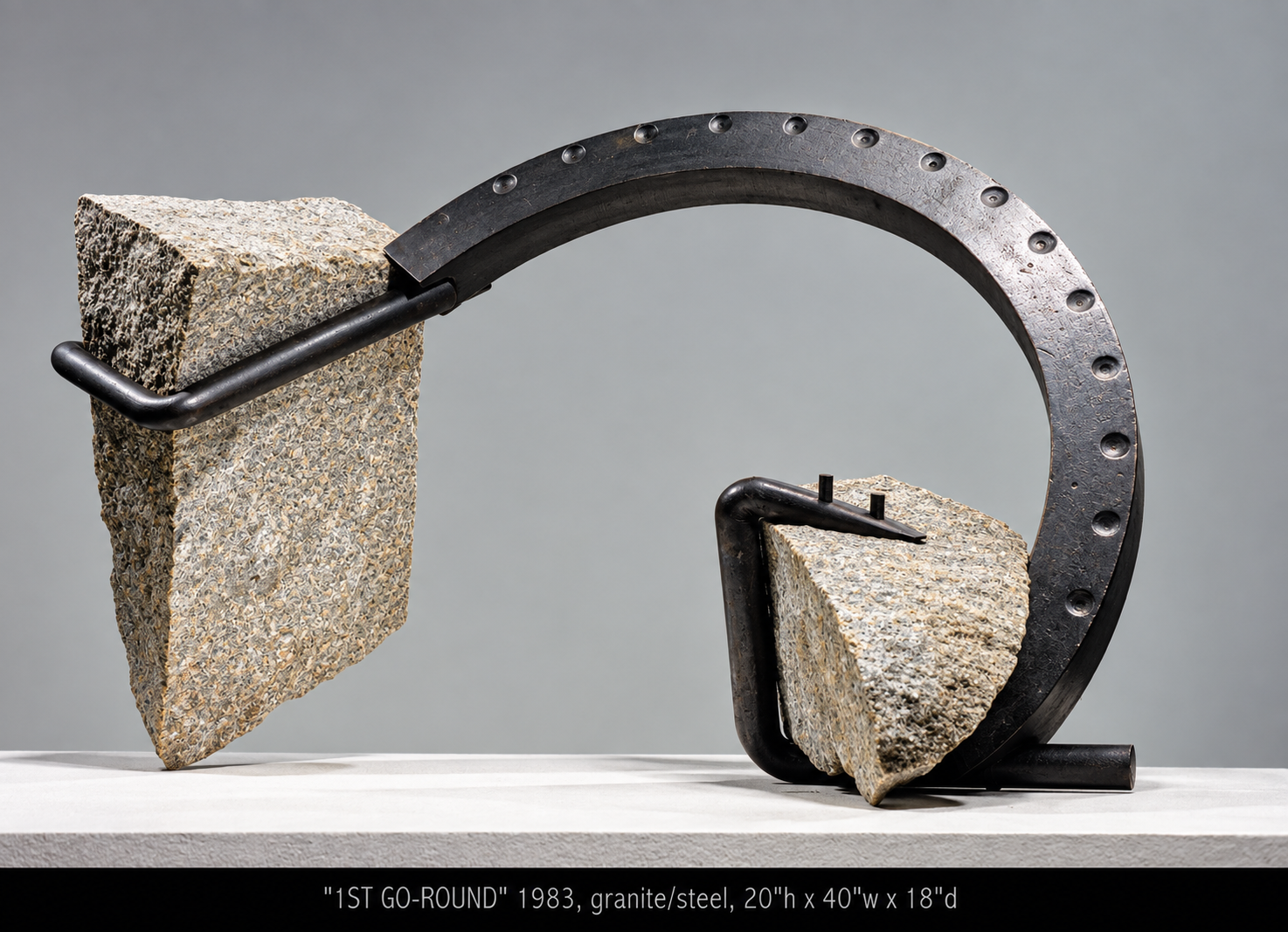
1st Go-Round, 1983
Granite, steel. 20 × 40 × 18 in (51 × 102 × 46 cm).
Private collection, Washington, DC.
1st Go-Round initiated the Go-Round Series and was among my first works to use a sweeping arc of steel to connect two pieces of found stone. While the work moves away from the strict structural principles of my earlier tensegrity, or Brute Series, the means of assembly remain important. Visible pins both secure the stones and celebrate how the sculpture is put together. The circular steel element also anticipates what would become one of my most persistent themes—the Sisyphean Circles.
The title grew partly from my years in Wyoming and the language of rodeo, where a contestant may get more than one “go-round” at an event. That idea of repetition and another attempt became a metaphor for my working process: no single sculpture fully exhausts an idea. Instead, a series develops through successive variations or “go-rounds,” each approaching the same formal and conceptual territory from a different direction.
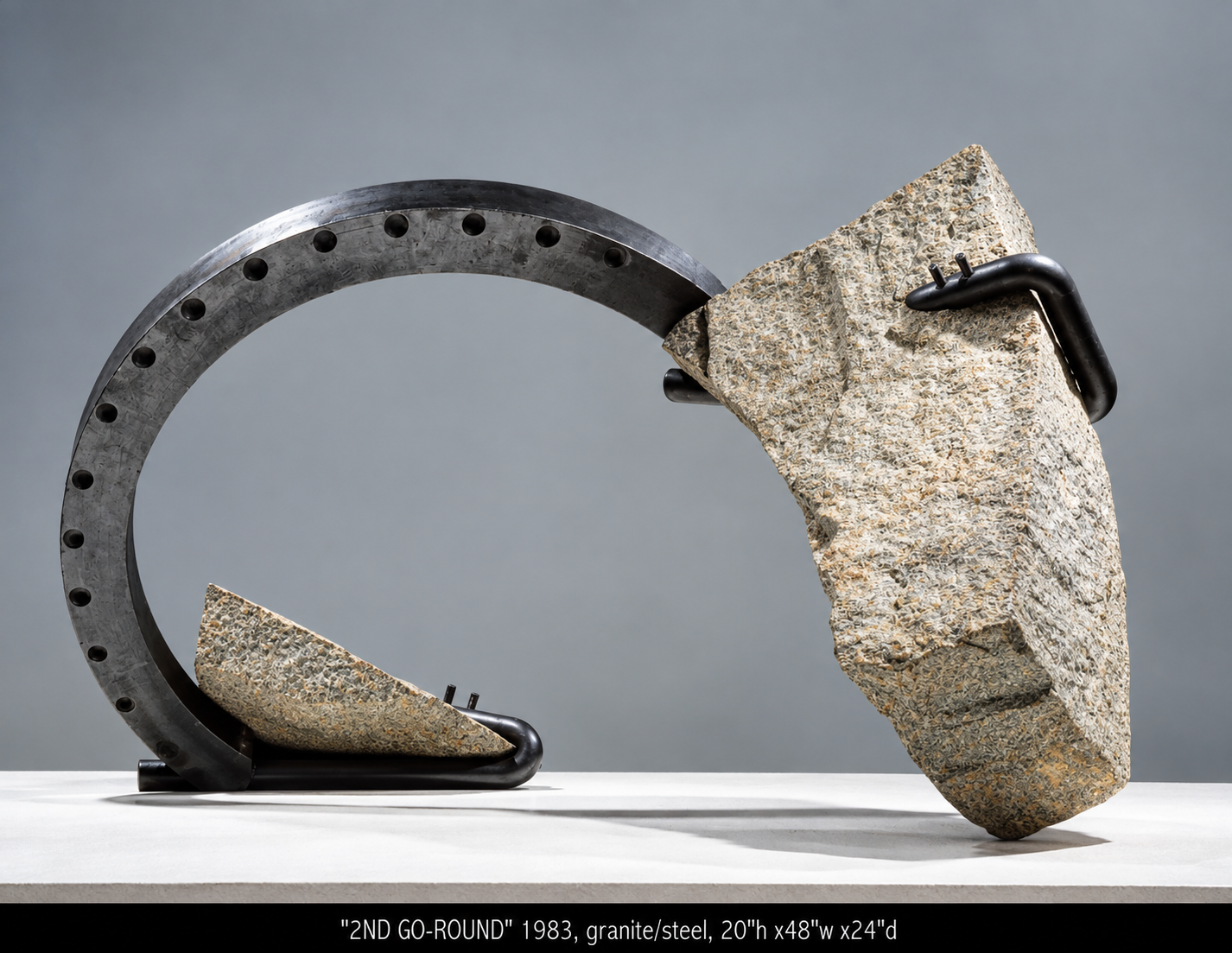
1983. Granite, steel. Dimensions: 20 × 48 × 24 in (51 × 122 × 61 cm).
Private collection - Washington, DC
2nd Go-Round, 1983
2nd Go-Round continues the ideas introduced in 1st Go-Round, using a broad arc of steel to connect two found granite forms. Here the sweeping curve becomes more dominant, lifting one stone almost entirely off the ground and creating a strong sense of circular movement and arrested motion. The visible forged-steel pins and attachments remain important—not only structurally, but as an acknowledgment and celebration of how the sculpture is assembled. The series marks my movement away from the stricter structural principles of the earlier tensegrity, or Brute Series, toward a more fluid and associative sculptural language.
The title Go-Round grew partly from my years in Wyoming and the language of rodeo, where a contestant may have more than one “go-round” at an event. I liked the term because it also describes the circular movement of the sculpture and, more importantly, the idea that a sculptural problem is rarely exhausted in a single work. Each piece becomes another attempt—or “go-round”—at an evolving idea. This exploration soon expanded into the monumental Big Go-Round of 1983 and, conceptually, anticipated my later recurring use of the circle and stone in the Sisyphean Circle Series.

March 1983. Black granite, painted steel. Dimensions: 56 × 46 × 17 in (142 × 117 × 43 cm). Private collection.
Firehead, 1983
Firehead belongs to a transitional period in my work when the structural concerns of my earlier tensegrity, or Brute Series, were expanding into a more expressive and metaphorical language. A dark, roughly textured stone rises vertically within an open circular steel form, while sharply pointed, flame-like elements radiate outward. The stone retains its physical presence and weight, but the increasingly animated steel moves beyond a purely structural role, giving the sculpture a strong figurative and psychological character.
The title Firehead reinforces this transformation. The circular form suggests a head, halo, sun, or burst of flame, while the central stone evokes a face or totemic presence. Fiery reds, oranges, and yellows heighten the sense of heat and energy, reflecting my growing interest in using stone and steel to carry broader natural and human associations.

1983. Marble, steel. Dimensions: 67 × 72 × 48 in (170 × 183 × 122 cm). Destroyed.
Thorned Marble Arch, 1983
Thorned Marble Arch continues my exploration of the arch, a form that appeared earlier in my tensegrity, or Brute Series, but here becomes more expressive and metaphorical. A sweeping steel arc rises from the massive marble toward a tall vertical element, while thorn-like projections transform the steel from a purely structural element into something more animated and organic.
The arch suggests support and passage, while the thorns introduce tension and resistance. The marble anchors the composition as the steel reaches outward and upward, balancing weight and gravity against growth and movement. The work reflects my shift during this period toward a more associative and expressive sculptural language.
1982

September 1982. Gray granite, steel. Dimensions: 15 × 6 × 5 ft.
Collection: Grounds for Sculpture - Hamilton, NJ
Torque 14 is one of the larger and most physically dramatic works from my tensegrity, or Brute Series. Two large pieces of gray granite are held in a precarious but stable relationship by interlocking forged-steel bars. The weight of the stones places the steel under torque, providing the energy—or “glue”—that locks the sculpture together without welding. The long diagonal stone appears almost to defy gravity, creating a “static energy event”—a sculpture held in arrested motion.
At roughly six feet high and fifteen feet long, Torque 14 brings these ideas to an architectural scale. The rough granite remains essentially as found, while the forged steel channels and makes visible the forces of gravity, tension, leverage, and balance. In this sense, the work is deliberately self-referential—“assemblage about assemblage, sculpture about sculpture”—with the forces holding it together becoming both its structure and its subject. Created in 1982, it stands near the culmination of these early investigations, which reached their largest public expression that same year in Trough in Billings, Montana.
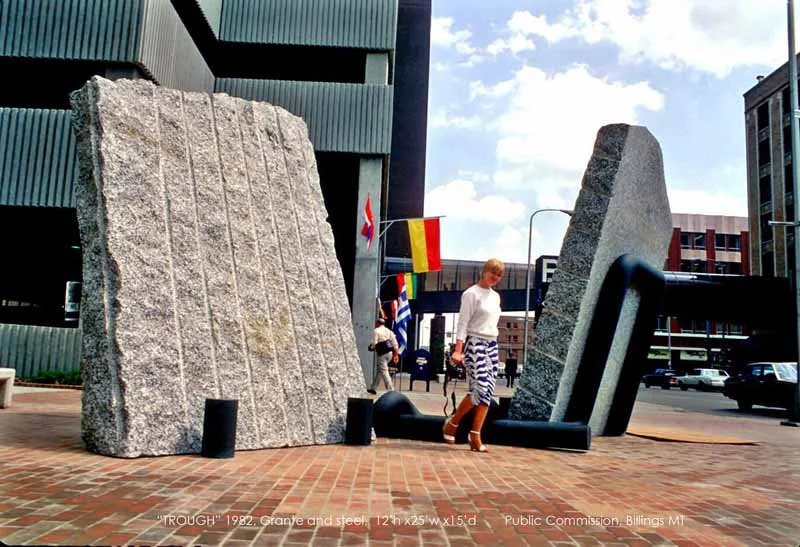
August 1982. Granite, steel. Dimensions: 11 × 25 × 12 in (28 × 64 × 30 cm).
Public Commission - Billings, Montana (S-82-03)
Trough (1982) was John Van Alstine's first large-scale public commission, created to commemorate the centennial of Billings, Montana. Composed of two monumental granite slabs held in dynamic suspension by interlocking steel elements, the sculpture marked the culmination of the artist's early Nature of Stone series while introducing the monumental scale and site-specific thinking that would define his public work for the next four decades.
Rather than serving as an isolated object, Trough was conceived as a response to its landscape. The dramatic negative space between the leaning stones echoes the broad geological trough carved by the Yellowstone River through the surrounding high plains, forging a direct connection between sculpture and place. This fusion of abstract form, geological history, and human experience established an approach that became a hallmark of Van Alstine's monumental commissions throughout the United States and abroad.

November 1982. Granite, steel. Dimensions: 64 × 176 × 90 in (163 × 447 × 229 cm).
Private collection - Washington, DC
Beam Torque marks an important transition in my work, as I began moving away from the tightly formulated tensegrity, or Brute Series, that had occupied me since the mid-1970s. I had come to feel that I had largely exhausted the possibilities of this “sculpture about sculpture” approach and was looking for a way forward. At the same time, I gained access to a cache of large I-beams, bent pipe, and other industrial steel, opening new formal possibilities. In Beam Torque, the opposing granite slabs still generate a strong sense of torque, weight, and arrested motion, but the steel no longer simply traces and channels gravitational forces as it had in the earlier work.
Although the pinned connections between stone and steel remain important and deliberately visible, their role is less dominant. Instead, the massive I-beam becomes a bold visual form in its own right, shifting the emphasis from how the sculpture holds itself together toward the overall image it creates. Beam Torque therefore straddles two directions: it retains the physical energy and precarious equilibrium of the Brute Series while moving beyond its self-referential focus. Works such as In the Clear, 4th Beast of Daniel, and Cronus would soon follow, opening my sculpture to a more expressive and associative vocabulary, with titles and imagery introducing ideas beyond the mechanics of sculpture itself.

January 1982. Granite, steel. Dimensions: 8 × 3 × 4 ft.
Private collection - Washington, DC
Totem I was created at my N Street studio in Washington, DC, and was the first of what I think of as the “closed-base” totems, marking an important transition in my work. I was moving away from the open, interlocking forged-steel structures of the tensegrity, or Brute Series, toward more solid supporting forms and a greater emphasis on the sculpture’s overall image and visual presence. The pyramidal steel base supports the tall vertical stone while recalling the sloping geological formations that originally inspired the Totem Series. The forged-steel clasps at the front and back, wrapping around projecting steel posts to prevent the base from spreading, are both functional and a deliberate link to the structural vocabulary of my earlier work.
The original inspiration for the Totems came from the tall, eroded rock spires I encountered after moving West to Laramie, Wyoming. I was particularly struck by the way these vertical formations often rose from broad, sloping accumulations of eroded and fallen material gathered at their bases over time. In Totem I, that geological relationship is transformed into the contrast between the rugged, vertical stone and the low, geometric steel pyramid. Rather than focusing primarily on making physical forces visible, as I had in the tensegrity works, I was beginning to use structure in service of a more unified and evocative sculptural image. Totem I established this new direction and was followed by four additional closed-base totems.

January 1982. Granite, steel. Dimensions: 17 × 4 × 5 in (43 × 10 × 13 cm).
Private collection - Washington, DC
Pull, 1982
Pull continues my exploration of gravity, tension, and compression as active sculptural forces. Two granite slabs are separated in space yet made structurally dependent through forged-steel bars. The large foreground stone leans dramatically forward while the smaller stone acts as a counterweight, creating a strong sense of pulling against one another. As in the Torque works, the sculpture becomes a “static energy event”—a moment of physical action held in arrested motion. This approach grew from my use of stone as an assemblage element rather than something to be carved into a predetermined form.
The title Pull is deliberately both noun and verb, identifying the physical force within the sculpture as well as suggesting an action taking place. The long diagonal steel element makes that otherwise invisible force visible, drawing the eye—and seemingly the smaller stone—toward the larger mass. The work is essentially sculpture about sculpture, with gravity, balance, and the act of holding disparate materials together becoming both its structure and its subject.

January 1982. Granite, steel. Dimensions: 24 × 32 × 92 in (61 × 81 × 234 cm).
Private collection - Washington, DC
Torque XI is part of my tensegrity, or Brute Series, in which gravity, weight, tension, and compression become active sculptural forces. Two elongated granite forms lean in opposing directions, held in equilibrium by interlocking forged-steel bars. The weight of the stones places the steel under torque, providing the energy—or “glue”—that holds the sculpture together without welding and creates a “static energy event”—a sculpture held in arrested motion.
The long horizontal steel bars open the sculpture into the surrounding space while making the forces between the separated stones visible. Acting as lines drawn in space, they trace the tension and twisting action that bind the granite masses together. The work is deliberately self-referential—sculpture about sculpture, assemblage about assemblage—with its structure and physical forces becoming its subject.

1982. Granite, steel. Dimensions: 11 × 7 × 5 ft.
Collection - SMITHSONION AMERICAN ART MUSEUM, Smithsonian Institution, Washington, DC
NMAA Wedge, 1982
NMAA Wedge grew from an invitation by curator Harry Rand at the National Museum of American Art, whom I had met when my Gallery Ladder was exhibited there as part of the touring 1st Western States Biennial. When a prominent site at the museum entrance became available, Rand suggested that one of my sculptures might work well there. I had nothing of the appropriate scale, so I created NMAA Wedge specifically for the site. The eleven-foot-high sculpture was installed at the museum later that year and subsequently entered the collection as a gift of collector Scott Lange. The National Museum of American Art was later renamed the Smithsonian American Art Museum.
The work extends my Wedge Series, combining an elevated, stilt-like structure with the principles of my tensegrity, or Brute Series. A massive wedge-shaped piece of granite is suspended within long forged-steel rods that wrap and interlock around the stone. Gravity and the weight of the granite provide the energy—or “glue”—that locks the structure together, making the stone an active structural element. As with Crimp and Torque, the title Wedge is deliberately both noun and verb: it identifies the form while describing the physical action taking place. At this larger, architectural scale, the work transforms my continuing exploration of weight, balance, tension, and visible assembly into a public presence.

Teddy’s Wedge, 1982
S-82-09
January 1982. Granite, steel.
Dimensions: 9 × 6 × 5 ft (274 × 183 × 152 cm)
Collection: Herbert F. Johnson Museum of Art, Cornell University, Ithaca, NY
Gift of Teddy Westreich
Teddy’s Wedge is a large-scale development of my Wedge Series, which combined the elevated, stilt-like structures of earlier works such as Triad and the Mantel Arches with the structural principles of my tensegrity, or Brute Series. Unlike the carved marble Wedges of 1975, which predated my tensegrity concerns, here a wedge-shaped piece of granite is suspended within long forged-steel rods that wrap and interlock around the stone. Gravity and the weight of the granite provide the energy—or “glue”—that locks the structure together, making the stone an active structural element.
As with titles such as Crimp and Torque, Wedge is deliberately both noun and verb: the granite is literally wedged into the steel structure, making the sculpture both object and action. The work extends my exploration of weight, balance, tension, and visible assembly into a more vertical and architectural form. The title honors Washington, DC collector Teddy Westreich, who commissioned the sculpture and later donated it to the Johnson Museum at Cornell University.

January 1982. Yellow granite, steel. Dimensions: 72 × 80 × 92 in (183 × 203 × 234 cm). Private Collection.
Tripod with Umbilical marks a pivotal moment in my work, when I began breaking away from the tightly formulated tensegrity, or Brute Series, that had occupied me through the late 1970s and early 1980s. The three long granite elements are still joined through an elaborate system of interlocking forged-steel bars, retaining the earlier emphasis on gravity, structural interdependence, and visible assembly. Yet the steel begins to take on a new role. Most notably, a long curved bar extends freely into space rather than serving a purely structural function—what I described at the time as “my flag going up” to signal that I was beginning to break away.
The title identifies this projecting element as an “umbilical”—a lifeline connecting where I had been with where the work was heading. Its animated, almost gestural line introduces an expressive element beyond the self-referential “sculpture about sculpture” concerns of the Brute Series. In this sense, Tripod with Umbilical stands directly on the threshold between two periods: still rooted in the structural vocabulary of my earlier work, but beginning to open toward a more image-driven, associative, and metaphorical language. This transition would become more explicit later in 1982 with works such as Beam Torque and In the Clear.

April 1982. Granite, steel. Dimensions: 12 × 12 × 4 ft.
Private collection - Washington, DC
Cronus, 1982
Cronus marks an important transition from the structural concerns of my earlier tensegrity, or Brute Series, toward a more expressive and metaphorical language. The massive granite slab remains dependent upon steel, weight, and balance, but the sweeping arch, animated by sharp, tooth-like projections, introduces a more aggressive, almost figurative presence.
The title refers to Cronus, the powerful Titan who swallowed his children, fearing one would eventually overthrow him. When Zeus was born, his mother Rhea saved him by wrapping a stone in swaddling clothes and giving it to Cronus, who swallowed it believing it was his son. The granite anchoring the sculpture suggests this stone, while the spiked steel evokes the threatening power of Cronus himself. Rather than illustrating the myth literally, I use it as a framework for ideas of power, conflict, and inevitable change.
The work is shown here in the courtyard of the American Institute of Architects’ national headquarters in Washington, DC. It was later acquired by a Washington-area collector and developer and displayed at one of his buildings in Rosslyn, Virginia, just across the Key Bridge from Georgetown.

January 1982. Granite, steel. Dimensions: 5 × 7 × 4 in (13 × 18 × 10 cm).
Private collection - Washington, DC
Torque X is part of my tensegrity, or Brute Series, in which gravity, weight, tension, and compression become active sculptural forces. Two rough granite forms are held in equilibrium by interlocking forged-steel bars, with the weight of the stones literally torquing the steel together. Gravity becomes the energy—or “glue”—that holds the sculpture without welding, creating what I think of as a “static energy event”—a sculpture held in arrested motion.
The title Torque describes both the twisting force within the sculpture and the action responsible for its assembly. The natural mass and quarry marks of the granite are left intact, while the forged steel traces and makes visible the forces acting between the stones. In this sense, the work is deliberately self-referential—sculpture about sculpture, assemblage about assemblage—with the act of holding its materials together becoming both its structure and its subject.
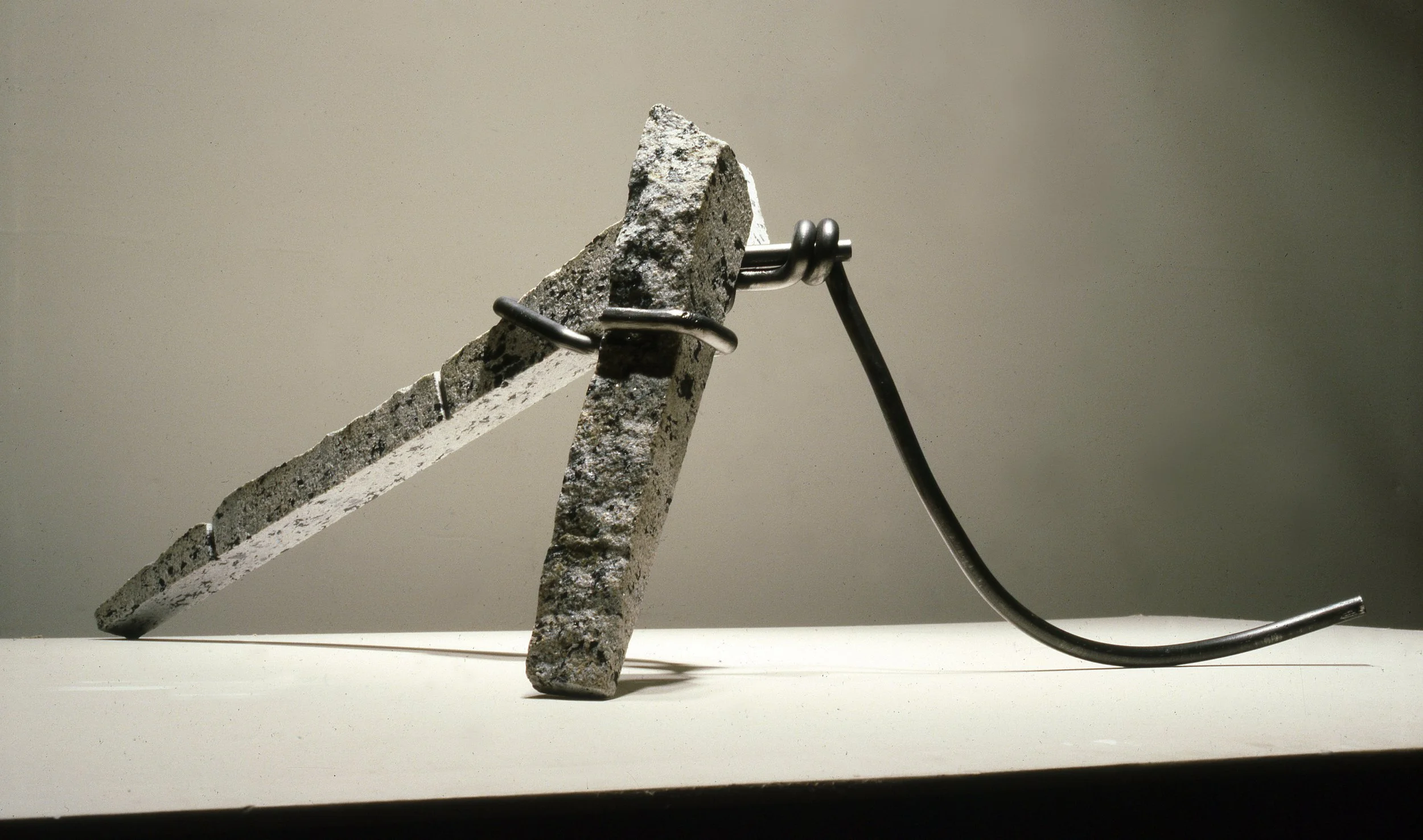
1982. Granite, forged steel. Dimensions: 13 × 24 × 15 in (33 × 61 × 38 cm).
Tripod with Umbilical II, 1982
Tripod with Umbilical II is a table-top variation on the “umbilical” theme and comes from a pivotal period when I was beginning to break away from the tightly formulated tensegrity, or Brute Series. The granite elements remain joined by interlocking forged-steel bars, retaining the earlier emphasis on gravity, structural interdependence, and visible assembly. Yet the steel begins to take on a new role, most notably in the long, curved bar that extends freely into the table surface and on into space rather than serving a purely structural function.
The projecting “umbilical” acts as a lifeline or symbolic connection between where my work had been and where it was heading. Its gestural line moves beyond the self-referential “sculpture about sculpture” concerns of the Brute Series toward a more expressive, associative, and metaphorical language that would emerge more fully later in 1982.
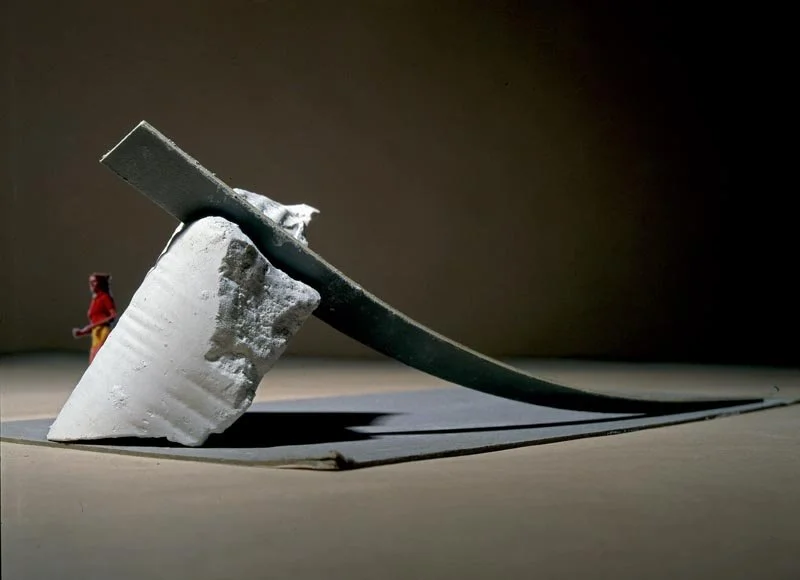
1981
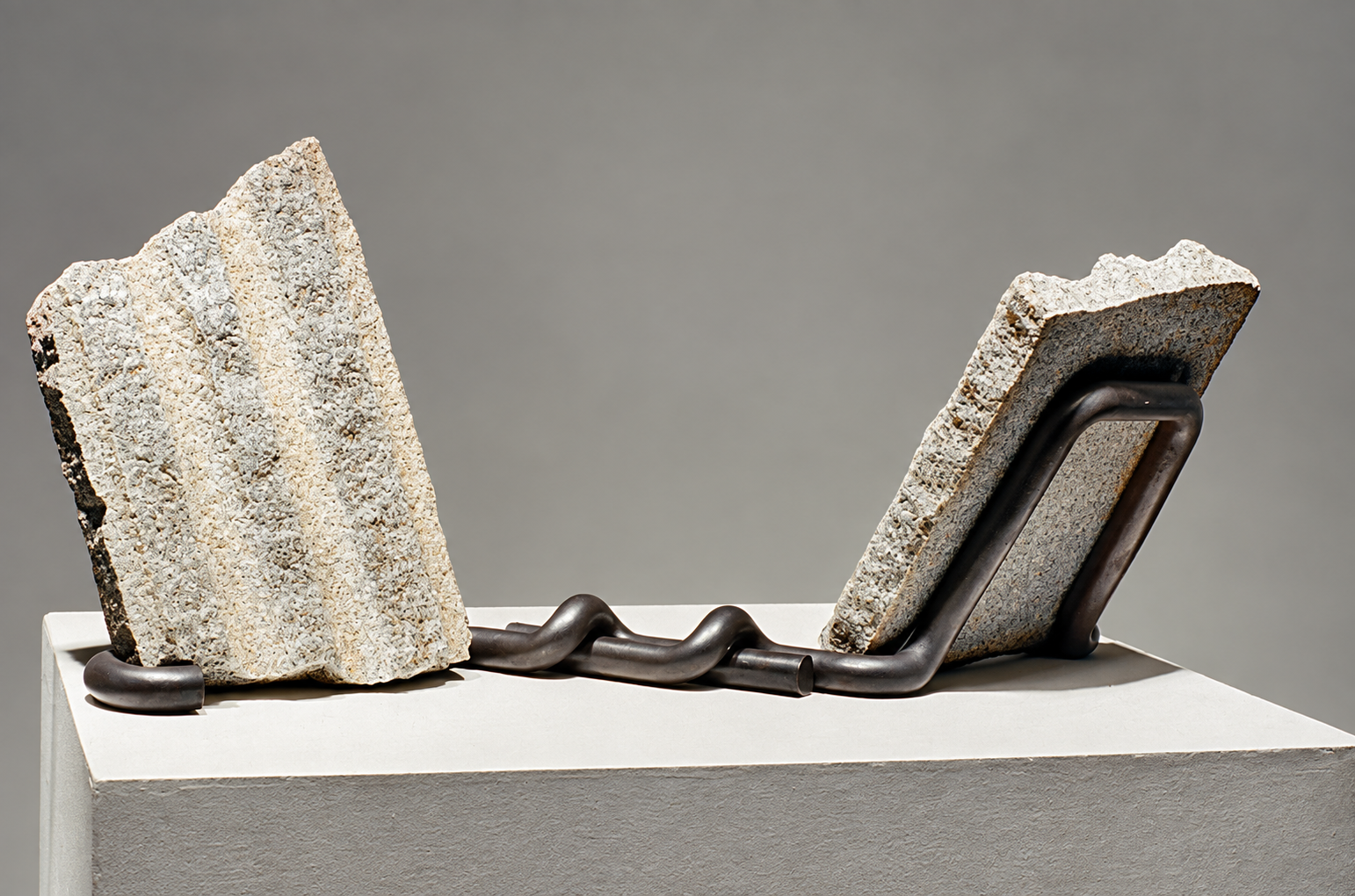
1981. Granite, forged steel. Dimensions: 38 × 16 × 15 in (97 × 41 × 38 cm). Private Collection.
Table Trough, 1981
Table Trough was created as a scale model for Trough, the large-scale public sculpture commissioned for Billings, Montana, and completed in 1982. The model explores the relationship between massive granite slabs and flowing, bent-steel elements that connect and support them. While rooted in the structural concerns of my tensegrity, or Brute Series, the steel takes on a more fluid, gestural character.
The model became the conceptual and structural basis for the full-scale Trough. In both, the weight of the granite and the force of gravity are channeled through the curved steel. Enlarged to an architectural scale in Billings, these relationships became a public sculpture that viewers could physically move around and through.
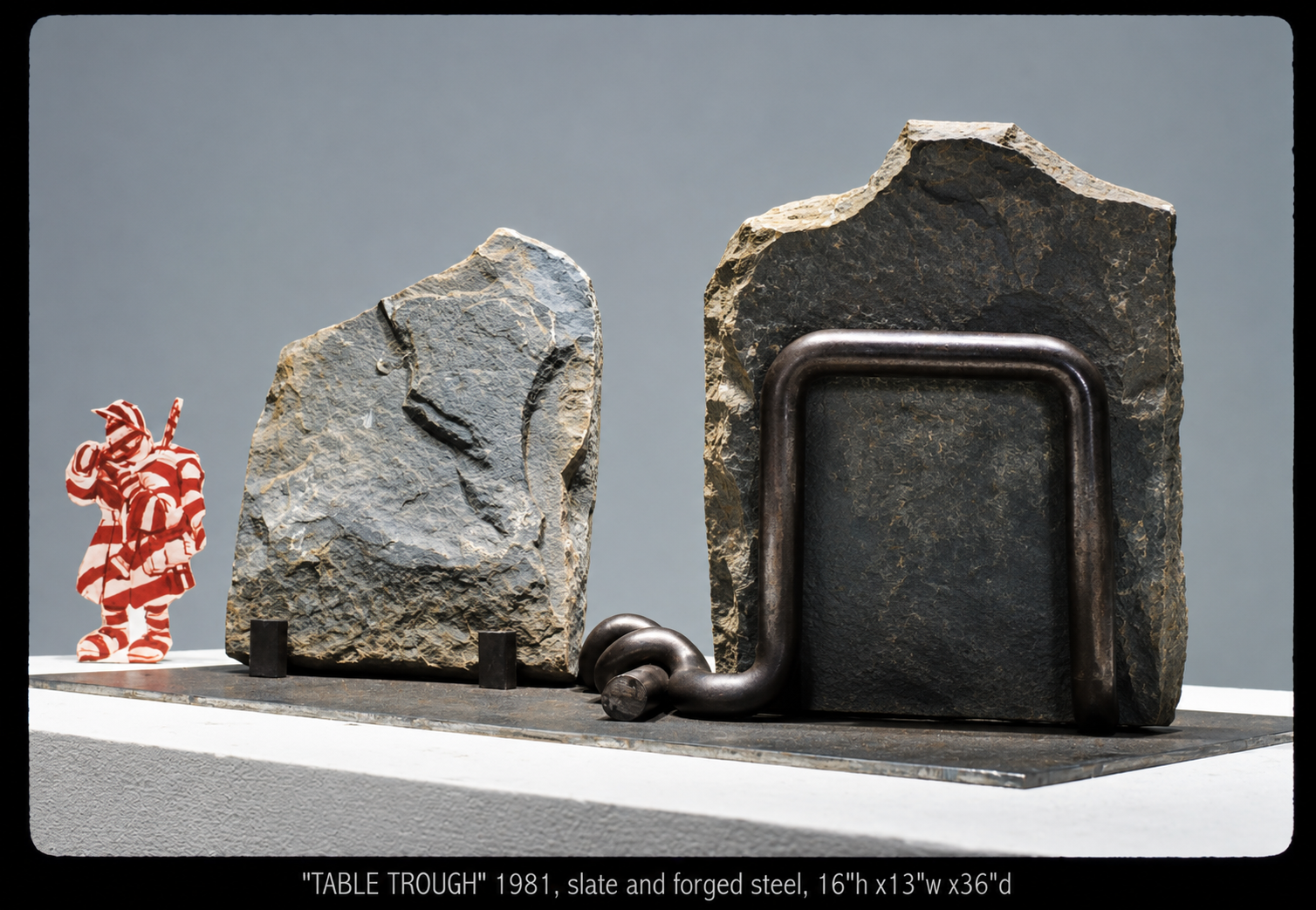
1980. Blue stone, steel. Dimensions: 16 × 15 × 38 in (41 × 38 × 97 cm).
Table Trough, 1981
Table Trough was created as a scale model for Trough, the large-scale public sculpture commissioned for Billings, Montana, and completed in 1982. Using bluestone and forged steel, the model explores the relationship between two massive stone forms connected by a flowing steel element. The weight and solidity of the stone contrast with the curved, linear movement of the steel, extending the structural concerns of my tensegrity, or Brute Series.
The model helped establish the basic vocabulary for the Billings commission: opposing stone masses, open space, and steel that bends around and connects the elements. Enlarged to an architectural scale in Trough, these relationships became a site-responsive public sculpture that viewers could physically move around and through.
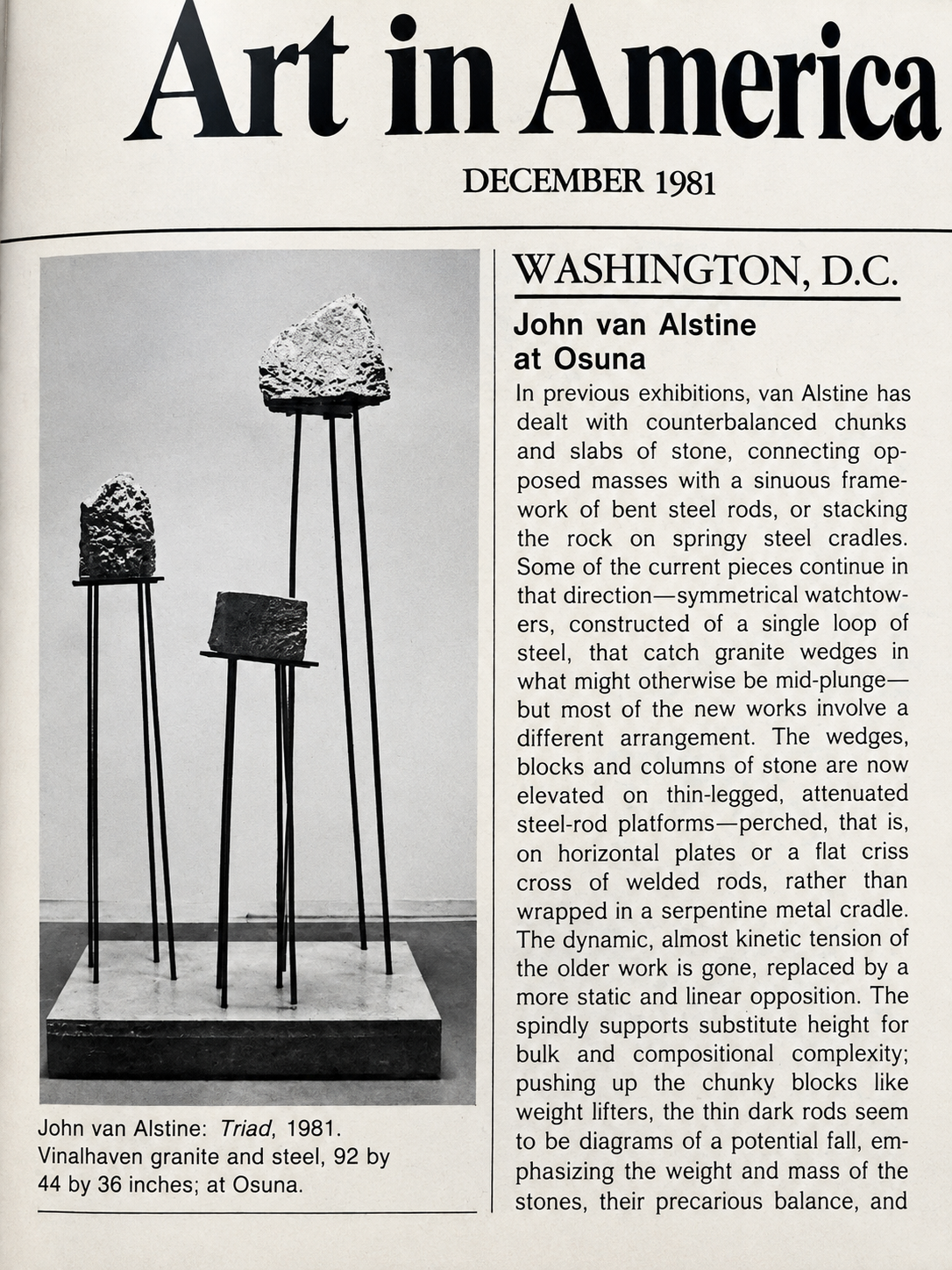
January 1981. Granite, steel. Dimensions: 92 × 44 ×36 in.
Triad belongs to a transitional group of works in which I began lifting stone away from the floor onto tall, attenuated steel structures. Three pieces of found Vinalhaven granite are elevated on slender steel-rod supports, emphasizing the contrast between the weight and mass of the stone and the apparent fragility of the structure supporting it. Writing about my 1981 Osuna Gallery exhibition, critics recognized this shift from the more complex, interlocking structures of my earlier tensegrity work toward taller, more linear configurations while retaining the underlying concerns with gravity, balance, and the possibility of collapse. Jo Ann Lewis similarly described these works as tall, stilt-like structures in which weight and balance remained central.
Although Triad moves away from the tightly interlocked vocabulary of the Brute Series, it preserves its sense of real physical tension and precarious balance. The thin steel legs seem almost inadequate to the task of supporting the massive stones, making gravity—and the possibility of falling—an active part of the sculpture. At the same time, the elevation and simplified vertical structure give the work a more architectural and increasingly image-driven presence. In retrospect, Triad points toward the broader transition that would become explicit the following year in Tripod with Umbilical, when I began deliberately breaking away from work that was primarily structurally driven.

January 1981. Granite, steel. Dimensions: 62 × 28 × 12 in (157 × 71 × 30 cm).
Private collection - Washington, DC
Vinalhaven Mantel Arch I grew out of my Arch and Prop sculptures and marks a transitional moment in my tensegrity, or Brute Series. Wanting to lift these works from the floor and give them greater visual presence, I began constructing tall, pedestal-like mantels using the same steel rod employed in the earlier tensegrity works. Two found pieces of granite, gathered from abandoned quarries on Vinalhaven Island off the coast of Maine, are balanced point-to-point to create a precarious arch. Small steel rods welded to either end of the top plate act as retainers, preventing the stones from slipping outward and the arch from collapsing.
Like my earlier tensegrity works, the sculpture depends upon actual gravity, weight, balance, and restraint, creating a sense of real rather than illusionary danger—an approach influenced in part by Richard Serra’s emphasis on the physical reality of sculpture. At the same time, the tall steel framework introduces a more architectural and image-driven presence. Vinalhaven Mantel Arch I therefore stands between the direct, structural concerns of the Brute Series and the broader expressive and associative possibilities that would increasingly enter my work over the next several years.
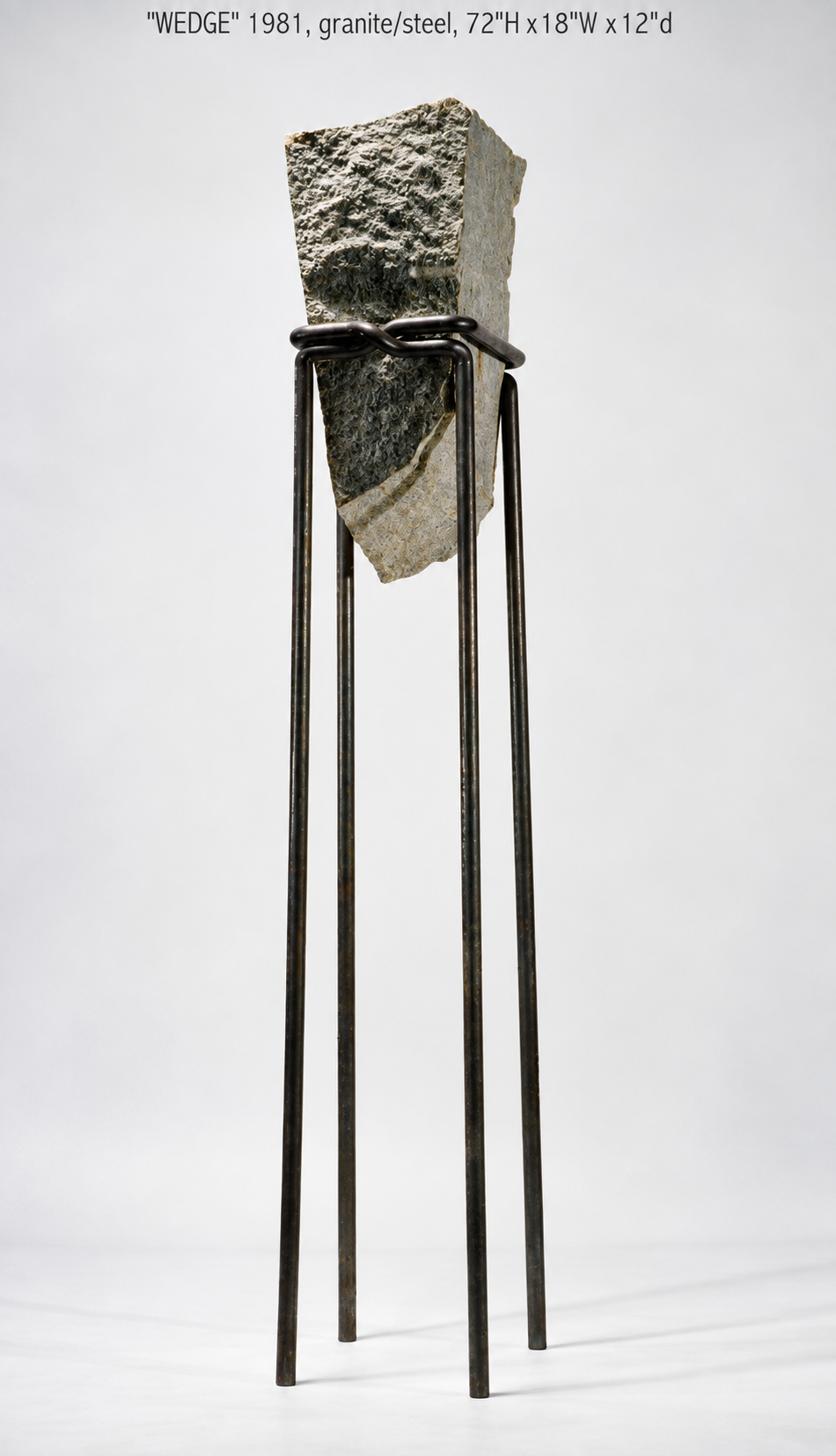
January 1981. Granite, steel. Dimensions: 72 × 18 × 12 in (183 × 46 × 30 cm). private collection,
Wedge, 1981
Wedge was the first in a series that combined the elevated, stilt-like structures of works such as Triad and the Mantel Arches with the structural principles of my tensegrity, or Brute Series. Unlike the carved marble Wedges of 1975, which predated my tensegrity concerns, here a wedge-shaped piece of granite is suspended within long forged-steel rods that wrap and interlock around the stone. Gravity and the weight of the granite provide the energy—or “glue”—that locks the structure together, continuing my use of stone as an active structural element.
As with titles such as Crimp and Torque, Wedge is deliberately both noun and verb: it identifies the stone form while also describing the action taking place. The granite is literally wedged into the steel structure, making the sculpture both object and action. The work extends my exploration of weight, balance, tension, and visible assembly into a more vertical and architectural form. Several additional Wedge sculptures followed.

January 1981. Granite, steel. Dimensions: 70 × 38 × 12 in (178 × 97 × 30 cm).
Private collection - Washington, DC
Vinalhaven Mantel Arch II, 1981
Vinalhaven Mantel Arch II directly followed Vinalhaven Mantel Arch I and grew out of my Arch and Prop sculptures and marks a transitional moment in my tensegrity, or Brute Series. Wanting to lift these works from the floor and give them greater visual presence, I began constructing tall, pedestal-like mantels using the same steel rod employed in the earlier tensegrity works. Two found pieces of granite, gathered from abandoned quarries on Vinalhaven Island off the coast of Maine, are balanced point-to-point to create a precarious arch. Small steel rods welded to either end of the top plate act as retainers, preventing the stones from slipping outward and the arch from collapsing.
Like my earlier tensegrity works, the sculpture depends upon actual gravity, weight, balance, and restraint, creating a sense of real rather than illusionary danger—an approach influenced in part by Richard Serra’s emphasis on the physical reality of sculpture. At the same time, the tall steel framework introduces a more architectural and image-driven presence. Vinalhaven Mantel Arch I and II therefore stands between the direct, structural concerns of the Brute Series and the broader expressive and associative possibilities that would increasingly enter my work over the next several years.

1981. Granite, steel. Dimensions: 77 × 20 × 20 in (196 × 51 × 51 cm).
Stone Column, 1981
Stone Column extends the structural concerns of my tensegrity, or Brute Series, into a tall, spare vertical form. A wedge-shaped piece of granite is elevated within long forged-steel bars that rise from the base and wrap around the stone. Gravity and the weight of the granite become active structural forces, creating a precarious but stable equilibrium—a static energy event held in arrested motion.
The extreme verticality gives the sculpture an almost architectural or totemic presence, while the long steel bars function as lines drawn in space. Unlike Wedge Column, where the forged bars visibly weave and interlock, Stone Column is more restrained and symmetrical, concentrating the structural action at the top where the steel grips and supports the stone. The result is a direct expression of weight, elevation, tension, and balance.

January 1981. Granite, steel. Dimensions: 92 × 32 × 32 in (234 × 81 × 81 cm).
Private collection - Washington, DC
Wedge V, 1981
Wedge V extends the structural principles of my tensegrity, or Brute Series, into a tall, open framework. A wedge-shaped piece of granite is suspended high within long forged-steel bars, its weight becoming the active force that locks the elements together. The stone appears precariously elevated, yet the opposing forces of gravity, tension, and compression create a stable equilibrium—a static energy event held in arrested motion.
The elongated steel supports act as lines drawn in space, emphasizing the distance between the suspended stone and the ground. At the top, the forged bars wrap and interlock tightly around the granite, making the mechanics of assembly visible. The work brings together two recurring concerns in my sculpture: the physical interaction of stone and steel and the expressive possibilities of elevation, balance, and gravity.

Walking Column, 1981
January 1981. Granite, steel. 98 × 40 × 40 in (249 × 102 × 102 cm).
Private collection, Aiken, SC.
Walking Column features a tall, narrow piece of granite elevated and held within a spare framework of forged-steel bars. Gravity and the weight of the stone remain active structural forces, but the outward-curving steel legs give the sculpture an animated, almost figurative presence, as though the massive stone has been lifted from the ground and set in motion.
The title plays on the contradiction between the immovable nature of stone and the suggestion of movement. The long steel supports function both structurally and as lines drawn in space, transforming the column into something that appears to stand, stride, or walk. The work reflects my growing interest during this period in moving beyond purely structural concerns toward a more associative and expressive sculptural language.

1981. Granite, steel. Dimensions: 81 × 40 × 32 in (206 × 102 × 81 cm). Destroyed.
Gable Top, 1981
Gable Top continues my exploration of elevated stone forms during this period. A massive, roughly triangular piece of granite rests high within a spare framework of forged-steel bars, its weight and gravity becoming active parts of the sculpture. The long, slightly flared supports lift the stone well above the ground, creating a tension between its substantial mass and the apparent lightness of the open structure.
The title comes directly from the granite’s naturally occurring gable-like shape, suggesting the roofline of a simple architectural structure. Rather than carving the stone to create this association, I responded to its existing form and allowed the steel framework to reinforce it. The result brings together recurring concerns in my work—weight and elevation, stone and steel, nature and architecture—while moving toward a more associative sculptural language.

Vinalhaven Arch VII, 1981
Granite, steel. 24 × 45 × 10 in (61 × 114 × 25 cm).
Private collection, Washington, DC.
Vinalhaven Arch VII is part of my continuing exploration of the arch within the tensegrity, or Brute Series. Rough granite stones lean and bear upon one another, using gravity, compression, and their considerable weight to create a precarious but stable structure. A long forged-steel bar beneath the stones binds the composition together, while the open central space becomes as important as the physical elements surrounding it.
The title refers to Vinalhaven, Maine, where I sourced the granite. Rather than carving the stones, I worked with their existing shapes, mass, and irregular surfaces, positioning them so weight and pressure become active structural forces. In this work, as in several others from the series, I employed hidden steel pins to secure some of the stones in service of the overall composition—a departure from my earlier insistence that the means of assembly remain visible.

1981. Granite, steel. Dimensions: 18 × 38 × 12 in (46 × 97 × 30 cm).
Vinalhaven Arch IX, 1981
Vinalhaven Arch IX is part of my continuing exploration of the arch within the tensegrity, or Brute Series. Rough granite blocks lean and bear upon one another to create a self-supporting arch in which gravity and compression become active structural forces. The long forged-steel bar running beneath the stones binds the composition together, making the forces of weight, pressure, and balance visible.
The title refers to Vinalhaven, Maine, where I sourced the stones. Rather than carving the stone into an architectural form, I use its existing shape, mass, and irregular surfaces to construct the arch. For the first time I employed hidden steel pins to secure several of the stones in service of the overall image, a departure from my earlier works.
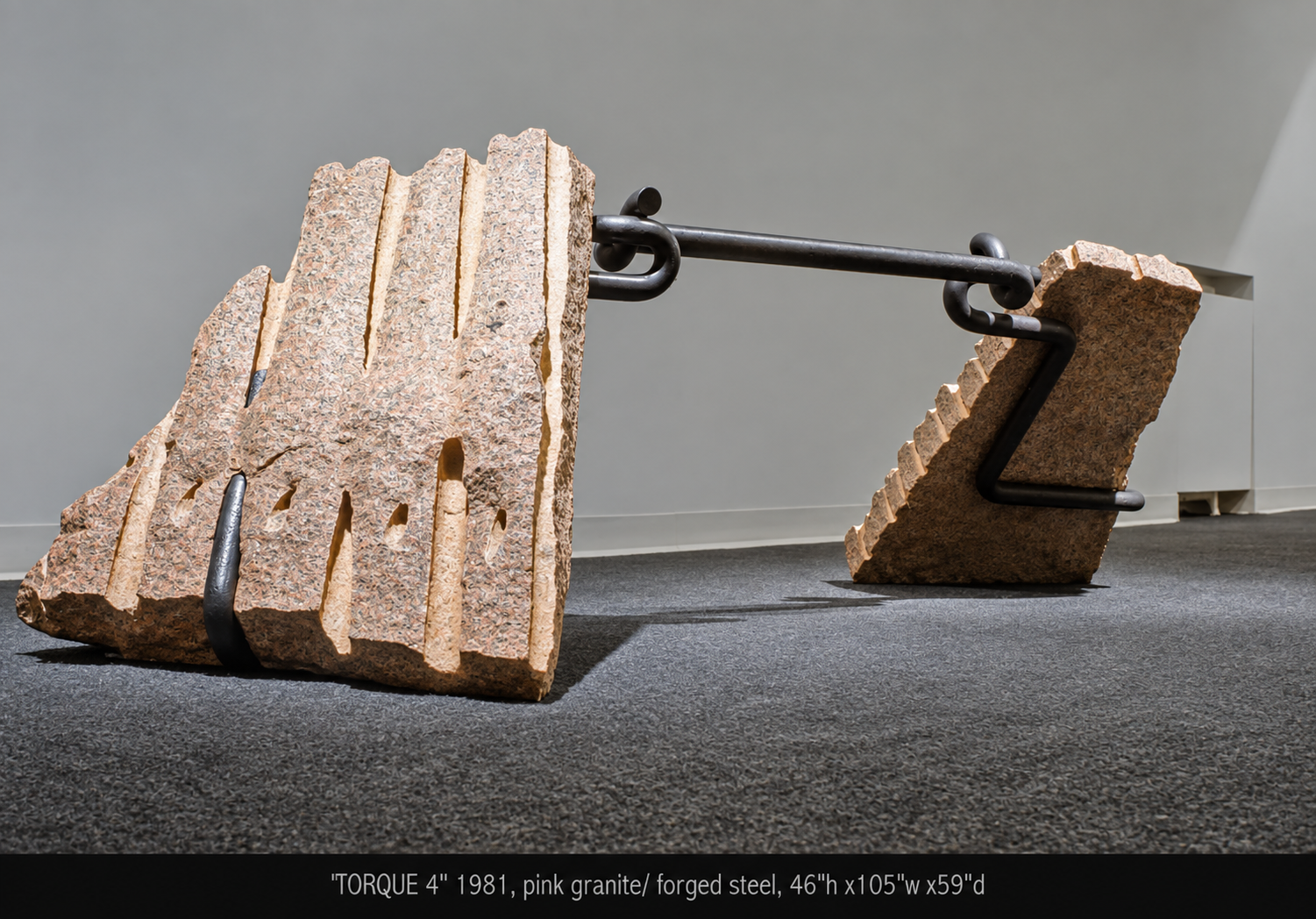
January 1981. Pink granite, steel. Dimensions: 44 × 105 × 59 in (112 × 267 × 150 cm).
Private collection - Washington, DC
Torque 4 is part of my tensegrity, or Brute Series, in which gravity, weight, tension, and compression become active sculptural forces. Two rough granite forms are held in equilibrium by interlocking forged-steel bars, with the weight of the stones literally torquing the steel together. Gravity becomes the energy—or “glue”—that holds the sculpture without welding, creating what I think of as a “static energy event”—a sculpture held in arrested motion.
The title Torque describes both the twisting force within the sculpture and the action responsible for its assembly. The natural mass and quarry marks of the granite are left intact, while the forged steel traces and makes visible the forces acting between the stones. In this sense, the work is deliberately self-referential—sculpture about sculpture, assemblage about assemblage—with the act of holding its materials together becoming both its structure and its subject.

1981. Granite, steel. Dimensions: 77 × 21 × 18 in (196 × 53 × 46 cm).
Private collection - Washington, DC
Wedge Column, 1981
Wedge Column extends the structural concerns of my tensegrity, or Brute Series, into a tall, attenuated vertical form. A wedge-shaped piece of granite is suspended high within long forged-steel rods that wrap and interlock around the stone. Gravity and the weight of the granite place the steel under tension, creating an interdependent structure in which the stone appears precariously elevated yet firmly held—a static energy event in arrested motion.
The forged-steel rods continue downward as long lines drawn in space, connecting the suspended stone to the base. At both top and bottom, the bars bend, cross, and weave around one another, making the forces holding the sculpture together visually explicit. The work combines the physical principles of my Brute Series with an increasing interest in verticality, elevation, and the expressive linear qualities of forged steel.
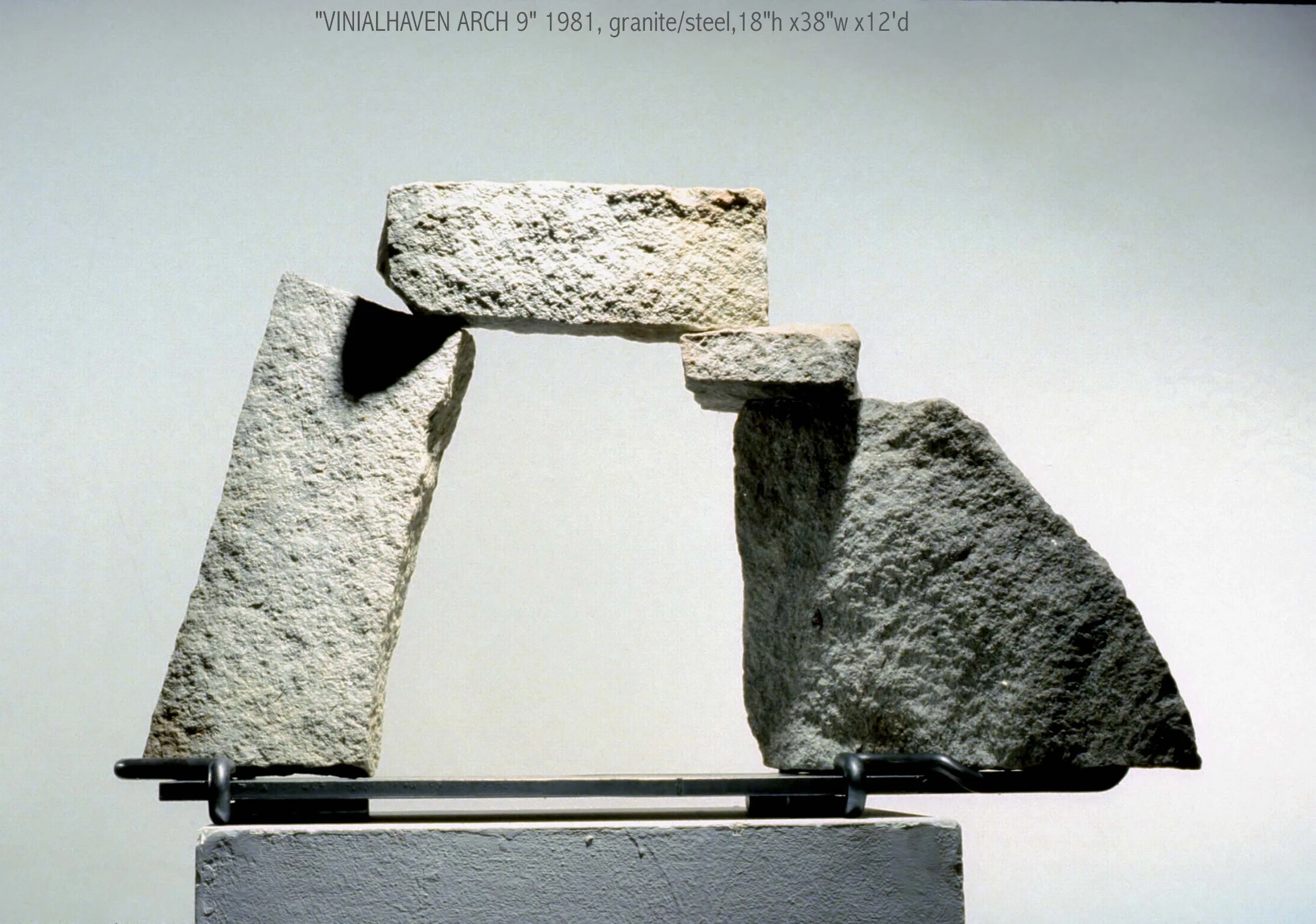

January 1981. Granite, steel. Dimensions: 36 × 56 × 36 in (91 × 142 × 91 cm).
Private collection - New York
Torque 5 is part of my tensegrity, or Brute Series, in which gravity, weight, tension, and compression become active sculptural forces. Two rough granite forms are held in equilibrium by interlocking forged-steel bars, with the weight of the stones literally torquing the steel together. Gravity becomes the energy—or “glue”—that holds the sculpture without welding, creating what I think of as a “static energy event”—a sculpture held in arrested motion.
The title Torque describes both the twisting force within the sculpture and the action responsible for its assembly. The natural mass and quarry marks of the granite are left intact, while the forged steel traces and makes visible the forces acting between the stones. In this sense, the work is deliberately self-referential—sculpture about sculpture, assemblage about assemblage—with the act of holding its materials together becoming both its structure and its subject.
Note: the blocky piece of granite used here was recycled from “Stonealope” (S-77-09)

January 1981. Granite, steel. Dimensions: 28 × 54 × 22 in (71 × 137 × 56 cm).
Private collection - New York
Torque VI is part of my tensegrity, or Brute Series, in which gravity, weight, tension, and compression become active sculptural forces. Two rough granite forms are held in equilibrium by interlocking forged-steel bars, with the weight of the stones literally torquing the steel together. Gravity becomes the energy—or “glue”—that holds the sculpture without welding, creating what I think of as a “static energy event”—a sculpture held in arrested motion.
The title Torque describes both the twisting force within the sculpture and the action responsible for its assembly. The natural mass and quarry marks of the granite are left intact, while the forged steel traces and makes visible the forces acting between the stones. In this sense, the work is deliberately self-referential—sculpture about sculpture, assemblage about assemblage—with the act of holding its materials together becoming both its structure and its subject.
January 1990. Granite, steel. Dimensions: 22 × 30 × 15 in (56 × 76 × 38 cm). Collection: Ringling Museum of Art, Sarasota, FL. Gift of Murray Bring and Kate Delaney Bring.
Pique à Terre I, 1989
Pique à Terre I, the first work in the series, grew as a spin-off from my earlier Rounder and Go-Round Series, carrying forward the circular steel arc and my ongoing interest in combining the raw weight of stone with industrial metal. Here, however, the relationship becomes more explicitly connected to movement and the human figure. The granite appears poised and lifted, while the sweeping perforated steel arc gives the heavy elements a sense of motion and levity.
The title comes from classical ballet, referring to a pose in which one toe lightly touches the ground while the other foot is firmly planted and an arm makes a sweeping gesture. That idea became central to the series: I began thinking of myself as a choreographer, arranging dense, earthbound materials so that they seem almost to dance. The challenge was to transform the inherent heaviness of stone into something suggesting balance, gesture, and grace.