2000
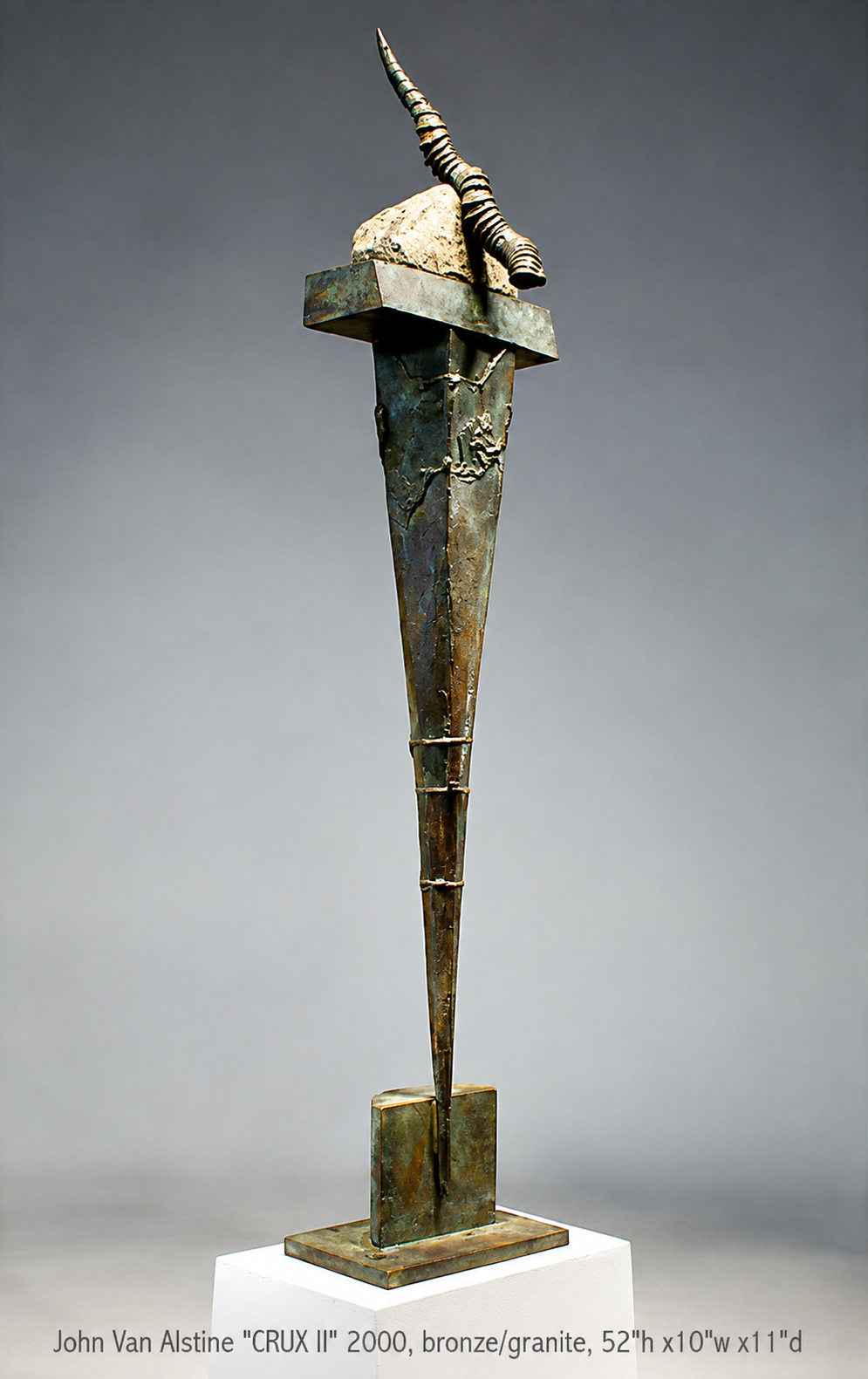
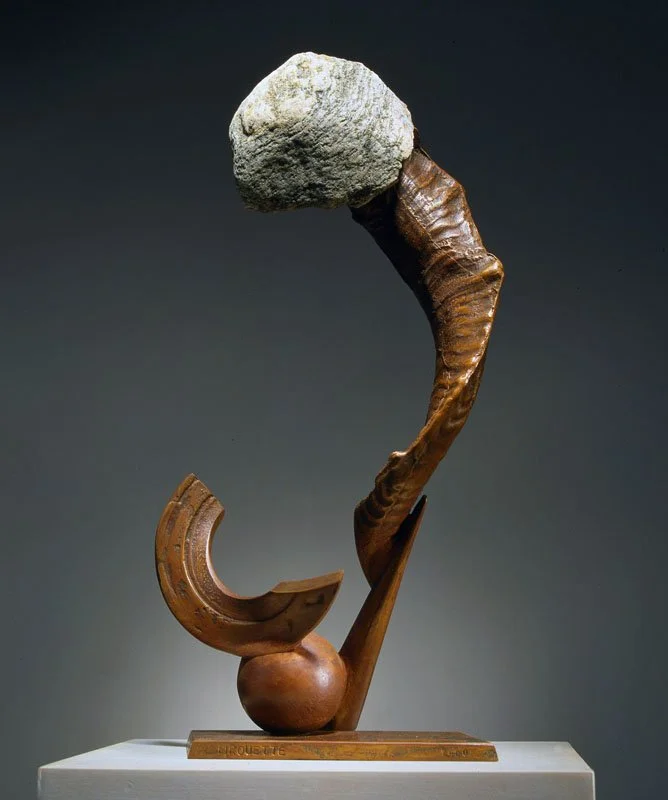
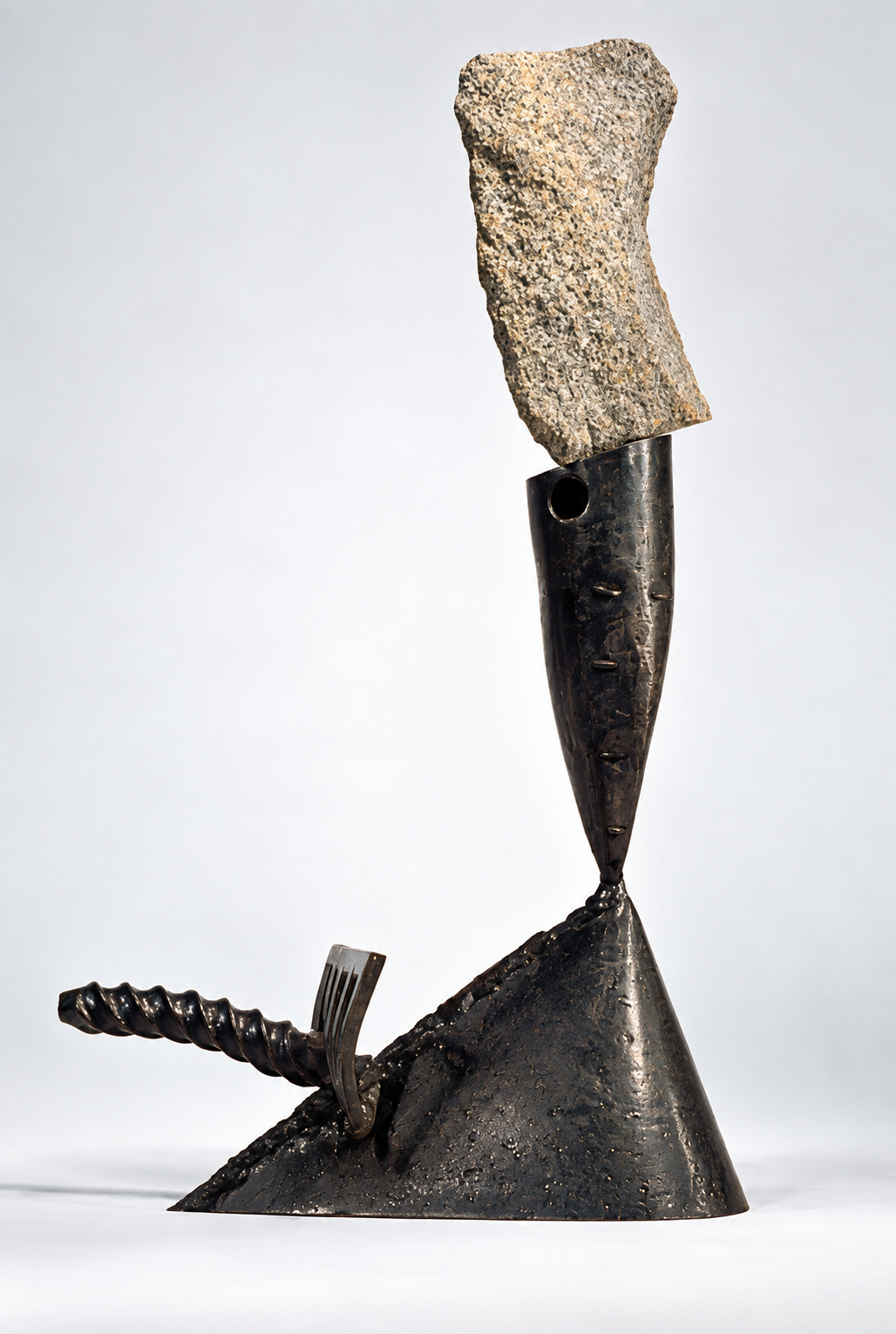
2000. Bronze, granite. Dimensions: 52 × 10 × 11 in (132 × 25 × 28 cm). Corporate Collection.
Crux II, 2000
Crux II, the second work in the Crux Series, continues my exploration of natural and human-made materials. A rough granite form is elevated atop a tall, tapering bronze structure.
The cast bronze horn reflects my growing interest in the spiraling geometry of animal forms. Horn, stone, and bronze come together in a vertical, almost emblematic configuration, balancing organic form with constructed structure.
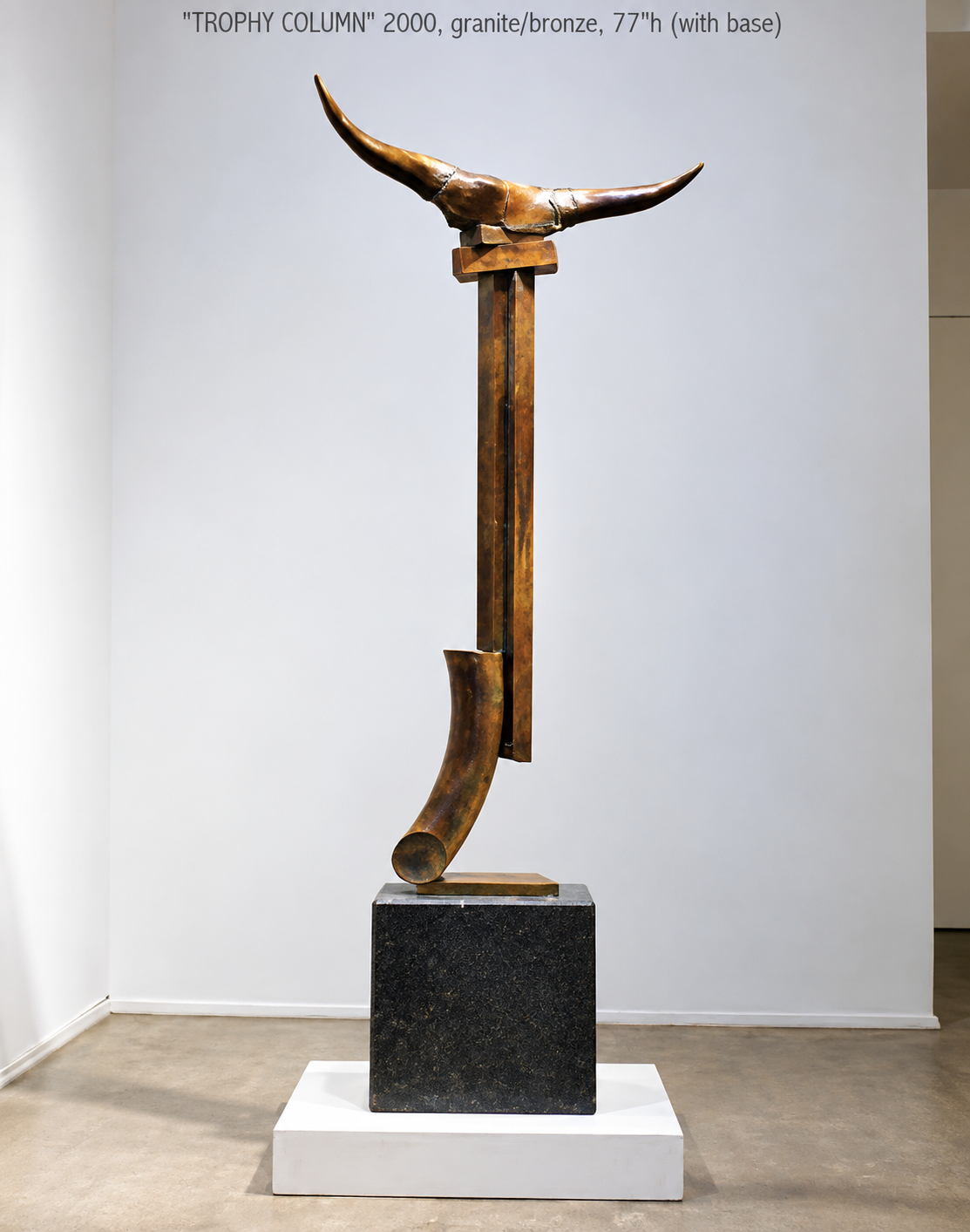
January 2000. Bronze. Dimensions: 62 × 29 × 8 in (157 × 74 × 20 cm). Disassembled 2021 parts used for new works.
Trophy Column, 2000
Trophy Column is unusual in my work from this period because it contains no stone. Constructed entirely in bronze, it incorporates animal horns cast from natural forms. I was drawn to their sweeping arcs and organic geometry, which extend the curving forms already present in my sculpture.
The title refers to the trophy-like presentation of the horns atop the column, recalling mounted animal trophies common to Adirondack hunting culture. Here, the familiar form is transformed into sculpture, bringing natural form and human-made structure together.
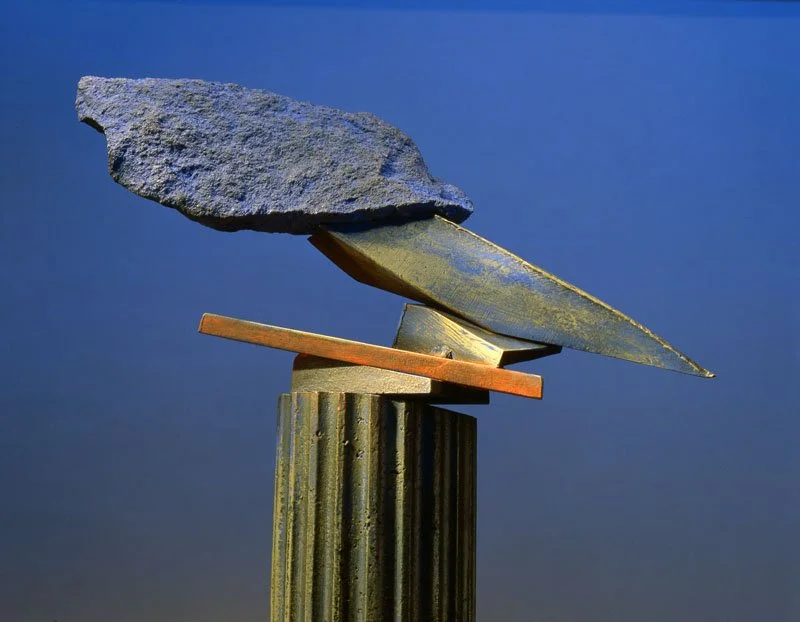
April 2000. painted granite and steel/cast iron. Dimensions: 78 × 23 × 21 in (198 × 58 × 53 cm).
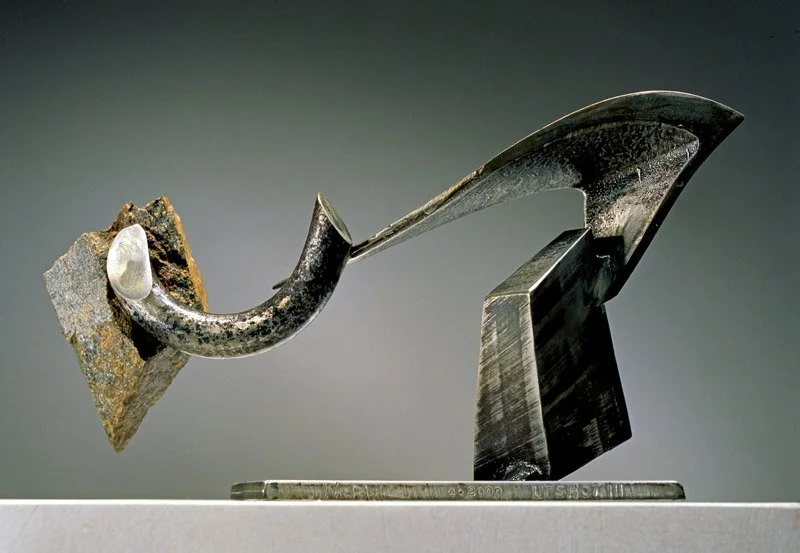
April 2000. Granite, steel. Dimensions: 8 × 17 × 6 in (20 × 43 × 15 cm).
Private collection - Sarasota FL
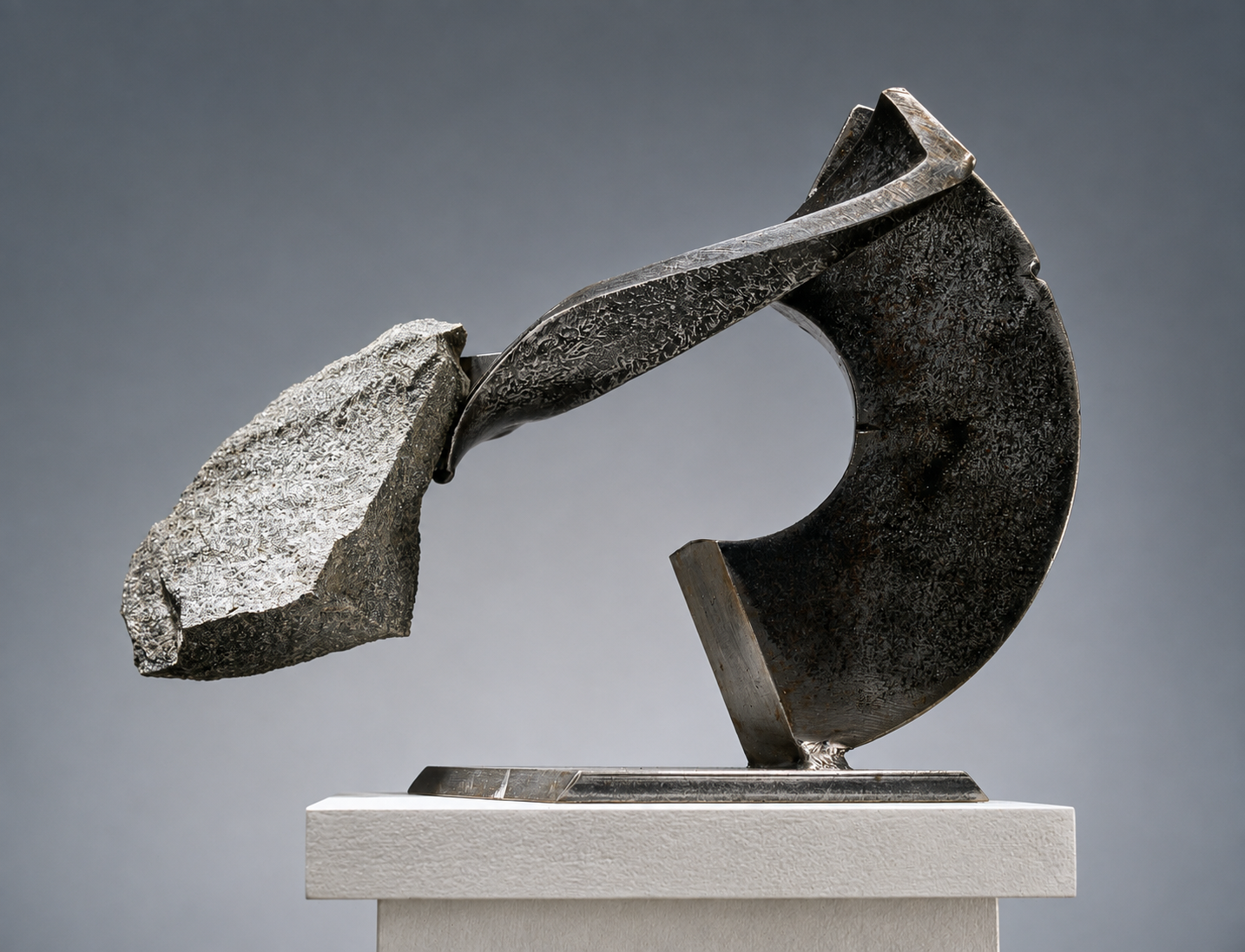
April 2000. Granite, steel. Dimensions: 12 × 18 × 6 in (30 × 46 × 15 cm). Private collection.
Tiller IV, 2000
Tiller IV continues my interest in tools and implements as expressive sculptural forms—extensions of the human hand and body that help us act upon and negotiate the world. The title refers to the tiller as a navigational device used to steer a ship or vessel. I have long been interested in such instruments because they help us carry out decisions and “chart a course,” transforming a functional implement into a metaphor for personal and societal navigation.
In this sense, the tiller becomes more than a physical steering device. It suggests our continuing effort to find direction through both the physical and psychological worlds—to make choices, adjust course, and move forward. This connection between tool, human action, and navigation makes the tiller especially rich subject matter for my sculpture.
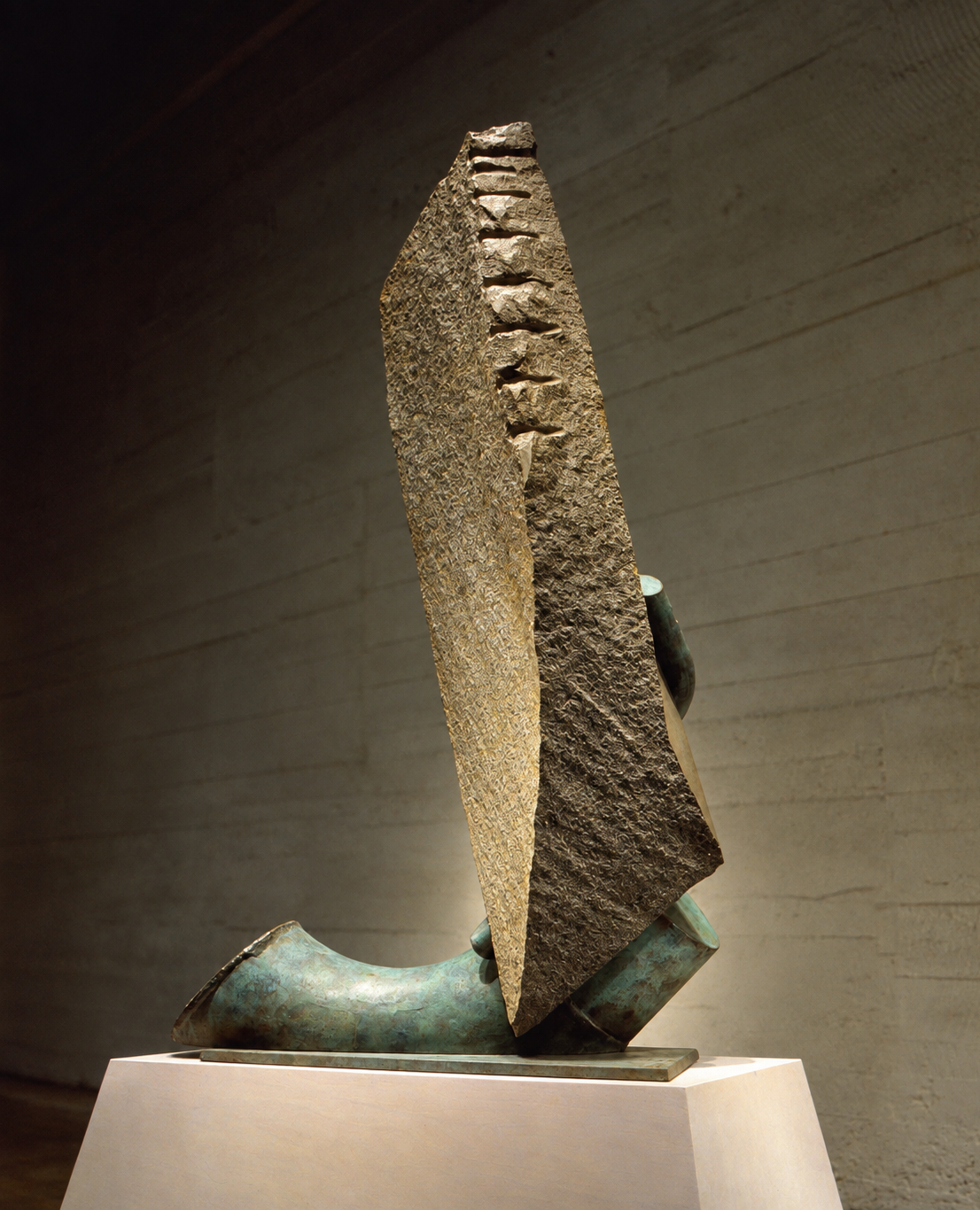
May 2000. Bronze, granite. Dimensions: 60 × 34 × 24 in (152 × 86 × 61 cm).
Corporate collection - Washington, DC
Flatbottom, 2000
Flatbottom combines black Pennsylvania granite and bronze, continuing my interest in bringing natural and human-made materials together. The curved bronze forms support and counter the tall granite slab, giving the heavy stone an unexpected sense of movement and balance.
The title is deliberately straightforward: Flatbottom simply refers to the flat bottom of the granite. The related drawings explore the same relationship between the upright stone and sweeping bronze forms with greater freedom and spontaneity.

May 2000. Bronze, granite. Dimensions: 17 × 10 × 5 in (43 × 25 × 13 cm).
Cannibalized to make “Rollover 02” (T-02-40)
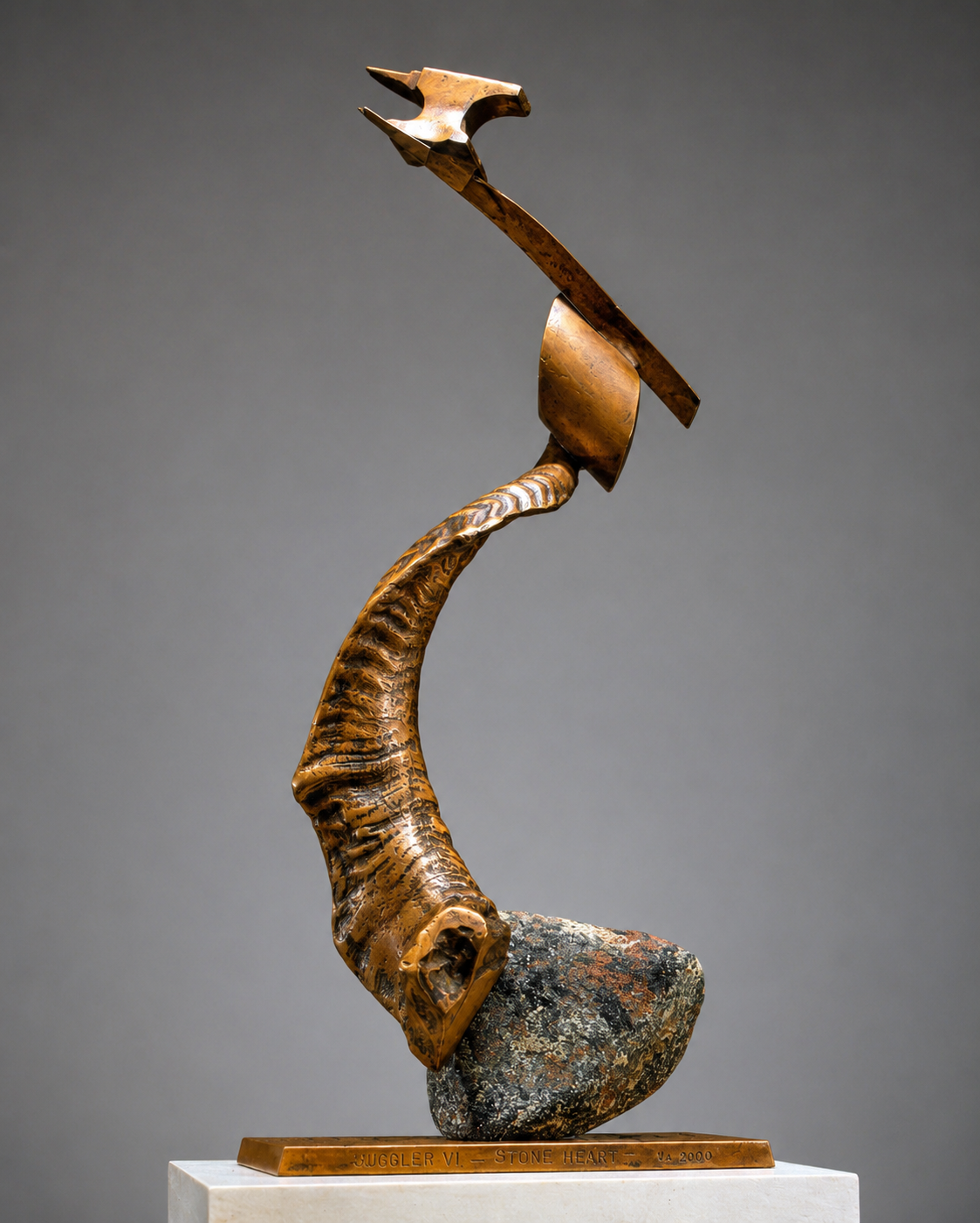
June 2000. Bronze, granite. Dimensions: 22 × 10 × 5 in (56 × 25 × 13 cm).
Private collection - New York State
Many of Van Alstine’s works take inspiration from the movement of the human body. This work can be seen as a kind of self-portrait, suggesting his studio process—literally juggling and repositioning the individual elements of a sculpture until they achieve a moment of perfect balance, then freezing that moment in space through welding. More universally, juggling becomes a metaphor for the way we all balance the competing demands of family, work, play, and responsibility.
The anvil, which appears in a number of the artist’s works, represents both the ultimate heavy object to “juggle” and the act of assembly itself—the forging together of object, material, and ideas that is central to Van Alstine’s work.
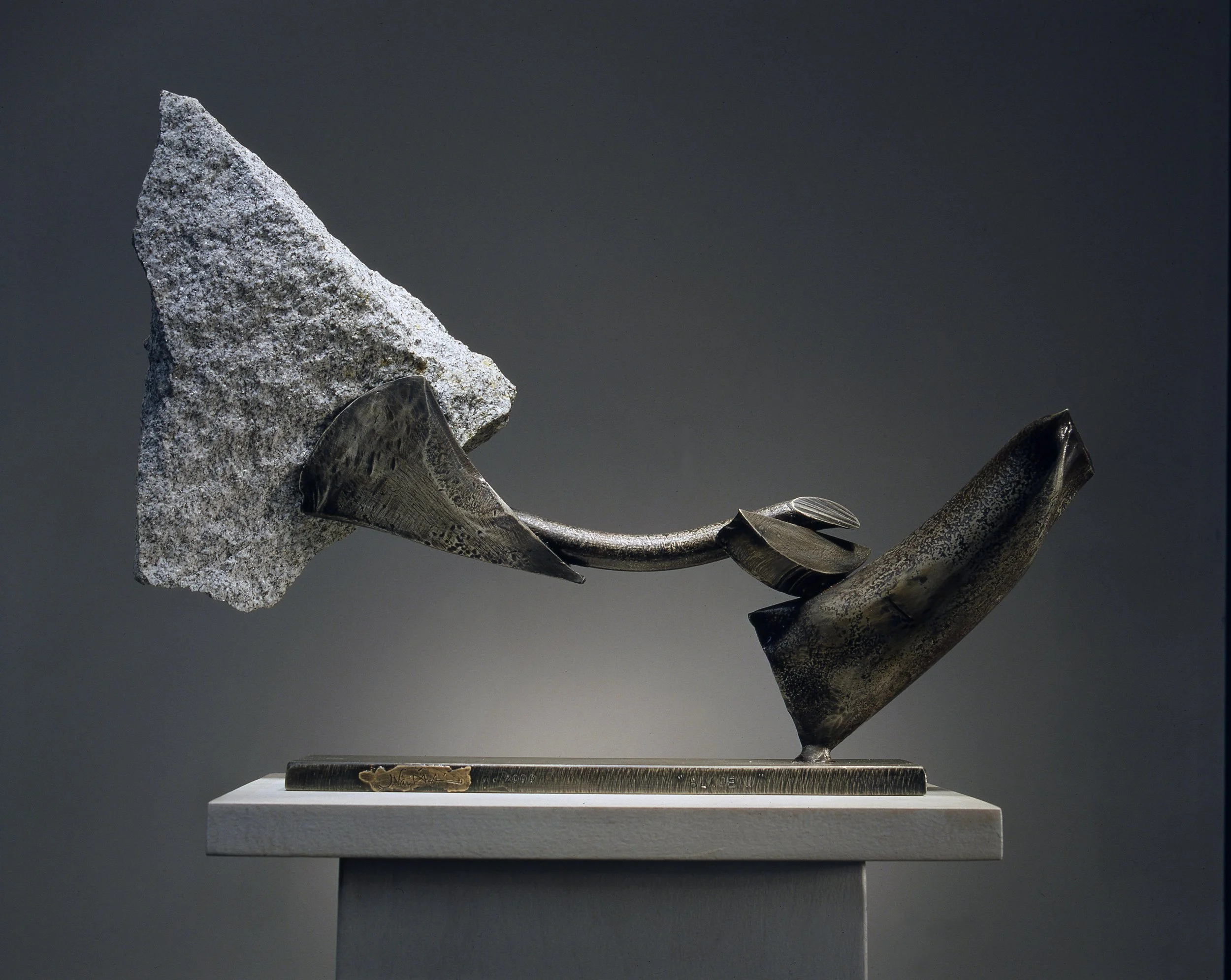
July 2000. Granite, steel. Dimensions: 16 × 22 × 5 in (41 × 56 × 13 cm).
Collection: Adirondack Museum, Blue Mountain Lake, NY

July 2000. Bronze, granite. Dimensions: 12 × 17 × 8 in (30 × 43 × 20 cm).
Private collection
Van Alstine is drawn to horns, antlers, and nautilus-like forms because nature has already endowed them with an extraordinary geometric logic—the arc, spiral, taper, and expanding curve. Cast in bronze, these organic structures become part of his constructed vocabulary, moving freely between natural form and human implement. Their long cultural associations also allow them to evoke classical mythology—from the cornucopia and Amalthea to broader ideas of strength, abundance, survival, and transformation—without becoming literal illustrations.
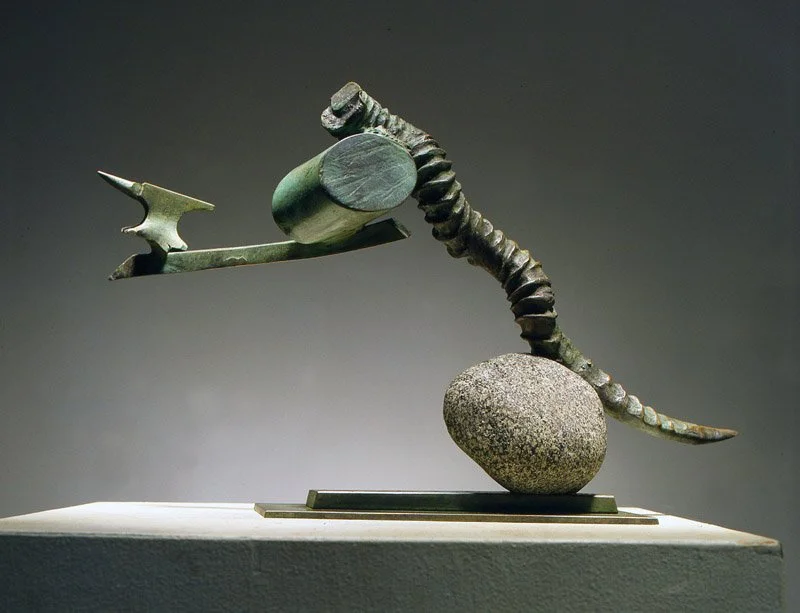
July 2000. Bronze, granite. Dimensions: 12 × 20 × 7 in (30 × 51 × 18 cm). Private Collection.
Many of Van Alstine’s works take inspiration from the movement of the human body. This work can be seen as a kind of self-portrait, suggesting his studio process—literally juggling and repositioning the individual elements of a sculpture until they achieve a moment of perfect balance, then freezing that moment in space through welding. More universally, juggling becomes a metaphor for the way we all balance the competing demands of family, work, play, and responsibility.
The anvil, which appears in a number of the artist’s works, represents both the ultimate heavy object to “juggle” and the act of assembly itself—the forging together of object, material, and ideas that is central to Van Alstine’s work.
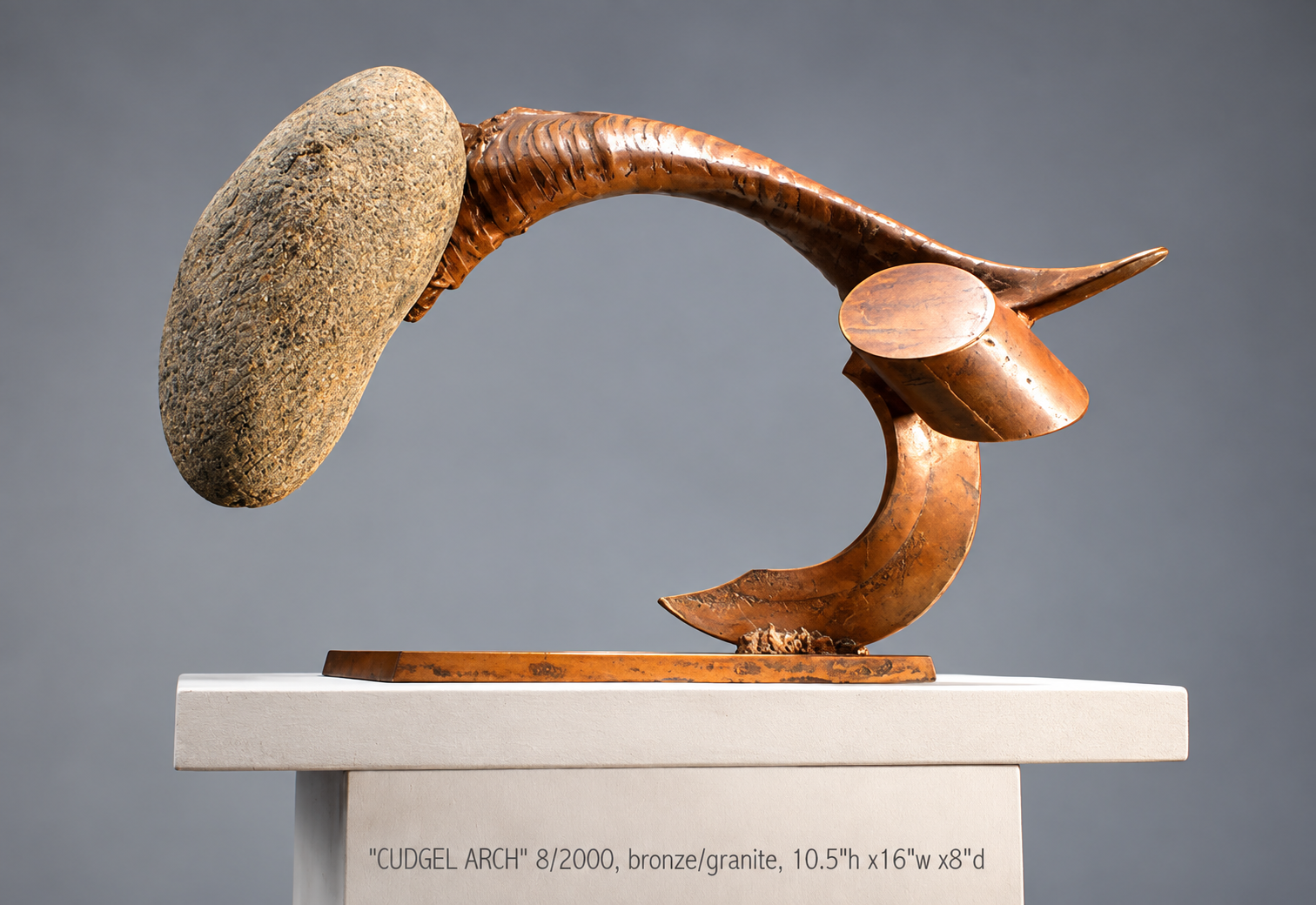
August 2000. Bronze, granite. Dimensions: 10.5 × 16 × 8 in (27 × 41 × 20 cm). Stone replaced resulting in new work: Cudgel ‘03.
Cudgel Arch, 2000
Cudgel Arch is part of my ongoing Cudgel Series and continues my interest in tools and implements as expressive sculptural forms. The sweeping bronze arc suggests a handle, while the rounded granite becomes the heavy head of a primitive tool or club. Unlike the sharper stones in earlier Cudgel works, which suggest a blade, its rounded form gives the sculpture a more distinctly club-like character.
Cudgel Arch also marks my first use in the series of an animal horn cast in bronze, reflecting my interest in the natural spiraling geometry of horns and other organic forms. The horn reinforces the primitive, elemental character of the imagined tool while bringing natural form and human-made implement together.
The stone broke and a new stone was attached resulting in Cudgel 03 (T-03-03)
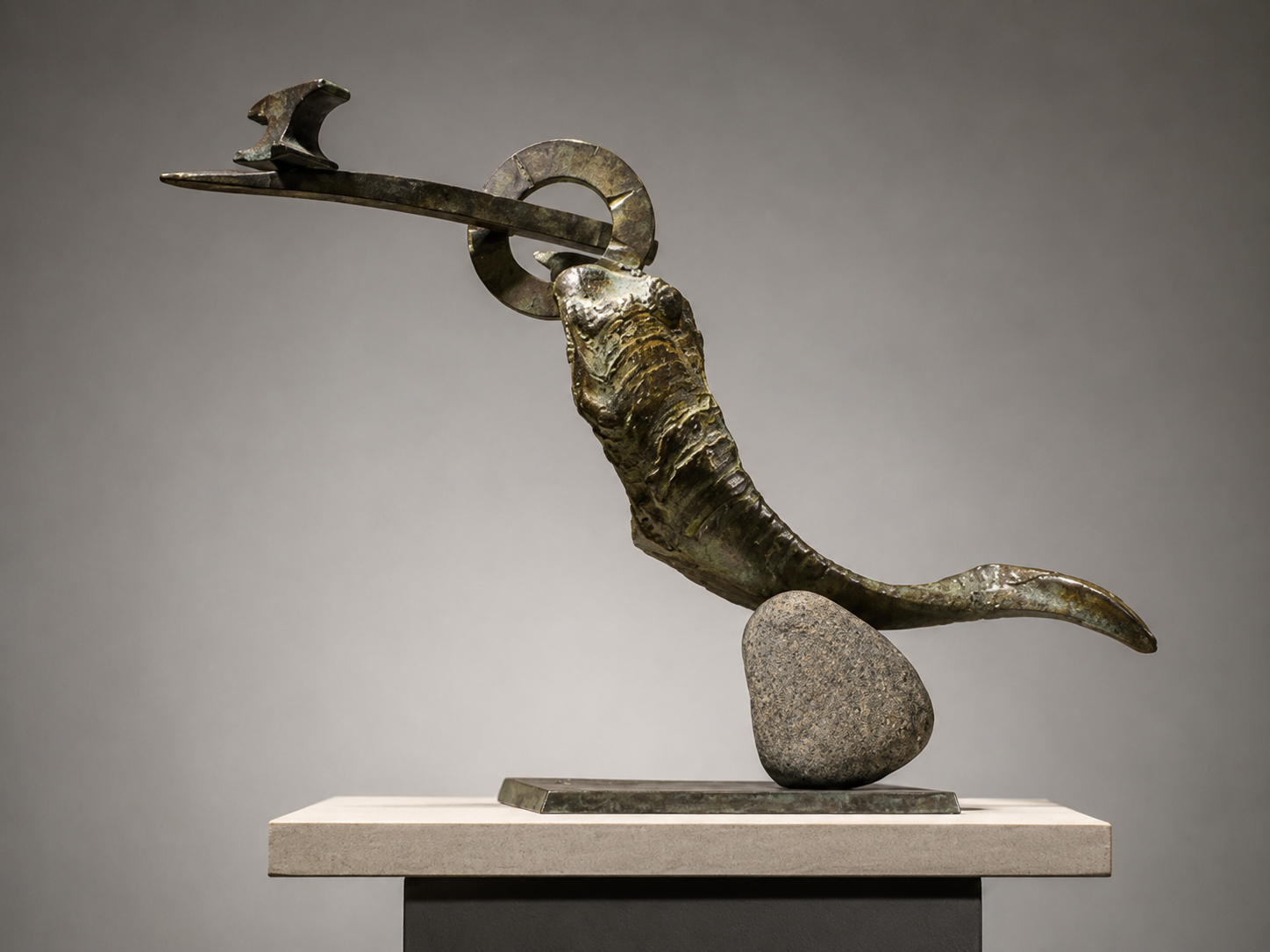
August 2000. Bronze, granite. Dimensions: 16 × 21 × 6 in (41 × 53 × 15 cm). Private collection - New York State
Many of Van Alstine’s works take inspiration from the movement of the human body. This work can be seen as a kind of self-portrait, suggesting his studio process—literally juggling and repositioning the individual elements of a sculpture until they achieve a moment of perfect balance, then freezing that moment in space through welding. More universally, juggling becomes a metaphor for the way we all balance the competing demands of family, work, play, and responsibility.
The anvil, which appears in a number of the artist’s works, represents both the ultimate heavy object to “juggle” and the act of assembly itself—the forging together of object, material, and ideas that is central to Van Alstine’s work.
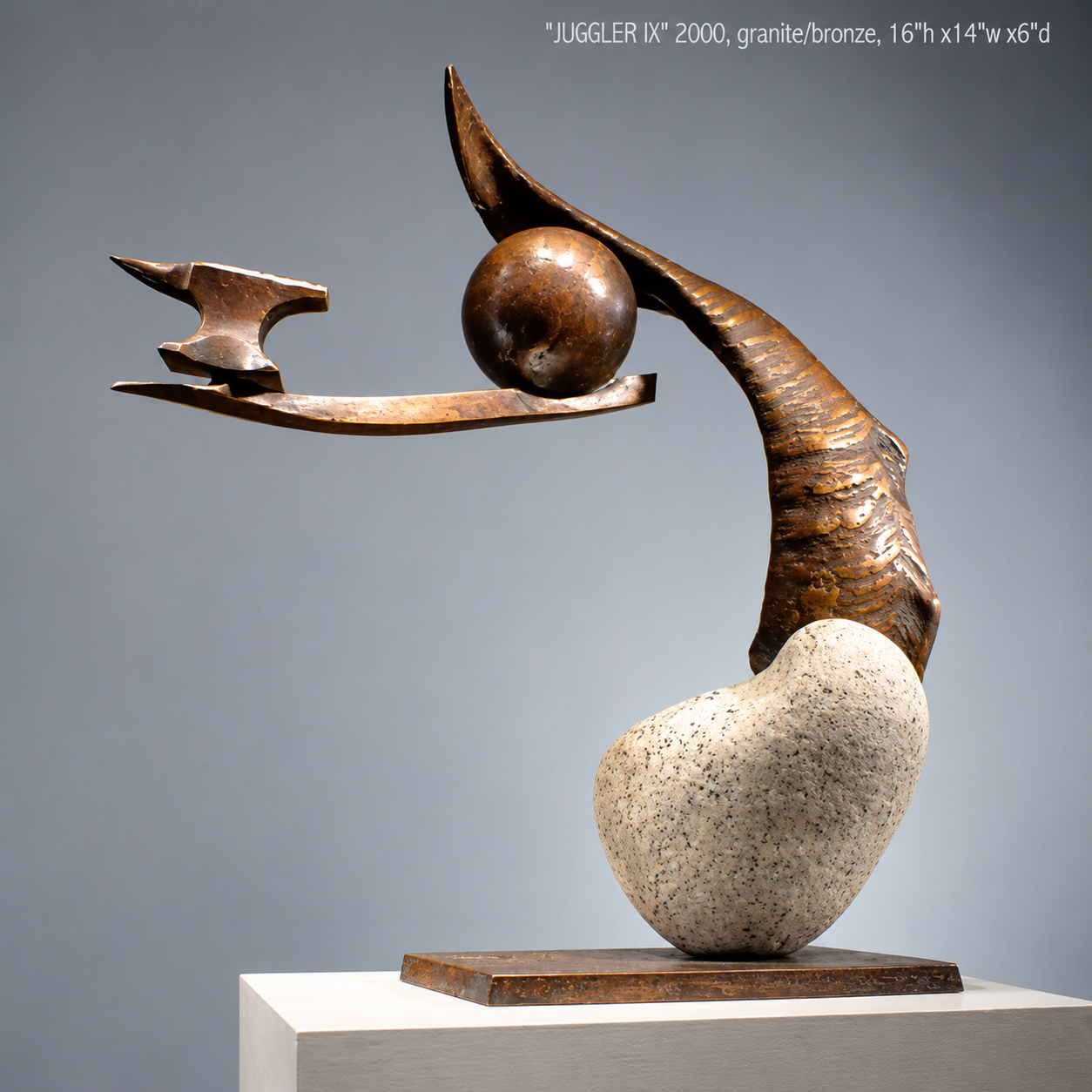
October 2000. Granite, bronze. Dimensions: 16 × 14 × 6 in (41 × 36 × 15 cm). Private collection - Los Angles, CA
Many of Van Alstine’s works take inspiration from the movement of the human body. This work can be seen as a kind of self-portrait, suggesting his studio process—literally juggling and repositioning the individual elements of a sculpture until they achieve a moment of perfect balance, then freezing that moment in space through welding. More universally, juggling becomes a metaphor for the way we all balance the competing demands of family, work, play, and responsibility.
The anvil, which appears in a number of the artist’s works, represents both the ultimate heavy object to “juggle” and the act of assembly itself—the forging together of object, material, and ideas that is central to Van Alstine’s work.
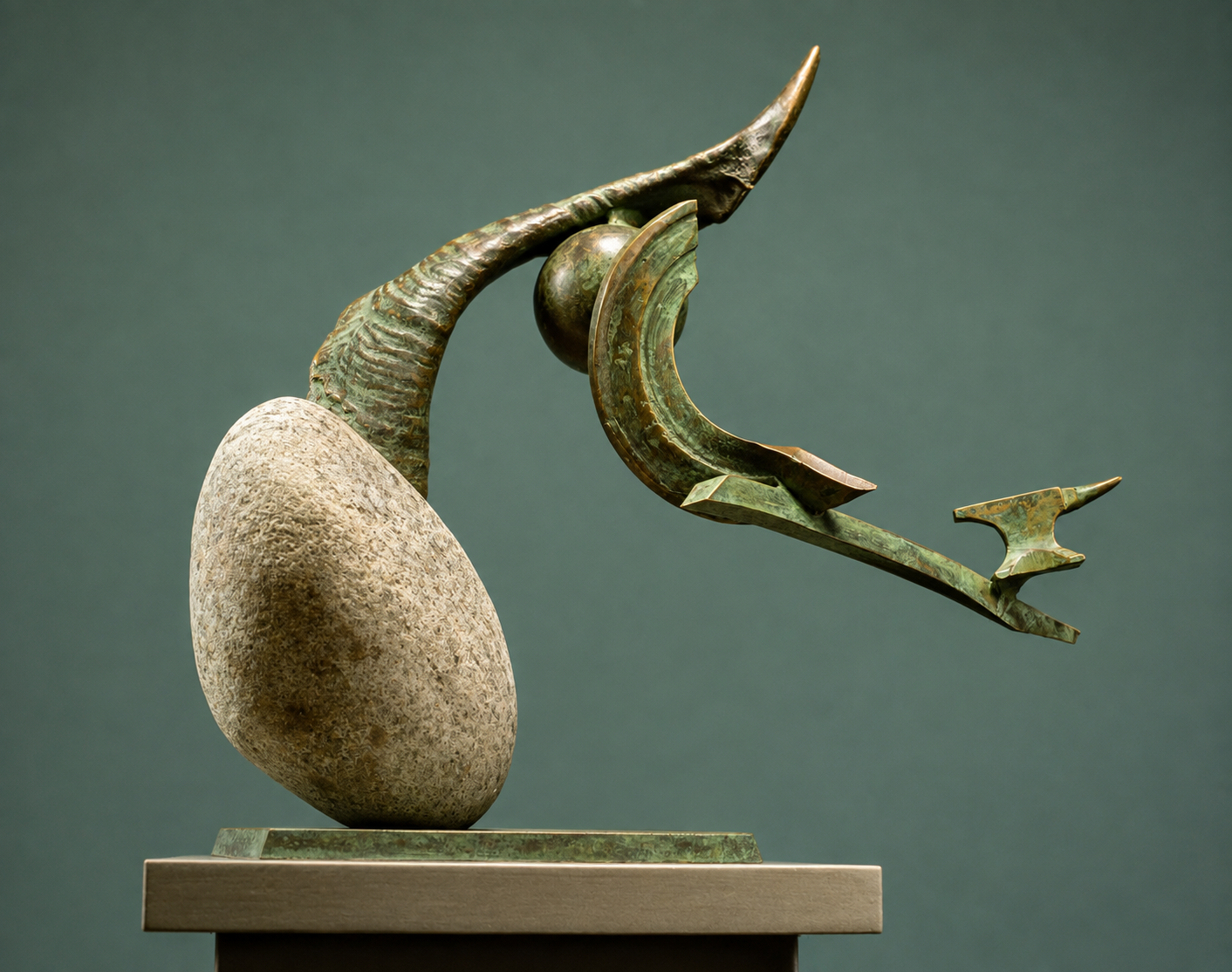
October 2000. Bronze, granite. Dimensions: 15 × 17 × 6 in (38 × 43 × 15 cm). Private collection - New York State
Many of Van Alstine’s works take inspiration from the movement of the human body. This work can be seen as a kind of self-portrait, suggesting his studio process—literally juggling and repositioning the individual elements of a sculpture until they achieve a moment of perfect balance, then freezing that moment in space through welding. More universally, juggling becomes a metaphor for the way we all balance the competing demands of family, work, play, and responsibility.
The anvil, which appears in a number of the artist’s works, represents both the ultimate heavy object to “juggle” and the act of assembly itself—the forging together of object, material, and ideas that is central to Van Alstine’s work.
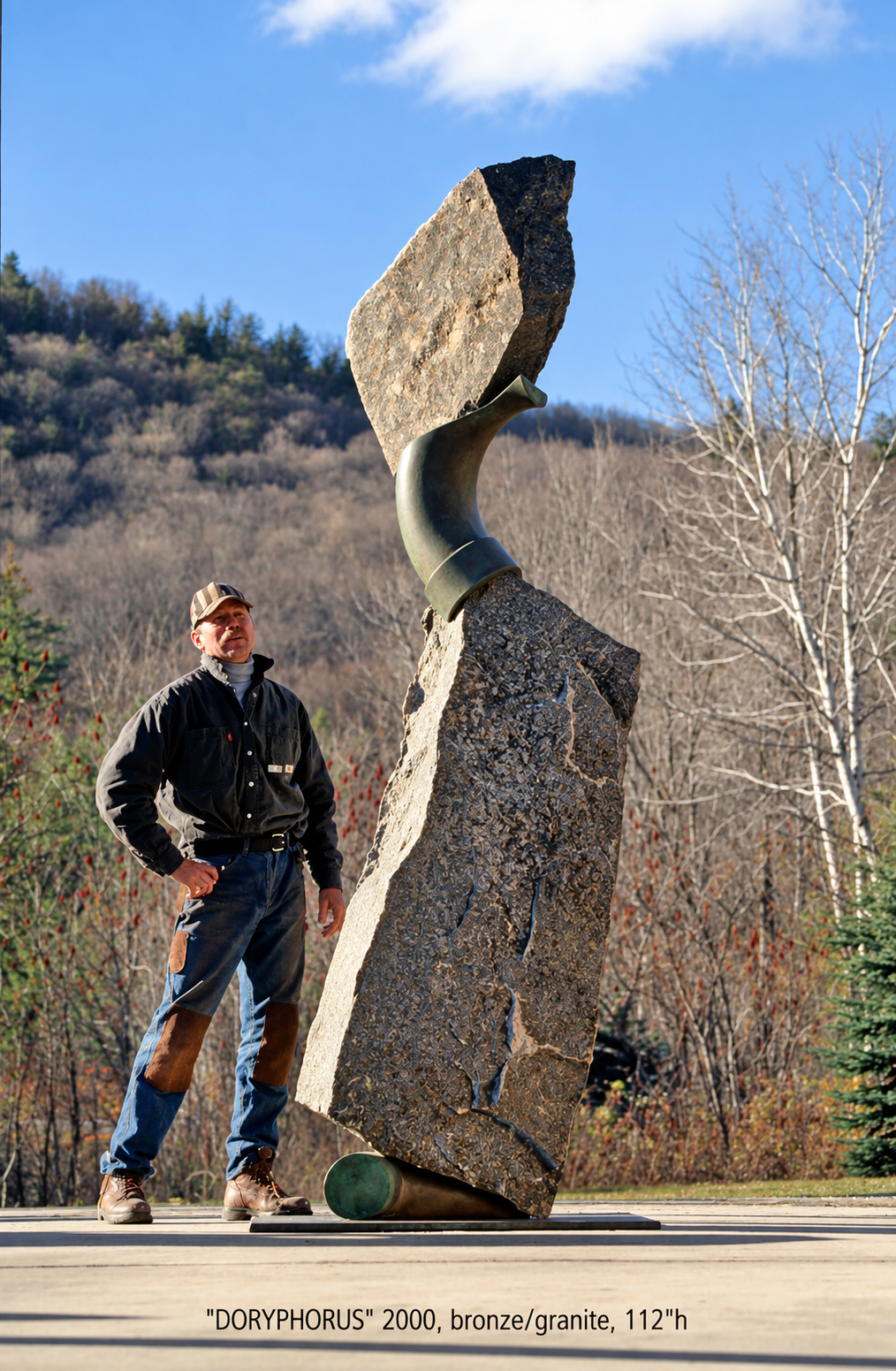
November 2000. Bronze, granite. Dimensions: 112 × 40 × 28 in (284 × 102 × 71 cm).
As its title suggests, this work was inspired and pays homage to the classical greek sculpture by Polyclitus, DORYPHORUS (Spear Bearer) c.450-440 B.C. This Greek work (below) is a quintessential example of contropposto (counterpoise), the Italian word we use to describe the “S-like” vertical line (or, to be exact, a reverse S-curve) that runs through figurative sculpture. It is this development that allowed the Greeks to convincingly convey motion or life in a non moving piece of stone.
Van Alstine's granite and bronze "Doryphorus" convincingly exhibits the reverse "S" curve. His attraction and affection for this period of classical work is precisely because of the way the ancients were able to breath life and movement into inanimate materials, a concept at the very core of his work for over 25 years.
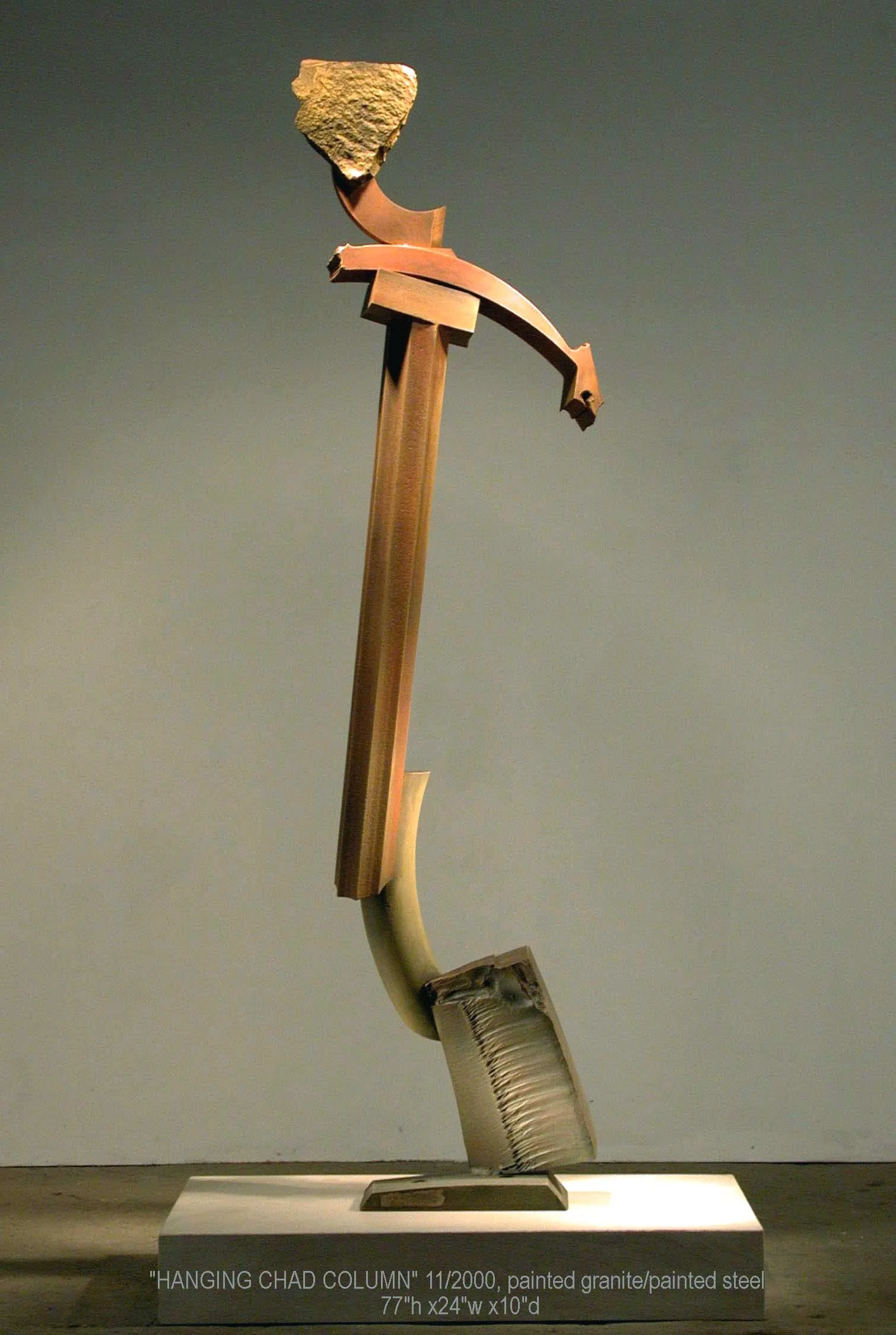
November 2000. Enamel on granite and steel. Dimensions: 77 × 24 × 10 in (196 × 61 × 25 cm).
Hanging Chad Column, 2000
Hanging Chad Column is part of a series of human-scale columns from this period combining painted stone and painted steel. The vertical structure becomes almost figure-like, with the stone and projecting steel elements creating a precarious sense of balance and gesture. The work dates to November 2000 and measures 77 × 24 × 10 inches.
The title adds a humorous political reference to the disputed 2000 presidential election between George W. Bush and Al Gore. “Hanging chads”—partially detached pieces of punched voting cards—became emblematic of the contested Florida recount. To the disappointment of many, myself included, the dispute ultimately reached the U.S. Supreme Court in Bush v. Gore, whose December 12 decision effectively ended the recount; Bush subsequently received a majority of the Electoral College votes.
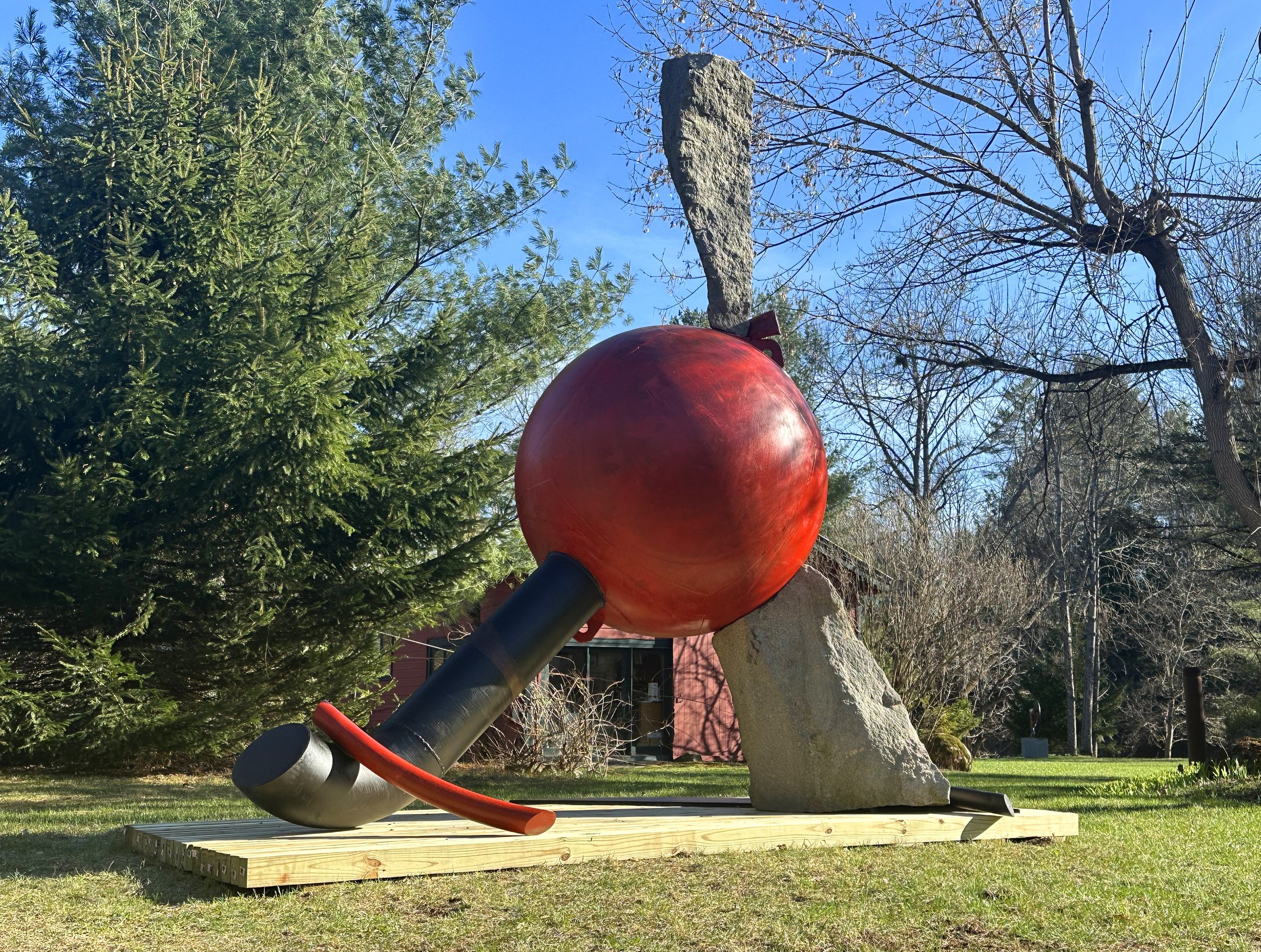
December 2000. Granite, steel painted. Dimensions: 12 × 11 × 7 in (30 × 28 × 18 cm).
Global (Buoy II) was purchased by Florida collector Martin Margulies and installed at Florida International University in Miami. In 2021, during the COVID period, it was shipped to Massachusetts along with several other works and installed at his residence there. When the house was sold in 2024, the sculpture was returned to me. It was restore and as of 2026, it is installed in my sculpture garden in Wells, New York.
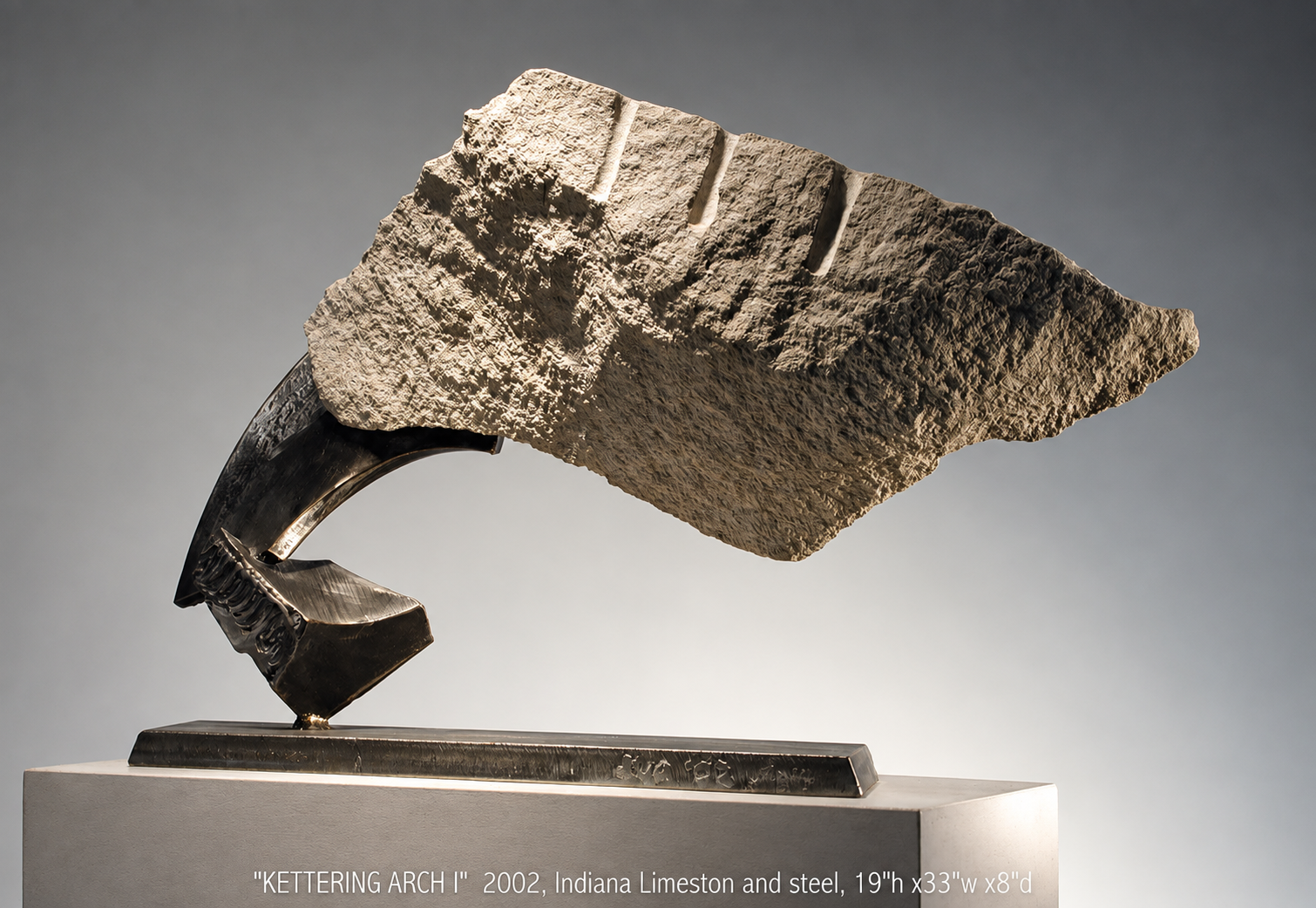
September 2002. Indiana Limestone, steel. Dimensions: 19 × 33 × 8 in (48 × 84 × 20 cm).
Private collection - Johnstown, NY
Created while in Kettering, OH for 2002 stone symposium.
1999
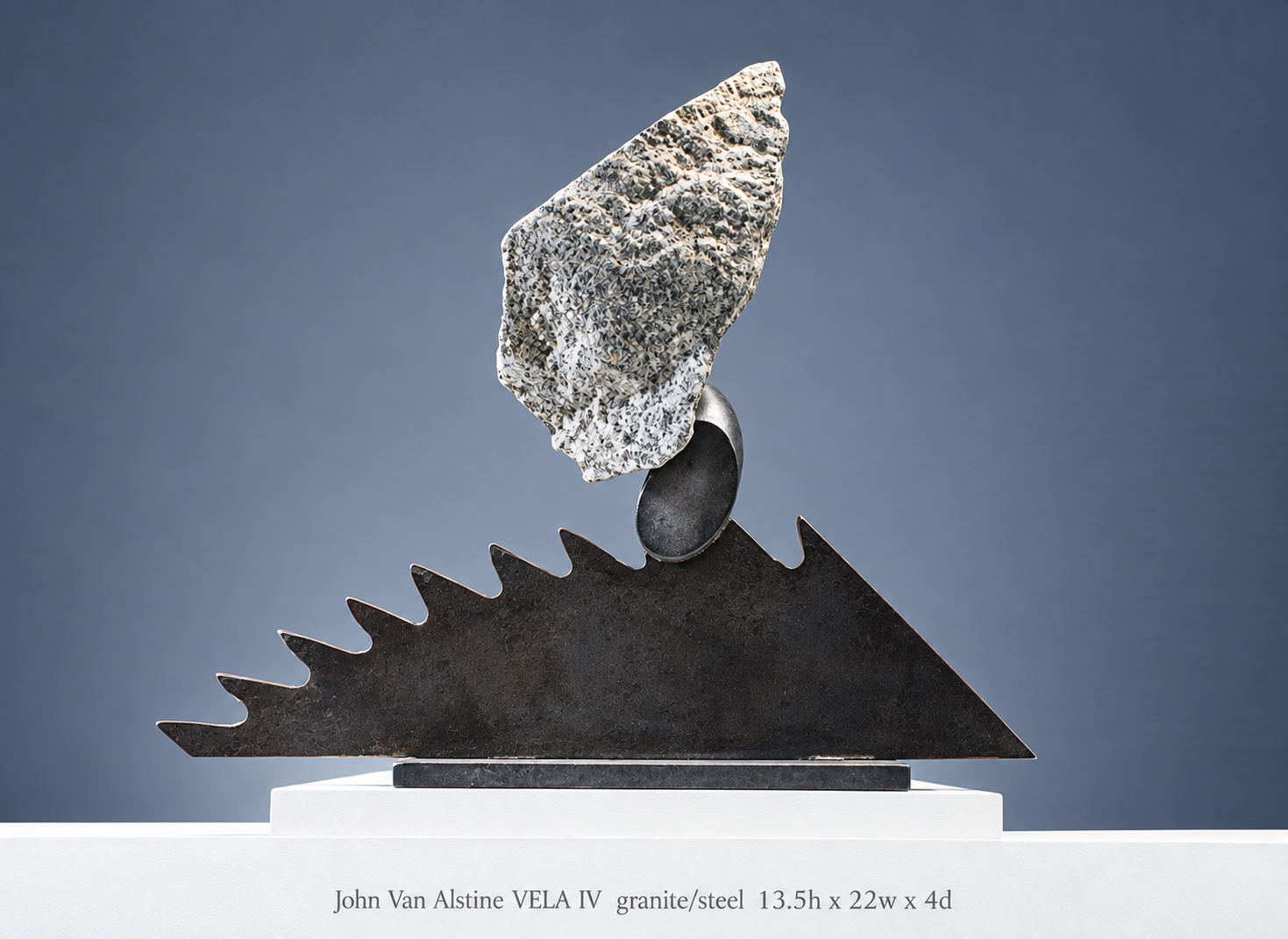
January 1999. Granite, steel. Dimensions: 13.5 × 12 × 3 in (34 × 30 × 8 cm). Private Collection.
Vela IV brings together two recurring interests in my work: tools and celestial imagery. The serrated steel form suggests a saw or cutting tool, reflecting my fascination with tools as extensions of the hand and symbols of human ingenuity and action. The granite balanced above creates a tension between natural and human-made materials, weight and equilibrium.
The title Vela comes from the southern constellation Vela, Latin for “sails.” The sail suggests navigation, movement, and journey, while the upward-reaching stone gives the sculpture a sense of propulsion and reflects my recurring interest in making heavy objects appear light.
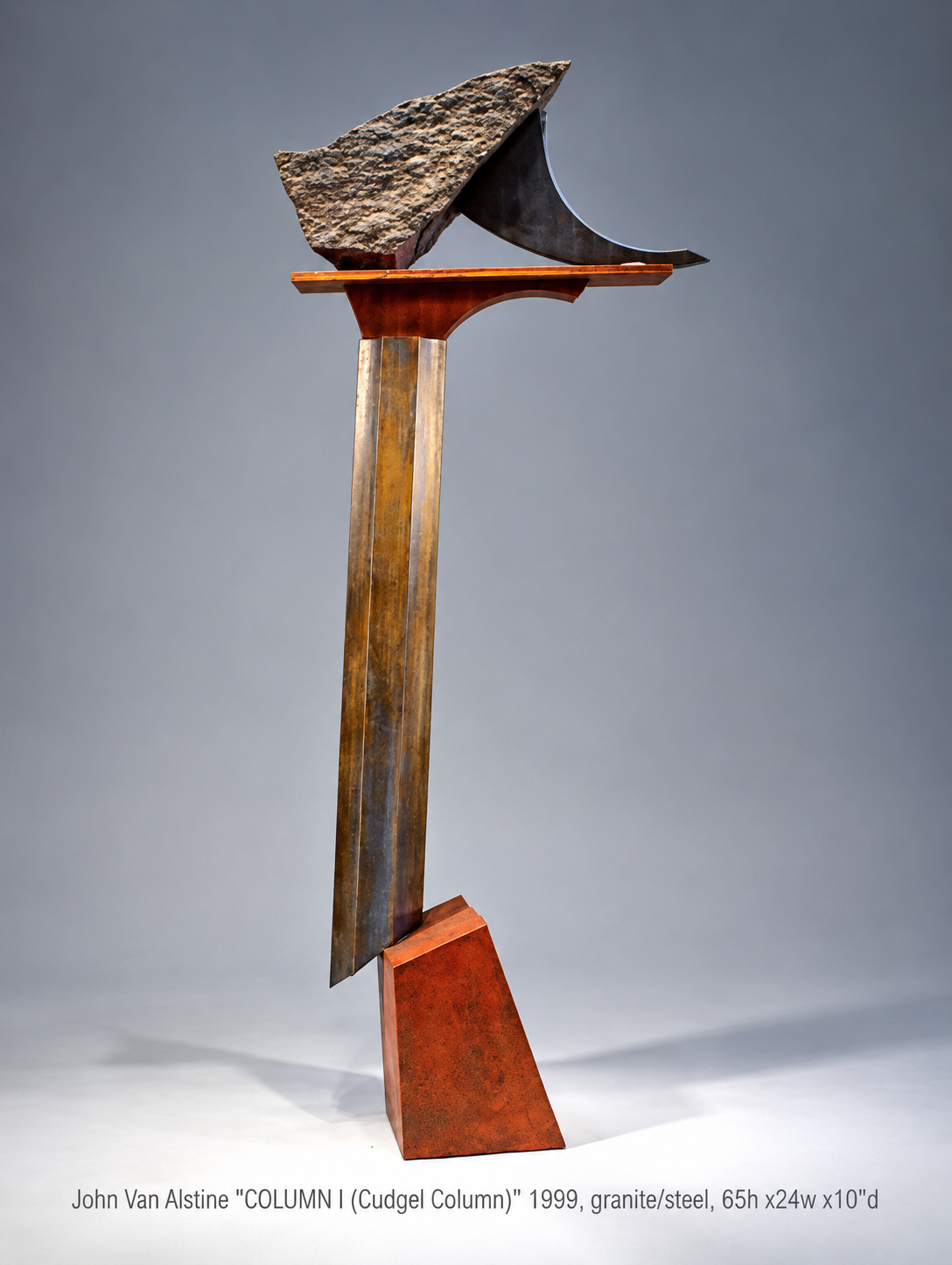
February 1999. Painted granite, painted steel. Dimensions: 65 × 24 × 10 in (165 × 61 × 25 cm). Private Collection - Baltimore, MD.
Cudgel Column, 1999
Cudgel Column enlarges ideas from my ongoing Cudgel Series into a polychromed, floor-standing column. It continues my interest in tools and implements as expressive sculptural forms—objects I have long regarded as extensions of the hand, with a “raw, efficient beauty of form dictated by function.”
At the top, the cudgel becomes the crowning element: the sweeping curved steel suggests a handle, while the granite assumes the weight and presence of the head or blade of a primitive hand tool or weapon. Elevated on the tall column, this tool-like form takes on a more vertical, figure-related presence.
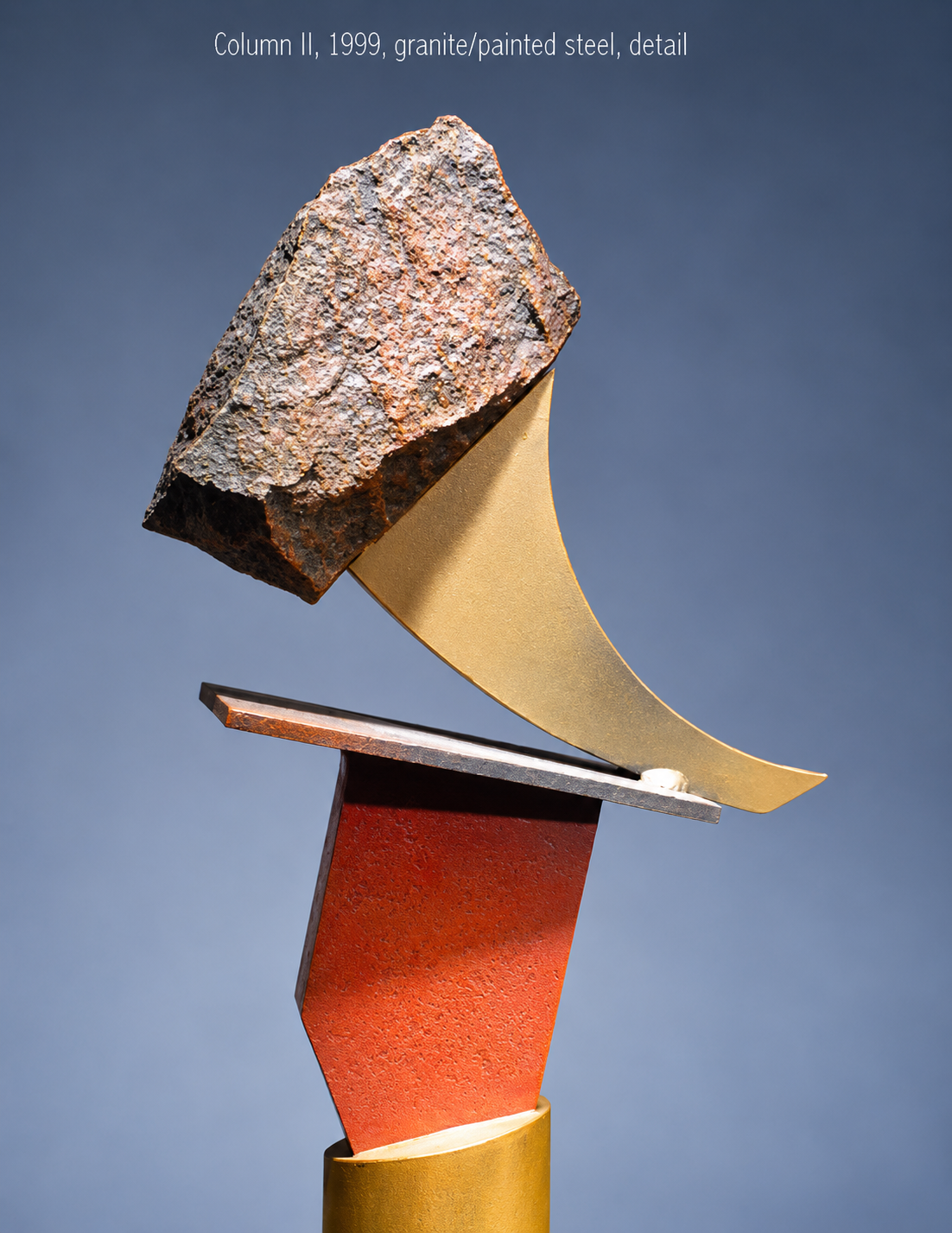
March 1999. Painted granite, steel. Dimensions: 71 × 15 × 10 in (180 × 38 × 25 cm).
Private Collection Washington, DC
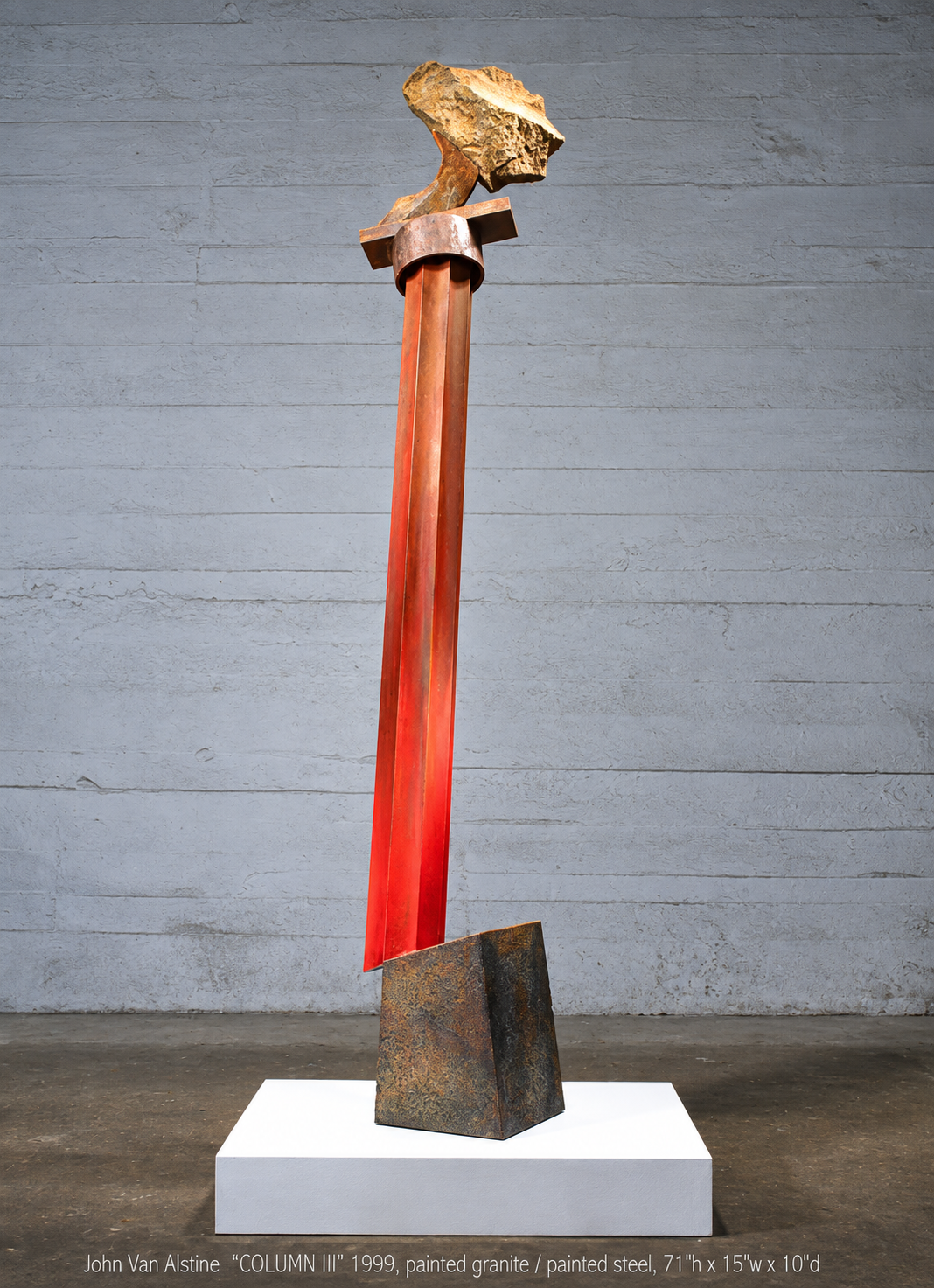
March 1999. Painted granite, steel. Dimensions: 72 × 16 × 9 in (183 × 41 × 23 cm).
Private Collection: Colorado.
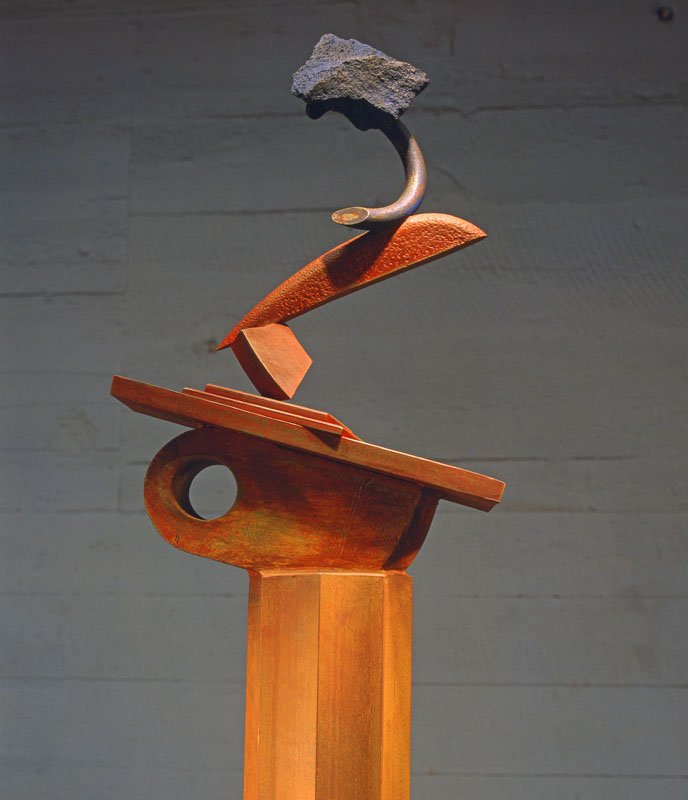
March 1999. Painted granite, steel. Dimensions: 88 × 18 × 18 in (224 × 46 × 46 cm). Private Collection Ohio.
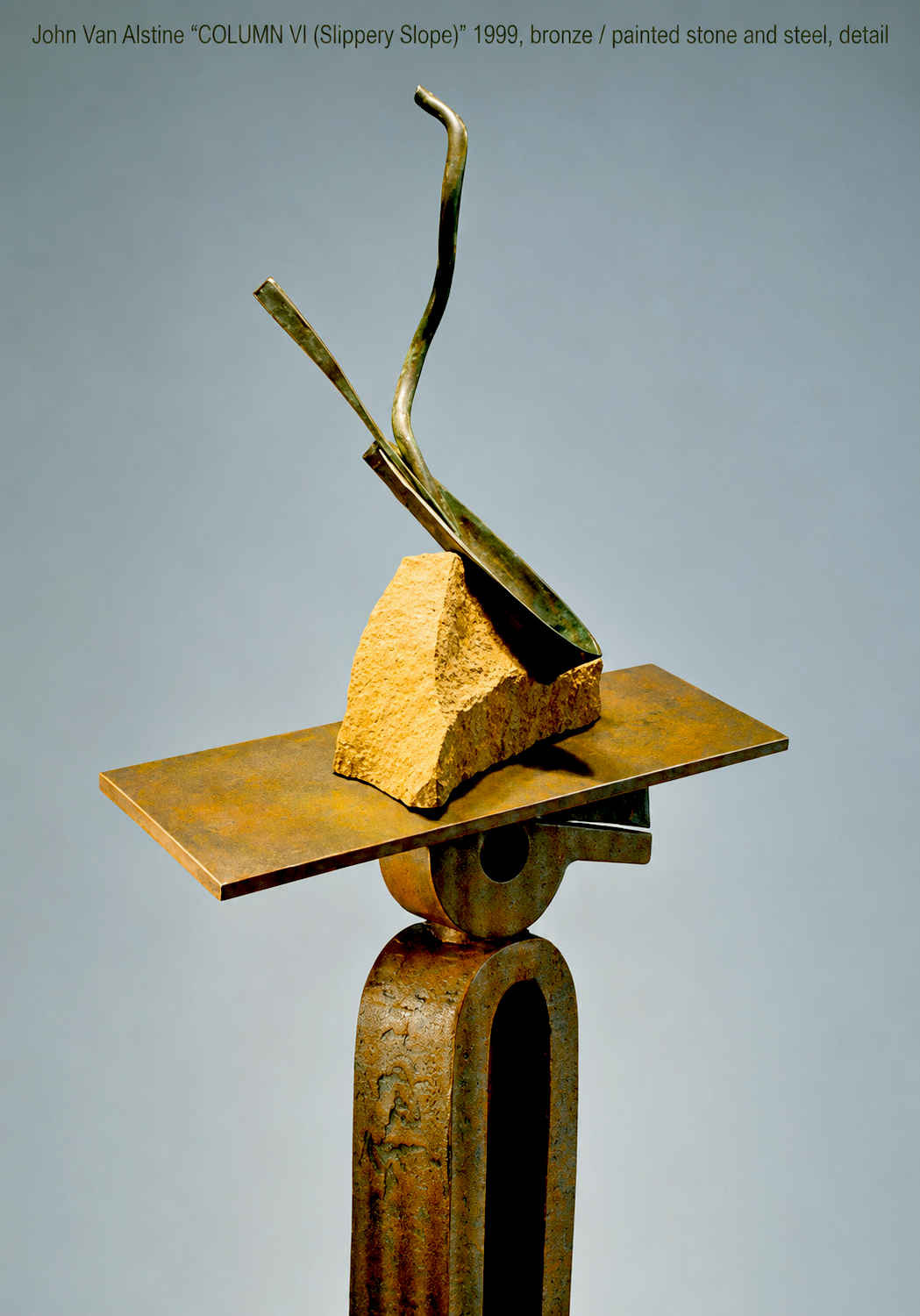
March 1999. Bronze, granite, steel. Dimensions: 82 × 21 × 11 in (208 × 53 × 28 cm).
Private Collection.
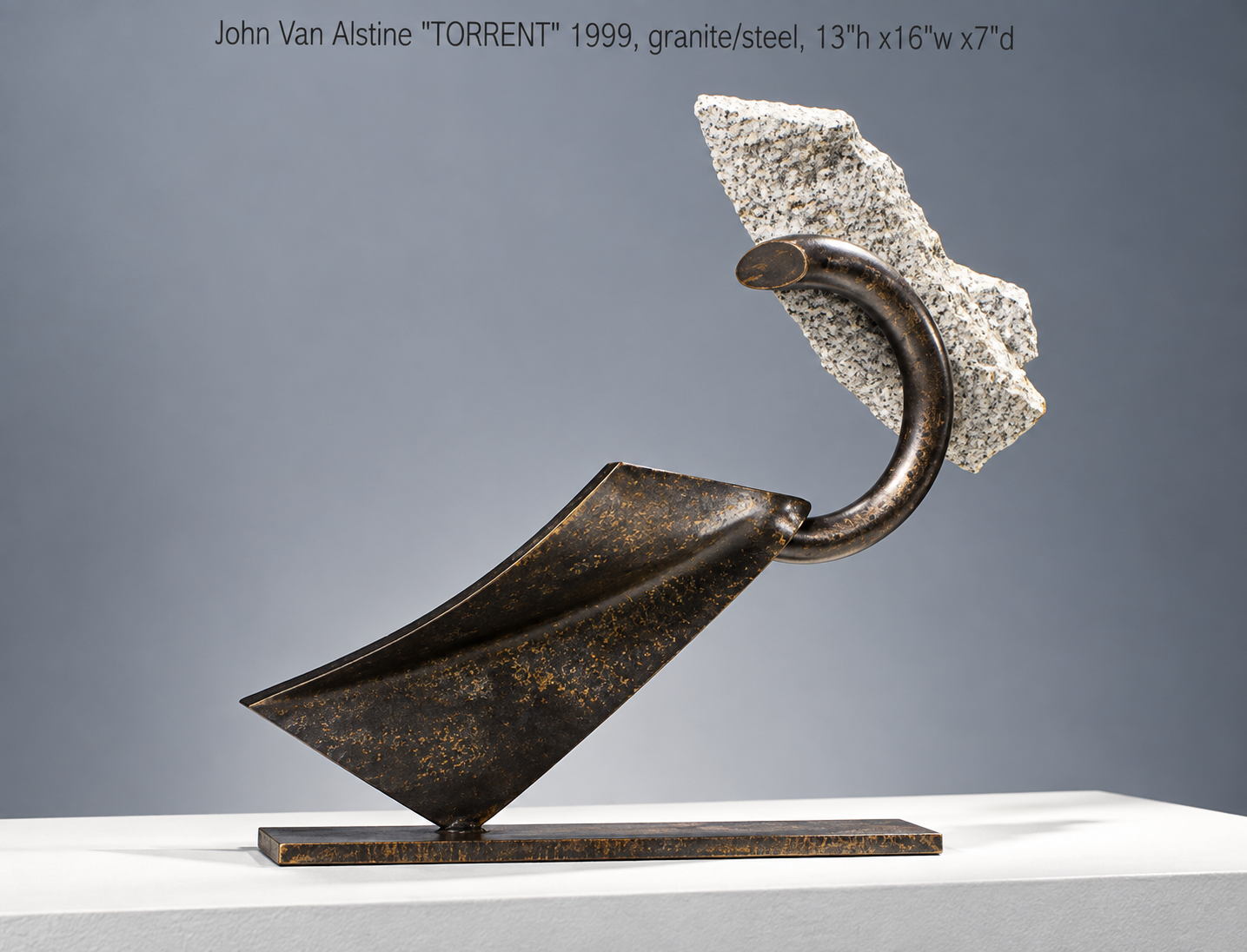
April 1999. Granite, steel. Dimensions: 13 × 16 × 7 in (33 × 41 × 18 cm).
Private Collection.
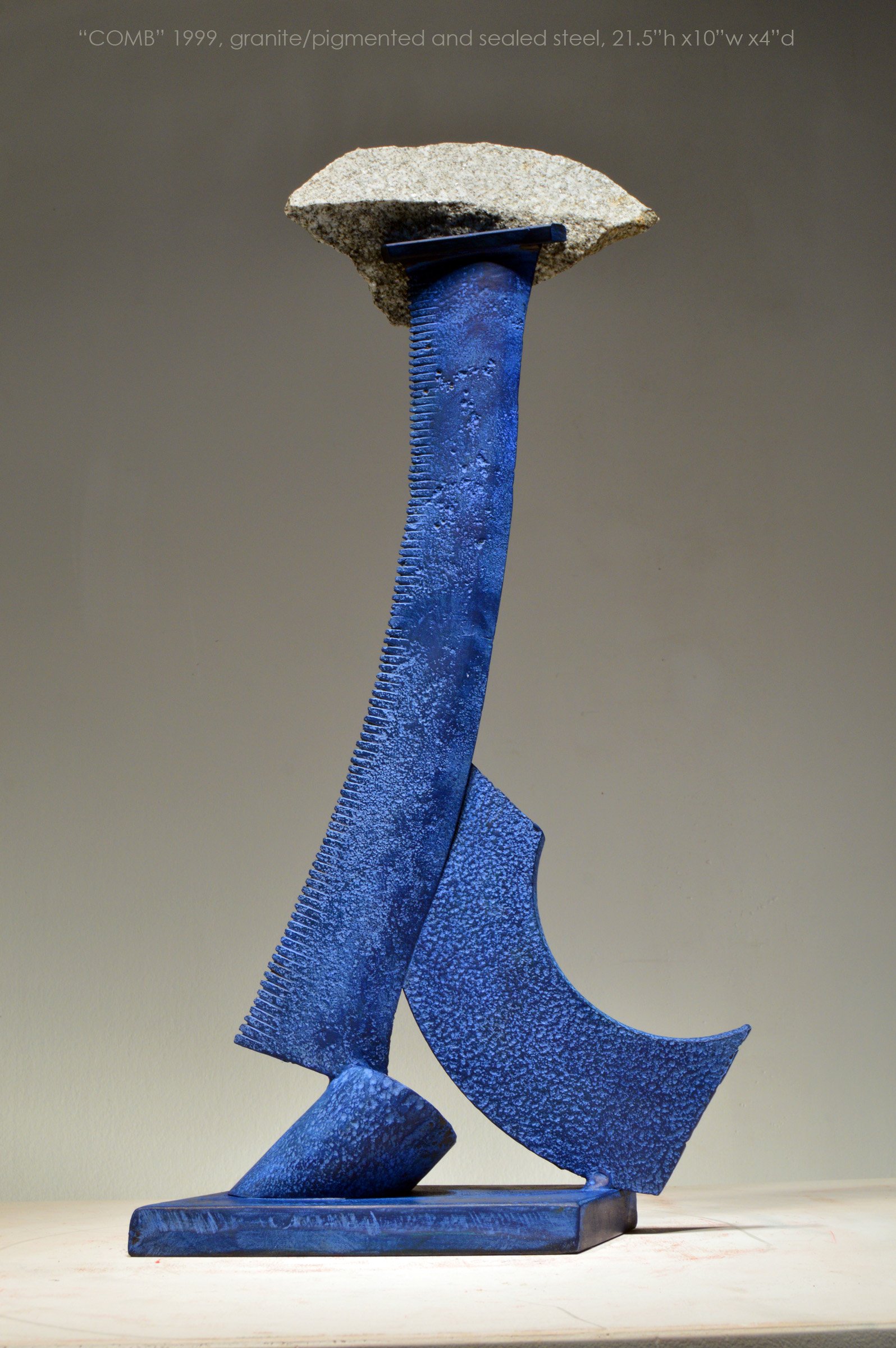
April 1999. Granite, steel. Dimensions: 21.5 × 10 × 4 in (55 × 25 × 10 cm).
Private Collection
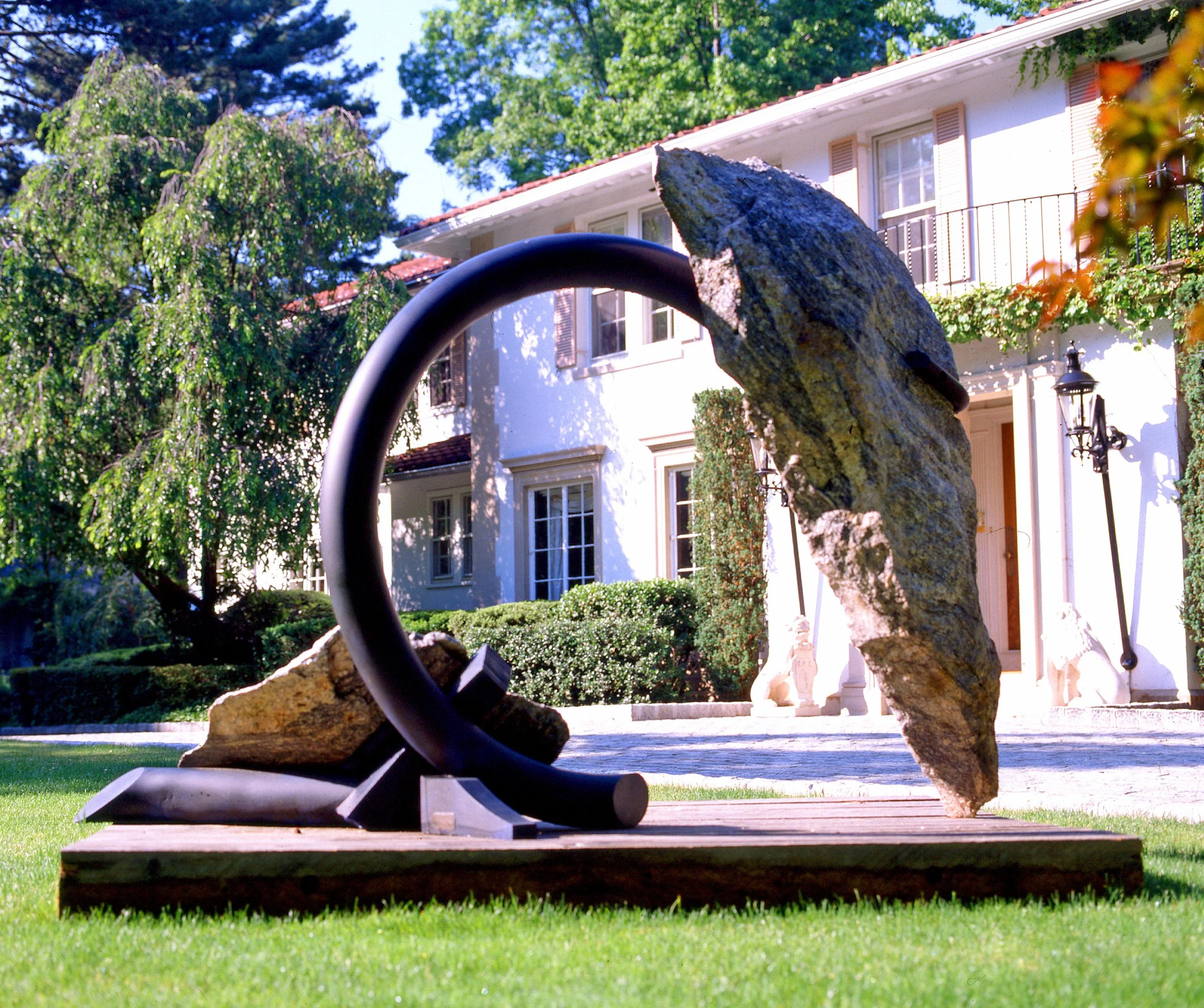
May 1999. Granite, steel. Dimensions: 6’h × 8’w × 4’d (183 cm × 244 cm × 122 cm).
Private collection - NJ
Pique à terre is a term from classical French ballet for a pose with one toe touching the ground, the other foot firmly planted, and a sweeping arm gesture. Once you are aware of the title, when you see the piece the connection is clear. I am in a sense choreographing these works, getting a heavy weight off the ground and making it dance—taking what is often seen as a negative, the fact that stone is damn heavy and a big hassle to move around, and turning it into a positive. It is this transition that helps give theses pieces their magic"*.
*from: Bones of the Earth, Spirit of the Land. The Sculpture of John Van Alstine
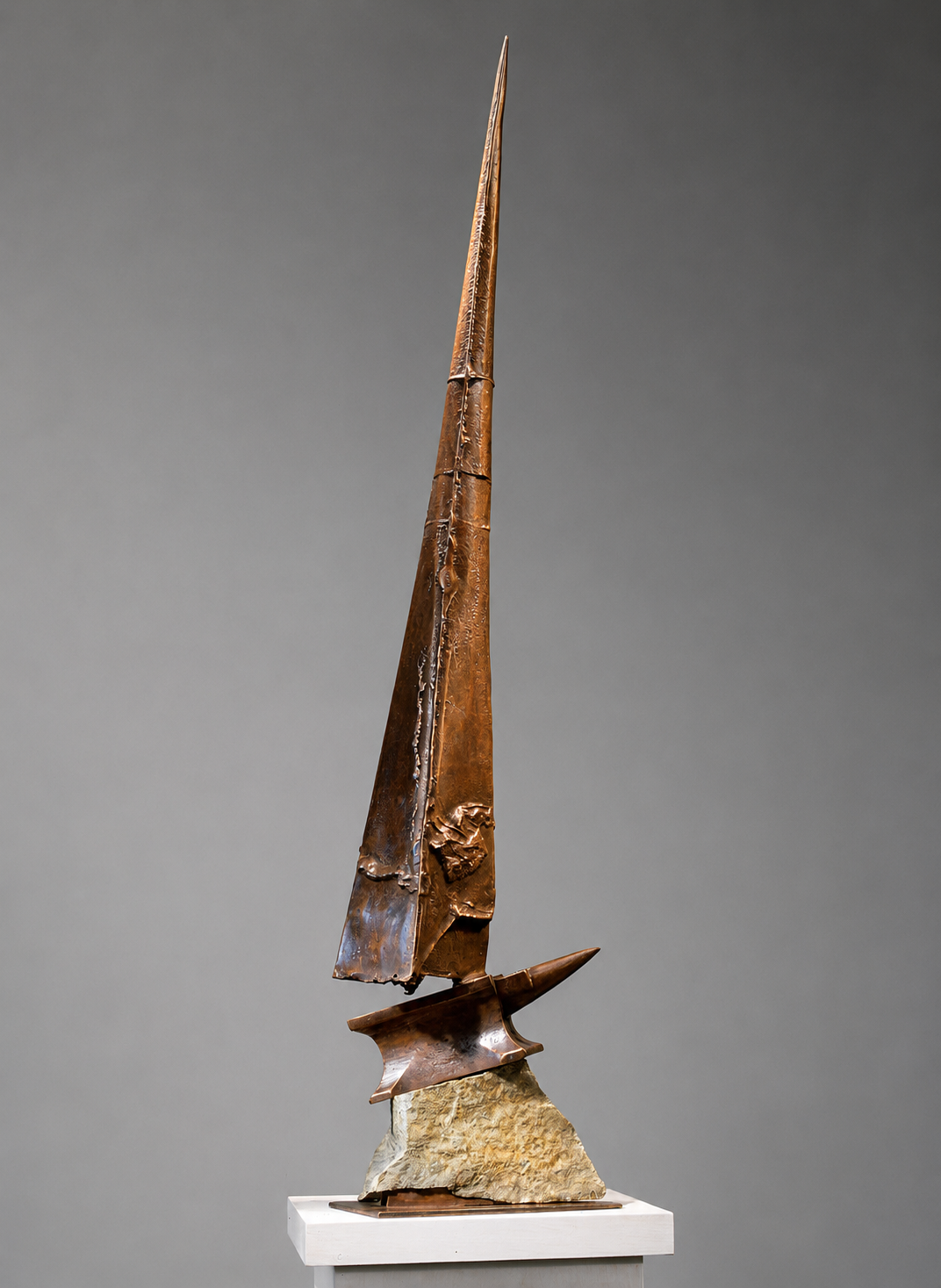
May 1999. Bronze, granite. Dimensions: 45 × 11 × 8 in (114 × 28 × 20 cm).
Corporate collection - Hartford, CT
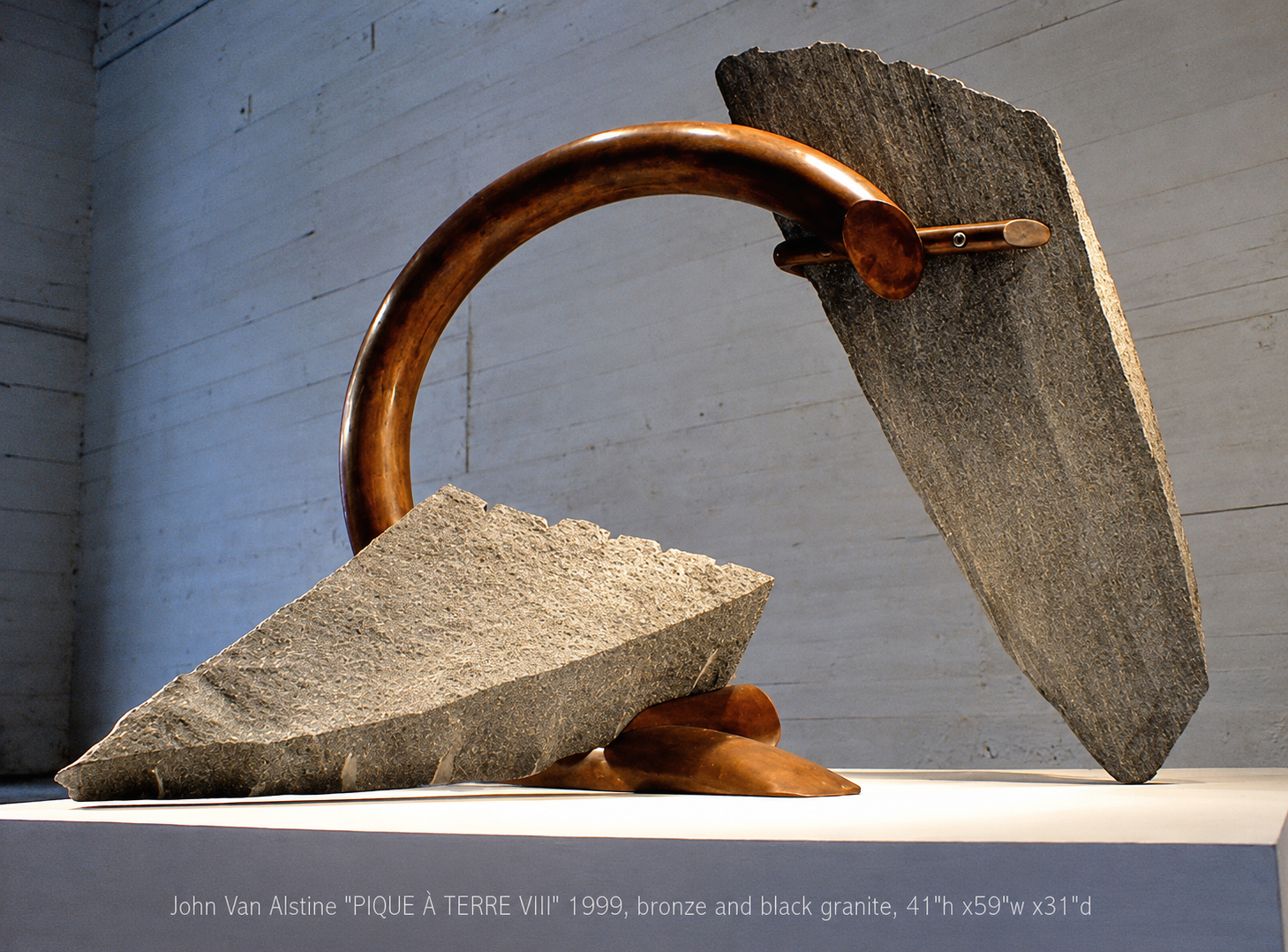
August 1999. Bronze, granite. Dimensions: 41 × 59 × 31 in (104 × 150 × 79 cm).
"Some more recent pieces refer to movement of the figure, particularly the Juggler and Pique à Terre series. Pique à terre is a term from classical French ballet for a pose with one toe touching the ground, the other foot firmly planted, and a sweeping arm gesture. Once you are aware of the title, when you see the piece the connection is clear. I am in a sense choreographing these works, getting a heavy weight off the ground and making it dance—taking what is often seen as a negative, the fact that stone is damn heavy and a big hassle to move around, and turning it into a positive. It is this transition that helps give theses pieces their magic".
from : Bones of the Earth, Spirit of the Land. The Sculpture of John Van Alstine
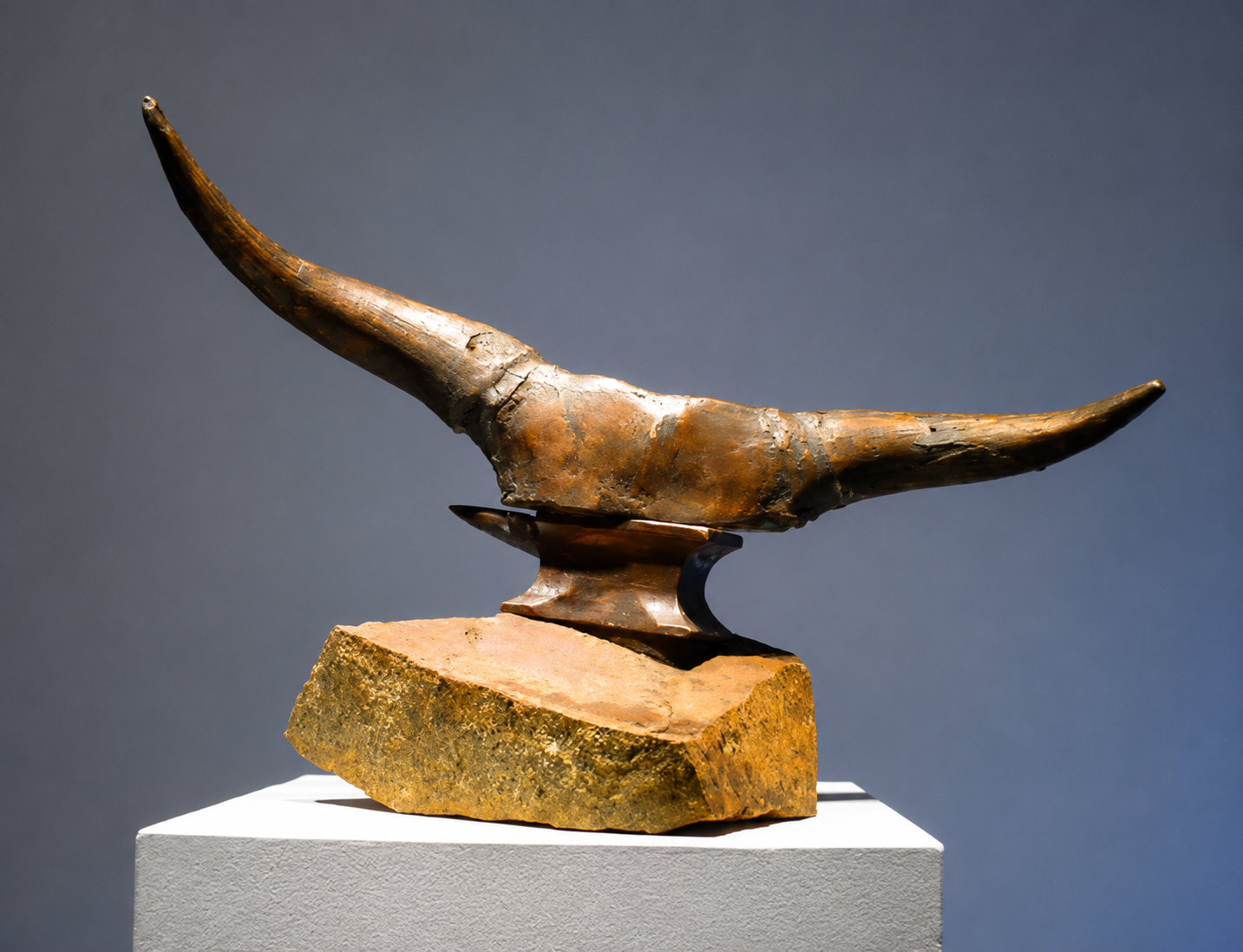
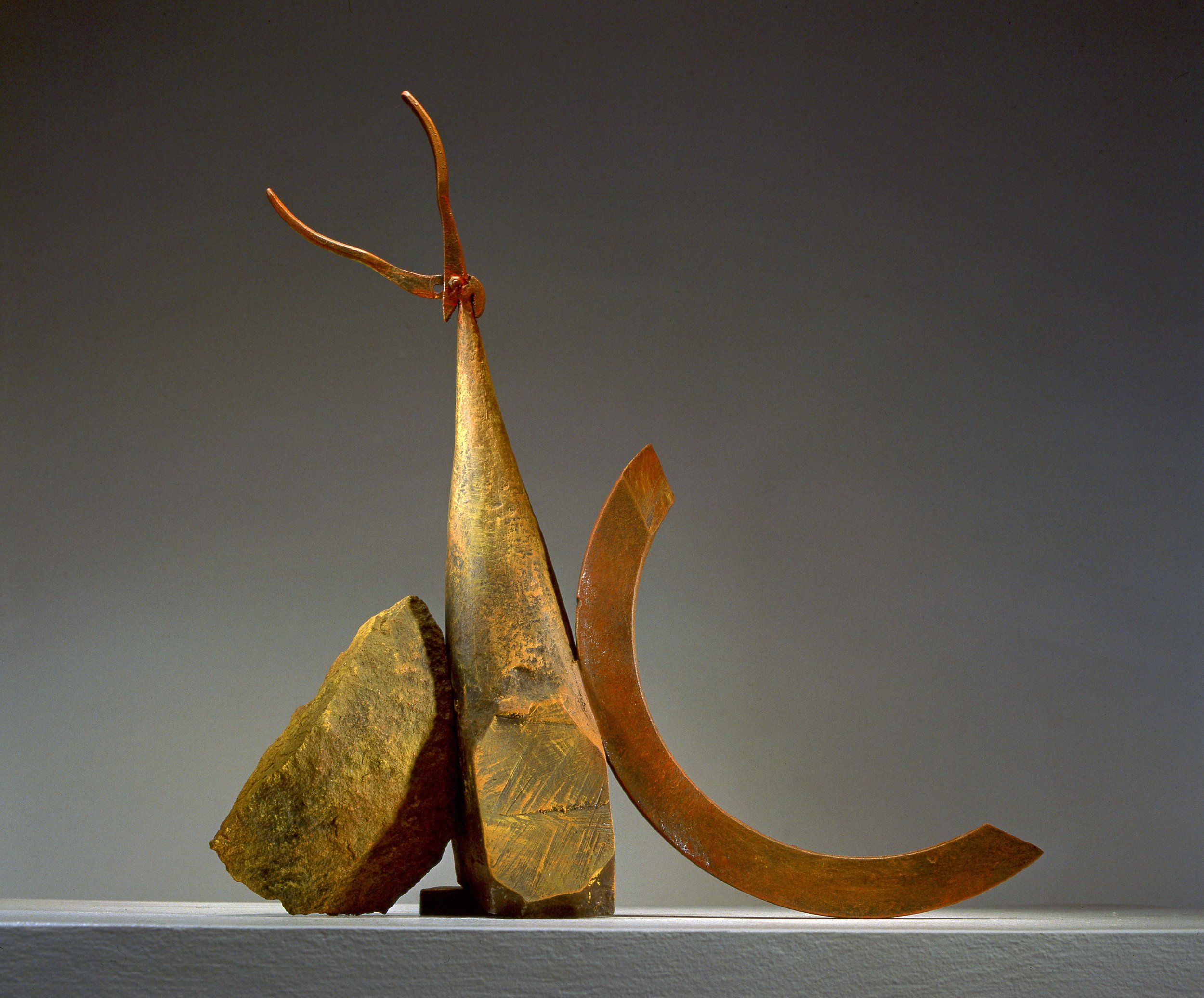
September 1999. Painted granite, steel. Dimensions: 16.5 × 15.5 × 5 in (42 × 39 × 13 cm).
Private collection - Toronto, Canada
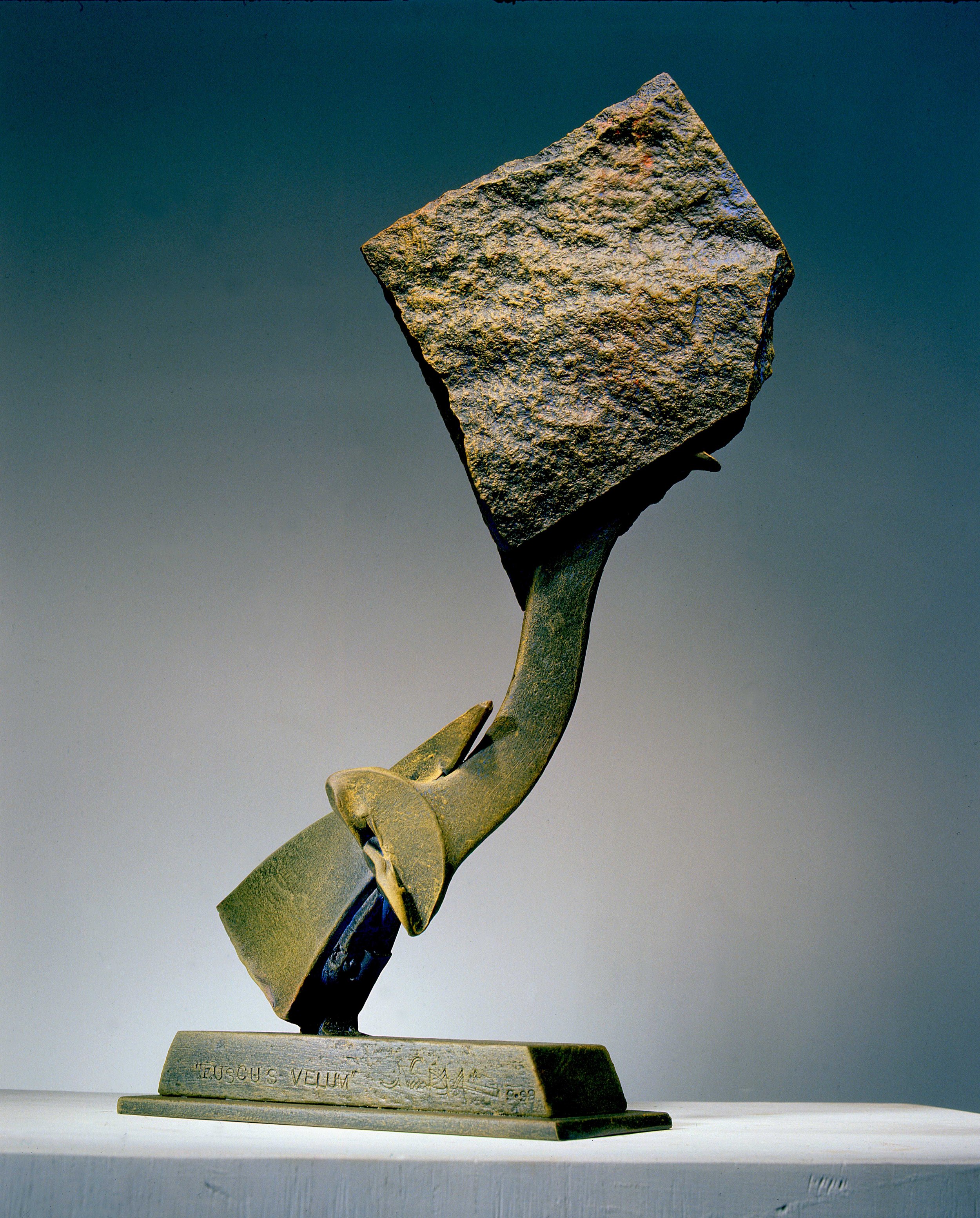
September 1999. Painted granite, steel. Dimensions: 15 × 10 × 4 in (38 × 25 × 10 cm).
Private collection
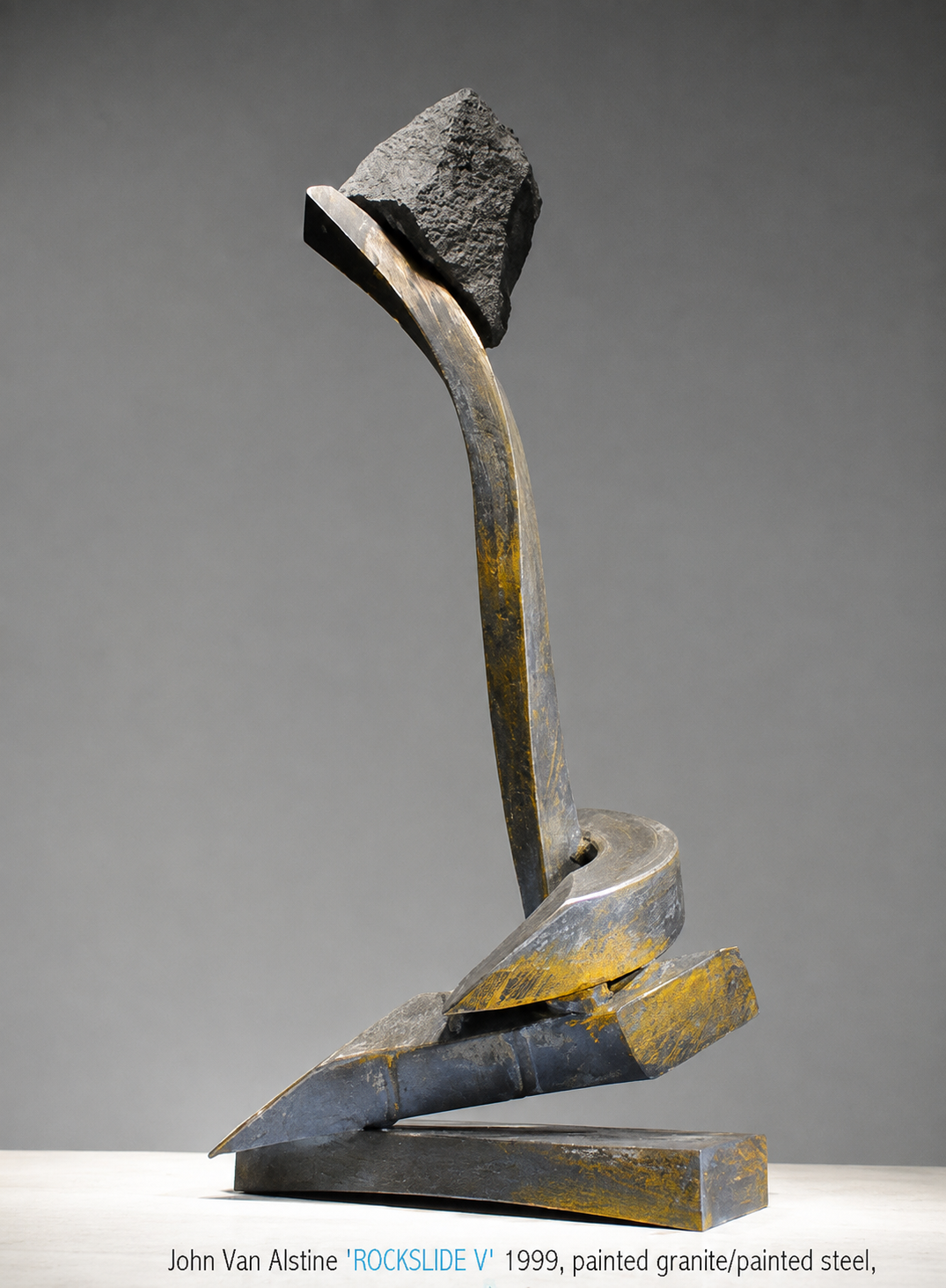
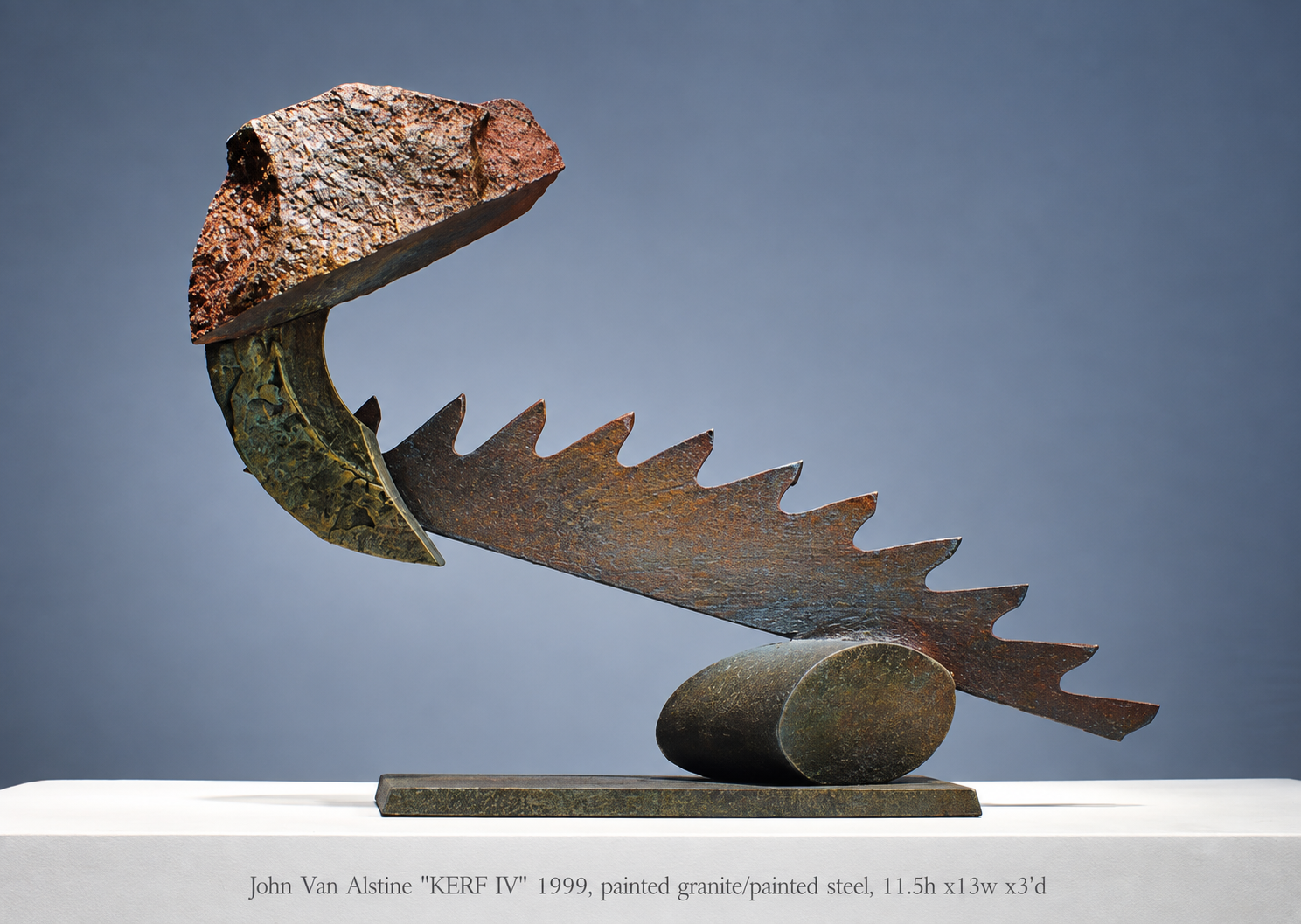
September 1999. Painted granite, steel. Dimensions: 11.5 × 13 × 3 in (29 × 33 × 8 cm). Used to make “Kerf Column” (S-99-25)

September 1999. Painted granite, steel. Dimensions: 12 × 12 × 4 in (30 × 30 × 10 cm).
Private Collection.
As a sculptor, I have always been fascinated by tools, implements, and instruments. I see them as extensions of the hand—essential allies in the act of making—and am drawn to their raw, efficient beauty, shaped over time by function and necessity. They also embody human ingenuity, labor, and our impulse to shape and engage the world around us.
Throughout my work, agricultural implements—rakes, plow blades, sledges, and tillers—as well as anvils, scales, compasses, and other instruments become both sculptural forms and vehicles for metaphor, suggesting ideas of balance, navigation, transformation, and our relationship to the natural world.
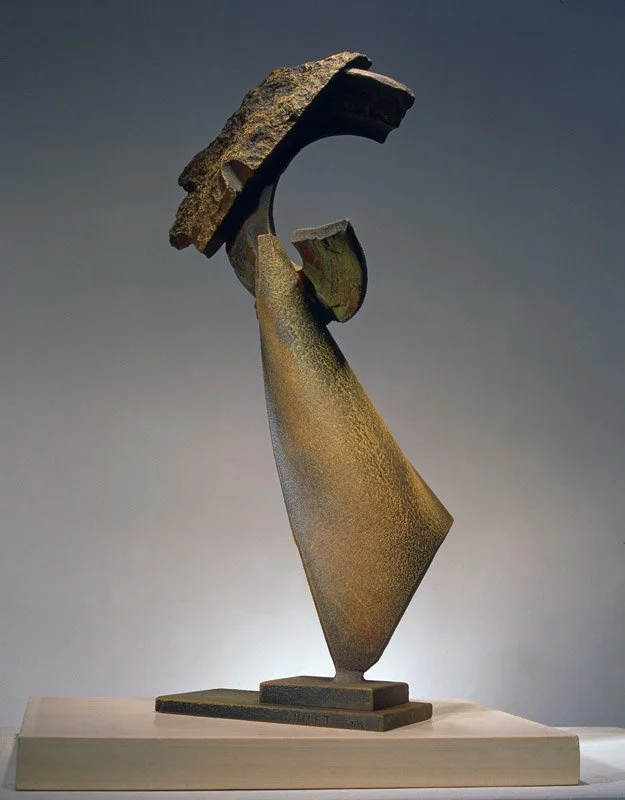
September 1999. Painted granite, steel. Dimensions: 18 × 8 × 7 in (46 × 20 × 18 cm).
Private collection
gimlet noun
gim·?let | 'gim-l?t
Definition of gimlet : a small tool with a screw point, grooved shank, and cross handle for boring holes
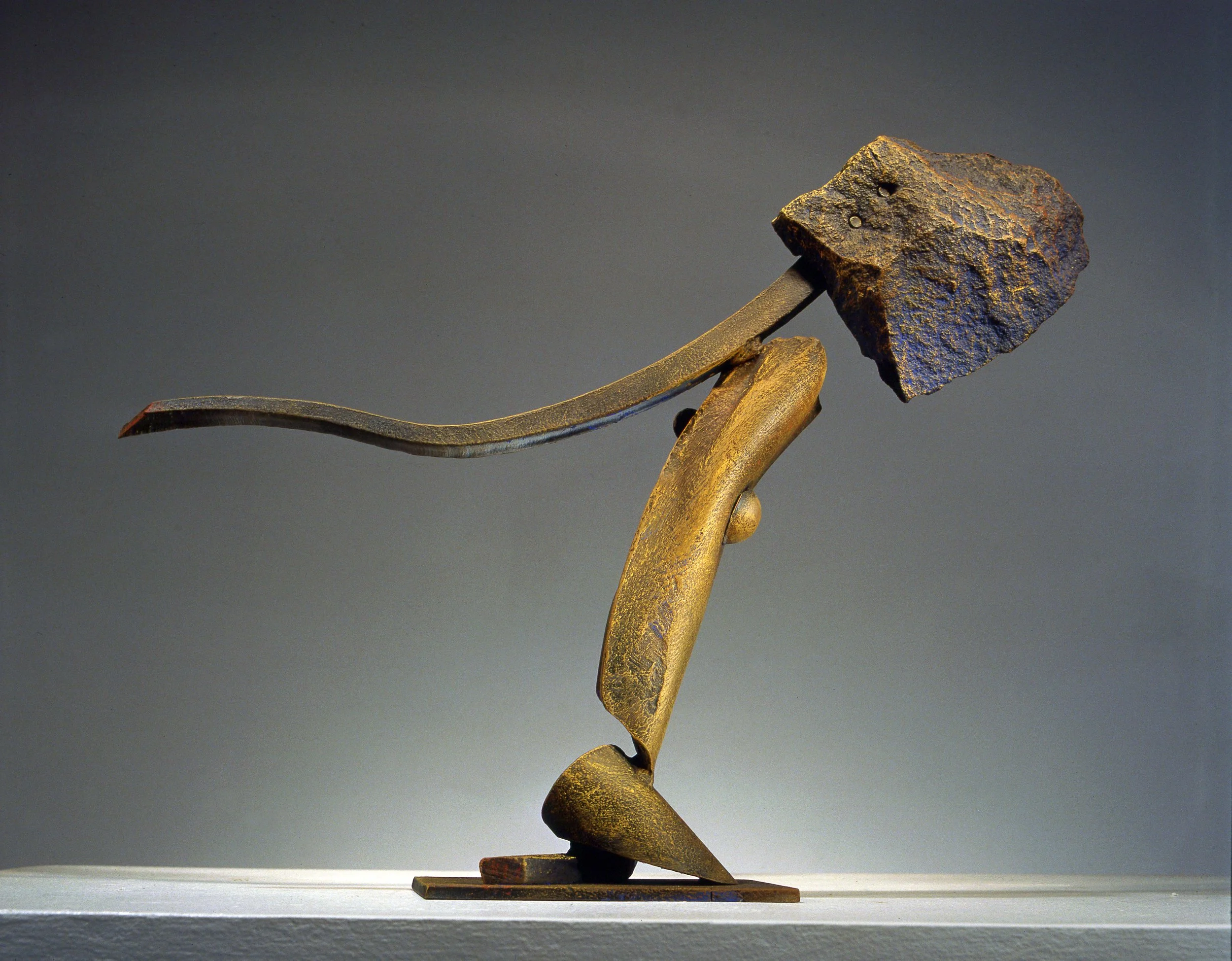
September 1999. Painted granite, steel. Dimensions: 15 × 20 × 3.5 in (38 × 51 × 9 cm).
Private collection
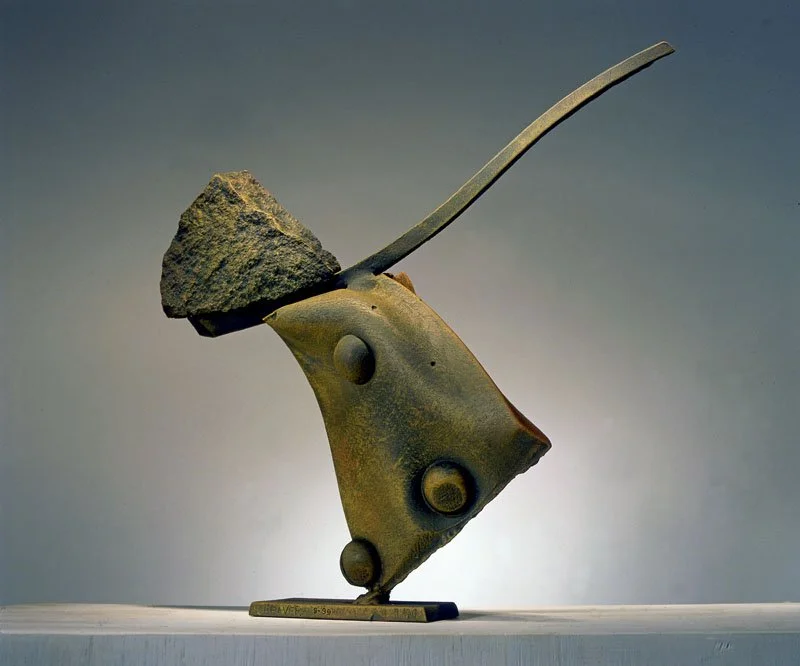
September 1999. Painted granite, steel. Dimensions: 14 × 14 × 4 in (36 × 36 × 10 cm).
Private collection
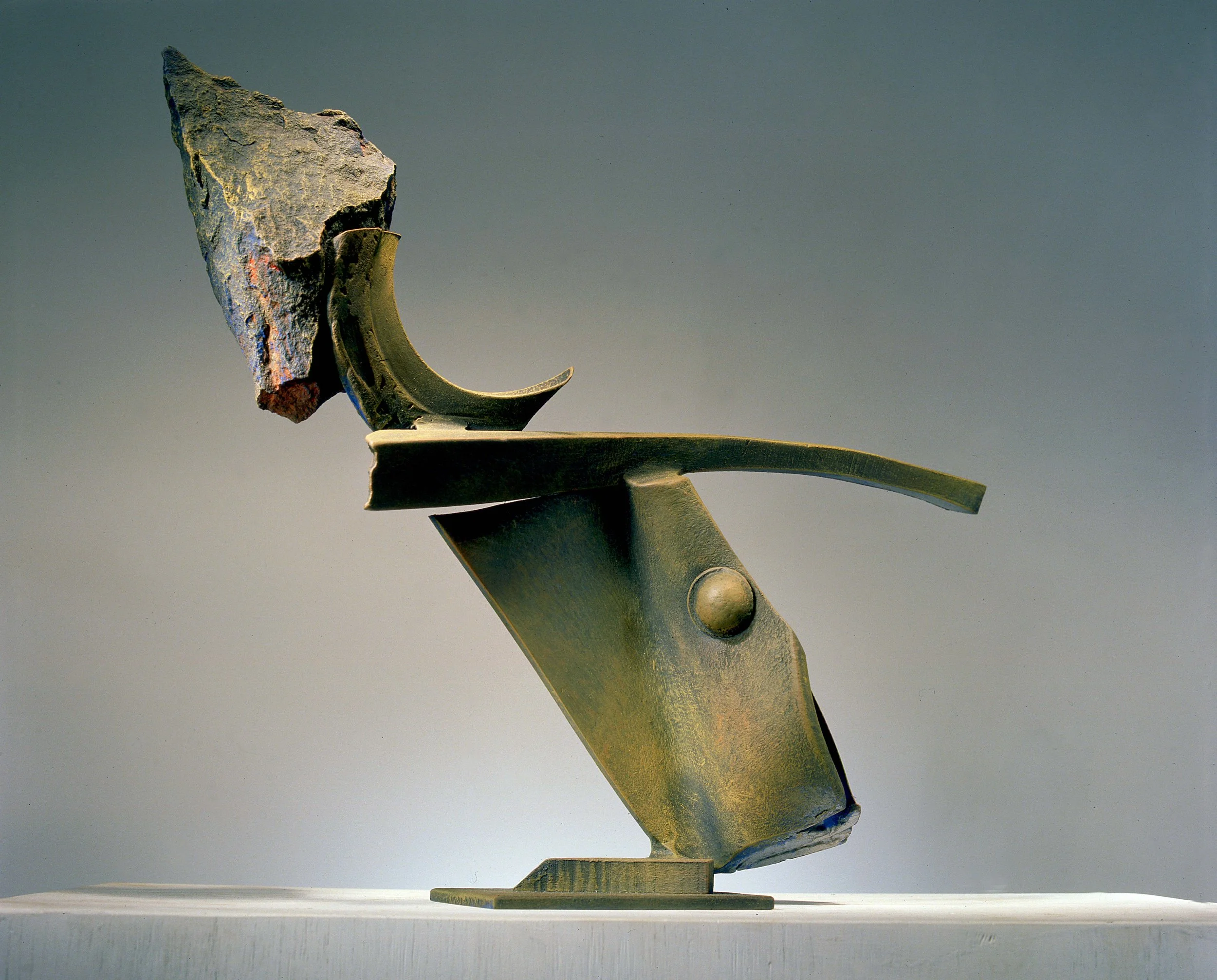
September 1999. Painted granite, steel. Dimensions: 16.5 × 19 × 4 in (42 × 48 × 10 cm).
Private collection
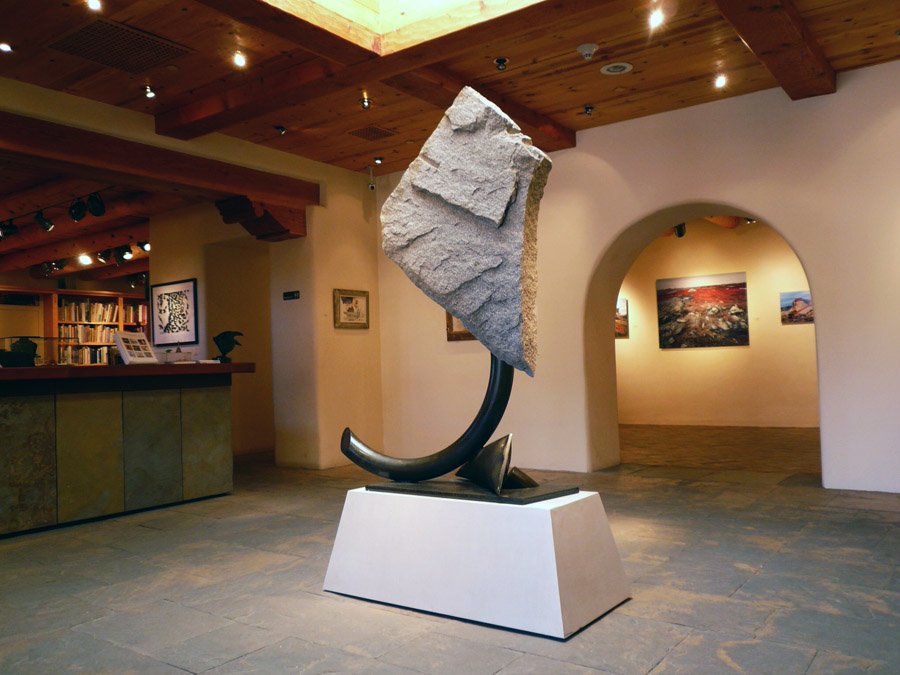
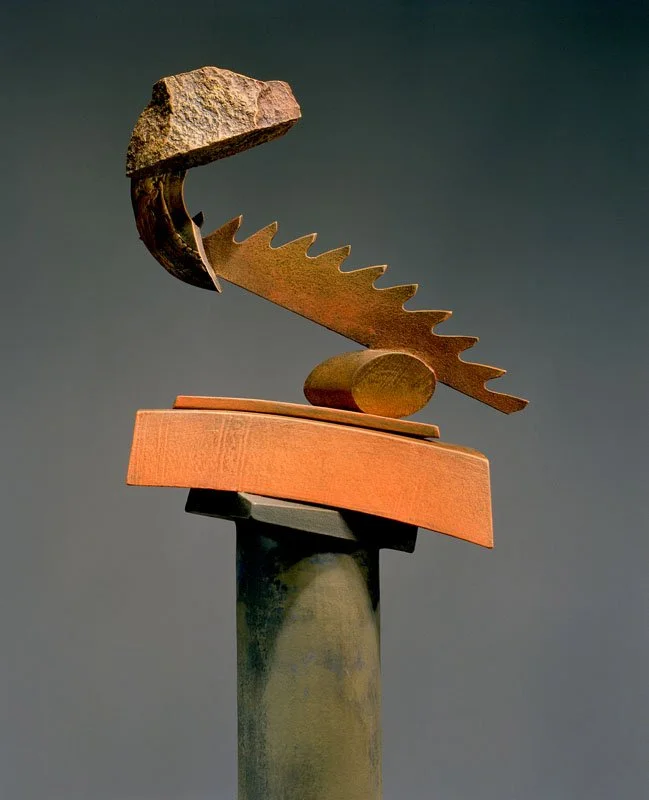
November 1999. Painted granite, steel. Dimensions: 66 × 14 × 10 in (168 × 36 × 25 cm).
Private collection: St. Louis, MO.
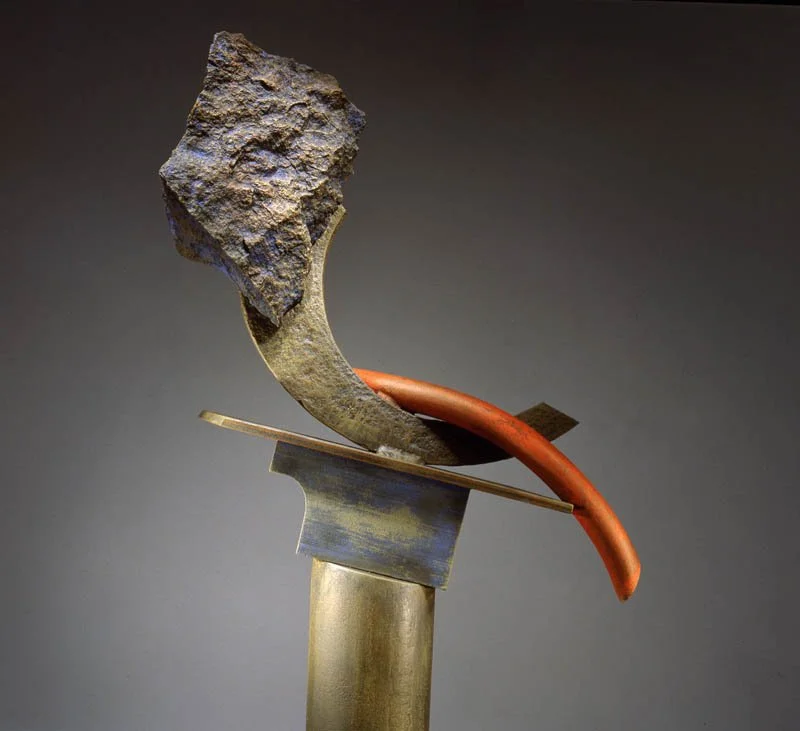
November 1999. Painted granite, steel. Dimensions: 78 × 20 × 10 in (198 × 51 × 25 cm). Private Collection - Austin TX.
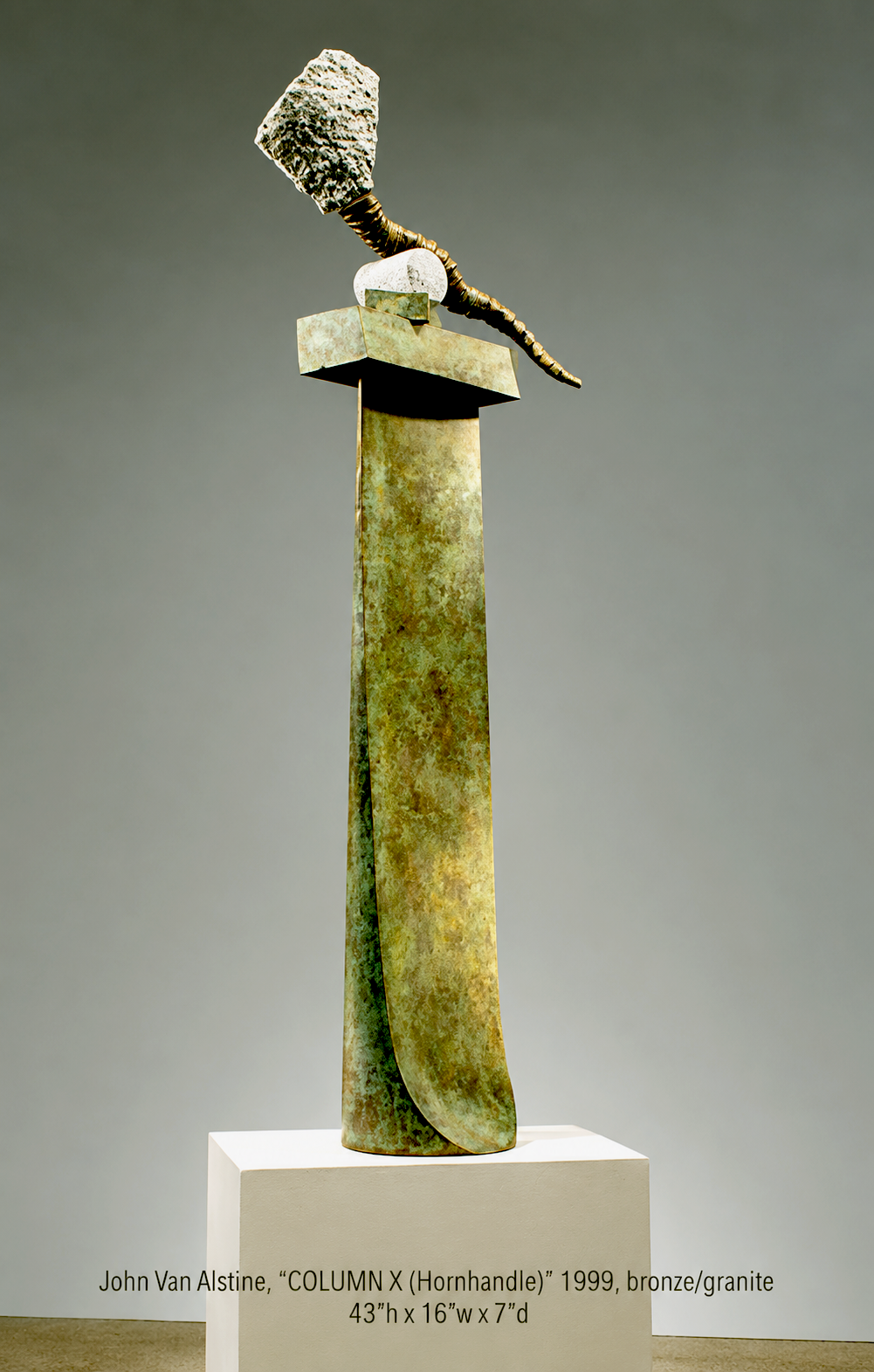
November 1999. Bronze, granite. Dimensions: 43 × 16 × 7 in (109 × 41 × 18 cm). Dissembled 2021, parts used for new pieces.
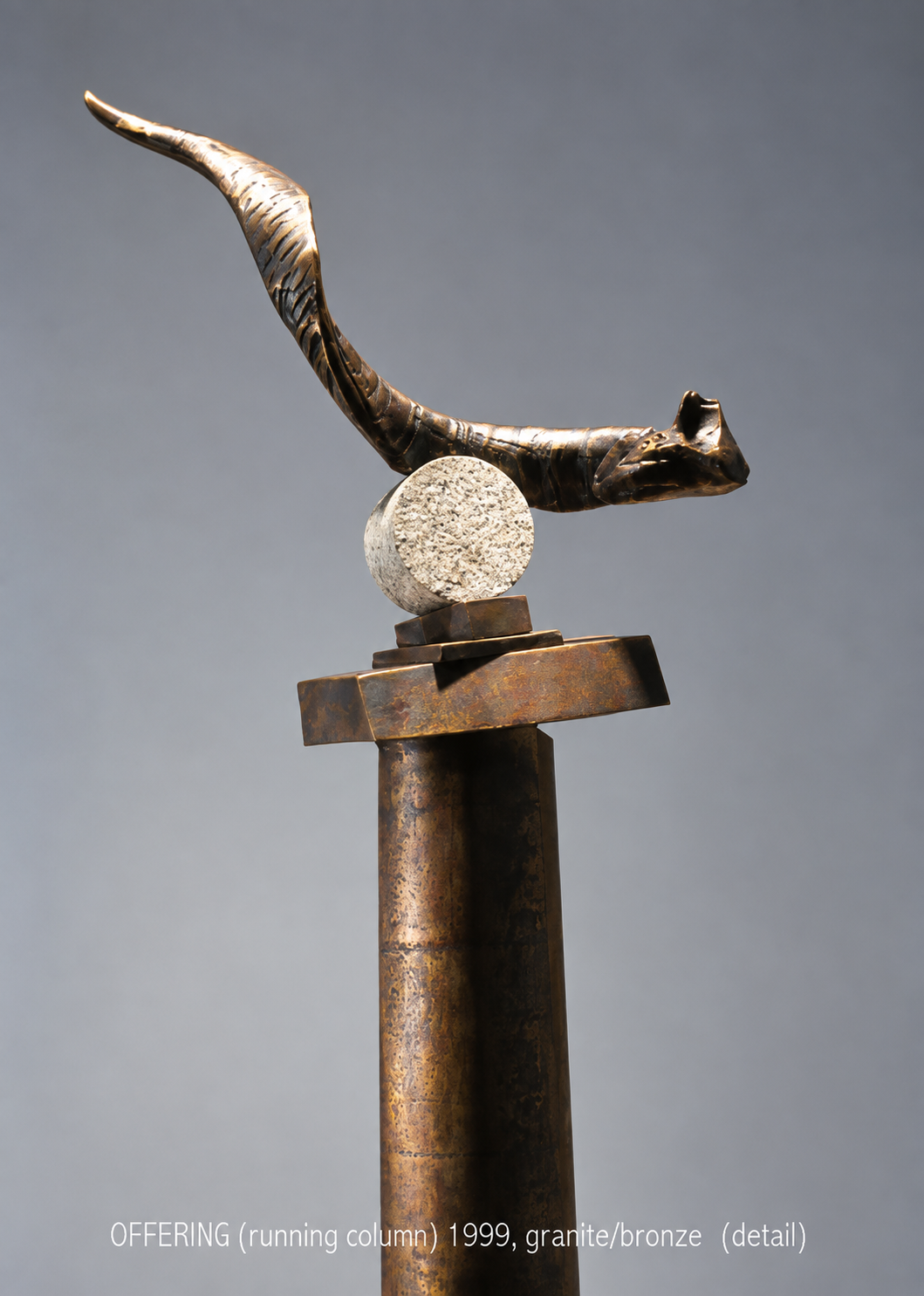
November 1999. Bronze, granite. Dimensions: 71 × 28 × 20 in (180 × 71 × 51 cm). Disassembled - parts used for other pieces.
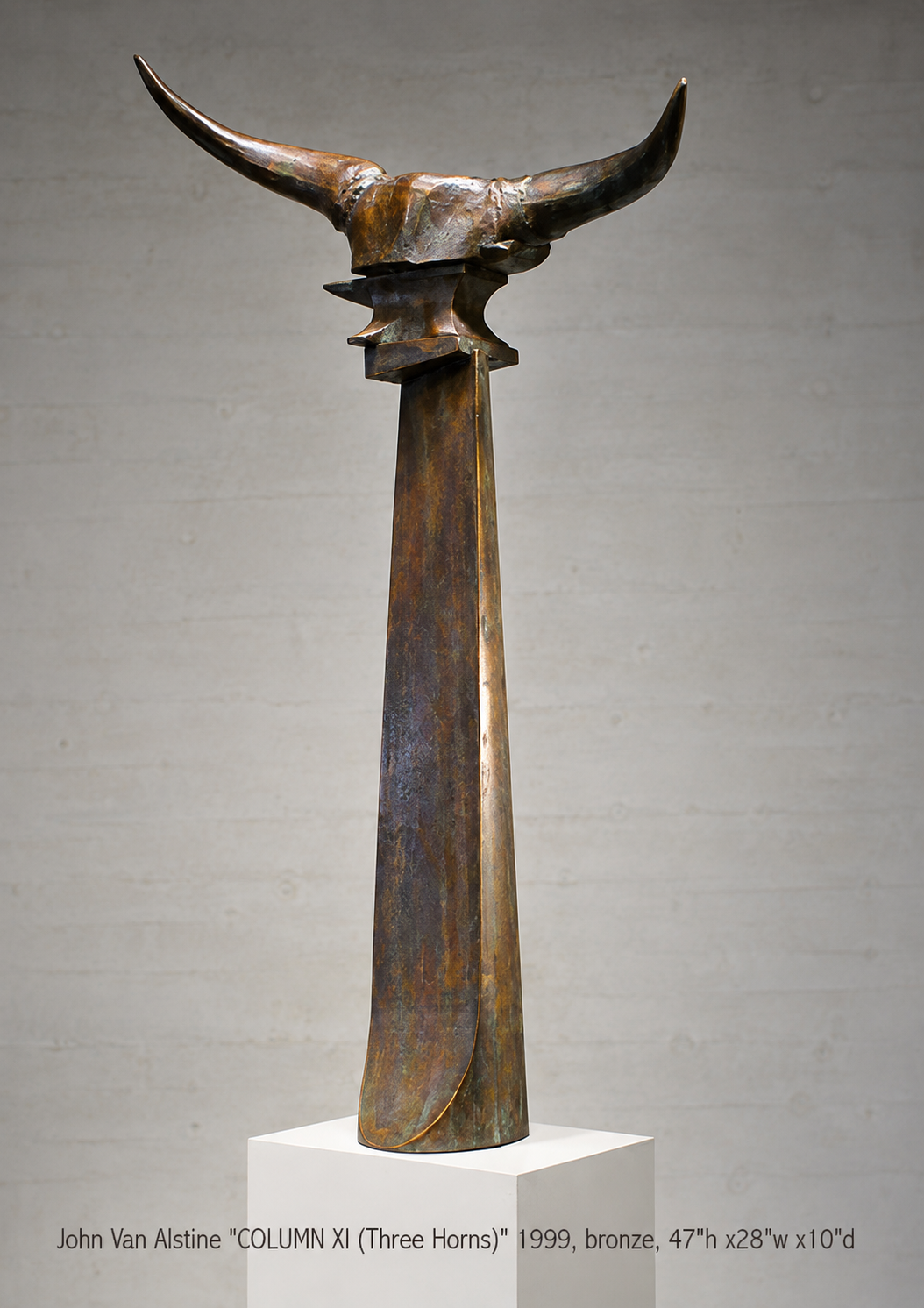
November 1999. Bronze. Dimensions: 47 × 28 × 10 in (119 × 71 × 25 cm).
Cannibalized
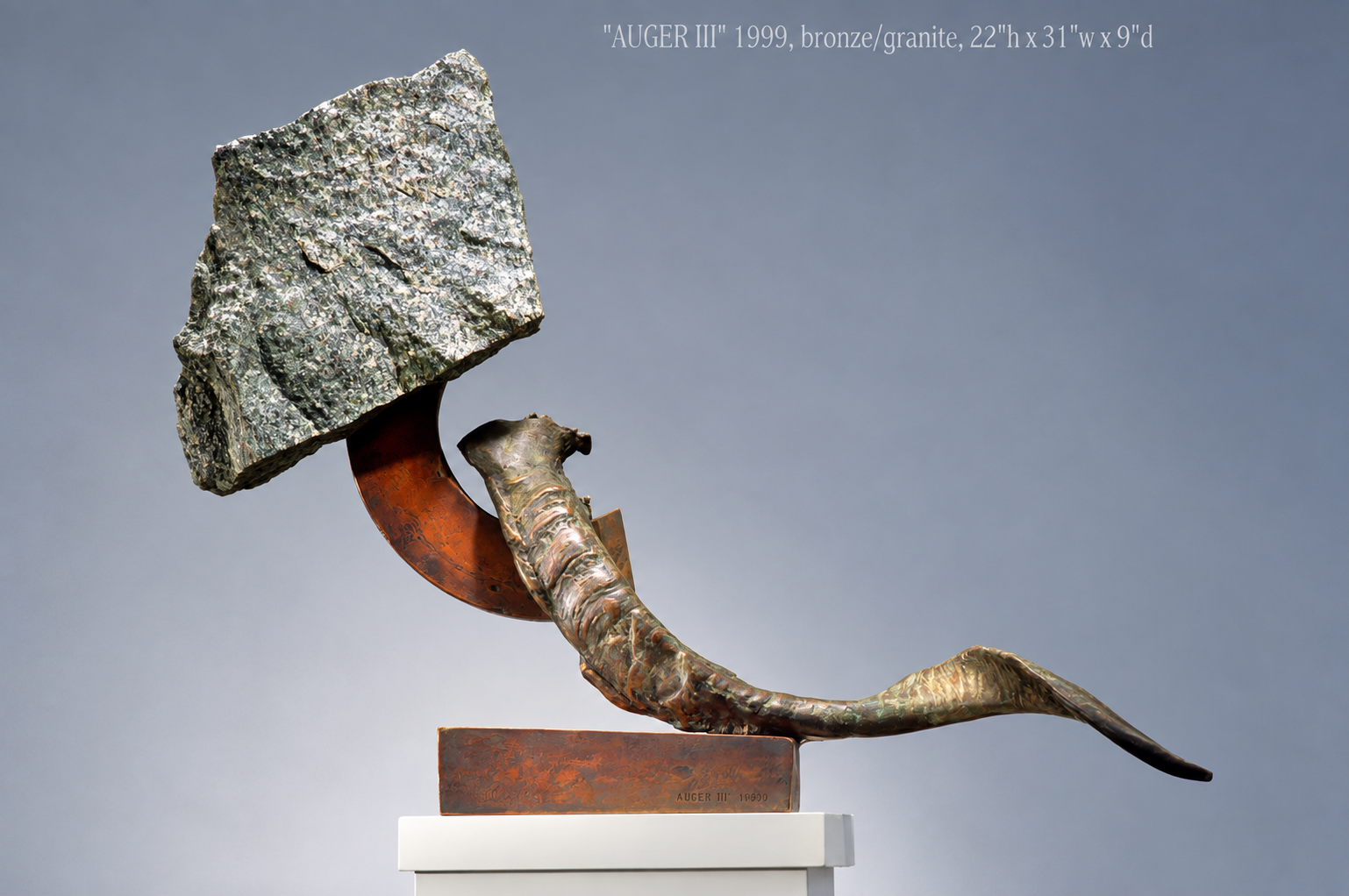
November 1999. Bronze, granite. Dimensions: 22 × 31 × 9 in (56 × 79 × 23 cm).
Private collection
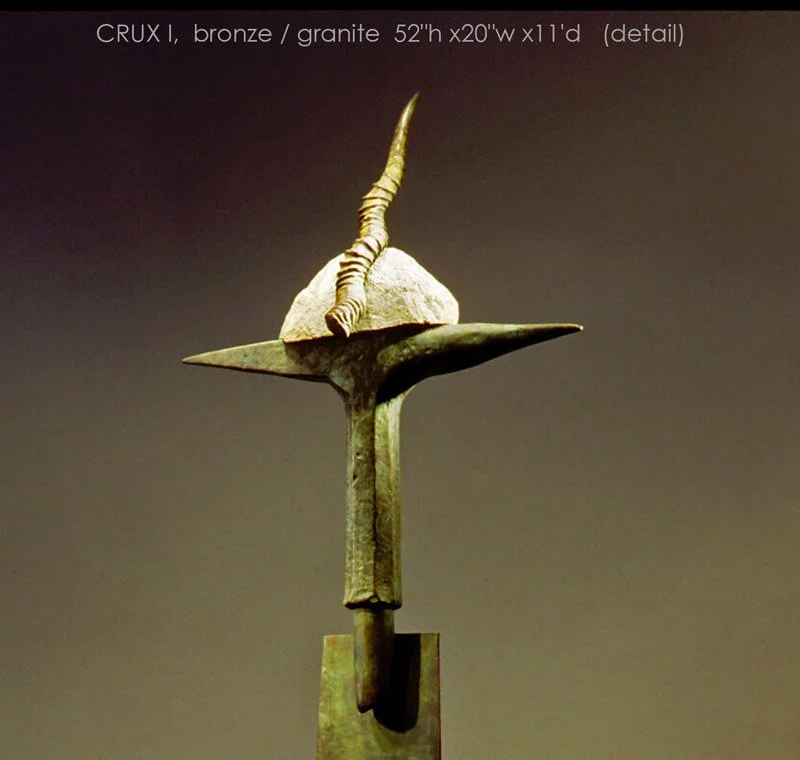
November 1999. Bronze, field stone. Dimensions: 56 × 20 × 11 in (142 × 51 × 28 cm).
Private collection
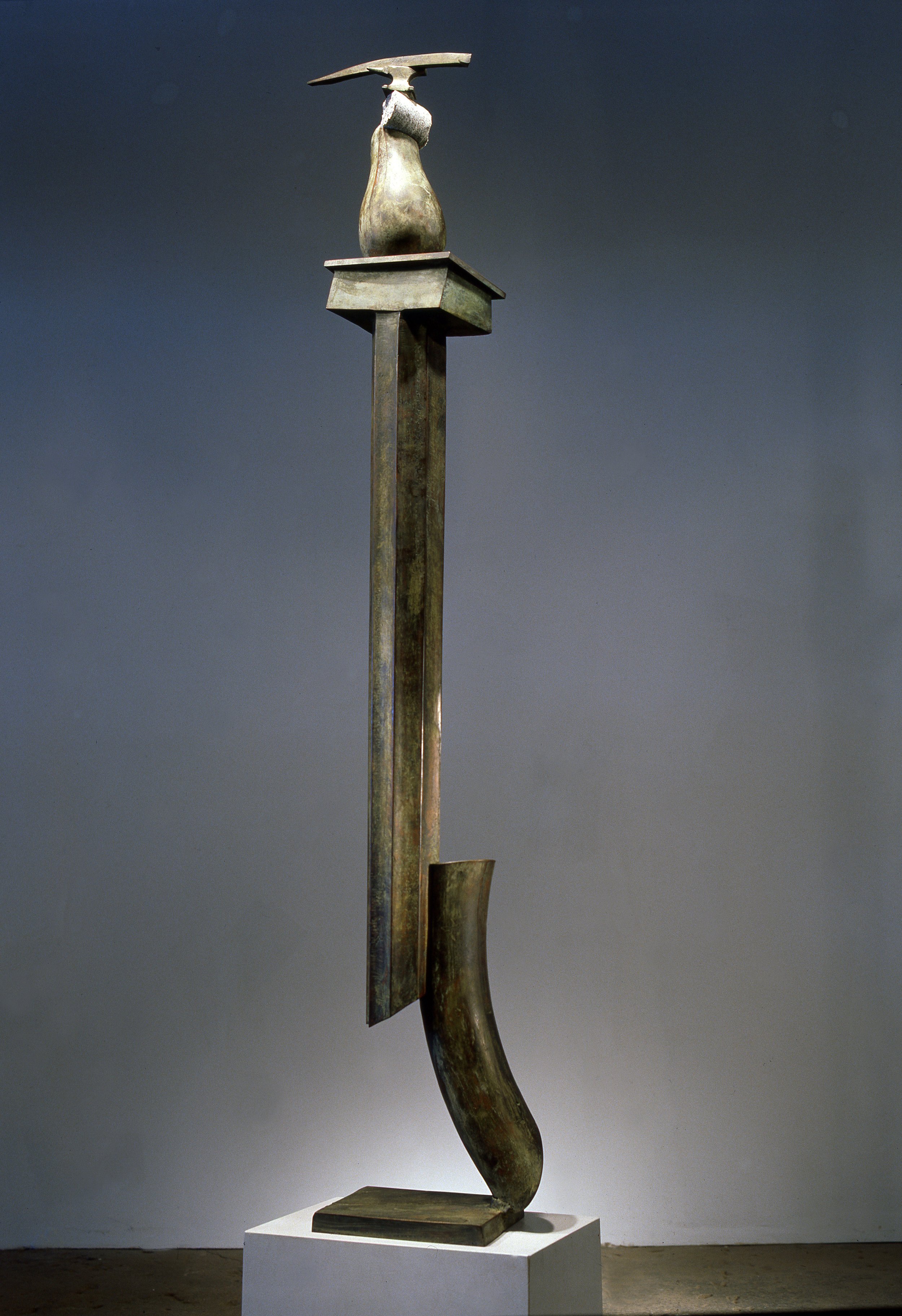
December 1999. Bronze, granite. Dimensions: 65 × 12 × 8 in (165 × 30 × 20 cm).
Private Collection - Philadelphia, PA
Strange Fruit (Ara), 1999
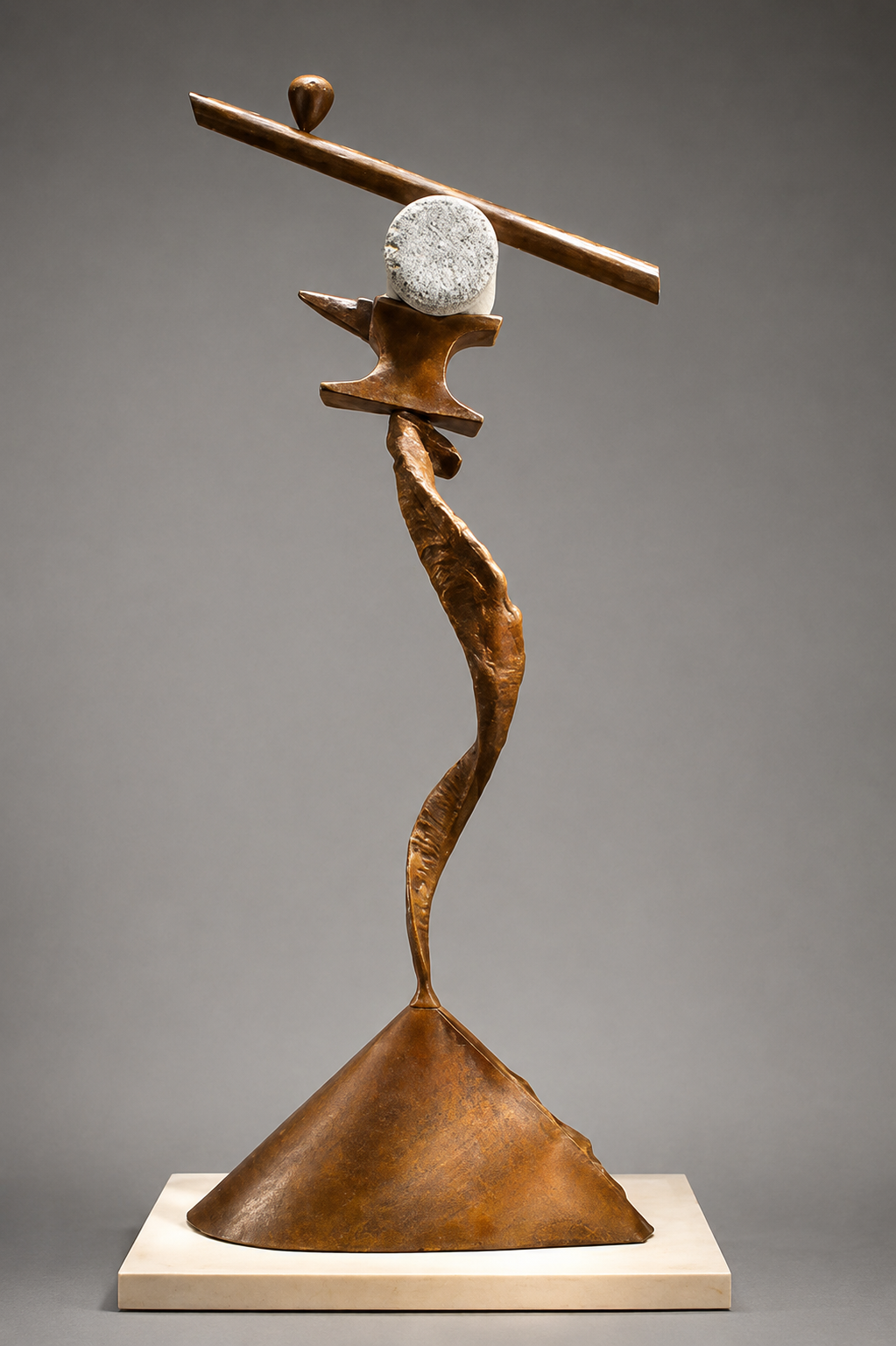
Strange Fruit (Ara) explores the column as a vertical, almost figure-like structure. At its summit, a fruit-like bronze form contrasts with the architectural shaft, while a small anvil seemingly balanced on a stone cylinder brings together recurring interests in tools, weight, and precarious balance.
The anvil—a place where material is literally forged—also serves as a metaphor for creative transformation. Ara, Latin for “altar,” reinforces the work’s ritualistic quality, while elevating this quintessentially heavy object creates an unexpected sense of lightness and suspension.
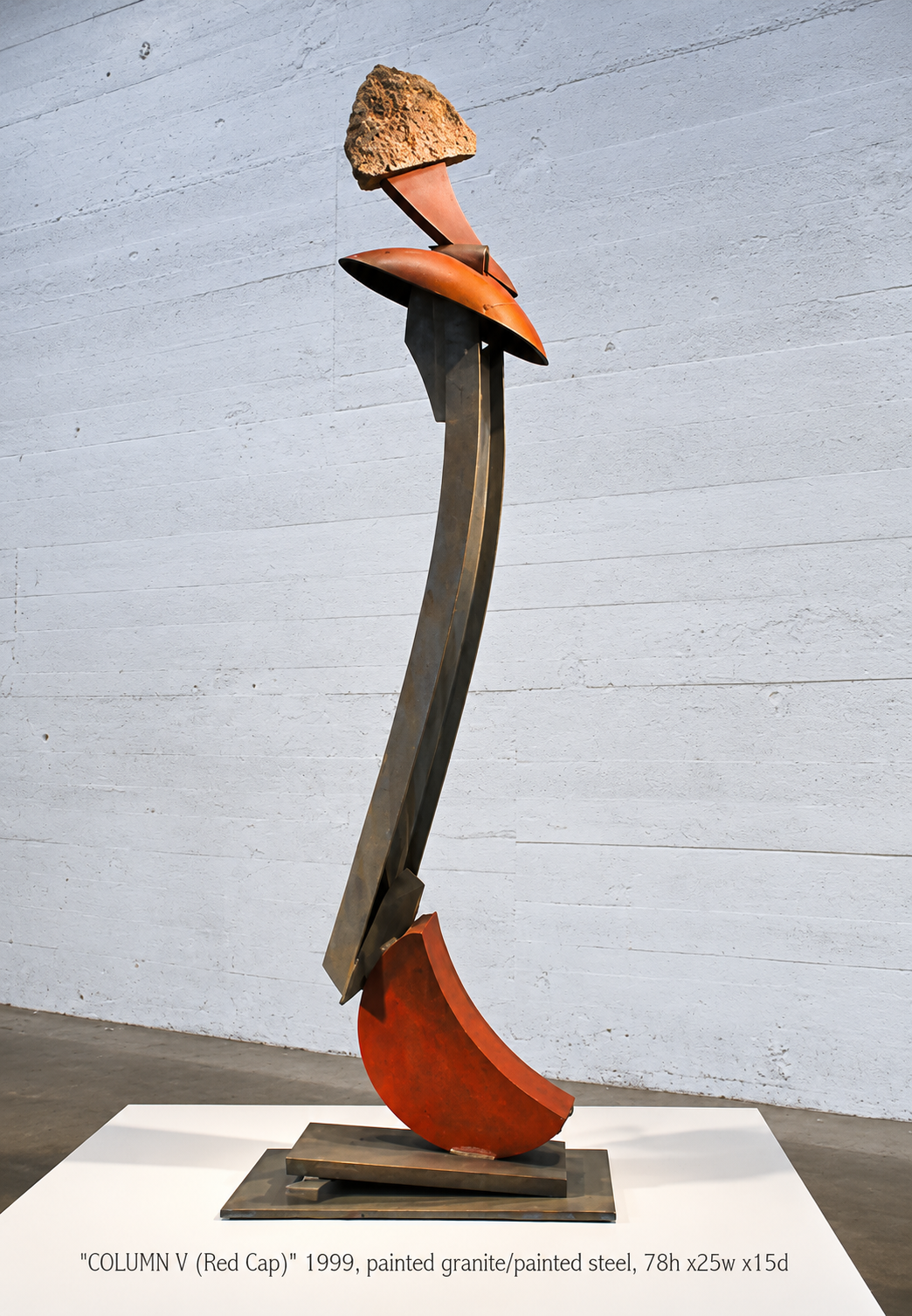
1998
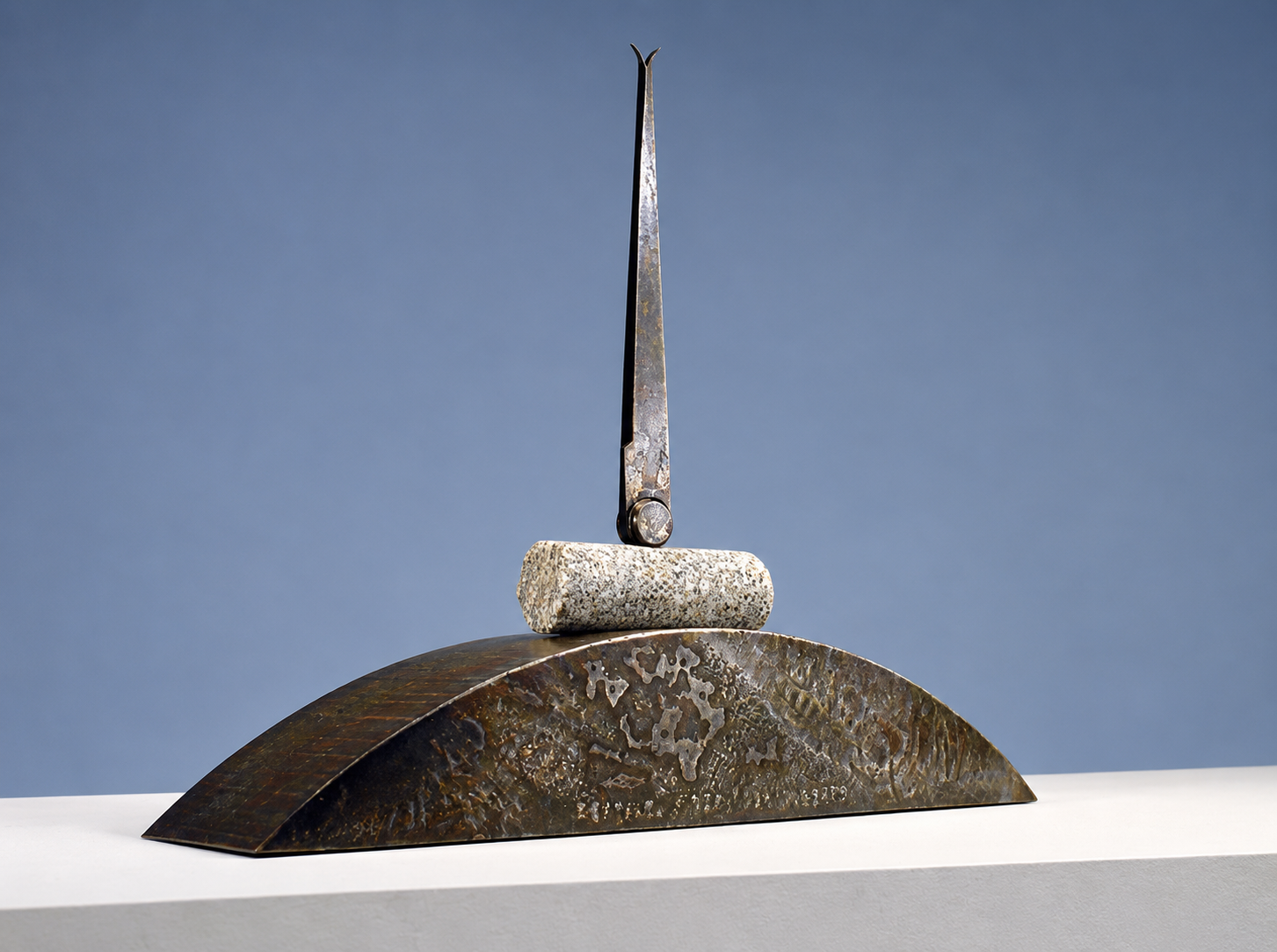
January 1998. Granite, steel. Dimensions: 13.5 × 15 × 4 in (34 × 38 × 10 cm). Private Collection - Boston
Sentinel (Tool for Alberto), 1998
Sentinel (Tool for Alberto) brings together my interest in tools, the figure, and balance. The upper element is a set of calipers—an instrument for measuring and gauging—transformed into a slender, upright figure seemingly poised on a granite cylinder. Its vertical stance suggests a sentinel standing at attention, while the tool becomes both a functional object and a metaphor for human action and ingenuity.
The sculpture’s long, attenuated form is an homage to the Italian sculptor Alberto Giacometti, whose lean, elongated figures have long interested me. Rather than depicting the human figure literally, the calipers, stone, and steel suggest its presence through proportion, posture, and precarious balance—allowing a familiar tool to take on an unexpectedly figurative character.

January 1998. Steel. Dimensions: 34 × 17 × 4 in (86 × 43 × 10 cm).
As a sculptor, I have always been fascinated by tools, implements, and instruments. I see them as extensions of the hand—essential allies in the act of making—and am drawn to their raw, efficient beauty, shaped over time by function and necessity. They also embody human ingenuity, labor, and our impulse to shape and engage the world around us.
Throughout my work, agricultural implements—rakes, plow blades, sledges, and tillers—as well as anvils, scales, compasses, and other instruments become both sculptural forms and vehicles for metaphor, suggesting ideas of balance, navigation, transformation, and our relationship to the natural world.
John Van Alstine
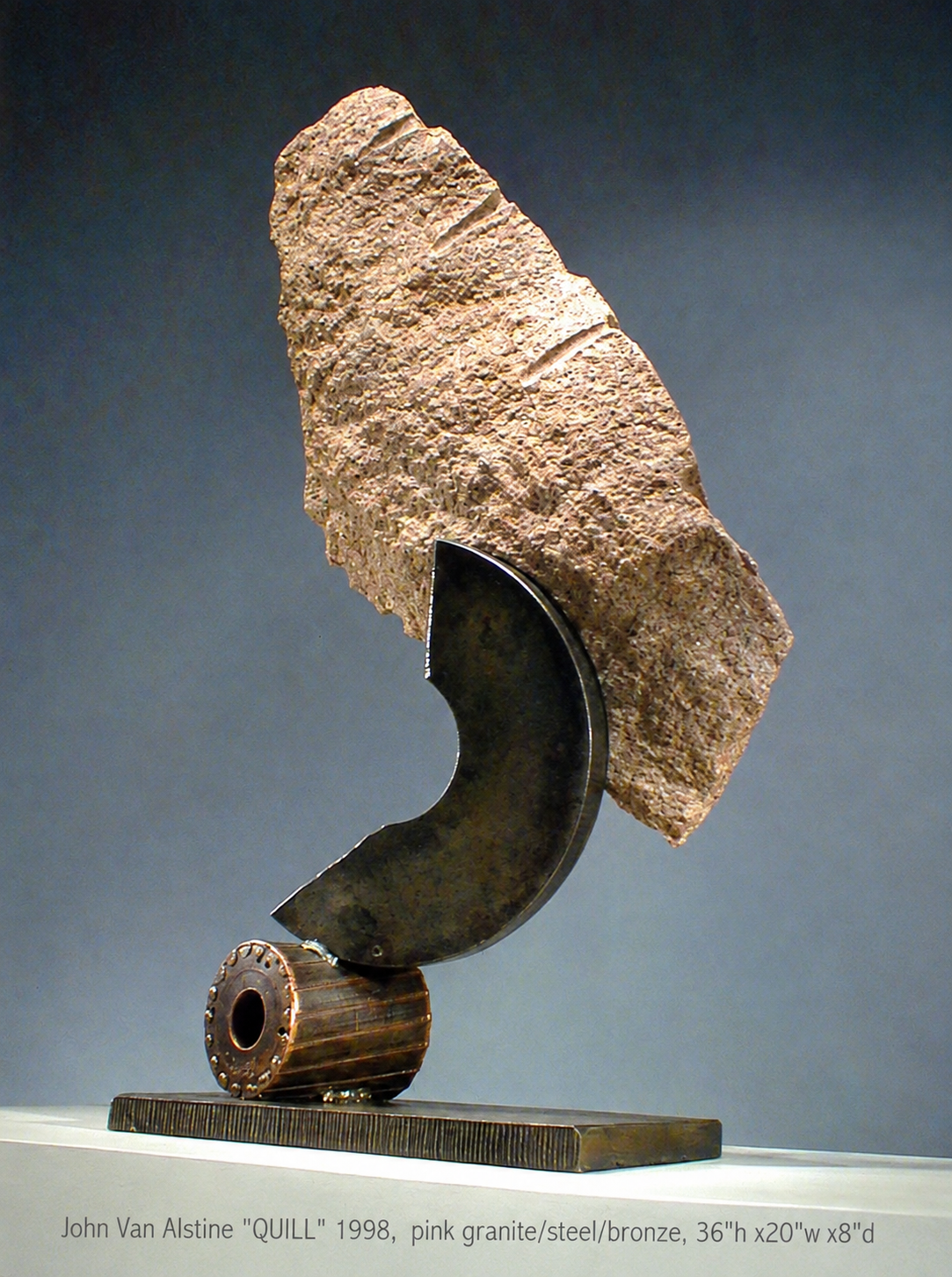
1998. Pink granite, steel. Dimensions: 36 × 20 × 8 in (91 × 51 × 20 cm). Corporate collection.
Quill, 1998
Quill continues my interest in combining rough-hewn stone with fabricated metal while challenging the inherent weight and earthbound character of stone. The pink granite is lifted and poised above the steel and bronze structure, creating a precarious balance that gives the heavy material an unexpected sense of movement and levity—part of my ongoing effort to “choreograph” stone and make it appear to defy gravity.
The title Quill suggests a feather, reinforced by the elongated shape and quarry marks of the granite. This association transforms the dense stone visually into something light and airborne, emphasizing a recurring contradiction in my work: using weight, gravity, and balance to create the illusion of their opposite.
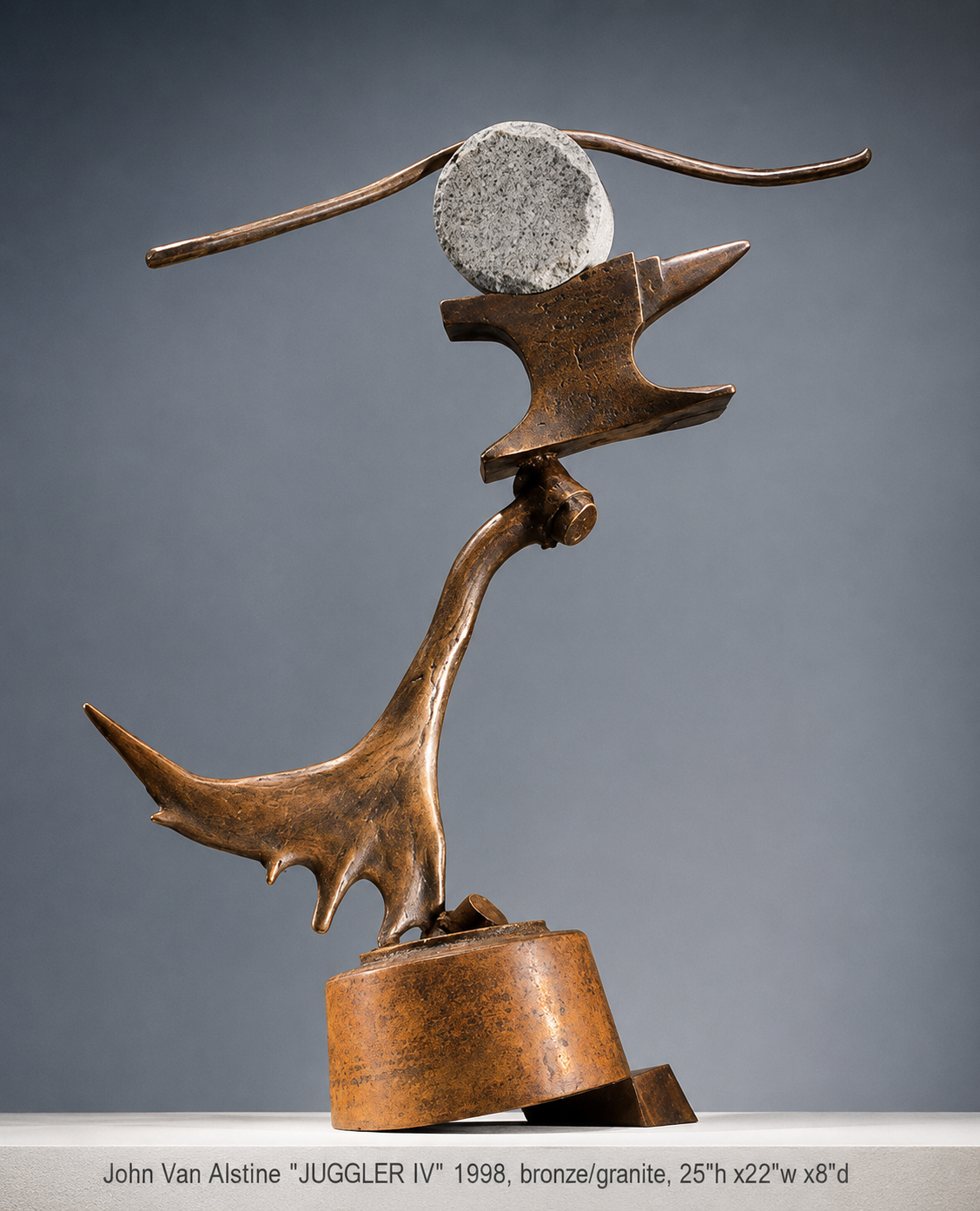
February 1998. Bronze, granite. Dimensions: 25 × 22 × 8 in (64 × 56 × 20 cm). Private collection - Washington, DC
Many of Van Alstine’s works take inspiration from the movement of the human body. This work can be seen as a kind of self-portrait, suggesting his studio process—literally juggling and repositioning the individual elements of a sculpture until they achieve a moment of perfect balance, then freezing that moment in space through welding. More universally, juggling becomes a metaphor for the way we all balance the competing demands of family, work, play, and responsibility.
The anvil, which appears in a number of the artist’s works, represents both the ultimate heavy object to “juggle” and the act of assembly itself—the forging together of object, material, and ideas that is central to Van Alstine’s work.
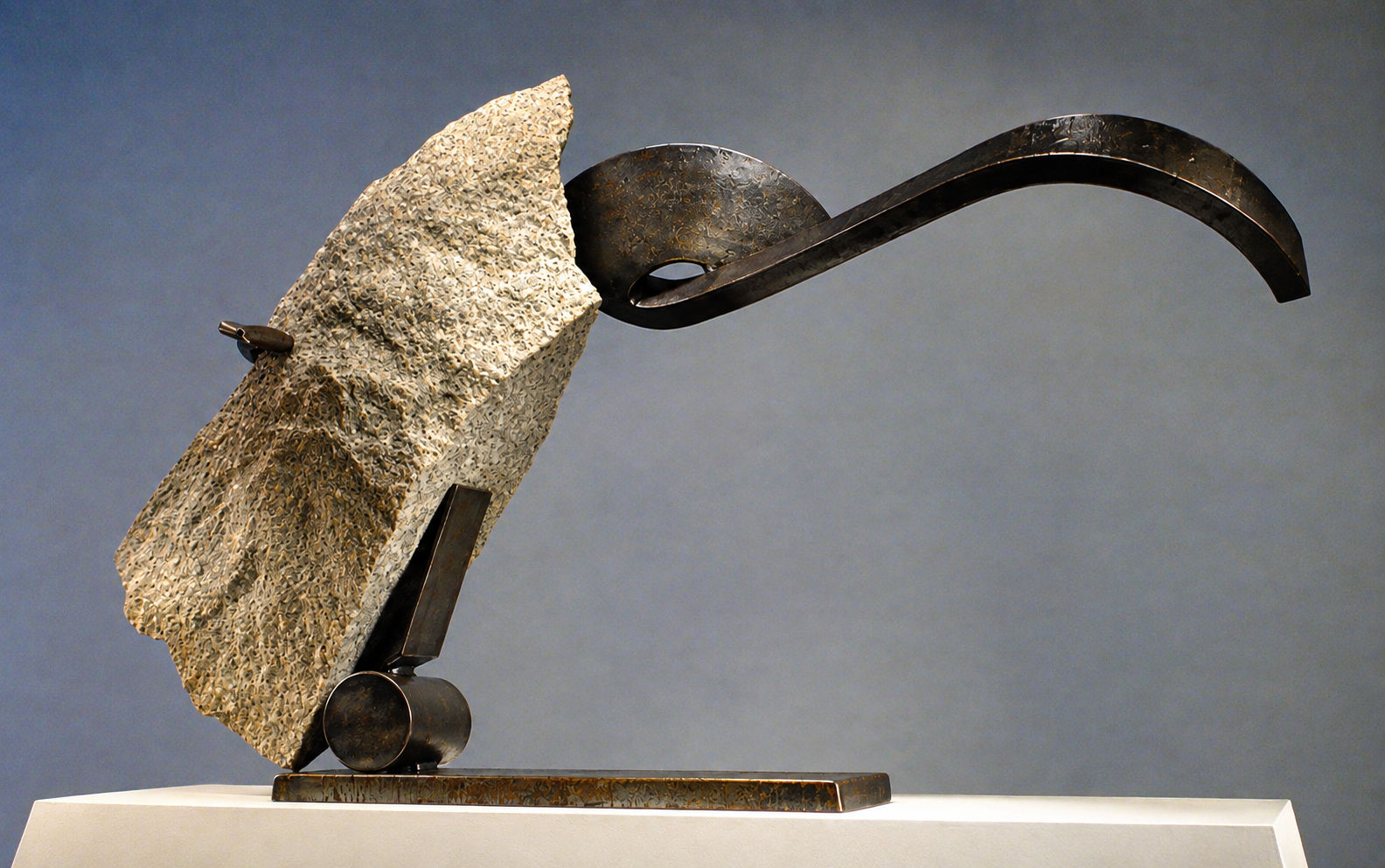
February 1998. Granite, steel. Dimensions: 27.5 × 45 × 9 in (70 × 114 × 23 cm).
Private collection
Angler, 1998
Angler reflects my continuing interest in bringing a sense of life and movement to inherently heavy, inanimate materials such as steel and stone. The granite mass appears to lean forward in an active, almost bodily gesture, while the long outstretched steel element has the fluidity of a fly-line cast through the air. The sculpture transforms weight and rigidity into a moment of balance, motion, and suspended energy. This idea of “choreographing” heavy materials was central to my work of this period.
The title reinforces this sense of action. Rather than literally depicting a fisherman, the sweeping curves and implied flexibility of the steel evoke the graceful movement of someone fly-fishing—the line extending outward at the moment of a cast. In this way, Angler uses gesture rather than representation to animate stone and steel, giving static materials an unexpected sense of fluidity and life.
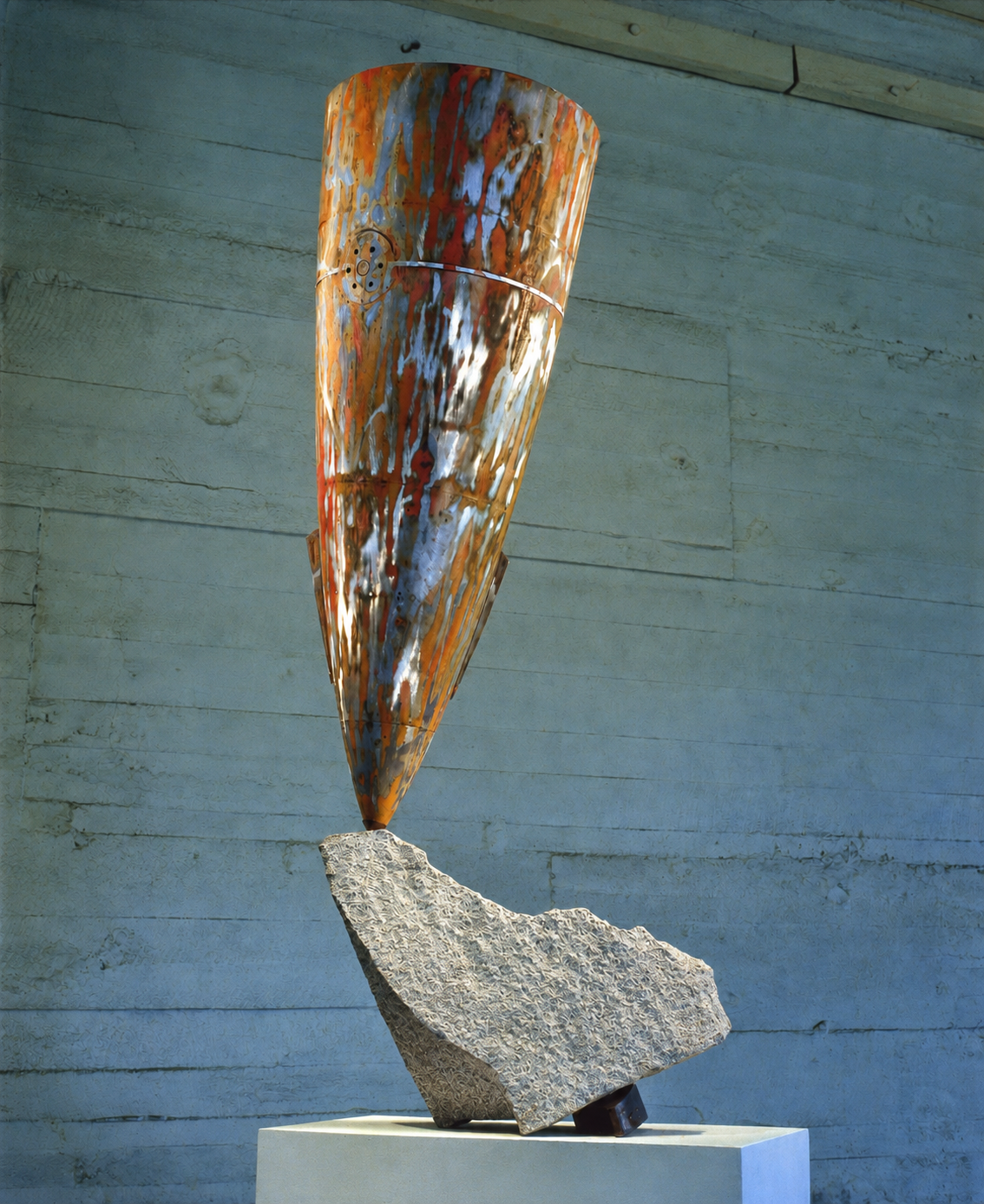
March 1998. Aluminum, bronze, granite. Dimensions: 74 × 30 × 24 in (188 × 76 × 61 cm).
Private collection Palm Desert, CA.
Chalice IV continues my Chalice Series and my longstanding interest in vessels and containers as sculptural forms and metaphors. Rooted partly in my early background as a potter, the vessel became a metaphor for passage—the individual or humanity moving through life. Here, a large aluminum aeronautical form balances point-to-point with a rough granite mass, creating an elongated chalice.
The sanded aluminum cup reflects the light and colors around it, subtly changing with its environment. Its luminous surface contrasts with the weight and permanence of the rough granite, bringing together lightness and mass, the human-made and the natural. Through its precarious balance, the familiar vessel becomes a spirited “cup of life,” suggesting passage and the human experience.
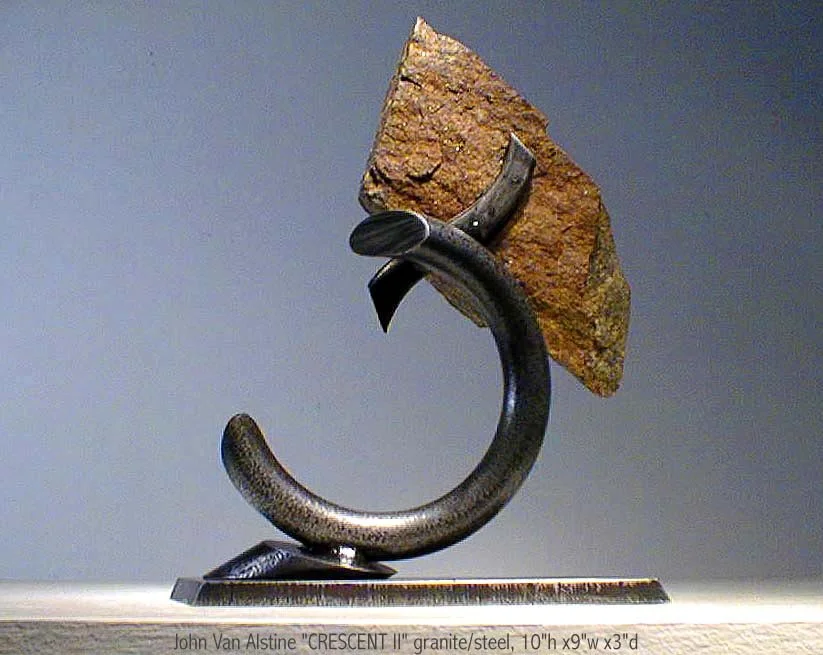
March 1998. Granite, steel. Dimensions: 10 × 9 × 3 in (25 × 23 × 8 cm).
Private collection
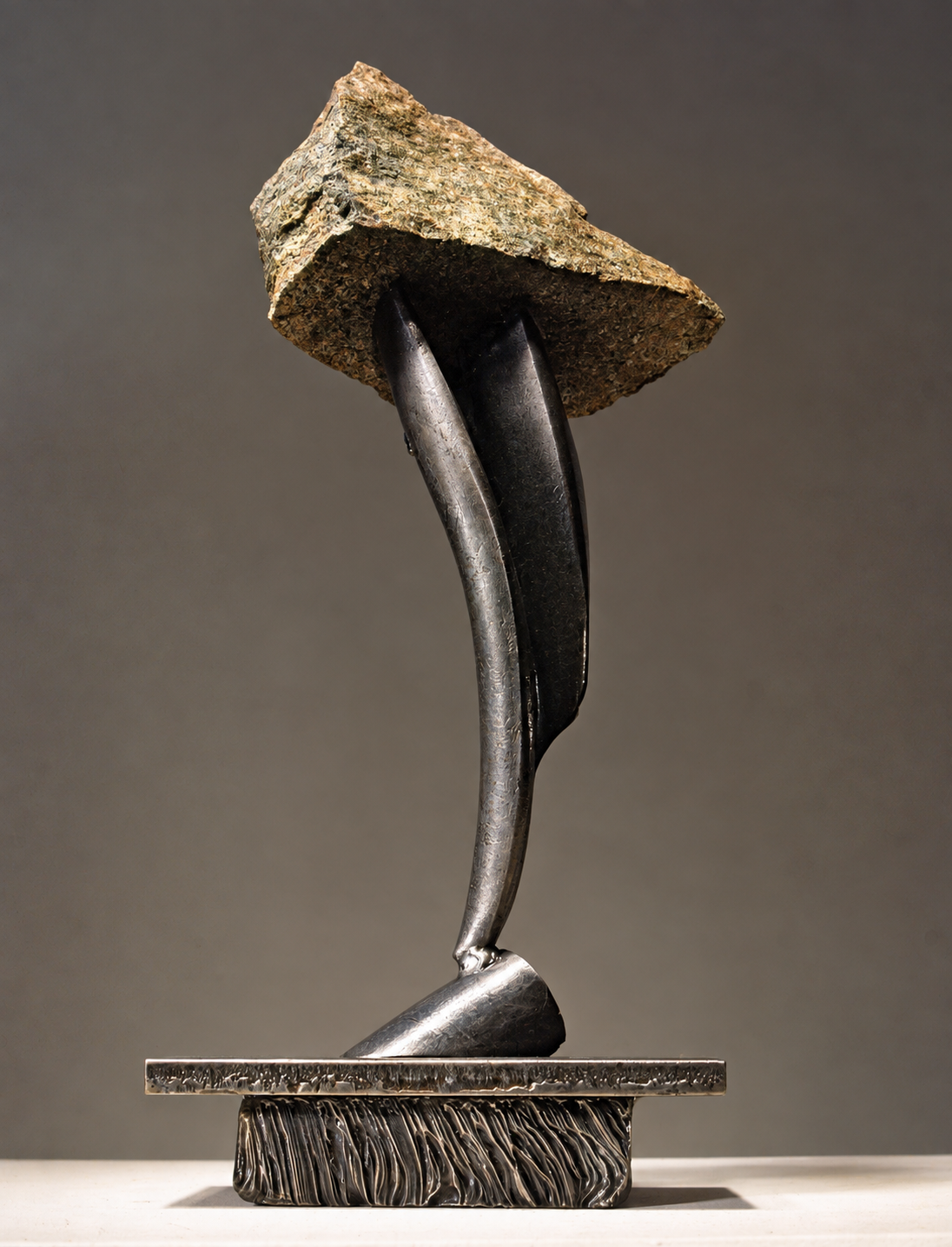
March 1998. Granite, steel. Dimensions: 16 × 9 × 3.5 in (41 × 23 × 9 cm). Private Collection
FAX takes its name from the Latin word meaning “torch,” which the physical arrangement of stone and steel suggests. The sculpture rises in a dramatic upward sweep, achieving a sense of precarious balance—a quality I often strive for and one that has become a signature feature of much of my work.
The piece also reflects an important aspect of my sculpture: the transformation of the viewer’s perception of material. If we accept the idea of a torch suggested by the title, the stone shifts in our imagination from something earthbound, heavy, and solid to something more like the gaseous energy of a chemical reaction—fire itself. It is this transformation that gives the work its power and invites the viewer to return, drawn again to its mystery and magic.
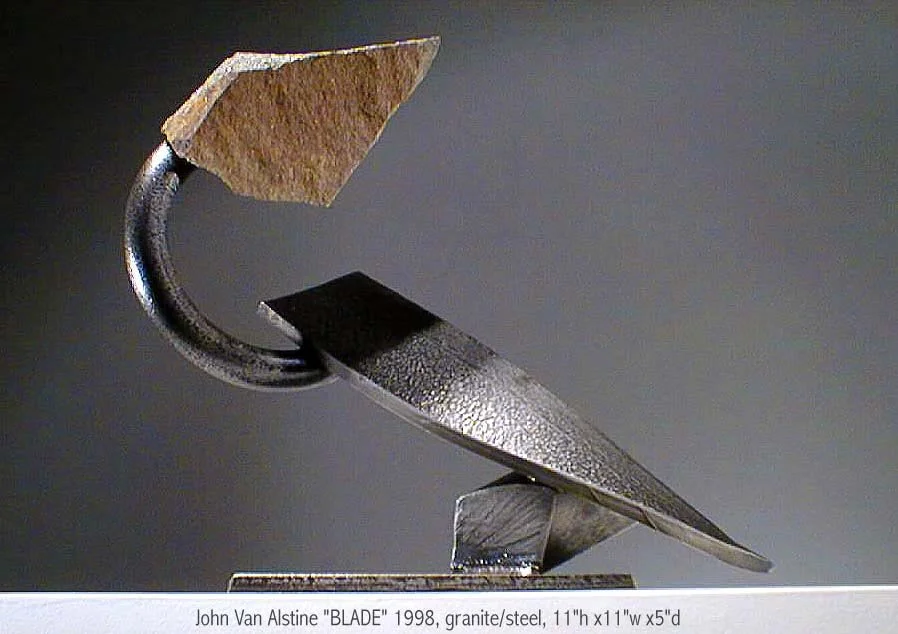
April 1998. Granite, steel. Dimensions: 11 × 11 × 5 in (28 × 28 × 13 cm).
Private collection
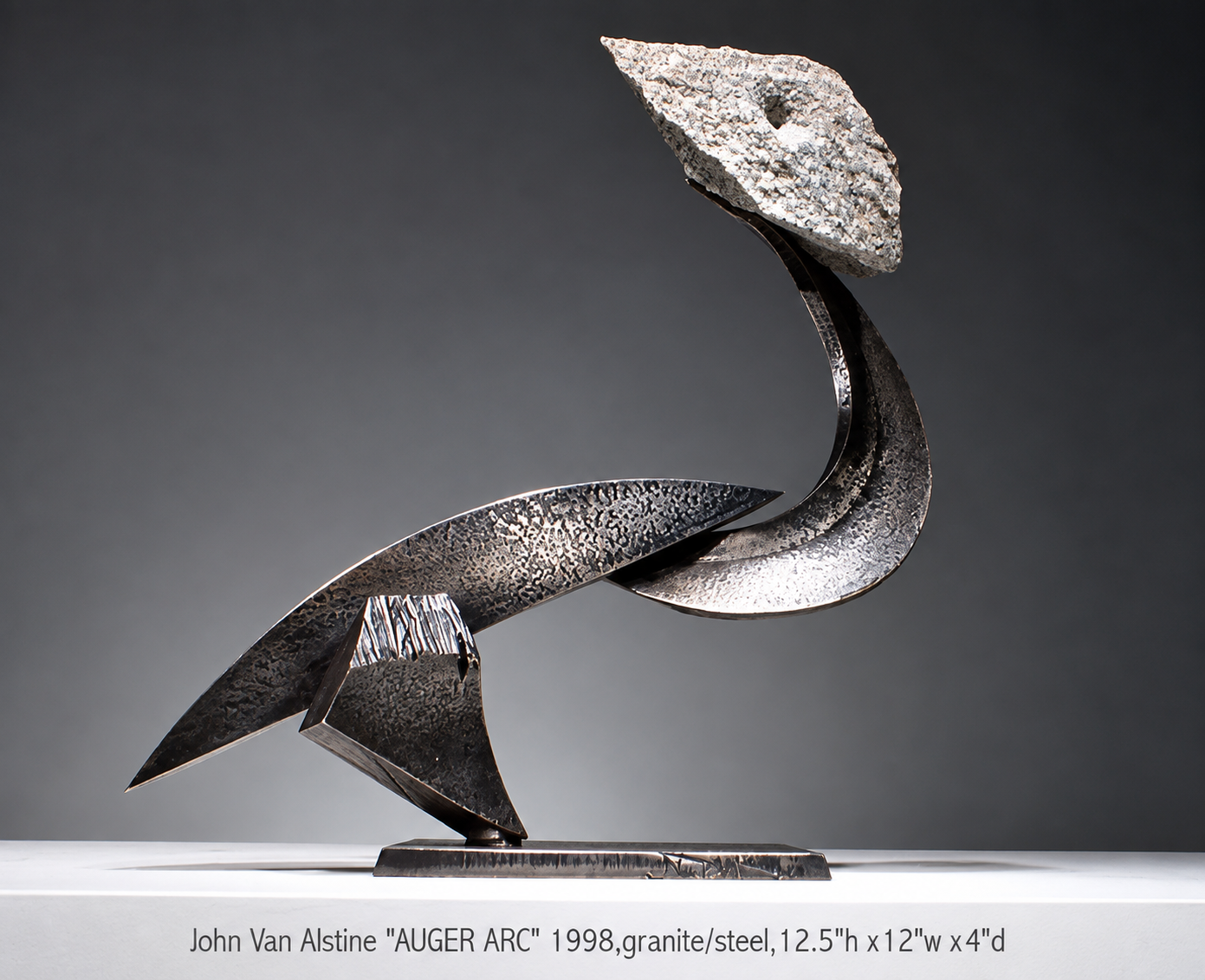
April 1998. Granite, steel. Dimensions: 12.5 × 12 × 4 in (32 × 30 × 10 cm).
Private Collection - Italy
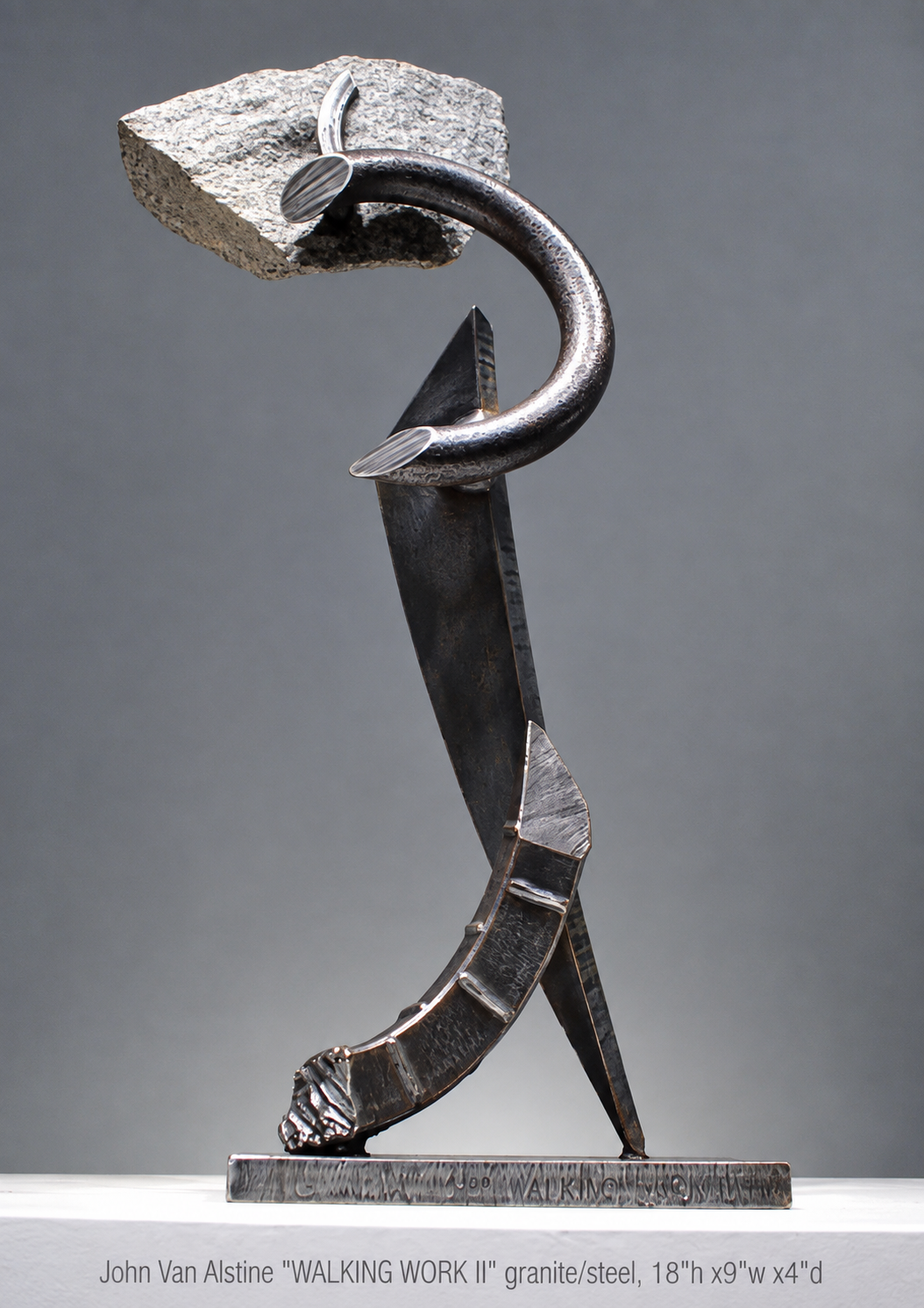
April 1998. Granite, steel. Dimensions: 18 × 9 × 4 in (46 × 23 × 10 cm).
Private Collection - Italy
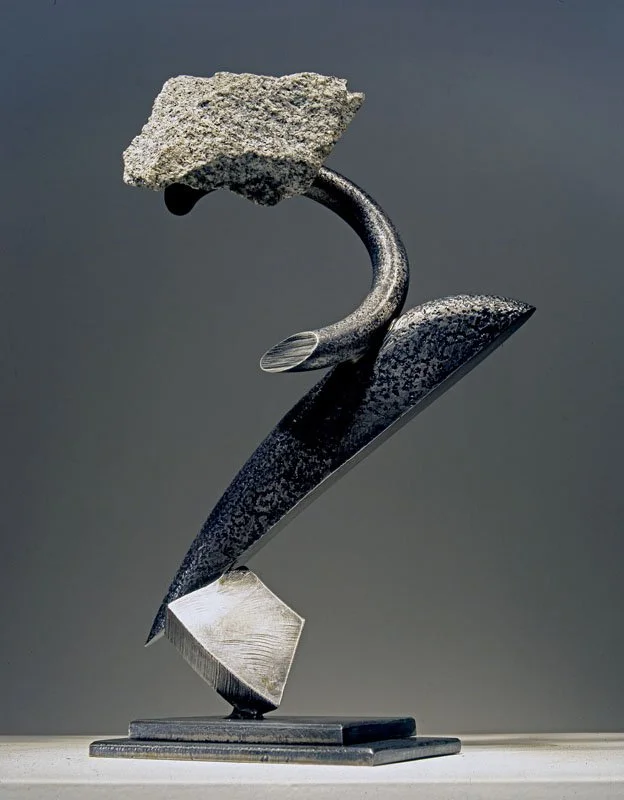
April 1998. Granite, steel. Dimensions: 15 × 9 × 5 in (38 × 23 × 13 cm). Used as top element for "COLUMN IV (slider)" 3/1999 (S-99-05).
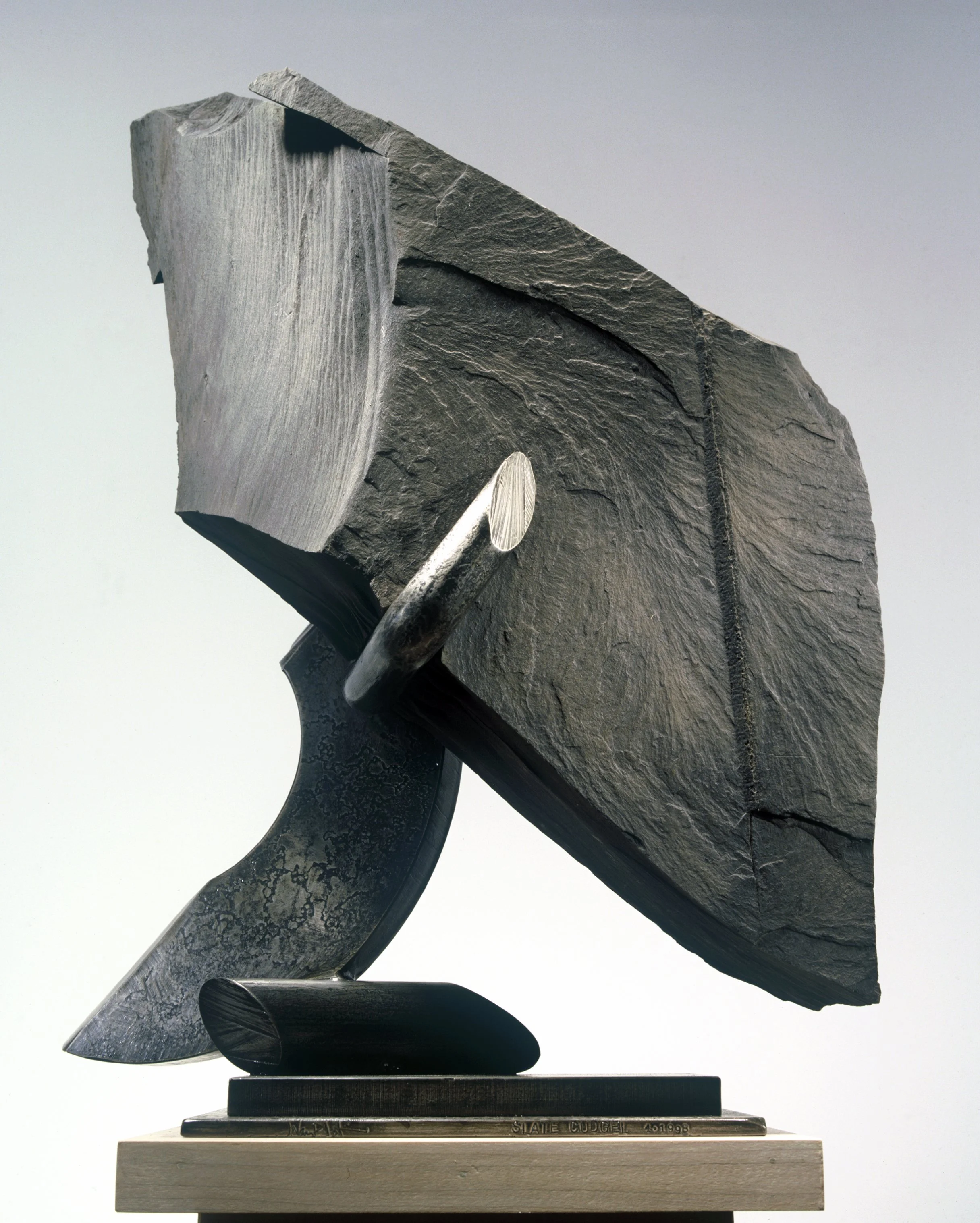
April 1998. Slate, steel. Dimensions: 25 × 18 × 9 in (64 × 46 × 23 cm). Private Collection - Plattsburgh, NY.
Slate Cudgel, 1998
Slate Cudgel is part of my ongoing Cudgel Series and reflects my interest in tools and implements as expressive sculptural forms. Here the curved steel suggests a handle, while the slate assumes the weight and presence of the head or blade of a primitive hand tool or weapon—a cudgel.
Although abstract, the sculpture implies human presence through the imagined act of grasping and using the tool. Slate and steel allow the work to shift between implement, implied figure, and abstract form.
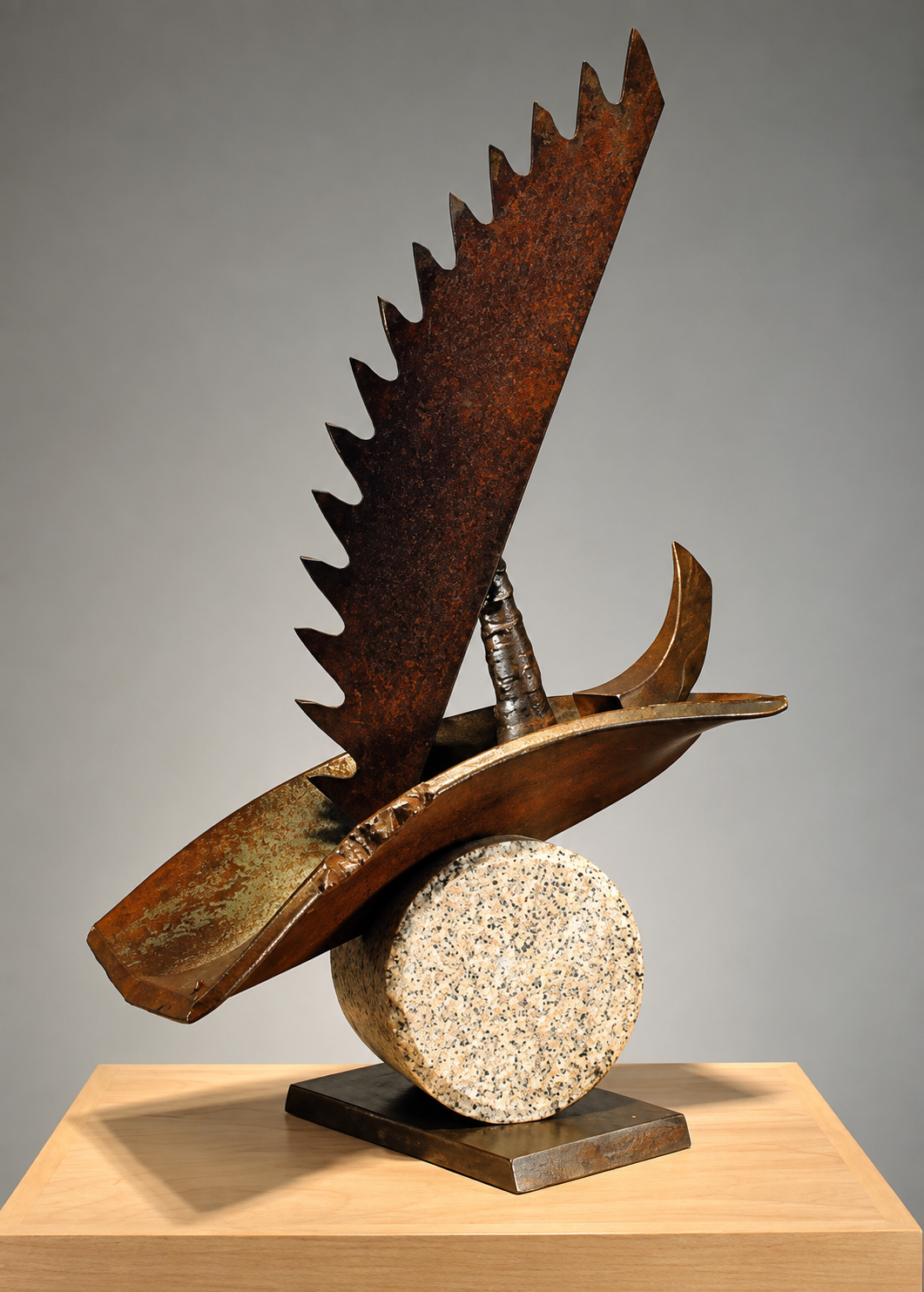
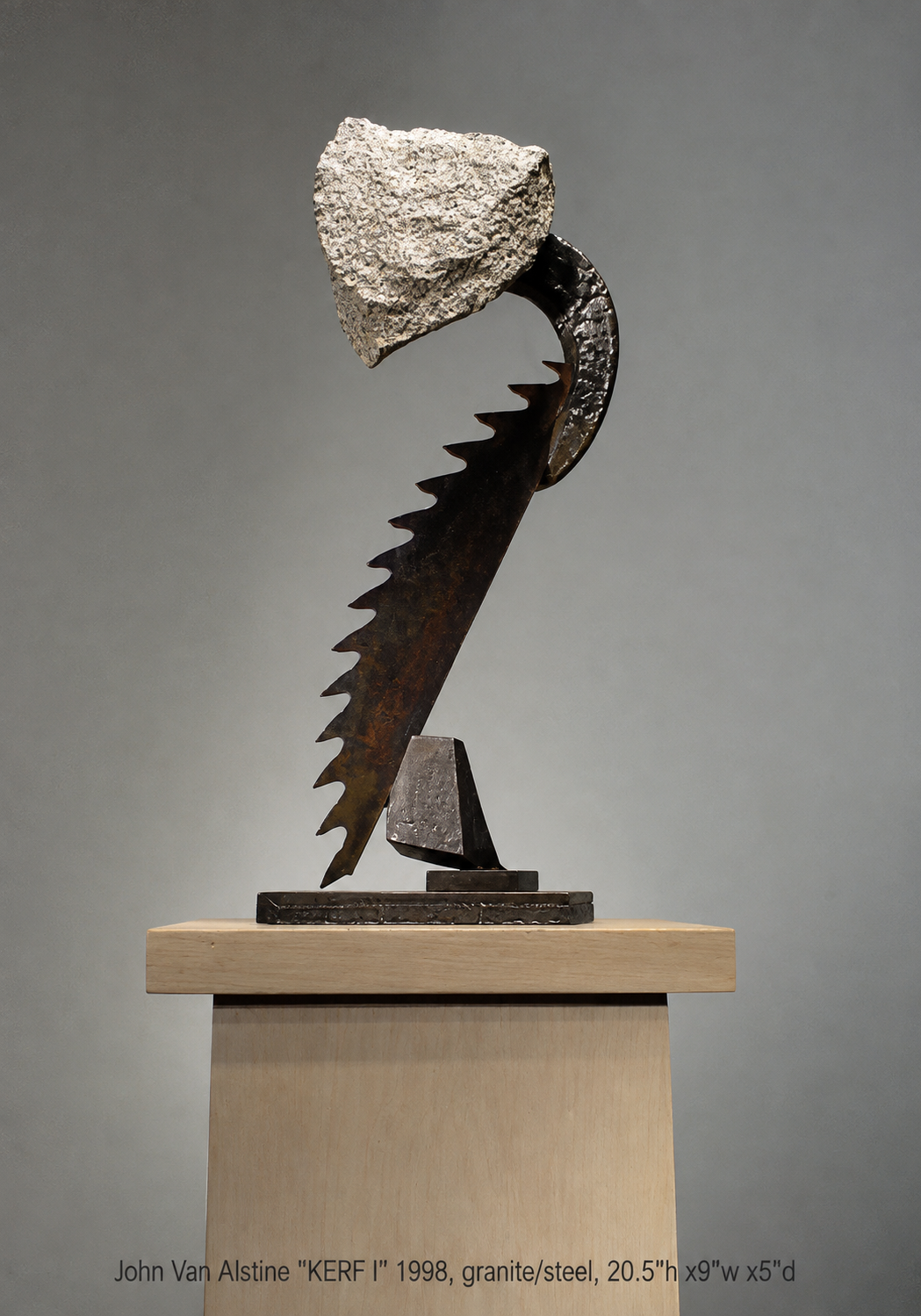
June 1998. Granite, steel. Dimensions: 20.5 × 10 × 5 in (52 × 25 × 13 cm). Private collection.
Private collection
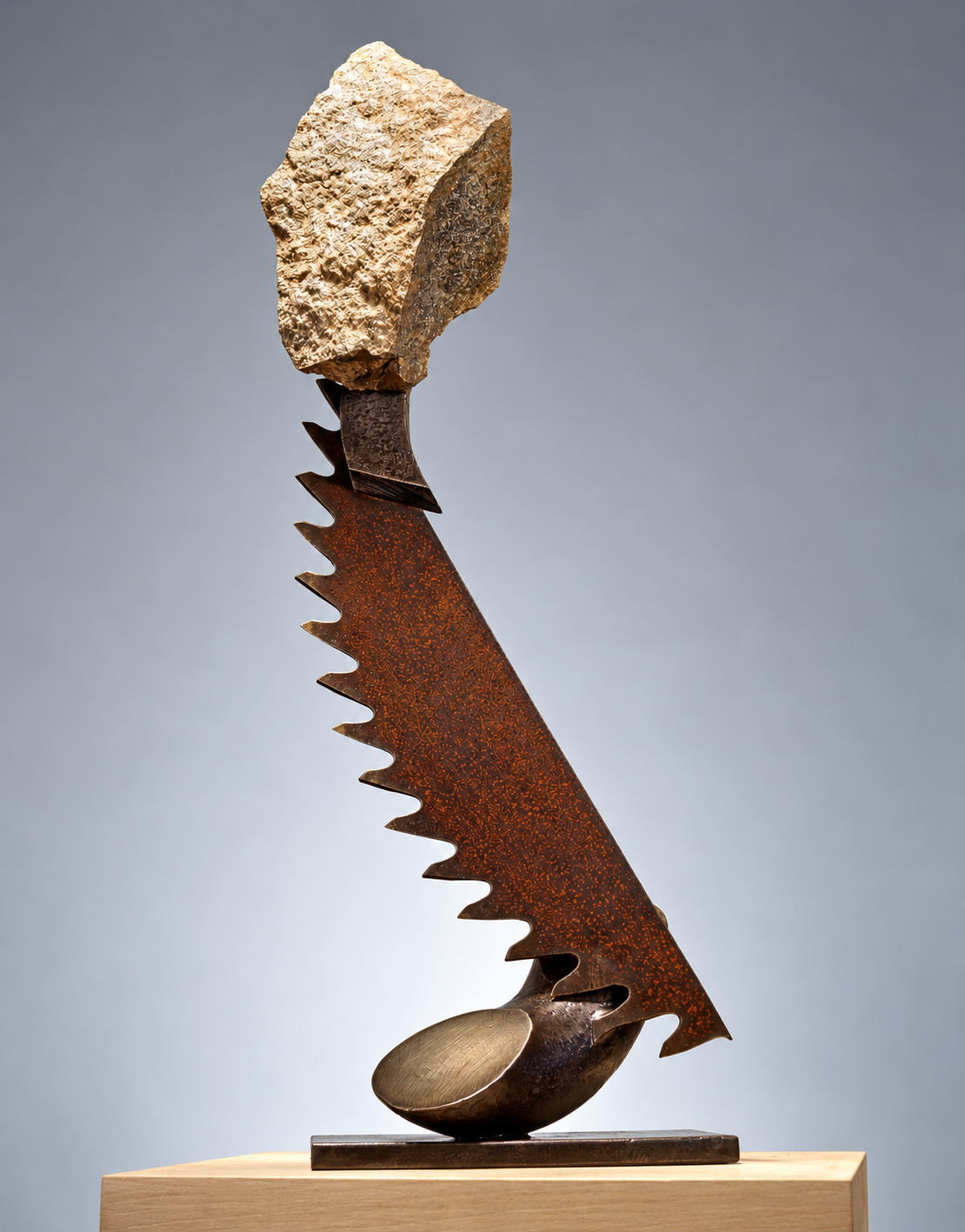
June 1998. Granite, steel. Dimensions: 24.5 × 9 × 5 in (62 × 23 × 13 cm). Private Collection.
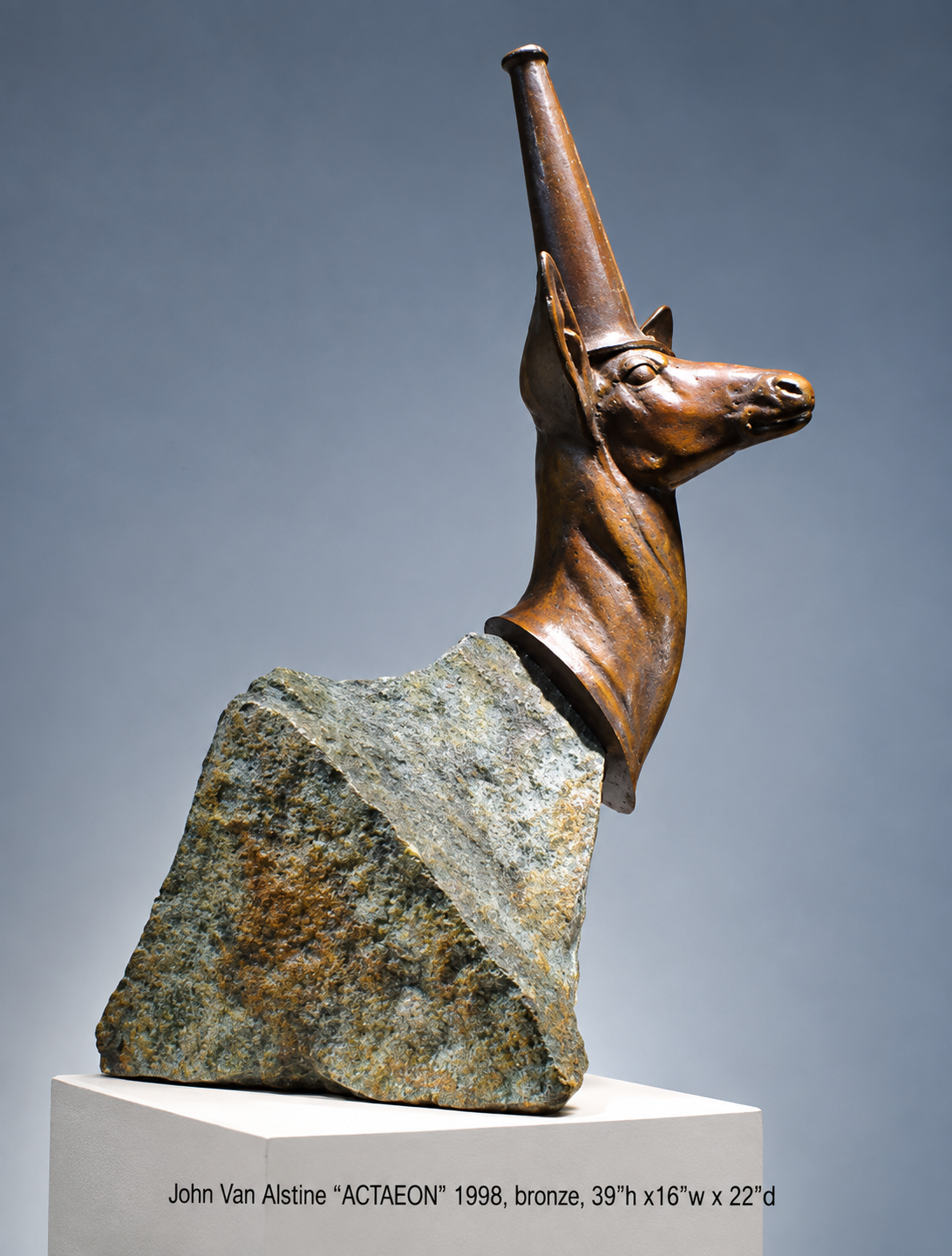
July 1998. Bronze. Dimensions: 39 × 16 × 22 in (99 × 41 × 56 cm). Private collection.
Actaeon, 1998
Actaeon reflects my growing interest during this period in the figure, animal forms, and mythology as sources for sculptural imagery. The title refers to the mythological hunter Actaeon, who comes upon Diana and her nymphs bathing in the woods. Enraged at being seen, Diana transforms him into a stag; as he flees, he is pursued and killed by his own hunting dogs.
The sculpture is unusual in that it contains no actual stone, but rather a bronze cast of one—a process I used with some frequency around this time—combined with a cast deer-head mount. The tall bronze cone, or dunce cap, adds a touch of humor, suggesting that Actaeon’s lingering to watch the nude bathers was not a particularly smart move. The work belongs to a period when I was more openly acknowledging the figure and using recognizable forms for their associative, symbolic, and narrative possibilities.
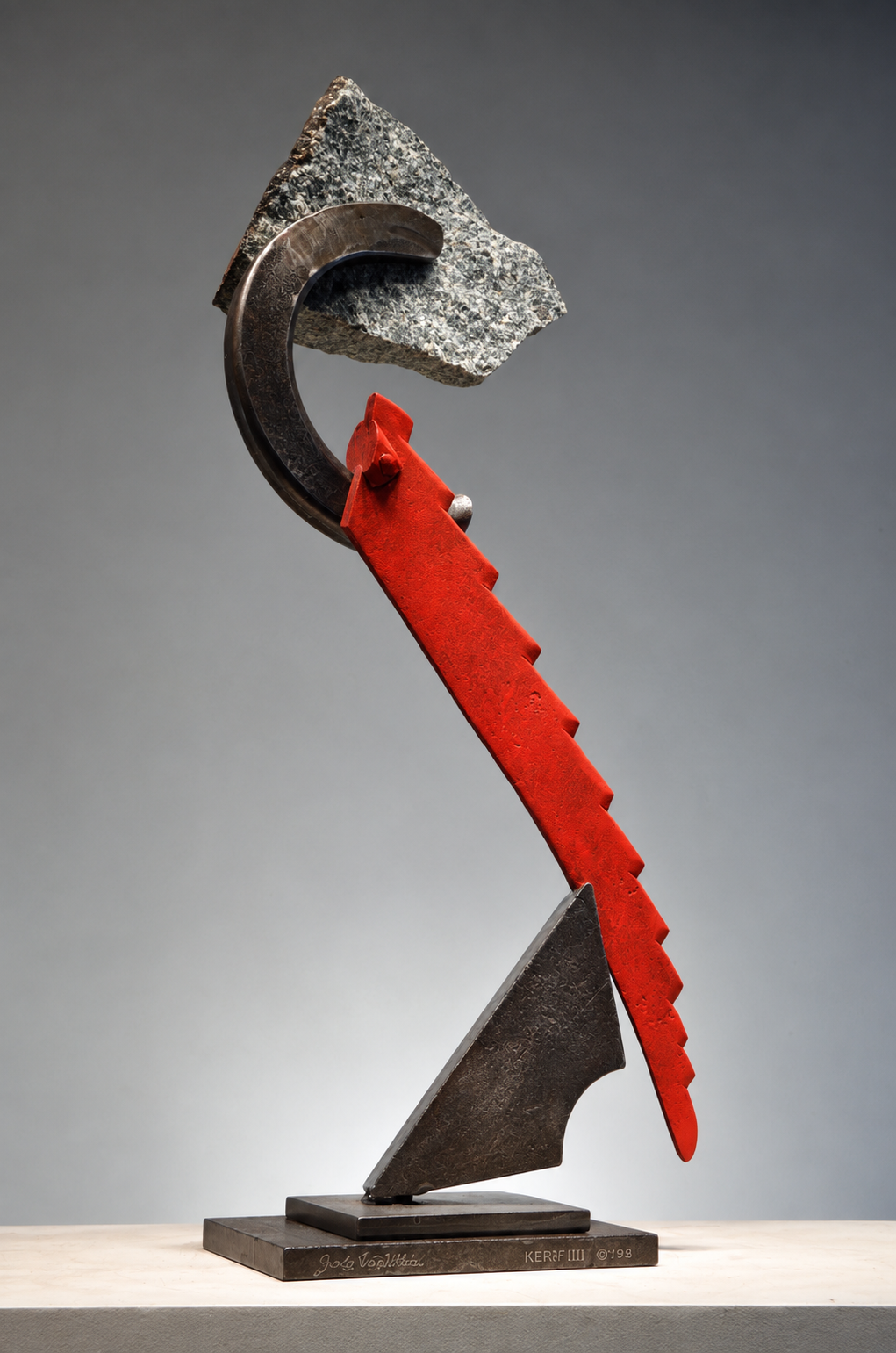
September 1998. Granite, steel. Dimensions: 31 × 15 × 7 in (79 × 38 × 18 cm). Private Collection.
Color added in 2022 as part of surface restoration.
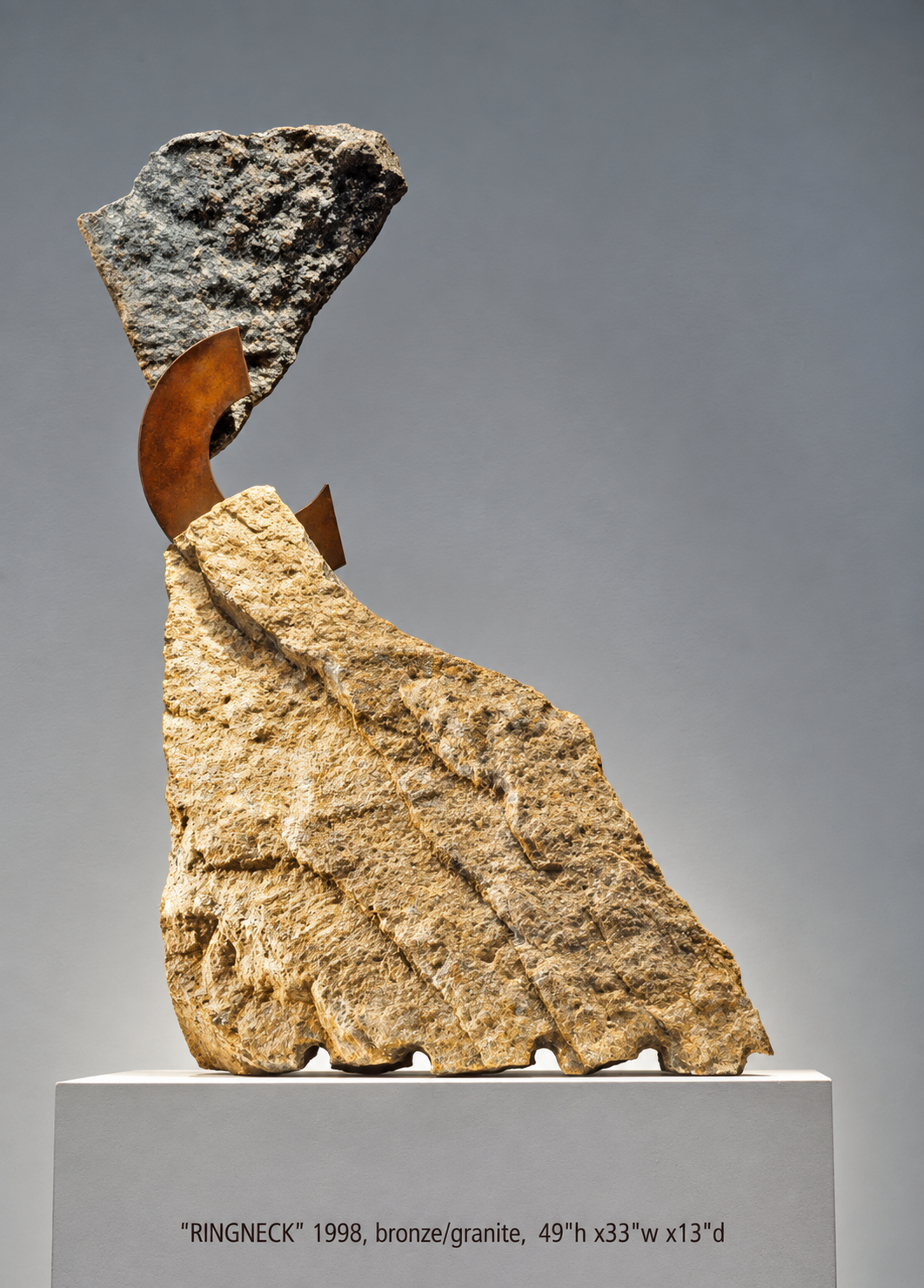
October 1998. Bronze, green granite. Dimensions: 49 × 33 × 13 in (124 × 84 × 33 cm). Disassembled 2020 and parts used in new works.
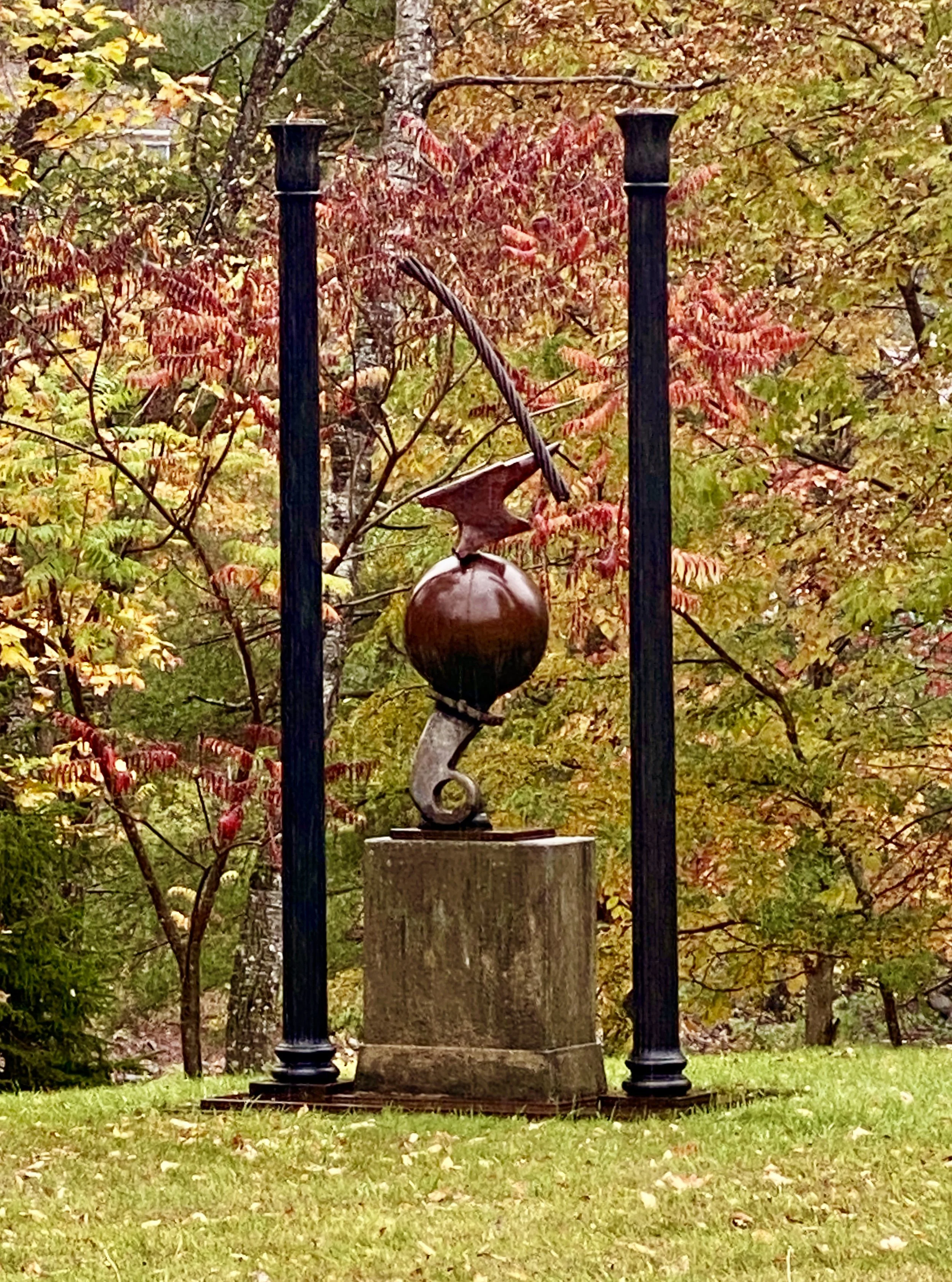
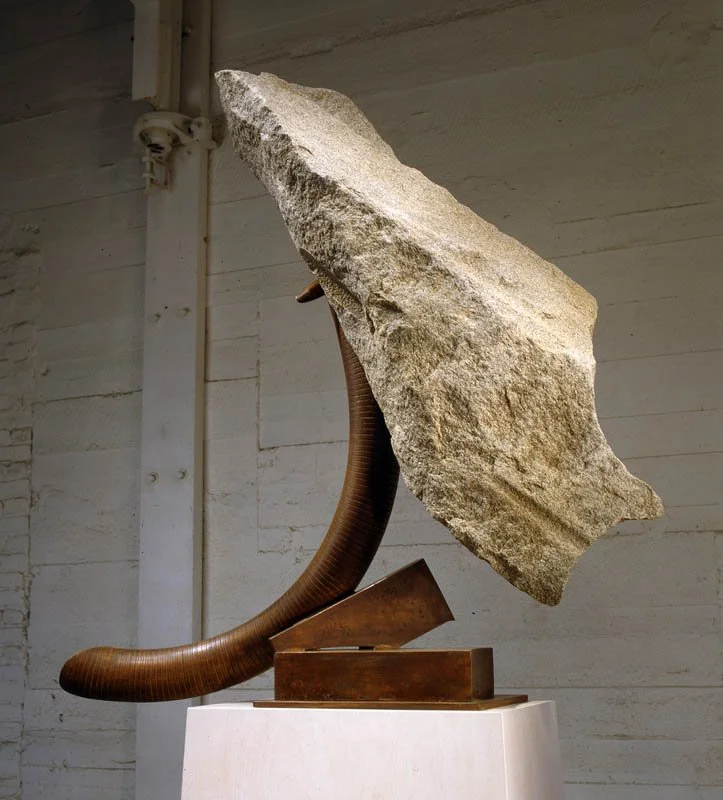
December 1998. Bronze, granite. Dimensions: (52"h x49"w x14"d).
Private collection -Santa Fe NM, USA
As a sculptor, I have always been fascinated by tools, implements, and instruments. I see them as extensions of the hand—essential allies in the act of making—and am drawn to their raw, efficient beauty, shaped over time by function and necessity. They also embody human ingenuity, labor, and our impulse to shape and engage the world around us.
Throughout my work, agricultural implements—rakes, plow blades, sledges, and tillers—as well as anvils, scales, compasses, and other instruments become both sculptural forms and vehicles for metaphor, suggesting ideas of balance, navigation, transformation, and our relationship to the natural world.
Proboscis refers to the projecting anatomical form of an animal’s trunk and reflects Van Alstine’s interest in the geometry and expressive curves found in nature. The elongated bronze form suggests a trunk, horn, or tusk while simultaneously functioning like a lever or tool. Its apparent flexibility and strength animate the massive granite, creating a hybrid form that moves between animal anatomy, natural geometry, and the human-made implement.
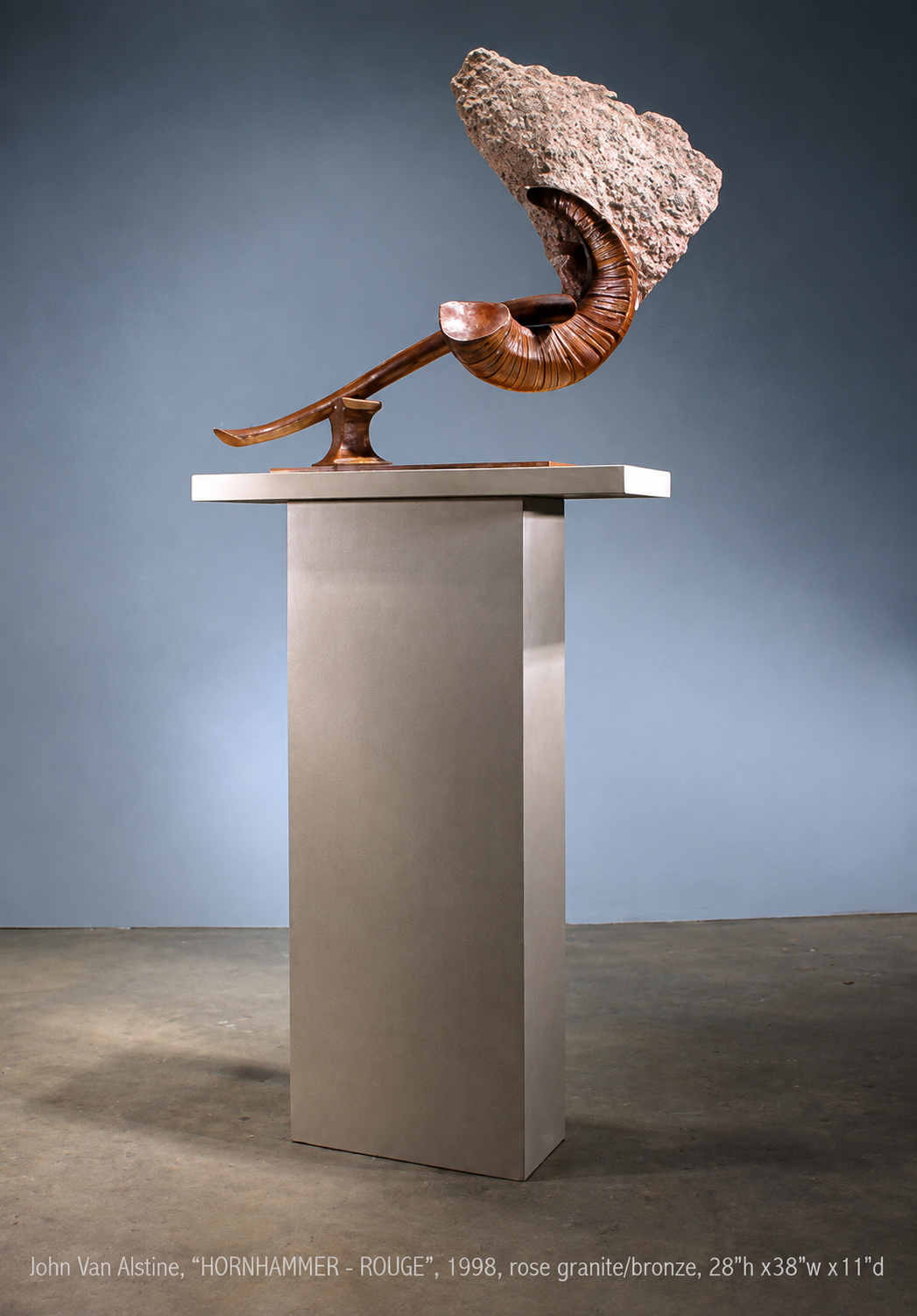
December 1998. Bronze, rose granite. Dimensions: 26 × 38 × 11 in (66 × 97 × 28 cm).
Private collection - Washington, DC
Hornhammer (Rouge), 1998
Hornhammer (Rouge) is the first work in my Hornhammer Series and brings together two recurring interests in my sculpture: tools and natural forms. The long bronze handle and rough rose granite suggest a primitive hammer or implement, reflecting my view of tools as extensions of the hand.
The cast bronze horn introduces the natural, spiraling geometry of animal forms. Combined with stone and the tool-like structure, it allows the sculpture to shift between natural form, human-made implement, and abstraction.
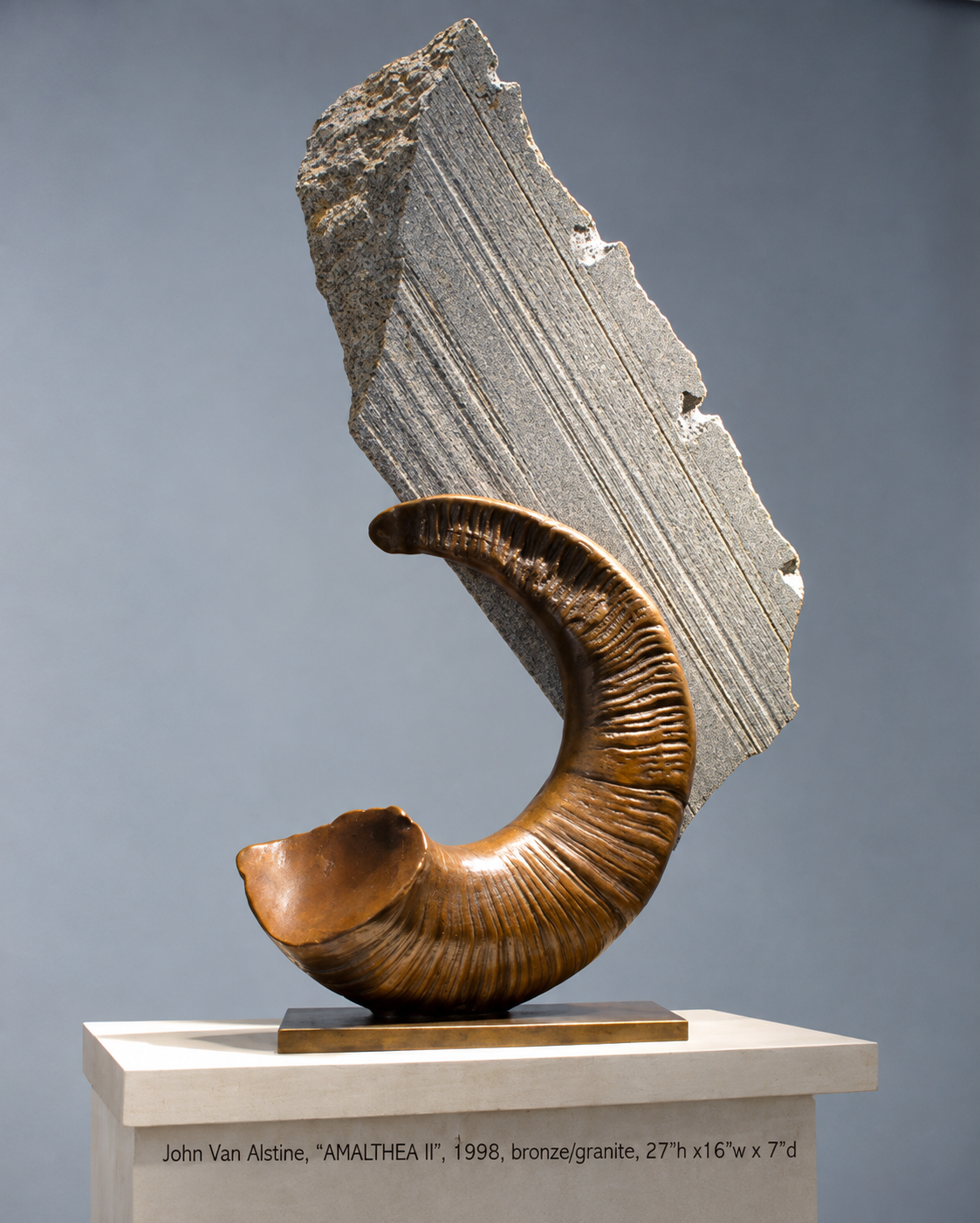
December 1998. Bronze, granite. Dimensions: 27 × 16 × 7 in (69 × 41 × 18 cm). Private Collection.
Amalthea II, 1998
Amalthea II is the second work in my Amalthea Series and reflects my growing interest in combining the natural forms of animal horns with stone. Cast in bronze, the horn becomes both a structural and expressive element, supporting and visually lifting the rough granite while bringing organic form into dialogue with stone.
The title refers to Amalthea, the nurturing figure in Greek mythology who fed the infant Zeus. One of her horns became the cornucopia, or horn of plenty, a symbol of nourishment and abundance. I use the myth as a metaphor for the sustaining power of art—my belief that art and culture nourish and sustain the human spirit.
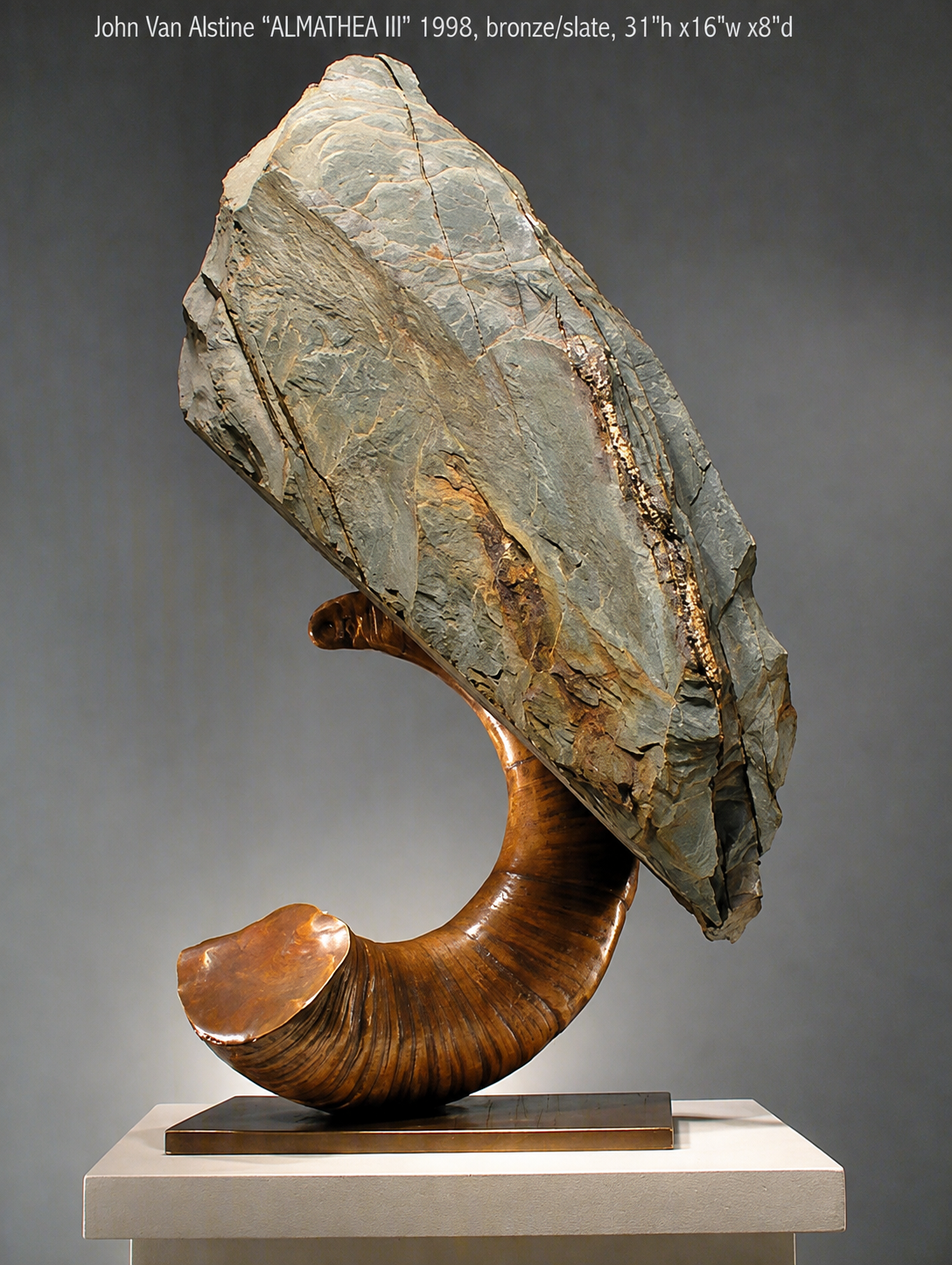
December 1998. Bronze, slate. Dimensions: 31 × 16 × 8 in (79 × 41 × 20 cm).
Amalthea III is the third work in my Amalthea Series and reflects my growing interest in combining the natural forms of animal horns with stone. Cast in bronze, the horn becomes both a structural and expressive element, supporting and visually lifting the rough granite while bringing organic form into dialogue with stone.
The title refers to Amalthea, the nurturing figure in Greek mythology who fed the infant Zeus. One of her horns became the cornucopia, or horn of plenty, a symbol of nourishment and abundance. I use the myth as a metaphor for the sustaining power of art—my belief that art and culture nourish and sustain the human spirit.
December 1998. Granite, bronze. Dimensions: 28 × 26 × 10 in (71 × 66 × 25 cm). Built for juried exhibition for Pierwalk International Sculpture Exhibition, Chicago, for the opportunity exhibit large version. (S-96-04).
1997
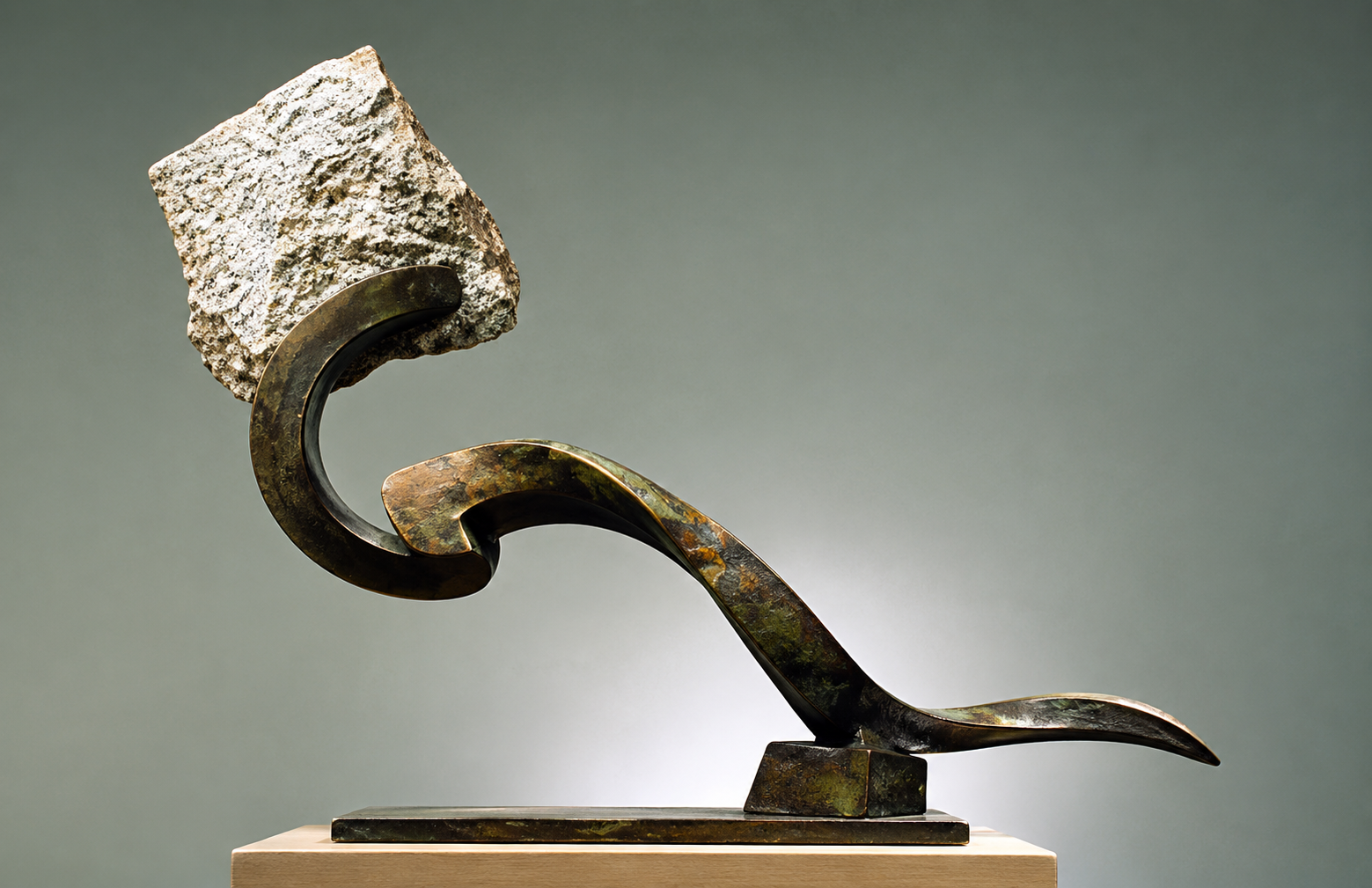
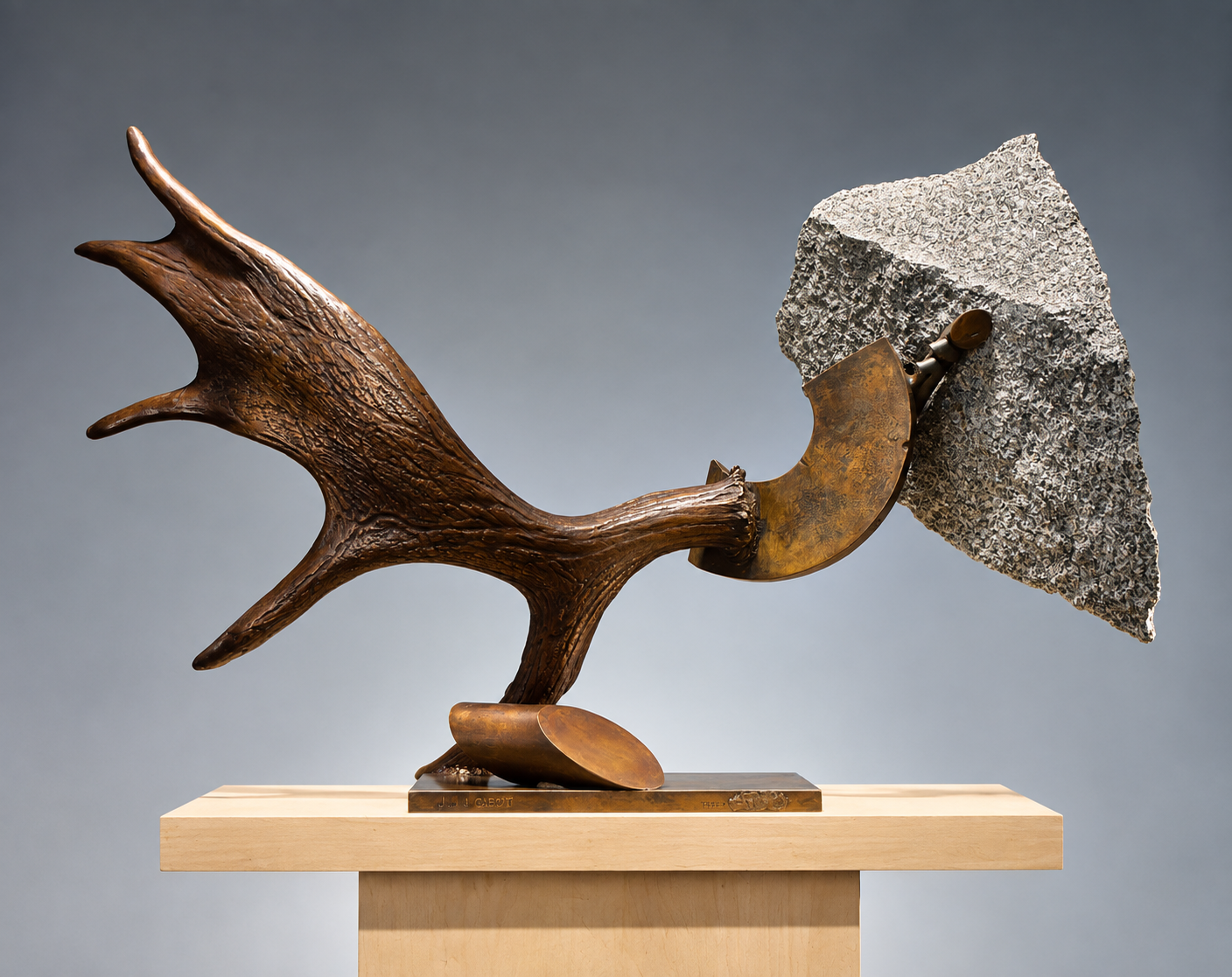
January 1997. Bronze, granite. Dimensions: 26 × 39 × 16 in (66 × 99 × 41 cm).
Private collection - Pittsburgh, PA
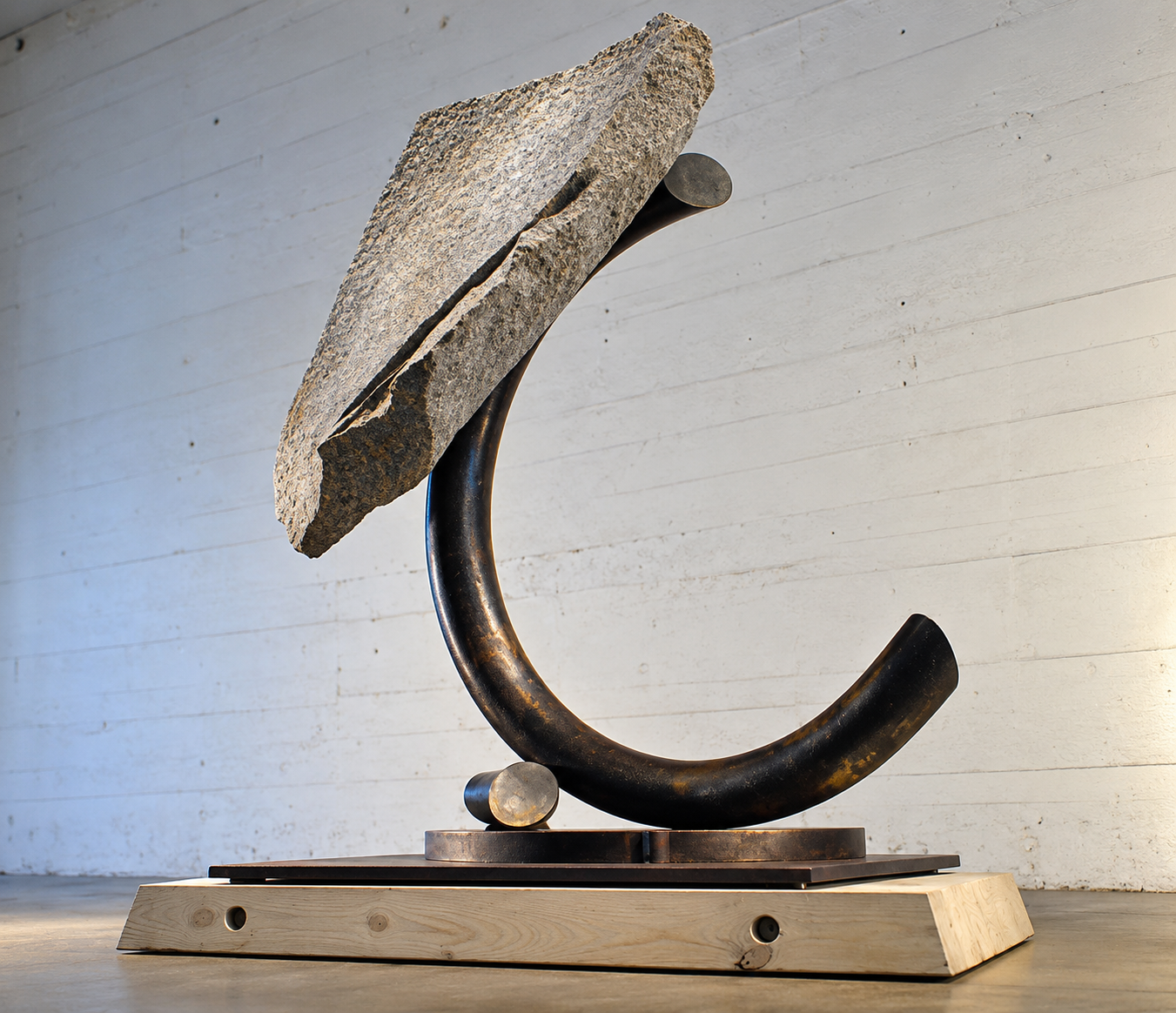
February 1997. Granite, steel. Dimensions: 80 × 72 × 27 in (203 × 183 × 69 cm).
Private Collection Virginia

February 1997. Bronze. Dimensions: 45 × 23 × 11 in (114 × 58 × 28 cm). Canabilized.
I am drawn to horns, antlers, and nautilus-like forms because nature has already endowed them with an extraordinary geometric logic—the arc, spiral, taper, and expanding curve. Cast in bronze, these organic structures become part of my constructed vocabulary, moving freely between natural form and human implement. Their long cultural associations also allow them to evoke classical mythology—from the cornucopia and Amalthea to broader ideas of strength, abundance, survival, and transformation—without becoming literal illustrations.
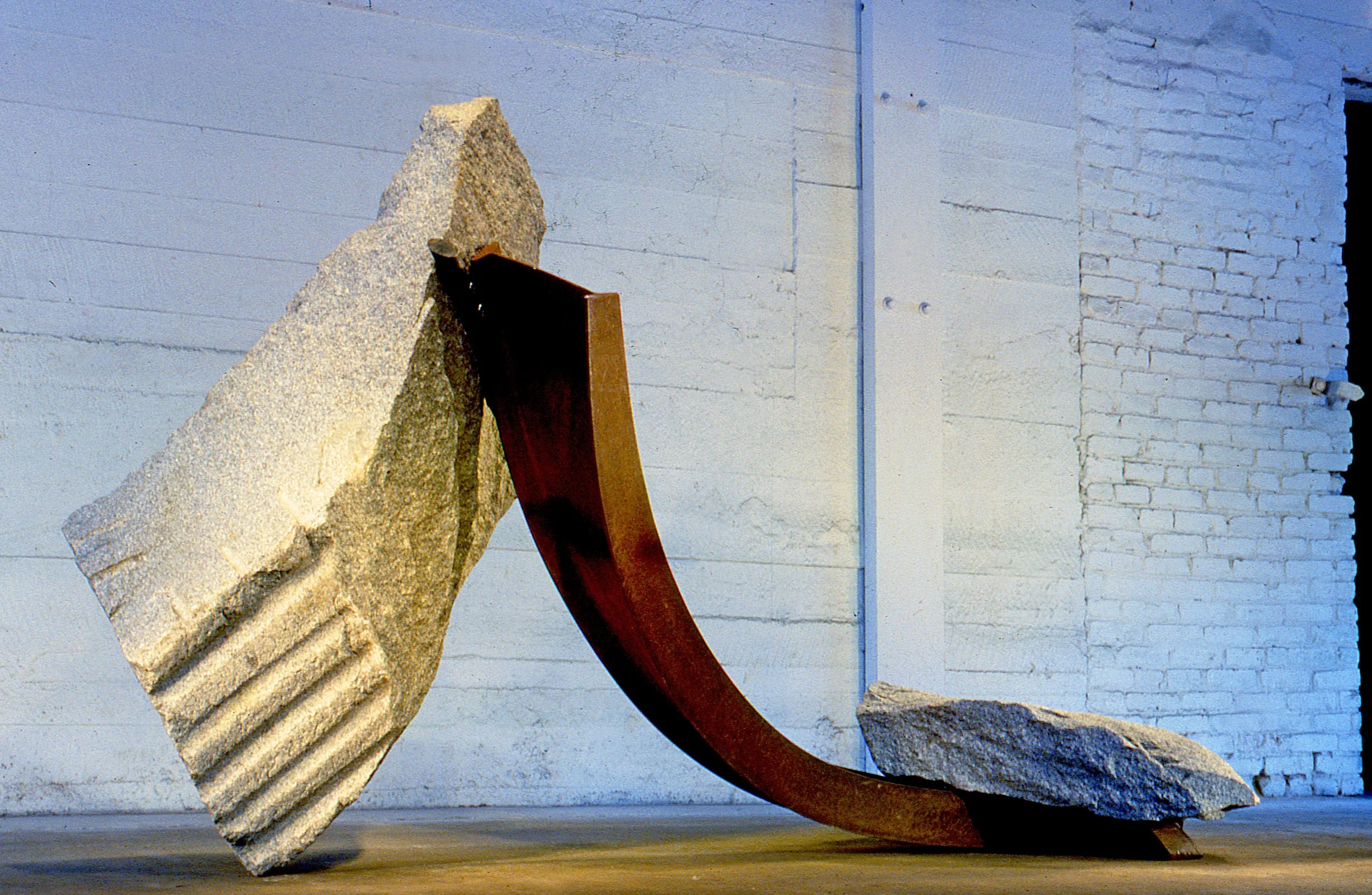
March 1997. Granite, steel. Dimensions: 58 × 106 × 50 in (147 × 269 × 127 cm).
Pique à Terre VI, 1997
Pique à Terre VI, the sixth work in the series, developed as a spin-off from my earlier Rounder and Go-Round Series, continuing their circular vocabulary and my ongoing interest in combining stone and metal. At this larger scale, a massive granite slab is poised on a single point while the sweeping steel arc connects it to the lower stone, transforming weight and gravity into balance, movement, and unexpected levity.
The title references a dance position in which one toe lightly touches the floor, the other foot remains firmly planted, and an arm makes a sweeping gesture. I began thinking of myself as a kind of choreographer—arranging heavy, earthbound materials so that, in a sense, they appear to dance.
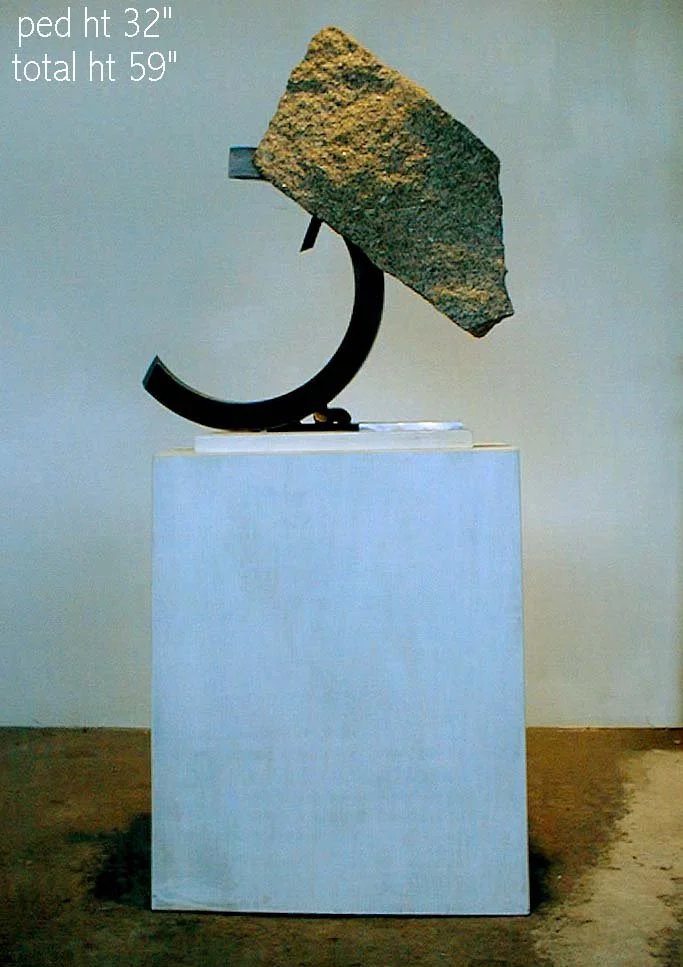
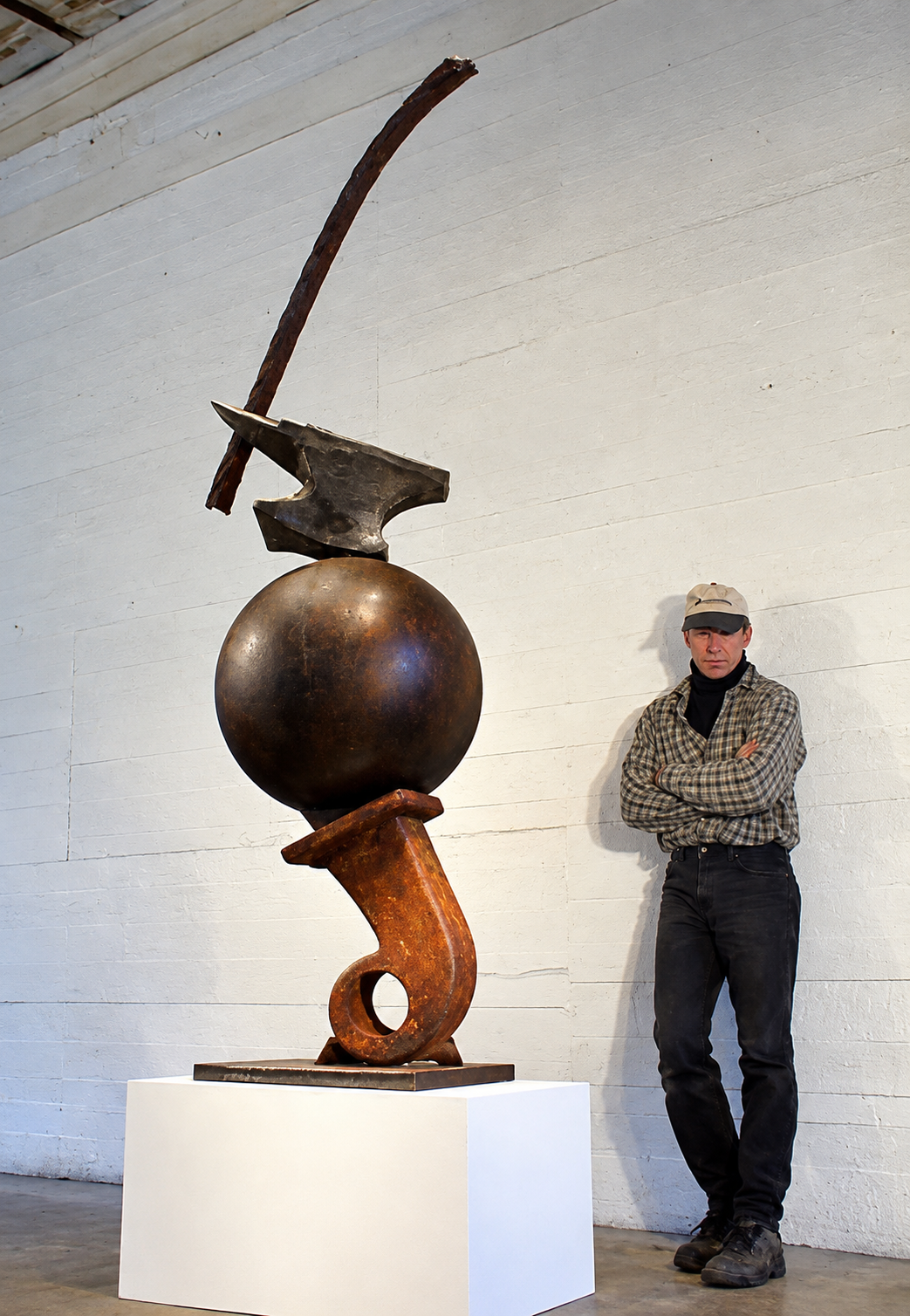
July 1997. Steel. Dimensions: 80 × 23 × 32 in (203 × 58 × 81 cm).
Incorporated into new sculpture: “Cornucopia with Columns” (S-98-21)
Cornucopia, 1997
Cornucopia brings together several recurring elements in my work—the sphere, anvil, and found industrial steel. These forms, along with the large cable, appear to emerge from a horn-like section of highway guardrail, salvaged during renovation of the Whitehurst Freeway near Georgetown in Washington, DC. The anvil is particularly significant in my work as both a tool of transformation and a place where things are physically and conceptually forged together.
The title refers to the cornucopia, or “horn of plenty,” familiar in American culture as a Thanksgiving symbol of abundance and nourishment. Here, rather than food spilling from the horn, it releases forms associated with industry, labor, and creative activity. For me, that bounty suggests the sustaining role of art and culture as essential nourishment in our lives.
The work was later made the centerpiece of a large work “Cornucopia with Columns” (S-98-21)
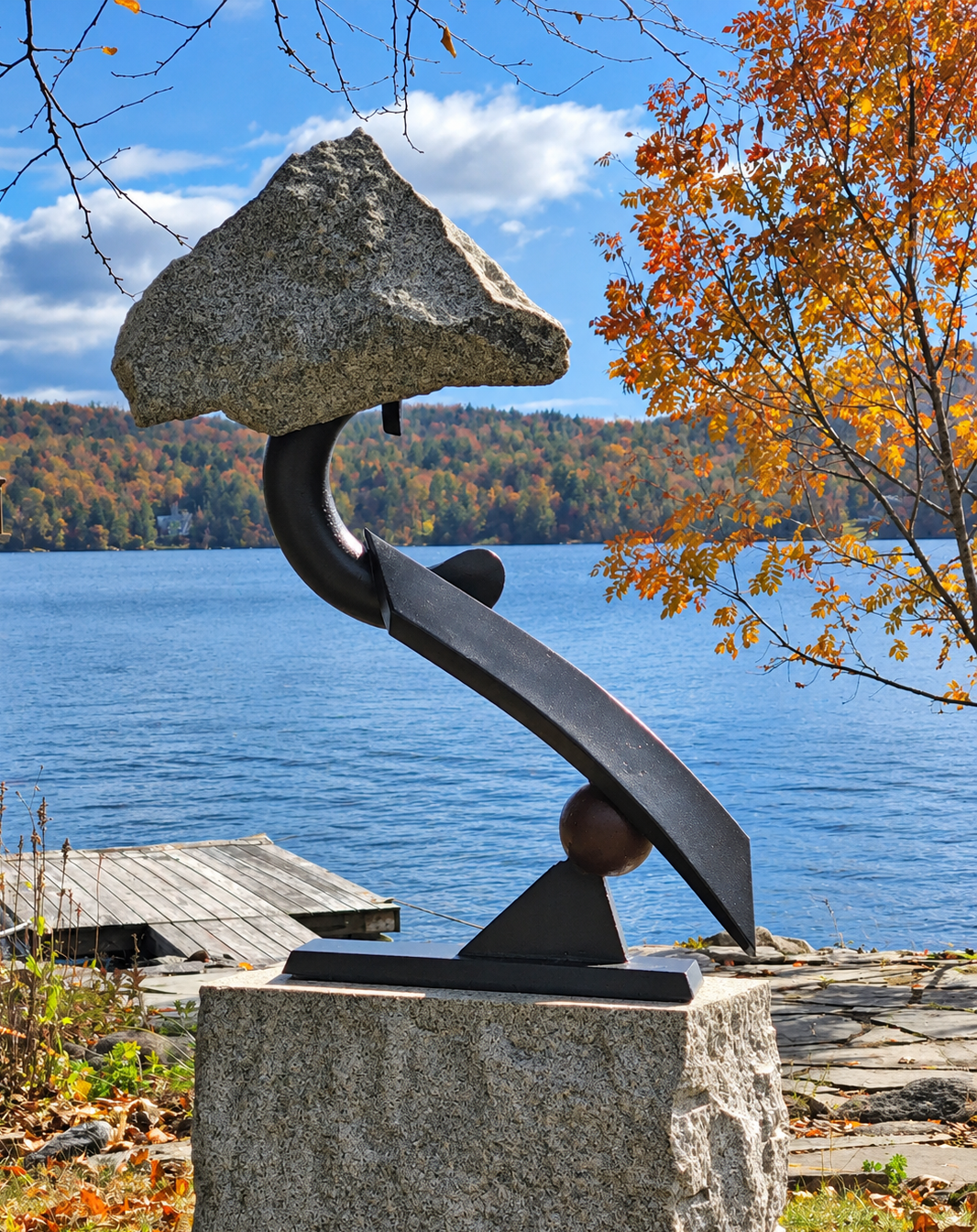
August 1997. Granite, steel. Dimensions: 36 × 29 × 10 in (91 × 74 × 25 cm). Private Collection.
Slider ’97, 1997
Slider ’97 revisits ideas first explored in the Slider works of 1992 and continues my interest in tools and implements and in their “raw, efficient beauty of form dictated by function.” Here I incorporate a section of a forklift tine, retaining and celebrating its former industrial shape while combining it with granite and fabricated steel. This reflects my broader practice of bringing found objects, with their histories and associations, into new sculptural relationships.
The title Slider again refers to the fluid, sliding movement suggested by the composition. The sweeping steel elements lift and carry the granite through space, transforming heavy, workmanlike materials into a poised arrangement that suggests movement, balance, and arrested motion.
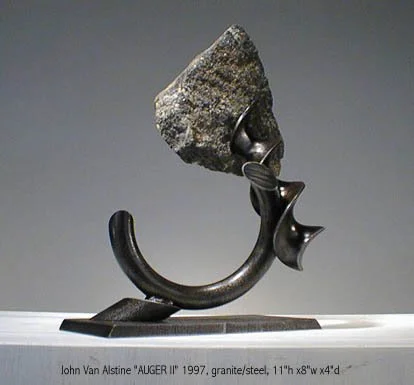
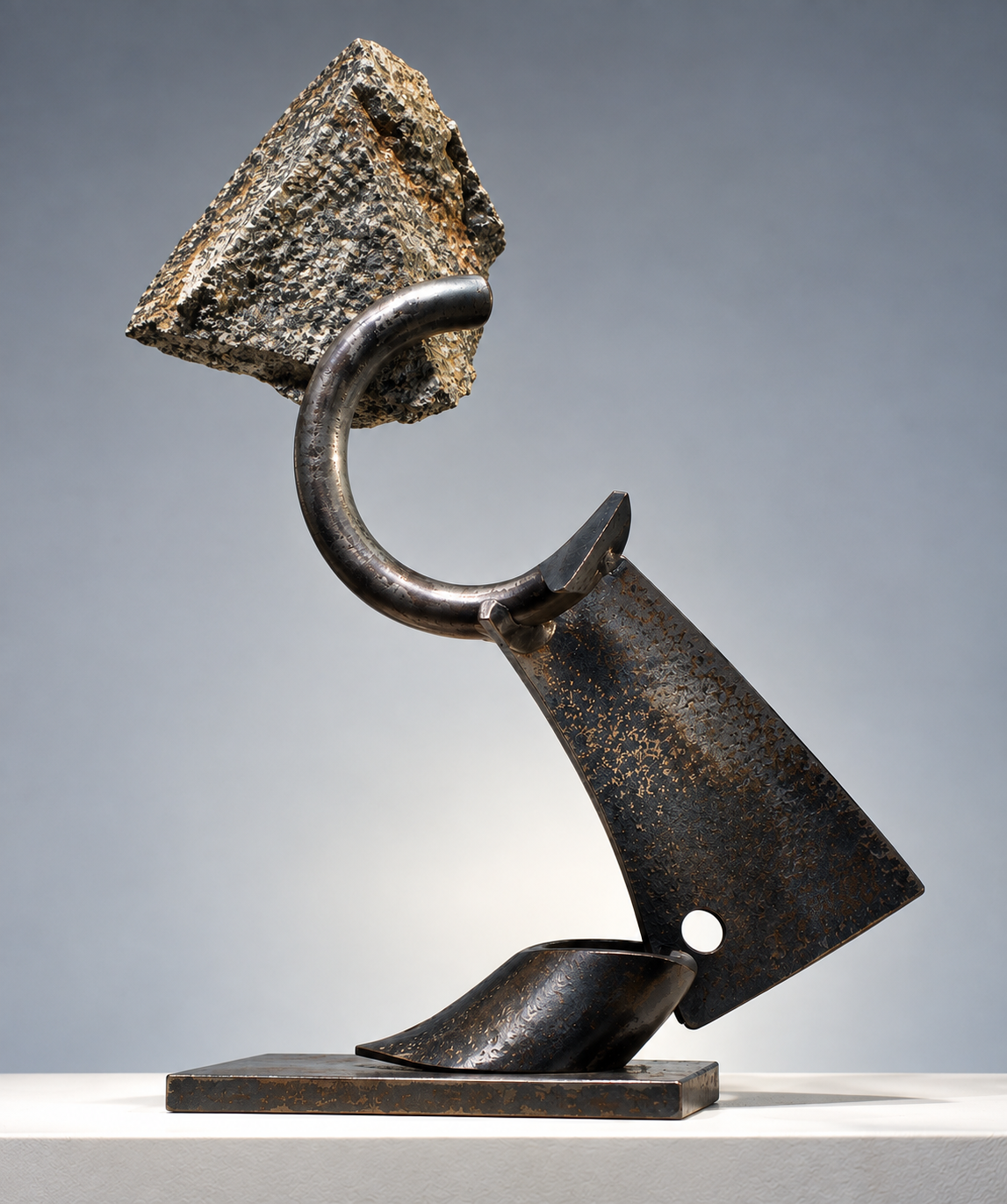
September 1997. Granite, steel. Dimensions: 17 × 14 × 6 in (43 × 36 × 15 cm).
Private Collection.
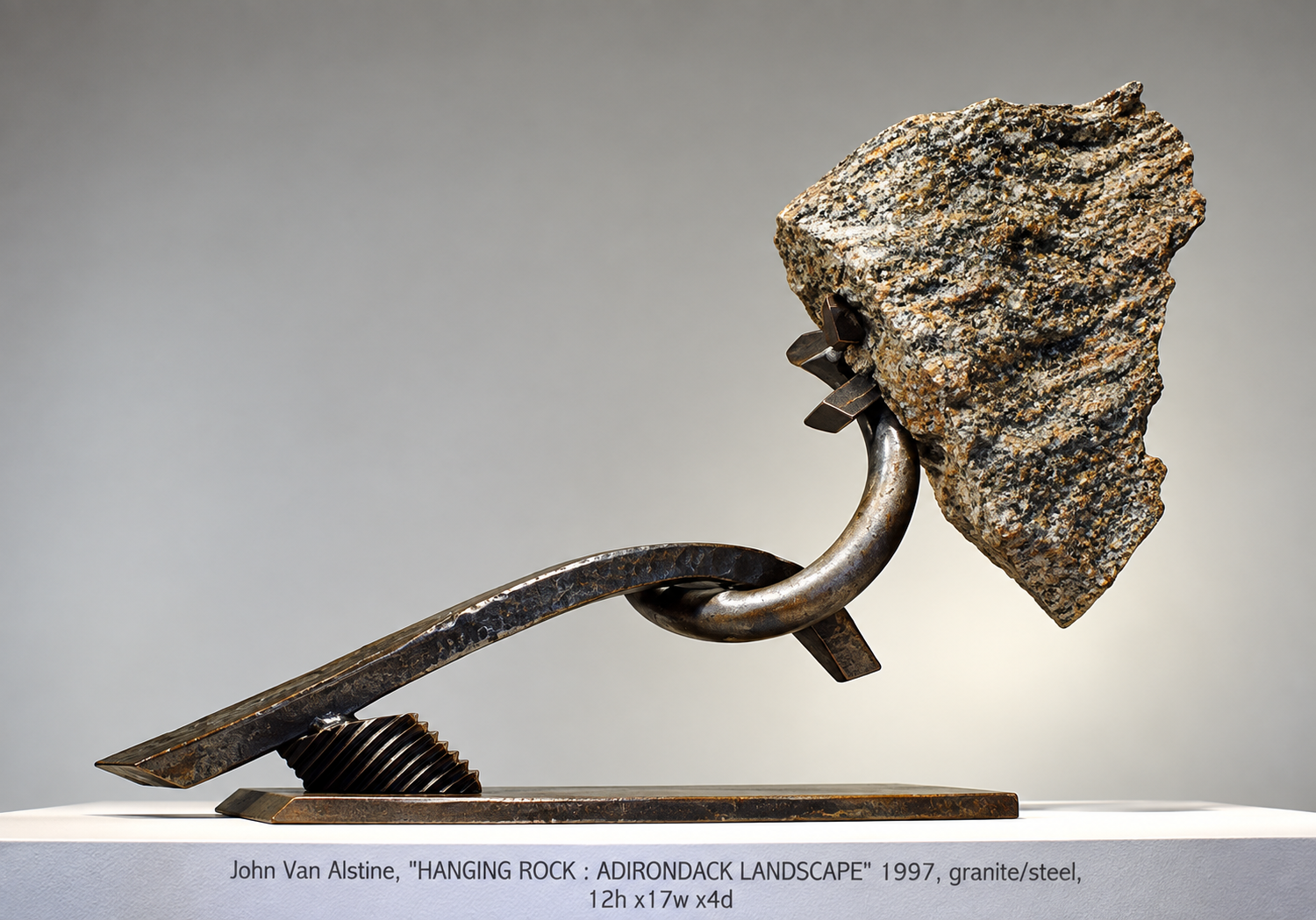
September 1997. Granite, steel. Dimensions: 12 × 17 × 4 in (30 × 43 × 10 cm).
Private Collection.
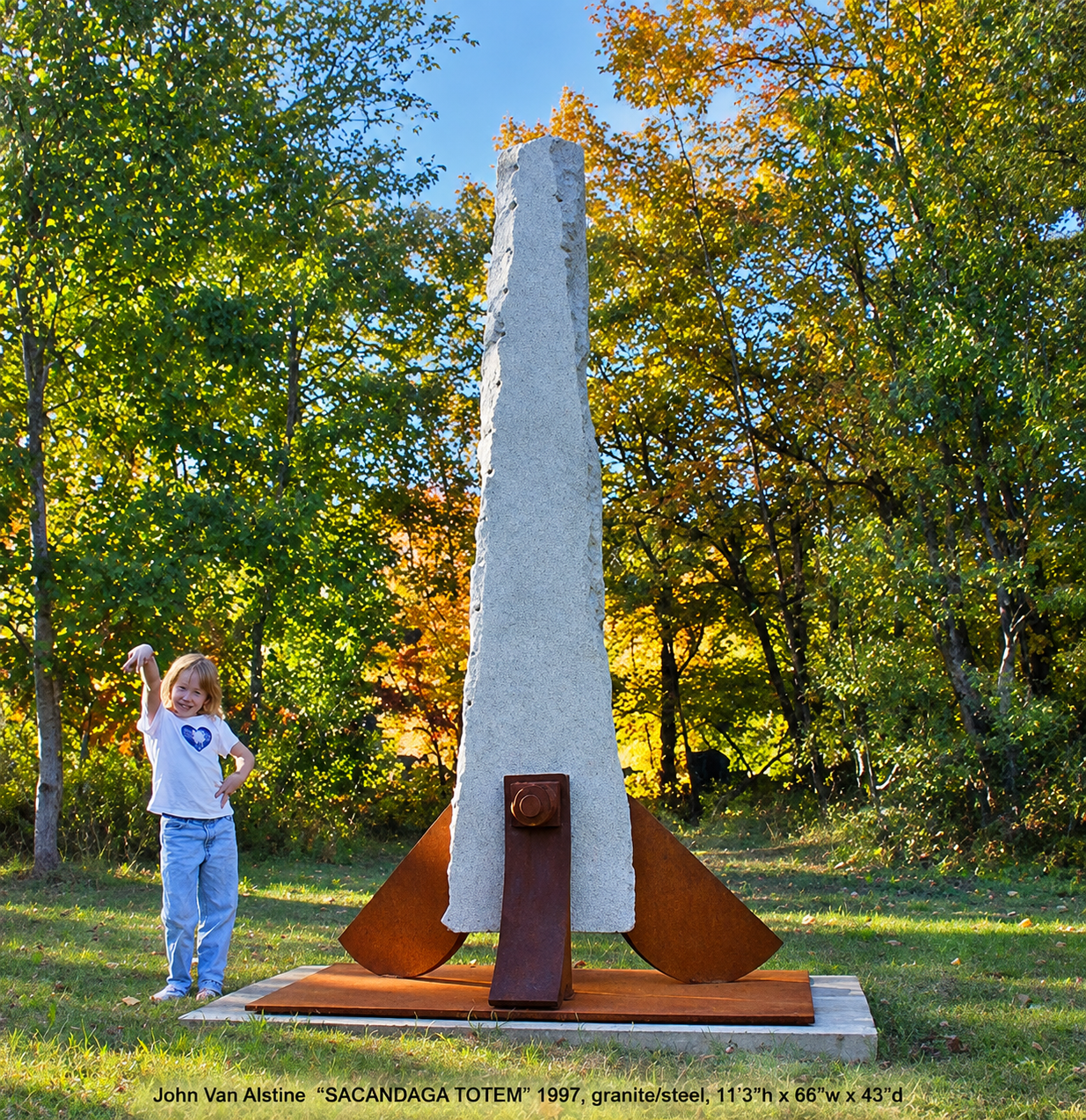
June 1997. Granite, steel. Dimensions: 113 × 66 × 43 in (287 × 168 × 109 cm).
Collection: City of Alexandria, VA
Sacandaga Totem, 1997
Sacandaga Totem continues my Totem Series, which grew from my years in Wyoming, where the exposed geology, towering buttes, and eroded rock formations of the Western landscape had a profound influence on my work. Here, the tall, rough-hewn granite rises vertically from a steel structure, bringing together the natural weight and permanence of stone with the strength and geometry of fabricated metal.
The title refers to the Sacandaga River, along which I live and work in the Adirondacks. The sculpture reflects my continuing interest in the marriage of the natural and human-made: the granite is accepted largely as found, while the steel supports and elevates it, allowing the typically earthbound stone to take on a more vertical, almost soaring presence.
The piece was installed in a public square in Old Town Alexandria and remains as of 2026.
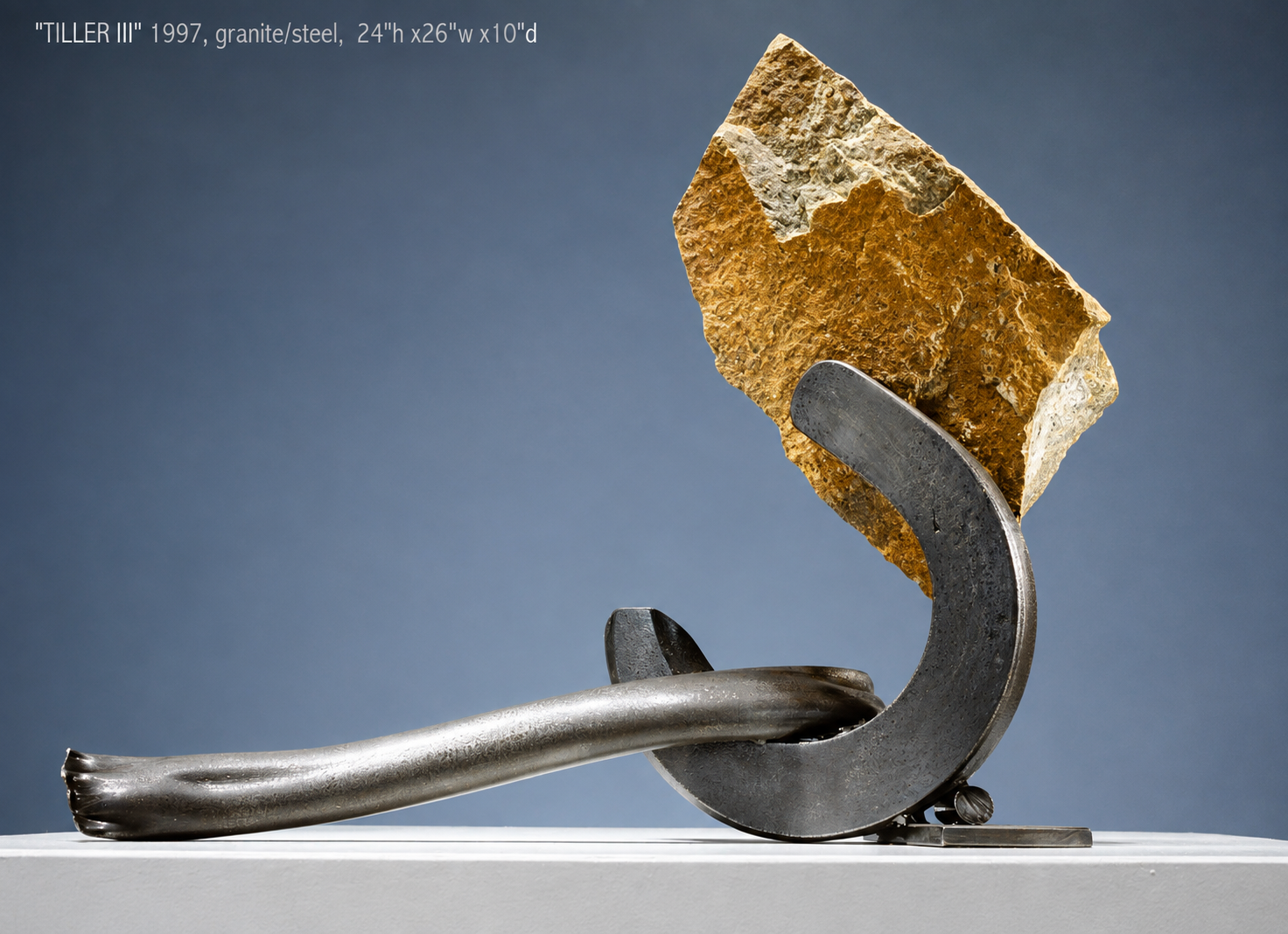
August 1997. Granite. Dimensions: 24 × 26 × 10 in (61 × 66 × 25 cm).
Private Collection.
The Tiller series grows from my interest in tools and agricultural implements as extensions of the human hand—objects that cultivate, shape, and engage the land. The title also evokes the tiller of a boat, a simple device used to steer and determine direction. Bringing these meanings together, the works explore the relationship between cultivation and navigation—our impulse both to shape the world around us and to chart a course through it.
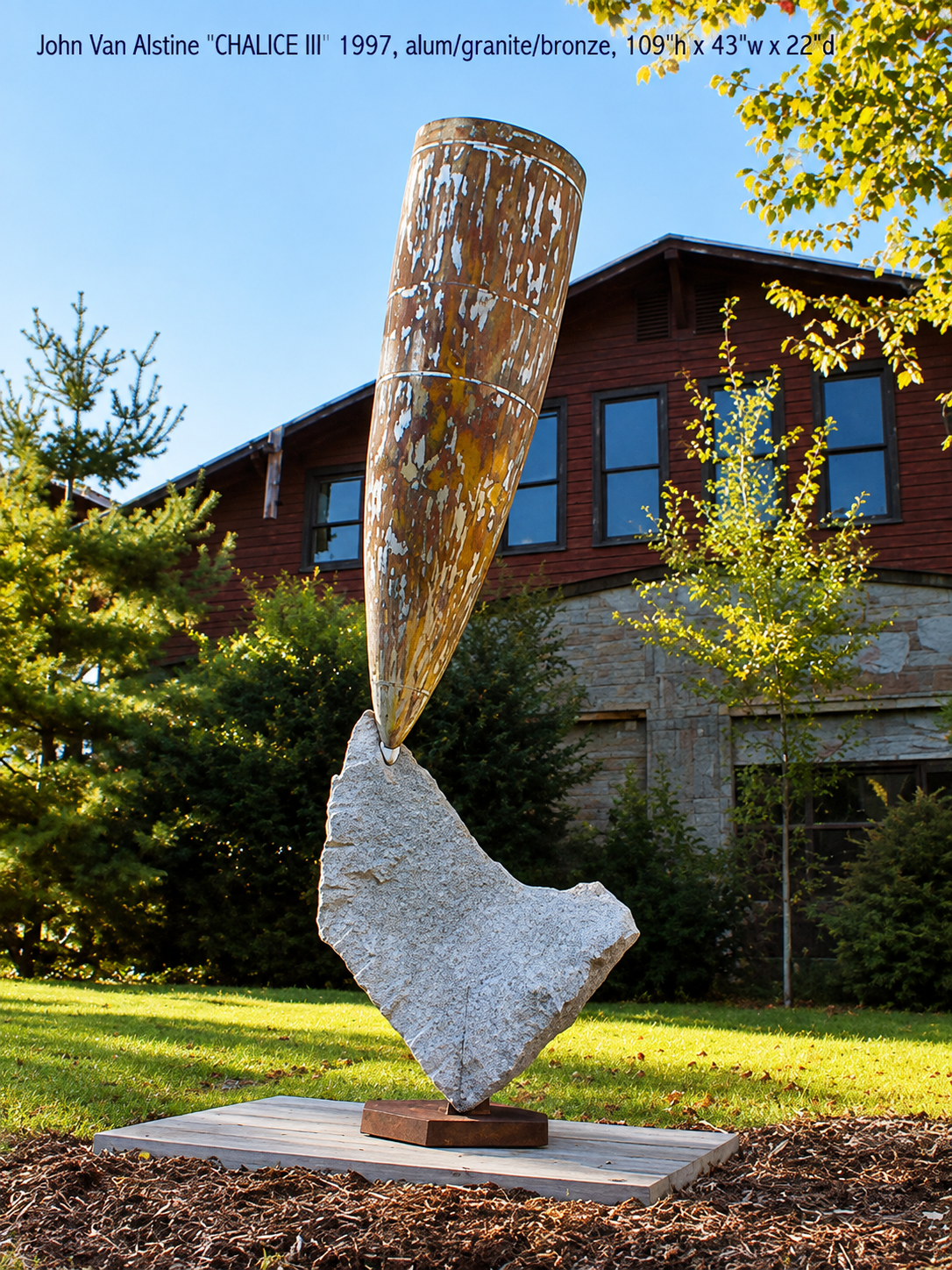
September 1997. Bronze, granite, aluminum. Dimensions: 103 × 43 × 22 in (262 × 109 × 56 cm). Private collection Atlanta, GA.
Chalice III, 1997
Chalice III continues my Chalice Series and my longstanding interest in vessels and containers as sculptural forms and metaphors. Rooted partly in my early background as a potter, the vessel became a metaphor for passage—the individual or humanity moving through life. Here, a large aluminum aeronautical form balances point-to-point with a rough granite mass, creating an elongated chalice.
The sanded aluminum cup reflects the light and colors around it, subtly changing with its environment. Its luminous surface contrasts with the weight and permanence of the rough granite, bringing together lightness and mass, the human-made and the natural. Through its precarious balance, the familiar vessel becomes a spirited “cup of life,” suggesting passage and the human experience.
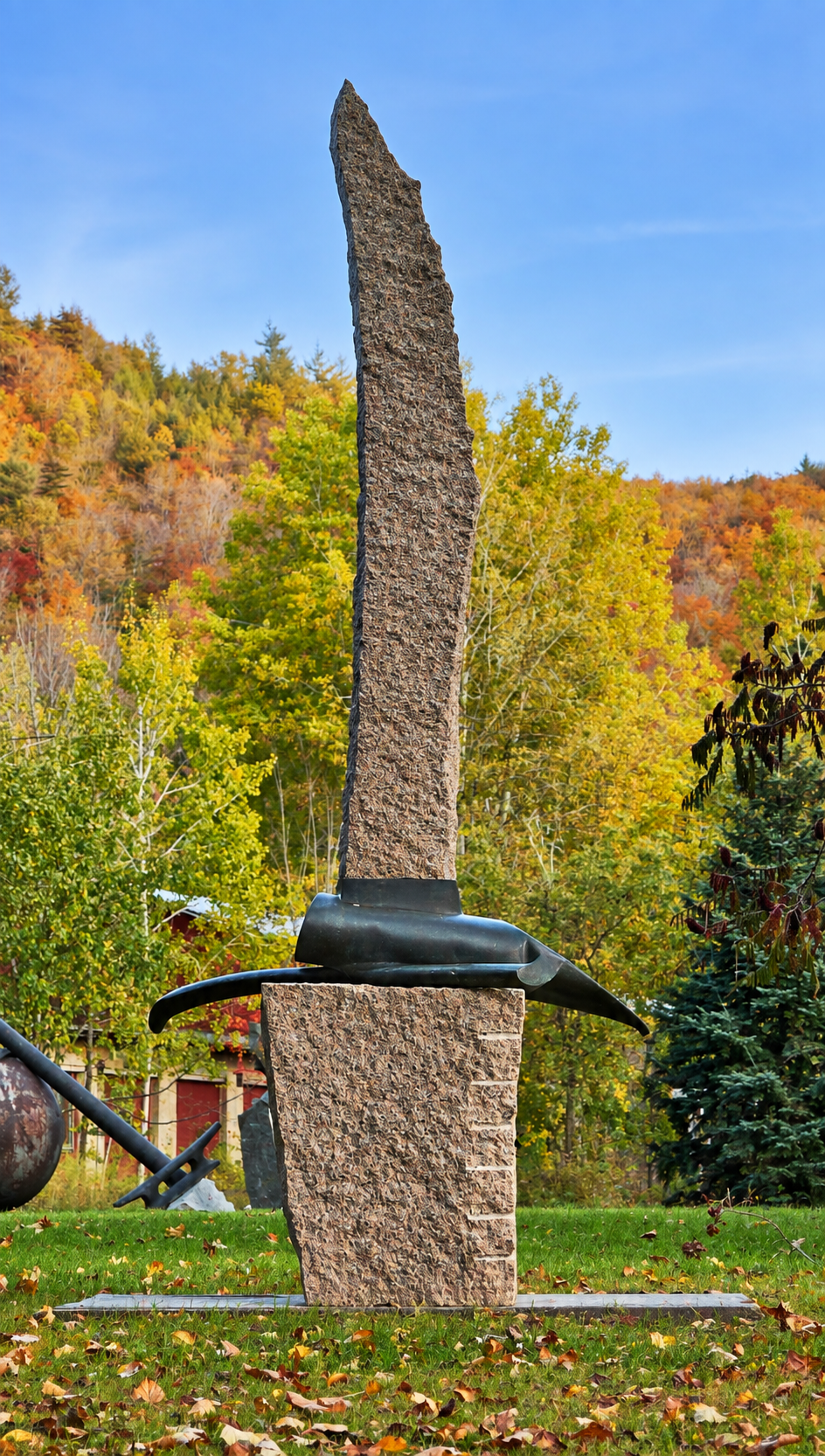
October 1997. Bronze, pink granite. Dimensions: 12 × 5 × 2 in (30 × 13 × 5 cm). Private collection - Germany
Midriff, 1997
Midriff uses its strong verticality to create a towering, almost figurative presence. The elongated granite forms suggest a body, while the bronze elements concentrated at the sculpture’s center become a kind of abstract abdominal section. The title calls attention specifically to this “midriff,” reinforcing the suggestion of the human figure without depicting it literally—an approach consistent with my broader interest in using balance, gesture, and movement to evoke the body.
At the same time, Midriff can be read geologically. The bronze forms appear to shift or drift between the two masses of granite, suggesting the movement of tectonic plates and the immense forces operating beneath the earth’s surface. This association connects the sculpture’s implied bodily movement with the natural processes that formed the stone itself, bringing together human and geological references through the contrasting materials of granite and bronze.
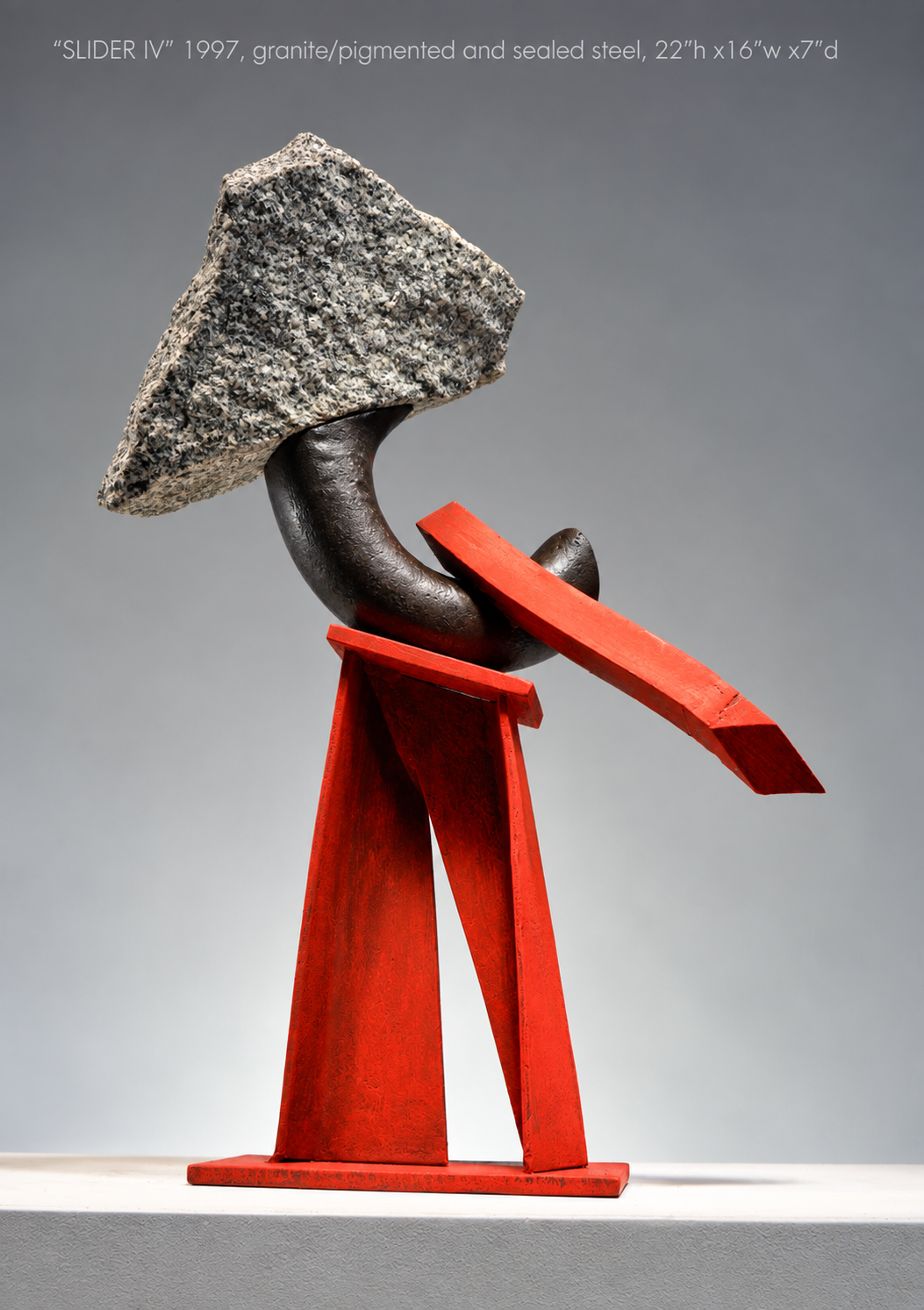
December 1997. Granite, steel. Dimensions: 22 × 16 × 7 in (56 × 41 × 18 cm).
Private collection.
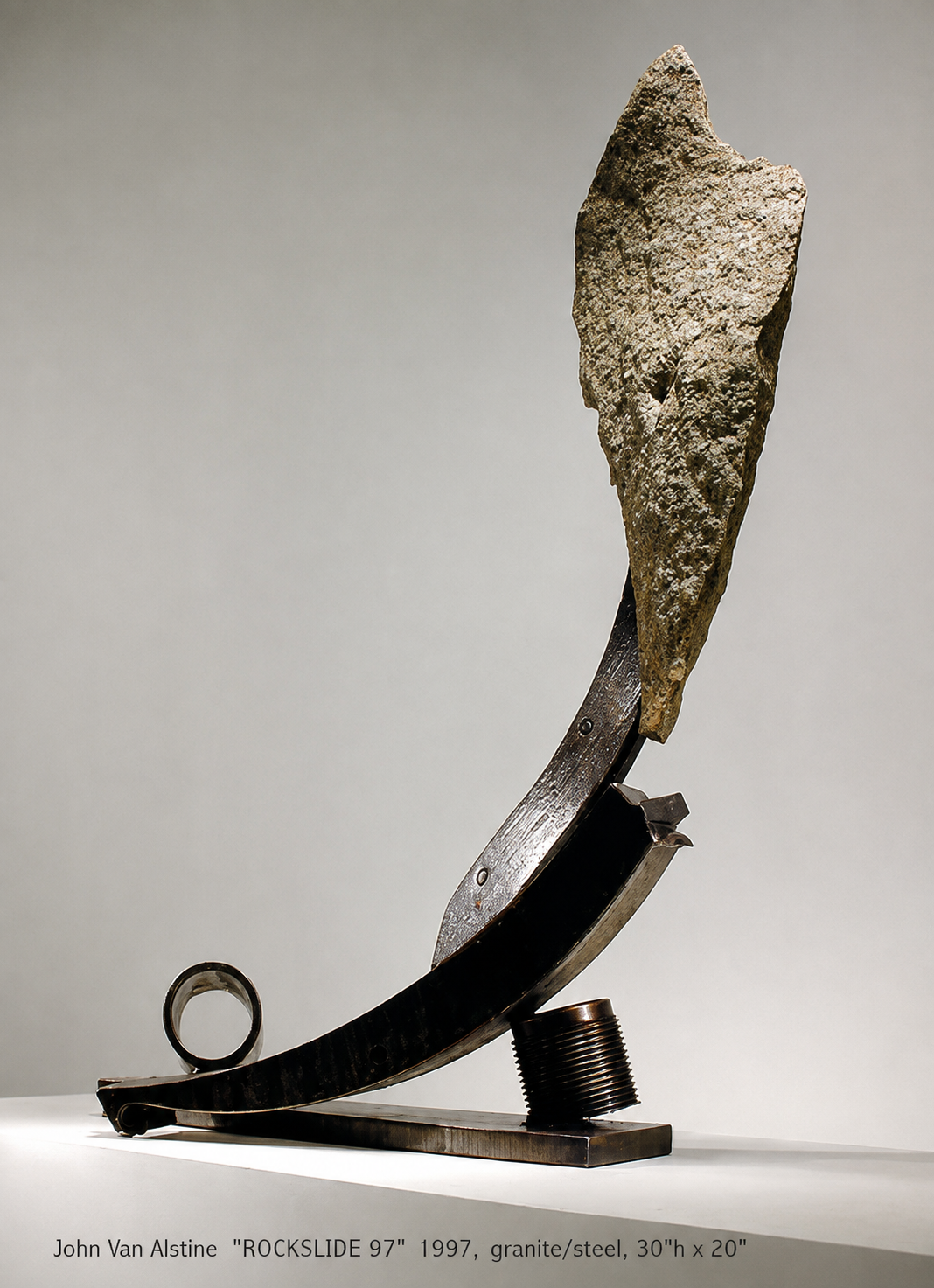
December 1997. Granite, steel. Dimensions: 30 × 26 × 8 in (76 × 66 × 20 cm).
Private collection - Beaver Creek, CO
Stone has been a constant in John Van Alstine’s work for more than fifty years. He often focuses on the material’s inherent qualities—especially its weight—choreographing stone and steel to create moments of visual and physical tension.
Landscape, particularly the mountain terrain where the artist has spent much of his life, has also been a powerful influence. In the Rockslide series, the shape and placement of stone, and its dynamic interaction with steel, evoke the drama of a familiar alpine event: a rock caught in mid-fall.
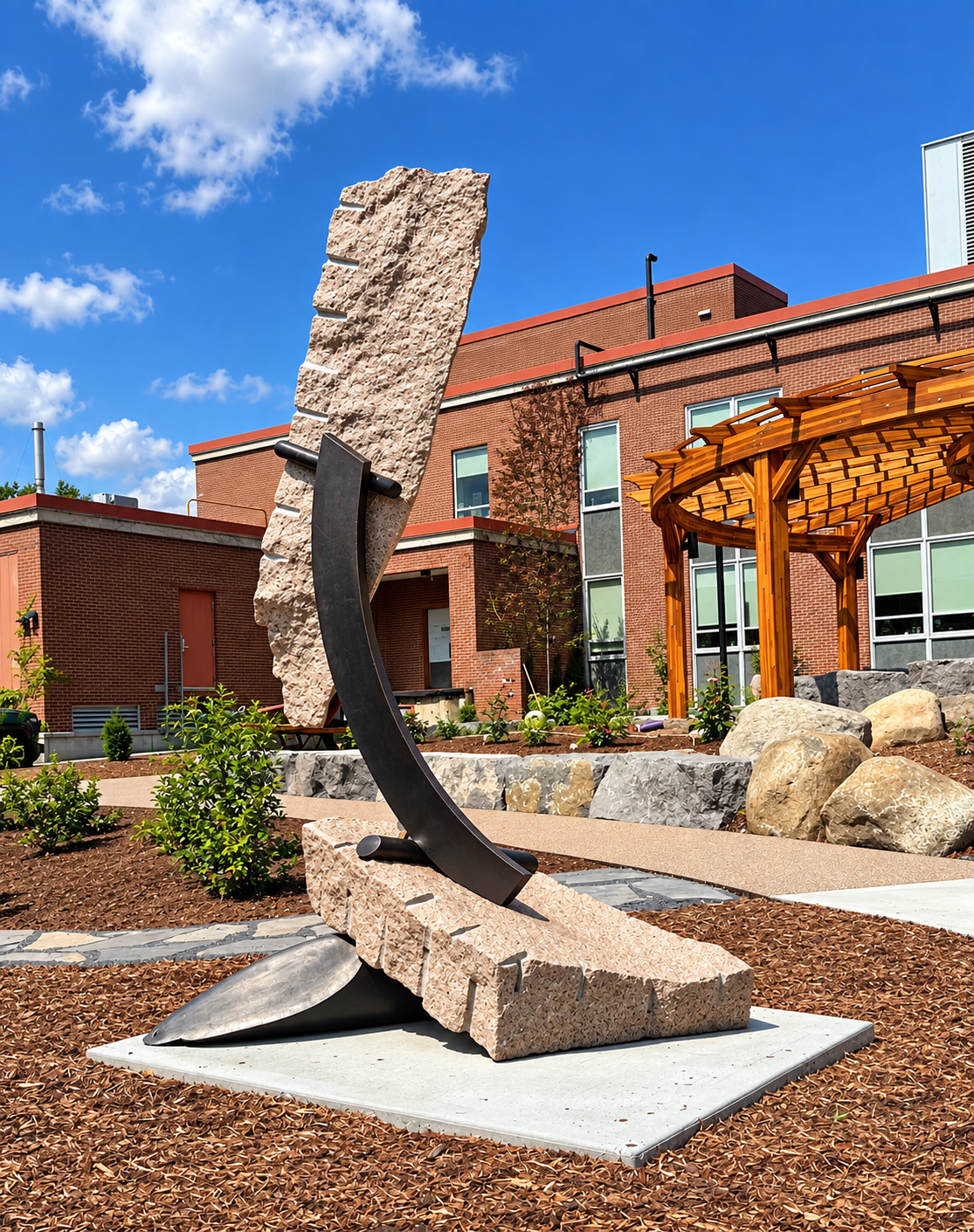
December 1997. Granite, steel. Dimensions: 88 × 60 × 42 in (224 × 152 × 107 cm). Collection: SUNY Potsdam, Potsdam, New York. Gift of Don and Kathy Lougheed with additional support of Robert and Wendy Wagner.
Pompadour refers to Madame de Pompadour and, more specifically, to the distinctive hairstyle associated with her and its many later iterations—from the Gibson Girls of the early 20th century to the exaggerated pompadours of the 1950s. The sculpture’s granite and steel configuration—with its upward sweep, crest, elaborate profile, and figurative quality—evokes the form and character of the pompadour.
Van Alstine’s sculptures from this period frequently use titles to introduce figurative, mythological, historical, nautical, or metaphorical associations into otherwise abstract arrangements. His work, therefore, is not simply formal abstraction; titles, as in this case, can provide an important interpretive key.
1996
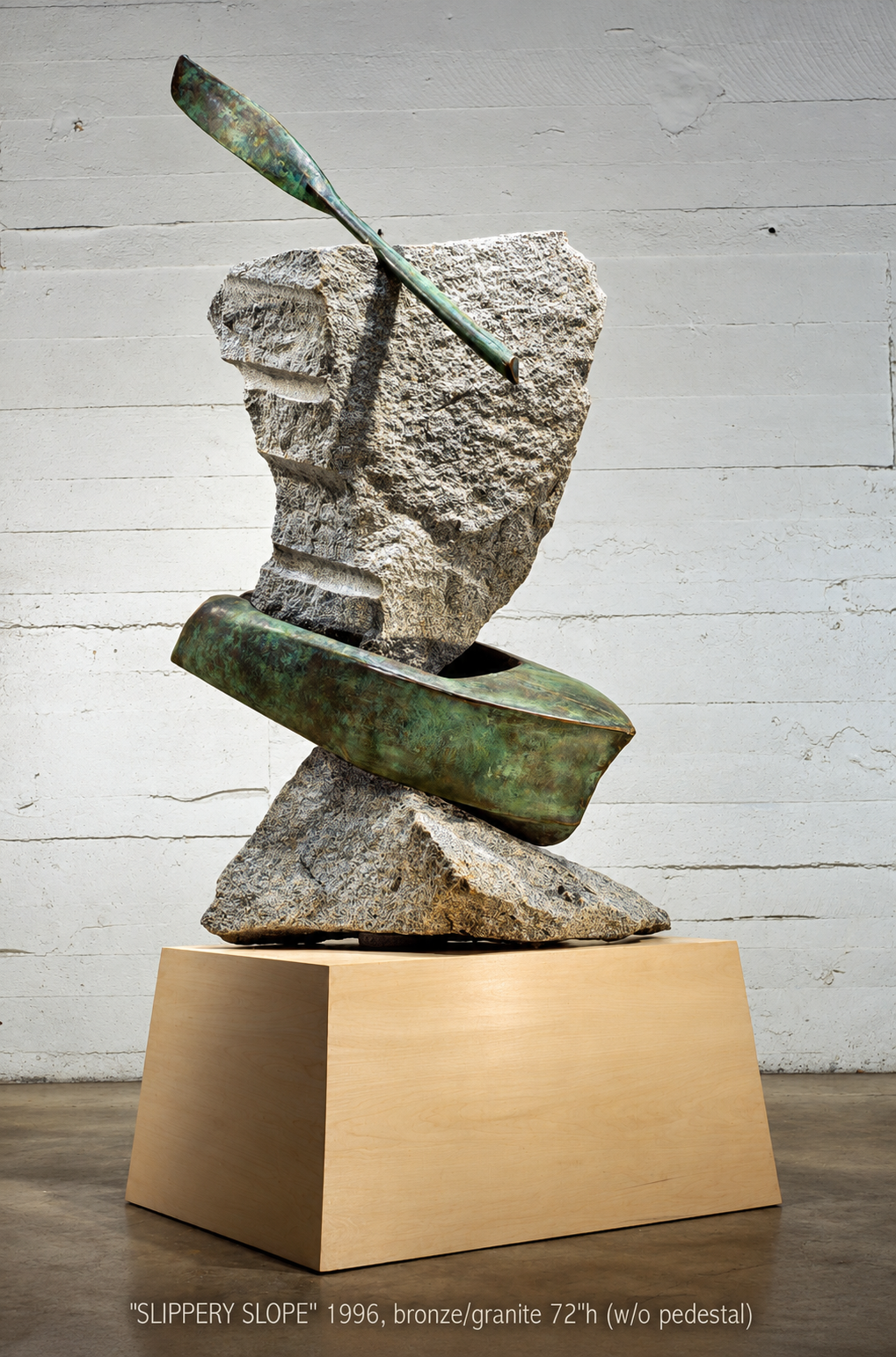
February 1996. Granite, bronze. Dimensions: 72 × 32 × 46 in (183 × 81 × 117 cm).
SLIPPERY SLOPE, bronze and granite, 72”h x32”w x48”w
Collection: Henry and Sylvia Heumann, Utica, NY
Many of my works contain boats which can be interpreted as a symbol for the self – often in the mists of a journey or passage. As the title suggests Slippery Slope presents the viewer with a bronze boat cascading down to an undetermined fate …
The stone, which in reality is earthbound, heavy and hard, is portrayed in this piece as a sail which propels the boat form and as water which carries and “slips” it downward. In both cases the stone is transformed from its “material-ness” in reality to the ephemeral states of a sail – which takes its form from nothing more than the wind and water which is fluid and transparent. It is exactly these transformations that give the work its power and mystery and keep us coming back time and time again to re-experience the magic
John Van Alstine August 2003
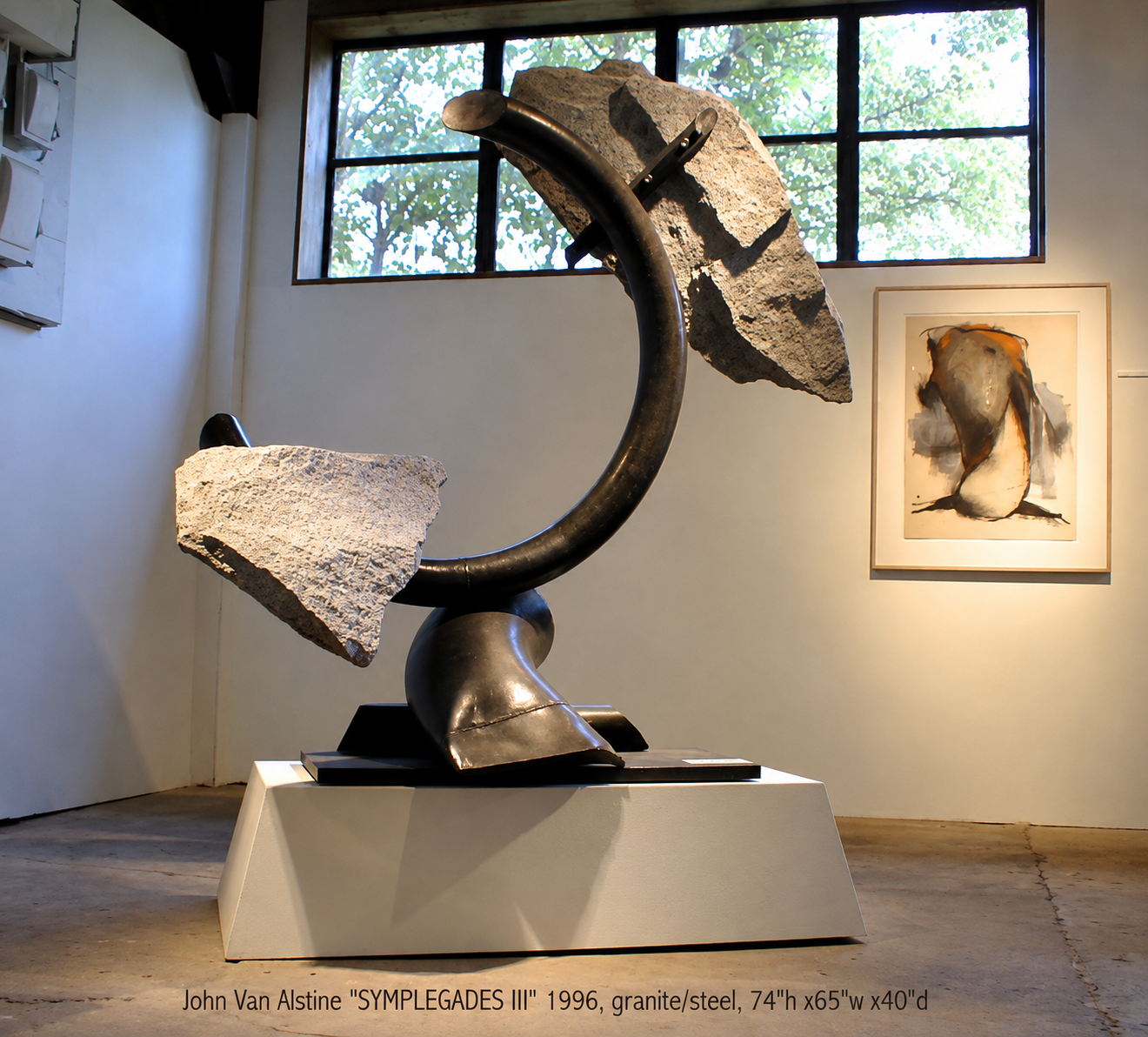
February 1996. Granite, steel. Dimensions: 71 × 65 × 40 in (180 × 165 × 102 cm).
Private collection Washington, DC
Symplegades (sim-PLEG-uh-deez) The Clashing Rocks, which smashed together upon any ship passing between them. Jason and the Argonauts had been advised to avoid this trap by causing a bird to fly ahead of their vessel. The Symplegades clashed together on its tail feathers, then drew apart in readiness to clash again. At this moment, the Argonauts sailed through safely, with only minor damage to the very stern of their ship.
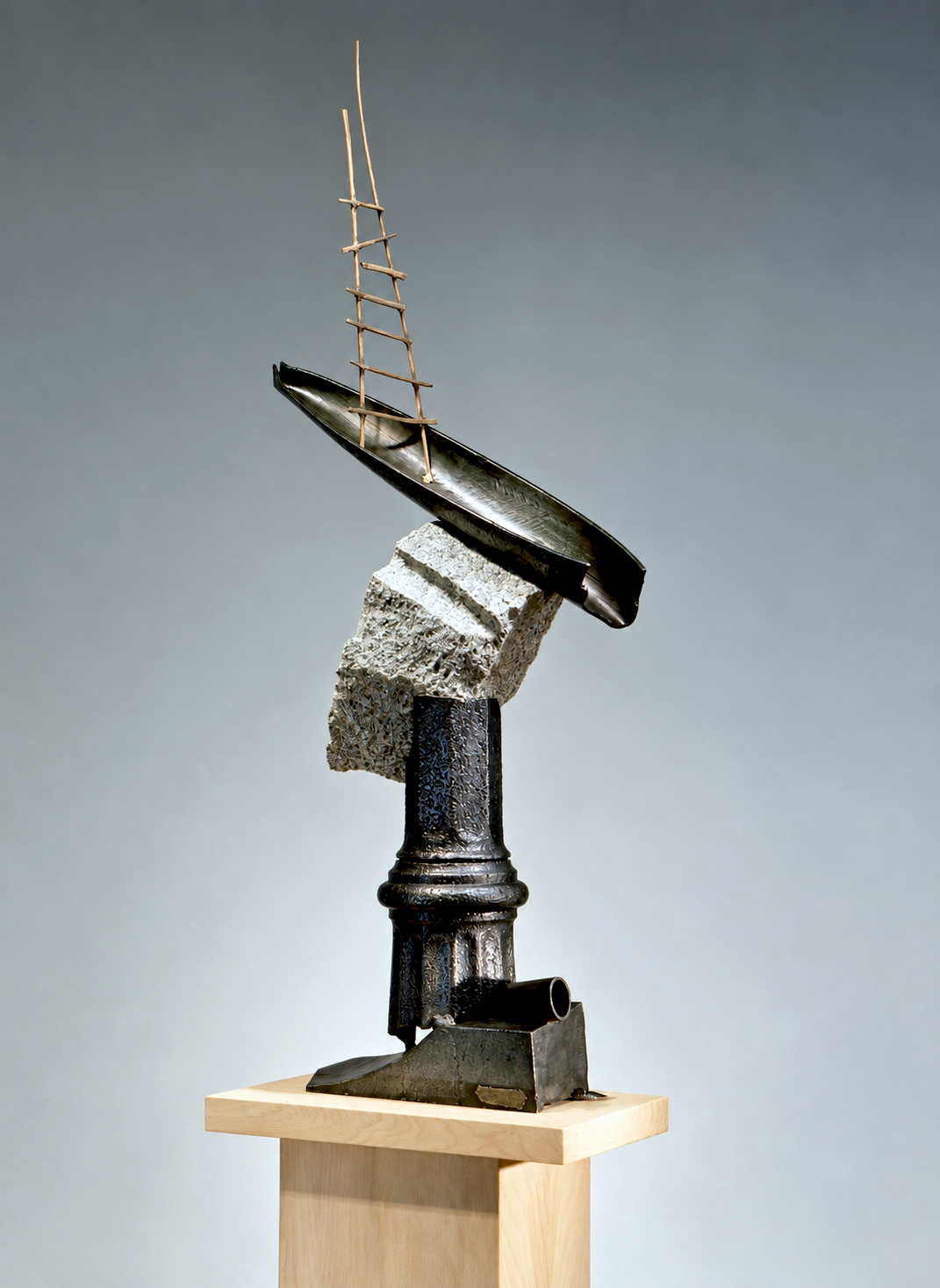
February 1996. Granite, steel. Dimensions: 53 × 24 × 10 in (135 × 61 × 25 cm).
Private collection.
High Rider - Fully Freighted was created for a benefit auction for the John Hopkins Children’s Center in Baltimore, and its imagery grew directly from that context. Rising from the tilted vessel, the delicate bronze ladder reaches upward, countering the sculpture’s weight and precariousness with a gesture of ascent. For me, it suggests hope, positive energy, and the possibility of moving beyond difficult circumstances—the support and optimism that a hospital and its dedicated staff can offer children and their families.
The sculpture draws on the vessel as a recurring metaphor in my work for passage and journey. Here, a symbolically and emotionally freighted vessel careens precariously atop granite and industrial steel, suggesting the uncertainty and imbalance faced by very sick children and their families.
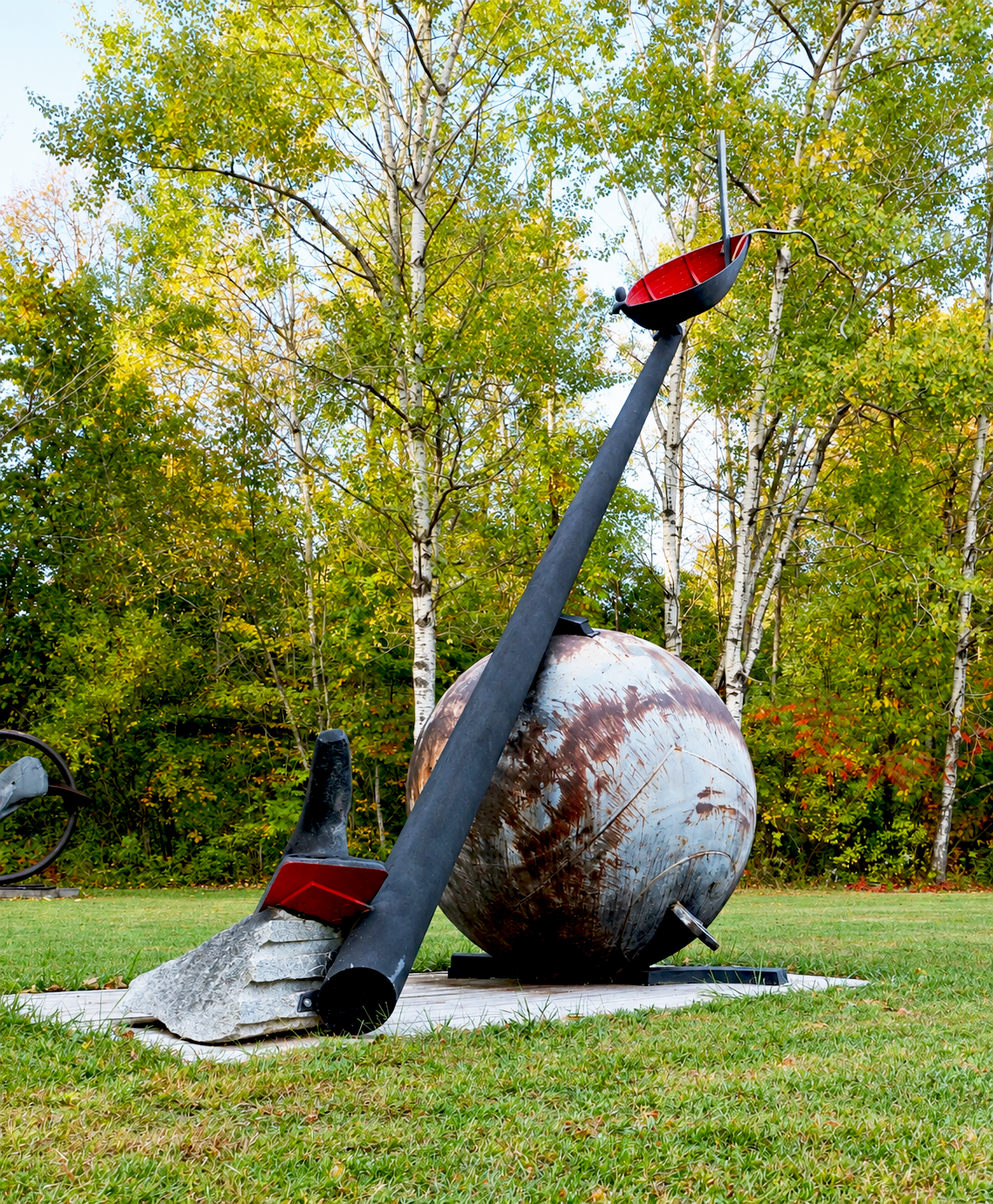
February 1996. Granite, steel, bronze. Dimensions: 17 × 4 × 20 in (43 × 10 × 51 cm).
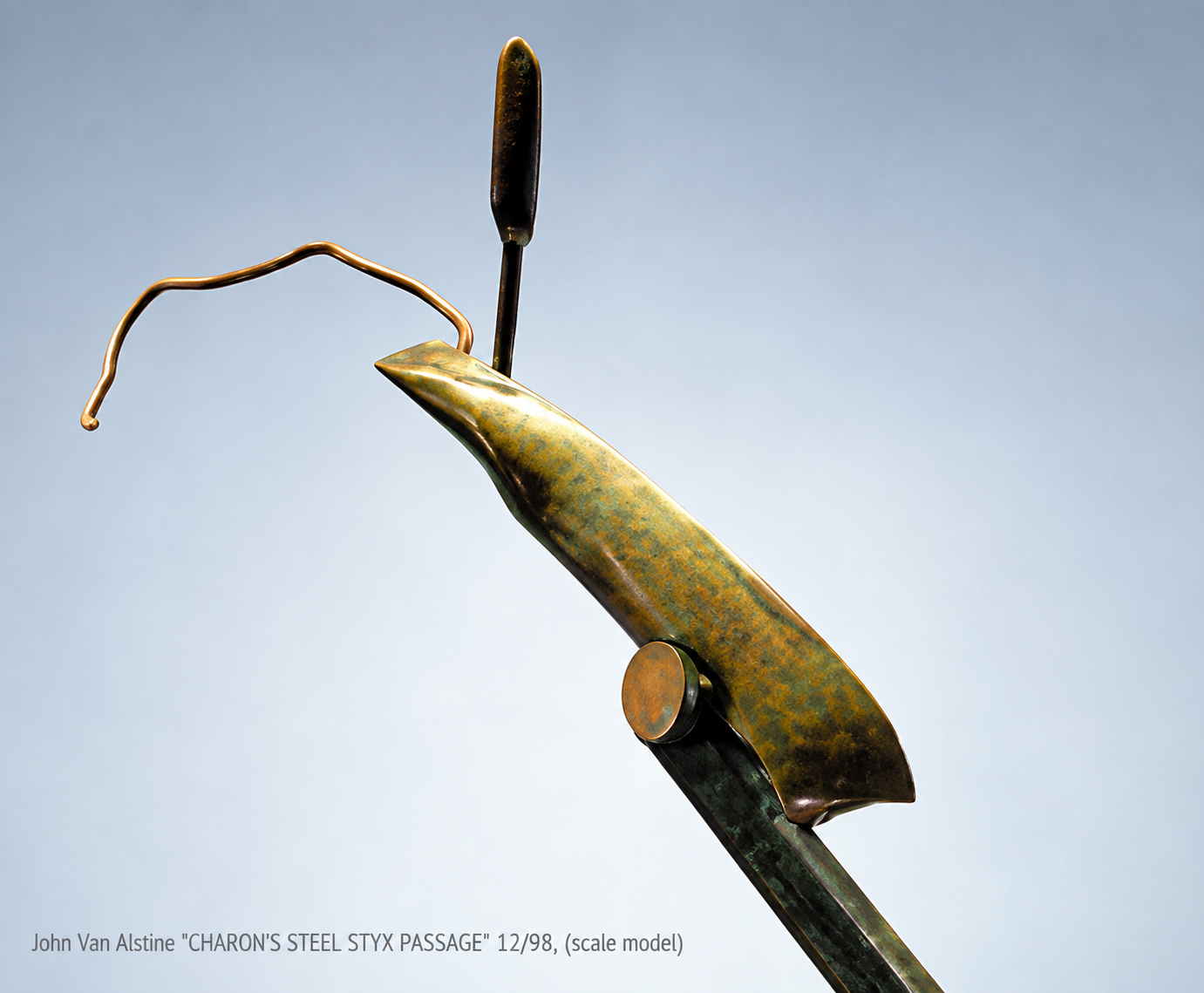
Charon, the mythical ferryman, is charged with transporting the deceased across the River Styx to the underworld. The vessel - my attempt to simulate an Adirondack like guide boat in steel – with its out-stretched oar, un-inhibited trailing “rope” and attached coin to “pay passage”- is poised atop the long black pole or stick/styx. It is aiming for its destination, the large cleat below (under) the globe like, metal buoy. The piece, contrary to perhaps its first impression is not about death or dying, but rather quite the opposite. The “final” journey is portrayed as a wild almost carnival-like passage, reminding us of the importance of each day and the necessity to live each one fully.
John Van Alstine
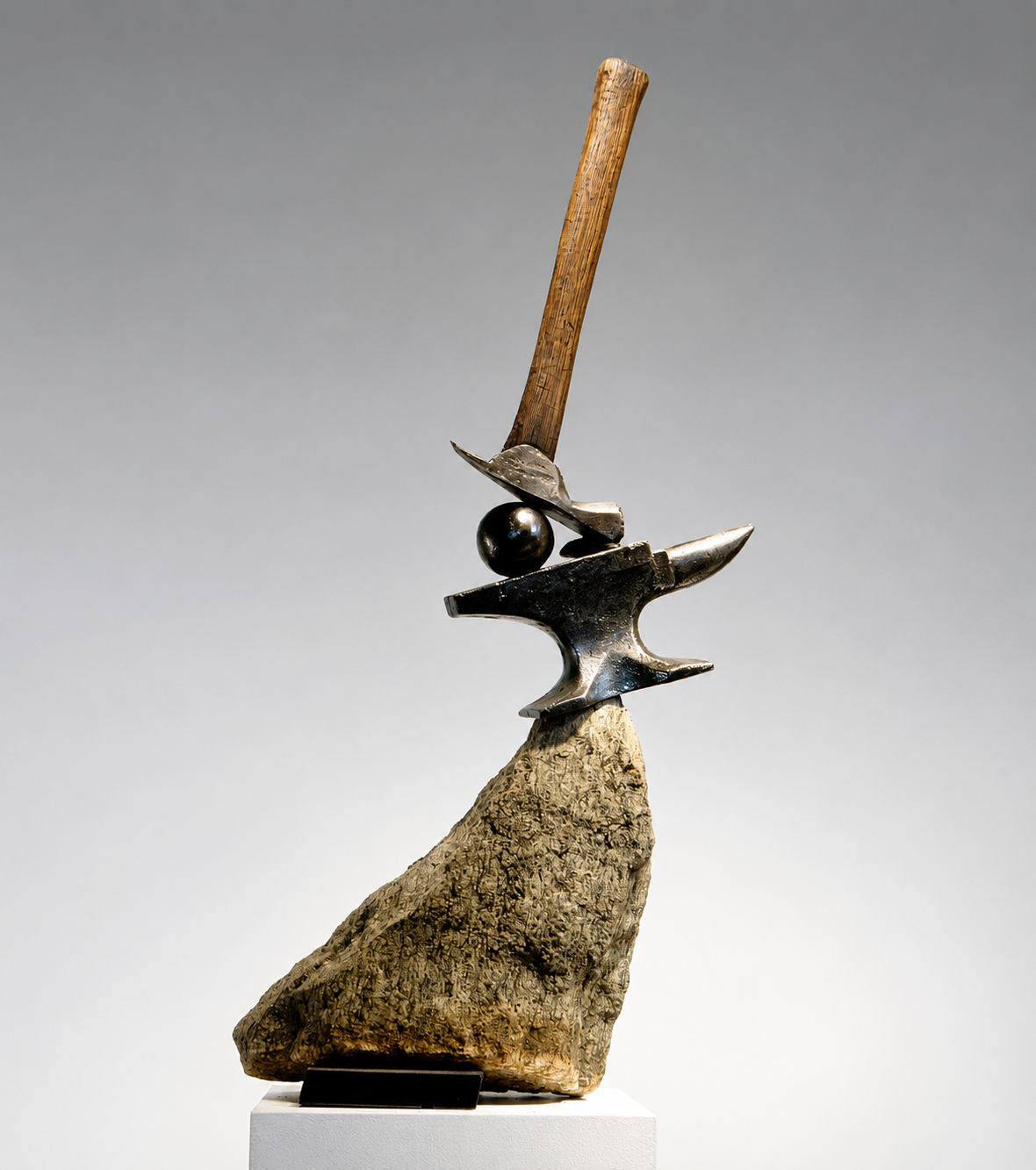
March 1996. Green granite, steel. Dimensions: 33 × 16 × 8 in (84 × 41 × 20 cm).
Private collection
Many of my works incorporate anvils, either real or cast. Anvils have the shape suggestive of a boat or vessel which implies journey which interests me. But further, as a metal worker and “assembler”, the anvil is the place where I physically and conceptually forge things together; for me it is the symbolic place where the “art” is born - there is an art spirit that comes off the anvil. It‘s almost like an altar. I've titled many of these pieces Ara, which is Latin for altar.
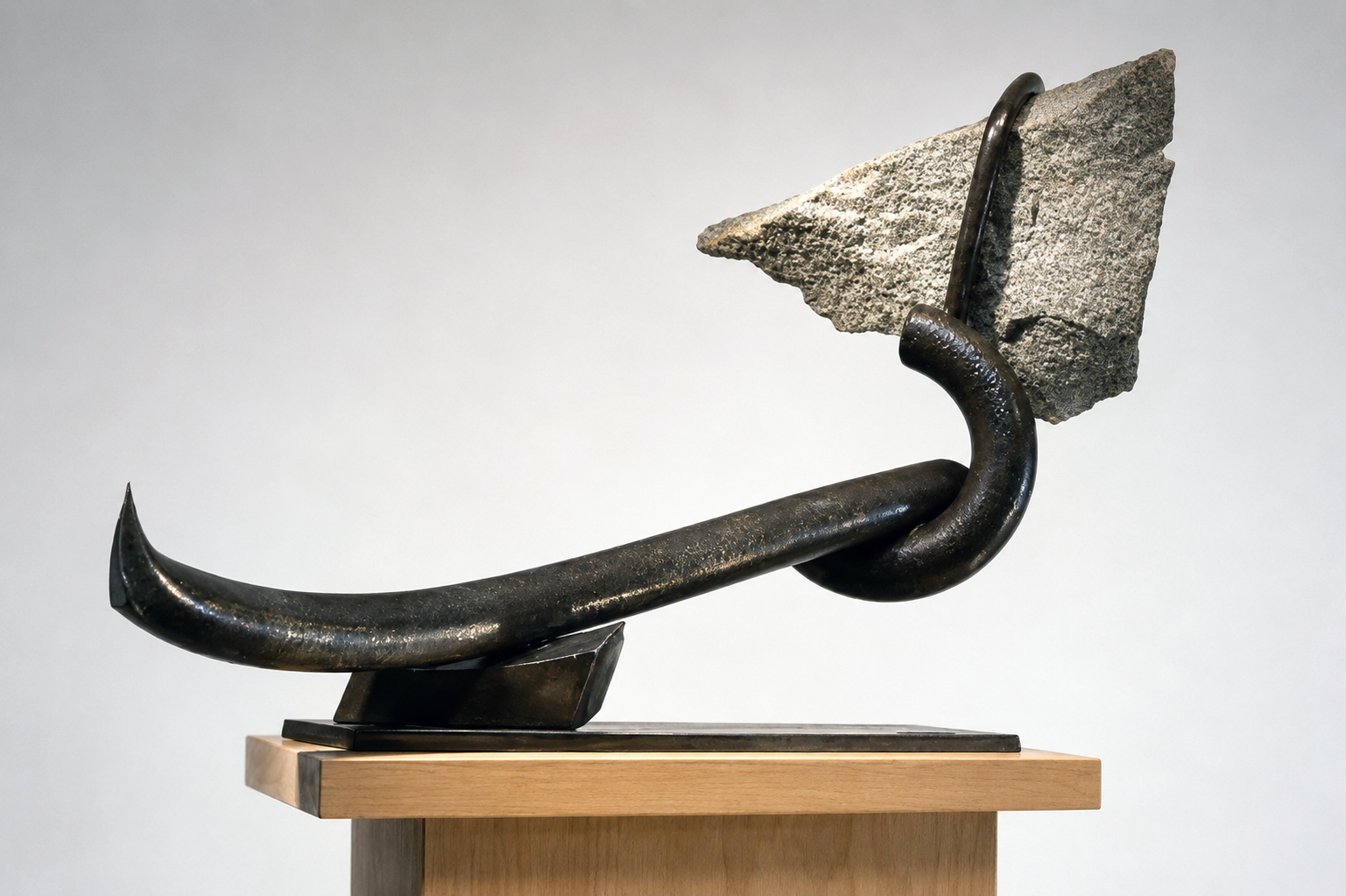
March 1996. Granite, steel. Dimensions: 43 × 63 × 15 in (109 × 160 × 38 cm).
Private collection
As a sculptor, I have always been fascinated by tools, implements, and instruments. I see them as extensions of the hand—essential allies in the act of making—and am drawn to their raw, efficient beauty, shaped over time by function and necessity. They also embody human ingenuity, labor, and our impulse to shape and engage the world around us.
Throughout my work, agricultural implements—rakes, plow blades, sledges, and tillers—as well as anvils, scales, compasses, and other instruments become both sculptural forms and vehicles for metaphor, suggesting ideas of balance, navigation, transformation, and our relationship to the natural world.
John Van Alstine
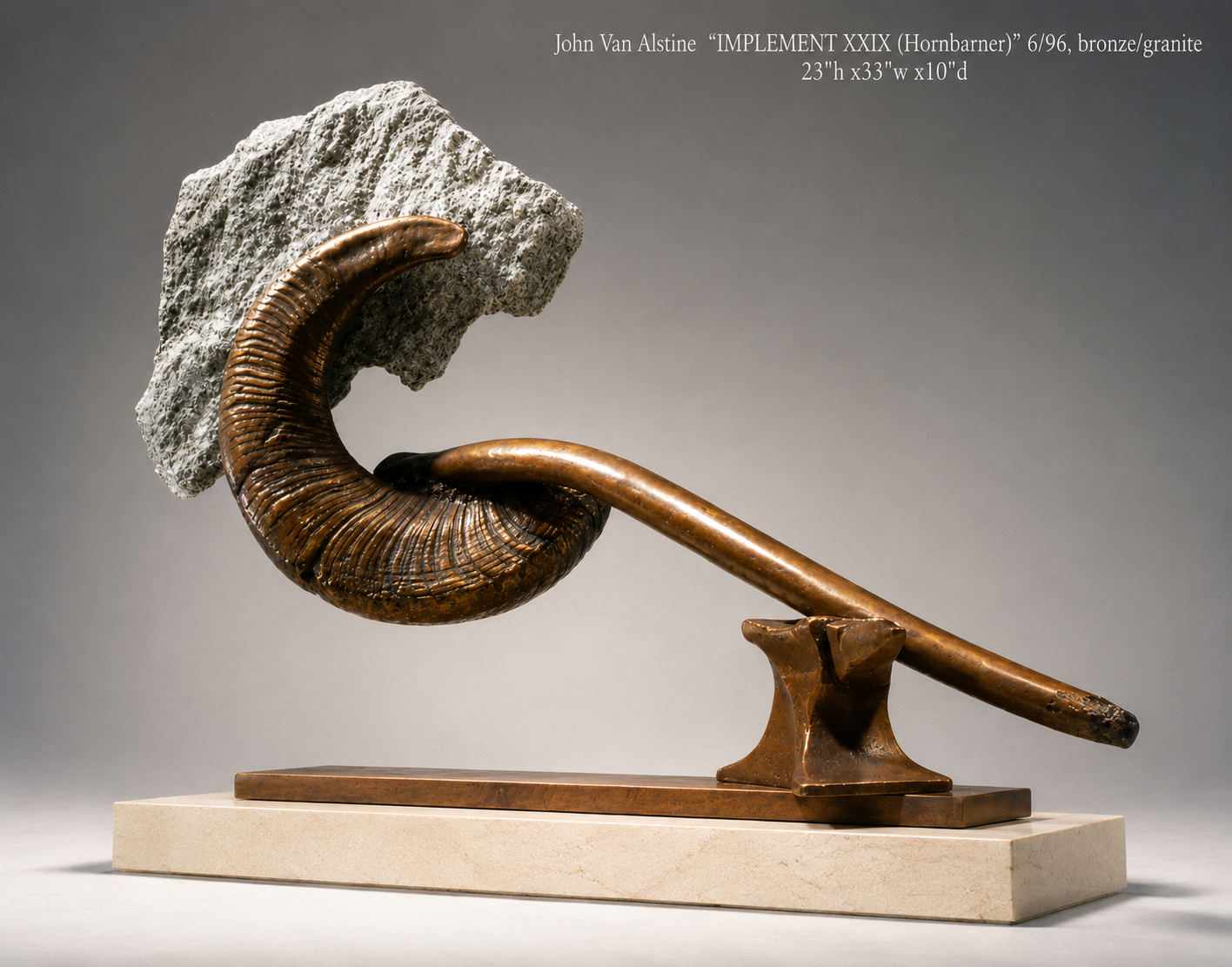
June 1996. Bronze, granite. Dimensions: 23 × 33 × 10 in (58 × 84 × 25 cm).
Private Collection.
As a sculptor, I have always been fascinated by tools, implements, and instruments. I see them as extensions of the hand—essential allies in the act of making—and am drawn to their raw, efficient beauty, shaped over time by function and necessity. They also embody human ingenuity, labor, and our impulse to shape and engage the world around us.
Throughout my work, agricultural implements—rakes, plow blades, sledges, and tillers—as well as anvils, scales, compasses, and other instruments become both sculptural forms and vehicles for metaphor, suggesting ideas of balance, navigation, transformation, and our relationship to the natural world.
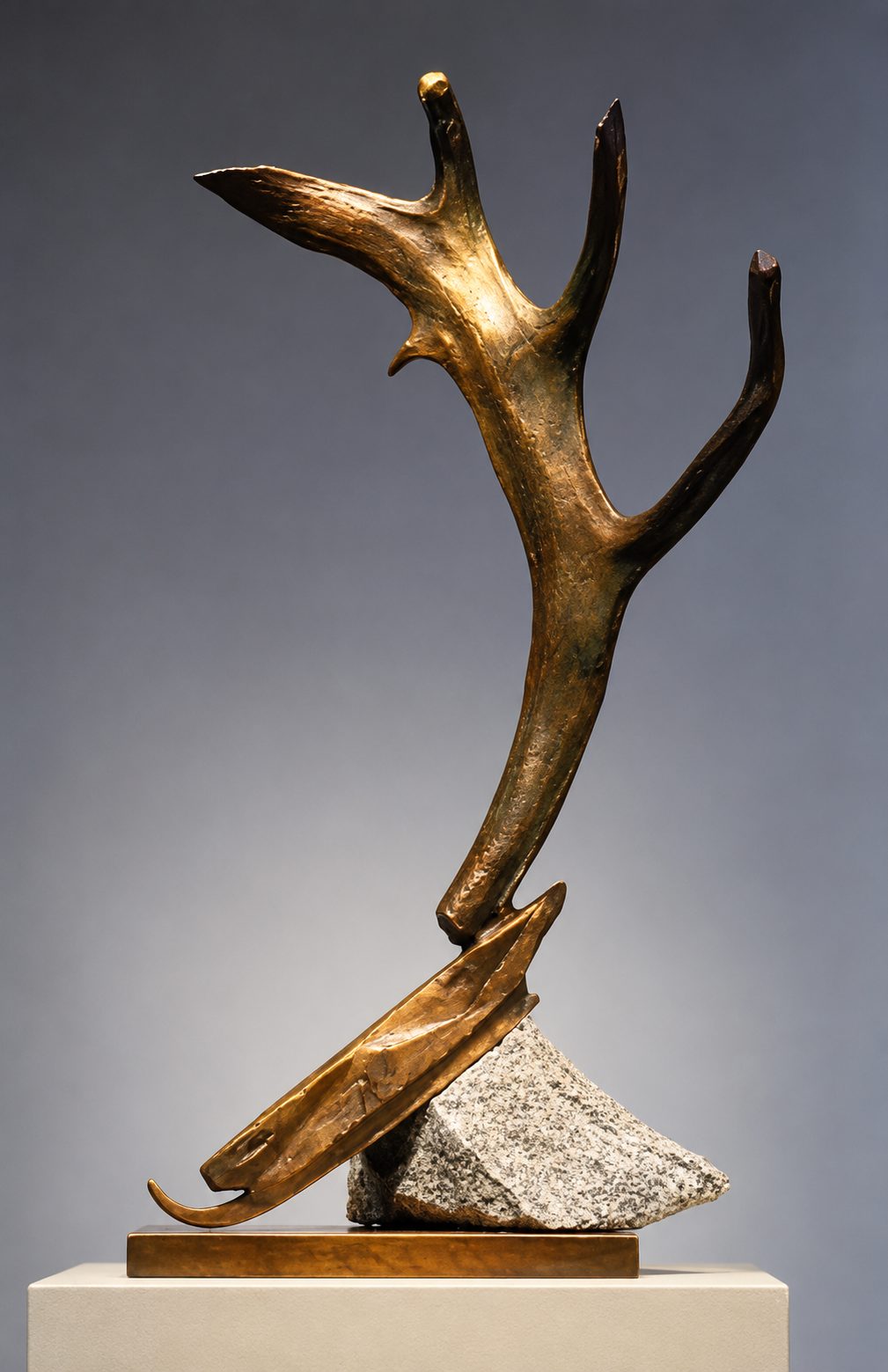
June 1996. Bronze, granite. Dimensions: 25 × 11 × 14 in (64 × 28 × 36 cm). Private collection.
Ceryneian Skate, 1996
Ceryneian Skate draws on the Greek myth of the Ceryneian Hind, the extraordinary female deer sacred to Artemis. Although female, the Hind was described as having stag-like golden antlers and bronze hooves, and possessing such supernatural speed that it could outrun a flying arrow. Capturing the animal alive became one of the Twelve Labors of Hercules. The cast antler form rising through the sculpture recalls this mythical creature while giving the work an animated, almost airborne presence.
The title Skate introduces another layer of movement. The elongated bronze form at the base suggests both the Hind’s bronze hoof and a skate or runner, transforming the weight of bronze and granite into an image of speed, balance, and forward motion. The sculpture brings together two recurring interests in my work—mythology as a framework for contemporary metaphor and the challenge of making inherently heavy materials appear light, agile, and in motion.
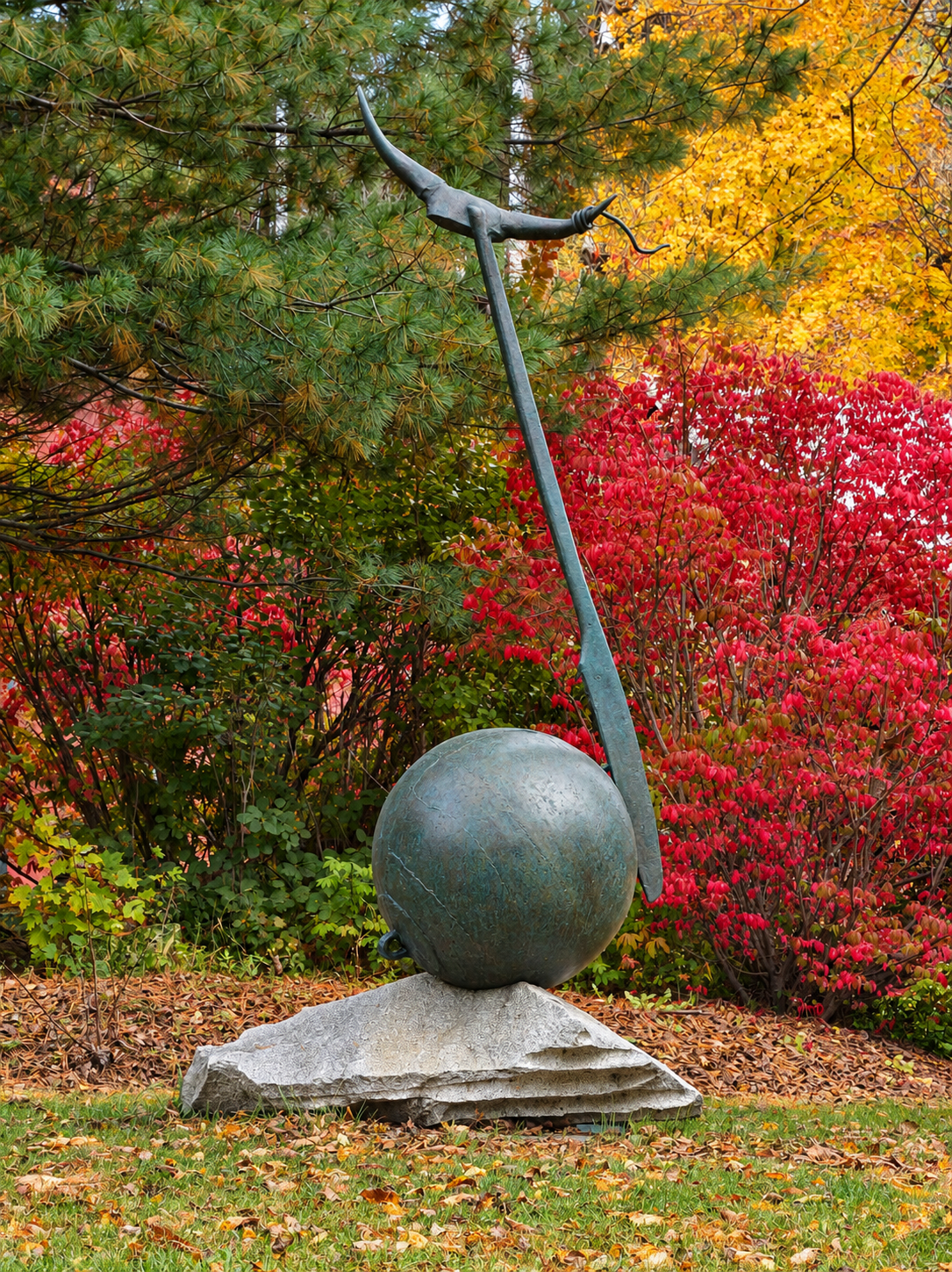
July 1996. Bronze, granite. Dimensions: 110 × 53 × 31 in (279 × 135 × 79 cm). Private Collection.
"Labyrinth Trophy" was inspired by the myth of Theseus slaying the Minotaur and his use of the ball of thread that Princess Anadne, daughter of King Minos, gave him to find his way out.
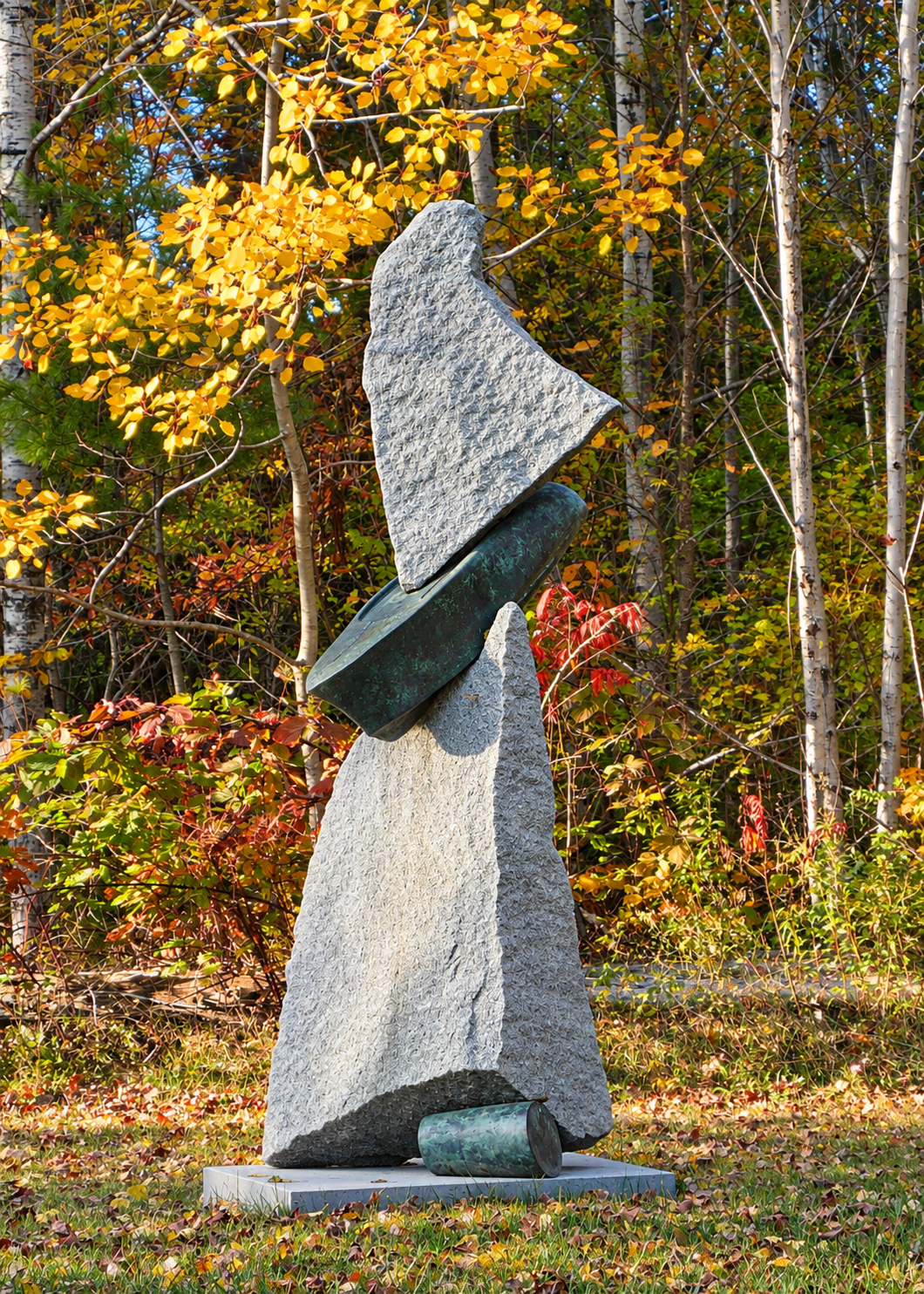
1996. Bronze, granite. Dimensions: 92 × 43 × 30 in (234 × 109 × 76 cm). Private Collection - New Jersey
The Latin title translates as “Stone Sail;” the sculpture features a bronze vessel careening off a sparkling gray granite “waterfall”, together they present an interesting suite of ironies.
Stone that we perceive as durable, ageless and heavy takes on the visual fluidity and capriciousness of water, reminding us that granite, an igneous stone, was once liquid. A sail generally get its billowing shape from something as ephemeral as the wind. Sparkling bits of cystatin mica embedded in the granite bring to mind sun sparkling on freshly fallen snow. All these characteristics and associations are quite the opposite of our traditional understanding of stone.
Art often confronts us with these conceptual reversals allowing, or sometimes forcing, us “to see” our preconceived ideas differently. When successful, it can re-align our instinctive understanding of the “real world” and open us up to new ideas and experiences.
John Van Alstine
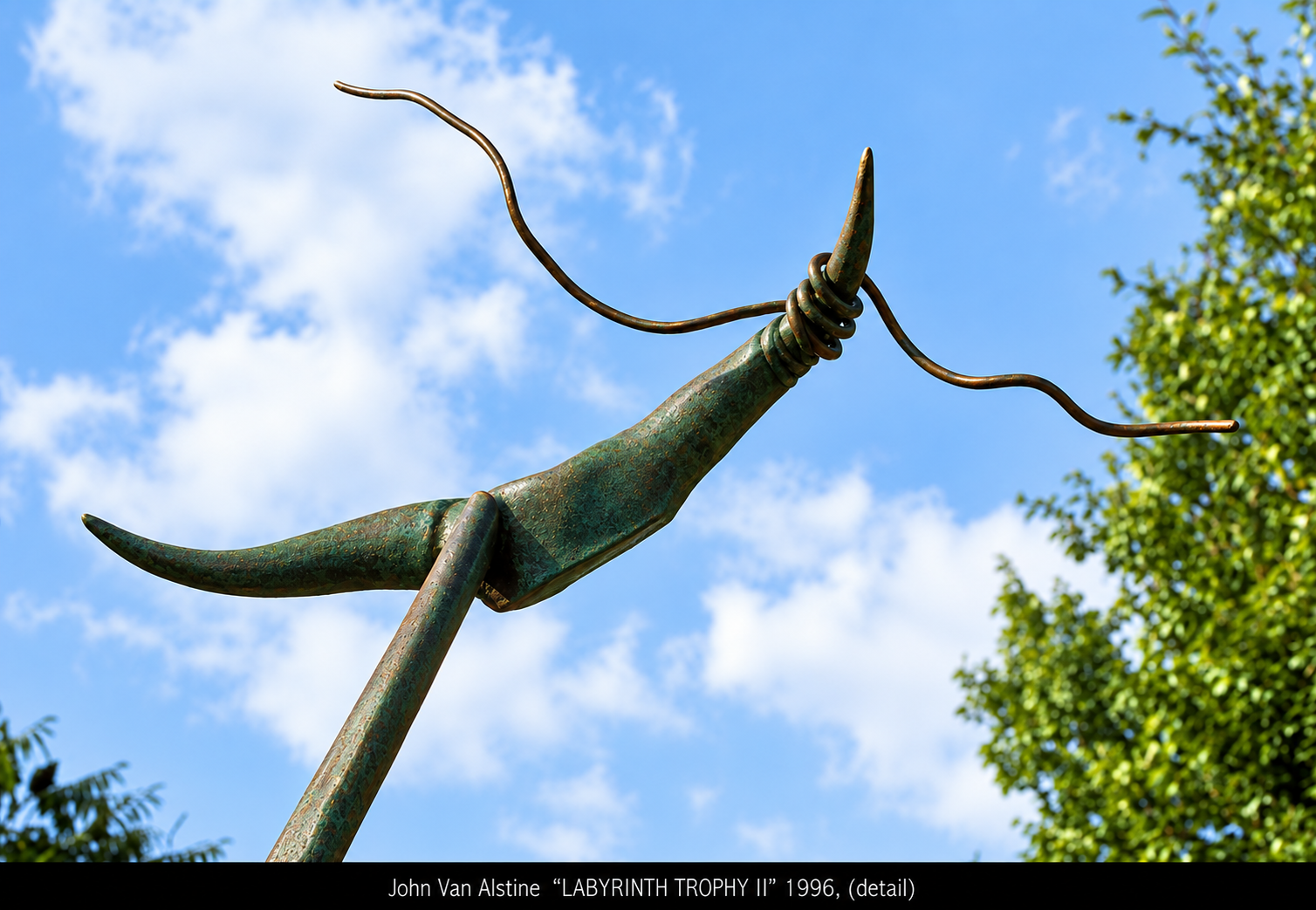
August 1996. Bronze, granite, steel. Dimensions: 12.5’ x 5’ x 5’. Parts used for new work.
"Labyrinth Trophy" was inspired by the myth of Theseus slaying the Minotaur and his use of the ball of thread that Princess Anadne, daughter of King Minos, gave him to find his way out.
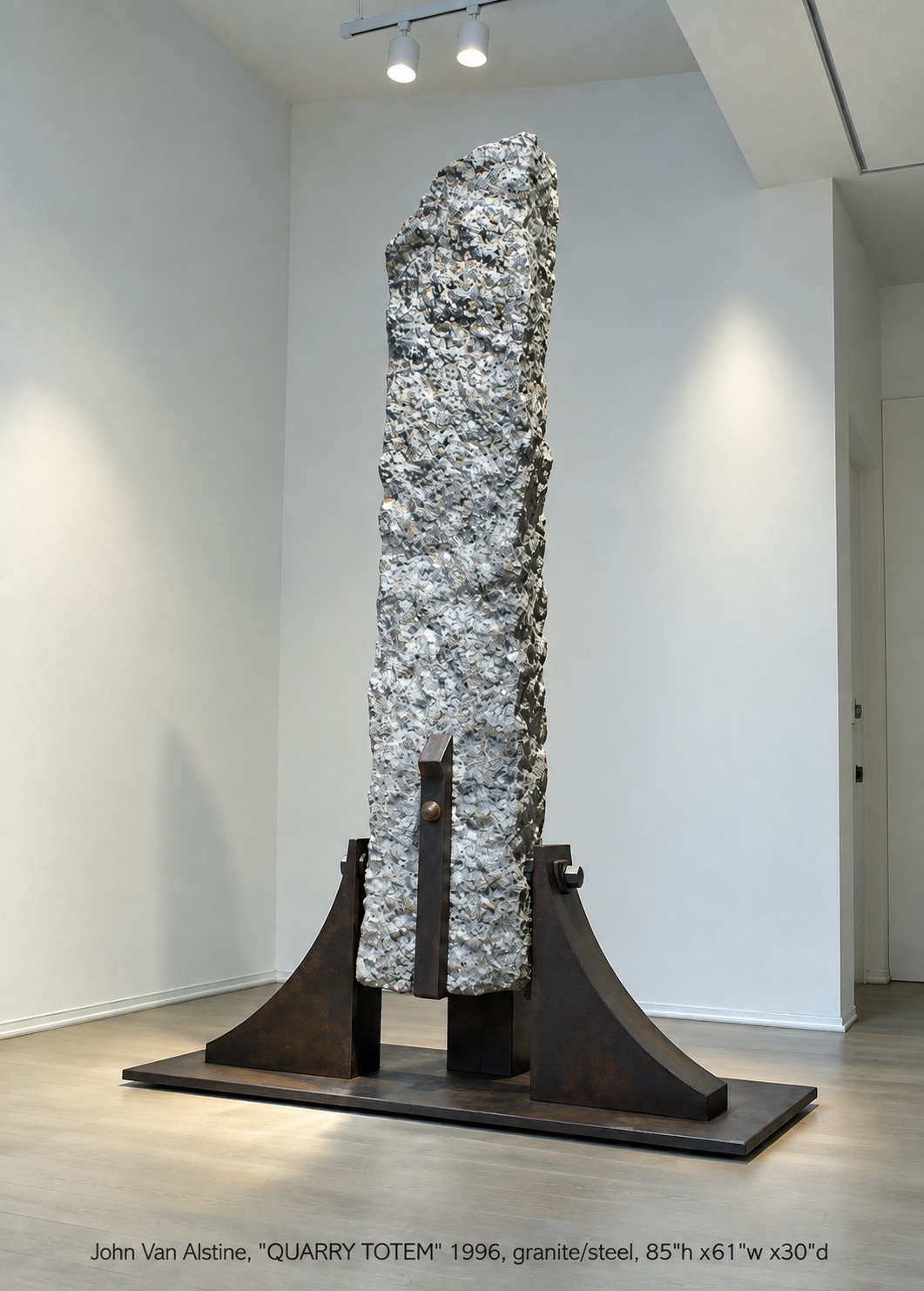
October 1996. Granite, steel. Dimensions: 97 × 61 × 30 in (246 × 155 × 76 cm). Private Collection Baltimore, MD
Quarry Totem, 1996
Quarry Totem continues my Totem Series, combining the vertical presence of a rough-hewn granite monolith with fabricated steel elements that clasp, support, and elevate the stone. The work brings together the natural character of the granite with the more deliberate, industrial geometry of the steel.
The granite was sourced from an abandoned quarry on Vinalhaven Island off the coast of Maine. Its weathered surface and irregular profile retain evidence of its quarry history, while the steel transforms the massive stone into a strong, upright totemic presence.

October 1996. Bronze, granite. Dimensions: 13 × 18 × 5 in (33 × 46 × 13 cm).
Private collection - Philadelphia
As a sculptor, I have always been fascinated by tools, implements, and instruments. I see them as extensions of the hand—essential allies in the act of making—and am drawn to their raw, efficient beauty, shaped over time by function and necessity. They also embody human ingenuity, labor, and our impulse to shape and engage the world around us.
Throughout my work, agricultural implements—rakes, plow blades, sledges, and tillers—as well as anvils, scales, compasses, and other instruments become both sculptural forms and vehicles for metaphor, suggesting ideas of balance, navigation, transformation, and our relationship to the natural world.
Horns and Antlers
I am also is drawn to horns, antlers, and nautilus-like forms because nature has already endowed them with an extraordinary geometric logic—the arc, spiral, taper, and expanding curve. Cast in bronze, these organic structures become part of my constructed vocabulary, moving freely between natural form and human implement. Their long cultural associations also allow them to evoke classical mythology—from the cornucopia and Amalthea to broader ideas of strength, abundance, survival, and transformation—without becoming literal illustrations.
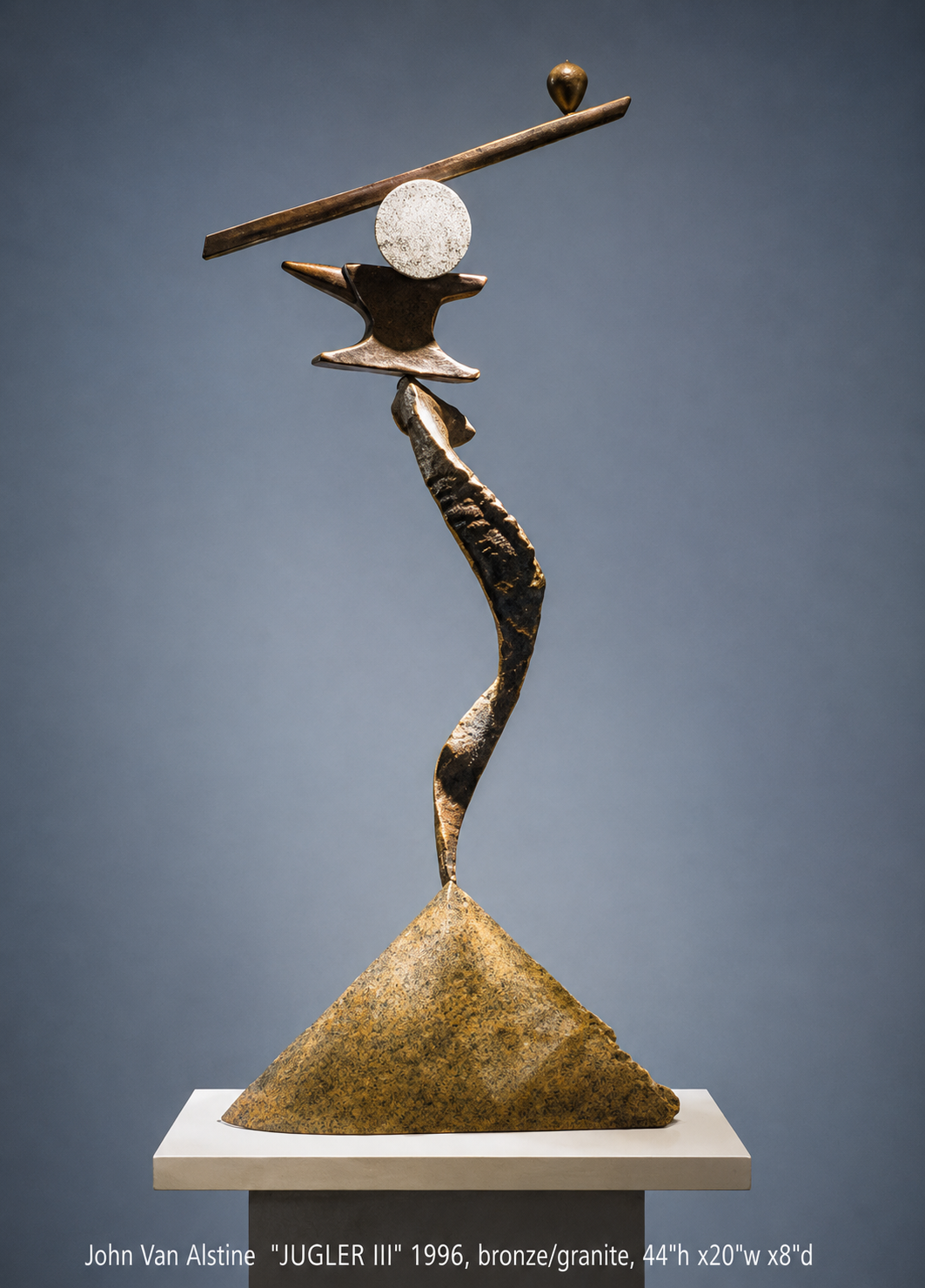
November 1996. Bronze, granite. Dimensions: 44 × 20 × 8 in (112 × 51 × 20 cm). Private collection
Many of Van Alstine’s works take inspiration from the movement of the human body. This work can be seen as a kind of self-portrait, suggesting his studio process—literally juggling and repositioning the individual elements of a sculpture until they achieve a moment of perfect balance, then freezing that moment in space through welding. More universally, juggling becomes a metaphor for the way we all balance the competing demands of family, work, play, and responsibility.
The anvil, which appears in a number of the artist’s works, represents both the ultimate heavy object to “juggle” and the act of assembly itself—the forging together of object, material, and ideas that is central to Van Alstine’s work.

November 1996. Bronze, green granite. Dimensions: 29 × 13 × 6 in (74 × 33 × 15 cm).
Private Collection.
I am drawn to horns, antlers, and nautilus-like forms because nature has already endowed them with an extraordinary geometric logic—the arc, spiral, taper, and expanding curve. Cast in bronze, these organic structures become part of my constructed vocabulary, moving freely between natural form and human implement. Their long cultural associations also allow them to evoke classical mythology—from the cornucopia and Amalthea to broader ideas of strength, abundance, survival, and transformation—without becoming literal illustrations.
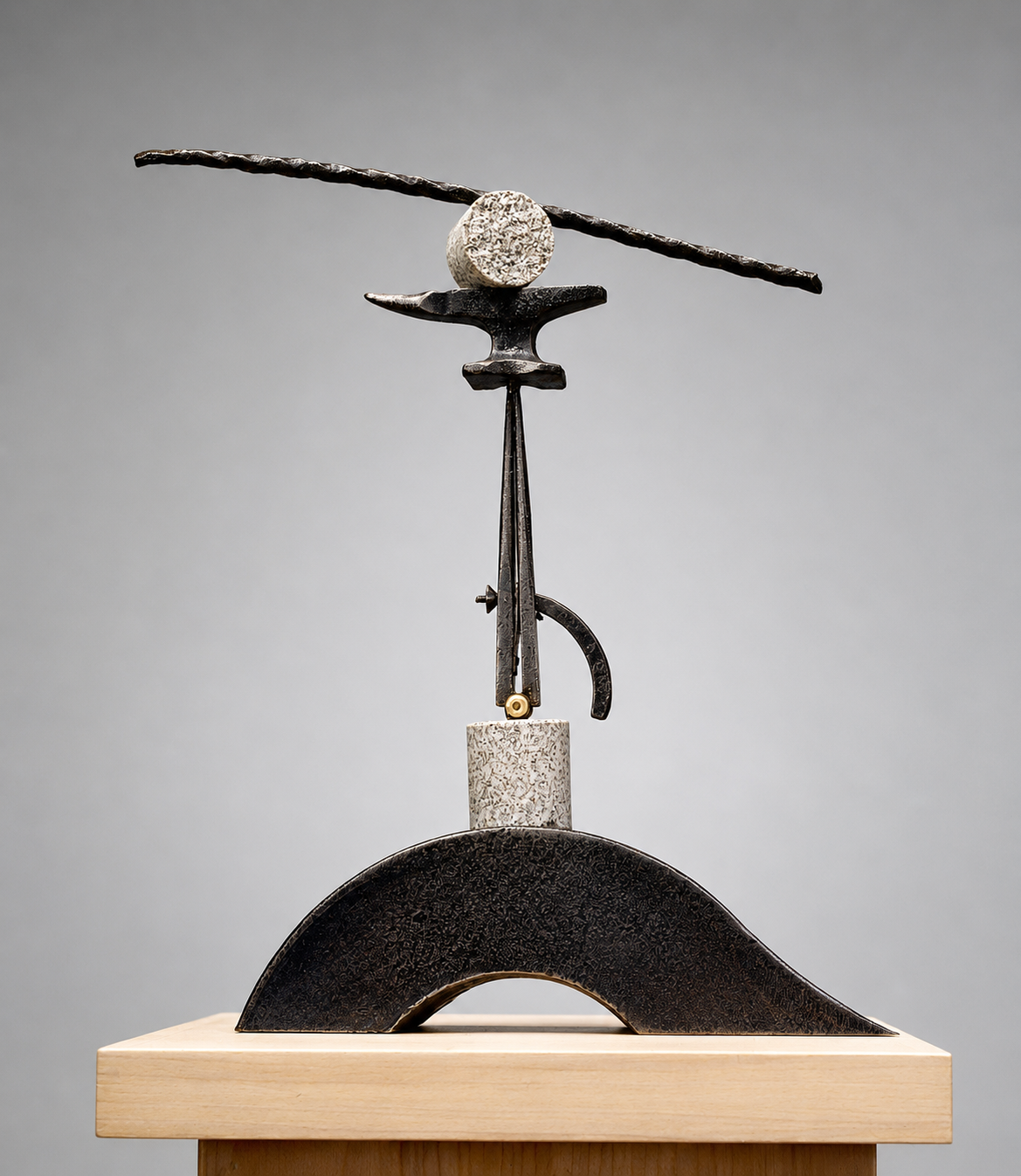
November 1996. Granite, steel. Dimensions: 16 × 14 × 5 in (41 × 36 × 13 cm).
Many of my works incorporate anvils, either real or cast. The anvil’s form, reminiscent of a boat or vessel, carries an inherent suggestion of journey—an idea that has long fascinated me. As a metalworker and “assembler,” I regard the anvil as both a physical and conceptual forge, the place where things come together and where the act of making transforms into art. For me, it holds an almost sacred presence—an altar of creation. In fact, I’ve titled a number of these works Ara, the Latin word for “altar.”
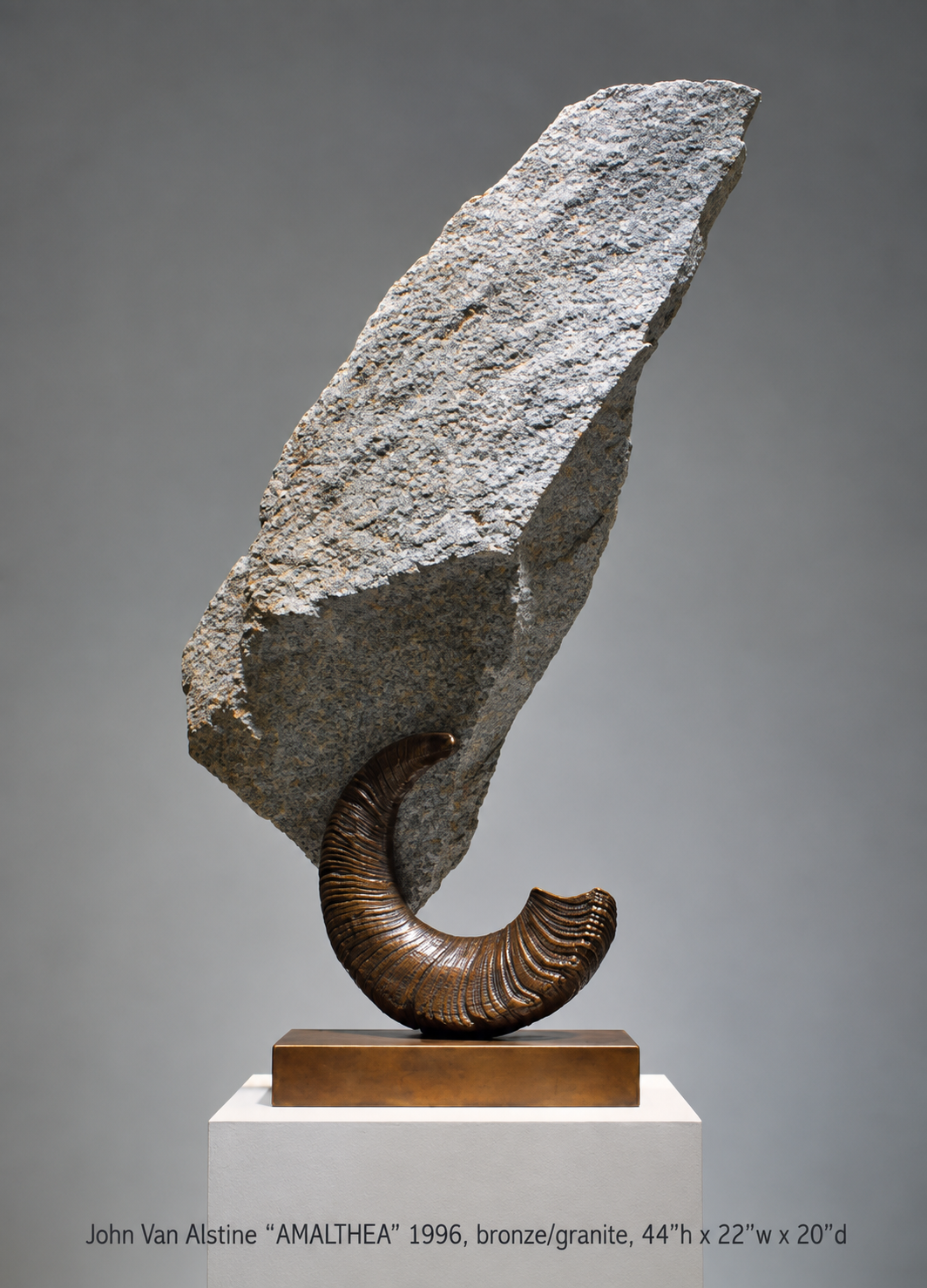
December 1996. Bronze, granite. Dimensions: 44 × 22 × 20 in (112 × 56 × 51 cm).
Private collection - Baltimore
Amalthea is a figure in Greek mythology—often depicted as a nurturing nymph or goat who fed the infant Zeus with her milk. In the myth, one of her horns became the Cornucopia, the horn of plenty, a symbol of nourishment and abundance. Her name is often interpreted as meaning “tender goddess” or “to soothe.”
In this work, Van Alstine invokes Amalthea as a metaphor for the sustaining power of art, expressing his belief that the arts nourish and sustain the human soul.
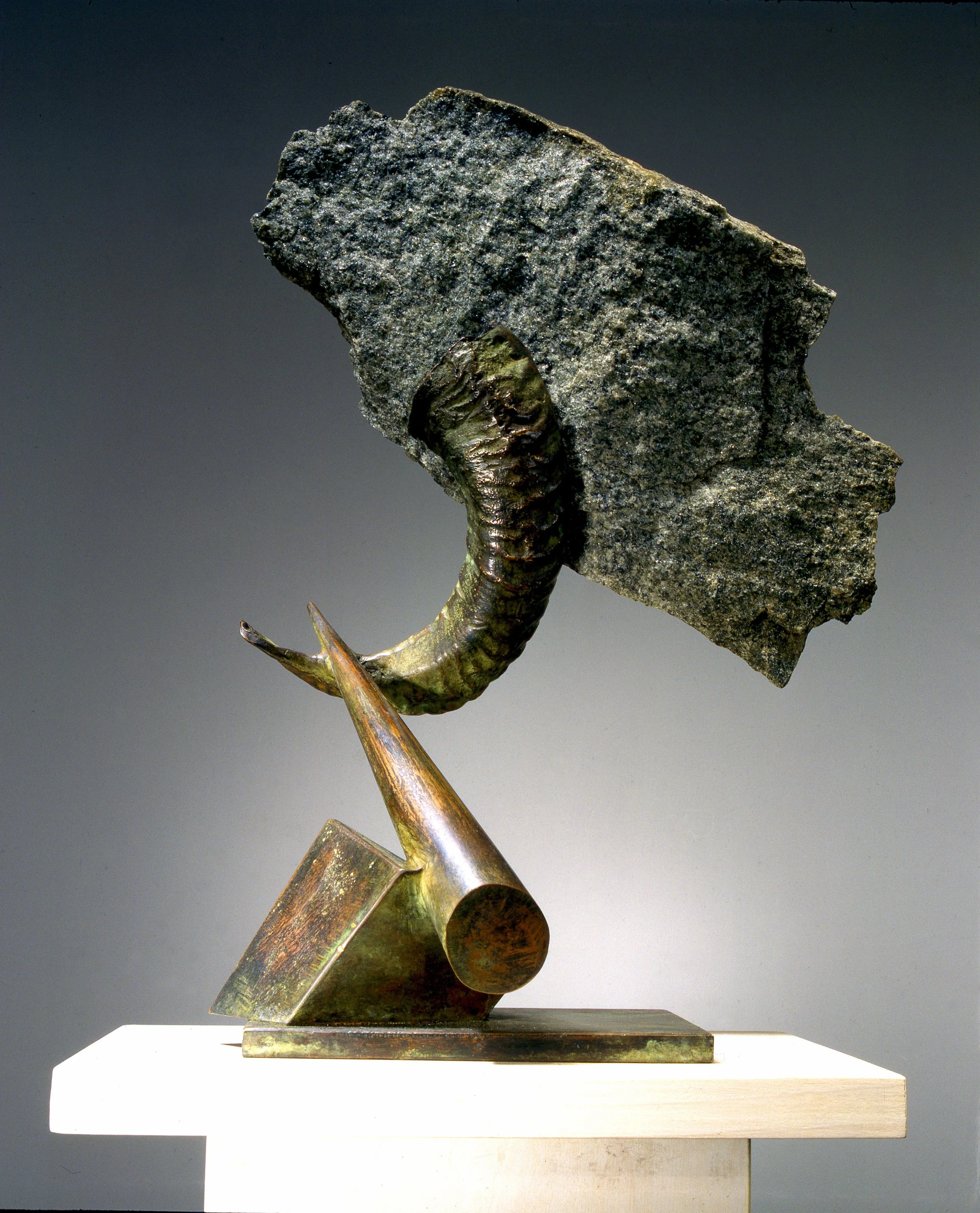
December 1996. Bronze, green granite. Dimensions: 16 × 12 × 6 in (41 × 30 × 15 cm).
Private collection.
As a sculptor, I have always been fascinated by tools, implements, and instruments. I see them as extensions of the hand—essential allies in the act of making—and am drawn to their raw, efficient beauty, shaped over time by function and necessity. They also embody human ingenuity, labor, and our impulse to shape and engage the world around us.
Throughout my work, agricultural implements—rakes, plow blades, sledges, and tillers—as well as anvils, scales, compasses, and other instruments become both sculptural forms and vehicles for metaphor, suggesting ideas of balance, navigation, transformation, and our relationship to the natural world.
- John Van Alstine
Horns, antlers, and nautilus-like forms fascinate Van Alstine for the natural geometry embodied in their arcs, spirals, and tapering curves. Cast in bronze, these organic forms become sculptural building blocks that can suggest both nature’s functional ingenuity and human-made tools—hooks, hammers, blades, and other implements.
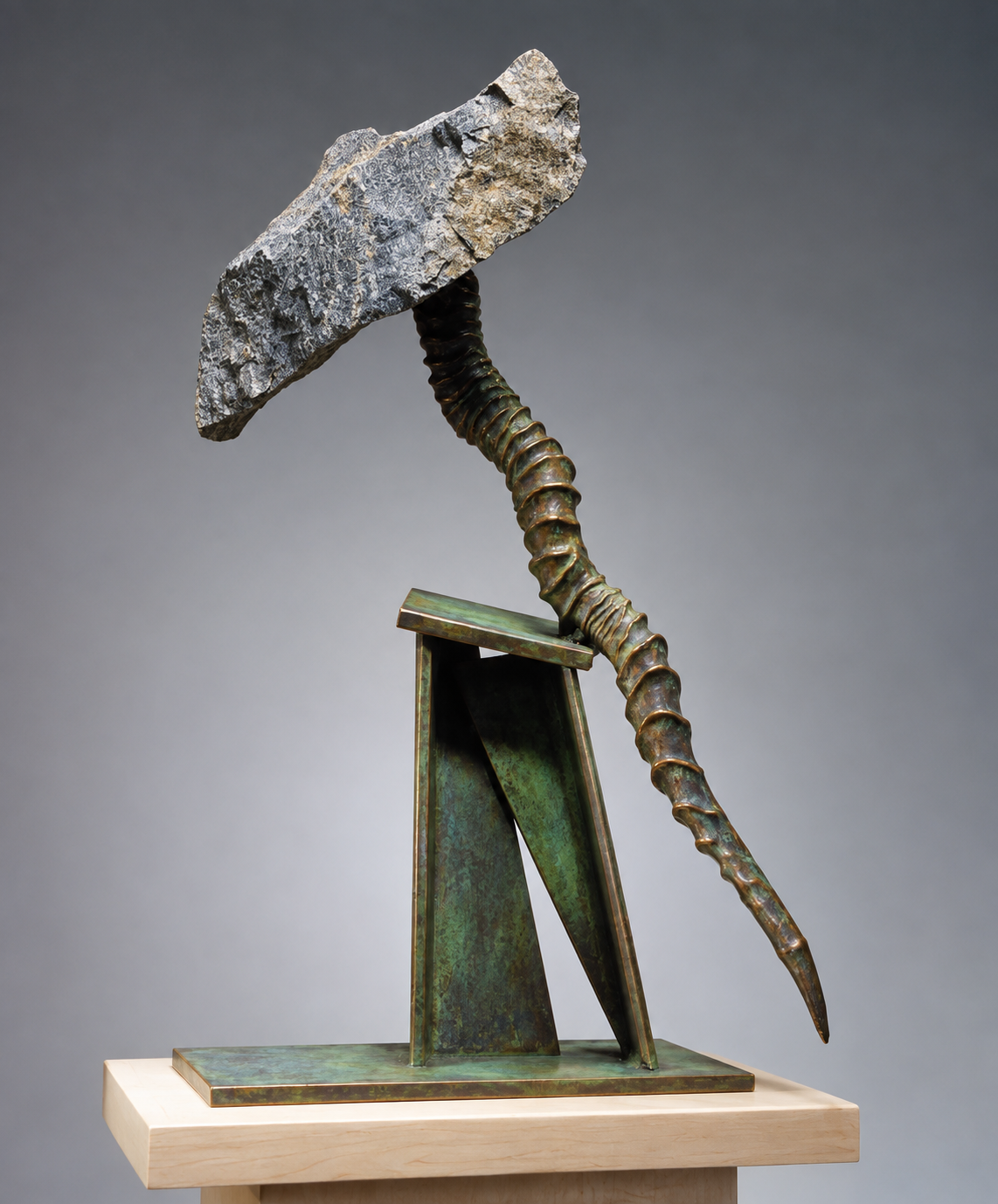
December 1996. Bronze, granite. Dimensions: 19 × 12 × 9 in (48 × 30 × 23 cm).
Private collection - Baltimore
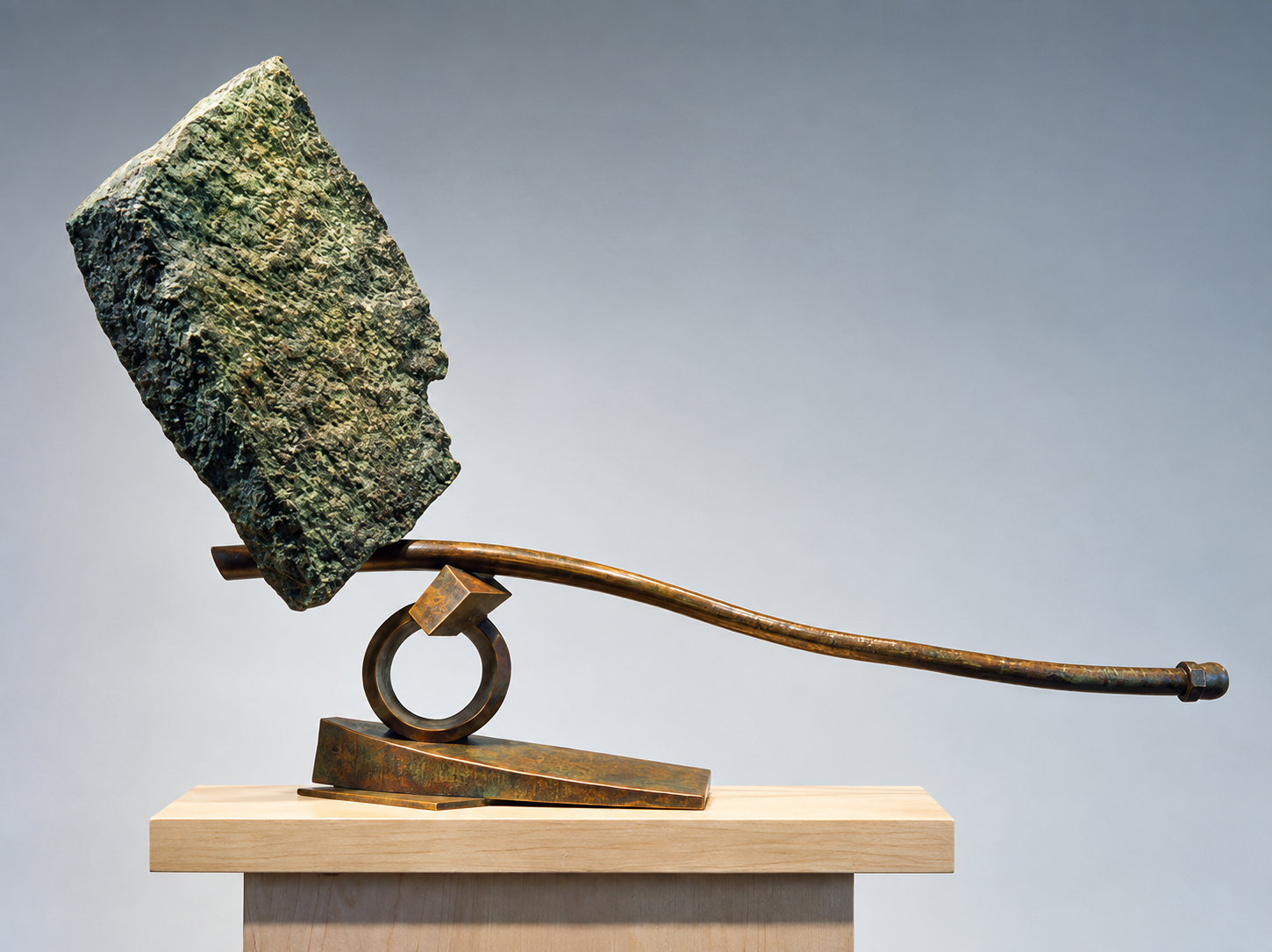
December 1996. Bronze. Dimensions: 22 × 36 × 11 in (56 × 91 × 28 cm).
Private collection
1995

January 1995. Granite, steel. Dimensions: 47 × 75 × 24 in (119 × 191 × 61 cm). Private collection - Atlanta, GA
Unda I takes its title from the undulating, wave-like steel element and brings together several recurring concerns in my work: the interaction of natural stone and human-made steel, and the expressive possibilities created through their union. The steel allows me to lift and choreograph the massive, earthbound granite in space, creating a counterintuitive sense of levity, balance, and arrested motion.
The work also reflects my longstanding fascination with tools and implements as extensions of the human hand. Its sweeping steel form and stone suggest an axe or hatchet without literally depicting one, evoking ideas of labor, ingenuity, and our impulse to shape the natural world. In Unda I, these elements become a metaphor for the continuing dialogue between nature and the built environment.
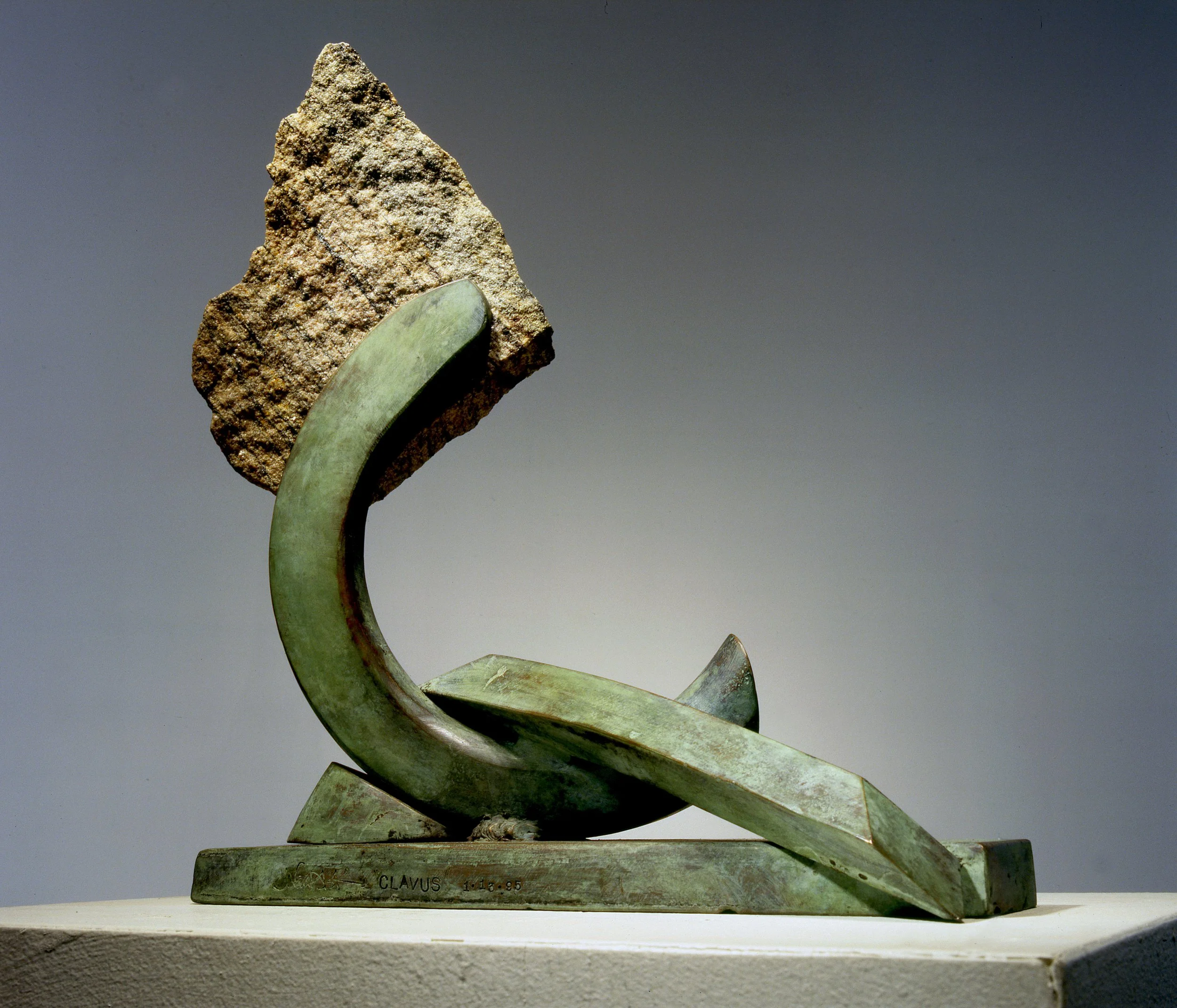
January 1995. Bronze, pink granite. Dimensions: 15 × 13 × 4 in (38 × 33 × 10 cm). Private Collection.
Clavus meaning a ship's rudder/tiller in certain Latin nautical usages. In fact, the expression ad clavum sedere essentially means “to sit at the helm.”
Clavus (Tiller) continues my interest in tools and implements as expressive sculptural forms—extensions of the human hand and body that help us act upon and negotiate the world. The title refers to the tiller as a navigational device used to steer a ship or vessel. I have long been interested in such instruments because they help us carry out decisions and “chart a course,” transforming a functional implement into a metaphor for personal and societal navigation.
In this sense, the tiller becomes more than a physical steering device. It suggests our continuing effort to find direction through both the physical and psychological worlds—to make choices, adjust course, and move forward. This connection between tool, human action, and navigation makes the tiller especially rich subject matter for my sculpture.
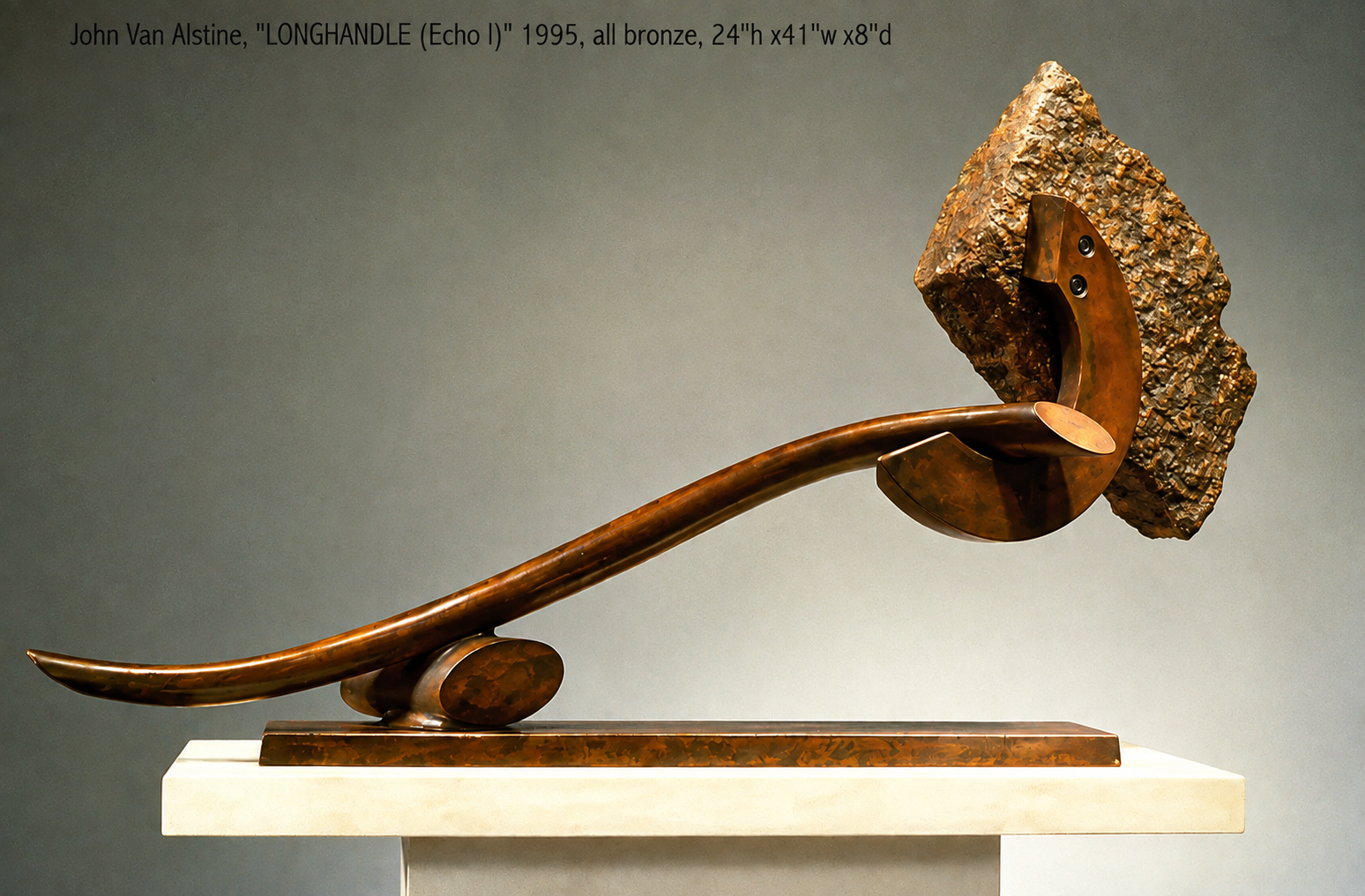
January 1995. Bronze. Dimensions: 24 × 41 × 8 in (61 × 104 × 20 cm).
Private collections - Baltimore; Glens Falls, NY
Longhandle (Echo I), 1995
Longhandle (Echo I) grows out of my longstanding interest in tools and implements as extensions of the human hand. Its elongated form suggests an oversized hand tool—somewhere between an axe and an adze. Here even the rough, stone-like form is cast in bronze, creating a visual contradiction between natural form and human-made material.
I created three versions of Longhandle, exploring variations in material and orientation while retaining the same basic tool-like image. The sweeping handle suggests leverage and action, while the elevated “stone” introduces weight and balance. Transformed from a familiar tool into an ambiguous sculptural form, the work evokes labor, ingenuity, and our impulse to shape the natural world.
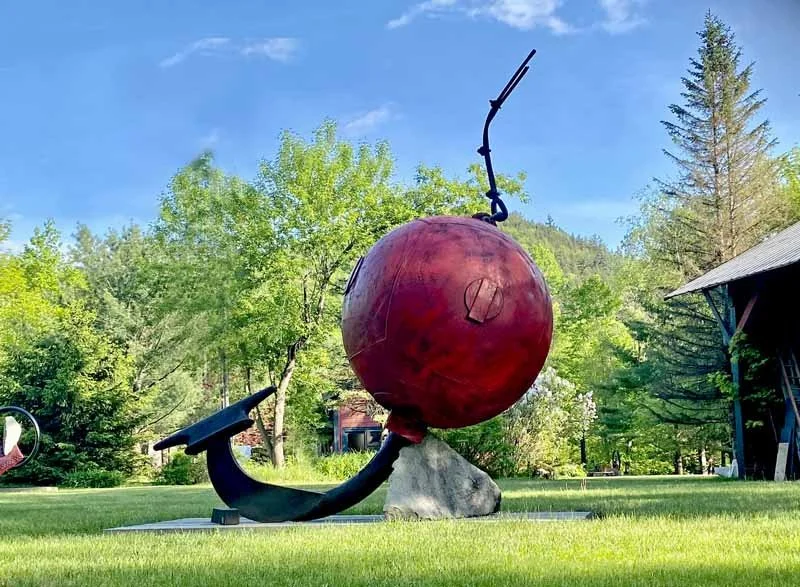
1995-2021. Granite, steel. Dimensions: 130 × 120 × 60 in (330 × 305 × 152 cm). Private Collection.
Buoy (1995) distills John Van Alstine's interest in tools and navigation into a more personal metaphor. Inspired by maritime objects gathered near his Jersey City studio, the buoy becomes less a literal form and more a marker of position—traditionally guiding passage, here reimagined as a way of tracking one's creative journey. Van Alstine's notion of “dropping buoys” suggests each sculpture as a point of reference, recording where he has been and what he was thinking.
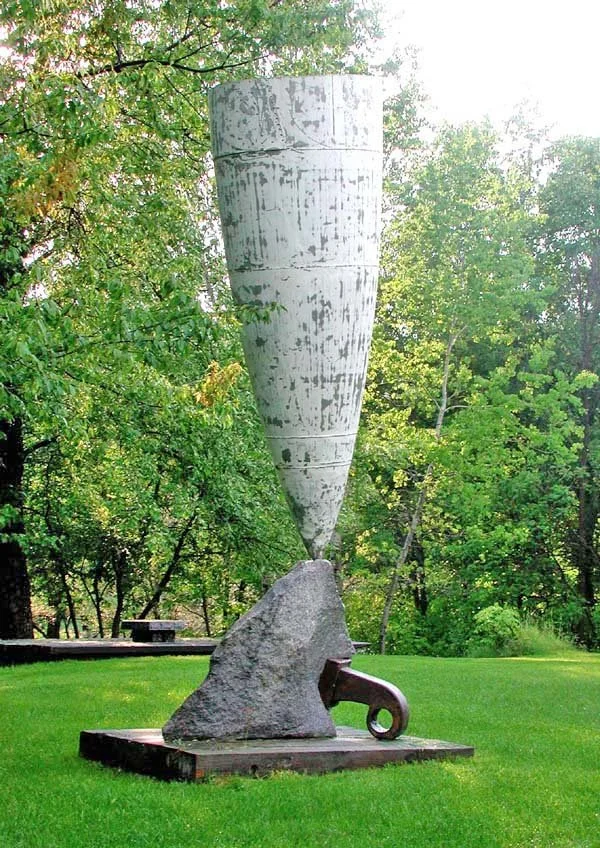
February 1995. Alum, granite, steel. Dimensions: 128 × 50 × 36 in (325 × 127 × 91 cm).
Public collection - Millersville’ University, PA.
Chalice I, 1995
Chalice I is the first work in my Chalice Series and grows from my longstanding interest in vessels and containers as sculptural forms and metaphors. My early background as a potter made the vessel part of my visual vocabulary, while its broader associations—with passage, the individual, or humanity moving through life—gave it metaphorical possibilities. Here, a large section of an aeronautical fuel tank is combined with granite and steel to create an exaggerated, upward-reaching chalice.
At more than ten feet high, the familiar idea of a cup or container is transformed through scale, industrial materials, and precarious balance. The work becomes a kind of “cup of life”—a vessel suggesting containment, passage, aspiration, and the human experience.
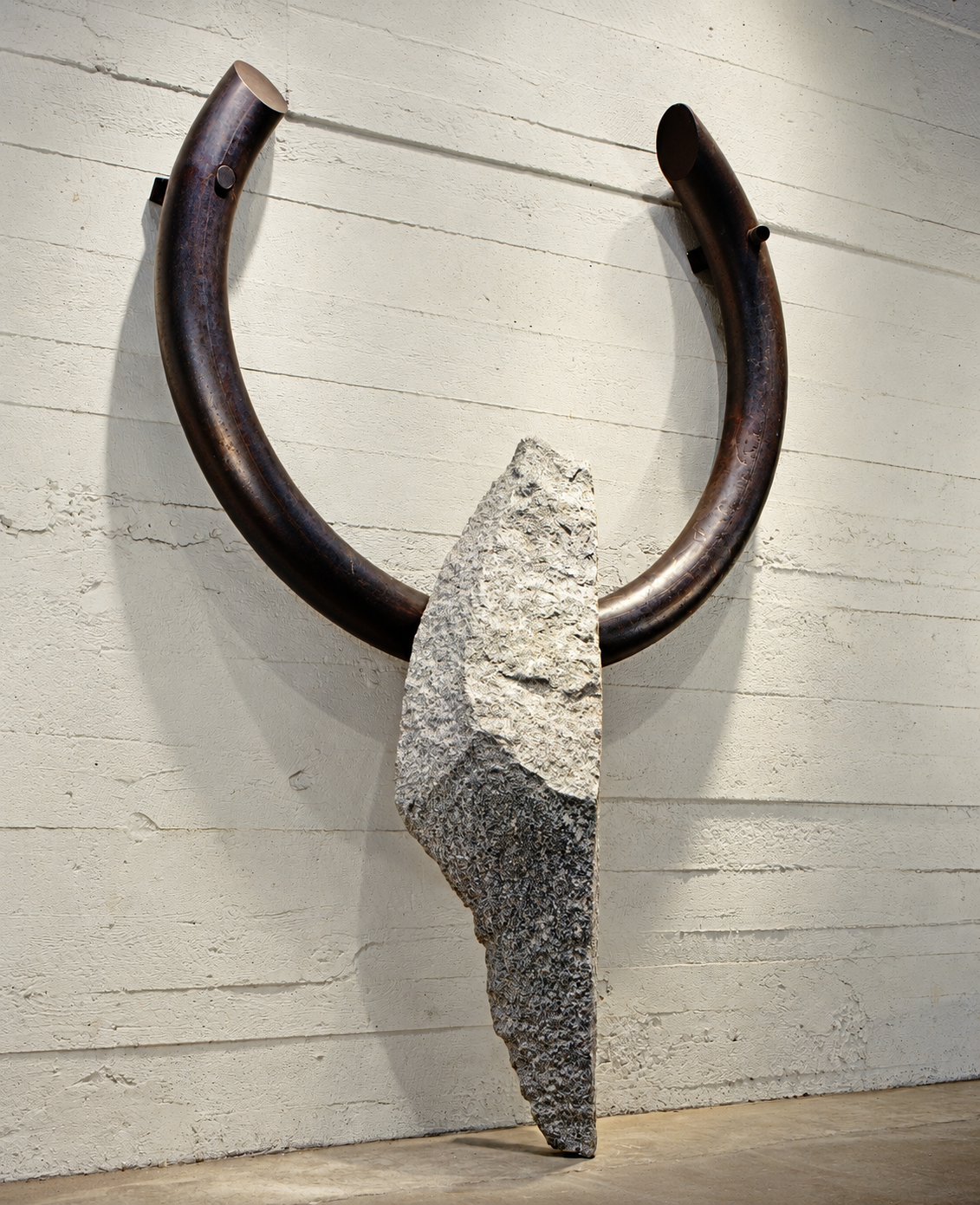
February 1995. Granite, steel. Dimensions: 88 × 60 × 19 in (224 × 152 × 48 cm).
Parts uses to create “Sisyphean Circle 10-16-16” (T-16-21)
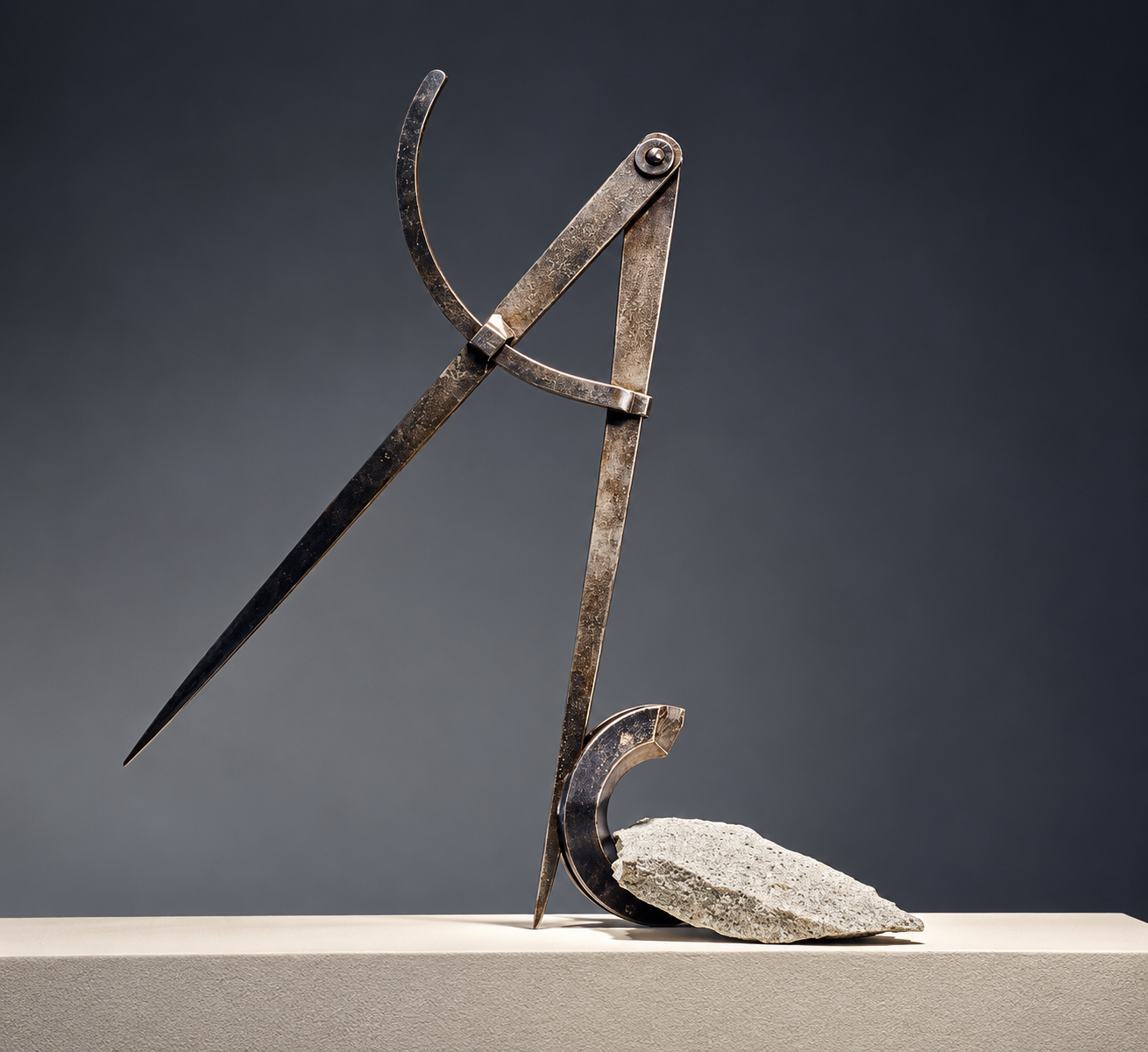
February 1995. Granite, steel. Dimensions: 22.5 × 22 × 10 in (57 × 56 × 25 cm).
Private collection
Circinus, 1995
Circinus takes its title from the small southern constellation whose Latin name means “the compass,” specifically a drawing compass. An actual drawing compass becomes the central element of the sculpture, its hinged legs and sweeping arc animating the work with a sense of movement and balance.
The piece reflects my longstanding interest in tools as extensions of the human hand, their forms shaped by function and necessity. Combined with forged steel and rough granite, the compass becomes an active, gestural form, bringing together the precision of a human-made instrument with the irregular character of natural stone.
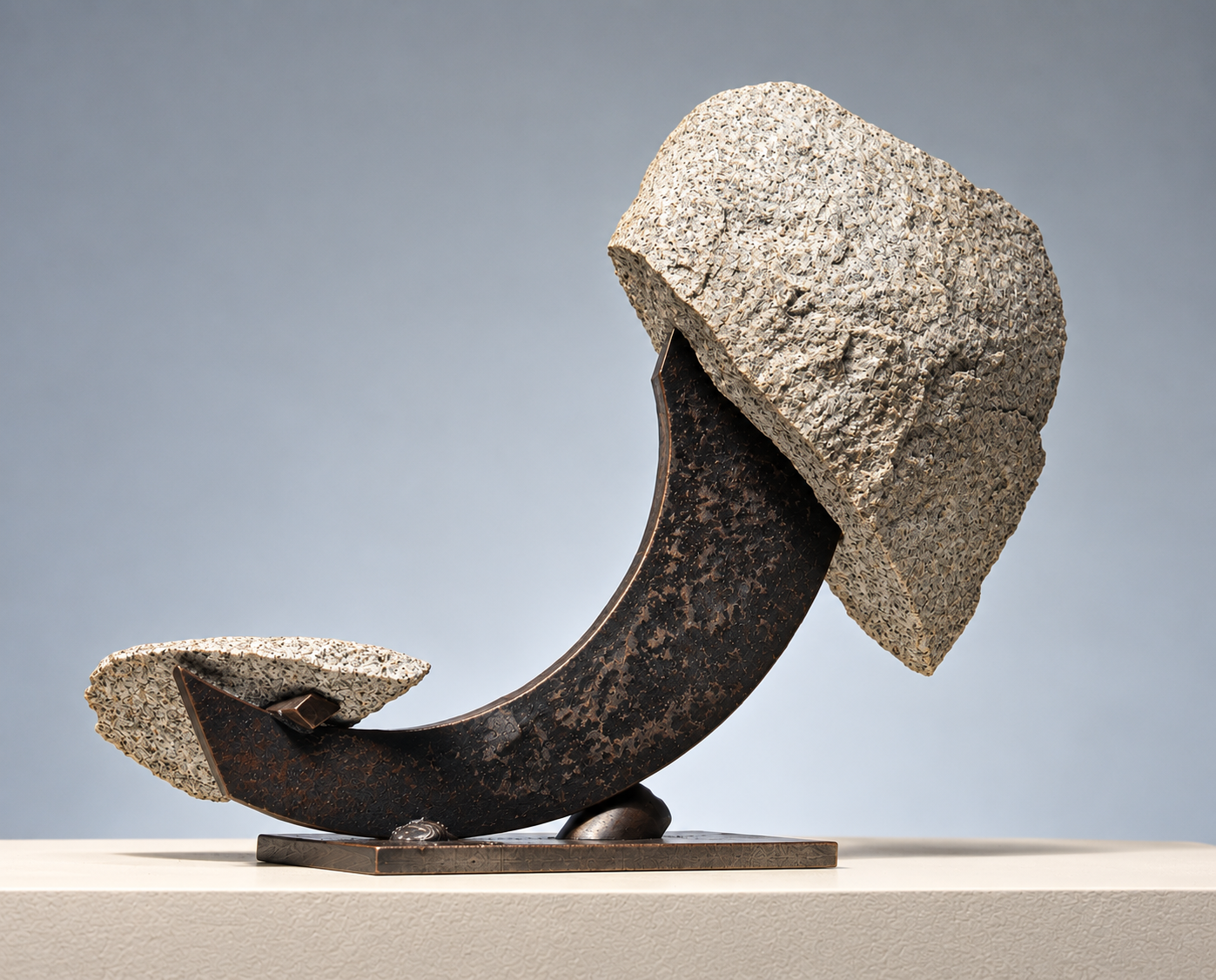
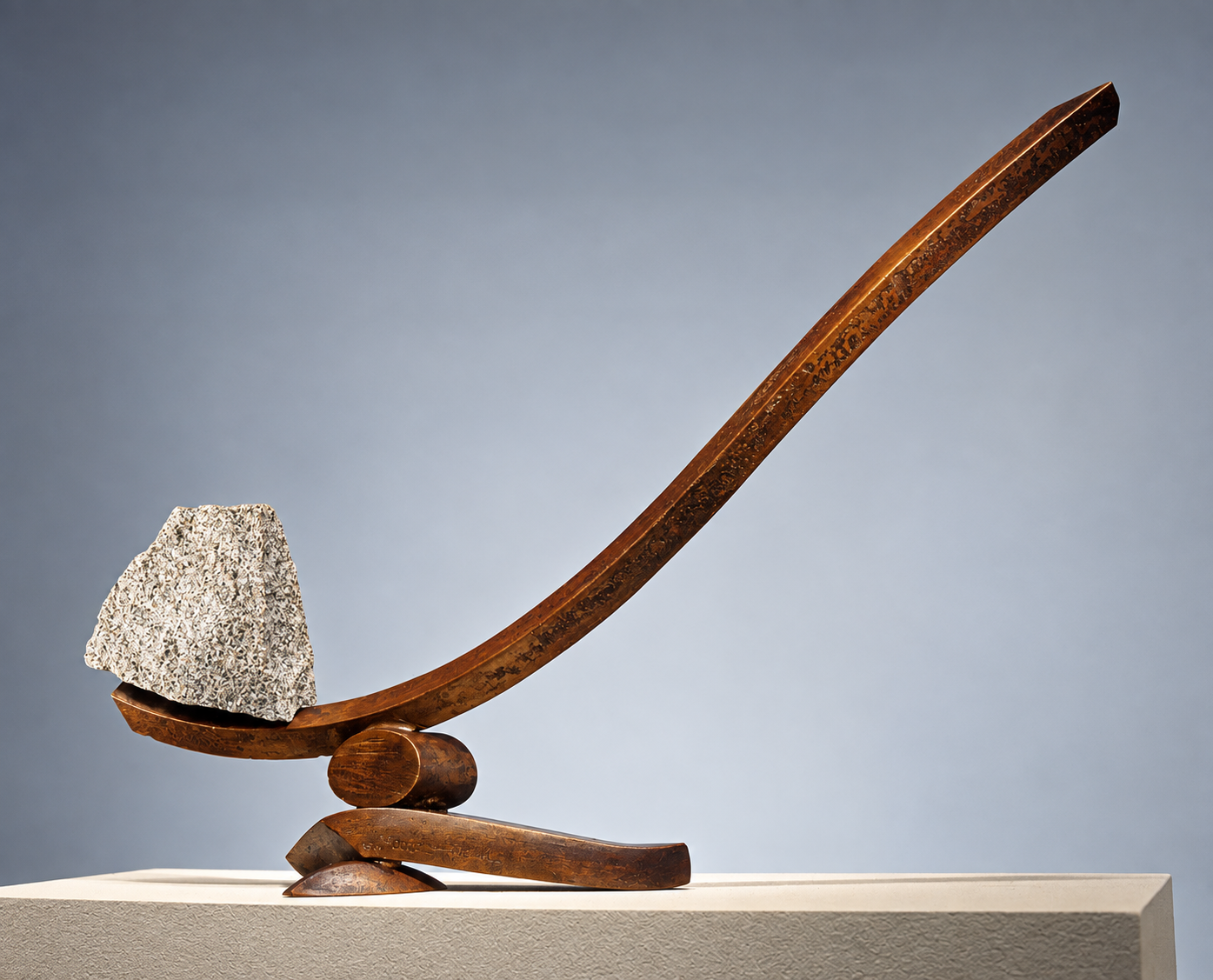

March 1995. Bronze. Dimensions: 41 × 24 × 9 in (104 × 61 × 23 cm).
Private collection
As a sculptor, I have always been fascinated by tools, implements, and instruments. I see them as extensions of the hand—essential allies in the act of making—and am drawn to their raw, efficient beauty, shaped over time by function and necessity. They also embody human ingenuity, labor, and our impulse to shape and engage the world around us.
Throughout my work, agricultural implements—rakes, plow blades, sledges, and tillers—as well as anvils, scales, compasses, and other instruments become both sculptural forms and vehicles for metaphor, suggesting ideas of balance, navigation, transformation, and our relationship to the natural world.
John Van Alstine
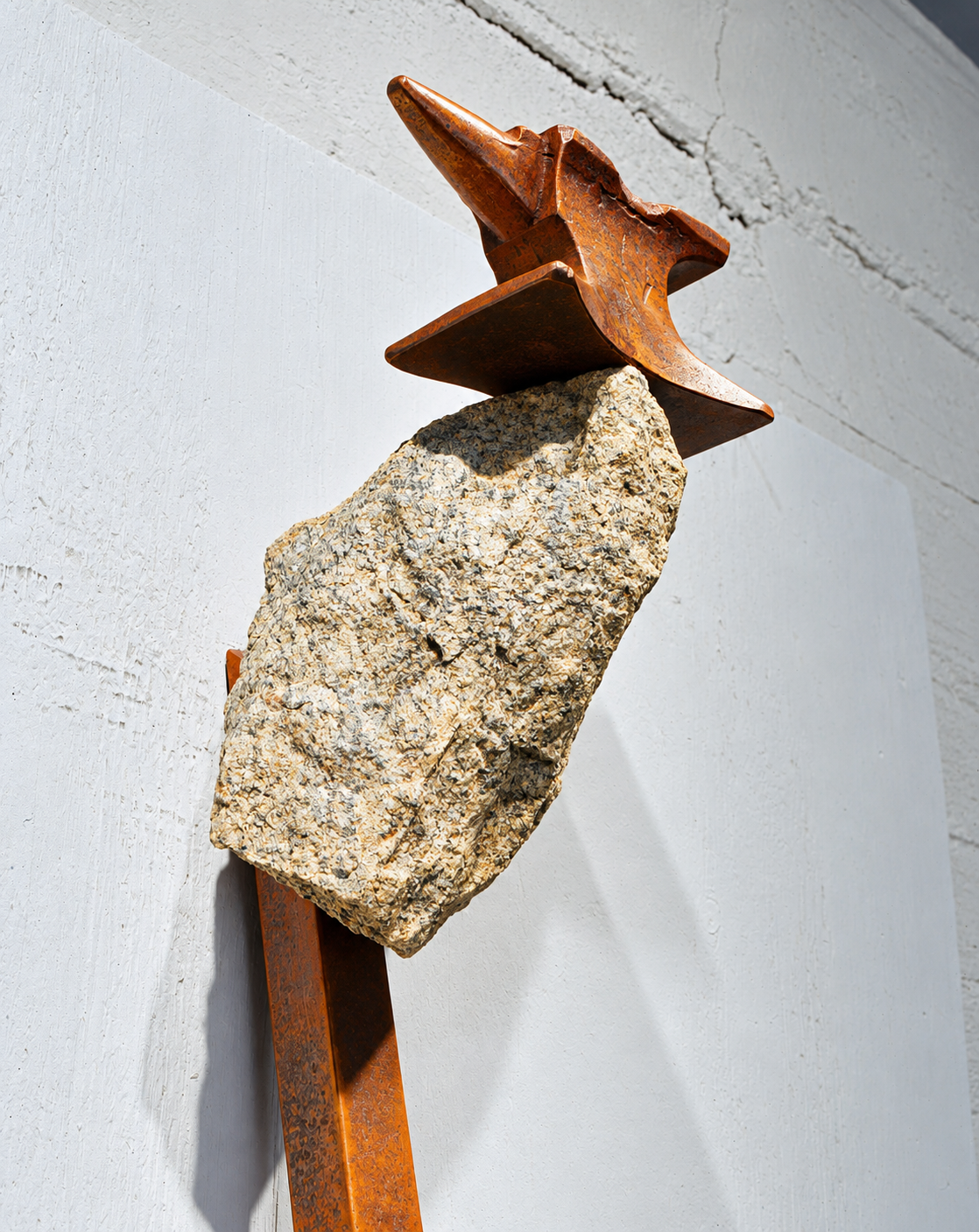
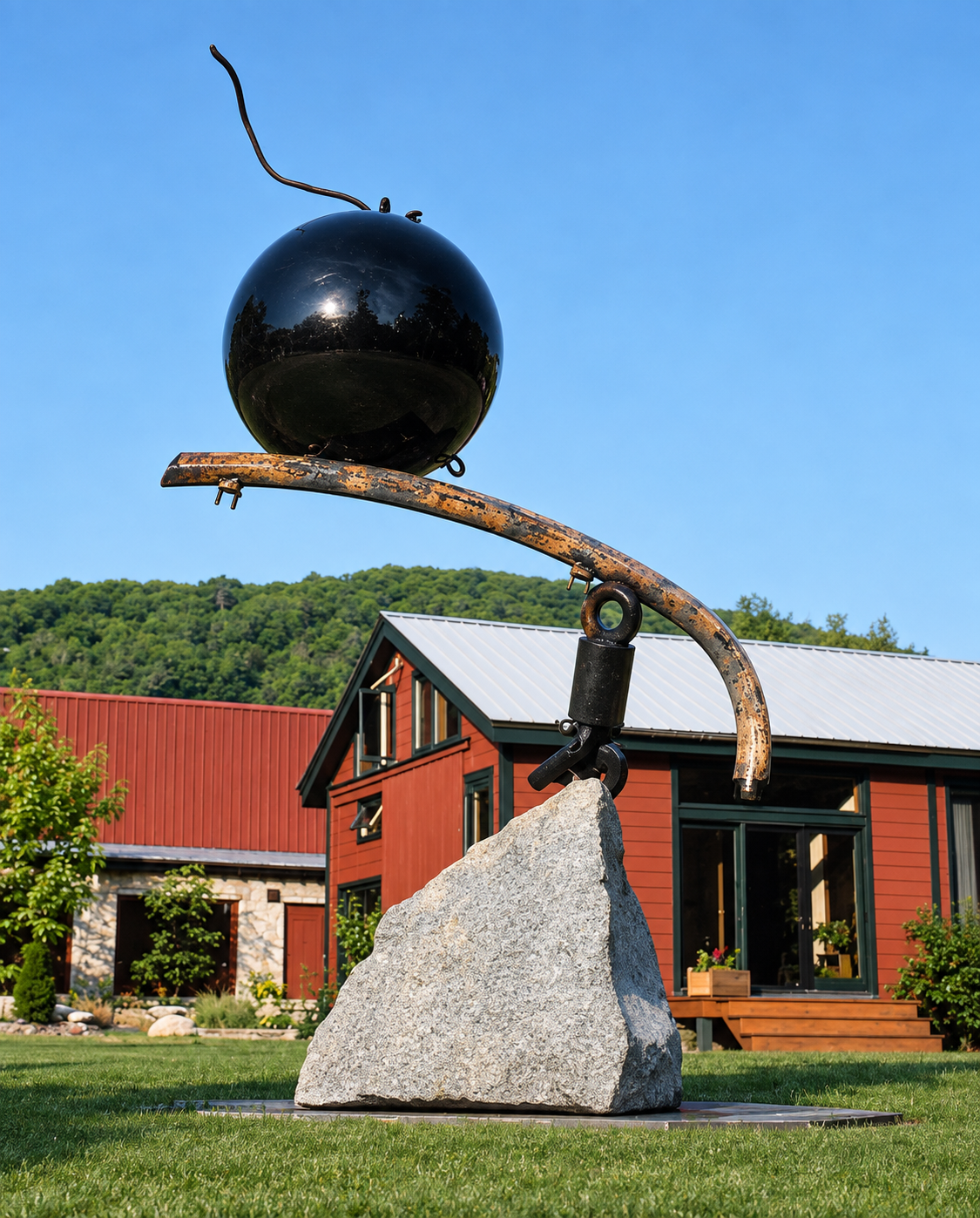
May 1995. Granite, steel. Dimensions: 126 × 72 × 42 in (320 × 183 × 107 cm).
Cannabilized to create bronze version see (S-95-22)

May 1995. Granite, bronze. Dimensions: 50 × 26 × 94 in (127 × 66 × 239 cm).
Private collection - Baltimore, MD
Implement 25 – River Arc, 1995
Implement 25 – River Arc continues my exploration of tools and implements as extensions of the human hand. Here the sweeping form suggests a tiller, with its dual associations—an agricultural implement for working the land and a marine device for steering and navigating. This ambiguity connects labor and landscape with ideas of direction, movement, and journey that recur throughout my work.
The sculpture also turns the tables on my usual relationship between materials: the dramatic arc, typically assigned to steel in my work, is instead embodied by stone. The stone is an actual gristmill stone pulled from the Sacandaga River, which runs through my studio property, giving the work a direct physical connection to the site and its industrial past.
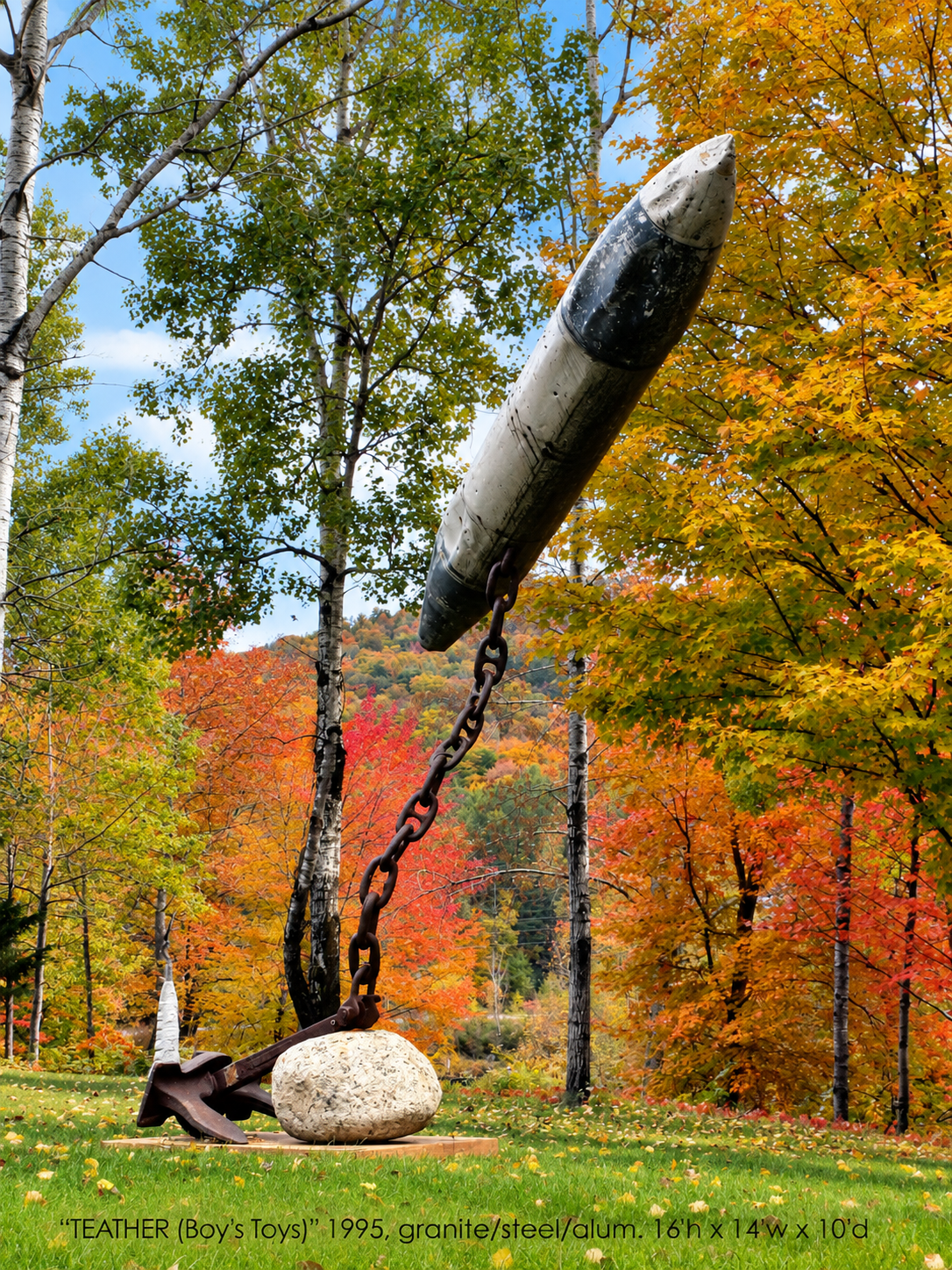
June 1995. Aluminum, granite, steel. Dimensions: 16’h × 14’w × 10’d.
Tether (Boy's Toys) grew from two formative experiences. As a child, I was fascinated by rural mailboxes mounted on lengths of welded chain that seemed to dance in my boyish imagination. Years later, during my first scuba dive, I looked upward to see boats drifting gently overhead, suspended from their anchor chains. That underwater view—where massive vessels appeared to float effortlessly—left a lasting impression.
At the time, my Jersey City studio overlooked the Hudson River and was filled with objects gathered from nearby marine salvage yards: anchors, heavy chain, buoys, pontoons, and cleats. Tether brings these memories together, recreating the sensation of looking upward through water at a vessel held in delicate balance. The subtitle, Boy's Toys, emerged during the sculpture's creation, referring both to its unmistakably phallic form and, with a touch of humor, to the oversized objects that have long captivated—and occasionally gotten the masculine imagination into trouble.
— John Van Alstine

August 1995. Granite, steel. Dimensions: 22 × 32 × 9 in (56 × 81 × 23 cm).
Private collection - New York State
Private collection
As a sculptor, I have always been fascinated by tools, implements, and instruments. I see them as extensions of the hand—essential allies in the act of making—and am drawn to their raw, efficient beauty, shaped over time by function and necessity. They also embody human ingenuity, labor, and our impulse to shape and engage the world around us.
Throughout my work, agricultural implements—rakes, plow blades, sledges, and tillers—as well as anvils, scales, compasses, and other instruments become both sculptural forms and vehicles for metaphor, suggesting ideas of balance, navigation, transformation, and our relationship to the natural world.
John Van Alstine.
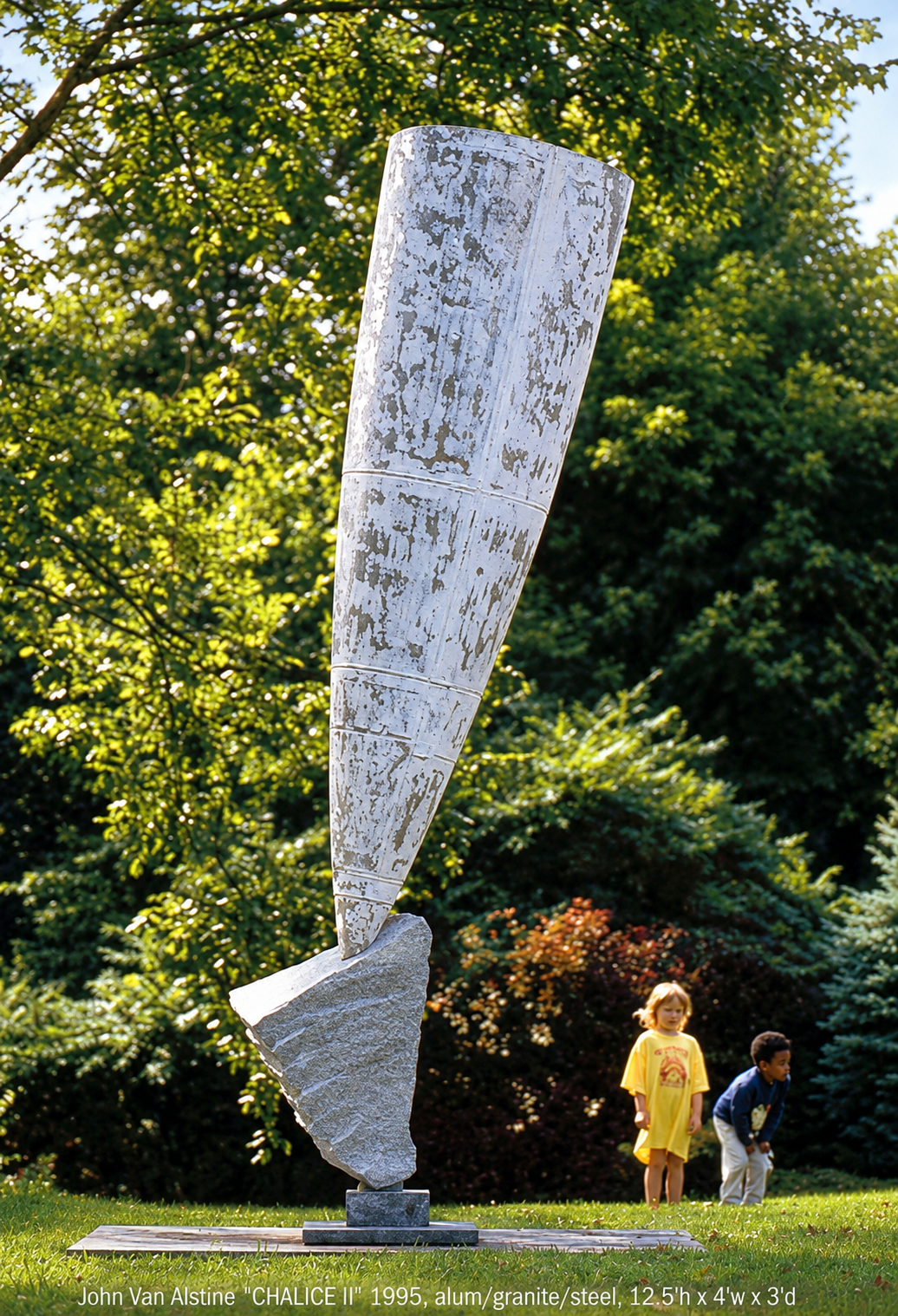
August 1995. Granite, aluminum, bronze. Dimensions: 149 × 52 × 3 in (378 × 132 × 8 cm). Parts used to make
Chalice II
Chalice I I is the 2nd work in my Chalice Series and grows from my longstanding interest in vessels and containers as sculptural forms and metaphors. My early background as a potter made the vessel part of my visual vocabulary, while its broader associations—with passage, the individual, or humanity moving through life—gave it metaphorical possibilities. Here, a large section of an aeronautical fuel tank is combined with granite and steel to create an exaggerated, upward-reaching chalice.
At more than ten feet high, the familiar idea of a cup or container is transformed through scale, industrial materials, and precarious balance. The work becomes a kind of “cup of life”—a vessel suggesting containment, passage, aspiration, and the human experience.
The stone split as a result of water freezing and expanding in the main hole that held the aluminum and was reworked twice with a new stones, final version Chalice V was completed in 2013
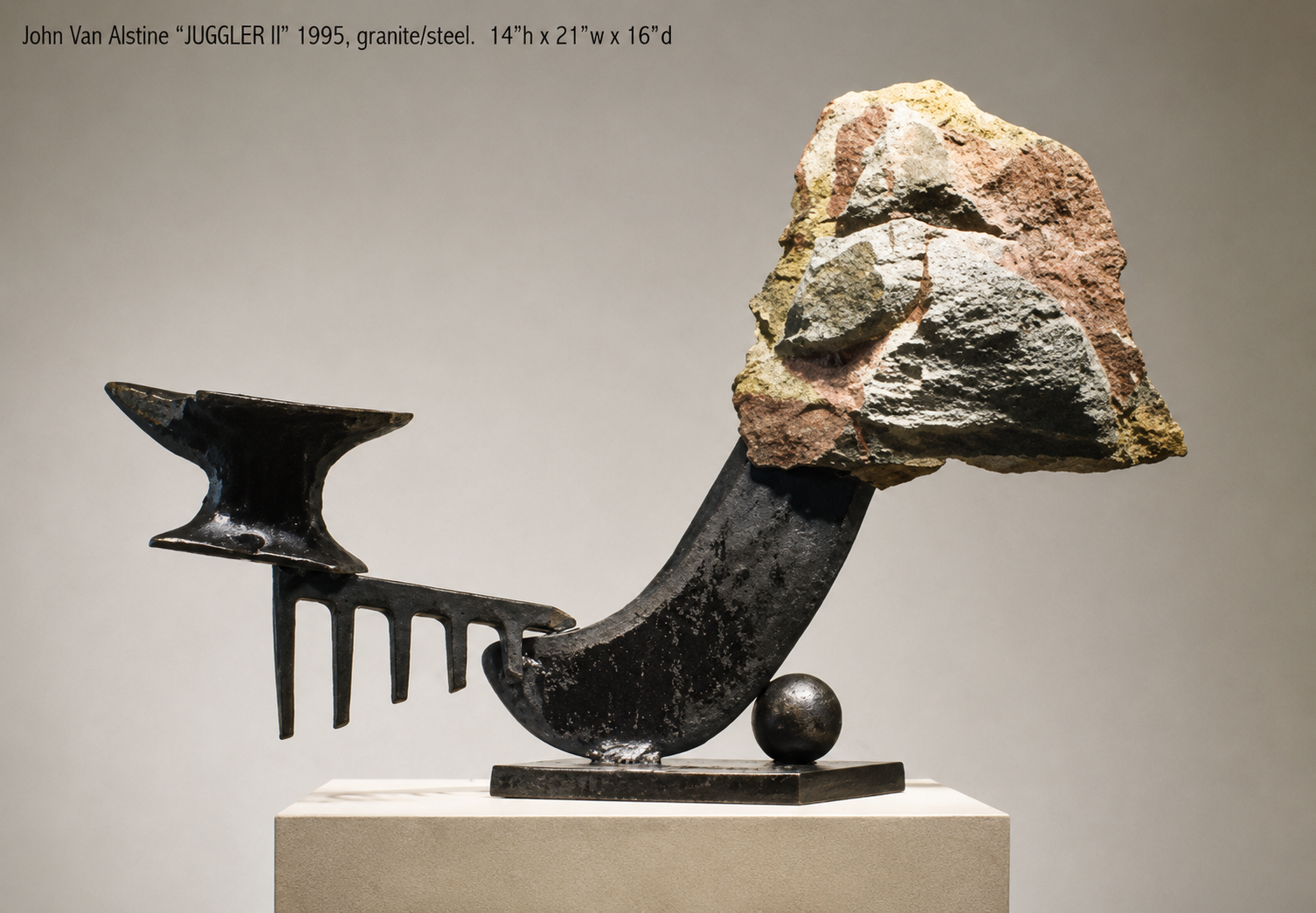
September 1995. Granite, steel. Dimensions: 14 × 21 × 16 in (36 × 53 × 41 cm). Private collection - Baltimore
Many of Van Alstine’s works take inspiration from the movement of the human body. This work can be seen as a kind of self-portrait, suggesting his studio process—literally juggling and repositioning the individual elements of a sculpture until they achieve a moment of perfect balance, then freezing that moment in space through welding. More universally, juggling becomes a metaphor for the way we all balance the competing demands of family, work, play, and responsibility.
The anvil, which appears in a number of the artist’s works, represents both the ultimate heavy object to “juggle” and the act of assembly itself—the forging together of object, material, and ideas that is central to Van Alstine’s work.
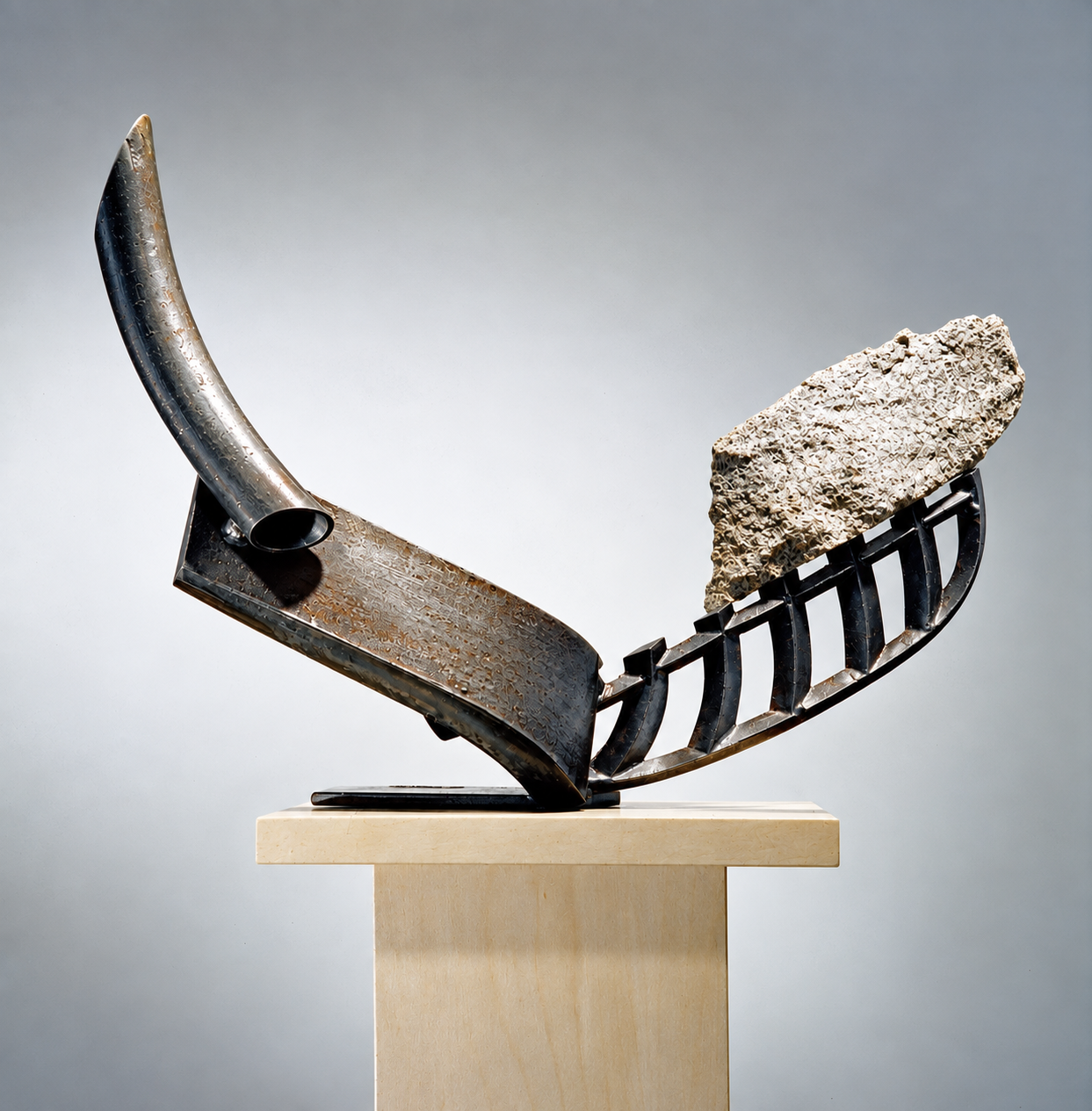
October 1995. Granite, steel. Dimensions: 9 × 11 × 3 in (23 × 28 × 8 cm).
Private collection.
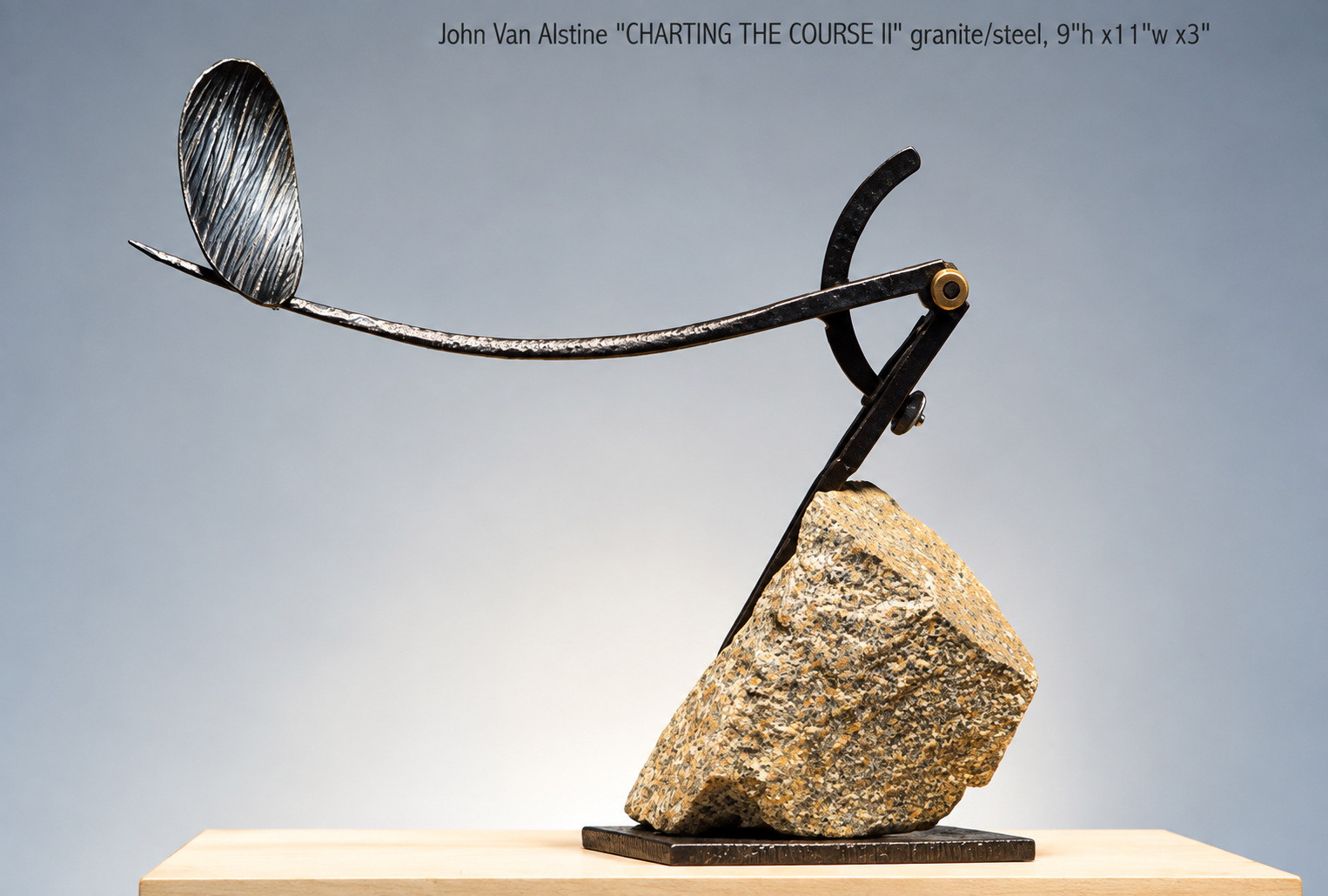
Charting the Course II, 1995
Charting the Course II, the second work in the series, continues my interest in tools and instruments as extensions of the human hand. A real set of calipers, manipulated and incorporated into the sculpture, combines with granite and forged steel, transforming a functional measuring tool into an expressive form.
The title suggests navigation, choice, and determining direction. The calipers and sweeping steel element evoke measuring and plotting a course, becoming a metaphor for choosing a path forward.
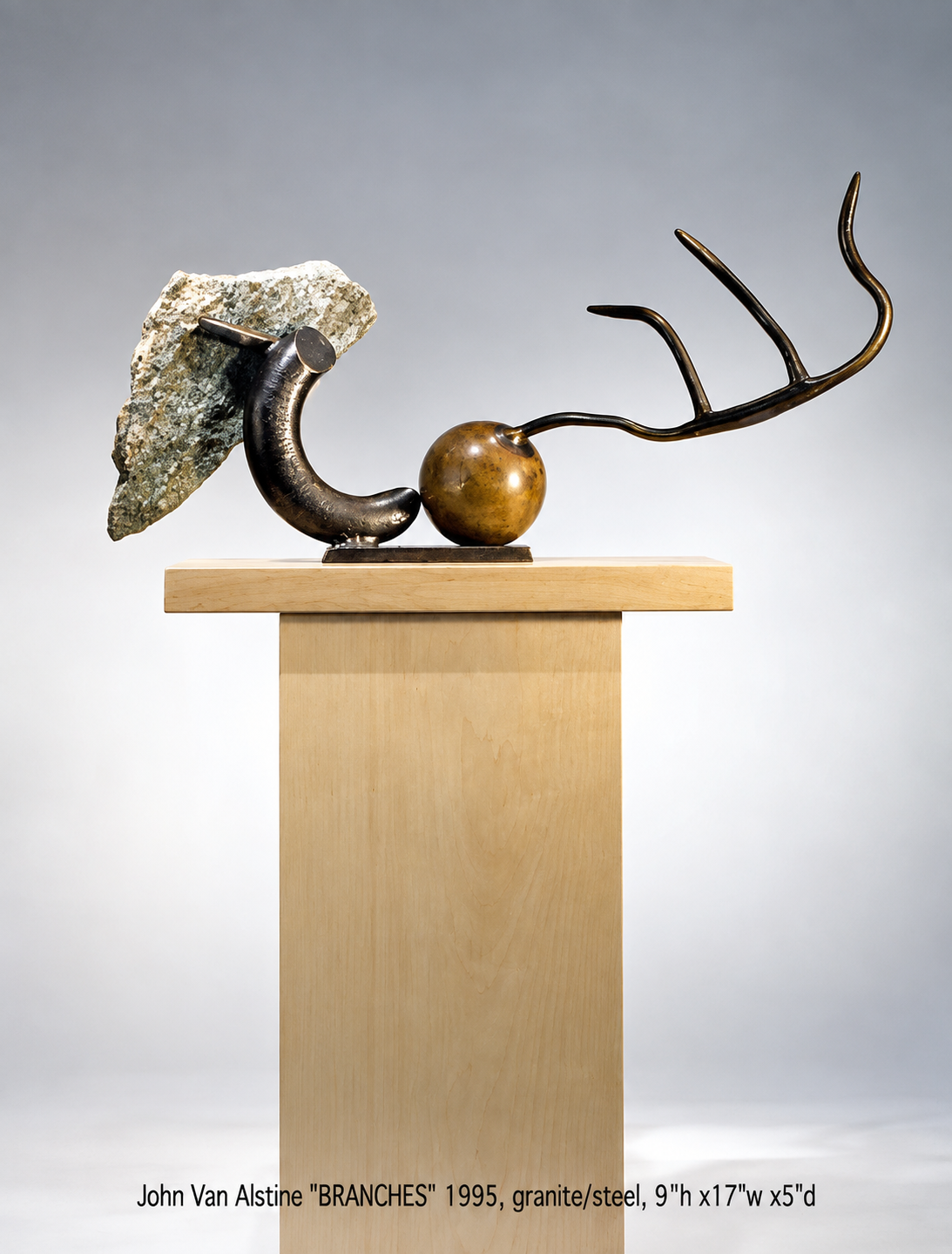
October 1995. Granite, bronze, steel. Dimensions: 9 × 17 × 5 in (23 × 43 × 13 cm).
Private collection - Baltimore, MD
Branches, 1995
Branches brings together granite with actual tools and found implements, reflecting my longstanding interest in tools as extensions of the human hand. Removed from their original functions, these familiar forms become sculptural elements that connect human ingenuity and labor with the natural world.
The sweeping antler form, sphere, granite, and curved steel create an animated horizontal movement. Their unlikely combination brings together natural and human-made forms, transforming familiar objects into a balance of gesture, movement, and metaphor.
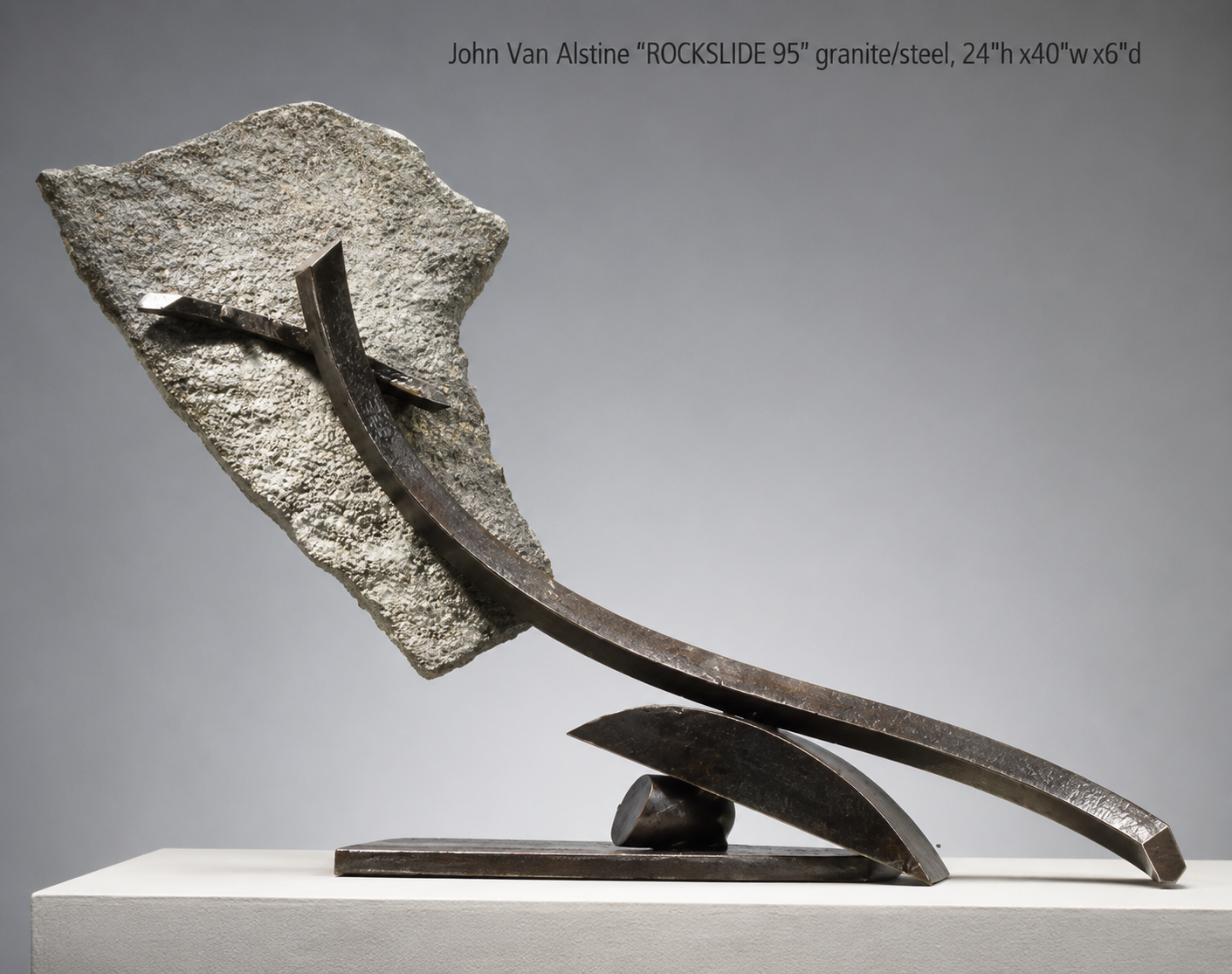
October 1995. Granite, steel. Dimensions: 24 × 40 × 6 in (61 × 102 × 15 cm).
Stone has been a constant in John Van Alstine’s work for more than fifty years. He often focuses on the material’s inherent qualities—especially its weight—choreographing stone and steel to create moments of visual and physical tension.
Landscape, particularly the mountain terrain where the artist has spent much of his life, has also been a powerful influence. In the Rockslide series, the shape and placement of stone, and its dynamic interaction with steel, evoke the drama of a familiar alpine event: a rock caught in mid-fall.
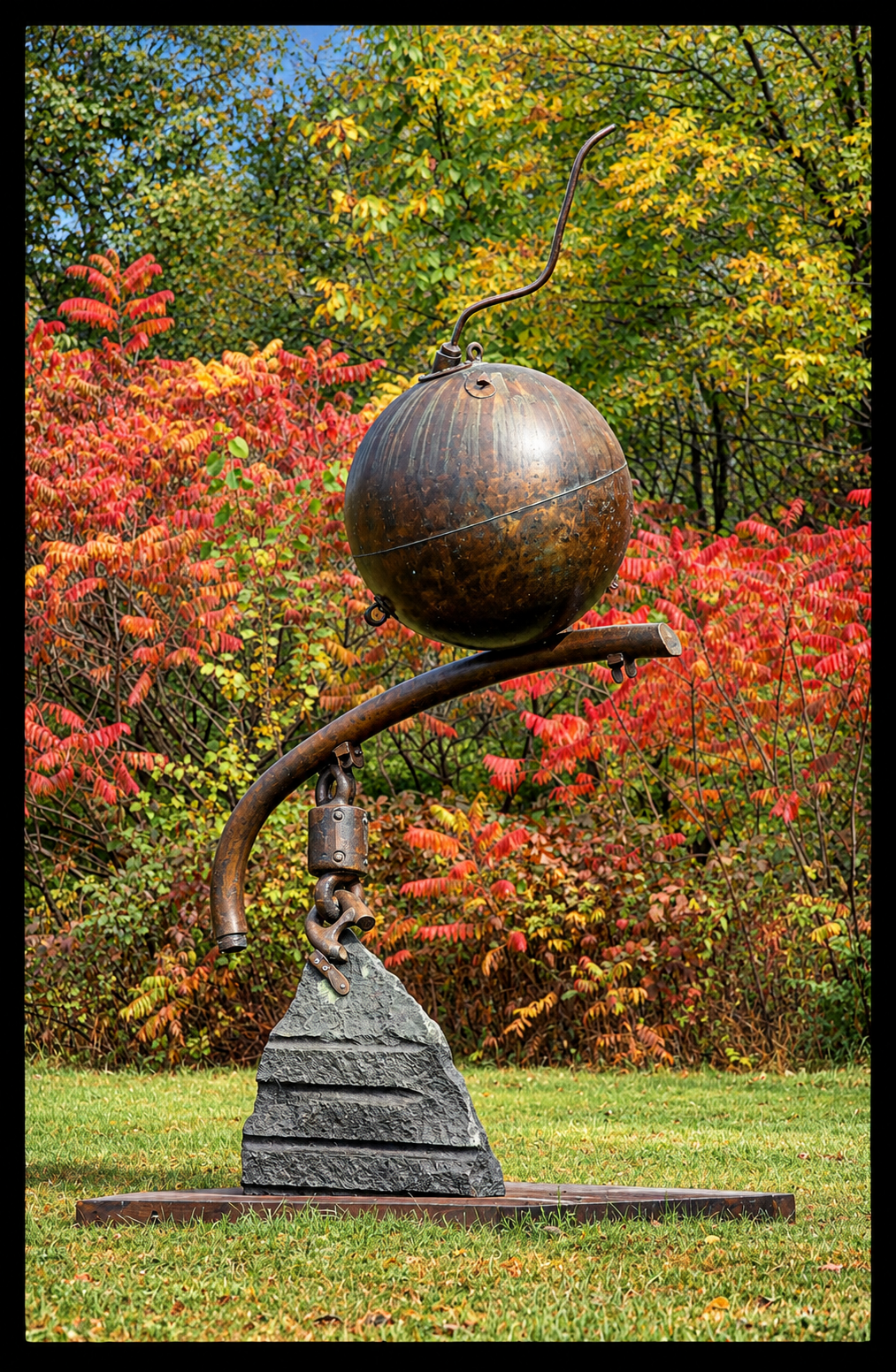
December 1995. Bronze. Dimensions: 126 × 72 × 42 in (320 × 183 × 107 cm).
Atlas/Highroller, 1995
Atlas/Highroller operates on several formal and conceptual levels. The sculpture suggests a human figure shouldering a globe, referencing Atlas, the mythic bearer of the heavens. The large sphere balances precariously on a sweeping arc, creating the sense that it might literally “roll off a high place.” The Highroller of the title extends this instability into the realm of high-stakes gambling—risk, chance, and uncertain consequences.
That sense of risk is heightened by the fact that the globe is a bronze casting of an actual naval sea-mine casing, transforming the image of Earth into a potentially explosive object. By combining the Atlas myth with the precariously balanced mine, I wanted to suggest the environmental risks facing the planet and the extent to which its future rests on our collective choices and behavior.
There were two versions - original granite and steel which was used to cast the entire piece including both the granite in bronze. In 2020-21 during Covid 19 the bronze was cut up to create many new works.
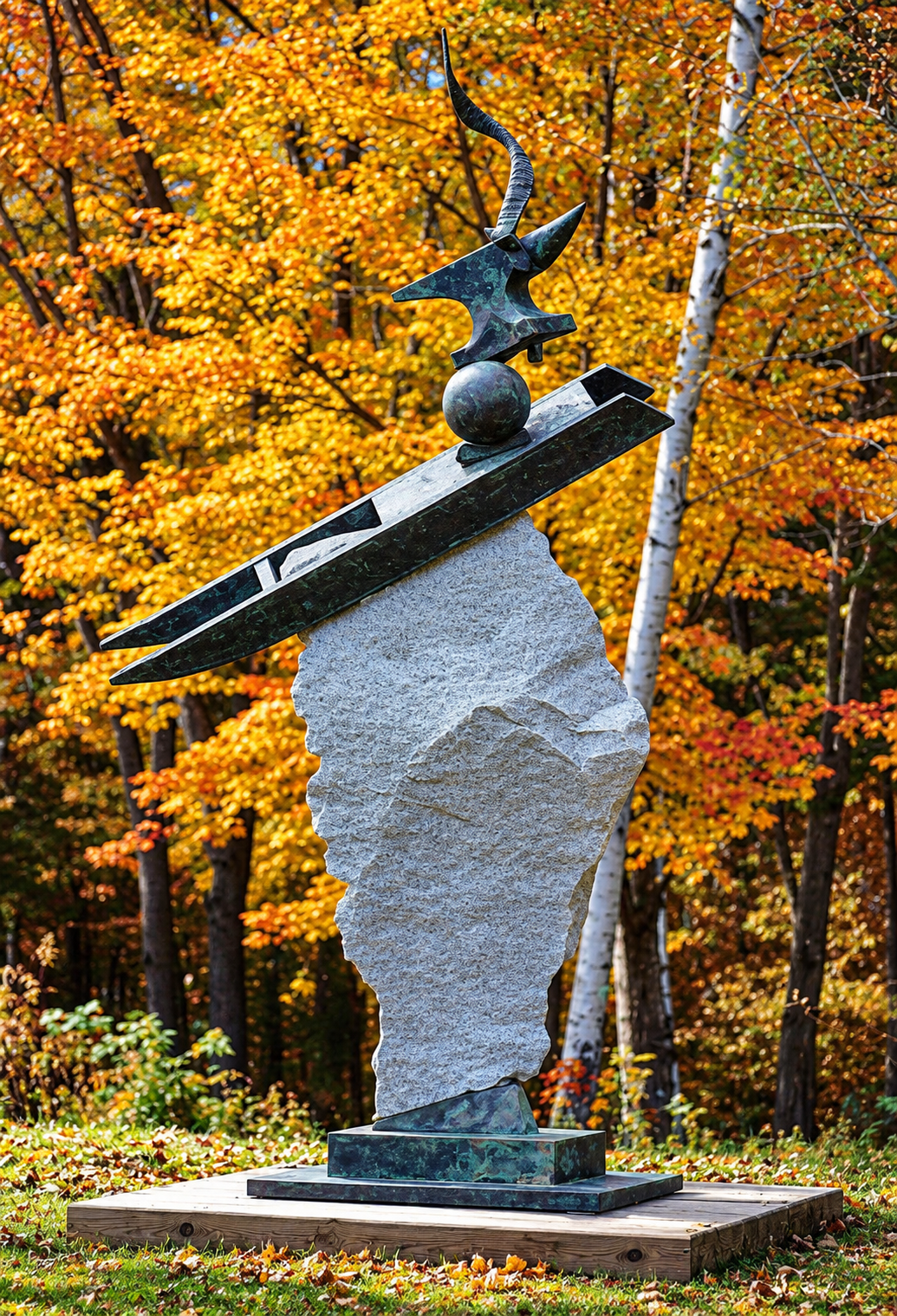
October 1996. Bronze, granite. Dimensions: 117 × 60 × 27 in (297 × 152 × 69 cm).
Collection Costal Discovery Museum, Bluffton/Hilton Head, SC. Gift of Mr. and Mrs. Robert Singer
Boys Toys II, 1996
Boys Toys II continues my interest in bringing together natural stone with familiar objects whose forms and associations carry their own histories. The upper bronze elements—a sled, bowling ball, and animal horn form—were cast from actual objects, allowing them to retain their recognizable character while becoming part of a new sculptural vocabulary. Their precarious placement above the granite creates a cascading, turbulent aura, as though the elements are tumbling downward yet have been arrested at a moment of unstable balance. This sense of suspended movement is central to much of my work.
The title introduces a playful but more ambiguous layer. These familiar “toys” suggest recreation, childhood, competition, and masculine culture, while the horn adds an organic, almost primal energy. Cast in bronze and combined with the weight and permanence of granite, the objects lose their ordinary functions and become charged sculptural forms. The work reflects my broader interest in combining disparate materials and associations to create what I think of as a “combustible mix”—one capable of generating multiple readings rather than a single narrative.
1994
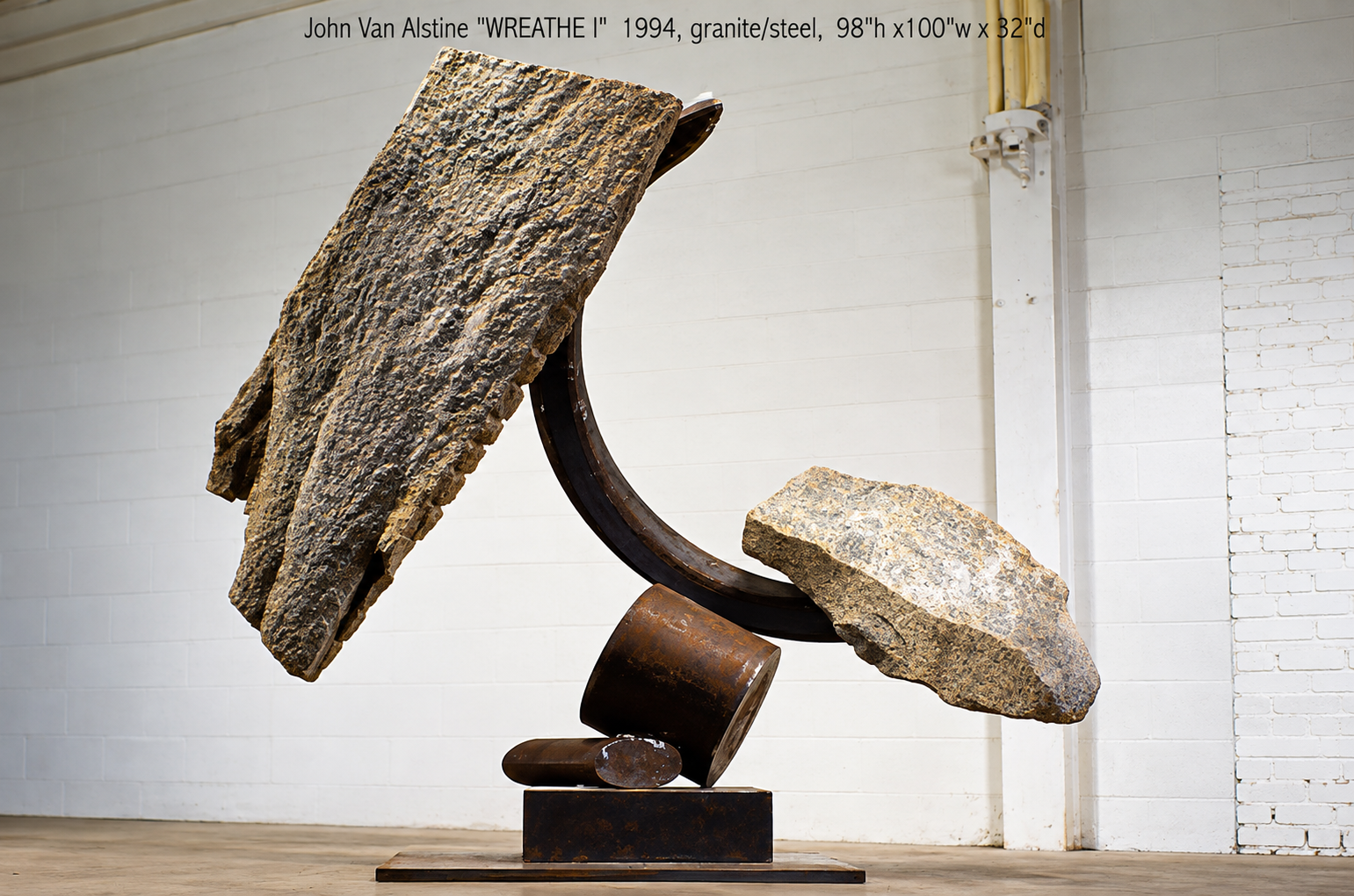
January 1994. Granite, steel. Dimensions: 98 × 100 × 52 in (249 × 254 × 132 cm).
Public collection - Art Center at Highland Park, Highland Park, IL, Chicago.
Wreathe I, 1994
Wreathe I is the first work in the Wreathe Series and continues my interest in using steel to lift and “choreograph” stone, freeing this inherently heavy material from its usual earthbound condition. The sweeping steel arc generates a strong circular movement, carrying the granite upward and outward so that the massive stones appear improbably suspended in space—part of my broader effort to make heavy objects appear light, animated, and floating.
The title Wreathe suggests a curling, rising energy—like a wreathe of gray smoke. In this reading, the gray granite itself becomes smoke-like: weighty material transformed visually into something buoyant and ephemeral. The contrast between actual mass and perceived lightness reinforces a recurring concern in my work—using balance, movement, and suspension to challenge our instinctive understanding of gravity and stone.
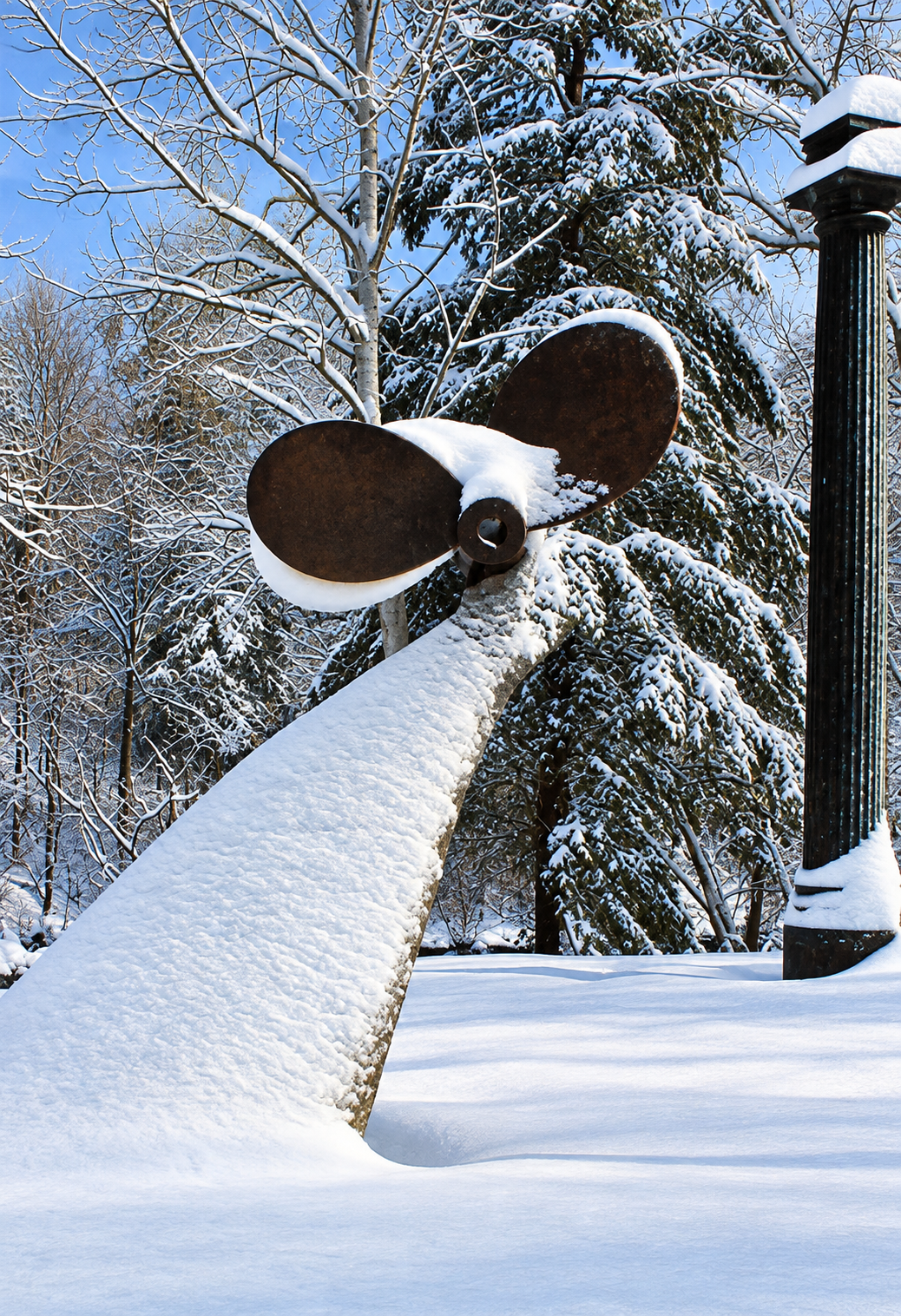
January 1994. Granite, bronze. Dimensions: 87 × 76 × 32 in (221 × 193 × 81 cm).
“Cannibalized” by artist - parts used to make new work.
Diagonal Tendencies II, 1994
Diagonal Tendencies II is the second work in the series, its title derived from the strong diagonal energy that drives the composition upward. A massive wedge of granite rises dramatically from the ground, culminating in a large bronze marine propeller. The propeller introduces associations with propulsion, navigation, and movement, transforming the stationary stone into something that seems poised to surge forward.
The work continues my recurring interest in challenging the inherent weight and immobility of stone. Here the sharp diagonal and elevated propeller visually propel the granite upward, giving the sculpture a sense of motion, lift, and suspended energy. The contrast between natural granite and a recognizable human-made implement also reflects my broader interest in bringing the natural and industrial worlds together while making heavy materials appear unexpectedly animated and light.
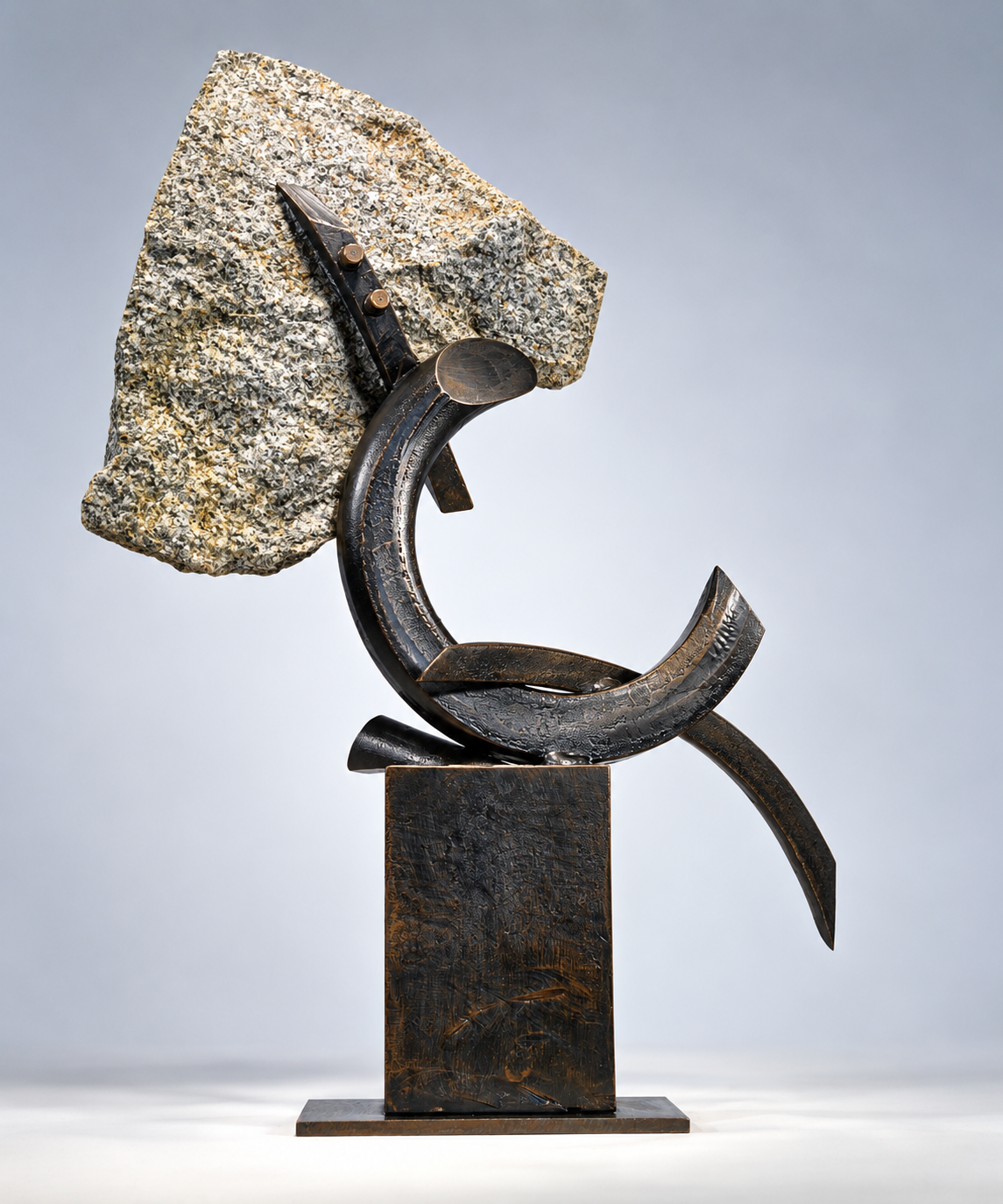
March 1994. Granite, steel. Dimensions: 20 × 16 × 8 in (51 × 41 × 20 cm).
The English word coulter (a plow blade) derives from the Latin word culter, meaning "a knife," "plowshare," or "cutting instrument". It entered Middle English as culter from Old English, maintaining the original Latin sense of a sharp tool used to cut the ground before the plowshare
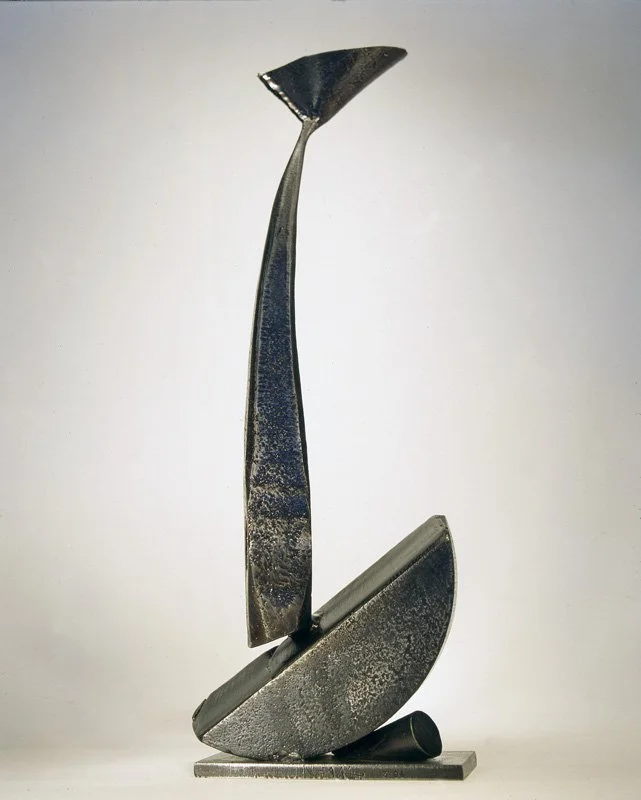

March 1994. Granite, steel. Dimensions: 22 × 16 × 4 in (56 × 41 × 10 cm).
Private collection
As a sculptor, I have always been fascinated by tools, implements, and instruments. I see them as extensions of the hand—essential allies in the act of making—and am drawn to their raw, efficient beauty, shaped over time by function and necessity. They also embody human ingenuity, labor, and our impulse to shape and engage the world around us.
Throughout my work, agricultural implements—rakes, plow blades, sledges, and tillers—as well as anvils, scales, compasses, and other instruments become both sculptural forms and vehicles for metaphor, suggesting ideas of balance, navigation, transformation, and our relationship to the natural world.
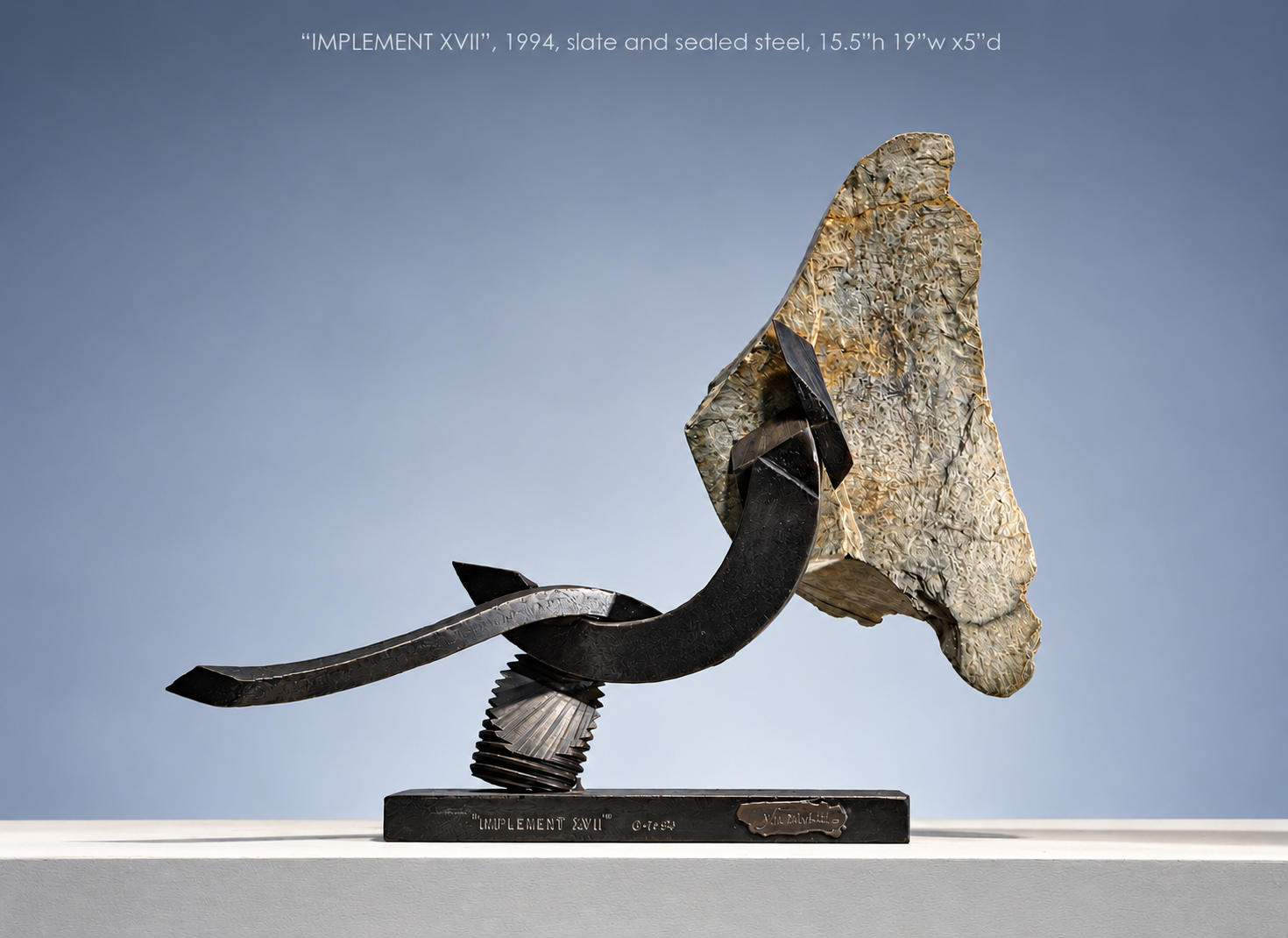
March 1994. slate, steel. Dimensions: 15.5 × 19 × 5 in (39 × 48 × 13 cm).
As a sculptor I've always been interested in tools, implements, and instruments. I see them as extensions of the artists' hand, important allies. I am also drawn to their raw, efficient beauty of form dictated by function. I am certainly not unique in using tools, David Smith, Jim Dine, Picasso and many others have staked out some very impressive territory. But I feel I have something to add to the mix based on my unique experiences and perspective.
John Van Alstine from "Bones of the Earth"
The original granite broke and the piece was reworked and a new piece of slate replaced it.
March 1994. Granite, steel. Dimensions: 19 × 11 × 6 in (48 × 28 × 15 cm).
Private Collection.
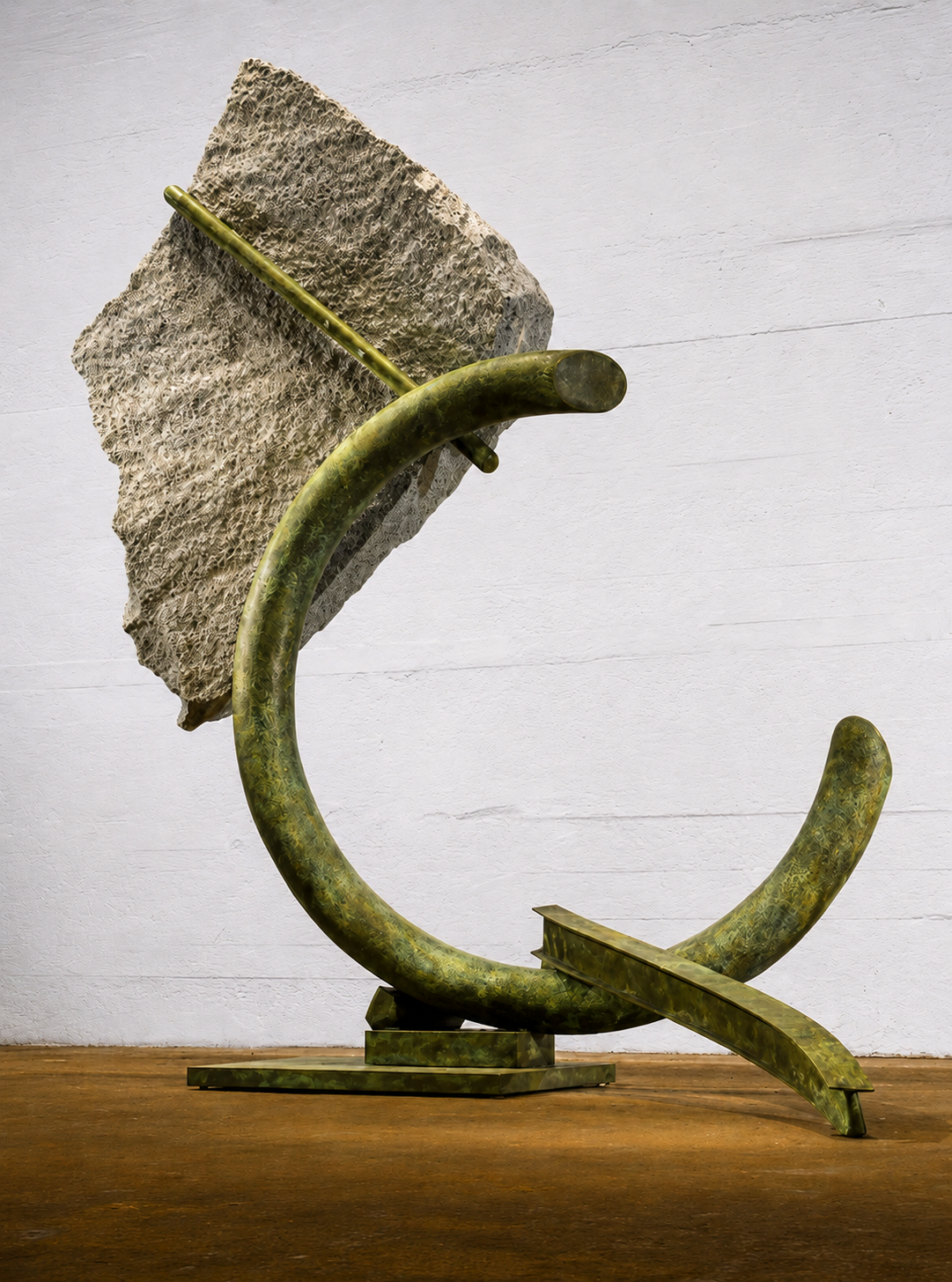
April 1994. Granite, bronze. Dimensions: 96 × 93 × 64 in (244 × 236 × 163 cm).
Private collection
The Tiller series grows from my interest in tools and agricultural implements as extensions of the human body—objects that cultivate, shape, and engage the land. The title also evokes the tiller of a boat, a simple device used to steer and determine direction. Bringing these meanings together, the works explore the relationship between cultivation and navigation—our impulse both to shape the world around us and to chart a course through it.
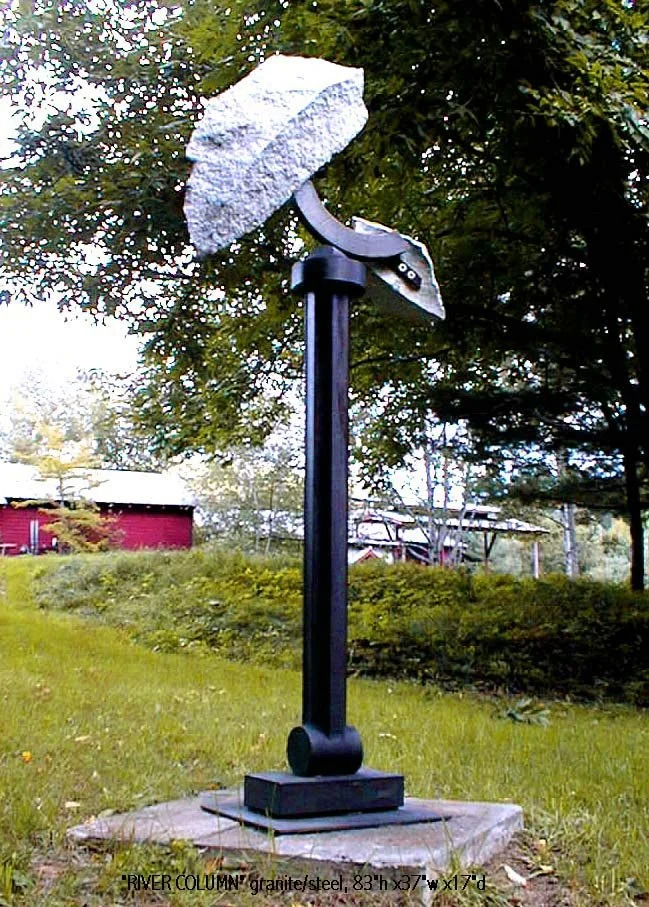
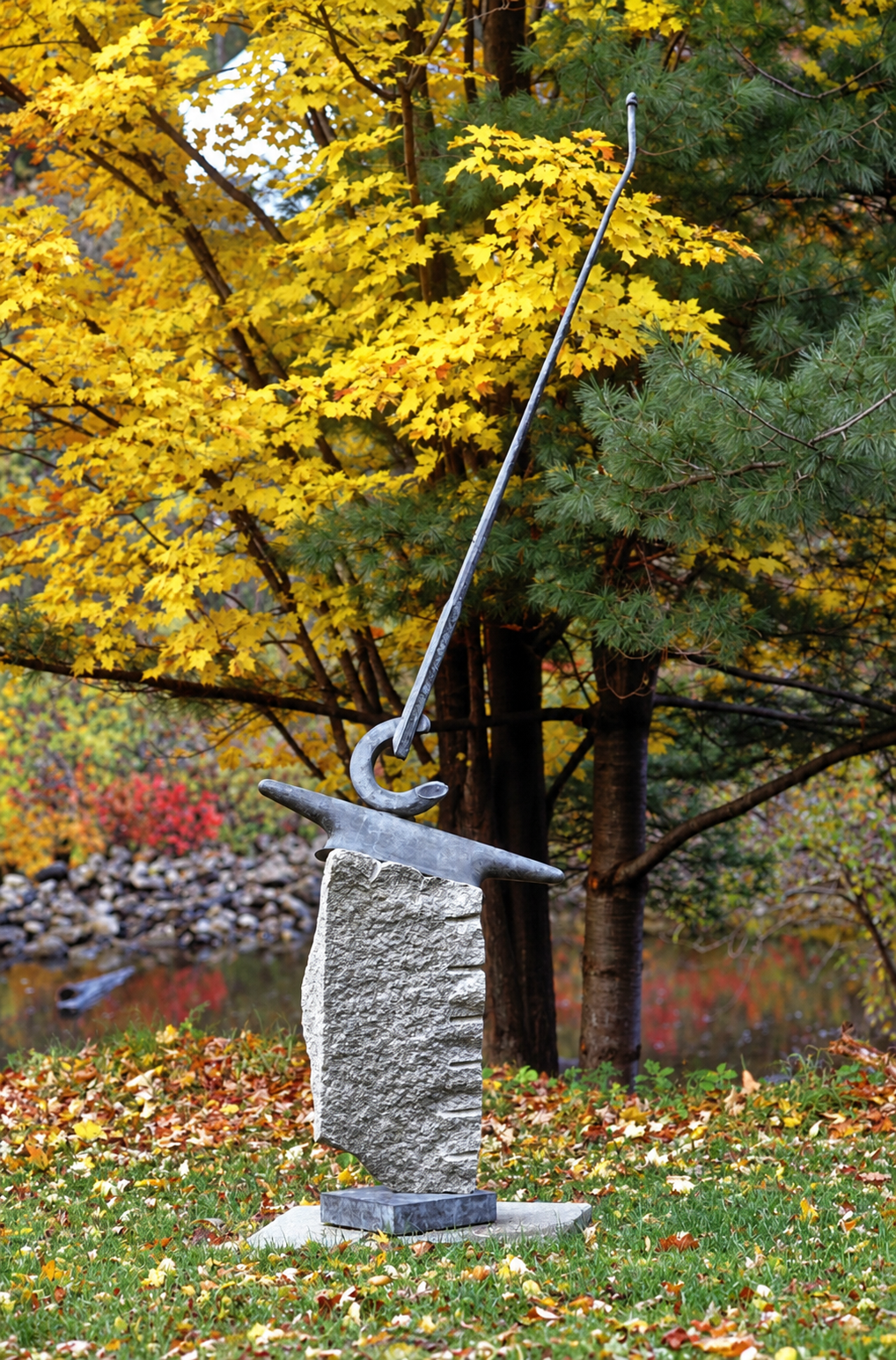
May 1994. Bronze, granite. Dimensions: 124 × 55 × 50 in (315 × 140 × 127 cm).
Cornua is the nominative/accusative plural of the Latin noun cornu (fourth declension, neuter), meaning "horns," "hooves," "beaks," or "ends". It frequently refers to the wings of an army, projecting parts of a structure (such as the ends of a scroll), or anatomical horn-shaped structures.
Destroyed by Oct 2019 flood, parts used in new 2020 works.
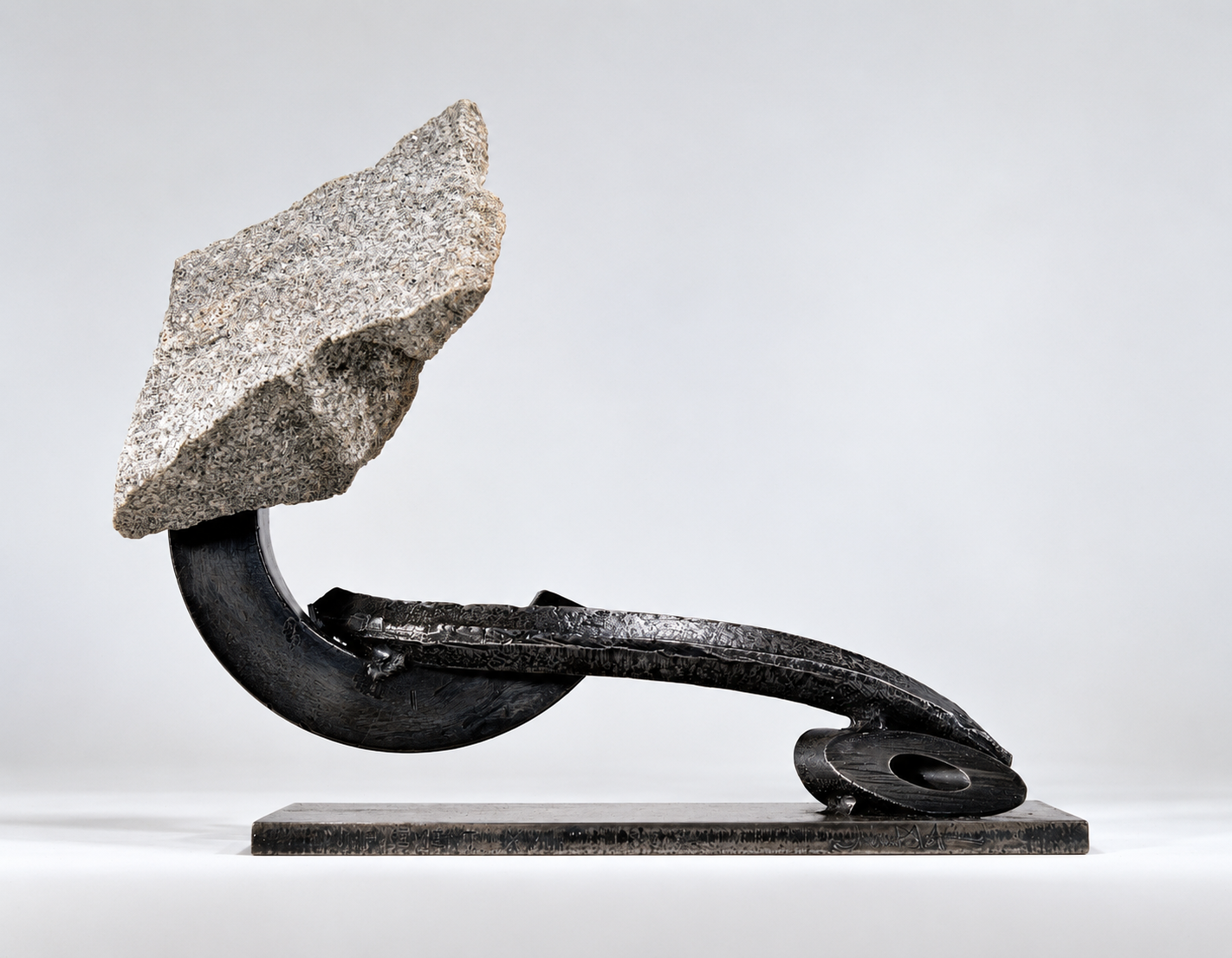
July 1994. Granite, steel. Dimensions: 10 × 12 × 3.5 in (25 × 30 × 9 cm).
Private Collection.
As a sculptor, I have always been fascinated by tools, implements, and instruments. I see them as extensions of the hand—essential allies in the act of making—and am drawn to their raw, efficient beauty, shaped over time by function and necessity. They also embody human ingenuity, labor, and our impulse to shape and engage the world around us.
Throughout my work, agricultural implements—rakes, plow blades, sledges, and tillers—as well as anvils, scales, compasses, and other instruments become both sculptural forms and vehicles for metaphor, suggesting ideas of balance, navigation, transformation, and our relationship to the natural world.
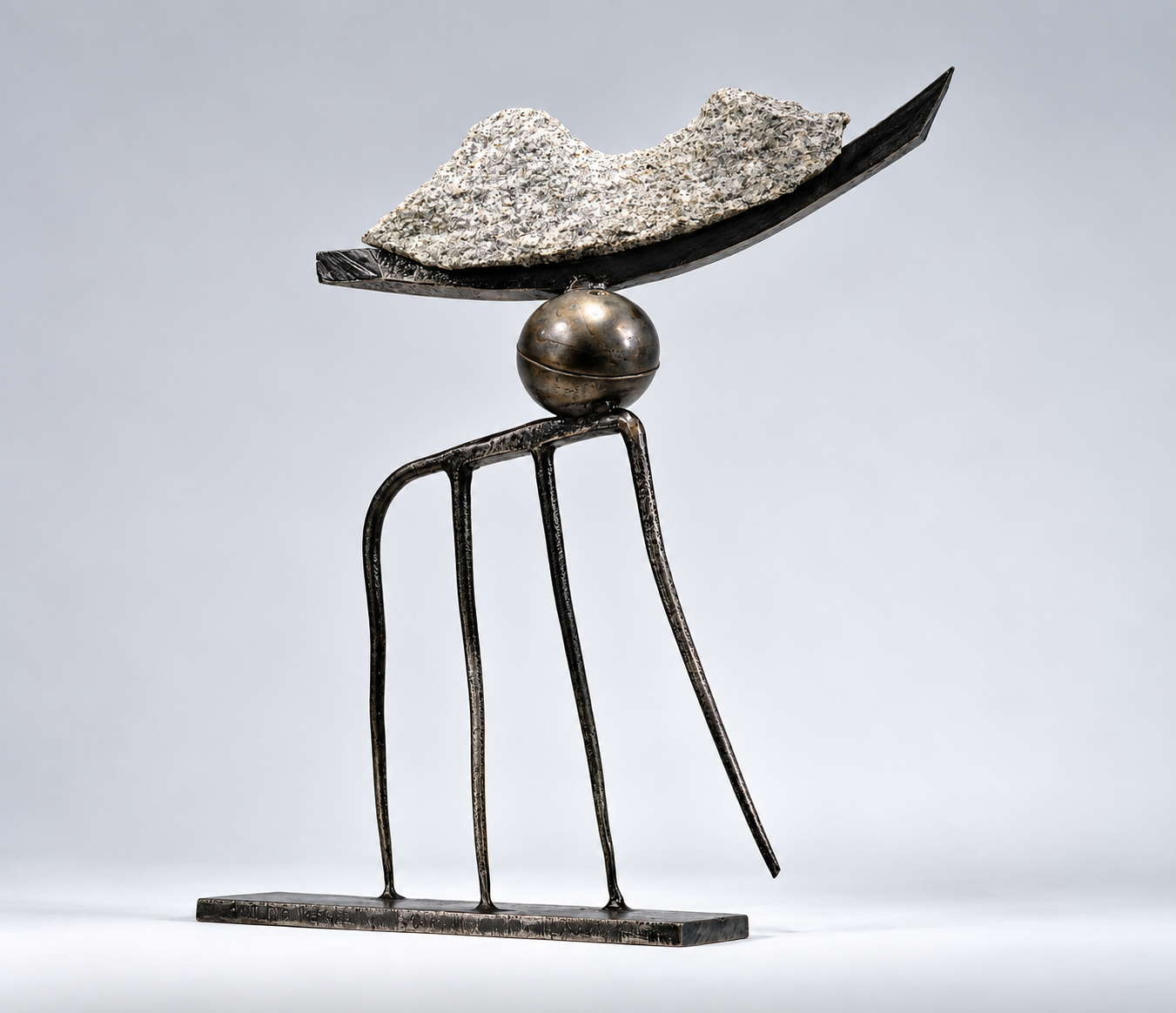
July 1994. Granite, steel. Dimensions: 15 × 15 × 4 in (38 × 38 × 10 cm). Private Collection - Baltimore

July 1994. Granite, steel. Dimensions: 18 × 9 × 4 in (46 × 23 × 10 cm).
Private Collection.
As a sculptor, I have always been fascinated by tools, implements, and instruments. I see them as extensions of the hand—essential allies in the act of making—and am drawn to their raw, efficient beauty, shaped over time by function and necessity. They also embody human ingenuity, labor, and our impulse to shape and engage the world around us.
Throughout my work, agricultural implements—rakes, plow blades, sledges, and tillers—as well as anvils, scales, compasses, and other instruments become both sculptural forms and vehicles for metaphor, suggesting ideas of balance, navigation, transformation, and our relationship to the natural world.

July 1994. Granite, steel. Dimensions: 10 × 14 × 4 in (25 × 36 × 10 cm).
Private Collection.
As a sculptor, I have always been fascinated by tools, implements, and instruments. I see them as extensions of the hand—essential allies in the act of making—and am drawn to their raw, efficient beauty, shaped over time by function and necessity. They also embody human ingenuity, labor, and our impulse to shape and engage the world around us.
Throughout my work, agricultural implements—rakes, plow blades, sledges, and tillers—as well as anvils, scales, compasses, and other instruments become both sculptural forms and vehicles for metaphor, suggesting ideas of balance, navigation, transformation, and our relationship to the natural world.

July 1994. Granite, steel. Dimensions: 10.5 × 16 × 3 in (27 × 41 × 8 cm).
Private Collection.
As a sculptor, I have always been fascinated by tools, implements, and instruments. I see them as extensions of the hand—essential allies in the act of making—and am drawn to their raw, efficient beauty, shaped over time by function and necessity. They also embody human ingenuity, labor, and our impulse to shape and engage the world around us.
Throughout my work, agricultural implements—rakes, plow blades, sledges, and tillers—as well as anvils, scales, compasses, and other instruments become both sculptural forms and vehicles for metaphor, suggesting ideas of balance, navigation, transformation, and our relationship to the natural world.
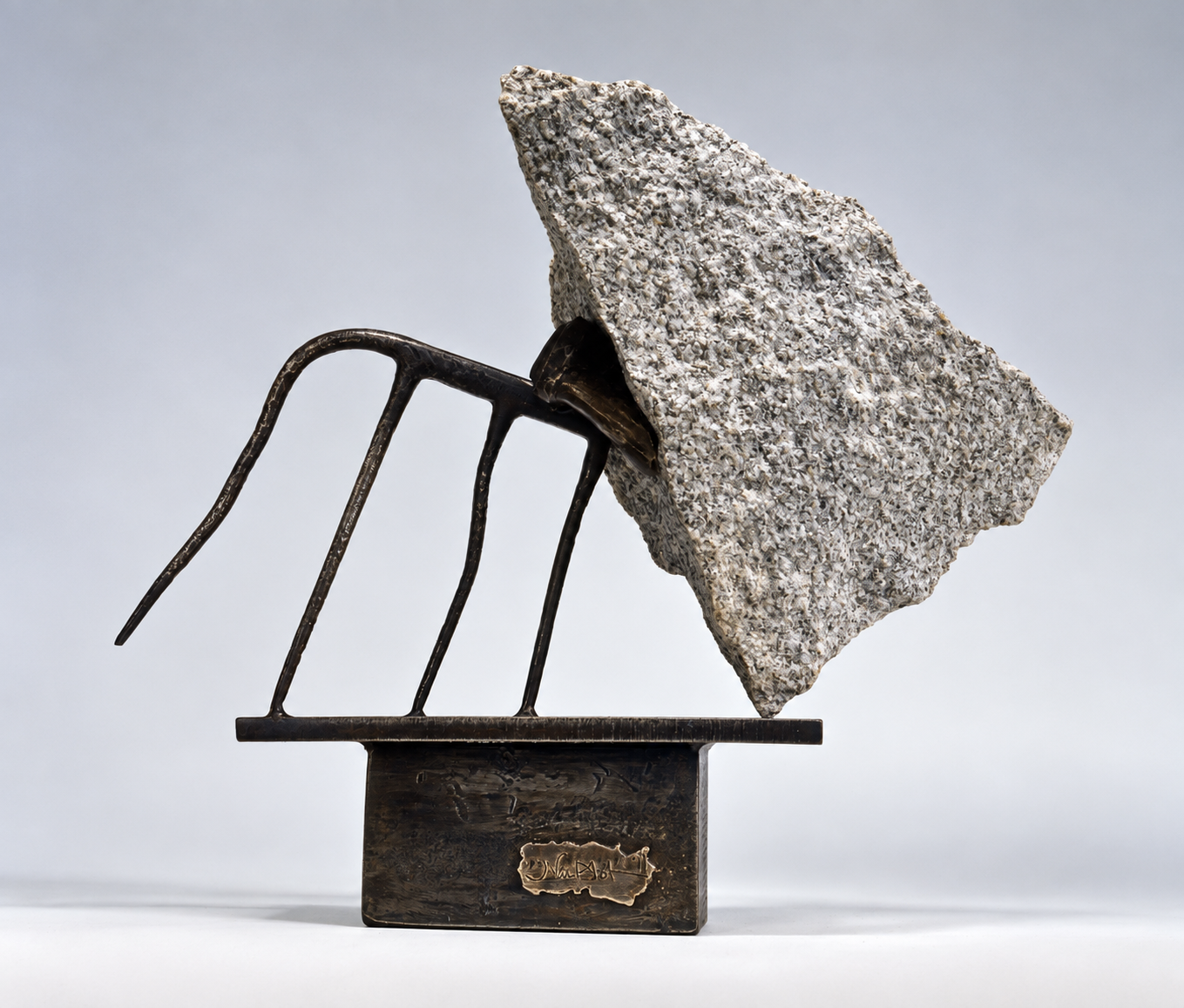
July 1994. Granite, steel. Dimensions: 13 × 15 × 4 in (33 × 38 × 10 cm).
Private collection - Washington, DC
Phalanx II, 1994
Phalanx II, the second work in the Phalanx Series, continues my interest in incorporating actual tools and agricultural implements into sculpture. Here a real pitchfork is manipulated and combined with a roughly fractured piece of granite. The familiar tool is transformed from a functional object into an active sculptural element—supporting, penetrating, and engaging the weight of the stone.
The title Phalanx refers to the bones that form the fingers, reinforcing the pitchfork’s tines as an extension of the human hand. This connection reflects my broader interest in tools as extensions of the hand—forms shaped by function that also symbolize human labor, ingenuity, and the physical act of making.

August 1994. Granite, bronze. Dimensions: 25 × 40 × 11 in (64 × 102 × 28 cm).
Private collection - Washington, DC
As a sculptor, I have always been fascinated by tools, implements, and instruments. I see them as extensions of the hand—essential allies in the act of making—and am drawn to their raw, efficient beauty, shaped over time by function and necessity. They also embody human ingenuity, labor, and our impulse to shape and engage the world around us.
Throughout my work, agricultural implements—rakes, plow blades, sledges, and tillers—as well as anvils, scales, compasses, and other instruments become both sculptural forms and vehicles for metaphor, suggesting ideas of balance, navigation, transformation, and our relationship to the natural world.
September 1994. Granite, steel. Dimensions: 172 × 205 × 128 in (437 × 521 × 325 cm). Martin Z Margulies Collection - Miami FL
Broad Reach I, 1994
Broad Reach I initiated a series inspired by my sailing experiences in the Adirondacks. The title comes from the sailing term broad reach—a point of sail when the wind comes from behind the beam and the sails are eased outward; a large spinnaker can be flown to catch the following wind. Bluewater Bound In the sculpture, the sweeping curved steel and elevated beam suggest the billowing sail, forward movement, and release of sailing with the wind.
For me, the Broad Reach Series also carries a broader metaphorical meaning. After the hard work of tacking back and forth, a broad reach suggests a moment when one can ease the sails, lean back, and let the wind carry you—a time to savor the fruits of one’s labor. This nautical imagery became a continuing theme in the series, later appearing in works such as Broadreach III (Red Billow).
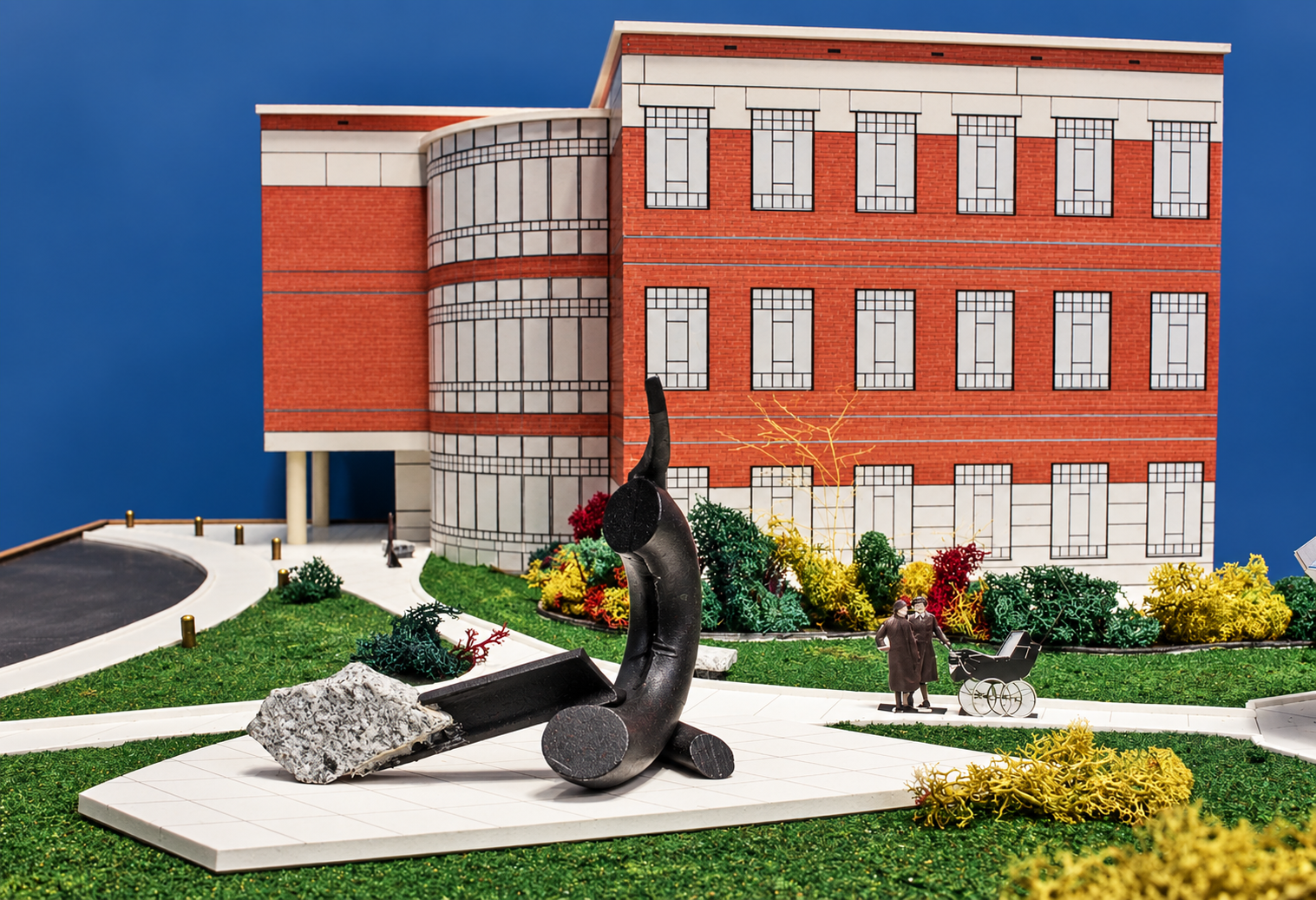
November 1994. Foam core, mixed. Dimensions: 41 × 33 × 15 in (104 × 84 × 38 cm).
Proposed for Rutgers University, but never built. See Chapter 11 in American Monuments.
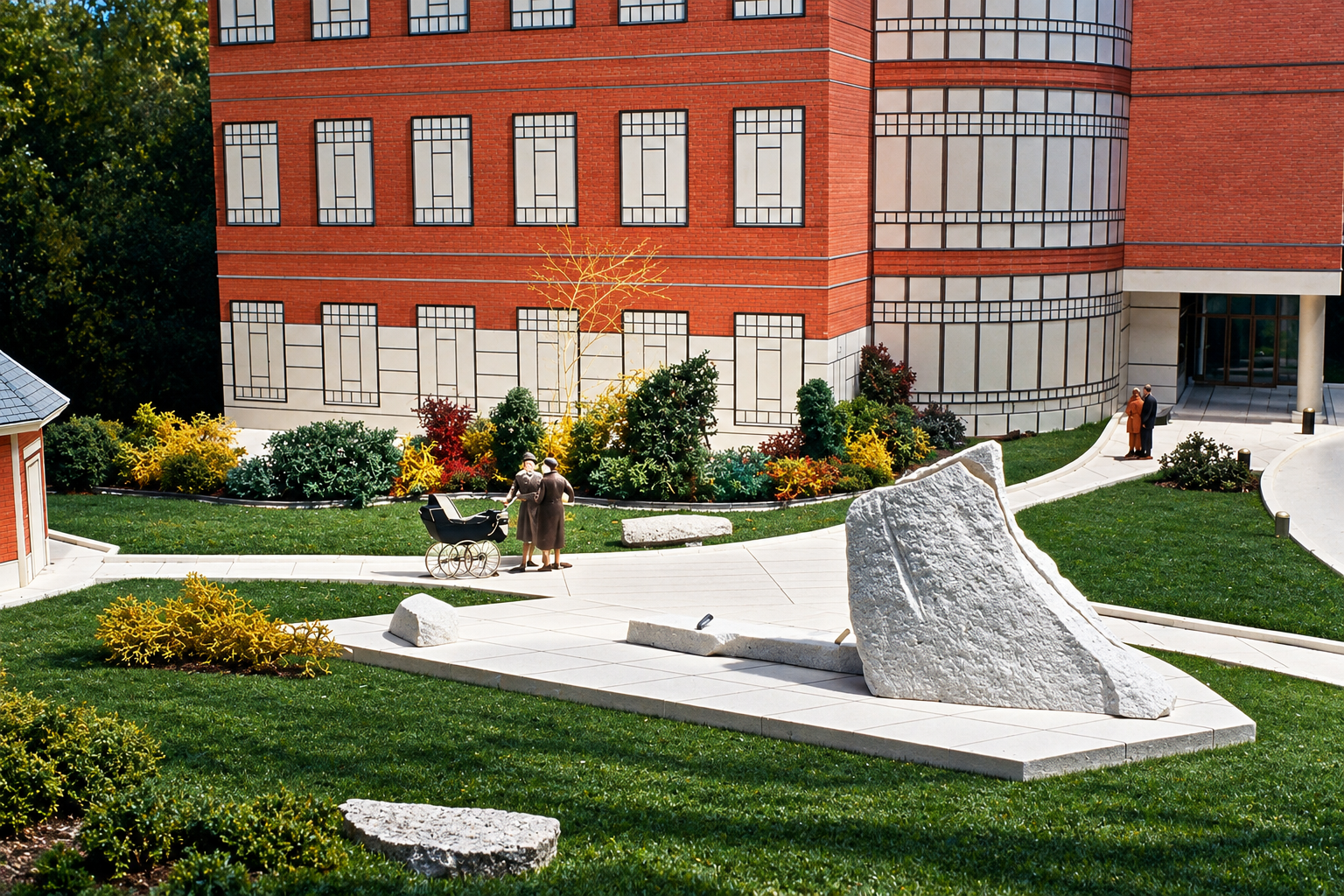
November 1994. Foam core, mixed. Dimensions: 41 × 33 × 15 in (104 × 84 × 38 cm).
Project proposed but not built - See Chapter 11 AMERICAN MONUMENTS
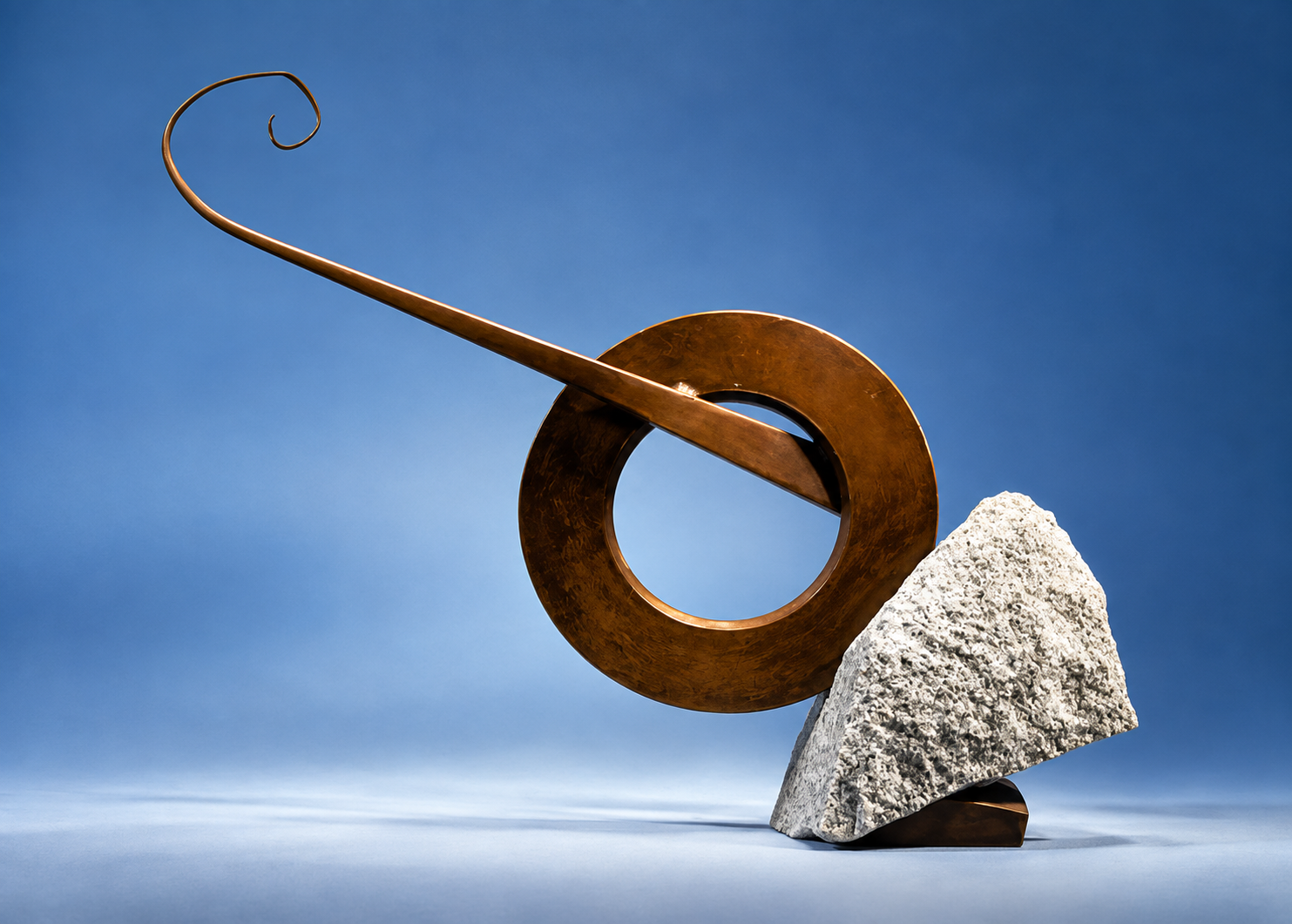
November 1994. Granite, bronze. Dimensions: 12 × 16 × 4 in (30 × 41 × 10 cm).
Private collection: New York
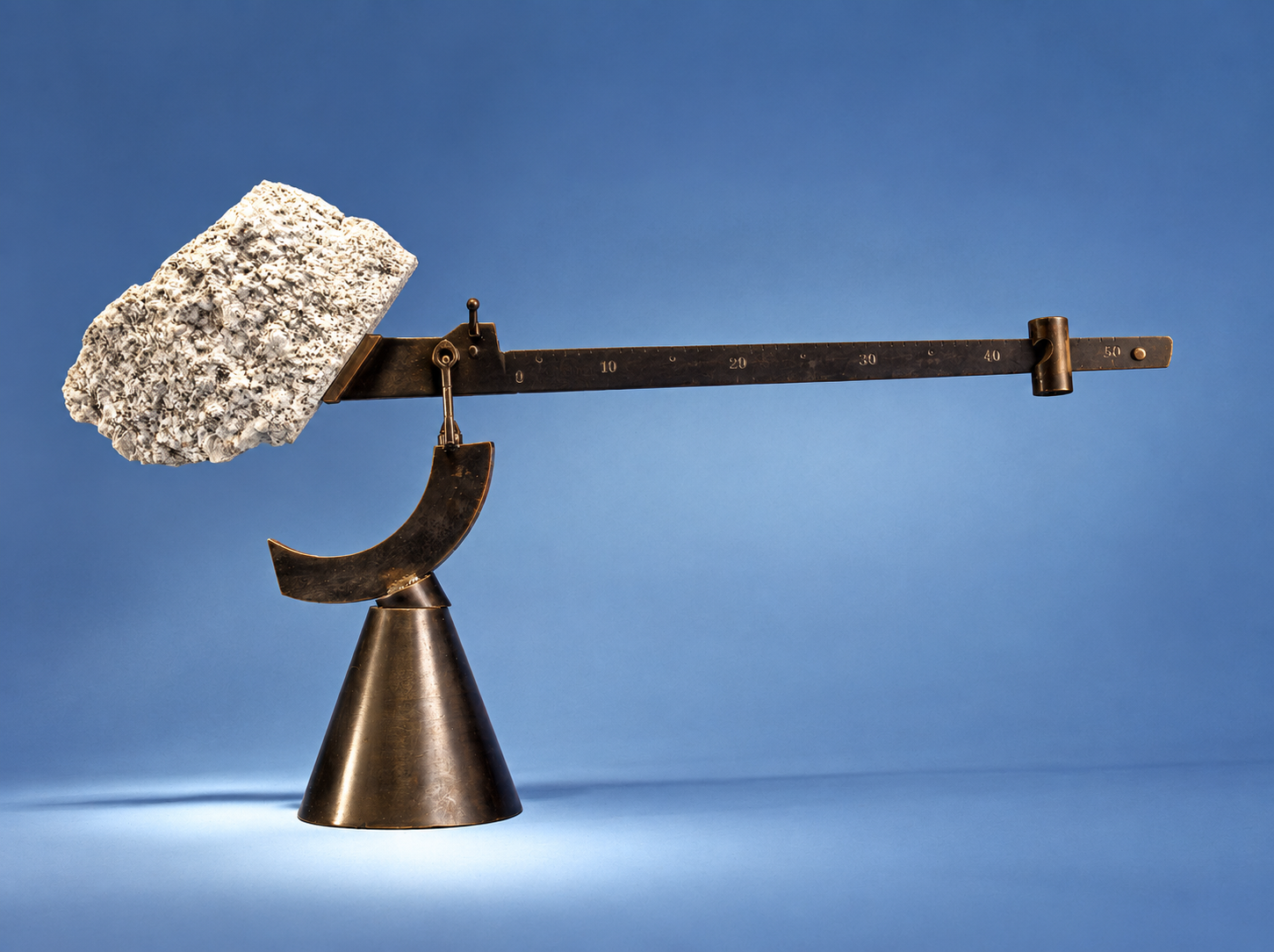
November 1994. White granite, steel. Dimensions: 18 × 32 × 6 in (46 × 81 × 15 cm). Private Collection Aspen, CO.
Beam IV, 1994
Beam IV continues my interest in tools and instruments as both sculptural forms and vehicles for metaphor. The work incorporates the beam section of an actual mechanical scale, complete with its original calibrations and sliding weight, combined with rough granite and fabricated metal elements. The contrast between the precisely calibrated instrument and the irregular mass of stone brings together the human-made and natural materials that have long been central to my work.
The scale or balance beam interests me because much of my sculpture is fundamentally concerned with weight, gravity, equilibrium, and balance. Here an instrument designed to measure weight becomes part of the balancing act itself: the granite extends from one end while the long beam reaches outward in the opposite direction. The physical balance of the sculpture also suggests the larger human impulse to weigh, measure, compare, and ultimately find equilibrium.
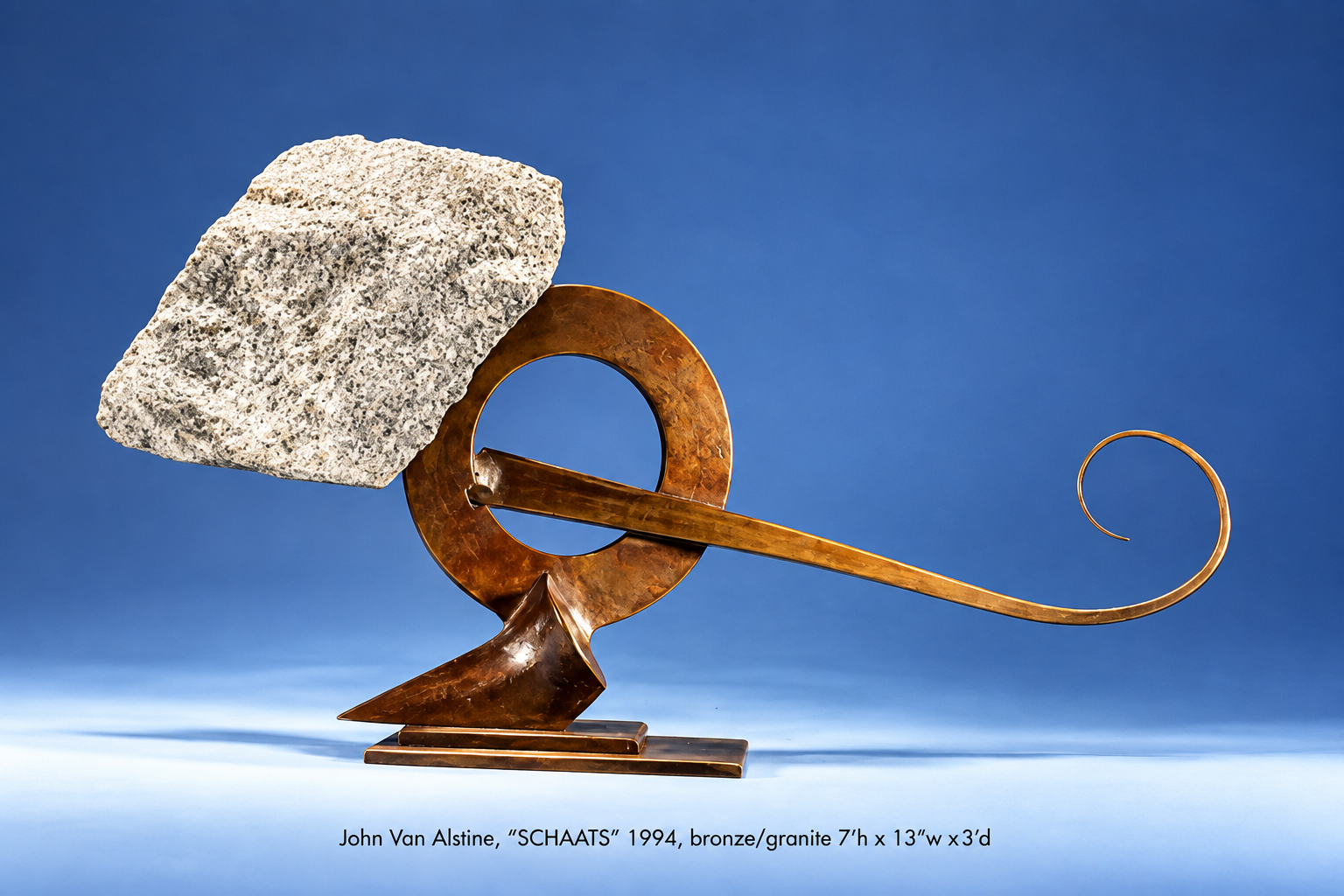
November 1994. Granite, bronze. Dimensions: 7 × 13 × 3 in (18 × 33 × 8 cm). Private collection.
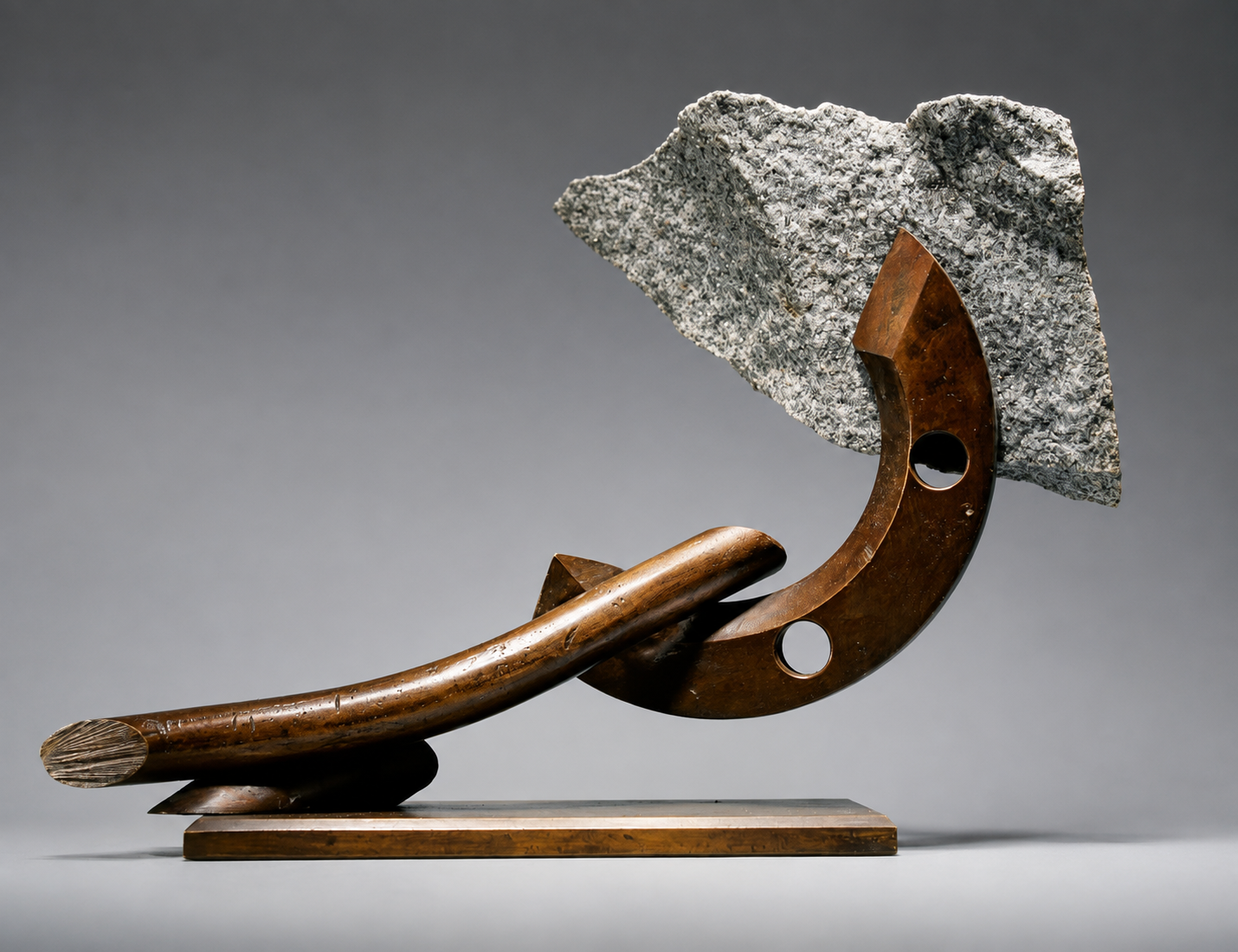
November 1994. Granite, bronze. Dimensions: 8 × 12 × 4.5 in (20 × 30 × 11 cm).
As a sculptor, I have always been fascinated by tools, implements, and instruments. I see them as extensions of the hand—essential allies in the act of making—and am drawn to their raw, efficient beauty, shaped over time by function and necessity. They also embody human ingenuity, labor, and our impulse to shape and engage the world around us.
Throughout my work, agricultural implements—rakes, plow blades, sledges, and tillers—as well as anvils, scales, compasses, and other instruments become both sculptural forms and vehicles for metaphor, suggesting ideas of balance, navigation, transformation, and our relationship to the natural world.
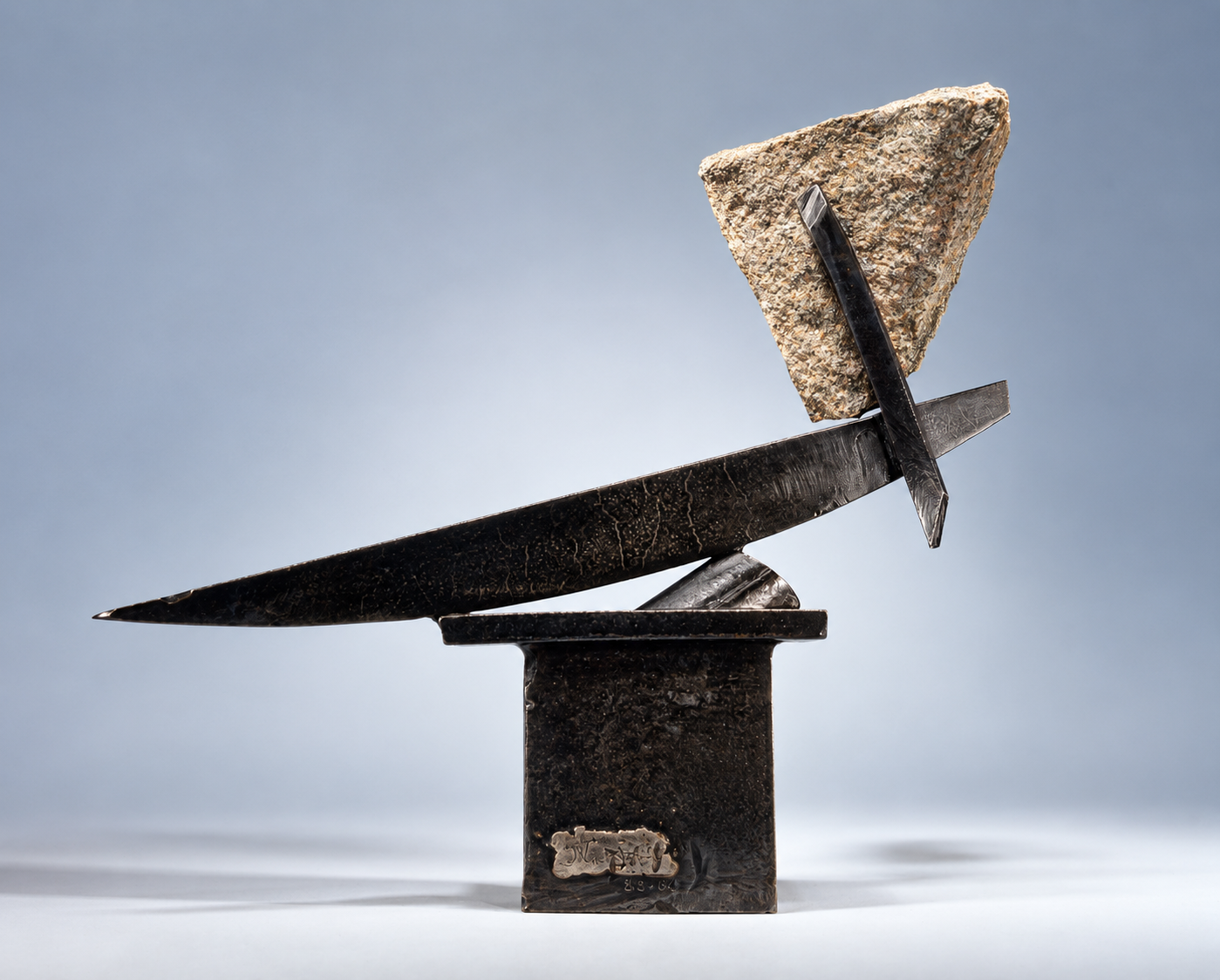
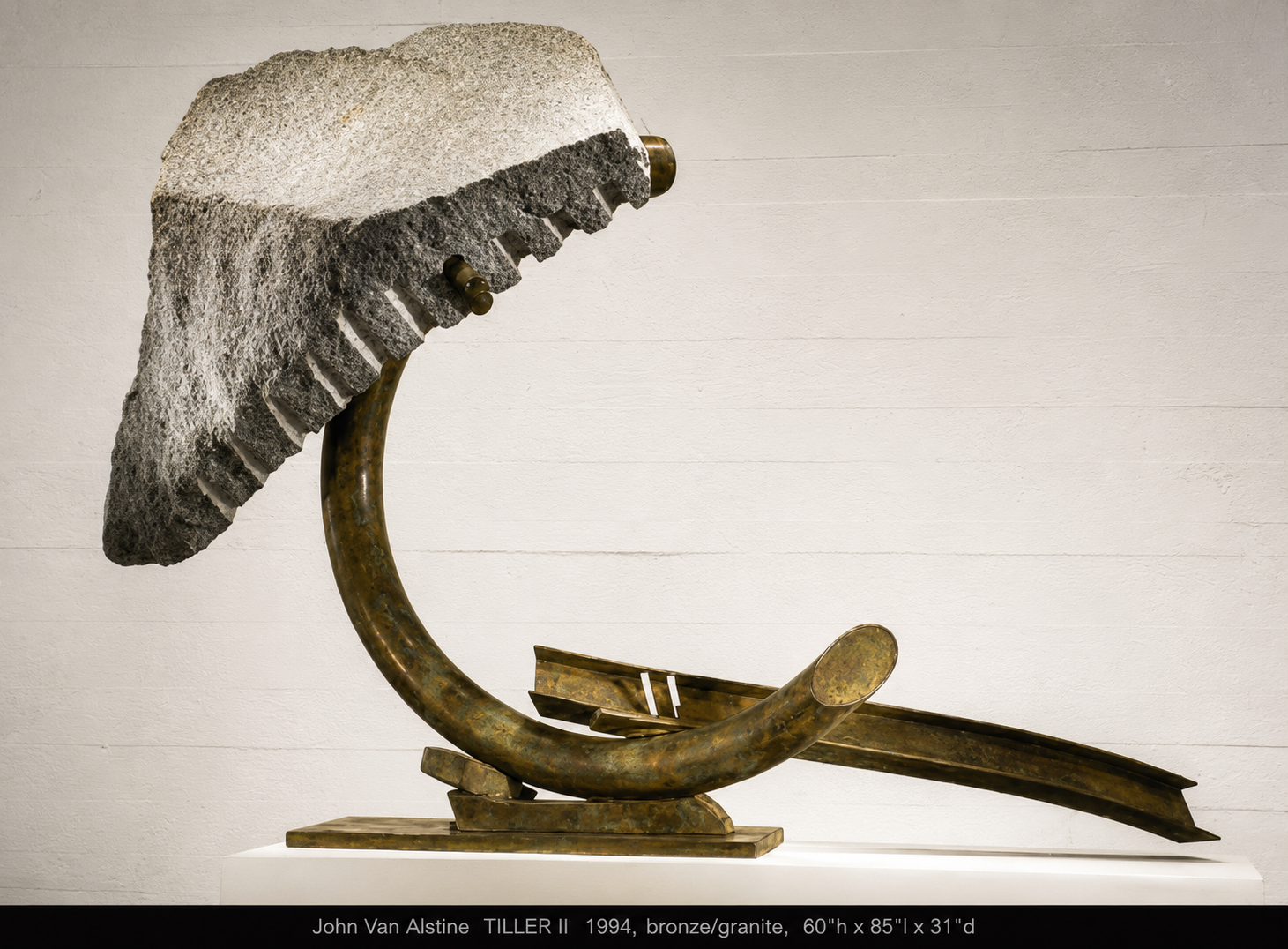
December 1994. Bronze, granite. Dimensions: 60 × 85 × 31 in (152 × 216 × 79 cm).
Private collection - Baltimore, MD
The Tiller series grows from my interest in tools and agricultural implements as extensions of the human body—objects that cultivate, shape, and engage the land. The title also evokes the tiller of a boat, a simple device used to steer and determine direction. Bringing these meanings together, the works explore the relationship between cultivation and navigation—our impulse both to shape the world around us and to chart a course through it.
1993
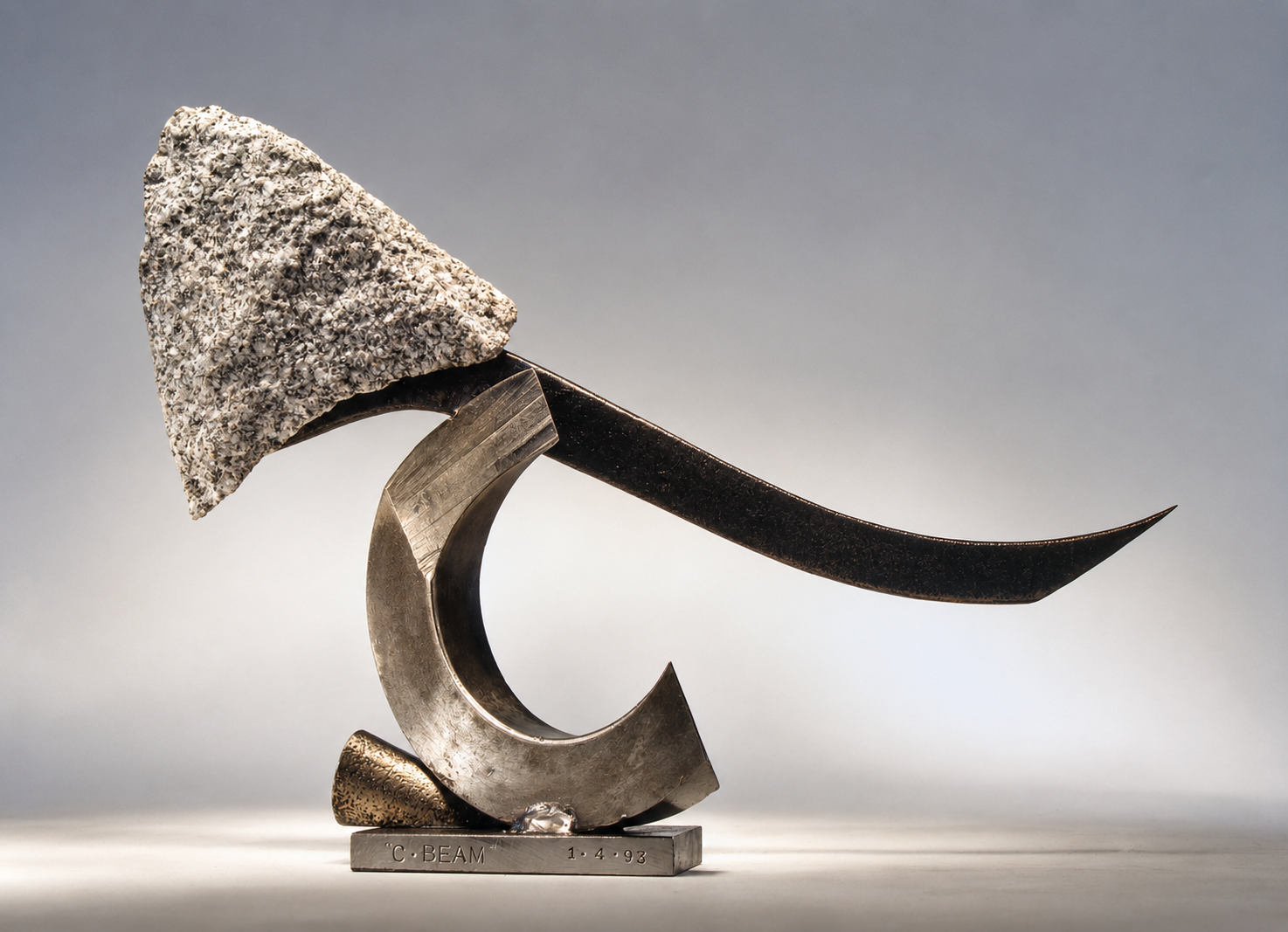
January 1993. Granite, steel. Dimensions: 10 × 14 × 4 in (25 × 36 × 10 cm). Private collection.
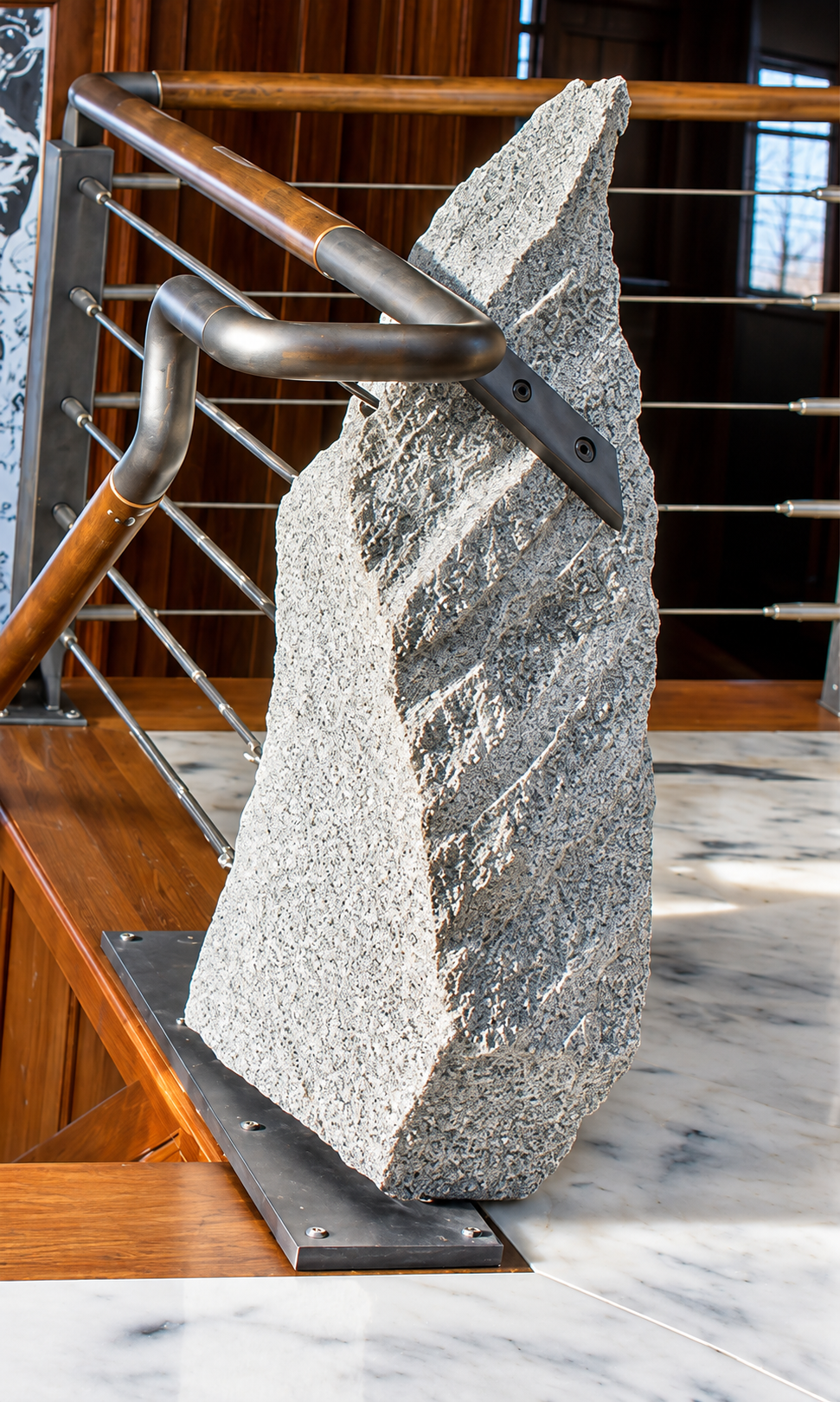
June 1993. Found rough granite, bronze, steel. Dimensions: APPROX 200'
Custom interior railing project and table, Aspen, CO.
Flug Rail, 1993
Flug Rail was commissioned by Debby and Marty Flug for their home on Red Mountain in Aspen, Colorado. Extending approximately 200 feet, the custom interior railing began at the grand staircase and continued throughout the house along the upper balconies. The work combines bronze and steel with large pieces of found rough granite, integrating sculpture directly into the architecture while retaining the contrasting qualities of natural stone and fabricated metal central to my work.
The entire railing was fabricated in my studio in Wells, New York, then transported to Colorado and installed with the help of my father, Richard Van Alstine. Rather than treating the railing simply as an architectural necessity, I approached it as an extended sculpture—using the handrail as a continuous linear element that moves through the house, periodically engaging the granite as both structural anchor and sculptural event.
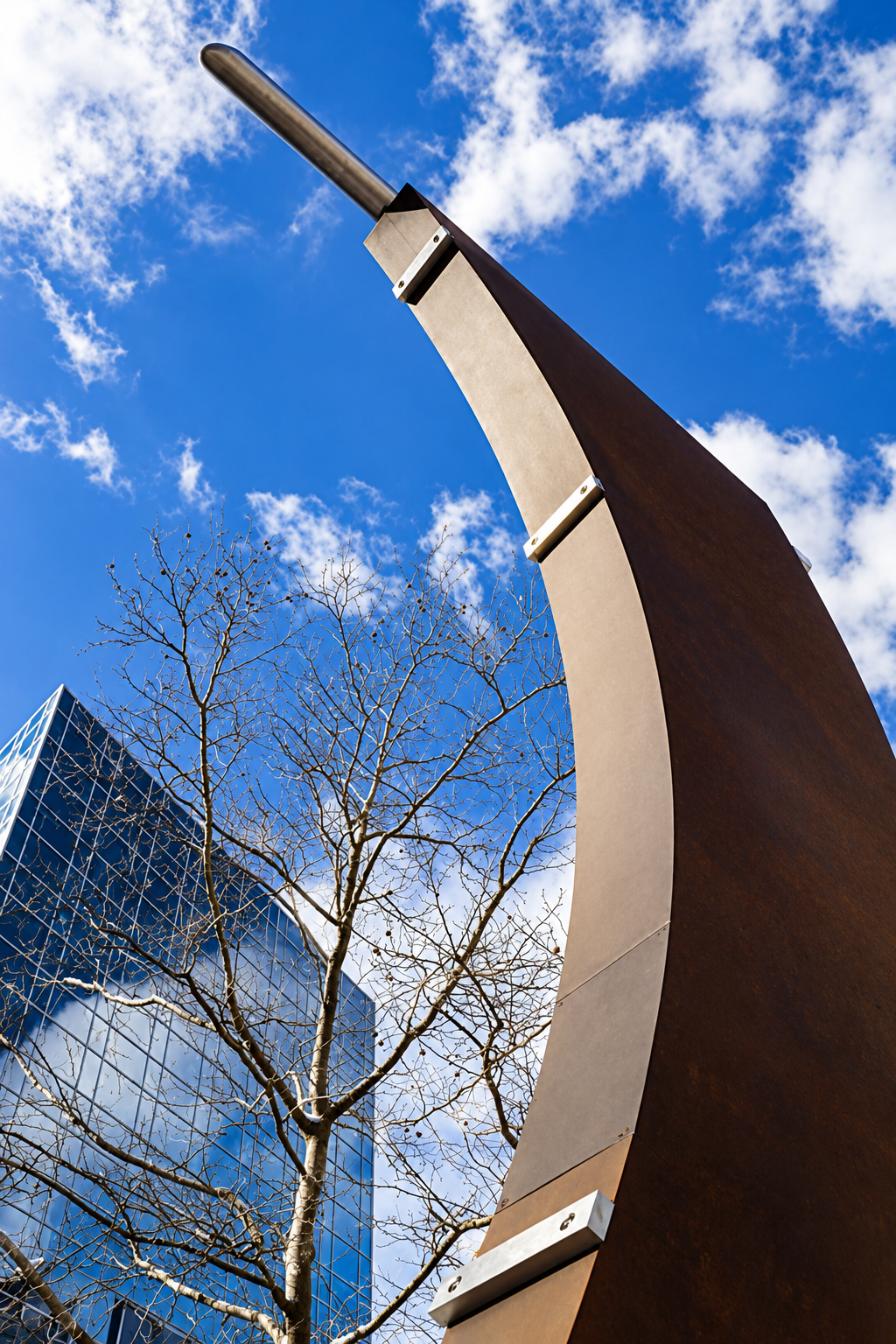
Artery Sunwork
August 1993
Granite, bronze, and steel
16 × 8 × 8 ft (4.9 × 2.4 × 2.4 m)
Artery Sunwork (1991–93) was commissioned for the headquarters of Artery Organization, Inc., in Bethesda, Maryland, just north of the DC line. A mature expression of John Van Alstine's Celestial Works series, the sculpture functions as a solar calendar, aligned on a true north–south axis. At solar noon, a suspended bronze element casts a shadow that records each day's position within the annual cycle, reaching its longest point at the summer solstice and its shortest at the winter solstice.
Inspired by prehistoric solar monuments, the work unites monumental granite, bronze, and steel in a sculpture that bridges art, science, and landscape. By transforming the changing movement of sunlight into a visible measure of time, Artery Sunwork invites viewers to experience the enduring rhythms of the natural world within a contemporary setting.
MORE INFO: Artery Sunwork chapter in AMERICAN MONUMENTS
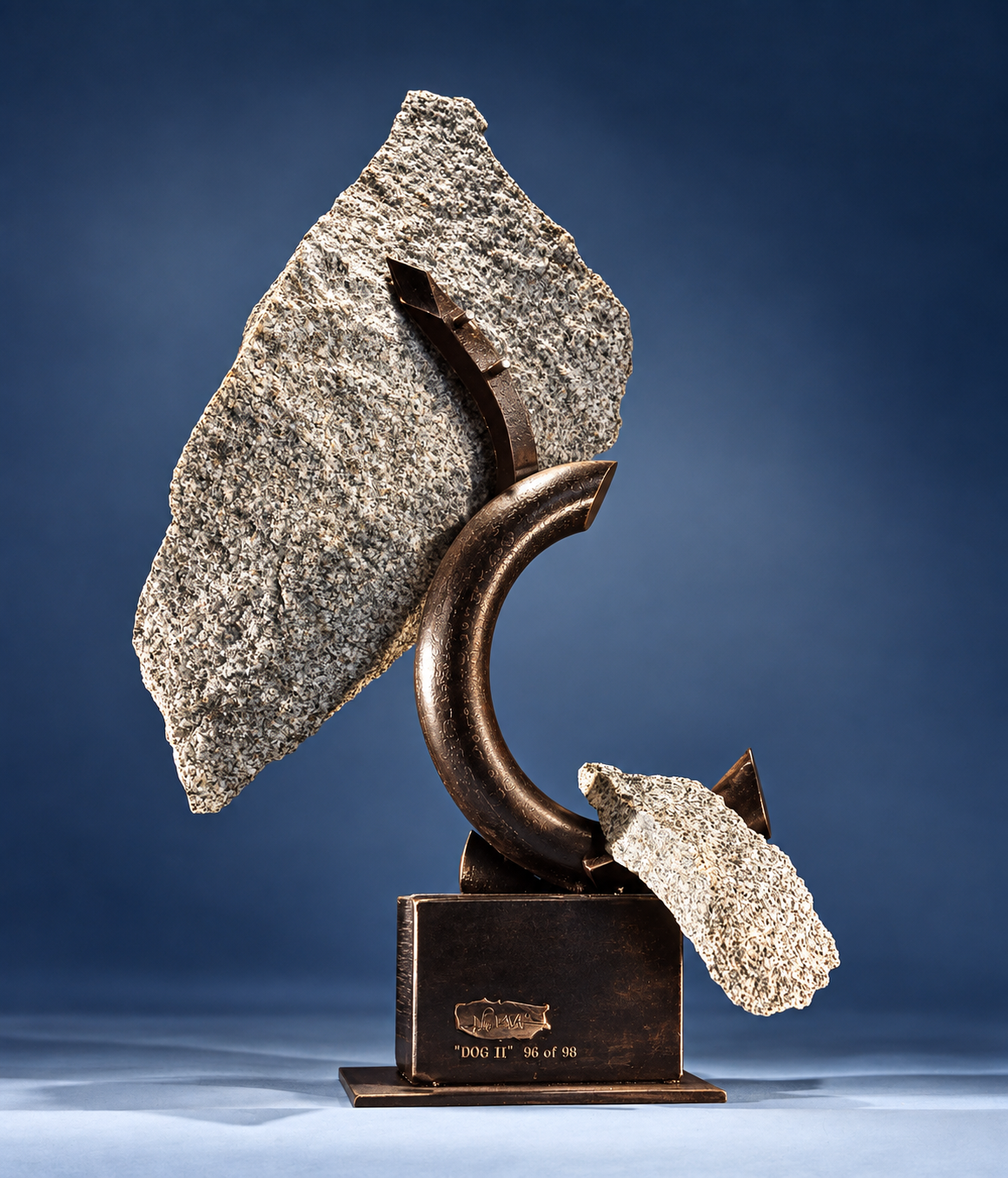
October 1993. Granite, steel. Dimensions: 24 × 16 × 8 in (61 × 41 × 20 cm).
Private collection
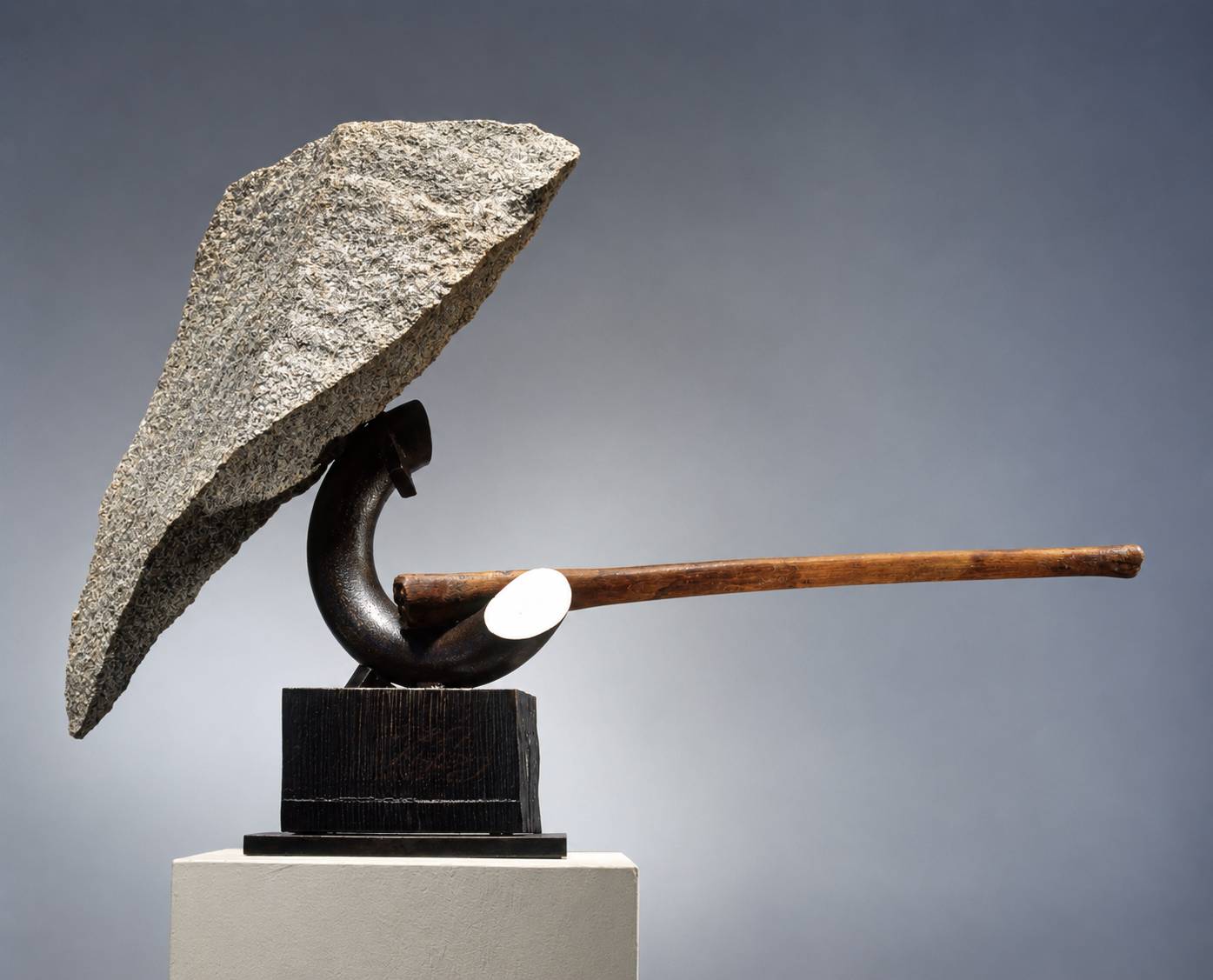
October 1993. Granite, steel. Dimensions: 31 × 40 × 10 in (79 × 102 × 25 cm).
As a sculptor, I have always been fascinated by tools, implements, and instruments. I see them as extensions of the hand—essential allies in the act of making—and am drawn to their raw, efficient beauty, shaped over time by function and necessity. They also embody human ingenuity, labor, and our impulse to shape and engage the world around us.
Throughout my work, agricultural implements—rakes, plow blades, sledges, and tillers—as well as anvils, scales, compasses, and other instruments become both sculptural forms and vehicles for metaphor, suggesting ideas of balance, navigation, transformation, and our relationship to the natural world.
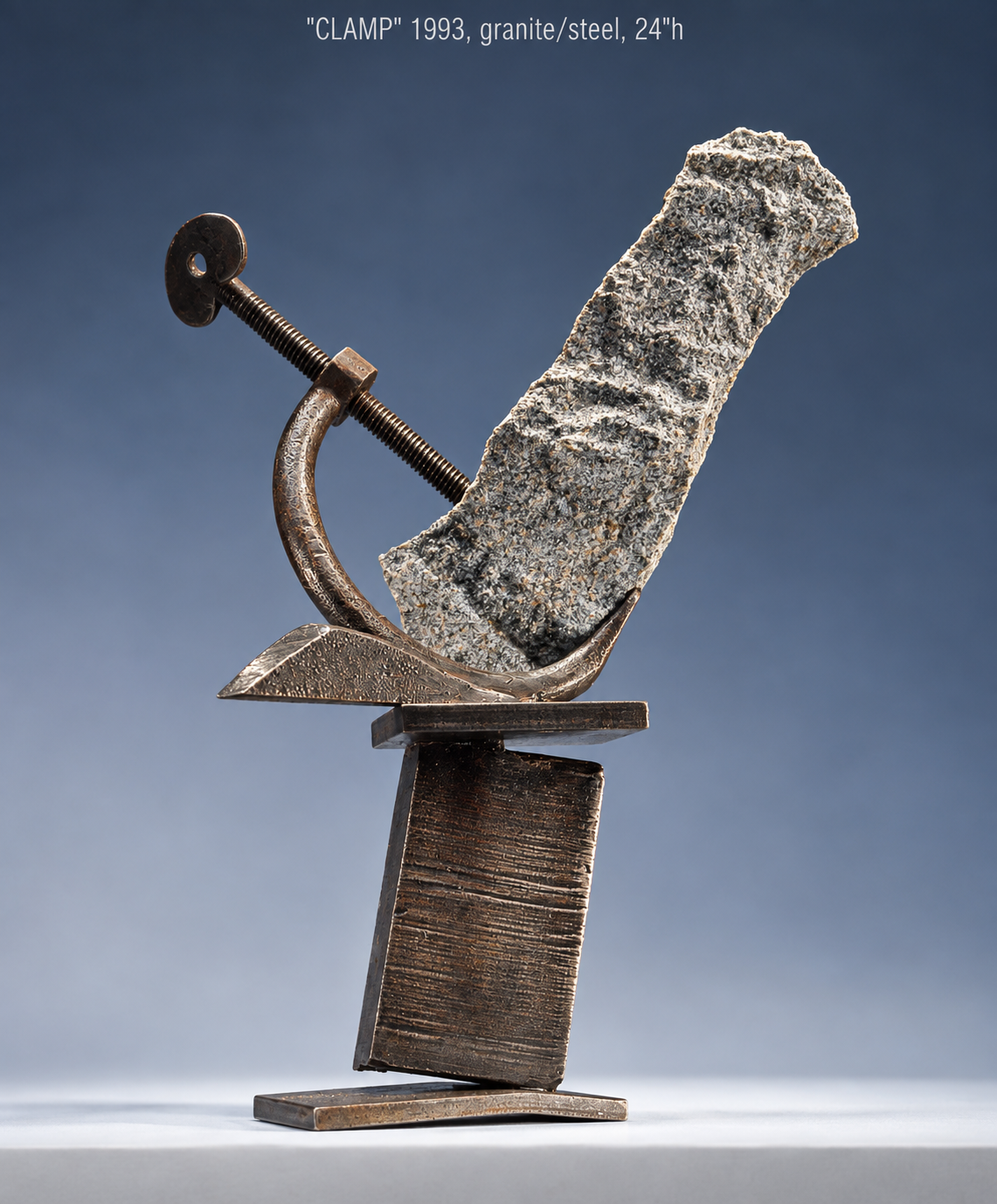
October 1993. Gray granite, steel. Dimensions: 18 × 13 × 7 in (46 × 33 × 18 cm). Private collection - Washington, DC.
Clamp, 1993
Clamp continues my interest in tools and implements as extensions of the hand and in what I have described as their “raw, efficient beauty of form dictated by function.” Here I use an actual C-clamp, celebrating both its distinctive circular shape and its practical purpose. Combined with rough granite and fabricated steel, the familiar tool becomes an integral part of the sculpture rather than simply a found object.
As in Kouros (1989) and Loop (1991), where I incorporated a real vise and C-clamp, the tool remains fully functional: its screw is tightened against the granite and actually helps hold the stone in place. Function and image become one—the act of clamping is made visible as part of the sculpture, bringing together my continuing concerns with tools, assembly, pressure, and the relationship between stone and steel.
The piece was later part of a multi-work trade with publisher James Trulove for the production of my first book, Bones of the Earth.
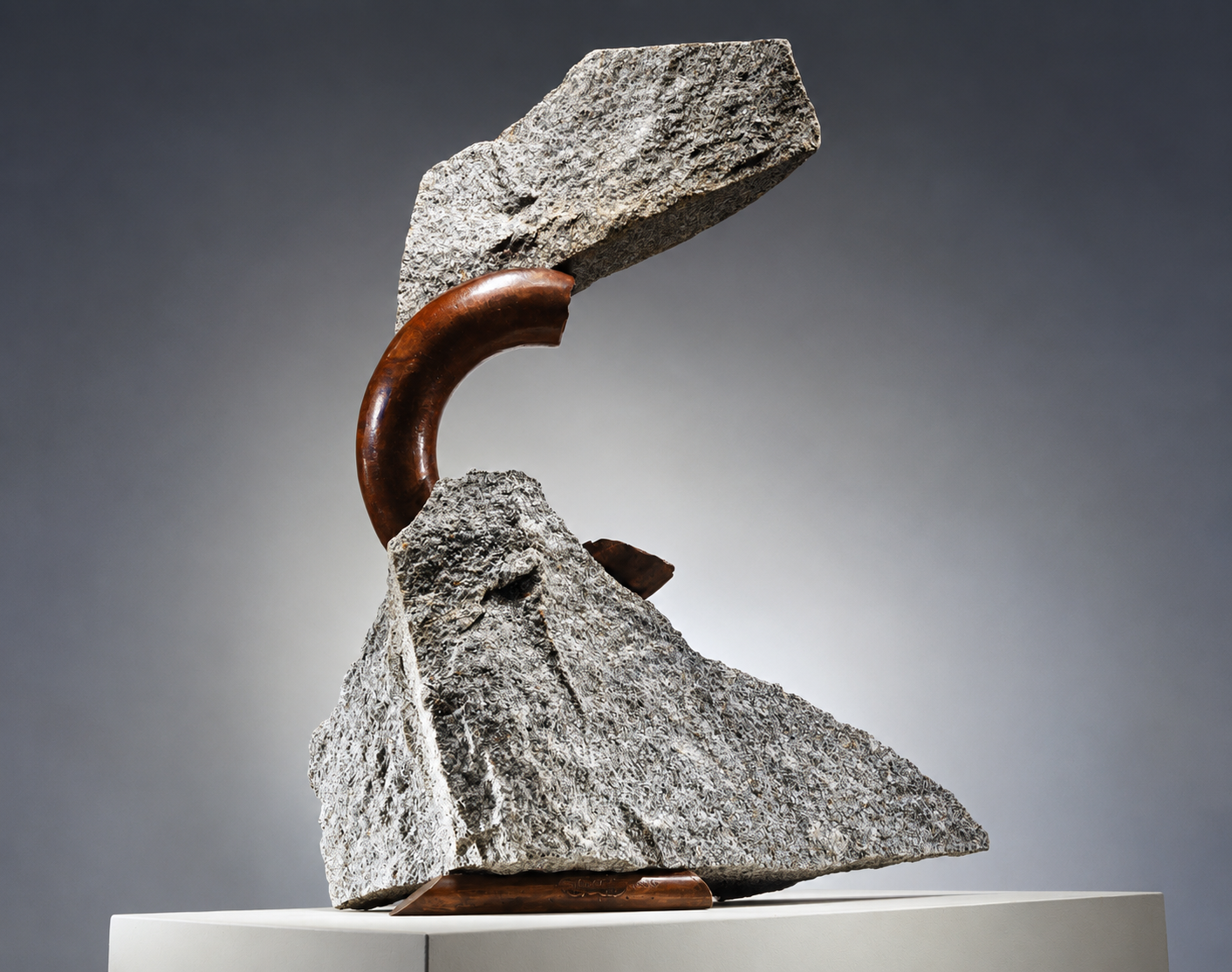
October 1993. Gray granite, bronze. Dimensions: 32 × 27 × 18 in (81 × 69 × 46 cm).
Private collection
Cygnus is a northern constellation on the plane of the Milky Way , deriving its name from the Latinized Greek word for swan . [1] Cygnus is one of the most recognizable constellations of the northern summer and autumn, and it features a prominent asterism known as the Northern Cross (in contrast to the Southern Cross )
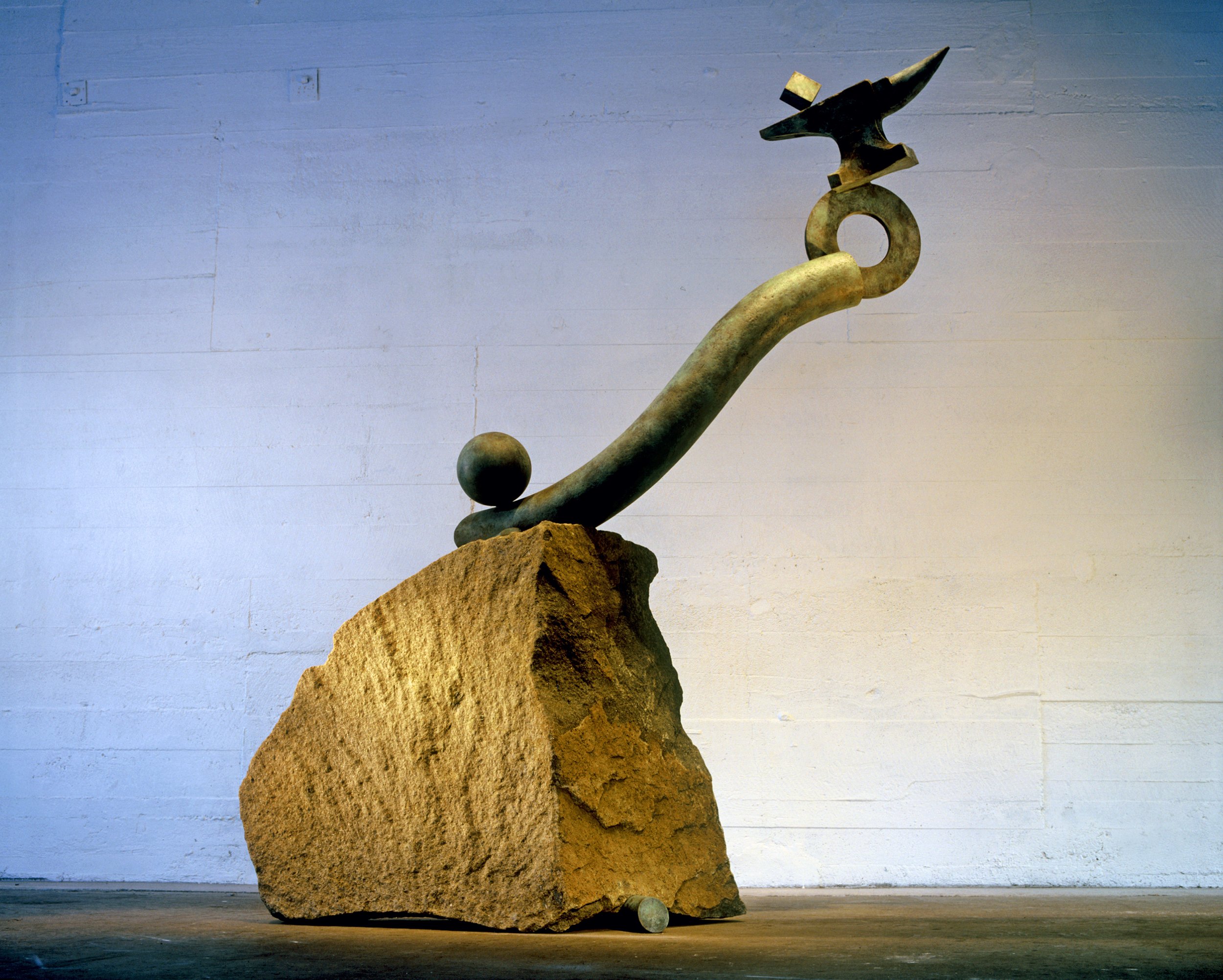
December 1993. Green granite, bronze. Dimensions: 98 × 80 × 32 in (249 × 203 × 81 cm).
On permanent loan: Grounds for Sculpture, Hamilton, NJ
Many of Van Alstine’s works take inspiration from the movement of the human body. This work can be seen as a kind of self-portrait, suggesting his studio process—literally juggling and repositioning the individual elements of a sculpture until they achieve a moment of perfect balance, then freezing that moment in space through welding. More universally, juggling becomes a metaphor for the way we all balance the competing demands of family, work, play, and responsibility.
The anvil, which appears in a number of the artist’s works, represents both the ultimate heavy object to “juggle” and the act of assembly itself—the forging together of object, material, and ideas that is central to Van Alstine’s work.
1992
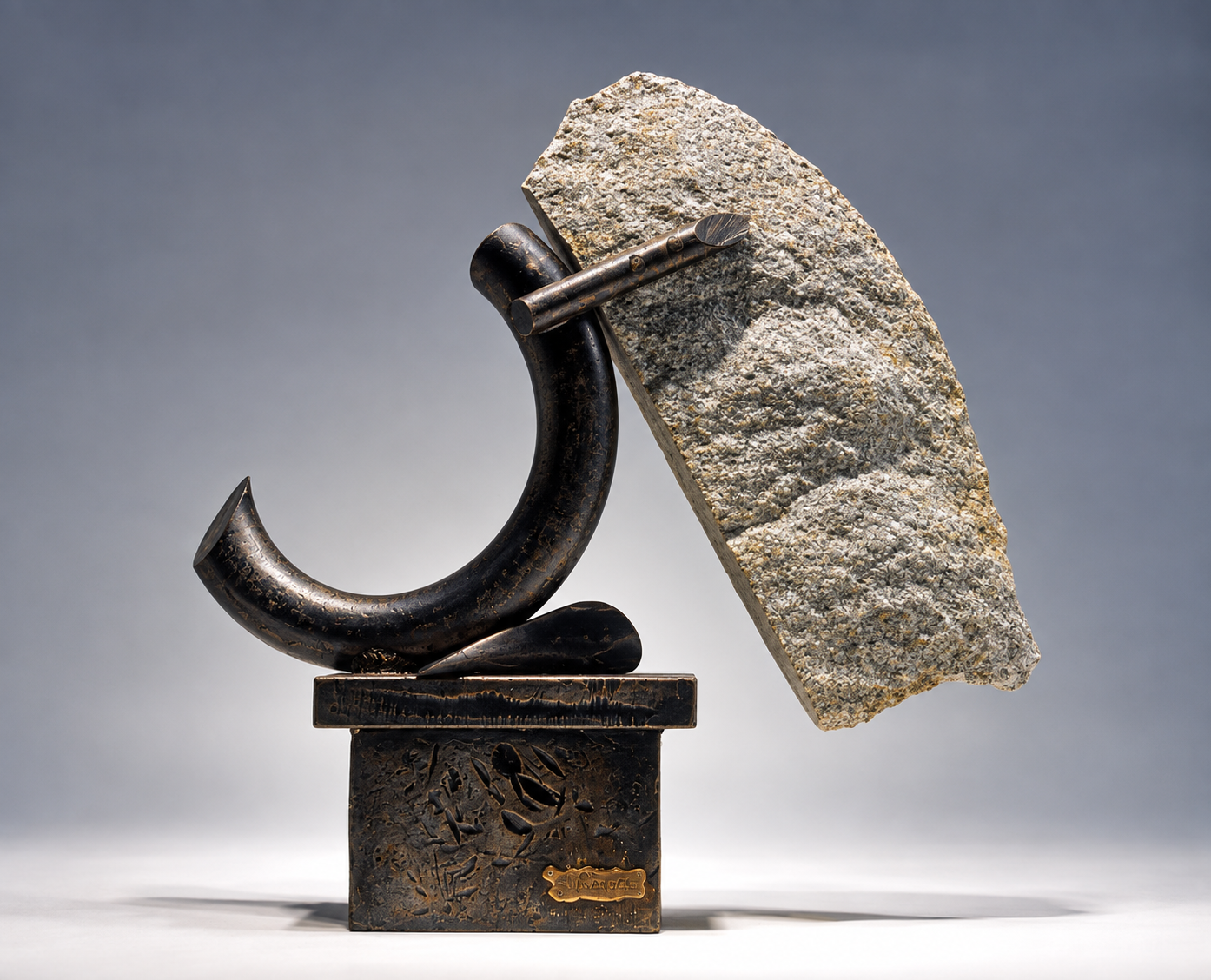
January 1992. Granite, steel. Dimensions: 17 × 17 × 5 in (43 × 43 × 13 cm). Private Collection
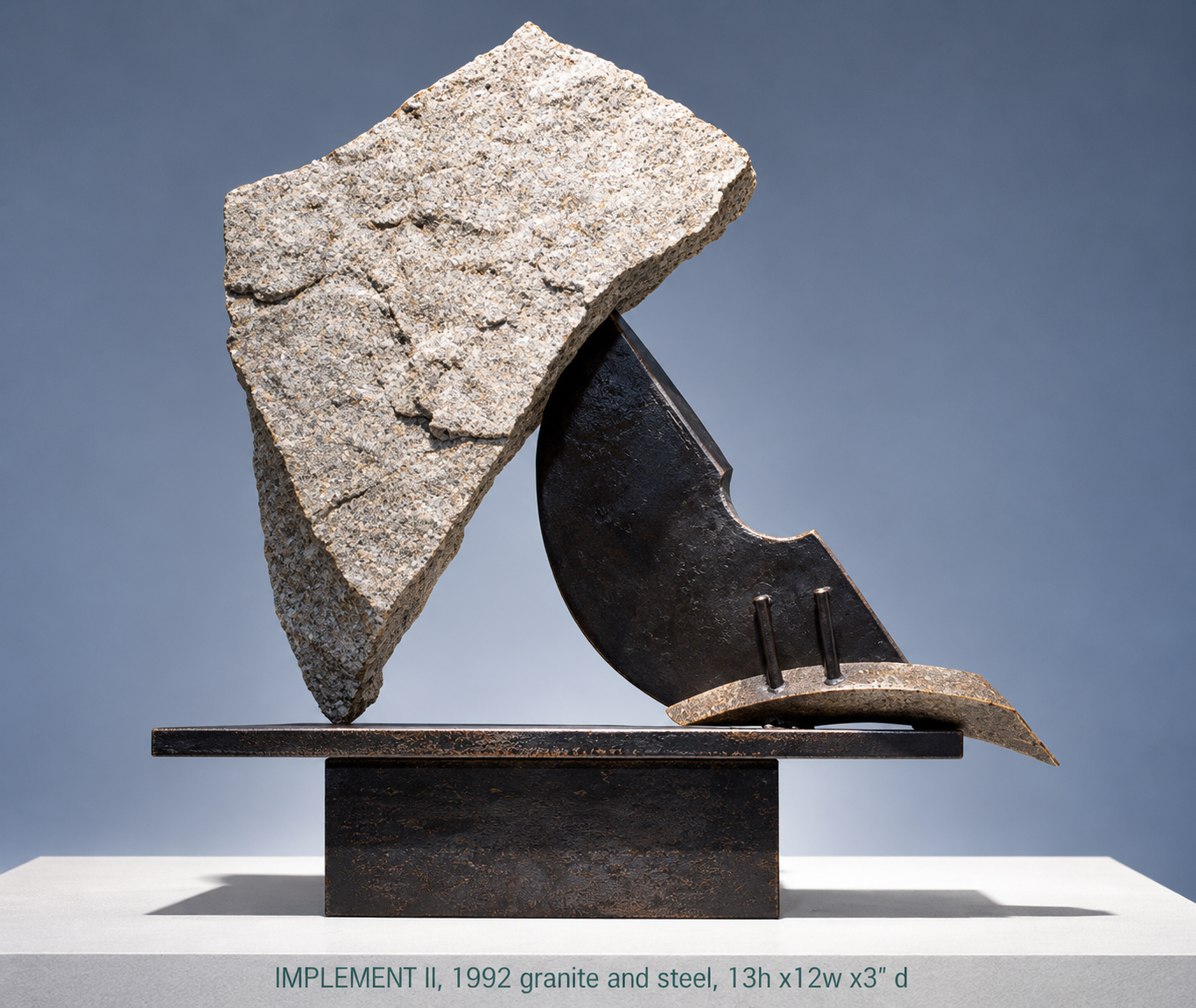
January 1992. Granite, steel. Dimensions: 13 × 12 × 3 in (33 × 30 × 8 cm). Private Collection - North Carolina
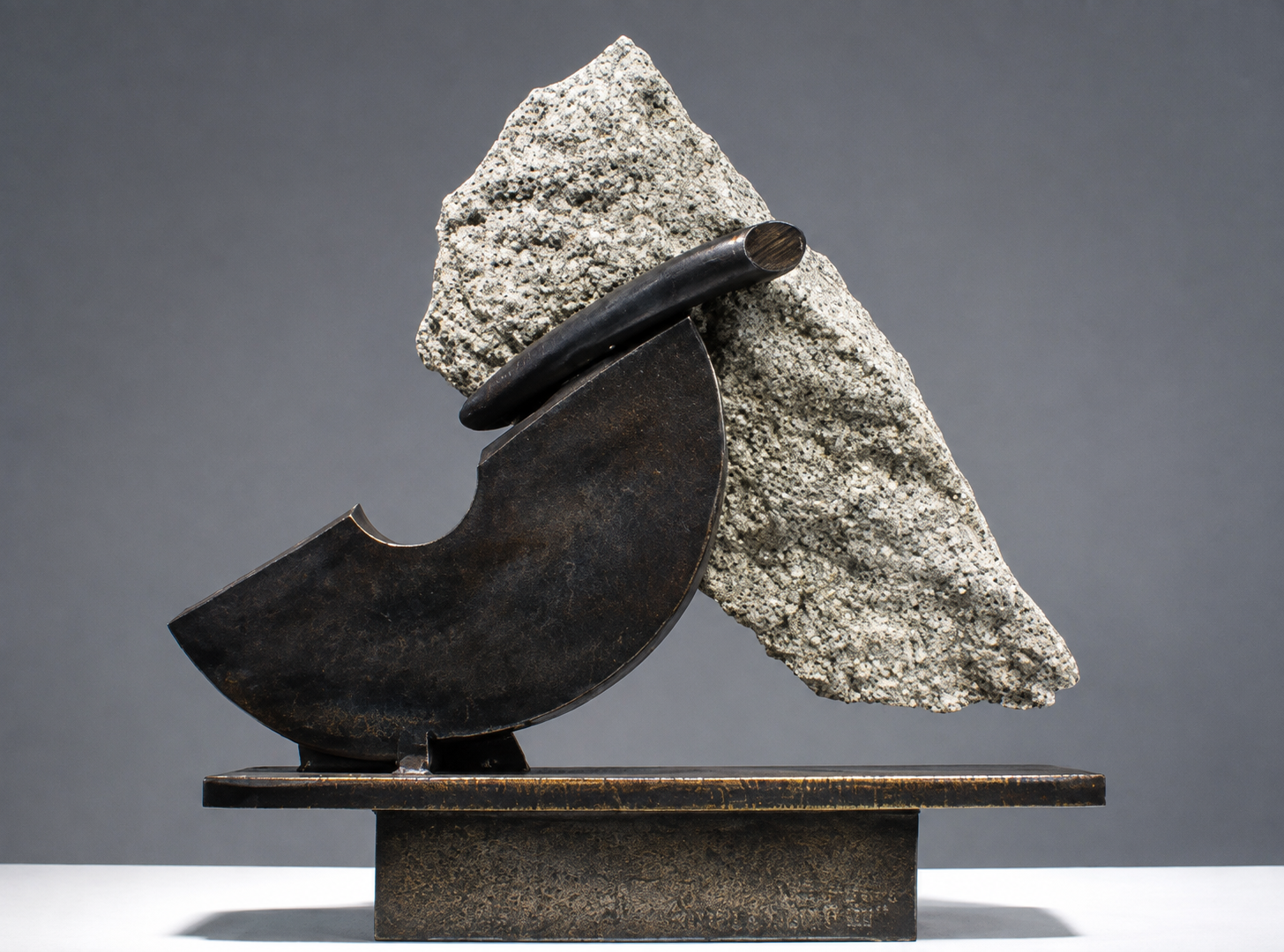
January 1992. Granite, steel. Dimensions: 11 × 12 × 3 in (28 × 30 × 8 cm).
Private Collection.
As a sculptor, I have always been fascinated by tools, implements, and instruments. I see them as extensions of the hand—essential allies in the act of making—and am drawn to their raw, efficient beauty, shaped over time by function and necessity. They also embody human ingenuity, labor, and our impulse to shape and engage the world around us.
Throughout my work, agricultural implements—rakes, plow blades, sledges, and tillers—as well as anvils, scales, compasses, and other instruments become both sculptural forms and vehicles for metaphor, suggesting ideas of balance, navigation, transformation, and our relationship to the natural world.
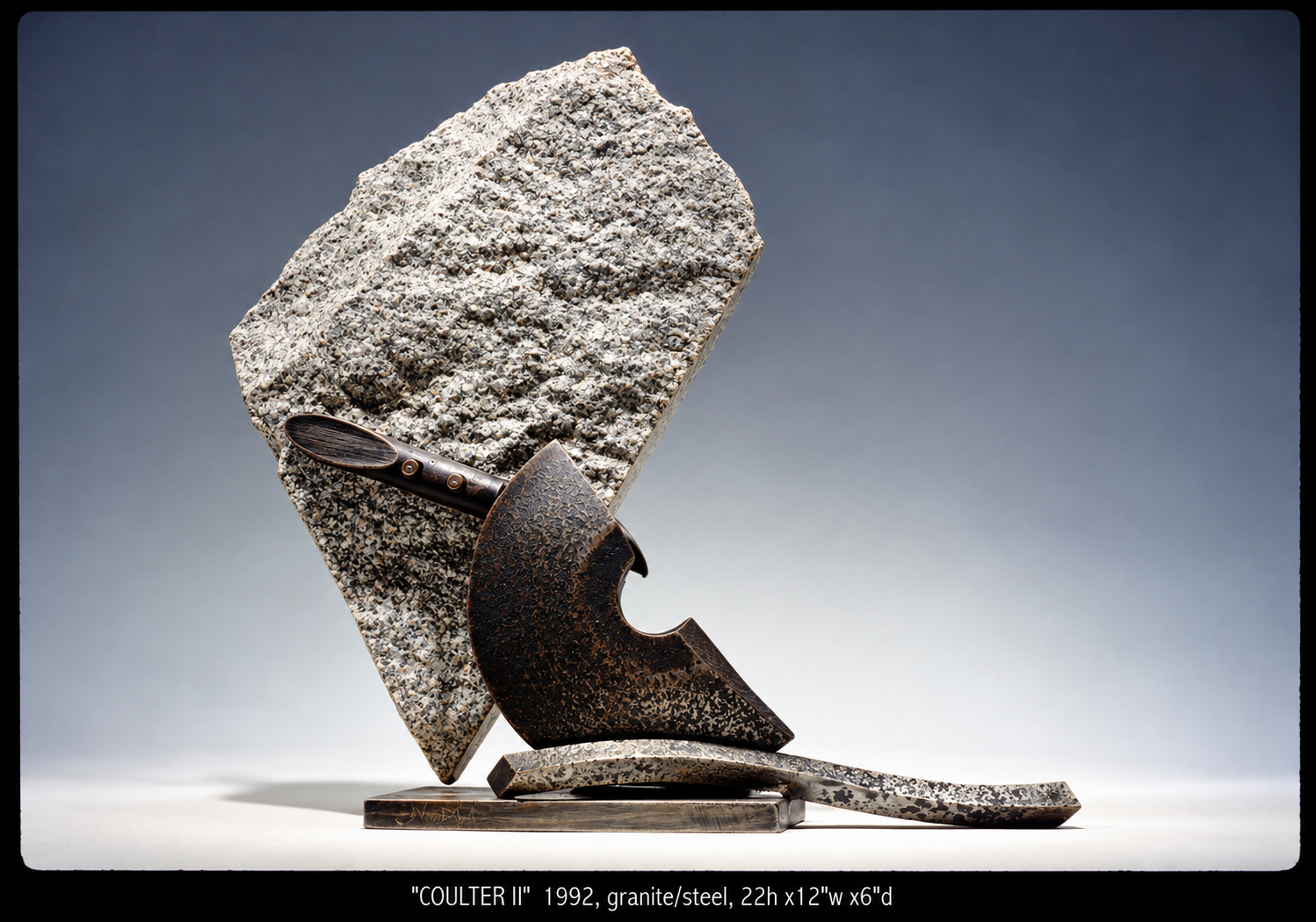
January 1992. Granite, steel. Dimensions: 22 × 12 × 6 in (56 × 30 × 15 cm). Private collection - Aspen, CO
The English word "coulter" (a plow blade) derives from the Latin word culter, which means a "knife," "plowshare," or "razor". In Roman agriculture, the culter was a vertical iron blade used to cut through soil ahead of the plowshare, facilitating the cultivation of heavy soils.
Wikipedia +4
Latin Term: Culter, cultrī (masculine).
Meaning: Knife, razor, or plowshare.
Agricultural Function: A blade that cuts a vertical furrow, improving plowing efficiency.
Origins: The term stems from an Old English adoption of the Latin word
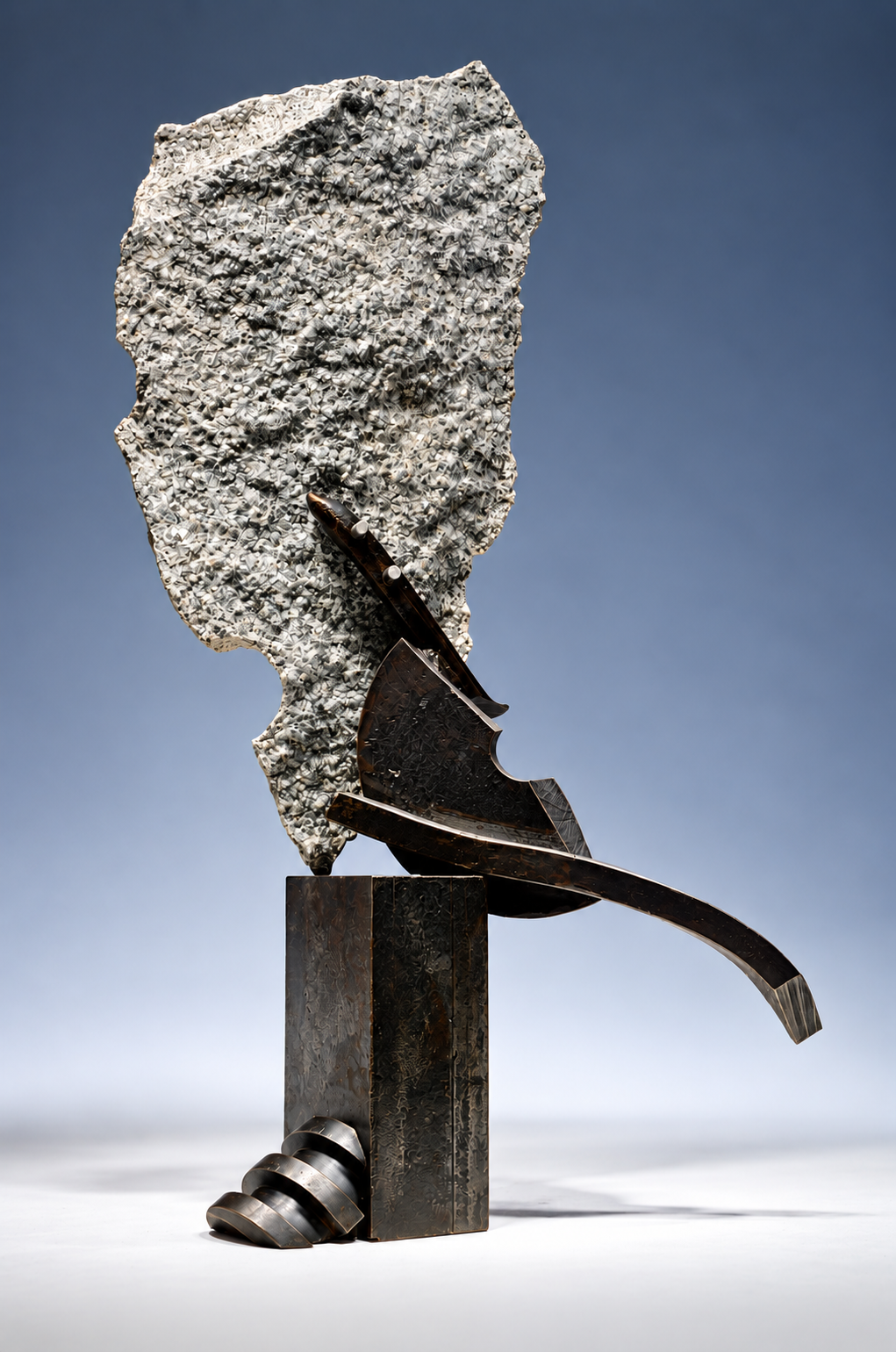
January 1992. Granite, steel. Dimensions: 13 × 12 × 14 in. (33 × 30 × 35 cm).
The English word coulter (a plow blade) derives from the Latin word culter, meaning "a knife," "plowshare," or "cutting instrument". It entered Middle English as culter from Old English, maintaining the original Latin sense of a sharp tool used to cut the ground before the plowshare.
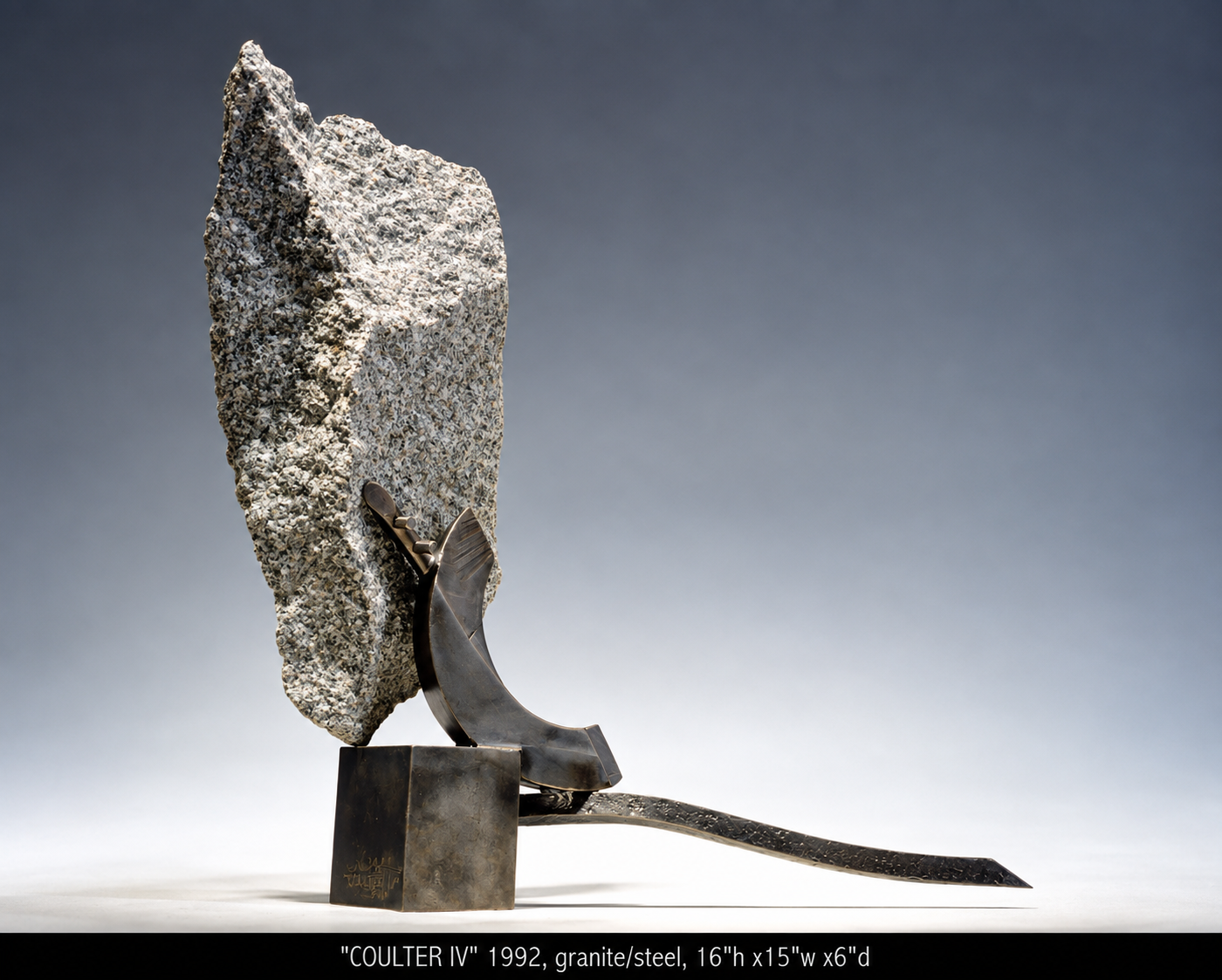
January 1992. Granite, steel. Dimensions: 16 × 15 × 6 in (41 × 38 × 15 cm).
The English word coulter (a plow blade) derives from the Latin word culter, meaning "a knife," "plowshare," or "cutting instrument". It entered Middle English as culter from Old English, maintaining the original Latin sense of a sharp tool used to cut the ground before the plowshare.

January 1992. Granite, steel. Dimensions: 12 × 18 × 3 in (30 × 46 × 8 cm).
Private collection
As a sculptor, I have always been fascinated by tools, implements, and instruments. I see them as extensions of the hand—essential allies in the act of making—and am drawn to their raw, efficient beauty, shaped over time by function and necessity. They also embody human ingenuity, labor, and our impulse to shape and engage the world around us.
Throughout my work, agricultural implements—rakes, plow blades, sledges, and tillers—as well as anvils, scales, compasses, and other instruments become both sculptural forms and vehicles for metaphor, suggesting ideas of balance, navigation, transformation, and our relationship to the natural world.
John Van Alstine

January 1992. Granite, steel. Dimensions: 16 × 12 × 4 in (41 × 30 × 10 cm).
Private collection
As a sculptor, I have always been fascinated by tools, implements, and instruments. I see them as extensions of the hand—essential allies in the act of making—and am drawn to their raw, efficient beauty, shaped over time by function and necessity. They also embody human ingenuity, labor, and our impulse to shape and engage the world around us.
Throughout my work, agricultural implements—rakes, plow blades, sledges, and tillers—as well as anvils, scales, compasses, and other instruments become both sculptural forms and vehicles for metaphor, suggesting ideas of balance, navigation, transformation, and our relationship to the natural world.
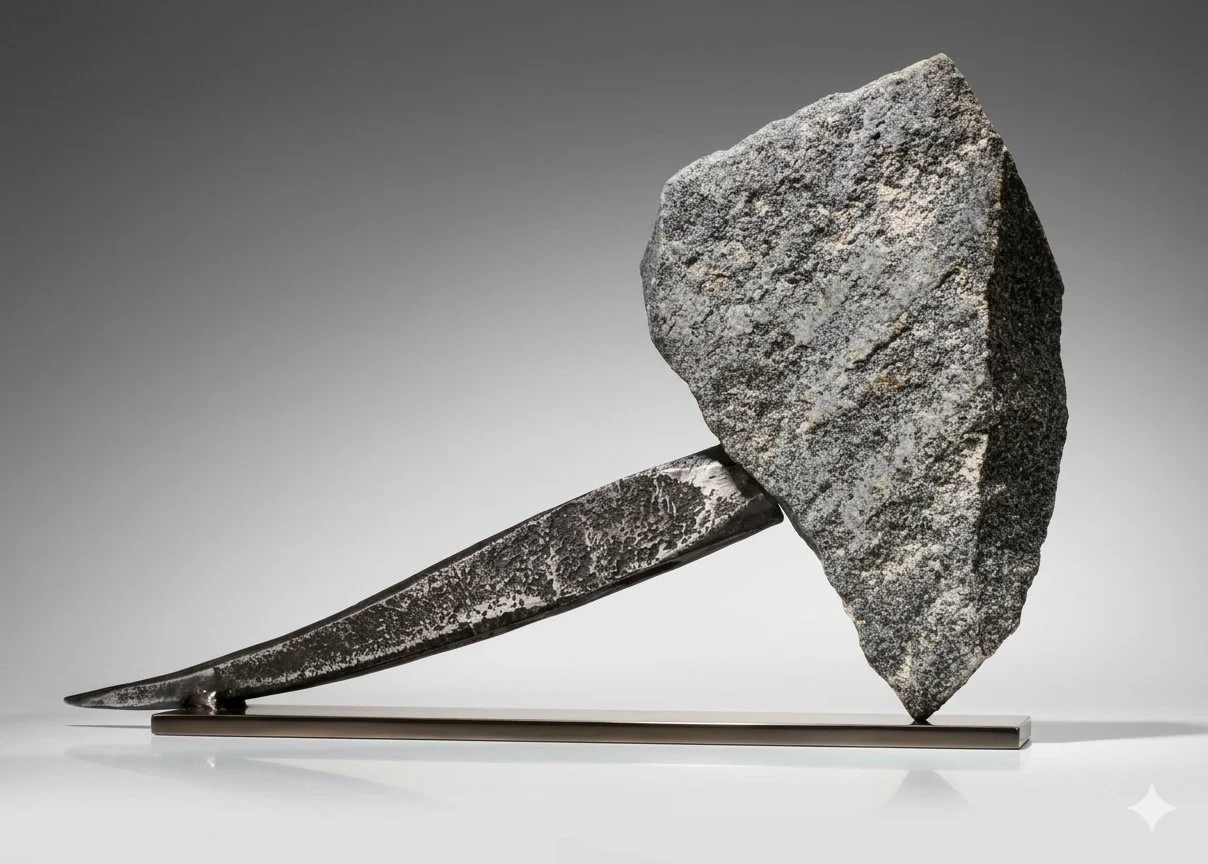
January 1992. Granite, steel. Dimensions: 12 × 18 × 4 in (30 × 46 × 10 cm).
Cannabilized
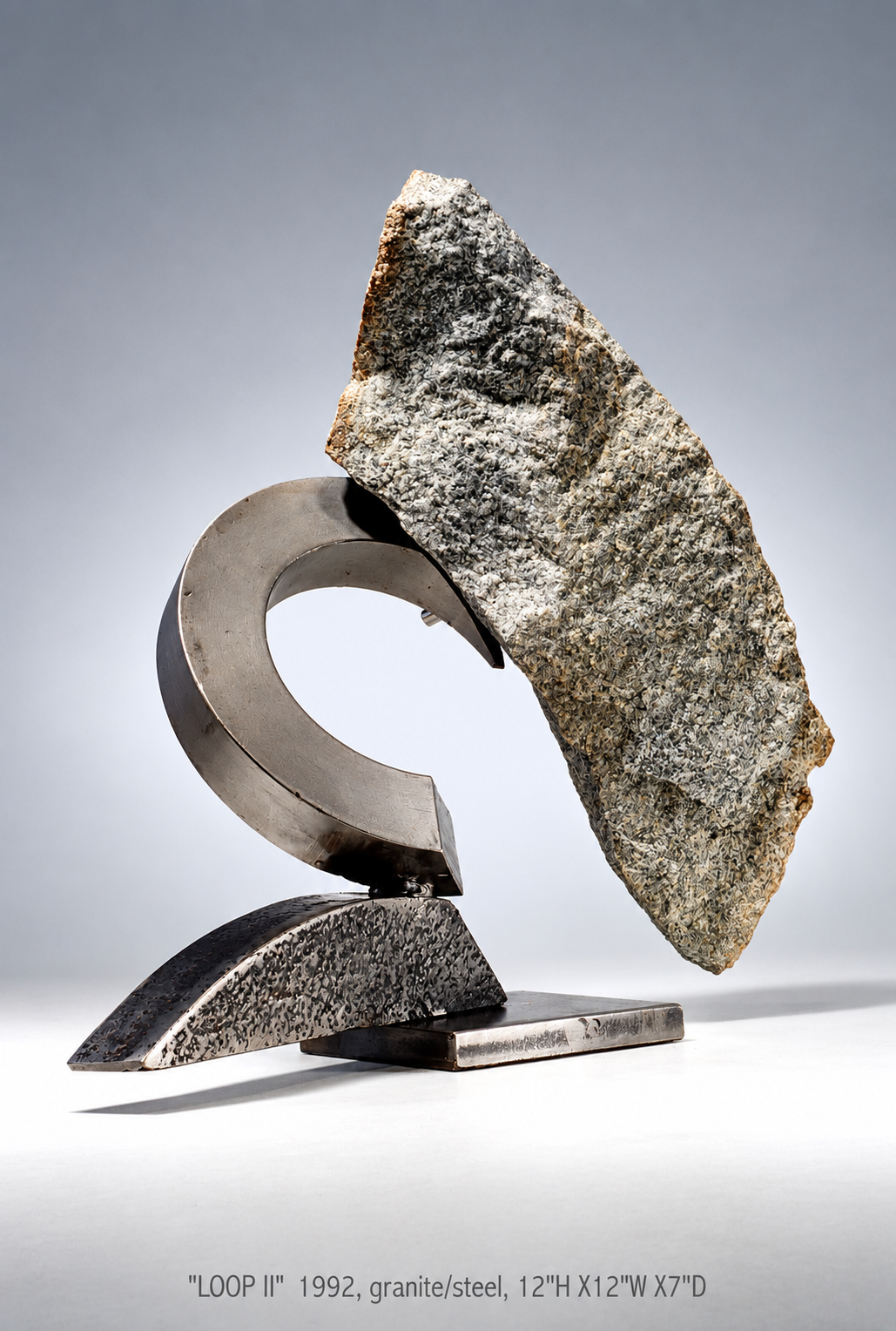
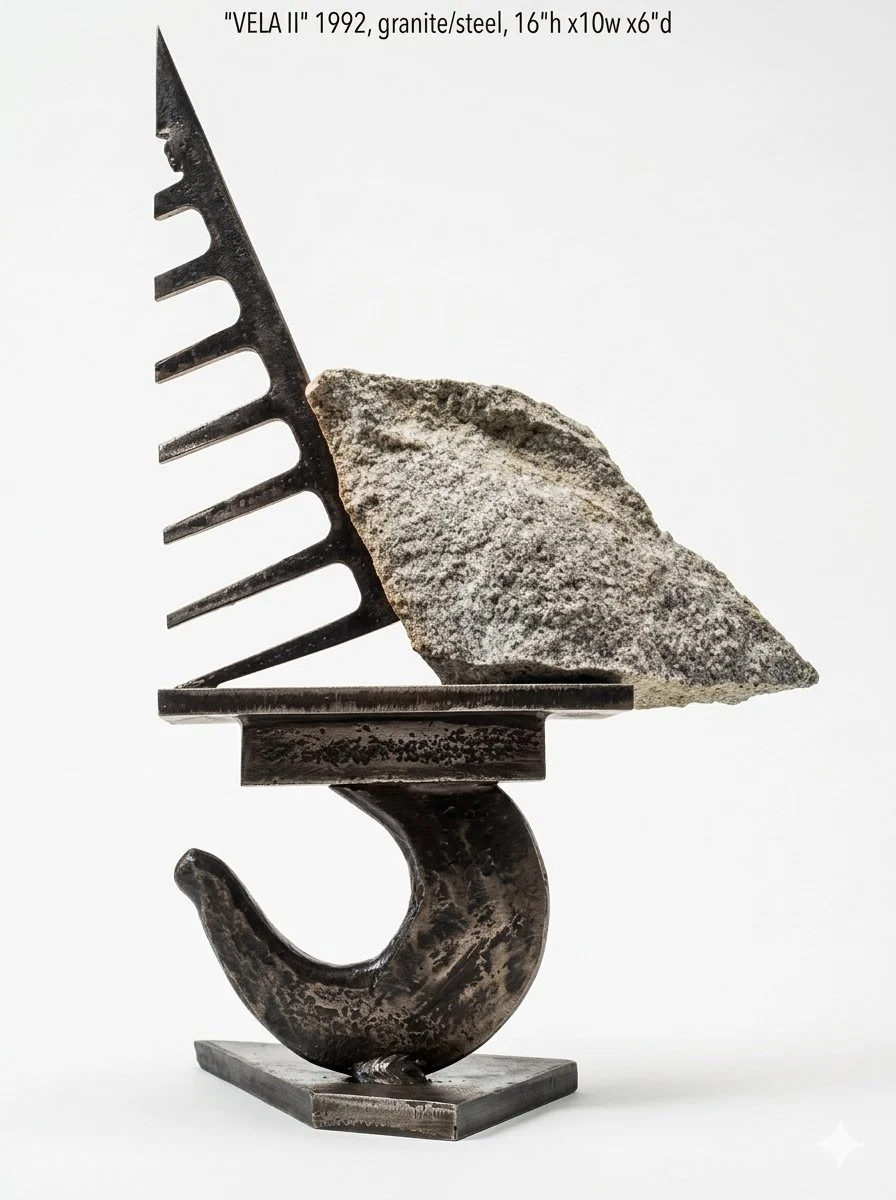
January 1992. Granite, steel. Dimensions: 16 × 10 × 6 in (41 × 25 × 15 cm). Private collection.
Vela II (S-99-01)
brings together two recurring interests in my work: tools and celestial imagery. The serrated steel form suggests a saw or cutting tool, reflecting my fascination with tools as extensions of the hand and symbols of human ingenuity and action. The granite balanced above creates a tension between natural and human-made materials, weight and equilibrium.
The title Vela comes from the southern constellation Vela, Latin for “sails.” The sail suggests navigation, movement, and journey, while the upward-reaching stone gives the sculpture a sense of propulsion and reflects my recurring interest in making heavy objects appear light.
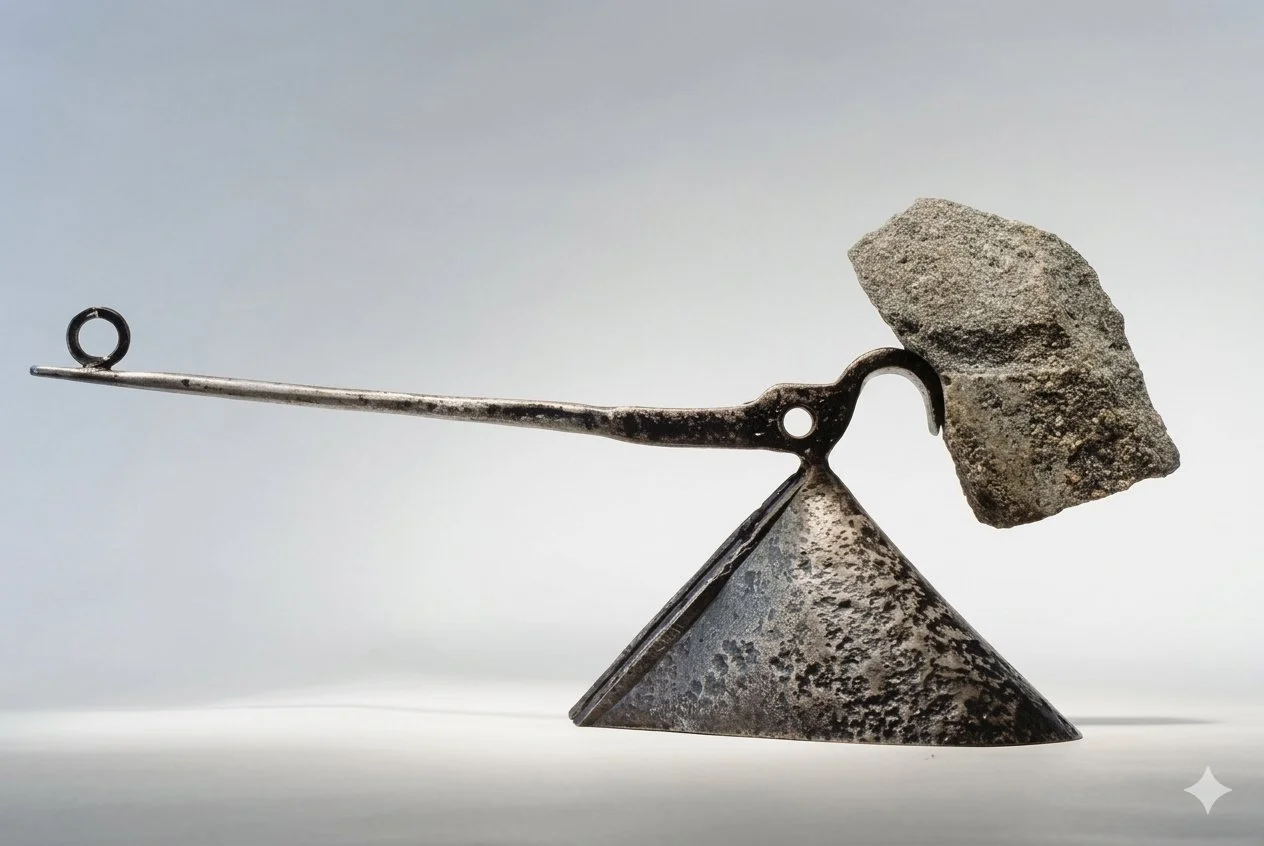
January 1992. Granite, steel. Dimensions: 9 × 19 × 5 in (23 × 48 × 13 cm). Private Collection - Aspen, CO
Beam I reflects my interest in tools and implements as extensions of the hand and in what I have described as their “raw, efficient beauty of form dictated by function.” The sculpture incorporates part of an actual tool, retaining and celebrating its physical shape and function while bringing it into a new relationship with granite and fabricated steel. As with the other works in the Beam Series, the title refers to the beam, or balance-beam scale—an appropriate instrument for work concerned with physical balance. Although the sculpture does not actually move, the long forged-steel rod poised across the small granite fulcrum suggests a teetering, precarious balance and a sense of arrested motion. Importantly, the Beam Series also marked the beginnings of ideas I would later develop in my Funambulist Series, where balance itself became an increasingly central metaphor.
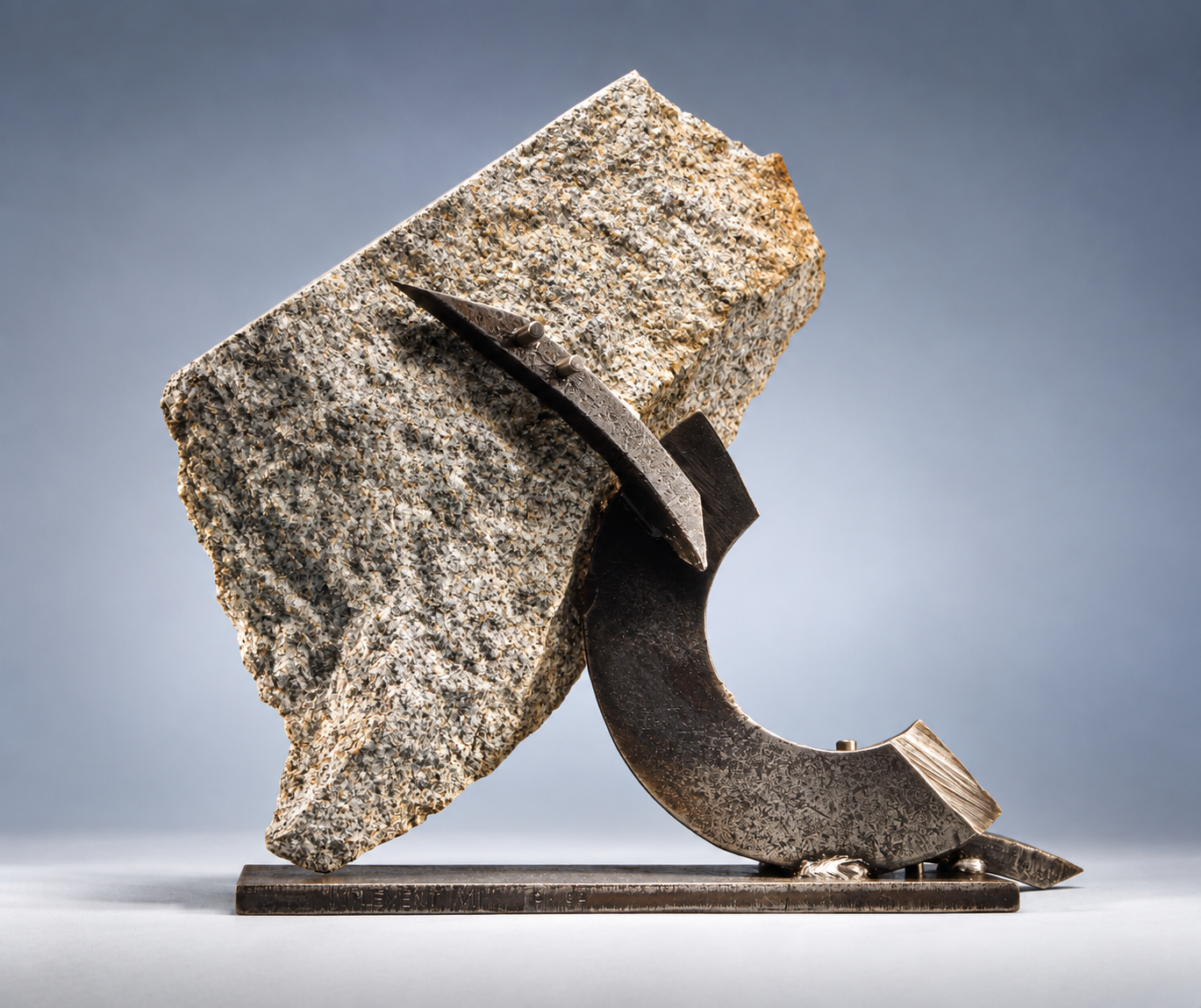
February 1992. Granite, steel. Dimensions: 13 × 14 × 5 in (33 × 36 × 13 cm). Private Collection Atlanta
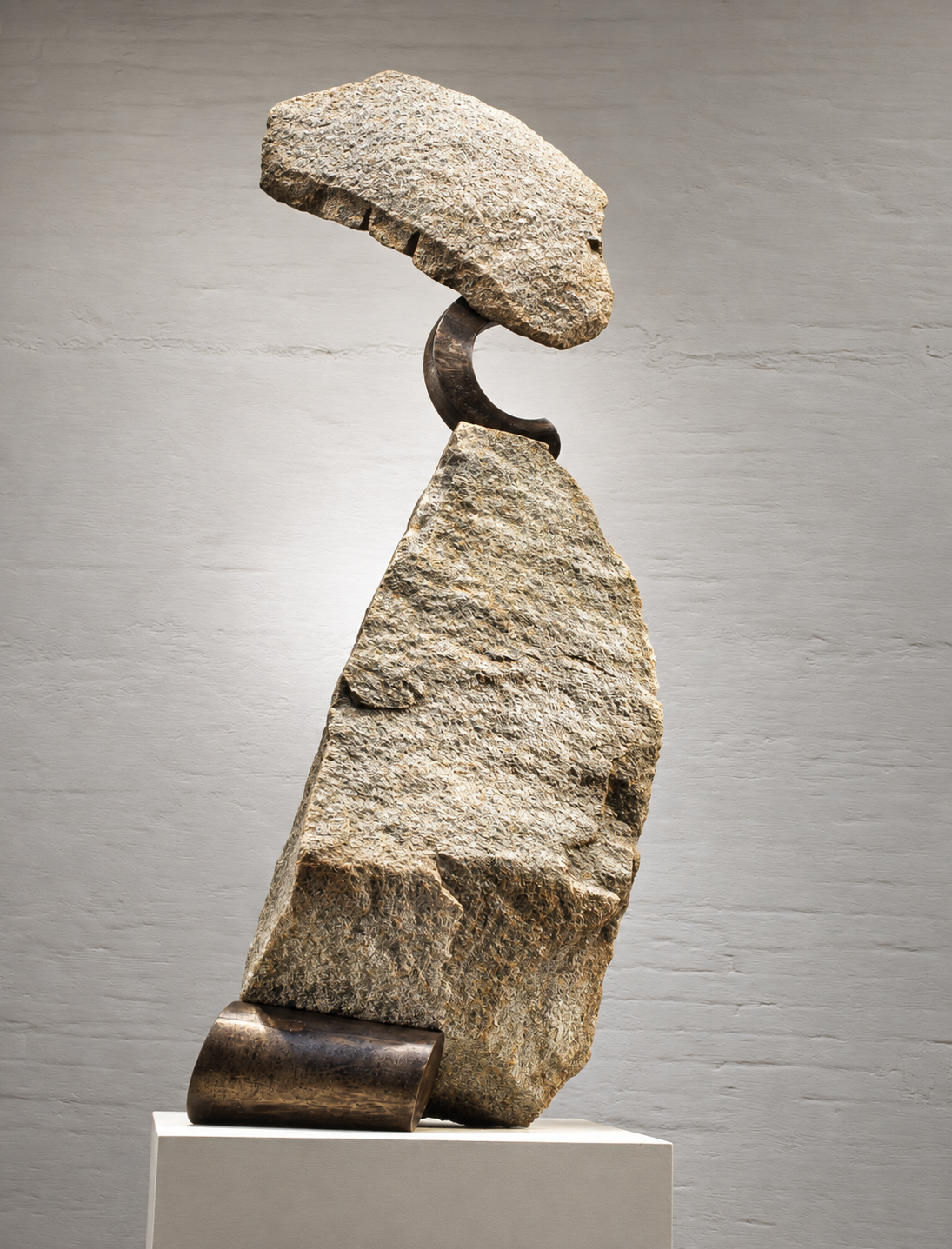
February 1992. Granite, steel. Dimensions: 72 × 34 × 20 in (183 × 86 × 51 cm). Private Collection Baltimore.
Aquila - a constellation “the Eagle”.
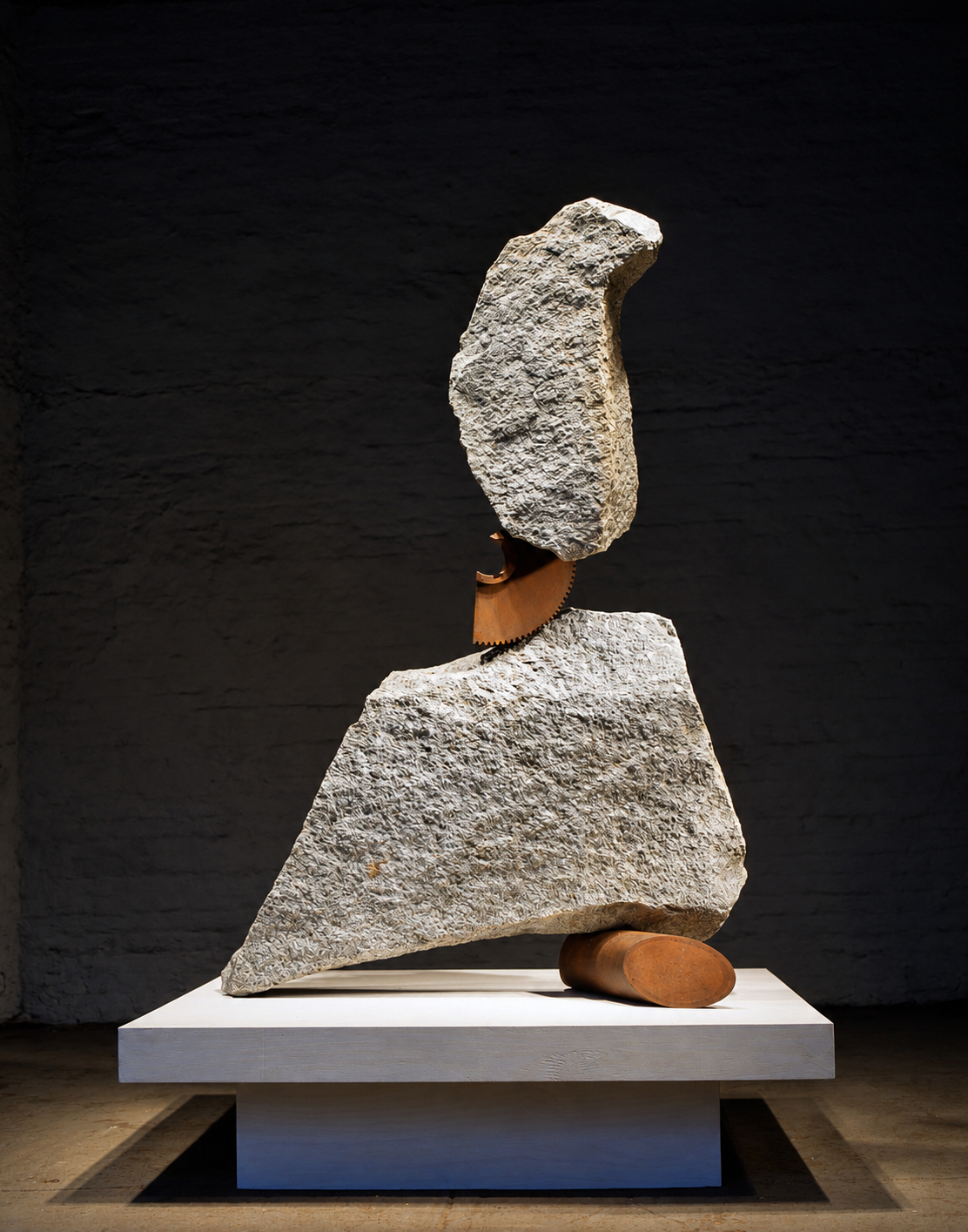
February 1992. Granite, steel. Dimensions: 70 × 46 × 24 in (178 × 117 × 61 cm).
Private colletion - California
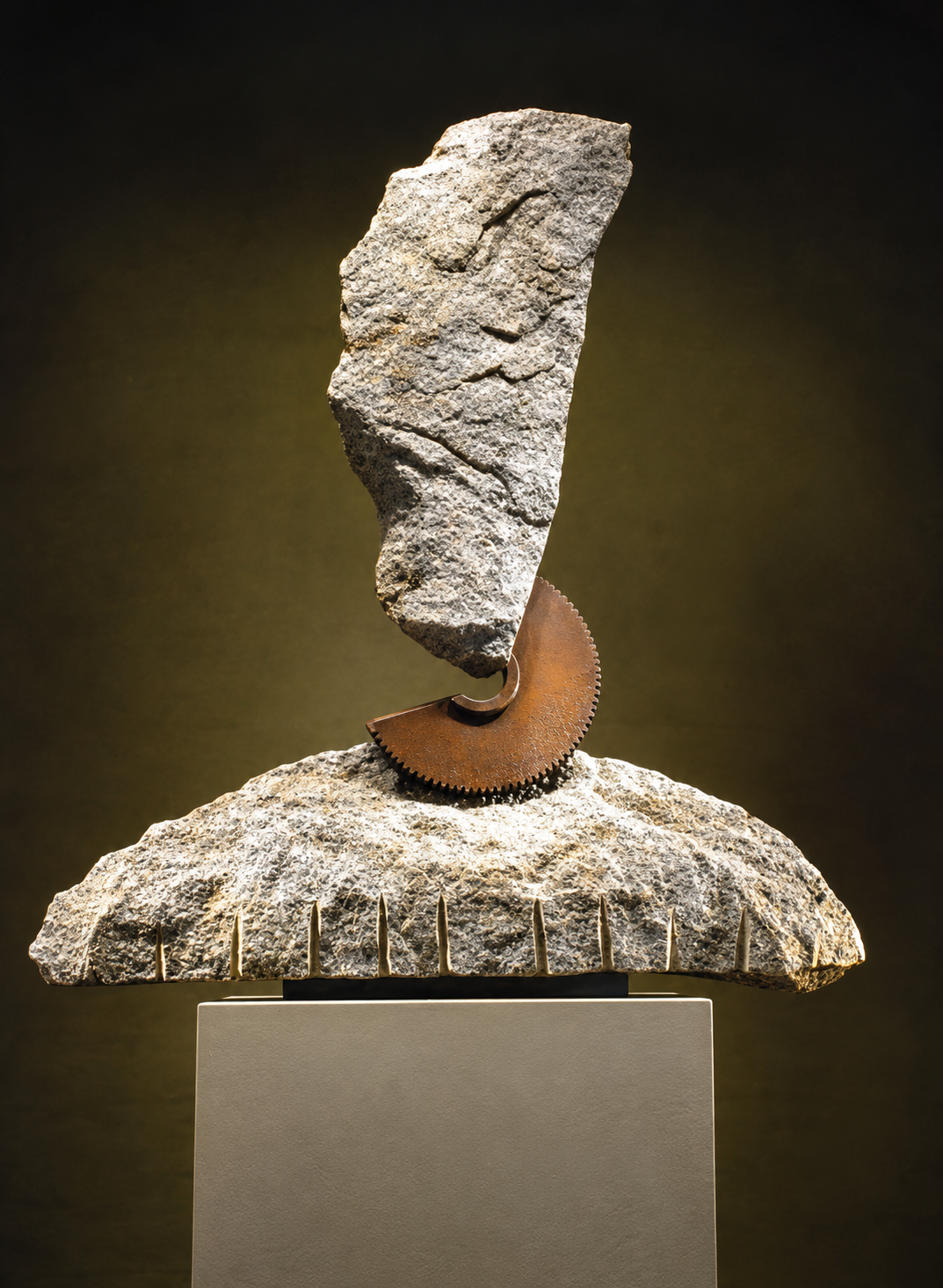
Vela: Latin for sail
February 1992. Granite, bronze. Dimensions: 61 × 52 × 14 in (155 × 132 × 36 cm).
Private collection
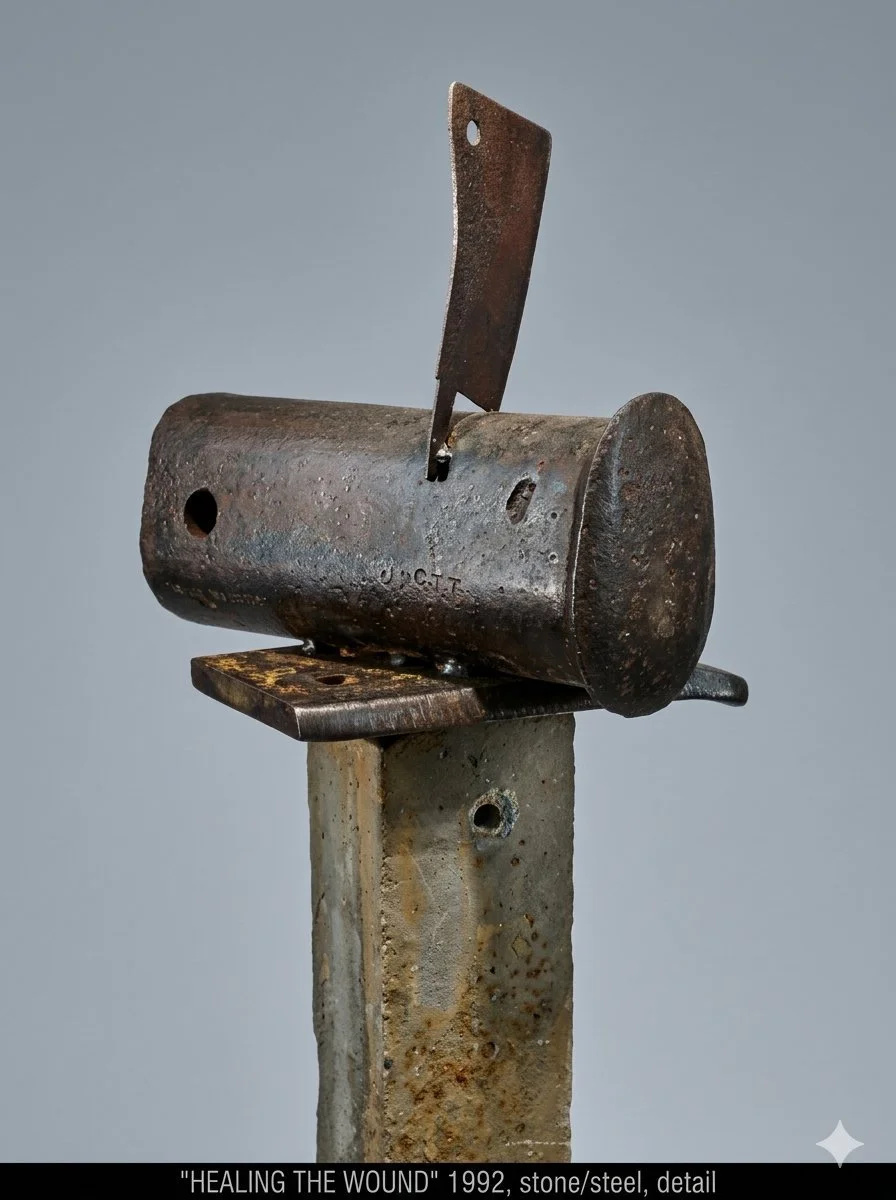
March 1992. Blue stone, steel. Dimensions: 60 × 14 × 16 in (152 × 36 × 41 cm). Disassembled and used for new work.
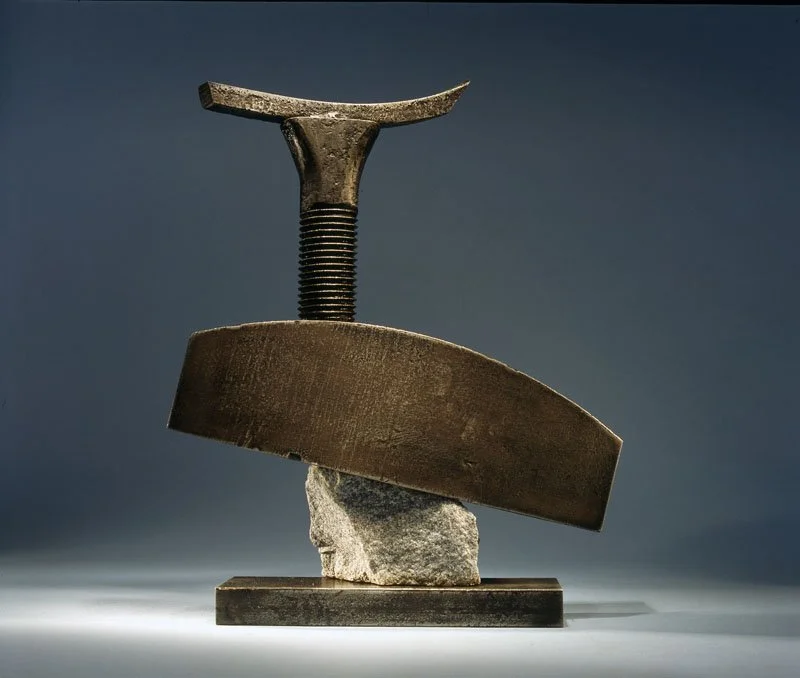
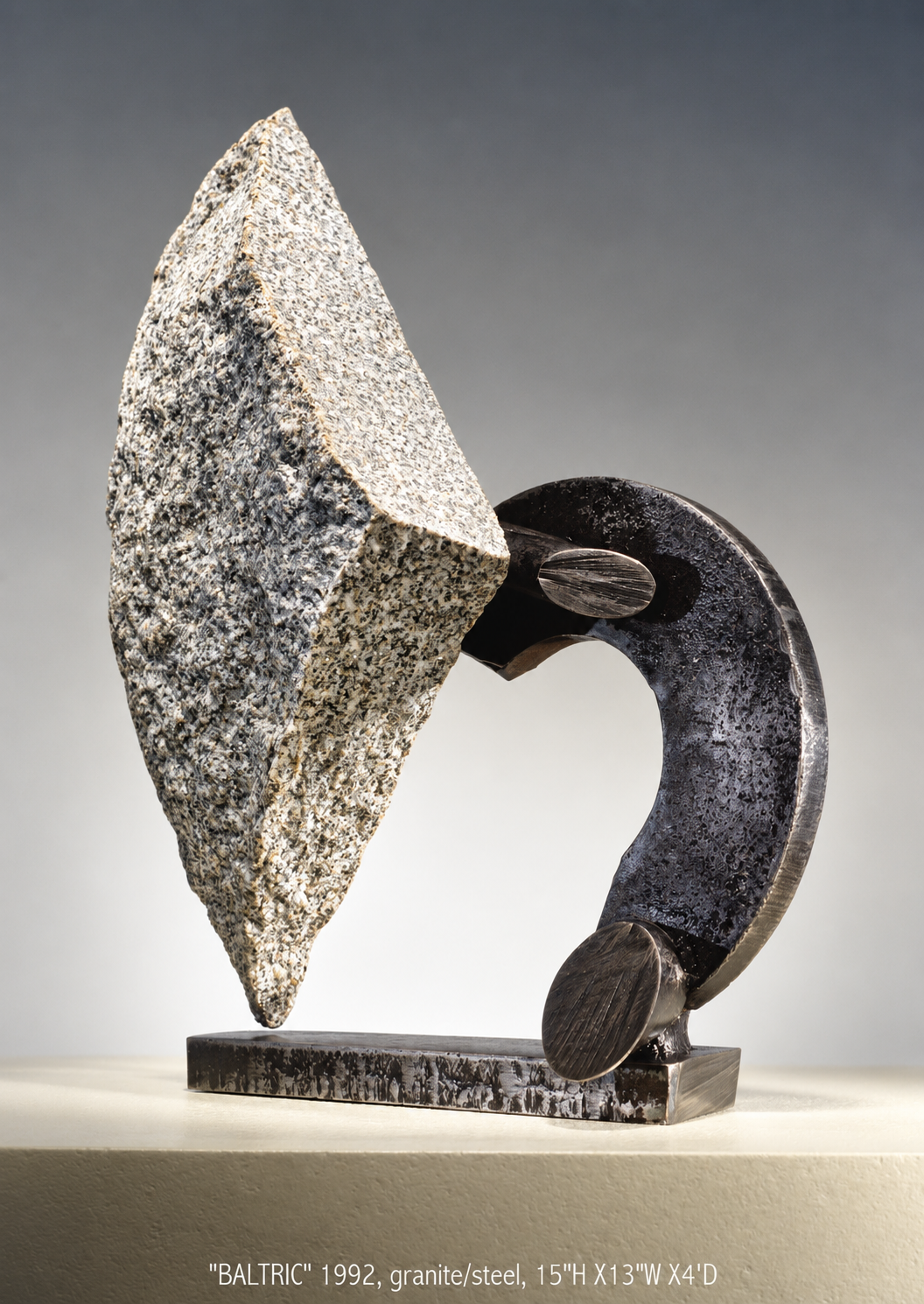
March 1992. Granite, steel. Dimensions: 15 × 13 × 4 in (38 × 33 × 10 cm). Private Collection.
A baldric (also baldrick, bawdrick, bauldrick as well as other rare or obsolete variations) is a belt worn over one shoulder that is typically used to carry a weapon (usually a sword) or other implement such as a bugle or drum.[1][2][3] The word may also refer to any belt in general, but this usage is poetic or archaic. In modern contexts, military drum majors usually wear a baldric.[4]
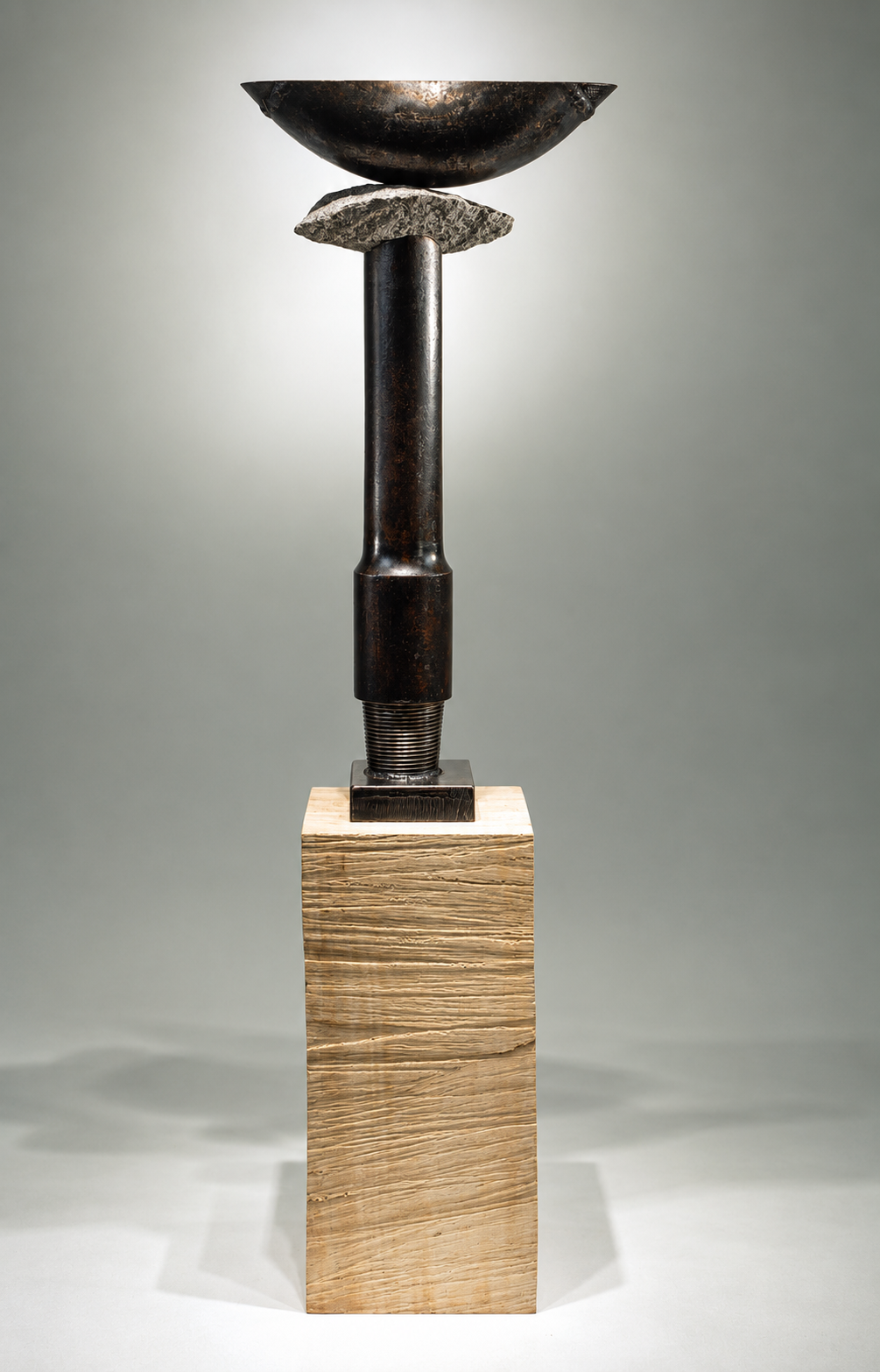
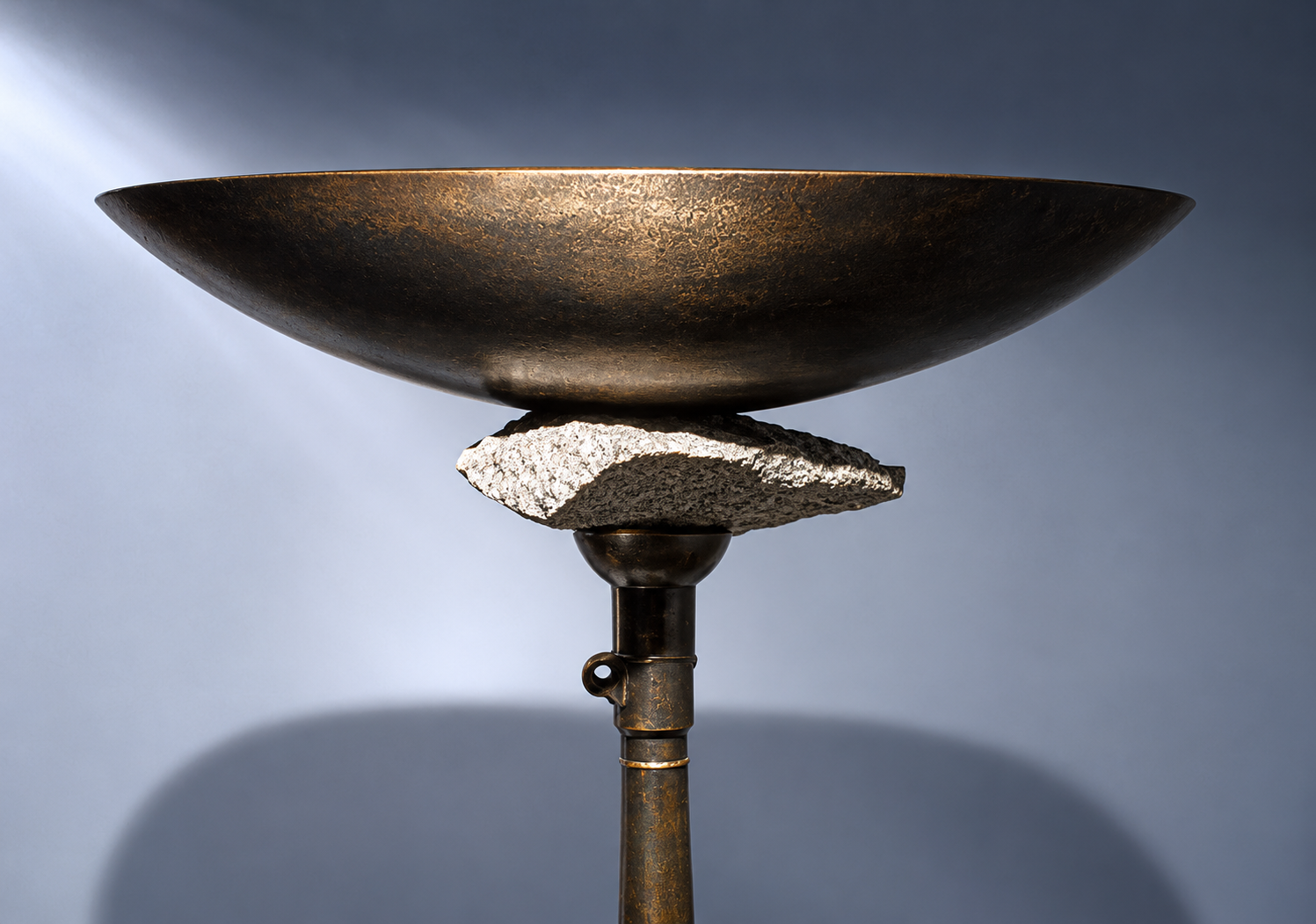
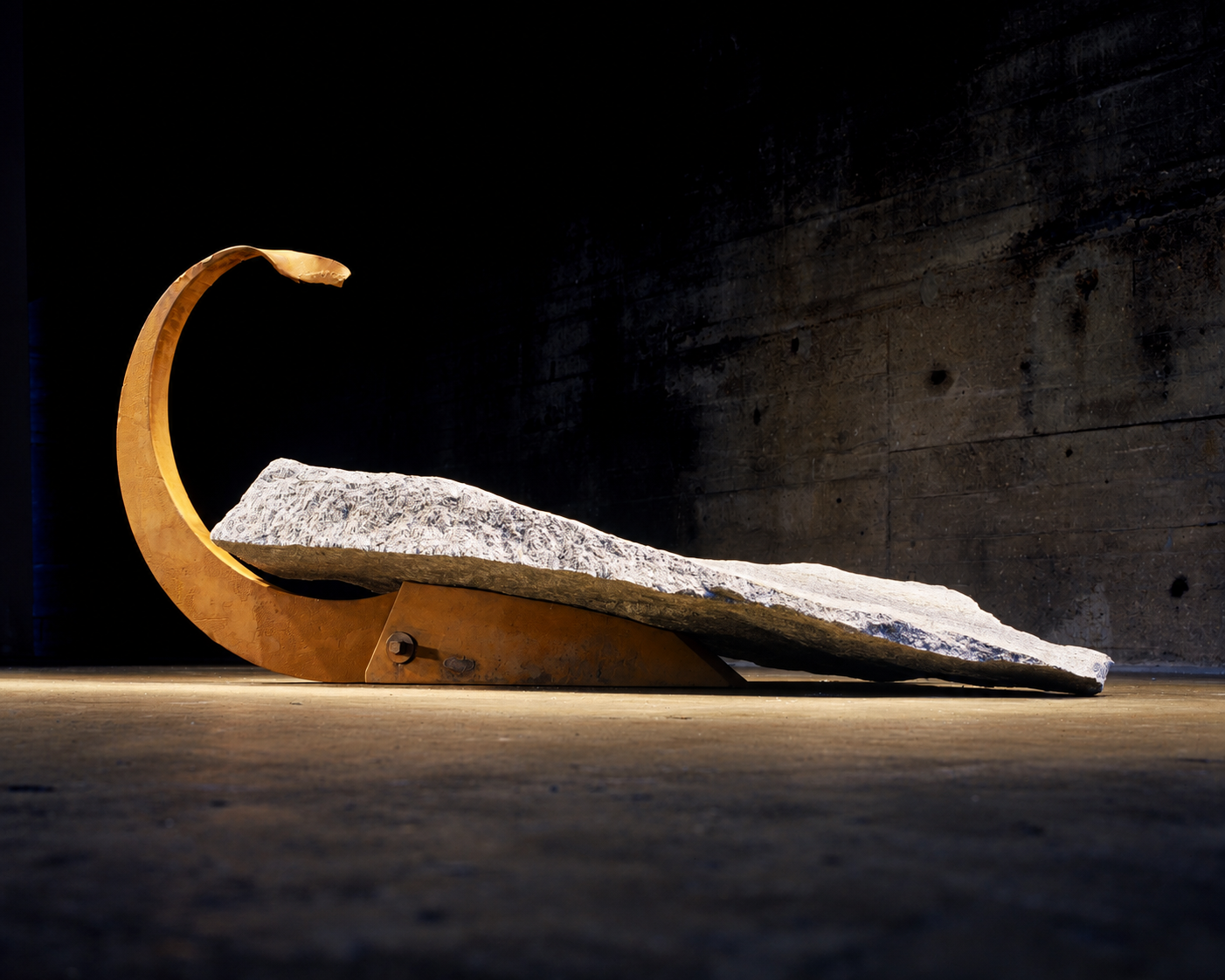
June 1992. Granite, steel. Dimensions: 30 × 64 × 42 in (76 × 163 × 107 cm).
sledge
Function: noun
Etymology: Dutch dialect sleedse; akin to Middle Dutch sledde sled
-a strong heavy sled often used to move stones
What makes this piece especially resonant is the merging of tool and cargo: the granite slab functions as both. This union collapses the distinction between means and end, reinforcing a sense of “oneness” between material, action, and intent. It's a key idea in Van Alstine's work—tools are not separate from the world they act upon, but deeply intertwined with it.
Within the sculptor's broader career, “Sledge” represents a foundational, almost primal form of navigation. Unlike later works that reference compasses or charting devices, this sculpture evokes a more direct, physical way of finding one's path—through effort, contact, and movement across the land. At the same time, its implied motion held in stillness reflects his ongoing ability to animate heavy materials, suggesting both the memory and potential of action.
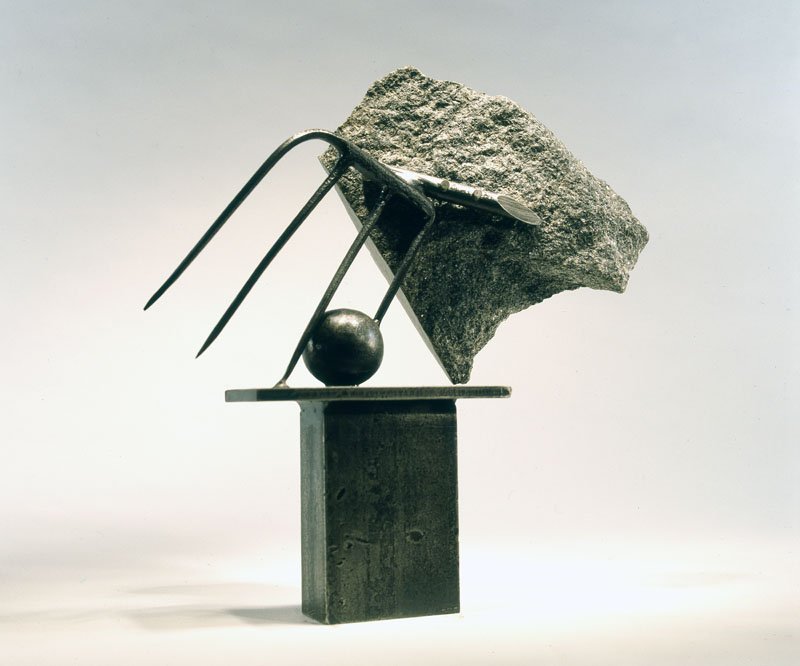
June 1992. Granite, steel. Dimensions: 16 × 15 × 4 in (41 × 38 × 10 cm).
Private collection - Washington, DC

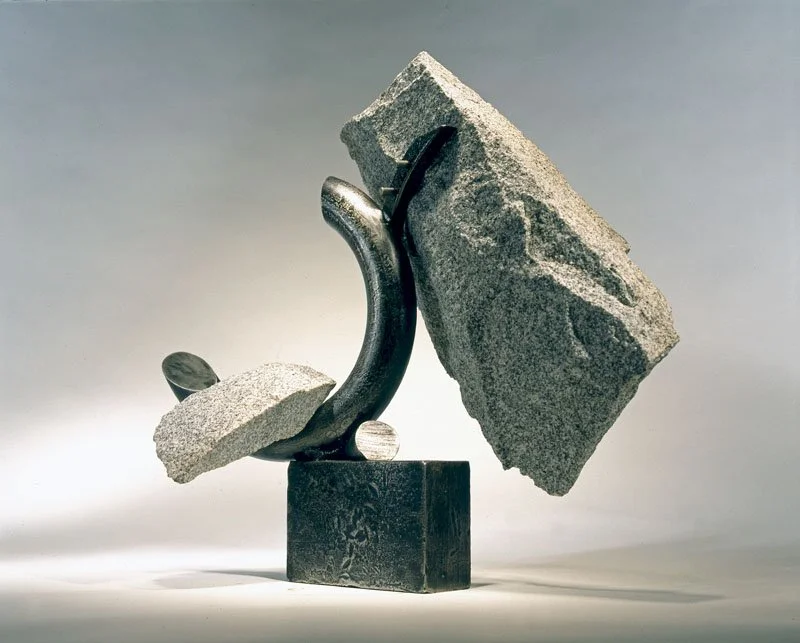

July 1992. Granite, steel. Dimensions: 20 × 18 × 6 in (51 × 46 × 15 cm).
Private Collection.
As a sculptor, I have always been fascinated by tools, implements, and instruments. I see them as extensions of the hand—essential allies in the act of making—and am drawn to their raw, efficient beauty, shaped over time by function and necessity. They also embody human ingenuity, labor, and our impulse to shape and engage the world around us.
Throughout my work, agricultural implements—rakes, plow blades, sledges, and tillers—as well as anvils, scales, compasses, and other instruments become both sculptural forms and vehicles for metaphor, suggesting ideas of balance, navigation, transformation, and our relationship to the natural world.
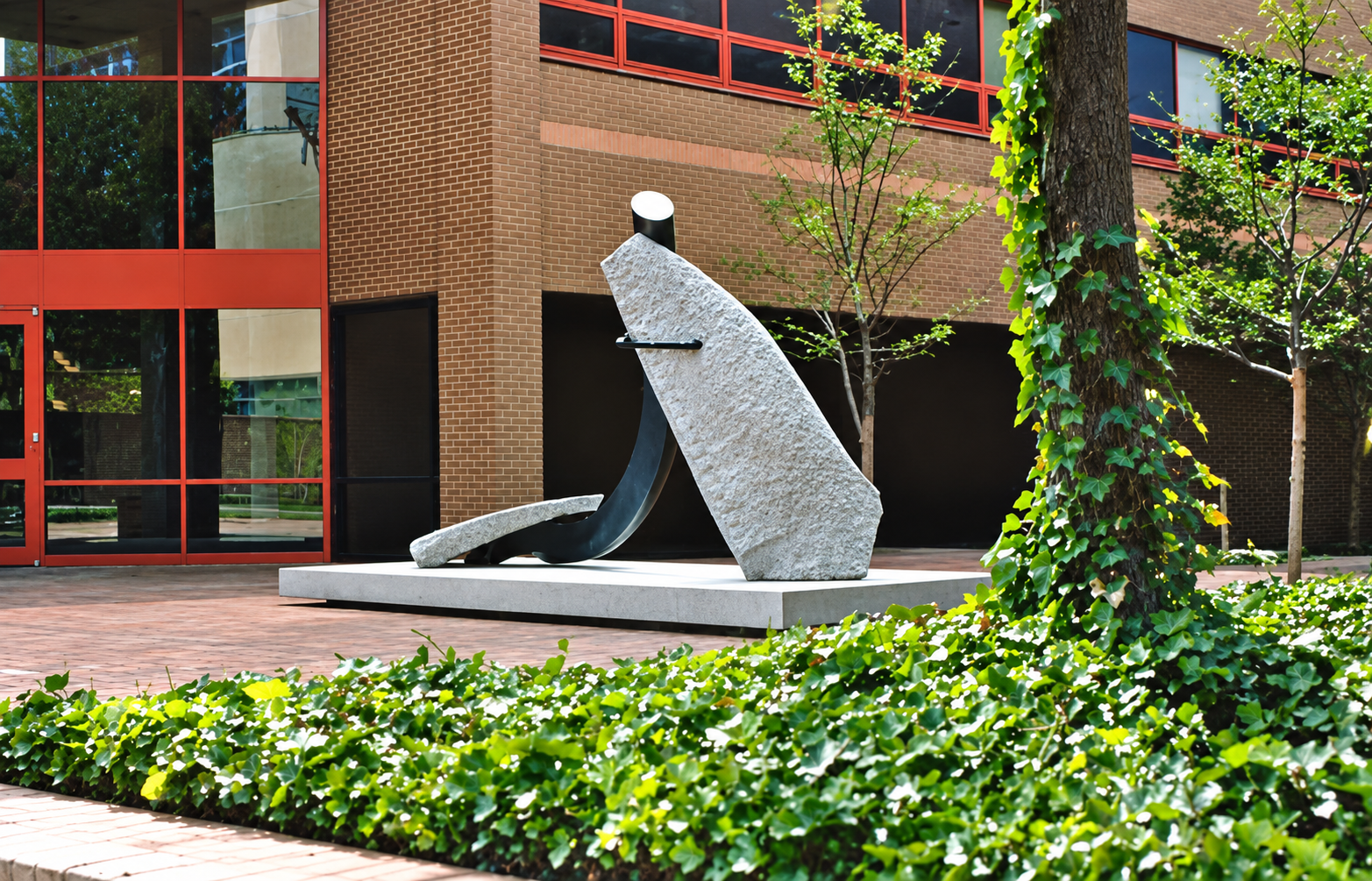
August 1992. Granite, painted steel. Dimensions: 9'h x16'w x6'd.
Collection: Jersey City State College - Commissioned by NJ State Public Arts Program
Reconsidering Sisyphus (1992) was commissioned for Jersey City State College (now New Jersey City University) as a monumental sculpture exploring one of humanity's oldest and most enduring myths. Drawing inspiration from the story of Sisyphus, John Van Alstine transforms the ancient tale from one of futility into a meditation on perseverance, renewal, and the human capacity to confront seemingly impossible challenges. Granite and steel combine in a dynamic composition that suggests both the weight of the stone and the energy required to move it.
Rather than illustrating the myth literally, Reconsidering Sisyphusinvites viewers to reconsider its meaning. The sculpture proposes that purpose is found not in reaching the summit, but in the continual act of striving. This early exploration of the Sisyphus theme foreshadowed Van Alstine's later Sisyphean Circle series, in which the ancient narrative became a central metaphor for resilience, creativity, and the enduring optimism of the human spirit.
MORE INFO: Reconsidering Sisyphus chapter in AMERICAN MONUMENTS
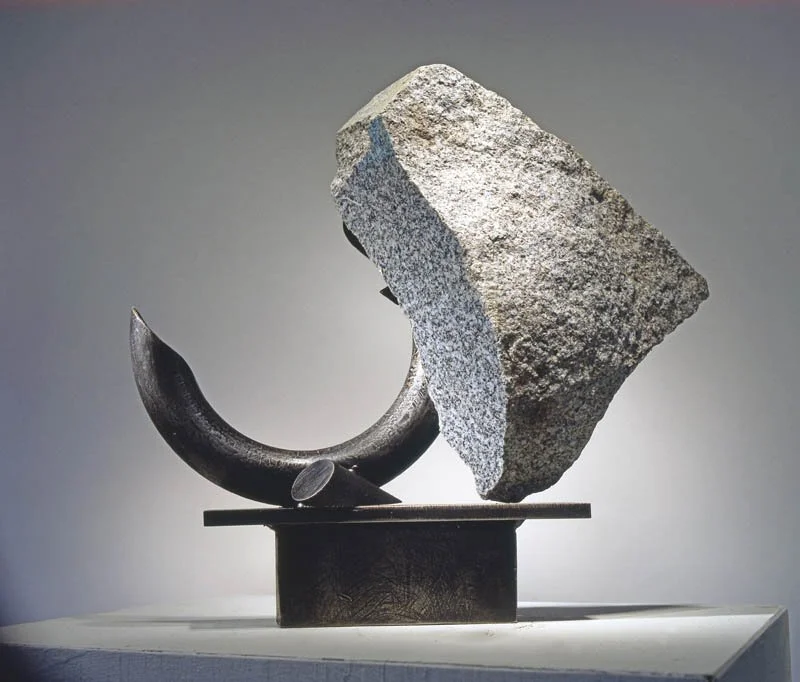
August 1992. Granite, steel. Dimensions: 14 × 15 × 4 in (36 × 38 × 10 cm). Private collection.
Cudgel III, 1992
Cudgel III is an early work in my Cudgel Series and reflects my interest in tools and implements as expressive sculptural forms. Here the sweeping curved steel suggests a handle, while the rough granite assumes the weight and presence of the head of a primitive hand tool or weapon—a cudgel.
Rather than depicting a specific tool, the sculpture uses the familiar relationship of handle and head to suggest physical action and human presence. The combination of stone and steel allows the work to shift between tool and abstract form.
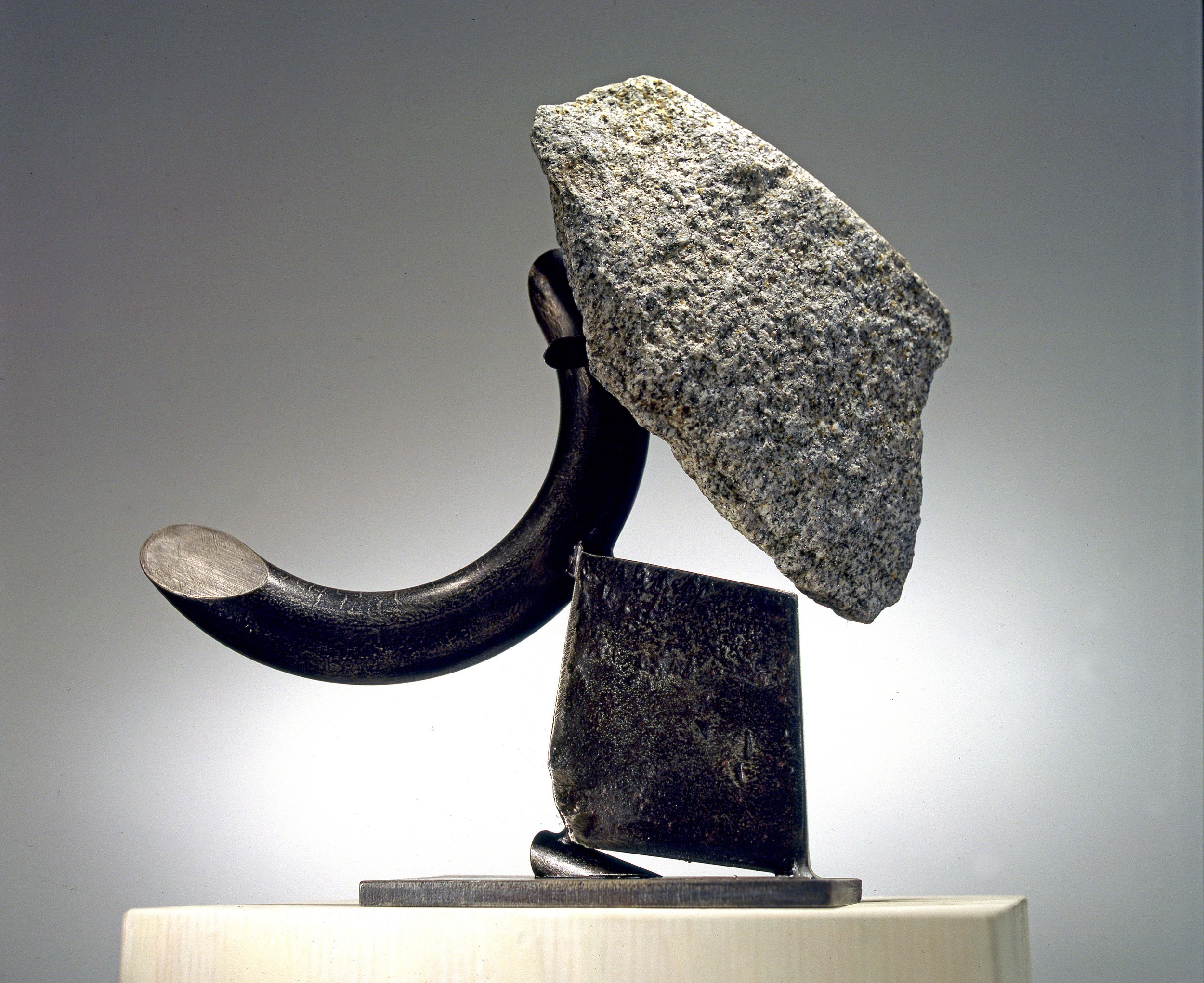
August 1992. Steel, granite. Dimensions: approx. 13"h 13"w x 4"d
Implement XI, 1997
Implement XI continues my interest in tools and implements as expressive sculptural subject matter. I have long been drawn to tools as extensions of the hand—objects whose “raw, efficient beauty of form” is dictated by function. Here the sweeping curved steel assumes the position of a handle, while the rough granite suggests the head or blade of a primitive hand tool—perhaps an adze, hatchet, or tomahawk.
Although conceived as an implement, the arrangement also suggests a human figure. The curved steel reads as both tool handle and bodily gesture, while its implied use acknowledges the presence of the human figure.
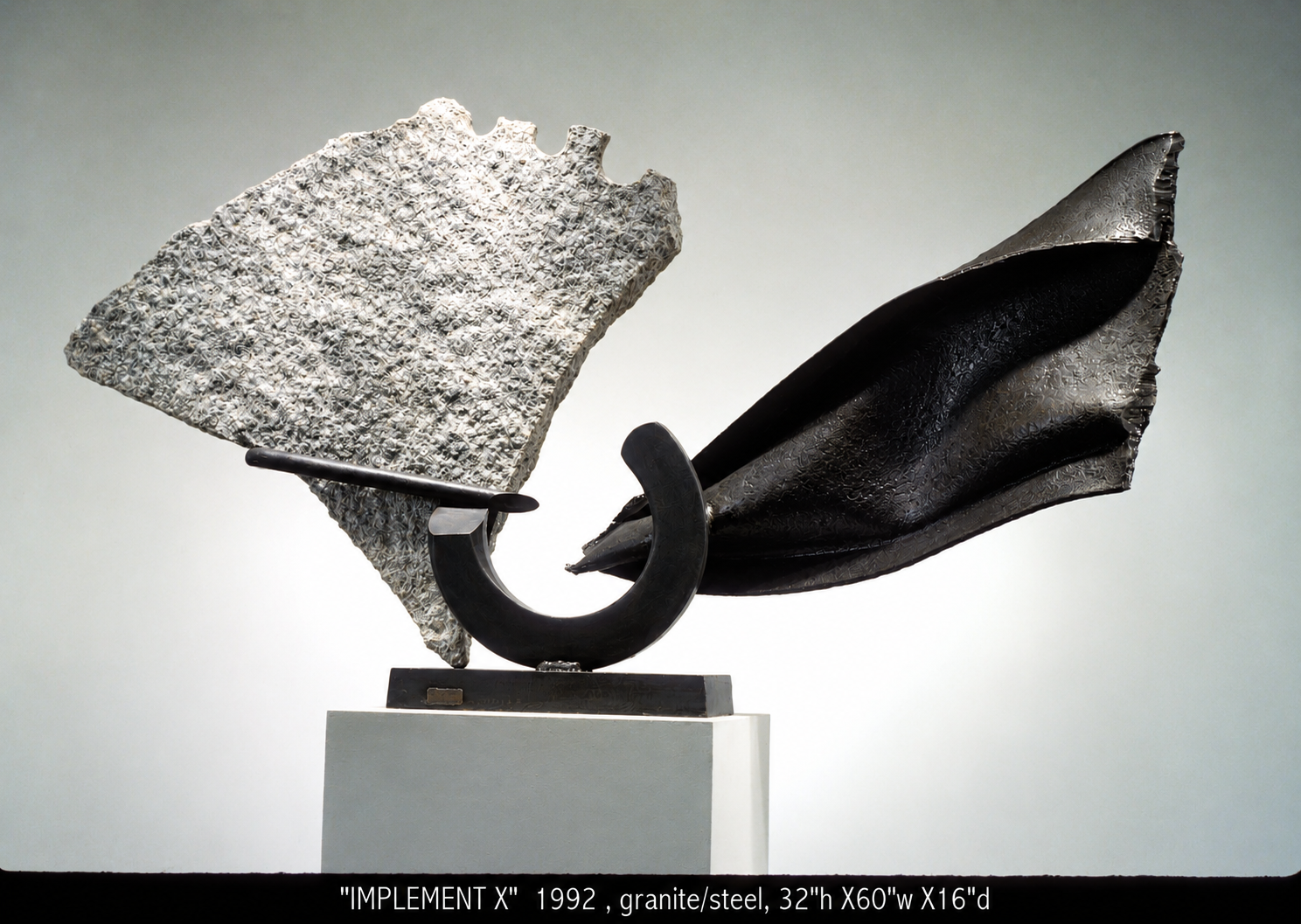
September 1992. Granite, steel. Dimensions: 32 × 60 × 16 in (81 × 152 × 41 cm).
Private Collection - Mexico
As a sculptor, I have always been fascinated by tools, implements, and instruments. I see them as extensions of the hand—essential allies in the act of making—and am drawn to their raw, efficient beauty, shaped over time by function and necessity. They also embody human ingenuity, labor, and our impulse to shape and engage the world around us.
Throughout my work, agricultural implements—rakes, plow blades, sledges, and tillers—as well as anvils, scales, compasses, and other instruments become both sculptural forms and vehicles for metaphor, suggesting ideas of balance, navigation, transformation, and our relationship to the natural world.

September 1992. Granite, steel. Dimensions: 12 × 12 × 4 in (30 × 30 × 10 cm).
Private collection.
As a sculptor, I have always been fascinated by tools, implements, and instruments. I see them as extensions of the hand—essential allies in the act of making—and am drawn to their raw, efficient beauty, shaped over time by function and necessity. They also embody human ingenuity, labor, and our impulse to shape and engage the world around us.
Throughout my work, agricultural implements—rakes, plow blades, sledges, and tillers—as well as anvils, scales, compasses, and other instruments become both sculptural forms and vehicles for metaphor, suggesting ideas of balance, navigation, transformation, and our relationship to the natural world.
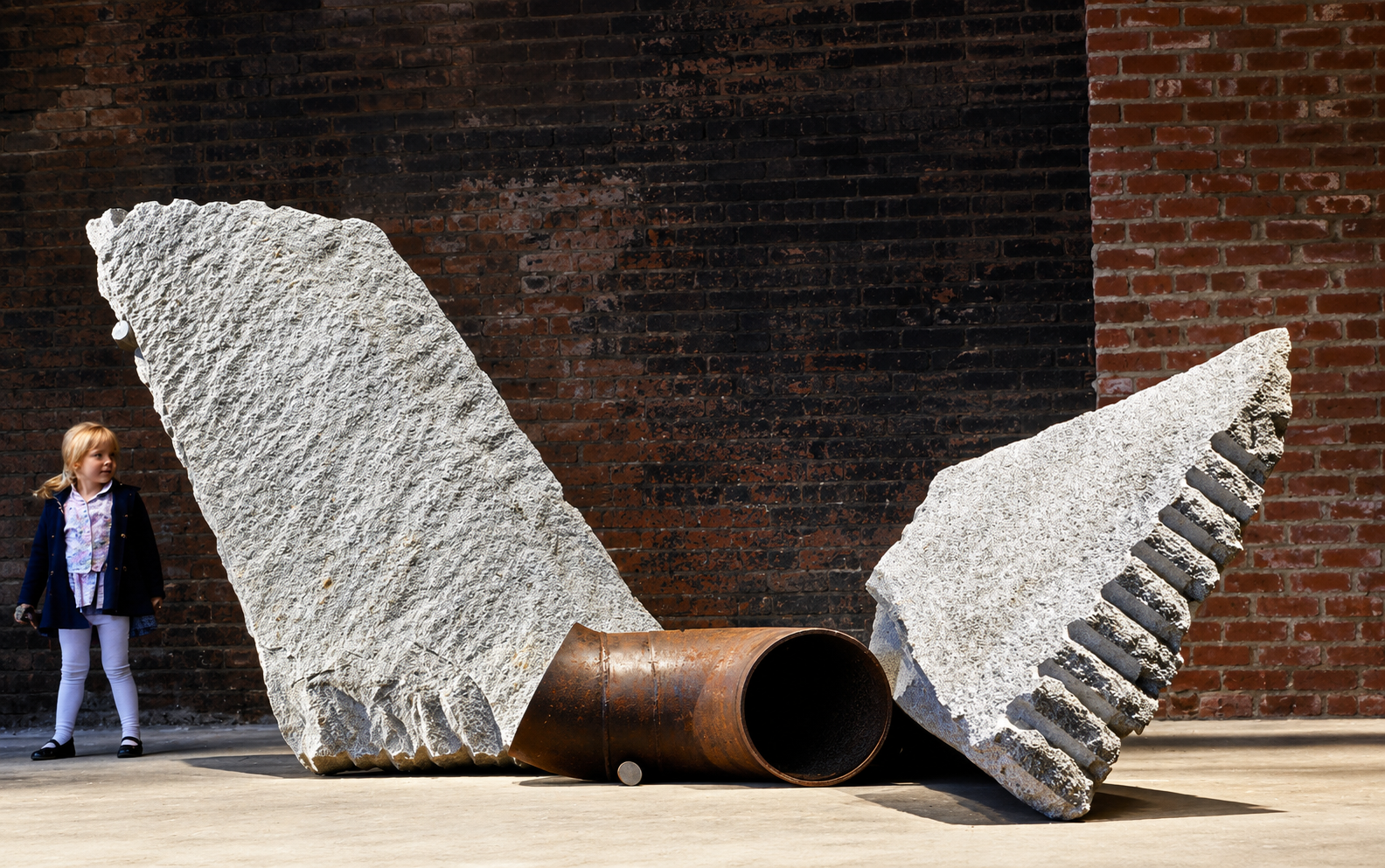
October 1992. Granite, steel. Dimensions: 64 × 134 × 56 in (163 × 340 × 142 cm). Parts used for new works 2010.
Splay, 1992
Like much of my work, Splay explores the relationship between natural and human-made materials. The title refers to the positioning of the sculpture’s elements, which suggest the act of opening or spreading outward. The massive granite forms appear caught in a moment of movement, their weight held in a state of arrested motion. In this sense, splay functions as a verb, implying action and the forces at work within the sculpture.
I also like the title’s meaning as a noun, particularly its architectural use: a sloped or beveled surface that forms an oblique angle, as in a doorway or window opening that widens toward one face of a wall. This dual meaning—both an action and an architectural form—reinforces the sculpture’s interplay of movement, mass, and structure.
October 1992. Pink granite, steel. Dimensions: 11 × 10 × 4 in (28 × 25 × 10 cm).
no photo
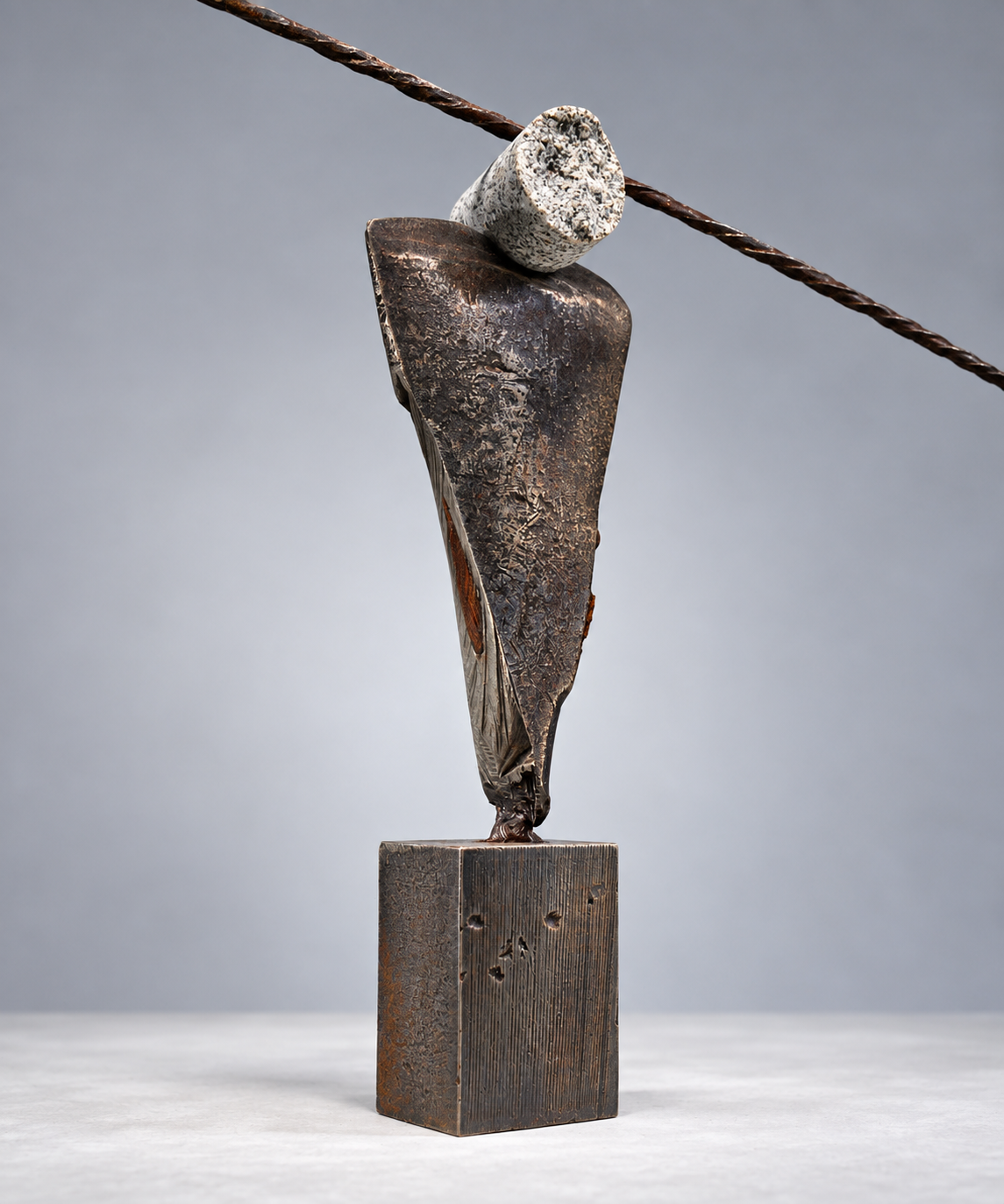
October 1992. Granite, steel. Dimensions: 12 × 21 × 4 in (30 × 53 × 10 cm). Private Collection.
Beam III, 1992
Beam III continues my interest in tools and implements as extensions of the hand and in what I have described as their “raw, efficient beauty of form dictated by function.” The sculpture incorporates part of an actual tool, retaining and celebrating its physical shape and function while bringing it into a new relationship with granite and fabricated steel.
As with the other works in the Beam Series, the title refers to the beam, or balance-beam scale—an appropriate instrument for work concerned with physical balance. Although the sculpture does not actually move, the long forged-steel rod poised across the small granite fulcrum suggests a teetering, precarious balance and a sense of arrested motion. Importantly, the Beam Series also marked the beginnings of ideas I would later develop in my Funambulist Series, where balance itself became an increasingly central metaphor.
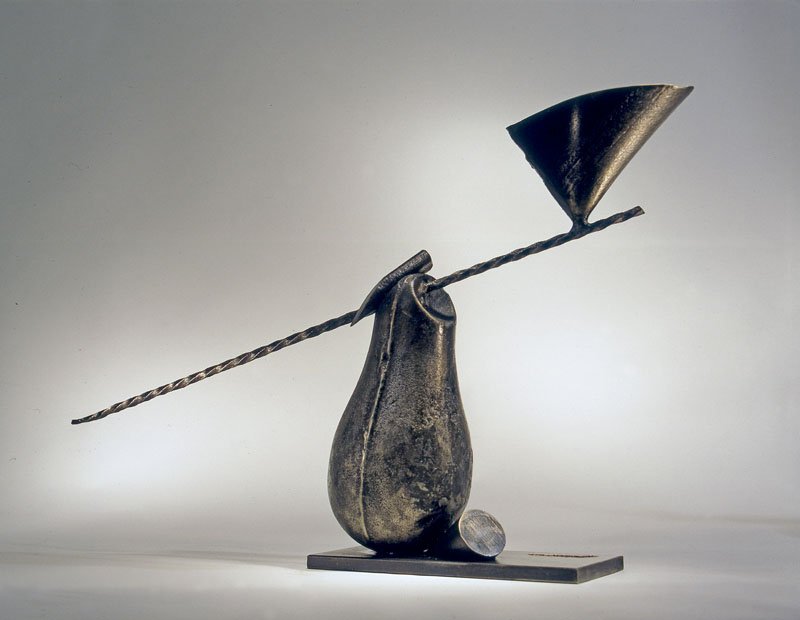
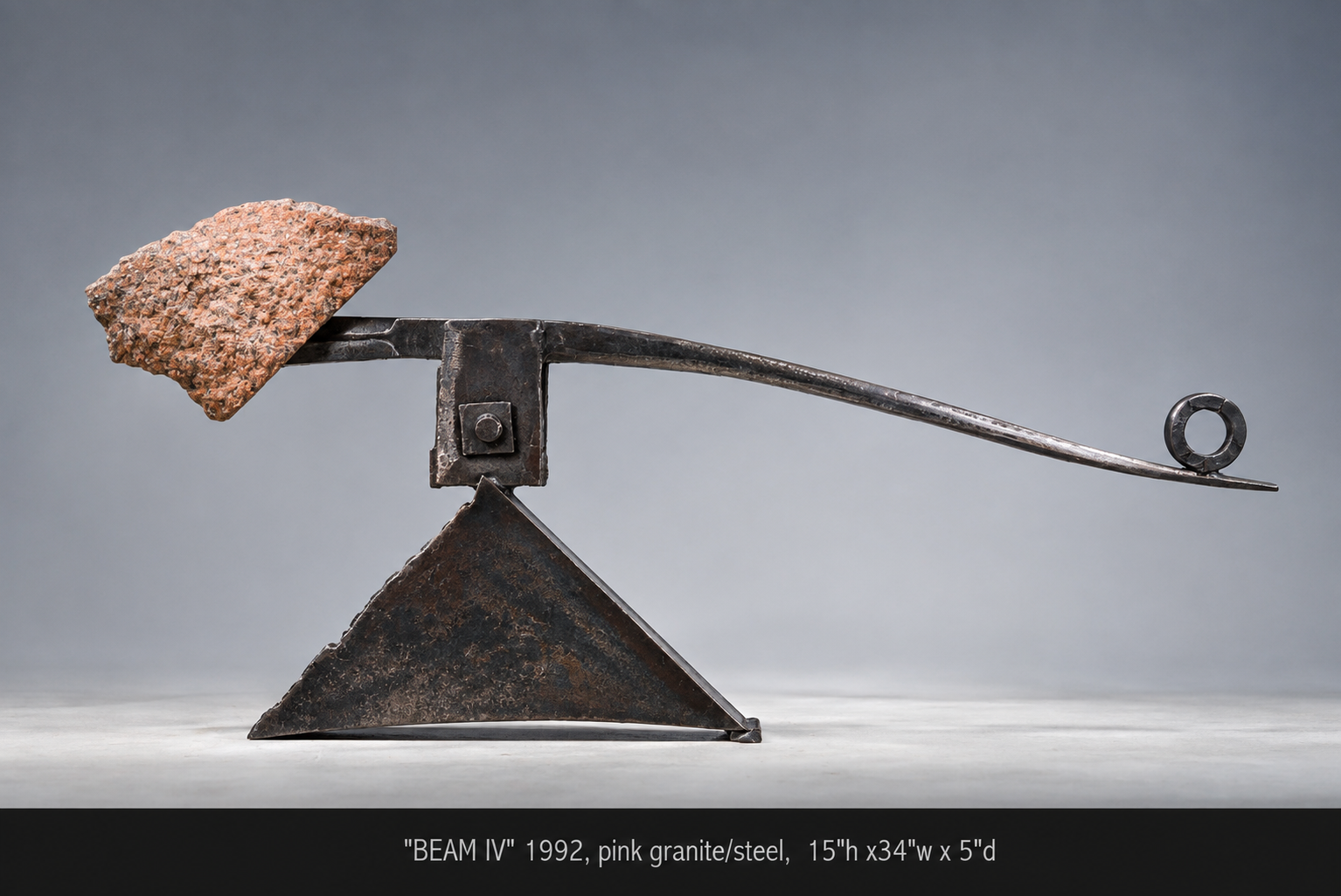
November 1992. Pink granite, steel. Dimensions: 15 × 34 × 5 in (38 × 86 × 13 cm). Private collection - Philadelphia
Beam IV, 1992
Beam IV is part of a series that brings together my interest in tools, physical balance, and the relationship between rough stone and industrial steel. The title refers to a beam, or balance-beam scale, a tool that has provided an especially appropriate sculptural vehicle because so much of my work deals with weight and balance. Here, part of an actual tool is incorporated into the sculpture, retaining and celebrating the directness of its functional shape while becoming part of a new visual structure.
Although the beam does not move, its off-center fulcrum, elongated steel arm, and granite weight suggest a teetering, precarious balance. Weight, leverage, and counterbalance animate the earthbound materials, making gravity and balance active elements of the work.
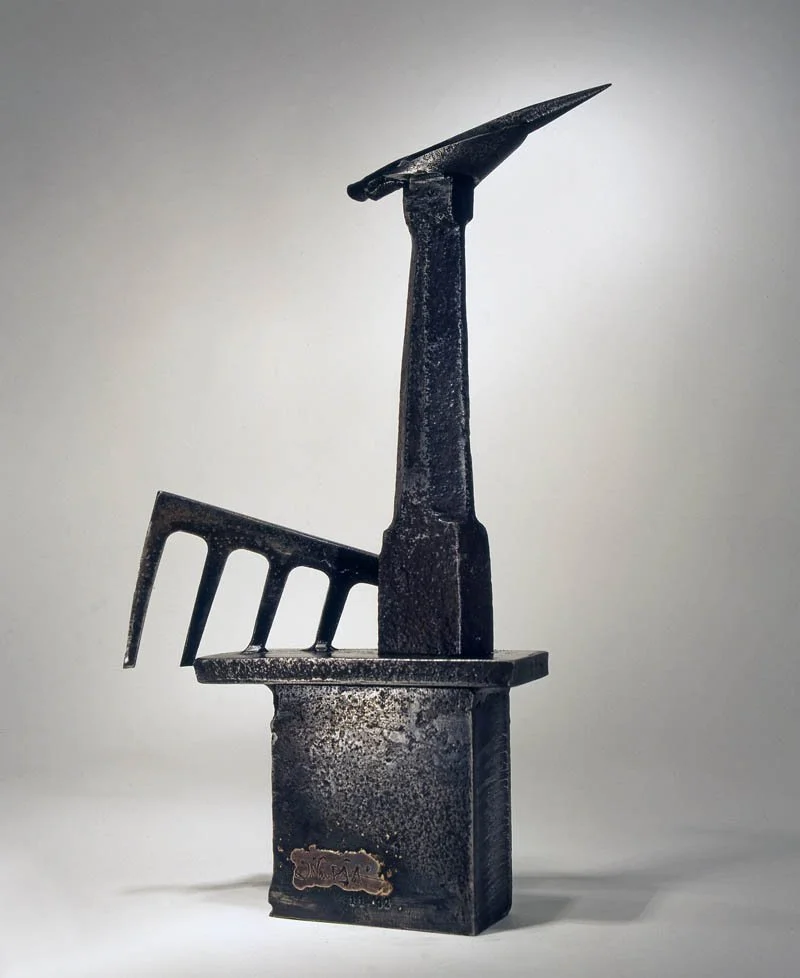
November 1992. Pink granite, steel. Dimensions: 17 × 12 × 31 in (43 × 30 × 79 cm).
no photo
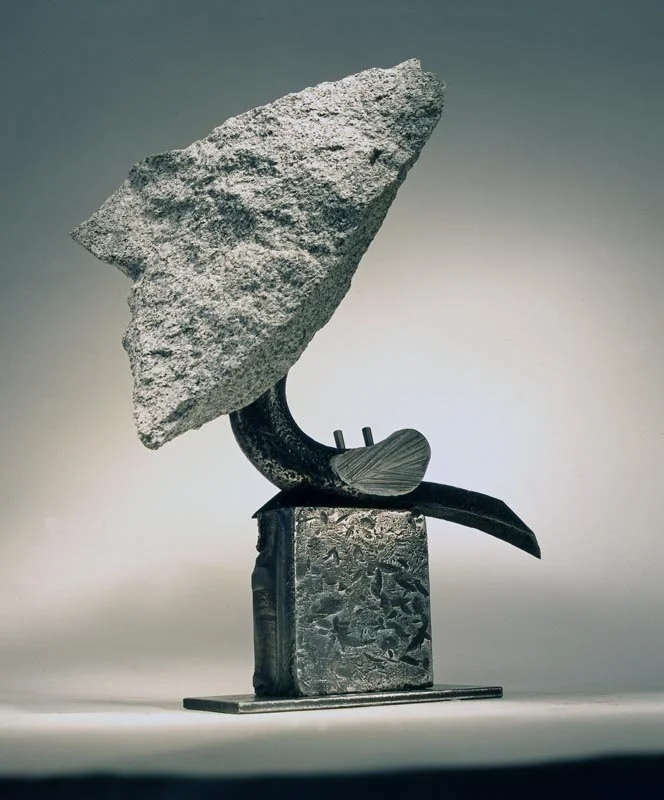
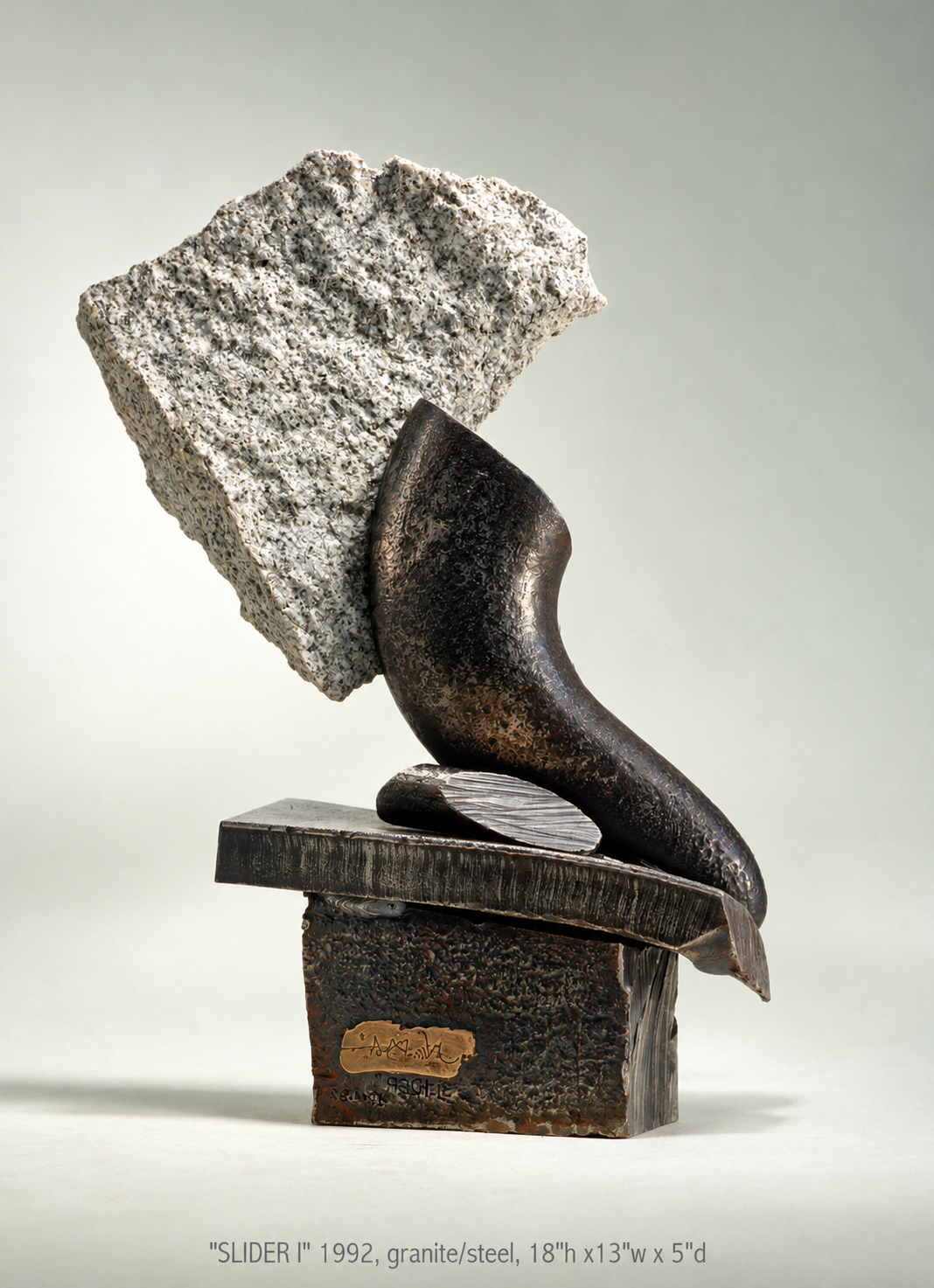
December 1992. Granite, steel. Dimensions: 13 × 8 × 5 in (33 × 20 × 13 cm). Private collection - Baltimore.
Slider I, 1992
Slider I is the first in a series and continues my interest in tools and implements as extensions of the hand and in their “raw, efficient beauty of form dictated by function.” Here I incorporated the tip of a large crane lifting hook, celebrating its powerful shape while combining it with rough granite and fabricated steel.
The title Slider comes from the fluid, sliding movement suggested by the forms. The curved hook sweeps through the compact composition while the granite appears to ride along it, giving considerable weight and solidity an unexpected sense of movement and balance.
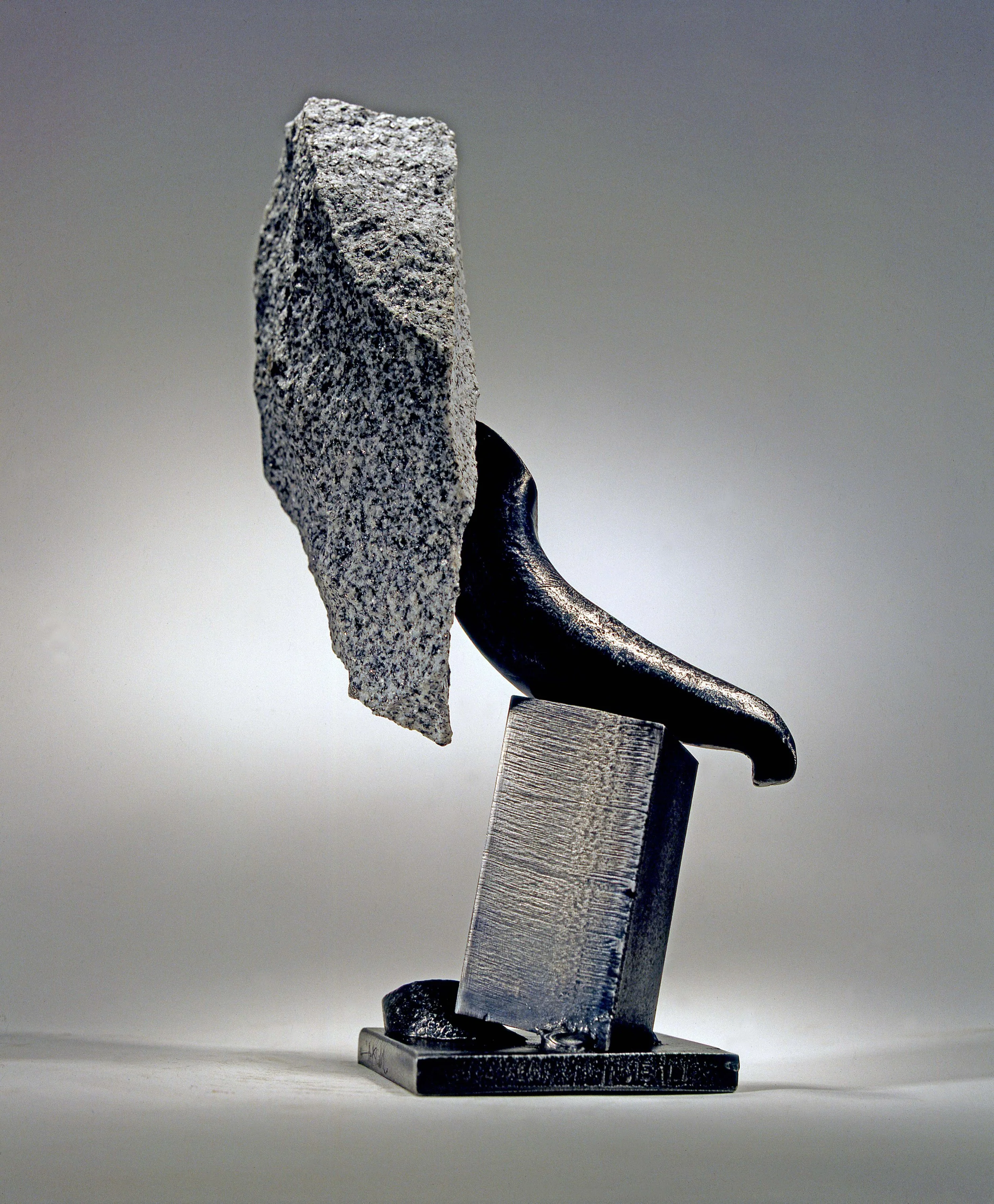
December 1992. Granite, steel. Dimensions: 12 × 6 × 4 in (30 × 15 × 10 cm). Destroyed - accident.
Slider II, 1992
Slider II follows Slider I and continues my interest in tools and implements and their “raw, efficient beauty of form dictated by function.” Here again I use the tip of a large crane lifting hook, celebrating its powerful shape while combining it with rough granite and fabricated steel.
The title Slider comes from the fluid, sliding movement suggested by the forms. The curved hook sweeps upward against the granite, giving this compact arrangement of heavy materials an unexpected sense of motion and balance.
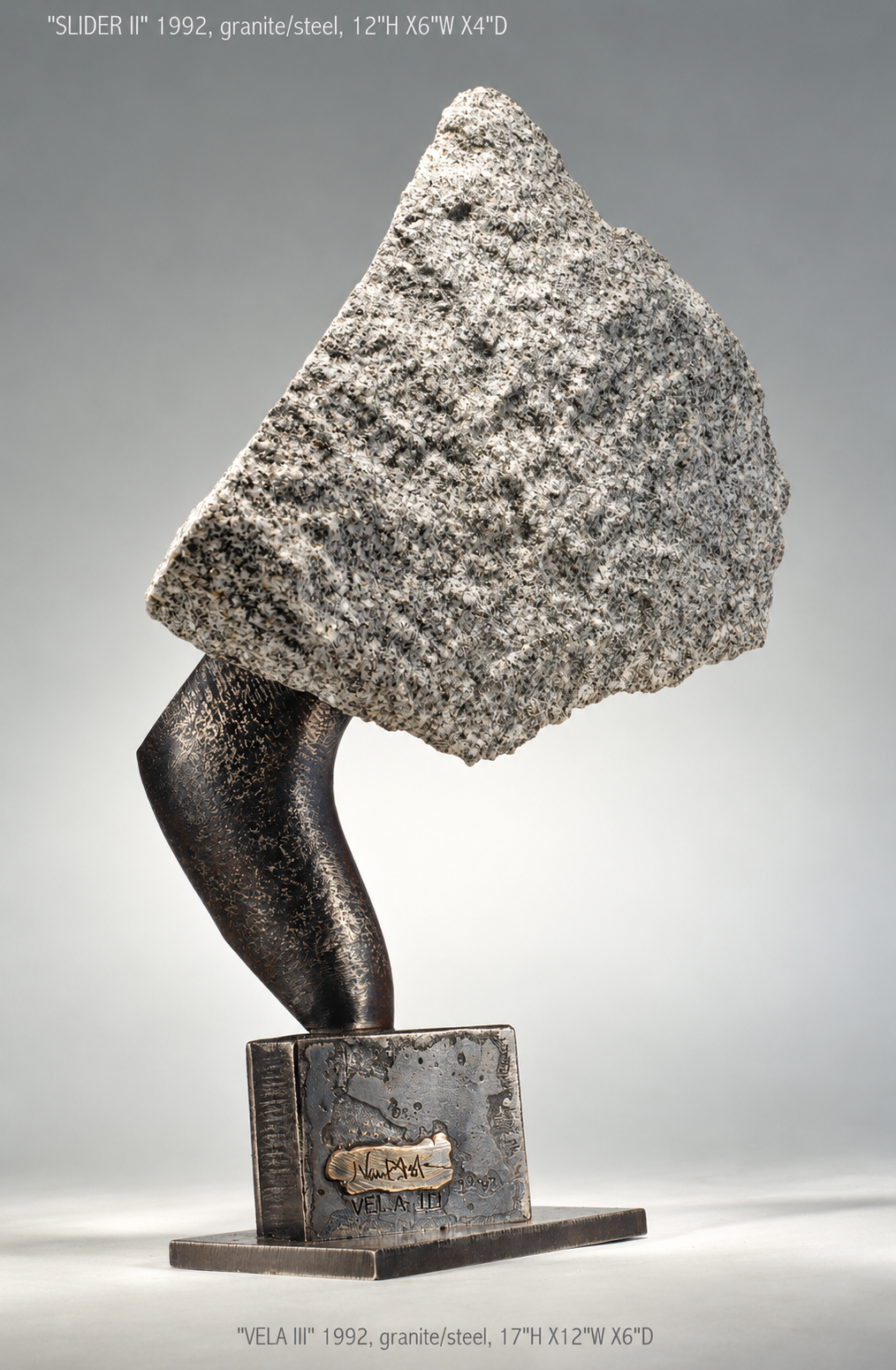
December 1992. Granite, steel. Dimensions: 17 × 12 × 6 in (43 × 30 × 15 cm). Disassemble - parts used in new work.
Vela III, 1992
Vela III continues my interest in tools and implements and in their “raw, efficient beauty of form dictated by function.” The sculpture incorporates a section of a large lifting hook, combining its powerful industrial shape with rough granite. The steel lifts and animates the heavy stone, reflecting my continuing interest in “choreographing” traditionally earthbound material.
The title Vela, Latin for “sails,” refers to the southern constellation representing the sails of Argo Navis. In my continuing effort to make heavy objects appear light, the billowing shape and elevated position of the stone suggest a sail caught by the wind.
Part of the steel lifting hook was later used in Arabesque (T-01-20).
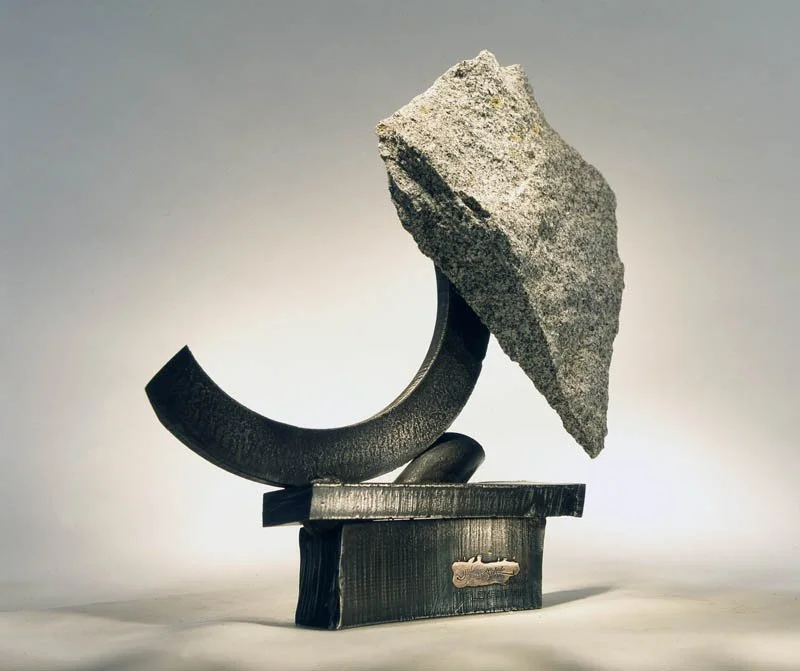
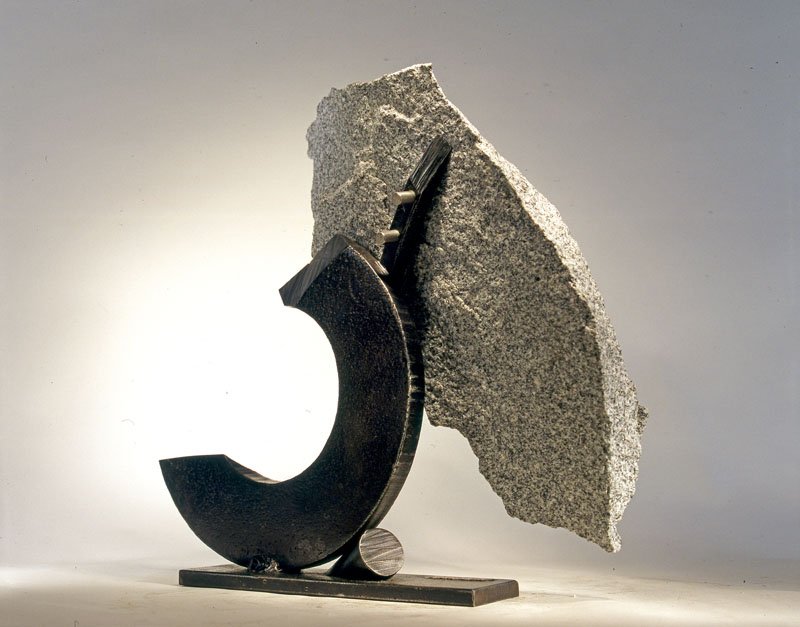
1991
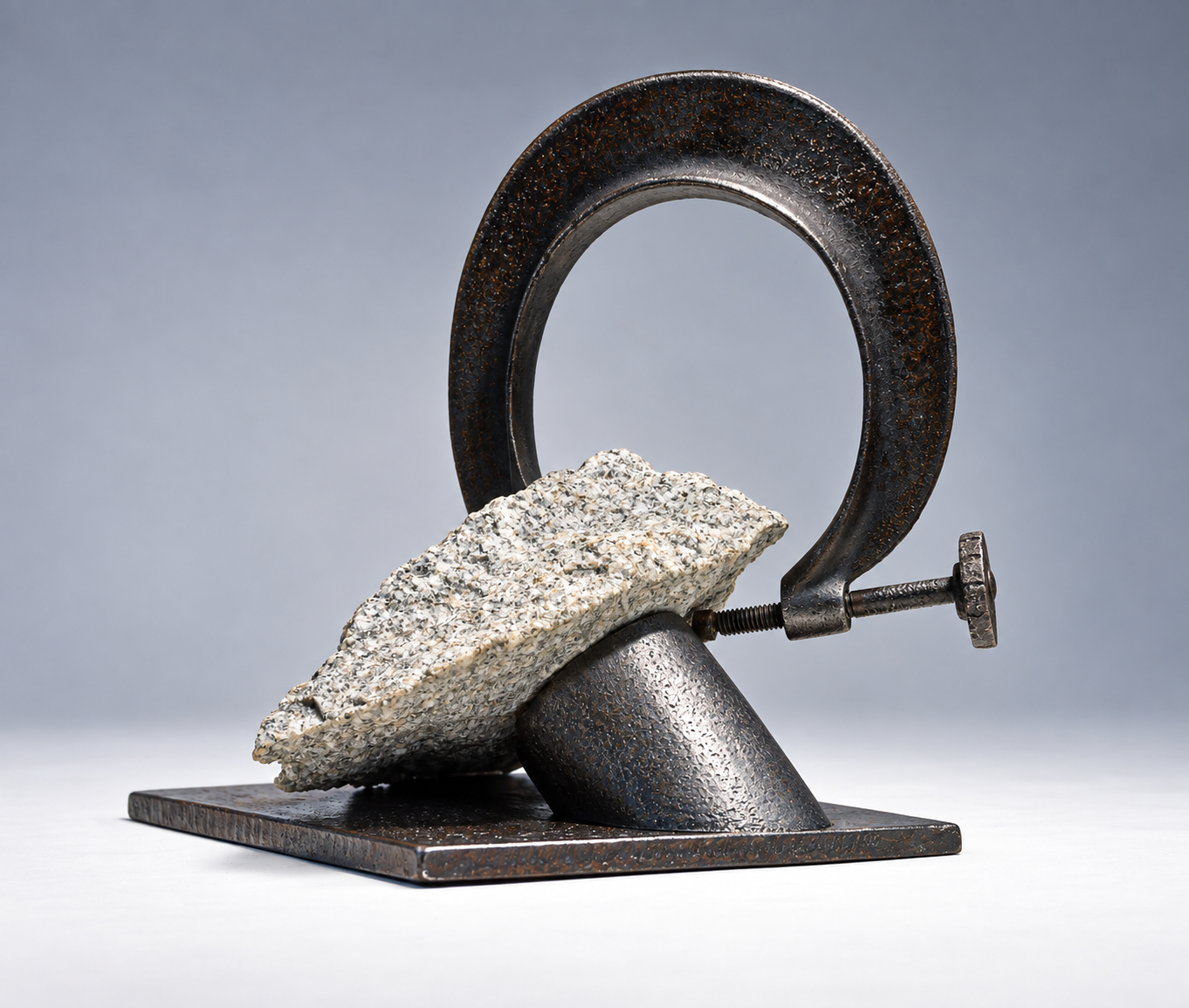
January 1991. Granite, steel. Dimensions: 9 x 10.5 x 9 in. Private Collection.
Loop, 1991
Loop continues my interest in tools and implements as extensions of the hand and in what I have described as their “raw, efficient beauty of form dictated by function.” Here I use an actual C-clamp, celebrating both its distinctive circular shape and its practical purpose. Combined with rough granite and fabricated steel, the familiar tool becomes an integral part of the sculpture rather than simply a found object.
As in Kouros, (S-89-14) and later Clamp (S-93-06) where I incorporated a real vise and larger clamp, the tool remains fully functional: the screw of the C-clamp is tightened against the granite and actually helps hold the stone in place. Function and image therefore become one—the physical act of clamping is made visible as part of the sculpture, bringing together my continuing concerns with tools, assembly, pressure, and the relationship between stone and steel.
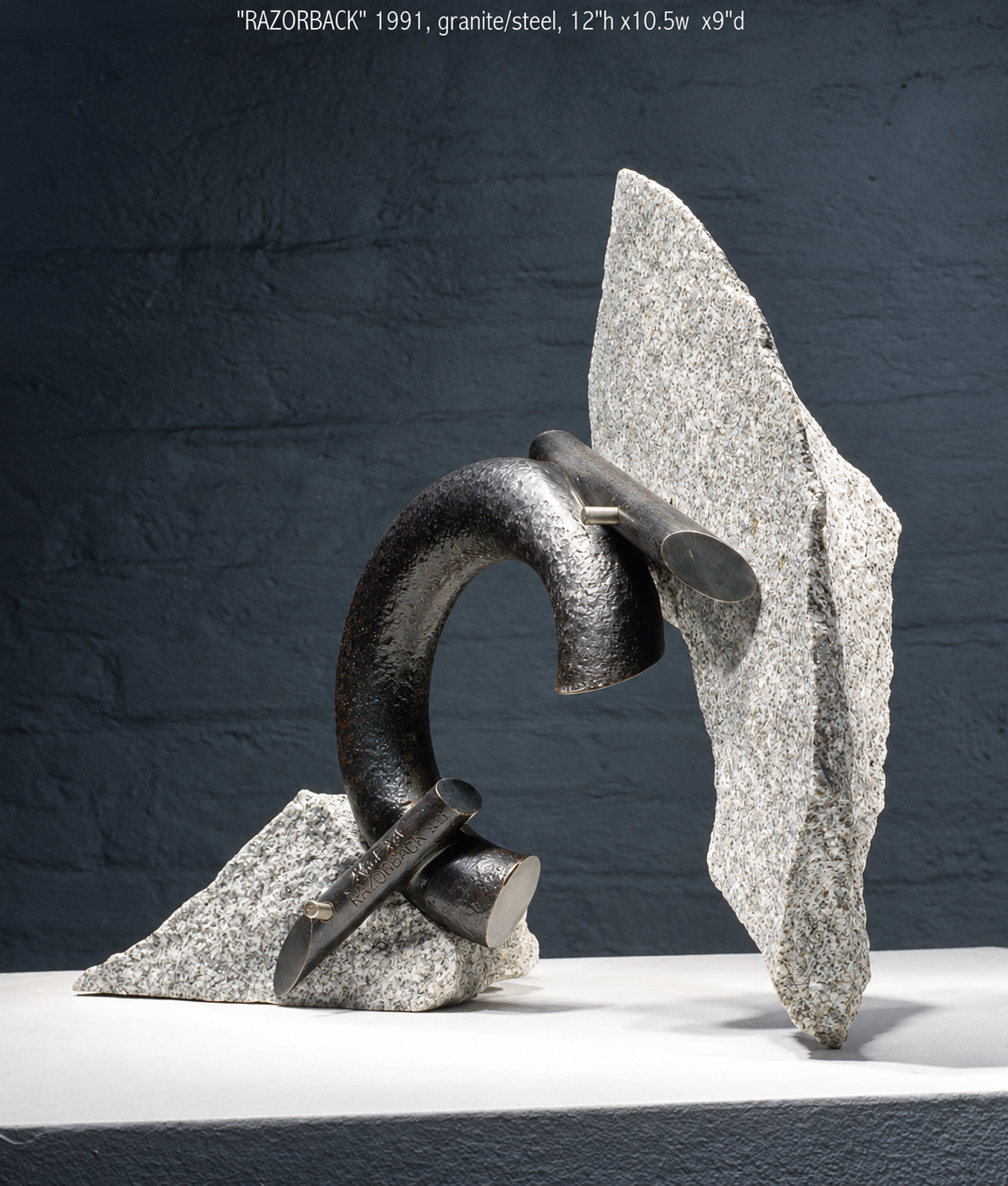
January 1991. Granite, steel. Dimensions: 12 x 101/2 x9 in. Private Collection.
Razorback, 1991
Razorback follows in the line of my earlier Rounder and Pique à Terre works, continuing their circular vocabulary and my interest in combining rough, found stone with metal. The sweeping steel arc brings the granite elements into a dynamic relationship of weight, balance, and movement.
The title comes directly from the larger stone, whose sharp edge runs down its “back” or spine like a raised razor. As often happens in my work, the particular character of a found stone helps determine both the final composition and the title.
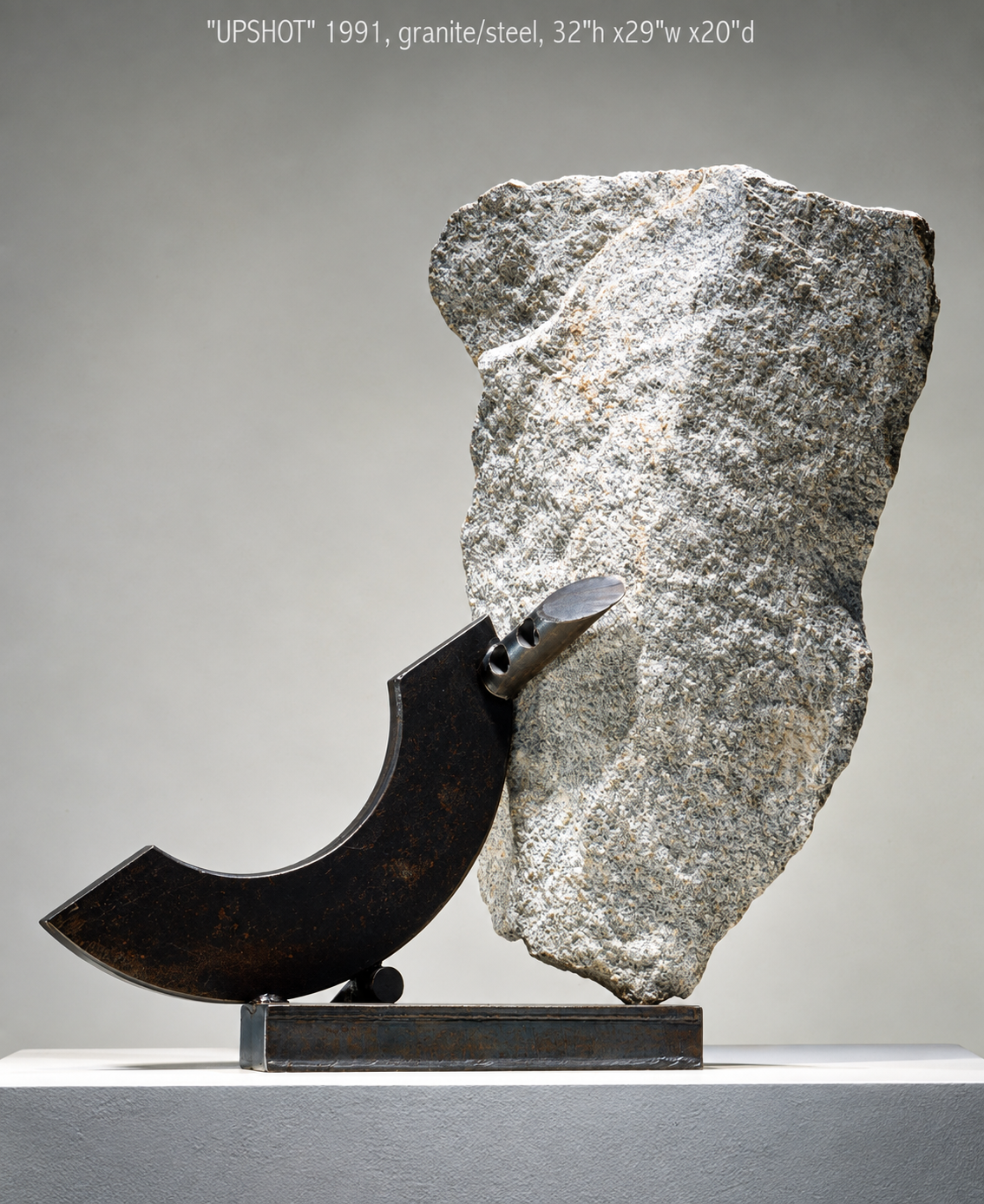
1991. Granite, steel. Dimensions: 32 × 29 × 20 in (81 × 74 × 51 cm). Disassemble and parts used in other works.
Upshot, 1991
Upshot is the first in a series exploring the expressive possibilities of a sweeping steel arc combined with rough, found stone. The arc lifts and activates the granite, continuing my interest in using metal to “choreograph” heavy, earthbound stone through balance, gravity, and implied movement.
The title comes directly from the upward gesture of the steel arc. Its rising sweep gives the sculpture a sense of thrust and direction, transforming the considerable weight of the granite into something that appears poised for movement.
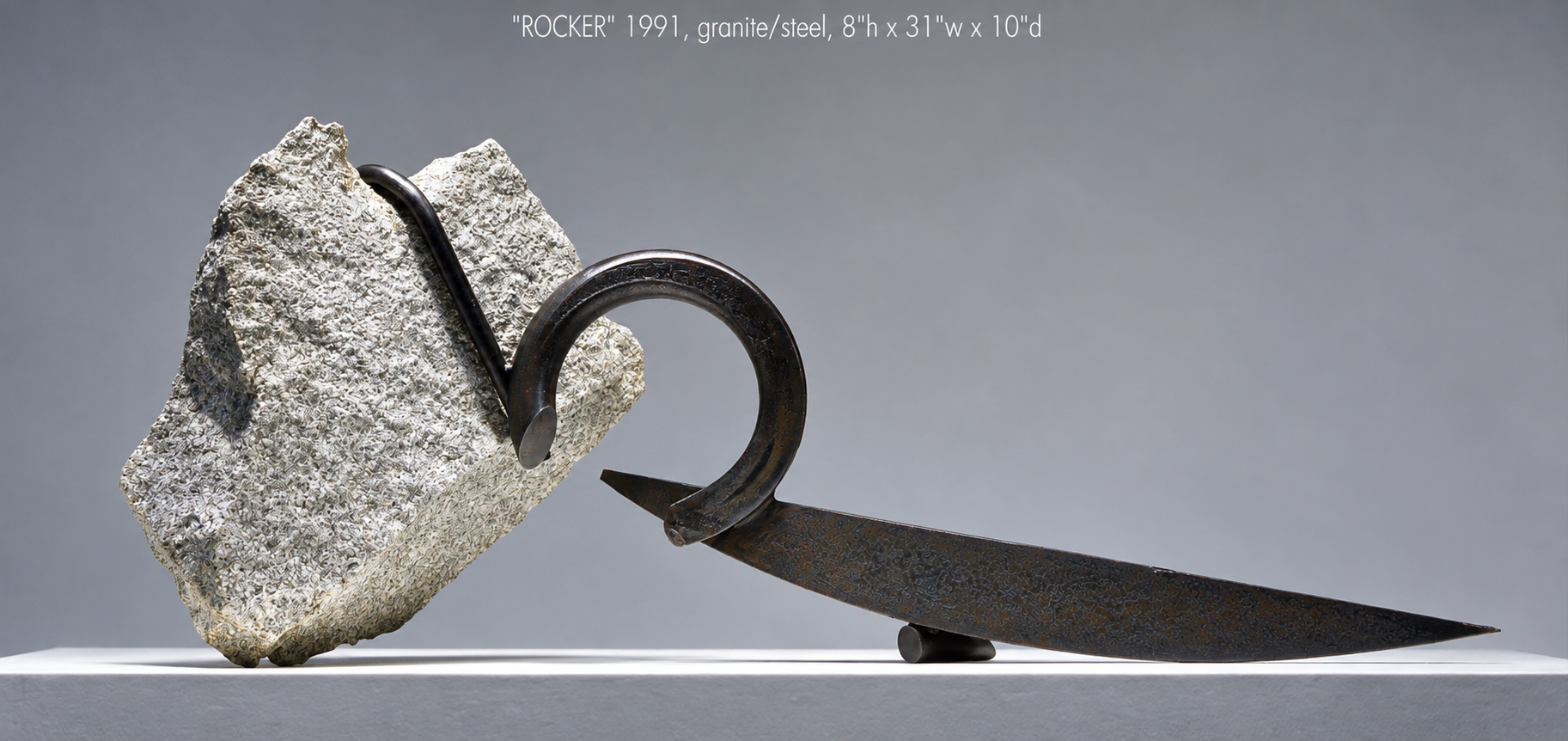
January 1991. Granite, steel. Dimensions: 19 × 43 × 15 in (48 × 109 × 38 cm). Disassembled and parts used in new pieces.
Rocker, 1991
Rocker is the first in a series that continues my interest in combining rough, found stone with steel and using balance and gravity to animate heavy materials. The granite is poised against an elongated steel arc, creating a sense of suspended movement—part of my continuing effort to “choreograph” traditionally earthbound stone.
The title comes directly from the rocking gesture of the elongated steel arc. Acting almost like a rocker or seesaw, it transforms the weight of the granite into a composition that appears capable of shifting and moving while remaining held in balance.
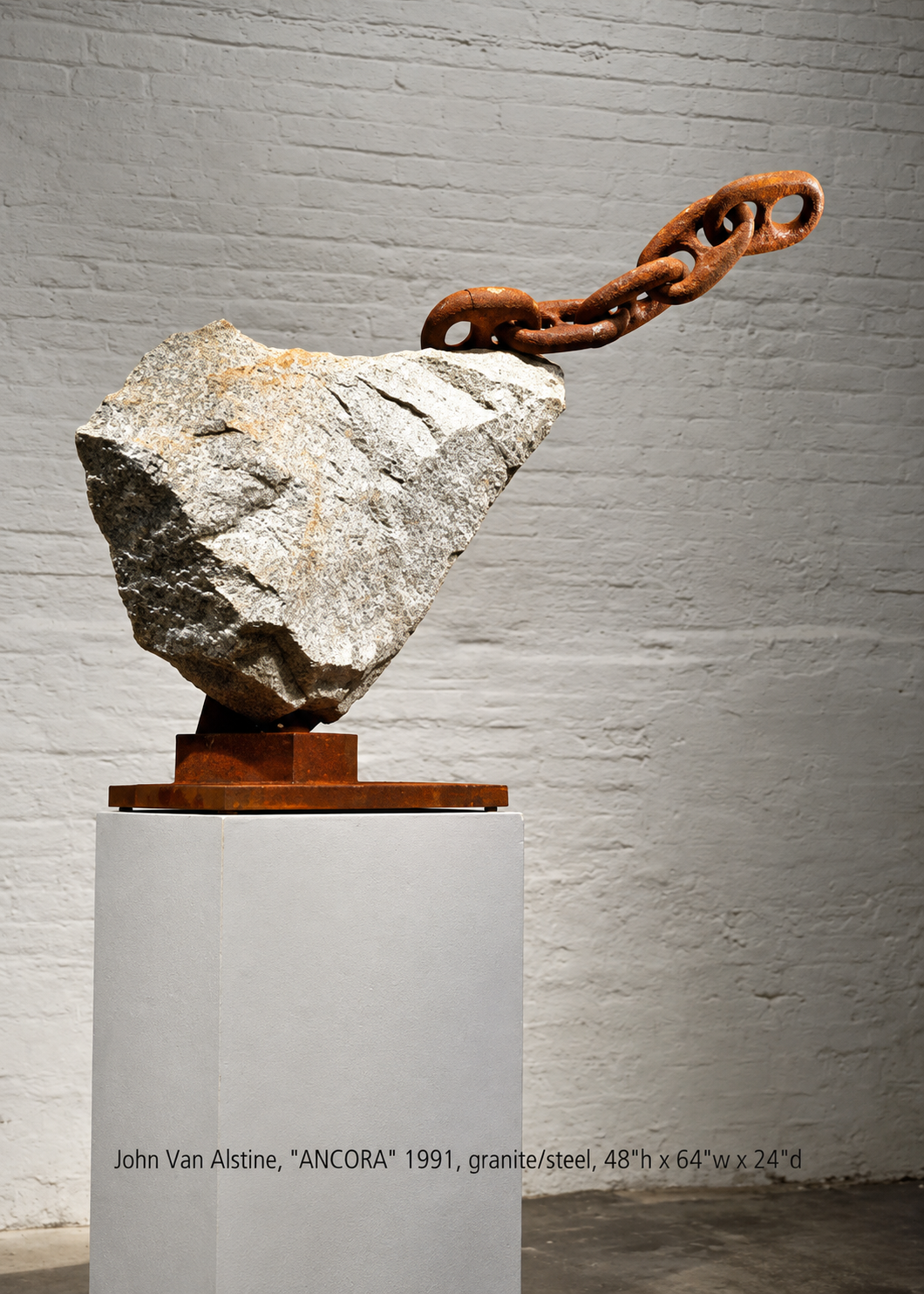
January 1991. Granite, steel. Dimensions: 48 × 65 × 24 in (122 × 165 × 61 cm). Piece was dissembled and parts were used for new works.
Ancora, 1991
Ancora continues my interest in combining rough, found stone with industrial steel and using weight and balance to animate otherwise earthbound materials. As in many of my works, the title is Latin—ancora means “anchor”—and the sculpture’s overall form suggests a massive stone anchor with its attached chain. My Jersey City studio and the nearby marine salvage yards provided both materials and imagery that entered my work during this period.
The chain links are welded together, creating the illusion that they float or drift through water or air. I had used this “trick” on a smaller scale in earlier works and returned to it on a much larger scale in Tether (Boy’s Toys) (1995), inspired in part by childhood memories of rural mailboxes seemingly held magically aloft on welded chains.
The chain was later used in Statio 2005 (T-05-21).
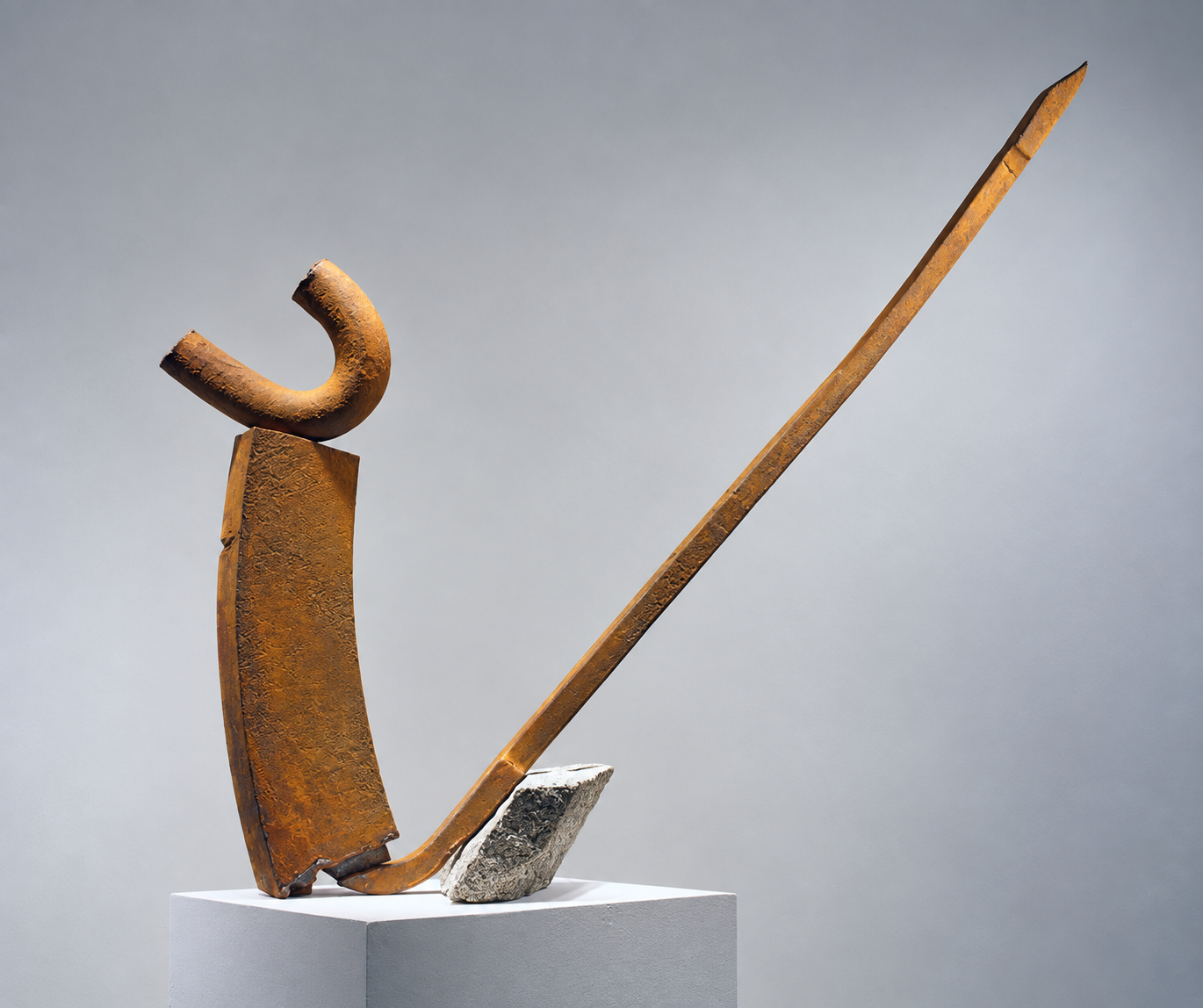
January 1991. Granite, steel. Dimensions: 44 × 65 × 42 in (112 × 165 × 107 cm). Parts used in other sculptures.
J-Bar, 1991
J-Bar continues my interest in tools and implements as extensions of the hand and as expressive sculptural forms. The long diagonal steel bar suggests a lever or pry bar, while the granite wedge introduces weight and resistance, bringing natural and industrial materials into an active relationship.
The title refers to the hooked, J-shaped steel element. Together, the hook, bar, and stone suggest an ambiguous tool, using leverage, weight, and force to imply human action.
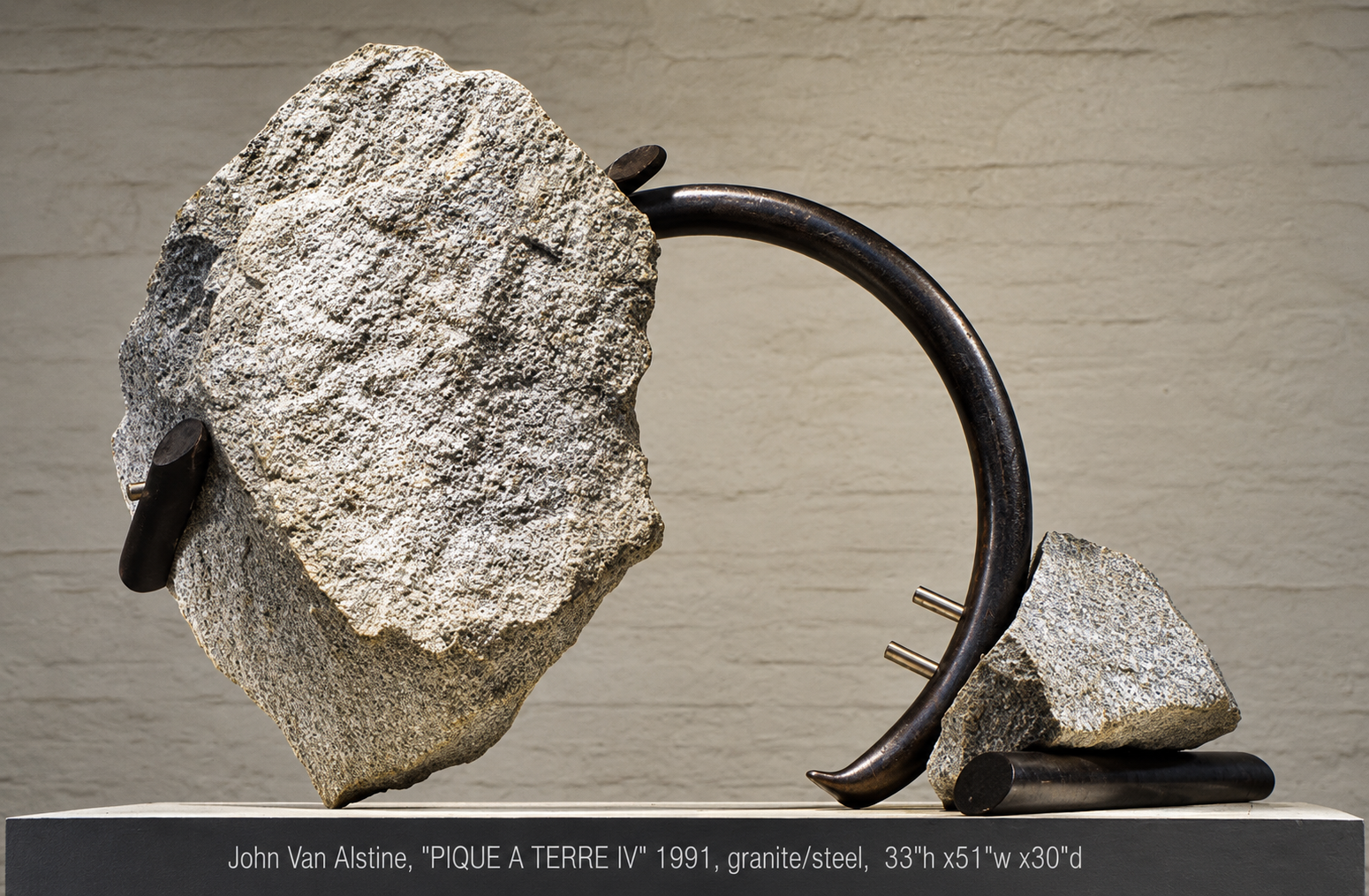
March 1991. Granite, steel. Dimensions: 33 x 57 x 32 in (84 x145 x 81 cm).
Pique à Terre IV, 1991
Pique à Terre IV, the fourth work in the series, developed as a spin-off from my earlier Rounder and Go-Round Series, continuing their circular vocabulary and my ongoing interest in combining stone and metal. Here, two granite elements are linked by a sweeping steel arc, with the larger stone lifted and poised delicately on a single point. The arrangement turns weight, gravity, and balance into gesture, giving these dense, earthbound materials an unexpected sense of movement and levity.
The title comes from classical French ballet and refers to a pose in which one toe lightly touches the ground, the other foot remains firmly planted, and an arm makes a sweeping gesture. I began to think of myself as a kind of choreographer—arranging heavy stone and steel so that they seem almost to dance. In Pique à Terre IV, the circular steel form acts much like that sweeping arm, connecting and animating the stones while transforming their inherent heaviness into a moment of precarious balance and arrested motion.
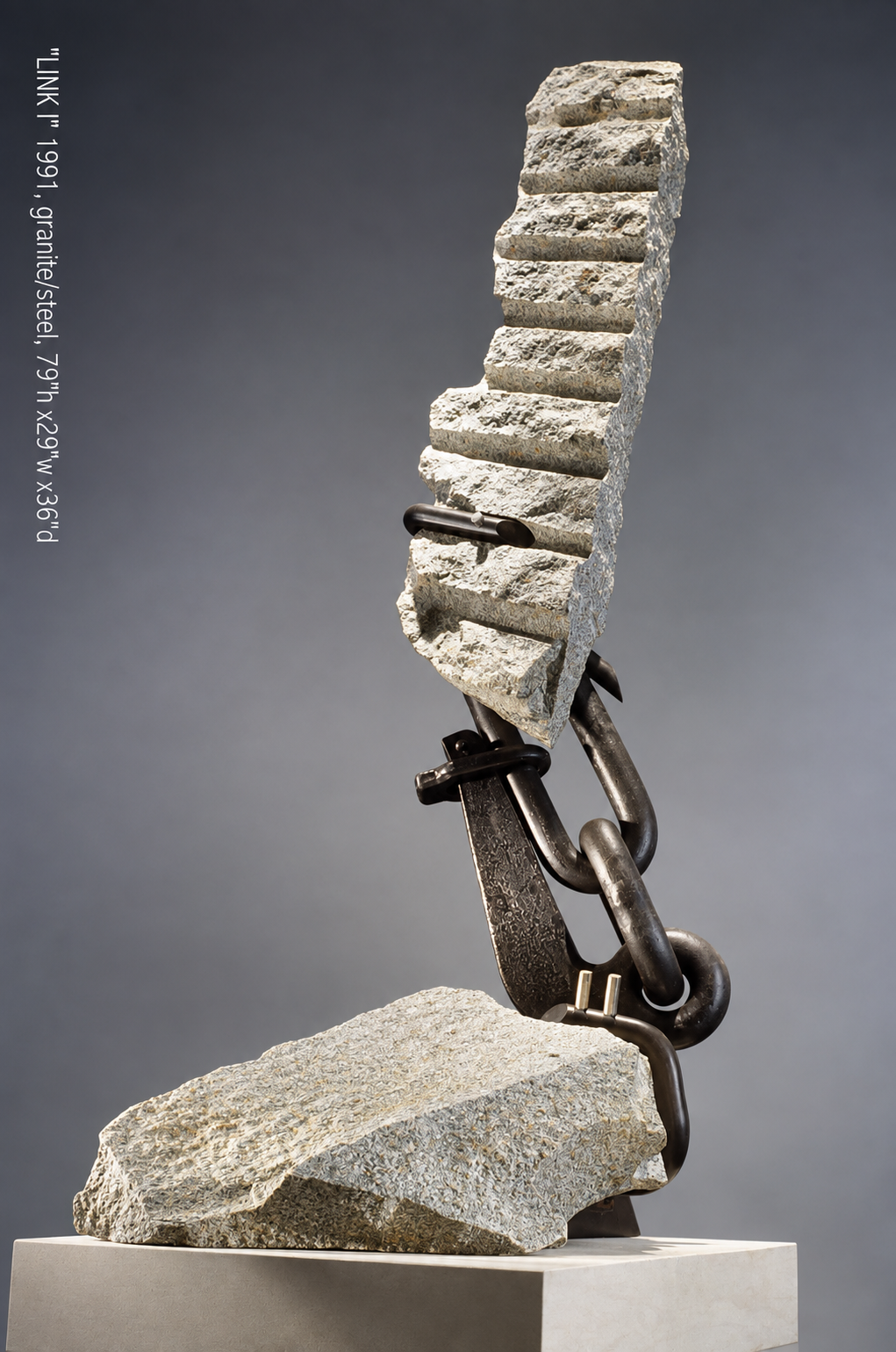
March 1991. Granite, steel. Dimensions: 79 × 29 × 36 in (201 × 74 × 91 cm). Private collection Baltimore.
Link I, 1991
Link I continues my interest in combining rough, found stone with industrial metal, using the steel to physically and visually unite otherwise separate elements. The central connector was salvaged from a marine salvage yard near my Jersey City studio, part of an industrial waterfront landscape that became an important source of materials and imagery in my work.
The steel element is a pelican clip, named for the beak-like form of its clasp and originally used to connect large sections of marine chain. Its former function gives the sculpture an additional layer of meaning: an object whose previous “life” was literally about connecting and linking becomes the physical and conceptual link holding the sculpture together.
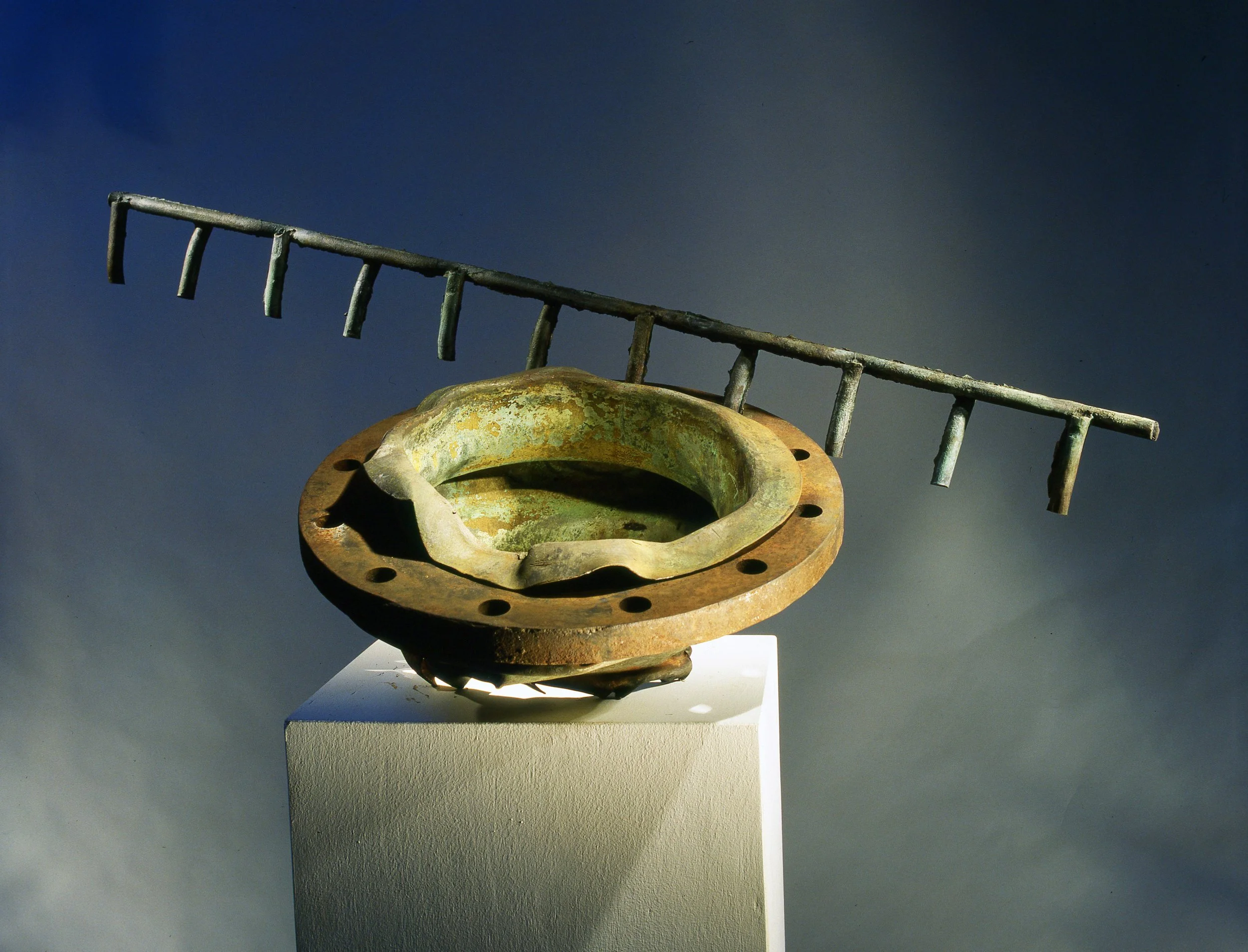
April 1990. Bronze, steel. Dimensions: 29 × 51 × 30 in (74 × 130 × 76 cm).
Nidus is Latin for “nest.” It can also carry related meanings such as a dwelling place, home, birthplace, or place of origin—a place where something is sheltered, formed, or begins.
In this case the sculpture suggests more than a literal nest: containment, protection, nurturing, origin, and the place from which something emerges or develops.
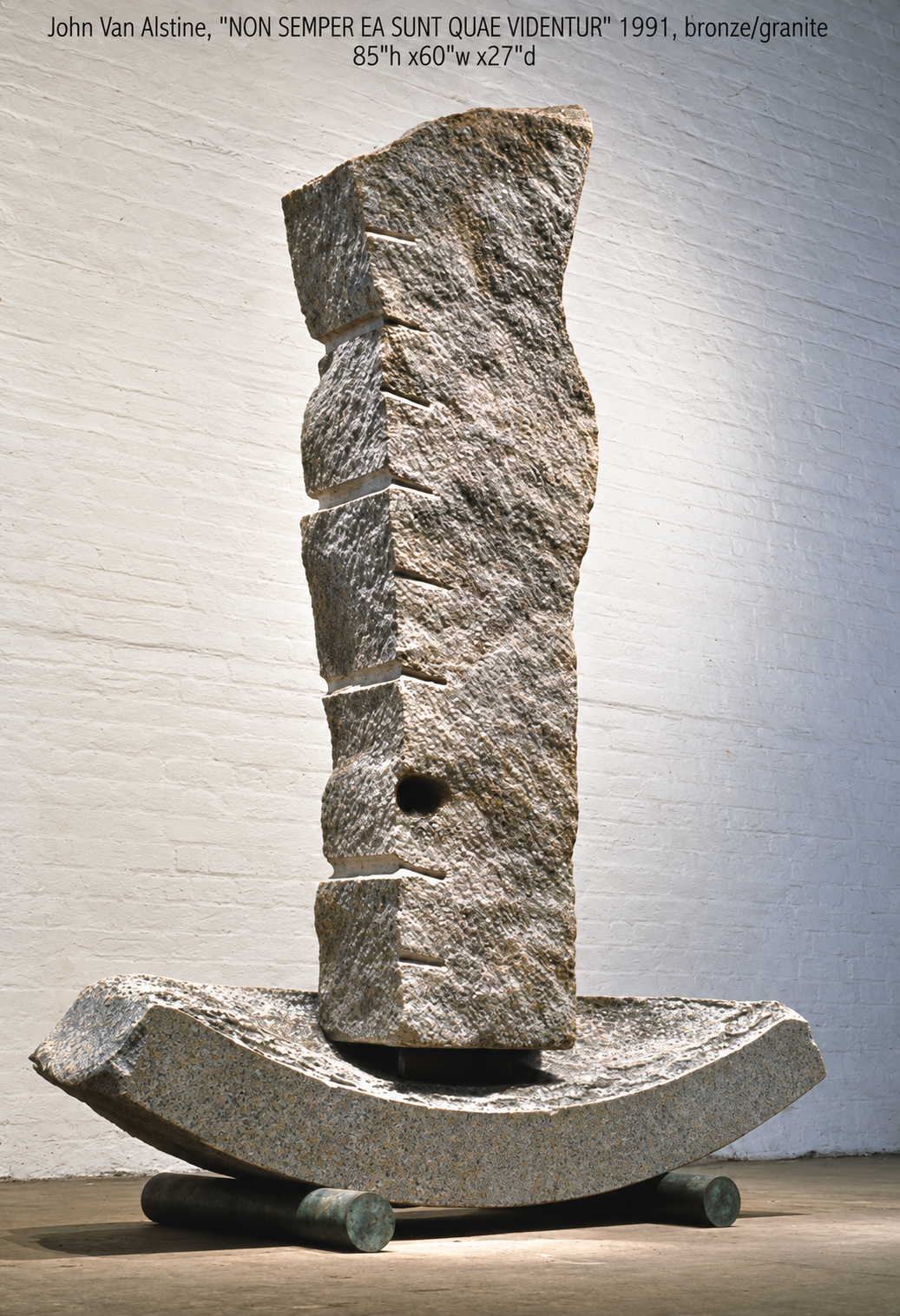
1991. Granite, bronze. Dimensions: 85 × 60 × 27 in (216 × 152 × 69 cm). Private collection - Aspen, CO
Non Semper Ea Sunt Quae Videntur, 1991
Non Semper Ea Sunt Quae Videntur—Latin for “things are not always what they appear”—continues my interest in combining rough-hewn stone with metal and in animating the inherent weight of stone. A tall granite column rises from a curved granite “rocker,” which appears precariously balanced on two bronze rollers. The arrangement gives the massive sculpture an unexpected sense of movement, as though it might rock back and forth or roll away—part of my continuing effort to make earthbound stone appear almost weightless or mobile.
The apparent instability, however, is an illusion: the bronze rollers are invisibly pinned to the granite, making movement impossible. The Latin title plays directly on this contradiction between what we perceive and what is actually occurring. In this sense, the work brings together several longstanding concerns in my sculpture—gravity, weight, balance, and the transformation of massive stone into something that seems poised for motion.
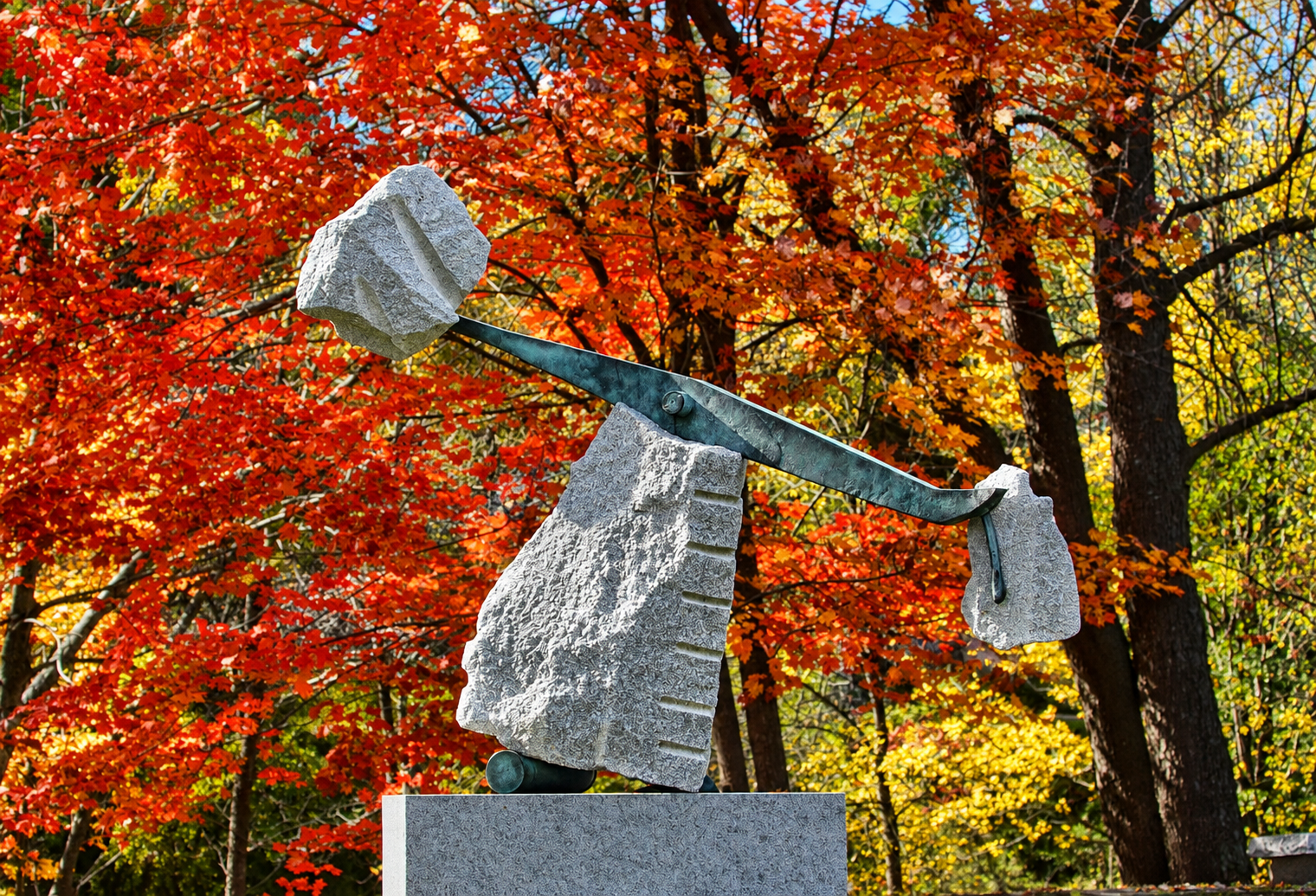
April 1991. Granite, bronze. Dimensions: 55 × 72 × 18 in (140 × 183 × 46 cm). Collection SUNY FMCC, Johnstown, NY
Astraea’s Beam, 1991
Astraea’s Beam continues my interest in combining rough, found stone with metal while bringing together several recurring concerns in my work—balance, tools, and myth. The bronze beam functions as a scale, transforming the physical balancing of stone into both the structure and subject of the sculpture.
The title refers to Astraea, the classical goddess of justice who became associated with Libra and its scales. Here her scale is deliberately askew: the larger, heavier stone rises while the smaller stone hangs below. This unnatural balance becomes a metaphor for justice out of equilibrium—a reminder of the need for vigilance in preserving the rule of law and its fair, impartial administration.
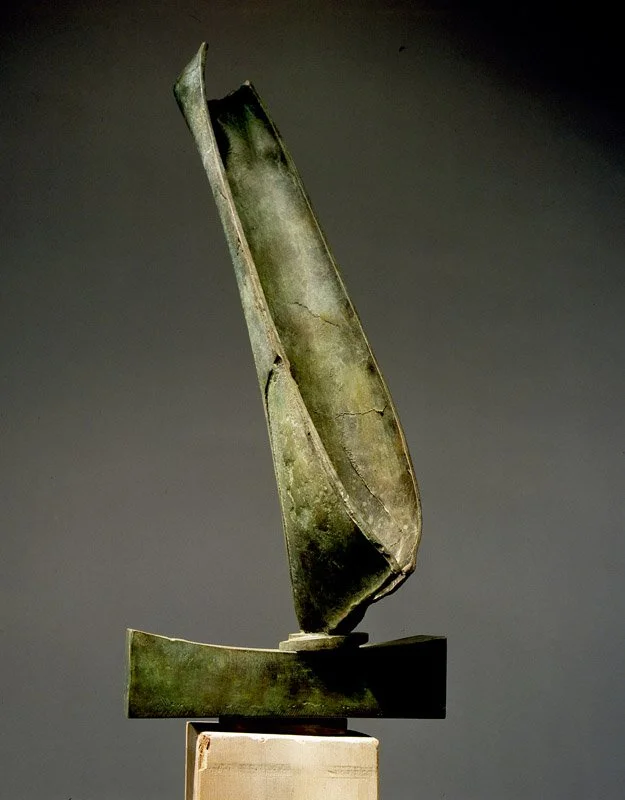
April 1991. Bronze, wood. Dimensions: 86 × 13 × 11 in (218 × 33 × 28 cm). Private Collection.
Strange Fruit IX continues the series while eliminating stone entirely. By this point I had cast a number of the vessel/pod forms in bronze and was creating unique but related variations by changing the bronze base block or support to which each was attached. The elongated, opening form suggests a fruit or seed pod—something like a pea pod—while also carrying the organic, bodily and vessel associations that were becoming increasingly important in my work. In my later writing I described Strange Fruit III and VI as suggesting “fruits of labor” from the studio, with forms carrying simultaneous male and female associations connected to ripeness, production, and reproduction.
The title adds a darker, oblique reference to Billie Holiday’s haunting “Strange Fruit,” confronting the lynching of African Americans in the American South.
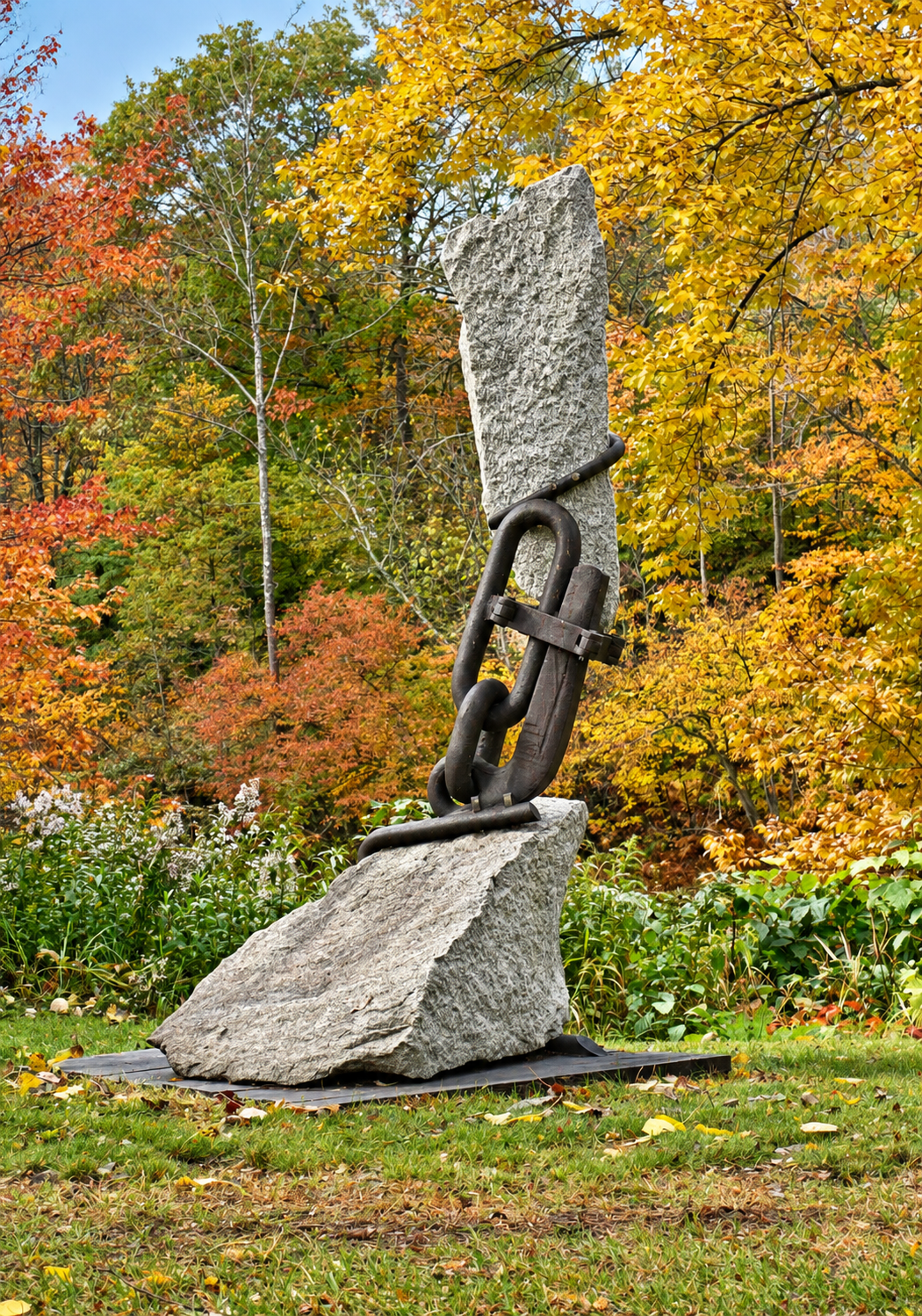
August 1991. Granite, steel. Dimensions: 74 × 48 × 30 in (188 × 122 × 76 cm). Collection Purdue University, West Layfette, IN installed 2017.
Link II continues my interest in combining rough, found stone with industrial metal, using the steel to physically and visually unite otherwise separate elements. The central connector was salvaged from a marine salvage yard near my Jersey City studio, part of an industrial waterfront landscape that became an important source of materials and imagery in my work.
The steel element is a pelican clip, named for the beak-like form of its clasp and originally used to connect large sections of marine chain. Its former function gives the sculpture an additional layer of meaning: an object whose previous “life” was literally about connecting and linking becomes the physical and conceptual link holding the sculpture together.
The piece was displayed in Palm Dessert, CA, 2001-04; later at the Gerald Peters Gallery, Santa Fe; returned to Wells in 2013 and finally sold to Purdue University in 2017.
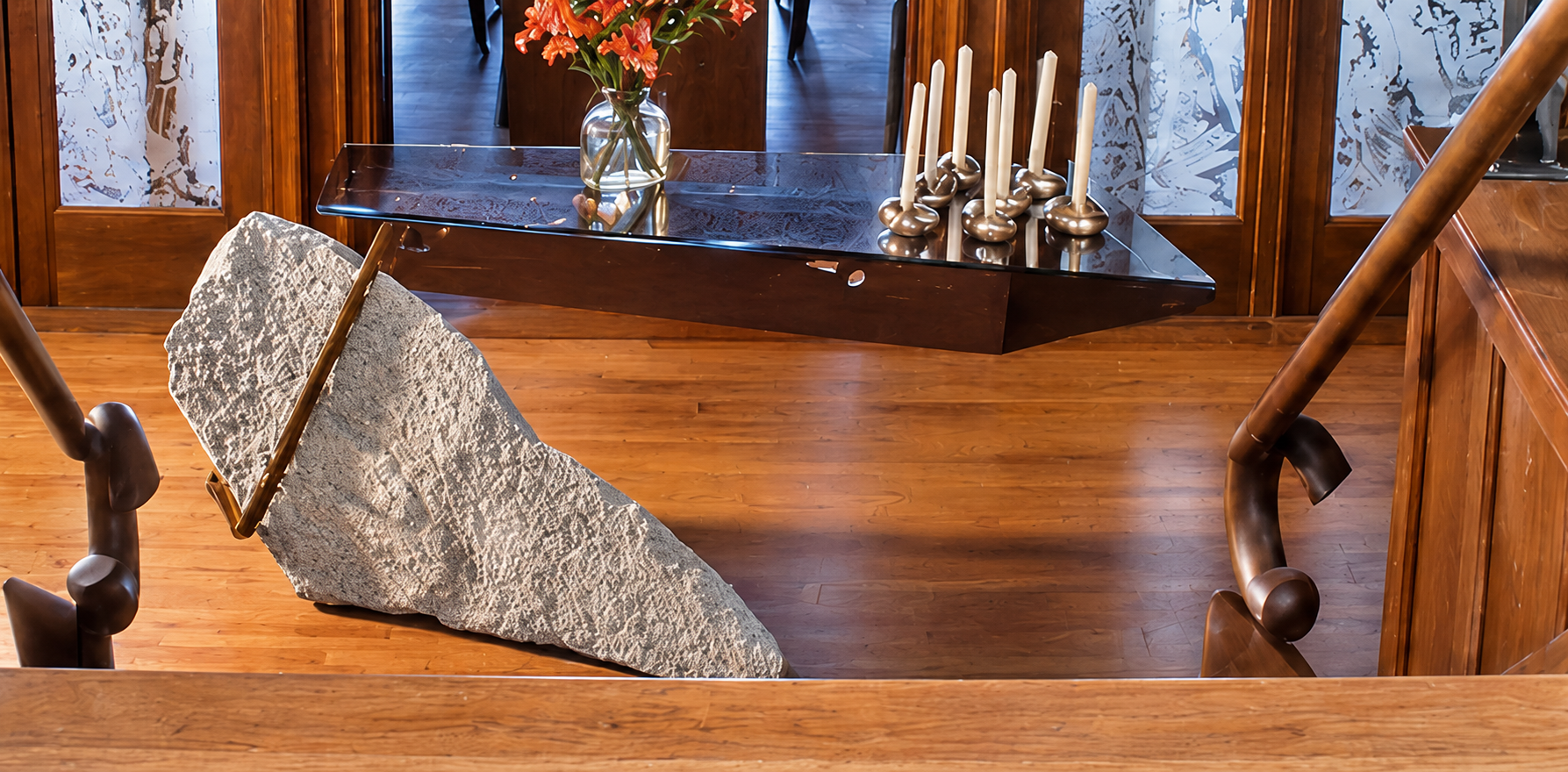
September 1991. Granite, steel, glass. Dimensions: 36 × 80 × 40 in (91 × 203 × 102 cm).
Flug Foyer Table, 1991
Flug Foyer Table was commissioned by Debby and Marty Flug for their home on Red Mountain in Aspen, Colorado, and is shown here at the foot of their grand staircase. The work continues my interest in combining found stone with industrial found steel, allowing the inherent character and history of the materials to remain visible.
A heavy glass tabletop is dramatically cantilevered beyond the granite, with the massive stone acting as a counterweight to create a sense of balance and suspension. A year later, I designed and installed the granite and steel railings and newel posts for the staircase, extending the sculptural vocabulary of the table into the surrounding architecture.
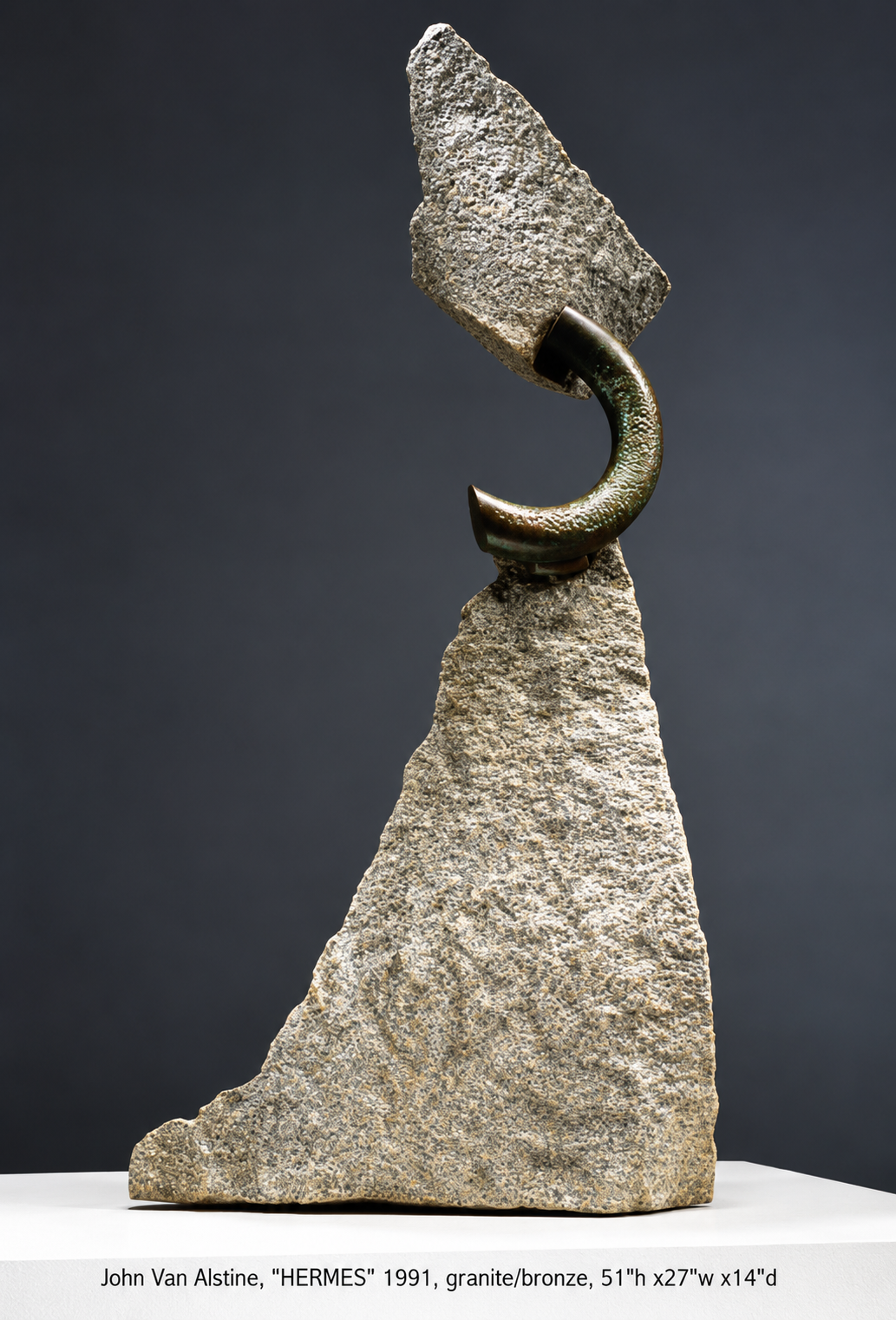
September 1991. Granite, bronze. Dimensions: 51 × 27 × 14 in (130 × 69 × 36 cm).
Hermes, 1991
Hermes continues my interest in exploring the figure and mythology as frameworks for sculptural expression. Rather than depicting the figure literally, the relationship of granite and bronze suggests bodily presence, movement, and balance. The curved bronze element acts like a joint, giving the heavy granite an unexpected sense of animation and lift.
The title refers to Hermes, the swift messenger god of Greek mythology. The upper stone takes on the shape of a wing, alluding to his winged helmet. This mythological reference transforms the sculpture into an abstract figure seemingly poised for movement or flight.
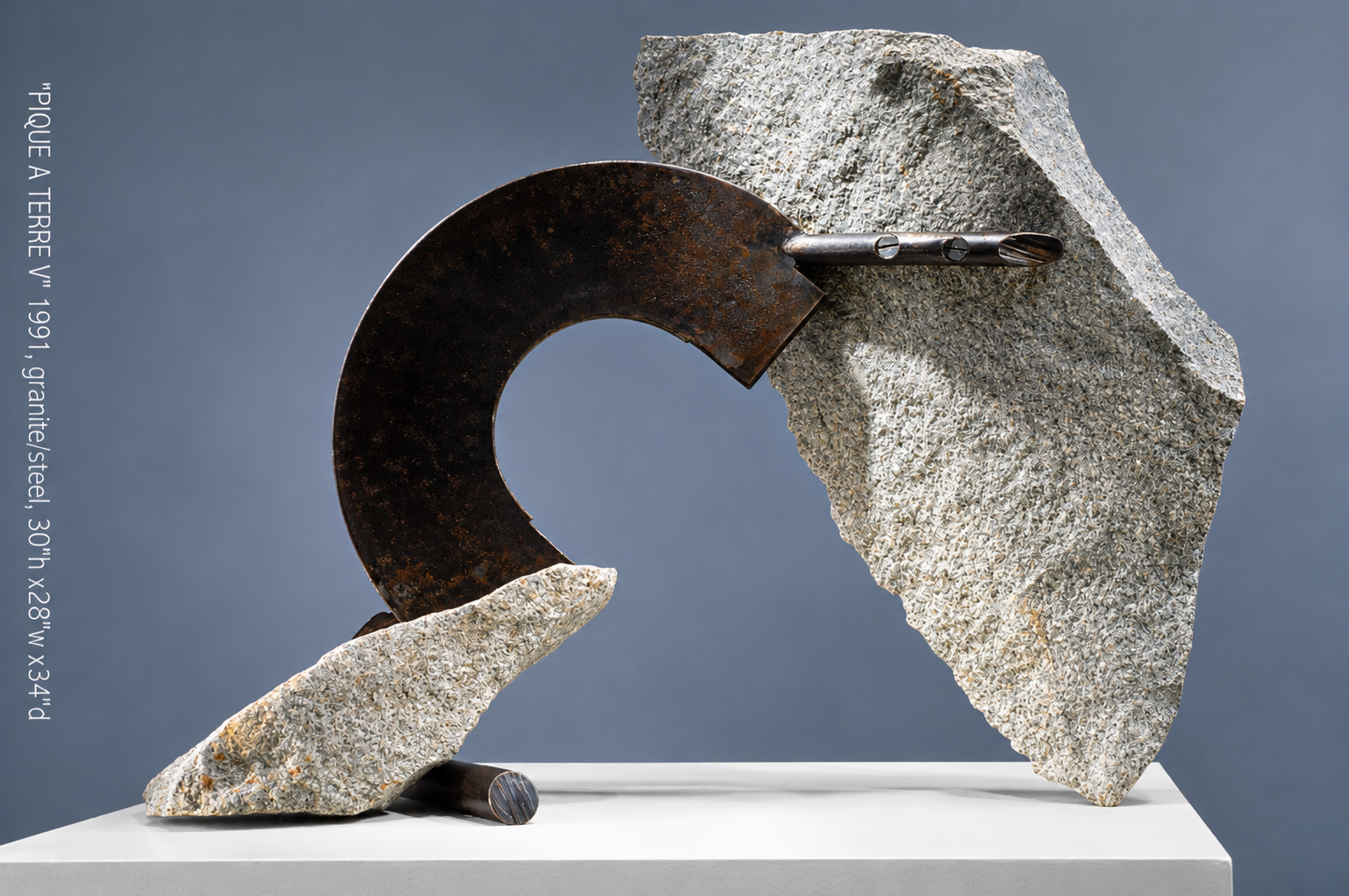
September 1991. Granite, steel. Dimensions: 30 × 38 × 24 in (76 × 97 × 61 cm).
Pique à Terre V, 1991
Pique à Terre V, the fifth work in the series, developed as a spin-off from my earlier Rounder and Go-Round Series, carrying forward their circular vocabulary and my ongoing interest in combining stone and metal. Here, the sweeping steel arc links two very different granite forms, lifting the larger stone onto a single point and creating a strong sense of balance, suspension, and arrested movement. The steel becomes both structural and gestural—a means of freeing the stone from its normally earthbound condition. This idea of using metal to “choreograph” and seemingly float stone has remained central to my sculpture.
The title comes from classical French ballet and refers to a pose in which one toe lightly touches the ground, the other foot remains firmly planted, and an arm makes a sweeping gesture. In the Pique à Terre Series, I began thinking of myself as a kind of choreographer, arranging dense, heavy materials so that they appear almost to dance. In Pique à Terre V, the precariously poised granite and circular sweep of steel turn weight and gravity into gesture, movement, and a surprising sense of levity.
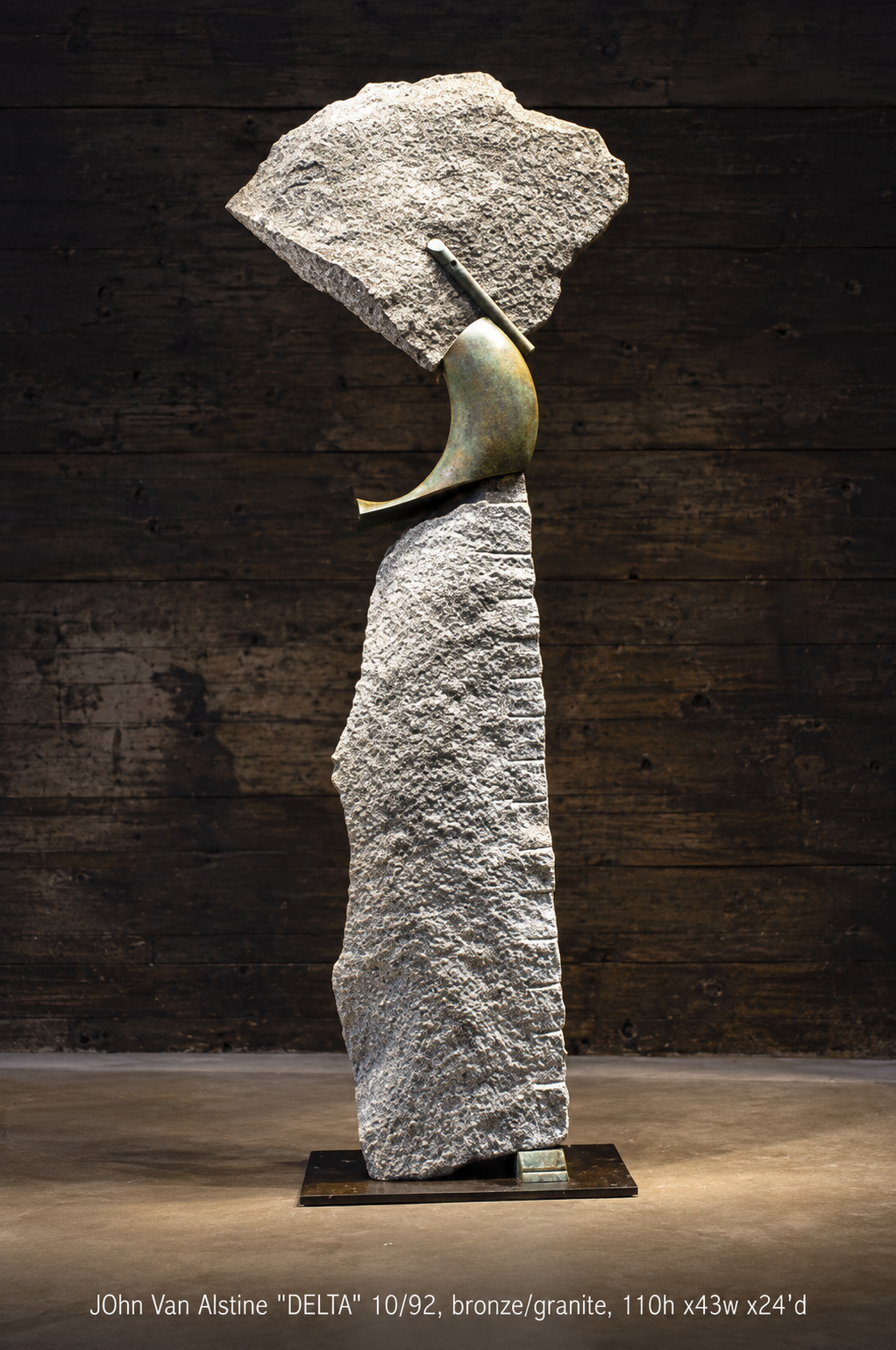
October 1991. Granite, bronze. Dimensions: 110 × 43 × 24 in (279 × 109 × 61 cm).
Collection: American University, Washington, DC
Delta, 1991
Delta continues my interest in combining rough, found stone with metal, allowing the inherent character of each material to remain visible. The curved bronze element joins the two granite forms, bringing weight, balance, and movement into an active relationship.
The title refers directly to the delta-shaped upper stone. Its broad triangular form crowns the sculpture, contrasting with the vertical granite below and the sweeping bronze that connects them.
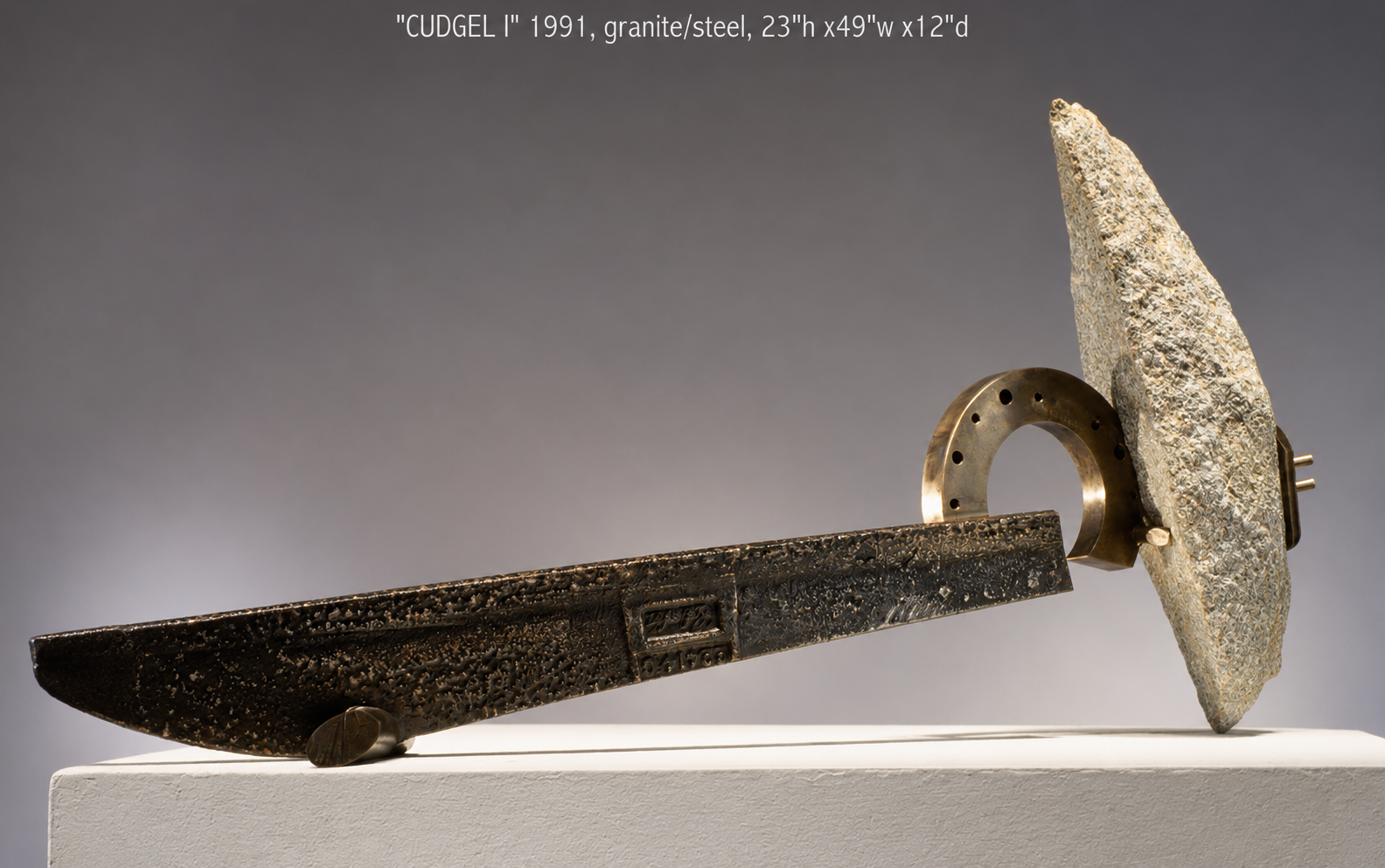
November 1991. Granite, steel. Dimensions: 23 × 49 × 12 in (58 × 124 × 30 cm).
Destroyed to use parts in other works.
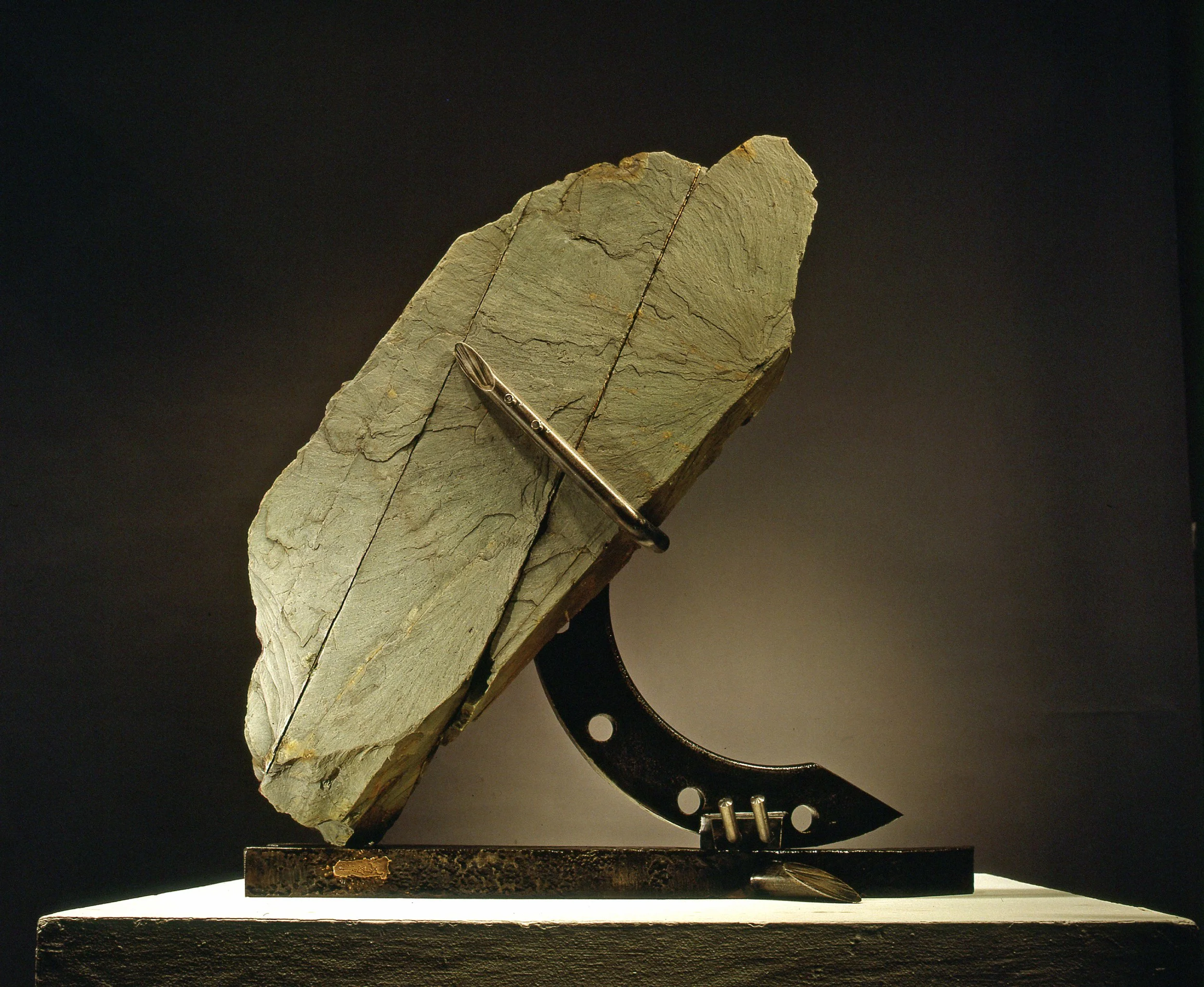
November 1991. Slate, steel. Dimensions: 32 × 31 × 10 in (81 × 79 × 25 cm).
Cudgel II is part of my ongoing exploration of tools and tool-like forms as expressive vehicles. I have always thought of tools as extensions of our hands and, for artists, essential allies in the quest for creating. A cudgel is among the most elemental of these forms—an extension of the arm associated with physical action, strength, and force. In Cudgel II, the combination of slate and steel suggests something that might be grasped, lifted, or swung, giving the sculpture a distinctly human presence.
Tools also connect to my broader interest in movement, balance, gravity, and gesture. Like my references to dance, gymnastics, and fencing, they provide a way to evoke the figure without depicting it literally.
John Van Alstine
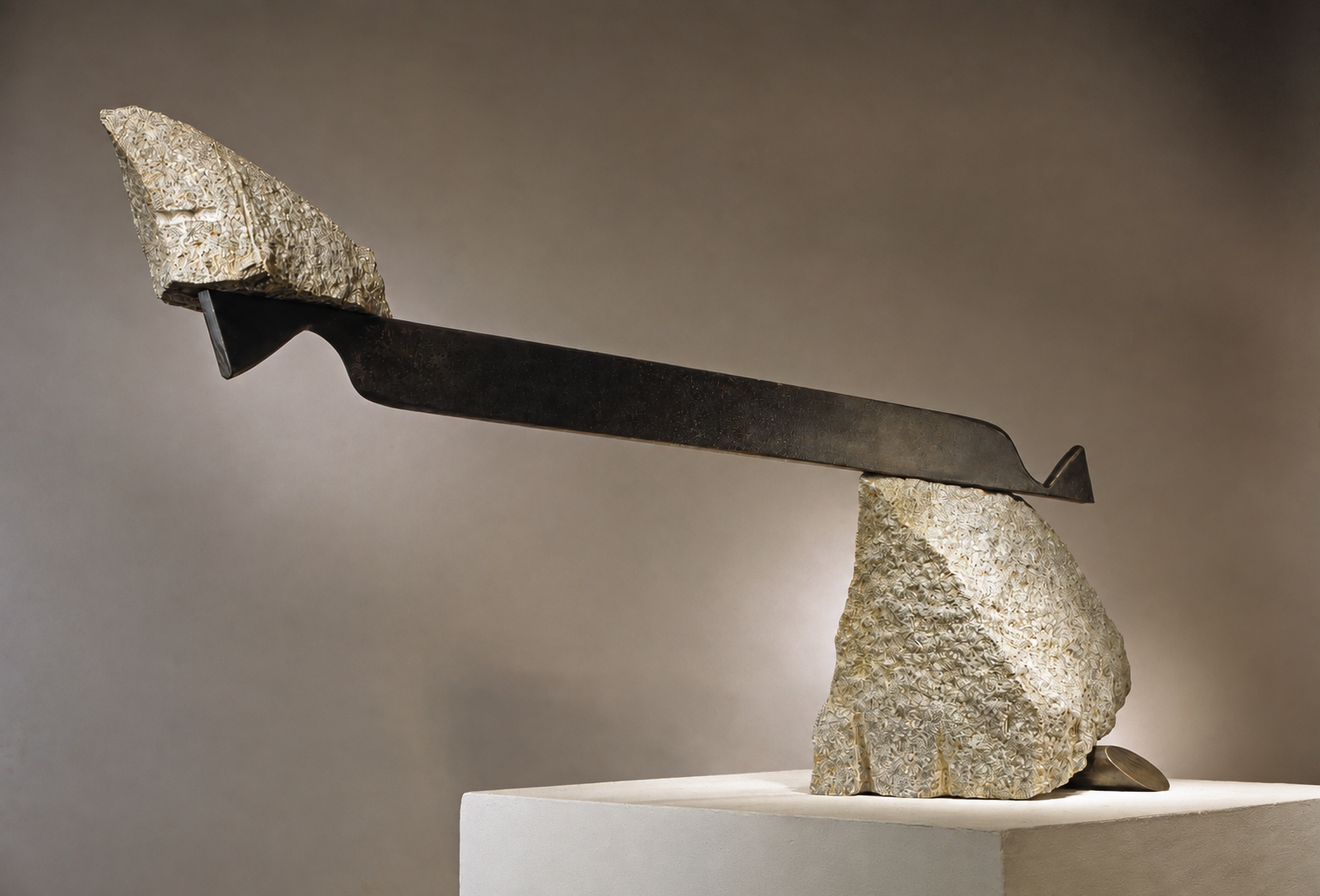
November 1991. Granite, steel. Dimensions: 32 × 69 × 18 in (81 × 175 × 46 cm). Destroyed.
destroyed
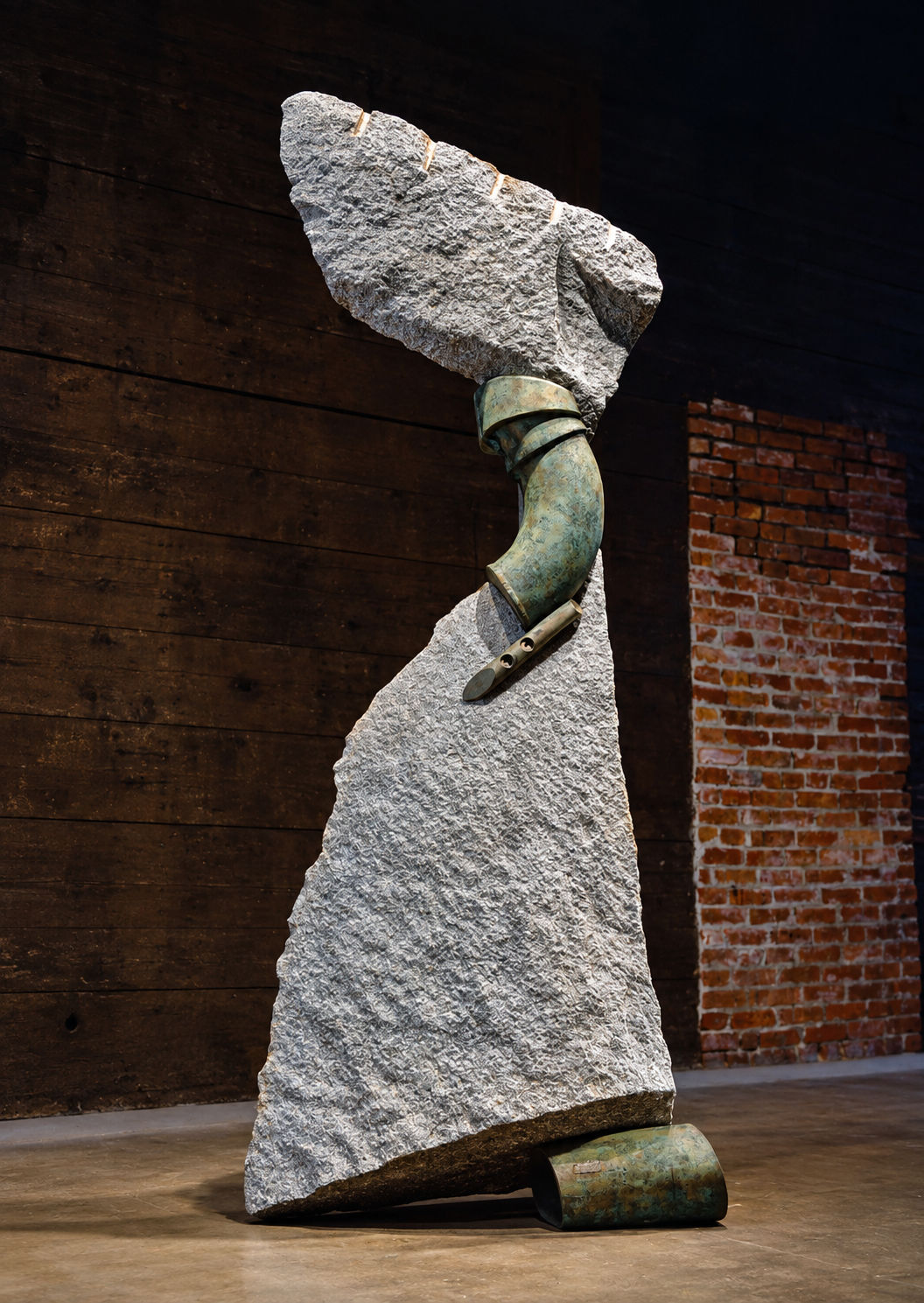
October 1991. Granite, bronze. Dimensions: 89 × 41 × 21 in (226 × 104 × 53 cm). Cannibalized to create Saxum Velum (S-96-11).
Mercury’s Caduceus continues my interest in exploring the figure and mythology as frameworks for sculptural expression. The title refers to Mercury—Hermes in Greek mythology—and his caduceus, the winged staff associated with the messenger god. Rather than illustrating the figure literally, the sculpture abstracts qualities of movement, balance, and flight. The sweeping bronze elements animate the granite, transforming its considerable weight into a figure that appears to pivot and ascend.
The work continues my interest in bringing opposing forces—weight and lift, mass and movement—into expressive balance, creating a massive figure that seems momentarily freed from gravity.
The work was on display in a public park in Baltimore where it was push over by vandals. The upper stone was broken. The remaining parts were used to create Saxum Velum (see below).
January 2000. Granite, painted steel. Dimensions: 88 × 30 × 41 in (224 × 76 × 104 cm).
Cannibalized