1980

October 1980. Sandstone, steel. Dimensions: 12 × 36 × 72 in (30 × 91 × 183 cm).
The Arch Series of the late 1970s and early 1980s evolved from my earlier tensegrity, or Brute Series, in which gravity and the physical pressure of massive stones provide the energy—or “glue”—that holds the sculpture together without welding. In these works, weight is not simply a burden to be supported but an active structural force. Stone and steel press against and respond to one another, creating a state of tension, compression, and equilibrium.
In the Arch Series, this principle developed into low, arching configurations in which heavy stone elements appear to rise from the ground while remaining firmly subject to gravity. The arch became both a structural device and a metaphor—suggesting support, passage, shelter, and the transformation of downward gravitational force into lateral tension. The works explore a recurring concern in my sculpture: how seemingly opposing forces—weight and lift, mass and movement, tension and stability—can be brought into a precarious but resolved balance.

November 1980. Vinalhaven granite, steel. Dimensions: 18 × 21 × 42 in (46 × 53 × 107 cm).
The Arch Series of the late 1970s and early 1980s evolved from my earlier tensegrity, or Brute Series, in which gravity and the physical pressure of massive stones provide the energy—or “glue”—that holds the sculpture together without welding. In these works, weight is not simply a burden to be supported but an active structural force. Stone and steel press against and respond to one another, creating a state of tension, compression, and equilibrium.
In the Arch Series, this principle developed into low, arching configurations in which heavy stone elements appear to rise from the ground while remaining firmly subject to gravity. The arch became both a structural device and a metaphor—suggesting support, passage, shelter, and the transformation of downward gravitational force into lateral tension. The works explore a recurring concern in my sculpture: how seemingly opposing forces—weight and lift, mass and movement, tension and stability—can be brought into a precarious but resolved balance.
November 1980. Granite, steel. Dimensions: 15 × 15 × 48 in (38 × 38 × 122 cm).
No Image available
November 1980. Granite, steel. Dimensions: 18 × 20 × 55 in (46 × 51 × 140 cm).
No Image available (work destroyed by artist)
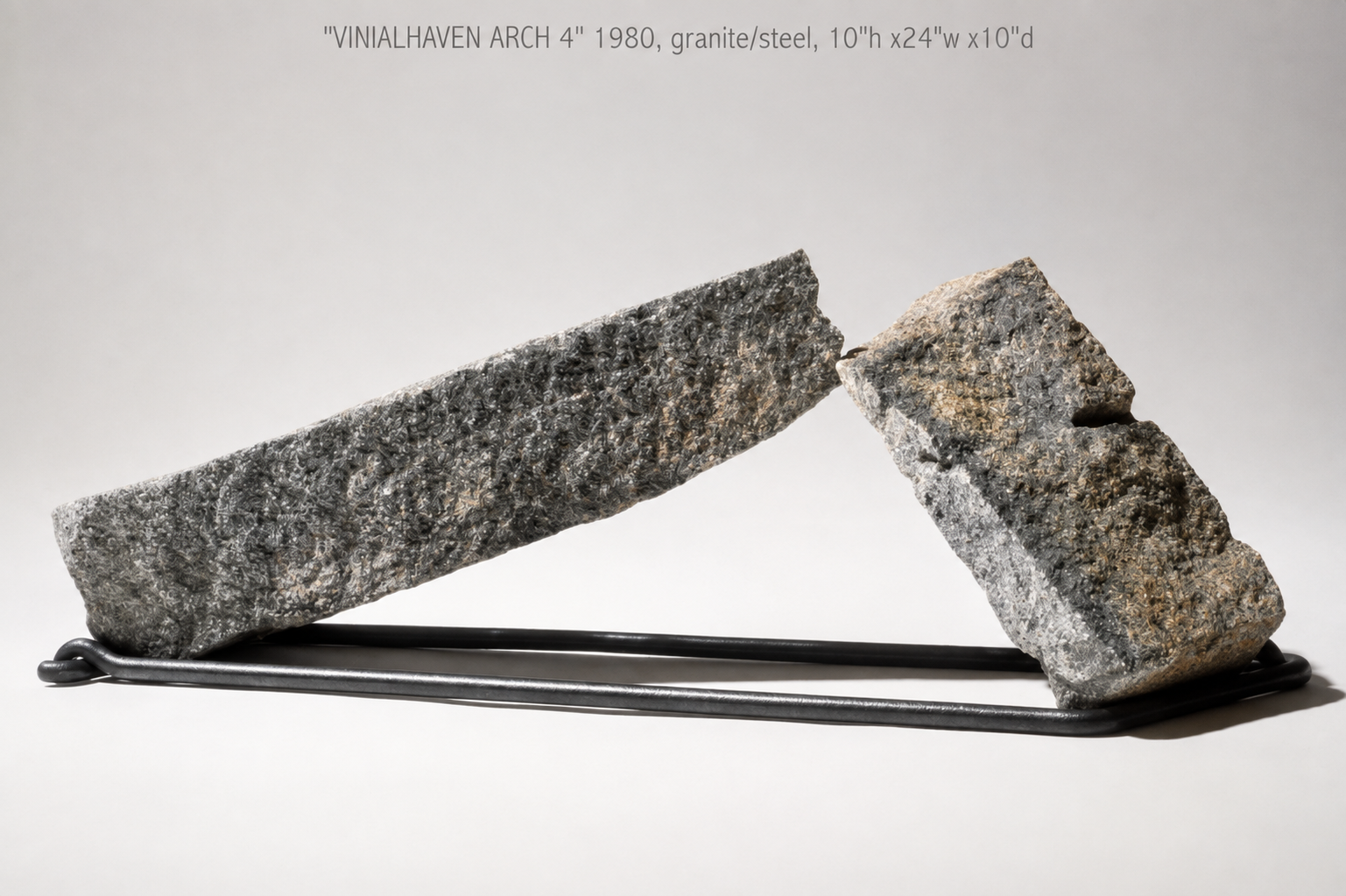
November 1980. Granite, steel. Dimensions: 10 × 24 × 10 in (25 × 61 × 25 cm).
The Arch Series of the late 1970s and early 1980s evolved from my earlier tensegrity, or Brute Series, in which gravity and the physical pressure of massive stones provide the energy—or “glue”—that holds the sculpture together without welding. In these works, weight is not simply a burden to be supported but an active structural force. Stone and steel press against and respond to one another, creating a state of tension, compression, and equilibrium.
In the Arch Series, this principle developed into low, arching configurations in which heavy stone elements appear to rise from the ground while remaining firmly subject to gravity. The arch became both a structural device and a metaphor—suggesting support, passage, shelter, and the transformation of downward gravitational force into lateral tension. The works explore a recurring concern in my sculpture: how seemingly opposing forces—weight and lift, mass and movement, tension and stability—can be brought into a precarious but resolved balance.
December 1980. Granite, steel. Dimensions: 10 × 12 × 30 in (25 × 30 × 76 cm).
No photos available.
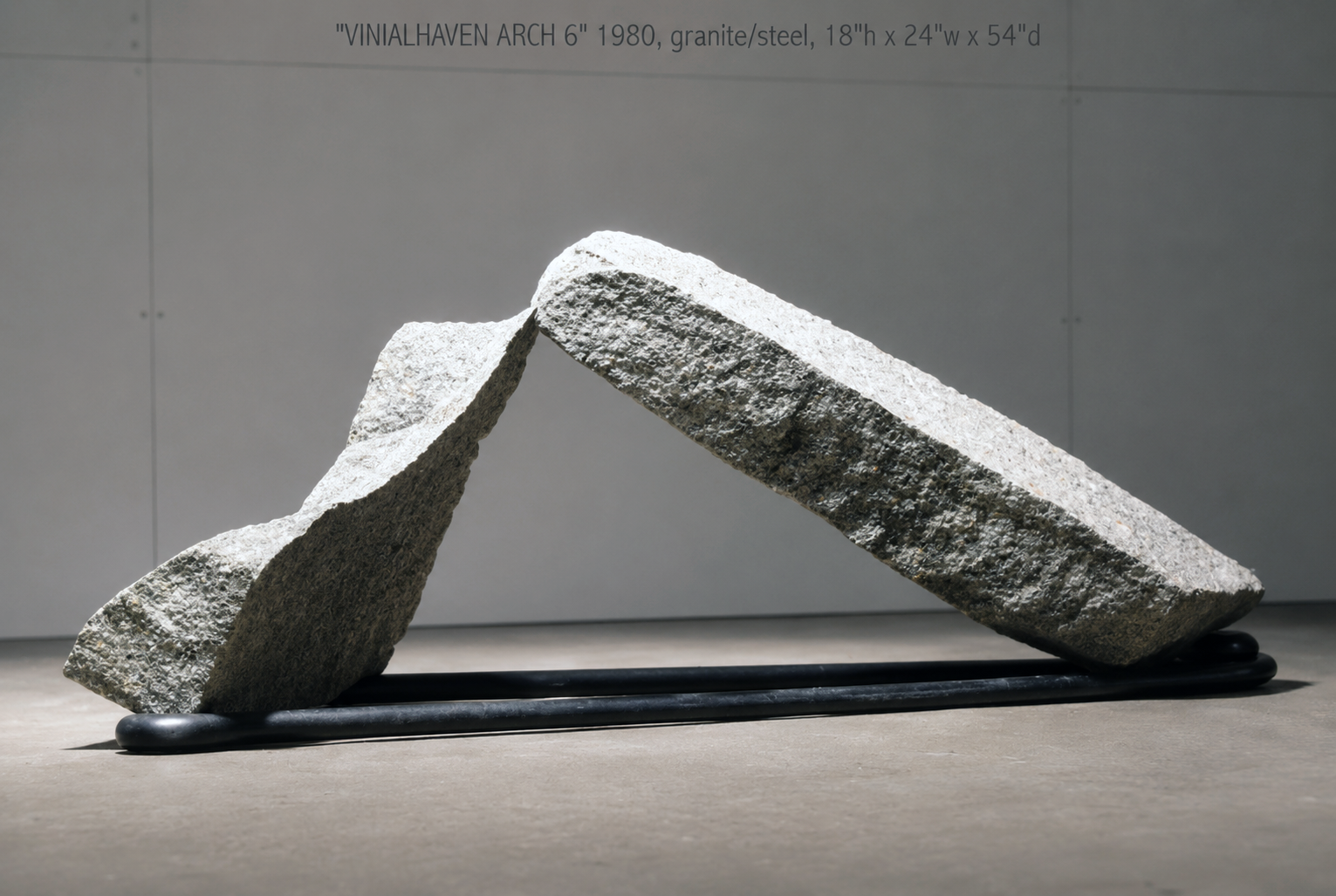
December 1980. Granite, steel. Dimensions: 18 × 24 × 54 in (46 × 61 × 137 cm).
The Arch Series of the late 1970s and early 1980s evolved from my earlier tensegrity, or Brute Series, in which gravity and the physical pressure of massive stones provide the energy—or “glue”—that holds the sculpture together without welding. In these works, weight is not simply a burden to be supported but an active structural force. Stone and steel press against and respond to one another, creating a state of tension, compression, and equilibrium.
In the Arch Series, this principle developed into low, arching configurations in which heavy stone elements appear to rise from the ground while remaining firmly subject to gravity. The arch became both a structural device and a metaphor—suggesting support, passage, shelter, and the transformation of downward gravitational force into lateral tension. The works explore a recurring concern in my sculpture: how seemingly opposing forces—weight and lift, mass and movement, tension and stability—can be brought into a precarious but resolved balance.
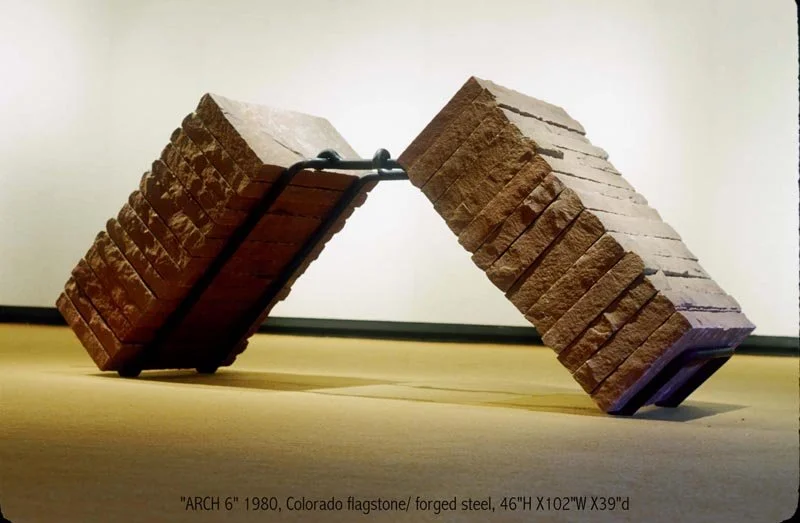
March 1980. Colorado flagstone, steel. Dimensions: 54 × 36 × 105 in (137 × 91 × 267 cm).
Collection: Arvada Center for the Arts, Arvada, CO.
The Arch Series of the late 1970s and early 1980s evolved from my earlier tensegrity, or Brute Series, in which gravity and the physical pressure of massive stones provide the energy—or “glue”—that holds the sculpture together without welding. In these works, weight is not simply a burden to be supported but an active structural force. Stone and steel press against and respond to one another, creating a state of tension, compression, and equilibrium.
In the Arch Series, this principle developed into low, arching configurations in which heavy stone elements appear to rise from the ground while remaining firmly subject to gravity. The arch became both a structural device and a metaphor—suggesting support, passage, shelter, and the transformation of downward gravitational force into lateral tension. The works explore a recurring concern in my sculpture: how seemingly opposing forces—weight and lift, mass and movement, tension and stability—can be brought into a precarious but resolved balance.

July 1980. Colorado flagstone, steel. Dimensions: 24 × 30 × 16 in (61 × 76 × 41 cm).
The Trough Series is part of my tensegrity, or Brute Series, in which gravity and the pressure of the stones provide the energy—or “glue”—that holds the sculpture together without welding. The title references the physical form of a trough. The stones tilt back against the forged steel, each bearing upon the other to create an interdependent structure in which weight becomes an active structural force.
Rather than carving the stone or using it to represent something else, I allow its inherent simple rectangular form, mass, and weight—and the structural behavior of the steel—to become the subject of the sculpture. Gravitational forces are channeled and made visible through the interlocking forged-steel bars, creating a static energy event—a sculpture held in arrested motion. In this sense, the Trough Series is deliberately self-referential—sculpture about sculpture, assemblage about assemblage—while exploring a recurring concern in my work: how opposing forces—weight and lift, mass and movement, tension and stability—can be brought into expressive balance.
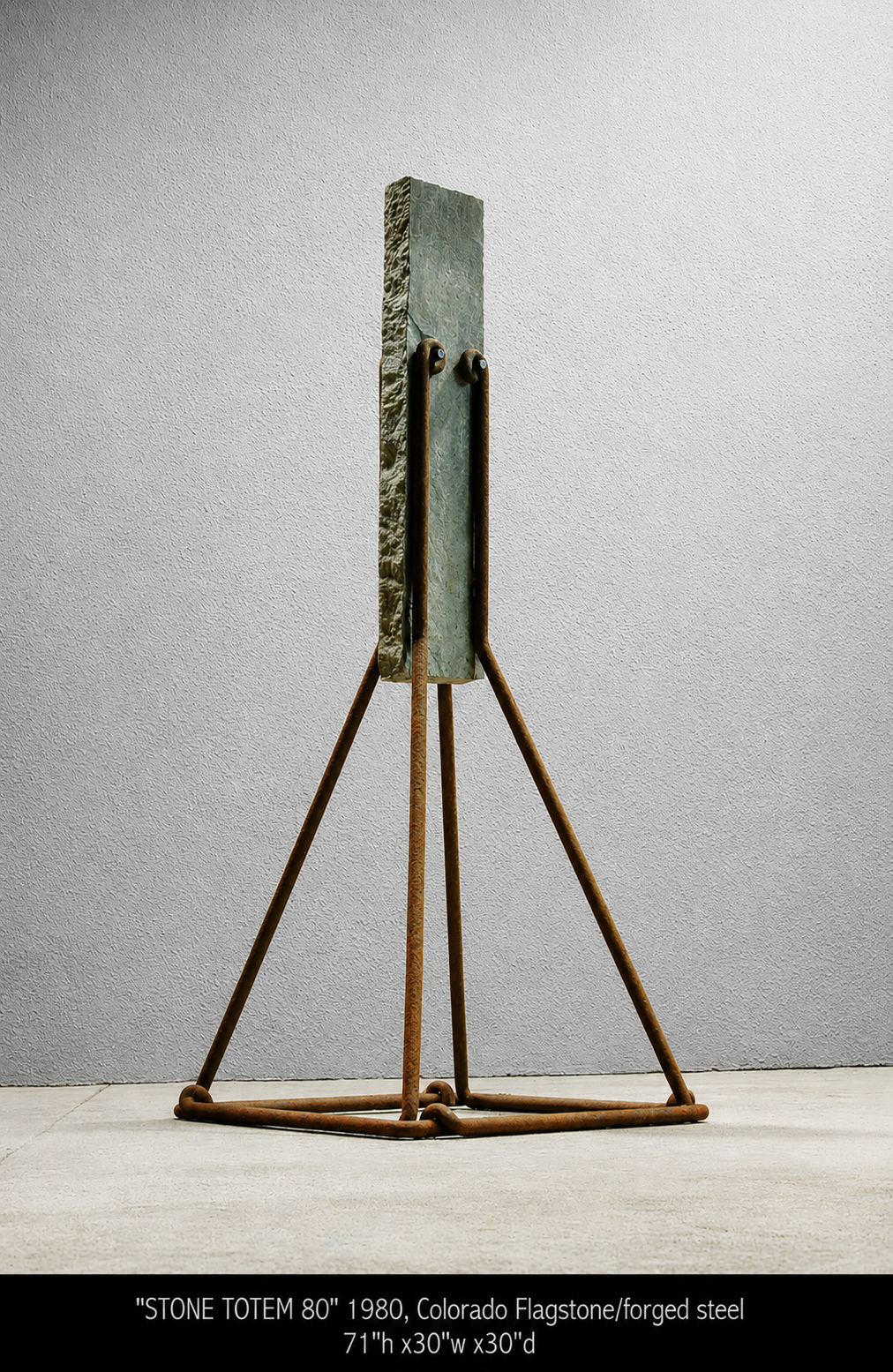
January 1980. Colorado flagstone, steel. Dimensions: 71 × 30 × 30 in (180 × 76 × 76 cm).
Private Collection
Stone Totem 80 is part of the tensegrity, or Brute Series, in which gravity and the pressure of the stones provide the energy—or “glue”—that holds the sculpture together without welding. Weight becomes an active structural force as stone and steel interact through tension, compression, and balance.
Gravitational energy is channeled and made visible through the interlocking forged steel bars, creating a static energy event—a sculpture held in arrested motion. The work reflects a recurring concern in my sculpture: how opposing forces—weight and lift, mass and movement, tension and stability—can be brought into balance.
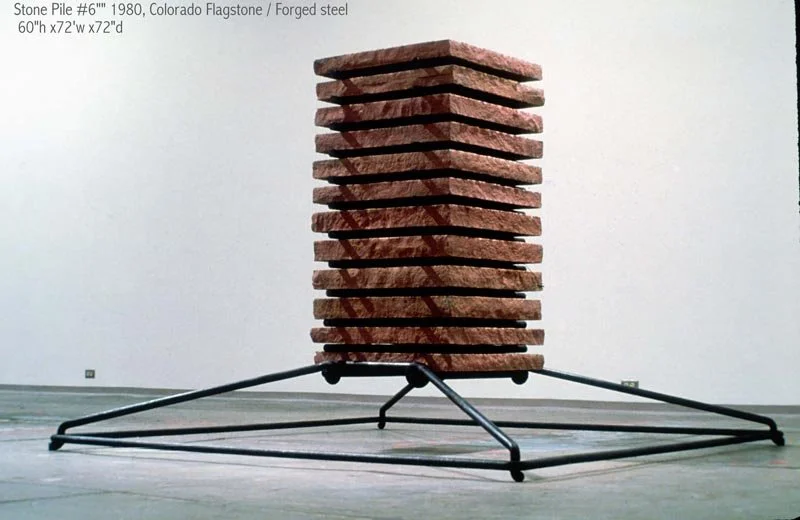
January 1980. Colorado flagstone, steel. Dimensions: 60 × 72 × 72 in (152 × 183 × 183 cm).
Stone Pile 6 is part of the tensegrity, or Brute Series, in which gravity and the pressure of the stones provide the energy—or “glue”—that holds the sculpture together without welding. Weight becomes an active structural force as stone and steel interact through tension, compression, and balance.
Gravitational energy is channeled and made visible through the interlocking forged steel bars, creating a static energy event—a sculpture held in arrested motion. The title Stone Pile functions deliberately as both noun and verb, suggesting not only an object but an action—the act of piling or stacking. The work reflects a recurring concern in my sculpture: how opposing forces—weight and lift, mass and movement, tension and stability—can be brought into balance.
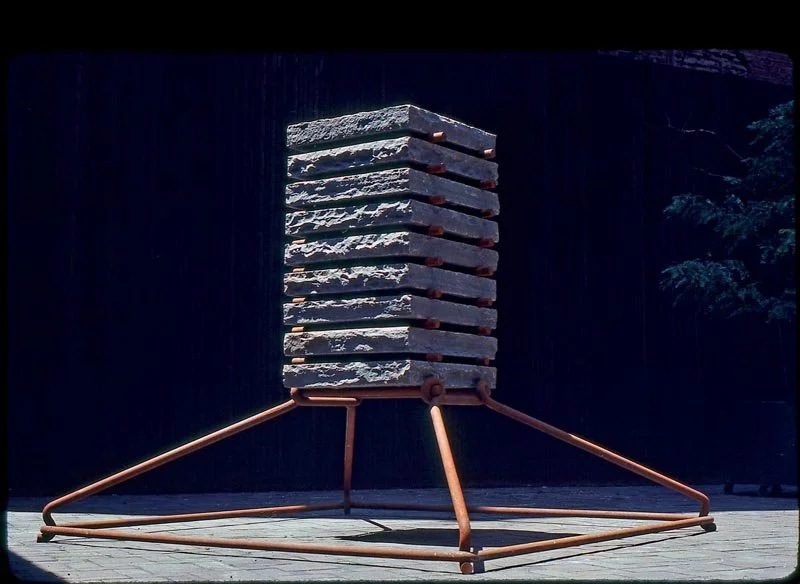
January 1980. Blue stone, steel. Dimensions: 7 × 7 × 7 in (18 × 18 × 18 cm).
Stone Pile 7, 1980
Stone Pile 7 is part of the tensegrity, or Brute Series, in which gravity and the pressure of the stones provide the energy—or “glue”—that holds the sculpture together without welding. Weight becomes an active structural force as stone and steel interact through tension, compression, and balance.
Gravitational energy is channeled and made visible through the interlocking forged steel bars, creating a static energy event—a sculpture held in arrested motion. The title Stone Pile functions deliberately as both noun and verb, suggesting not only an object but an action—the act of piling or stacking. The work reflects a recurring concern in my sculpture: how opposing forces—weight and lift, mass and movement, tension and stability—can be brought into balance.

January 1980. Colorado flagstone, forged steel. Dimensions: 16”h x 50”w x 50”d in.
The Arch Series of the late 1970s and early 1980s evolved from my earlier tensegrity, or Brute Series, in which gravity and the physical pressure of massive stones provide the energy—or “glue”—that holds the sculpture together without welding. In these works, weight is not simply a burden to be supported but an active structural force. Stone and steel press against and respond to one another, creating a state of tension, compression, and equilibrium.
In the Arch Series, this principle developed into low, arching configurations in which heavy stone elements appear to rise from the ground while remaining firmly subject to gravity. The arch became both a structural device and a metaphor—suggesting support, passage, shelter, and the transformation of downward gravitational force into lateral tension. The works explore a recurring concern in my sculpture: how seemingly opposing forces—weight and lift, mass and movement, tension and stability—can be brought into a precarious but resolved balance.
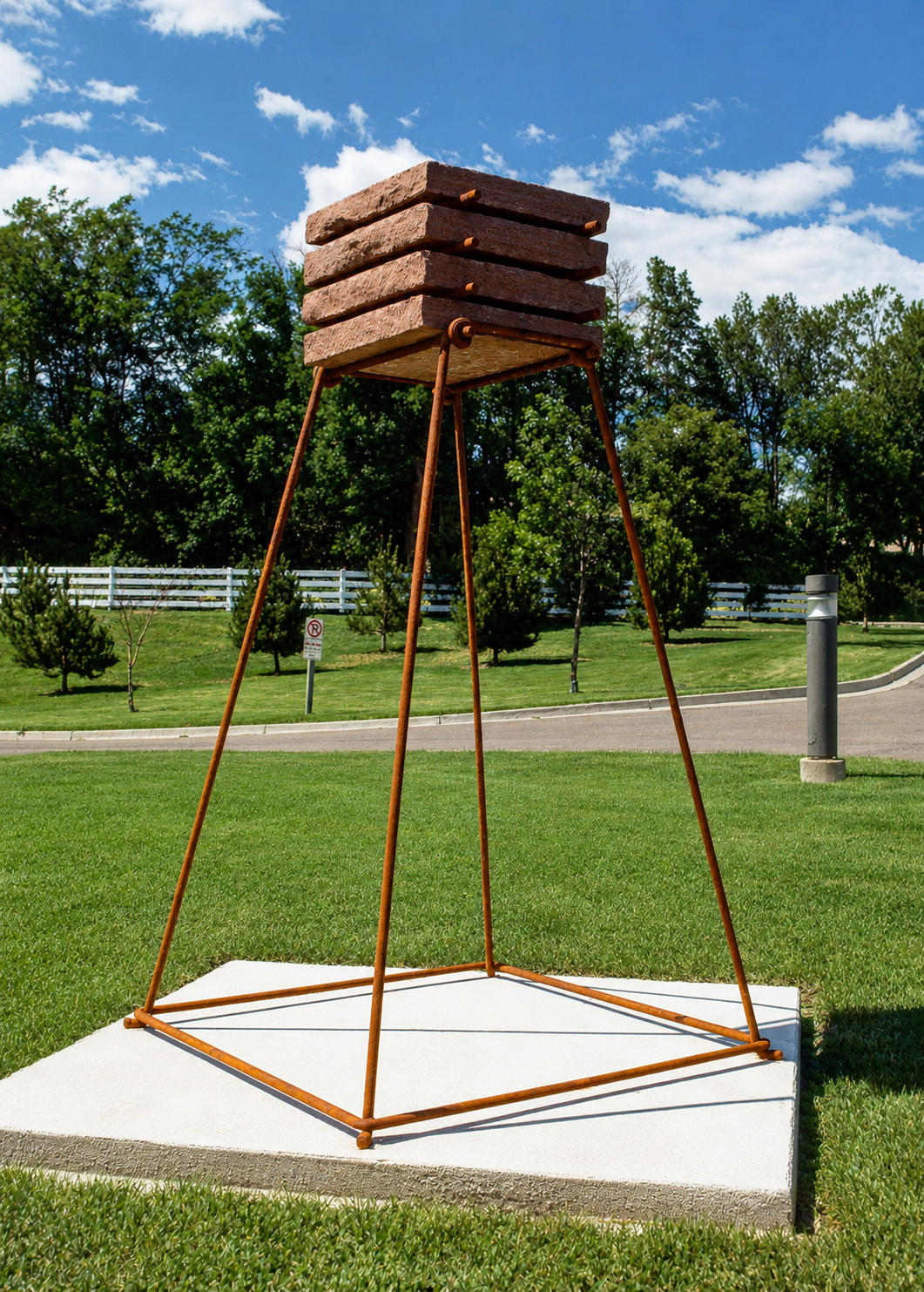
January 1980. Colorado flagstone, steel. Dimensions: 8 × 4 × 4 in (20 × 10 × 10 cm).
Stone Tower is part of the tensegrity, or Brute Series, in which gravity and the pressure of the stones provide the energy—or “glue”—that holds the sculpture together without welding. Weight becomes an active structural force as stone and steel interact through tension, compression, and balance.
Gravitational energy is channeled and made visible through the interlocking forged steel bars, creating a static energy event—a sculpture held in arrested motion. The title Stone Tower functions deliberately as both noun and verb, suggesting not only an object but an action—the act of piling or stacking. The work reflects a recurring concern in my sculpture: how opposing forces—weight and lift, mass and movement, tension and stability—can be brought into balance.
1976 - 1979

1976, pink granite / forged steel
Nature of Stone Series marks the beginning of my exploration of tensegrity, an approach that would become central to the early Brute Sculpture. In these works, gravity and the physical pressure of massive stones provide the energy—or “glue”—that holds the sculpture together without welding.
Weight is not simply a burden to be supported, but an active structural force. These forces are traced both visually and physically through the linear forged-steel bars. Stone and steel press against and respond to one another through tension and compression, creating a precarious yet stable state of expressive equilibrium that reveals the intrinsic nature of the materials.

June 1976. White granite, steel. Dimensions: 76 × 53 × 48 in (193 × 135 × 122 cm).
Stone Totem ‘76 marks the beginning of my exploration of tensegrity, an approach that would become central to the early Brute Sculpture. In these works, gravity and the physical pressure of massive stones provide the energy—or “glue”—that holds the sculpture together without welding.
Weight is not simply a burden to be supported, but an active structural force. These forces are traced both visually and physically through the linear forged-steel bars. Stone and steel press against and respond to one another through tension and compression, creating a precarious yet stable state of expressive equilibrium that reveals the intrinsic nature of the materials.
This period also marks my increasing use of “found stone,” obtained from both industrial and natural sources, and my treatment of it as an additive sculptural element rather than as material to be carved through the traditional subtractive process. The stone is allowed to retain and celebrate its inherent form, weight, texture, and character—an approach that has an affinity with the appreciation of naturally occurring stone in the Japanese rock garden.

February 1976. Pink granite, steel. Dimensions: 36 × 48 × 108 in (91 × 122 × 274 cm).
Untitled 76 – 3 Curved Stones marks the beginning of my exploration of tensegrity, an approach that would become central to the early Brute Sculpture. In these works, gravity and the physical pressure of the stones provide the energy—or “glue”—that holds the sculpture together without welding.
Weight is not simply a burden to be supported, but an active structural force. These forces are traced both visually and physically through the linear forged-steel bars. Stone and steel press against and respond to one another through tension and compression, creating a precarious yet stable state of expressive equilibrium that reveals the intrinsic nature of the materials.
This period also marks my increasing use of “found stone,” obtained from both industrial and natural sources, and my treatment of it as an additive sculptural element rather than as material to be carved through the traditional subtractive process. The stone is allowed to retain and celebrate its inherent form, weight, texture, and character—an approach that has an affinity with the appreciation of naturally occurring stone in the Japanese rock garden.
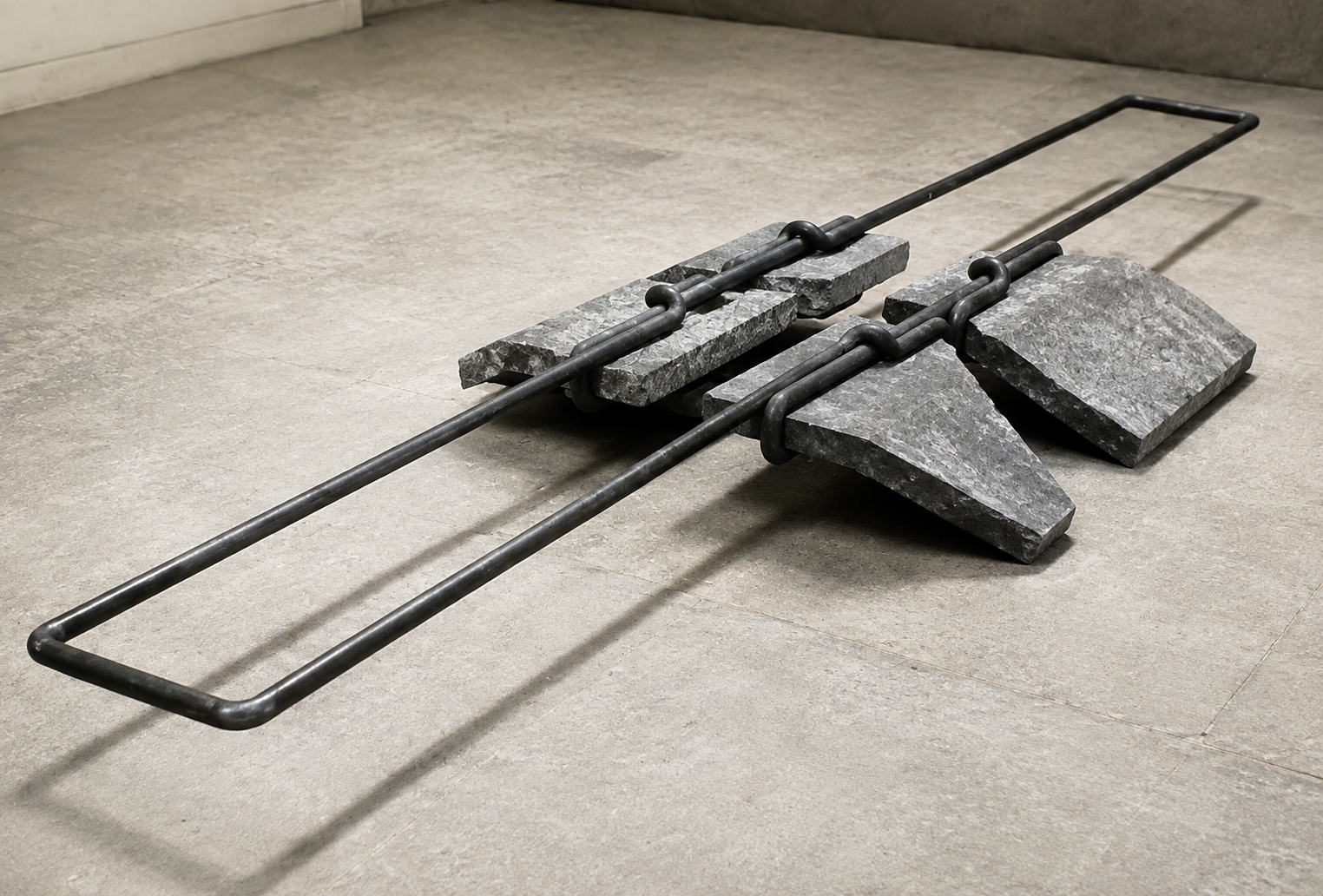
February 1976. Black granite, steel. Dimensions: 12 × 49 × 156 in (30 × 124 × 396 cm).
Boundary, 1976
Boundary was the second work in my tensegrity, or Brute Series. The title operates in two ways: the found granite stones are literally bound in place by forged-steel bars, while the long horizontal extension of the steel traces a line through space, suggesting a border or boundary. Rather than carving the granite, I use its inherent mass and weight as an active structural element.
Gravity and the downward pressure of the stones provide the energy—or “glue”—that holds the sculpture together without welding. As the stones settle, their weight activates the interlocking steel bars, creating tension, compression, and equilibrium. The result is a static energy event—a sculpture held in arrested motion, in which the forces that might cause the structure to collapse are instead redirected to hold it together.
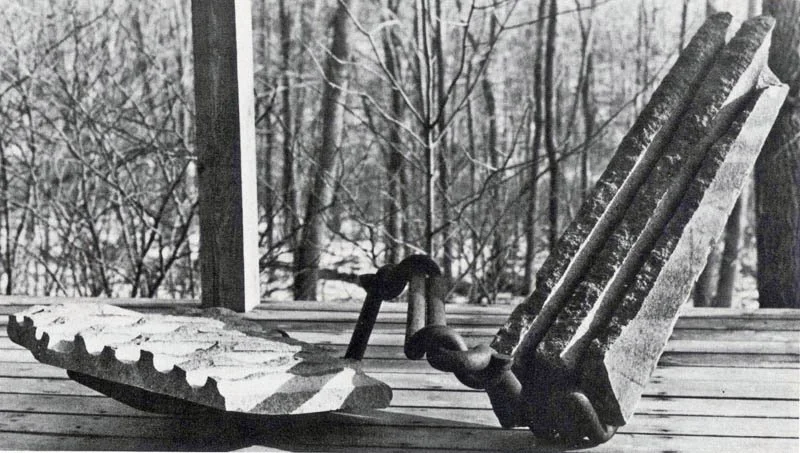
Nature of Stone I, 1976, Granite and steel, 33 3/4" h x69 1/4 x43 3/4"d ., 500 lb. (85.7 x175.9 x111.1 cm, 226.8 kg)
Collection Hirshhorn Museum and Sculpture garden, Washington, DC
Nature of Stone Series marks the beginning of my exploration of tensegrity, an approach that would become central to the early Brute Sculpture. In these works, gravity and the physical pressure of massive stones provide the energy—or “glue”—that holds the sculpture together without welding.
Weight is not simply a burden to be supported, but an active structural force. These forces are traced both visually and physically through the linear forged-steel bars. Stone and steel press against and respond to one another through tension and compression, creating a precarious yet stable state of expressive equilibrium that reveals the intrinsic nature of the materials.
This period also marks my increasing use of “found stone,” obtained from both industrial and natural sources, and my treatment of it as an additive sculptural element rather than as material to be carved through the traditional subtractive process. The stone is allowed to retain and celebrate its inherent form, weight, texture, and character—an approach that has an affinity with the appreciation of naturally occurring stone in the Japanese rock garden.

November 1976. Pink granite, steel. Dimensions: 72 × 56 × 56 in (183 × 142 × 142 cm). destroyed.
Laramie Stone Totem was the first sculpture I made after moving to Laramie, Wyoming. The pink granite, transported with me from Ithaca, provided a physical and conceptual link to the tensegrity, or Brute Series, I had begun there. Gravity and the downward pressure of the stone provide the energy—or “glue”—that holds the sculpture together without welding. Weight becomes an active structural force as stone and steel interact through tension, compression, and balance.
The work also marks the beginning of my Totem Series. Its strong vertical stone element was a creative response to the natural stone towers and dramatic geological formations I encountered for the first time in the western landscape. The gravitational energy of the stone is channeled and made visible through the interlocking forged-steel bars, creating a static energy event—a sculpture held in arrested motion, with the weight of the stone generating the forces that clamp it firmly in place.

November 1976. Granite, forged steel. Dimensions: 27 × 81 × 46 in (69 × 206 × 117 cm).
Nature of Stone (Crimp) was the first work in my Nature of Stone Series and the third in my tensegrity, or Brute Series. The title describes the physical action of the sculpture: the weight of the found granite literally crimps the forged-steel bars together. Rather than carving the stone or using it to represent something else, I allow its inherent form, mass, and weight—and the structural behavior of the steel—to become the subject of the work. In this sense, Crimp is deliberately self-referential: sculpture about sculpture, assemblage about assemblage.
Gravity and the downward pressure of the stone provide the energy—or “glue”—that holds the sculpture together without welding. As the stone settles, its weight activates the interlocking steel bars, producing tension, compression, and equilibrium. The result is a static energy event—a sculpture held in arrested motion, in which the gravitational force that threatens collapse is redirected to hold the structure together.

January 1977. Steel, granite. Dimensions: 67 × 57 × 165 in (170 × 145 × 419 cm).
Torque Series
The Torque Series is part of my tensegrity, or Brute Series, in which gravity and the pressure of the stones provide the energy—or “glue”—that holds the sculpture together without welding. The title refers to torque—the twisting force generated as the weight of the stones acts through the forged-steel bars. Stone and steel bear upon one another, creating an interdependent structure in which weight, leverage, and torque become active structural forces.
Rather than carving the stone or using it to represent something else, I allow its inherent form, mass, and weight—and the structural behavior of the steel—to become the subject of the sculpture. Gravitational forces are channeled and made visible through the interlocking forged-steel bars, creating a static energy event—a sculpture held in arrested motion. In this sense, the Torque Series is deliberately self-referential—sculpture about sculpture, assemblage about assemblage—while exploring a recurring concern in my work: how opposing forces—weight and lift, mass and movement, tension and stability—can be brought into expressive balance.

January 1977. Granite, steel. Dimensions: 27 × 189 × 24 in (69 × 480 × 61 cm).
he Prop Series is closely related to the Arch Series of the late 1970s and early 1980s and evolved from my earlier tensegrity, or Brute Series, in which gravity and the physical pressure of massive stones provide the energy—or “glue”—that holds the sculpture together without welding. Weight is not simply a burden to be supported but an active structural force. Stone and steel press against and respond to one another, creating a state of tension, compression, and equilibrium.
The title Prop is purposely both noun and verb, emphasizing that the sculpture is simultaneously an object and an action or event—the act of propping, supporting, and holding in balance.
Prop #2 is a transitional work that carries these real force energies into the more linear and graphic language that developed in my Gallery Drawing Series. Its extended steel rod reaches dramatically into the surrounding space, functioning almost as a line drawn in space. In this way, the work combines the physical forces of gravity, weight, and balance with a strong graphic quality, suggesting a three-dimensional drawing.
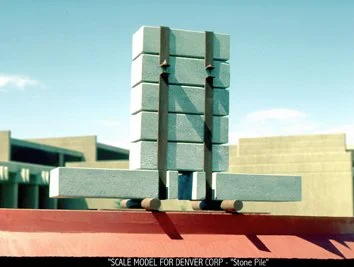
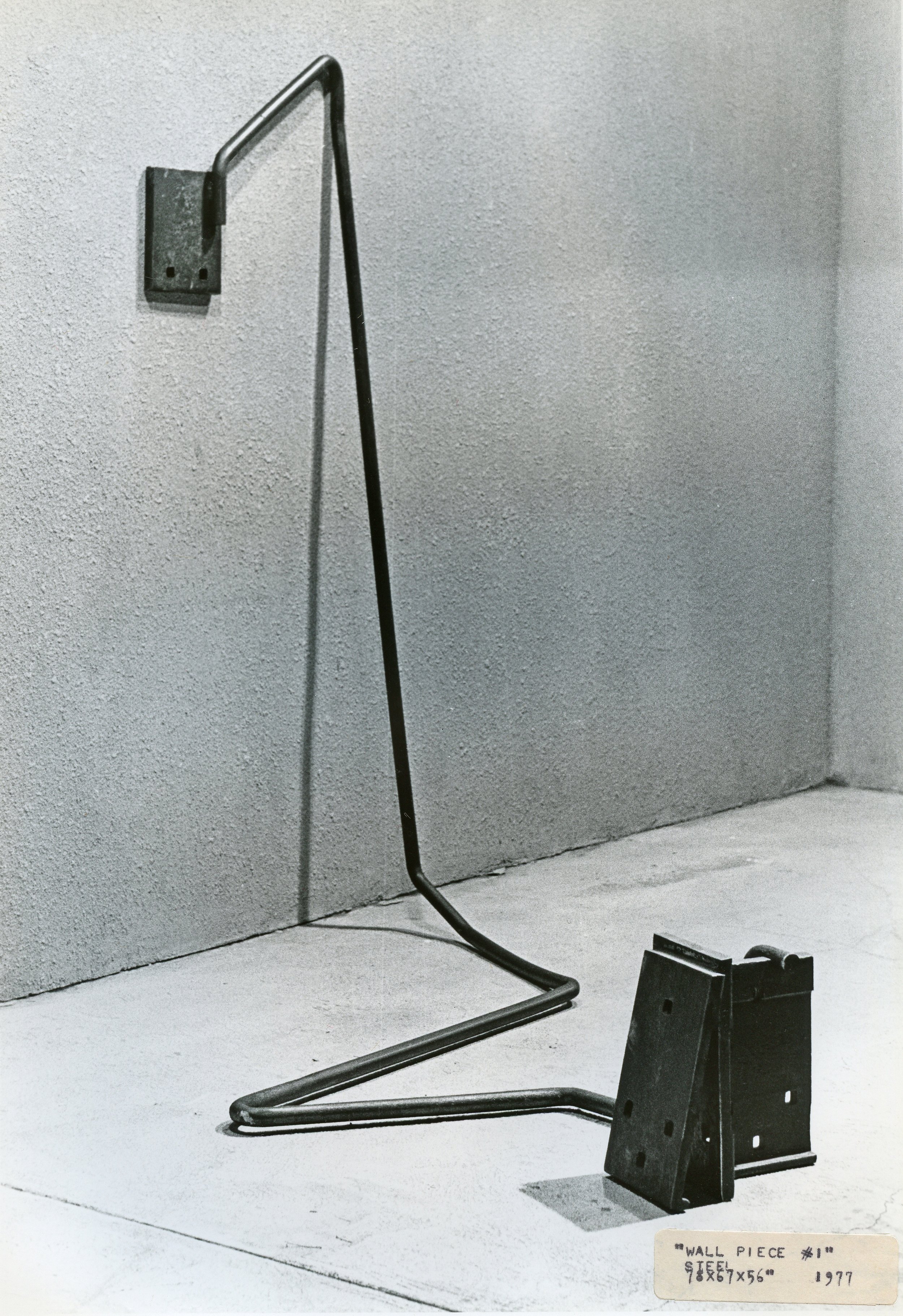
January 1977. Steel. Dimensions: 78 × 67 × 56 in (198 × 170 × 142 cm). Destroyed.
Wall Piece #1 is part of the Gallery Drawing Series and grew out of my earlier tensegrity, or Brute Series, but marked a shift from the concentrated physical interaction of stone and steel toward a more open, linear exploration of space. Long forged-steel rods extend across the floor and into the gallery as lines drawn in space, activating the surrounding architecture and making the gallery itself an integral part of the work.
The series also questions the gallery as a framing and sanctioning device for art. Much as a frame separates an artwork from the world around it, the gallery performs a similar function on an architectural scale. By extending sculpture directly into that space, the Gallery Drawings blur distinctions between object, drawing, architecture, and environment, raising the question of where the artwork actually begins and ends.
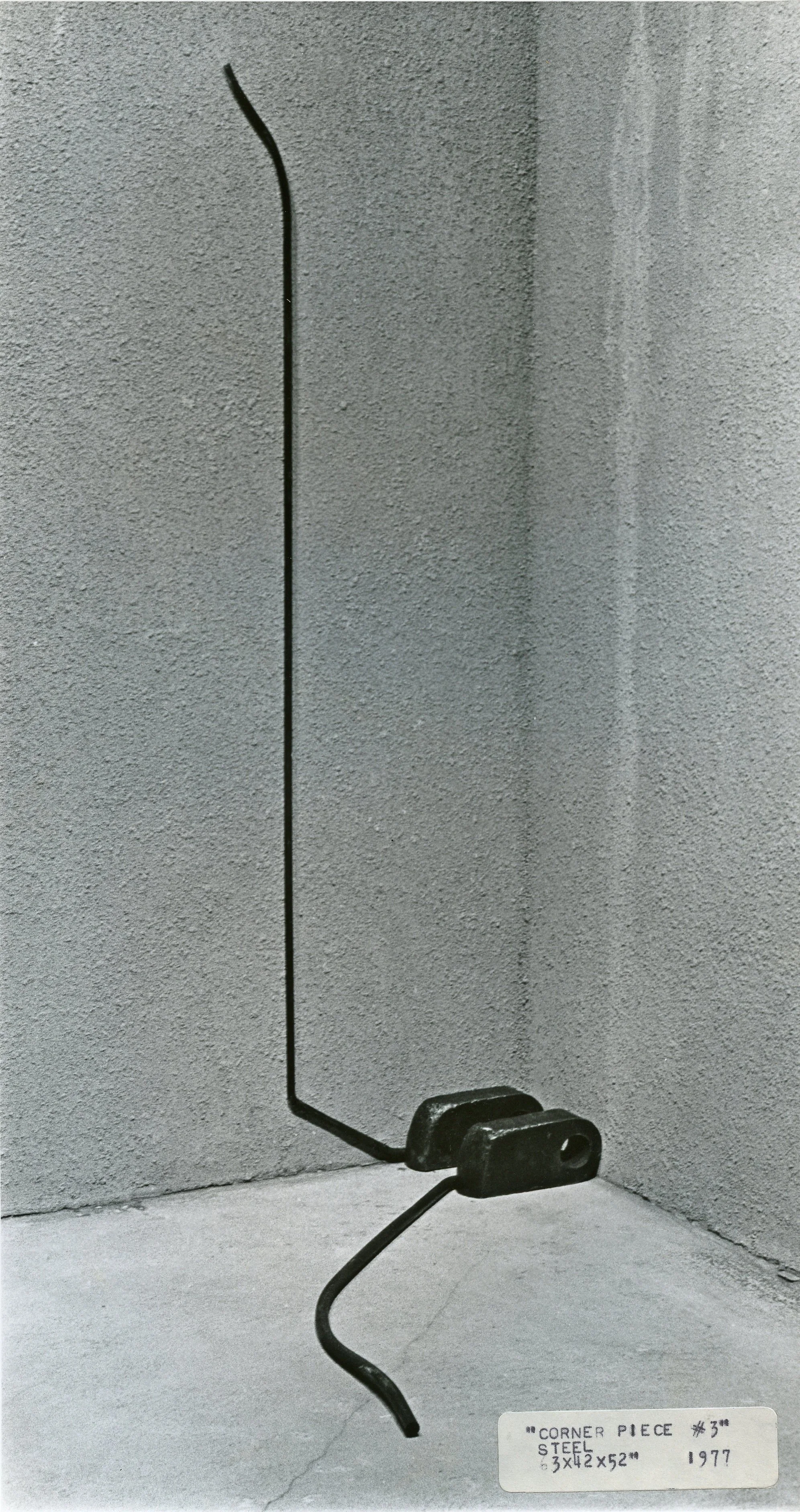
January 1977. Steel. Dimensions: 63 × 42 × 52 in (160 × 107 × 132 cm). Destroyed.
Corner Piece #3 is part of the Gallery Drawing Series and grew out of my earlier tensegrity, or Brute Series, but marked a shift from the concentrated physical interaction of stone and steel toward a more open, linear exploration of space. Long forged-steel rods extend across the floor and into the gallery as lines drawn in space, activating the surrounding architecture and making the gallery itself an integral part of the work.
The series also questions the gallery as a framing and sanctioning device for art. Much as a frame separates an artwork from the world around it, the gallery performs a similar function on an architectural scale. By extending sculpture directly into that space, the Gallery Drawings blur distinctions between object, drawing, architecture, and environment, raising the question of where the artwork actually begins and ends.
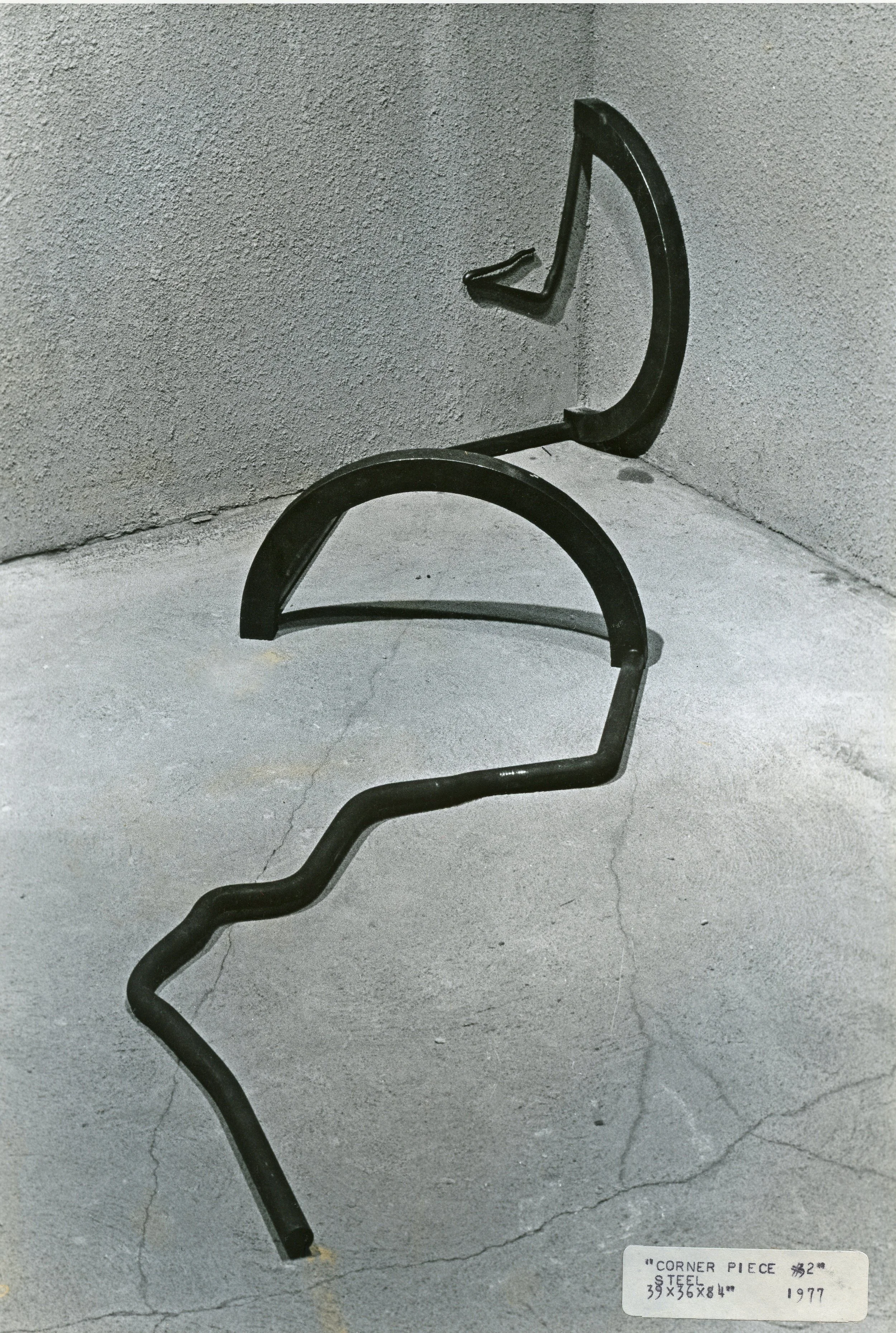
January 1977. Steel. Dimensions: 39 × 36 × 84 in (99 × 91 × 213 cm). Destroyed
Corner Piece #2 is part of the Gallery Drawing Series and grew out of my earlier tensegrity, or Brute Series, but marked a shift from the concentrated physical interaction of stone and steel toward a more open, linear exploration of space. Long forged-steel rods extend across the floor and into the gallery as lines drawn in space, activating the surrounding architecture and making the gallery itself an integral part of the work.
The series also questions the gallery as a framing and sanctioning device for art. Much as a frame separates an artwork from the world around it, the gallery performs a similar function on an architectural scale. By extending sculpture directly into that space, the Gallery Drawings blur distinctions between object, drawing, architecture, and environment, raising the question of where the artwork actually begins and ends.

January 1977. Granite, steel. Dimensions: 5 × 6 × 10 in (13 × 15 × 25 cm). Destroyed.
Stonealope is a transitional work that carries these real force energies into the more linear and graphic language that developed in my Gallery Drawing Series. Its extended steel rod reaches dramatically into the surrounding space, functioning almost as a line drawn in space. In this way, the work combines the physical forces of gravity, weight, and balance with a strong graphic quality, suggesting a three-dimensional drawing.
The sculpture also makes an anatomical reference to a loping or running animal, introducing a playful, figurative association. The title Stonealope is a tongue-in-cheek nod to the fictitious jackalope—the legendary hybrid of jackrabbit and antelope familiar in Western, particularly Wyoming, cowboy folklore. The title brings an element of humor to the work while reinforcing its suggestion of an improbable stone-and-steel creature caught in motion.

January 1977. Steel. Dimensions: 94 × 37 × 82 in (239 × 94 × 208 cm). Destroyed.
Wall Piece #2 is part of the Gallery Drawing Series and grew out of my earlier tensegrity, or Brute Series, but marked a shift from the concentrated physical interaction of stone and steel toward a more open, linear exploration of space. Long forged-steel rods extend across the floor and into the gallery as lines drawn in space, activating the surrounding architecture and making the gallery itself an integral part of the work.
The series also questions the gallery as a framing and sanctioning device for art. Much as a frame separates an artwork from the world around it, the gallery performs a similar function on an architectural scale. By extending sculpture directly into that space, the Gallery Drawings blur distinctions between object, drawing, architecture, and environment, raising the question of where the artwork actually begins and ends.
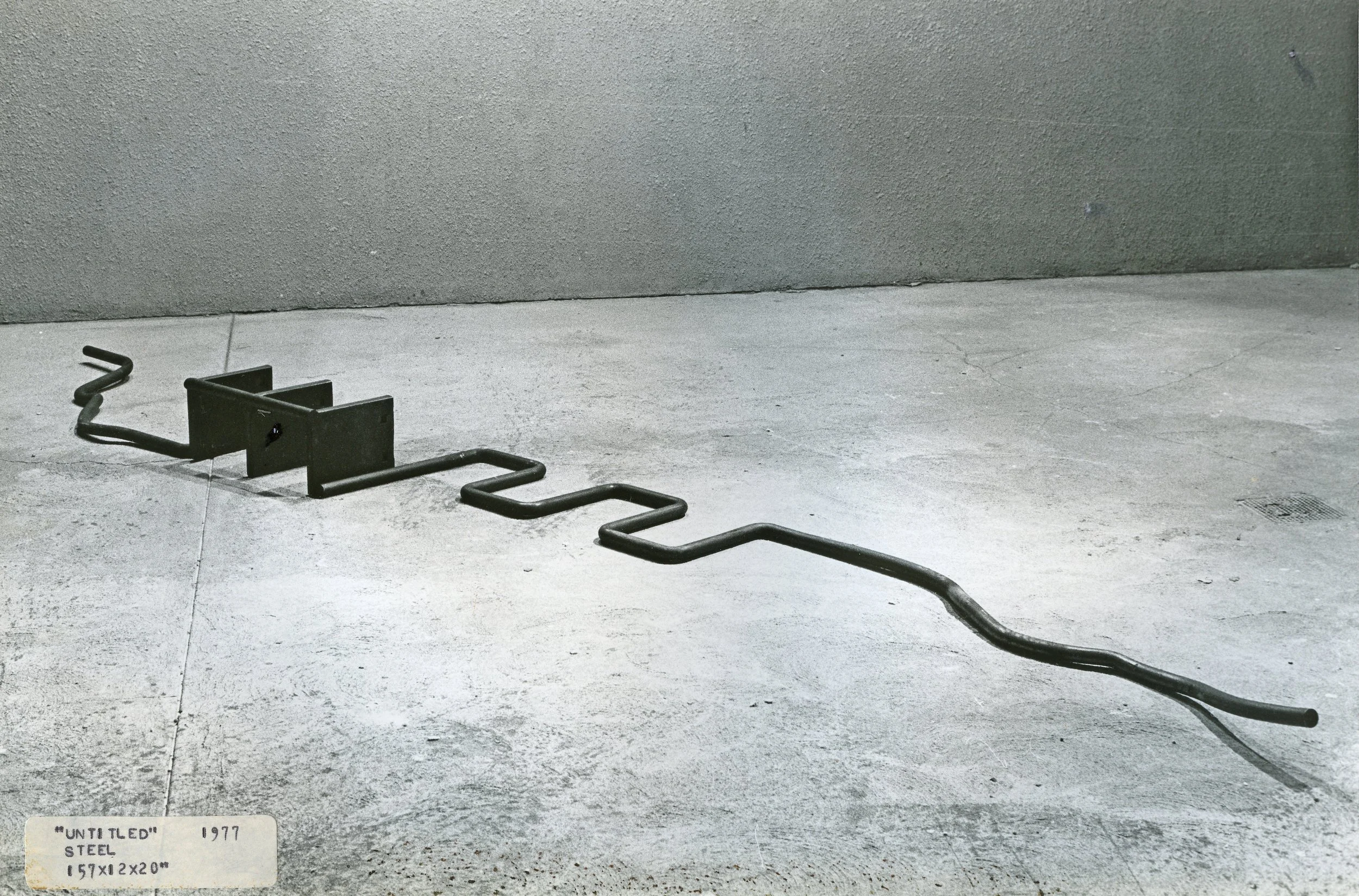
January 1977. Steel. Dimensions: 157 × 20 × 12 in (399 × 51 × 30 cm). Destroyed.
Untitled (floor piece) is part of the Gallery Drawing Series and grew out of my earlier tensegrity, or Brute Series, but marked a shift from the concentrated physical interaction of stone and steel toward a more open, linear exploration of space. Long forged-steel rods extend across the floor and into the gallery as lines drawn in space, activating the surrounding architecture and making the gallery itself an integral part of the work.
The series also questions the gallery as a framing and sanctioning device for art. Much as a frame separates an artwork from the world around it, the gallery performs a similar function on an architectural scale. By extending sculpture directly into that space, the Gallery Drawings blur distinctions between object, drawing, architecture, and environment, raising the question of where the artwork actually begins and ends.
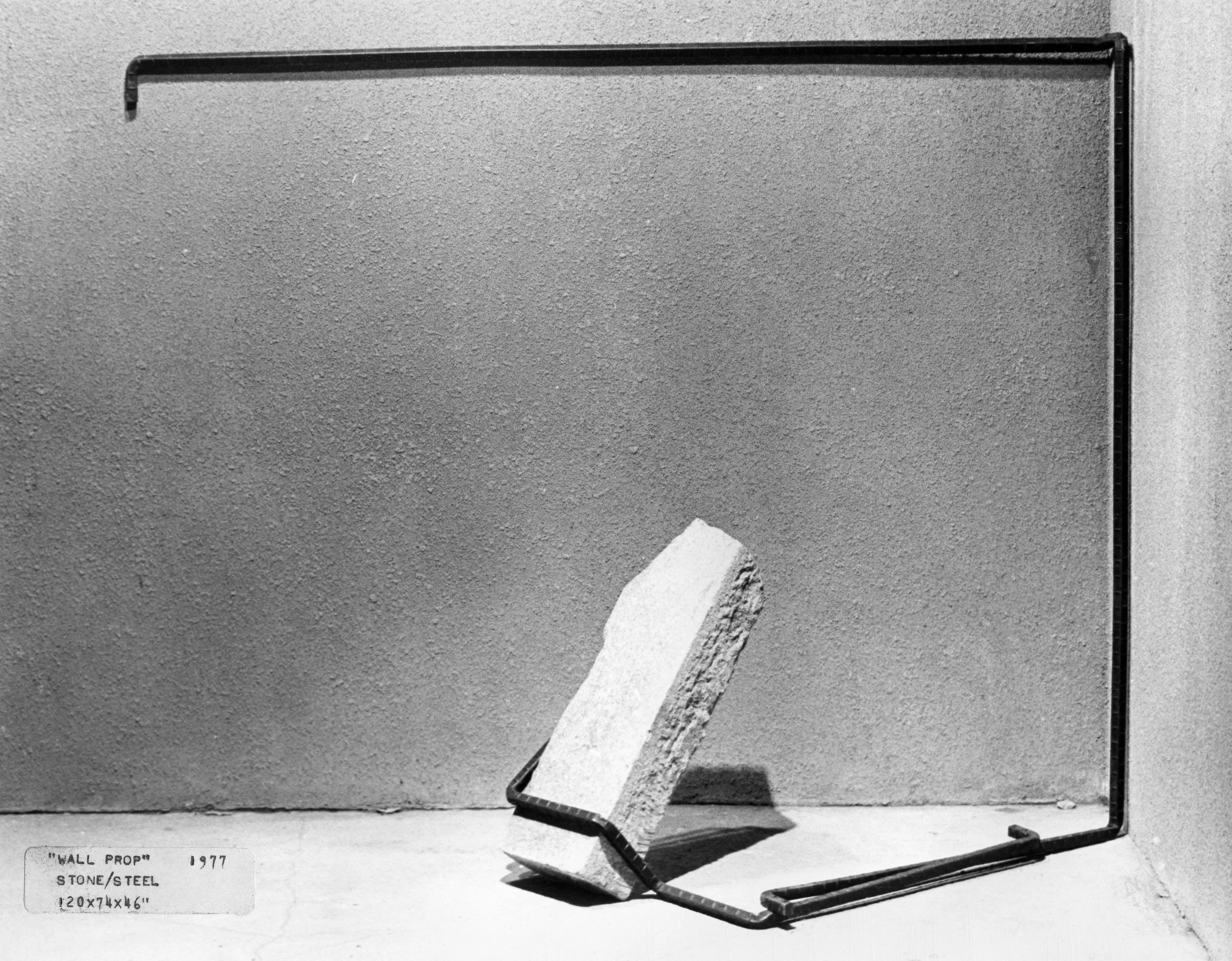
January 1977. Stone, steel. Dimensions: 74 × 120 × 46 in (188 × 305 × 117 cm).
Wall Prop (1977) is a transitional work linking the tensegrity, or Brute Series, with the Gallery Drawing Series of 1977–78. While retaining the earlier work’s reliance on gravity, tension, and the physical interaction of stone and steel, it introduces the idea of the frame as a device that defines and legitimizes an object as art.
The extended steel bar functions simultaneously as structure, frame, and line—a three-dimensional drawing surrounding the stone and the space it occupies. This exploration of framing would continue in the Gallery Drawings and later the Easel Landscape Series, questioning how framing something can alter our perception of it and confer the status of art.
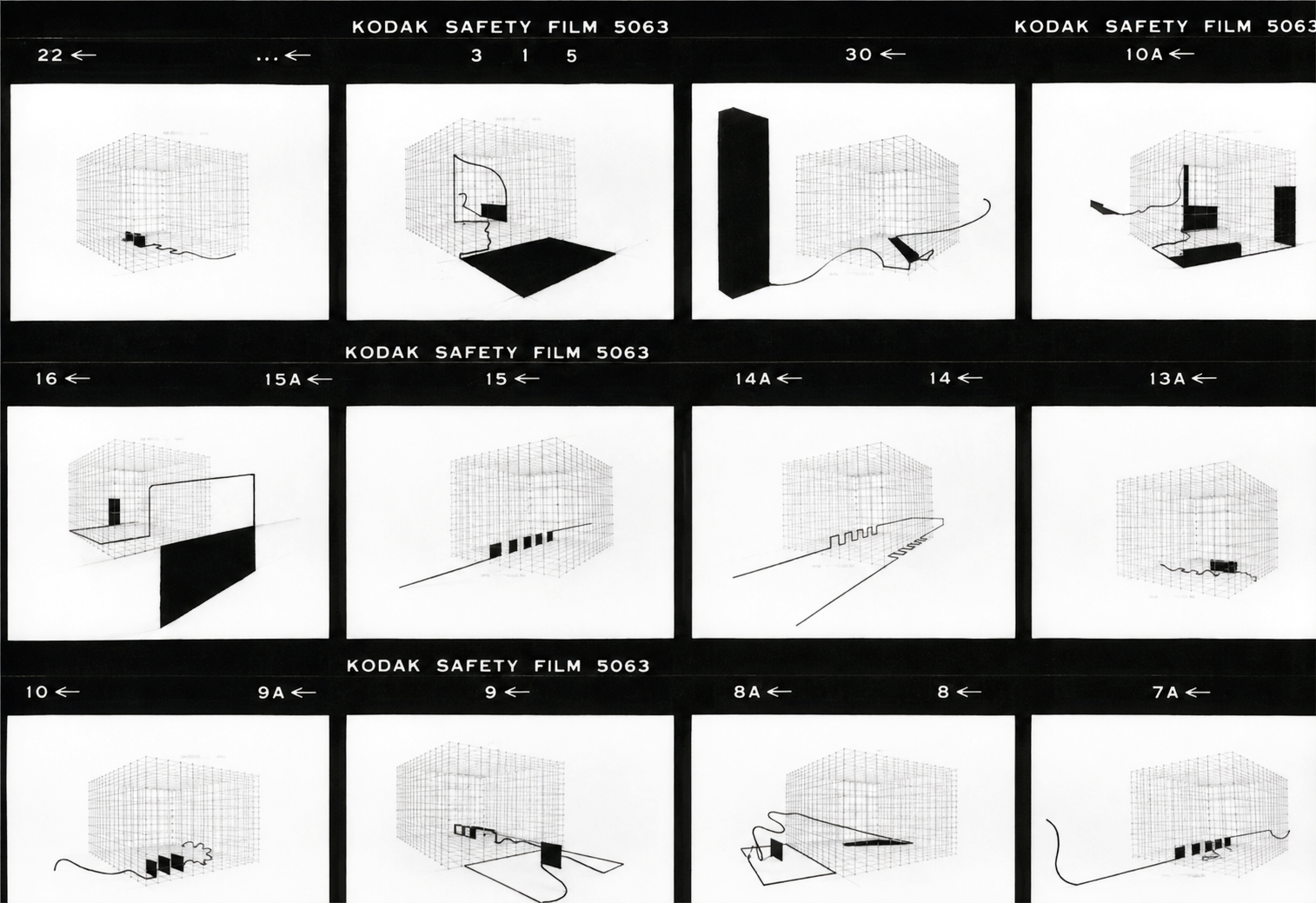
1978, graph paper/charcoal, each 8.5" x11"
Gallery Drawing Series and grew out of my earlier tensegrity, or Brute Series, but marked a shift from the concentrated physical interaction of stone and steel toward a more open, linear exploration of space. Long forged-steel rods extend across the floor and into the gallery as lines drawn in space, activating the surrounding architecture and making the gallery itself an integral part of the work.
The series also questions the gallery as a framing and sanctioning device for art. Much as a frame separates an artwork from the world around it, the gallery performs a similar function on an architectural scale. By extending sculpture directly into that space, the Gallery Drawings blur distinctions between object, drawing, architecture, and environment, raising the question of where the artwork actually begins and ends.

November 1978. Colorado flagstone, steel. Dimensions: 10 × 62 × 174 in (25 × 157 × 442 cm).
Sag, 1978
Sag is part of the tensegrity, or Brute Series, in which gravity and the pressure of massive stones provide the energy—or “glue”—that holds the sculpture together without welding. Weight becomes an active structural force as stone and steel interact through tension, compression, and balance.
In Sag, these forces produce a low, arching configuration that suggests a bridge—both structure and passage. The work explores a recurring concern in my sculpture: how opposing forces—weight and lift, mass and movement, tension and stability—can be brought into balance.
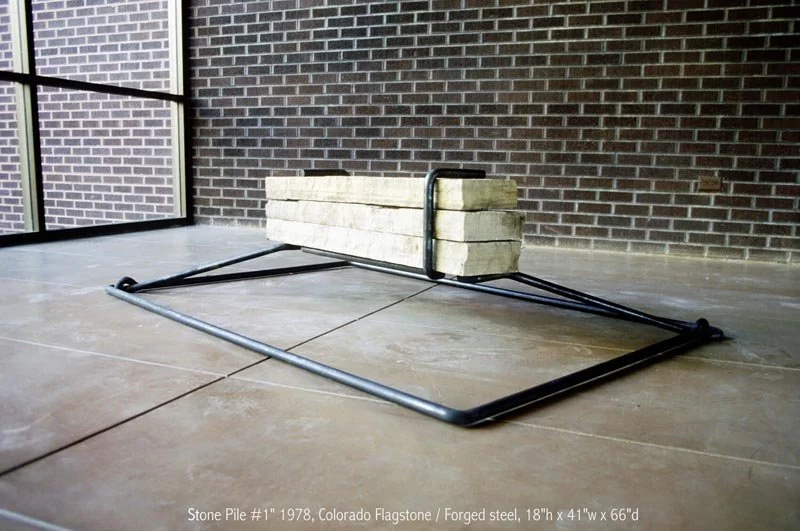
November 1978. Colorado flagstone, steel. Dimensions: 18 × 41 × 66 in (46 × 104 × 168 cm).
Stone Pile 1 is part of the tensegrity, or Brute Series, in which gravity and the pressure of the stones provide the energy—or “glue”—that holds the sculpture together without welding. Weight becomes an active structural force as stone and steel interact through tension, compression, and balance.
The gravitational energy is channeled and made visible through the interlocking forged steel bars, creating a static energy event—a sculpture held in arrested motion. The title Stone Pile is deliberately both noun and verb, suggesting that the sculpture is not only an object, but also an action—the act of piling or stacking. The work explores a recurring concern in my sculpture: how opposing forces—weight and lift, mass and movement, tension and stability—can be brought into balance.
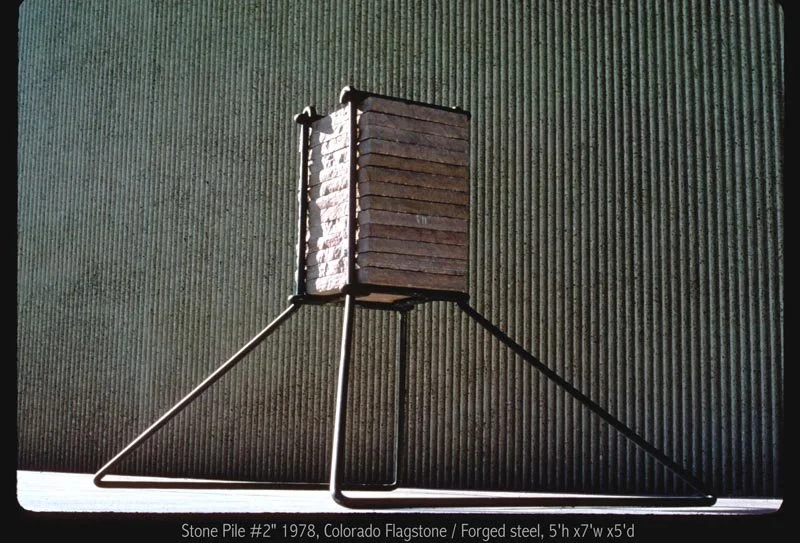
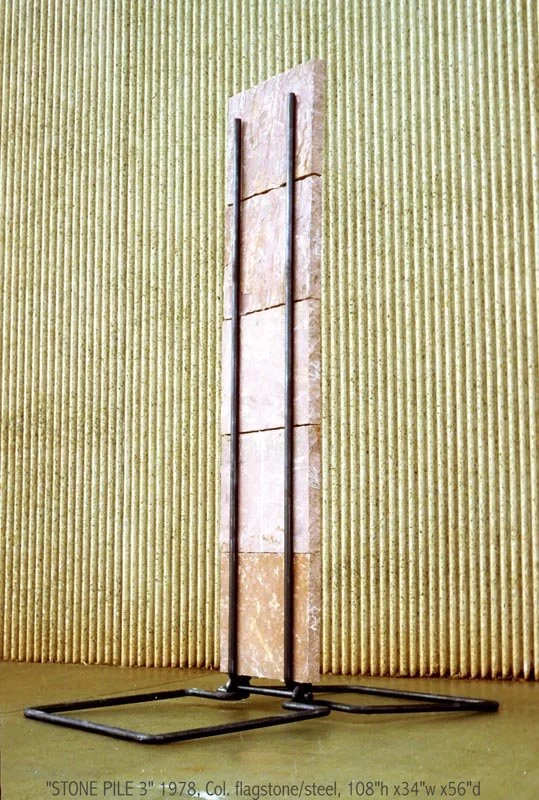
January 1978. Colorado flagstone, steel. Dimensions: 108 × 34 × 56 in (274 × 86 × 142 cm).
Stone Pile 3, 1978
Stone Pile 3 is part of the tensegrity, or Brute Series, in which gravity and the pressure of the stones provide the energy—or “glue”—that holds the sculpture together without welding. Weight becomes an active structural force as stone and steel interact through tension, compression, and balance.
Gravitational energy is channeled and made visible through the interlocking forged steel bars, creating a static energy event—a sculpture held in arrested motion. The title Stone Pile functions deliberately as both noun and verb, suggesting not only an object but an action—the act of piling or stacking. The work reflects a recurring concern in my sculpture: how opposing forces—weight and lift, mass and movement, tension and stability—can be brought into balance.
The work also subtly pays homage to Romanian sculptor Constantin Brâncuși’s Endless Column. The open-ended vertical steel bars suggest that the stack of stone might continue upward indefinitely, extending the sculpture conceptually beyond its physical limits.

January 1978. Granite, forged steel. Dimensions: 8 × 4 × 4 ft.
destroyed
Push/Pull is part of the tensegrity, or Brute Series, in which gravity and the pressure of the stones provide the energy—or “glue”—that holds the sculpture together without welding. Weight becomes an active structural force as stone and steel interact through tension, compression, and balance.
The gravitational energy is channeled and made visible through the interlocking forged steel bars, creating a static energy event—a sculpture held in arrested motion. The work explores a recurring concern in my sculpture: how opposing forces—weight and lift, mass and movement, tension and stability—can be brought into balance.
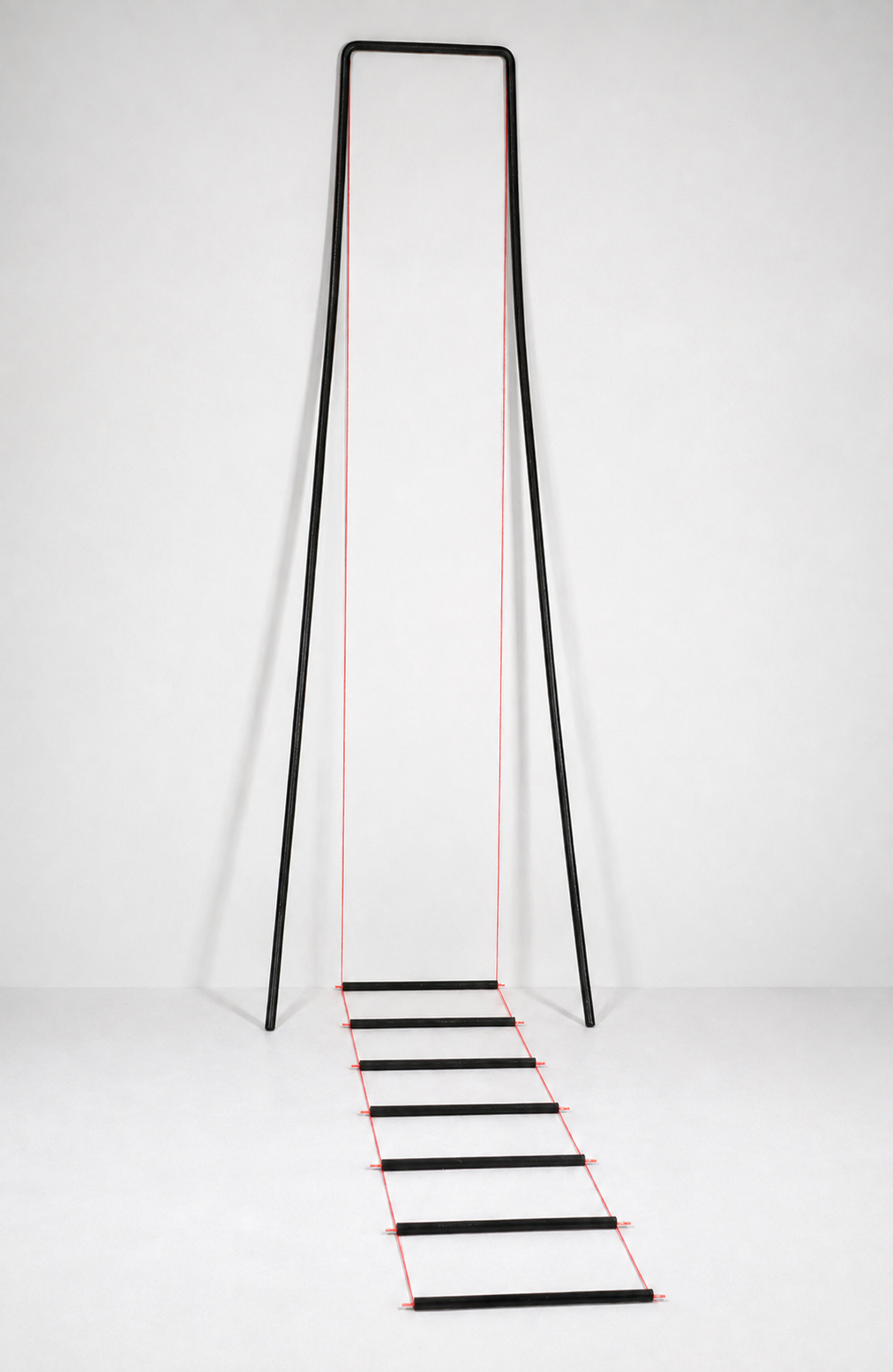
January 1978. Steel, chalk line. Dimensions: 87 × 32 × 76 in (221 × 81 × 193 cm).
Collection: Denver Art Museum, Denver, CO. Gift of the Vera List Foundation.
Gallery Ladder is part of my Gallery Drawing Series, which marked a shift from the concentrated physical forces of my earlier tensegrity, or Brute Series, toward a more conceptual and linear exploration of space. Steel elements combine with a carpenter’s red chalk line snapped directly onto the gallery wall and floor, together suggesting the form of a ladder. The work blurs distinctions between drawing, sculpture, and architecture, while the ephemeral chalk line makes the gallery itself part of the work.
The title also carries a more personal, somewhat tongue-in-cheek meaning. At twenty-six, I was a young artist trying to establish myself in the art world, and the idea of “climbing the gallery ladder” seemed both appropriate and slightly absurd. Here the ladder is suggested rather than functional—there is no practical way to climb it—and the fleeting chalk line underscores the uncertain and elusive nature of that path.
A related series of charcoal drawings on standard 8½ × 11-inch graph paper explores the same idea conceptually, using the gridded gallery “cube” as a framework through which linear and planar elements move inside, outside, and beyond the gallery space.

January 1978. Steel. Dimensions: 70 × 39 × 48 in (178 × 99 × 122 cm). Destroyed.
Gallery Frame is part of the Gallery Drawing Series, which grew out of my earlier tensegrity, or Brute Series, but marked a shift from the concentrated physical interaction of stone and steel toward a more open, linear exploration of space. Long forged-steel rods extend across the floor and into the gallery as lines drawn in space, activating the surrounding architecture and making the gallery itself an integral part of the work.
The series also questions the gallery as a framing and sanctioning device for art. Much as a frame separates an artwork from the world around it, the gallery performs a similar function on an architectural scale. By extending sculpture directly into that space, the Gallery Drawings blur distinctions between object, drawing, architecture, and environment, raising the question of where the artwork actually begins and ends.
A related series of charcoal drawings on standard 8½ × 11-inch graph paper explores the same idea conceptually, using the gridded gallery “cube” as a framework through which linear and planar elements move inside, outside, and beyond the gallery space.
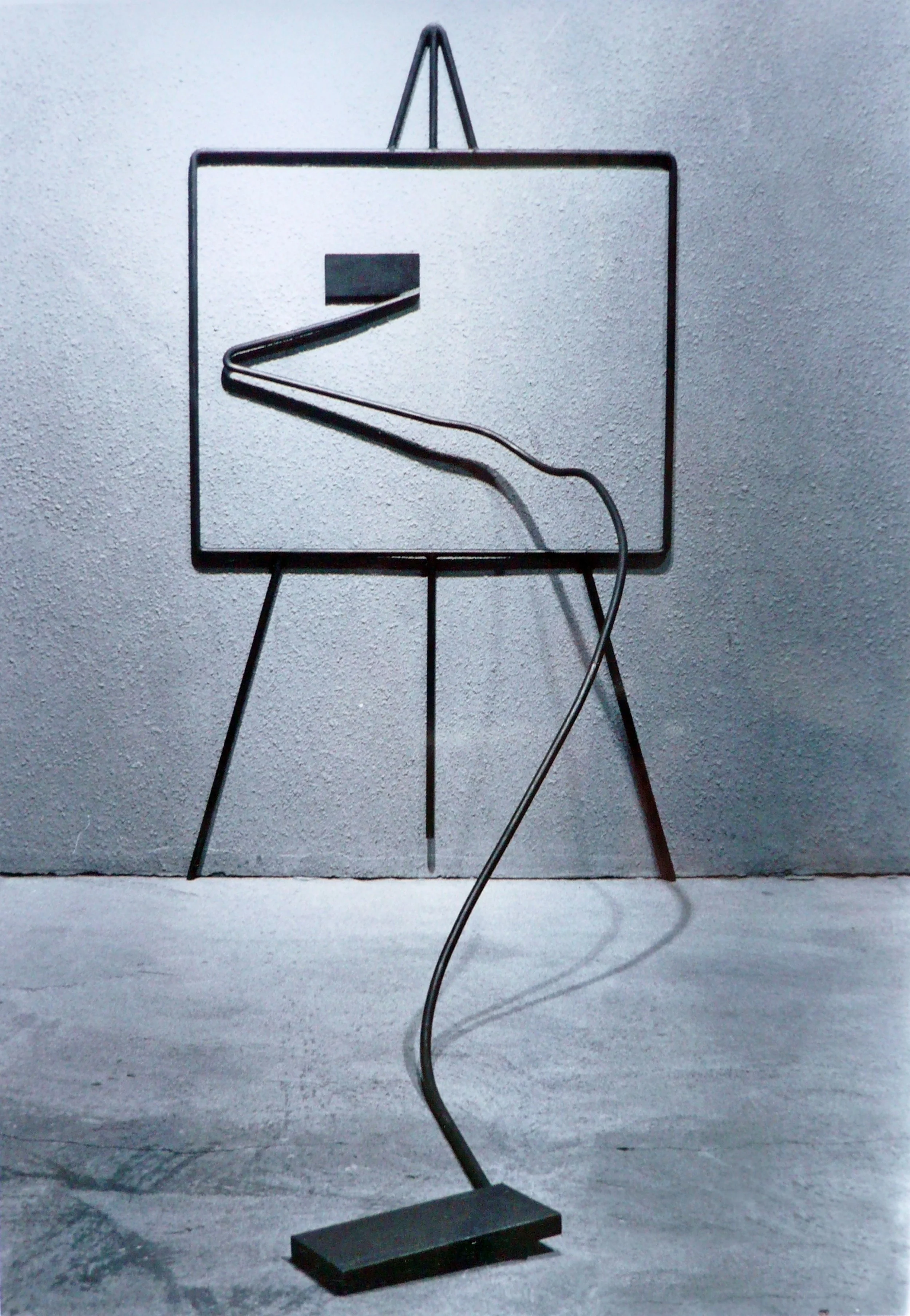
January 1978. Steel. Dimensions: 74 × 45 × 5 in (188 × 114 × 13 cm).
Gallery Easel is part of my Gallery Drawing Series, which marked a shift from the concentrated physical forces of my earlier tensegrity, or Brute Series, toward a more conceptual and linear exploration of space. Linear steel elements form the outline of a traditional painter’s easel propped against the gallery wall, while another steel line extends from the frame across the floor. Like the other Gallery Drawings, the work blurs distinctions between drawing, sculpture, and architecture, making the gallery itself part of the work.
The easel also introduces the idea of the frame as a device that defines—or sanctions—what we perceive as art. This same steel easel later moved outside to become the central element of my Easel Landscape Series (1978–80), where I photographed the landscape through it. Inspired in part by René Magritte’s The Human Condition, those works play with the relationship between frame, image, object, and reality, questioning where the artwork begins and ends—and how the simple act of framing something can alter the way we see it.

January 1978. Steel. Dimensions: 85 × 56 × 60 in (216 × 142 × 152 cm). Destroyed.
Corner Triptych #1 is part of the Gallery Drawing Series, which grew out of my earlier tensegrity, or Brute Series, but marked a shift from the concentrated physical interaction of stone and steel toward a more open, linear exploration of space. Long forged-steel rods extend across the floor and into the gallery as lines drawn in space, activating the surrounding architecture and making the gallery itself an integral part of the work.
The series also questions the gallery as a framing and sanctioning device for art. Much as a frame separates an artwork from the world around it, the gallery performs a similar function on an architectural scale. By extending sculpture directly into that space, the Gallery Drawings blur distinctions between object, drawing, architecture, and environment, raising the question of where the artwork actually begins and ends.
A related series of charcoal drawings on standard 8½ × 11-inch graph paper explores the same idea conceptually, using the gridded gallery “cube” as a framework through which linear and planar elements move inside, outside, and beyond the gallery space.
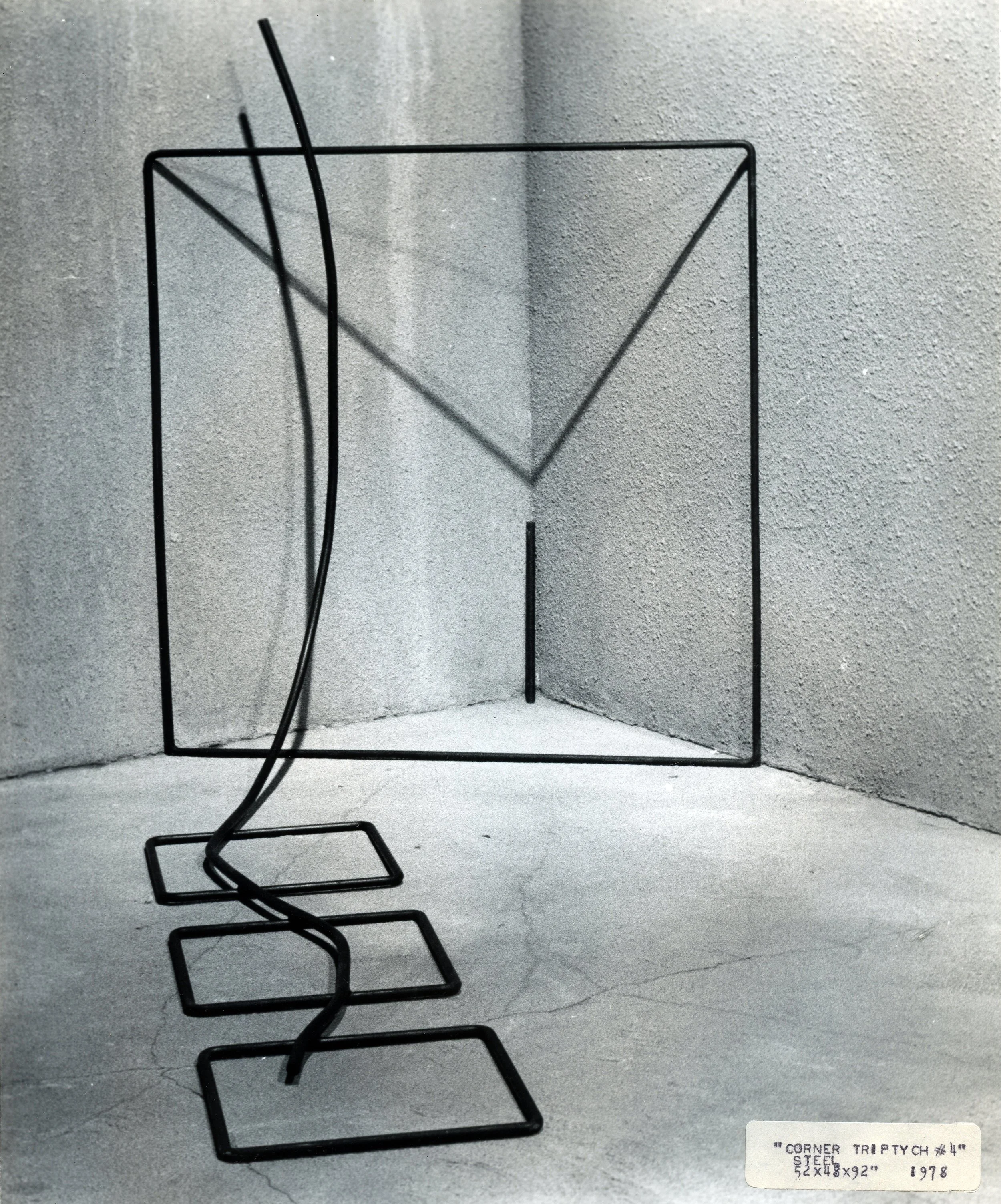
January 1978. Steel. Dimensions: 58 × 45 × 37 in (147 × 114 × 94 cm).
Corner Triptych #4 is part of the Gallery Drawing Series, which grew out of my earlier tensegrity, or Brute Series, but marked a shift from the concentrated physical interaction of stone and steel toward a more open, linear exploration of space. Long forged-steel rods extend across the floor and into the gallery as lines drawn in space, activating the surrounding architecture and making the gallery itself an integral part of the work.
The series also questions the gallery as a framing and sanctioning device for art. Much as a frame separates an artwork from the world around it, the gallery performs a similar function on an architectural scale. By extending sculpture directly into that space, the Gallery Drawings blur distinctions between object, drawing, architecture, and environment, raising the question of where the artwork actually begins and ends.
A related series of charcoal drawings on standard 8½ × 11-inch graph paper explores the same idea conceptually, using the gridded gallery “cube” as a framework through which linear and planar elements move inside, outside, and beyond the gallery space.
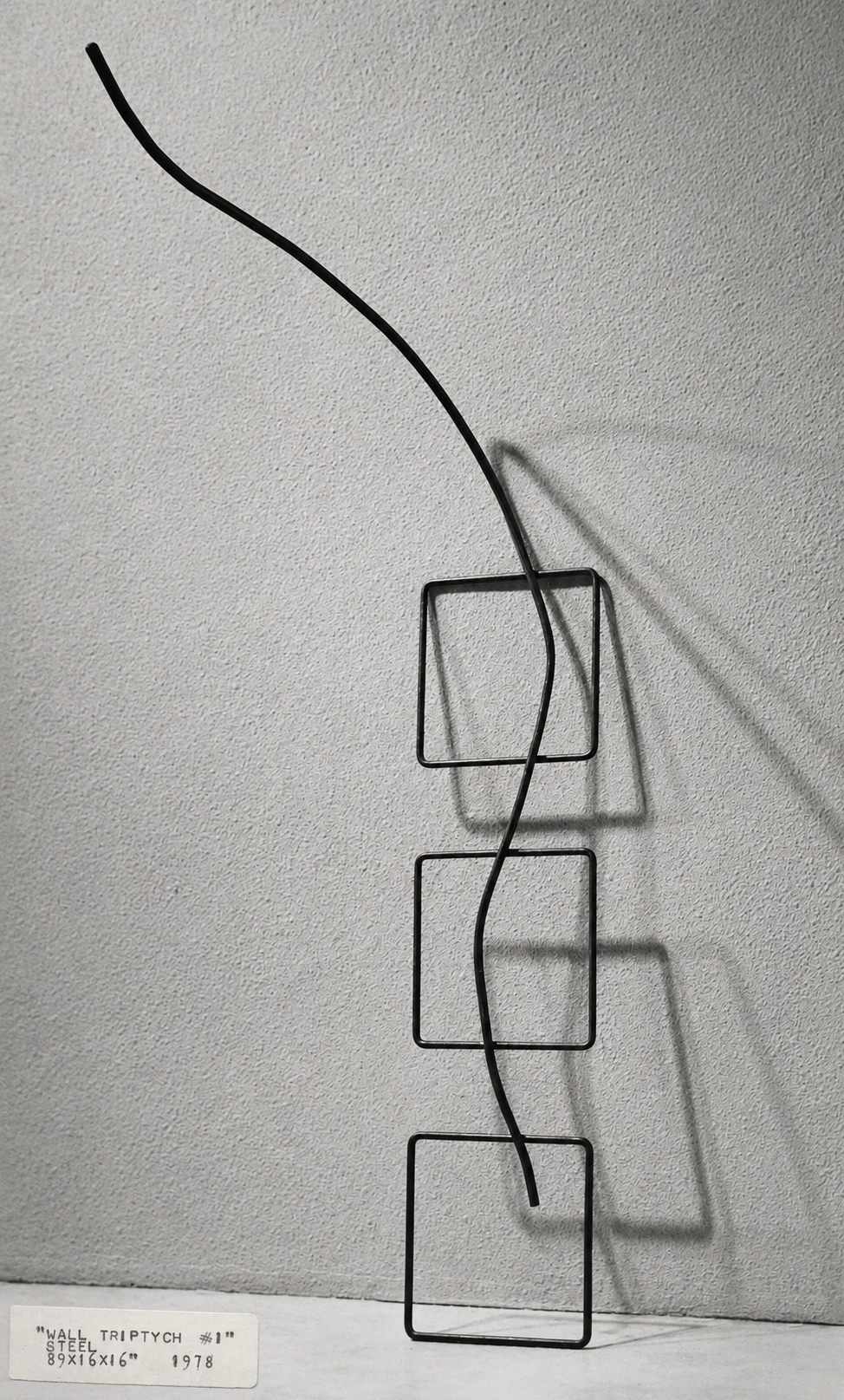
January 1978. Steel. Dimensions: 89 × 616 × 16 in (226 × 1565 × 41 cm). Destroyed.
Wall Triptych #1 is part of the Gallery Drawing Series, which grew out of my earlier tensegrity, or Brute Series, but marked a shift from the concentrated physical interaction of stone and steel toward a more open, linear exploration of space. Long forged-steel rods extend across the floor and into the gallery as lines drawn in space, activating the surrounding architecture and making the gallery itself an integral part of the work.
The series also questions the gallery as a framing and sanctioning device for art. Much as a frame separates an artwork from the world around it, the gallery performs a similar function on an architectural scale. By extending sculpture directly into that space, the Gallery Drawings blur distinctions between object, drawing, architecture, and environment, raising the question of where the artwork actually begins and ends.
A related series of charcoal drawings on standard 8½ × 11-inch graph paper explores the same idea conceptually, using the gridded gallery “cube” as a framework through which linear and planar elements move inside, outside, and beyond the gallery space.

January 1978. Steel. Dimensions: 52 × 48 × 92 in (132 × 122 × 234 cm). Destroyed.
Corner Triptych #3 is part of the Gallery Drawing Series, which grew out of my earlier tensegrity, or Brute Series, but marked a shift from the concentrated physical interaction of stone and steel toward a more open, linear exploration of space. Long forged-steel rods extend across the floor and into the gallery as lines drawn in space, activating the surrounding architecture and making the gallery itself an integral part of the work.
The series also questions the gallery as a framing and sanctioning device for art. Much as a frame separates an artwork from the world around it, the gallery performs a similar function on an architectural scale. By extending sculpture directly into that space, the Gallery Drawings blur distinctions between object, drawing, architecture, and environment, raising the question of where the artwork actually begins and ends.
A related series of charcoal drawings on standard 8½ × 11-inch graph paper explores the same idea conceptually, using the gridded gallery “cube” as a framework through which linear and planar elements move inside, outside, and beyond the gallery space.

January 1978. Steel. Dimensions: 77 × 45 × 16 in (196 × 114 × 41 cm). Destroyed.
Gallery Triptych #3 is part of the Gallery Drawing Series, which grew out of my earlier tensegrity, or Brute Series, but marked a shift from the concentrated physical interaction of stone and steel toward a more open, linear exploration of space. Long forged-steel rods extend across the floor and into the gallery as lines drawn in space, activating the surrounding architecture and making the gallery itself an integral part of the work.
The series also questions the gallery as a framing and sanctioning device for art. Much as a frame separates an artwork from the world around it, the gallery performs a similar function on an architectural scale. By extending sculpture directly into that space, the Gallery Drawings blur distinctions between object, drawing, architecture, and environment, raising the question of where the artwork actually begins and ends.
A related series of charcoal drawings on standard 8½ × 11-inch graph paper explores the same idea conceptually, using the gridded gallery “cube” as a framework through which linear and planar elements move inside, outside, and beyond the gallery space.

January 1978. Steel. Dimensions: 65 × 18 × 24 in (165 × 46 × 61 cm). Destroyed.
Gallery Triptych #4 is part of the Gallery Drawing Series, which grew out of my earlier tensegrity, or Brute Series, but marked a shift from the concentrated physical interaction of stone and steel toward a more open, linear exploration of space. Long forged-steel rods extend across the floor and into the gallery as lines drawn in space, activating the surrounding architecture and making the gallery itself an integral part of the work.
The series also questions the gallery as a framing and sanctioning device for art. Much as a frame separates an artwork from the world around it, the gallery performs a similar function on an architectural scale. By extending sculpture directly into that space, the Gallery Drawings blur distinctions between object, drawing, architecture, and environment, raising the question of where the artwork actually begins and ends.
A related series of charcoal drawings on standard 8½ × 11-inch graph paper explores the same idea conceptually, using the gridded gallery “cube” as a framework through which linear and planar elements move inside, outside, and beyond the gallery space.

January 1978. Steel. Dimensions: 17 × 86 × 75 in (43 × 218 × 191 cm). Destroyed.
Corner Triptych #2 is part of the Gallery Drawing Series, which grew out of my earlier tensegrity, or Brute Series, but marked a shift from the concentrated physical interaction of stone and steel toward a more open, linear exploration of space. Long forged-steel rods extend across the floor and into the gallery as lines drawn in space, activating the surrounding architecture and making the gallery itself an integral part of the work.
The series also questions the gallery as a framing and sanctioning device for art. Much as a frame separates an artwork from the world around it, the gallery performs a similar function on an architectural scale. By extending sculpture directly into that space, the Gallery Drawings blur distinctions between object, drawing, architecture, and environment, raising the question of where the artwork actually begins and ends.
A related series of charcoal drawings on standard 8½ × 11-inch graph paper explores the same idea conceptually, using the gridded gallery “cube” as a framework through which linear and planar elements move inside, outside, and beyond the gallery space.
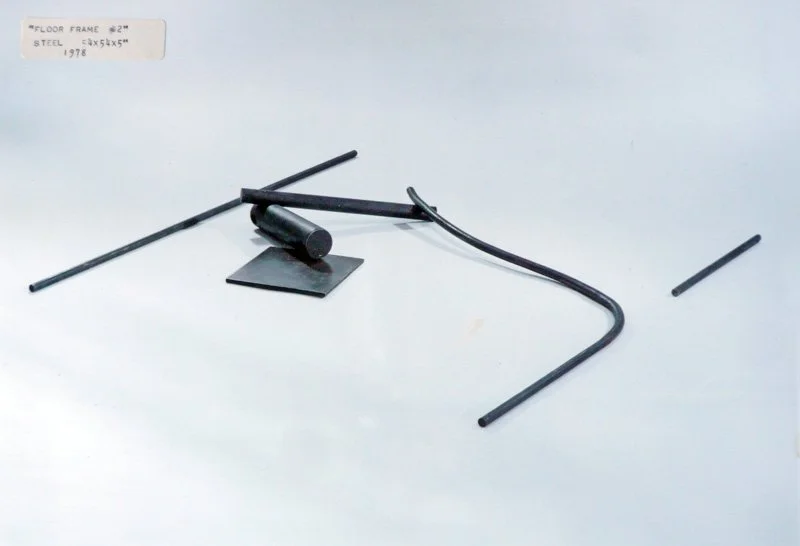
January 1978. Steel. Dimensions: 5 × 54 × 54 in (13 × 137 × 137 cm). Destroyed.
Floor Frame #2 is part of the Gallery Drawing Series, which grew out of my earlier tensegrity, or Brute Series, but marked a shift from the concentrated physical interaction of stone and steel toward a more open, linear exploration of space. Long forged-steel rods extend across the floor and into the gallery as lines drawn in space, activating the surrounding architecture and making the gallery itself an integral part of the work.
The series also questions the gallery as a framing and sanctioning device for art. Much as a frame separates an artwork from the world around it, the gallery performs a similar function on an architectural scale. By extending sculpture directly into that space, the Gallery Drawings blur distinctions between object, drawing, architecture, and environment, raising the question of where the artwork actually begins and ends.
A related series of charcoal drawings on standard 8½ × 11-inch graph paper explores the same idea conceptually, using the gridded gallery “cube” as a framework through which linear and planar elements move inside, outside, and beyond the gallery space.

January 1978. Steel. Dimensions: 4 × 64 × 48 in (10 × 163 × 122 cm). Destroyed.
Floor Frame #3 is part of the Gallery Drawing Series, which grew out of my earlier tensegrity, or Brute Series, but marked a shift from the concentrated physical interaction of stone and steel toward a more open, linear exploration of space. Long forged-steel rods extend across the floor and into the gallery as lines drawn in space, activating the surrounding architecture and making the gallery itself an integral part of the work.
The series also questions the gallery as a framing and sanctioning device for art. Much as a frame separates an artwork from the world around it, the gallery performs a similar function on an architectural scale. By extending sculpture directly into that space, the Gallery Drawings blur distinctions between object, drawing, architecture, and environment, raising the question of where the artwork actually begins and ends.
A related series of charcoal drawings on standard 8½ × 11-inch graph paper explores the same idea conceptually, using the gridded gallery “cube” as a framework through which linear and planar elements move inside, outside, and beyond the gallery space.
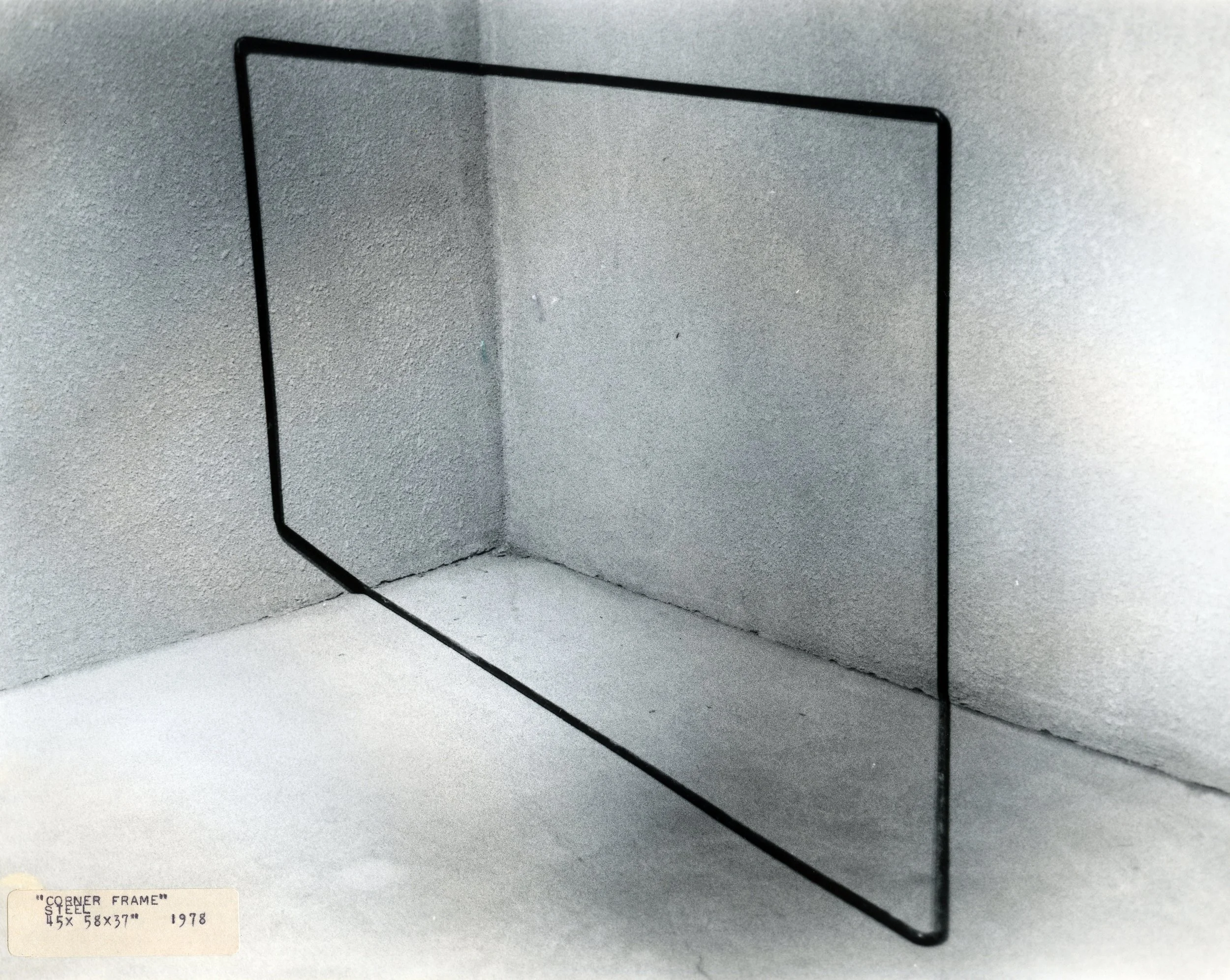
January 1978. Steel. Dimensions: 45 × 58 × 37 in (114 × 147 × 94 cm). Destroyed.
Corner Frame is part of the Gallery Drawing Series, which grew out of my earlier tensegrity, or Brute Series, but marked a shift from the concentrated physical interaction of stone and steel toward a more open, linear exploration of space. Long forged-steel rods extend across the floor and into the gallery as lines drawn in space, activating the surrounding architecture and making the gallery itself an integral part of the work.
The series also questions the gallery as a framing and sanctioning device for art. Much as a frame separates an artwork from the world around it, the gallery performs a similar function on an architectural scale. By extending sculpture directly into that space, the Gallery Drawings blur distinctions between object, drawing, architecture, and environment, raising the question of where the artwork actually begins and ends.
A related series of charcoal drawings on standard 8½ × 11-inch graph paper explores the same idea conceptually, using the gridded gallery “cube” as a framework through which linear and planar elements move inside, outside, and beyond the gallery space.
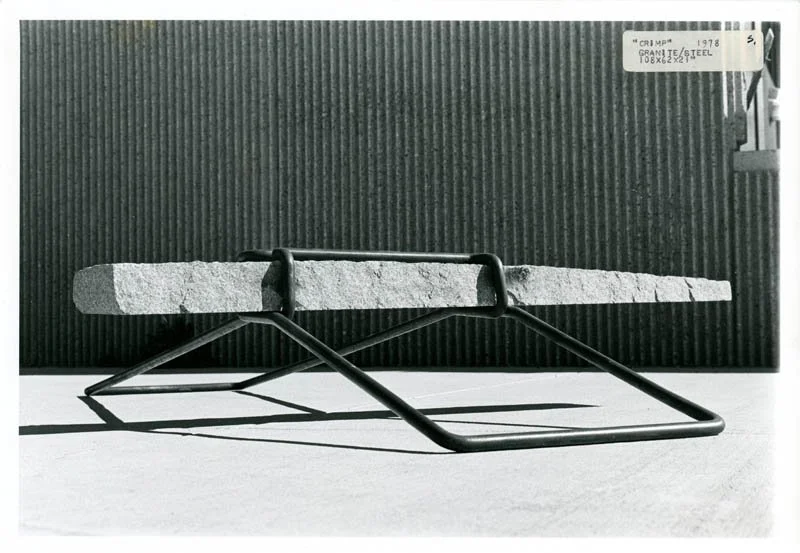
April 1978. Granite, forged steel. Dimensions: 16 × 84 × 56 in (41 × 213 × 142 cm).
private collection
Crimp II is part of my tensegrity, or Brute Series. The title describes the physical action of the sculpture: the weight of the found granite literally crimps the forged-steel bars together. Rather than carving the stone or using it to represent something else, I allow its inherent form, mass, and weight—and the structural behavior of the steel—to become the subject of the work. In this sense, Crimp II is deliberately self-referential: sculpture about sculpture, assemblage about assemblage.
Gravity and the downward pressure of the stone provide the energy—or “glue”—that holds the sculpture together without welding. As the stone settles, its weight activates the interlocking steel bars, producing tension, compression, and equilibrium. The result is a static energy event—a sculpture held in arrested motion, in which the gravitational force that threatens collapse is redirected to hold the structure together.

January 1978. Steel. Dimensions: 24 × 50 × 6 in (61 × 127 × 15 cm). Destroyed.
Floor Triptych is part of the Gallery Drawing Series, which grew out of my earlier tensegrity, or Brute Series, but marked a shift from the concentrated physical interaction of stone and steel toward a more open, linear exploration of space. Long forged-steel rods extend across the floor and into the gallery as lines drawn in space, activating the surrounding architecture and making the gallery itself an integral part of the work.
The series also questions the gallery as a framing and sanctioning device for art. Much as a frame separates an artwork from the world around it, the gallery performs a similar function on an architectural scale. By extending sculpture directly into that space, the Gallery Drawings blur distinctions between object, drawing, architecture, and environment, raising the question of where the artwork actually begins and ends.
A related series of charcoal drawings on standard 8½ × 11-inch graph paper explores the same idea conceptually, using the gridded gallery “cube” as a framework through which linear and planar elements move inside, outside, and beyond the gallery space.

April 1978. Granite, forged steel. Dimensions: 56 × 180 × 18 in (142 × 457 × 46 cm). Destroyed.
Keystone
Keystone is a transitional work combining the real force energies of my tensegrity, or Brute Series, with the more linear and graphic elements that developed in my Gallery Drawing Series. As in the earlier tensegrity works, gravity is not merely suggested but becomes an active structural force: the weight and pressure of the stone act upon the steel bars, locking the separate elements into a precarious but stable equilibrium. The extended steel rods also function as lines in space, giving the sculpture a strong graphic quality and suggesting a three-dimensional drawing.
The title refers to the keystone of an architectural arch—the central element that completes and locks the structure into a system of compression. In the sculpture, the stone assumes a similar physical and metaphorical role: it becomes the point around which forces are gathered, redirected, and held in balance. Remove or significantly reposition a critical element and the structure collapses. In this way, Keystone makes gravity, pressure, leverage, and balance visible, creating a static energy event—a sculpture held in arrested motion while marking a transition from the physically interdependent structures of the tensegrity works toward the more open, linear language of the Gallery Drawing Series.

Shadow, steel, 1 8" x 63 x 54" is part of the Gallery Drawing Series, which grew out of my earlier tensegrity, or Brute Series, but marked a shift from the concentrated physical interaction of stone and steel toward a more open, linear exploration of space. Long forged-steel rods extend across the floor and into the gallery as lines drawn in space, activating the surrounding architecture and making the gallery itself an integral part of the work.
The series also questions the gallery as a framing and sanctioning device for art. Much as a frame separates an artwork from the world around it, the gallery performs a similar function on an architectural scale. By extending sculpture directly into that space, the Gallery Drawings blur distinctions between object, drawing, architecture, and environment, raising the question of where the artwork actually begins and ends.
A related series of charcoal drawings on standard 8½ × 11-inch graph paper explores the same idea conceptually, using the gridded gallery “cube” as a framework through which linear and planar elements move inside, outside, and beyond the gallery space.

January 1987. Steel. Dimensions: 7 × 40 × 56 in (18 × 102 × 142 cm). Destroyed.
Floor Frame #4 is part of the Gallery Drawing Series, which grew out of my earlier tensegrity, or Brute Series, but marked a shift from the concentrated physical interaction of stone and steel toward a more open, linear exploration of space. Long forged-steel rods extend across the floor and into the gallery as lines drawn in space, activating the surrounding architecture and making the gallery itself an integral part of the work.
The series also questions the gallery as a framing and sanctioning device for art. Much as a frame separates an artwork from the world around it, the gallery performs a similar function on an architectural scale. By extending sculpture directly into that space, the Gallery Drawings blur distinctions between object, drawing, architecture, and environment, raising the question of where the artwork actually begins and ends.
A related series of charcoal drawings on standard 8½ × 11-inch graph paper explores the same idea conceptually, using the gridded gallery “cube” as a framework through which linear and planar elements move inside, outside, and beyond the gallery space.

January 1979. Colorado flagstone, steel. Dimensions: 32 × 64 × 24 in (81 × 163 × 61 cm).
Arch Series
Arch #1 is part of my tensegrity, or Brute Series, in which gravity and the pressure of the stones provide the energy—or “glue”—that holds the sculpture together without welding. The Arch Series takes its structural and conceptual cue from the architectural arch. Just as a traditional stone arch is self-supporting because its individual elements transfer their weight through compression, these sculptures use gravity as an essential stabilizing force. Stone and forged steel bear upon one another, creating an interdependent structure in which weight becomes an active structural force.
Rather than carving the stone or using it to represent something else, I allow its inherent industrial form, mass, and weight—and the structural behavior of the steel—to become the subject of the sculpture. Gravitational forces are channeled and made visible through the interlocking forged-steel bars, creating a static energy event—a sculpture held in arrested motion. In this sense, the Arch Series is sculpture about sculpture, assemblage about assemblage, while exploring a recurring concern in my work: how opposing forces—weight and lift, mass and movement, tension and stability—can be brought into expressive balance.

January 1979. Colorado flagstone, steel. Dimensions: 27 × 66 × 24 in (69 × 168 × 61 cm).
Arch Series
Arch #2 is part of my tensegrity, or Brute Series, in which gravity and the pressure of the stones provide the energy—or “glue”—that holds the sculpture together without welding. The Arch Series takes its structural and conceptual cue from the architectural arch. Just as a traditional stone arch is self-supporting because its individual elements transfer their weight through compression, these sculptures use gravity as an essential stabilizing force. Stone and forged steel bear upon one another, creating an interdependent structure in which weight becomes an active structural force.
Rather than carving the stone or using it to represent something else, I allow its inherent form, mass, and weight—and the structural behavior of the steel—to become the subject of the sculpture. Gravitational forces are channeled and made visible through the interlocking forged-steel bars, creating a static energy event—a sculpture held in arrested motion. In this sense, the Arch Series is sculpture about sculpture, assemblage about assemblage, while exploring a recurring concern in my work: how opposing forces—weight and lift, mass and movement, tension and stability—can be brought into expressive balance.
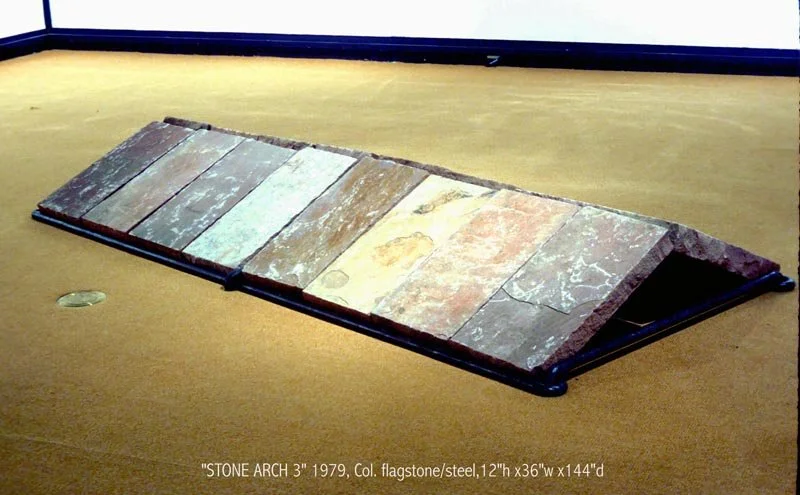

January 1979. Colorado flagstone, steel. Dimensions: 6 × 4 × 16 in (15 × 10 × 41 cm). Private Collection.
Torque Series
The Torque Series is part of my tensegrity, or Brute Series, in which gravity and the pressure of the stones provide the energy—or “glue”—that holds the sculpture together without welding. The title refers to torque—the twisting force generated as the weight of the stones acts through the forged-steel bars. Stone and steel bear upon one another, creating an interdependent structure in which weight, leverage, and torque become active structural forces.
Rather than carving the stone or using it to represent something else, I allow its inherent form, mass, and weight—and the structural behavior of the steel—to become the subject of the sculpture. Gravitational forces are channeled and made visible through the interlocking forged-steel bars, creating a static energy event—a sculpture held in arrested motion. In this sense, the Torque Series is deliberately self-referential—sculpture about sculpture, assemblage about assemblage—while exploring a recurring concern in my work: how opposing forces—weight and lift, mass and movement, tension and stability—can be brought into expressive balance.
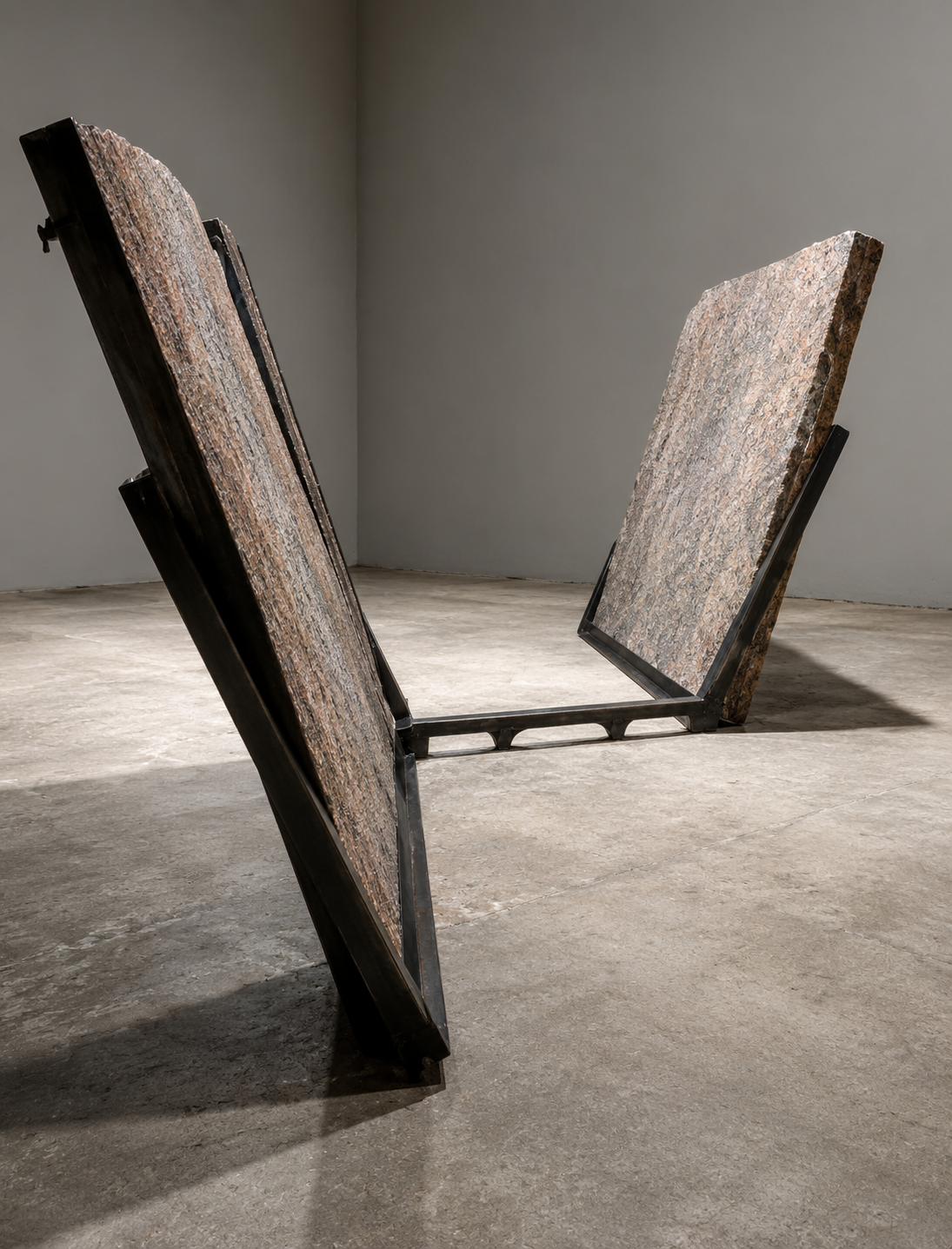
January 1979. Colorado flagstone, steel. Dimensions: 36 × 28 × 144 in (91 × 71 × 366 cm).
Trough Series
The Trough Series is part of my tensegrity, or Brute Series, in which gravity and the pressure of the stones provide the energy—or “glue”—that holds the sculpture together without welding. The title references the physical form of a trough. The stones tilt back against the forged steel, each bearing upon the other to create an interdependent structure in which weight becomes an active structural force.
Rather than carving the stone or using it to represent something else, I allow its inherent simple rectangular form, mass, and weight—and the structural behavior of the steel—to become the subject of the sculpture. Gravitational forces are channeled and made visible through the interlocking forged-steel bars, creating a static energy event—a sculpture held in arrested motion. In this sense, the Trough Series is deliberately self-referential—sculpture about sculpture, assemblage about assemblage—while exploring a recurring concern in my work: how opposing forces—weight and lift, mass and movement, tension and stability—can be brought into expressive balance.

January 1979. Colorado flagstone, steel. Dimensions: 20 × 25 × 75 in (51 × 64 × 191 cm)
Private Collection.
The Ballast Series is part of my tensegrity, or Brute Series, in which gravity and the pressure of the stones provide the energy—or “glue”—that holds the sculpture together without welding. The title refers to ballast—the weight placed low in a vessel to provide balance and stability. Here, the mass of the stone serves a similar function: its gravitational force is transmitted through the forged-steel bars, creating an interdependent structure in which weight and counterweight become active stabilizing forces.
Rather than carving the stone or using it to represent something else, I allow its inherent form, mass, and weight—and the structural behavior of the steel—to become the subject of the sculpture. Gravitational forces are channeled and made visible through the interlocking forged-steel bars, creating a static energy event—a sculpture held in arrested motion. In this sense, the Ballast Series is deliberately self-referential—sculpture about sculpture, assemblage about assemblage—while exploring a recurring concern in my work: how opposing forces—weight and lift, mass and movement, tension and stability—can be brought into expressive balance.
1971 - 1975
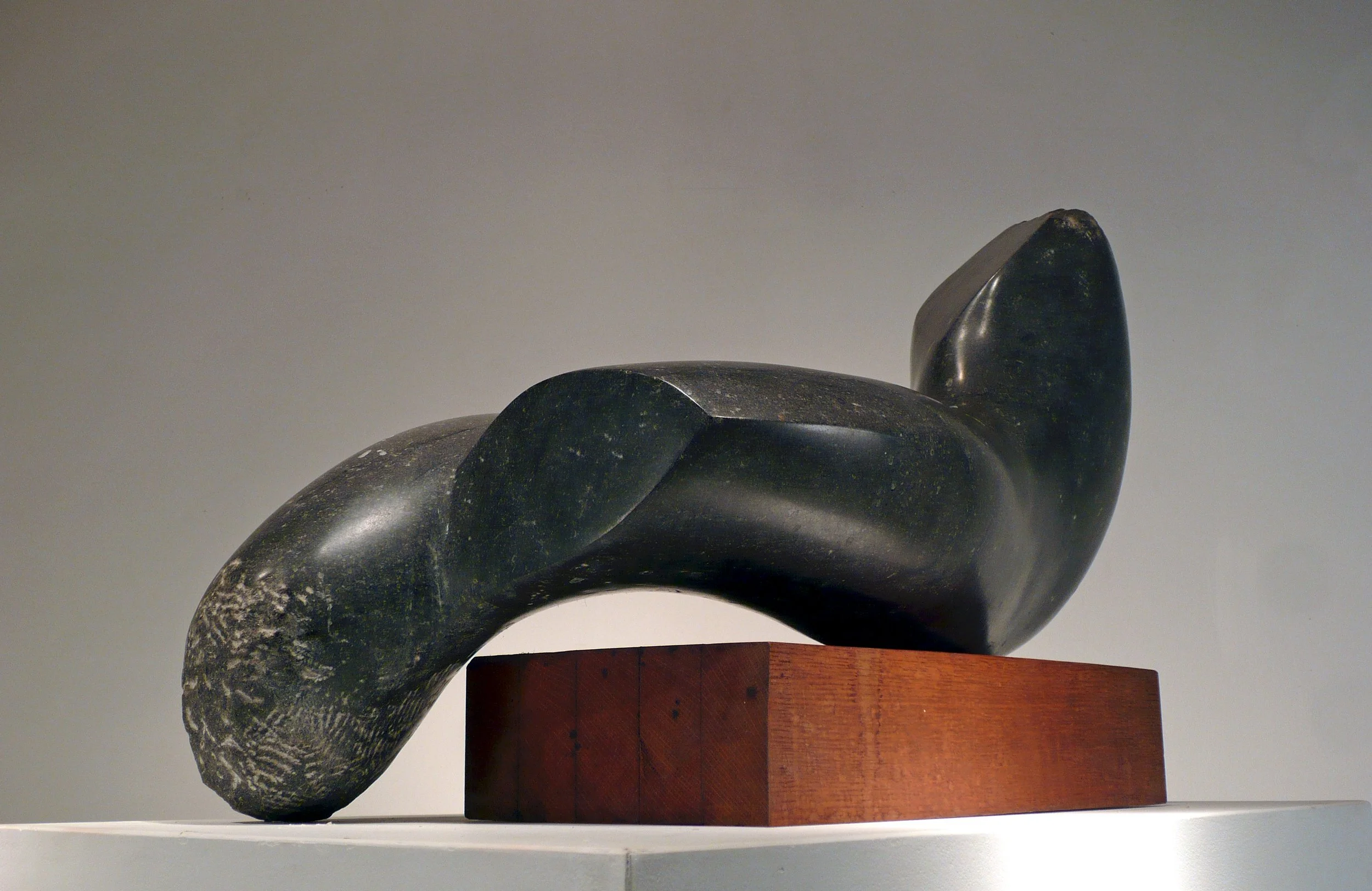
1973, gray marble, 18.5"h x30"w x14"d. Collection of the artist.
Reclining Form, 1973
Reclining Form was created during the summer of 1973 while I was attending the Blossom Festival School in Cleveland on a full scholarship in sculpture. The work reflects my early interest in the organic abstraction of Jean Arp, Constantin Brancusi, and Henry Moore—particularly Moore’s use of the reclining human figure as a point of departure for abstract form. At the same time, the sculpture shows the emerging influence of Isamu Noguchi in my decision to leave portions of the marble uncarved, specifically the quarry drilling channels and chisel marks, allowing the stone’s found and unfinished surface and character to become an expressive part of the work.
Although I did not fully recognize its significance at the time, this simple decision marked an important shift in my relationship with stone—from seeing it primarily as a material to be shaped toward allowing its inherent form, texture, and history to participate in the sculpture. This developing awareness of the nature of the material would become increasingly central to my work and, several years later, find fuller expression in my tensegrity or Brute Sculpture and the Nature of Stone Series.

January 1971. Steel. Dimensions: 57 × 36 × 40 in (145 × 91 × 102 cm). Private Collection, Florida.
Flight, 1971
Flight is my first welded-steel sculpture, created in a Sculpture 101 class at St. Lawrence University in 1971 in response to an assignment exploring line as the primary design element. As a beginning student with little firsthand exposure to museums and galleries, I looked primarily to books and was especially drawn to early 20th-century Russian Constructivists such as Naum Gabo, Vladimir Tatlin and Antoine Pevsner. Their use of linear structure to define space rather than solid mass helped inform the sculpture’s open, skeletal construction.
The title Flight reflects the work’s sense of lift, movement, and implied speed. Sweeping steel contours and intersecting lines create an open form that reaches into the surrounding space. Looking back, I can see in this first welded sculpture the beginnings of concerns that would continue throughout my work: line drawn in space, movement and balance, and the use of open structure to activate the space around a sculpture.

January 1971. Plaster, wire. Dimensions: 36 × 20 × 20 in (91 × 51 × 51 cm). Collection of the artist.
Untitled (class exercise), 1971
Untitled (class exercise) was literally my first sculpture, created as a freshman at St. Lawrence University in 1971. The form was modeled in oil-based clay, surrounded by a multi-piece plaster mold, and then cast in plaster. After the mold was removed, I sanded and polished the surface with increasingly fine sandpaper, finishing it by rubbing the plaster with milk to achieve its smooth, luminous surface.
At the time, I had very little firsthand exposure to sculpture in museums or galleries, so books provided much of my introduction to modern sculpture. I was particularly influenced by the organic abstraction of Jean Arp, Constantin Brancusi, and Henry Moore, evident here in the sculpture’s rounded, biomorphic forms, flowing contours, and interplay of mass and void. Looking back, this modest student exercise marks the beginning of my exploration of abstract form, material, and the relationship between solid mass and surrounding space—concerns that would continue to evolve throughout my work.

January 1971. Carved cement. Dimensions: 27 × 16 × 12 in (69 × 41 × 30 cm).
The Soldier, 1971
The Soldier was created while I was an undergraduate at St. Lawrence University as an introduction to carving and the subtractive process. A block of cement was poured and, before it fully hardened, I carved directly into it. The resulting standing figure is reduced to an arrangement of geometric masses and voids—a soldier at attention, holding a weapon, with clenched fists and a conspicuous circular opening where the head or brain might be.
Created during the turbulence of the Vietnam War and widespread student protest, the sculpture was also an early, somewhat instinctive expression of my feelings about war and unquestioned authority. Looking back, the empty head suggests to me a soldier deprived of independent thought—or perhaps brainwashed into obedience. Although political commentary has never been the primary focus of my sculpture, The Soldier foreshadows my occasional use of art to respond to political and social concerns, something that would reappear decades later in works such as the Pyxis Awry Series, addressing a society or humanity adrift and off course, with personal, political, and environmental consequences.

January 1972. Welded steel. Dimensions: 60 × 40 × 40 in (152 × 102 × 102 cm).
The Cellist, 1972
The Cellist was my second welded-steel sculpture and my first life-size figurative work, created as an undergraduate in 1972 as an homage to the great Catalan cellist Pablo Casals. Working from strips of steel torch-cut from rusted plate, I forged, bent, and welded the material into an open representation of the seated musician, his cello, and bow. Rather than modeling a solid figure, I used the steel almost as lines drawn in space, allowing the surrounding space to move through and become part of the sculpture.
Although clearly figurative, The Cellist already reveals interests that would continue throughout my work: movement, gesture, open structure, and the expressive possibilities of forged steel. The sweeping curves and overlapping linear elements suggest both the physical action of the musician and the rhythms of the music itself. Looking back, I see the piece as an early step toward understanding how steel could be used not simply to describe form, but to give movement and energy a physical presence.

January 1973. Vermont marble. Dimensions: 36 × 24 × 12 in (91 × 61 × 30 cm). Private Collection.
Untitled (Kiss I), 1973
Untitled (Kiss I) was created while I was an undergraduate at Kent State and reflects my early interest in Jean Arp, Henry Moore, and particularly Constantin Brancusi. The work pays homage to Brancusi’s The Kiss and his reduction of the embracing figures to two simplified, block-like forms. Here, two marble elements are brought closely together, activating the negative space between them. The central opening is carved so that as the viewer moves from side to side, the opening appears to shift and follow—a simple optical effect that makes the viewer’s movement part of the experience of the sculpture.
Like Brancusi, I retained much of the geometry of the original quarry block, allowing the rectangular mass of the stone to remain clearly present. At the same time, the work reflects my growing awareness of the Minimalist aesthetic of the 1960s and ’70s, particularly the reduced geometric sculpture being made around me at Kent State—an approach I later affectionately called “Midwest minimalism.” The piece represents an early merging of these influences: the sensual, carved forms of European modernism with the more austere geometry of contemporary American sculpture. Untitled (Kiss I) was exhibited and sold in the Cleveland Museum of Art’s 1973 May Show, becoming my first sculpture to be sold.

January 1973. Welded steel. Dimensions: 12 × 84 × 52 in (30 × 213 × 132 cm). Destroyed.
Above and Below, 1973
Above and Below was created in 1973 while I was an undergraduate at Kent State University, in response to an assignment exploring line as an expressive element in sculpture. Constructed from welded steel, the work uses strong linear forms that appear to enter and emerge from the ground, visually penetrating the floor plane and suggesting that portions of the sculpture continue unseen beneath the surface.
Looking back, I see the work as an early indication of my interest in where sculpture begins and ends and how its surroundings influence what we perceive as art. By implying that the sculpture continues beyond the visible space, Above and Below begins to question the physical boundaries that contain an artwork. This concern would become more explicit several years later in my Gallery Drawing and Easel Landscape series, where I explored the gallery—and the frame—as devices that define and, in a sense, sanction what lies within them as art.

January 1973. Wood. Dimensions: 19 × 29 × 12 in (48 × 74 × 30 cm). Collection of the artist.
Homage to Brancusi, 1973
Homage to Brancusi was created while I was an undergraduate at Kent State University and is a full-throated acknowledgment of my admiration for Constantin Brancusi and his groundbreaking reduction of the human figure to elemental, archetypal form. Carved in wood, the sculpture directly references Brancusi’s Sleeping Muse, originally carved in marble in 1909 and subsequently cast in bronze. Its simplified, egg-like volume and smoothly carved contours reflect my early fascination with his ability to move beyond literal representation in search of the essential character of a form.
At this formative stage, Brancusi helped me understand that abstraction did not necessarily mean abandoning the figure, but rather distilling it. In Homage to Brancusi, the head is reduced to a continuous rounded mass, with a sweeping concavity suggesting facial structure while allowing the grain and warmth of the wood to remain visually active. Looking back, the sculpture marks an important early step in my developing interest in simplification, material, mass and void, and the expressive power of abstract form—concerns that would soon lead me toward a more personal sculptural language.
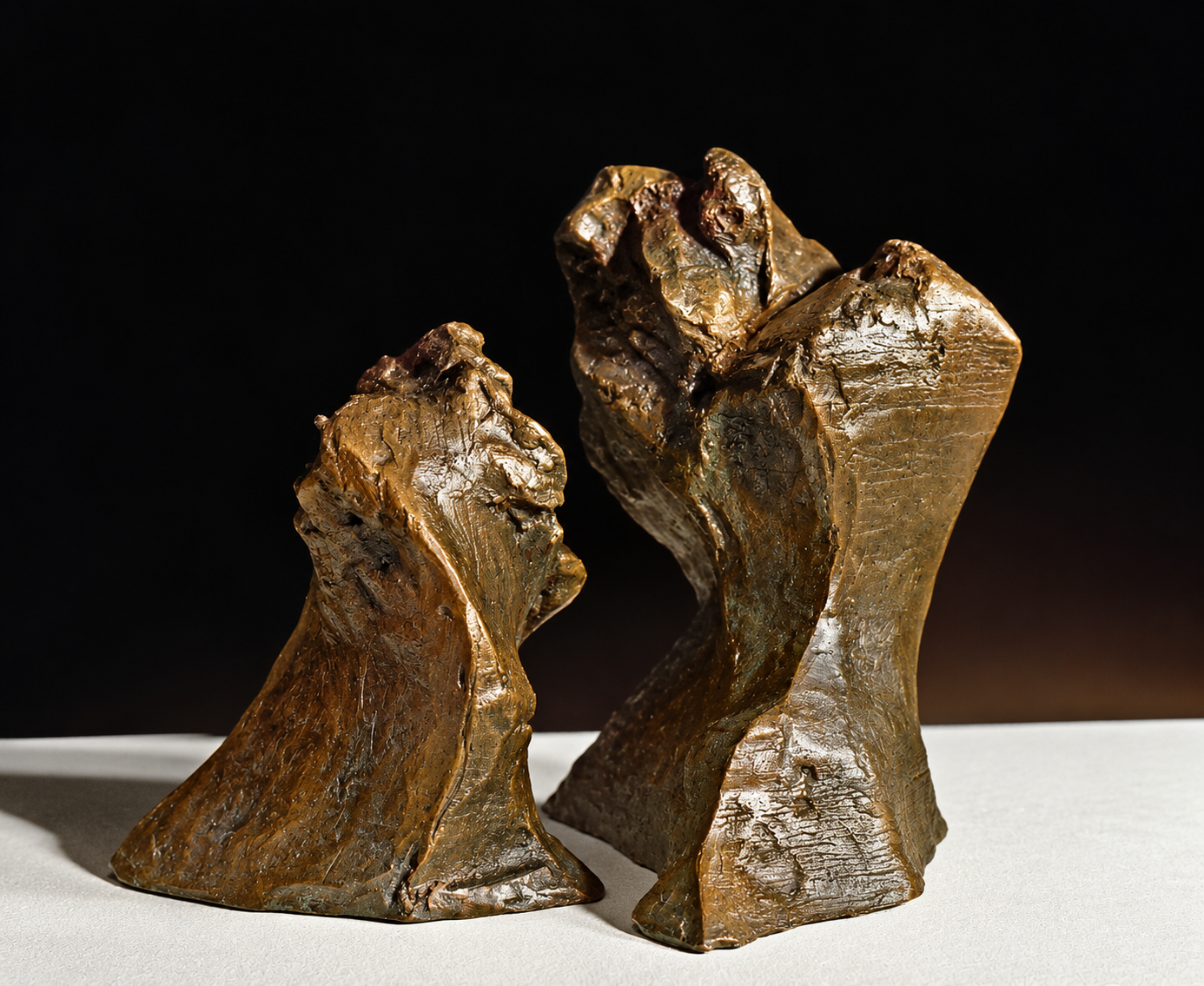
January 1973. Cast bronze. Dimensions: 20 × 18 × 16 in (51 × 46 × 41 cm). Collection of the artist.
Oppression, 1973
Oppression was my first bronze sculpture, created in 1973 while I was an undergraduate at Kent State University, and introduced me to the multi-step process of lost-wax casting. It was also one of my first works composed of two separate elements positioned so that the negative space between them becomes an active part of the sculpture. I would continue exploring this relationship between separate forms and the space they define in several marble sculptures from the same period.
The title grew from the relationship between the two abstract forms: the larger element seems to loom over and bear down upon the smaller, creating a sense of pressure, dominance, and psychological tension. Although completely abstract, their scale, positioning, and posture suggest a distinctly human relationship. Looking back, Oppression represents an early recognition of the communicative and expressive power of abstraction—that relationships between mass, space, scale, and gesture could convey an emotional idea without relying on literal representation.
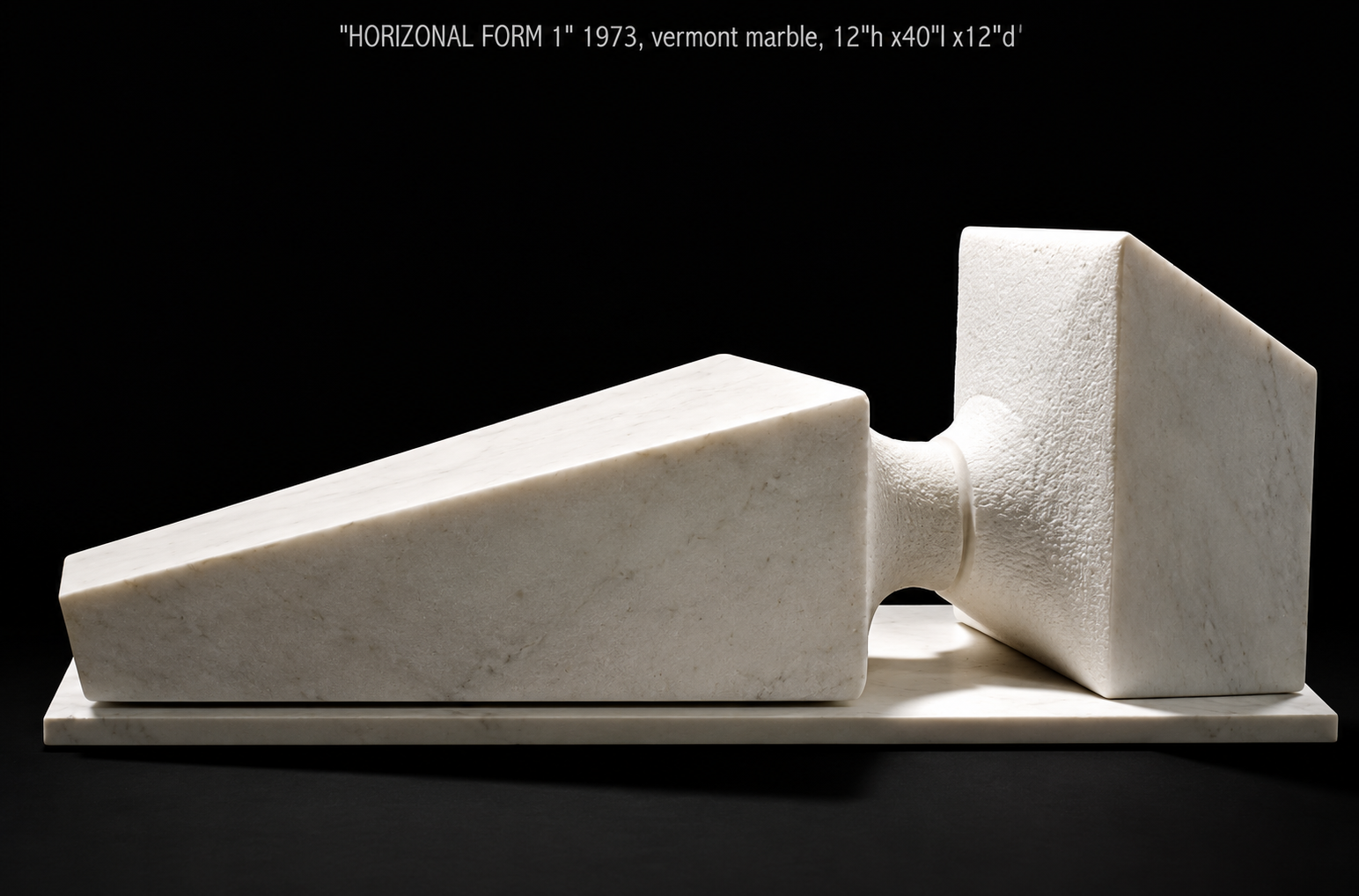
January 1973. Vermont marble. Dimensions: 12 × 42 × 12 in (30 × 107 × 30 cm).
Horizontal Form #1, 1973
Horizontal Form #1, created while I was an undergraduate at Kent State, shares many of the concerns found in my other marble sculptures from this period. Two geometric forms are placed in close relationship, creating a concentrated area of negative space between them. The contrasting carved surfaces and solid block-like masses reflect my early interest in the organic abstraction of Jean Arp and Henry Moore, as well as the reductive geometry and directness of Constantin Brancusi.
The work also reflects my growing awareness of the Minimalist aesthetic of the 1960s and ’70s prevalent around me at Kent State—an approach I later affectionately called “Midwest minimalism.” Rather than treating negative space simply as an absence, I was beginning to see the space between separate elements as an active sculptural form, creating visual tension and linking the individual masses into a unified whole.

January 1973. Marble. Dimensions: 30 × 12 × 12 in (76 × 30 × 30 cm).
Gaea, 1973
Gaea was my first carved marble sculpture, created in 1973 while I was an undergraduate at Kent State University. The title refers to Gaea, or Gaia, the ancient Greek personification of the Earth and primordial mother, who gave birth to Uranus and, with him, the Titans. Carved from Vermont marble, the sculpture reflects my early interest in the human figure, here reduced to a simplified, abstract female form whose swelling volume suggests pregnancy, fertility, and motherhood. The natural veining and weight of the marble reinforce this connection between the female body and the earth itself.
The work also marks an early use of mythology as a conceptual framework for sculpture—a way of connecting a personal idea or image to something larger and more universal. Rather than illustrating the myth literally, I used Gaea as a kind of scaffolding on which to build ideas about the body, birth, nature, and the generative power of the earth. Looking back, Gaea anticipates my continuing interest in mythology not as narrative, but as a means of giving contemporary and personal concerns a broader human resonance—an approach that would reappear many years later in works drawing upon figures such as Sisyphus and Amalthea.

January 1973. Marble. Dimensions: 37 × 35 × 12 in (94 × 89 × 30 cm). Private Collection.
Sea Stone, 1973
Sea Stone was my second carved marble sculpture, created while I was an undergraduate at Kent State University. The work reflects my early interest in the organic abstraction of Jean Arp, Constantin Brancusi, and Henry Moore, and their ability to create simplified forms that seem closely connected to nature. The opening activates negative space, giving the solid marble a sense of openness and allowing the surrounding space to become part of the sculpture.
The title grew from my fascination with stones I collected during summers in Kennebunkport, Maine, and the way water and sand gradually transformed them into smooth, rounded forms, revealing the crystalline character of the stone. In Sea Stone, I sought to evoke that natural process through carving and polishing—as though the form had been shaped by the forces of nature as much as by my own hand.
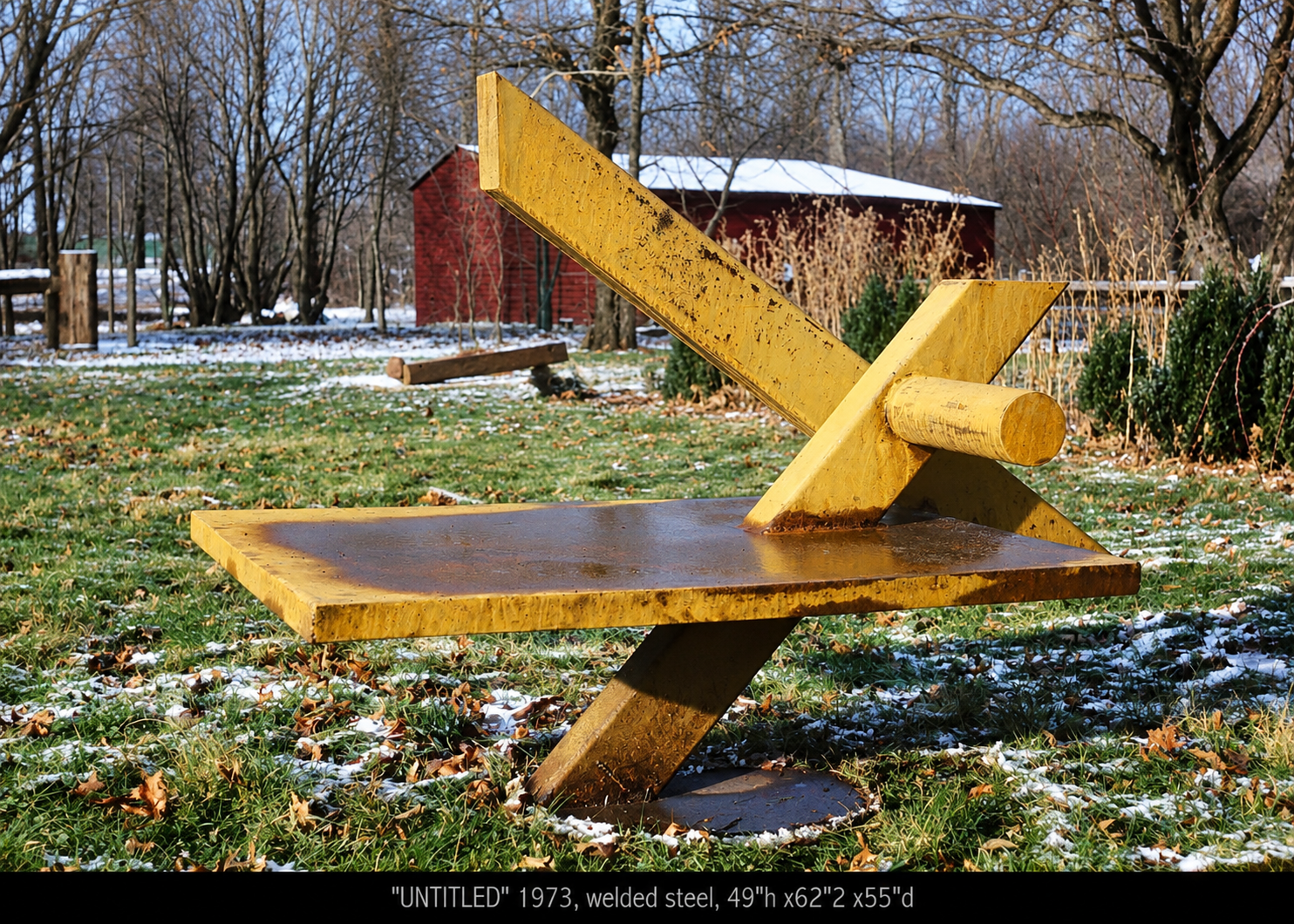
January 1973. Welded steel. Dimensions: 49 × 62 × 55 in (124 × 157 × 140 cm). Destroyed.
Untitled 73, 1973
Untitled 73 was created while I was an undergraduate at Kent State University and shares concerns with my sculpture Above and Below from the same year. A large horizontal steel plane is suspended several feet above the ground and pierced by a strong diagonal element, creating the sense that the sculpture extends through rather than simply occupies space. While not yet specifically addressing the gallery or frame as devices that define what we perceive as art, the work reflects my emerging interest in breaking and penetrating physical boundaries.
The sculpture is also an early example of my growing interest in the inherent structural and expressive qualities of steel. Rather than treating the material simply as a means of constructing form, I began to recognize how its strength, weight, rigidity, and ability to project through space could themselves generate sculptural meaning. Looking back, Untitled 73 points toward my later use of material, structure, gravity, and spatial extension as active elements in the work.

January 1973. Wood, Ohio Chestnut. Dimensions: 10 × 10 × 52 in (25 × 25 × 132 cm). Collection of the artist.
Horizontal Form #2, 1973
Horizontal Form #2 was created while I was an undergraduate at Kent State University and, like several works from this period, explores the visual tension and spatial relationship between distinct abstract forms. Rather than relying solely on the negative space separating individual elements, however, the two major geometric masses are physically joined by an expressively carved organic passage. The contrast between the long, restrained horizontal geometry and the concentrated, flowing forms at the center creates a dialogue between geometric order and organic movement, solid mass and open space.
The work reflects my growing awareness that sculpture could be shaped as much by the space moving through and around a form as by the material itself. The carved openings penetrate the central mass, while the organic contours seem to pull the two extended geometric elements together, concentrating the sculpture's visual energy at their point of connection. Looking back, Horizontal Form #2 represents an early exploration of mass and void, geometry and organic form, and the expressive possibilities created when contrasting sculptural elements are brought into a dynamic relationship—concerns that would continue to develop throughout my work.

January 1974. Marble. Dimensions: 36 × 30 × 20 in (91 × 76 × 51 cm). Private Collection.
Untitled (Kiss II) was created while I was an undergraduate at Kent State and reflects my early interest in Jean Arp, Henry Moore, and particularly Constantin Brancusi. It is the second in the series and pays homage to Brancusi’s The Kiss and his reduction of the embracing figures to two simplified, block-like forms. Here, two marble elements are brought closely together, activating and electrifying the negative space between them simulating and expressing the sexual attraction of the couple.
Like Brancusi, I retained much of the geometry of the original quarry block, allowing the rectangular mass of the stone to remain clearly present. At the same time, the work reflects my growing awareness of the Minimalist aesthetic of the 1960s and ’70s, particularly the reduced geometric sculpture being made around me at Kent State—an approach I later affectionately called “Midwest minimalism.” The piece represents an early merging of these influences: the sensual, carved forms of European modernism with the more austere geometry of contemporary American sculpture.

January 1974. Vermont marble. Dimensions: 48 × 12 × 12 in (122 × 30 × 30 cm).
Vertical Series #1, 1974
Vertical Series #1, carved while I was an undergraduate at Kent State, initiated a multi-year exploration of vertical form and the relationship between positive and negative space. The work reflects my early interest in the organic abstraction of Jean Arp and Henry Moore, and particularly Constantin Brancusi’s Bird in Space. Like Brancusi, I was interested in simplifying and elongating form to suggest upward movement, while allowing the inherent qualities of the marble to remain visible.
Another, more personal influence came from my longtime involvement with snow skiing and racing during my youth. The sculpture’s crisp edges and long, flowing contours recall the clean tracks of a well-carved turn through snow—a physical sensation of balance, speed, and controlled movement translated into stone. At the same time, leaving portions of the marble in their natural state reflects my developing awareness that the inherent character of the material itself could become an expressive part of the sculpture, an idea that would become increasingly important in my later work.
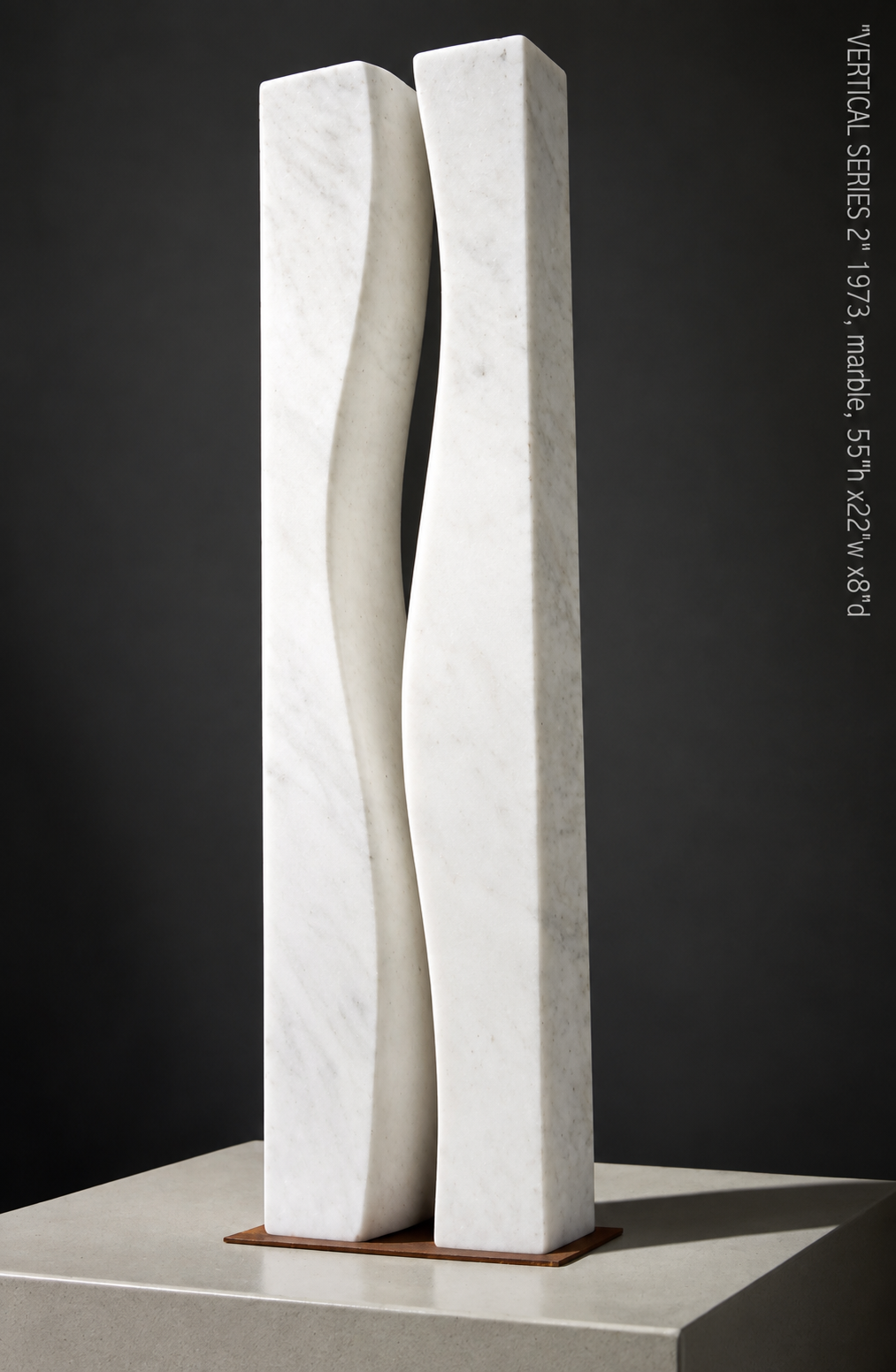
January 1974. Marble. Dimensions: 55 × 22 × 8 in (140 × 56 × 20 cm). Private Collection.
Vertical Series #2, 1974
Vertical Series #2 continues my early exploration of vertical form and the relationship between positive and negative space. Created while I was an undergraduate at Kent State, the work reflects the influence of Jean Arp, Henry Moore, and particularly Constantin Brancusi’s Bird in Space. Two elongated marble elements create a narrow, active space between them. Their flowing contours also recall my longtime involvement with skiing and racing—the clean tracks of a well-carved turn through snow and the sensations of balance, speed, and controlled movement.
I retained much of the geometry of the original quarry blocks, reflecting both Brancusi’s respect for the stone and my growing awareness of the Minimalist aesthetic of the 1960s and ’70s—an approach I later affectionately called “Midwest minimalism.” The work brings these influences together while developing an idea that would remain important in my sculpture: using the space between separate elements as an active sculptural form.

January 1974. Marble. Dimensions: @4”h x16”w x6”d Private collection.
Vertical Series #3, 1974
Vertical Series #3 continues my early exploration of vertical form and the relationship between positive and negative space. Created while I was an undergraduate at Kent State, the work reflects the influence of Jean Arp, Henry Moore, and particularly Constantin Brancusi’s Bird in Space. Two elongated marble elements create a narrow, active space between them. Their flowing contours also recall my longtime involvement with skiing and racing—the clean tracks of a well-carved turn through snow and the sensations of balance, speed, and controlled movement.
I retained much of the geometry of the original quarry blocks, reflecting both Brancusi’s respect for the stone and my growing awareness of the Minimalist aesthetic of the 1960s and ’70s that was prevalent at Kent —an approach I later affectionately called “Midwest minimalism.” The work brings these influences together while developing an idea that would remain important in my sculpture: using the space between separate elements as an active sculptural form.

January 1974. Marble, stainless. Dimensions: 68 × 18 × 12 in (173 × 46 × 30 cm). Private Collection.
Vertical Series #4, 1974
Vertical Series #4, the tallest work in the series, continues my early exploration of vertical form and the expressive relationship between positive and negative space. One of the last carved marble works created while I was an undergraduate at Kent State, the sculpture reflects the influence of early twentieth-century modernists Jean Arp, Henry Moore, and particularly Constantin Brancusi’s Bird in Space. Two slender marble elements rise in close parallel, creating a narrow vertical void that expands into a circular opening near the top, making the negative space as visually active as the stone itself.
I retained much of the geometry of the original quarry blocks, reflecting both Brancusi’s respect for the integrity of the stone and my growing awareness of the Minimalist aesthetic of the 1960s and ’70s prevalent at Kent State—an approach I later affectionately called “Midwest minimalism.” The work brings these influences together while advancing an idea that would remain central to my sculpture: using the space between separate elements not simply as emptiness, but as an active sculptural form.
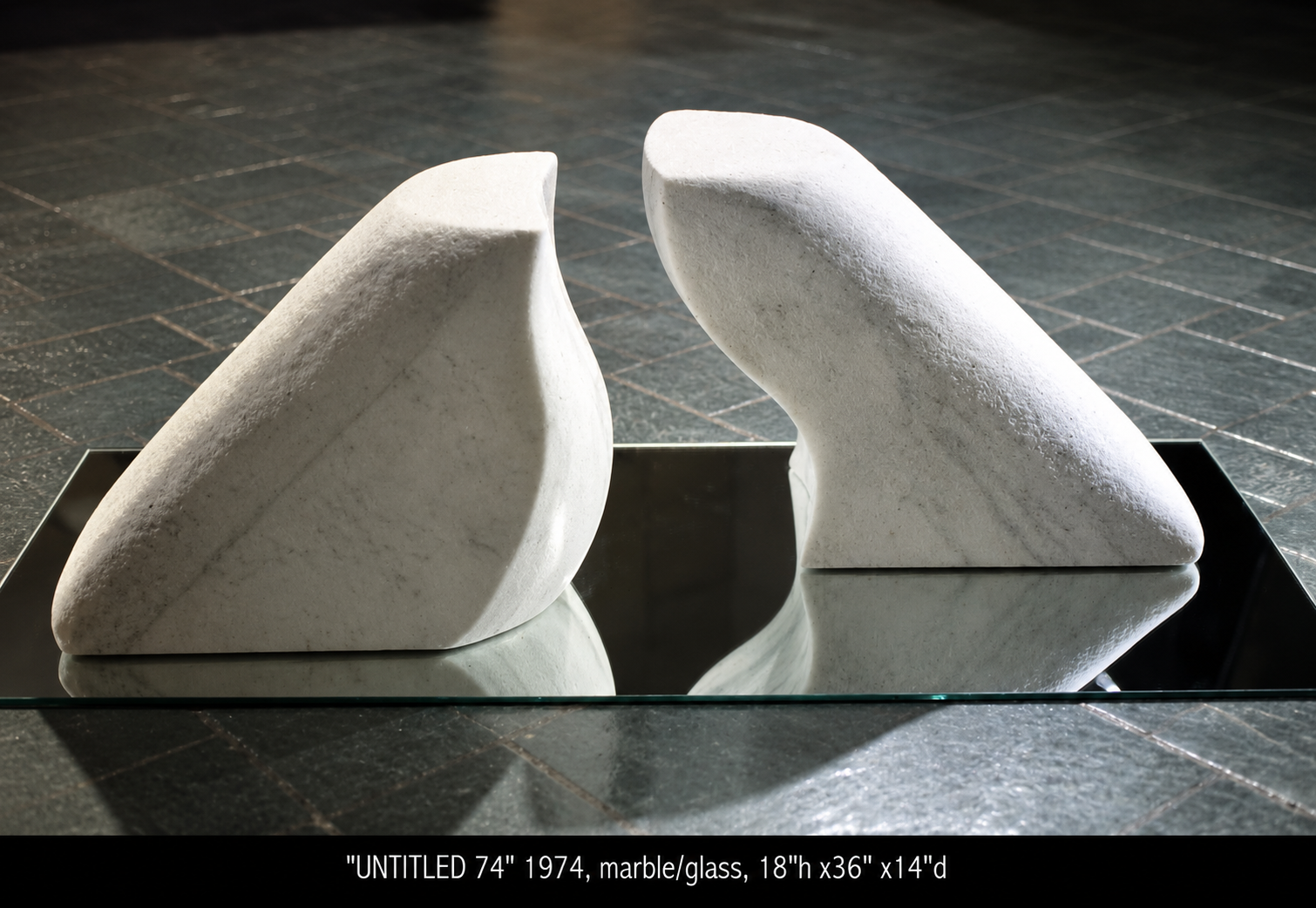
January 1974. Marble, mirror. Dimensions: 18 × 14 × 26 in (46 × 36 × 66 cm).
Untitled #4 (Vertical Series #4), 1974
Untitled #4 continues my early exploration of positive and negative space while I was an undergraduate at Kent State. The work reflects the influence of Jean Arp, Henry Moore, and particularly Constantin Brancusi, whose simplified forms and respect for the integrity of stone were important to me. Two carved marble elements are positioned in opposition, creating an active space between them. Placing the forms on a mirror extends and multiplies that relationship, making reflection—and the space surrounding the sculpture—part of the work itself.
Although lower and more horizontal than other works in the Vertical Series, its flowing contours and the channel of space between the forms also recall my longtime involvement with skiing and racing—the clean tracks of a well-carved turn through snow and the sensations of balance and controlled movement. By retaining much of the geometry and natural character of the original quarry blocks, the piece also reflects my growing awareness of the Minimalist aesthetic prevalent at Kent State—an approach I later affectionately called “Midwest minimalism.” The work represents another early step toward making the space between separate elements an active part of the sculpture.
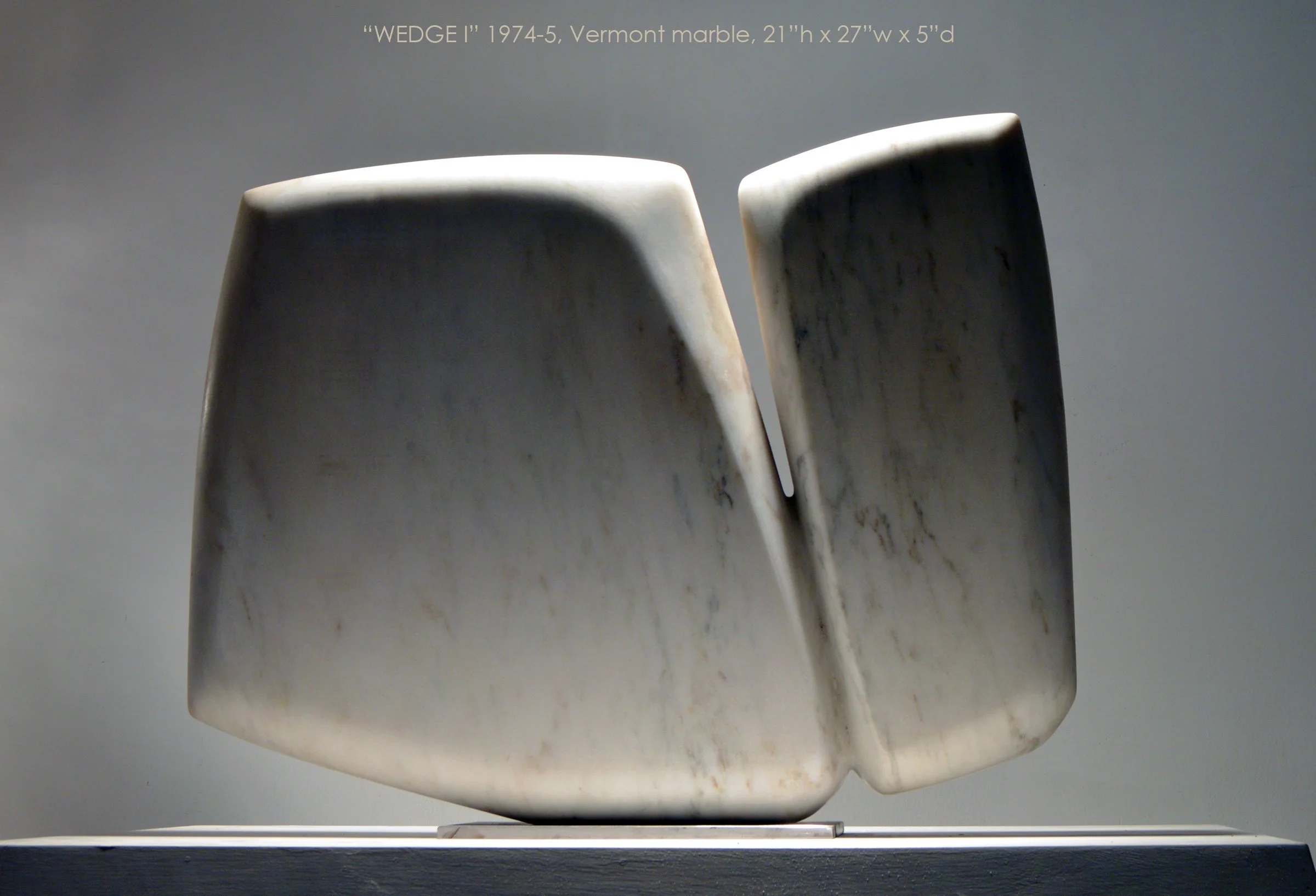
Wedge I (More Than the Sum of Its Parts), 1975, Vermont marble and stainless steel, 21"h x27"w x5"d. Private Collection.
Wedge I (More Than the Sum of Its Parts)
Wedge I was the first sculpture I created after beginning my MFA studies at Cornell and continued the minimally carved aesthetic I had begun at Kent State. The title grew from my original plan to place a carved walnut wedge between the two marble forms, creating the illusion that it was forcing them apart. The idea referenced an early stone-splitting technique in which wooden wedges were soaked with water, causing them to expand and exert pressure on the stone.
After several attempts, I abandoned the walnut wedge, encouraged by my dear friend and older, more seasoned sculptor Clara Seley, who compared the space between the marble forms to the cleavage between a woman’s breasts—beautiful and sensuous in itself—and felt that filling it with wood diminished its power.
Although I would soon go on to successfully combine different materials, I sought to do so in ways that allowed each material and its physical properties to speak more truthfully. This became an important step toward the material honesty and real physical forces that would soon become central to my tensegrity, or Brute Sculpture. The subtitle, More Than the Sum of Its Parts, came later and playfully acknowledges the expressive power created by bringing separate elements into relationship.

January 1975. Vermont marble. Dimensions: 22 × 16 × 4 in (56 × 41 × 10 cm). Private Collection.
Wedge II, 1975
Wedge II, my second carved sculpture at Cornell, is both an aesthetic and conceptual extension of Wedge I. Two minimally carved marble forms are brought into close relationship, creating a narrow, activated negative space between them. The softened geometry and restrained carving continue ideas developed at Kent State, while the separation of the two elements gives the sculpture a sense of tension, balance, and implied movement.
In retrospect, Wedge II stands very near the end of one phase of my work. It preceded Falling Stone (1975), which grew from the accidental breaking of a nearly completed carved marble sculpture in my Cornell studio. That event redirected my attention from carving predetermined forms toward working with broken and eventually found stone—allowing the material’s natural surfaces, weight, and physical forces to become active parts of the sculpture. Wedge II therefore occupies an important transitional position between my early carved marble works and the tensegrity, or Brute Sculpture, that would soon follow.

April 1975. Vermont marble, stainless steel. Dimensions: 24 × 24 × 18 in (61 × 61 × 46 cm).
In 1975, a nearly completed carved marble sculpture, similar to Wedge I, fell off my Cornell studio carving table and broke into pieces. After a period of consternation and disbelief, I finally regained enough composure to pick the shards off the floor. The crystals of the freshly broken surfaces, gleaming in the sunlight, caught my eye. Intrigued by the relationships I saw among the shapes, volumes, and contrasting surfaces—and trying to make the best of a bad situation—I began experimenting with the shards.
Falling Stones, initially conceived as an attempt to recapture the act of falling, consists of two “broken” elements lifted from the floor and pinned precariously to a steel plate. It was my first sculpture with dynamically positioned stone elements and the first to feature rough, natural “found” surfaces.
I didn’t fully realize it at the time, but this sculpture—and, more significantly, the “new” approach to making it—marked one of the most important hinge moments in my career. It set me on a new and dynamic course, freeing and choreographing this traditionally “earthbound” material.
The transformation came as a result of a disruptive event and an honest re-evaluation of the material and how I could best communicate with it.
JVA, 1999

January 1975. Rough hewn granite. Dimensions: 4 × 4 × 2 in (10 × 10 × 5 cm). Destroyed.
Stone Assemblage II, 1975
Stone Assemblage II, the second sculpture I made after Falling Stones, continues an important shift in my relationship with stone—from carving it in the traditional subtractive manner to using found stone as an additive, assemblage element. Discarded granite curbstones are accepted largely as found, retaining their rough surfaces, irregular edges, weathering, and quarry marks. These marks create what I later described as a kind of “quarry graphic,” revealing something of the stone’s history while adding a visual cadence to the work. The separate stones are joined with concealed steel pins, a transitional fastening method I would soon abandon in favor of exposing the structural forces and connections themselves—an idea that became central to the tensegrity or Brute Series that followed.
The sculpture also reflects my growing interest in the work of Isamu Noguchi and a Japanese sensibility toward stone—accepting and even celebrating the material for what it already is rather than imposing a predetermined form upon it. Here, the leaning slab, upright vertical, and long horizontal stone create a spare, gestural composition reminiscent of strokes in East Asian calligraphy. At the same time, the lintel-like upper stone introduces a strong sense of weight, balance, and architectural structure. Stone Assemblage II thus brings together several ideas that would become fundamental to my sculpture: found stone, assemblage, the expressive history of materials, and the dynamic relationship between mass, gesture, balance, and gravity.

August 1975. Granite. Dimensions: 54 × 32 × 18 in (137 × 81 × 46 cm). Destroyed.
Stone Assemblage I, 1975
Stone Assemblage I was the first sculpture I made after Falling Stones and marks an important next step in my changing relationship with stone. Rather than carving a single block in the traditional subtractive manner, I began using found stone as an additive, assemblage element—in this case discarded granite curbstones whose existing shapes, fractured surfaces, drill marks, and history became part of the sculpture. The stones are joined and aligned with concealed steel pins, allowing the separate elements to read as a single upright configuration. This fastening method was transitional; I would soon abandon hidden connections in favor of making the structural forces and means of assembly visibly—and physically—central to the tensegrity or Brute Series that followed.
The work also reflects my growing interest the work of Isamu Noguchi and an Eastern, particularly Japanese, sensibility toward stone—accepting the material largely as found and allowing its intrinsic character to “speak,” rather than imposing a predetermined form upon it. The stacked granite elements create a spare, gestural composition that suggests the strokes of East Asian brush calligraphy: the strong vertical mass is crossed by a broad horizontal element and animated by the angled stone above. In this sense, Stone Assemblage I represents an early convergence of ideas that would become fundamental to my work—the acceptance of found stone, assemblage as a method, and the search for a dynamic relationship among mass, gesture, balance, and gravity.

November 1975. Granite, wood, steel. Dimensions: 4 × 12 × 4 in (10 × 30 × 10 cm).
Untitled (Up and Over) was the last sculpture from this transitional period in which I used wood beams, and it brought my investigation of assemblage, exposed joinery, and the intrinsic character of materials to a critical point. Found granite, heavy timber, and forged steel are brought together in an extended, low architectural configuration. The long diagonal beam moves literally “up and over” the stone, while the forged-steel elements wrap around and connect the materials, openly revealing how the sculpture is assembled. Unlike the concealed connections of the earlier Stone Assemblages, the fastening system has become a prominent visual and structural element, creating a sense of movement while emphasizing the physical interaction of stone, wood, and steel.
In making this work, however, I realized that I was still not fully exploiting the structural capabilities of the materials—particularly steel. If the sculpture was fundamentally about assemblage and the nature of its materials, each element needed to do more than simply serve as a connector or support; its inherent physical properties needed to become essential to the structure itself. I therefore eliminated wood in the work that followed and began using interlocking forged-steel bars to harness and redirect the actual weight and gravitational energy of the stone. This realization led directly to Boundary (1976) and the tensegrity or Brute Series, where gravity, weight, tension, and compression became not how the sculpture stood, but central subjects of the work itself.
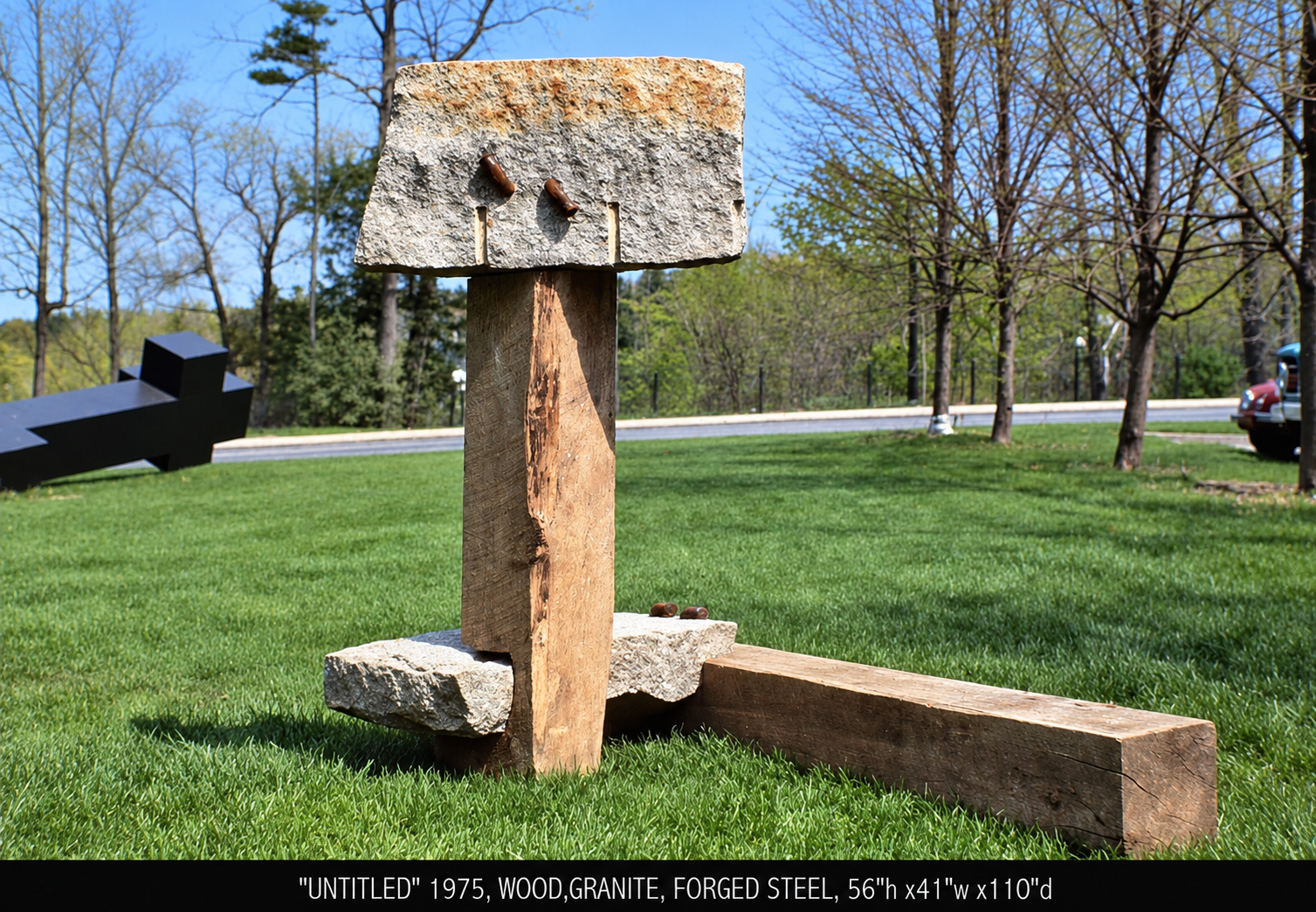
January 1975. Wood, granite, steel. Dimensions: 51 × 84 × 48 in (130 × 213 × 122 cm). (Destroyed)
Untitled (Bent Pins), 1975
Untitled (Bent Pins) followed Stone Assemblage I and II and represents another step in my move away from carving toward assemblage and a more architectural approach to sculpture. I was particularly interested in Japanese building traditions in which joinery and fastening are acknowledged rather than concealed, as well as the work of early 20th-century California architects Greene and Greene, whose Arts and Crafts architecture incorporated Asian-inspired joinery and exposed structural details.
In this sculpture, stone and timber are joined by oversized forged-steel pins that pierce the granite and are bent flat against its surface. Rather than hiding the connection, the fastening becomes an expressive part of the sculpture—the bent pins create a strong directional graphic while clearly revealing how the work is put together.
The bent-pin idea grew from something I had observed along the Maine coast near Kennebunkport, where I spent seven summers: old iron and steel pins embedded in granite, bent and worn through years of use and exposure. Incorporating that memory reinforced my evolving interest in material, structure, gravity, and the physical act of assembly. In retrospect, Untitled (Bent Pins) is an important transitional work—the hidden pins of the preceding Stone Assemblages have become emphatically visible, anticipating the more direct and structurally explicit connections of the tensegrity or Brute Series that soon followed.

April 1975. Marble. Dimensions: 42 × 24 × 6 in (107 × 61 × 15 cm).
Monolithic Monument, 1975
Monolithic Monument followed the Wedge Series and was among my last traditionally carved marble sculptures before a studio accident at Cornell dramatically changed the direction of my work. Reduced to a single upright planar form with softly rounded edges, the sculpture carries the “Midwest minimalism” I had begun exploring at Kent State to perhaps its purest expression. Carving is held to a minimum, allowing the simple geometry, scale, and striking natural veining of the marble to become the primary expressive elements.
In retrospect, the work stands at an important threshold. Soon afterward, a nearly completed planar marble sculpture fell from my carving table at Cornell and shattered. Two of those fragments became Falling Stone (1975), my first sculpture to dynamically position broken stone with steel and a pivotal work in my development. That accident shifted my attention away from imposing a predetermined form through carving and toward accepting the stone’s inherent shape, surface, weight, and physical energy—ideas that would soon become central to my Brute and Nature of Stone works.

January 1975. Granite. Dimensions: 4 × 12 × 12 in (10 × 30 × 30 cm).
Stone Circle is an experimental work from the period immediately following Falling Stones, when I had begun to accept stone as a found object and an additive sculptural element rather than something that necessarily had to be carved. Discarded granite curbstones are placed in a circular progression, some partially buried while others gradually emerge, rise, and tilt like a sequence of falling—or rising—dominoes. The work develops ideas I had already explored in Above and Below and the Gallery Drawing Series, where I questioned the conventional boundaries of sculpture by treating the gallery wall and floor as active elements in the work. Here those concerns move outdoors: the ground itself becomes part of the sculpture, with the stones passing into and out of it and the circular configuration extending the composition across the landscape.
At the same time, Stone Circle reflects my discovery of and growing fascination with ancient stone circles and standing stones, where individual stones gain meaning through their placement in relation to one another, the surrounding landscape, and the viewer position. At this point the reference was exploratory rather than specifically astronomical, but it introduced ideas of circle, placement, orientation, time, and place that remained with me. These interests eventually developed on a much larger scale in public works incorporating solar and calendrical relationships, including Solstice Calendar and Via Solaris. In retrospect, Stone Circle brings together two important strands in my developing work: the activation of the surrounding space and ground, and the expressive placement of found stone within the landscape

January 1975. Wood, granite, steel. Dimensions: 46 × 56 × 110 in (117 × 142 × 279 cm).
Gate, 1975
Gate continues the transition begun with Stone Assemblage I, II, and Untitled (Bent Pins), as I moved away from carving toward assemblage and a more architectural approach to sculpture. Inspired by an actual farm gate I had observed, the work combines found granite with heavy timbers and forged steel, allowing each material to retain its own character and history. The long horizontal beam, balanced across the upright stone, gives the sculpture an extended architectural presence and suggests the post-and-lintel construction of a gate or entrance. The forged-steel straps and fasteners are deliberately visible, continuing my growing interest in making the means of connection and assembly part of the visual language of the sculpture.
Looking back, Gate occupies an important position between these early wood-and-stone assemblages and the tensegrity or Brute Series that followed in 1976. I was beginning to recognize that if a sculpture was fundamentally about assemblage and the intrinsic nature of materials, its structure should not merely connect the elements but become an active part of the work. I would soon eliminate the wood and rely more fully on forged steel and the weight of the stone itself. In Gate, that transition is still unfolding: stone, wood, and steel each perform a distinct role, while balance, gravity, connection, and the physical act of assembly increasingly become the sculpture’s subject.
October 1980. Sandstone, steel. Dimensions: 12 × 36 × 60 in (30 × 91 × 152 cm).
The Arch Series of the late 1970s and early 1980s evolved from my earlier tensegrity, or Brute Series, in which gravity and the physical pressure of massive stones provide the energy—or “glue”—that holds the sculpture together without welding. In these works, weight is not simply a burden to be supported but an active structural force. Stone and steel press against and respond to one another, creating a state of tension, compression, and equilibrium.
In the Arch Series, this principle developed into low, arching configurations in which heavy stone elements appear to rise from the ground while remaining firmly subject to gravity. The arch became both a structural device and a metaphor—suggesting support, passage, shelter, and the transformation of downward gravitational force into lateral tension. The works explore a recurring concern in my sculpture: how seemingly opposing forces—weight and lift, mass and movement, tension and stability—can be brought into a precarious but resolved balance.